




Abstract
How does development aid shape democracy after civil conflicts? I argue that political aid conditionalities and the economic utility that recipient elites gain from office give rise to a rent-seeking/democracy dilemma: recipients can initiate democratic reforms but also risk uncertainty over office and rents. Or they can refuse to implement such reforms, but risk losing aid rents if donors reduce aid flows in response to failed democratic reforms. This dilemma is strongest in power-sharing cabinets. By granting rebel groups temporally limited access to the state budget, such cabinets intensify elites’ rent-seeking motives. Thus, aid-dependent power-sharing elites will hold cleaner elections, but also limit judicial independence and increase particularistic spending to simultaneously reap aid benefits and remain in power. I find statistical support for this argument using data on aid flows and power-sharing governments for all post-conflict states between 1990 and 2010.
Introduction
How does development aid shape democracy after civil conflicts? In 2010, donors committed US$50 billion in development assistance—38% of all aid transfers in that year—to conflict-affected or fragile countries (OECD, 2013: 43). Despite these attempts, however, democratic outcomes after war vary widely across the globe. While the post-conflict elections in Liberia in 2005, for instance, brought Africa’s first female head of state, Ellen Johnson-Sirleaf, to power, the end of the Rwandan civil war did not lead to similar democratic progress. Instead, the end of the Rwandan civil war entrenched the authoritarian tendencies in the country—despite the similarly enormous amounts of foreign aid both countries received. What explains this discrepancy between post-conflict aid investments and democratic outcomes?
Despite a burgeoning literature on this question, our understanding of post-conflict democratization remains limited. Scholars have mostly focused on how institutional solutions to post-conflict commitment problems shape the prospects for successful post-conflict elections (Hartzell and Hoddie, 2015; Joshi, 2010; Zürcher et al., 2013). Yet little research has explored how the choice to hold elections interacts with elite decisions to reform other institutions. Moreover, while elites’ economic motives feature prominently in general theories of democratic transitions (Acemoglu and Robinson, 2006), few studies explicitly model how elites’ economic motives affect democracy in post-conflict settings. 1 This focus on economic motives is particularly relevant if we shift our attention to foreign aid, a major source of income for post-conflict elites.
To address these gaps, this article studies post-conflict democratization through the lens of political economy theory. A key feature of this approach is that it generates predictions for the joint effect of post-conflict institutions and foreign aid on post-conflict democracy, rather than for institutions or aid individually. Specifically, I argue that the economic utility obtained from political office together with donors’ political aid conditionalities give rise to a rent-seeking/democracy dilemma for post-conflict elites: elites can either hold elections and face uncertainty over their access to power—while also securing economic rents from continued aid flows—or they can refuse to implement democratic reforms, but risk losing aid revenues and derailing the peace process when donors withdraw aid in response to violations of their political conditions. In this situation, elites’ optimal course of action corresponds to an electoral authoritarian strategy (Hyde, 2011): elites agree to democratic reforms in the policy area on which donors place the most value—election quality. However, to maximize their chances of electoral victory—and thus secure access to rents from office—elites simultaneously restrain an independent rule of law and narrowly distribute public goods to their supporters.
The rent-seeking/democracy dilemma is particularly prevalent in one of the most popular forms of post-conflict institutions: power-sharing governments (Binningsbø, 2013; Hartzell and Hoddie, 2007; Ottmann and Vüllers, 2015). In power-sharing governments, aid can function as an economic commitment device that links the survival of the peace deal to continued external funding. Moreover, including rebel elites in post-conflict cabinets increases the number of actors and their constituencies that need to be sustained from a limited government budget, amplifying the rent-seeking incentives of participating elites. In addition, the interim nature of transitional power-sharing cabinets causes elites to steeply discount the future and increase rent-seeking in the short term. As a result, the aggregate level of rent-seeking in power-sharing governments is stronger than in other types of post-conflict governments—and power-sharing governments are thus more susceptible to donor demands for democratization. My main hypothesis is that large aid flows from democratic donors to extensive power-sharing governments should be associated not only with improved election quality, but also with limits to the rule of law and greater provision of private rather than public goods.
To test this prediction, I combine data on aid flows and rebel participation in post-conflict cabinets between 1990 and 2010 with indicators for democratic development, election quality, rule of law, and public goods provision. Results from a wide range of regression models provide empirical support for a rent-seeking/democracy dilemma: power-sharing and foreign aid jointly predict a positive, but small change in democracy scores as well as cleaner elections. At the same time, they are jointly associated with limited rule of law and stronger tendencies toward particularistic rather than public spending.
This article makes a number of contributions to the literature on post-conflict institutions and democracy. First, it demonstrates the usefulness of moving away from a singular focus on elections when studying post-conflict democratization. A central question in existing work has been the conditions under which belligerent parties agree to trade violence for votes (Brancati and Snyder, 2011, 2013; Flores and Nooruddin, 2012; Hartzell and Hoddie, 2015; Wantchekon, 2004). Less attention has been directed at the quality of elections and the institutional composition of post-conflict democratization beyond elections. In contrast, I show that elites’ decision to organize clean elections is strategically linked to their (un-)willingness to reform other institutional features of democracy, such as the rule of law or clientelistic practices in the presence of external demands of democratization. 2 A similar strategic link between clean elections and simultaneous restrictions in other areas has been found in broader comparative politics literature (Hyde, 2011)—yet I am able to show that this dilemma also exists in post-conflict countries and that it is particularly pronounced in one of the most frequent types of post-conflict institutions: transitional power-sharing governments.
My results also advance the broader scholarship on democratic development. I show that post-conflict democratization echoes certain features of non-conflict democratic transitions, such as the role of elections in authoritarian regimes (Gandhi and Lust-Okar, 2009). Thus, my findings emphasize one so far little appreciated source of electoral authoritarianism: the presence of rebel elites in transitional power-sharing governments and their heterogeneous response to external political demands.
Moreover, I introduce a novel political economy perspective into the literature on power-sharing. In contrast to the existing literature, which mainly focuses on the political and security functions of power-sharing institutions, I emphasize the economic functions of these institutions as resource-generating instruments for elites (Gates et al., 2016; Hartzell and Hoddie, 2007; Walter, 2002). While economic motives do enter the power-sharing literature through the notion of “economic power-sharing,” 3 focusing on actual wealth-sharing arrangements is short-sighted. In many post-conflict societies, the state—and thus any political office than allows access to state resources—is the primary source of economic income for those who control it (Bates, 2008). Modeling the state as a source of rent income—and power-sharing cabinets as a means to access these resources—thus helps us to better understand how power-sharing shapes the political and economic “adoption costs” of post-conflict democratization (Zürcher et al., 2013).
Finally, my findings help to clarify an important scholarly and policy debate on the effects of foreign aid on institutional quality. Existing aid scholarship has largely approached this phenomenon without disaggregating the particular context in which aid is deployed (Djankov et al., 2008). This has led to a large number of diverging arguments about the positive and negative effects of aid on democracy (Wright, 2010). I show that the post-conflict context, and particularly the presence of a power-sharing government, moderates the aid–democracy relationship—a context that has been largely ignored in the quantitative aid literature. 4 Thus, my results add nuance to the strand of this literature that highlights the moderating effect of domestic institutions on the political effects of aid (Bader and Faust, 2014).
How power-sharing and foreign aid shape post-conflict democratization
My theoretical explanation of how power-sharing executives and foreign aid affect post-conflict democratization builds on three core assumptions. First, rebel and government elites are assumed to be rational, self-interested, office-seeking, and crucially, rent-seeking actors. Second, donors attach a minimum of political conditions to their aid projects in post-conflict settings. And third, rebel and government elites’ rent-seeking preferences are most pronounced in post-conflict power-sharing governments.
Rent-seeking and the post-conflict state
That political leaders seek to retain political power is an established assumption in comparative politics research (Bueno de Mesquita et al., 2003). As such it has found entry in the study of post-conflict politics as well (Joshi and Mason, 2011). Less well established is the assumption that post-conflict leaders also seek to gain economic rents. This preference for economic rents is closely linked to political leaders’ office-seeking motives: economic resources—in the form of direct money transfers to their political supporters, but also in the form of indirect resource transfers such as preferential treatment with public services, jobs, and government grants—enable political elites to buy political loyalty from their supporters and thus provide them with an instrument to secure power (Bueno de Mesquita et al., 2003).
Political office allows post-conflict elites to access rents from the state. In many developing countries, the state is a major source of economic income for elites and their constituency groups—and this holds particularly true for post-conflict countries where a conflict has devastated the economy and jobs in the private sector are rare. In this setting, the state (or what is left of it) is the main recipient of development and humanitarian aid, controls access to natural resource rents, and collects taxes—to the extent that a tax collection infrastructure exists (Bräutigam, 2008). A baseline implication from this assumption is that rent- and office-seeking post-conflict elites should prefer not to implement democratic reforms. Democratization jeopardizes elites’ grip on power and thus their access to rents from office by introducing uncertainty over political office through elections and judicial oversight.
Political aid conditionalities
The term political aid conditionalities refers to “the allocation and use of financial resources to sanction or reward recipients in order to promote democratic governance and human rights” (Molenaers et al., 2015b: 62). The increasing popularity of political conditionalities emerged from insights in academia and practice that the effectiveness of foreign aid was conditional on the quality of governance in the recipient country (Burnside and Dollar, 2004; Molenaers et al., 2015a). As a result, political conditionality is a widespread practice, particularly among European and North American donors.
Donors also employ political aid conditionalities in post-conflict settings. Labeled “peace conditionalities,” they are often linked to outcomes specific to the peace process, such as disarmament of rebel factions, adherence to the terms of a peace deal, and particularly post-conflict elections (Boyce, 2002; Paris, 2004). Donors typically use such conditionalities to uphold stability, with political conditions often taking a back seat. This does not mean that political conditions do not matter. On the contrary, the strategic goal of fostering liberal democratic forms of government is hard-wired into the peacebuilding strategies of almost all bilateral and multilateral aid agencies (Barnett et al., 2007). Thus, political conditions in post-conflict settings often take the form of “rewards” for reaching certain milestones, or of implicit threats of aid withdrawals should governance goals not be implemented. These milestones are typically elections: in over 90% of the post-conflict cases in my sample elections were held within the first five years after the end of the conflict. In addition to the normative value many donors place on elections, an institutional and bureaucratic logic reinforces this focus. Explaining the puzzling priority of donors pushing for elections in volatile situations, Swedlund writes that “for development practitioners to do their job they need a legitimate, stable partner with whom they can engage. In transition periods, this is lacking. Therefore, donor officials are keen to move as quickly as possible out of the transition period” (Swedlund, 2015: n.p.). We see this preference for elections play out in individual post-conflict cases: in the run-up to the 1994 elections in Mozambique, for instance, donors explicitly made the continuation of their financial support conditional on an inclusive electoral law that was to be signed by the former conflict parties (Manning and Malbrough, 2010: 161).
The more a government is dependent on aid as a source of government income, the more aid reductions in response to human rights violations hurt the recipient’s budget. 5 In Burundi, for instance, the European Union institutions and Belgium—among the largest donors in the country—swiftly suspended aid after the regime’s violent crackdown on pre-election protests in May 2015 (Nduwimana, 2015). The Burundian case is exemplary of a broader pattern of political conditionalities and aid dependency in post-conflict countries. In post-conflict countries, aid typically makes up an enormous share of the state budget—or vastly exceeds it. If we rank all lower-income and lower-middle-income countries (country-years between 1989 and 2010, specifically) according to the ratio of aid to government expenditures, among the top 10 country-years, only one has not been affected by conflict: Micronesia. The remaining nine spots are taken up by the DRC, Liberia, Palestine, and Nicaragua with aid to government expenditure ratios of up to a staggering 1000%. Where aid makes up such a large part of the post-conflict state’s government budget, donors’ leverage to extract political concessions from the recipient state increases.
Office- and rent-seeking elites who are subject to political conditionalities therefore face a “rent-seeking/democracy” dilemma involving two opposing courses of action. One option for elites is to engage in democratic reforms, such as improvements of election quality, judicial control of the executive or impartial provision of public goods. This means they can enjoy continued access to aid rents, but face the possibility of being removed from office through elections—which, in turn, jeopardizes their access to rents. The other option is to refuse to implement democratic reforms. In so doing, however, elites risk losing aid rents via aid reductions or even withdrawals in response to violations of donors’ political demands.
A second baseline expectation that follows from this logic is that elites will resort to a “second best” option that satisfies both demands: they will initiate democratic reforms, but will implement them in a limited way that maximizes their chances of remaining in power, even despite democratic reforms.
The political economy of power-sharing governments
This “second-best” solution to the rent-seeking/democracy dilemma is unlikely to be the same across post-conflict countries. Instead, it should vary with the aggregated level of rent-seeking in a country. In a post-conflict environment, this overall level of rent-seeking is largely determined by the institutional environment that is established after an internal conflict has ended. Specifically, the effect of foreign aid—and thus the implications of the rent-seeking/democracy dilemma—is strongest in the context of post-conflict power-sharing governments.
Power-sharing is defined as “rules that, in addition to defining how decisions will be made by groups within the polity, allocate decision-making rights, including access to state resources, among collectivities competing for power” (Hartzell and Hoddie, 2003: 320). I follow this definition, but focus specifically on transitional power-sharing governments, instead of other, potentially more permanent types of power-sharing, such as military, economic, or territorial (Hartzell and Hoddie, 2003). Power-sharing governments are characterized by the explicit inclusion of former insurgents in a post-conflict power-sharing cabinet. The reason for this focus on cabinet-level power-sharing is that power-sharing governments enable rebel groups to directly access state resources—and thus enable formerly excluded rebel elites to generate “wealth through power” (Bates, 2008: 43), including the access to aid resources. It is this rent-generation function and access to aid which makes power-sharing governments particularly relevant for studying the aid-induced rent-seeking/democracy dilemma. In contrast to other types of post-conflict governments, power-sharing governments increase the level of domestic rent-seeking for at least three reasons.
First, a power-sharing government gives elites the opportunity to generate income from aid by upholding the peace deal. This process of generating rents through elite coalitions echoes the mechanism of historical state consolidation in which elites form coalitions as economic commitment devices (North et al., 2009). In these situations, conflict lowers elites’ rent income, while peace increases their rent income. This creates economic incentives to uphold the peace. Such an argument directly applies to political conditionalities and power-sharing coalitions regulated by peace deals: here it is not only the threat of violence that induces cooperation, but also the threat of reduced aid income if power-sharing elites do not comply with donor demands for democratization. While this mechanism pertains to all conflicts that end with a peace deal, not only those that also include rebels in transitional governments, it increases rent-seeking, particularly in conjunction with the following two power-sharing-specific mechanisms.
Second, transitional power-sharing cabinets, as opposed to other types of post-conflict governments, introduce a limited time horizon for elites. As power-sharing governments are typically temporally limited, so is the time in office for participating elites. This temporal limitation is a function of sunset clauses that explicitly regulate the duration of the interim government, such as in the Democratic Republic of Congo’s 2003 Sun City Agreement which called for the election of a new government after a 24-month interim period (Schmidt and Galyan, 2016: 112). Even if no explicit sunset clauses exist, elites—particularly rebel elites who transitioned from guerilla warfare to government office—cannot be sure that the peace agreement will hold: while the power-sharing government might increase the chances it will (Hartzell and Hoddie, 2003), an uncertainty remains which causes elites to discount the future. Office holders with a limited time horizon face a greater risk of moral hazard, because they cannot be certain of being compensated after they lose office—which, given a limited time horizon, they expect to happen sooner rather than later (Levi, 1989). Facing such a limited time horizon, parties to the power-sharing agreement have greater economic incentives to become what Olson has labeled “roving bandits”: “when an autocrat has no reason to consider the future output of the society at all, his incentives are those of a roving bandit and that is what he becomes” (Olson, 1993: 571).
Third, power-sharing governments intensify rent-seeking by expanding the number of actors with access to a limited government budget and their constituencies, which need to be sustained from the same budget. The new elites—particularly former rebels propelled into government offices that provide higher living standards than guerilla camps in the bush—simply want to enjoy spoils from the peace, increasing competition among elites over resources, and thus rent-seeking. Moreover, these elites have to satisfy their constituencies: in addition to the government constituencies that existed prior to the power-sharing arrangement, there are now also the rebel constituents, such as ethnic supporters, former combatants, and close political allies, whom elites must target in order to remain in power.
This might seem paradoxical at first: a greater overall constituency base through the inclusion of formerly excluded rebel elites and their constituents should, at first glance, increase the societal winning coalition as a proportion of the selectorate—which suggests a greater provision of public goods instead of private goods (Bueno de Mesquita et al., 2003). Yet the argument that links more constituencies to more public goods rests on a number of context conditions—conditions which are rarely met in post-conflict and power-sharing contexts. First, Cao and Ward (2015) show that the state must have sufficient capacity to implement public goods—which is rarely the case in war-torn states, however. Second, in the context of deep-seated intergroup cleavages—such as in post-civil war contexts—politicians will rarely expand their winning coalition to members of the opposing group because of deep-running mistrust (Habyarimana et al., 2007). Moreover, even in contexts where these conditions are met, coalition governments can increase overspending: research on government spending in Western coalition governments has found that individual ministers may tap into the budget to target spending to their constituents. Yet these ministers individually rarely have to bear the full costs of these spending decisions themselves; costs are distributed over the entire government and into the future (Velasco, 2000). As a consequence, competition over a limited budget reinforces rent-seeking, since all parties seek to internalize benefits for their constituencies while externalizing the costs.
On their own, i.e. without high foreign aid income and political conditionalities, these mechanisms do not necessarily imply a worsening rent-seeking/democracy dilemma. Expanding the number of constituencies that need to be sustained from the government budget, for instance, might lead to improved democratic governance, by holding more political elites accountable to their actions. Indeed, the literature points to a moderate effect of power-sharing on post-conflict democratization on its own, on average (Hartzell and Hoddie, 2015).
However, as aid dependency increases, an “aid curse” occurs, in which rulers become less responsive toward their citizens as they are less reliant on citizens’ taxes for income (Djankov et al., 2008). That means that the third mechanism becomes more about targeting revenue toward narrow patronage circles instead of toward power-sharing elites’ broader constituent base. Moreover, regarding the second mechanism, holding political office in such an aid-dependent government amplifies the short-term rent-seeking effect of limited time in office, as is the case in power-sharing governments, as the loss of office becomes economically much more costly. Finally, related to the first mechanism, upholding the peace deal becomes much more lucrative as more aid becomes available.
As a consequence, we should observe “good enough” or limited democratization, particularly in the context of power-sharing governments that receive large amounts of development assistance.
Auxiliary hypotheses
While this hypothesis formulates an initial observable implication of the rent-seeking/democracy dilemma, it remains imprecise regarding how the proposed “limited” democratic reforms look in practice. To remedy this problem and to trace the mechanisms through which this effect runs, I consider this effect in three dimensions of political order: accountable government, represented by election quality; institutional limits to political power through the rule of law; and an effective state, represented by the impartial provision of public goods. These three dimensions correspond to Fukuyama’s concept of political order (Fukuyama, 2011: 15ff.). They are conceptually useful dimensions of governance, because they cover a broader range than most narrow definitions of democracy that focus mostly on accountability and/or rule of law. These three dimensions also represent the input, process, and output elements of a political system, taking into account the linkages between the simultaneous processes of statebuilding and democratization that take place in many post-conflict societies.
Moreover, these dimensions help to clarify what I mean by the term “democratization,” namely the process of initiating reforms that improve each of these three dimensions toward a more democratic ideal: more free and fair elections, a stronger rule of law, and impartial provision of public goods.
Election quality
Large aid inflows to power-sharing governments should be associated with higher post-conflict election quality. 6 Donors often put pressure on post-conflict governments for early post-conflict elections and often accompany this pressure with large amounts of election assistance (Brancati and Snyder, 2011; Flores and Nooruddin, 2016). For many donors, elections provide a clearly visible goal in the peacebuilding process. They are a signpost that serves not only as a potential end or starting point for external engagement, but also as a foundation of the peace process in the eyes of many donors and the post-conflict parties (Jarstad and Sisk, 2008).
If this external pressure—together with the resources attached to it—confronts the rent-seeking motives of post-conflict elites in power-sharing governments, the most rational course of action for elites is to comply with donor demands for clean elections. Even though elections introduce uncertainty over elites’ firm hold on political power, refusing to hold elections—or overtly manipulating elections—is simply too costly economically. Particularly when elections end the transitional period of power-sharing governments and participation in government is not guaranteed, rebels and government elites need external resources to campaign for votes. 7 This does not imply, however, that donor-supported post-conflict elections in the context of power-sharing governments will be spotless. Instead, elites likely give aid donors, what Marina Ottaway has aptly labeled “an election barely clean enough to receive a low passing grade, but dirty enough to make it difficult for the opposition to win” (Ottaway, 1993: 3). Nevertheless, a positive effect on election quality should be visible.
Rule of law
In contrast, more foreign aid to power-sharing governments should be associated with a weaker post-conflict rule of law. Limiting the extent to which a de facto independent judiciary can control political elites is an effective strategy for securing political power when elites face uncertainty over political office and rents because of elections (Linzer and Staton, 2015).
This strategy is particularly useful in the context of transitional power-sharing governments. If government office is a particularly profitable source of economic rents for political elites—as it is for elites in a power-sharing cabinet—an independent judiciary threatens discretionary access to state resources. What is more, powerful judges might prevent elites from winning elections, for instance through unfavorable rulings in the case of close election outcomes. In this situation, an independent judiciary functions less as a form of “future insurance policy” (Finkel, 2008; Haggard and Tiede, 2014) and more as an obstacle to reaping the economic benefits of political power.
Elites in power-sharing governments do not have to cooperate closely to limit judicial independence, however. This would be an unrealistic assumption for former battlefield opponents who do not trust each other, but find themselves in the same government cabinet. In this situation, simply failing to cooperate to implement rule of law reforms, and thereby upholding a weak rule of law status quo, is often sufficiently in everyone’s political interest.
Public goods
The particularistic provision of goods to core political supporters constitutes a second strategy with which post-conflict elites can increase their chances of staying in power. The key insight from distributive politics research in non-conflict settings is that “incumbent politicians are rewarded by voters for distributive allocations, and in particular for those that are clientelistic and from which recipients can be excluded” (Golden and Min, 2013: 12). This insight particularly applies in the context of power-sharing governments, for at least two reasons.
First, a persistent security dilemma between former belligerents and their constituencies does not create incentives to provide public goods that benefit all citizens, including the opponent’s constituency. Svensson reports that “foreign aid and windfalls are associated with increased corruption in countries more likely to suffer from competing social groups” (Svensson, 2000: 457). Post-conflict societies are, almost by definition, riven by such political competition between social groups—a competition that power-sharing governments institutionalize. Competing groups will therefore try to capture as many benefits as possible for themselves and their political supporters in order to secure their own political survival beyond the interim period of power-sharing. Second, parties might allocate private goods predominantly to their constituencies as a form of compensation. In Burundi, for instance, “the change in the power-structure gave the Hutu an excuse to enrich themselves to compensate for prior losses” (Rose-Ackerman, 2009: 81). Power-sharing cabinets propel rebel elites into a powerful position from which to engage in this form of compensation.
When aid flows increase, these mechanisms—competition over resources and resources available for compensation—are amplified. Thus, the allocation of private or club goods provides a second viable strategy to overcome the rent-seeking/democracy dilemma: being pushed to hold elections, power-sharing recipients will try to sway these elections in their favor by engaging in distributive politics to their constituencies.
Data and empirical strategy
To test these hypotheses, I construct a dataset of post-conflict country-years between 1990 and 2010. 8 Based on the conflict termination data by Kreutz (2010), I create a cross-section time-series dataset in which each post-conflict country-year, including up to five country-years after a conflict termination, is treated as a separate observation (see the Online Appendix for details on the sample construction). Note that these criteria allow for more than five post-conflict years per country if the country experienced repeated conflict terminations and subsequent peace periods. 9 In addition to the cross-section time series sample, I rely on the National Elections across Democracies and Autocracies (NELDA) dataset to test Hypothesis 2 on election quality (Hyde and Marinov, 2012). To identify post-conflict elections, I extract from the NELDA data those executive, parliamentary, and constitutional assembly elections that take place during the post-conflict period in the cross-sectional sample. This results in 273 post-conflict country-years in 46 countries and 145 elections in 41 countries. 10 See the Online Appendix for a detailed list of the countries and time periods in my sample.
Measuring post-conflict democratization
I rely on data from the Polity IV project to measure my main dependent variable, post-conflict democratization (Marshall et al., 2015). In robustness checks, I replace the Polity data with Unified Democracy Scores and XPOLITY values to guard against a potential violence and interregnum bias in the regular Polity scores (Pemstein et al., 2010; Plümper and Neumayer, 2010; Vreeland, 2008). The Polity data allow me to measure the degree to which a country is democratic on a −10 to +10 scale, with positive values indicating a more democratic regime type. The Polity data is uniquely suited to test the main theoretical implication of Hypothesis 1—that power-sharing governments and foreign aid are jointly associated with limited democratization—since it provides a continuous measure of democracy. This allows for more nuance in capturing the degree of democratization than the binary measures of democracy/autocracy used in previous studies (Hartzell and Hoddie, 2015). I employ a temporal lead of two years for the Polity score, to ensure that meaningful institutional development can take place between t0 (when all independent variables are measured) and t2.
I complement the aggregated Polity score with more detailed data on election quality, rule of law, and public goods provision. To capture election quality, I rely on the Varieties of Democracy (V-Dem) dataset’s Clean Election Index (CEI) (Coppedge et al., 2015). The CEI aggregates expert opinions on the question: “To what extent are elections free and fair?,” where “free and fair” connotes an “absence of registration fraud, systematic irregularities, government intimidation of the opposition, vote buying, and election violence” (Coppedge et al., 2015: 52). The V-Dem country-date dataset allows me to precisely match CEI codings with the date of the election captured in the NELDA dataset which results in data on the election quality of each election. For robustness checks, I construct a similar index from indicators of the NELDA dataset (see Section 7 in the Online Appendix). The variable is continuous and ranges from 0 (low election quality) to 1 (high election quality).
To capture the rule of law, I rely on Linzer and Staton’s data on de facto judicial independence. Linzer and Staton distinguish between two dimensions of de facto judicial independence: autonomy and power (Linzer and Staton, 2015). Judicial autonomy refers to the extent to which judges are free from external influence—that is, whether a judge’s decisions reflect only her “sincere evaluation of the legal record” (Linzer and Staton, 2015: 225). Judicial power refers to the extent to which a judge’s or a court’s decisions are going to be implemented, especially by a government. In this sense, a powerful judiciary is, by definition, autonomous, but an autonomous judiciary is not necessarily in itself powerful. Thus, strong rule of law reflects a formal judicial system in which judges are both autonomous and powerful. Linzer and Staton’s data capture the power and autonomy of judges by aggregating information from various existing sources on judicial politics through a Bayesian measurement model. The resulting variable ranges from 0 to 1, with 1 reflecting strong judicial independence.
To measure whether elites invest in public goods or narrow particularistic goods, I use V-Dem’s “particularistic or public goods spending” variable. The variable aggregates expert opinions on the question: “considering the profile of social and infrastructural spending in the national budget, how ‘particularistic’ or ’public goods’ are most expenditures?” (Coppedge et al., 2015: 189). This variable is better suited than any direct measures of certain types of spending, such as infrastructure or health spending, to capture my theoretical quantity of interest. Specific spending types suffer from the problem that not all public goods are comparable and important across countries—a problem that the general measurement of the V-Dem variable solves. The variable—subsequently referred to as “Public goods”—ranges from 1 (highly particularistic spending) to 4 (almost all spending has public goods character) and is converted to a continuous variable through V-Dem’s measurement model.
Measuring power-sharing governments and foreign aid
I use information from the Power-Sharing Event Dataset (PSED) to measure the presence and extent of power-sharing governments (Ottmann and Vüllers, 2015). My theoretical focus lies on the transitional nature of rebel participation in the post-conflict executive. It is in these very circumstances that a limited time horizon and uncertainty about future participation in office should trigger the postulated theoretical mechanisms. PSED is uniquely suited to empirically capture this phenomenon as it explicitly focuses on power-sharing arrangements between rebel groups and governments in the immediate post-conflict period. Focusing on the short-term commitment problems that give rise to many power-sharing governments, PSED excludes broader societal power-sharing, such as religious or ethnic quotas that were implemented, for instance, in Lebanon. 11 PSED records the implementation of power-sharing between the government and one (or more) rebel groups in the first five years after the respective peace agreement. This makes PSED a better choice than other existing datasets that largely only capture the provisions—and not the actual implementation—of power-sharing in peace agreements (Hartzell and Hoddie, 2007).
To aggregate the event structure of PSED to a country-year level, I calculate the number of post-conflict cabinet seats held by representatives of all rebel groups in a country each month. I then compute the average over all months to arrive at a measure of all rebels seats per year. 12 The resulting measure Power-Sharing (cabinet) can be understood as a rough proxy of the extensiveness of a power-sharing government, where a higher number of rebel seats corresponds to a more extensive power-sharing government. In addition, I construct a dummy Power-Sharing (binary) that captures whether at least one seat in a post-conflict cabinet was held by rebels.
My second independent variable, foreign aid, draws on the AidData dataset (Tierney et al., 2011). I aggregate all individual project commitments for each recipient country-year in my sample and normalize the resulting value by a country’s GDP in the respective year. While this gives us a good approximation of all aid flows to a post-conflict country in a given year, the postulated theoretical mechanism relies on the political conditionalities attached to these aid commitments. Unfortunately no comprehensive dataset of political aid conditionalities exists. To remedy this problem, I restrict the foreign aid variable to include values only from Western democratic countries—mostly European countries and the United States. Specifically, I exclude all donors with a Polity score lower than 6. Restricting my sample to only democratic donors makes it more plausible that my data also capture political conditionalities, since “European donors face domestic pressure to take democracy seriously in their aid policies” (Faust, 2013: 2).
Empirical strategy
In the Online Appendix, I offer descriptive evidence that shows, consistent with my theoretical expectations, that the relationship between aid and post-conflict democracy is positive only in the context of power-sharing governments. To investigate this pattern more systematically, I estimate an equation of the following form:

where
The main challenge to interpreting β3 in a causal fashion is that it might be influenced by factors that shape both power-sharing and aid allocation as well as democratic development. I include a vector of covariates Xit in all models that captures the selection process of both aid allocation and the establishment and continuation of power-sharing governments. Xit includes GDP per capita, since poorer countries are likely to receive, on average, higher levels of aid; the natural log of population, since smaller countries tend to receive more aid; conflict intensity (a dummy measuring whether the conflict preceding the peace period was a civil war with more than 1000 battle-related deaths); a dummy that captures whether a non-state conflict was ongoing in a given year as violence might affect both aid allocation and the persistence of power-sharing in that year; a measure of natural resource rents (as percentage of GDP) to isolate the effects of aid income from other unearned income sources; and a measure of regime type (the country’s Polity or Freedom House score in year t) to capture aid selection bias to more democratic countries and to isolate the effect of power-sharing institutions from the broader institutional context of the post-conflict country. 13 In addition, I include a vector of year fixed effects ηt that captures common annual shocks, such as trends in aid allocation patterns or democratic “waves” that could simultaneously affect all countries in the sample. 14
Results
Baseline results
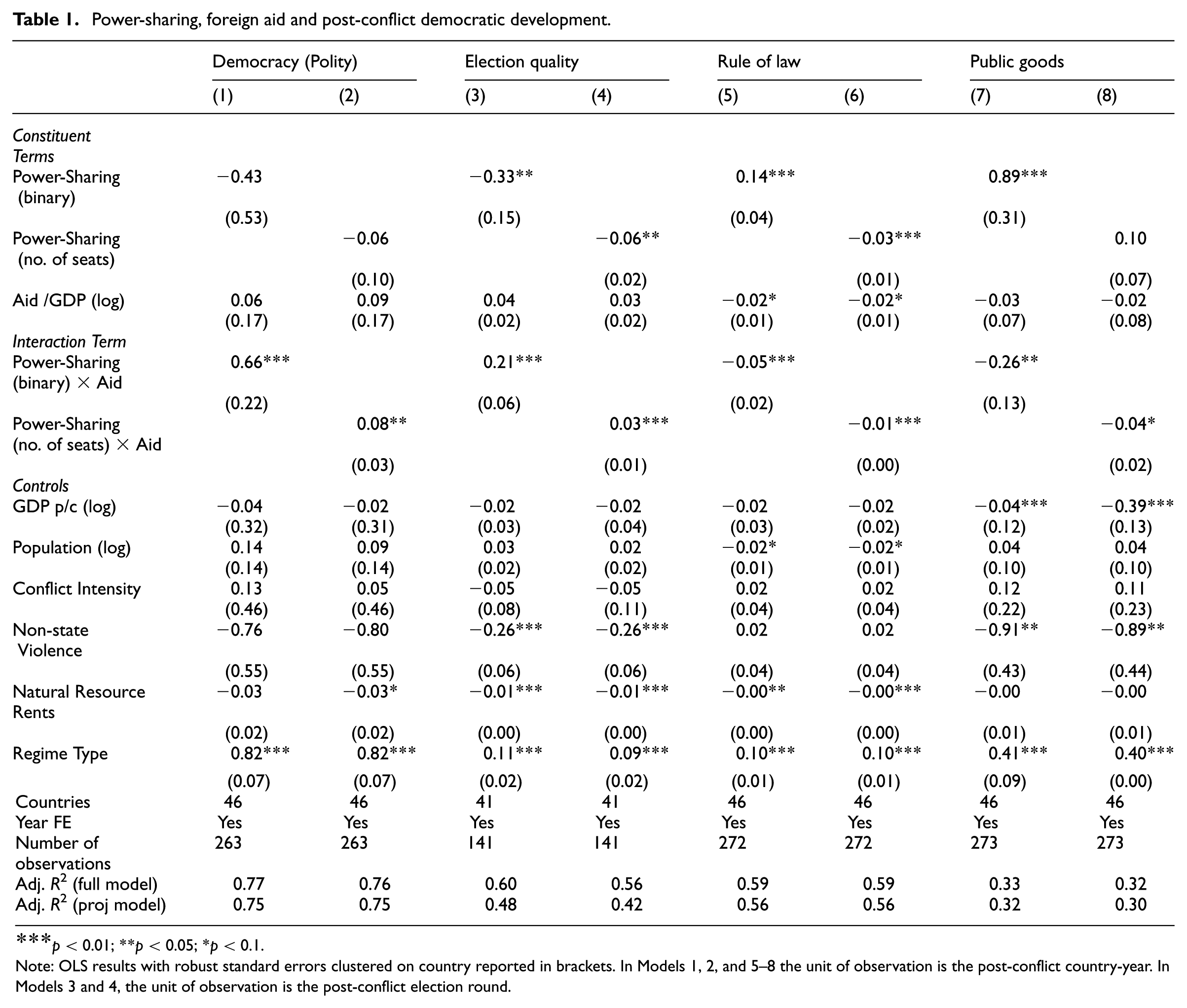
Table 1 presents the results. Odd-numbered columns employ a dummy measure of power-sharing executives, while the models in even-numbered columns use the finer-grained measure of the number of cabinet seats held by rebels in a power-sharing government. Columns 1 and 2 test the proposition that—as a result of the rent-seeking/democracy dilemma—power-sharing and foreign aid are jointly associated with positive, but limited democratic development after conflict (H1). The results are consistent with this expectation. In columns 1 and 2, the coefficient of the interaction term between power-sharing and foreign aid is positive and statistically significant. As expected, the model predicts higher Polity scores for countries with (more extensive) power-sharing governments and high aid inflows.
Power-sharing, foreign aid and post-conflict democratic development.
p < 0.01; **p < 0.05; *p < 0.1.
Note: OLS results with robust standard errors clustered on country reported in brackets. In Models 1, 2, and 5–8 the unit of observation is the post-conflict country-year. In Models 3 and 4, the unit of observation is the post-conflict election round.
However, it is difficult to infer from these results if they also support the second part of the proposition: that power-sharing and foreign aid should be associated with positive, but limited democratization. Thus, the left panel of Figure 1 plots predicted Polity scores in countries with and without power-sharing with aid inflows at 1% (light-blue estimates) and 30% (dark-red estimates) of GDP. 15 In countries without power-sharing, the difference between low and high aid flows results in a substantively negligible and statistically insignificant difference in predicted Polity scores. Yet in post-conflict countries with power-sharing governments, the level of aid income results in substantively and statistically different estimates of Polity scores. In countries with power-sharing governments, but low aid inflows, the model predicts a Polity score of approximately 3.5—roughly the equivalent of Haiti’s Polity score of 3 in 2005. At substantially high aid inflows of 30%, however, the model predicts a Polity score of approximately 6 points in post-conflict countries with power-sharing governments. This estimate is similar to the Polity score of Nepal in 2008.
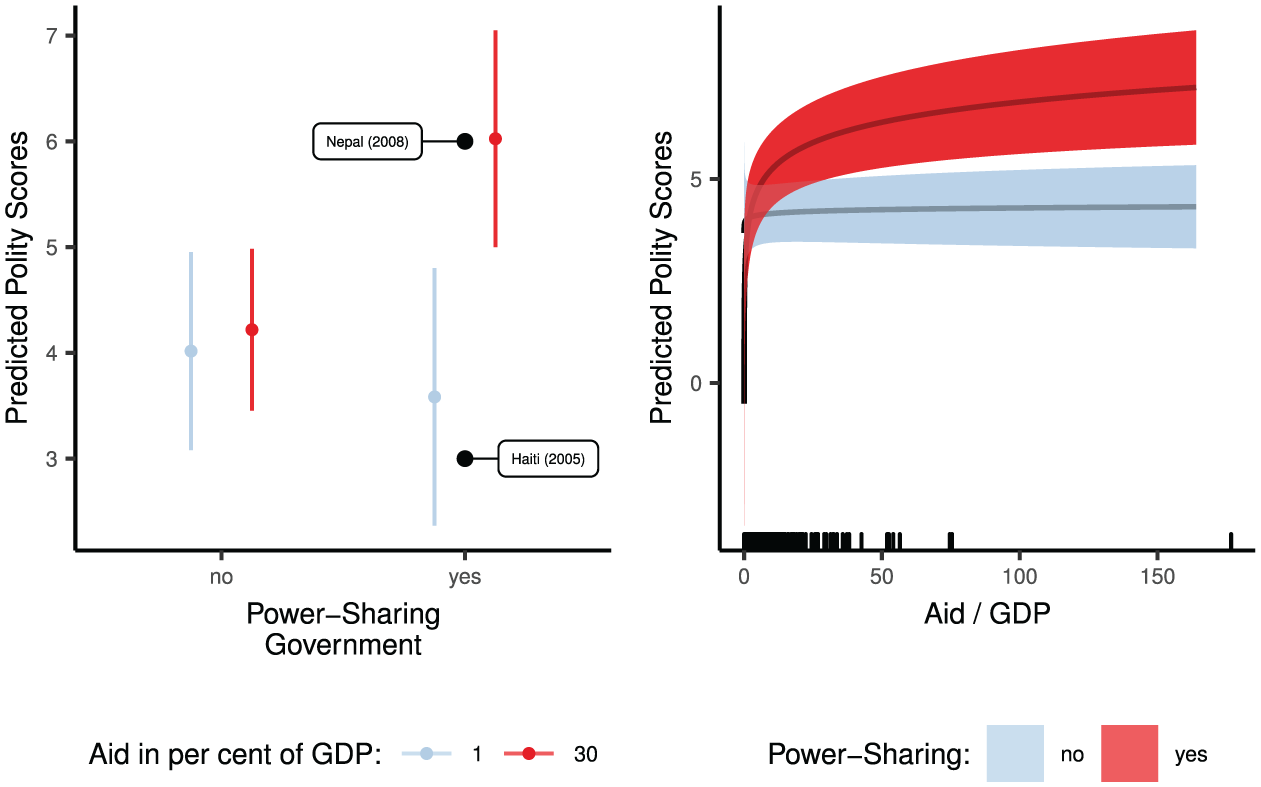
Baseline results: model predictions.
Conversely, the right panel of Figure 1 predicts Polity scores setting power-sharing to yes/no while varying the level of aid (over the range of the aid variable in the sample). We see that the effect of having a power-sharing government is associated with a Polity score of about 5–6 on the 20-point Polity scale as aid levels increase. In contrast, without rebel participation, the predicted Polity scores are only around 4 as aid increases. We also see that the effect of aid in the context of power-sharing becomes statistically significant at around 30% of in recipient GDP. Thus, it is mostly the highly aid-dependent post-conflict countries, such as Liberia, the DRC, Tajikistan, or Rwanda, where the rent-seeking/democracy dilemma is most pronounced. This finding is consistent with the theory, since it is precisely in these countries not only where donors have most leverage, but also where aid makes up a considerable resource of the government.
Disaggregated outcomes
Models 3–8 in Table 1 disaggregate this finding and illustrate which elements of a democracy drive the Polity scores’ movement toward a more democratic score and which elements inhibit further improvement. All interaction terms are in the expected directions: they are positive in Models 3 and 4, indicating that—consistent with Hypothesis 2—the positive effect of aid in the context of post-conflict power-sharing governments stems from improvements in election quality. The interaction terms in Models 5–8 are negative, however. Consistent with hypothesis 3, this means that as aid increases, power-sharing governments limit independent rule of law. Moreover, the negative interaction coefficient in Models 7 and 8 presents evidence that aid-dependent elites in power-sharing governments also engage in the selective provision of public goods.
Figure 2 presents model predictions to illustrate the substantive effect size of the joint effect of power-sharing and aid on election quality, rule of law, and the provision of public goods. The plot shows that the statistically significant findings discussed above also translate into substantively meaningful effects for the average post-conflict country. Based on a simulation of Model 3 (see the left panel of Figure 2), I find that a ratio of aid income to GDP of 30% in power-sharing executives predicts an election quality score that is more than three times higher than the election quality score in power-sharing governments without substantive aid income. Nevertheless, the predicted election quality score of 0.85 in power-sharing cabinets with high aid income is not a perfect score of 1. This is consistent with the interpretation that rent-seeking elites in aid-depdendent power-sharing governments will organize elections that are substantively more free and fair, but still include elements of fraud.
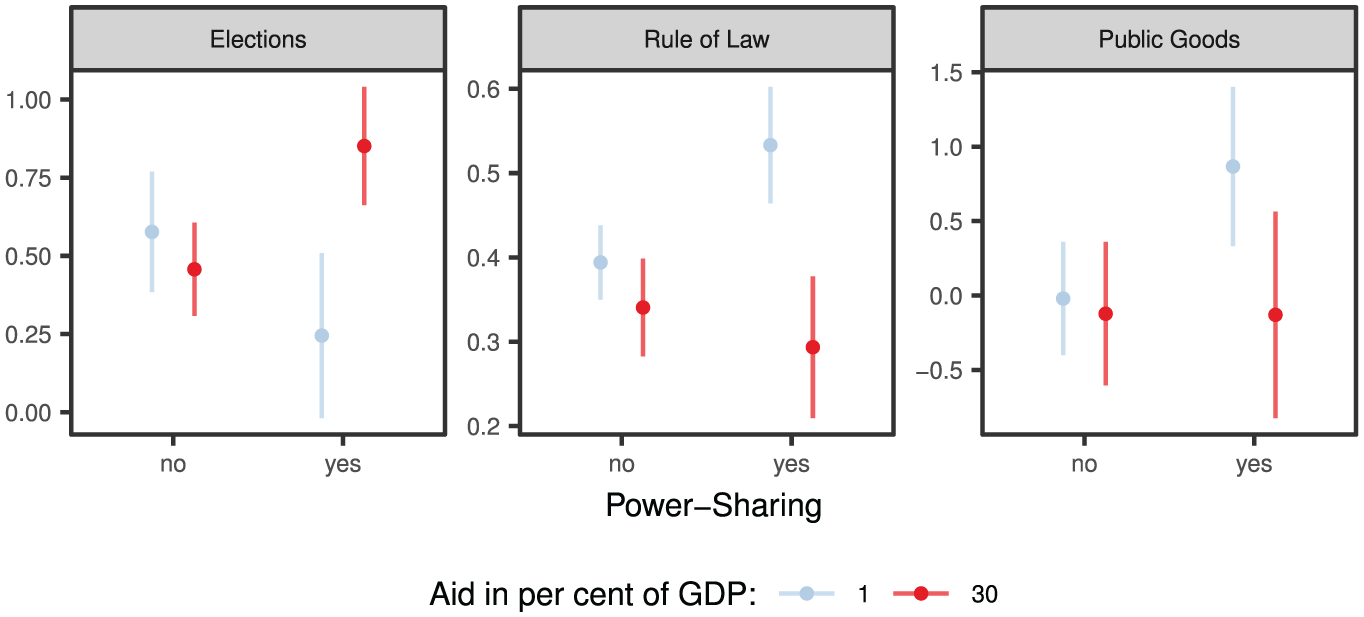
Disaggregated outcomes: model predictions.
The substantive effect of power-sharing and aid on judicial independence is large (see middle panel of Figure 2). In post-conflict states with power-sharing executives and high aid income (dark-red estimate), the predicted judicial independence score of approximately 0.3 is almost half the size of the estimate with little aid income (0.53; light-blue estimate). This difference is approximately the size of the index distance between Mali in 1992 and Moldova in 1993.
I find a similarly sized effect for public goods provision (right panel of Figure 2): the model predicts a particularistic/public goods spending score of approximately zero for aid-dependent power-sharing governments (dark-red estimate), indicating much lower levels of public goods spending and more particularistic spending. If aid comprises only a small proportion of the power-sharing government’s income, the estimate points toward higher public goods spending with a predicted estimate of about 0.9. This difference of 0.9 points is comparable with the difference between the highly autocratic Tajikistan in 1999 and the less clientelistic Macedonia in 2002.
How persistent are these effects over time? In Section 7.5 of the Online Appendix I present evidence on temporal variation of effects. I plot the interaction term of my main specification with varying temporal leads of the respective dependent variable. The resulting Figure 5 in the Online Appendix shows that the positive effects of the aid/power-sharing interaction are mainly visible for the first post-conflict elections. The effect becomes substantively small and statistically insignificant for the second election. This is consistent with my theory of donors that focus on quick results. Moreover, the negative effect of aid/power-sharing on rule of law dissipates over time (yet does not become positive) whereas the effect on particularistic spending remains negative and stable. This points to a pattern where post-conflict democracy in countries with a past of power-sharing and aid-dependency shows a short-term improvement, but is inhibited in further democratic consolidation by increasingly flawed elections and entrenched clientelism.
Robustness checks
These results are robust to a number of sensitivity checks. I summarize these robustness checks below, while more detailed results are available in the Online Appendix.
First, neither aid nor power-sharing are allocated randomly. Moreover, the model specifications in Table 1 might suffer from model dependence. To guard against these potential sources of bias I implement an instrumental variable and matching strategy in Section 4 in the Online Appendix. Even after instrumenting for aid through short-term donor budget fluctuations and matching on the power-sharing variable, the main results from Table 1 remain stable.
Second, I test for a number of alternative explanations. I introduce a control for the presence of a United Nations peacekeeping operation into the models of Table 1. This helps rule out the alternative explanation that the results simply reflect the democratization efforts of peacekeeping operations that accompany aid commitments. Moreover, power-sharing might reflect ethnic heterogeneity that has escalated into violent armed conflict. Ethnically heterogeneous societies have been shown to experience higher levels of societal rent-seeking (Svensson, 2000). Thus, the results could be driven by the underlying ethnic structure in a country instead of its post-conflict institutional configuration. I therefore include a measure of ethnic fractionalization to account for this alternative story. Finally, power-sharing might be more likely in instances where elections were also promised, potentially biasing the results. I therefore use the PSED promises data to generate a variable that counts if a peace agreement promises parliamentary elections, presidential elections, or a referendum. If actors’ expectations of elections drive my results, my main effect should disappear after controlling for this variable. Sections 5 and 7.7 in the Online Appendix present results for specifications that include variables that capture UN peacekeeping operations, ethnic fractionalization, and election promises. Across all alternative models specifications, the key finding that power-sharing governments and foreign aid jointly predict limited post-conflict democratization is retained.
Third, the findings hinge on the assumption that Western donors consistently attach political conditionalities to their aid commitments. To further probe the robustness of this assumption, I pursue two complementary strategies. I begin by exploiting a unique feature of the NELDA dataset that records whether elections were accompanied by threats of aid cut-offs. This approach should reflect my underlying assumption, but it is available only for the election dataset. Moreover, I test whether the results disappear when the aid variable is replaced with a measure of Chinese aid flows. Chinese aid is typically assumed to have fewer political conditionalities than Western aid (Strange et al., 2017). Thus, my results should disappear when using Chinese aid instead of aid flows from Western democratic donors. Section 6 in the Online Appendix presents both models. The results are in the expected directions. I find a positive, large and precisely estimated interaction effect of the power-sharing variable and the NELDA measure of threatened aid cut-offs on election quality, similar to my main results. The results disappear, however, when the aid variable is replaced with a measure of Chinese aid flows. 16 Both results lend further credibility to my findings.
Fourth, I conduct a series of technical robustness checks. I substitute key variables with plausible alternative measures to guard against an arbitrary choice of indicators (see Section 7 in the Online Appendix, which also provides more detailed descriptions of these variables). I retain my key finding across all of these alternative specifications, except when I replace V-Dem’s measure of particularistic vs public spending with V-Dem’s measure for political corruption in general. Thus, my finding emphasizes the strategic role of particularistic spending: the rent-seeking/democracy dilemma introduces a rationale for power-sharing elites to engage in selective, clientelistic spending—instead of purely kleptocratic behavior—to strenghten their political support.
Finally, the findings might be driven purely by the short time-series variation of my data’s panel setup. To alleviate this concern, I aggregate the data to its cross-sectional unit (the peace period) and average over the outcome variables. Visual inspection of the key interactive relationship (see Section 7.1 in the Appendix) confirms the basic findings of Table 1, however. Also, I show in Section 7.3 of the Appendix that if power-sharing includes rebels in more senior-level positions, the effects of the rent-seeking dilemma are more pronounced. In line with my theory, this result provides further evidence that power-sharing generates strong rent-seeking behavior.
Conclusion
In this paper, I propose and test a political economy theory of post-conflict democratization. I demonstrate that the rent-seeking/democracy dilemma inherent in power-sharing governments with large aid income results in limited post-conflict democratization. Elites agree to initiate a “good enough” democratization process that satisfies donors’ demands for democratic reforms (and upholds aid flows), but that retains sufficient autocratic elements for elites to reduce elites’ uncertainty with respect to losing political office. Empirically, this pattern is reflected in a positive, but limited improvement in Polity scores. In addition, I show that this limited, but positive effect of power-sharing cabinets and foreign aid on democratization is reflected in improved elections. At the same time, elites limit the rule of law and have a stronger tendency to provide particularistic goods to politically important groups.
This article opens up new avenues for the broader research on power-sharing and post-conflict democracy. While I demonstrate that elites’ economic benefits from certain institutional setups shape limited democratic development in the short run, future research is necessary to determine whether this effect translates into a future electoral authoritarian “shadow” in post-conflict countries—or whether repeated elections help consolidate other dimensions of post-conflict democracy in the long-run.
From a policy perspective, the findings presented here offer good and bad news. The good news is that external engagement can help shaping reforms toward more democratic political systems, even after civil conflict. The bad news, however, is that these political reforms are limited to mostly clean elections and that they seem to hold only for the very short term (see Section 7.5 in the Appendix). By (maybe involuntarily) limiting the rule of law and entrenching particularistic spending, however, external pressure for democratic reforms might have unintended consequences: since it does not resolve key issues that are often at the heart of the conflicts that power-sharing deals pacify—elite corruption and unchecked executive power—subsequent democratic consolidation becomes difficult and peace can remain elusive. The still fragile situations in Bosnia and Herzegovina or the Democratic Republic of the Congo in 2018—both countries where attempts for conflict resolution included transitional power-sharing governments and massive external involvement—are cases in point. Donors who want to counter the democracy dilemma need to implement rule-of-law reforms and combat corruption alongside a simple focus on elections—even if such reforms are technically more difficult.
Supplemental Material
appendix_2 – Supplemental material for The democracy dilemma. Aid, power-sharing governments, and post-conflict democratization
Supplemental material, appendix_2 for The democracy dilemma. Aid, power-sharing governments, and post-conflict democratization by Felix Haass in Conflict Management and Peace Science
Supplemental Material
replication_archive – Supplemental material for The democracy dilemma. Aid, power-sharing governments, and post-conflict democratization
Supplemental material, replication_archive for The democracy dilemma. Aid, power-sharing governments, and post-conflict democratization by Felix Haass in Conflict Management and Peace Science
Footnotes
Acknowledgements
I am grateful to Levke Aduda, Nadine Ansorg, Felix Bethke, Vincenzo Bove, Margit Bussmann, Julia Grauvogel, Christoph Hartmann, Caroline Hartzell, Sabine Kurtenbach, Anja Menzel, Sebastian Nickel, Martin Ottmann, Gerald Schneider, Christian von Soest and Julia Strasheim for helpful comments on this project and three anonymous reviewers for useful feedback. Participants in the University of Greifswald’s PhD colloquium and GIGA’s research program “Peace and Security” also provided helpful input. In its various stages, the paper also benefited from feedback by panelists, participants, and audience members at the ALMA Research Seminar Series at the Arnold-Bergstraesser-Institute in Freiburg 2018, the Lunch Seminar Series at the University of Gothenburg 2018, the Network of European Peace Science Conference 2017, the International Studies Association Conference 2014, and the EnCoRE Workshop in Barcelona 2015.
Funding
I acknowledge funding from the German Research Foundation (ME 1701/7-1).

Supplemental material
Notes
References
Supplementary Material
Please find the following supplemental material available below.
For Open Access articles published under a Creative Commons License, all supplemental material carries the same license as the article it is associated with.
For non-Open Access articles published, all supplemental material carries a non-exclusive license, and permission requests for re-use of supplemental material or any part of supplemental material shall be sent directly to the copyright owner as specified in the copyright notice associated with the article.
