




Abstract
Great powers frequently signal their alliance commitments during peacetime. While scholars see this peacetime practice as an integral part of great powers’ alliance maintenance, there is significant variation in the intensity of signals that junior allies receive. This article suggests that the choices made by great powers in signalling alliance commitments can be explained by the motivation to encourage compliance among junior allies. Great powers typically form alliances to exert control over their junior allies’ decision-making and thereby maintain their sphere of influence. Yet, great powers may face difficulty in making junior allies accommodate their demands as junior allies’ interests are not always in alignment. This article argues that great powers attempt to maintain their allies’ incentive to comply by reaffirming alliance commitments as an ex-post reward. In addition, to increase the efficiency of this reward strategy, great powers carefully select the targets, taking into account their allies’ willingness to make concessions. Empirical analysis using the sample of United States alliance relationships provides evidence that supports these arguments. This article contributes to the literature by deepening our comprehension of how great powers manage their alliances and providing at least a partial answer to how asymmetric alliances are maintained. Furthermore, this article has important implications for how great powers maintain their status within the international system.
Introduction
Why do great powers signal their alliance commitments to some junior allies but not others? Great powers frequently reaffirm their alliance commitments publicly during peacetime through various means, including, for instance, troop deployments, diplomatic exchanges and public statements (McManus and Nieman, 2019). A growing body of literature sees these peacetime practices as an integral part of great powers’ alliance maintenance. Some scholars suggest that reaffirming security commitments helps maintain their alliance credibility, thereby deterring potential aggressors (Machain and Morgan, 2013; McManus, 2018). Others propose that great powers reassure their junior allies to address threats and shocks that could harm alliance cohesion and potentially lead to alliance dissolution, such as allies’ economic growth (Blankenship, 2020), domestic instability (Kim and Ko, 2020) and hostile pressure from rival great powers (Izumikawa, 2018). 1
Addressing these threats and preserving the cohesion of alliances are crucial for great powers, yet this alone may not suffice. Scholars have argued that great powers typically enter into alliances with the expectation that their junior allies will acquiesce to the great powers’ policy demands in exchange for security (Kim, 2016; Kim and Ko, 2020; Morrow, 1991). This dynamic enhances the great powers’ autonomy and bolsters their capacity to reshape the status quo in their favour (Morrow, 1991). However, I contend that enforcing compliance among junior allies is not automatically achieved; rather, it can be a challenging task. The behaviour expected of junior allies is generally multifaceted and subject to change over time, making it difficult to formalize the precise demands that great powers place on their allies in alliance treaties. This nature of autonomy implies that the cooperation-enforcing function anticipated of international institutions may not work sufficiently (Koremenos et al., 2001). In other words, solely signing an alliance treaty does not guarantee that junior allies will continue to accommodate the great powers’ demands in the future. Thus, great powers need strategies to encourage their junior allies’ compliance after forming alliances.
I suggest that the choices made by great powers in signalling alliance commitments can be explained by such a motivation: the desire to maintain their allies’ incentive to accommodate the great powers’ demands. Specifically, I propose that great powers signal their alliance commitments as reassurance to reward their allies who behave in line with their patrons’ interests. That is, great powers signal their alliance commitments conditionally, depending on the behaviour of their junior allies, with the aim of instilling the recognition that their security hinges on their contributions. Receiving stronger reassurance as a reward, junior allies can understand that they need to keep accommodating great powers’ demands to maintain their security commitments.
This argument leads to the expectation that great powers will provide stronger reassurance to junior allies when these allies align their actions with the great powers’ interests. Conversely, when junior allies deviate from the great powers’ interests, the level of reassurance is likely to be weakened. Furthermore, I posit that great powers, in a bid to enhance the efficiency of their reassurance efforts and minimize associated risks, such as entrapment (Snyder, 1984), strategically target their reward strategy towards those junior allies who have stronger bargaining leverage. This is because such allies are unwilling to comply with great powers’ demands unless they anticipate receiving additional benefits as a reward.
I assess these arguments focusing on the relationship between the United States peacetime reassurance and its similarity of voting records with its allies in the United Nations General Assembly (UNGA). The empirical findings largely support my theoretical expectations. Specifically, the USA tends to provide stronger reassurance to its allies when these allies align their behaviour more closely with the USA in UNGA. In addition, this association is observed particularly in cases where the allies possess feasible alternative security options.
My findings confirm and strengthen the existing understanding of asymmetric alliances (Morrow, 1991). Great powers do not see their alliances as a free-gift. Rather, great powers demand a commensurate quid pro quo from their allies in exchange for security guarantees. My findings imply that signals of reassurance are a key tool for great powers to achieve this exchange. This mercenary dimension of great powers’ signals complements the literature on great powers’ alliance maintenance, which has largely focused on how these signals bring profitable consequences to junior allies, such as extended deterrence and reductions in military spending (DiGiuseppe and Shea, 2021; McManus, 2018).
This article should be of interest to a broad range of international relations scholars beyond alliance literature. Scholars generally see great powers as distinct actors actively pursuing their interests by exerting political influence over other states with their considerable national capabilities (Fordham, 2011; Lake, 2009; Morrow, 1991). Alliance partners are often regarded as primary contributors to the interests of these powerful states (Morrow, 1991). However, my findings highlight that reliance on national capabilities alone may not provide a complete explanation for how great powers successfully maintain their sphere of influence. A comprehensive understanding of great powers necessitates greater attention to their strategies for managing their relationships with junior partners. In addition, my findings contribute to the long-standing literature on signals. Scholars have long discussed the strategic use of signals and its consequences on their credibility (Fearon, 1994, 1997; Jervis, 1970). My findings contribute to this discussion by providing new explanations for the great powers’ strategies for signals of alliance commitments.
Difficulty in enforcing compliance in asymmetric alliances
Great powers often possess sufficient military capabilities to secure their own defence, yet they actively engage in alliances with militarily weaker states. Scholars have explained that great powers form alliances with weaker states as a means to influence the decision-making processes of other states, thereby expanding their sphere of influence. In return for the great powers assuming the costs of their junior allies’ security and accepting the inherent risks of being entraped in conflicts, these junior allies typically align with their patrons’ demands, even when these demands do not necessarily align with their own interests (e.g. Kim, 2016; Morrow, 1991). Morrow characterizes the benefits that weaker states provide to their patrons as autonomy, which he defines as ‘the degree to which it [a nation] pursues desired changes in the status quo’ (Morrow, 1991: 908–909). He argues that asymmetric alliances fundamentally hinge on the exchange of security and autonomy between strong and weak states. Junior allies often cede somewhat of their autonomy by conforming to their patrons’ interests and complying with their patrons’ demands, frequently resulting in policy concessions, especially when their preferred policies do not align with those of their patrons.
The provision of autonomy is crucial for great powers to continue reaping benefits from their alliances; however, ensuring that their allies align their behaviour with the interests of great powers can be a challenging task. Scholars have proposed that formalized agreements can help enforce interstate cooperation since the inclusion of clear statements regarding anticipated actions by signatories in treaties can impose reputation costs and domestic audience costs on those who fail to honour their commitments (Koremenos et al., 2001). However, this enforcement mechanism may not be entirely effective in encouraging compliance among junior allies. Alliance treaties generally lack provisions that specify the precise actions that junior allies are expected to undertake to provide autonomy. While some alliances include provisions for policy concessions in their treaties (Johnson, 2015), these provisions often have limited scope, and the language used typically remains vague. 2 For instance, the USA has often demanded that its junior allies grant economic concessions in trade negotiations, leveraging their alliance ties (e.g. Stone, 1999), even though such concessions are not explicitly stipulated in the alliance agreements. 3 Consequently, great powers frequently find themselves in situations where they need to request actions or concessions that go beyond the explicit terms initially agreed upon. 4
Indeed, the provision of autonomy may be less suitable for formalization. 5 This is primarily because the demands made by great powers are generally multifaceted and subject to change over time. Great powers require their junior allies to undertake actions that align with their interests, but the specific actions that junior allies need to take are not static and evolve in response to shifts in the surrounding international environment. For example, junior allies voluntarily join military coalitions led by their great power allies, contributing by deploying troops, facilitating military logistics and sharing economic burdens (Bennett et al., 1994). Junior allies also accept the presence of their great power allies’ troops on their territory, provide land for military bases and shoulder substantial monetary costs. 6 In addition, junior allies continuously engage in behaviours that serve to advance their great power allies’ interests on a daily basis, such as making concessions during trade negotiations and supporting their positions in international organizations (e.g. Bennett, 1997; Kim, 2016). These characteristics of autonomy make it challenging to anticipate the specific actions required of junior allies and include them in treaties in advance during negotiations over the terms of the agreement.
In addition, the informal nature of autonomy may be attributed to domestic constraints. Making policy concessions to their patron is generally unpopular among citizens, as it often imposes costs on ordinary citizens (e.g. Bueno de Mesquita and Smith, 2009). Also, offering concessions can incur emotional costs, as it may be perceived as indicative of an unequal relationship wherein the junior allies occupy a subordinate position (Kim, 2016: 38). To mitigate domestic backlash, leaders of junior allies may want to avoid formalizing the concession of autonomy in a visible manner.
Junior allies sometimes deviate from their great power allies’ interests by adopting policy positions that diverge from those of the great power. Instances of such non-compliance can be observed in historical events, such as the first Indochina War in 1954 (see Pressman, 2011: 53–61) and the Iraq War in 2003, where United States allies exhibited opposition to United States-led military coalitions. Importantly, junior allies’ under-compliance extends beyond wartime scenarios. Lake (2009: 13) characterizes this behaviour as ‘everyday resistance’ and ‘open defiance.’ Recent examples, such as French President Emmanuel Macron’s public expression of scepticism regarding the efficacy of the North Atlantic Treaty Organization (NATO) and his criticisms of United States policies concerning the China–Taiwan relationship (Emmott and Rose, 2019; Wintour, 2023), underscore the potential for United States allies to distance themselves from United States foreign policies and, in some cases, actively resist them.
Reassurance to reward compliance
I theorize how great powers seek to enforce compliance among their allies, with a specific focus on reassurance. Reassurance is defined as ‘acts made by a state that are intended to convince an ally that its assistance will be forthcoming in the event of an attack from a third-party state’ (Blankenship, 2020: 1). 7 The formation of alliances serves as a credible signal, showcasing the commitments of alliance members to provide military support in times of war, leading to the incurring of sunk costs and reputation costs associated with betrayal. However, it is imperative to note that the credibility of such commitments may wane over time following alliance formation, particularly in response to changing circumstances involving alliance members (Leeds and Savun, 2007). Consequently, to maintain the credibility of alliances, states often signal the strength of their commitments after formation. I contend that great powers, leveraging their position as security suppliers and capitalizing on the vulnerability of their junior allies, strive to prevent opportunistic defiance among their allies by effectively employing reassurance strategies.
Junior allies typically harbour concerns about whether great powers will indeed maintain their alliance commitments to provide military assistance in the face of potential attacks. Formal agreements can aid leaders in making their alliance commitments more credible. However, even with such agreements in place, there is no guarantee that great powers will consistently view their junior allies as valuable enough to justify going to war, as they initially did when forming the alliances (Leeds and Savun, 2007). Signatory states do not always honour their alliance obligations and may fail to provide military support in times of war. Indeed, Leeds et al. (2000) uncovered that approximately 25% of alliances formed between 1815 and 1944 experienced betrayal. Furthermore, Leeds’s (2003) analysis suggests that major powers are more prone to betray their partners in comparison to minor powers.
Junior allies assess the resolve of their patronal great powers through their peacetime signalling (Blankenship, 2020; DiGiuseppe and Shea, 2021; Izumikawa, 2018; Kim and Ko, 2020). Signals can take both explicit and implicit forms. Explicit signals, such as public statements and leaders’ visits, straightforwardly convey the messages of great powers. Implicit signals, such as arms transfers and troop deployments, leave room for interpretation. In either case, signals effectively demonstrate the great powers’ commitments in a credible manner, as they carry the potential for ex-post reputational costs of betrayal due to their visibility and their ability to attract international attention (McManus and Nieman, 2019; McManus and Yarhi-Milo, 2017). Furthermore, publicly demonstrated signals not only signify the resolve of the senders but also, through increased credibility, directly enhance the security of junior allies by reinforcing extended deterrence. McManus (2018) and Krause (2004) reveal that leader-specific signals and arms transfers, along with a formal alliance, reduce the likelihood of major powers’ allies becoming targets of military attacks.
I suggest that great powers attempt to preserve their influence by utilizing reassurance as an ex-post reward for their junior allies’ alignment. Numerous scholars have argued that bolstering alliance commitments diminishes bargaining leverage (Snyder, 1984). The underlying rationale is that reinforcing alliance commitments alleviates junior allies’ concerns about abandonment, consequently reducing their motivation to align their behaviour with their partners’ interests.
However, I propose an alternative perspective, suggesting that employing reassurance as a response to junior allies adopting policies that are beneficial to their patrons, rather than unconditionally reassuring alliance partners, serves as an incentive for allies to continue it. This practice helps great powers to make their junior allies understand that their security hinges on their contributions to great power allies’ interests. Conversely, attempts to exploit the situation by reducing contributions would weaken the patronal great powers’ alliance commitments and eventually jeopardize their security. Consequently, I anticipate that great powers seek to encourage their allies to take policies beneficial to great powers by selectively signalling their resolve. Specifically, great powers are likely to provide stronger reassurance when their allies behave in line with the great powers’ interests. By contrast, they offer weaker reassurance when allies do not. 8
It is important to note that my theory expects that patrons reward their junior allies’ behaviour regardless of their sincere interests. Junior allies may find themselves needing to relinquish the pursuit of their own interests and make concessions to align with their patrons’ policies if their preferred policies diverge significantly from those of their patrons. Conversely, junior allies may find it easier to align with their patrons’ interests without sacrificing their own if their preferred policies are already in line. According to my theory, great powers will reward junior allies who are aligning their behaviour with the great powers’ interests regardless of their sincere preference. This is because failure to do so may lead junior allies, whose interests initially coincide with those of their patrons, to drift away from alignment if their preferred policies deviate from those of their patrons in the future. Thus, rewarding their behaviour regardless of their sincere preferences is important to ensure long-standing compliance.
Some may claim that the strategic use of signals may undermine its effectiveness as it makes junior allies become cynical, leading to doubt about the patron’s sincere resolve (see Jervis, 1970). However, even if junior allies become cynical, it is unlikely that they will doubt the patron’s resolve. That is, the signals can credibly reassure junior allies, regardless of the great powers’ underlying motivation. Costly signalling logic suggests that signals impose ex-post costs on senders who betray their allies. These costs thus increase the credibility of the senders’ commitments (Fearon, 1997). In line with this, McManus (2018) shows that leader-specific signals sent by great powers, despite their high manipulability, effectively deter potential military aggression to junior allies, indicating the high credibility of patrons’ signals. Thus, junior allies should be reassured even if they interpret the patron’s signals of reassurance cynically.
One illustrative case of the reward strategy occurred in 2003 when the Bush administration acknowledged the valuable contributions of Thailand’s Prime Minister Thaksin Shinawatra to the war on terror by bestowing upon Thailand the designation of a ‘Major Non-NATO Ally’ (Chambers, 2004: 468–469). While the status itself does not entail formal security commitments, the United States government used it as ‘a powerful symbol of the close relationship the United States shares with those countries’ (United States Department of State, 2021a). In addition, the status ensures a legal status that allowed designated states to receive financial and military aid from the USA on a priority basis. President Bush announced this decision during his visit to Bangkok in October 2003, concurrently commending Thailand for its commitments to operations in Afghanistan and Iraq. 9 To evaluate my argument, I test the following hypothesis.
Hypothesis 1: A great power offers stronger reassurance to its allies when the allies’ behaviour aligns more closely with the great power’s interests.
While reassurance can serve as a valuable tool for great powers in pursuit of autonomy, the act of strengthening alliance commitments is not without its potential drawbacks. Sending signals, such as through troop deployments and arms transfers, comes with substantial costs. Moreover, there is an inherent risk associated with strong alliance commitments, as scholars have noted the possibility of entrapment (Snyder, 1984). Therefore, great powers must exercise careful discretion in selecting the recipients of reassurance so that the anticipated benefits of rewarding loyalty outweigh the associated costs and risks.
To explore the selective use of reassurance, I focus on a factor that determines the willingness of junior allies to contribute to their patronal great powers’ interests. To avoid excessive use of reassurance, great powers purposefully direct their efforts towards allies who exhibit a lower inclination to make policy concessions. The objective of reward-based reassurance is to cultivate loyalty among allies, targeting those who may not readily comply with their patrons’ demands unless they anticipate receiving additional benefits as a reward, as opposed to those who are already predisposed to doing so. I suggest that junior allies possessing feasible outside options of security are more likely to be a target. Junior allies with feasible outside options have greater bargaining power and thus can strongly resist demands from their great power allies. This is because these junior allies possess the ability to credibly threaten alliance abandonment (Blankenship, 2020; Snyder, 1984). Thus, great powers must offer supplementary benefits to motivate and retain the loyalty of such allies.
In this article, I focus on the latent military power of junior allies as a measure of their security outside option. In the pursuit of improved security, states typically employ two main avenues: bolstering their own military capabilities independently; or relying on military assistance from other states (Morrow, 1993). However, I focus on self-armament as the preferred method because finding a new alliance partner whose military assistance is at least as credible as the current partner is usually unattainable. The credibility of military assistance is contingent upon the salience of the partner’s interests in the relationship with the potential target of military aggression (Morrow, 1993). Given that great powers and their allies generally develop a mutually beneficial relationship over time, it may be improbable that other great powers can immediately assume the same position. 10 Therefore, junior allies possessing substantial latent military power wield stronger bargaining leverage against their great power allies, prompting great powers to selectively target them for rewards aimed at cultivating loyalty. 11 This discussion leads to my second hypothesis.
Hypothesis 2: The association between alignment and reassurance (as described in Hypothesis 1) becomes greater when the allies have greater latent military power.
Research design
This section explains the design of the empirical analysis. The unit of analysis is a United States ally-year. The dataset includes states for which the USA had a formal defence obligation between 1950 and 2012. I use the Alliance Treaty Obligations and Provisions (ATOP) Project (version 5.0) to identify United States allies (Leeds et al., 2002).
The dependent variable is Reassurance. I operationalize Reassurance using the measurement of the major powers’ signal of security support created by McManus and Nieman (2019). 12 As discussed, great powers reassure their allies by signalling their security commitments through various means. McManus and Nieman (2019) measure how intensely major powers signal their security commitments around the globe by creating a latent variable that captures seven indicators. 13 McManus and Nieman (2019) choose these indicators based on the idea that they contribute more or less to raising the expectations of some form of intervention in times of disputes, as they impose ex-ante and ex-post costs of betrayal. Each component may be a candidate for the measurement for reassurance independently. However, I use a latent variable because the selection of the type of signals is supposed to be strategic, and thus focusing only on certain types of signals may fail to capture the overall level of reassurance. 14 A latent variable is also advantageous as it captures a latent trait that is common among all factors, indicating that it allows the extraction of a part of every factor that plays a role as signals while excluding other parts. Since each component is multidimensional and more or less fraught with the possibility of endogeneity, using a latent variable approach enables the creation of a less noisy measure for reassurance. 15 Because including alliances is inappropriate as my sample consists of only United States allies, following DiGiuseppe and Shea (2021), I re-estimate the latent variable without using alliances and use it for analyses reported in the following sections. I use Reassurance measured in t + 1 to rule out the possibility of reverse causality. The models also include a contemporaneous variable (t) of Reassurance to take into account serial correlation.
The main independent variable is alignment – how closely United States allies behave in line with United States interests. I use the voting similarity between the USA and its allies measured with the UNGA roll-call votes as an approximation. The voting similarity in the UNGA has been used in the literature in two ways. Some scholars use the voting similarity as a reflection of the political distance between a pair of states (e.g. Blankenship, 2020; Terman and Byun, 2021). Others consider the voting patterns in the UNGA not as a mere reflection of shared perceptions and values but as a reflection of powerful states’ influence over other United Nations members. 16 Recent studies, such as Blankenship and Miles Joyce (2020), Malis and Smith (2021) and Martinez Machain (2021), use this variable as a measurement for policy concessions and political support to great powers (the USA, in particular) from their junior allies. As explained in the previous section, my theory focuses on both scenarios because the USA is anticipated to reward its allies’ behaviour regardless of their sincere preferences. Thus, voting similarity is an appropriate approximation of my independent variable. 17
The variable Voting similarity is the absolute distance between the USA and its allies’ ideal points estimated by Bailey et al. (2017). 18 Ideal points are estimated using roll-call votes for two sets of the UNGA resolutions: all resolutions; and the resolutions that the United States Department of State identifies as ‘votes on issues which directly affected important United States interests and on which the United States lobbied extensively’ since 1983 (United States Department of State, 2021b). I use both variables since using only important resolutions enables us to examine the cases in which junior allies contributed to the core United States interests, whereas the variable using all resolutions covers a longer time period. For ease of interpretation, I multiply −1 by the absolute distance; thus, the higher values indicate greater Voting similarity between the USA and its allies in a given year.
To test Hypothesis 2, I operationalize United States allies’ latent military power with their surplus domestic product (SDP). This measurement captures ‘the amount of resources that are potentially available for extraction and arming’ (Anders et al., 2020: 3). Scholars have commonly employed the size of the economy, measured by the gross domestic product (GDP), as an indicator of the amount of potential resources that can be invested in arming (e.g. Blankenship, 2020). However, Anders et al. (2020) claim that the mere size of the economy captures both subsistence income, which must be consumed to feed the populace, and surplus income, which can be invested in other purposes, and that only the latter should be used to measure the latent amount of military resources. In line with this argument, they measure SDP by subtracting the minimum subsistence value from GDP. I use this measure after taking a natural logarithm. The data of SDP and some other variables explained below are downloaded through an R package peacesciencer (version 1.1.0) (Miller, 2022). 19
The models include several control variables. To control for the economic and geographical importance of allies, I include total population (Anders et al., 2020), total trade (Barbieri et al., 2009) and intercapital distance in the models (Miller, 2022). I also include total trade and intercapital distance between an ally and the competitors of the USA, Russia/Union of Soviet Socialist Republics and China, in models as well to control for the influence of rivals. I take a natural logarithm of the total population and the amount of total trade. To control for the security environment of United States allies, I include Leeds and Savun’s (2007) measurement for external threats, which is an aggregated composite index of national capability score of potential opponents (Singer et al., 1972). 20 Moreover, as a second measurement for the security environment, I include a dummy variable of the militarized interstate disputes (MIDs) that is coded as 1 if the ally has experienced at least one MID within the last five years and 0 otherwise (Palmer et al., 2015). Third, the models include the Polity IV score (Marshall et al., 2017) and the alliance portfolio similarity between the USA and their allies using the S-score calculated using ATOP data (Chiba et al., 2015). These variables are included to control shared values and perceptions between the USA and its allies that can determine the voting similarity. Lastly, I include region-fixed effect as voting similarity and the level of reassurance may be similar in the same region. The inclusion of region-fixed effect also contributes to controlling for United States strategic interests specific to certain regions. 21
Results
Table 1 shows the estimation results. Since the dependent variable is continuous, the analytical technique is ordinary least squares regression. 22 To control for potential time trends, models include a cubic polynomial of time after subtracting the mean. Standard errors are clustered on allies. Following existing studies (DiGiuseppe and Shea, 2021; McManus and Nieman, 2019), to take into account the uncertainty of the latent variable, I take ten random draws from the posterior distributions of the latent variable and estimate separate models using each of the draws. Then, I combine ten estimation results using Rubin’s (1987) formula. 23 While Models 1 and 2 use Voting similarity calculated using records of all the UNGA resolutions, Models 3 and 4 use the one calculated using records of resolutions that are identified as important for United States interests. While Models 1 and 3 examine unconditional effects of Voting similarity to test Hypothesis 1, Models 2 and 4 examine interaction terms between Voting similarity and SDP to test Hypothesis 2. In addition, Figure 1 visualizes interaction terms. Note that Models 3 and 4 cover a period since 1983. 24
Ordinary least squares regressions on United States reassurance.

Two-tailed test: **p < 0.01, *p < 0.05, †p < 0.1. Clustered standard errors are reported in parentheses. A cubic polynomial of time and region fixed effects are included in all models but not reported. The dependent variables are measured in t + 1.
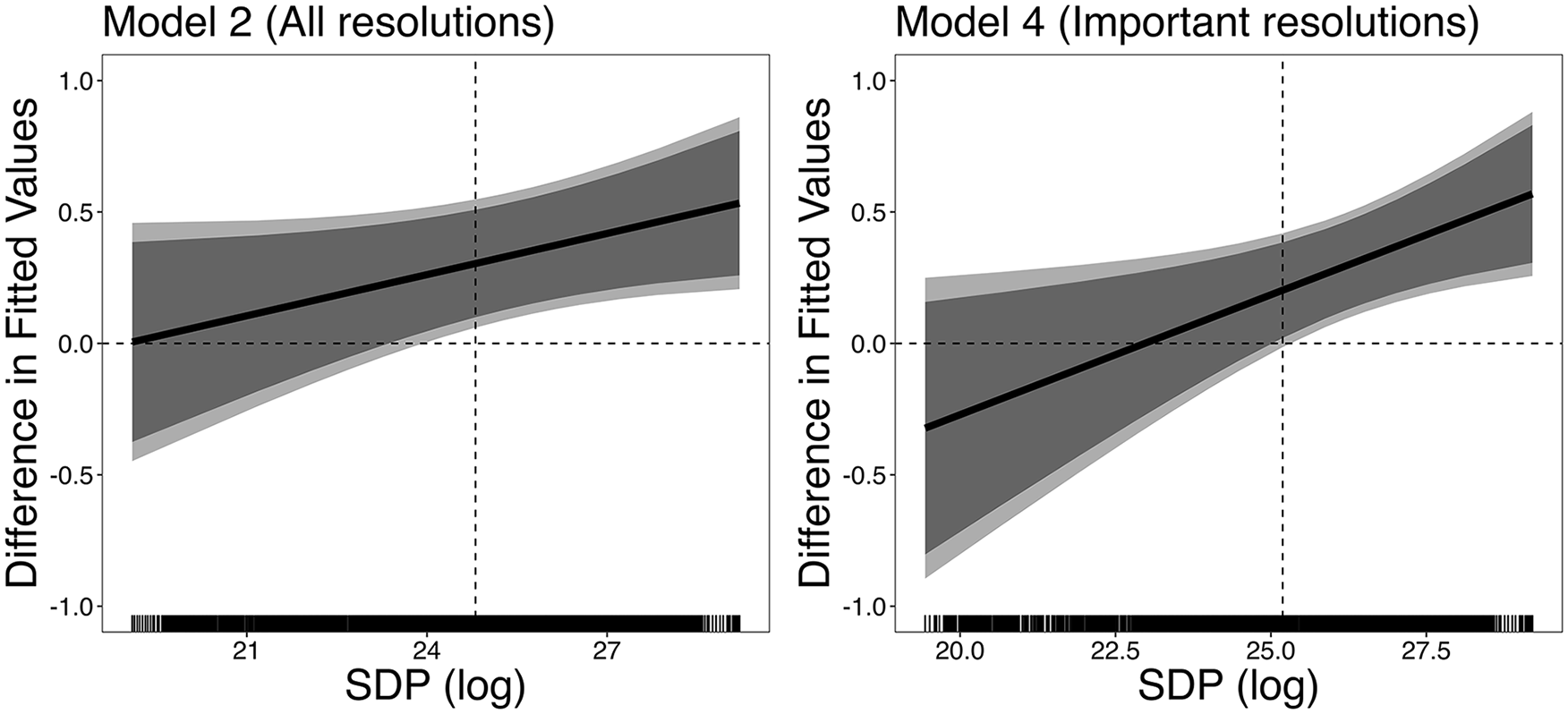
Effect of voting similarity on United States reassurance conditional on surplus domestic product.
Hypothesis 1 expects that the USA increases the level of reassurance to their allies when they have contributed to United States interests. The coefficients for Voting similarity in these two models are positive and statistically significant at the 95% confidence level. These results indicate that there is a positive association between Reassurance and Voting similarity, and this is consistent across different sets of the UNGA resolutions. These results are consistent with Hypothesis 1 and suggest that the USA provides more security support when their allies behave more in line with the USA in the UNGA.
Hypothesis 2 expects that the association between Reassurance and Voting similarity is more pronounced when the United States allies’ latent military power is greater. Interaction terms in Models 2 and 4 support this expectation. The positive coefficients for interaction terms between Voting similarity and SDP indicate that the positive associations between Voting similarity and Reassurance become stronger as SDP increases. Figure 1 illustrates the interaction terms: the difference in the predicted levels of Reassurance associated with an increase in Voting similarity by its two standard deviations. Both panels show similar results: the association between the two variables is positive and significant when United States allies’ SDP is high; however, it diminishes as SDP decreases and eventually becomes insignificant. 25 Substantively, a shift in Voting similarity leads to an increase in Reassurance by 0.534 (Model 2) and 0.569 (Model 4) when the level of SDP is at its maximum. While the interpretation on the scale of latent measure is difficult, these differences are substantively meaningful, considering that these substantive effects are close to the median of the within-state standard deviations for Reassurance (0.555). 26
Discussion on reverse causalities
While the findings presented above provide support for my hypotheses, it is conceivable that causality could run in the opposite direction. Junior allies might adjust their positions in the UNGA based on the level of reassurance that they have received from the USA. To address this concern, the models use the dependent variable measured in t + 1. However, it is acknowledged that this may not entirely eliminate the possibility of reverse causality. To address this concern more directly, I have examined whether the level of reassurance influences voting similarity by switching the dependent and independent variables. The models examine the relationship between current level of Reassurance and Voting similarity measured in t + 1 with the same control variables and methods as the models presented in Table 1. The results indicate that there is no significant association between these variables: the coefficients are negligible and statistically insignificant; and their directions are inconsistent (see Online Appendix 5). Thus, evidence to suggest reverse causality is not found in this analysis.
In addition, it is noteworthy that this additional analysis provides no evidence suggesting that United States efforts result in an increase in contributions from its junior allies. If a reward by the USA is successful, junior allies who received signals should strengthen their alignment with the USA after receiving the signals. But the results indicate that whereas the United States rewards its allies who vote similarly to the USA, its allies do not necessarily behave closely with the USA in response to reassurance. However, this result is not unexpected, given the possibility that the USA selects targets for rewards based on their allies’ anticipated level of contributions in the absence of reassurance. Hypothesis 2 posits that the USA is inclined to target junior allies who are less likely to contribute to United States interests since offering reassurance to allies who would contribute regardless would be inefficient. Furthermore, Blankenship (2020) suggests that the USA reassures allies with viable alternative security options to dissuade them from leaving the alliance, as these allies often possess substantial bargaining power. This approach to target selection implies that the effects of Reassurance may not manifest as observable differences in the behaviour of junior allies, even if it proves to be effective. Nevertheless, the primary objective of this article is to gain insights into when great powers employ reassurance. Therefore, the potential effects of reassurance are left as an intriguing avenue for future research. Overall, these results bolster my argument that the positive correlation between Voting similarity and Reassurance arises because the USA responds after observing its allies’ good behaviour rather than the United States allies reacting to reassurance from the USA.
Conclusion
The trade-off model of alliances posits that great powers establish alliances to acquire political power that enables them to pursue their ideal foreign policies while providing security in return (Morrow, 1991). While this model has significantly advanced our comprehension of alliance cooperation, it also raises a question: how is this exchange between security and autonomy upheld? Managing alliances involves challenges in ensuring the compliance of junior allies. In this article, I propose that great powers seek to prevent opportunistic defiance by their allies through the strategic use of reassurance as a reward for loyalty. In addition, I argue that great powers employ this strategy selectively, targeting allies with greater bargaining leverage. Empirical analyses conducted with a sample of United States allies provide support for these arguments.
My findings contribute to a deeper understanding of alliance cooperation. Scholars have traditionally contended that entering into an alliance treaty binds the signatories to formal obligations, thereby facilitating enforcement through the imposition of costs for violating the agreement. However, a less-explored aspect is that some alliance treaties lack clear stipulations regarding signatory behaviour after the agreement is established. Notably, the requirement for policy concessions in asymmetric alliances sometimes remains informal, creating an opportunity for junior allies to potentially resist compliance with their patrons’ demands. My research findings indicate that senior partners of asymmetric alliances use reassurance to enforce the asymmetrical exchange within intra-alliance bargaining.
Implications of my findings extend beyond the realm of formal alliances and shed light on how great powers maintain their positions within the international system. International relations theories often distinguish great powers as those that define their interests broadly and pursue them assertively (see Fordham, 2011). These states are believed to maintain their status by leveraging their considerable national capabilities to secure compliance from their junior partners (Lake, 2009). This article contributes to this body of literature by suggesting that reliance on national capabilities alone may not fully explain the longevity of these statuses. Examining their strategies for managing relationships with junior partners is essential for constructing a comprehensive understanding.
Finally, my findings provide important policy implications. It has been a prevailing assumption among scholars and practitioners that junior allies align with their great power allies’ policies primarily due to concerns about abandonment during times of war. For instance, Bennett et al. (1994) and Tago (2007) suggest that junior allies’ participation in military coalitions is largely driven by the fear of abandonment. Nonetheless, the extent to which junior allies have succeeded in securing guarantees of security support from their patronal great powers has remained unexplored. My findings shed light on this aspect, indicating that such efforts by junior allies can indeed yield rewards, but the outcomes are not uniform and depend on other factors, including bargaining power of junior partners vis-à-vis their patronal great powers.
While the empirical focus of my analyses is United States alliances, the theoretical framework advanced in this article can be broadly applicable to other great powers and major powers because they typically have junior allies to varying degrees. However, generalizations should be made cautiously, as the credibility of alliance commitments can differ among patrons, leading to varying degrees of enforcement challenges within asymmetric alliances. For example, non-democratic powerful alliance partners such as Russia and China may encounter difficulties in establishing credible commitments, potentially leading to a lesser degree of entanglement in alliance obligations compared to democratic patrons. In addition, some patrons may opt for less binding obligations, such as consultation obligations rather than defence pacts (Chiba et al., 2015). Consequently, I believe that further research can explore the enforcement challenges in patron–junior partner relationships across different contexts.
Supplemental Material
sj-pdf-1-jpr-10.1177_00223433241292270 – Supplemental material for Rewarding loyalty: Selective reassurance and enforcement of asymmetric alliances
Supplemental material, sj-pdf-1-jpr-10.1177_00223433241292270 for Rewarding loyalty: Selective reassurance and enforcement of asymmetric alliances by Yasuki Kudo in Journal of Peace Research
Footnotes
Acknowledgements
An earlier version of this paper was presented in a seminar at Kobe University in 2020. I thank Jesse C Johnson, Tiffany D Barnes, Jillienne Haglund, Atsushi Tago and Naoko Matsumura and Michael A Zilis for their feedback. I appreciate the thoughtful comments of the reviewers.
Replication data

Funding
The author received no financial support for the research, authorship, and/or publication of this article.
Notes
YASUKI KUDO, b. 1993, MA in Political Science (Kobe University, 2020); PhD student, University of Texas at Austin (2024–present).
References
Supplementary Material
Please find the following supplemental material available below.
For Open Access articles published under a Creative Commons License, all supplemental material carries the same license as the article it is associated with.
For non-Open Access articles published, all supplemental material carries a non-exclusive license, and permission requests for re-use of supplemental material or any part of supplemental material shall be sent directly to the copyright owner as specified in the copyright notice associated with the article.
