




Abstract
Alliances are often presumed to serve the dual purpose of restraint and deterrence, though few existing studies examine their relationship and the connection with defense burden-sharing. This research employs a three-player game-theoretic model, which endogenizes the process of alliance formation and arms buildups, to demonstrate how intra-alliance burden-sharing allows the alliance to preserve the status quo. The results suggest that alliance burden-sharing may exert the deterrence and restraining effects, while at most one effect is observable at a time because the effects occur in separate parameter spaces. If a prospective ally’s cost of arms buildups is relatively low, a status-quo-oriented superpower may form an alliance even by shouldering a disproportionately heavy burden to dissuade the ally from overturning the status quo (the restraining effect). Conversely, if the cost is relatively high, the superpower may form an alliance to protect the ally from external threats (the deterrence effect). However, to prevent being exploited by this ally, the superpower provides only the units of armed forces that are sufficient to incentivize the ally to bolster its military capabilities to deter the threats. Their alliance entails power aggrandizement, but it does not provoke a non-signatory as the ally remains too weak to act unilaterally.
‘Keep the Soviet Union out, the Americans in, and the Germans down.’
Lord Ismay (NATO, 2019)
Introduction
The establishment of security arrangements with various alliance partners is one of the major diplomatic accomplishments of the United States in the postwar period. 1 The primary objective of creating such an extensive alliance network was to preserve the sphere of influence while containing the threat of communism. By making a formal commitment to protect the allies, the United States attempted to deter the Soviet Union from menacing their security and seizing strategically important locations (Morrow, 2000). To achieve this political objective, the US government even extended its alliance network to the former Axis powers, most notably (West) Germany and Japan. Through the provision of security and economic assistance to these war-torn countries, the United States tried to prevent former enemies from falling into the communist bloc, protect their governments from being toppled by communist insurgents, and turn them into economically wealthy, consolidated democracies (Cha, 2016: 122–160).
Incorporating former enemies into security arrangements, however, required the United States to keep a watchful eye on their military strength as militarily strong former enemies would threaten the existing order and provoke non-signatories, whereas militarily weak allies would increase the US defense burden or invite attacks. The renowned statement made by Lord Ismay indicates that the establishment of an alliance that could constrain the former enemy was one of the major challenges the United States was facing after the war, and the long-lasting peace in the postwar era suggests that the United States somehow altered (or forestalled) the revisionist incentives that either allies or non-signatories might have harbored if the alliances had not been forged. In this research, I explore how a superpower, which wishes to preserve the existing world order, manages to restrain an ally while deterring external threats through alliance formation, 2 and to what extent it agrees to shoulder the defense burden to achieve these ends.
States form alliances for diverse purposes; however, most scholars agree that their primary objective is to deter external threats by either aggregating military capabilities (Morgenthau, 1948; Waltz, 1979; Walt, 1987) or signaling commitments (Morrow, 1994; Smith, 1995). Realist scholars assert that alliance formation is one of the three options available for states to enhance security (Snyder, 1997: 156; Glaser, 2000: 252), 3 and along with arms buildups, alliances have served as a means of power aggrandizement, helping states counter a predominant power and preserve the distribution of capabilities (Morgenthau, 1948; Waltz, 1979; Walt, 1987). Although the existing models of alliances tend to focus on alliance commitments, the majority still assume that alliance formation entails power aggrandizement and makes the probability alliance members win a multilateral war greater than the probability each member wins unilaterally (Morrow, 1994; Smith, 1995, 1998; Yuen, 2009; Benson, Meirowitz & Ramsay, 2014; Fang, Johnson & Leeds, 2014). 4
However, this assumption does not lead all scholars to agree that alliance formation always stabilizes the existing order. Specifically, if a prospective ally seems to harbor (or clearly harbors) revisionist aims, extending an alliance to that state may increase the perceived fear of non-signatories and precipitate arms racing (Kaplan, 1957: 24; Holsti, Hopmann & Sullivan, 1973: 33; Snyder, 1997: 17). Although Snyder (1984: 467) treated this problem as a risk of entrapment and recommended that states refrain from making strong commitments, if the revisionist has sufficient resources to acquire massive military capabilities and extracts concessions from the opponent, then making weak commitments or even excluding it from an alliance does not reduce the probability that the status quo is overturned. 5 This possibility suggests that states need to restrain a potential revisionist within the framework of an alliance. Recent theoretical studies of alliance restraint have demonstrated that the ally’s increased dependence on the alliance would raise the probability that it will be restrained from taking provocative action against non-signatories (Fang, Johnson & Leeds, 2014; Yuen, 2009; Zagare & Kilgour, 2003). However, as these models focused on a crisis situation, they reasonably assumed that alliance formation and each member’s military strength are exogenously given. Thus, to examine how alliances forestall a crisis and maintain the status quo over the long haul and why the would-be restrainee increases its dependence on the alliance and agrees to be restrained despite having a credible outside option (i.e. arms acquisition), we need a new model.
Accordingly, I develop a three-player game-theoretic model (a status-quo-oriented superpower, a potential revisionist ally, and a potential revisionist non-signatory), which endogenizes the process of alliance formation and arms buildups, and analyze the deterrence and restraining effects of an alliance by focusing on intra-alliance burden-sharing as it is closely related to each member’s military capabilities, its dependence on the alliance, the total level of security the alliance can provide, and the perceived fear of the non-signatory. 6 I also examine how alliance formation can alter the revisionist incentive the ally or the non-signatory might have harbored without the alliance, and how much of a defense burden a superpower agrees to assume to preserve the status quo and reduce the fear of non-signatories.
I find that an alliance may exert the deterrence or restraining effect, while at most one effect is observable at a time because each effect occurs in separate parameter spaces. When the prospective ally’s cost of arms buildups is relatively low, then without an alliance, the prospective ally would acquire massive military capabilities and overturn the status quo. By offering an alliance and shouldering a disproportionately heavy burden, a status-quo-oriented superpower may reduce the ally’s peacetime defense spending and change its incentive to accept the status quo with small armed forces (the restraining effect). Thus, even if a prospective ally harbored revisionist interests without an alliance, forming an alliance with that state would not menace a non-signatory because the ally is too weak to provoke the opponent. Conversely, when the cost of arms buildups is relatively high, then without an alliance, the prospective ally could not effectively protect against the non-signatory. By forming an alliance, the superpower may deter the non-signatory from extracting concessions from the ally (the deterrence effect). However, to prevent being exploited by this ally and unnecessarily provoking the non-signatory, the superpower provides only the units of forces that suffice to incentivize the ally to strengthen military capabilities to deter the opponent. Their alliance entails power aggrandizement, but it does not menace the non-signatory because the ally remains too weak to act unilaterally. I illustrate the restraining and deterrence effects of an alliance by discussing the rearmament process of postwar Japan from 1945 to 1960.
Alliance formation and defense burden-sharing
Alliance burden-sharing influences the course and outcomes of states’ interactions in at least two ways. First, because defense burden-sharing is determined primarily by individual members’ military contributions, it directly affects the level of security the alliance can provide. According to realist scholars, alliances can serve as a critical means of conserving the international system as they help alliance members aggregate military capabilities and prevent any revisionists from attaining a predominant position (Morgenthau, 1948: 137; Holsti, Hopmann & Sullivan, 1973: 4; Waltz, 1979; Snyder, 1997). Through aggregating military capabilities, alliances help members preserve the distribution of capabilities, increase the probability of deterrence success, and contribute to the maintenance of international peace (Gulick, 1955: 61–62; Holsti, Hopmann & Sullivan, 1973: 31–32). The existing models of alliances tend to uphold this view as they generally assume that the probability a state wins a war against an opponent is higher when another state intervenes on its side than when it fights unilaterally (Morrow, 1994; Smith, 1995, 1998; Yuen, 2009; Benson, Meirowitz & Ramsay, 2014; Fang, Johnson & Leeds, 2014).
However, not all scholars agree that alliance formation always leads to power aggrandizement. For instance, the economic theory of alliances posits that a state may form an alliance to cut military spending by sharing the defense burden with alliance partners (Olson & Zeckhauser, 1966; Sandler, 1993; Sandler & Hartley, 2001). Because acquiring armaments is costly, states have the incentive to reduce military spending, and the public-good nature of alliances enables some members to free ride on the others (Olson & Zeckhauser, 1966). Olson & Zeckhauser (1966) demonstrated that the major powers are likely to make greater military contributions as they receive more benefits from the alliance, which allows the minor powers to exploit their efforts. They also asserted that the aggregated military capabilities tend to be suboptimal because some members refrain from providing the optimal units of armed forces. Their argument suggests that once an alliance is forged, member states are likely to change their military capabilities especially if their partners are deemed reliable. For instance, Britain reduced its naval forces under NATO following the US Navy’s commitment to defend the North Atlantic (Morrow, 2000: 70). Yet the existing models, which examined the tradeoff between alliance formation and arms buildups (Altfeld, 1984; Morrow, 1993; Sorokin, 1994), did not incorporate states’ incentive to free ride into their analyses, and thereby, more research is needed to elucidate whether alliance formation actually leads to capability aggregation and increases the probability of deterrence success.
Second, alliance burden-sharing is closely associated with individual members’ dependence on the alliance and their influence within it, which subsequently affects the perceived fear of non-signatories and their military capabilities. If alliance formation indeed entails power aggrandizement, it may trigger a bargaining failure stemming from the commitment problem (Fearon, 1995; Powell, 2006; Benson & Smith, 2022) or increase the non-signatories’ fear of encirclement, which may breed counter-alliances, exacerbate mistrust and tensions between the adversaries, and lead to the polarization of the alliance structure (Kaplan, 1957: 24; Liska, 1962: 27; Holsti, Hopmann & Sullivan, 1973: 33; Snyder, 1984: 462). For instance, in 1891/94, the Franco-Russian alliance was formed to counter the Dual Alliance of 1879 (Schroeder, 1976: 244). Although a few theoretical studies have demonstrated that in some situations, an increase in aggregated defense spending actually exacerbates a hostility spiral and ironically reduces members’ welfare (Bruce, 1990; Ihori, 2000), they did not scrutinize the possibility that alliances may allay non-signatories’ fear by restraining members from taking provocative actions.
Recent theoretical studies on alliance restraint suggested that even after forming an alliance, states may avoid provoking a non-signatory by constraining an ally that has conflicting interests with this opponent. They demonstrated that an increase in a member’s dependency on the alliance may help other members persuade the ally to offer (greater) concessions to an opponent and facilitate a peaceful settlement between them (Fang, Johnson & Leeds, 2014; Yuen, 2009; Zagare & Kilgour, 2003). Their finding is consistent with the security–autonomy tradeoff model, which asserts that a small state may join an alliance and agree to reduce autonomy in exchange for greater security provided by a major power (Altfeld, 1984; Morrow, 1991). They imply that the level of the defense burden a member agrees to shoulder is closely associated with the influence the member can exert on (or exclude from) other members, and that if a status-quo-oriented country, which has sufficient resources to expend on security, shoulders a heavy defense burden, it may exert enormous influence on a potential revisionist ally and mitigate the fear of a non-signatory.
Unfortunately, this possibility of alliance restraint through defense burden-sharing has not been scrutinized in previous studies. The existing models of alliance restraint assumed that each member’s military contributions (i.e. capabilities) are exogenously given; therefore, they did not examine why a state that has sufficient resources to defend itself agrees to increase its dependence on other members despite the risk of being restrained in the future. The economic theory of alliances also failed to examine whether an ally retains the incentive to free ride even though free riding increases the ally’s dependence on the alliance and reduces its autonomy (Sorokin, 1994: 424). Conversely, scholars who investigated the relationship between alliance burden-sharing and the hostility spiral (Bruce, 1990; Ihori, 2000) did not examine the effect of alliance restraint because they assumed that each member’s military strength equally menaces a non-signatory and did not consider the heterogeneity among members’ preferences. If, contrary to their assumption, only a particular ally harbors revisionist aims and has conflicting interests with a non-signatory, and if this revisionist ally continues strengthening military capabilities while the status-quo-oriented ally reduces defense spending, the latter may become less effective in restraining the former, leading the non-signatory to take countermeasures and prepare for war even though the aggregated military capabilities of the alliance are decreasing. This possibility suggests that it is the size of military capabilities of a particular ally (rather than alliance formation or the aggregated military capabilities) that may provoke the non-signatory, and that if other members could prevent this ally from acquiring massive military capabilities, their alliance will not provoke the opponent. In what follows, I develop a game-theoretic model to demonstrate how alliance burden-sharing helps a status-quo-oriented superpower restrain a potential revisionist from overturning the status quo.
The model
There are three players in the model: country
The game consists of two phases: the military-spending phase and the bargaining phase. At the military-spending phase, countries Z, A, and B sequentially choose the units of armed forces
The probability country A wins a war is given by 10
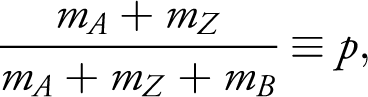
and the probability country B wins is
After the military-spending phase, the bargaining phase follows in which country B proposes
Each player’s utility from the status-quo outcome is given by:



where



If bargaining fails and war breaks out, players’ utilities are given by



where wi
represents country i’s expected utility from war (i.e.

Because war is costly, summation of countries A’s and B’s expected utilities from war is strictly less than the total value of the good (i.e.
The sequence of the game is as follows. In the military-spending phase, country Z first decides whether to align with country A. If
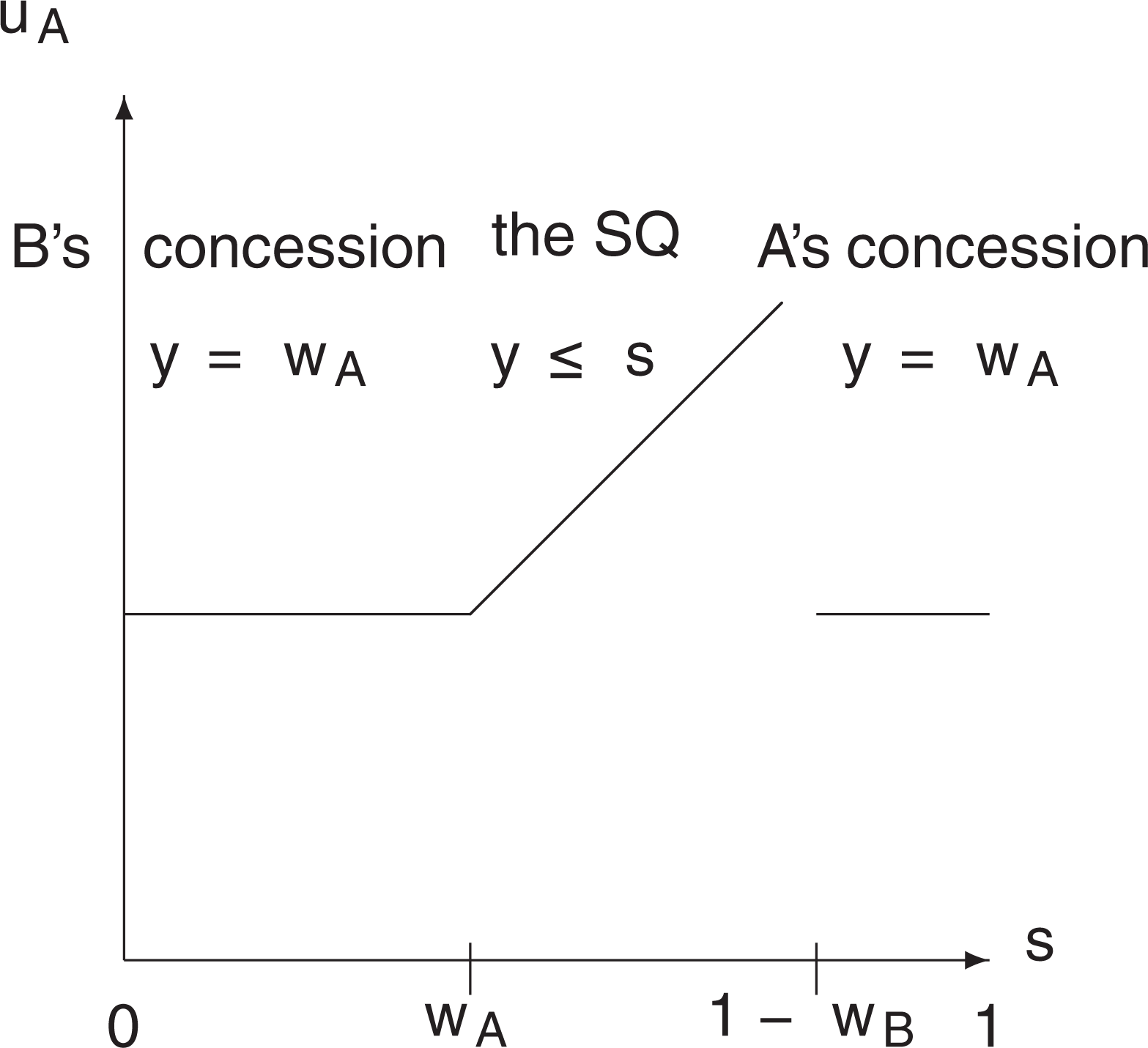
Country A’s utility from each bargaining outcome
Equilibria
Because this is a complete information game, I look for the subgame perfect Nash equilibria using backward induction. Mathematical details and proofs are provided in the Online appendix.
Optimal actions in the bargaining phase
Let us first analyze countries A’s and B’s optimal actions in the bargaining phase (see Lemma 1 in the Online appendix).
18
After country A plays Reject, country B chooses Fight if its expected utility from war is greater than or equal to its utility from the status quo and chooses
In Case 2, neither country has a credible threat to fight. Country B plays
Optimal military capabilities after
Now I look for countries A’s and B’s optimal actions in the military-spending phase after an alliance is not formed (i.e.
Figure 3 displays country A’s optimal armed forces ( Country B’s optimal armed forces and utility after Country A’s optimal armed forces and utility after 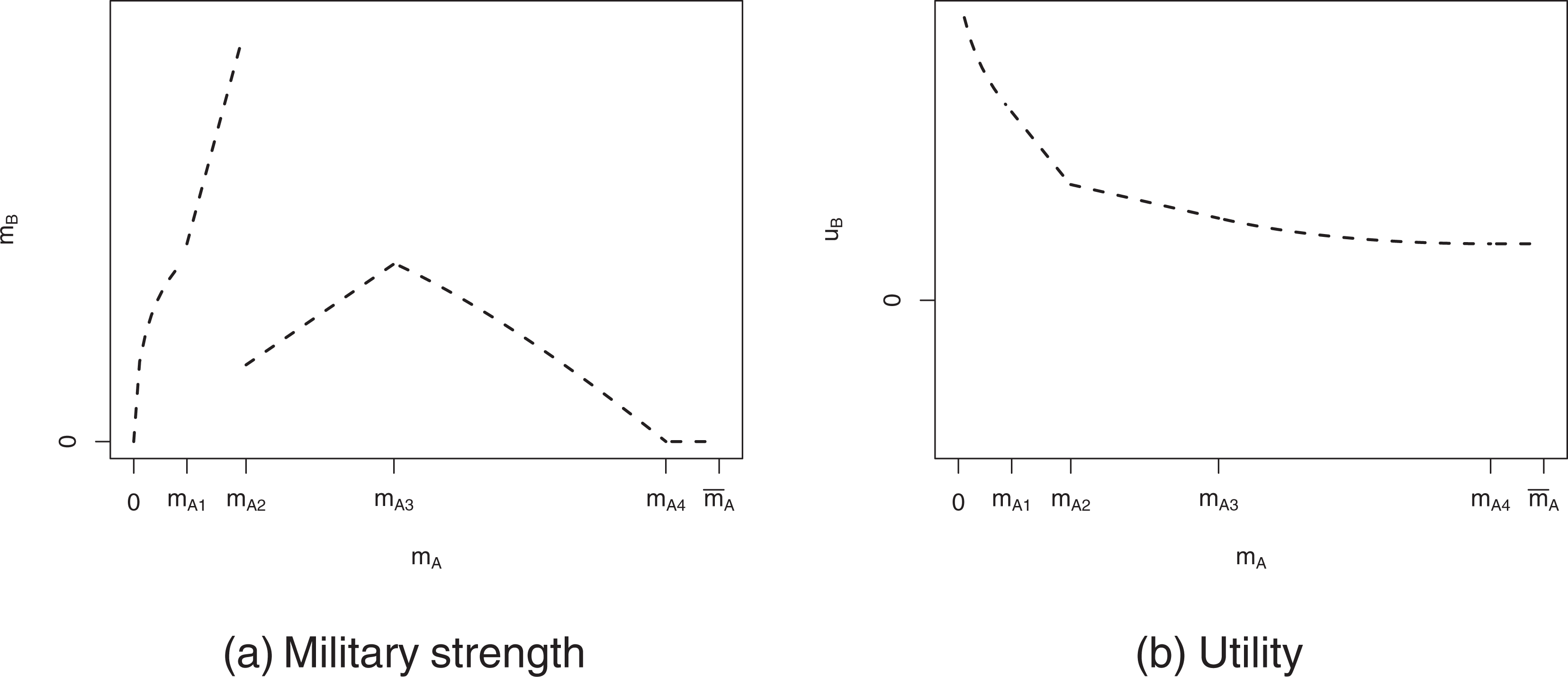
Optimal military capabilities after
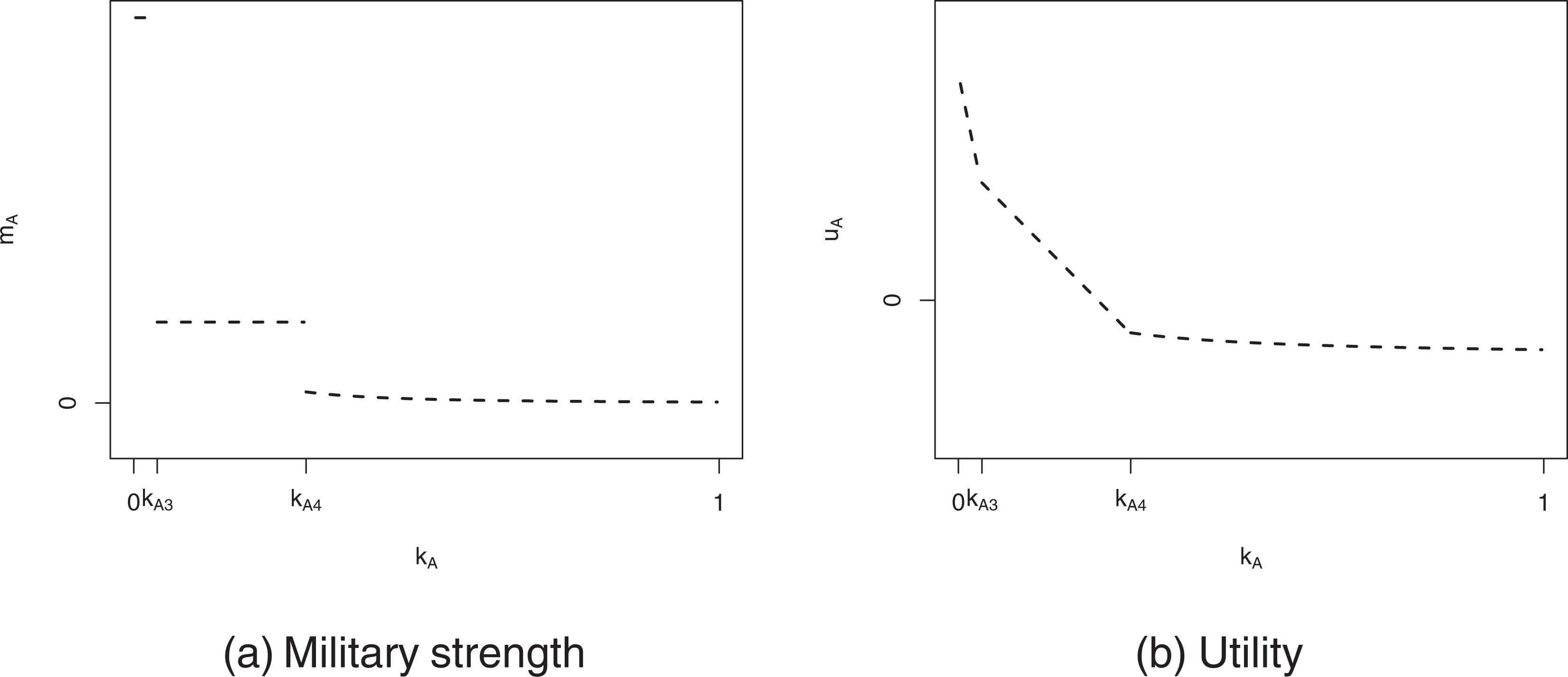
Let us examine players’ optimal military capabilities after an alliance is forged (i.e. Country A’s optimal armed forces and utilities Country Z’s optimal armed forces and utilities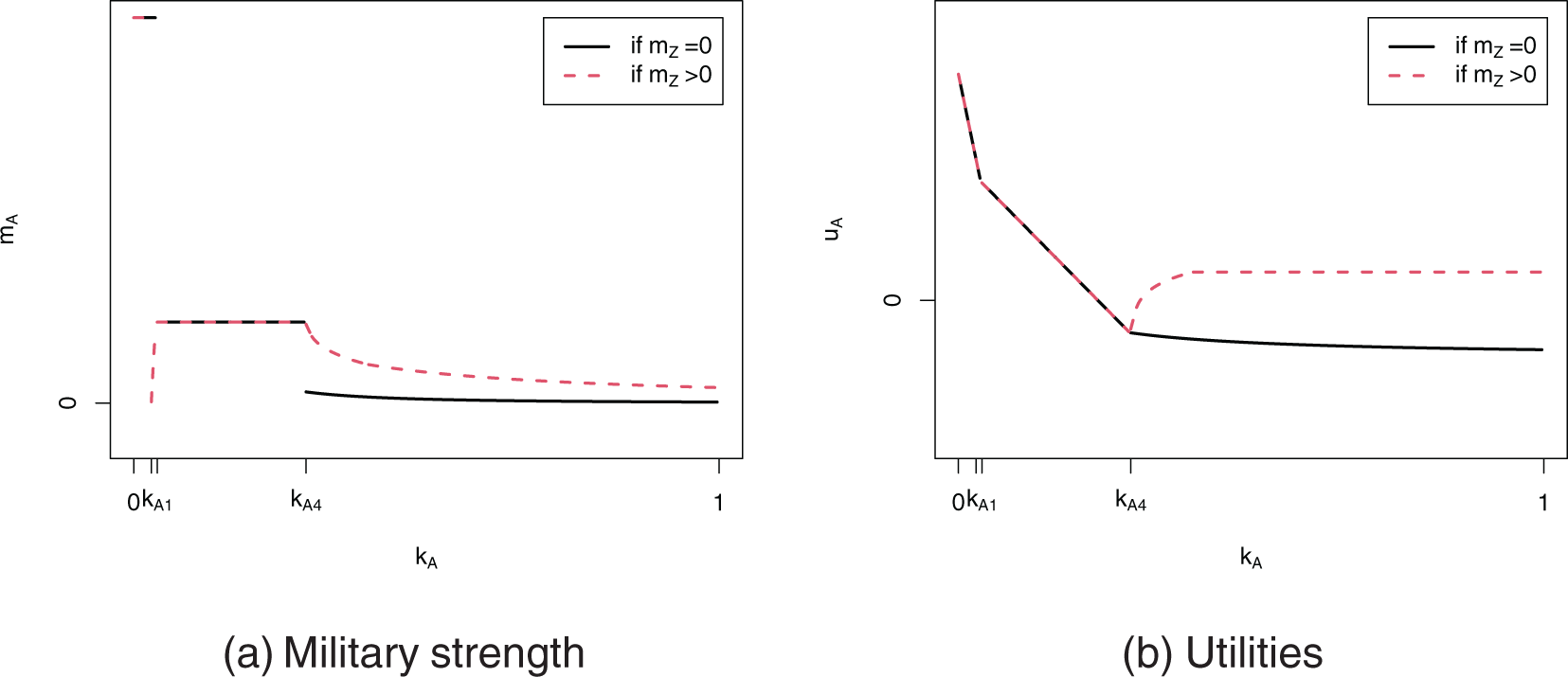
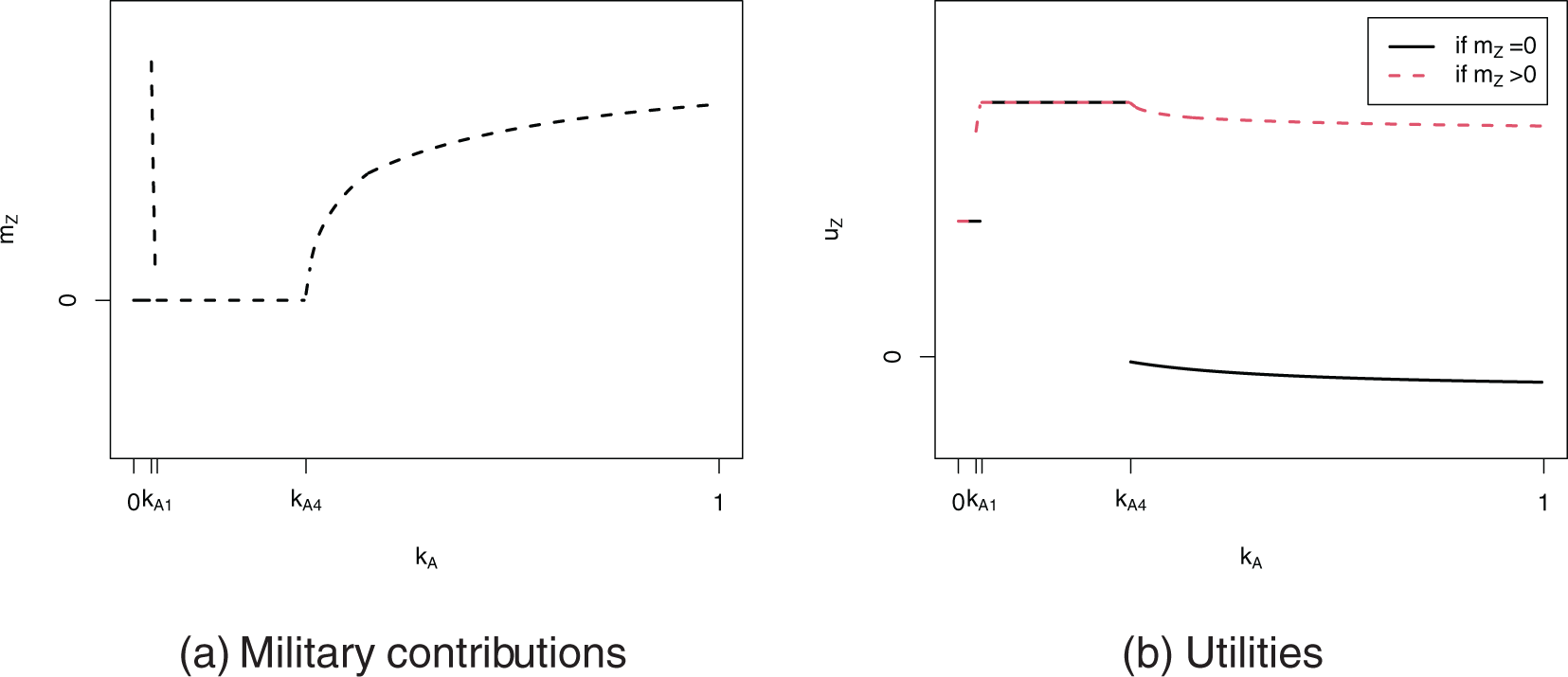
Figure 5(a) displays country Z’s optimal military contributions when kZ
is sufficiently small, and Figure 5(b) exhibits country Z’s utilities from playing The restraining and deterrence effects of an alliance
Alliance burden-sharing and its consequences
Let us summarize the key findings of this research. First, country Z does not forge an alliance unless its formation contributes to the maintenance of the status quo. If countries A and B can preserve the status quo without an alliance, country Z does not offer an alliance so as not to let country A free ride. Also, if country Z cannot dissuade country A from acquiring massive military capabilities and revising the status quo, it does not form an alliance.
Second, a comparison between the bargaining outcomes after
Third, when kA
falls within the range that yields the restraining effect, country Z may shoulder a disproportionately heavy burden to maintain the status quo (asymmetric burden-sharing), but a slight increase in kA
leads to a substantial reduction in country Z’s contributions (Figure 5(a)). In contrast, when kA
falls within the range that generates the deterrence effect, country Z’s contributions increase gradually as kA
becomes greater, and when kA
becomes extremely large, country Z’s military contributions supersede country A’s.
Fourth, recall that when the status quo prevails without an alliance, country Z does not form an alliance to avoid being exploited by the ally (Claim 1). I further find that even when an alliance is forged, country Z does not let country A free ride as it offers only the units of armed forces that suffice to incentivize the ally to aggrandize its military capabilities to deter country B. Although this outcome hinges on the model assumptions, it suggests an alternative way alliance burden-sharing occurs: contrary to Olson & Zeckhauser (1966), the superpower may not always allow the minor powers to exploit its efforts.
Fifth, alliance formation always makes country Z better off while it does not necessarily improve country A’s utility. To restrain country A, country Z makes military contributions to have the ally indifferent between being included in and excluded from the alliance. Conversely, to deter country B, country Z makes contributions to induce country A to strengthen its own armaments. Thus, when the alliance exerts the restraining effect, country A’s utility is not improved, while when the deterrence effect is exerted, it is improved (Figure 4(b)). Country Z’s utility is improved if the status quo is maintained, and its utility is further improved if it successfully induces country A to shoulder a heavier burden to preserve the status quo. This finding helps us understand why historically US policymakers kept urging alliance partners to take on more of the defense burden (e.g. the Nixon Doctrine). Their purposes are not only to prevent alliance partners from free riding but also to let the allies help the United States attain its overarching strategic objectives (i.e. maintenance of the existing world order).
Sixth, when the deterrence effect is exerted, alliance formation may entail power aggrandizement (Morgenthau, 1948) as country A is induced to strengthen its armed forces. Yet their alliance does not provoke country B because country A remains too weak to act unilaterally due to the high cost of arms buildups. Similarly, when the restraining effect is exerted, country B’s security is not threatened because the alliance curtails country A’s incentive to overturn the status quo.
Case study
Now I illustrate how alliance burden-sharing exerts the restraining or deterrence effect by discussing the rearmament process of postwar Japan from 1945 to 1960. I focus on the US-Japan Security Treaty because it provides insights into how the United States strove to preserve the postwar order first by restraining Japan and then by deterring the communist threat while preventing Japan from free riding on its efforts.
Rearmament of Japan from 1945 to 1960
Shortly after the Japanese declaration of surrender, the occupation by the US-led Allied powers took place. 20 General Douglas MacArthur was appointed as the head of the Supreme Commander for Allied Powers (SCAP) which disarmed the Japanese wartime military of six million soldiers (Weinstein, 1971: 8) and implemented the land, labor, and industrial reforms (Nester, 1996: 205–221). Within one year, Japan lost ‘the means or the will to take up arms, either for attack or for defense’ (Weinstein, 1971: 9). At that time, US officials believed that Japan was the primary source of threats in Asia and ‘if Japan’s military power were destroyed, Japan and its neighbors would live in peace’ (Weinstein, 1971: 9). In February 1946, SCAP drafted a new Constitution for Japan, which renounced rearmament and the right to use force as a means of resolving international disputes (Article 9). Although Japanese officials initially resisted, the US draft Constitution was eventually approved by the Diet and came into effect on 3 May 1947 (Schonberger, 1989: 57; Nester, 1996: 214). On 10 April 1946, the first postwar democratic election took place, which brought the Liberal Party to power, and Yoshida Shigeru, a conservative politician, was appointed as prime minister.
By 1947, the Cold War rivalry had heightened, and the occupation policy underwent a reverse course. US policymakers feared that Japan would become the target of the Soviet Union, and the loss of Japan would tilt the balance of power in favor of the Soviets. Although previously the occupation policy had been aimed at protecting the Allied powers from future Japanese aggression, the new policy attempted to defend Japan from the communist threat (Cha, 2016: 129). The US government tried to boost Japan’s economy as it precluded Japan’s large-scale rearmament. George Kennan, the director of the State Department’s Policy Planning Staff, suggested that implementing economic reconstruction (rather than reform) was essential to prevent Japan from falling into the communist camp (Schonberger, 1989: 72). Kennan also called for the establishment of 150,000 paramilitary forces (Welfield, 1988: 71) because he believed that ‘the Russians could not be trusted to honor a demilitarization treaty arrangement for Japan’ (Cha, 2016: 133). However, the enlargement of the police force was delayed due to MacArthur’s objection (Schonberger, 1989: 83) and the discord between the State and Defense Departments (Nester, 1996: 235).
On 18 May 1950, Truman appointed John Foster Dulles in charge of the negotiations for the Japanese peace treaty. Dulles endorsed the State Department’s basic ideas of transforming the wartime enemy into an alliance partner in the Cold War and developing Japanese paramilitary forces (Schonberger, 1989: 245). On 23 June 1950, John Foster Dulles came to Tokyo. By stressing that independent Japan would be vulnerable to the communist threat, he pressed Yoshida for rearmament and acceptance of US bases; he explained that to form an alliance with the West, Japan must take the ‘primary responsibility of protecting itself by its own efforts against the ever present menace of indirect aggression’ (Yoshitsu, 1982: 41; Schonberger, 1989: 248). Although Yoshida longed for an early peace treaty, he also sought US protection of an unarmed Japan; therefore, he refrained from making a clear commitment to rearmament (Yoshitsu, 1982: 41–42). During his visit, Dulles found that almost all Japanese officials he consulted were opposed to rearmament (Schonberger, 1989: 249).
On 25 June 1950, the Korean War broke out, which led the United States to reconfirm that Japan was an important forward base in Asia (Welfeild, 1988: 47). The war also convinced US policymakers that the communist threat against Japan was real, which enabled the State Department to obtain Truman’s (and subsequently, the Pentagon’s) approval for an early peace treaty (Nester, 1996: 251; Cha, 2016: 137). On 8 September, Dulles and Secretary of Defense Louis Johnson reached a consensus on the post-treaty settlement, including Japan’s ‘right to self-defense’ (Schonberger, 1989: 251; Schaller, 1997: 32). On 14 September, Truman publicly stated that the United States was ready to negotiate a peace treaty with Japan (Yoshitsu, 1982: 43).
As US forces stationed in Japan were dispatched to the Korean peninsula, MacArthur was convinced that Japan should establish armed forces to defend itself (Schonberger, 1989: 251). On 8 July 1950, MacArthur directed Yoshida to create the National Police Reserve (NPR) with 75,000 men and expand the existing Maritime Safety Force (MSF) by 8,000 (Yoshida, 1962: 182). 21 Yoshida grudgingly complied, and the NPR was officially founded on 10 August 1950. The NPR was a paramilitary force, which was organized separately from the existing police force and attached directly to the prime minister’s office (Schaller, 1997: 45). Yoshida made these concessions to gain independence, secure US military and economic assistance, and retain access to US domestic markets (Schaller, 1997: 63). The NPR was equipped with weapons, ammunition, and uniforms provided by the United States. Because the Constitution prohibited a military force, Yoshida explained to the public that it was a police force rather than an army (Schonberger, 1989: 251–253; Nester, 1996: 251).
On 25 January 1951, Truman dispatched Dulles to Tokyo to resume negotiations on a peace treaty. The Korean War strengthened Dulles’s belief that the Soviet Union attempted to ‘control the manpower and industrial resources of Japan […] such control over Japan […] would permit the Soviet Union to sustain and win a long war against America’ (Yoshitsu, 1982: 52). Therefore, during the meetings on 29 and 31 January, Dulles kept pressing Yoshida on rearmament; however, Yoshida resisted as rearmament would impede economic recovery, increase the risk of inviting the resurgence of wartime militarism, and provoke neighboring states (Yoshitsu, 1982: 50–57; Schonberger, 1989: 256–257). On 1–2 February, negotiations continued at the staff level, during which US officials threatened to enumerate the rights of US forces in the security treaty rather than in a supplementary document. To prevent this, on 3 February, Yoshida pledged to establish a 50,000-strong ground, air, and maritime force distinct from the NPR and the MSF, though he feared that this creation would provoke domestic opposition (Schonberger, 1989: 257). On 5 February, Dulles presented Japanese representatives with draft peace and security treaties, and on 9 February, they agreed on the terms of the treaties (Yoshitsu, 1982: 65). Although US officials were not satisfied with the level of troops Yoshida promised, they accepted his offer because they understood that a military of 50,000 men was the only offer that Yoshida could make at that time. Dulles stated that ‘the US cannot press the Japanese to assume military obligations until they have dealt with their Constitutional problems, and are in a position formally and publicly to assume such obligations’ (Schonberger, 1989: 258).
On 8 September 1951, delegates from 49 countries signed the peace treaty. Later that day, the United States and Japan signed the US–Japan Security Treaty; Japan agreed to maintain US military bases on its soil, while the United States did not explicitly commit itself to the protection of Japan; Japan granted US rights to intervene in domestic affairs with the consent of the Japanese government and to use bases in Japan to project military power against a third country without consulting the Japanese (Welfield, 1988: 25). In Japan, the majority Liberal and Democratic parties supported both treaties, while Communists, Socialists, intelligentsia, and trade unionists were vehemently opposed to rearmament and the security treaty (Welfield, 1988: 52–54; Schonberger, 1989: 264).
The peace and security treaties took effect on 28 April 1952, and the occupation formally ended. In August 1952, Yoshida established the National Safety Agency and attached it to the Cabinet (Welfield, 1988: 79). The NPR and MSF were placed under the command of the National Safety Agency, and in October 1952, the NPR was renamed as the National Safety Force (Yoshida, 1962: 187). 22 Although the National Safety Force was not given authority to defend Japan against external threats, some units were deployed to Hokkaido, Japan’s northernmost main island, replacing US forces that had been deployed against a Soviet attack (Weinstein, 1971: 69, 108; Welfield, 1988: 80). The establishment of the National Safety Agency imposed substantial costs on Yoshida’s Liberal Party. In the October 1952 general elections, rearmament became a contested issue and the Liberal Party lost 45 seats, while the Democratic Party and two Socialist parties gained 21 and 65 seats, respectively (Welfield, 1988: 81). In the April 1953 elections, the Liberal Party lost 23 seats, while the Socialist parties increased their seats from 116 to 138 (Welfield, 1988: 84).
With the establishment of the National Security Agency, Yoshida thought that he fulfilled his commitment to Dulles (Welfield, 1988: 81). However, in July 1953, he found that he had to alter the defense laws and establish armed forces to make Japan eligible for US economic and military assistance under the scheme of the Mutual Security Assistance Act (MSA) (Yoshida, 1962: 188). The MSA was first brought before the Japanese in September 1952. The US officials explained that if Japan expanded the National Safety Force from 110,000 to 180,000 men by the end of 1952 and to 325,000 by 1954–55, the US Congress would offer $300 million toward the costs (Welfield, 1988: 98; Schaller 1997: 64–65). John Allison, the US ambassador to Japan, also explained to Yoshida that MSA was aimed at enhancing Japan’s self-defense capacity so that US troops could start leaving Japan (Schaller, 1997: 66). The US officials further explained that the United States would not force Japan to rearm beyond the level Japan could afford economically and politically. Believing that MSA aid would not demand new military responsibilities, the Japanese government decided to begin negotiations in June 1953 (Welfield, 1988: 99). Although the MSA demanded that recipients must possess an army and a navy, Japanese policymakers initially believed that Washington would amend the provision to meet Japan’s special conditions. Thus, only after the first round of MSA negotiations on 15 July 1953, did Japanese officials realize the necessity of amending the existing legal framework and establishing defense forces that were capable of fighting against both internal and external aggression (Welfield, 1988: 82–85). In the subsequent talks, negotiations reached an impasse as Japan continued resisting large-scale rearmament by citing the Constitution (Welfield, 1988: 100–102). In February 1954, US officials softened their attitude and agreed on the level of Japanese military; Japan pledged to establish modest air and maritime forces and strengthen its ground forces up to 180,000 (Welfield, 1988: 106; Schaller, 1997: 70).
On 8 March 1954, the United States and Japan signed the Mutual Defense Assistance Agreement in which the United States agreed to aid Japan in establishing its military and Japan promised to gradually take on its own defense, though its contributions were subject to economic and constitutional limitations (Nester, 1996: 270). On 1 July 1954, the Defense Agency Establishment Law and the Self-Defense Forces Law came into force, and the National Defense Agency and the Self-Defense Force (SDF) were established. The SDF was a de facto military force, consisting of ground, maritime, and air forces, had a total of 146,285 personnel, and was authorized ‘to defend Japan against direct and indirect aggression’ (Weinstein, 1971: 75, 108; Nester, 1996: 269).
As the 1951 security treaty had many unequal provisions, Kishi Nobusuke, who served as prime minister from 1957 to 1960, made efforts to eliminate the unequal aspects of the treaty. On 19 January 1960, the Mutual Security Treaty was signed by Kishi and Secretary of State Christian Herter. Under the new treaty, the United States promised to help Japan if it was attacked, while Japan pledged to help US forces in Japan if they were attacked and to strengthen its armed forces to counter external threats (Nester, 1996: 273). To fulfill its promise, Japan gradually increased the SDF; by 1960, it contained 206,001 men (Weinstein, 1971: 111). Meanwhile, since 1955, the size of US military has gradually reduced; between 1955 and 1957, US forces in Japan were reduced from 210,000 to 87,000 men, and by 1960, the number fell to 58,000 (Weinstein, 1971: 111; Welfield, 1988: 110).
Discussion
Shortly after Japan’s surrender, the United States dispatched a significant number of troops to oversee Japan’s disarmament and prevent the former enemy from disturbing the postwar order. Disarmament of Japan mitigated the fear of neighboring states. However, as the communist threat has heightened, the US government transformed its policy toward Japan from restraint to deterrence and started pressing Japan for rearmament. By that time, Japan’s cost of armaments had soared due to various domestic factors, such as a weak economy, constitutional constraints, and public opposition, which forestalled Japan’s large-scale rearmament. Because the US government acknowledged the importance of a stable economy and continuous ruling of the conservative party in Japan, it could not exert strong pressure on Japan. Instead, the United States tried to reduce Japan’s cost of arms buildups by strengthening the ally’s economy and providing economic assistance. US efforts helped Japan revive its economy and gradually increase its defense burden. 23
Conclusion
Alliances have been presumed to serve the dual purpose of deterrence and restraint, while few scholars examined their relationship and the connection with alliance burden-sharing. I developed a game-theoretic model endogenizing the process of arms buildups and alliance formation and demonstrated that alliance burden-sharing may exert the deterrence and restraining effects, though at most one effect is observable at a time because each effect occurs in separate parameter spaces. I also showed that a superpower attempts to prevent the ally’s free riding by offering only the units of armed forces that suffice to incentivize the ally to bolster its own military capabilities. This finding provides new insights into alliance burden-sharing because preceding studies tended to assert that the superpower allows the minor powers to exploit its efforts (Olson & Zeckhauser, 1966). Furthermore, I demonstrated how alliance members could provide reassurance to non-signatories even if their alliance formation entailed power aggrandizement. I employed the US-Japan Security Treaty, an alliance that has been understudied theoretically, to illustrate the deterrence and restraining effects of the alliance. In the Online appendix, I provided two additional cases (i.e. the rearmament of West Germany from 1945 to 1955 and the unification of Germany from 1989 to 1990) to illustrate the logic of alliance restraint. These cases suggest that alliance burden-sharing had a profound influence on the stability in postwar Europe and Asia.
It should be noted that these predictions hinge on the model assumptions, such as complete information, the sequence of the game (i.e. country Z moving first to determine its contributions), and the superpower’s credible commitments. Therefore, future empirical studies need to take into account these constraints when analyzing alliance burden-sharing and its impact on the maintenance of international security. Notwithstanding these limitations, the model outcomes provide several important implications. First, we may need to reconsider the role of a superpower in extended deterrence. Existing models tend to assume that the weak ally’s military capabilities are constant, and that it is the strong ally’s responsibility to fill the military gap between the weak ally and the opponent. The present model rather predicts that the strong ally provides minimal protection and encourages the weak ally to strengthen its own military capabilities. This result suggests that to secure protection, the weak ally needs to make efforts to strengthen itself, and that even if the weak ally’s contributions are smaller than the strong ally’s, it does not necessarily mean that the former free rides on the latter.
Second, an ally’s domestic constraints on arms buildups may exert a profound influence on alliance burden-sharing and the maintenance of the existing order. Because a member’s dependence on an alliance (i.e. alliance burden-sharing) hinges on the marginal cost of arms buildups, if a status-quo power could prevent the prospective ally’s marginal cost from falling dramatically, it might increase the chance of restraining the potential revisionist through alliance formation. Similarly, if it could remove the ally’s domestic constraints, it might reduce its own defense burdens.
Third, as alliances may change the incentive of a revisionist state, they can serve as means of conciliation as well as power aggrandizement (Glaser, 2000). Even though alliance formation may alter the balance of power between the adversaries, as long as the defense burden is appropriately shared, alliances can enhance members’ security without menacing non-signatories. Thus, their formation does not necessarily precipitate the hostility spiral (Snyder, 1997: 17) nor is it preceded by a preventive war (Fearon, 1995).
Footnotes
Replication data

Acknowledgements
I would like to thank Susumu Cato, Saori Chiba, Wilfred Chow, Daniel Connolly, Han Dorussen, Christopher J Fettweis, Hiroyuki Fukushima, Erik Gartzke, Hein Goemans, Kazumi Hori, Hiroyuki Hoshiro, Atsushi Ishida, Kaoru Ishiguro, Hirokazu Ishise, Gaku Ito, Hiroto Ito, Daiki Kishishita, Norihito Kubota, Masayuki Kudamatsu, Shuhei Kurizaki, Phillip Y Lipscy, Kenneth M McElwain, Shigeo Morita, Keisuke Nakao, Akira Okada, Tetsuro Okazaki, Ryosuke Okazawa, Curtis S Signorino, Katsuya Takii, Randall W Stone, the editor, and four reviewers for their valuable comments and suggestions. I am responsible for all remaining errors.
Funding
Financial support from Grants-in-Aid for Scientific Research is gratefully acknowledged (19K01504).