



Abstract
When signaling resolve, is it necessary to go ‘all-in’ and send the strongest possible signal or can sending a lesser signal be effective? Prior research suggests that sending a lesser signal is an admission of irresolution, akin to sending no signal. We make the novel claim that lesser signals of resolve can actually be worse for credibility than sending no signal, particularly in general deterrence situations. We theorize that while the absence of a signal may go unnoticed, a lesser signal puts a spotlight on irresolution. Building on prior findings that high-level visits can function as signals of extended deterrence commitment, we test our theory using new data on visits abroad by the US president, vice president, secretary of state, and secretary of defense. We find that only presidential visits are effective at deterring military challenges against the country visited. Visits by lesser officials, whom we dub the ‘B Team’, actually increase the risk of deterrence failure.
Introduction
In January 2022, as a Russian invasion loomed, US Secretary of State Antony Blinken visited Ukraine. According to the State Department, his visit was intended to emphasize US ‘support for Ukraine’s sovereignty and territorial integrity’ (Lewis, 2022). Yet the Ukrainian government was unsatisfied. Ukrainian President Volodymyr Zelensky encouraged US President Biden to visit himself in a 13 February telephone conversation, saying, ‘I am convinced that your arrival in Kyiv in the coming days, which are crucial for stabilizing the situation, will be a powerful signal’ (Kramer, 2022). Yet the US president did not visit, and Russia invaded Ukraine shortly thereafter. This was not the first instance of Ukrainian dissatisfaction with visits below the presidential level. When Biden visited Ukraine as vice president in 2016, the Kyiv Post wrote, ‘While Biden’s visit to Ukraine will be one of his last foreign trips as vice president, President Barack Obama is the first U.S. president not to visit Ukraine since it became independent’ (Zhuk, 2017). Why was Ukraine dissatisfied with lower-level visits? And did this make a difference for Ukraine’s security?
In this manuscript, we compare the credibility and coercive effectiveness of two types of signals: maximum and lesser. 1 Drawing from Fearon’s (1997) conceptualization, we define a maximum signal as the most costly signal a state can send in a particular situation, or as a signal that could at least plausibly be the most costly in cases where there is ambiguity about the costliness of signals or the signaling options available. We define a lesser signal as a signal that is clearly less costly than other available signaling options. While the definition of maximum and lesser signals is context-dependent, we argue that visits abroad by high-level officials who rank below the leader (dubbed the ‘B Team’) are one of the clearest examples of lesser signals because a similar and more costly substitute exists – namely, a leader visit.
Fearon’s (1997) well-known models predict that credibility requires sending the maximum possible signal. Having the option to send a maximum signal and sending a lesser signal instead is essentially an admission of irresoluteness. Since the absence of a signal also conveys irresolution, Fearon predicts that sending a lesser signal and sending no signal will be equally bad for coercive success. This argument has been echoed by scholars who claim that relatively cheap actions, such as airstrikes, sanctions, or verbal threats are ineffective for coercion (Chamberlain, 2016; Lektzian and Sprecher, 2007; Schwebach, 2000; Zenko, 2010). According to this line of argument, lesser signals are unlikely to be coercively effective, and yet sending them does not harm credibility.
Our argument takes this logic a step further by advancing the novel claim that sending a lesser signal of resolve can sometimes be worse for credibility than sending no signal. Our theory is rooted in literature on individual and organizational psychology. We theorize that government officials are often overwhelmed with information (Finel and Lord, 1999; Katagiri and Min, 2019) and unmotivated to update their beliefs (Jervis, 1976; Kertzer et al., 2020). Thus, the absence of signaling may go unnoticed by government officials who must evaluate an adversary’s resolve over a long time. In contrast, sending a lesser signal can generate renewed attention and put a spotlight on the sender’s weak resolve. We argue that such dynamics are most likely to occur in general deterrence contexts, in which it is often necessary to evaluate other states’ resolve over a period of years or even decades, straining attention spans.
We test the applicability of our theory to extended general deterrence using data on visits abroad by high-level US officials. We code original data on vice presidential visits and combine it with State Department (2022) data on presidential and secretary of state visits and newly released Department of Defense (2022) data on secretary of defense visits. Focusing on visits simplifies the ranking of signal strength, since ‘B Team’ visits are clearly lesser signals than presidential visits. We replicate McManus’s (2018) finding that presidential visits increase the likelihood of extended deterrence success, but we find that B Team visits make deterrence failure more likely. When interacting B Team visits with other signals, we find that they have a less detrimental effect when coupled with stronger signals.
While some studies have analyzed the coercive effectiveness of different signals (i.e. Fuhrmann and Sechser, 2014; Johnson and Leeds, 2011), few have explicitly compared the effect of maximum and lesser signals. Some exceptions are Thyne (2006), who examines the effect of costly and cheap signals on civil conflict onset; Post (2019), who compares the compellent effect of air power signals and other military signals; and Quek (2021), who compares maximum and lesser signals in abstract experimental settings. Our study improves upon this existing research by comparing two real-world signals (leader and B Team visits) that are extremely similar except for their costliness, reducing the potential for confounding. Thus, we find the strongest evidence to date that lesser signals have a harmful effect.
We contribute to a variety of literatures. Our finding that weak resolve can be overlooked until it is highlighted by a visit speaks to recent research on how individual psychology and information processing limitations influence the interpretation of signals (Katagiri and Min, 2019; Kertzer et al., 2020; Yarhi-Milo et al., 2018). We also contribute to literature on the importance of leaders (Carter and Smith, 2020; Debs and Goemans, 2010; Fuhrmann, 2020; Horowitz et al., 2015) and leader visits and signaling (Blankenship, 2020; Goldsmith et al., 2021; Lebovic and Saunders, 2016; Malis and Smith, 2020) in international relations by showing that leader visits have a different effect from visits by other officials.
The debate over the utility of lesser signals has important implications for US extended deterrence signaling and other coercive signaling. We are among the first to argue that more signaling is not always better and that some signals are counterproductive. 2 Given that policymakers do not always understand how their signals are perceived, this suggests that governments may sometimes inadvertently undermine their bargaining positions by sending too many lesser signals.
Existing research on weak signals
The logic of signaling in international relations is well established. States employ threats to deter adversaries from taking action against their interests or to compel adversaries to take desirable actions. States have private information about their resolve to follow through on threats, but they cannot simply tell their rivals about their resolve and be believed because they have an incentive to exaggerate. To overcome this problem, they must signal resolve in a costly way. Costly signals enhance the credibility of threats because less resolved states should be more reluctant to pay the cost of sending them (Fearon, 1997). In turn, greater credibility enhances the likelihood of coercive success, meaning greater odds that the target of the threat will comply. Yet while there is widespread acknowledgment that costly signals contribute to coercive success, less attention has been devoted to how costly a signal must be.
We compare two types of signals: maximum and lesser. As stated earlier, we consider a signal to be maximum if it could plausibly be the most costly signal that could be sent in a particular situation, whereas a lesser signal is clearly less costly than other available signaling options. 3 Precisely which signals are maximum and lesser is context-dependent. For example, while an alliance is probably a costlier extended deterrence signal than a visit, in circumstances where forming an alliance is infeasible, a visit could be a maximum signal. We further address the challenges of applying these definitions to the real world in our research design section. For now, we treat maximum and lesser signals as theoretical ideal types.
Our concepts of maximum and lesser signals are derived from Fearon (1997), who presents models of sunk-cost and hand-tying signaling. In both models, a defender seeking to deter a challenger chooses the cost of the signal to send. In the sunk-cost model, it is possible to sink a cost so large that only a defender who is certain to fight would sink it. Similarly, in the hand-tying model, it is possible to generate such a large hand-tying cost that the defender will certainly prefer fighting over backing down. Therefore, it is possible to signal with complete credibility in both models. Yet a perverse prediction of Fearon’s models is that sending a signal of anything less than full commitment is viewed as a clear indication that the defender is not willing to fight. The reasoning is that types who are willing to fight can always do best by signaling full commitment. It can thus be inferred that states that send less costly signals are unwilling to fight. Since the absence of a signal is also an admission of irresolution in Fearon’s models, this suggests that sending a lesser signal and sending no signal will have equally detrimental effects on perceptions of resolve.
Other arguments suggest that lesser signals do not indicate a total absence of resolve. Fearon (1997) himself notes that resolved states might weaken their signals due to domestic constraints, concerns about provocation, fear of emboldening allies, or uncertainty about future resolve. Others argue that lesser signals may be sent to leave open the possibility of compromise (Trager, 2013), lull adversaries into complacency (Slantchev, 2010; Trager, 2010), retain coalition support (Wolford, 2014), or avoid third-party backlash (Wolford, 2020). If states that are resolved to fight send lesser signals for any of these reasons, then observing a lesser signal is not necessarily akin to observing no signal. Nonetheless, we can still expect that lesser signals will result in relatively low estimates of resolve. The reasons not to send maximum signals listed above are essentially signaling costs, and unwillingness to bear these costs suggests lower resolve.
Few studies have examined the impact of maximum and lesser signals empirically. Quek, (2021) explores this with experiments in which subjects are told the numerical cost of a signal and asked to rate credibility. He analyzes four types of signaling costs: sunk costs, hand-tying costs, installment costs, and reducible costs, and finds in most cases that a low-cost signal reduces credibility compared to sending no signal, although the difference is insignificant. Few studies have compared maximum and lesser signals using real-world data. Some research compares the effectiveness of different signals, but makes no claims about their relative costliness (i.e. Fuhrmann and Sechser, 2014; Yarhi-Milo et al., 2018). Thyne (2006) compares the impact of costly signals (sanctions, troop mobilization, alliances, and trade ties) and cheap signals (statements and diplomatic activity) on civil war onset. He finds no effect of costly signals, but his results indicate shifts in cheap signaling increase the likelihood of civil war. One scholar who compares the effect of more and less costly signals in interstate bargaining is Post (2019), who argues that airpower signals are less costly than other military signals. She finds that airpower signals not only fail to aid compellence success, but even counteract the positive effect of other military signals.
Quek’s (2021), Post’s (2019), and Thyne’s (2006) findings provide tentative evidence that lesser signals may be not only ineffective, but worse than sending no signal. Yet these scholars do not explore this evidence in depth, nor do they offer compelling theories about why this might be true. Below we offer a novel theoretical argument for the counterproductive effect of lesser signals and a new empirical test that provides a clearer comparison of maximum and lesser signals.
How lesser signals can undermine credibility
The 19th century British Prime Minister Benjamin Disraeli said that Britain ‘must be careful about “demonstrations”’, i.e. signals of resolve because, ‘Unless it hits the nail on the head, it will be looked on as weak and hysterical’ (Buckle, 1920: 51). Similarly, later British Prime Minister Winston Churchill said that ‘a gesture of power not fully implemented was almost less effective than no gesture at all’ (Forrestal, 1951: 144–145). These leaders were expressing concern that sending lesser signals of resolve could undermine the credibility of threats compared to sending no signal. But why should this be true, when lesser signals do entail some costs? We offer a theory to explain this based on the context of signals and how policymakers process them.
Most formal models consider signaling as a one-time event, typically during a crisis. Yet a larger number of real-world signals are sent in general deterrence contexts – in which a military challenge is possible, but not believed to be imminent (Morgan, 1977). Countries often send repeated general deterrence signals of resolve for years or even decades, including during times of relative peace. For example, the United States signaled resolve to defend South Korea by conducting military exercises, transferring arms, and making supportive statements in every year between 1990 and 2010, in addition to maintaining an alliance and large troop presence (McManus and Nieman, 2019).
We argue that the need to evaluate resolve over a prolonged time, such as during general deterrence, has important implications for the ability of policymakers to process the information conveyed by signaling. Scholars have long recognized that governments struggle to interpret the intentions of other states accurately (Jervis, 1976). One problem is that governments are overwhelmed with information. As Vertzberger (1990: 53) says, ‘Decisionmakers are not, however, willing – or, even more important, able – to pay attention to all sources of information available to them and then decide what is relevant. Attention is a scarce resource and is therefore selective.’ Such information overload can lead to difficulties in processing information. For example, an inability to distinguish ‘signal’ from ‘noise’ contributed to failure to warn of the Pearl Harbor attack (Wohlstetter, 1962). Similarly, Finel and Lord (1999) argue that more sources of information hinder conflict resolution because decisionmakers are unsure which information is authoritative. Katagiri and Min (2019) argue that policymakers struggle to process public statements because of their frequency.
The findings above suggest that if the period over which one country must evaluate another’s resolve stretches out over months or years, as it often does in general deterrence situations, some changes in signaling will be missed because of inattention. We further argue that the absence of signaling will be slower to result in updated beliefs than the presence of new signals. This is true for two related psychological reasons: first, confirmation bias creates a tendency to continue holding beliefs based on previous signals. Second, the absence of a signal is insufficiently vivid to update beliefs.
Confirmation bias is the tendency to cling to pre-existing beliefs, failing to seek information that could contradict them and sometimes even dismissing contradictory information. In international relations, Jervis (1976) and Kertzer et al. (2020) argue that confirmation bias presents an obstacle to updating beliefs about adversaries’ motives based on new information. There is sometimes an overlap between confirmation bias (clinging to existing beliefs) and motivated reasoning (clinging to what one wants to believe), but studies have found evidence of confirmation bias even in the absence of motivated reasoning (Bruner et al., 1956; Hodgins and Zuckerman, 1993; Shaklee and Fischhoff, 1982; Tweney et al., 1980; Wason, 1960). Thus, regardless of what policymakers want to believe about adversaries’ resolve, they are unlikely to seek information contradicting their beliefs formed based on previous signaling. Since the absence of signaling is rarely covered in the media, policymakers would have to make extra effort to track halts in signaling. Confirmation bias suggests this is unlikely to happen.
One might wonder whether anything can overcome the fixity of beliefs caused by information overload and confirmation bias. Drawing on previous research by Tversky and Kahneman (1973) and Vertzberger (1990), Yarhi-Milo (2014) proposes that new information can overturn existing beliefs if it is sufficiently ‘vivid’. Yarhi-Milo (2014) defines vividness as the ‘emotional interest of information, the concreteness and imaginability of information, and the sensory, spatial, and temporal proximity of information’ (p. 16). According to Yarhi-Milo, vivid information is influential to policymakers because it is engaging and remains in their memory.
The theory of vividness has important implications for the impact of sending lesser signals of resolve versus no signal. The absence of a signal can never be vivid because it lacks concreteness and cannot be tied to any particular point in time. There can be no pictures or soundbites from an absent signal, and there is nothing to trigger an emotional reaction. Therefore, the presence of a signal, either maximum or lesser, will always be more vivid than the absence of a signal. Not all signals will be vivid enough to update beliefs, but at least some signals will be. The next section argues that high-level visits are likely to be quite vivid signals.
To summarize our argument so far, we claim that the absence of signaling can go unnoticed in general deterrence and other situations where attention is limited, allowing previous estimates of resolve to persist. 4 We also claim that signals will at least sometimes be sufficiently vivid to update beliefs about resolve. Putting these claims together leads us to expect that lesser signals will, on average, have a worse effect on credibility than sending no signal. The following logic shows why: if a lesser signal updates observers’ beliefs about resolve, then the updated estimate of resolve will be low because observers will note that the sender lacked the resolve to send a maximum signal. If the previous estimate of resolve was also low, then the lesser signal will have no substantive effect. However, if the previous estimate of resolve was high, then observing the lesser signal will lower it. Because the high estimate of resolve could have persisted longer in the absence of signaling, the lesser signal harms the sender’s credibility in this case. Since lesser signals leave low estimates of resolve unchanged and reduce high estimates of resolve, we expect their average effect on the sender’s credibility to be worse than sending no signal.
Therefore, although the precise effect of any given lesser signal will be conditional on prior signaling and beliefs, our theory yields an expectation about the average effect of lesser signals that is unconditional. On average, lesser signals harm credibility. It follows that the lower credibility associated with lesser signals will, on average, reduce the odds of coercive success. While this argument applies to any coercive situation where attention is limited, we focus on general deterrence as the situation most likely to strain attention. This leads to the following hypothesis:
Hypothesis 1: Sending a lesser signal when a costlier signaling option is available will decrease the likelihood of general deterrence success compared to sending no signal.
High-level visits as signals
As noted earlier, few scholars have compared the impact of maximum and lesser signals empirically. One impediment to empirical analysis is difficulty in measuring signal strength. Another obstacle is observability: if lesser signals are non-credible, then rational leaders might not send them, making their detrimental effect difficult to observe. We overcome these challenges by analyzing high-level visits as signals of resolve to defend the visited state. We specifically define high-level visits as visits by cabinet-level officials or above. All high-level visits except leader visits constitute ‘B Team’ visits. Visits by officials below the cabinet level are insufficiently vivid to factor into our argument.
Recent research has highlighted the importance of high-level visits in international relations (Goldsmith et al., 2021; Lebovic and Saunders, 2016; Malis and Smith, 2020). The concept of high-level visits as signals of resolve was introduced by McManus and Yarhi-Milo (2017) and McManus (2018). These scholars focus on visits by major power leaders to weaker states, which they argue can serve an extended general deterrence function. Even when visits do not have an explicit security-related purpose, McManus (2018) argues that media coverage of the visit can lead to hand-tying costs in the form of domestic backlash and reputational damage if the visitor’s country later abandons the visited country. In addition to hand-tying costs, high-level visits involve sunk costs, mostly in terms of time expended. Thus, visits can raise estimates of the probability of military intervention – or other costly forms of assistance, such as military aid or sanctions – if the visited country is challenged.
If visits convey a credible commitment to assist the visited country when it faces a military challenge, then visits should boost the odds of extended deterrence success. McManus (2018) finds support for this expectation, showing that major power leader visits decrease a minor power’s likelihood of facing a military challenge. Moreover, there may be a similar deterrent effect at the domestic level. Malis and Smith (2020) show that US presidential visits deter domestic rivals from challenging a leader. However, no one has yet explored the deterrent effect of visits by officials ranking below the leader.
Ranking visits
Identifying which signals of resolve are maximum and lesser can be challenging because their costs may differ not only in size, but also in nature. Furthermore, the perception of which signals are costlier might even vary with individual psychology (Holmes, 2018; Yarhi-Milo et al., 2018). Analyzing high-level visits as signals of resolve helps to address these measurement challenges because visits by officials of different ranks are very similar signals, except for their costliness. Visits by any high-level official involve similar activities and imagery. Therefore, when comparing the costliness of visits, it is not necessary to make apples-to-oranges comparisons between different types of signaling costs.
We argue that leader visits can potentially be maximum signals. Although other signals, such as alliances, troop deployments, or arms transfers might be more costly, it is not always feasible to send such signals. Alliances take a long time to establish and cannot be repeated once established. 5 Troop deployments and military exercises can take some time to plan and are subject to the limitations of finite military resources. Arms transfers are a more flexible signal, but they may not always be possible due to domestic constraints, such as opposition from the legislature. 6 When costlier signals are infeasible, leader visits meet our definition of maximum signals. Nonetheless, we do not claim that leader visits are always maximum signals, nor does our empirical strategy rest on determining which type of signal they are. Since we focus on the effect of lesser signals, all that is required is to identify one signal that is clearly lesser.
Visits by B Team officials, whom we defined earlier as ranking at least at the cabinet level but below the leader, can almost always be considered lesser signals than leader visits for two main reasons. First, they generate lower hand-tying costs. As scholars such as Lupton (2020) and Renshon et al. (2018) note, reputational costs often adhere more to leaders than states. McManus (2018) further argues that the hand-tying costs generated by images of comradery during a visit are specific to the individual who visited. Thus, B Team visits allow leaders more freedom to abandon the country visited without suffering personal hand-tying costs. Second, because lower-level officials’ time is less precious than leaders’ time, B Team visits also have lower sunk costs.
In most cases when a lesser official visits a country, it would have been possible for the leader to visit personally instead. Of course, leaders cannot constantly visit every country in the world, but there is usually no specific reason why they could not visit a particular country in a particular year. Given the option to send a stronger signal by having the leader visit, B Team visits are nearly always lesser signals by our definition. For example, when President Carter sent Vice President Mondale to attend the funeral of Yugoslav leader Tito instead of attending himself, it was perceived as a signal of low resolve. According to the New York Times, ‘The general attitude in Western European countries [. . .] was that Mr. Carter had missed an opportunity to show American support for Yugoslavia in its struggle to maintain its independence of the Soviet Union’ (Apple, 1980). The Times of London said the decision showed Carter was ‘blind to the stature of President Tito, to the importance of Yugoslavia, to the mood of the Yugoslav people, to the interests of the United States’ (quoted in Apple, 1980).
Observability and vividness
Focusing on visits also helps us overcome the problem of observability. The nature of the problem is that if lesser signals are ineffective, then rational leaders might never send them. In the case of high-level visits, however, the politics associated with patron–client relations can easily result in suboptimal signaling decisions. Client states will rationally demand leader visits. When a patron state is insufficiently resolved to send its leader, our theory suggests it would be better off sending no signal. However, patron state officials may be reluctant to straightforwardly decline a leader visit request due to both norms and psychology. Foreign policy officials are socialized in an environment where compromise is valued and a straightforward ‘no’ may be considered undiplomatic. Second, action bias, a common tendency to take action to address a problem even when doing nothing is better (Patt and Zeckhauser, 2000), may cause patron state officials to believe they cannot simply ignore a visit request. These dynamics may lead the patron state to propose a B Team visit when the client desires a leader visit. While our theory suggests the client should decline the B Team visit, the client may fear offending the patron. Moreover, the client may see some benefits in B Team visits that could outweigh their negative effect on deterrence. Such benefits might include the ability to hold in-person consultations, which could result in more aid from the patron, and a possible improvement in the government’s domestic standing (Malis and Smith, 2020). For these reasons, we expect B Team visits to be regularly undertaken, even if they have the detrimental effect that we predict. 7
A final benefit of focusing on high-level visits to test our theory is that they are likely to be vivid signals to policymakers in potential challenger countries, who are the key audience for extended deterrence signals. One reason is their press coverage. We found that the New York Times covered 98% of secretary of state trips in our sample. Moreover, high-level visits are even more likely to have media coverage in the receiving country, where they are a greater novelty. Another reason that high-level visits will be vivid to policymakers is that many policymakers participate in similar visits themselves. Therefore, while B Team visits are less costly signals than leader visits, they should be about equally vivid signals to the key audience, foreign government observers.
Research design
We now turn to describing our research design, which analyzes how maximum and lesser signals – namely, leader visits and B Team visits – affect extended general deterrence success. As explained earlier, our theory is most applicable to general deterrence because the long time horizons strain attention and can cause the absence of signals to be overlooked. We focus our empirical analysis specifically on extended general deterrence because extended deterrence is inherently less credible than direct deterrence, and therefore signals of resolve play a greater role in extended deterrence. We expect maximum signals to increase the perceived credibility of extended general deterrence and thus contribute to deterrence success. We expect lesser signals to have the opposite effect. We utilize a dataset of politically relevant directed dyad-years between 1950 and 2010 for our main analysis. 8 We also test our hypothesis in a narrower sample that contains only rival dyad-years (Goertz et al., 2016) 9 as well as other samples (see Table A4 in the Online appendix) to make sure that our results are robust.
Our main dependent variable is Violent MID Initiation, a binary variable that scores 1 if the first state (State A) in a dyad-year initiated a militarized interstate dispute (MID) involving force against the second state (State B). This variable is derived from the Militarized Interstate Dispute Dataset, Version 5.0 (Palmer et al., 2022), in which a MID is defined as a threat, show, or use of force. Using MID initiation as our dependent variable makes our study comparable to other studies of deterrence and extended deterrence (Fuhrmann and Sechser, 2014; Johnson and Leeds, 2011; McManus, 2018; Weisiger and Yarhi-Milo, 2015). We focus particularly on violent MIDs to avoid including trivial disputes, but Online appendix Table A4 shows our results are robust to broader and narrower dependent variables.
Our primary independent variables are indicators for high-level visits to State B. We restrict our focus to US extended deterrence and only include visits by US officials. 10 The US-centric focus is primarily driven by information availability, but it is also appropriate because US superpower status makes US visits particularly impactful, as shown by McManus (2018: 988). Although any US cabinet official could be part of the B Team under our definition, we focused on collecting data about the B Team members who most often travel abroad. We obtained data on presidential and secretary of state visits from the State Department (2022). We obtained newly released data on secretary of defense visits from the Department of Defense (2022). We collected original data on vice presidential travel by hand-coding New York Times articles. 11
Figure 1 shows temporal trends in the different types of visits. 12 Presidential visits increased dramatically around 1960, remained steady for three decades, and began rising again around 1990. Secretary of state travels have also increased over time. In contrast, vice presidential and secretary of defense visits increased initially, but declined in more recent years. Online appendix Table A2 presents regressions analyzing the predictors of each type of visit. As expected, many indicators of a country’s power, importance, and closeness to the US are significant predictors of all types of visits. However, a few variables predict some types of visits and not others. The B Team is significantly more likely to visit countries with new leaders (Goemans et al., 2009), but presidents are not, suggesting that visiting new leaders is a matter of protocol relegated to the B Team. Also, whereas participating in a military dispute on the same side as the US significantly increases the likelihood of both presidential (P = 0.059) and B Team visits (P = 0.010), involvement in disputes without the US only significantly increases the probability of B Team visits. This suggests that the B Team is more likely to visit countries whose security interests are less closely aligned with the US.
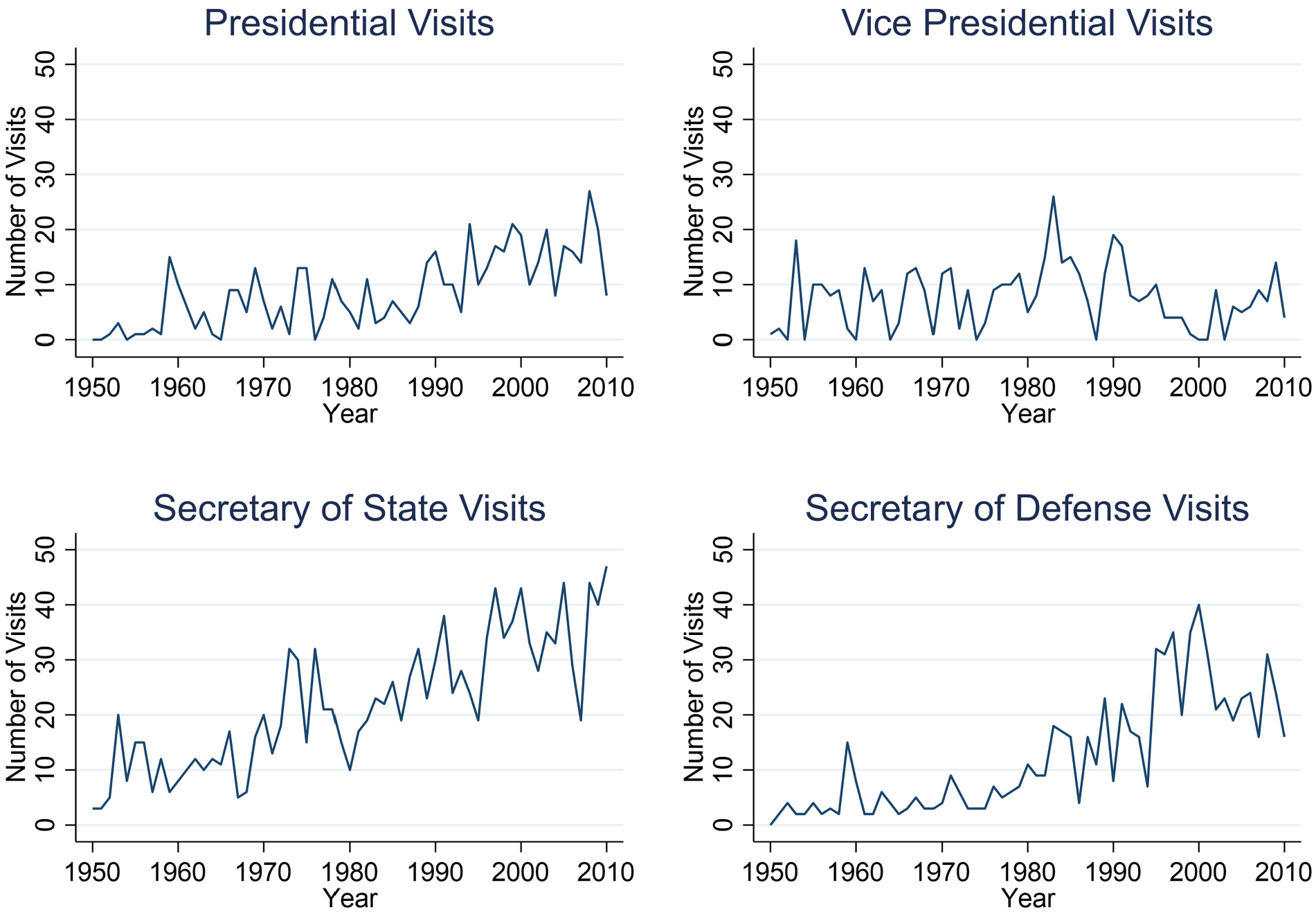
Total visits over time.
The visits data are used to create the main independent variables in our regressions: Presidential Visit, Vice Presidential Visit, Secretary of State Visit, Secretary of Defense Visit, and B Team Visit. The B Team variable indicates a visit by the vice president, secretary of state, or secretary of defense. Each of these variables scores 1 if the designated type of visit occurred under the current US presidential administration but prior to the current year. 13 When multiple officials traveled together, we only code the highest official. 14 We include all visits by the relevant officials in our independent variables, in keeping with the argument of McManus (2018: 985) that even non-security-related visits can serve as extended deterrence signals. In robustness checks, we drop multilateral visits, vary the number of years over which we count visits, and account for the relative frequency of different visit types (Table A5 in the Online appendix).
For our main models, we use rare events logit with robust standard errors clustered by dyad (Tomz et al., 2003). 15 In addition to the visit variables, we control for whether State B has a US defense pact (Leeds et al., 2002) because an alliance could be viewed as an even stronger signal of resolve than a leader visit. We also include standard controls for land contiguity (Stinnett et al., 2002), distance (Bennett and Stam, 2000), military power (Singer et al., 1972), regime type (Marshall et al., 2010), and temporal dependence (Carter and Signorino, 2010). In later robustness checks, we add additional controls and also estimate a parsimonious model with considerably fewer controls (Tables A6 and A7).
Results
The main results are shown in Table I. Models 1 and 2 are basic tests of Hypothesis 1, in a sample of politically relevant directed dyad-years and a sample of rival directed dyad-years respectively. Model 3 explores variation in the effect of different types of B Team visits. The initiation of a MID represents a deterrence failure, so variables with negative coefficients contribute to deterrence success, while variables with positive coefficients contribute to deterrence failure. In all models, we see that the presidential visit indicator is negative and at least weakly significant. This replicates the finding of McManus (2018) that presidential visits contribute to deterrence success, suggesting that they are probably often viewed as maximum signals.
Rare events logit models predicting Violent MID Initiation.

Control variable and constant coefficients are shown in Table A8. Standard errors, clustered by dyad, are in parentheses. †p < .10, *p < .05, **p < .01.
In Model 1, the B Team Visit coefficient is positive and highly significant, which supports our expectation that visits from high-ranking officials other than the president undermine general deterrence success. Model 2 shows that this result holds even in the much smaller sample of rival dyads. Model 3 analyzes the effect of visits by different B Team members separately. Secretary of state visits have a positive and strongly significant effect, while vice presidential visits have a positive and weakly significant effect. In contrast, the effect of secretary of defense visits is insignificant. This may be because the secretaries of state and defense visit mostly the same countries, but the secretary of state visits more frequently, as illustrated in Figures 1 and A1. Although secretary of state visits appear to be the primary driver of the B Team effect, we note that the B Team coefficient in Model 1 is more significant (P = 0.0003) than the Secretary of State coefficient in Model 3 (P = 0.004), which suggests that the other visits also contribute to the B Team effect. We therefore continue to use the B Team variable in our subsequent analysis.
Although Models 1–3 suggest that B Team visits have a harmful effect on extended general deterrence, we might wonder whether the harmful effect applies to all circumstances. Some might expect B Team visits to be less harmful and perhaps even beneficial when the United States sends few or no other signals of support for a country. In this circumstance, it might be argued, even a B Team visit might seem like a dramatic signal of resolve. Yet this logic is contrary to our theory. Since the absence of signaling is more likely to go unnoticed, we expect B Team visits to highlight weak resolve and have the most harmful effect when sent alone. B Team visits will have a less detrimental, though still not helpful, effect when combined with maximum signals. As long as a maximum signal is sent, it will be clear that the sender is resolved, so additional lesser signals will do no harm. We explore these expectations with interactions in Table II.
Logit interaction models predicting Violent MID Initiation.

These are logit models estimated in a sample of politically relevant directed dyad-years. We use logit to simplify the calculation of substantive effects. Table A9 in the Online appendix shows the results using rare events logit are very similar. Control variable and constant coefficients are also shown in Table A9. Standard errors, clustered by dyad, are in parentheses. †p < .10, *p < .05, **p < .01.
Model 1 in Table II interacts the B Team Visit and Presidential Visit indicators. The interaction coefficient is not significant, but the predicted probabilities, plotted in Figure 2, are insightful. The predicted probability of deterrence failure is highest when there has been only a B Team visit. This probability is 36% higher than in the case of no visit at all, and the difference is highly significant (P = 0.0003). In contrast, when a B Team visit occurs together with a presidential visit, the predicted probability of deterrence failure is 13% lower than in the case of no signal, although this difference is not significant. Notably, the predicted probabilities in the case of a presidential visit alone and the case of a presidential and B Team visit together are almost identical. This suggests that when paired with a maximum signal, a lesser signal does no harm but also does not contribute to improving deterrence. This fits with our expectation.
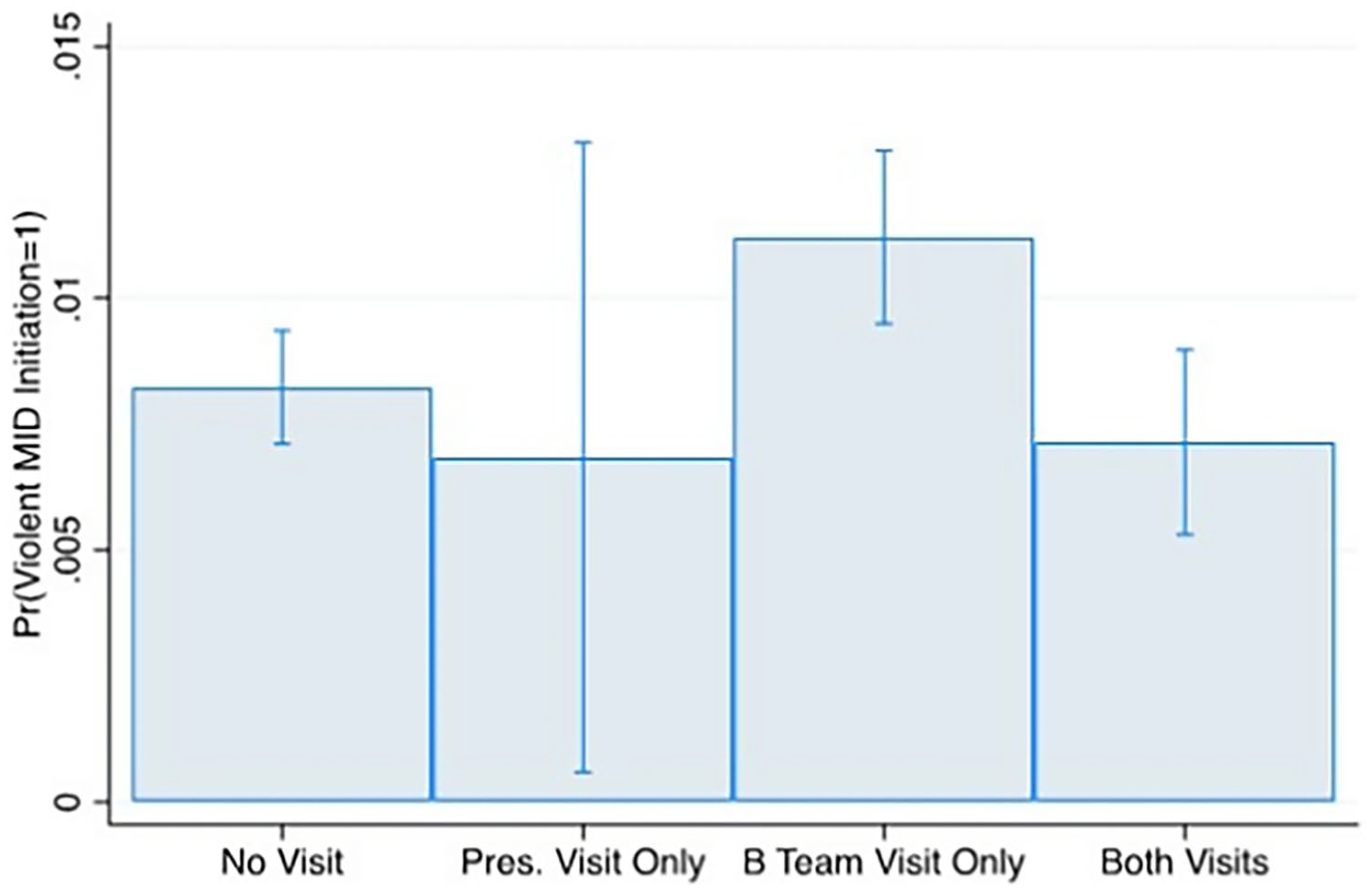
Predicted probabilities of violent MID initiation from Model 1 in Table II.
We also explore how B Team visits interact with a wider variety of signals. Since interacting the B Team Visit variable with every other possible US signal individually would be cumbersome, we use McManus and Nieman’s (2019) aggregate measure of US support signaled for other states. This measure combines information about alliances, presidential visits, presidential statements, military exercises, nuclear deployments, troop deployments, and arms transfers using a Bayesian latent variable model. While this measure does not distinguish between maximum and lesser signals, higher values of this measure should be associated with costlier signals that are more likely to be maximum. We interact McManus and Nieman’s measure, which we normalize between 0 and 1 and dub US Support Score, with the B Team Visit indicator in Model 2 (Table II). The interaction coefficient is highly significant.
Figure 3 plots the average marginal effect of B Team Visit as a function of US Support Score. We see that the effect of a B Team visit depends on how much other support is signaled. For the approximately 80% of observations with a support score less than 0.35, the B Team marginal effect is positive and significant, meaning that B Team visits increase the risk of deterrence failure for these countries. For the remaining observations, a B Team visit has no significant effect. These results are in keeping with our expectations, as sending a B Team visit with few or no other signals seems to be the worst thing for deterrence.
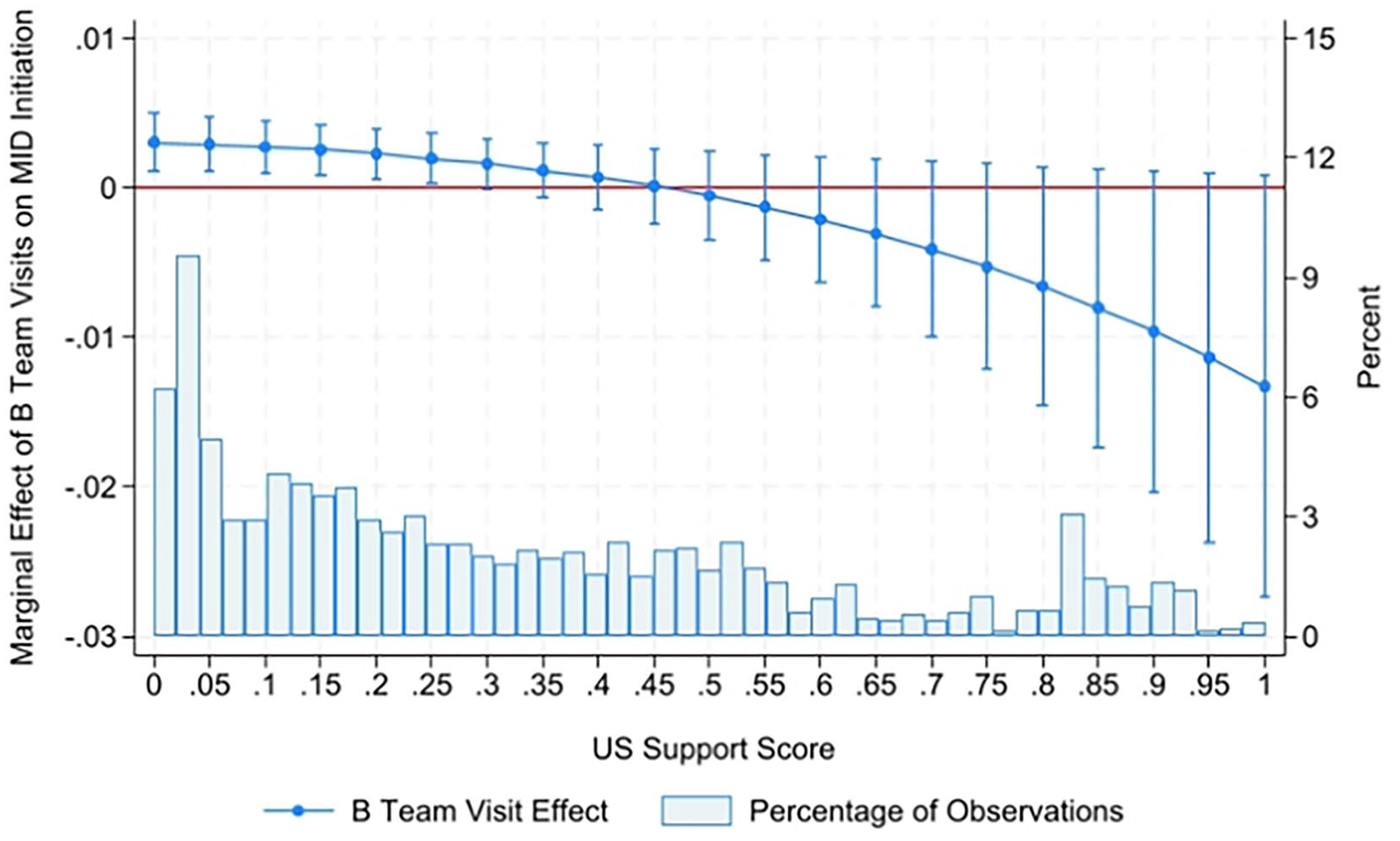
Marginal effect of B Team Visit on Violent MID Initiation as a function of US Support Score, from Model 2 in Table II.
Addressing treatment selection bias and robustness
The results so far support our hypothesis that lesser signals increase the probability of general deterrence failure, but some readers may wonder if this is due to treatment selection bias because the B Team is more likely to visit places that are already likely to have MIDs. This could be true because the president wishes to avoid danger, because the president wants to avoid hand-tying costs when he is not resolved to fight, or because the B Team – particularly the secretary of state – might be better equipped to handle negotiations aimed at avoiding conflict. All of these possibilities are plausible, but we do not believe that the differences in travel patterns are enough to drive our results. Indeed, we found earlier that MIDs fought with the US are a positive and weakly significant predictor of presidential visits, meaning that presidents do not entirely shy away from visiting MID-prone countries. Also, Table A7 in the Online appendix shows that B Team visits to the potential initiator (State A) in the dyad do not increase the probability of MID initiation, as we would expect if the apparent harmful effect of B Team visits simply reflected failed attempts to resolve disputes.
To more formally test for treatment selection bias, we use a bivariate probit model to estimate the probability of a B Team visit and a B Team visit’s effect on the probability of violent MID initiation simultaneously. This model is designed to account for the possibility that unobserved factors may simultaneously influence both probabilities by accounting for the correlation of the equations’ error terms. The first equation predicts Violent MID Initiation using predictors from Model 1. The second equation predicts a B Team visit to State B using the significant country-level predictors of a B Team visit from Table A2. As exclusion restrictions, we use an indicator for a new leader in State B (Goemans et al., 2009) and an indicator for whether State B’s leader previously visited the US under the same US presidential administration (State Department, 2022). These variables are significant (P = 0.000) for predicting a B Team visit, but insignificant for predicting MID initiation. The bivariate probit results replicate our previous findings in support of our hypothesis (Table A3). The correlation coefficient is insignificant, suggesting that the decision to send a B Team visit is not significantly related to the probability of a MID. An important caveat is that the bivariate probit results depend on the functional form assumptions and may be less reliable in a situation like this, where the second-stage dependent variable has little variation. Still, we view this as the best available test for treatment selection bias.
We also consider the robustness of our results to other specification changes. First, we use a sample of all possible directed dyad-years rather than just politically relevant ones and then a matched sample (Table A4 in the Online appendix). Second, we adjust the dependent variable, expanding it to include all MIDs and then narrowing it to include only fatal MIDs (Table A4). Third, we adjust the visit variables (Table A5). We drop visits that are not purely bilateral, as these might matter less. We also drop secretary of state and defense visits in the prior or same year as a presidential visit because these might be intended to prepare for a presidential visit. Additionally, we count visits back over a smaller number of years, instead of the president’s entire term. Furthermore, we replace the visit indicators with mutually exclusive variables that indicate which type of visit was most frequent. Fourth, we adjust the control variables (Tables A6 and A7). We control for indicators of State B’s region because the regions of the world receive visits with different frequency, which could impact their effect. We also add year fixed effects and directed dyad random effects to our model. Next, we add controls for visits to State A, other US signals of resolve, and factors that predict visits. Finally, we estimate a model with fewer controls. The B Team Visit coefficient remains positive and significant at the 95% threshold in all cases, except for dropping to the 93% confidence level when the dependent variable is restricted to only fatal MIDs. Overall, our results are highly robust.
Conclusion
This article has made the novel argument that lesser signals of resolve are not merely ineffective, as Fearon (1997) claims, but can actually harm a country’s chances of coercive success in general deterrence and other situations with long time horizons. We theorize that information overload and cognitive biases make it difficult for policymakers to notice the absence of signaling in such situations. Lesser signals gain policymakers’ attention and can lead to lower estimates of resolve than if no signal was sent. We argue that visits by high-level officials who rank below the leader qualify as lesser signals and increase the odds of extended general deterrence failure. We find support for this expectation in large-N analysis.
Our findings contribute to growing literatures on the role of individual psychology in interpreting signals (Kertzer et al., 2020; Yarhi-Milo et al., 2018) and limitations on the ability of individuals and organizations to process information (Katagiri and Min, 2019). Our results highlight the important and unique role of leaders in international relations, which scholars have increasingly emphasized (Carter and Smith, 2020; Debs and Goemans, 2010; Fuhrmann, 2020; Horowitz et al., 2015). We also make several empirical contributions. We are among the first to compare the effects of maximum and lesser signals using real-world data, and our findings have important implications for other empirical research on signaling, as they suggest that measures grouping maximum and lesser signals together may be problematic.
This study also offers important policy implications. Policymakers should be aware that sending lesser signals can have negative consequences and should not send them simply out of a desire to take some action. An important caveat is that not all weak signals are necessarily lesser signals by our definition. When no costlier signaling option is feasible, even relatively low-cost signals can be considered maximum and may have a helpful effect.
Our manuscript has focused on general deterrence and has not analyzed the effect of lesser signals in crisis bargaining. Since our argument hinges on the difficulty of paying attention over a prolonged time, our predictions are less likely to apply to crises, where shorter time spans and higher tensions are likely to result in closer attention. On the other hand, our results clearly indicate that observers do not infer strong resolve from lesser signals, meaning they are unlikely to have a helpful effect even in short crises. Of course, it would be desirable for future research to explicitly study the effect of lesser signals in crisis bargaining. Our findings also suggest other directions for future research. First, scholars could investigate if our findings are applicable to signals sent by other countries. Although the US is arguably the best test case for our theory, due to its frequent signaling and large extended deterrence reach, our theory should apply to extended deterrence signaling by other powers also. In addition, it would be valuable for future research to explore how our framework of maximum and lesser signals applies to other types of signals. This would improve our theoretical understanding of signaling and enable more specific advice to be provided to policymakers.
Footnotes
Acknowledgements
We thank our anonymous reviewers, Michael Goldfien, Marcus Holmes, Michael Joseph, Andrew Kydd, Glenn Palmer, Krista Wiegand, and participants at the 2021 and 2022 ISA Annual Conventions, the Penn State PEIR Workshop, and the Penn State-Pitt IR Workshop for helpful feedback. We thank Russell Harrison for excellent research assistance.
Replication data

Funding
This research was supported by the Pennsylvania State University Political Science Department and College of the Liberal Arts.
Notes
ROSEANNE W MCMANUS, PhD in Political Science (University of Wisconsin, 2014); Associate Professor, Pennsylvania State University (2018– ); recent article in the American Political Science Review.
TUBA SENDINÇ, PhD Candidate in Political Science (Pennsylvania State University 2019– ); recent article in Electoral Studies.