



Abstract
How robust is public support for extended nuclear deterrence in patron and client states? Recent studies have improved scholarly understanding of US public opinion about nuclear weapon use against non-nuclear adversaries. Yet, there is limited knowledge of public attitudes regarding retaliation for nuclear strikes against US allies. We develop a theoretical typology of nuclear crises and investigate this phenomenon with a novel survey experiment (n = 6,623). Americans, Japanese, and South Koreans viewed realistic emergency alert messages about a most-likely case for nuclear retaliation: a North Korean missile attack on a US ally protected by the nuclear umbrella. Support for nuclear retaliation is low in all three countries, with important cross-national differences. Favorability increases with North Korean nuclear first-use, but it remains limited nonetheless. Surprisingly, US “tripwire” troop casualties do not increase Americans’ demands for nuclear retaliation. These findings have important implications for the study of nuclear crises and practice of extended deterrence.
Keywords
Introduction
Since the early atomic age, Washington has protected many allies against regional threats. This policy of extended deterrence often involves US pledges to defend partners with nuclear weapons, resulting in coverage by the “nuclear umbrella.” During the Cold War, these assurances mainly focused on deterring Soviet military invasions of Western Europe, but they also sought to counter China and North Korea. Today’s umbrella covers dozens of US allies confronting nuclear and non-nuclear threats emanating from China, Iran, North Korea, Russia, and beyond. There are no explicit requirements for US nuclear weapon use when red lines are crossed, but the nuclear umbrella creates such expectations. A long-standing consensus among Washington foreign policy elites holds that the umbrella deters bellicose rivals, dampens odds of nuclear proliferation among US allies, and thus contributes to global peace and stability (Fuhrmann 2018).
However, the North Korean nuclear crisis has raised concerns about the strength of Washington’s security commitments. The Democratic People’s Republic of Korea (DPRK) has tested six nuclear devices and 173 ballistic missiles at the time of writing, including a suspected thermonuclear detonation and missile overflights of Japan (Herzog 2018, 8; Nuclear Threat Initiative 2022). North Korean Supreme Leader Kim Jong-un has claimed the ability to strike Japan, South Korea, and the continental United States with nuclear weapons. Former US President Donald Trump responded to threats against the United States with prospects of nuclear retaliation (Baker and Choe 2017), but he showed markedly more restraint regarding threats toward Japan and South Korea. Trump even considered withdrawing US troops from East Asia and suggested these allies might be better off if they developed their own nuclear arsenals (Landler 2018). Perhaps this should be expected, as extended deterrence faces a daunting paradox. As the severity and credibility of threats to US protégés increase, so too does the level of risk presented to the United States and its population by intervening. Such threats have not disappeared with Trump’s departure; North Korea continues to test ballistic missiles and refuses to engage in nuclear diplomacy with the administration of President Joe Biden (Kim 2021). The Pentagon has also continued joint military exercises with South Korea, which are highly provocative to Pyongyang (Bernhardt and Sukin 2021).
Public opinion will play a significant role in an emerging nuclear crisis involving an attack on a US ally for two reasons. First, miscalculations could endanger millions of American lives and citizens in allied nations. Second, Washington has many bilateral security treaties and informal arrangements calling for consultations in regional crises, irrespective of the target of an adversary’s attack. American decision-makers are likely to take a strategic pause when possible to consider different responses and sources of reputational costs: domestic audiences who may hold leaders accountable for conflict escalation and foreign audiences who may demand Washington uphold its deterrent promises or lose credibility. Both the opinion of the US public providing the nuclear umbrella and the publics receiving protection could affect crisis dynamics and outcomes.
Survey experiments offer a tool to study this phenomenon. Due to survey experiments in international relations, scholars have a clearer understanding of how publics view foreign aid (Milner and Tingley 2013), the democratic peace (Tomz and Weeks 2013), terrorism (Huff and Kertzer 2018), and other topics. Groundbreaking studies also provided initial experimental assessments of public sentiment toward nuclear weapon use in conflict and inspired others to follow suit. By simulating confrontations between the United States and an al-Qaeda affiliate (Press, Sagan, and Valentino 2013) or Iran (Sagan and Valentino 2017), these works suggested notable public support for the potential first-use of nuclear weapons. However, some of today’s most likely nuclear crises involve different contexts with nuclear-armed adversaries and aggression against US allies.
Public opinion regarding nuclear dynamics under the umbrella has long been subject to scholarly inquiry (Tanaka 1970; Eichenberg 1989). Extended deterrence is an elite-driven phenomenon developed through diplomatic negotiations; a given public’s perceptions may differ from those of its national elites and other involved publics. For example, one recent study finds that foreign publics may fear that overly credible US assurances can entrap their nation in unwanted conflicts (Sukin 2020a). Scholars have argued democratic publics can influence and constrain leaders in international crises (Kurizaki and Whang 2015) and alliance politics (Leeds, Mattes, and Vogel 2009). Additionally, the recent global wave of populism has led to the rise of leaders—including Trump—who come from outside traditional political establishments. These leaders may be more representative of public beliefs than their predecessors, not only on domestic issues, but also on foreign policy, as with Trump’s “America First” challenge to long-held elite orthodoxy (Boucher and Thies 2019; Löfflmann 2019). It is therefore essential to understand public views on nuclear security issues that may empower unpredictable crisis behavior.
This article evaluates public responses to crises under the nuclear umbrella in four sections. First, we survey relevant studies and highlight ways to theoretically advance the literature by presenting a new typology of nuclear crises. Second, we describe a novel extended deterrence crisis survey experiment (n = 6,623) using realistic emergency alert messages carried out simultaneously in Japan, South Korea, and the United States. Third, we discuss the results and implications of the experiment, offering a new test of public opinion on the US nuclear umbrella. We conclude by laying out lessons for the politics of nuclear crises and extended deterrence.
Extended Deterrence and Nuclear Crises
A North Korean crisis under the nuclear umbrella would look different than scenarios simulated by many recent studies. Some of these studies showed high US public willingness to use nuclear weapons, contrasting with scholarship about the prevalence of a nuclear taboo and pervasive pro-disarmament sentiment in the United States (Tannenwald 2007; Rosendorf, Smetana, and Vranka 2021; Herzog, Baron, and Gibbons 2022). 1 Press, Sagan, and Valentino (2013, 199) found the majority of Americans assented to nuclear weapon use to strike suspected al-Qaeda nuclear facilities. Sagan and Valentino (2017, 58) observed that nearly 60% of Americans recommended using nuclear weapons to raze Mashhad, Iran—killing two million civilians—to prevent 20,000 US troops from dying in a potential land invasion.
How do these groundbreaking findings interact with tensions inherent in the protection provided to US allies in East Asia by the nuclear umbrella? Previous studies demonstrated US public support for nuclear weapon use in conflicts with non-nuclear states. An extended deterrence crisis could involve three important dynamics not present in crises with Iran and al-Qaeda affiliates: use of nuclear weapons against a US ally, legal and strategic avenues for public opinion to influence nuclear decisions, and the threat of nuclear retaliation. These elements—discussed in the context of US–DPRK conflict—make for a particularly strong test of the role of public opinion in shaping nuclear crisis outcomes.
Typology of nuclear crises.
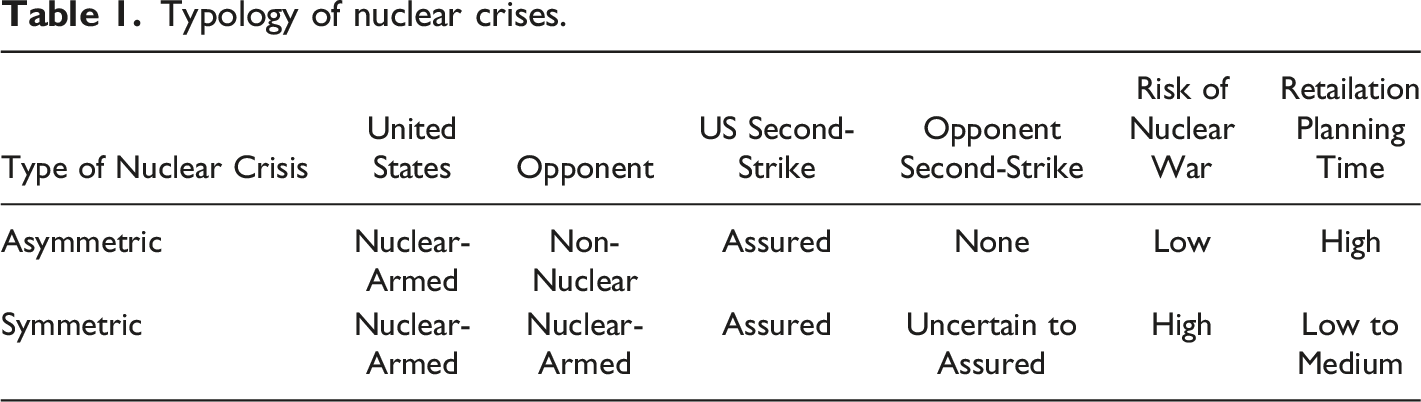
Unlike asymmetric crises with non-nuclear states or non-state actors, Table 1 shows a symmetric crisis risks a real chance of a nuclear attack and escalation. Kim Jong-un has made this unmistakably clear with nuclear tests and threats to strike the United States and its allies. While the full extent of DPRK nuclear capabilities remains unknown, Pyongyang “might have produced sufficient fissile material to build 40 to 50 nuclear weapons and...might possibly have assembled 10 to 20 warheads” (Kristensen and Korda 2021a, 222). The regime has tested at least five ballistic missile classes with intercontinental ranges and conducted a nuclear test explosion with a yield of up to 250 kilotons (Kristensen and Korda 2021a, 226, 230). These capabilities may induce restraint for supporting retaliatory nuclear use among both elites and members of the public in the United States, Japan, and South Korea. When confronting North Korea, these populations must grapple with the potential for harm coming to themselves and their loved ones. We thus predict only limited support for the nuclear option even absent vivid imagery (Koch and Wells 2021) or international law priming (Carpenter, Montgomery, and Nylen 2021).
History also shows the US public and populations of its two East Asian allies often have divergent views on international security. This matters because cross-national public opinion may have powerful shaping effects if a nuclear-armed state attacks a country protected by extended deterrence. The US bilateral treaties with Japan and South Korea call for consultation in times of regional crisis. Furthermore, the small size of North Korea’s nuclear arsenal protects the United States from having to pursue a retaliatory strategy of “launch-on-warning.” With approximately 3,800 nuclear warheads deployed across numerous delivery systems (Kristensen and Korda 2021b, 336), the United States has secure second-strike capabilities against North Korea. Pronounced US nuclear superiority would enable Washington and its allies to take a strategic pause to plan and consult on appropriate responses to DPRK missile strikes (Kroenig 2018). The potential for escalation would also make domestic and international publics particularly predisposed to voicing opinion. This could provide avenues for public opinion to influence foreign policy both among civilian and military leaders (Lin-Greenberg 2021). Polling trends underline the importance of measuring public opinion on a DPRK extended deterrence crisis. Heterogeneous perceptions may impact deterrence, as they deal with public willingness to use nuclear weapons and the strength of alliance commitments. For example, the Japanese public has for decades remained strongly opposed to nuclear weapon use given the Hiroshima and Nagasaki legacies (Tanaka 1970; Baron, Gibbons, and Herzog 2020). In contrast, amid high tensions with Pyongyang, studies have shown the majority of South Koreans are interested in developing their own nuclear weapons even if they trust the nuclear umbrella (Ko 2019; Sukin 2020a; Son and Yim 2021). In the United States, reactions to Trump’s criticism of the North Atlantic Treaty Organization, the United Nations, and the Trans-Pacific Partnership revealed many Americans are skeptical of international obligations (Pew Research Center 2017).
These differences in public opinion are almost certain to matter based on the target of a DPRK attack in East Asia. The history of Japanese occupation of the Korean Peninsula from 1910–1945 looms large; Japan and South Korea have never been allies despite sharing a common patron. Since Kim began discussing possible denuclearization and rapprochement in early 2018, South Korean public favorability towards North Korea and Kim has often surpassed favorability towards Japan and its leaders (Kim, Kim, and Kang 2018, 9–10). While attacks on their home countries may trigger incentives for revenge and retributive justice identified in the literature (Liberman 2006, 2013) among Japanese and South Koreans, strikes on the other state are less likely to do so. Tokyo and Seoul will have different considerations in consultations with Washington depending on whether or not their countries are attacked, especially since regional escalation risks the untargeted state becoming a subject of DPRK hostilities.
There are two reasons why a DPRK nuclear crisis scenario is more likely to occur than one involving Russia, China, or a non-nuclear opponent. First, Pauly (2018) provides historical evidence that elites simply prefer conventional options in asymmetric nuclear crises, offering little space for considering public opinion. Decision-makers chose conventional responses in all 13 declassified US war games versus non-nuclear adversaries Pauly studied. Unsurprisingly, nuclear use was not a part of public or elite discourse in two decades of ground wars in Afghanistan and Iraq. Second, Pauly also finds decision-makers are far less willing to use nuclear weapons against peer nuclear competitors than previously believed. Given strongly held elite priors about risks of escalation to a strategic nuclear exchange, it is unlikely that US leaders could be swayed by public opinion toward nuclear use against Russia or China. Consequently, we maintain that current events, greater elite receptivity to nuclear use as shown by Trump’s threats to Kim, and increased retaliation planning time make North Korea a most-likely case for public opinion to influence nuclear use. DPRK capabilities, combined with the unpredictability of the Kim regime, may also present decision-makers with a situation where nuclear weapons have already been used or US first-use may have counterforce justifications. Strategic planners writing about such scenarios have concluded that DPRK first-use would generate considerable pressure for nuclear retaliation from the US and allied publics and elites (Manzo and Warden 2018). By contrast, many conventional North Korean hostilities would be less likely to trigger these types of sentiments.
Still, as suggested by Hypothesis 1, the prospect of future retaliation may well result in low baseline public support for using nuclear weapons against North Korea even among the targeted population. A crisis with a nuclear-armed state under the shadow of the nuclear umbrella introduces a retaliatory dynamic. Attacks on North Korea by the US military—particularly those involving nuclear weapons—could result in nuclear strikes against the United States, its allies in East Asia, or both. Mechanisms of restraint due to self-interest (e.g. Schelling 1966; Koch and Wells 2021) might be particularly salient if North Korea explicitly threatens countries by name. Two recent studies provide a foundation for discussing such retaliation risks, but there is some disagreement among them. Koch and Wells (2021) find US public support for a nuclear first-strike on an unnamed adversary decreases as nuclear retaliation becomes more plausible. Sukin (2020b) concludes the opposite, showing Americans and South Koreans become more likely to support nuclear first-use amid a conventional conflict if Russia or North Korea threaten nuclear retaliation. Both studies present noteworthy and interesting findings to build upon. For example, neither confronts respondents with a scenario in which nuclear weapons have already been used by the adversary. Further, like Press, Sagan, and Valentino (2013), and Sagan and Valentino (2017), these studies do not offer respondents a range of non-nuclear choices available to decision-makers. A US–North Korea symmetric nuclear crisis would entail uncertain DPRK second-strike capabilities and non-negligible nuclear retaliation risks. In some cases, as discussed above, North Korea may have already used nuclear weapons. The marked US–DPRK power imbalance also offers the United States a portfolio of non-nuclear responses that could be effective retaliation. Presenting a broad option set may be key to better understanding public preferences for and against nuclear use. In fact, one study (Haworth, Sagan, and Valentino 2019) indicates most Americans prefer a non-military solution to the DPRK standoff. Pyongyang has also threatened Japan and South Korea with ballistic missiles. Thus, we test the reactions of these allied populations to determine their views on retaliation.
The nuclear risks entailed to the US population in a North Korean crisis are at the heart of ongoing debates about the credibility of American assurances. US nuclear umbrella pledges to protect Japan and South Korea from North Korea exemplify extended deterrence. However, such protection has long suffered from credibility problems (Huth 1988, 1999; Danilovic 2001; Fuhrmann 2018). Because security sponsors risk high costs in defending allies from a nuclear attack, insecure protégés and bellicose rivals may come to question if the sponsor has “sufficient emotional motivation for revenge” (McDermott, Lopez, and Hatemi 2017, 75). As soon as the US nuclear monopoly and later position of strategic superiority vis-à-vis the Soviet Union transitioned to relative parity in the 1950s, doubts arose about US commitments. More specifically, US partners began to wonder if American government elites and the broader public would place themselves in harm’s way on behalf of allies (Eichenberg 1989; Pelopidas 2015). These debates remain salient in the contemporary era. When officials in the Barack Obama administration considered adopting a no-first-use policy, they ultimately refrained to avoid undermining the umbrella’s credibility (Kaplan 2020). Then, the Trump administration’s “America First” foreign policy sent shockwaves through US alliances around the globe; the credibility of American assurances has yet to recover. Today, concerns that emerged in the early Cold War present a new question: Would the United States really risk New York, Los Angeles, or even Guam to retaliate with nuclear weapons if North Korea attacked Japan or South Korea? There are, however, reasons to believe Washington might do so. An oft-prescribed tool to enhance the credibility of extended deterrence is for the patron to create “tripwires” to defend its clients from shared adversaries. According to Schelling (1966, 99–100), forward deployments “incur commitment” and raise the stakes for an opponent by manipulating their level of risk when contemplating an attack. Put bluntly, the point of deploying US troops in West Berlin during the Cold War, or to the Korean Demilitarized Zone today, is not to win a conflict outright. Rather, deployment is meant to bolster extended deterrence’s credibility. Those troops are massively outnumbered, but in theory, “the prospect of their death ensures the emotional commitment designed to spark the revenge-driven war upon which the credible threat of deterrence is based” (McDermott, Lopez, and Hatemi 2017, 75). Tripwires may have implications for shaping both public and elite sentiment in a conflict with North Korea. Fuhrmann and Sechser (2014), Fuhrmann (2018), Reiter and Poast (2021), and Blankenship and Lin-Greenberg (2022) argue that small contingents of forward-deployed troops have little utility for preventing conflict, but this may be discrete from their deaths’ ability to motivate a desire for revenge. Liberman (2006, 2013) shows that individuals with moral justifications for revenge are particularly disposed to support retributive action. Members of the public may seek revenge against foreign states, Liberman finds, even when it runs counter to their material incentives. Current scholarship does not experimentally analyze tripwire scenarios, but some literature suggests strong sensitivity to troop casualties among the US public. A number of studies (Gelpi, Reifler, and Feaver 2009; Press, Sagan, and Valentino 2013; Sagan and Valentino 2017) presented survey respondents with choices between intensifying conflict or losing thousands of US troops in combat. In each case, Americans endorsed increased violence—sometimes including nuclear first-use—to achieve military objectives with reduced troop casualty levels. If this pattern of casualty sensitivity has validity beyond these studies’ airstrike and bombing scenarios, it should support the mechanics of extended nuclear deterrence among the public. If US troops deployed in Japan or South Korea are killed by North Korea, Americans may demand retaliation, possibly involving use of nuclear weapons against Pyongyang.
In sum, we present hypotheses about how certain conflict dynamics will generate public opposition or support for US nuclear retaliation. They center around our prediction of low baseline cross-national support for nuclear use against North Korea (Hypothesis 1). Yet, the picture is complicated by potentially heterogeneous Japanese, South Korean, and US public opinion (Hypothesis 2) that could shift depending on the DPRK attack target (Hypothesis 3). We also predict that North Korean first-use of nuclear weapons in East Asia will increase support for nuclear retaliation (Hypothesis 4). However, direct threats of future North Korean strikes against countries may make those states’ populations less willing to back nuclear responses (Hypothesis 5). Finally, we predict US military tripwire casualties will increase Americans’ support for involvement in a nuclear confrontation with North Korea (Hypothesis 6).
Simulating a Nuclear Crisis
We designed a survey experiment to simulate a North Korean attack on a US ally. While we predicted low baseline cross-national support for nuclear use against North Korea (Hypothesis 1), the experiment enabled us to evaluate how crisis dynamics affect backing for retaliatory strikes underpinning the nuclear umbrella (Hypotheses 2–6). We contracted with a major international polling research firm, Qualtrics, to field our survey via the internet in August 2018 and recruited a sample of 6,623 American, Japanese, and South Korean respondents ages 18 and older. 2 Quotas were used to tailor a nationally representative subsample of each respective country’s demographics across age, gender, and regional divisions. Although the three countries’ populations differ greatly, our survey experiment includes approximately 2,000 subjects from each state to detect effects of similar magnitudes.
While our use of quota-based nationally representative samples means we forewent some advantages of equal probability random sampling, quotas do confer a number of advantages. Critically, “equal probability” sampling over the internet or telephone is often anything but equal, potentially underrepresenting males, people over age 55, and those from rural areas (Sanders et al. 2007; Yeager et al. 2011). Gender, age, and community type strongly correlate with ideology and political affiliation, so we stratified our sample along these lines to ensure proper representation of demographic subgroup populations.
After consent, subjects from Japan, South Korea, and the United States were randomly assigned to one of the treatment arms and presented with a crisis scenario in the Japanese, Korean, or English language, respectively. Our treatment delivery marked a methodological innovation. Each group received a government emergency alert informing them of a North Korean strike on a civilian target using an image replicating official notifications sent to cellular telephones running the iOS operating system. Our treatment was thus a more accurate representation of the information the public would receive in the short-term during a nuclear crisis than treatments used in extant studies. In the United States, we matched our alert to the 2018 ballistic missile alert incident in Hawaii. In South Korea, we followed the format of the Ministry of the Interior and Safety’s warnings. In Japan, we mimicked the J-Alert system used by the Japanese government for both disaster alerts and warnings about DPRK ballistic missile overflights. An example of each appears in Figure 1. Sample iOS emergency alerts (English, Japanese, and Korean languages).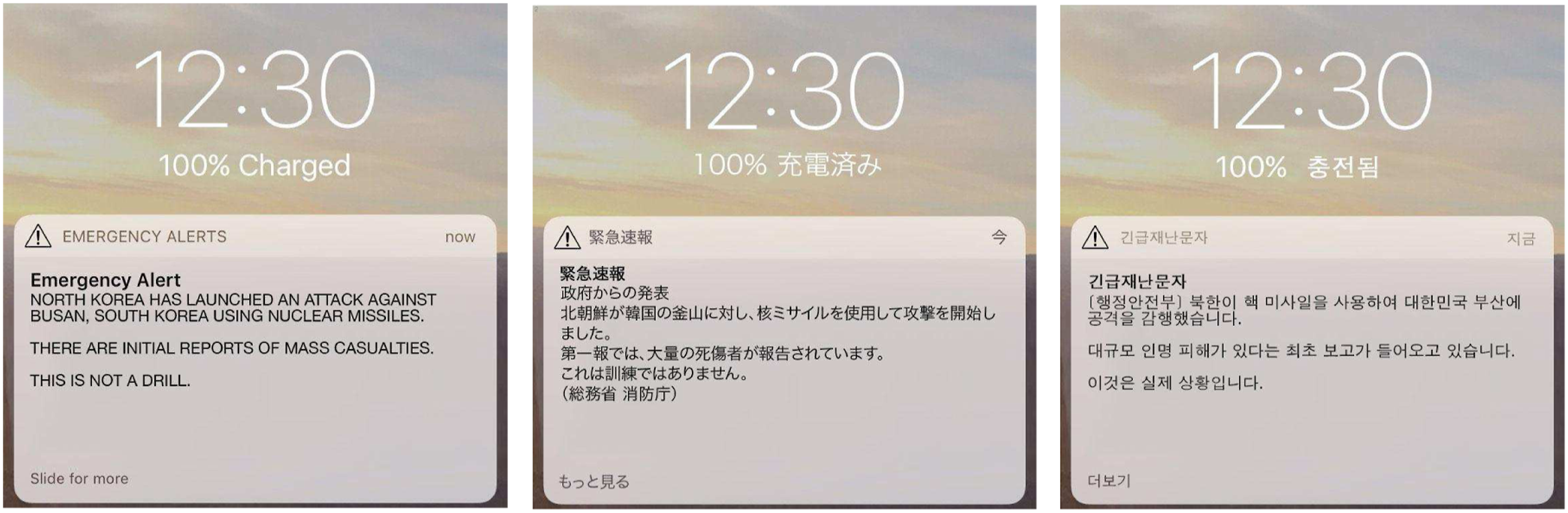
While all alerts informed participants of mass casualties from a North Korean missile strike against a populated area, we varied four elements of the attack. First, the alert informed the respondent that North Korea used either nuclear missiles or conventional (not nuclear) missiles. The purpose of this manipulation was to determine effects of a nuclear versus a conventional attack on American, Japanese, and South Korean public preferences for retaliation (Hypothesis 4), especially nuclear retaliation against North Korea. Second, respondents received alerts warning that North Korea had targeted either Busan, South Korea or Nagoya, Japan—each a major urban population center. This allowed us to identify further differences between public preferences for retaliation and extended deterrence across the United States and its East Asian allies (Hypothesis 2). We also tracked differential preferences given news of an attack on a Japanese or South Korean subject’s home country versus that of the other US ally (Hypothesis 3).
We included two additional manipulations to test aspects of the nuclear umbrella with particular implications for current US foreign policy. A proportion of respondents were randomly assigned to a condition where the report of mass casualties was appended to include “including US military personnel.” This condition tested the tripwire (Hypothesis 6), whereby stationing US forces in an allied country should theoretically increase the credibility of extended deterrence. By exposing troops to lethal risk, the tripwire could create US public pressure for retaliation to a DPRK attack on Japan or South Korea. Next, a random subset of respondents viewed alerts with a further warning that North Korea had threatened to attack their home country in the event of a US military response. This condition enabled evaluation of the effects of retaliation (Hypothesis 5), which we predicted would decrease the likelihood of a subject choosing a potentially escalatory response. Although many respondents undoubtedly considered the possibility of North Korean nuclear retaliation, subjects in this condition were especially primed to think about this potential outcome. Finally, we assigned a separate subset of respondents to receive both the tripwire and retaliation primes. Figure 2 illustrates the design of our survey experiment. Survey experimental design.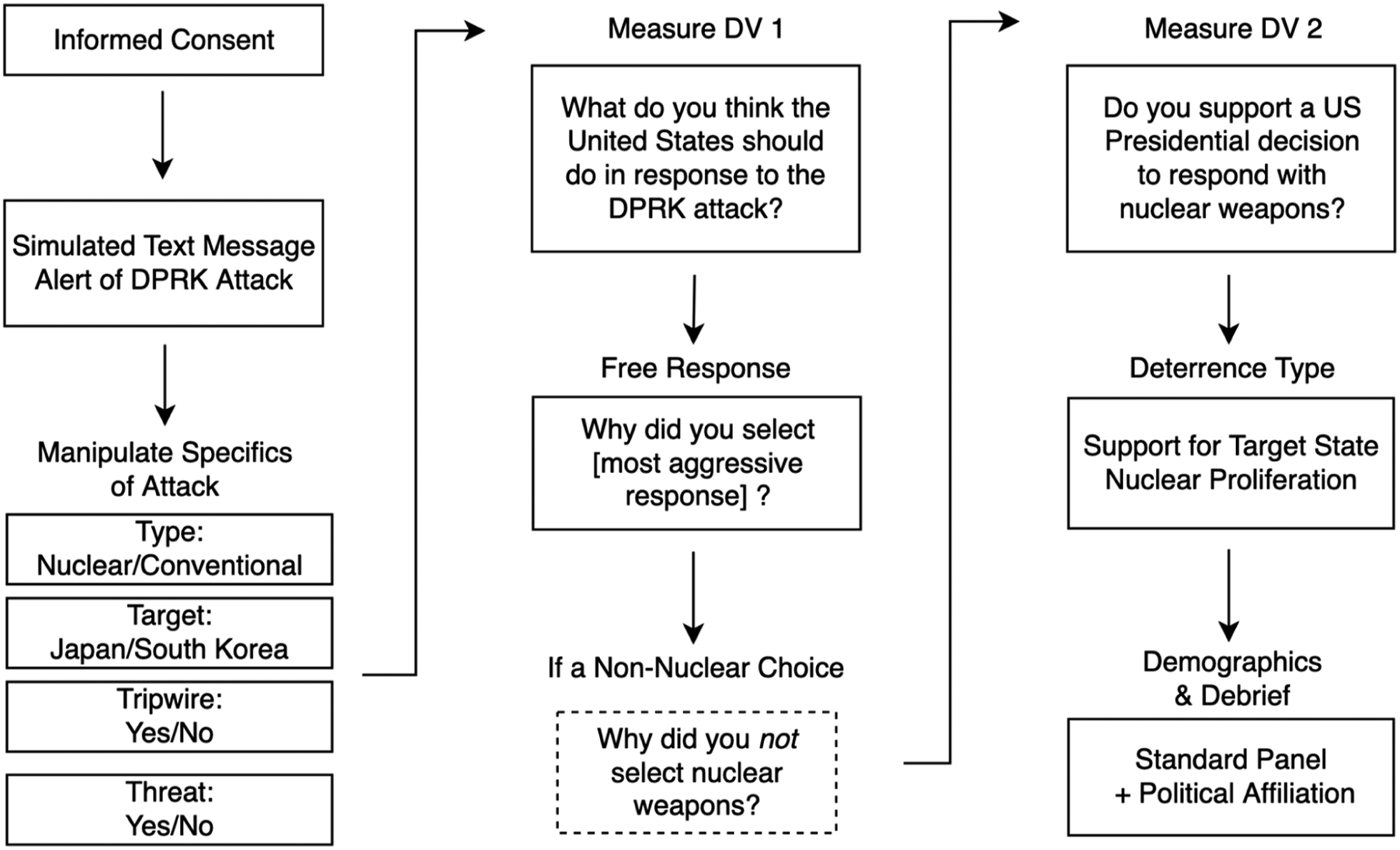
Following treatment, subjects answered questions designed to reveal information about public support for nuclear retaliation. We offered respondents the opportunity to place themselves into the decision-maker’s shoes and determine appropriate US responses to the DPRK attack. After viewing a randomly assigned scenario, each subject was given a choice of six non-exclusive US responses:
3
Do nothing. Issue a statement verbally condemning North Korea’s actions. Impose new sanctions on North Korea. Launch conventional (non-nuclear) missiles against North Korea. Send troops to North Korea and remove its leadership. Launch nuclear missiles against North Korea.
Respondents were told they could select multiple responses, with the exception of “Do Nothing,” which precluded selecting any other choice. The list of possible responses was scored 0–5 in the order shown, but we presented it in randomized order. Most respondents selected more than one response.
We built upon previous scholarship by offering subjects a panoply of choices available to a US decision-maker in an extended deterrence crisis. Past studies (Press, Sagan, and Valentino 2013; Sagan and Valentino 2017) offered respondents a simple binary choice between a conventional and nuclear option based upon a newspaper article treatment indicating the potential consequences of each. While informative about public preferences, these designs excluded a number of conventional and non-military responses. Our survey improved upon this by presenting subjects with a realistic set of options, allowing them to choose multiple actions, and forcing them to grapple with uncertainties inherent in a decision to respond to an emerging crisis. Likewise, we did not prime respondents with vivid imagery of a potential nuclear response (e.g. Koch and Wells 2021).
The reality of this challenge became evident in the next question, where we required subjects to provide a free response explaining why they selected their most aggressive option from the scale. Respondents were generally enthusiastic to justify their answers, providing additional data. While the average US free response was a sentence of 70 characters or approximately 15–20 words, 4 many subjects wrote significantly more, ranging from thoughtful to profane.
To analyze the free responses, we identified five “positive” justifications and five “negative” justifications that broadly characterized subject responses. The list drew upon international relations theory, off-the-record consultations with government officials and experts from the three countries, and themes from free responses collected in our pilot study.
5
Two native-language coders read each free response and assessed the justifications highlighted by the subject. We then cross-referenced the scores. The possible codings were: Support for Ally Proportionality Punishment/Revenge Eliminate Threat Efficiency Avoid Escalation Avoid Entanglement Avoid Violence Avoid Nuclear Use Uncertainty
Next, we wanted to learn more about the subjects who did not select nuclear retaliation. We asked those subjects to choose from a randomly ordered, non-exclusive list of nine possible reasons why a respondent might not support nuclear use. As with free response coding, we designed the list to encompass a broad spectrum of possible justifications and theoretical explanations: No country should ever use nuclear weapons. (Anti-Nuclear Use/Taboo) Using nuclear weapons would be an overreaction. (Proportionality) Using nuclear weapons could start a nuclear war. (Risk of Escalation) The United States was not attacked. (Isolationism) The United States could defeat North Korea with conventional (non-nuclear) weapons. (Strategic Superiority) The international community would not support the use of nuclear weapons. (International Norms) Violence is never justified, for any reason. (Pacifism) It is too early to make this decision without more information. (Uncertainty) The response should be handled by the country that was attacked. (Individualism)
Finally, following the lead of past studies (Press, Sagan, and Valentino 2013; Sagan and Valentino 2017), we tested whether or not subjects would support nuclear retaliation if presented a fait accompli. We told respondents the President of the United States had decided to retaliate against North Korea with nuclear strikes and asked if they agreed or disagreed with this action. Using a five-point Likert scale, we assessed the strength of respondent convictions about nuclear use and checked for consistency between stated preferences and selected rationales. Because the question specifically noted that the President of the United States made the decision, we also gained insight into the US domestic political considerations involved in supporting or opposing the nuclear retaliatory strikes underlying extended deterrence. After answering this question, subjects provided demographic information and read a debrief due to use of fictitious scenarios.
Overall, our survey experiment drew from, and innovated on, preceding work that established this area of research in nuclear politics. We built on past designs by working with Japanese, South Korean, and US policy-makers to create scenarios that would mirror real-world crises in an experimental setting, improving on prior studies in two main ways. First, we offered our respondents a range of non-exclusive military and non-military responses to North Korea. These choices, alongside free response answers, help us more accurately gauge public preferences and (mis)perceptions about nuclear crises and effectiveness of military and diplomatic crisis management tools. Second, the experimental designs in the extant literature risk being overly deterministic by aiming to measure Americans’ casualty sensitivity. To do so, these studies provided respondents with mathematically precise levels of effectiveness for nuclear and conventional weapons alongside a specific number of US soldiers and local civilians that would die given each choice. Both pieces of information remain highly uncertain in any military engagement, especially an emerging nuclear crisis.
We therefore opted not to provide casualty estimates or probabilities of success, including potential US military losses that would result from a ground invasion of North Korea. This could artificially induce casualty sensitivity, as the public rarely considers such casualties unless primed (Rich 2019). Additionally, pre-war predictions of casualties are highly variable. A US Congressional Research Service study (McInnis et al. 2017) estimates 30,000–300,000 people (a tenfold difference) in South Korea would die in the first few days of a military conflict with North Korea, including US military personnel and civilians. The estimate is also based on the optimistic assumption that North Korea refrains from using nuclear, chemical, and biological weapons. In seeming contrast to these high (but widely varied) casualty estimates, a 2013 Pentagon report characterized the DPRK military as a “weakened force that suffers from logistical shortages, aging equipment, and inadequate training” (Cordesman and Lin 2015). Conflicting assessments of North Korean military strength highlight the difficulties of using “bean counting” to predict conflict outcomes (e.g. Biddle 2004). For instance, while Iraq had one of the world’s largest militaries, the Gulf War resulted in surprisingly low US military casualties. Likewise, for similar reasons, we did not provide civilian casualty counts in the emergency alert treatments, as these numbers would be unclear—potentially for weeks—in a developing crisis. The great variability in casualties from a nuclear versus a conventional missile strike would also weaken the realism and external validity of our scenarios if we indicated equivalent deaths for comparison.
Selecting and Supporting Nuclear Retaliation
Proportion of respondents selecting each policy option.
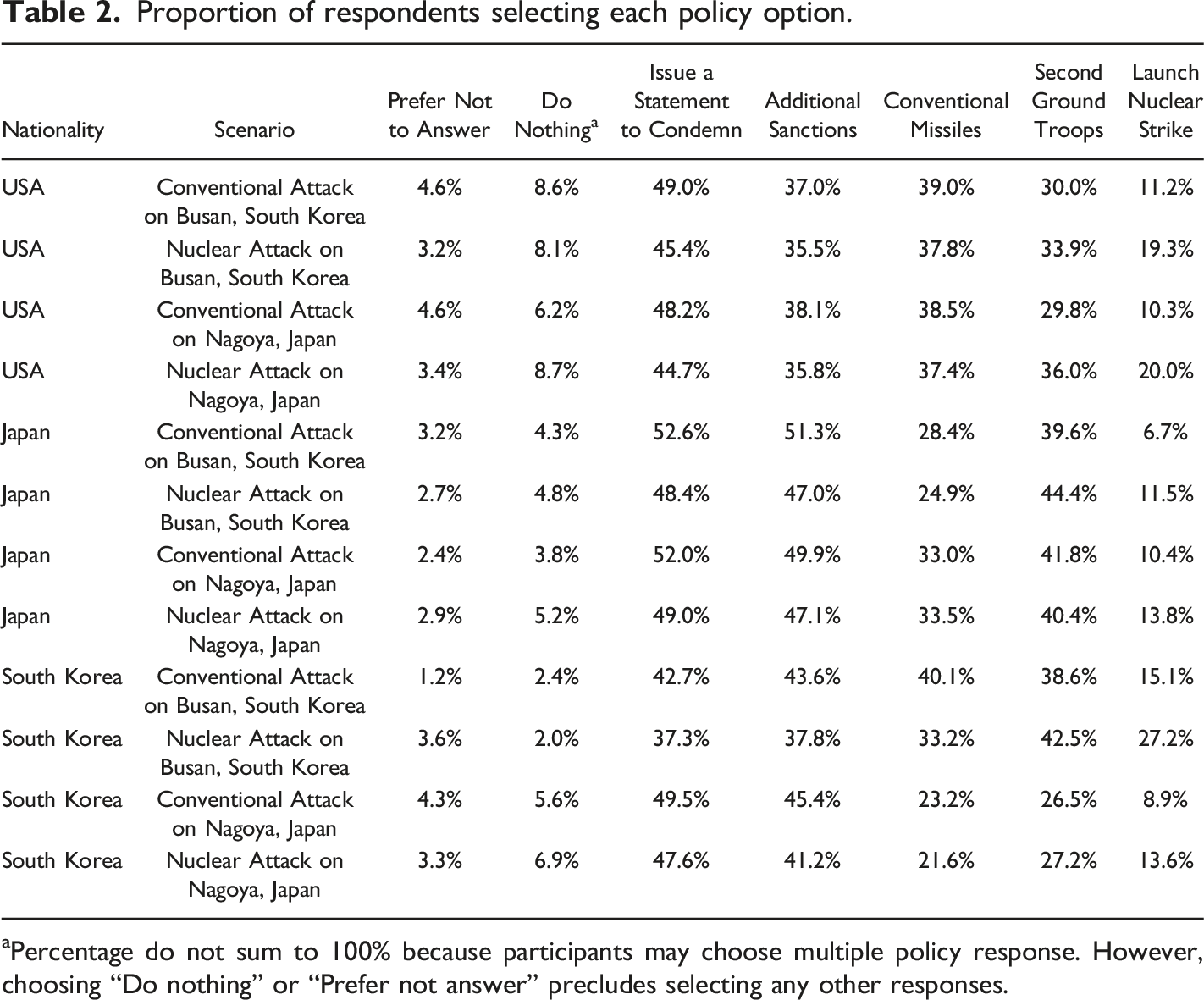
aPercentage do not sum to 100% because participants may choose multiple policy response. However, choosing “Do nothing” or “Prefer not answer” precludes selecting any other responses.
Figure 3 displays the most aggressive choice selected by each respondent from among the multiple, non-exclusive choices they could pick. We exclude the few subjects who preferred not to answer and create three distinct categories of responses: non-military, conventional, and nuclear. Subjects in the non-military category selected a most aggressive option of doing nothing, issuing a statement condemning North Korea, or imposing new sanctions on Pyongyang. They chose no conventional or nuclear responses. By contrast, those in the conventional category usually selected non-military options alongside more aggressive responses of non-nuclear missile strikes or a ground invasion of North Korea. Finally, those in the nuclear category chose nuclear retaliation, although most also selected non-military or conventional options. Cross-national retaliation preferences.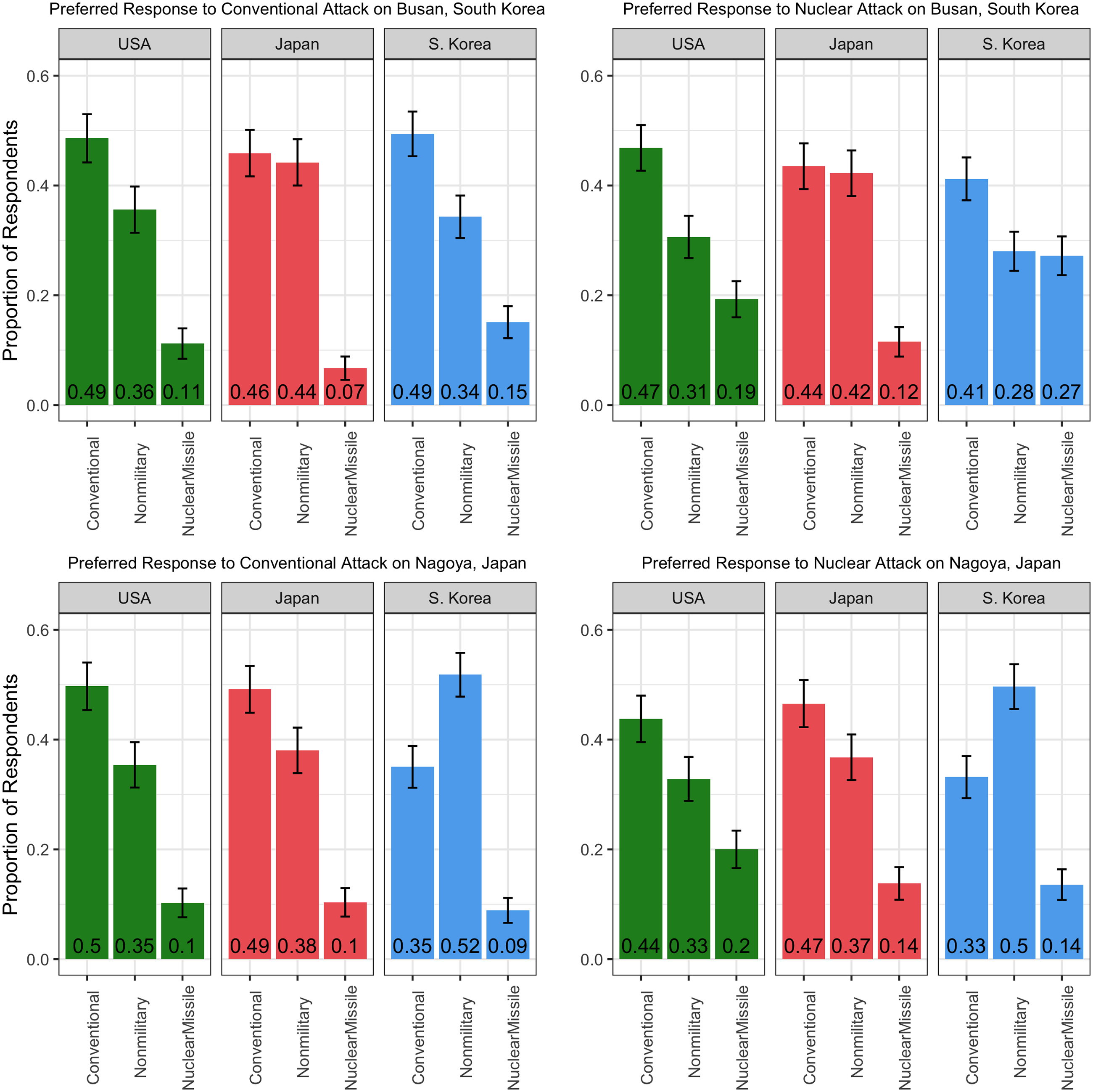
Respondents in all three countries significantly prefer conventional and non-military options to nuclear retaliation. This is true regardless of the country target or the missile type used in the DPRK attack. Still, the majority of respondents selected at least one military option from the provided list, suggesting that subjects generally support retaliating against North Korea for its actions. Haworth, Sagan, and Valentino (2019) noted that a majority of Americans prefer a non-military solution to DPRK testing of nuclear-capable missiles. Our results indicate that actual missile attacks on US allies are sufficient to shift such perceptions and also draw support for military action—albeit heterogeneously—from Japan and South Korea in some scenarios. However, only South Korean respondents selected “Launch nuclear missiles against North Korea” at a rate greater than 20%, and only when they were asked what the United States should do in response to a nuclear attack on Busan, South Korea (Hypothesis 3). Public support for the retaliatory strikes underpinning the nuclear umbrella appears quite low and at odds with the decades-old elite consensus.
These results suggest Americans support nuclear retaliation against a nuclear-armed state at much lower levels than found by Press, Sagan, and Valentino (2013) and Sagan and Valentino (2017). Nearly half or more of Americans in those survey experiments expressed support for using nuclear weapons to target a suspected al-Qaeda nuclear facility or Mashhad, the second-largest city in Iran. Our finding that less than a quarter of US respondents support nuclear retaliation when their ally is attacked suggests differing perceptions of symmetric and asymmetric nuclear crises and circumspection about nuclear use in situations that could escalate to nuclear war.
The fact that we did not use priming such as vivid imagery (Koch and Wells 2021) and still found low public support speaks to the power of providing respondents with realistic retaliatory option sets. It is important to note that our respondents in all three countries displayed a clear interest in retaliating against North Korea for its attacks on either Japan or South Korea. However, when given access to a spectrum of realistic and non-exclusive options for retaliation, few respondents chose the nuclear option.
Pronounced public reluctance to use nuclear weapons raises an important question: Even if subjects prefer other options to nuclear retaliation, would they be willing to support a nuclear strike if the US president made the decision? Figure 4 shows the proportion of subjects that selected “Agree” or “Strongly Agree” in response to this question on a five-point Likert scale. Support for US presidential decision for nuclear retaliation.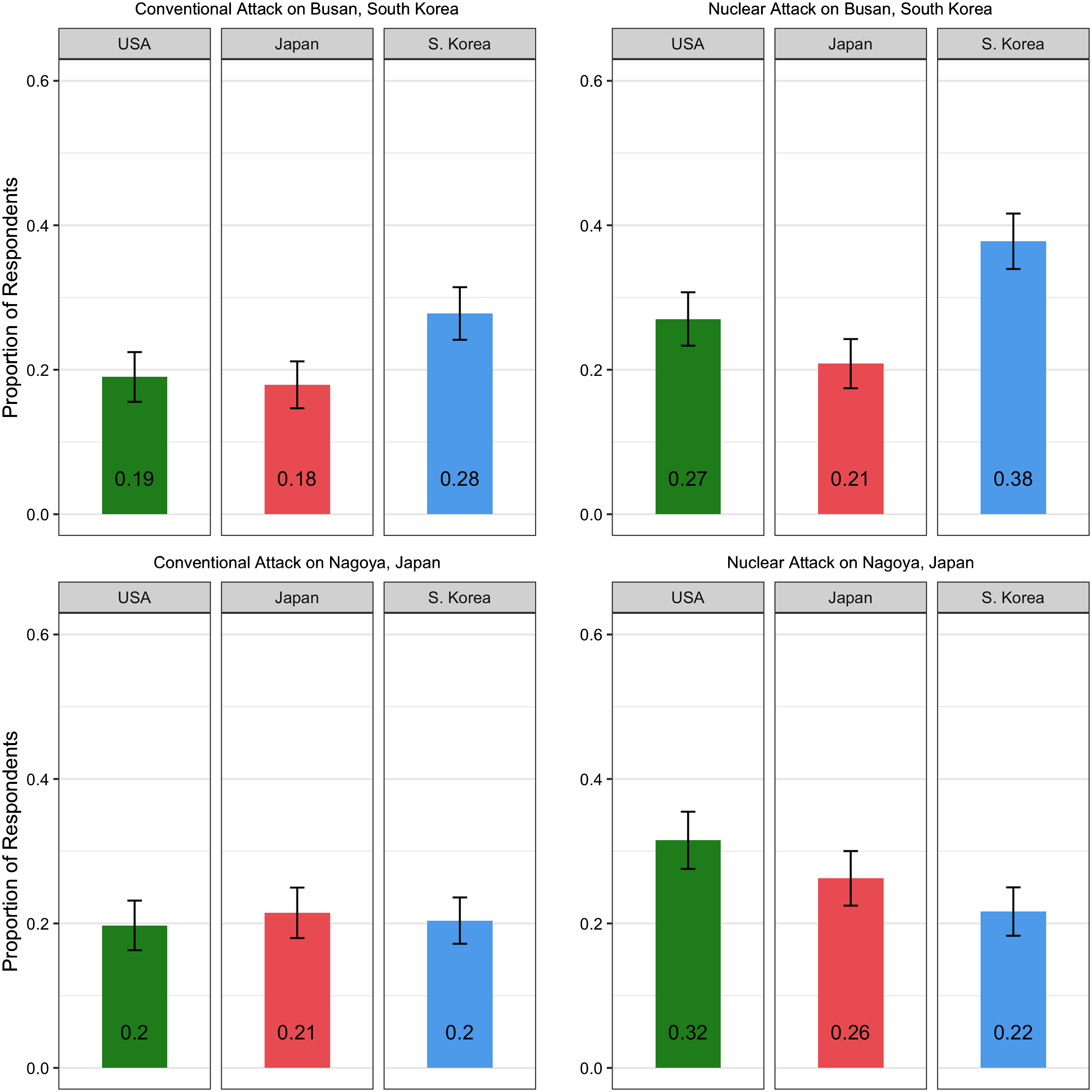
A significantly higher proportion of respondents agreed with the US presidential decision to use nuclear weapons than selected nuclear retaliation themselves. Yet, support remains low in all three countries. Although it appears a nuclear strike is an acceptable alternative to some subjects’ preferred response, a large percentage of respondents rejected the nuclear option even when they selected a strong conventional military response (e.g. ground invasion). After the policy received US presidential endorsement, it is striking respondents were not more enthusiastic about nuclear use against North Korea. Such retaliatory strikes are, after all, the foundation of the elite-driven consensus on the nuclear umbrella. Our results further highlight the differences between asymmetric and symmetric nuclear crises. In Press, Sagan, and Valentino (2013, 199), a surprising 47.9% of American respondents supported the presidential decision to use nuclear weapons to strike a suspected al-Qaeda nuclear facility, even when they learned the probability of destroying the target was equivalent with nuclear and conventional weapons. Approval soared to 77.2% of Americans when treatment indicated that nuclear weapons were twice as effective compared with their conventional counterparts. An al-Qaeda affiliate organization does not, however, have North Korea’s demonstrated nuclear weapons and missile delivery systems.
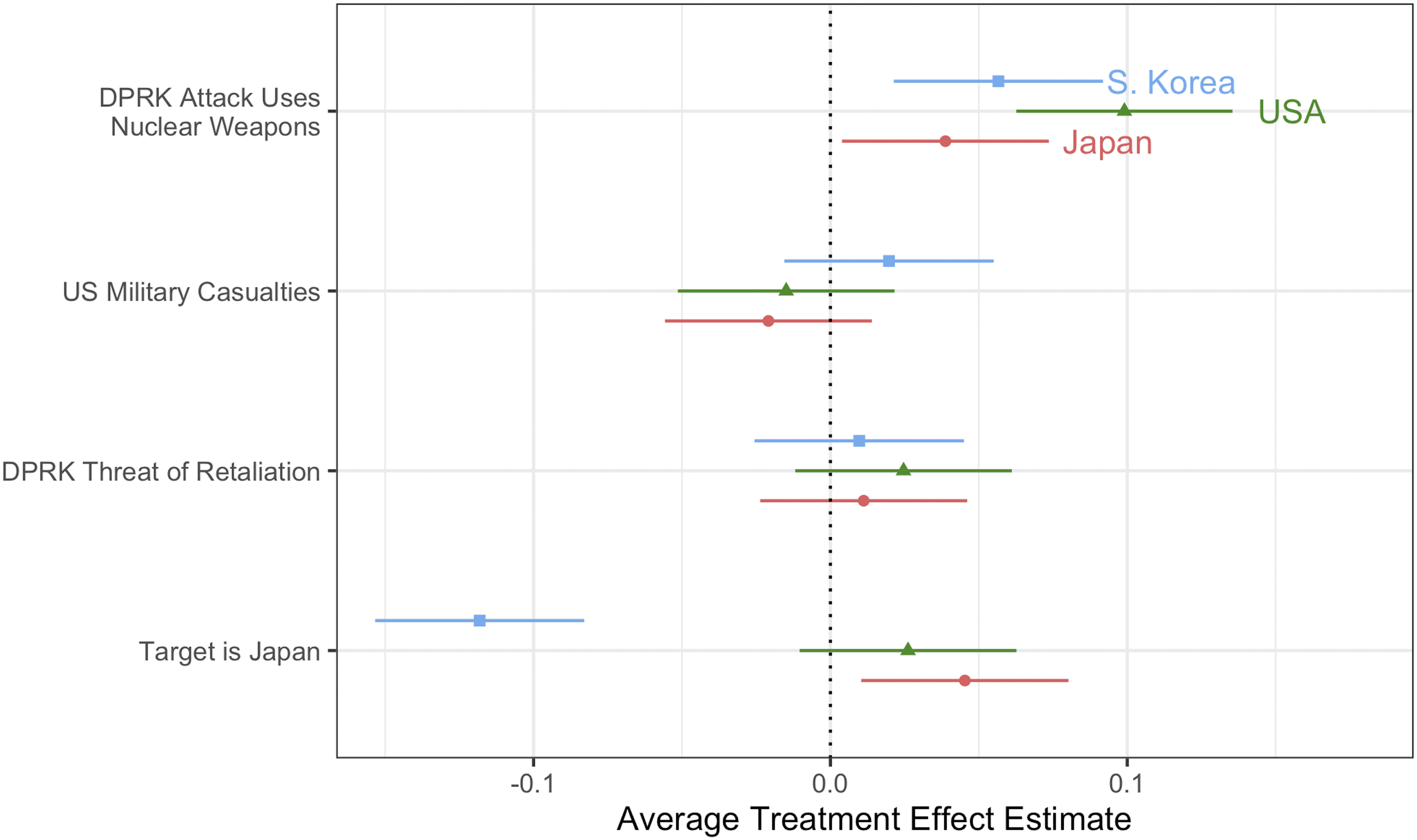
We also see subjects responding differently to DPRK use of nuclear versus conventional weapons (Hypothesis 4). Figure 5 and Figure 6 reflect ordinary least squares regressions modeling the probability of selecting and supporting nuclear retaliation. Although we find support for nuclear retaliation remains low in all three countries as in Figure 3 and Figure 4, there is a statistically significant increase in the likelihood a respondent will both select and support US nuclear retaliation when North Korea uses nuclear missiles. Among the United States and its East Asian allies, the desire to eliminate the threat is the main motivation for supporting nuclear weapon use we observe in respondents’ free response answers. Subjects who prefer military action frequently state that they want to target the current North Korean regime and its military capabilities. In some cases, they want to destroy the state itself, although this takes multiple forms, from regime change to reunification to annihilation. At the same time, avoiding nuclear war is a common objective, with many respondents explaining why they believe their selected response limits escalation to nuclear war. Probability of selecting a nuclear response to a DPRK attack. Probability of supporting a US presidential nuclear response.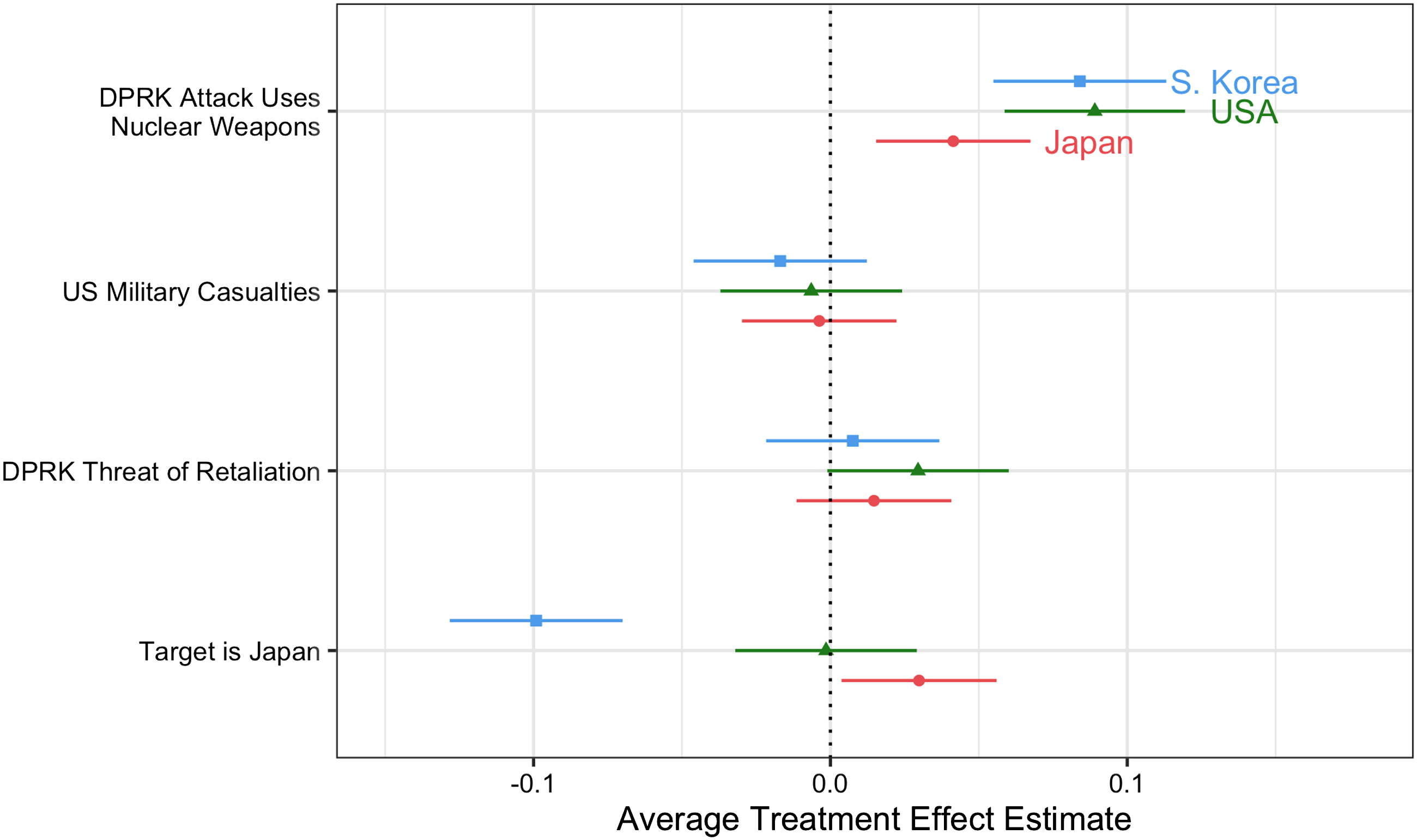
Concerns about civilian casualties, including among North Korean citizens, 6 are high in all three countries. 7 However, among the respondents advocating for regime change, few—if any—seem to recognize the potential for US military casualties. 8 None identify the risk that a regime change attempt could create a “use-it-or-lose-it” nuclear crisis for the Kim regime. For example, one American respondent selected send troops, stating that this option “Would be the best solution that would lead to the least loss of life while eliminating the threat of further nuclear aggression from the North Korean regime.” These findings are broadly consistent with Haworth, Sagan, and Valentino (2019), who point out that Americans have significant misperceptions about US military capabilities. They found the majority of Americans greatly overestimate the potential effectiveness of US counterforce strikes and ballistic missile defenses with respect to North Korea.
Figure 5 and Figure 6 also illustrate one of the challenges that may emerge in the aftermath of a strike on either Japan or South Korea due to cross-national public opinion differences (Hypothesis 2). While manipulating the target country does not have any discernible effect on the likelihood that American respondents will select nuclear retaliation, this is not the case among allied populations. Japanese respondents are the least likely to support nuclear retaliation, yet significantly more likely to select a nuclear response when North Korea attacks Nagoya, Japan as per Hypothesis 3. Likewise, South Korean respondents are significantly more likely to do so when Busan, South Korea is the target. In fact, while American respondents are sensitive to the type of attack on their ally, there is no significant difference between how Japanese and South Korean respondents view conventional and nuclear attacks when the other state is the target. This disconnect suggests difficulties in determining a mutually agreeable response between the United States and its allies in a crisis that would have considerable security implications for all parties.
Next, we consider our additional manipulations for the tripwire and retaliation primes. We tested whether providing information about the deaths of forward-deployed US troops or a North Korean threat to attack the respondents’ home country affected subject preferences. Predictably, we find no significant effect of US military casualties on the willingness of Japanese or South Korean respondents to use nuclear weapons. More interestingly, US military casualties do not make American respondents more likely to select or support nuclear retaliation (Hypothesis 6). This finding contradicts decades of US scholarship, policy, and overseas basing strategies, but is in line with other literature suggesting the effectiveness of tripwires may be overemphasized (Fuhrmann and Sechser 2014; Fuhrmann 2018; Reiter and Poast 2021; Blankenship and Lin-Greenberg 2022). Similarly, we find no increase in the selection of, or support for, the use of nuclear weapons following a direct DPRK threat against a respondent’s home nation (Hypothesis 5). However, increased preference for nuclear use among American respondents is just outside the threshold for significance (p = 0.0556).
At first glance, our inability to reject the null hypothesis for these scenarios appears to be cause for concern. Perhaps respondents were insufficiently moved by our primes due to issues with attention, extremely rigid priors, or a relatively weak treatment? Yet, analysis of subjects’ free response justifications provides strong evidence indicating that our primes did indeed work. US military casualties and threats against the respondent’s home country significantly change how subjects justify decisions about responding to North Korean attacks. Figure 7 shows an ordinary least squares regression on the US sample data looking at the relationship between different scenarios and free response justifications. When the scenario involves US military casualties, we observe measurable effects on Americans. As Liberman (2006, 2013) predicts, they are significantly more likely to cite punishment or revenge as the motivation behind their preferred response and significantly less likely to discuss alliance commitments. They are also less likely to make isolationist statements (p = 0.0641), although this finding does not quite meet the threshold for significance. We also find a significant positive effect of US military casualties on the aggressiveness of Japanese responses, driven by increased Japanese support for military action when told US forces were killed in an attack on South Korea.
9
Scenario changes and respondent free response justifications (US sample).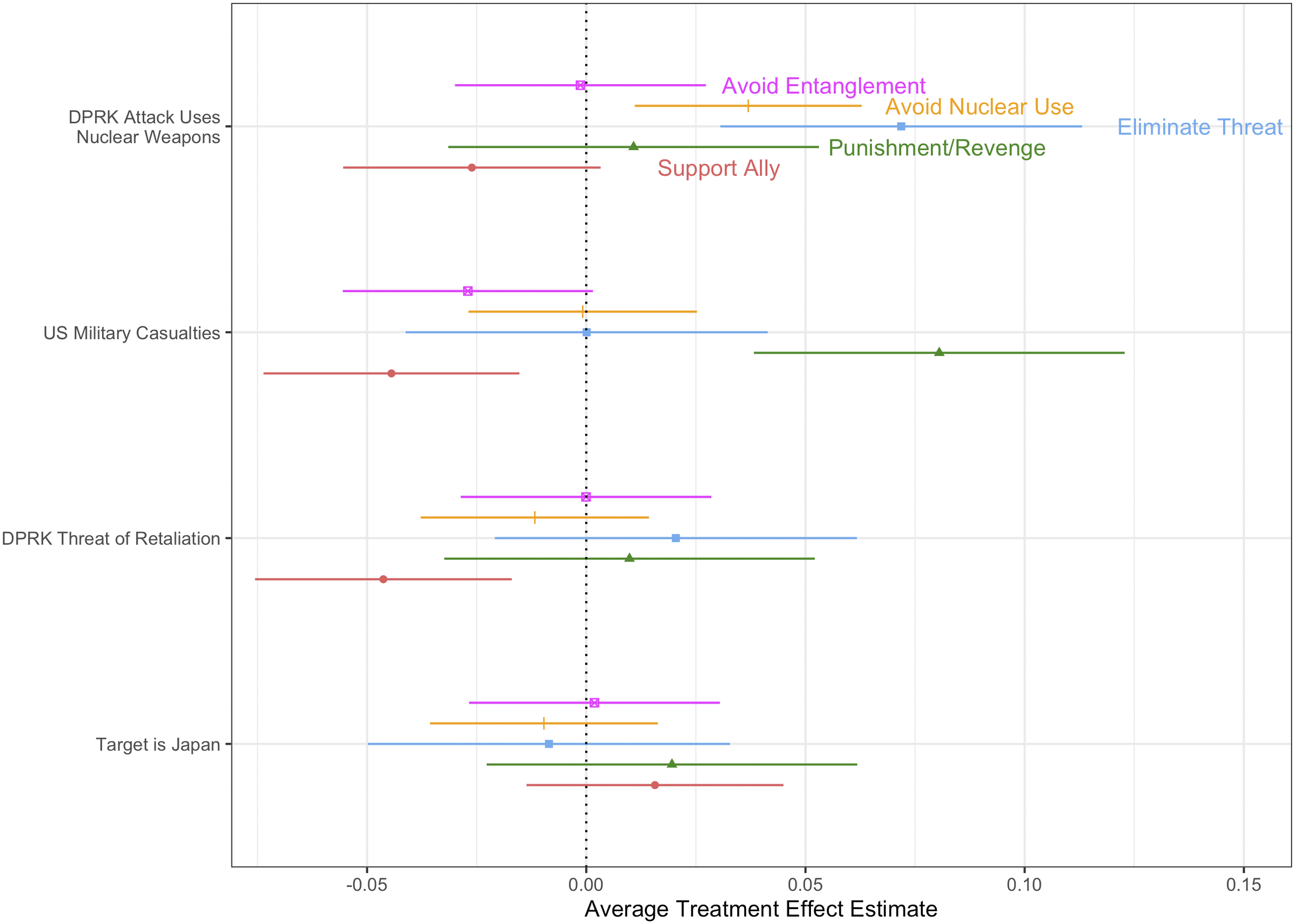
Returning to the retaliation debate between Koch and Wells (2021) and Sukin (2020b), our findings are suggestive but inconclusive. There is no significant effect supporting Hypothesis 5 that a direct threat of retaliation against a subject’s home country will decrease willingness of American, South Korean, or Japanese respondents to use nuclear weapons. In fact, we find a nearly significant increase for US respondents, corresponding with Sukin (2020b). That said, free responses suggest the retaliation prime creates heterogeneous effects. North Korean nuclear retaliatory capability likely causes some respondents to become more circumspect, consistent with Koch and Wells (2021) and what we predicted would occur in a symmetric nuclear crisis with North Korea. But while we observe considerably lower overall support for nuclear use than in some previous studies, many respondents actually became more bellicose and inclined to use nuclear weapons when threatened, as Sukin (2020b) found. As Figure 7 shows, respondents are indeed moved by the prime. A direct threat against the United States makes American respondents more nationalistic and less likely to justify their response on the basis of alliance commitments.
We also look at demographic factors in the US sample that predict respondent selection of, and support for, using nuclear weapons. In our analysis, we replace the basic political ideology factor with a more nuanced measure of whether or not the respondent self-reported as supporting President Trump in the 2016 election. Because our survey instrument told respondents the President of the United States made the decision to use nuclear weapons against North Korea during the Trump administration’s tenure, this measure allows us to test if support for nuclear use is partisan political behavior. Figure 8 displays results of two ordinary least squares regressions looking at the predicted probability of independently selecting nuclear retaliation and of supporting a nuclear decision by the US president. Selecting nuclear retaliation versus supporting nuclear retaliation (US sample).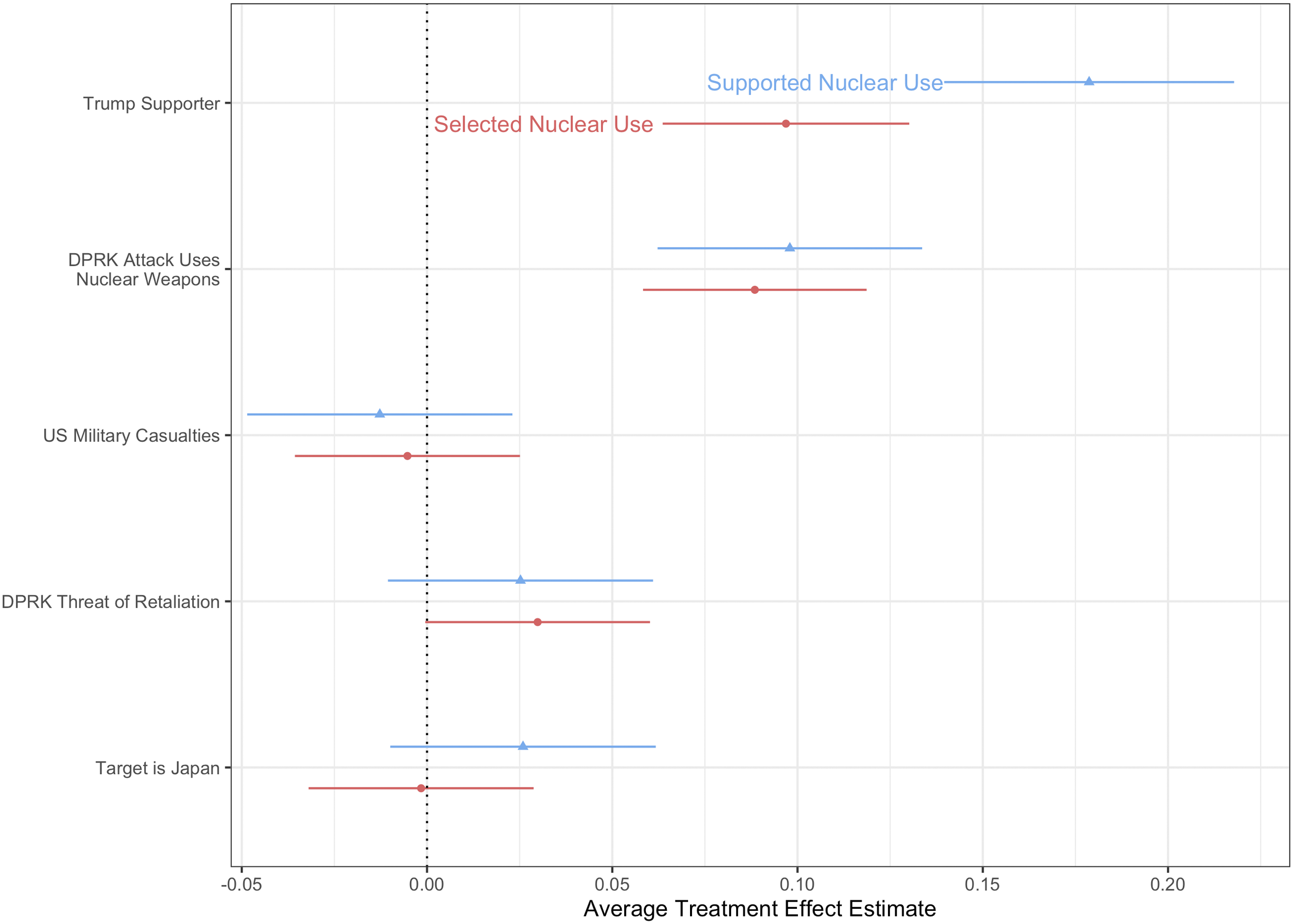
Although self-identified Trump supporters are more likely to support the president’s decision to use nuclear weapons, 10 they are also more likely to select nuclear retaliation independently. 11 We note, however, that only 35.7% of self-identified Trump supporters indicated that they agreed or strongly agreed with a presidential decision to retaliate with nuclear weapons. This figure is less than the 40.3% of Trump supporters who said they disagreed or strongly disagreed with the decision. The low support for nuclear retaliation was unanticipated considering consistently high support Trump had among his base as president (e.g. Gallup 2020). Overall, we see that the best predictor of agreeing with the president’s decision to launch nuclear missiles against North Korea is, unsurprisingly, a respondent’s independent preference for nuclear retaliation. Once we control for selecting nuclear retaliation, Trump supporters are not significantly more likely to switch to supporting nuclear retaliation given presidential endorsement.
Lastly, subjects who chose responses to the DPRK attack other than nuclear retaliation provided varying rationales from the non-exclusive list asking them to justify restraint. Two main themes emerged: fear of escalation and anti-nuclear attitudes. In the United States (60%) and South Korea (59%), the most commonly selected justification was that using nuclear weapons could start a nuclear war. 12 In Japan, this was the second most selected answer, with 53% of respondents expressing concerns about escalation. The most common response in Japan (58%) was no country should ever use nuclear weapons, which was the second most pervasive in the United States (44%) and South Korea (51%). While no other explanations exceeded the 50% threshold for each overall population, the subset of American and South Korean respondents who selected conventional military options was more likely to cite strategic superiority than any other motivation. They indicated that the United States could defeat North Korea with conventional (non-nuclear) weapons. For Japanese respondents, the nuclear taboo remained the preferred explanation independent of the subject’s chosen response.
These results suggest that the nuclear taboo may factor into some people’s decisions, but its strength varies across countries, is influenced by conventional superiority, and is far from universal. Interestingly, approximately half of all respondents who expressed moral objections to nuclear use were also worried about nuclear war with North Korea. In a symmetric nuclear crisis, untangling linkages between fear of retaliation and prevalence of taboos may be difficult.
Our findings on proliferation also substantiate cross-national differences in support for the nuclear taboo that add further context to Hypothesis 2’s predictions. Following a simulated attack on Busan, 51.7% of South Korean respondents said they “Agree” or “Strongly Agree” with South Korea developing its own nuclear weapons, in line with findings by Ko (2019) and Sukin (2020a). Conversely, following a simulated attack on Nagoya, only 22.2% of Japanese respondents supported Japanese proliferation. 13 American subjects (29.2%) were actually more supportive of a Japanese decision to build the bomb after an attack than were Japanese respondents themselves. This is consistent with Baron, Gibbons, and Herzog’s (2020) finding of durable anti-nuclear norms among Japanese.
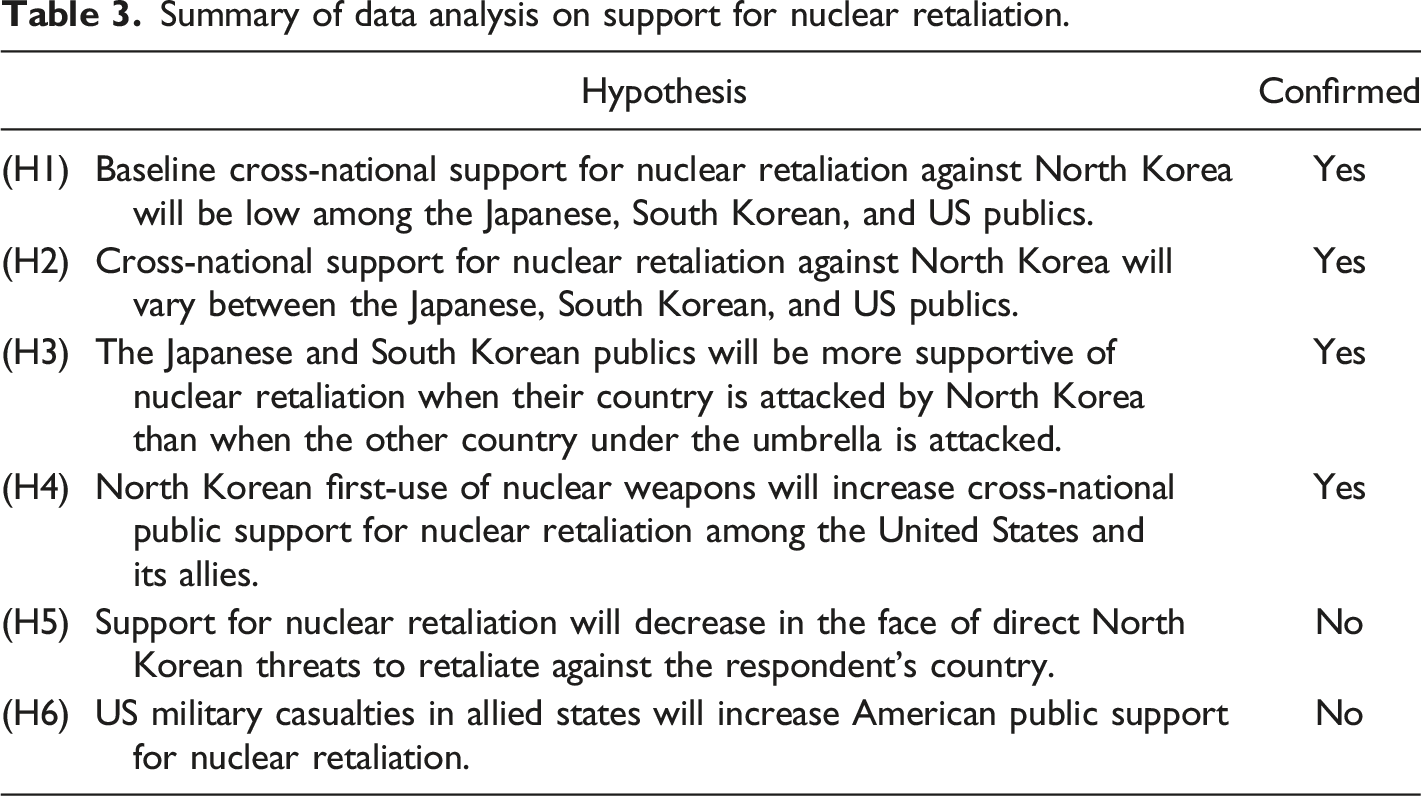
Summary of data analysis on support for nuclear retaliation.
Conclusion
In the near-term, it seems exceptionally unlikely that the DPRK nuclear threat to the United States and its Japanese and South Korean allies will dissipate (Narang and Panda 2018). After all, North Korea has promised to denuclearize at least six times prior to the 2018 Singapore Summit (Herzog 2018, 6), which began a new series of US–DPRK nuclear arms control talks. And after the stalemate at the follow-on Hanoi Summit in 2019, North Korea resumed familiar patterns of provocative behavior that have not stopped even after Trump’s departure. Such activities include rebuilding dismantled missile testing facilities (Choe 2019) and test launching ballistic missiles (Nuclear Threat Initiative 2022). As scholars and policy-makers grapple with long-term prospects of a nuclear North Korea and risks of a nuclear crisis, this survey experimental research offers four important lessons for extended nuclear deterrence.
First, crises involving the potential use of nuclear weapons may have dramatically different dynamics. As indicated by our theoretical typology in Table 1, the asymmetric or symmetric nature of dyadic nuclear armament and the risk of nuclear retaliation shape the contours of crises and the role of public opinion in crisis behavior. We find extremely limited public support in a most-likely case for the use of nuclear weapons against North Korea among our 6,623 respondents from Japan, South Korea, and the United States. This result is durable regardless of whether North Korea attacks with nuclear or conventional missiles, strikes Japan or South Korea, kills forward-deployed US troops, or threatens subjects’ homelands. Although DPRK first-use significantly increases support for nuclear retaliation, fewer than one-third of US respondents backed nuclear use against North Korea in any treatment condition. These findings strongly differ from studies evaluating asymmetric nuclear crises between the United States and non-nuclear adversaries. They also suggest that presenting survey respondents with the types of realistic and non-exclusive option sets considered by policy-makers are important for assessing public support for nuclear use.
Second, it is imperative that leaders not automatically assume democratic publics will endorse the nuclear strikes that are central to the credibility of extended deterrence—even against North Korea. Our results indicate that multiple considerations may motivate an individual’s desire not to use nuclear weapons in a conflict. Such factors vary across individuals and different state populations; they include fear of nuclear retaliation, belief in the nuclear taboo, and support for conventional military options people think may be more discriminant than—and equally effective as—nuclear weapons. Nuclear retaliation may be part and parcel of extended deterrence, but we find that partisan politics do not reign supreme concerning potential use of nuclear weapons. Indeed, support for nuclear retaliatory strikes remained low in all three countries even following a US presidential nuclear retaliation decision. The results indicate a significant fissure between public opinion and the more than seven-decade-old elite consensus on the nuclear umbrella.
Third, nuclear crises can have heterogeneous effects under the shadow of the nuclear umbrella. In the event of a DPRK attack, we discovered measurable tensions in Japanese, South Korean, and US public preferences for retaliation. Taking note of these cross-national differences is critical in a North Korea extended deterrence crisis, where strategic pauses and treaty-mandated consultations could provide space for diverse public opinion inputs. Japanese and South Korean respondents were significantly less inclined to support military retaliation when Pyongyang targeted the other country. A staggering 52% of South Korean respondents wanted no military response by the United States when Nagoya, Japan was the target of a North Korean nuclear attack. Further, our results show the South Korean population was much more supportive of nuclear retaliation and indigenous proliferation than its US patron (or Japan) if Busan, South Korea was the target. Given the standoff between the United States and North Korea, this result should give allied decision-makers cause for concern. The security of all three countries would be deeply impacted by a conflict with North Korea, and public pressure might cause difficult government consultations regarding retaliation.
Finally, there appears to be little evidence that forward-deployed US military units providing a tripwire in Japan and South Korea increase the likelihood of American public support for retaliation against North Korea. The US public strongly supports a military response to DPRK missile strikes on its allies independent of US military casualties, although most Americans would prefer a non-nuclear response. Removing long-standing troop deployments from Japan and South Korea might frighten those governments, encourage South Korean nuclear proliferation, or embolden North Korea. However, we find no compelling evidence to support the claim that US public support for retaliating against North Korea would be attenuated by removing tripwire deployments in East Asia. Like the overall policy of extended nuclear deterrence it intends to bolster, the tripwire is a product of decades of elite consensus that may require reevaluation.
Future research would do well to note these dynamics and test their robustness under different conditions. The challenges posed by multipolarity in the global nuclear order may eventually produce nuclear crises wherein the United States confronts the more mature arsenals of China and Russia (Gibbons and Herzog 2022). Would the American public and its European counterparts—as our theory predicts—react warily toward Russia as our survey respondents did vis-à-vis North Korea? And if subjects’ preferred responses to an aggressor failed to stop ongoing hostilities, would publics actually become more supportive of decisions to use nuclear weapons?
Footnotes
Acknowledgments
The authors are grateful for comments from Frances Rosenbluth, Nuno Monteiro, Sheila Smith, Yusaku Horiuchi, Daryl Press, Benjamin Valentino, Rupal Mehta, Nobumasa Akiyama, Jeff Kaplow, Alexandre Debs, Alexander Coppock, Rebecca Hersman, Matthew Bunn, Francesca Giovannini, Rebecca Davis Gibbons, Benoît Pelopidas, Pavel Podvig, Ryan Snyder, Renata Dalaqua, Steven Miller, Matias Spektor, Paul Huth, and two anonymous reviewers. They appreciate feedback from focus groups with government, military, and non-governmental policy experts as well as from various academic seminars and conferences.
Declaration of Conflicting Interests
The author(s) declared no potential conflicts of interest with respect to the research, authorship, and/or publication of this article.
Funding
The author(s) disclosed receipt of the following financial support for the research, authorship, and/or publication of this article: This work was supported by the Japan Foundation Center for Global Partnership, 17RECJ-01.
