




Abstract
In late developing states, labor markets are often segmented as a result of import substitution and political coalitions centered on the formally employed. Building on insider–outsider and moral economy frameworks from political economy, we theorize that in such contexts labor market insiders develop strong expectations about welfare provision and public transfers that make them more likely to riot against proposed austerity measures. We test our argument with the case of Egypt during the 1977 Bread Intifada, when the announcement of subsidy cuts sparked rioting across the country. To conduct our analysis, we match an original event catalog compiled from Arabic-language sources with disaggregated employment data. Spatial models, rich micro-level data, and the sudden and short-lived nature of the rioting help us to disentangle the importance of an area’s labor force from its location and wider socio-economic context. As we show, despite the diffuse impact of the subsidy cuts, rioting was especially concentrated in areas with labor market insiders – and this is after accounting for a range of plausible alternative explanations. The results suggest that moral economies arising from labor market segmentation can powerfully structure violent opposition to austerity.
Playing out against the backdrop of major economic changes in the last four decades, riots in reaction to fiscal retrenchment have become a recurrent phenomenon in world politics. 1 These events have been especially concentrated in the Global South, where since the late 1970s inward-oriented development models have tumbled under the pressure of increasing debt, lagging productivity, and external imbalances. Abetted by the advent of the neoliberal paradigm, the ensuing structural adjustment of economies has entailed severe cutbacks in state spending, affecting wages and social services. Frequently, fiscal contraction has touched upon the very core of established social contracts, leading to violent outbursts against symbols of state authority, as well as public and private property.
The incidence of austerity riots in the Global South contrasts sharply with the paucity of knowledge on the socio-economic contexts and processes that produce such events. While the literature has associated austerity (Ponticelli & Voth, 2020), food price hikes (Aidt & Leon, 2016), and IMF programs (Abouharb & Cingranelli, 2008) with rioting, we know surprisingly little about the wider causal mechanisms influencing participation in anti-austerity riots. This contrasts with scholarship on anti-austerity protests (e.g. Rüdig & Karyotis, 2014) and race riots (e.g. Olzak, 1992) in OECD countries, which is underpinned by systematic data capturing the ecologies and dynamics of mobilization. Studies that do make claims about the socio-economic contexts of anti-austerity riots in late developing states predominantly highlight the role of ‘the urban poor’ (e.g. Walton & Seddon, 1994). Empirically often anecdotal, this scholarship reduces anti-austerity riots to poverty-induced spasms. It also ignores a key finding from the welfare states literature which has identified beneficiaries of public provision as key opponents to retrenchment (Pierson, 1994). In late developing states, these beneficiaries are rarely to be found among ‘the urban poor’. Furthermore, while mobilization is easier to explain when austerity produces a clear set of losers in specific sectors (e.g. wage cuts in education; see Grenier & Jalette 2016), scholarship has struggled to explain the pattern of riots in situations where austerity packages are more diffuse and affect different socio-economic groups at once. It is the latter scenario that this article is particularly concerned with.
To explain rioting during episodes of diffuse fiscal retrenchment, we propose a political economy of anti-austerity riots that combines theories of dualized labor markets and the concept of moral economy. Policies of autarkic industrialization and the need to build viable political support coalitions have left many late developing states with a lasting legacy of segmented labor markets divided into insiders with formal employment contracts, statutory social rights, and access to social insurance, and outsiders working in the informal sector where these features are absent or heavily curtailed (Rueda, Wibbels & Altamirano, 2006). While wages for insiders are often higher than the median, it is important to realize that labor market insiders comprise a variety of blue- and white-collar workers with different levels of personal income – unionized and non-unionized. They cannot be equated with organized labor. Insiders are therefore not universally better off than outsiders – rather, in late developing states they have a different relationship with the state and, as a result, their labor market status critically shapes their feelings of entitlement toward public transfers. By contrast, state–society relations for outsiders are often characterized by mistrust (Holland, 2017). In the context of diffuse fiscal retrenchment that distributes economic pain across the socio-economic spectrum, we should therefore expect labor market insiders to react more strongly to austerity than labor market outsiders.
We empirically test our argument by studying the 1977 Egyptian Bread Intifada, when rioting broke out across Egypt within hours of price rises being announced on a range of subsidized consumables and white goods. The Bread Intifada is often held up as a paradigmatic case of popular resistance to austerity measures in the political economy literature (Cammett, 2015: 265). It is also well suited to using systematic empirical methods. A principal challenge of studying rioting is a dearth of individual-level data. In the ideal scenario, we would analyze a population survey where respondents are asked whether they participated in any rioting, alongside a battery of questions probing their employment status. To our knowledge, no such survey has been enumerated in the aftermath of an anti-austerity riot in a late developing state. If it were, we would expect that self-reported participation would be subject to severe desirability bias (cf. Soliman, 2021). An alternative approach would be to leverage acts of repression to create a sample of participants (e.g. Kawalerowicz & Biggs, 2015), which are then matched with a representative sample of the population using a case-control design (Rosenfeld, 2017). Unfortunately, this is also not viable as anti-austerity riots often provide a pretext for regimes to crackdown against opposition movements, as occurred in Egypt.
In the absence of individual-level data, our analysis necessarily relies on a mode of ecological reasoning. This strategy is common to the race riots literature and also been recently employed in MENA research facing similar data limitations (Abadeer, Blackman & Williamson, 2017). The Bread Intifada is amenable to this approach given the spontaneous and short-lived nature of the events. This, coupled with the imposition of a curfew, harsh repression, and attacks on transport infrastructure, make it likely that individuals acted locally to where they lived. Districts where insiders lived were also very homogenous.
To conduct our analysis, we match a catalog of anti-austerity events derived from Arabic language newspapers with disaggregated employment data enumerated just before the outbreak of rioting. As we show, the incidence of rioting was most intense in districts where employment in formal, insider sectors was highly concentrated. This finding is robust to a number of different specifications, among others immediate and spatially proximate deprivation, recent histories of protest, and grievances arising from the mobilization itself. Taken together, our results suggest that in late developing states, areas populated by those in formalized employment are more likely to riot when the social contract appears to be under threat.
The socio-economic contexts of anti-austerity riots
The literatures on austerity and food riots represent a natural starting point for situating our theoretical framework. Much of this scholarship is cross-national in design, and so can only really illuminate aggregate, across-country trends in the incidence of rioting. Such studies often key the occurrence of riots to ‘over-urbanization’ (Walton & Ragin, 1990) and poverty (Berazneva & Lee, 2013). Auyero & Moran’s (2012) study of anti-austerity rioting in Argentina is notable for examining subnational variation in rioting, but they do not account for the socio-economic contexts of the events. Qualitatively, however, they describe rioters as ‘poor residents’ (Auyero & Moran, 2012: 24), an assessment which is echoed by claims in other cross-country studies. In those accounts, riots primarily occur in poorer neighborhoods and urban shantytowns (Berazneva & Lee, 2013: 30) with limited middle-class participation (Walton, 1989). Proposed mechanisms are economic hardship and a ‘“moral economy” of the urban poor’ (Walton & Ragin, 1990: 887) – a feeling of moral indignation at the (expected) loss of transfers and entitlement to goods and services.
The tenor is very similar in qualitative case studies where notions of ‘the urban poor’ and a moral economy of betrayed entitlements feature prominently. In line with depictions of historical food riots in Europe (e.g. Tilly, 1971), participants in the food riots of 2008–10 have typically been characterized as ‘the poor’ or ‘poor people’ (Hossain, 2009). Similar notions of ‘urban lower classes’ have been used to describe participants in food and austerity riots in the 1980s and 1990s (Bienen & Gersovitz, 1986; Bush, 2011). Walton & Seddon’s (1994: 43, 52, 81–82) major study of food and austerity riots since the 1970s also spotlights the role played by the ‘urban poor and working classes’, and in particular, those affected by unemployment or working in precarious jobs in the informal urban economy. By contrast, professionals, public sector workers, and organized labor, while featured, are portrayed as fickle ‘swing’ participants, mainly turning out when their specific sectoral interests are at stake (Walton & Seddon, 1994: 106, 172).
When it comes to the Middle East, Walton & Seddon (1994: 171, 189, 194) claim that austerity riots ‘almost always involved unemployed and informally employed’ who form part of a ‘“critical mass” of the urban poor [living] in miserable living conditions’ (Seddon, 1984). Sadiki (2000) similarly views Middle Eastern food riots as driven by ‘marginals’. This line of argument reverberates in some recent studies of the post-financial crisis protests, at the forefront of which Della Porta (2017: 455–456) sees ‘precarious workers, the unemployed and others impoverished by the crash’. All of the above-mentioned authors point to either economic hardship or a feeling of injustice often stemming from unemployment – explanations that rely either on notions of deprivation or a shared moral economy as the key mechanisms.
We find this literature problematic in several respects. First, studies of both anti-austerity and food riots tend to lump together large segments of society into relatively undifferentiated aggregates, such as ‘the urban poor’ or ‘lower classes’. This is likely related to the fact that the literature on food and austerity riots stands on a relatively thin empirical basis, with few attempts to systematically compare participants or events to the underlying populations from which they are drawn. When such data are collected, the empirical pattern often appears more complex. For instance, based on survey data, Dufour, Nez & Ancelovici (2016: 15–16) find that austerity protesters in post-2008 Spain, similar to anti-Wall Street protesters, were ‘in a rather good financial situation’. Recent survey-based research has further emphasized that opposition to austerity critically depends on the design of austerity packages and that socio-economic characteristics become meaningful predictors of opposition to austerity once ‘individuals are better able to assess how austerity would affect them’ (Bansak, Bechtel & Margalit, 2021; Bremer & Bürgisser, 2023). That, however, raises the question of how aggregate mobilization against austerity will be patterned when, as in the case of diffuse retrenchment, multiple socio-economic groups are affected at once.
Second, deprivation-based explanations of riot participation have been criticized theoretically and empirically (Foran, 1993), especially in adjacent literatures that rest on a more solid empirical foundation. An array of ecological studies on US race riots find that deprivation indicators are not systematically associated with the occurrence of rioting (DiPasquale & Glaeser, 1998; Myers, 1997). In fact, some studies have found that poverty depresses the rate of racial unrest (Olzak & Shanahan, 1996), leading to the claim that ‘deprivation has no effect on rioting’ (Herman, 2005: 152). Rüdig & Karyotis (2014) draw on survey data of recent anti-austerity protests in Greece to show that those most affected by austerity were not more likely to protest. These critiques are echoed in social movement theory which has emphasized the importance of available resources, pre-existing networks, and organization as determinants of mobilization (McCarthy & Zald, 1977; Snow, Zurcher & Ekland-Olson, 1980). In the Middle East, Bayat (2013) has shown that the urban poor typically find coping mechanisms rather than protest.
That said, deprivation cannot be dismissed too easily. Models underlying the case against deprivation in the race riots literature have been criticized on empirical grounds (e.g. Useem, 1998) – and an important study of the 2011 London riots finds that rioters were more likely to come from deprived neighborhoods (Kawalerowicz & Biggs, 2015). Similarly, building on the classic relative deprivation literature, Kurer et al. (2019) argue that a deterioration in someone’s economic situation as opposed to static structural inequality can be mobilizing. It is furthermore not clear that resource mobilization theories of social movements are necessarily applicable to the study of riots which are temporally concentrated, often more spontaneous, and not as dependent on formalized organization (Piven & Cloward, 1992). We therefore take deprivation seriously as a possible explanation, while proposing an alternative explanatory framework below.
The other major mechanism proposed in the food and austerity riot literature operates through the concept of moral economy; that is, shared moral principles about a fair social order in which members are entitled to certain goods or treatment. Since grievances operate within a popular consensus of what constitutes legitimate and illegitimate practice (Galais & Lorenzini, 2017), the violation of these shared principles can be an important motivator of protest (Stekelenburg & Klandermans, 2013: 888). What is less clear, however, is whose consensus we are talking about. By evoking notions of ‘the moral economy of the poor’ (e.g. Walton & Ragin, 1990), the riots literature fails to explore the possibility that feelings of entitlement based on moral principles can operate differently across different social strata. While recent literature has highlighted the potential for variation in the resonance of moral economy among populations (Hossain & Kalita, 2014), the reasons for why the sense of injustice is felt more strongly by some social groups than others remain undertheorized. Understanding these processes seems particularly relevant in cases of diffuse retrenchment where the announced austerity measures affect goods with universal access, such as subsidies, where sector-specific grievances cannot be easily identified. When losses are distributed diffusely in such a way, we suggest that augmenting moral economy arguments with a political economy component operating through labor markets allows us to better identify which groups in society feel the moral economy most, holding the promise of a better understanding of the socio-economic contexts that produce rioters.
The political economy of moral economy
Our theoretical argument starts from the assumption that austerity represents a series of crisis-related, often unexpected measures eliminating or restricting access to social transfers, with the potential to cause a moral shock stimulating outrage. The strength of the shock and thus the likelihood of (violent) protest will depend on the strength of feeling of entitlement toward these transfers. Importantly, we argue that in late developing states this feeling is fundamentally shaped and mediated by labor market status, as this determines the extent to which individuals have access to the social protective function of the state and, in turn, form a sense of entitlement in the first place. 2 Given that most labor markets in the Global South are dualized due to segmentation into formal and informal sector workers, we expect the sense of entitlement to be strongest among workers in highly protected formal sector jobs (private and public) as opposed to workers in informal sectors with low levels of protection and employment rights (Lindvall & Rueda, 2014). Contrary to much of the austerity and food riots literature, we therefore expect rioting to occur predominantly in areas with higher concentrations of labor market insiders. Let us look at the individual components of our argument and the mechanism in turn.
It is well established that labor markets in late developing economies such as Egypt are highly dualized. In 2018, the International Labour Organization (2018: 13–14) estimated that with the exception of Latin America, more than two-thirds of the Global South’s workforce are informally employed. Transition rates of workers into the formal sector in some economies, including Latin America, are as low as 15% (e.g. La Porta & Shleifer, 2014). Labor markets in the Middle East and North Africa are particularly dualistic (Hertog, 2022). This dualization often stems from import-substituting industrialization (ISI) that benefited ‘privileged labor’ in the industrial and public sector – which were often identical (Nooruddin & Rudra, 2014) – making internally oriented segments of the labor market key supporters of protection (Rueda, Wibbels & Altamirano, 2006). These groups were deemed strategic for economic development but also politically vital for regime stability. Job security was thus often a means to share rents and to achieve ‘labor peace and political support’ (Assaad, 2014).
Development strategies and attendant labor market dualization had important knock-on effects on the expansion of social insurance (Wibbels & Ahlquist, 2011), as well as access to social policies more broadly. Labor market status often determines if individuals have access to any social policies at all (Hernández, 2015). As labor market outsiders in the informal sector do not pay payroll taxes, their access to contributory social insurance, such as pensions or sick pay, is either limited or absent. Moreover, irregular incomes prevent most outsiders from making voluntary contributions to social insurance schemes (Stuart, Samman & Hunt, 2018), including access to health insurance and care. Statutory rights, such as paid holidays or maternity leave, are also tied to insider status. Taken together, these dynamics ensure that the vast majority of social rights and transfers are mediated through labor market status.
This, in turn, has important effects on workers’ relationship to the state and their sense of entitlement. As Hernández (2015: 26–29) notes, ‘given the low level of benefits derived from government programs, members of the informal sector adjust their expectations regarding public policies [and] individuals in the informal sector might not perceive themselves as right holders or entitled to social policy benefit’. 3 Similarly, Holland (2017: 28) demonstrates in her work that ‘the poor do not see themselves as the main beneficiaries of social spending’. This assertion is backed up by political economy research on inequality and distributive preferences. It is well established that individuals benefiting more from the welfare state are both more loss adverse (Pierson, 1994) and more likely to be supportive of redistributive policies (e.g. Neundorf & Soroka, 2018). With regard to developing economies specifically, Haggard et al. (2010) argue that urban workers – who benefit more from social policies – might have stronger expectations about what the state can provide.
Reaction to austerity will be conditional on the specific types of austerity packages, however (Bansak, Bechtel & Margalit, 2021). If retrenchment is targeted at specific sectoral interests of insiders or outsiders (or subsets of those), we would expect these groups to be most likely to protest. By contrast, if retrenchment is diffuse with austerity measures targeting universal arrangements rather than specific insider or outsider benefits, we would expect this perceived threat to distributive policies to resonate more strongly among insiders. Following the ecological nature of our analysis, this implies that in late developing states with dualistic labor markets, anti-austerity riots in response to diffuse fiscal retrenchment are more likely to occur in areas with a higher concentration of labor market insiders.
Egypt and the 1977 Bread Intifada
The political economy that President Sadat inherited after Nasser’s death in 1970 was in many ways the epitome of insider-centered dualization. By the mid-1970s, nearly 90% of gross capital formation was carried out by the state (El-Issawy, 1984). In the predominantly male labor force (80%), manufacturing was the second largest sector in the economy (15%) behind agriculture (37%), with textiles, apparel, and furniture production being the top three manufacturing sectors. 4 At the same time, employment in public administration had been expanded to 25% of total employment, partly due to a job guarantee for all university graduates (Ikram, 2006: 243). The resulting segment of blue- and white-collar insiders was diverse in income, but shared important privileges in terms of job security, social respectability, better access to public services in urban areas, and the promise of middle class social mobility and consumption (Shechter, 2018: 61, 108). 5
Beyond economics, these policies reflected a strategic choice to ensure regime stability by building a support coalition composed of working and (lower) middle classes (Eibl, 2020: 98). Rent distribution through the expansion of formal, predominantly public employment was the most expedient way to do so (Assaad, 2014). Extending social policies to this group of insiders formed part of this strategy. In 1955 and 1960, the regime introduced major social insurance schemes, membership in which was tied to formal employment (Mabro & Radwan, 1976: 135–137). The only major distributive policies with universal access were subsidies for food, items of daily consumption, and white goods, which were sold through state-run outlets. Subsidies were the Achilles heel of the regime as many subsidized goods, importantly food, had to be imported and thus drained the country’s currency reserves (Waterbury, 1983: 215). Following the 1973 war and major spikes in international food prices thereafter, subsidies became increasingly unsustainable and, after consultations with the IMF, the Egyptian government decided in late 1976 to cut the cost of subsidies and, in so doing, targeted the only social policy available to both insiders and outsiders alike.
Although the ensuing riots came to be known as the Bread Intifada, the publicly announced measures that precipitated the events of 18–19 January 1977 were not related to the price of subsidized bread. 6 Instead, Sadat’s government proposed price rises on several other subsidized goods, including bottled gas, sugar, fine flour, and rice. 7 Significant price rises were also announced on petrol, cigarettes, alcohol, televisions, ovens, fridges, washing machines, and air conditioning units (see Al-Ahram 18 January 1977: 1; Al-Gumhurriya 18 January 1977: 1). Importantly, the proposed austerity package did not produce any clear winners or losers, but seems to have instead sought to balance out losses across different socio-economic groups – probably with the intention to prevent popular backlash. Indeed, evidence from consumption surveys suggests that the distributive impact of these measures would have been mixed: low-income households at the time spent about 30% of their income on bread, but the price of their main staple – baladi bread – was not affected. Other key staple foods, such as beans and lentils, also remained unaffected. However, bottled gas and sugar were consumed more by lower-income households. Rice, fine flour, and most white goods were consumed more by middle- to high-income groups (World Bank, 1980: 106–107). To offset the impact of the changes, the Egyptian Finance Minister announced a simultaneous 10% increase in the state pension (Al-Gumhurriya 18 January 1977: 6) – a policy clearly targeted at insiders but only affecting a small section of the population. On the whole, the measures were a clear case of diffuse fiscal retrenchment.
These policies were presented to the People’s Assembly on the evening of 17 January 1977. However, most Egyptians only learned of the proposals the following morning, when the new prices were reported on the front pages of Egypt’s national newspapers and on the radio. Media accounts do not provide sufficient information to identify the first event – but what is clear is that by around 10:00 am on the morning of 18 January, workers from state-owned factories, students, and local residents in Cairo, Helwan, and Alexandria had already begun to stage unruly marches that left workplaces and universities for main roads and public squares. Figure 1 maps the onset and intensity of anti-austerity events across time and space. While anti-austerity events took place in governorates across the country, contention was especially concentrated in Egypt’s major population centers. By the end of the first day, 39 anti-austerity events in 13 governorates had been recorded. Street-level mobilization intensified on the second day, with 71 events reported across 12 governorates.
Most of these events involved some degree of ‘unarmed violence’ (Kadivar & Ketchley, 2018). Citizens set fire to buildings and looted – but they did not use firearms or explosives. Around one-fifth of the anti-austerity events recorded over these two days began as demonstrations, strikes, and marches. For these events, newspaper reporting does not contain enough information to classify the occurrence or type of violence. Of course, instances of nonviolent collective action are common to episodes of rioting, with the latter often developing from the former (Kawalerowicz & Biggs, 2015: 675). For those events where sufficient information is recorded, the most frequently recurring sites of protester violence were local and central government buildings, police stations, party political offices, state cooperatives, shops, public transport, cars, and kiosks. Often, rioters would attack multiple sites during one event. Excluding strikes, of the 104 street-level events recorded over these two days, 54 (52%) were met with harsh repression, including the use of live ammunition and tear gas.
With the Sadat regime visibly shaken by events, government newspapers published on the morning of 19 January reported that the Ministry of Finance was reconsidering the price rises (see e.g. Al-Gumhurriya 19 January 1977: 1). Spatial variation in anti-austerity events, 18–19 January 1977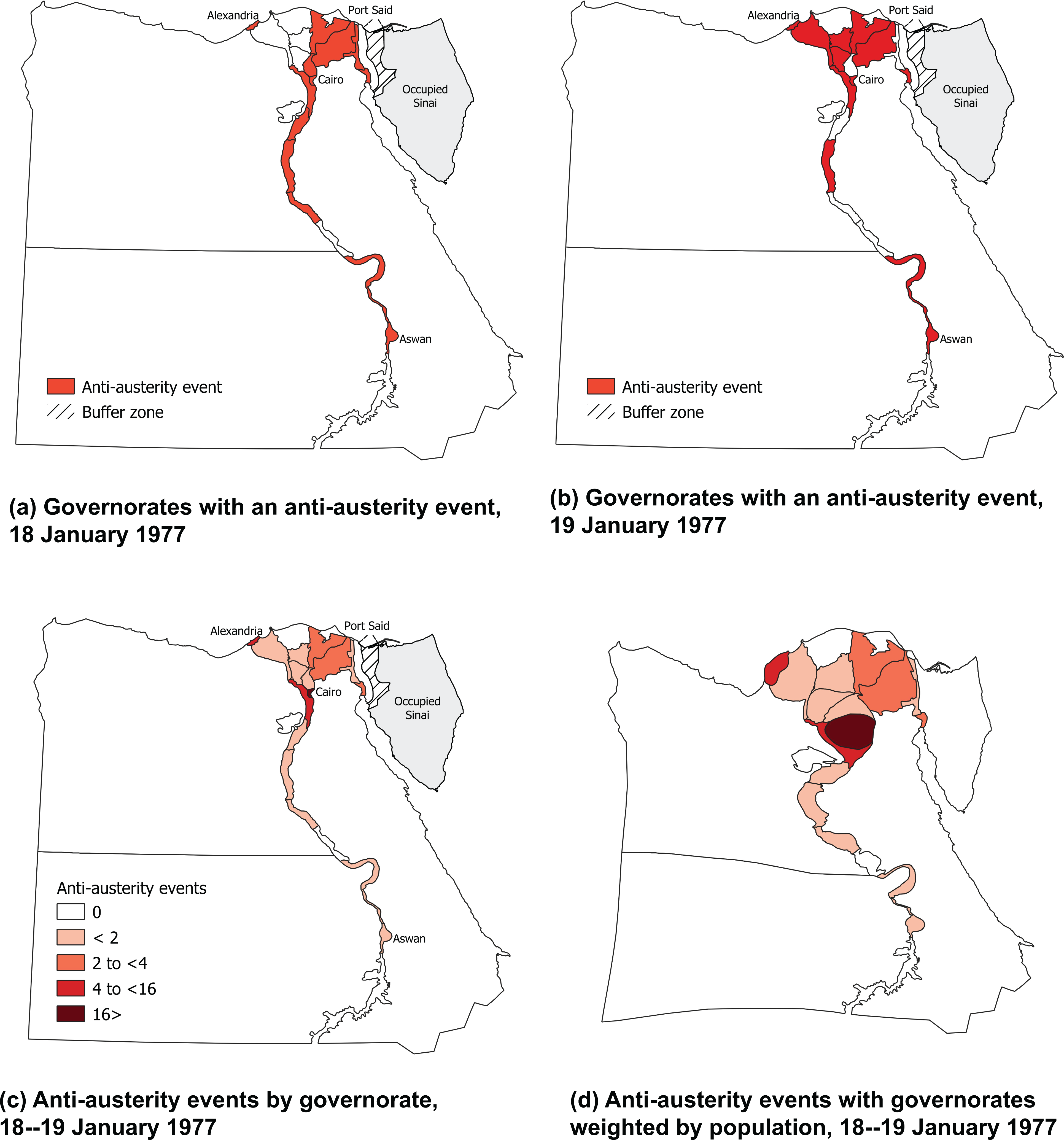
The damage to state and economic infrastructure was extensive, estimated at around 1.5 billion current $US (US Department of State, 1977a). In total, 77 Egyptians were killed, and over 500 were injured (Cairo Press Review 22 January 1977: 7). The state prosecutor announced that 1,270 Egyptians had been arrested (Al-Ahram 22 January 1977: 1). Left-wing groups in particular were singled out as having orchestrated the violence. This became the official state narrative, which claimed that ‘secret communist organizations [had] instigated acts of sabotage’ (Al-Ahram 22 January 1977: 1). However, claims that the Bread Intifada had been instigated and coordinated by leftists were met with widespread skepticism (Ansari, 1986: 187). In a secret cable, the US Embassy noted that ‘Despite GOE’s [Government of Egypt’s] efforts to publicly blame communists for riots […] all the evidence indicates that the demonstrations were in first instance a spontaneous public outcry against announced price rises’ (US Department of State, 1977a). The cable goes on to note that while some leftists likely participated at a local level, claims of an organized conspiracy ‘reflects customary effort by GOE to exculpate itself’ (US Department of State, 1977a). Tellingly, many of these leftist activists were subsequently released (Soliman, 2021).
Academic treatments of the events have also discarded the leftist hypothesis and instead – in line with this literature’s tendency to amalgamate – variously described rioters as ‘workers, students, and the urban poor’ (Mitchell, 2002: 249), the ‘urban lumpenproletariat’ (Ayubi, 1991: 245), and ‘people suffering from poverty and hunger’ (Abd Al-Raziq, 1979: 80–81). An alternative description comes from Adly (2014), who suggests that the rioters were ‘public sector workers and civil servants’. Similarly, albeit anecdotal, Soliman’s (2021) oral history of 1977 riot participants in Suez is almost exclusively composed of Egyptians who were working in the public sector. Sadowski (1991: 156) gives an even more specific account that anticipates our argument: ‘the groups that initiated the riots were relatively privileged – industrial workers, students, and muwazzafin (public sector employees). By Egyptian standards they were almost middle class; they had regular jobs, decent wages, and a guaranteed future. They demonstrated not because they were in imminent danger of hunger; for them the IMF’s austerity program meant constriction, not strangulation. Rather, they were moved into the streets by a feeling of injustice. By a violation of their standards of fairness.’ In what follows, we look to empirically arbitrate these claims.
Data and method
To study the Bread Intifada, we first constructed a catalog of anti-austerity events recorded in three Arabic-language newspapers: al-Ahram, al-Akhbar, and al-Gumhurriya. These were three of the largest newspapers by circulation in Egypt at that time and are held on microfilm in the Egyptian National Library. We also coded the Cairo Press Review, a daily news bulletin held at the American University in Cairo. We also consulted the memoirs of participants, as well as US diplomatic cables, FCO archives, the Egyptian Gazette, and local histories of the Bread Intifada published by activist groups. By triangulating these sources we were able to identify 110 events occurring between 18 and 19 January 1977.
The Egyptian statistics authority (CAPMAS) enumerated the tenth population census in the country’s modern history just six weeks before the outbreak of the Bread Intifada. This census records disaggregated information on employment, education, and demographics for 231 districts. The timing of this census provides a unique opportunity to capture the socio-economic contexts of the riots. To refine our understanding of employment categories, we triangulate our census data with the 1988 labor force survey (the first labor force survey available), which asked retrospective questions about individuals’ labor market status at the time of the Bread Intifada. We also digitized appendices to the 1976 census held at the American University in Cairo recording district-level data on infant mortality and access to running water.
To account for prior mobilization in a district, which would point to pre-existing protest networks and historical focal points of protest, we created a separate catalog of protest events reported in al-Ahram, al-Akhbar, and al-Gumhurriya from 1 January 1975 to 18 January 1977. These events were coded from the microfilms held at the Egyptian National Library and the Greater Cairo Library. The period immediately prior to the Bread Intifada saw the first competitive multiparty parliamentary elections held in Egypt since the Free Officers seized power in 1952. To measure the mobilizational capacity of leftist candidates and parties, we coded the district-level electoral results reported in al-Ahram from 20 October to 7 November 1976. To identify districts that were proximate to the Israeli-occupied Sinai, we geo-referenced a 1:1,000,000 scale map of the UN-enforced buffer zone in place at that time (Central Intelligence Agency, 1976).
Empirical strategy
Our dependent variable is a count of anti-austerity events in a district day from 18 to 19 January 1977. There were 231 districts in Egypt during this period; the event catalog records one or more anti-austerity events in 54 districts (23%) over the two-day period. A Global Moran’s I test for spatial autocorrelation reveals significant spatial clustering in the occurrence of events. We therefore estimate a series of spatial models to account for how a district’s location may have determined the local intensity of events. As events on the first day may have patterned the intensity and location of contention on the second day, we observe each district over both days.
Our dependent variable has a mean equal to its variance, and so is modeled using Poisson regression. In a first specification, we account for unobserved spatial confounding by including a time-lagged measure of spatially proximate protest. Our count of anti-austerity events, μ, in district i at time t is estimated as:

where for districts i≠j, γWyit
−
1 is a spatially lagged count of anti-austerity events within 3 kilometers of a district that occurred on the previous day calculated with
We also estimate a spatial error model. We transform the count of anti-austerity events in a district to the inverse hyperbolic sine. 8 The number of events in district i at time t is modeled as:

where our time-invariant and time-varying variables follow those set out in Equation (1). Epsilon accounts for spatially correlated errors in the covariance structure of the disturbance term:

where
Finally, to take into account the panel structure of our data, we also estimate a spatial autoregressive panel model.:

with
Independent variables
Our key independent variable measures the percentage of labor market insiders in a district’s economically active population. We construct this variable from two data sources: the 1976 census provides us with information about the number of people working in different employment categories in a district (e.g. manufacturing); the Egyptian labor force panel provides us with retrospective information about the employment status of individuals in the labor force who held a job in December 1976, just a month prior to the Bread Intifada. We use information about access to social security from the labor force survey as an indicator of insider status and calculate the percentage share of labor market insiders within each employment category at the governorate level. For example, in the governorate of Suez, 71% of manufacturing workers had access to social security, compared to only 12% of manufacturing workers in Asyut. 9 We then apply these percentage shares as weights to the district-level employment categories in the census in order to calculate the proportion of labor market insiders among the economically active population. 10 This triangulation of data sources allows us to obtain a rather precise picture of the pattern of labor market status and informality in 1977 Egypt – something that is notoriously difficult to estimate. If anti-austerity rioting during the Bread Intifada was more likely in districts with more regime insiders, this variable should be positive.
We also enter variables to test rival explanations. As per studies that stress the role of the ‘urban poor’, one explanation for the local intensity of action could be that rioters were drawn from pockets of deprivation found in districts with more formalized employment. Following the austerity literature, we operationalize local deprivation using the male unemployment rate in a district. An alternative explanation might be that districts with more formal, insider employment were located in close proximity to more deprived areas. Here, residents from more deprived neighborhoods could have traveled to neighboring districts to attack property, loot, etc. Travel from further afield would have been difficult given the spontaneous and short-lived nature of events, as well as the fact that public transport was a key target for rioters and security forces sought to control movement. To account for proximate deprivation, we include a spatially lagged variable for male unemployment rate in surrounding districts. This is measured using an exponential weights matrix with a distance decay parameter that gives greater weight to deprivation in districts that are located closer to a target district. In the robustness section, we also test infant mortality and the percentage of families without access to running water as alternative indicators of deprivation, as well as an interaction term between unemployment and insider employment to capture relative deprivation. If deprivation (absolute or relative) patterned the contexts of the Bread Intifada, then one or more of these variables should be positive.
Another plausible factor in the patterning of anti-austerity events relates to protest backlash, with repression on the first day possibly triggering backlash events on the second. We therefore add a temporally lagged dummy variable for whether an anti-austerity event was repressed in a district at t–1. If backlash was a major factor in the incidence of rioting, this variable should be positive.
Given the blame the Egyptian government placed on leftist activists for fomenting the events and arguments in the social movement literature about resource mobilization and professional organizers, we enter a dummy variable for a district where a left candidate either won outright, or went into the second round run-off, in the parliamentary elections of October–November 1976. Our underlying assumption is that leftist mobilizing capacity was greatest in districts where leftist candidates performed well. 11 A corollary explanation relates to the role played by leftist students, and university students more generally. Here, we code a dummy variable for whether a university campus was located in a district. If these factors patterned the Bread Intifada, these variables should be positive.
Controls
To parse the importance of insider employment from a district’s wider socio-economic context, we introduce a series of control variables. Middle class, educated individuals are more likely to protest (labor is the exception; Biggs, 2014), and so we enter the percentage of the population who are university educated. Both contentious events and employment in insider sectors are likely to be found in more urban districts. To account for this, we enter the percentage of the population who live in urban areas. We also anticipate that events will be more likely in major population centers where more people were affected by proposed subsidy cuts, and so we control for the total population of a district, transformed by taking its logarithm to the base 10. The percentage of males aged between 16 and 24 accounts for more protest-prone populations.
We should also account for the focal qualities of collective action. During episodes of political upheaval, protesters often fall back on familiar repertoires and travel to sites associated with protest. We therefore enter a dummy variable for whether a district saw any protest in the two years before the Bread Intifada. Protesters also travel to symbols of political power. To capture this, we enter a variable measuring the square root distance in kilometers between a district’s centroid and the centroid of the district containing the governorate building. Governorate centers also hosted a range of other local and central government buildings.
Finally, the Israel–Egypt Disengagement Treaty of 1974 saw the deployment of United Nations soldiers along a disengagement zone east of the Suez Canal, with Egypt and Israel maintaining a significant military presence on either side of the zone. Our expectation is that events were less likely in districts closer to the buffer zone due to its heavy militarization, and so measure the square root distance in kilometers between a district’s centroid and the buffer.
Results
Explaining anti-austerity events, 18–19 January 1977
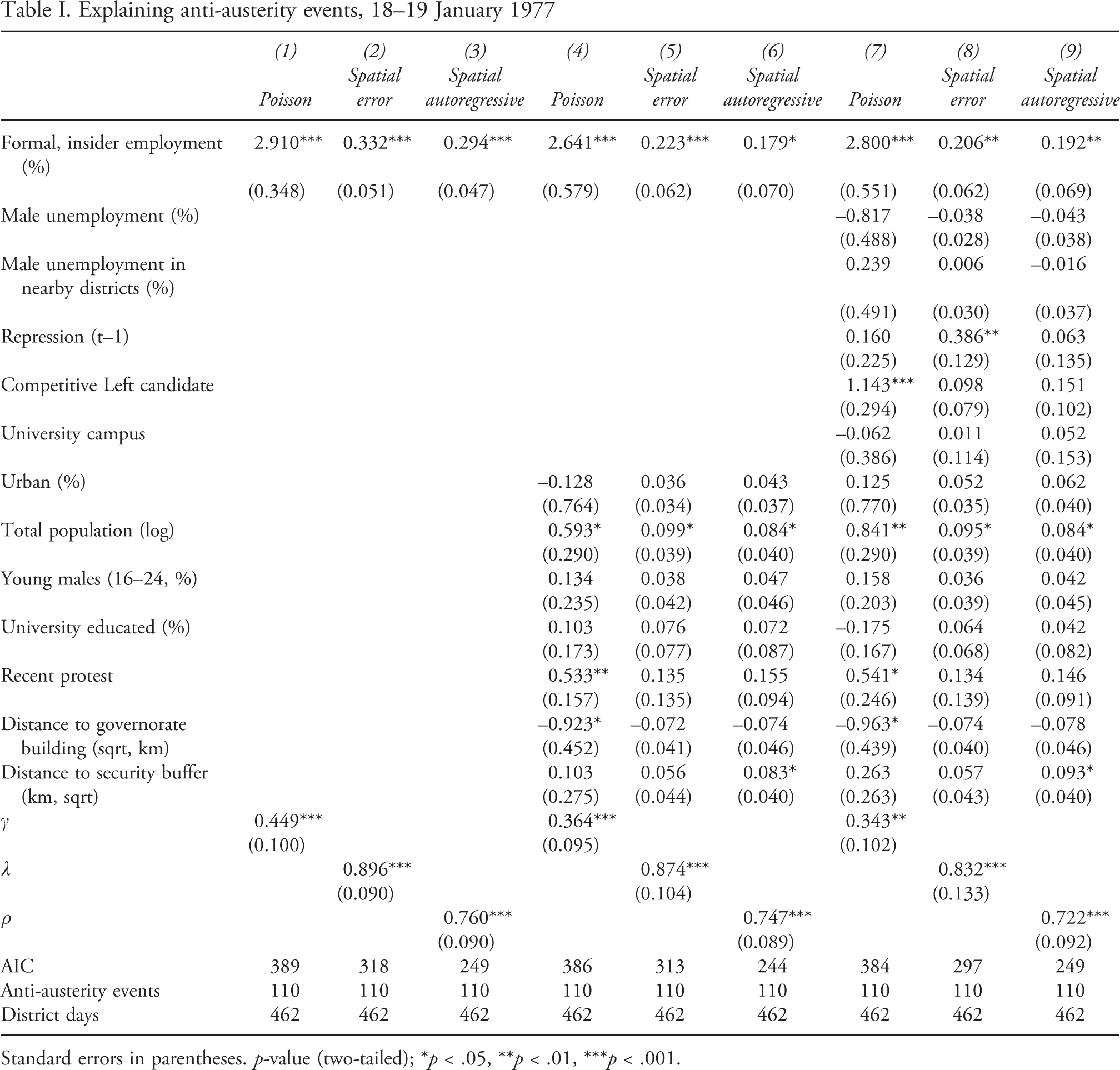
Standard errors in parentheses. p-value (two-tailed); *p < .05, **p < .01, ***p < .001.
Models 1–3 begin with the bivariate association. Models 4–6 add control variables. Models 7–9 test alternative explanations. All models show evidence of spatial confounding. Moving from Model 1 to Model 9, districts with more employment in formal, insider sectors were consistently more likely to see anti-austerity events on a given day during the Bread Intifada – and this association is both statistically significant and substantively important. Figure 2 shows the predicted incidence-rate ratio (the exponent of β) from Model 7 calibrated to the median district where 24% of the economically active population were employed in formal, insider sectors. A histogram shows the marginal distribution of formal, insider employment (note the pronounced bi-model nature of the distribution as insiders and outsiders lived in different districts). Vertical dashed lines mark the 10th, 50th, and 90th percentiles. Moving location from the median district (where the rate is 1, marked by the horizontal line) to a district where 70% of the population was employed in formal, insider sectors (the 90th percentile), multiplies the predicted incidence rate 15 times.
Turning to our alternative explanations: the role of deprivation in patterning anti-austerity events is ambiguous. Across all models, increasing the male unemployment How formal, insider employment predicts anti-austerity events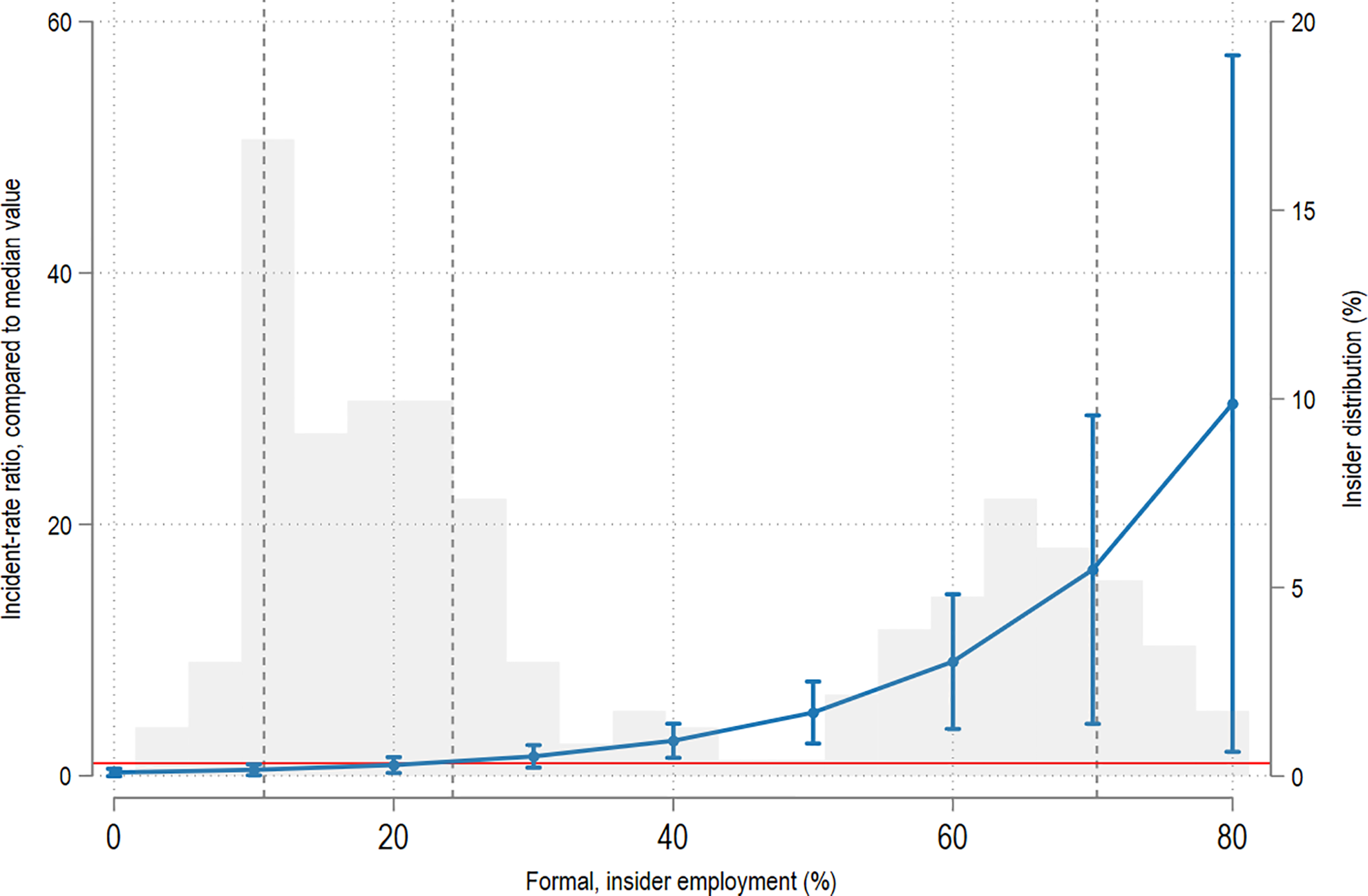
Tables A1–A4 in the Online appendix report additional tests that confirm the robustness of our findings. These include testing alternative measures of deprivation, an interaction term for relative deprivation, subsetting to urban districts, and sensitivity tests for omitted variable bias.
Conclusions
Before expanding on the implications of our findings, we should reflect on shortcomings. Our results speak to the aggregate employment characteristics of districts. In mitigation, anti-austerity events during the 1977 Bread Intifada were most likely in areas with very little heterogeneity – in some districts that saw events, 80% of the adult population were labor market insiders. This makes it less likely that the pattern of rioting we observe was driven by a minority of outsiders in insider-majority districts. That would require the incidence of rioting to increase as the proportion of outsiders decreased and for insiders not to protest at all as they would otherwise pattern the aggregate. In other words, outsiders would only consistently mobilize in areas where they were less prevalent. Critical mass models for collective action suggest that this is implausible (Marwell, Oliver & Prahl, 1988), especially if we assume that the selective incentives stemming from the planned cuts were equally distributed across both groups. Furthermore, there is no evidence that insider districts located in close proximity to deprivation were more riot prone. The spontaneous nature of the riots, coupled with harsh repression and the imposition of a curfew, will have ensured that participants could not easily travel, and so acted locally to where they lived.
Zooming out to reflect on the wider significance of this study, we are reminded of E. P. Thompson (1971) who rallied against ‘spasmodic’ explanations for rioting. Too often, he argued, riots are reduced to ‘rebellions of the belly’ (Thompson, 1971: 77). The same critique could be applied to studies of anti-austerity riots in the Global South, which key participation in riots to the aggrieved ‘urban poor’. While we should not dismiss the relevance of deprivation based on a single case, our study suggests a new avenue for inquiry into the political economy of anti-austerity riots in late developing states. By harnessing insider–outsider theories of labor markets to provide a theoretical underpinning for the concept of moral economy, we offer a framework which allows us to better understand how development trajectories and the formation of insider coalitions shape political behavior. This study thus makes an important step towards connecting the political sociology of labor market dualization modelled on OECD economies to the MENA. We also provide a much needed explanation for the processes through which shared moral principles about a ‘just’ social order can emerge, rather than deploying the concept ad hoc assuming that moral codes are shared by populations at large. Most fundamentally, this study calls for greater attention to the ways in which labor market inequalities can structure the ecologies and contexts of contentious politics.
Footnotes
Replication data

Acknowledgements
We thank Ahmed Atif for outstanding research assistance, Tarek Masoud for sharing data, and Christopher Barrie, Thoraya El-Rayyes, Marco Giani, Lamiaa Shehata, and Steffen Hertog for comments.
Funding
This research received a Faculty Grant from King’s College London.