




Abstract
When are mass protest movements able to overthrow authoritarian regimes and promote democratic transitions? This article considers whether socially diverse protest movements are more conducive to democratization than movements restricted to one or a few social groups. Coalitions across social groups should impose higher costs on authoritarian regimes through access to a wide range of resources, strategies and sources of leverage. Heterogenous protest coalitions are also more likely to socially overlap with regime supporters and the security forces, which should encourage regime splits and defections. But, diverse protest movements may also be more vulnerable to fragmentation and in-fighting, which may particularly threaten prospects of democracy in the aftermath of an authoritarian regime breakdown. Analyzing new global data mapping the social group composition of anti-regime protest campaigns from 1900 to 2013, the article finds consistent evidence that socially diverse protest movements are more likely to overthrow authoritarian regimes, and this is not driven by protest size. Socially diverse movements are also more likely to end in the short- and long-run establishment of more democratic institutions, suggesting that heterogenous protest movements’ potential for bringing about democracy is more promising than expected. These findings speak to the importance of securing broad and not only large mass movements to promote democracy.
Introduction
As part of the recent global protest wave of 2019, citizens in countries such as Algeria, Hong Kong, Hungary, Eswatini, Georgia, Iran and Sudan took to the streets to demand (more) democratic governments. While all these movements attracted large crowds and created local and international headlines, only a few, including those in Sudan and Algeria, produced any meaningful democratic improvements, and the Sudanese improvements were later reversed in a 2021 military coup. Important insights have been offered into why and when resistance movements are able to promote democratization (and related goals), pointing in particular to strategic choices such as a reliance on nonviolent resistance strategies (Chenoweth & Stephan, 2011), tactical diversity and innovation (Cunningham, Dahl & Fruge, 2017), large-scale mobilization (Chenoweth & Belgioioso, 2019) and repression-contention dynamics (Sutton, Butcher & Svensson, 2014). While this literature yields important insights into the dynamics, strategies and contexts of effective protest movements, it has paid less attention to who the protesters are. Crucially, protest movements vary considerably in terms of participants’ social background, and this should influence prospects for achieving political change. In particular, while some protests have a relatively homogenous social profile, mainly restricted to certain segments of society, others build on broad coalitions across different social groups such as urban middle classes, peasants and industrial workers. Could the social diversity of protest movements explain prospects of democratization?
Both historically and today, we see significant variation in resistance movements’ social diversity. To take one historical example, while the 1932 anti-regime campaign in El Salvador against authoritarian president Martinez was largely restricted to peasants, the El Salvadorian ‘Strike of Fallen Arms’ campaign initiated 12 years later, which overthrew the government, was a coalition movement spanning groups such as industrial workers, public employees, peasants and urban middle classes. Importantly, such social diversity is not just a function of the number of participants in a protest, and we see significant variation in protester diversity even among very large movements. For instance, survey data from the 2011 Arab Spring suggest that while the large-scale Egyptian Arab Spring uprising was mainly confined to the urban middle class including professionals, government employees and private sector employees, the Tunisian Arab Spring movement was a broad-based coalition between the urban middle class, workers, students and the unemployed (Beissinger, Jamal & Mazur, 2015). Indeed, this has been pointed to as one reason why the Egyptian revolution ended in a new dictatorship, while the Tunisian revolution induced a decade of democratic improvements. Yet, the link between the social diversity of protest coalitions and their outcomes has yet to be studied systematically.
In considering the role of diverse social coalitions in pro-democracy protests, the article builds on prominent political science contributions highlighting the importance of cross-class coalitions for transitions to democracy. 1 Several influential case studies and small-N comparative studies from the historical-sociological literature emphasize the role of class coalitions in fostering transitions to democracy (Moore, 1966; Luebbert, 1991; Lipset & Rokkan, 1967; Rokkan, 1999; Rueschemeyer, Stephens & Stephens, 1992). Also comparative work on mass protests, such as Chenoweth & Stephan (2011), suggests that movements are more effective ‘when participants reflect diverse members of society’. However, the contemporary protest literature has not yet accounted for differences in protest movements’ social diversity, and expectations about the social basis of successful pro-democracy movements have not yet been investigated in a quantitative framework.
This article offers the first global study of the relationship between protest movements’ social diversity and democratic transitions. A protest movement can be diverse in many ways, including goals, ideology, ethnicity, organizational basis or gender, but this article considers movements’ diversity in terms of social group composition, defining a social group as a group of individuals with a common social and/or socio-economic identity, that are likely to have some degree of connection through a shared social network. 2 The article discusses several mechanisms implying that a socially diverse campaign, bringing together a broad range of social groups, should be more effective than a movement mainly consisting of protesters with a shared social background. For instance, diverse social coalitions should impose higher disruption costs on antagonist regimes, through the ability to use a broad range of strategies and inflict costs across different sectors. Socially diverse protests should also have more vertical ties with members of the ruling coalition, increasing the likelihood that ongoing protest promotes defection by regime supporters. However, there are also potential mechanisms indicating that class-coalitions may harm prospects of democratization. Extant literature has emphasized unity and coherence as important characteristics of successful resistance campaigns, while showing that fractionalization may lead to campaign deterioration. Highly heterogeneous movements may be ‘negative coalitions’, in the sense that their members are united by their goal to overthrow existing (authoritarian) institutions but lack a common goal for an alternative government (e.g. Goldstone, 2011). Such negative class coalitions may struggle to unite around a new set of democratic institutions.
To evaluate the merits of these (somewhat) contrasting expectations, this study analyses new global data on the social group composition of all anti-regime protest campaigns listed in the NAVCO 1.2 dataset (Chenoweth & Stephan, 2011), covering 1900–2013. These data map whether and to what extent a range of social groups participated in each campaign: peasants; public sector employees; military employees; religious or ethnic groups; industrial workers; and urban middle classes. Various tests of the relationship between protest movements’ social diversity and democratization, at both the protest campaign level and the country level, yield consistent evidence that socially diverse protests are linked to increases in democracy level, both in the short term and the medium/long term. This association holds up to accounting for the size of the campaign, and the coefficient estimate for protest size is close to zero and statistically insignificant when also accounting for protest diversity. Nor is there evidence that the link between diversity and democracy is conditioned on the movement reaching a certain size, or that large numbers can compensate for low levels of social diversity.
The relationship between protests’ social diversity and democratization holds up when controlling for characteristics or conditions of the campaign, such as regime repression and foreign support, contextual characteristics such as GDP per capita and education level, and country and year fixed effects. Results from causal sensitivity analysis suggest that although omitted confounders, such as unmeasured campaign characteristics or contextual factors that facilitate both diverse protests and transitions to democracy, can not be ruled out, they are unlikely to fully explain away the estimated coefficients.
The results indicate that the potential downsides of socially heterogenous movements (such as fragmentation) are less of a threat to democratic transitions, on average, than expected. Rather, overcoming divisions and joining forces in a broad social coalition seem to be a powerful force for democratic improvements.
Mass protest and democratization
Mass collective action has been a significant force for democratization throughout history (see e.g. Skocpol, 1979; Tilly, 1996; Brancati, 2016; Haggard & Kaufman, 2016; Teorell, 2010). Organized mass movements can trigger transitions to democracy directly, through toppling a dictator in a democratic revolution, as has occurred in countries such as Tunisia, Czech Republic, the Philippines, Poland, Chile and Sudan. Regime change can also be induced more indirectly by protesters, through for instance pressuring elites to accept a ‘pacted transition’ (Collier, 1999), promote elite fractionalization conducive to elite defection and coup d’états, thereby creating a window of opportunity for pro-democracy forces (e.g. Thyne & Powell, 2016), or induce democratic concessions by leaders afraid of revolution (e.g. Bratton & van de Walle, 1992; Kim & Kroeger, 2019). Even in the comprehensive literature on socio-economic and structural determinants of democratization, collective action is often considered a key mediator linking structural changes to regime change (Lipset, 1959; Glaeser, Ponzetto & Shleifer, 2007; Acemoglu, 2006; Ansell & Samuels, 2014). For instance, socio-economic development is often expected to strengthen the lower and/or middle classes, through raised income, education, more extensive social networks (through urbanization) and improvements in infrastructure and communication technology, facilitating the ability to organize collective action (Glaeser, Ponzetto & Shleifer, 2007).
Yet, far from all opposition movements have succeeded in overthrowing dictators and triggering democratization. Chenoweth & Stephan (2011) suggest that around 50% of all nonviolent revolutions since 1900 have succeeded, and only 30% in the most recent decade. This raises the question of why some mass protests succeed in promoting democracy. Classical social science explanations of democratic transitions often focus on the social background of the actors involved in collective action (and other attempts at) promoting regime change, highlighting the role of different groups such as the middle classes, industrial workers and peasants (Moore, 1966; Luebbert, 1991; Lipset & Rokkan, 1967; Rokkan, 1999; Rueschemeyer, Stephens & Stephens, 1992). Most of these contributions assume that democratic transitions rely on different social classes joining forces in a coalition to promote regime change. This includes Moore (1966), arguing that democracy is primarily achieved through a coalition between the middle classes and rural groups. Rueschemeyer, Stephens & Stephens (1992) also highlight the role of multiclass coalitions in democratic transitions, proposing in particular that the working classes are more likely to induce democracy when allying with the urban middle classes (see also Luebbert, 1991), while Lipset & Rokkan (1967) emphasize the importance of class alliances based on cross-cutting cleavages for the emergence of modern social democracy (see also Rokkan, 1999).
Hence, prominent social science contributions point to the role of class coalitions in facilitating democratic transitions. Yet, the findings from this literature often rely on the specific cases under scrutiny – usually one or a few Western European instances of transitions to democracy during the first wave of democratization. At the same time, although many studies emphasize the role of class coalitions in pro-democracy collective action – the role of coalitions in mass protest movements are rarely studied directly. This calls for a global investigation of whether protest movements bringing together a range of social groups are systematically linked to democratization, when accounting for other characteristics and conditions of these movements.
In studying the role of protest movements in democratization, this article builds on a large quantitative literature on the determinants and outcomes of mass protest. This literature offers important insights on why and when protest movements succeed in achieving their goals, with a focus on campaign strategies and the strategic interaction between the protest movement and the regime. A key insight from this literature is that nonviolent protest strategies are more likely to lead to democratization than violent ones (Teorell, 2010; Chenoweth & Stephan, 2011; Celestino Rivera & Gleditsch, 2013; Kim & Kroeger, 2019; Pinckney, 2020), and that democracies emerging in the aftermath of nonviolent movements are more likely to consolidate (Bayer, Bethke & Lambach, 2016; Bethke & Pinckney, 2021; Kadivar, 2018). One suggested explanation for this finding is that nonviolent protest can mobilize a larger crowd, due to lower costs of participation – both in terms of risk and necessary preparation (e.g. the need for weapon and battle training to participate in violent resistance). Several studies show a positive link between the number of participants in resistance movements (usually at its peak) and the likelihood of achieving stated goals (Chenoweth & Stephan, 2011; Nepstad, 2011; Chenoweth & Belgioioso, 2019; Brancati, 2016). Speaking to the power of large numbers, Chenoweth & Belgioioso (2019) argue that no movement mobilizing more than 3.5% of citizens in a given country has failed at achieving its main goals. A large number of participants should be crucial to maintain a diverse repertoire of contention and to achieve sufficient leverage to force regime concessions (Chenoweth & Stephan, 2011).
Yet, the key to successful protest may not necessarily be the number of participants in the movement, but whether movements cut across different social classes, thereby tapping into different resources and interests. Recent studies on historical and contemporary revolutions point to the importance of coalitions of different groups in transitions to democracy. Analyzing the 2011 Arab Spring revolutions in Tunisia, Egypt and Libya, Goldstone (2011) argues that ‘virtually all successful revolutions were forged by cross-class coalitions that bridged the diverse goals and interests of different groups’. He also discusses how successful revolutions are often carried out by ‘negative coalitions’ that is, coalitions with more diverse preferences on most other issues than their opposition towards the incumbent regime.
While contemporary protest research has offered important insights into strategic and contextual explanations of efficient protest, the literature has paid much less attention to the social composition of the mobilizing actors. A couple of studies, including Butcher & Svensson (2016) and Dahlum, Knutsen & Wig (2019), investigate the role of particular social groups. The former shows that protest movements consisting of labor unions are more likely to use nonviolent resistance, while the latter finds that protests by urban social groups are associated with democratization. Yet, none of these studies consider coalitions between groups. As noted by others, protest movements – violent or nonviolent – are not unitary actors, but may consist of ‘shifting coalitions of groups with malleable allegiances and at times divergent interests’ (Pearlman, 2012). Crucially, movements vary when it comes to their social configuration, with some movements consisting of diverse coalitions of social groups with very different resources and interests, while others are more homogenous.
The next section details ways in which social diversity can influence protest movement’s prospects for democratization.
The power of social diversity in pro-democracy movements
Protest movements can promote democratization through processes that involve overthrowing the authoritarian regime, often through a revolution, and replacing it with democracy. It can be useful to conceptualize this as a two-stage process, consisting of the pre-breakdown phase, leading up to the breakdown of autocracy, and the post-breakdown phase, in which the relevant actors reach an agreement to introduce democracy. In many cases, mass protests may succeed at bringing down the dictator, but the post-breakdown phase ends in the establishment of a new autocratic regime, such as in Egypt after the Arab Spring, or prolonged periods of conflict, such as in Libya after the 2011 uprisings (e.g. Geddes, Wright & Frantz, 2014). Alternatively, protest coalitions may pressure the autocratic leader to gradual liberalization and/or to introduce multiparty coalitions. Protest movements’ social diversity may play into these different processes.
First, socially broad protest campaigns should inflict higher disruption costs on the authoritarian regime. Protest movements gain leverage by inflicting costs on the regime, prominently by disrupting the existing political and/or economic order (e.g. Klein & Regan, 2018). While violent campaigns impose costs through use of force, nonviolent campaigns can raise the political or economic costs of remaining in power. Existing research highlights the benefits of diversifying resistance strategies rather than relying on one or a few methods (Cunningham, Dahl & Fruge, 2017; Chenoweth & Lewis, 2013). Having access to a more diverse set of resources, skills, and sources of leverage, socially diverse campaigns should be well placed for diversifying their tactics, combining strategies such as boycotts, demonstrations, sit-ins, petitions and online campaigns. A socially diverse protest could also induce costs across sectors, through combining measures such as blocking commerce, shutting down transport or trade, labor strikes, obstructing the public sector, agricultural strikes and student sit-ins. This diverse toolbox may raise the regime’s costs of remaining in power sufficiently to induce a regime breakdown, either due to personal costs on the core leadership or because key allies consider the costs of supporting the regime too high and thereby withdraw support. This points to the importance of not only securing a large number of protesters, but also the participation of different groups that control different societal sectors and therefore can hurt the regime in various ways.
A broad class-coalition may also raise disruption costs indirectly, through its potential advantage in attracting large-scale mobilization, which again has been shown to put pressure on existing regimes (Chenoweth & Belgioioso, 2019). While a protest largely dominated by one social group, such as industrial workers, may have existing networks conducive to recruiting more industrial workers to the protests, the recruitment potential among other social groups may be limited. Any individual is more likely to join mass movements after observing that friends and co-workers are also doing so (Doherty & Schraeder, 2018). A class-coalition campaign has a broader pool of potential participants, having links to different social networks. In this way, socially broad protest coalitions can establish ‘mega-networks’, understood as networks tying prior within-group networks to each other (Goldstone, 2011).
Second, a large social coalition will be more likely to have ‘vertical overlaps’ with the regime’s support coalition, which should be conducive to elite defections. Authoritarian regimes usually rely on a coalition of groups or individuals constituting the dictator’s power base in exchange for benefits such as political influence, jobs or public goods (Svolik, 2012; Geddes, Wright & Frantz, 2014). Even an elite-based support coalition usually has links to broader segments of society – if they are not leaders or representatives of broader social groups. Members of a support coalition should be more inclined to withdraw support from the regime if they have links to or social overlaps with protest participants. This mechanism applies to not only civilian members of a regime support coalition, but also to the security forces: the more social overlap between protesters and the (networks of the) members of the security forces, the more likely the military is to defect from a regime coalition (Thurber, 2019).
Third, if the protest movement is socially narrow, incumbents can undermine it by allying with (leaders of) social groups representing ‘third parties’ groups outside of the protest movement and the ruling coalition. If resistance is mainly confined to one or a few groups, the regime can more easily frame the opposition as a threat to society, from a distinct and non-representative segment of society, and use this rationale to build a coalition against the campaign. With the support of other social groups, the regime can also more legitimately repress the resistance campaign or simply ignore its demands. This mechanism is illustrated by Lachapelle (2022), showing how the Egyptian regime in 2013 could violently repress participants in a street protest while effectively bolstering its legitimacy among segments of society not participating in protest, who considered the protesters as a threat. However, if protestors are perceived as representative of the societal majority rather than as voicing more parochial interests, it is harder to recruit anti-movement allies and undermine the movement. A campaign deriving its legitimacy from a broad support base can more effectively appeal to potential domestic regime-supporters but also supporters abroad, such as foreign governments, NGOs or civil society organizations, and generate international condemnation of the regime if it represses the movement.
Finally, a socially diverse coalition may facilitate the establishment of democratic institutions in the post-breakdown phase. If one or a few social groups dominate(s) the post-breakdown phase, the institutional changes introduced could be viewed as the product of one particular group seeking advantages for itself rather than for the majority. This may create instability in the form of backlash by groups perceiving that their interests are being violated. In contrast, a broad-based process in which a variety of groups are brought to the negotiation table will bring legitimacy to the outcome. Consistent with this, the social movement literature argues that a mechanism labeled ‘brokerage’ – understood as the process of connecting previously unconnected groups in society, and mediating to realize common interests – is key to successful protest (McAdam, Tarrow & Tilly, 2001; Kingstone, Young & Aubrey, 2013). Protest movements with a diverse set of social groups should be well positioned to broker with wide segments of society, to establish common agendas for change.
These mechanisms yield the following overall hypothesis, which is the key focus in this study:
Hypothesis 1: The protest campaign’s coalition size is positively linked to democratization
Yet, there are also potential challenges to socially diverse protests. The mass resistance literature emphasizes the need for unity and coherence in order to achieve political change (Pearlman, 2012). Diversity in terms of social class identities and interests of protest participants may be a source of fractionalization, particularly in the post-revolutionary stage. Insights from particular cases, such Egypt and Ukraine (e.g. Beissinger, 2013), suggests that the danger of fractionalization based on diversity of interests and identities could be a major obstacle to post-revolution democracy. Although different social groups manage to unite around a common goal of overthrowing the dictator, these groups may differ in preferences regarding the institutional outcome of the revolution. A cross-class alliance may be a ‘negative coalition’, in the sense that its uniting force is opposition against the incumbent, rather than an agreement about an alternative form of government. This lack of ideological or political coherence may lead to fractionalization or in-fighting in the post-revolutionary stage. As Goldstone (2011) argues, ‘what was just recently a remarkably tough coalition capable of unseating a regime […] can become a pack of feuding forces in the aftermath of a successful revolt’.
There are indeed reasons to expect preferences for democracy, as well as the specific design of the democratic institutions, to vary across social groups. According to prominent economic theories of democratic transitions, preference for democracy is driven by expectations that economic redistribution will take place after democratization, while groups expected to lose out from economic redistribution should oppose democracy (e.g. Acemoglu, 2006). This suggests that poorer groups such as industrial workers may have a strong preference for democracy, while others, such as business elites or the aristocracy, may not. It also implies that groups expecting to win the majority vote in a future election may have incentives to promote democracy while groups expecting to be underrepresented are more hesitant. Preferences may also diverge on the particular design of the democratic institutions, pertaining to aspects such as voting system, constitutional rights and power-sharing agreements. Broad-based coalitions may therefore have very divergent preferences at the negotiation table in the aftermath of the dictator’s fall, which could increase the likelihood that bargaining breaks down. The outcome of this may be emergence of a new non-democratic regime or even violent conflict.
The latter points suggest that diverse protest campaigns may harm prospects of democratization, through undermining unity and coherence. Hence, if these mechanisms are operating, we should not expect that Hypothesis 1 is confirmed.
One further theoretical nuance that could help to unite these contrasting expectations on the usefulness of protest diversity builds on the distinction between the two stages of democratic revolutions discussed above the pre-regime breakdown stage and the post-breakdown stage. Very different dynamics may be at play in each stage, and the two processes may have different and even contradictory causes (see e.g. Kennedy, 2010). In particular, the mechanisms discussed above may imply that protest diversity facilitates authoritarian regime breakdown, due to heterogenous coalitions’ abilities to impose disruption costs in different areas. But, social diversity in the movement may prevent a ‘democratic pact’ in the post-breakdown phase, due to lack of consensus on a new regime. Below, this more nuanced expectation will also be tested, drawing on data on authoritarian regime breakdown.
Data
This section describes features of the core independent variables, pertaining to social group participation in opposition movements, and discusses the data generating process. The social diversity of protest movements is measured using the novel Who Revolts v.2 dataset, which is an extension of the Who Revolts v.1 data (Dahlum, Knutsen & Wig, 2019).
The units of analysis, the anti-regime opposition movements, are identified using the campaigns from the NAVCO 1.2 dataset (Chenoweth & Lewis, 2013), which covers major anti-regime protest campaigns and their features globally from 1900 to 2013. A campaign is defined as a series of observable, continuous, purposive mass tactics or events in pursuit of a political objective. Campaigns are observable, meaning that the tactics used are overt and documented. A campaign is continuous and lasts anywhere from days to years, distinguishing it from one-off events or revolts. Campaigns are also purposive, meaning that they are consciously acting with a specific objective in mind, such as expelling a foreign occupier or overthrowing a domestic regime. (Chenoweth & Lewis, 2013: 7)
The dataset records each social group and their level of involvement in each protest campaign. The dataset draws on information from various sources, notably including the Global Nonviolent Action database (Swarthmore, 2015), a global catalogue of nonviolent mass movements listing the social-group composition of movements and other features. Other important sources include International Encyclopedia of Revolutions and Protest (Ness, 2015). The coding also draws on cross-country and country-specific secondary sources. In many sources the social-group categories are clearly described; a source might, for example, explicitly note that a movement was dominated by industrial workers, and that peasants also participated. 3
Different types of variables are coded to represent different levels of involvement, including whether a group at a minimum participated at some level, dominated the movement in terms of numbers or active involvement, or initiated it. To compute the measure of social group diversity I draw on the set of variables registering whether the movement at some point in time consisted partly of members of the given group. This participation dummy is scored 1 if the social group is mentioned in at least two separate sources. This is fairly easy to gauge, especially since the mentioned databases include lists of social-group participation where my categories are included. 4 My independent variable is the Number of social groups that participated in each campaign.
The coding scheme can be illustrated with two examples. First, the Velvet Revolution against the Czechoslovakian Communist regime in 1989 is described in the sources as a broad-based movement consisting of urban middle classes, industrial workers, and peasants; these three groups are therefore all registered as participating. According to, for example, the Swarthmore database, the movement was sparked off by student demonstrations on International Students Day in November 1989, which soon developed into larger-scale mobilization including other groups. Moreover, the Swarthmore database describes the Public Against Violence organization – made up of, for example, artists, scientists and intellectuals – as the ‘leading force’. The movement is therefore coded as having originated among, and as being dominated by, urban middle classes. Second, the Senderista Insurgency against the Peruvian government from 1980 to 1999 is described by several sources (e.g. Swarthmore, 2015) as founded by an alliance of peasants and a student group in San Cristobal. Hence, it is coded as having originated among and consisting of peasants and urban middle classes.
Figure 1 shows the frequency with which different social groups participated in the campaigns in the sample, as well as their degree of involvement. It suggests that there is considerable variation in protest campaigns’ social composition. Figure 2 shows how participation by each of the main social groups co-varies with protest coalition size. In brief, it suggests that all social groups participate in some large class coalitions (with maximum five social groups in total), which is not surprising given that coalition-campaigns are more likely to contain any group. However, social groups such as industrial workers or public employees mainly participate in large coalition-movements (with some exceptions), while other groups such as the military are less inclined to join large coalitions.
Democracy
As the main specification of the dependent variable, I draw on the continuous Polyarchy measure from V-Dem (Coppedge et al., 2016).
5
Polyarchy reflects the electoral democracy concept of Dahl (1971), and the
Social groups’ involvement in NAVCO protest campaigns Size of protest coalitions and social group participation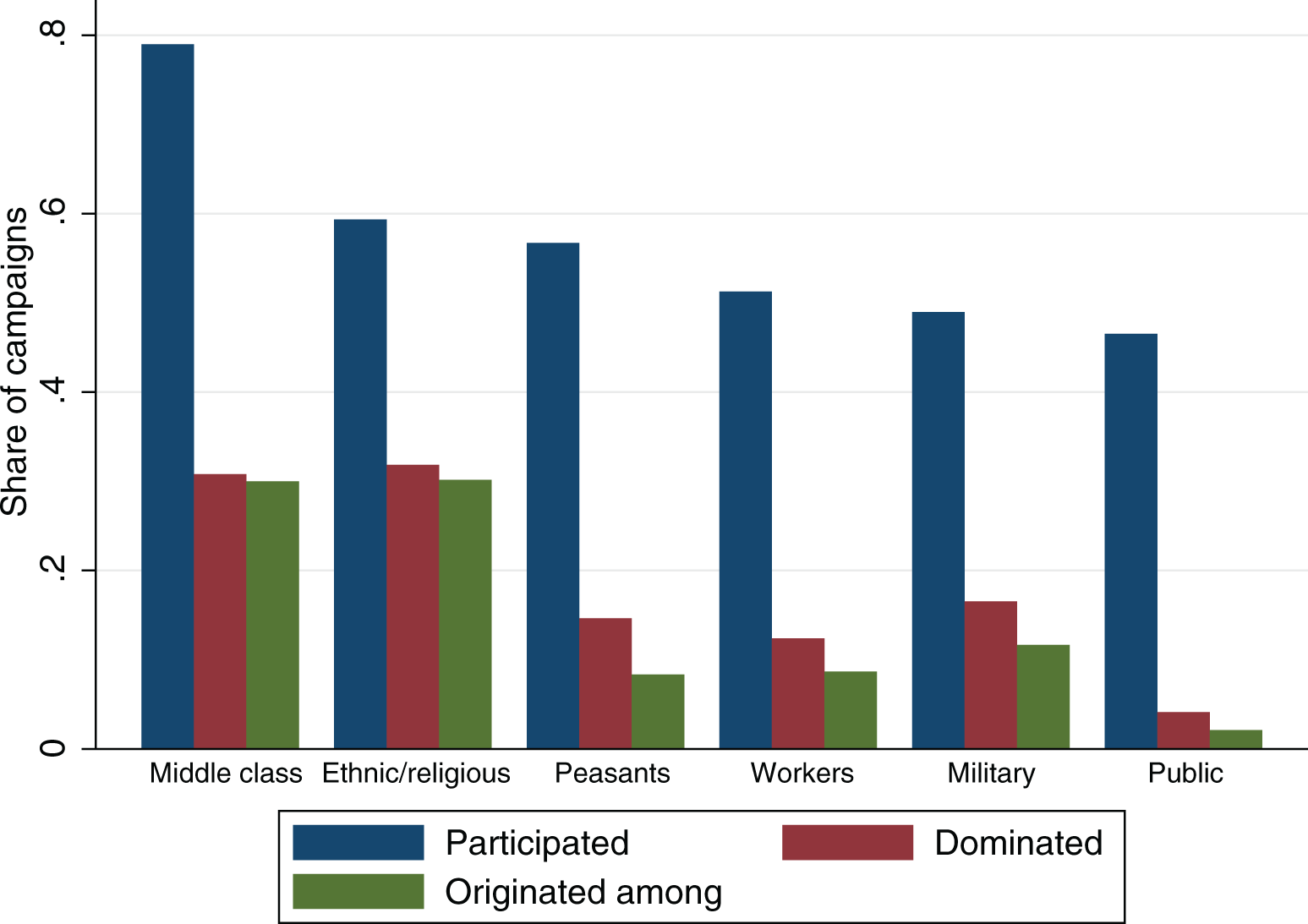
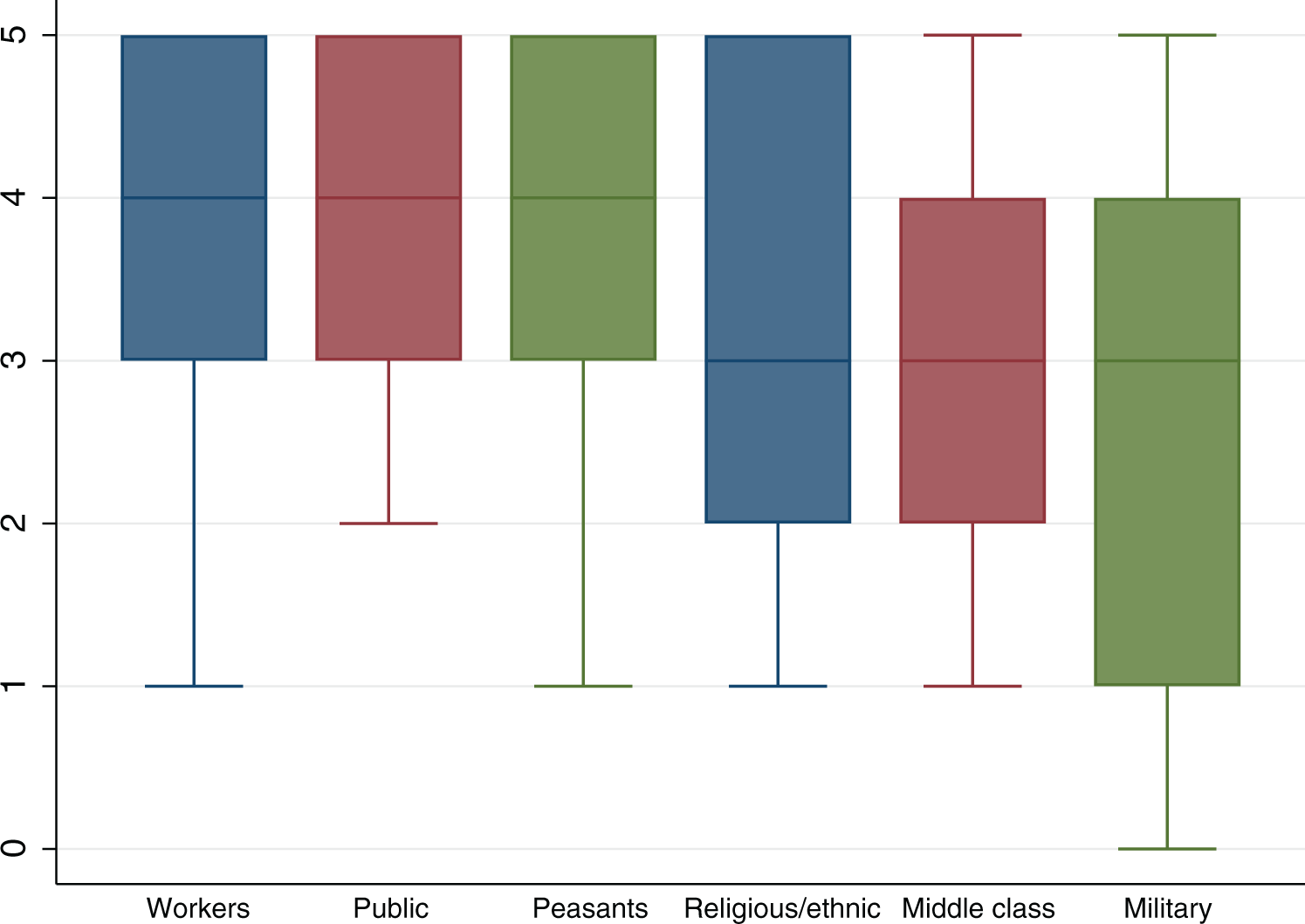
Confounders
One important potential confounder is the number of participants in the protest. One could expect a large protest to be more likely to be diverse, although the relationship between size and diversity is far from uniform, and large movements have been linked to democratization (Chenoweth & Stephan, 2011). For this reason, the main models control for protest size, based on data from Navco. However, protest size could also potentially induce post-treatment bias, since diverse protests may attract more protesters. Reflecting this, all models are also estimated without controlling for size (see Online appendix, section 5).
There is significant variation between protest campaigns pertaining to the contexts they are operating in, and this may influence both campaigns’ ability to attract a diverse following and prospects of promoting democracy. To capture economic development and modernization, all baseline models control for log GDP per capita in the country where protest is occurring, either in t in the country-year models or in the year prior to campaign-start in the campaign-level models. This may influence both the social composition of the protest movement and the likelihood of democratic transition. In the main models I also control for a country’s population size, and in robustness tests I include additional variables capturing local features such as education level, urbanization, economic growth, and ongoing and recent civil wars (see Online appendix).
Since most campaign characteristics related to strategies or regime responses could potentially induce post-treatment bias, as they may be influenced by a campaign’s social diversity, the main model specifications usually leave out such covariates. But, models presented in the Online appendix also include additional campaign covariates, such as use of regime violence, external support for the campaign, external support for the regime, campaign duration and military defection.
Finally, to account for country-specific and time-invariant omitted founders, for instance related to geographical features, political culture or institutional persistence, I include country-fixed effects in the country-year analysis, as well as time fixed effects to account for country-invariant time-specific factors, for instance related to international waves of protest or economic shocks. As the campaign-level analysis does not offer enough variation to include country-fixed effects (as most countries only have one or a few campaigns), and does not vary over time, I only include region dummies in these models, to account for regional differences that may influence both protest heterogeneity and democratization, for instance related to culture or democratic history, as well as decade dummies.
Levels of analysis
I conduct the analysis in two steps. First, I investigate the link between protest movements’ social diversity and democratization using protest campaigns as units of analysis, exploring the link between protest campaigns’ social diversity and democratization in the year(s) after the campaign ended, accounting for other relevant characteristics of the campaign and the context. One challenge with this approach is that it does not include information on observations without campaigns, disallowing comparisons between campaigns with a given social profile and situations where no campaign exists. Second, including information on covariates from additional years will expectedly allow for more efficient comparisons also between campaigns. Third, controlling for country and year fixed effects is not feasible in the campaign setup. There may well be country-specific features, related for example to geography or political culture, that correlate with campaigns’ ability to mobilize opposition and with democratization. There may also be global trends in democratization and campaign composition, for instance related to increased chances of democratization right after the Cold War and more urban opposition campaigns in recent years. For this reason, I also conduct a country-year analysis, and estimate models of the form:

where DEMi,t
+1 represents democracy at time t+1 in country i. DC registers the social diversity of an ongoing protest campaign, measured using the number of social groups participating in the campaign. OC registers the presence of an ongoing protest campaign. The models also include level of democracy at t (DEMi,t
), and vectors of country-year covariates
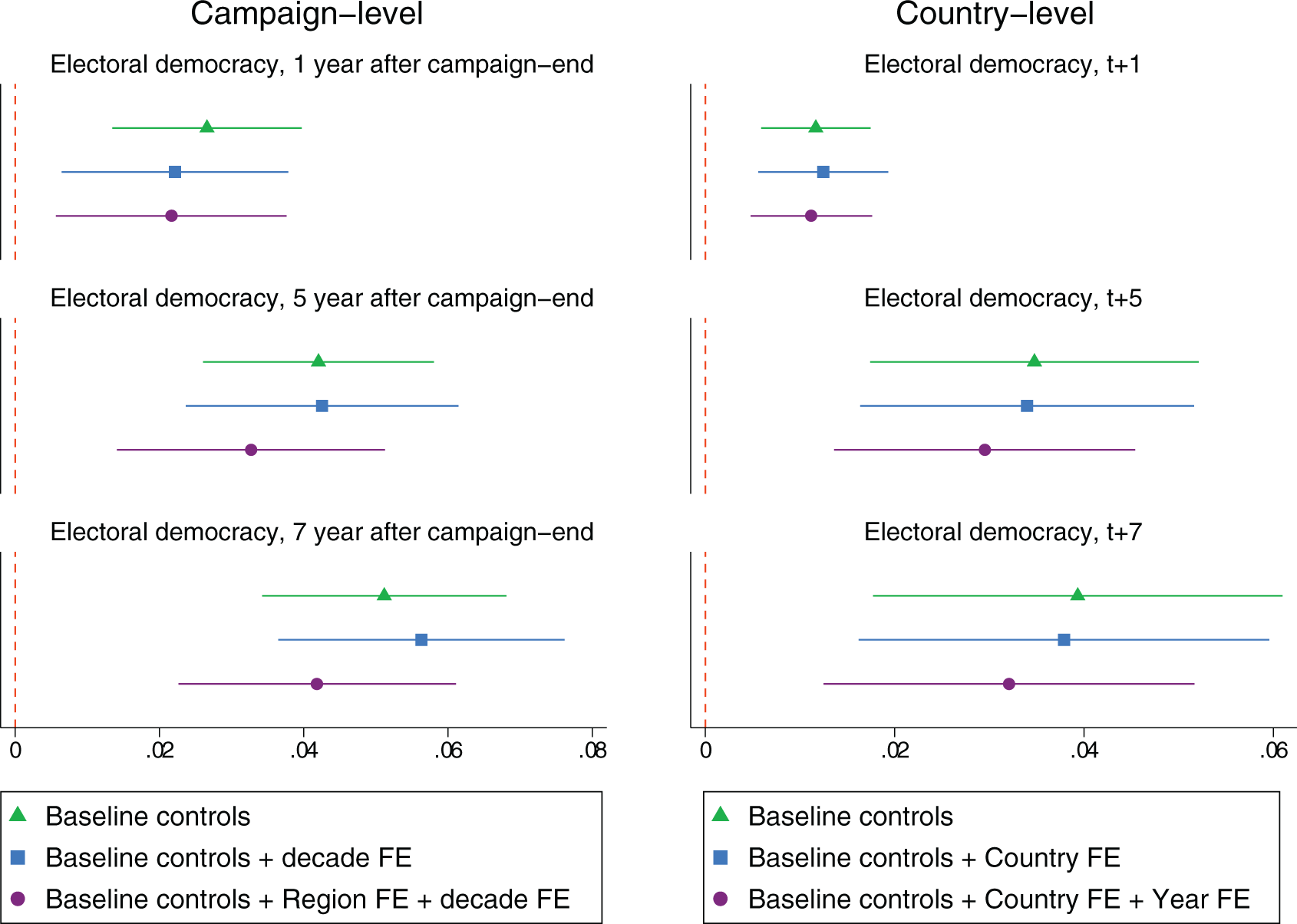
Coefficient plots
Empirical analysis
Social coalitions and democratization
I start by discussing results from models analyzing the relationship between protest campaign diversity and democratization. The Polyarchy measure of electoral democracy from V-Dem is the dependent variable, and the independent variable is my main measure of campaign social diversity. To explore whether social diversity is positively related to democracy both in the short term and the medium/long term, the dependent variable is measured at t+1, t+5 and t+7 (in the country-year models) or at 1, 5 or 7 years after the protest campaign ended (in the campaign-level models). Since all models control for electoral democracy in t (country-year models) or electoral democracy in the year prior to the campaign (campaign-level models), the results are picking up (short- or medium/long-term) changes in electoral democracy score.
The results are presented in Figure 3, showing the coefficient estimates for protest movements’ social diversity across different model specifications. The results on the right-hand side are from campaign-level models, with electoral democracy in years 1, 5 and 7 after the campaign ended as outcome, controlling for electoral democracy in the year prior to campaign start. The coefficient estimates for protest diversity are positive and statistically significant at conventional levels across all the model specifications. A socially diverse protest is associated with improvements in democracy both in the first year after campaign end, but also five and seven years after. All models control for ln protest size and ln GDP p.c. at the campaign start. Controlling for size is particularly important for testing this article’s argument that it is social group diversity that should influence democratization, rather than just a large number of
Social group diversity and democratization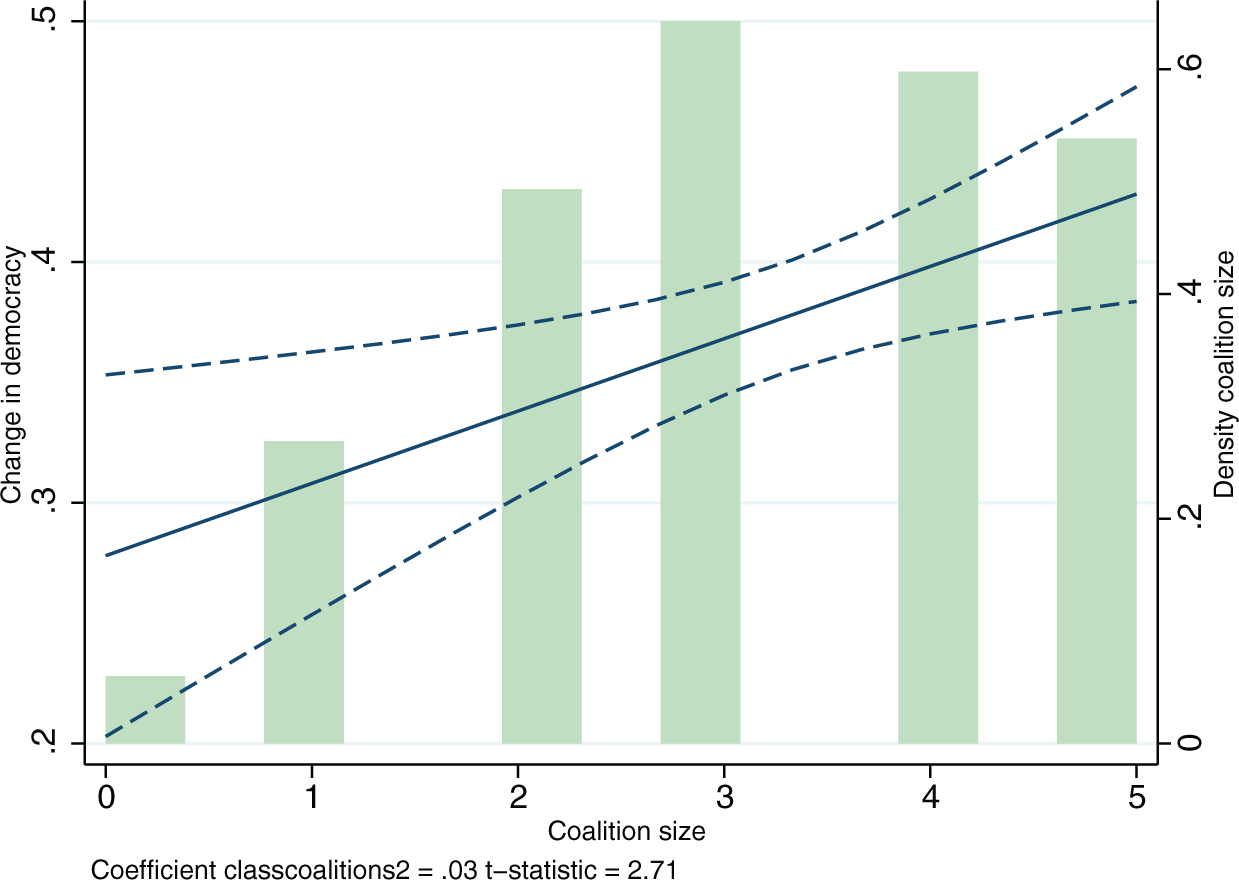
Results from country-year models are on the left-hand side of Figure 3, with electoral democracy in t+1, t+5 and t+7 as dependent variable, and the level of social diversity in an ongoing protest campaign in t as independent variable. Since all models control for whether there is an ongoing protest campaign or not, the coefficient estimate for social diversity can be interpreted as the relationship between social diversity and democratization, given that there is an ongoing campaign. There is consistent evidence that the social diversity of an ongoing protest campaign is systematically linked to positive changes in democracy. This result not only reflects a short-term upsurge in democracy level immediately after socially diverse campaigns. Rather, the coefficient estimates for social diversity increase when considering democracy in t+5 and t+7 as dependent variables, although there is somewhat more uncertainty associated with these estimates, indicated by the larger confidence intervals. The positive coefficient holds up to controlling for ln protest size, ln GDP p.c. and population size. The results are also consistent in a relatively strict model specification with both country and year fixed effects. The country-year results also indicate that there is no independent positive relationship between protest size and democratization when protest diversity is accounted for (see Online appendix for results).
The estimated relationship between protest campaigns’ social diversity and democratization is also of a substantial size. The size of the social diversity coefficient ranges from around 0.04 to 0.06 in the campaign-level models. This indicates a substantial relationship, as illustrated in Figure 4, which plots the predicted electoral democracy score one year after a campaign has ended, for different levels of social diversity (based on the strictest campaign-level model specification from Figure 3). The figure suggests that the identified relationship between coalition diversity and democratization is quite substantial, as the expected change in democracy score increases from less than 0.3 to more than 0.4 (on a scale from 0 to 1) when comparing the most narrow protest campaign to a highly diverse one. In the country-year models, the coefficient estimate for protest diversity ranges from 0.02 for the short-term democratization models to around 0.04 for medium/long-term democratization. Note that these models only capture changes in democracy score from one year to another (e.g. from year t to t+1), and the estimated aggregate relationship between a diverse campaign and changes in democracy score is likely to be much higher, given that most campaigns last for many years.
In sum, the results indicate a positive and statistically significant aggregate relationship between the social diversity of protests and democratization. This aligns with arguments on the benefits of broad coalitions in imposing costs on authoritarian regimes and thereby facilitating regime breakdown, but it does not necessarily align with arguments on the potential fragmentation risk of broad coalitions, hindering the establishment of democracy. To further analyse whether social diversity may play a different role in overthrowing existing regimes than in establishing democratic institutions, which is an alternative implication of the mechanisms discussed above, I also present results from models distinguishing between the pre-breakdown phase and the post-breakdown phase.
To measure authoritarian regime breakdown (regardless of whether it leads to democracy or not) I use the Historical Regimes Data (HRD) (Djuve, Knutsen & Wig, 2020). Here, a regime breakdown is understood as a substantive change in the formal and informal rules selecting leaders, and covers not only transitions between autocratic and democratic regimes, but also various transitions between relatively autocratic regimes and between relatively democratic ones. The HRD dataset contains start and end dates of regimes, which I use to compute a dichotomous variable with the value 1 if a regime breakdown takes place in a certain year.
Figure 5 shows the coefficient estimate for campaign diversity for different outcomes and model specifications. The models on the left-hand side have regime breakdown as dependent variable. 7 The figure shows that the coefficient estimate for socially broad protest campaigns is substantially strong and statistically significant, both for campaign-level analyses and country-year analyses, indicating a clear positive relationship between campaign social diversity and regime breakdown.
The models on the right-hand side indicate that protest diversity is positively associated with improvements in democracy – once the existing regime has stepped down. These models only include cases that experienced a regime breakdown in t, and the dependent variable is electoral democracy. At the campaign level, all coefficient estimates for coalition diversity are positive and statistically significant. Also results from the country-year models indicate a positive and statistically significant coefficient for social diversity when considering democracy in t+1. The estimates are less precisely estimated for democracy in t+5 and t+7 in the country-year setup, although the social diversity coefficient is positive and statistically significant when considering democracy in t+7 and including both country and year fixed effects. Hence, there is evidence that socially diverse protest campaigns are conducive to democratic improvements in the aftermath of regime breakdown, although this result is not as robust as the results discussed earlier.
Additional tests
Having established that protests’ social diversity is positively related to regime breakdown and democratic improvements, this section explores some further nuances. First, it looks further into the interplay between protest diversity, size and democratization. The results above indicate that protest size is not significantly related to democratization once protest diversity is accounted for. Yet, this does not necessarily imply that protest size is irrelevant for movements’ potential for democratic change. For instance, it could be that the effect of protest diversity is conditioned on protests reaching a certain size, or that protest size only matters when protest diversity is low, suggesting that size can ‘compensate’ for lack of diversity. This would imply an interaction effect between protest diversity and size.
To test this, I estimate interaction effects between protest diversity and size. The results, which are included in the Online appendix (section A3), yield little evidence that the link between social diversity and democracy is conditioned by protest size. Protest size is not systematically linked to democratization at low levels of social diversity (or at medium or high levels). Also, there is no robust evidence that the estimated coefficient for protest diversity is conditioned on protest size.
Second, most of the mechanisms presented in the theoretical section seem to mainly pertain to nonviolent resistance tactics. For instance, the benefits of drawing on a diverse set of resources and sources of leverage are primarily beneficial for nonviolent resistance, that relies on forcing the regime out of power by imposing (nonviolent) costs. To analyse whether the estimated relationship between protest diversity and democratization depends on use of tactics, I re-estimate the baseline models separately for nonviolent and violent protest campaigns, drawing on the NAVCO categorization of use
Coefficient plots from models estimating the relationship between socially diverse protest campaigns and regime breakdown/democratization after breakdown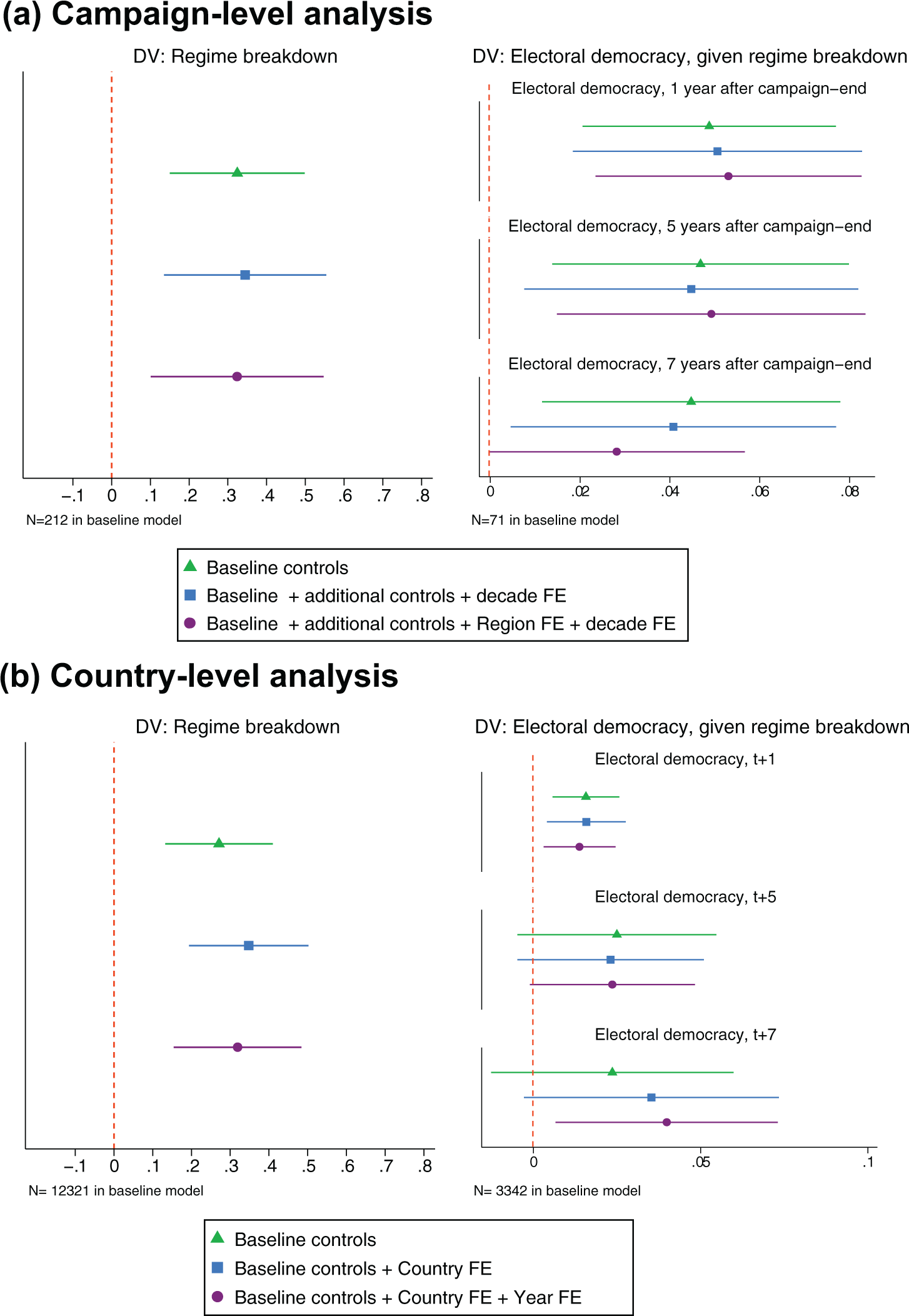
The sensitivity of the results
The results above could be driven by at least two types of explanations. The first pertains to causal processes through which protest diversity impacts authoritarian regime breakdown and/or democratization, while the second relates to omitted factors that could influence both protest diversity and regime change. While it is very difficult to fully adjudicate between these two explanations with the observational data used in this study, this section offers a discussion of how plausible the first interpretation is.
Campaigns with large social coalitions may vary systematically from more socially narrow campaigns – on a wide range of characteristics other than their potential for promoting democratization. The analysis in this article rules out a key source of campaign heterogeneity by restricting the sample to campaigns aiming for regime change or ‘other goals’, thereby excluding national self-determination and secessionist campaigns, that may have characteristics correlating with both social composition and democratization. The models also control for important potential confounders related to national context, such as socio-economic conditions, or characteristics of the campaign or its target, such as campaign size. Further robustness tests included in the Online appendix show that the findings also hold up to numerous additional controls, such as GDP growth, education level, urbanization, ongoing or recent civil wars, campaign duration, military defection, regime violence and external support for the campaign and the regime.
Yet, there may still be unobserved factors conducive to both social group diversity and democratization. For instance, diverse campaigns could be more common in urban areas, and additional social groups may join these movements precisely because of their location. Although I control for urbanization at the country-level, within-country variation in urbanization is unaccounted for. Other potential unmeasured confounders pertain to factors indicating that a campaign will be successful, such as statements, personality and background of campaign leaders, a community’s previous experience with mass protest, and characteristics of the regime that yields information about its preferred response to the campaign. These factors may not only induce participation by more social groups but also have an independent effect on democratization.
To investigate how sensitive the results are to such omitted confounders, I perform sensitivity analysis using information about selection on observable factors – which can be learned by considering how and to what extent the diversity coefficient changes when the measured confounders are included – as a guide to potential selection on unobserved factors. To do this, I draw on the framework and software developed in Oster (2019), which adjusts the estimated coefficient under different hypothetical scenarios of potential omitted variable bias. The results from this test, which are included in the Online appendix (in section 2, together with more details), show that the diversity coefficient remains positive and becomes more sizeable when adjusting for various omitted-variable scenarios. If omitted confounders behave similarly to the observable controls, the relationship is actually considerably stronger than what our benchmark suggests. Hence, a causal interpretation is not made any less credible when assessing how the inclusion of omitted confounders would impact the results.
Conclusion
Classical social science contributions propose that the road to democracy in Western Europe was a result of coalitions between social classes with different interests and resources (e.g. Moore, 1966; Rokkan, 1999; Rueschemeyer, Stephens & Stephens, 1992). Also case-study evidence from recent and historical democratic revolutions suggest that pro-democracy movements unifying different segments of society have better odds at overthrowing authoritarian regimes (Beissinger, 2013). Yet, others have pointed to the potential dangers of socially broad coalitions, warning that the risk of fragmentation and in-fighting may prevent democratic transitions (Goldstone, 2011). Contributing to a literature that has rarely unpacked the composition of participants in mass protests – focusing instead on strategies, tactics, contexts and protest size – this study assesses claims about the role of diversity in mass protest movements.
Based on global data on the social group composition of all major anti-regime movements from 1900 to 2013, the article presents consistent evidence that socially broad movements are linked to a higher likelihood of democratization than more narrow movements. Contrary to warnings about protest diversity being an impediment to democratic transitions, the results further indicate that socially diverse movements are more likely to both overthrow existing autocracies and secure a transition to democracy after autocratic breakdown. In other words, social diversity may help social movements overcome the various obstacles on the road towards democracy.
This finding has implications for the future of recent and ongoing protest movements across the globe. While many of these are able to attract and unite highly diverse segments of society, others are dominated by one or a few social groups – be it urban middle classes, intellectuals, workers or rural groups (Beissinger, Jamal & Mazur, 2015). In a world where many countries are experiencing a rise in political polarization between different social groups, a socially narrow pro-democracy movement may risk alienating other segments of society, by appealing to specific identity categories or goals that prevent a broad support base. Given the benefits of social diversity demonstrated in this article, a scenario where protest movements struggle to unite citizens across social divides is bad news for transitions to democracy.
At the same time, the article indicates that social diversity – once it is achieved – can be a powerful force for democratization. The findings add to existing literature highlighting the importance of large numbers for successful protest outcomes, by indicating that achieving social diversity may be equally important – and perhaps even more crucial – than attracting large crowds.
