




Abstract
National identity remains one of the most potent forces in global politics, yet surprisingly little is known about processes of national identity formation and change. This article argues that national identity preferences are susceptible to fluctuations in group status and distance but constrained by conflict experience and socialization. Integrating research on conflict socialization with social identity theory, we hypothesize that growing up during violent intergroup conflict socializes individuals into identities and attitudes which are durable to significant changes. Conversely, the identity preferences of those who grow up during relative peace are more malleable and likely to change due to significant events which affect perception of group identities. Exploiting the unique political context in Northern Ireland, where individuals can legally choose to identify as Irish, British, or both, we use a diff-in-diff approach to estimate national identity preferences of individuals before and after the EU referendum. The results show that 20% of Protestants who did not experience conflict shifted from British towards Irish identity after the referendum. However, for those who experienced violent intergroup conflict, there is a ‘durable distance’ between groups which constrains identity change irrespective of fluctuations in status. The results have important implications for our understanding of national identity, particularly in post-conflict societies.
Why would an individual choose to switch national identity? How do significant political events and experience of violent conflict affect this process? While there has been considerable research analyzing patterns of ethnic identification and boundary-making, and more recently the interaction between ethnic and national identity, the dynamic processes of national identity formation and change have received surprisingly limited attention (Chen, Lin & Yang, 2018; Eifert, Miguel & Posner, 2010; Green, 2020; Nair & Sambanis, 2019; Phinney et al., 2001; Wimmer, 2013). Part of the challenge with analyzing changes in identification with groups such as national or ethnic identity is their relatively static nature. 1 However, given the resurgence of nationalism and the complexity introduced by mass migration, globalization, and supranational institutions, it is important to understand the causes and dynamics of national identity change and stasis.
Bringing together literature on social identity and conflict socialization with recent work on the effect of exposure to political violence on identity, we argue that the potential changes in identity caused by fluctuations in group status are moderated by exposure to intergroup violence. Existing studies argue that ethnic group identification can be disrupted by factors such as changes in the status of the identity group, perceived similarity between individuals and the group (i.e. distance), and whether one’s ethnic group is in power (Green, 2020; Penn, 2008; Sambanis & Shayo, 2013). We argue that this effect of status and distance extends to an individual’s choice of national identity. However, building on conflict socialization literature and more recent research which shows that exposure to state violence reduces national identification (Nair & Sambanis, 2019), we further argue that the potential impact of fluctuations in group status are moderated by exposure to violent intergroup conflict. This experience of conflict polarizes individuals to such an extent that they are unlikely to switch identity regardless of changes in group status. 2 This creates a durable distance between groups and an ossification of identities.
Using the unique political context in Northern Ireland where anyone born there is legally able to identify as British, Irish or both, alongside the transformative impact of the EU referendum result, 3 we analyze patterns of national identity choice before and after the Brexit vote. The results show that fewer people choose to identify as British in the year after Brexit. However, this effect stems almost entirely from those who did not experience intergroup conflict. Our results show that up to 20% of Protestants who did not experience ‘The Troubles’ in Northern Ireland shifted national identification from British to Irish. On the other hand, there is no significant shift among those who experienced this violent intergroup conflict. This effect is due primarily to the impact of exposure to intergroup violence and conflict socialization on conflict-related identities. This creates ‘durable distance’ between groups and makes individuals unlikely to change identity irrespective of fluctuations in status. Conversely, for those who did not experience the conflict, their shift away from British identity is caused by a decline in group status as a result of material losses and the association of British identity with illiberal attitudes due to the Brexit campaign. The results are robust to additional checks and corroborated by placebo tests. We also present evidence that the observed effect is not likely to stem from different opinions about the effect of Brexit.
These findings have important implications for our understanding of national identity change and particularly the interaction between significant political events, political violence, and national identification. Firstly, they further emphasize that ‘violence hardens boundaries’, with individuals who experienced conflict unwilling to change national identity despite significant fluctuations in group status more than two decades after a peace agreement and with limited ongoing intergroup violence. This should serve as a precautionary message to policymakers on the importance of continued efforts for genuine reconciliation and awareness of any action which may provoke heightened tensions and potential violence. On a more positive note, the results indicate that individuals who did not experience conflict are surprisingly willing to change their national identity as a result of disruptive political outcomes, even in a particularly fraught context such as Northern Ireland. Given recent research regarding intergenerational transmission of attitudes (Lupu & Peisakhin, 2017), this does not imply that full reconciliation is just a matter of time, but it does present an opportunity for policymakers and community leaders. More broadly the results imply that national identities in contexts where they are not aligned with conflict cleavages act like many other social identities which are malleable and susceptible to change triggered by status, context or meaning. In the following section we outline related research on identity change before developing and testing our theoretical argument.
Politics and identity change
Identification with a particular social group entails a set of preferences which affect the behavior and attitudes of group members (Shayo, 2009). According to Shayo (2009), preferences involve two novel components: status and distance. Group status is the relative position of a group on important dimensions of comparison in a given society and distance is the perceived similarity between an individual and an archetypal member of that group (or perceived characteristics of the majority of other members of that group) (Sambanis & Shayo, 2013; Shayo, 2009). While the salience of a given identity may vary according to the context, those social identities with which one identifies are generally understood to be relatively stable. This is particularly the case for identities such as ethnic or national identity that are often assigned at birth and have limited scope for change. As a result, while fluctuations in group status and distance may affect the salience or strength of identification, in most cases they are unlikely to cause individuals to change identities. Consequently, dissociating from or changing a significant identity (such as nationality) is not fully understood (Stets & Burke, 2000; Gil-White, 1999).
According to identity control theory, identities ‘are dynamic and change’ on a continual basis, but ‘in normal circumstances the change is small and slow’ (Burke, 2006: 84). In these normal circumstances where identities change gradually, individuals are in a constant process of incremental, often imperceptible and unconscious, adjustments to bring their self-conception into alignment with their identities. This may necessitate adjusting one’s own self-perception to align more closely with changes in the archetypal group member (i.e. to maintain similarity/distance) or adjusting the way in which identities are evaluated (i.e. to maintain status). However, under certain conditions, we argue that discontinuous changes in the meaning or status of an identity can occur. When this happens, individuals must make a conscious choice of whether to bring their self-conception into alignment with the new shared understanding of an identity or less commonly, individuals can choose to dissociate from an identity or change identities. 4
Given identities are a social phenomenon, considerable changes in the meaning of an identity can be triggered by high profile public events or as a result of actions by individuals considered to be archetypal of an identity. 5 The type of event which is likely to trigger these discontinuous changes in the status or meaning of an identity group need to be highly salient and have widespread awareness among the relevant population. They are likely to also challenge how some portion of that group previously understood their identity. Referendums are one example of a political event which may have this effect (Bond, 2015). Unlike general elections, they have a clear binary outcome which can be seen as a reflection of the nation’s collective identity. This is further exacerbated when the issue is one of significant moral, social or political weight (e.g. marriage equality, abortion, national independence, etc.). 6 If the result of the referendum is particularly shocking or surprising to a portion of the population, or has a negative impact on their material well-being, this may further exacerbate the perceived changes in status or distance from the national identity, which may increase the likelihood that individuals choose not to identify with that national identity. In short, rare and disruptive events can alter the perceived status and character of a group, changing how people understand their identity and potentially causing them to dissociate from that group identity and shift towards others.
Although these significant events can disrupt patterns of group identification, this effect may be restrained by other factors. In the following section we explore the role of exposure to violent conflict and particularly conflict socialization as a restraint on potential identity change.
Conflict socialization as a restraint on identity change
As noted, for many people national identity forms an intrinsic part of how they understand themselves and their place in the world. This is further compounded where national identities are engaged as part of violent intergroup conflict. Identities activated in enduring intergroup conflict seep into many aspects of daily life, shaping attitudes and behavior. Research consistently highlights that conflict experience hardens identities and prolonged exposure to intractable conflict engenders antagonistic intergroup attitudes which persist long after intense conflict has abated (Bar-Tal, 1998; Hadzic, Carlson & Tavits, 2020; Nair & Sambanis, 2019). These attitudes, such as the justness of one’s goals and in-group unity, create a durable distance between identity groups (Bar-Tal, 1998; Tint, 2010). Therefore, we argue that conflict identities will be very resistant to change irrespective of fluctuations in the meaning or status.
The effect of conflict experience is particularly strong when individuals are born into and exposed to enduring conflict during their formative years, as conflict becomes an inseparable part of their daily lives (Bar-Tal, Diamond & Nasie, 2017). The learning and adoption of political attitudes and content based on the context in which one grows up is known as political socialization (Greenberg, 2009). This concept describes the process ‘by which citizens crystallize political identities, values, and behavior that remain relatively persistent throughout later’ (Neundorf & Smets, 2020: 1). These political attitudes are said to mature during adolescence, which is generally defined as between the ages of
As a result of this socialization process, the experiences of those who grow up in a conflict environment are ‘very different from the experiences of children who do not […] children living in intractable conflict acquire a distinctive set of societal beliefs, attitudes, and emotions that provide cognitive tools for understanding their conflictual reality’ (Bar-Tal, Diamond & Nasie, 2017: 418). These views are likely to persist throughout their lifetime, with research on the development and stability of political attitudes indicating that there is a strong correlation between attitudinal scales in early adolescents, late adolescents, and young adults, and that ‘distinct political cultures’ are well established and political attitudes mature ‘during the formative phase of adolescence’ (Hooghe & Wilkenfeld, 2008; Neundorf & Smets, 2020; Rekker et al., 2015).
Therefore, the experience of ongoing intractable conflict during one’s formative years has an enduring effect on the attitudes of those who lived through these experiences (Neundorf & Smets, 2020; Rekker et al., 2015). It is notable that this effect does not necessitate direct exposure to violence; simply growing up in this environment of ongoing conflict, particularly intractable intergroup conflict, means that ‘almost every child is affected by conflict-related events’ (Bar-Tal, Diamond & Nasie, 2017: 418). Two of the primary mechanisms through which conflict socialization occurs do not necessitate any direct experience of conflict-related violence, and the third mechanism can include experience of oppression, discrimination or humiliation which would not typically be classified as political violence. While it is possible that those who have more direct exposure to conflict-related violence will have more extreme views, it is clear that simply growing up in a conflict environment results in conflict socialization and shapes the attitudes of those who experience it. This research on political and conflict socialization intersects with related research on the development of social identities which indicates that not only do children form clear social identities at a very early age but they also develop a clear differentiation between their in-group and rival out-groups (Barrett & Oppenheimer, 2011; Oppenheimer, 2006). As a result, individuals who grow up in the environment of ongoing intergroup conflict are shaped indelibly by this experience; it influences their attitudes, beliefs, behaviors, and identity in enduring ways which are likely to persist into adulthood (Bar-Tal, Diamond & Nasie, 2017; Hooghe & Wilkenfeld, 2008; Neundorf & Smets, 2020).
Bringing these strands of literature together, it is clear that individuals who grow up in the context of ongoing conflict are socialized into attitudes, beliefs, emotions, and group identities which are likely to endure throughout their lives. One of the most significant effects is likely to be the development of strong conflict-related identities, particularly where the conflict aligns with strong pre-existing ethnic or national identities. Combined with research which shows that exposure to violence hardens ethnic identities (Nair & Sambanis, 2019; Wimmer 2008), individuals who grow up in the context of an ongoing conflict develop strong social identities that are aligned to the conflict and due to the process of conflict socialization, these identities and the associated attitudes, emotions, and beliefs are likely to endure throughout their lives (Barrett & Oppenheimer, 2011; Bar-Tal, Diamond & Nasie, 2017; Hooghe & Wilkenfeld, 2008; Nair & Sambanis, 2019; Oppenheimer, 2006).
As a result, we argue that these strong conflict identities are unlikely to be affected by significant events which appear to undermine the status or change the meaning of these identities which are stable and durable. There is a durable distance between these conflict-related identities, which makes people unwilling to switch irrespective of fluctuations in group status. However, this effect does not extend to those who do not experience ongoing violent intergroup conflict. While they may be socialized into certain relevant beliefs, behaviors, and attitudes related to intergroup relations, these are not as intense or durable as those developed during ongoing conflict (Bar-Tal, Diamond & Nasie, 2017). Their identities are likely to be more malleable and are therefore more susceptible to significant discontinuities in the meaning or status of an identity. As a result, when there are significant events which challenge the status or meaning of their group, they are more likely to be willing to switch from that identity to available alternatives or simply stop identifying with that group. In the next section, we apply this theoretical framework to the impact of the Brexit referendum on British identity in post-conflict Northern Ireland.
Brexit and British identity
Despite being a UK-wide referendum, Brexit became inextricably linked with British identity, as evidenced by the portmanteau Brexit (British-exit). Furthermore, while the vote was ostensibly a binary choice regarding membership of a supranational institution, it represented a contest over many other significant social, political, and economic issues. Leaving the EU is a profound constitutional change, removing or transforming many rights and obligations people have as citizens. Although the long-term impact of Brexit is still unclear, it is likely that the outcome will result in material costs and losses (Sampson, 2017), removing many valuable benefits such as free movement, the single market, EU funding, and Erasmus study. Furthermore, the Brexit campaign and therefore British identity was associated by many with nationalism, anti-immigrant sentiment, and xenophobia (Corbett 2016; Goodwin & Milazzo, 2017; Rzepnikowska, 2019), which harms perceptions of the British identity as diverse and internationalist (Easton, 2018). While these sentiments may not be representative of all or even a majority of those who supported Brexit, an All Party Parliamentary Group found that people were concerned about the ‘decline of Britain’s tolerant and multicultural image’ and the harmful effects of what they term ‘Brexit’s anti-immigration message’ (Mejias & Banaji, 2017). Furthermore, survey responses from Britons living abroad in Europe found that many reacted to Brexit with ‘shame and embarrassment’ (Higgins, 2019).
Therefore, as a result of the material loss of rights and benefits, alongside the association with illiberal attitudes, the Brexit referendum may have changed the meaning and status of British identity. In the next section we argue that due to the uniquely flexible framework for national identity in Northern Ireland, this may have resulted in a decline in people identifying as British and an increase in people identifying as Irish after the referendum. However, this effect will be restrained by experience of violent intergroup conflict (i.e. ‘The Troubles’).
British identity in post-conflict Northern Ireland
As a result of political and social tensions, Northern Ireland erupted into sectarian violence between Catholics and Protestants in 1971, continuing until 1991 at a severity level which meets the traditional definition of a civil conflict of
As noted, Brexit was a significant political event which had intense media coverage and broad awareness among the population with
Crucially, while the Good Friday Agreement enabled the ‘multilevel complexity of identities’ in Northern Ireland, the Brexit debate and consequences flatten this complexity by ‘framing Northern Ireland’s “choice” as […] between being closer to Britain or closer to Ireland’ (Hayward, 2020: 273). This forces the question of national identity to the forefront of debate, triggering people to reconsider their national identity preferences in a way which was not previously the case. This may catalyze individuals to form a new understanding of national identity, one which potentially shifts away from British and towards Irish due to the perceived negative impact of Brexit on British identity. The formation of a new identity may not result in a complete transferal from British to Irish identity, but causes people to feel more distant from British identity and closer to Irish identity. This process of forming a complex new identity which incorporates more aspects of Irish identity is facilitated by the change in what Ireland and Irish identity represents over the past decade. Referendums on gay marriage in 2015 and abortion in 2018, in particular, have been interpreted as a rejection of ‘conservative Catholic Ireland’ (Elkink et al., 2020), which potentially makes it easier for Protestants to embrace aspects of Irish identity. In short, the focus on issues closely related to British identity during Brexit, and the progressive evolution of Irish identity, may have contributed to a process of new national identity formation in a way which shifts some people in Northern Ireland away from British identity and towards Irish.
However, we argue that any effect of Brexit on patterns of national identification will be restrained by an individual’s experience of violent intergroup conflict and the impact of conflict socialization on the attitudes and identities of people who lived through the Troubles. For those who lived through the violent conflict in Northern Ireland their identities will be much more durable. Their experience has created a durable distance between British and Irish identities which makes them unwilling to switch their identity irrespective of perceived changes in British identity. As noted, this effect is unlikely to be constrained only to those who had direct experience of violence, as even growing up in the environment of ongoing intergroup conflict (particularly in a relatively small country such as Northern Ireland where almost everyone was perceived as aligning with one side or the other) will result in a degree of conflict socialization among the majority of the population. For these people, their national identities are conflict identities which are likely to be durably embedded.
Based on the above analysis, we argue that following the Brexit referendum, we expect to see a decline in British identity and concurrent rise in Irish identity among Protestants who did not experience the conflict, but no change in either (i) Protestants who did experience the conflict or (ii) Catholics with or without experience of the conflict.
Data and methodology
The Brexit referendum provides a clear time-specific event which can be used to analyze identity patterns before and after. In order to test the proposed argument, we use the Northern Ireland Life and Times Survey (NILT). The NILT is an ideal data source as it is a high-quality annual survey that offers a broad set of data on national and religious identification and a range of demographic characteristics. The question about religion is Do you regard yourself as belonging to any particular religion? If yes, which? Respondents can choose Catholic, Protestant, or no religion. The cleavage in this conflict is aligned with religious denominations. Catholics generally identify themselves as Irish, whereas Protestants define themselves as British. The question relating to national identification is Some people think of themselves first as British. Others may think of themselves first as Irish. Which, if any, of the following best describes how you see yourself? and respondents can pick among Irish not British, more Irish than British, equally Irish and British, more British than Irish, British not Irish, and Other. We created an Irish–British scale where lower values denote ‘Irishness’. 9
On an Irish–British identity scale (Irish on the left, British on the right, and a proportional mixture in between), people are generally placed on the edges: Catholics on the left and Protestants on the right. The decrease in the status of British identity is not likely to have an effect on Catholics as they already define themselves as Irish not British, and therefore there is not much space to move further left. On the other hand, we argue that Protestants are more likely to be affected by the referendum. They identify themselves as British and may experience a perceived drop in the status of their identity. They can move further left on the scale: from British toward Irish identity.
For the purposes of our analysis we simplify the basic structure to those who identify as Protestant (who generally also identify as British and unionist), those who identify as Catholic (who generally also identify as Irish and nationalist), and those who do not identify with either of these identities (primarily no religion). This pattern of overlapping opposing group identities is deeply embedded and can be found in survey evidence going back to the classic work of Rose (1971) and Moxon-Browne (1983), and has persisted to post-Good Friday Northern Ireland (Muldoon et al., 2007). However, despite this pattern, there is a significant minority who do not fall into this simplistic framework, and others who have more fluid identities which incorporate many aspects of both groups of identities (Todd et al., 2006). 10 These factors mean that classifying people straightforwardly as Protestant or Catholic might overlook important nuances within these groups which may affect how they respond to significant political events. Furthermore, it also has normative consequences for political discourse and progress, limiting the possibility of moving beyond the simplistic binary, and propagating an essentialist understanding of politics and community (Bryan, 2006; Conrad, 2006).
Despite this important atypical minority and the complex dynamics within each group, there are a number of reasons why religion continues to be an important and useful way to structure analysis, particularly for research such as this. 11 Many aspects of Northern Irish society continue to be structured around religious identity. Although there are attempts to increase educational integration, over 90% of school children still attend primary or post-primary schools which are denominated as either Catholic or Protestant (Borooah & Knox, 2015) and only 5% attend formally integrated schools (Hewstone et al., 2004). Similarly, there are generally high levels of residential segregation with less than 1% of housing shared between faiths and estimates that even social housing is 93% segregated (McClements, 2018; McKittrick, 2004).
Crucially, this is not simply a top-down mechanism, as noted by Bryan (2006: 615) who finds that ‘the “two traditions” model is not simply the product of a community relations industry but is politically and culturally embedded in ongoing social processes’. This can be seen in the low rates of mixed marriage (again generally measured by religion), which has been estimated to be less than one in ten over a decade after the Good Friday Agreement (Lloyd & Robinson, 2011). Therefore, it is clear that despite the ambiguities, more fluid patterns of identification among a minority, and the complex affiliations and authorities within each community, the more simplistic binary still structures much of everyday life. Finally, we choose to use religion as our main grouping variable as it is least likely to be directly affected by the impact of Brexit which was a political referendum and engaged many aspects of national identity in the process. Therefore, religious identity is likely to be the most stable variable across both treatment and control for analyzing change within the two major communities in Northern Ireland. 12
In this study, we argue that the effect of status change on identity depends on conflict experience. Whether or not an individual experienced conflict can be defined by their age at various points in the conflict. Although a ceasefire was declared in 1994 and the peace agreement not signed until 1998, the conflict had receded to the point that it no longer reached the conventional 25-battle-deaths threshold by 1991. 13 Given this, 1991 can be considered as the de facto end of civil conflict. As noted above, research highlights that political attitudes mature during adolescence (i.e. between the ages of 10 and 19); therefore, we code respondents who were ten years old or younger in 1992 (i.e. those who were born after 1981) as ‘no conflict experience’ and others as ‘conflict experience’ (Rekker et al., 2015; Sawyer et al., 2018). 14 Given our argument is related to socialization during conflict, those who were born in 1951 or earlier do not fit straightforwardly into our conflict experience and socialization binary as although they did live through the conflict and are likely to have been impacted by it, this was not during formative years which are important for socialization into political attitudes and identity. As a result, we exclude them from the main analysis. We run additional models including those born in 1951 or earlier and comparing those born in 1951 or earlier to other groups; these are discussed further in the robustness discussion. The survey is carried out between September and December of each year and we compare the 2015 survey, pre-referendum, to the 2016 one, post-referendum (ARK, 2017).
In the estimation of the causal effect, we need to be sure that between the 2015 and 2016 surveys personal characteristics are randomly distributed and the only difference should be whether the survey was carried out before or after the referendum. In the Online appendix Table A1, we present the pre- and post-referendum means of covariates as well as the difference between the two surveys. Particularly, we look at age, religious denominations, gender, marital status, education level, and income. None of the covariates show a significant difference for pre- and post-Brexit years.
To examine how Brexit (i.e. the treatment – a decrease in the status of British identity) affects British and Irish identity in Northern Ireland, we employ a diff-in-diff approach. First, we run a model with post-Brexit referendum being the only explanatory variable for the whole sample, for Catholics, for Protestants, and for people who do not follow any religion. We repeat this procedure for the full sample, for those who did not experience the conflict, and for those who lived through the conflict. 15 Subsequently, we run a diff-in-diff model which is defined as below:
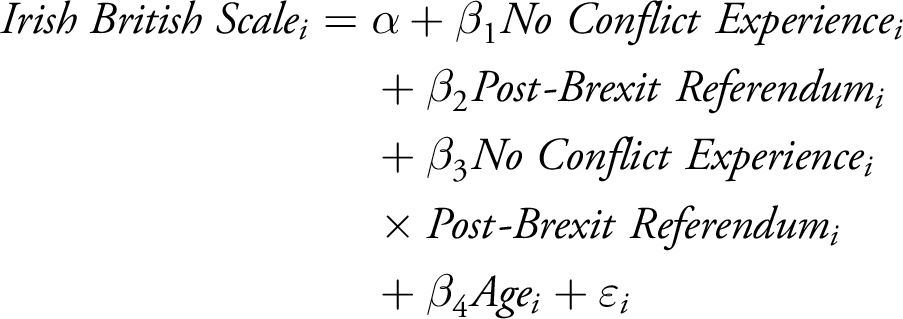
Here, the
Results
Before moving to regression results, we present the percentage change in identity after the Brexit referendum. As explained above, we only expect to see a decline in British identity among Protestants. Catholics are already on the left side of the scale and there is not much space to move further left (i.e. being ‘more Irish’). Protestants, on the other hand, are generally on the right side of the scale and therefore can shift away from their British identity towards the left. However, as outlined earlier, for Protestants who experienced the conflict, there is a durable distance between identities and switching from British toward Irish is not likely. Conversely, for people who did not experience the conflict, identities are more malleable and moving from British to Irish identity is possible. In Figure 1, we present the percentage change in identity after the Brexit referendum by the conflict experience. Results corroborate our argument. Among Protestants who did not experience the conflict, there is a significant shift in national identity. The percentage of people who define themselves as British not Irish drops by more than 20 percentage points after the referendum. 17 Among older Protestants, there is no significant change in identification as there is a ‘durable distance’ between the identities due to their experience of violent intergroup conflict.
The regression results are presented in Table I. The dependent variable is the Irish–British identity scale (Irish on the left, British on the right, and a proportional mixture in between). Negative coefficients denote a shift toward Irish identity. The upper panel reports the results of the regression analysis where post-referendum is the only explanatory variable for the whole sample, the mid-upper panel for people who did not experience conflict, the mid-lower panel for people who experienced the conflict, and lastly the lower panel presents the diff-in-diff estimates. In the first column, the analysis is run with the whole sample, in the second column only with Catholics, in the third column only with Protestants, and in the fourth column only with people without any
The percentage change in identities after the Brexit referendum across religious denominations by conflict experience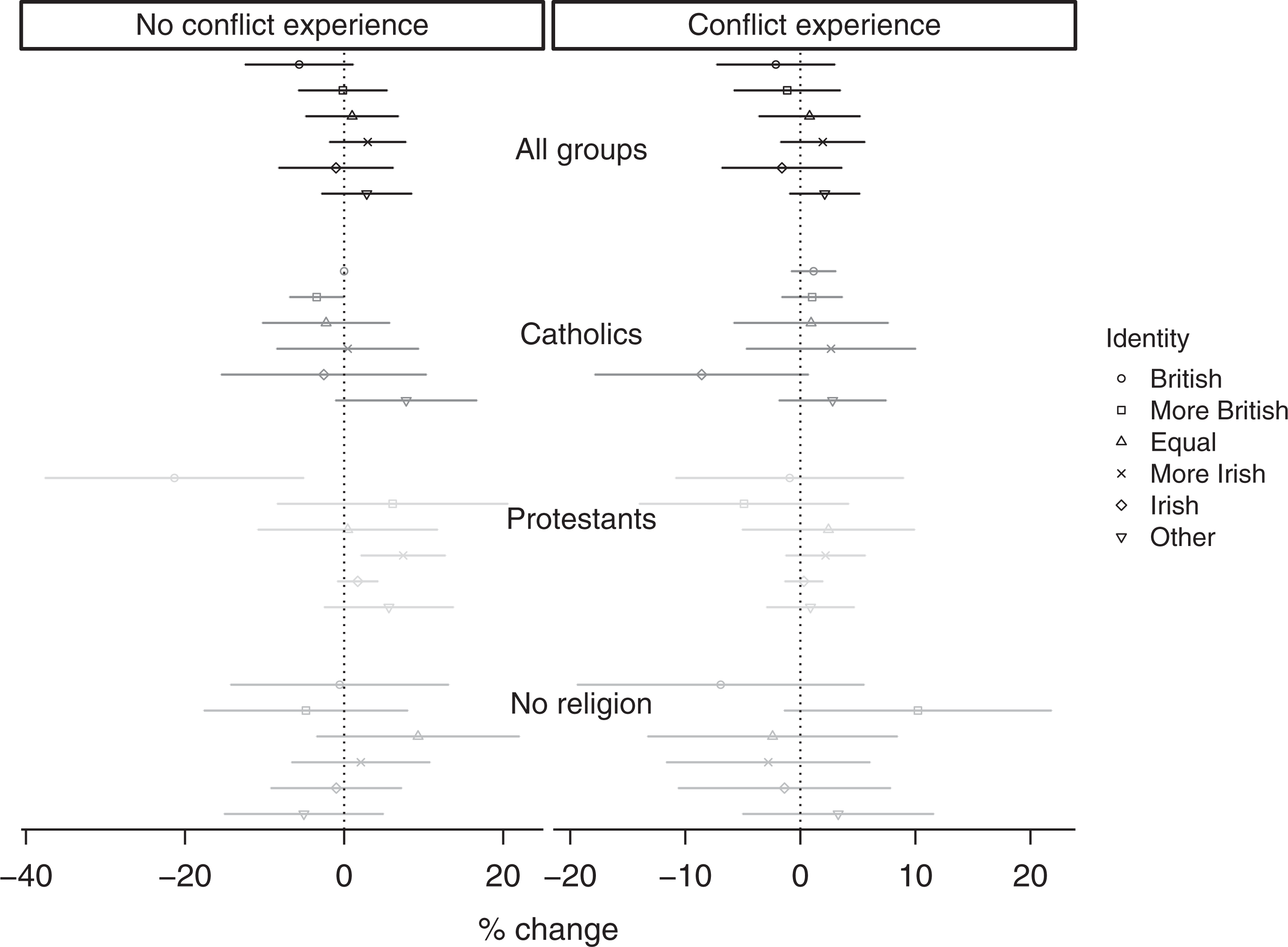
The analysis suggests that there is a significant change in national identification from British to Irish among Protestants after the referendum. When the analysis is run by taking conflict experience (using age as a proxy) into account, it becomes clear that the observed effect is driven by people who did not live through the conflict. While there is no significant change in identification among people who experienced the conflict, Protestants who did not live through the conflict show a significant decline in British identification, and corresponding increase in Irish identification. Critically, among other religious groups, no such effect is detected. Diff-in-diff analysis further corroborates our argument showing the differential effect of the referendum on Protestants. The difference in the effect of the referendum on identity between Protestants who experienced the conflict and those who did not live through the conflict is around
OLS regression of change in identity
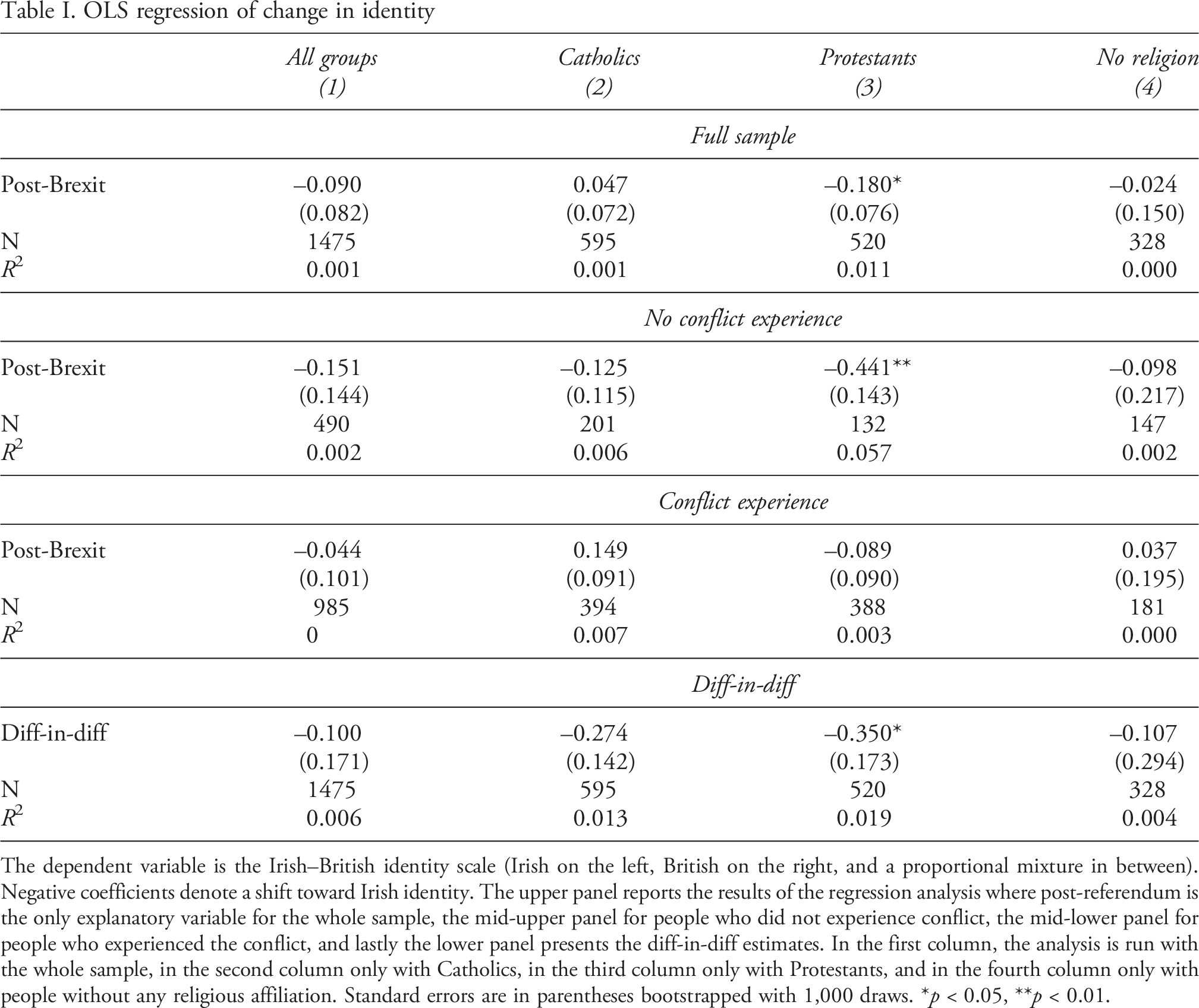
The dependent variable is the Irish–British identity scale (Irish on the left, British on the right, and a proportional mixture in between). Negative coefficients denote a shift toward Irish identity. The upper panel reports the results of the regression analysis where post-referendum is the only explanatory variable for the whole sample, the mid-upper panel for people who did not experience conflict, the mid-lower panel for people who experienced the conflict, and lastly the lower panel presents the diff-in-diff estimates. In the first column, the analysis is run with the whole sample, in the second column only with Catholics, in the third column only with Protestants, and in the fourth column only with people without any religious affiliation. Standard errors are in parentheses bootstrapped with 1,000 draws. *p < 0.05, **p < 0.01.
In terms of changes in identity beyond Protestants who did not experience the conflict, we do not observe any significant changes among Catholics and those without any religious affiliation regardless of conflict experience. We do not believe this is conclusive proof that Brexit had no effect on other identities (particularly on the content of those identities), but simply that our analysis indicates that it did not change national identity preferences of these groups enough to reach statistical significance.
Robustness checks
In this study, we adopt a diff-in-diff approach to test our argument without controlling for any demographics. Balance test of pre- and post-Brexit covariates showed no significant difference. Still, as a further robustness check, we run the analysis in Table I by including covariates. Results are presented in the Online appendix Tables A3 (upper panel in Table I), A4 (mid-upper panel in Table I), A5 (mid-lower panel in Table I), and A6 (lower panel in Table I) and still support our argument.
In the main analysis, we code people who were ten years old or younger in 1992 as ‘no conflict experience’. However, childhood experiences can have an important impact on attitudes in later life and therefore this latter group undermine the validity of the results. In order to address this, we run the analysis above excluding people who were born after 1981 and before 1992, coding only those who were born after 1991 as ‘no conflict experience’ and those who were born before 1982 as ‘conflict experience’. 20 The results still support our argument.
Given the importance of age as an alternative explanation, we ran an additional robustness check to ensure age is not the primary source of the effect identified. We do this by employing kernel smoothing estimation which is an application of semiparametric smooth varying-coefficient models as suggested by Hainmueller, Mummolo & Xu (2019). This fully automated technique evaluates the linearity of interaction terms by estimating a series of local effects of the treatment on the dependent variable over the values of moderator with a kernel weighting scheme. In other words, this method shows whether the moderated effect is linear and if it is not linear, what the effect looks like (e.g. U shaped, fluctuated, etc.). For the purpose of our study, we employ this method by limiting the sample to Protestants as they are the subgroup in which we expect to observe an effect. Here, the treatment is Brexit and the moderator variable is age. This analysis will indicate where the effect of Brexit on identity evaporates. Our argument is related to conflict experience and we expect to see the effect of Brexit disappearing for people who were born before 1982 as operationalized in the analysis. Results of kernel smoothing estimation are reported in the Online appendix Figure A2 and supportive of our argument. In line with our expectations, this analysis suggests that Brexit significantly impacted people who were born after 1979 (which is very similar to our original operationalization), and these people moved away from British identity toward Irish identity. For people who were born before 1979, Brexit did not have a significant impact as their identities have already been ossified.
As an alternative explanation, one might think that younger people’s identities are generally more malleable and the observed effect may not stem from the change in the group status but is rather driven by age. There is no support for this argument in the data. First, the results already presented show that there is no change in identity for young people (i.e. ‘no conflict experience’) in the dataset when taken as a whole (i.e. all groups), nor is there a shift in any subgroup other than Protestants. Second, to further address this concern, we run models in Table I by interacting post-Brexit with the age variable. We should observe a significant effect if age is the main determinant. However, the interaction term does not have explanatory power over identity choices for the whole sample and different religious groups. 21 Additionally, to balance the control and treatment groups in terms of age, we restrict the sample to those who were born between 1965 and 1998. Analysis with this sample also corroborates our main argument. 22
Furthermore, we run a placebo diff-in-diff analysis by coding people who were born after 1971 as ‘no conflict experience’, respondents who were born before 1972 as ‘conflict experience’, and excluding people who were born after 1981. Again, if age is the main driver, the variable of interest should be significant. However, in general and among different religious denominations, there is no significant change in identification. 23
Similarly, to check whether we can attribute the observed effect to the Brexit referendum, we run the same diff-in-diff analysis on the 2014 (control) and 2015 (treatment) surveys. If the same effects are not present in this analysis then we can have further confidence our findings are due to the EU referendum. This is exactly what we observe and provides additional support for our argument. 24
As noted above, those born prior to 1951 do not fit easily into our conflict socialization and experience binary. Although they experienced the conflict as adults, this was not during formative years which are important for socialization. As a result we excluded them from the main analysis; however, we ran a number of additional models to probe the effect of conflict and Brexit on their attitudes compared to other groups. First, when we include them in the main analysis as ‘conflict experience’ the results still hold. We also ran models directly comparing those born in 1951 or earlier to those born between 1952 and 1981. The results are highlighted in Figure A4 (i.e. Kernel smoothing estimation of the effect of Brexit on Protestants) and indicate that the identities of those born in 1951 or earlier, who experienced the conflict only as adults, are more malleable than those born between 1951 and 1981 who were socialized into conflict. However, this change is not as substantive as the change among those who were born after 1981 (i.e. those who did not experience the conflict or only as very young children). We also examined the differences between those born in 1951 or earlier and those born between 1952 and 1981 in a regression framework. Again, Brexit appears to have a greater impact on those born in 1951 or earlier, indicating that their identities are more malleable; however, the results here are not statistically significant. Taken together, these results suggest that although being socialized into conflict can have a more enduring effect on political identities and attitudes, experiencing the conflict as an adult can still significantly shape attitudes and identity relative to those with no conflict exposure.
Finally, we also examine the durability of the effects. The results indicate that the effect on British identity for those with no conflict experience is sustained for the three years after Brexit up to 2018. The direction of the effect is still negative in 2019; however, it no longer reaches statistical significance. Similarly, the results for the differential effect of Brexit on those without conflict experience compared to those who lived through the conflict (lower panel in Table I) suggest that the effect persisted for the three years after Brexit up to 2018. For more information, please see the Online appendix.
Conclusion
National identity continues to play a central role in politics, yet little is known about national identity formation and change. This article leverages the unique flexibility in nationality choice in Northern Ireland to analyze how the Brexit vote and resultant change in group status affected patterns of national identification. The results show that a significant number of individuals who previously identified with British identity no longer do so after the EU referendum. However, we provide an important corollary to this by distinguishing between individuals who experience violent intergroup conflict and those who do not. For those who experience conflict, identities ossify and a ‘durable distance’ is created, which makes changes in national identification highly unlikely, irrespective of large fluctuations in group status. This is not the case for those who did not experience the conflict, where changes in the status of British identity cause a significant number of younger Protestants to shift away from British identity towards Irish identity. The results suggest that national identities are malleable, even in a particularly polarized society such as Northern Ireland. Despite the referendum taking place almost six years ago, the long-term impact of Brexit on Northern Ireland remains unclear. Similarly, whether these changes in identity mark a clear departure from long-term trends will depend on how the ongoing political and social fallout from Brexit are resolved. The argument that conflict creates a ‘durable distance’ between identities builds on existing work in this area but is an embryonic research area itself. Future research should further explore this question both in Northern Ireland and beyond, particularly focusing on how durable this effect is over time through additional quantitative analysis of macro trends, and combine this with qualitative research on how the meaning and content of identities have evolved as a result of the referendum and the day-to-day impact of Brexit.
Given the resurgence of nationalism and complexity introduced by mass migration, globalization, and supranational institutions, these results are significant for our understanding of national identity. For those working on or living in post-conflict societies, they indicate both fragility and hope. While the identities of older generations remain hardened and inflexible even 20 years after conflict, younger individuals appear more flexible and open to change in their identity (although it is not clear to what extent this occurs among both communities or in the absence of significant political changes). This indicates that policymakers and politicians should be wary of political disruption which increases the salience of identities and perpetuates ossified identities to the next generation. Conversely, there may be a window of opportunity to create shared identities across communities in the next generation which could set the foundation for full reconciliation and lasting peace.
Footnotes
Replication data

Acknowledgments
We thank Gizem Arikan, Trasa Canavan, Thomas Chadefaux, Caroline Coogan, Chris Ellis, Michael Faulkner, Nicholas Sambanis, Claire Scott, Moses Shayo, and Jimmy Wyatt and the participants of the 2020 University College London Political Turbulence Workshop, the 2020 Annual Meeting of International Society of Political Psychology, and the 2021 Postgraduate Conference of the Political Studies Association of Ireland for invaluable feedback.