




Abstract
Processes of constitutional discussion increasingly invite widespread popular inclusion and participation. Conceptual and practical problems remain, not least the respects in which inclusion is to take place. In deeply divided places, these challenges are intensified, first in the difficulties of conceptualising inclusion, and second in the practical dangers participation may pose to peace. We tackle these problems empirically by looking at a hard case of constitutional discussion amid division: the re-emergence of debate about Irish unity in Northern Ireland and the Republic of Ireland. Through focus groups and interviews, we explore how ‘others’, disengaged from the main political groups and defined transversally, approach the discussion, showing that they welcome the prospect of participation and seek to remove discursive triggers of conflict by focussing on shared everyday experience. We discuss the implications for the constitutional process and the likely impact on polarisation. The analysis has implications for the literature on divided societies, for constitutional theory and for policy. We argue that it is both possible and desirable to remedy group exclusion while facilitating universalistic discussion and lessening the dangers of polarisation. The policy implications are quite radical.
Introduction
Does popular inclusion and participation shape constitutional outcomes? And if so, how? These questions are central to the theory and practice of constitution-making. In recent decades, popular participation in constitution-making has been a priority for policymakers and an emergent international norm. Including citizens in such processes is expected to reap a reward in terms of the quality and legitimacy of democracy. Yet, questions remain about the theory and practice of inclusive, participatory constitutionalism: what counts as inclusion, who is to be included, how the debate is best to be structured, what issues are to be prioritised and what will be the impact of different choices. In particular, there is little consensus on the value of what we call ‘radical inclusion’, not just of group representatives but of a multiplicity of citizens defined in crosscutting ways, and concerning not just choice of predefined options but also framing the constitutional values and agenda. This paper explores the value of radical inclusion in deeply divided places.
In deeply divided places, where provisions for constitution-making and constitutional change are often built into peace agreements (see Choudhry, 2008), the dilemmas are intensified. First, the marginalised are many and diverse, for the political predominance of the main ethno-political groups excludes not simply the economically disadvantaged but a range of groups and a still greater range of issues and ideas. This problem has been termed the ‘exclusion amid inclusion’ dilemma in power-sharing arrangements where ‘Others’ as individuals and groups who do not identify with the main identity groups remain marginalised (Agarin et al., 2018). The problem is intensified in constitutional discussions, for the views of these others – who give constitutional issues less priority – may be a deciding factor in any future decision on constitutional change, for example, in a constitutional referendum. Even conceptualising constitutional inclusion in such circumstances poses a major challenge.
Second, constitutional discussion is high stake politics, threatening the uneasy coexistence that characterises conflict to peace transitions by highlighting the issues of power, authority and territory that were central to conflict. Participation is often seen as increasing the danger of polarisation. The constitutional dilemma is whether to limit inclusion to elites negotiating under strong central control, or instead to attempt a more inclusive approach despite the plurality and multiplicity of the ‘others’ to be included.
We tackle these problems empirically and inductively by looking at a hard case of constitutional discussion amid division, and how the ‘others’ marginalised by major ethno-political divisions seek to address exclusion. We explore the constitutional debates about Irish unification in Northern Ireland and the Republic of Ireland which have re-emerged since Brexit in 2016. Northern Ireland is a devolved region of the United Kingdom, founded with partition of the island of Ireland in 1920–1921 on the insistence of the Protestant and unionist majority there, whose very existence was accepted as legitimate by the nationalist and republican minority there only with the Good Friday Agreement (GFA) of 1998. It is a post-conflict and still deeply divided society, which manifests an evident ‘exclusion amid inclusion’ dilemma. The Republic of Ireland is the other part of a divided island. Constitutional debate on Irish reunification has recently re-emerged after Brexit, in the context also of demographic change. 1 The very discussion is widely perceived as potentially polarising, even though the form and structure of a reunified Ireland is far from clear. 2 In recent research projects involving interviews and focus groups, we explored how ‘others’, disengaged from the main political groups and defined transversally in terms of their gender, generational or minority ethnic positioning rather than their political or religious identification, approach constitutional discussion. Do they converge or diverge in perceptions, meanings, and values surrounding unity? 3 How do they perceive exclusion and how do they want to be included – as group members or as individual citizens, to further group interests or more general shared concerns? Do they wish to include group-interests on the agenda, or rather to broaden the agenda away from group interests to more general concerns? Is the likely impact of their inclusion to provoke or de-trigger conflict? Thus, we build on the views of the marginalised to help inform the conceptualisation and design of a fully inclusive, conciliatory process of constitutional discussion.
In the following section, we show how some of the choices identified in the literature on inclusion in constitutional change become even more serious dilemmas in deeply divided and post-conflict societies. We then describe our research design and present our findings, highlighting how marginalised voices approach questions of inclusion, constitutional process, and triggers of conflict. Finally, we discuss the significance of our findings for scholarship on divided societies, constitutional theory and practical policy.
Inclusive constitutional debate and conflict to peace transitions in divided societies
There is scholarly consensus within constitutional theory whereby ‘for a constitution to be truly democratic, the process of its writing must be inclusive, participatory and open’ (Choudhry and Tushnet, 2020; Hart, 2003; Segura and Bejarano, 2004: 217). Yet, the literature on inclusion in constitutional change, sometimes on ‘inclusiveness’, approaches the concept in different ways (Jermanová, 2021). Some of this literature centres on vertical inclusion, that is the inclusion of citizens (Carey, 2009; Eisenstadt et al., 2015; Hudson, 2021; Landemore, 2015; Maboudi, 2020a, 2020b) and other scholarship investigates horizontal/partisan inclusion by political parties and interest groups (Eisenstadt and Maboudi, 2019; Jermanová, 2021; Maboudi, 2020a). A distinction is also made between formal inclusiveness (all relevant stakeholders at the table) and substantive inclusiveness (moving beyond formal inclusion so that all voices are heard) (Jermanová, 2021; see also Genauer, 2021).
This growing literature on constitution-making processes investigates the impact of various forms of inclusion and participation on outcomes. Eisenstadt et al. (2015, 2017) demonstrate that overall increased citizen participation (particularly at the drafting stage) in constitution-making positively impacts levels of democracy. Separating group inclusion (by interest groups, political parties and civil society organisations) and citizen participation, Eisenstadt and Maboudi (2019) advance ‘an interest group argument on the importance of group inclusion in contrast to mere participation’ and argue that the inclusion of ‘the widest possible range of interests’ is more important to the level of democracy in the longer term than the number of participants. There is arguably potential then, for marginalised communities to influence the outcome subject to their organisation in interest groups and civil society. However, Maboudi (2020a) also shows that citizen participation can deliver an increased number of democratic provisions in constitutions whereas group inclusion ‘is not a predictor of the content of constitutions’. Recent work has also identified a positive relationship between popular participation and the inclusion of minority rights protections in the constitution and argues that participation should be embedded in the process from the beginning (Fruhstorfer and Hudson, 2022).
The interaction between process – the different sorts of inclusion and participation at different points in the constitutional process – and outcomes – in terms of constitutional provisions and wider socio-political impact requires in-depth analysis of the mechanisms involved in the process and in its translation to outcome (see Carolan, 2015). Here, careful case studies make a difference: for example, they show how marginalised communities may be involved at both the individual level and the level of interest group advocacy and negotiation, impacting constitution-making by virtue of the alliances, coalitions and strategies they pursue (Segura and Bejarano, 2004: 218). Moreover, the nuances of process and its effects in triggering or detriggering group opposition require attention (see Fishkin et al., 2021).
Very similar problems of inclusion and participation are exemplified in post-conflict politics in divided societies. Recent scholarship on post-conflict institutions highlights a particular problem: the marginalisation of individuals and groups who sit outside the dominant ethno-national or ethno-religious communities. As new political arrangements prioritise representation of these dominant communities to enhance the prospects of political stability, non-dominant groups find themselves relatively excluded. Agarin and McCulloch (2020) summarise the problem thus: ‘Where politics rely on ethno-political bargaining, gender and sexual minorities, micro-minorities, members of groups identifying around non-ethnic or civic labels all find it disproportionately difficult to mobilise around issues that cut across the politically salient group boundaries’. In conceptualising this ‘exclusion amid inclusion’ dilemma, Agarin et al. (2018) note the plurality of political identities outside the main groups: ‘ethnic others’ are groups whose main political identity is ethnic but who sit outside the dominant ethno-political communities; ‘ethnic-rejecting others’ are marginalised by virtue of their socially relevant identity other than ethnicity (e.g. gender and sexuality, generation, or non-conventional religion not accounted for in power-sharing arrangements); and ‘issue-oriented others’ reject identity labels in favour of ‘ideologically underpinned forms of political participation’ (e.g. left-right politics).
Most important of all, this increases the extent and the range of the marginalised. Women who may, of course, have an ethnic identity of their own, nevertheless find that issues important to them are dismissed as secondary in conflict-to-peace transitions (Byrne and McCulloch, 2012, 2018; Deiana, 2016). Marginalisation takes the form of exclusion of ideas as well as of representation. As Allison McCulloch (2020) writes, ‘even if included, [women’s] priorities continue to butt up against resilient gender norms and tropes’. Feminist scholarship highlights the gendered nature of peace deals and the marginalisation of gender issues (Byrne, 2020; Deiana, 2016; Kennedy et al., 2016). In these cases, formal inclusion may not involve substantive inclusion. Moreover, political exclusion is not confined to women: gender activists, ecologists and smaller ‘micro-minorities’ also find themselves excluded from post-conflict institutional design and a ‘frequent victim of such institutional ‘sidelining’ in power-sharing systems’ (Juon, 2020).
These ‘others’ may find ways to have their voices heard in consociational regimes (Agarin et al., 2018). But, constitutional debate throws up new questions of inclusion, for it is not clear in what respects whole swathes of the population uneasily positioned with respect to the main blocs are to be included: as groups or as citizens? As umbrella organisations (e.g. those representing a range of BME groups) or as intersectionally defined individuals? The increasing interest in everyday constructions of identity and politics in peace-making suggests that group-centred identification may be less central to these marginalised constituencies than is often supposed (Bachleitner, 2021; see also Mac Ginty, 2021). There is considerable discussion whether and when what Michèle Lamont (2019) calls ‘everyday universalism’ serves as an alternative to groupist perspectives. 4 But if the issue is inclusion of ideas and issues as well as, or rather than, groups, the question is what ideas and with what democratic justification?
Moreover, constitution-making in these societies poses particular dangers because it touches on the issues of territoriality, power and authority that were central to the conflict. The political dominance of the conflict-blocs, for example, in power-sharing arrangements, that allowed agreement to bed in, also threatens to renew polarisation in any constitution-making process that follows. Can inclusive processes of constitution-making open up more general issues for discussion away from party politics and bloc polarisation? The practical dilemma for states and international guarantors is whether to limit inclusion to elite negotiation under strong central control, or instead to attempt an inclusive process with a bewildering multiplicity of ‘others’ to be included.
To address these issues requires us to pay attention to meanings, perceptions and aims more than categorisations and comparisons and to process more than outcomes. In what follows, we ask how people disengaged from dominant communities perceive constitutional discussion, how they seek to address exclusion and how they navigate contentious constitutional politics. We build on our findings to address questions about the value and viability of radical constitutional inclusion in deeply divided societies.
Research design and methods
Our recent research among the constitutionally disengaged and undecided in Northern Ireland and the Republic of Ireland addresses these questions. The island of Ireland is a hard case for constitutional theory and practice: it has been partitioned for a century, with deep division and conflict in Northern Ireland, and considerable political and institutional divergence between each part of the island. The Good Friday Agreement (1998) provided for constitutional change to a united Ireland if and only if a majority in Northern Ireland and a majority in the Republic of Ireland so willed (Working Group on Unification Referendums on the Island of Ireland, 2021). There has been a recent re-emergence of constitutional discussion on Irish unity in Northern Ireland and the Republic of Ireland, stimulated by Brexit, and we wanted to explore how people who distance from mainstream nationalist and unionist political blocs think about these constitutional issues. Such people amount to about half of the Northern Ireland population, and a very large proportion of the population in the Republic of Ireland, and so their views are important. 5
Our method was to prioritise access rather than representativeness, and to prioritise discussion of the constitutional process and agenda over discussion of constitutional provisions or outcomes. We engaged with transversally defined organisations and networks organised by and for women or migrants or LGBTQ+ or youth, in an attempt to access politically marginalised and/or constitutionally disengaged populations in ways that explored the potential for convergence even on these contentious issues. Parallel projects were undertaken in Northern Ireland and the Republic of Ireland and a set of cross-border youth and women’s focus groups were held, together with engagement with gender activists and migrants and ethnic minorities. We also undertook semi-structured interviews with representatives of most main political parties, to access ‘ideological’ others, and to explore if and how grass roots views differed from those of the mainstream political elite. 6 We conducted interviews and focus groups through Zoom. They were recorded, transcribed, anonymised, coded in NVIVO and analysed. We engaged with more than 65 people, slightly more in the North than in the South, and within the North Catholics were slightly overrepresented.
We engaged with ‘groups’ of different types: some were ethnically defined micro-minorities, some umbrella organisations for all ethnic others and incomers; some were gender-specific organisations, although many of their members were also nationalists and unionists; and some were role-based (students). Meanwhile we conducted semi-structured interviews with politicians from issue-oriented socialist and ecologist parties as well as from nationalist and unionist parties. Thus we engaged with all three forms of ‘others’ discussed by Agarin and McCulloch. Typically, however, our participants were radically intersectional in their positioning: for example, participants from women’s groups focussed on their rural, border and/or class perspectives. They were, for the most part, disengaged from party-politics, but not from political issues, and they had considerable experience in social relations in divided local areas. They also, as we note below, wanted their views heard by those in authority. 7
Interviews and focus groups were minimally structured around ideas of ‘constitutional change’ and ‘North-South relations’, and our main questions were exploratory: were our respondents interested in participating in constitutional discussion and what prevented their participation? How would they like the process to proceed? And how would they design the agenda? The interviews and focus groups were designed as opportunities for reflexive discussion and debate around the constitutional issues, allowing the participants to re-define the important questions rather than us posing them. Focus groups may be impacted by group dynamics; they risk the dominance of louder voices and group-think. These dangers were mitigated by the zoom medium, where each participant was alone with their thoughts, less impacted by others than in in-person meetings; we also encouraged all to participate and invited divergent perspectives. We coded each individual’s interventions to pick up on divergence. 8
Our research allows us to highlight the distinction between modes of exclusion, on the one hand, and the constitutional process and agenda, on the other. While exclusion may be implicitly or explicitly group-based, and inclusion requires a focussed countering of these mechanisms of exclusion, the agenda may be general and universalistic, and the process multiple and mixed.
Research findings: inclusion, shared experience, and removing discursive conflict triggers
Discussions in our interviews and focus groups were wide-ranging. They took place not simply or even primarily on the merits of a united Ireland or the United Kingdom, but also on issues of process and the agenda for discussion, the triggers of contention, fears of polarisation, and sharing experience how to negotiate such fears. Our discussion of research findings centres on three sets of questions relevant to the theoretical discussions outlined above:
Do participants want to be included in constitutional discussion, and if so why?
How do they think the constitutional agenda should be defined and the constitutional process organised? What issues, what principles, what concerns are important to them? And how far do they converge or diverge on these views?
How do they propose to avoid polarisation and potential conflict? What do they see as potential conflict triggers?
Inclusion
Surveys show that most people in the Republic of Ireland and Northern Ireland have clear preferences about the constitutional future. 9 But for many these are low intensity preferences and they keep out of contentious public debates. Relatively few of our research participants – with the exception of some politicians – had participated in public constitutional discussion and debate. There was, however, a broad-based appetite among our participants for future participation and inclusion in constitutional discussion: some noted that the emerging process is ‘important’ and that different voices should be heard; 10 others would welcome an inclusive process of discussion provided that people throughout the island of Ireland should have their say, including rural communities, not just a focus on Belfast and Dublin. 11
For some, Brexit precipitated this conversation about the future: everybody will be worried about their daily life . . .. jobs, education, this is where we need to start the conversations . . .. I’m ready for those conversations because we in Northern Ireland are in No Man’s Land and we need to be together to help each other, to progress, to move forward.
12
This was especially important for women living near the Irish border, whose daily life is spent negotiating the border, who spoke of their memories of conflict and fears that Brexit would resurrect a hard border. 13
For others, their interest in North-South cooperation and constitutional issues was stimulated by previous cross-border engagement on other issues: . . .. in relation to domestic violence, that was something that would have come up obviously in conversation. And also, obviously around Repeal the Eighth, when the abortion legislation came through, and then the difference between us and the North in relation to that. I think that was a huge thing for women, around that time, and there was a lot of conversations around that . . .. And now Covid.
14
Similar views were put forward by a left-wing Dublin politician: I think the experience of those practical [gender rights] campaigns that crossed the border sort of, you know, changed people’s thinking about that . . .. [saying] ‘The things that I want to see change in Irish society on will have to be on an all-Ireland basis’, you know? Because they saw the direct connection between those two things, between the North/South dynamic on the issues that matter to them.
15
European migrants in Northern Ireland were, for the most part, worried about Brexit but reluctant to get involved in constitutional discussion, which they said should be ‘sorted by the two main communities’ [in Northern Ireland]. 16 But, there was also a different view: that those who work and study on the island, moving across North and South, should have their voices heard; that refugees and asylum seekers be facilitated into the discussion; that those who have made their home on the island should have some say. 17
Among the politicians we interviewed, North and South, most were supportive of the need to open up the debate to the diverse perspectives across the island. There was recognition of the increasing fluidity of the ‘middle’ section of people who would welcome having discussions and listening to different arguments about Northern Ireland’s constitutional future.
18
Some mainstream politicians wanted to diversify involvement so as to defuse potential polarisation: . . .. if we just keep it at that level . . .. the debate on a reunification will be used the same way as the past is used. It will simply become another weapon, along with legacy issues, and identity issues, as part of the ongoing battle between two staunch communities in Northern Ireland. So, I think we need to get other political parties into the debate.
19
Another benefit of inclusive discussion, for left-wing politicians, was that it enhanced prospects for wider social and political change. 20
Although unionist parties are opposed to discussion about constitutional change, most of the unionists who agreed to speak to us said they could be involved if discussions were to focus on socio-economic issues. Only one expressed sharp opposition to any discussion on Northern Ireland’s constitutional future: we, those of us who have participated in things like that are allowing ourselves . . .. for all the subtle language, to be embroiled into a discussion even the phrase ‘New Ireland’ should be resisted . . .. I see people, Unionist academics, Unionist commentators, Unionist bloggers, Unionist politicians, of course it’s all very flattering to suddenly think that you’re important and that your view matters. But I think that, you know, we have to not engage.
21
If this political resistance to discussion was atypical of our participants, a more diffuse uncertainty was expressed. One woman felt ‘silenced’ by the constitutional discussion: I actually feel I’ve rocked up to the wrong meeting this evening . . .. I don’t understand a lot of what it is that we’re talking about.
22
As the discussion proceeded, she made clear the roots of her feelings: a habitual avoidance of identity politics; her felt need to speak to experience, not ideology. She also criticised the apparent disengagement of politicians: they don’t listen anyway and they just go and do their own thing, like, so what’s the point, if they don’t listen . . .. that’s sort of quite a problematic thing where people think that even if they get, you know, they use their voice, it doesn’t matter . . .. it’s not going to change anything.
This sense of being ignored by politicians and officials was common among our participants – North and South – and dissuaded some from participation: Everybody says, ‘That’s a great idea’, everybody, but we still get no actions.
23
Jaded . . .. jaded is probably too far but yeah, I could do without it.
24
We have it all of the time, you know, in all of our areas, the women are sick of being asked how do they feel and what do they want and not getting anything out of it.
25
Participants in focus groups repeatedly asked us what the results would be: as we ended discussion, they asked ‘is that it?’, were we going to leave without providing channels for follow-up or feedback?
In summary, most of the grass-roots participants wanted to be involved in future constitutional discussion. Most thought that the constitutional debate should be inclusive of diverse perspectives. Despite variation in their reasons for engagement, they were clear on the importance of having their voices heard. Some expressed scepticism that their views would be taken on board by elites.
The constitutional agenda and process: shared experience beyond groupness
Our participants, from different backgrounds and different areas, and from all sorts of ‘other’ groups, converged in the view that constitutional discussion should focus on shared experience rather than on ideology. One participant explained, ideology is grand, but that’s not really up in my agenda, it’s the practicalities of how life works on a day-to-day basis, in terms of what makes life easier, less complicated, what makes life safer and security issues around those conversations.
26
Almost all framed these ‘practicalities’ in universalistic and shared, rather than in group-centred ways: So, if the greater good would mean to actually have a functioning coalition [government] which would mean an all-Ireland, I would vote for that.
27
A participant in a migrant focus group commented, A shared Ireland is one which would challenge things like racism. A shared Ireland is one which I think stamping out things like sectarianism that actually impacted everyone . . .. so it’s just ensuring the equality across the board for all in terms of equality in education, equality in employment, et cetera.
28
A participant in the youth focus group called for dialogue to help ensure a future that ‘accommodates everyone’. 29 Only occasionally were group-rights discussed (for example for BME representation in all political parties). More usually, group-specific interests (as students, as border residents, as LGBTQ+, as women) were also developed into more general terms: ‘the greater good’; ‘don’t forget men too’.
Health and educational provision were frequently mentioned as shared concerns, and other issues were reframed in ways that showed common rather than group specific experience. One woman emphasised the similarities of experience in different contexts: So, down South, the drug scourge on families is just horrendous. So, people who have had drug barons knocking on their door, people shooting their mostly young men. People, families like re-mortgaging their houses. So, then you move like slightly down, a few miles down the North
30
and you have women who their sons or their grandsons are on hunger-strike, who have been knee capped, who have been forced to join different organisations.
31
Another emphasised the intersection of different fields: we are talking about it being a gender issue, it’s also a class issue, you know. And I suppose to recognise that if you’re talking about creating participative spaces, that that’s another factor, you know, in the main these things are developed, you know, by middle class for middle class.
32
Again and again, participants emphasised the importance of process, suggesting that only the right process can help people from diverse backgrounds recognise shared experiences. One woman in a Belfast focus group called for open-minded ‘conversations’: Debates are deliberately confrontational. The idea is you find a winner; actual conversations aren’t like that, they aren’t about beating somebody else, they’re about learning a little bit and giving a little bit of what you know for the other person to learn too so everybody comes out hopefully not upset, not frustrated and a little bit wiser than they went in. Conversations are what we need to be having, I think and for that to work I think the rhetoric needs to change completely, so instead of people going in fearing their identity being lost, fearing being put in a box they don’t want to be in, fearing anything really. You have to go in there with an open mind; otherwise it won’t work.
33
Others emphasised that these conversations should start at the local level: You know the small community groups, the knit and natter groups, that’s where our conversations need to start. Right down, small, you know? Start from there and build it up because we are interested because when we do get together you know and you meet people and give each other a helping hand and to educate each other. And again, it’s all to do with networking and informing yourself but it’s nice to get a helping hand.
34
A participant in the youth focus group called for a programme of ‘community outreach’ at the local level to invite more people into dialogue. 35
Other research participants called for unbiased information on potential constitutional change. One participant suggested that the experience of the COVID pandemic had demonstrated people’s resilience and adaption to change if we think it’s for a greater good . . .. So surely, if people are just presented with changes, . . .. United Ireland or not, they can then make a decision based on that information. . . .. I just think it’s getting to a point where we have that information very clearly and summatively presented to people . . ..
36
Others emphasised ‘the need to know as much as possible’ about what any change might look like, ‘or at least as much discussion as possible’ so people can learn about the wide range of viewpoints. 37
Both grass-roots participants and some politicians favoured new deliberative processes of engagement: You could see a series of Citizens’ Assemblies. You could see a first Citizens’ Assembly for the citizens to identify the complexities of the issues. For their goal to be, what did you find out or think about this weekend that you haven’t thought about before as being a relevant aspect of any conversation on a united Ireland. If you were in the seat of somebody in Larne or wherever else, who didn’t want a united Ireland, what would your concerns be, and how would you want them reflected.
38
In summary, grass-roots participants wanted the discussion to focus on shared experience, on the practicalities of life and on policy areas, especially health and education. They called for attention to aspects of process: the need to have conversations starting at the local level, framed as open-minded explorations rather than as debates, the provision of unbiased information to the public, time for lots of discussion and potential use of different ways of bringing people together, for example, via citizens’ assemblies. Of particular interest was the extent of convergence between the different and unconnected grass-roots groups and networks, those from unionist backgrounds and those from nationalist backgrounds, and also between politicians and grass-roots voices, North and South.
Changing the language of constitutionalism: removing the discursive triggers of conflict
A third important research finding was the widespread emphasis on the need to avoid a polarised constitutional discussion. Among the most common themes highlighted by participants were the discursive tropes which dissuaded widespread participation, and could trigger conflict. They were very keen to avoid divisive language, to have ‘measured’ conversations and – as noted above – to change the debate from ‘ideological’ issues of identity politics to issues of experience. One participant explained, I think that the term ‘united Ireland and unification’, it’s a very loaded term. I think it causes a huge reaction to some people, either pro or anti, and it’s really, this is about a conversation about what that would mean for people on the island. And I think . . .. it’s an all-island . . .. not even an ‘all-Ireland’ approach, but just seeing it as an island, as one joint Ireland, one of the areas of cooperation and how would that benefit everybody.
39
Another participant expressed a similar view: to mention the word ‘united Ireland . . .. for me, that’s where the very slow conversation begins. In other words, it has to be about, even to use the all-Ireland approach, rather than united Ireland’.
40
Some said that the terminology acted as a block to the conversation because you’re either for it or you’re against it . . .. it becomes an ideological question and it’s yes or no whereas if you look at constitutional change and constitutional questions around levels of cooperation and levels of joint decision-making and shared decision-making you know to go back with the peace language about shared spaces . . .. let’s look at this as a shared island, you know, it’s not who owns it or what colour it’s going to be, it’s just that it’s a shared space that we all live in.
41
And most politicians tended to agree: You can’t be aggressively nationalist in 2021, we have seen how that works . . .. aggressive nationalism facilitated by social media. And which removes the space for nuance.
42
Several participants suggested that a different type of conversation, beginning with practical, experiential issues, could lead to more productive discussion about political and constitutional change. As one participant suggested, it would be preferable to look at ‘areas of cooperation and what benefits people rather than jumping straight into a conversation about unification’. 43 There was agreement that ‘the wording is key’ and therefore better to start with a policy area like health, policy issue areas that are ‘not as loaded’. 44 Similar views were held by politicians, North and South: one nationalist in Northern Ireland spoke of the need to disaggregate the issues in dispute into ‘bite-sized chunks’.
To help limit polarisation, the participants called for widespread inclusion: ‘people need to be included, people need to be spoken to, have the conversation . . ..’. 45 A participant in a youth focus group suggested that it would be important to listen to ‘people in the middle who are not heard as much’, thus opening up the debate. 46 A participant in a Belfast women’s focus group thought that more dialogue ‘at the civic level’ could help address people’s anxieties and circumvent people being ‘fed the information that different parties want to give them’. 47 It was felt that this widespread inclusion should be done in a way that increases mixing and contact between different communities. Some women spoke of the strength of the women’s sector: ‘when we talk, we don’t talk in groups of single identity; when we talk, we talk to each other’. 48
There was agreement that diminishing polarisation would require the provision of lots of unbiased information. Some referred to the perceived misinformation around Brexit, calling for ‘correct information’ to be disseminated at the local level, rather than leaving it to elites who might otherwise provide information tailored to improve their electoral prospects. 49 There was also a view that in order to bring as many people as possible into the discussion to understand the range of different viewpoints, the discussion must ‘take its time’, that there ‘should be absolutely no rush at all’. 50
In summary, participants suggested moving away from the terminology of ‘ideological’ identity politics and ‘loaded’ language around Irish unification and suggested refocusing on all-island cooperation in policy issues that matter to people’s lives. They saw this as a lead-in to constitutional discussion. They advocated widespread inclusion to bring as many voices as possible on board; starting conversations at the local level; the provision of lots of unbiased information; and proceeding carefully, avoiding a rushed process.
Discussion of findings
As Table 1 indicates, we found considerable interest in constitutional issues, even from those disengaged from the main political parties. We also found very considerable convergence among participants from nationalist, unionist and other backgrounds in their perceptions of shared interests, and a desire to use these as routes into constitutional discussion. These were general not group-based interests: our participants were accessed through group organisations but for the most part they did not argue for group-rights or group-specific procedures or provisions – their concern was rather for ‘the general good’. The participants converged also in their desire to remove discursive triggers from constitutional debate by beginning discussion with ‘experiential’ issues that arise ‘organically’ in social practice, not ‘ideological’ issues: they wanted to counter divisive identity politics with experiential politics.
Constitutional views by category of participant.
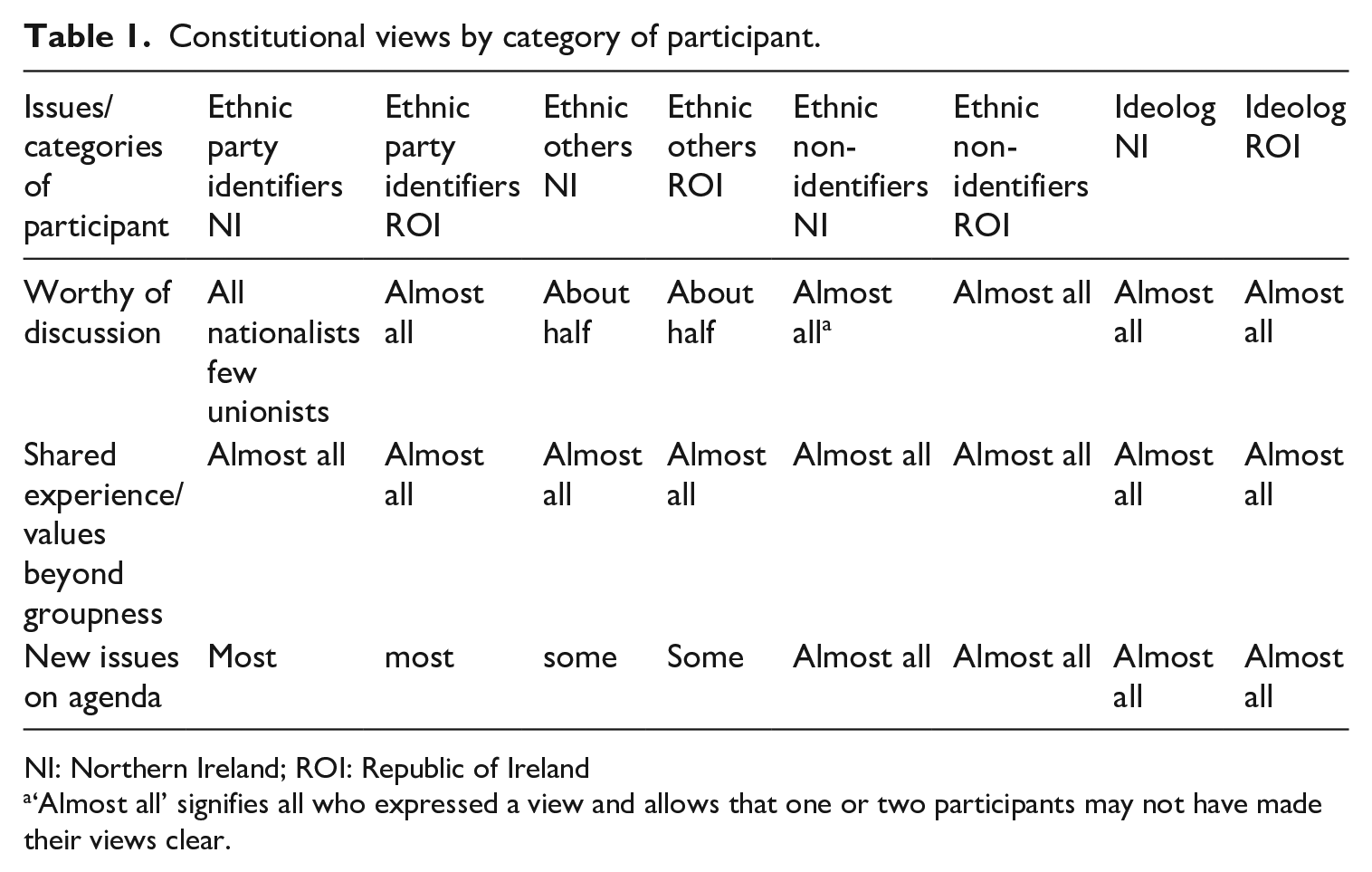
NI: Northern Ireland; ROI: Republic of Ireland
‘Almost all’ signifies all who expressed a view and allows that one or two participants may not have made their views clear.
Our findings in part cohere with, in part complement and in part critically engage with other research on a united Ireland. Garry et al. (2020, 2022) conducted two deliberative mini-publics – one in the North and one in South – focussing on the question whether a future united Ireland should be an integrated state, or whether Northern Ireland would remain a distinct polity within it. The procedure involved expert presentations of each of these institutional options between which the participants were offered a choice, as in a deliberative poll. Garry et al. found considerable interest and capacity for discussion and deliberation among the participants, North and South, just as we did. They did not open the agenda of debate to participation and discussion. When we did, we found very strong preferences for changing that agenda to focus on the frame and values of constitutional deliberation. Garry et al. provided structured expert information to help deliberation and to probe what information is relevant to participants changing their views: we did not do this, although we believe our participants would have welcomed it. 51 Finally, Garry et al. used representative mini-publics that tend to under-sample hard-to-reach clusters: we accessed disengaged and hard-to-reach participants with no claim to representativeness. There are benefits and costs to each choice: in principle a well-planned iterative series of deliberative events could garner the benefits of each approach. 52
Wider significance
Our findings feed into an emergent body of work on everyday peacebuilding and participative and deliberative constitutionalism.
Our work foregrounds the concept of radical inclusion of the multiple ‘others’ whose presence and concerns are marginalised in deeply divided societies, and who are invited not simply to state their constitutional preferences but to define the constitutional agenda. Making a constitution is important for everyone and thus can serve as an arena within which to address the ‘exclusion amid inclusion’ dilemma. Our work develops analysis of radical inclusion for the literature on constitutionalism. 53
It shows that such radical inclusion can advance a more civic constitutional debate beyond polarised political blocs. It allows a focus on the experience of marginalisation and shared ‘everyday universalist’ values distinct from opposing political identifications. 54 Countering group-based exclusion (by accessing participants through transversal group organisations) can be combined with highlighting questions of the ‘general good’. The criteria and values that grass roots participants highlight – violence, effective governance, equality, concern for the disadvantaged – are at once rooted in their experience and also generalised into more universalistic forms.
Our work confirms a major gap between everyday concerns and elite definitions of the constitutional issues. 55 This cannot be dismissed as simply a result of popular ignorance of constitutionalism, nor of populist desire to confound elites. 56 It may instead be a different and more civic mode of approaching these issues, short-circuiting polarising political meanings, and countering ‘identity politics’ with ‘experiential politics’. In this sense radically inclusive constitutionalism is an example of what Mac Ginty (2021: 45–49) called ‘scaling up and scaling out’ of everyday peace.
More generally again, we can see radical inclusion as a form of resistance to the divisive ‘identity politics’ and the mutual disengagement of the public and politicians which has become such a feature of the current age (see Mair, 2013). The antidote, for the participants in this study, is ‘experiential politics’, beginning at the local level and linking together localities through their transversal networks. Our participants counterposed the language and politics of experience, demanding new processes of dialogue between local actors, policy-makers and politicians, so that everyday political concerns and ideals can be informed by and inform wider processes and decisions. There are echoes here of those (in the USA) who see ‘local democracy’ as an antidote to party polarisation, and to the weaponizing of the language of politics in social media.
Our findings confirmed many of the practical steps that have been shown comparatively to be important if constitutional deliberation is to soften rather than harden division – widespread inclusion in debate; the provision of unbiased expert information; time for deliberation; mixing and contact; disaggregating issues in debate; avoidance of politicised language; and accountability (see Fishkin et al., 2021). Our grass-roots participants insisted, however, on real accountability, what might be called ‘substantive’ rather than merely ‘formal’ inclusion: their previous experience of what they saw as fruitless consultations had disillusioned them with merely ‘formal’ inclusion. They did not want simply a feeling of making a difference but rather credible channels by which their time and local expertise could feed into policy. This is likely to be common in situations of conflict and post-conflict, for example, with regard to the implementation of UN Security Council Resolution 1325 (Davies and True, 2018).
The policy implications are quite radical. First, the need for a sequence of new deliberative processes of engagement, feeding local deliberation into agenda setting, testing suggestions in wider mini-publics and surveys, and going back again to the grassroots for feedback and ideas, in particular at the early stages of constitutional framing. Second, the need for multiple channels of accountability and feedback. International actors, political leaders and civil servants in deeply divided places have been used to controlling the political agenda and restricting public participation, particularly in issues of constitutional import. Whether they might come to perceive the benefits of greater participation as worth the cost is an open question. One small positive indication lies in the fact that significant numbers of the politicians that we interviewed – from mainstream as well as more leftist parties – were aware of the need to feed in popular input to decision-making and to find ways to encourage diverse voices in order to depolarise the constitutional issues.
Conclusion
This article analysed the challenges of radical constitutional inclusion in divided societies, considering how inclusion was likely to impact constitutional process and outcomes. It did so by taking a hard case of potentially polarising constitutional debate on the island of Ireland. Its method was to show how those who disengage from the dominant nationalist and unionist political communities seek to address exclusion, how they wish to be involved in the constitutional process, and to navigate contentious constitutional politics. Drawing on extensive data collected via focus groups and semi-structured interviews, we showed how these constituencies welcome the prospect of participation in constitutional discussion while seeking to remove discursive triggers of conflict in constitutional discussion by focussing on shared everyday experience.
We identified some of the mechanisms by which constitutional inclusion can soften rather than harden divisions in divided post-conflict situations. First, constitutional engagement is likely to be of interest to very many people who are disengaged from party, bloc and electoral politics. Second, that furthering such engagement is likely to have multiple benefits – not simply greater democracy and legitimacy for the constitutional outcome, but also channelling a more civic discussion by changing the agenda and process of constitutional discussion in ways less likely to trigger polarisation and conflict. While constitutional discussion carries potential dangers for post-conflict societies, one way to counter the dangers may be to radicalise inclusion.
Our analysis contributes to debates in constitutional theory by showing that inclusion need not be conceived in binary fashion as ‘group’ or ‘citizen’ centred, but that it is both possible (and arguably desirable) to remedy group exclusion while facilitating universalistic discussion. Setting out to remedy group-specific obstacles to inclusion does not lead to a proliferation of group-based demands but can address the general good, developing everyday universalist values on the basis of shared experience of marginalisation.
The practice of radically inclusive constitutionalism is only beginning, and comparative cross-learning is vital. Much can be learned from the local deliberations in the Philippines (Curato, 2019), from the extensive participation but questionable gender inclusion before the Scottish independence referendum (Keating, 2015; Kenny, 2014), and from radical inclusion in the wider constitutional processes in Chile (Heiss, 2021; Suárez-Cao, 2021). Other constitution making cases known for their high levels of inclusivity in different contexts such as Iceland (Landemore, 2015) and democratisation in Tunisia (Jermanová, 2021) raise further questions about the translation between process and outcome. The Irish case offers both considerable public and political support for and expertise on deliberation in general (see Farrell et al.), and a period of at least a decade before any likely constitutional referendum when a large-scale inclusive deliberation may be taken forward.
For practical policy, our study shows the need to develop multiple arenas of discussion and deliberation, from the local to the national, and credible institutional channels to allow reciprocal feedback between grass-roots and policymakers and a level of accountability. It is beyond the scope of this article to explore how this might best be pursued institutionally and the answer is likely to vary in different circumstances. In the Irish case, a start would be to link existing researchers and practitioners to permit joined-up planning of a sequence of interconnected deliberative forums; and political determination to create effective channels of accountability and feedback, perhaps through a dedicated ombudsperson. We have, however, given empirical evidence that radically inclusive constitutionalism can address group-centred exclusion while prioritising ever more inclusive discussion of general issues, shared concerns and convergent experiences. In these hard cases, a wide range of diverse grassroots voices converge in their desire for such an approach.
Footnotes
Funding
The author(s) disclosed receipt of the following financial support for the research, authorship, and/or publication of this article: Research for this article was funded by two grants from the Reconciliation Fund of the Irish Department of Foreign Affairs, one to each author respectively for work in Northern Ireland and in the Republic of Ireland, and by one grant from the University of Notre Dame, Clingan Institute, through the ARINS project (Analysing and Researching Ireland, North and South,  ).
).