



Abstract
This article theorizes on how military and civilian components of peacekeeping operations contribute to the conclusion of local ceasefires in non-state conflicts involving armed opposition groups or communal groups. A mediation-based logic suggests that civilian peacekeeping staff can provide technical support aimed at resolving the conflict issues and engage with state officials to promote peace. A capabilities-based logic suggest that military peacekeepers can provide security during the negotiations, arrange logistics, and put military pressure on the conflict parties, which all should make the conclusion of a ceasefire more likely. The analysis supports both the capabilities-based and the mediation-based logic. An instrumental variable estimation helps to account for endogeneity. This article contributes to the literature on peacekeeping, mediation, and ceasefires through shifting the focus to non-state conflicts.
Introduction
Peacekeeping operations are commonly deployed in response to intrastate armed conflicts between a government and one or more rebel groups (Bellamy and Williams 2010; Duursma and Gledhill 2019; Hultman et al. 2019). This means that the majority of contemporary peacekeeping operations are deployed in countries with fragile governments and places where multiple non-state armed actors are vying for power and where relations between different communal groups are highly polarized (De Waal 2015; Lombard 2016). Yet, most studies focus on the impact of mediation and peacekeeping on armed conflicts between government and rebel forces (Duursma 2020a; Hultman et al. 2019), ignoring non-state conflicts among different rebel groups or communal groups. This article aims to fill this gap in research. The article theorizes on how the military and civilian components of a peacekeeping operation contribute to the conclusion of ceasefires in non-state conflicts.
I argue that military peacekeepers can provide security during negotiations aimed at ending non-state conflicts. Moreover, the more peacekeeping troops are deployed, the better peacekeeping troops will be able facilitate the logistics to bring conflict parties together for negotiations. A high military capacity also makes it possible for mediators to put military pressure on the conflict parties to push them towards signing a ceasefire. This capabilities-based logic thus suggest that a higher number of military peacekeepers should be associated with a higher likelihood that a local ceasefire is concluded. I further argue that civilian peacekeeping staff can provide technical support aimed at resolving the non-state conflict issues and engage with state officials to promote peace. This mediation-based logic suggests that the involvement of civilian peacekeeping staff in negotiations aimed at ending non-state conflict should make the conclusion of a ceasefire more likely.
An analysis based on Uppsala Conflict Data Program (UCDP) data on non-state conflicts and the African Peace Processes (APP) dataset suggests that the involvement of civilian peacekeeping staff in negotiations indeed increases the likelihood that a ceasefire is concluded. The findings on the impact of the number of military peacekeeping staff deployed are less conclusive. While the number of peacekeeping troops seem to have a negative effect on the conclusion of ceasefire in a naïve model that does not account for endogeneity, an instrumental variable model suggests instead that the number of peacekeeping troops make the conclusion of a ceasefire more likely.
This article makes two contributions. The first contribution is that through theorizing on what explains the conclusion of ceasefires in non-state conflicts, this article supplements the emerging literature on ceasefires (see: Clayton et al. introduction to the special issue). 1 Most studies on ceasefires to date focus on the conclusion of ceasefires in either interstate conflicts (Fortna 2003; Fortna 2004; Werner and Yuen 2005), or in intrastate armed conflicts between government forces and rebel groups (Akebo 2016; Höglund 2011; Mahieu 2007; for a notable exception that looks at Syria, see: Karakus and Svensson 2017). However, non-state conflicts make up a large part of the armed violence in zones of armed conflict, especially in more recent years (Duursma 2019, 2022; Pettersson et al. 2019). Non-state conflict can be defined as the use of armed force between two organized armed groups, neither of which is the government of a state, which results in at least 25 battle-related deaths in a year (Pettersson et al. 2019). This type of conflict accounted for around 17% of the total of battle-deaths recorded by the UCDP in African countries where UN peacekeepers were deployed between 1989 and 1999. This grew to 45% of the total number of battle-deaths in the 2000-2018 period (Duursma 2019). For instance, UN officials estimate that around half of all people killed in South Sudan since the start of the civil war in December 2013 have died in the context of communal conflicts (Krause 2019).
The second contribution of this article is that it shifts the research on the effectiveness of peacekeeping to a new empirical domain. Several studies demonstrate that UN peacekeeping is effective in prolonging peace (Doyle and Sambanis 2006; Fortna 2008), as well as helps to manage or even resolve armed conflict (Fortna 2008; Hultman et al. 2019; Kathman and Benson 2019; Ruggeri et al. 2017), yet most of these studies focus on the impact of the military component of UN peacekeeping operations rather than on the conflict resolution efforts of the UN. The few studies that do look both at peacekeeping and mediation focus on intrastate armed conflicts (Beardsley et al. 2018; Clayton and Dorussen 2021; DeRouen and Chowdhury 2018; Howard 2019; Wall and Druckman 2003). Some work is also beginning to emerge on peacemaking activities in non-state conflicts in the context of UN peacekeeping operations, but these studies focus on a single country and do not theorize on military activities conducted by peacekeepers (Blattman et al. 2014; Duursma 2020b; Smidt 2019). This article instead looks at mediation efforts in non-state conflicts in Africa between 1989 and 2018.
Previous Literature
A ceasefire can be defined as an “arrangement between belligerents to stop hostilities from a specific point in time” (Clayton et al. introduction to the special issue). Ceasefires concluded in civil wars typically either serve to suspend armed fighting between conflict parties or are aimed at paving the way for the conclusion of a comprehensive peace agreement that resolves the conflict issues (for a more elaborate discussion on the purposes of ceasefires, see: Clayton et al. 2021).
Research on ceasefires initially focused on interstate conflicts (Fortna 2003, 2004; Werner and Yuen 2005), though research on the role of ceasefires in intrastate conflicts has also emerged in more recent years (Akebo 2016; Clayton and Sticher 2021; Duursma 2021a; Dukalskis 2015; Mahieu 2007). However, interstate and intrastate conflicts are not the only type of conflict in which the belligerents sign a ceasefire. Ceasefires are also frequently concluded in non-state conflicts among different rebel groups or communal groups. There is a growing literature on this type of conflict. This literature commonly makes a distinction between communal conflict and intra-rebel fighting (Fjelde and Nilsson 2012; Elfversson 2019; Krause 2019), but it can also involve armed conflict between a rebel group and a communal group or a pro-government militia fighting a communal group or rebel group (Carey and Mitchell 2016; Duursma 2020b, 2022).
While UN peacekeepers are occasionally deployed in response to interstate conflicts and are frequently deployed in response to intrastate armed conflicts, non-state conflicts are often one of the primary sources of insecurity in locations were UN peacekeepers are deployed (Duursma 2020b, 2022; Krause 2019; Smidt 2019). Gorur and Vellturo note that UN peacekeeping missions “are deployed to support the resolution of a major national- or international-level conflicts,” but “once they deploy, they often find that they are confronted with a variety of locally-driven conflicts in addition to the overarching conflicts they were mandated to address” (Gorur and Vellturo 2017, 7). This explains why UN civilian staff become frequently involved in supporting peace processes in non-state conflict, among others through helping negotiations move to the conclusion of a ceasefire (O’Bryan et al. 2017; UNDPKO 2012; UN Mediation Support Unit 2020).
Ceasefires concluded in non-state conflicts are usually concluded with the goal to permanently end armed fighting. As such, ceasefires concluded in non-state conflicts typically also include provisions addressing the conflict issues. These conflict issues almost always relate to the immediate sub-national, politico-geographic context of the conflict parties. Examples include land and cattle issues, the freedom of movement of people and goods, or control over a sub-national district. This is why ceasefires concluded in non-state conflicts are typically referred to as local ceasefires, even when the ceasefire applies to the entire non-state conflict area (Duursma 2022).
In spite of the important role local ceasefires play in negotiations aimed at ending non-state conflict, there is relatively little research on this topic. Indeed, in comparison to the many participant observations and numerous reports on peacemaking efforts in non-state conflicts by UN civilian staff (Brockmeier and Rotmann 2016; Gorur and Vellturo 2017; O’Bryan et al. 2017; UN Mediation Support Unit 2020; Zahar and Mechoulan, 2017), there is relatively little quantitative evidence to support the effectiveness of peacekeeping in non-state conflict (Autesserre 2014, 495). When looking at the peacekeeping literature, only a few studies have so far considered the impact of peacekeeping on non-state conflicts (Bara 2020; Krause 2019). A few other studies have looked at the impact of local peacebuilding efforts by UN civilian staff. Blattman et al. demonstrate how alternative dispute resolution training by UN peacekeeping staff in Liberia reduced subsequent local conflicts (Blattman et al. 2014). Focusing on the Ivory Coast, Smidt shows that UN civilian staff facilitating inter-group dialogues helped to reduce levels of violence (Smidt 2019). Duursma shows that peacekeeping staff in Darfur made the reoccurrence of armed clashes in a given locality in Darfur less likely by initiating or supporting local mediation efforts between organized armed groups (Duursma 2020b).
However, there is currently no research that looks at the impact of both military and civilian components of a peacekeeping operation. Existing research that looks at both peacekeeping and peacemaking efforts have solely focused on violence between government and rebel forces (Beardsley et al. 2018; Clayton and Dorussen 2021; DeRouen and Chowdhury 2018; Greig and Diehl 2005; Howard 2019; Wall and Druckman 2003).
The next section theorizes on why the presence of high number of military peacekeeping staff and mediation efforts by civilian peacekeeping staff should make the conclusion of a ceasefire in non-state peace process more likely.
The Argument
This section explains how military peacekeeping personnel can contribute to the conclusion of a ceasefire in a non-state conflict based on a capabilities-based logic, while the impact of civilian peacekeepers is explained based on a mediation-based logic. A mediation-based logic suggests that civilian peacekeeping staff can provide technical support aimed at resolving the conflict issues and engage with state officials to promote peace. A capabilities-based logic suggest that peacekeeping troops can provide security during the negotiations, as well as makes it possible to put military pressure on the conflict parties to make peace.
The Mediation-Based Logic
Peacekeeping operations not only consist of military troops, they also consist of civilian personnel. One of the tasks assigned to civilian personnel is to mediate non-state conflicts (Duursma 2020b, 2022; O’Bryan et al. 2017). The UN Civil Affairs handbook highlights how supporting mediation to prevent and end armed conflict involving non-state armed groups and communal groups is a key task for Civil Affairs officers (UNDPKO 2012, 168). This type of involvement often takes the form of technical support, for instance to develop the agenda for negotiations or even chair negotiations (O’Bryan et al. 2017).
Civilian peacekeeping staff are often perceived as impartial, because they are usually not entangled in everyday local politics (Fortna 2008, 93-98; Smidt 2019). This allows civilian peacekeepers to mediate and build trust between leaders of non-state conflict parties that are typically highly distrustful of the other side (Duursma 2020b; Nomikos 2021; Smidt 2020). Previous research shows that conflict parties trusting the mediator can convince them to initiate negotiations, which, in turn, helps the conflict parties to resolve the underlying conflict issues (Kelman 1972; Smith 1994). The work of UN Civilian peacekeeping staff can therefore help the conflict parties to resolve the underlying conflict issues (Duursma 2020b; Smidt 2019). Trust in the peacekeepers allows the peacekeepers to persuade the conflict parties to make peace (Bove et al. 2020; Howard 2019).
A telling example of how the UN has facilitated problem-solving is a peace conference organized by civil affairs officers within the United Nations Mission in Sudan (UNMIS) in 2011. After having convinced the tribes to initiate negotiations, the civil affairs officers helped the tribes to agree upon three thematic issues that needed to be discussed: the payment of “blood money” for the compensation of tribe members being killed, the development of peaceful co-existence, and consolidating the reconciliation through joint services. Three thematic groups of ten tribe members from each side were subsequently formed. Each thematic group discussed how to address issues of concern and signed a document detailing what they had agreed upon. Later in the peace conference, all conference participants from both tribes endorsed these agreements and signed a ceasefire (O’Bryan et al. 2017).
In addition to supporting problem-solving, UN civilian staff that are involved in mediation can engage with national-level actors that are connected to the non-state conflict parties. Non-state conflicts are often tied to individuals in the capital or other major urban centers with interests in these conflicts. These actors from urban centers often instrumentalize non-state conflicts in the periphery to further their own interests (Brosché and Duursma 2018; Duursma 2021b; De Waal 2015; Stearns et al. 2017). One central challenge to resolving non-state conflicts is therefore ensuring that these external actors do not undermine the peace process. The UN is in a good position to coordinate with national-level actors that are relevant for non-state peace processes. UN peace operations not only have field offices, they also have access to the highest circles of national-level decision-making via the Headquarters (HQ) of the mission. UN involvement in local peace processes can thus help solidify links between actors at the local and national levels (UN Mediation Support Unit 2020, 5). Consequently, UN peacekeeping staff can try to dampen or mitigate the negative effect of government actors on local conflict. Peacekeeping staff can even try to get government actors on board to support the local peace process. A report by the UN Mediation Support Unit on local mediation emphasizes that there is a “need to protect [local peace] processes from harmful interference while taking available opportunities to engage with national authorities and, in the process, bring the state closer to the people” (UN Mediation Support Unit 2020, 12).
A telling example is that because the Berti had received weapons from the governor of North Darfur prior to the start of the armed conflict between the Berti and the al-Zayadia in the Darfur province of Sudan, the al-Zayadia were unwilling to let Sudanese government officials mediate the conflict. UNAMID’s engagement with the Sudanese government and the involvement of civilian peacekeepers in the mediation process helped to mitigate these concerns. Subsequent peace talks resulted in the signing of a ceasefire agreement in Mellit on 21 August 2012 (UN Secretary-General, 16 October 2012; UNAMID News, 23 August 2012; Duursma 2022, 154).
In sum, civilian peacekeeping staff can act as impartial third parties in order to convince non-state conflict parties to resolve the conflict issues and stop fighting. In addition, peacekeeping missions are typically in a good position to engage with government actors in order to prevent them from undermining the peace process. The involvement of civilian peacekeeping staff in negotiations should thus make the conclusion of a ceasefire more likely. This leads to the following testable implication.
Negotiations in non-state conflicts in which peacekeeping staff are involved are more likely to lead to the conclusion of a ceasefire than negotiations in which they are not involved.
The capabilities-based logic
Compared to local mediators, state officials, and NGOs, peacekeeping operations have a comparative advantage in ensuring the security of those participating in negotiations. Adversaries that intend to conclude a ceasefire face a commitment problem in the sense that they can never be sure that the other side will not exploit the ceasefire and launch a surprise attack (Powell 2006; Walter 2002). Commitment problems are especially pressing in the negotiation phase of non-state conflicts because negotiations aimed at ending non-state conflict typically take place in the local conflict-affected area. Consequently, participating in these type of local peace processes is risky (Duursma and Gamez 2022). For instance, after peace talks between the Newiba and the Hotiya Baggara ended in failure in Darfur in October 2005, the Hotiya killed the entire seven-man Newiba delegation that attended the peace talks (Duursma 2022, 152; Flint 2010, 18). As a result of these type of security risks, non-state conflict parties are often hesitant to engage in negotiations.
The presence of a high number of peacekeeping troops can at least somewhat mitigate security concerns (Hultman et al. 2019). All the major UN peacekeeping operations in Africa have a mandate to prevent and end non-state conflicts (Bara 2020; Duursma 2022; Krause 2019). The military capacity of a peacekeeping mission can therefore raise the confidence among the non-state conflict parties that the other side will not launch a surprise attack before, during, or after negotiations on the conclusion of a ceasefire (Duursma 2020b; Duursma and Gamez 2022; Ruggeri et al. 2017). This is acknowledged in a report published by the UN Civil Affairs section:
“UN peacekeeping operations may have a comparative advantage relative to state actors, local civil society groups, international non-governmental organizations, and other actors in addressing local conflicts. UN peacekeeping operations’ military component is an evident source of comparative advantage. Peacekeeping forces can be leveraged to either protect civilians at risk from local conflicts, or to create situations conducive to inter-communal dialogue” (O’Bryan et al. 2017, 19).
The comparative advantage of UN peacekeeping operations in providing security during negotiations is well illustrated by looking at the peace process between the Rizeigat and Missiriya tribes in Darfur in February 2010. A committee of neutral tribal elders mediated between the Rizeigat and Missiriya in February 2010. The Rizeigat attacked the Missiriya as soon as the failed peace meeting was over and killed several Missiriya negotiators (Flint 2010, 22). As a result, the Rizeigat and Missiriya engaged in heavy fighting in the Khor Ramla area in late February and early March 2010, resulting in more than 100 deaths. The role of UNAMID in ensuring the safety of those involved in subsequent negotiations proved to be crucial. A round of peace talks, supported by UNAMID, resulted in the conclusion of a ceasefire on 28 March 2010 (Duursma 2022, 152; Flint 2010, 22).
Another reason why I expect that the presence of a high number of peacekeeping troops should make the conclusion of a ceasefire more likely is that it helps to facilitate the traveling of the conflict parties and the mediators to the site of the negotiations. A UN Civil Affairs report on local conflicts notes that with “superior logistical capabilities than most other actors, and often operating at a greater nationwide scale, UN missions can leverage these capacities to bring communities together and encourage peaceful means of conflict resolution” (O’Bryan et al. 2017, 42). For instance, the UN operation in the Central African Republic has repeatedly transported Muslim militia members to Christian dominated areas for negotiations with Christian militia members and vice versa (Zahar and Mechoulan 2017). A Political Affairs officer in Bossangoa explains how the support of UN peacekeeping troops is necessary in order to bring armed group representatives from Kouki to Bossangoa for negotiations:
“The UN Force picks them up, but also escorts them. They are not allowed to stay within the UN camp in Bossangoa, so UN soldiers then secure and guard the premise of where they spent the night. Without UN peacekeepers protecting the negotiations teams, negotiations would simply not be possible” (Interview with UN Political Affairs Officer in Bossangoa, 2020).
Similar observations have been made in other contexts. For instance, UNMIS arranged the transport for representatives of two rival tribes in south Kordofan to attend a peace conference. This allowed the participants to reach an agreement on a ceasefire and peaceful co-existence (O’Bryan et al. 2017). Taylor et al. note about this type of support by UNMIS in southern Sudan before independence that “In many instances it is the inability of the government to access the regions where conflict is occurring or to meet with warring groups that leads to the lack of implementation and follow-up of peace agreement resolutions. In this context, logistical support provides an incredibly valuable initiative, not only for CAD [the Civil Affairs Department], but also in terms of the need to get government officials closer to the communities they are intended to serve” (Taylor et al. 2010, 13).
A final reason why I expect a high number of peacekeeping troops to make a ceasefire more likely is that this makes it possible to put pressure on the conflict parties to reach a ceasefire. Civilian peacekeeping staff and peacekeeping troops often coordinate how military pressure can be used in order to move non-state conflict parties towards compromise. For example, according to Sisk, UN mediation teams involved in the peace processes between Liberia’s various war lords linked up their efforts to military peacekeeping staff, effectively brokering ceasefires in this conflicts through “muscle” (Sisk 2009, 113-132). A combination of mediation and military force by peacekeepers can thus move non-state armed groups towards signing a ceasefire.
In short, the deployment of a high number of peacekeeping troops should create a more secure situation, which, in turn, should be conducive to negotiations and the conclusion of a ceasefire. A high number of peacekeeping troops also increases the capacity of peacekeepers to arrange logistics to bring in key actors and coerce the conflict parties. This should also make the conclusion of a ceasefire more likely. This leads to the following testable implication.
The probability that a ceasefire is concluded in a non-state conflict becomes higher when the number of peacekeeping troops deployed increase.
Data and Methodology
In order to examine the hypotheses, I draw on a dataset that includes all non-state conflicts identified by the UCDP in Africa from 1989 to 2019 (Pettersson et al. 2019; Sundberg et al. 2012). The UCDP non-state conflict dataset includes conflicts between two or more organized armed groups which results in at least 25 battle-related deaths in a calendar year (Eck 2012). The unit of analysis in this dataset is the conflict month. All conflict months between the start of a conflict and the end date of a conflict, as listed in the UCDP Non-State Conflict Dataset, are included in the dataset. In addition, following standard practice within the civil war literature (Cunningham et al. 2009; Hultman et al. 2019, 86), I also allow for 2 years of time to pass before coding a non-state conflict as terminated.
Data on UN peacekeeping troop numbers is taken from an updated dataset of Kathman (2013), while I rely on Bara and Hultman for data on regional peacekeeping operations (Bara and Hultman 2020). 2 I take the sum of the total number of peacekeeping personnel if two or more missions are deployed in parallel in a given mission area. Instead of coding the total number of peacekeepers in a given country in which a non-state conflict takes place, I determine whether the area of operations of the peacekeeping mission overlaps with a conflict area. For example, I assign the number troops deployed as part of UNAMID to those non-state conflicts that take place in the Darfur province of Sudan from 2008 onwards, but I do not take into account the troop numbers of UNMIS between 2006 and 2011 for those conflicts because UNMIS did not have troops deployed in the Darfur province.
Data on mediation efforts and involvement of peacekeeping in peace processes in non-state conflicts is taken from the African Peace Processes (APP) dataset (Duursma and Gamez 2022). This dataset uses the general definition of mediation used by the United Nations, which describes mediation as “a process whereby a third party assists two or more parties, with their consent, to prevent, manage or resolve a conflict” (Mediation Support Unit 2012, 4). The APP dataset has been compiled based on a “saturation approach”, meaning that several sources––including news media articles, reports by NGOs, reports by international organizations (e.g., UN Secretary-General reports), and scholarly articles and books––are used to code peace efforts in a given conflict until no new information on peace efforts can be found based on these sources (Faulkner and Trotter 2017). The reason why several sources are used is that previous research indicates that underreporting on non-state conflict events by media sources is often quite substantial and in some cases even non-random (Duursma 2017; Dietrich and Eck 2020; Dawkins 2020). For instance, Zahar and Mechoulan highlight that while local peace agreements in non-state conflicts in the Central African Republic “may be quite significant for the localities in which they are signed, their importance remains relatively limited at the national level, and media coverage could therefore not fill in the gaps” (Zahar and Mechoulan 2017, 1).
Based on the analytical summaries on peace processes in non-state conflicts in Africa, I code whether peacekeeping staff were involved in a peace effort in a given month. This variable is referred to as Peacekeeping Mediation. If mediation took place in a given conflict month without the involvement of peacekeeping staff, I code this as Non-Peacekeeping Mediation. Finally, a Bilateral Negotiations variable measures indicates that a peace effort takes place without the involvement of mediators in a given month. These three variables are thus mutually exclusive.
Turning to the dependent variable, I follow (Clayton et al. introduction to the special issue) in defining ceasefires as arrangements by conflict parties in which they commit to stop hostilities from a specific point in time. Ceasefires in non-state conflicts are referred to in a variety of ways––including just ceasefires, but also, among others, as non-aggression pacts, local truces, reconciliation agreements, and peaceful coexistence pacts. Moreover, local peace agreements often also contain a ceasefire provision. To code this dependent variable, I draw on the analytical summaries in the APP dataset. An advantage of drawing on the APP dataset is that it goes beyond news media sources when coding ceasefires in non-state conflicts. This is an advantage because the news media tends to report more on “master cleavage conflicts” than on non-state conflicts (Duursma 2017). Indeed, around half of the ceasefires included in the dataset for this article are not coded based on news media. An example of a non-state conflict ceasefire not reported in the media is the Communiqué conjoint between the Front populaire pour la renaissance de la Centrafrique (FPRC) and Anti-Balaka that was signed on 21 September 2017. Figure 1 below shows a copy of this ceasefire document (Obtained from the MINUSCA Political Affairs Department 2015). The Communiqué conjoint between the FPRC and the Anti-Balaka, signed on 21 September 2017.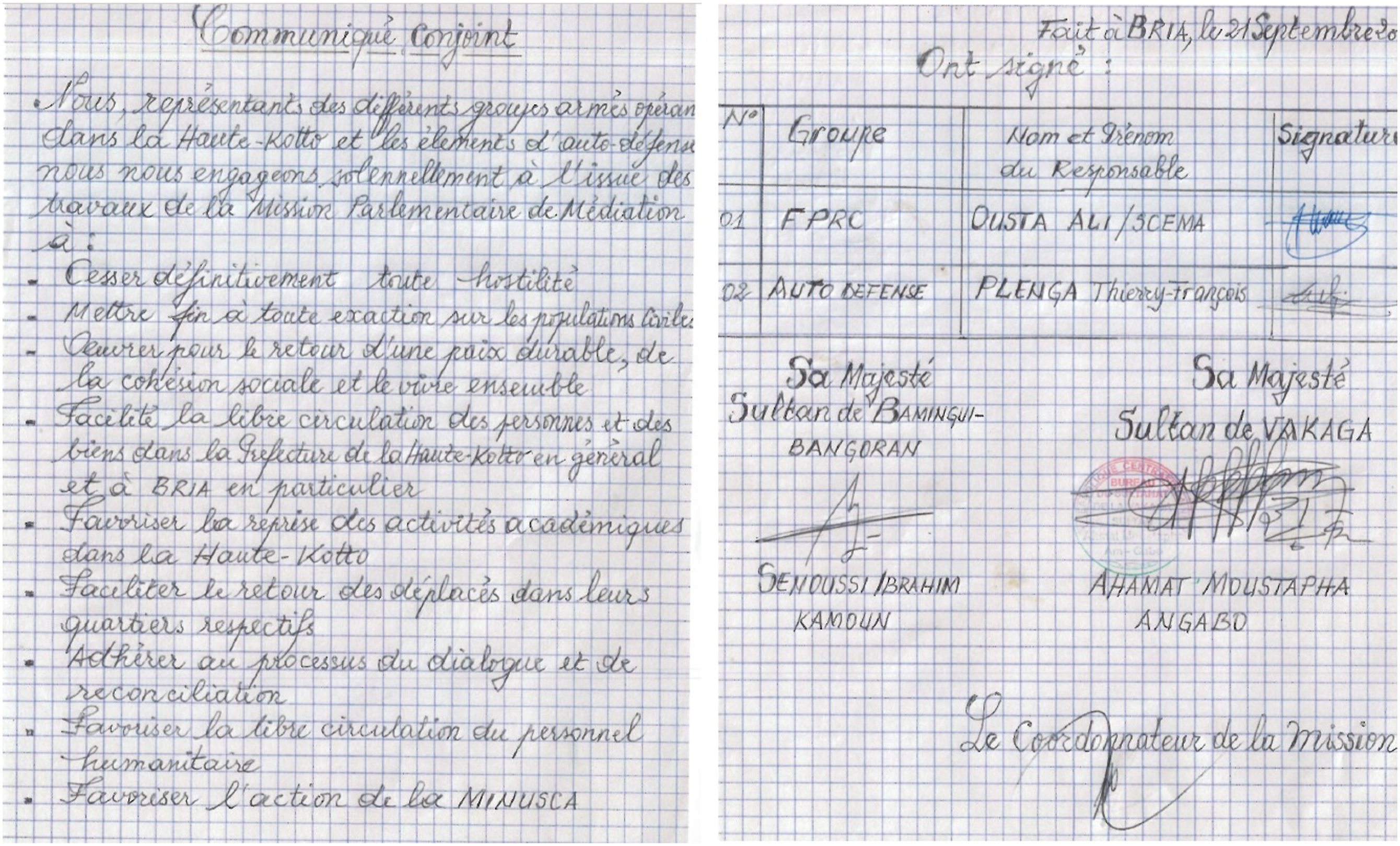
The models used in the analysis include several variables to control for the impact of contextual factors that may influence the number of peacekeeping troops deployed, the occurrence of peacekeeping mediation, and the conclusion of ceasefires. First of all, I draw on the UCDP Georeferenced Event Dataset (GED) to measure the number fatalities in a given month (Sundberg and Melander 2013). Whenever a violent event in a given non-state conflict extends over more than one calendar month, I assume that an equal proportion of fatalities occurred between the start and end dates listed in the UCDP GED. I then take the sum of the fatalities of all days of a given calendar month.
Since non-state conflicts do not take place in a vacuum, I try to account for intra-state conflict dynamics that could influence non-state conflicts. Case study research demonstrates that non-state conflict sometimes precedes a wider civil war, sometimes even contributing to it. Other times, non-state conflicts are caused or extracted by a civil war (Bradbury et al. 2006, 4; Krause 2019). Most case studies suggest that peace processes in non-state conflicts are more challenging when they take place in the context of national civil war” (Brosché and Duursma 2018; Boswell 2019, 10; Elfversson, 2019; Krause 2019). I therefore draw on the UCDP to control for whether an intrastate armed conflict is ongoing in the country and the calendar year of the active non-state conflict month (Pettersson et al. 2019). In order to measure the impact of intra-state conflicts more directly, the models also include a variable that measures the total number of intra-state fatalities in a country in a given month (Sundberg and Melander 2013).
Furthermore, I draw on the UCDP to include a variable that indicates whether one or both of the conflict parties are formally organized groups, which almost always is a rebel group that is fighting or has fought against government forces. Including this variable is important because peacekeeping staff might be more or less likely to be involved in mediation processes aimed at resolving non-state conflicts involving a rebel party, as opposed to communal conflicts. These different type of non-state conflicts might also be more less likely to lead to a ceasefire. In addition, drawing on the UCDP, I code whether a non-state conflict involves more than two groups. Mediators might be more hesitant to become involved in conflicts with multiple parties and ceasefires might less likely to be concluded in these type of conflicts. I also draw on the UCDP to include a variable that measures the number of months since the start of the conflict (Pettersson et al. 2019). The duration of a non-state conflict may influence the number of peacekeeping troops and the occurrence of mediation, but also could influence whether a ceasefire is concluded. Table A1 in the online appendix provides a summary of the variables used in the analysis.
In order to control for temporal dependence of peace negotiations, a variable is included that indicates the number of months since the last round of negotiations took place a given non-state conflict (Beck et al. 1998). A previous round of negotiations could make subsequent peacemaking more likely, but it could also make the conclusion of a ceasefire more likely. The cubic polynomial terms of the time since the last mediation effort are also included (Carter and Signorino 2010).
Finally, logit models are used because the conclusion of a ceasefire is a binary variable. The analysis thus focuses on the likelihood that a ceasefire is concluded. I cluster the robust standard errors on the conflict level in order to account for observations within a given conflict being related. For instance, the number of peacekeeping troops within a given non-state conflict often vary little.
Analysis
The dataset used for the analysis includes 16,418 non-state conflict months. These non-state conflict months can be split into 15,373 conflict months in which no peace effort took place and 1045 conflict months in which a peace effort took place. The subset of conflict months in which a peace effort took place can be further split into 211 conflict months in which peacekeeping mediation took place, 665 conflict months in which mediation took place without peacekeeping staff involved, and 169 conflict months in which only bilateral negotiations took place without the involvement of a mediator.
In total, 461 ceasefires were concluded in the non-state conflict months included in the dataset. A ceasefire was concluded in 142 out of the 211 conflict months in which peacekeeping mediation occurred (67.3%). This is 251 ceasefires out of the 665 conflict months for non-peacekeeping mediation (37.7%), and 73 ceasefires out of 169 conflict months for bilateral negotiations (43.2%). These descriptive statistics on the conclusion of ceasefires in conflict years provide some initial evidence on the effectiveness of peacekeeping mediation.
Logit Estimates on the Likelihood of Ceasefires in Non-State Conflicts in Africa, 1989-2019.
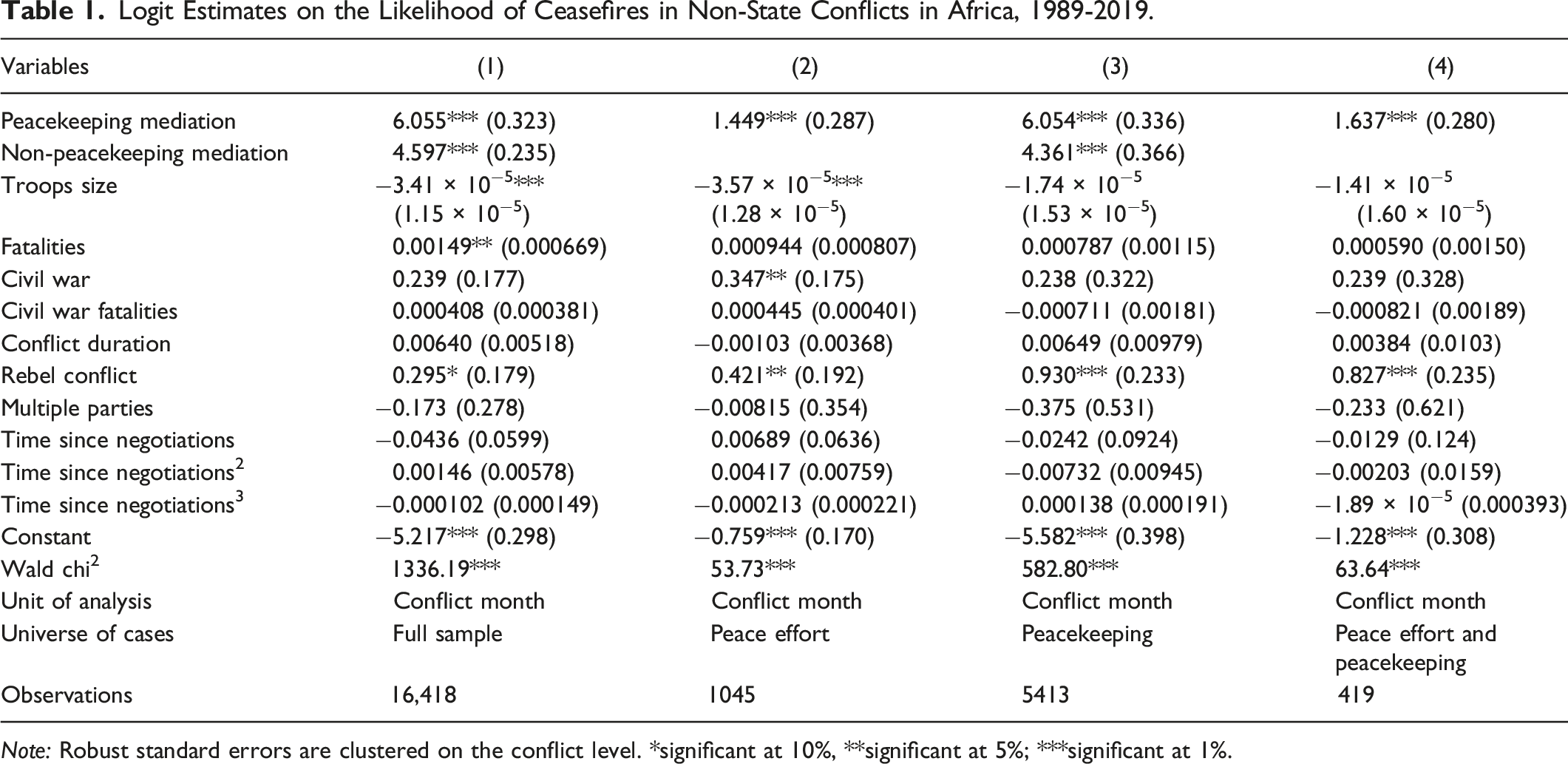
Note: Robust standard errors are clustered on the conflict level. *significant at 10%, **significant at 5%; ***significant at 1%.
However, one limitation of Model 1 is that the reference category groups conflict months in which no peace effort takes place together with conflict months in which bilateral negotiations takes place. Including a variable that captures bilateral negotiations in Model 1 is not possible because together with non-peacekeeping mediation and mediation, these variables would perfectly predict the conclusion of a ceasefire. Ceasefires have simply not been concluded without a peace effort taking place first. Model 2 therefore looks at the impact of peacekeeping mediation while solely looking at conflict months in which a peace effort takes place, taking conflict months in which either mediation without the involvement of peacekeeping staff or bilateral negotiations take place as the reference category. The probability of a ceasefire is 37.2% when non-peacekeeping mediation or bilateral negotiations take place, but this increases to 71.5% when peacekeeping mediation takes place. This effect is significant at the 1% level. It thus follows from Model 1 and 2 that the involvement of peacekeeping staff in peace efforts increases the likelihood that a ceasefire is concluded.
Contrary to the capabilities-based logic, the size of peacekeeping troops deployed has a negative and significant effect on the likelihood that a ceasefire is concluded in both Model 1 and Model 2. In order to examine whether this is due to the effect of peacekeeping troops or whether it perhaps is related to the nature of non-state conflicts in countries where a peacekeeping mission is deployed, Model 3 only considers non-state conflicts in locations where peacekeeping missions are deployed, while Model 4 only looks at round of negotiations in non-state conflicts where peacekeepers are deployed. Models 3 and 4 thus essentially replicate Models 1 and 2, but for a sub-sample of non-state conflicts in locations where a peacekeeping mission is deployed. The results are fairly similar with regard to peacekeeping mediation, but the significant effect of troop size goes away when restricting the sample to non-state conflicts where a peacekeeping operation is deployed. This could mean that the negative and significant effect of peacekeeping troops is due to peacekeepers being deployed in contexts that also make non-state conflicts more intractable. The next section examines this further.
Accounting for Endogeneity
One obvious challenge to estimating the added benefit of peacekeeping on the conclusion of ceasefires in non-state conflicts is that both the deployment of high number of peacekeepers and the involvement of peacekeeping staff in mediation processes are not random. In fact, they are likely to be driven by the very same processes that may make the conclusion of a ceasefire less likely. Previous research clearly shows that peacekeepers are deployed in intractable conflicts (Fortna 2008; Gilligan and Stedman 2003). It could be the cases that non-state conflicts in settings where high troop numbers are deployed are also less prone to being resolved. In addition to peacekeeping troops being deployed in more intractable conflict, anecdotal evidence suggest that peacekeeping mediation also often takes place in more intractable non-state conflicts. The authors of a recent report published by UN Civil Affairs note that given “the proliferation of violent local conflicts in many peacekeeping contexts, and given the inevitably limited resources of UN peacekeeping operations, peacekeepers are forced to make difficult decisions about which local conflicts to address as a priority” (O’Bryan et al. 2017, 18). Indeed, peacekeeping staff are often involved as a “mediator of last resort” in non-state conflicts “where there is nobody else to do the work and there is a major long-term risk of escalation” (Brockmeier and Rotmann 2016, 17). These more severe type of conflicts are likely to be less prone to the conclusion of ceasefires.
The previous set of models tried to minimize biases by accounting for known confounding variables. However, some confounders are unobserved––such as political will––or even unknown. I account for endogeneity as a result of unobserved or unknown confounding in two ways: first through using fixed effects models, and then through using an instrumental variable approach.
Fixed Effects Logit Estimates on the Likelihood of Ceasefires in Non-State Conflicts in Africa, 1989-2019.
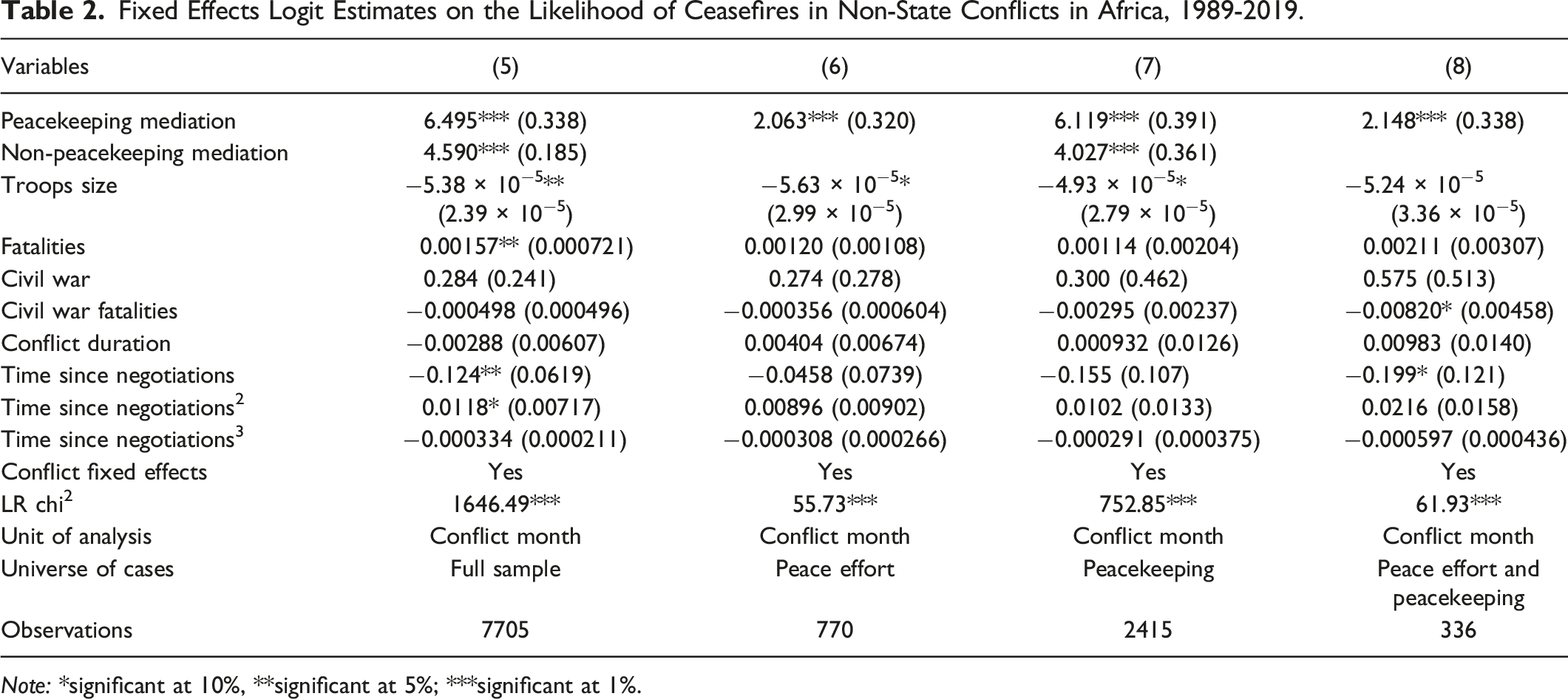
Note: *significant at 10%, **significant at 5%; ***significant at 1%.
However, one disadvantage of the fixed effects models is that they cannot account for time-varying, unobservable variables. Consequently, the second way through which I try to minimize biases is through the use of an instrumental variable approach. Following Carnegie and Mikulaschek, I use the rotation of African states as non-permanent members in the UN Security Council as an instrument for the number of peacekeeping troops deployed (Carnegie and Mikulaschek 2020). UN Security Council membership of African states can be leveraged as an exogenous variation when looking at the effects of peacekeeping troops on the conclusion of ceasefires because the predetermined rules and procedures surrounding this membership takes the shape of an “as-if random” treatment. Specifically, under a formula devised in the 1960s, three African states always hold a non-permanent seat in the UN Security Council. One of these three seats is always held by a Western African state, but of the two remaining seats, one rotates among a Central or North African state and the second seat alternates between an Eastern and Southern African state. African states in the UN Security Council hold their seat for a period of 2 years. The election of the two seats that alternate between the different regions from Africa is staggered, so that a state from a different region replaces the state from another region each year (Carnegie and Mikulaschek 2020, 815). Table A2 in the online appendix list the African states that are part of the UN Security Council and the regions they represent for each year between 1989 and 2019.
Crucially, Carnegie and Mikulaschek demonstrate that because African states that have UN Security Council membership wield more influence, they are able to send more peacekeepers to mission in their own region. This makes sense because once a peace operation is established, the UN Security Council regularly reviews the size of the mission (Carnegie and Mikulaschek 2020). The rotation of African states within the UN Security Council therefore meets the relevance criteria for an instrumental variable: the instrument has a direct effect on the possible endogenous variable (Cunningham 2021), in this case the number of peacekeeping troops deployed.
Instrumental Variable Estimates on the Likelihood of Ceasefires in Non-State Conflicts in Africa, 1989-2019.
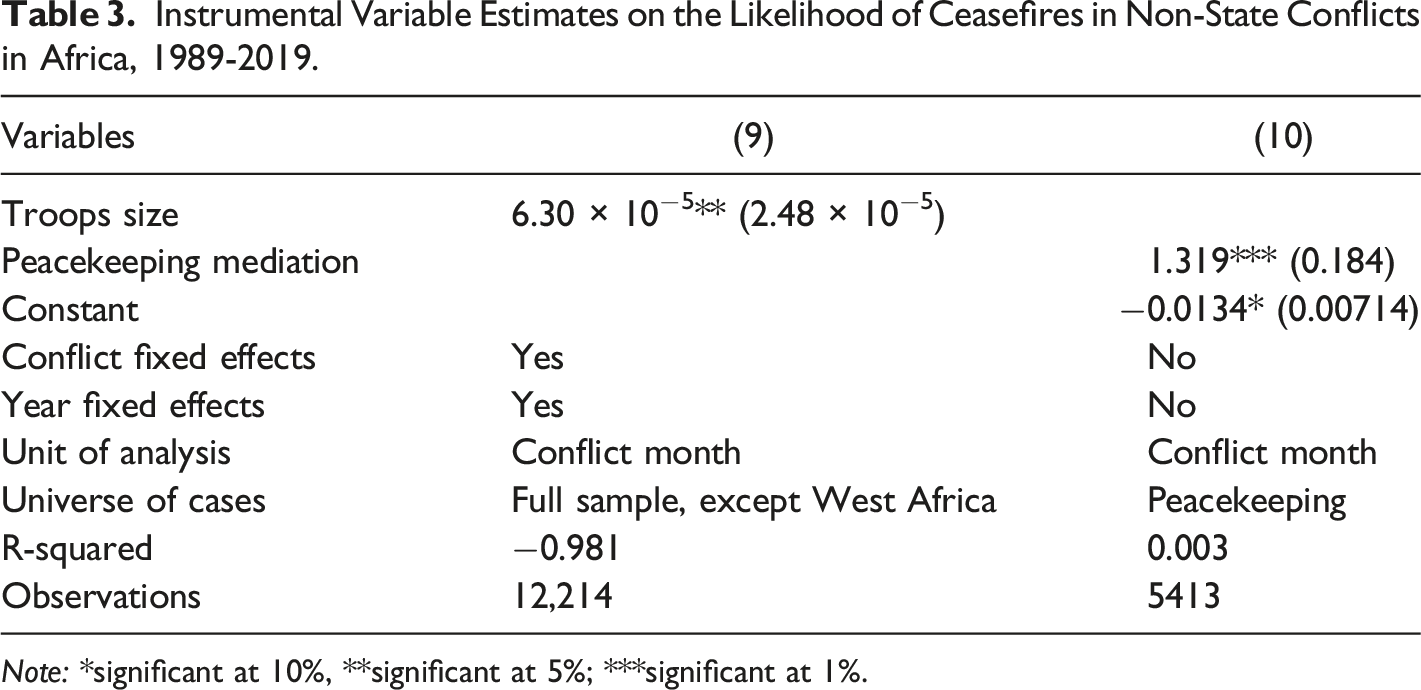
Note: *significant at 10%, **significant at 5%; ***significant at 1%.
As for peacekeeping mediation, I leverage an instrumental variable that measures the number of peacekeeping mediation efforts in non-state conflicts in a given mission area
3
over the past 12 months, excluding the number of peacekeeping mediation efforts that have taken place in the non-state conflict under observation. Since civilian peacekeeping staff need to report on their activities in the form of situation-reports and since the mission headquarters sends out country-wide updates, civilian peacekeeping staff are typically well informed of what their colleagues in other field offices across a mission area are doing (Duursma 2017, 2018). Moreover, peacekeepers generally want to fulfil their mandate (Blair et al. 2021), so if they see their colleagues undertake certain activities to achieve the mandate, it is likely they will consider undertaking these type of activities as well. As a result, the initiation of peacekeeping mediation in a non-state conflict in one part of a country can trigger the onset of peacekeeping mediation in a non-state conflict in another part of the country. For example, a peacekeeping mediation effort in the Ouaka prefecture in September 2015 (see: MINUSCA 2015), in the southern part of the Central African Republic, motivated MINUSCA staff in the Ouham prefecture, in the northern part of the country, to also initiate a mediation effort in December 2015. As a UN staff member that was part of the team that initiated this mediation reflects: “We went on a fact-finding mission to assess the situation in Batangafo [a town in Ouham]. In the evening, during the debriefing, I asked my colleagues, why do we not suggest implementing what is happening in Bambari? Because at that time, MINUSCA and armed groups operating in Bambari had just declared a weapon free zone. We will go tomorrow to talk to community leaders and to talk to the armed groups, let’s tell them that we have been instructed from Bangui to tell them to discuss turning Batangafo into a weapon free zone” (Interview with a civilian MINUSCA staff member in Bossangoa in the Central African Republic, 29 January 2020).
Accordingly, the number of peacekeeping mediation efforts in other non-state conflicts in a given mission area over the past 12 months meets the relevance criteria for an instrumental variable. Recent peacekeeping mediation efforts in other non-state conflicts should make peacekeeping mediation more likely in a given non-state conflict.
Furthermore, the fact that only recent peacekeeping mediation efforts in other non-state conflicts in a given mission area are taken into account ensures that the instrumental variable does not directly affect the likelihood that a ceasefire is concluded, except through the mechanism of peacekeeping mediation itself. Indeed, non-state conflicts are highly localized (Autesserre 2010; Gorur and Vellturo 2017; O’Bryan et al. 2017; UN Mediation Support Unit 2020), meaning that mediation efforts in other non-state conflicts should generally not affect the conclusion of ceasefires in a given non-state conflict. Model 10 in Table 3 shows the effect of peacekeeping mediation on the likelihood of the conclusion of a ceasefire through the use of the instrument. The sample on which this analysis is based is restricted to only non-states conflicts where peacekeeping operations are deployed, because peacekeeping mediation can simply only occur in those cases. An F-score of 34.4 suggest that the instrumental variable is sufficiently strongly correlated with peacekeeping mediation. The results of the first-stage are shown in Table A3 in the online appendix. The second-stage results shown in Model 10 in Table 3 suggest that peacekeeping mediation maintains its positive and significant effect in the instrumental variable analysis.
Furthermore, Table A4 in the online appendix replicates the instrumental variable models from Table 3, but also adds the control variables to both the first and the second stages of the models. This does not change the main findings that both peacekeeping troops and peacekeeping mediation make the conclusion of a ceasefire more likely.
In short, when accounting for endogeneity, I find support for both the mediation-based and the capabilities-based logics. Unlike in a naïve model that does not account for endogeneity, I find that the number of peacekeeping troops has a positive and significant effect on the conclusion of a ceasefire.
Conclusion
This article has provided the first systematic examination of the impact of peacekeeping troops and mediation by civilian peacekeeping staff on the conclusion of ceasefires in non-state conflicts. Based on a capabilities-based logic, I have argued that the deployment of a relatively high number of peacekeeping troops makes the conclusion of a ceasefire more likely because it helps to create the secure conditions under which negotiations can take place. In addition, the greater the military capacity of a peacekeeping operation, the better peacekeeping troops will be able facilitate the logistics to bring conflict parties and mediators together for negotiations. A high military capacity also makes it possible for mediators to put military pressure on the conflict parties to push them towards signing a ceasefire. Based on a mediation-based logic, I have further argued that mediation by civilian peacekeepers helps to build trust and allows the conflict parties to resolve the conflict issues. Mediation by civilian peacekeepers is also effective because they are in a good position to engage with state officials to promote peace.
I find strong support for a general, positive impact of mediation by peacekeeping staff on the likelihood that a ceasefire is concluded. This finding holds when accounting for endogeneity. I find mixed support for the capabilities-based logic. While the number of peacekeeping troops seem to have a negative effect on the conclusion of ceasefire in the naïve models, the instrumental variable analysis suggest that higher number of peacekeeping troops are significantly and positively correlated with the conclusion of ceasefires.
Accordingly, this article contributes to the growing literature on the effectiveness of peacekeeping. Some work is beginning to emerge that looks at the local impact of UN civilian staff supporting peace processes in non-state conflicts (Bara 2020; Duursma 2020b; Krause 2019; Smidt 2019), but this is the first cross-country study that evaluates the effectiveness of UN involvement in peace processes aimed at ending non-state conflicts. In addition, while several previous studies have looked at both peacekeeping and mediation in intra-state conflicts (Beardsley et al. 2018; Clayton and Dorussen 2021; DeRouen and Chowdhury 2018), this study has looked at the effect of both the number of peacekeeping troops and mediation on non-state conflicts. Finally, this article also contributes to the literature on ceasefires through focusing on the conclusion of ceasefires in non-state conflicts. The academic focus on armed conflicts involving government forces stands in contrast with how deathly non-state conflict is and how non-state conflicts can also undermine peace processes aimed at ending intrastate conflicts (Brosché and Duursma 2018; Krause 2019). Indeed, a pertinent avenue for future research is to examine how peace processes aimed at ending non-state conflicts and intrastate conflicts interact.
Supplemental Material
Supplemental Material - Peacekeeping, Mediation, and the Conclusion of Local Ceasefires in Non-State Conflicts
Supplemental Material for Peacekeeping, Mediation, and the Conclusion of Local Ceasefires in Non-State Conflicts by Allard Duursma in Journal of Conflict Resolution
Footnotes
Declaration of conflicting interests
The author(s) declared no potential conflicts of interest with respect to the research, authorship, and/or publication of this article.
Funding
The author(s) received no financial support for the research, authorship, and/or publication of this article.

Supplemental Material
Supplemental material for this article is available online.
Notes
References
Supplementary Material
Please find the following supplemental material available below.
For Open Access articles published under a Creative Commons License, all supplemental material carries the same license as the article it is associated with.
For non-Open Access articles published, all supplemental material carries a non-exclusive license, and permission requests for re-use of supplemental material or any part of supplemental material shall be sent directly to the copyright owner as specified in the copyright notice associated with the article.
