



Abstract
Child marriage is a fundamental violation of human rights. It hinders progress towards development and public health goals. In this study, we argue that armed conflict plays an important role in the occurrence of child marriages; it influences the supply of and demand for young brides. We argue that in conflict settings, families are more willing to marry off their young daughters for protection. Armed conflict can also influence the demand: marriage in general declines due to an imbalance in sex ratio. However, in cases where belligerents use war tactics specifically focused on harming girls, such as sexual violence and girl recruitment, early marriage might increase as the result of armed conflict. To empirically examine these linkages, we combine the Demographic and Health Surveys of West Africa with information on the location of armed conflict. Our study shows that armed conflict generally reduces the occurrence of child marriage with 13% to 18%. However, we observe that when conflict actors use war tactics that specifically harm young girls there is a significant increase of 12% to 18% in the probability of a girl getting married before the age of 18. This research has important implications for our understanding of the relationship between armed conflict, gender inequality, and their impact on children.
Introduction
Child marriage, also known as early marriage, is defined as a legal or customary union between two people where at least one spouse is below the age of 18 (Article 1, Convention of the Rights of the Child; OHCHR, 1989). 1 It is one of the world’s most devastating and widespread human rights abuses, disproportionally affecting young girls. Worldwide, approximately 650 million women alive today were married before their 18th birthday and 25 million entered into union before the age of 15 (United Nations Children’s Fund (UNICEF), 2014, 2018). Child marriage often compromises a girl’s development by causing early pregnancy and social isolation, interrupting her schooling, and limiting her opportunities for career and vocational advancement (UNICEF, 2020). It is then no surprise that the Sustainable Development Goals explicitly called for the elimination of child, early, and forced marriage (UN, 2015).
While the academic research on this phenomenon is growing, most of the literature on the drivers of child marriage is conducted by nongovernmental and intergovernmental organizations. They have often suggested a potential link with insecurity, that is, child marriages are rising as instability increases (e.g. World Vision, 2013; Women’s Refugee Commission, 2016). This conclusion is often based on the limited observations of field practitioners and anecdotal findings. The lack of systematic and comparative research on the relationship between armed conflict and child marriage has left practitioners, policymakers, and scholars with more questions than answers (Jain & Kurz, 2007; Neal, Stone & Ingham, 2016; Mazurana, Marshak & Spears, 2019).
In this study, we explore the relationship between armed conflict and child marriage in a systematic fashion. We argue that– besides exacerbating other causes of early marriage – armed conflict directly influences the occurrence of this custom by influencing the supply of and demand for young brides. More specifically, we argue that armed conflict exacerbates child marriage if belligerents use war tactics that threaten the safety of young girls, such as sexual violence and girl recruitment. During conflicts in which these tactics are less prevalent, the occurrence of child marriage is likely to decrease. We examine these arguments with empirical data from West Africa, a region in which marriage as an institution is important in comparison to other world’s regions (Schindler & Verpoorten, 2013).
This study contributes to three different – albeit intertwined – strands of academic literature. First, it contributes to those studies examining the deleterious effects of armed conflict on individual well-being. Studies examining these human security issues have increasingly documented these negative effects, particularly for women (e.g. Lai & Thyne, 2007; Østby, Leiby & Nordås, 2019). Second, this study adds to a rapidly growing literature that examines demographic responses of households and individuals to armed conflict (e.g. Jayaraman, Gebreselassie & Chandrasekhar, 2009; Shemyakina, 2013). In this context, marriage is especially important, since it is the demographic behavior over which people have the most control. It can, therefore, be manipulated to secure various ends, some of which may be conflict-related (Randall, 2005). Third, our study is related to those examining the economics of marriage (e.g. Grossbard-Schechtman, 1993; Abramitzky, Delavande & Vasconcelos, 2011; Shemyakina, 2013). It contributes to this scholarship by analyzing an often-neglected aspect of the marriage market: the supply of and demand for young brides.
We proceed as follows: first, we summarize the existing research on child marriage. Second, we present our theoretical argument about the direct association between armed conflict and child marriage. In the research design section, we outline our quantitative approach, in which we combine the Demographic Health Surveys (DHS) held in nine West African countries with the Uppsala Conflict Data Program Geographical Event Data (UCDEP GED version 19.1; Sundberg & Melander, 2013), the Girl-Child Soldier Dataset (G-CSDS; Haer & Böhmelt, 2018), and the Geocoded Sexual Violence in Armed Conflict Dataset (GEO-SVAC; Bahgat, Nordås & Østby, 2016). Following Corno, Hildebrandt & Voena (2020), we estimate a discrete approximation of a duration model, based on a linear probability model. The results of our analysis are largely supportive of our central argument: conditional on armed conflict, girl recruitment or sexual violence increases child marriage. We conclude with a brief discussion of policy implications and directions for future research.
Child marriages: Trends, causes, and consequences
Most of the research on child marriage has been conducted by the international policy community (Lemmon, 2014). Together with the few existing academic studies on this phenomenon, this research generally falls in one of three strands: those that examine the trends of child marriage, those that look at the consequences of child marriage, and the very few that report on its causes.
First, some academic studies on child marriage examine the trends over time and space (e.g. Harwood-Lejeune, 2000). These studies are primarily conducted by demographers who are interested in the age at first union because of its close temporal link with fertility (Mensch, Singh & Casterline, 2005). For instance, Koski, Clark & Nandi (2017) show that although marriage before the age of 18 has become less common in sub-Saharan African countries, more than one-third of the girls continue to marry before reaching adulthood.
The second strand of studies has been conducted by scholars working in the field of economic development. They have primarily looked at the consequences of child marriage. They have, for instance, examined the relationship between child marriage and poor health outcomes for the young bride and her children (e.g. Raj et al., 2009). Others have investigated the socio-economic consequences of child marriage and have shown that these marriages have negative consequences for educational attainment and economic empowerment (Delprato, Akyeampong & Dunne, 2017).
Lastly, some – mostly qualitative – studies and reports have investigated the roots of child marriage (Neal, Stone & Ingham, 2016). In addition to emphasizing a girl’s lack of agency in the marriage decision, 2 these studies have largely discussed the role of poverty, lack of educational opportunities, tradition, and instability. First, child marriage is much more common in poorer countries, and within those countries, it tends to be concentrated among the poorest regions and households (Plan International, 2015). Child marriage can reduce the demand for household resources (at least in the short run) as the financial burden of raising the child is passed on to another family (Delprato et al., 2015). Moreover, in many countries around the world, there is a persistent tradition of marriage payments (Jain & Kurz, 2007). Throughout sub-Saharan Africa, it is customary for the groom or his family to pay a bride price to the bride’s family, whereas in many Asian countries, the prevailing tradition is for the bride’s family to pay a dowry to the groom and his family at the time of marriage. When income is low, families might be incentivized to bring forward their daughter’s marriage (in case of bride prices) or delay (in case of dowry) (Corno, Hildebrandt & Voena, 2020). 3 An additional implication of household poverty is that child marriages are associated with limited educational opportunities. When schools are inaccessible or too expensive, some parents might see marriage as the best option for their children. For example, Soler-Hampejsek et al. (2018) find that school attendance significantly reduces the risk of first marriage at an early age in Malawi. Others have argued that child marriage is primarily rooted in culture, religion, and tradition (Schaffnit, Urassa & Lawson, 2019). In many societies, parents are under pressure to marry off their daughters as early as possible to prevent them from becoming sexually active before marriage; a girl who does so is perceived to bring dishonor to her family and community.
The policy community, in particular, has emphasized that child marriage is caused by insecurity in the face of armed conflict (e.g. Malhorta, 2010; Girls not Brides, 2020). They often underscore that insecurity and humanitarian crises exacerbate factors that drive child marriage. For instance, armed conflict disrupts legal and administrative structures that normally monitor marriage and prevent the occurrence of child marriage (Mazurana, Marshak & Spears, 2019). Others have emphasized the fact that conflict often negatively influences a household’s economic situation, thereby creating an environment conducive to child marriage (e.g. Schlecht, 2016). Despite these insights, many scholars and policymakers have argued that the occurrence of child marriage in times of conflict is significantly under-studied (e.g. Jain & Kurz, 2007; Neal, Stone & Ingham, 2016; Mazurana, Marshak & Spears, 2019). Below, we theorize that besides contributing to existing causes, armed conflict has an independent effect on rates of child marriage. Moreover, we show that the association between child marriage and armed conflict is less straightforward than is assumed by many international organizations.
Armed conflict and the market of early marriage
Our starting point is the work of Becker (1973, 1974, 1981), who was one of the first to talk about the marriage market, that is, the idea that the institution of marriage is governed by an economic model of supply and demand. Exogenous shocks, such as armed conflict, 4 can influence both the ‘supply’ side – that is, why households marry off their daughters at a young age – and the ‘demand’ side – that is, why men prefer young brides (Jensen & Thornton, 2003). This is especially the case in regions such as West Africa, where the institution of marriage is very important since it is related to status (Adekunle, 2007; Schindler & Verpoorten, 2013). While it is difficult to separate these supply and demand arguments empirically, it is helpful to differentiate between them in a theoretical framework.
Supply of young brides
Armed conflict can significantly influence the supply of young girls for child marriage. Families living in conflict-affected areas often see early marriage as a ‘protective strategy’: parents often believe that especially young girls are physically safer in a married relationship (Williams et al., 2012; Women’s Refugee Commission, 2016). For instance, early marriage is often used to reduce the risk of the girls being recruited by armed groups (e.g. Delprato et al., 2015; Hutchinson et al., 2016; Neal, Stone & Ingham, 2016). In Sri Lanka, for example, where the incidence of early marriage was relatively low, girls were married off on a large scale during the conflict because parents believed that the Liberation Tigers of Tamil Eelam would not recruit married girls (World Vision, 213; Lemmon, 2014; Girls not Brides, 2020). Similar considerations have been documented among Nepalese and Palestinian families (Khawaja, 2000; Williams et al., 2012).
Other studies support the notion that early marriage serves as a form of sexual security in times of conflict, that is, a way for families to protect the ‘honor’ of their daughters (Hutchinson et al., 2016). Marriage might protect young girls from sexual slavery, rape, sexual assault, and sexual torture. For example, an analysis of medical records at Panzi Hospital in the Eastern Democratic Republic of the Congo found that among women who were receiving care for sexual violence, those who had never been married were six times as likely to have experienced sexual slavery as those who were married, abandoned, or widowed (Bartels et al., 2010). Moreover, in line with other studies (e.g. McKay, 1998), Bartels et al. (2010) show that it was especially young girls that were targeted.
In addition, early marriages are often used to construct or consolidate family and other alliances (Human Rights Watch, 2012; WLUML, 2013). This function of early marriage is especially important in times of conflict. Securing and reinforcing bonds not only between families but also between families and armed groups reduces the likelihood of households and families becoming further exposed to violence (Donelly, 2019; Corno, Hildebrandt & Voena, 2020). For instance, Randall (2005) shows that the number of child marriages increased during the 1990 rebellion in Mali. During this rebellion, child marriage was used as a strategy to generate alliances and networks within and between Tuareg groups. Likewise, UNICEF (2001) reports that in conflict-torn Northern Uganda, some families married off their young daughters to militia members to secure ‘protection’ for their household.
Demand for young brides
Unlike the above-described positive association between armed conflict and the supply of young brides, there are good reasons to believe that armed conflict significantly decreases the demand for marriage. Men are the first that are drafted or forced to join armed groups and they often die or ‘disappear’ during armed conflict. For instance, according to reports by the Truth and Reconciliation Commission, males accounted for 74% of reported fatalities in Sierra Leone, 87% of reported fatalities in East Timor, and 84% of reported killings and disappearances in Guatemala (Buvinic et al., 2012). This relatively high excess mortality as a direct effect of armed conflict results in a significantly low sex ratio: a shortage of men and a surplus of women that are available to marry (e.g. Burnham et al., 2006; Bethmann & Kvasnicka, 2014). 5 This so-called ‘female marriage squeeze’ has important implications for the general functioning of the marriage market.
When sex ratios are low (i.e. men are scarce), men are likely to negotiate more favorable relationship outcomes because of their bargaining advantage (Fossett & Kiecolt, 1990). In such circumstances, men are predicted to assign less value to family life, are less likely to commit to a single partner, and will avoid or delay marriage (e.g. Fossett & Kiecolt, 1990; Lloyd & South, 1996; Kesternich et al., 2020). Empirically, Abramitzky, Delavande & Vasconcelos (2011), for instance, show that male scarcity induced by World War II profoundly affected women’s lives: they were less likely to marry. Also, Shemyakina (2013) shows that during the Tajik Civil War, women from conflict regions were less likely to enter marriage than those from less-affected regions. Jayaraman, Gebreselassie & Chandrasekhar (2009) observe a similar pattern when examining the demographic effects of the Rwandan genocide. 6
Although armed conflict is expected to significantly decrease the occurrence of marriage in general, there are reasons to believe that this effect is not as substantial for early marriage. First, a surplus of women means that men can raise the ‘reservation quality’, that is, set higher standards for acceptable partners (e.g. Mortensen, 1988). Research has shown that men are more likely to emphasize youth in evaluating potential long-term partners, presumably due to the high residual reproductive value of young females (e.g. Lichter et al., 1992; Boserup, 1970). Younger brides are more valued because they potentially bear more children during their lifetime, which is an important motivation especially in subsistence agricultural societies and in regions where infant mortality or rates of miscarriage are high (e.g. Boserup, 1970; Buss, Shackelford & LeBlanc, 2000). Isiugo-Abanihe (2004), for instance, shows that Nigerian men place a high premium on having children. Children confer a high sense of satisfaction or success, even if the man is materially poor. Moreover, they constitute an important source of old-age support (Cain, 1983). 7 Hence, armed conflict may well decrease marriage, but the decline in early marriage might be modest because a young bride’s value is intrinsically linked to fertility (Cain, 1983; Nugent, 1985).
Second, the decline of early marriage might also be less severe than those of older brides, due to fact that male members of armed groups might be interested in getting married during times of conflict. Some armed groups, such as Boko Haram in Nigeria and the Revolutionary United Front in Sierra Leone, have used early marriages as an intentional war strategy to induce internal and external cohesion (e.g. Marks, 2014; Cohen, 2017; Donelly, 2019). For instance, the Lord’s Resistance Army forced girls into marriages with commanders, creating ‘families’ within the group, which in turn created loyalty to and interdependence on individual commanders (Baines, 2014). At the same time, early marriages with rebels are also a strategy of controlling the civilian population. Al-Shabaab, for example, promotes early marriages not only as part of the group’s effort to impose its ideology on every aspect of civilians’ lives, but also because it is their way of connecting local families to the fate of the group (Human Rights Watch, 2012; Donelly, 2019).
To summarize our argument: due to a general lack of available grooms, we expect an overall decline in marriage because of armed conflict. However, early marriages might not decline as much as expected. Our theoretical framework suggests that the number of early marriages might even increase due to armed conflict. When belligerents use war tactics specifically focused on harming young girls, such as sexual violence, girl recruitment, or whenever early marriage is used as a war tactic to consolidate armed group’s internal and external power-base, armed conflict is likely to increase the supply of and demand for young brides. Both forces will increase the number of young brides. However, it is an empirical question if these forces will overcome the drop in the supply of men. In the remainder of the article, we empirically test the net effect of these propositions.
Research design
To examine the relationship between child marriage and armed conflict, we link individual-level data from the DHS with violent event data from the UCDP GED (version 19.1; Sundberg & Melander, 2013), data on sexual violence in conflict (GEO-SVAC 2.1; Bahgat, Nordås & Østby, 2016), and the only available data on the recruitment of girls during conflict by armed groups (G-CSDS; Haer & Böhmelt, 2018).
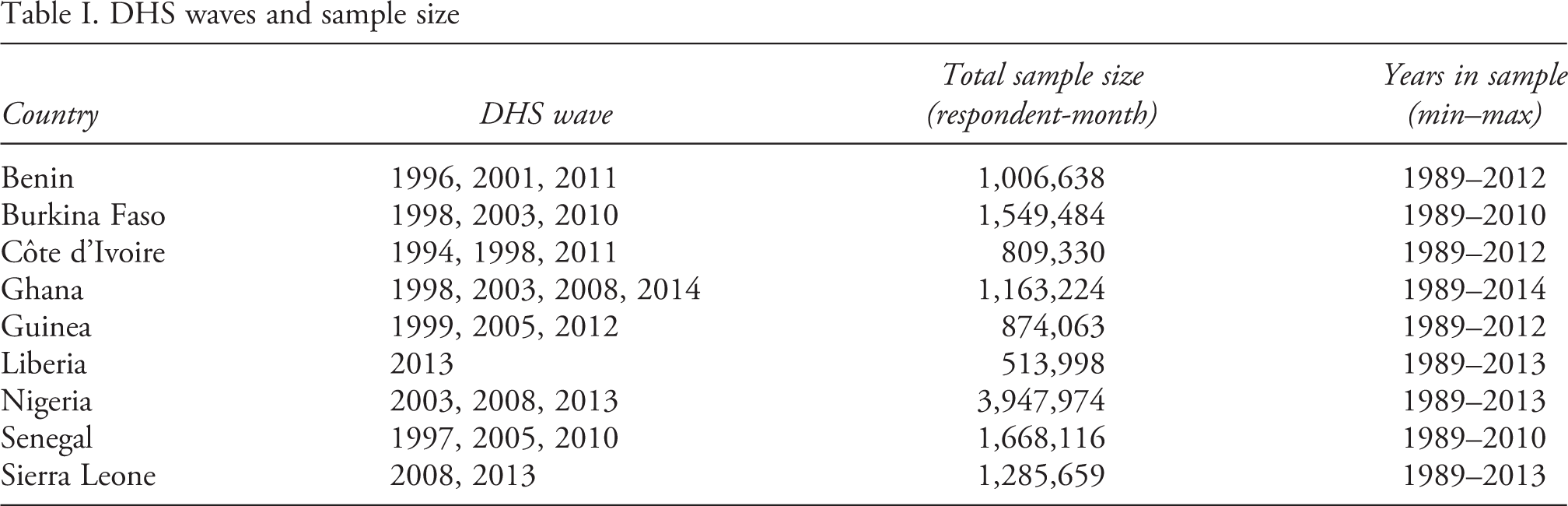
DHS are nationally representative, household-level surveys carried out in many countries at different time periods. As such, the surveys offer the cross-sectional and temporal variation necessary to examine the relationship between how wide-reaching events, like conflict, impact individual and household behavior. In each DHS survey, women aged 15 to 49 are interviewed about health, nutrition, family, and other demographic factors. Given the fact that conflict often occurs within a particular geographical area, we use only those surveys that contain survey location coordinates. For this study, we focus on those surveys conducted between 1996 and 2014 in West Africa (Benin, Burkina Faso, Côte d’Ivoire, Ghana, Guinea, Liberia, Nigeria, Senegal, and Sierra Leone). This region is especially known for its high rates of child marriages (UNICEF, 2018). In total, our fully merged dataset includes 25 surveys in 9 counties (see also Table I).
Dependent variable: Child marriage
DHS waves and sample size
To examine the risk of child marriage, we convert the DHS information on marriage into a respondent-month panel format starting from when a girl is 11 until the month and year that she reports being married or turns 18. 9 The probability of early marriage is relatively low up until age 13 or 14, which is consistent with the hypothesis that girls are often considered ready for marriage at the onset of puberty (Field & Ambrus, 2008). In our data, the median age of first marriage is low, 18.0 years, and 67% (140,836 of 211,654 female respondents) are married before the age of 18. Figure 1 shows the distribution. The left panel indicates the frequency of age at first marriage in our used DHS surveys and the right panel indicates the age of the respondents in our used DHS surveys that are unmarried.
Independent variables: Armed conflict, sexual violence, and girl recruitment
To identify if and when a woman experienced armed conflict before entering marriage, we rely on the UCDP GED (version 19.1; Sundberg & Melander, 2013). This dataset includes information on the location of armed conflict events and the number of deaths caused by each of those events. Events are included that crossed the 25-deaths threshold in any year of the UCDP annual data. We do not expect that the type of conflict event will impact child marriage differently. As such, we included all events listed in this dataset.
Our main independent variable Armed conflict takes the value of 1 (0 otherwise) if a violent event occurs in a given spatiotemporal domain. To determine this, we expand the DHS points of the interviewed women to polygons using spatial buffering at given radii (de Smith, Goodchild & Longley, 2007). We follow previous literature in the choice of main buffer zones by using a 50-kilometer buffer (e.g. Kotsadam & Østby, 2019). 10 In addition to this spatial domain, we set our temporal domain to a six-month window as this allows us to have greater confidence that conflict is preceding our observation of whether or not a marriage has occurred. 11 We include this six-month window in recognition that it may take time for families to make decisions over marriage in response to ongoing and past conflict. 12
We use two subsets of conflict events to capture the threat to young girls: sexual violence and girl recruitment into rebel groups.
13
First, we argue that families who are living in conflict areas that are characterized by high
Distribution of the ages at first marriage and age of unmarried respondents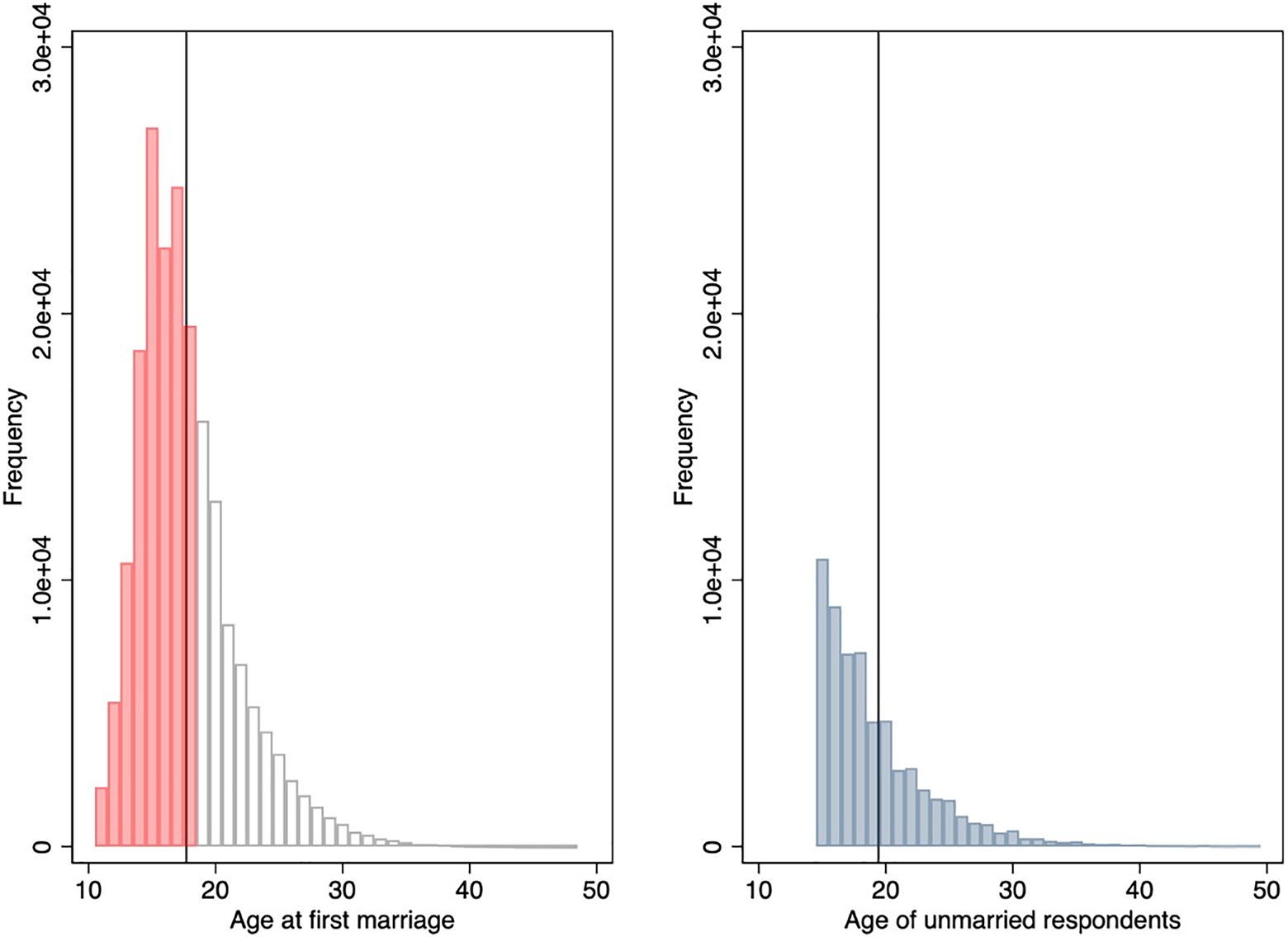
Second, we examine the role of girl recruitment on the occurrence of early marriage. Girl recruitment can not only influence the supply of girls to be married off (as a protective strategy) but it can also influence the demand side: armed groups can use girl recruitment as a cohesion strategy. To identify conflicts that pose a risk of girl recruitment, we rely on the Girl-Child Soldier Dataset (G-CSDS; Haer & Böhmelt, 2018). This dataset records information on the recruitment of girls to be used as child soldiers by rebel groups. The term child soldier refers to any person below 18 years of age who is or who has been recruited or used by an armed force or armed group in any capacity, including but not limited to children, used as fighters, cooks, porters, messengers, or spies. This dataset is currently the largest dataset available on child recruitment by armed groups. We cross-referenced these data with the UCDP GED at the conflict level (version 19.1; Sundberg & Melander, 2013). All events within a conflict in which an actor is involved that recruited girls are coded in the child recruitment category (coded as 1, or 0 otherwise). 15
To estimate the impact of proximate conflict on the probability of child marriage, we estimate a discrete approximation of a duration model adapted from Currie & Neidell (2005) and applied by scholars examining the demographic consequences of armed conflict. For instance, Corno, Hildebrandt & Voena (2020) have applied it to the marriage market and Wagner et al. (2019) have used this model to examine the mortality and orphanhood rates due to armed conflict. The model is based on a linear probability model in which the dependent variable M is the probability that a woman i living in location l in month t is married (see Equation (1)).

The variable X is the dichotomous indicator for an armed conflict occurring in our spatiotemporal domain. β measures the effect of armed conflict on the probability of marriage. We include several fixed effects. First, we include fixed effects γ it for age (in months) at the corresponding time in observation. This is not to be confused with the age at the time of the survey. This is because the probability of marriage will increase as our respondents grow older. Second, we include (δ i ) cohort fixed effects measured at each respondent’s birth year. This allows us to address changes over time in the propensity of marriage at different periods. Moreover, it controls for potential biases arising from forward displacement and selective survival (Koski & Nandi, 2016). Third, we include country-calendar month fixed effects (ψ) to address the differences in the opportunity for marriage. Marriages, like many other demographic phenomena, have seasonal patterns of variation (Rault, Régnier-Loilier & Dutreuilh, 2016). For instance, marriage likely takes place outside the harvest season. These idle times might also provide a greater opportunity for conflict. Lastly, we include DHS cluster fixed effects (ϑ l ) to address time-invariant local unobservable characteristics. These include cultural factors, like patrilocal marriage customs and bride prices, and also location-specific factors such as rurality that might have a unique impact on the probability of marriage at an early age and the likelihood of conflict (e.g. Delprato, Akyeampong & Dunne, 2017; Fjelde, 2014).
Since we are combining data across multiple countries, we use survey sampling weights, reweighted by each country’s population of women aged 18–49 in the year the survey was conducted to make the results representative of the countries included in the analysis. 16 Finally, we cluster our standard errors at the DHS survey location to account for serial correlation.
When we estimate the effect of conflict events specifically threatening to young girls, we estimate Equation (2). Here, we interact our dichotomous variable of conflict (other than sexual violence or girl recruitment) with our binary indicator of sexual violence or girl recruitment. For ease of interpretation, we present the coefficient of the effect of conflict (

Control variables
Beyond the time-invariant factors addressed with fixed effects, several other important factors might influence the relationship between armed conflict and sexual violence. However, given the retrospective nature of our analysis, we can only control for a few of them (e.g. Staveteig, 2011). To control for economic conditions, we follow Corno, Hildebrandt & Voena (2020) who have shown that income shocks measured by changes in temperature and precipitation are significantly related to child marriages. We use the University of Delaware Air Temperature & Precipitation dataset (Willmott & Matsuura, 2001) to create these binary indicators. A temperature shock is measured by a particular cell (defined by 0.5-degree latitude and longitude) having experienced a high temperature exceeding the 90th percentile observed in that cell for in a particular month since data have been recorded starting in 1950. Droughts are similarly measured; they are coded for months in which rainfall is below the 10th percentile for a given calendar month in that cell’s particular history.
The effect of armed conflict and child marriage
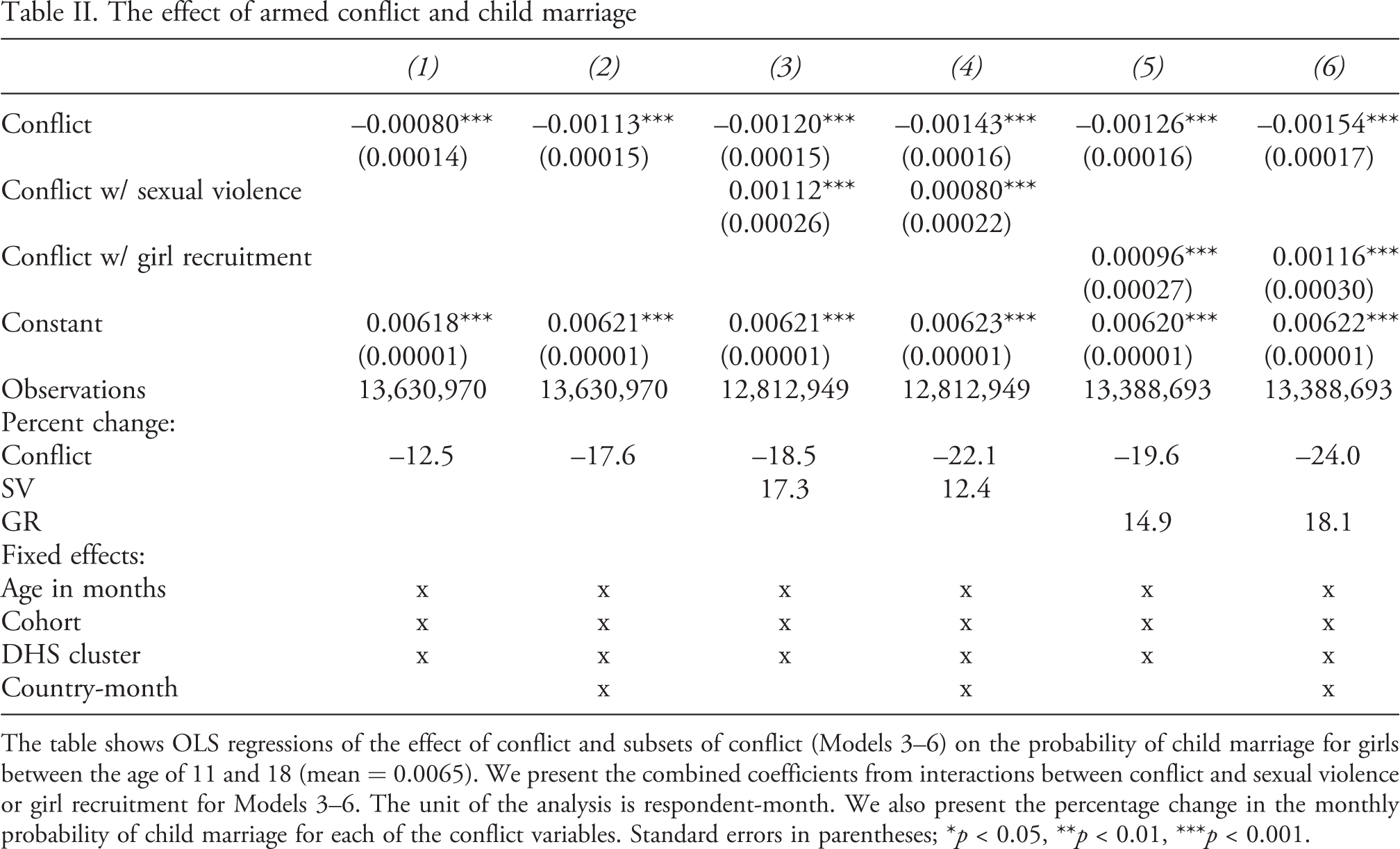
The table shows OLS regressions of the effect of conflict and subsets of conflict (Models 3–6) on the probability of child marriage for girls between the age of 11 and 18 (mean = 0.0065). We present the combined coefficients from interactions between conflict and sexual violence or girl recruitment for Models 3–6. The unit of the analysis is respondent-month. We also present the percentage change in the monthly probability of child marriage for each of the conflict variables. Standard errors in parentheses; *p < 0.05, **p < 0.01, ***p < 0.001.
There are, however, many unobservable variables for which we cannot control because we lack the necessary data. Most notable among these are the migration patterns caused by conflict. The DHS elicits information on where a woman currently resides, but not on where she resided at the time of her first marriage. This data limitation may introduce error if the respondent’s recorded place of residence is different, and sufficiently far, from her location at the time of marriage. For two reasons we believe that this does not pose a serious problem for our identification. First, Corno, Hildebrandt & Voena (2020) have shown that in sub-Saharan Africa, women remain in or close to their village of birth, and when migration does occur due to patrilocal marriage customs, it happens across relatively short distances. Mbaye & Wagner (2017), for instance, show that in Senegal, married women live on average 20 kilometers from their natal home. Second, it is highly likely that women migrate from conflict areas to non-conflict areas (e.g. Moore & Shellman, 2006). If this assumption is true, child marriages that were driven by conflict will be coded in regions in which there is no history of conflict. This would make it more difficult to find a relationship between conflict and early marriage. The descriptive statistics of all variables used in the analysis can be found in the Online appendix.
Analyses
Table II presents our main analysis. The first model examines the effect of a conflict (mean = 0.10, s.d. = 0.29) within 50 kilometers of the women’s location in the past six months on the probability of child marriage. We find that a conflict in the previous six months has a negative and statistically significant influence. However, with a large sample size, most variables will retain significance. It is therefore important to examine the substantive effect (Lin, Lucas & Shmueli, 2013). Here, we focus on the change in the probability that a girl will get married before the age of 18 year due to armed conflict. To do so, we compare the probability of early marriage when there is a proximate conflict with the mean monthly probability of early marriage in our sample (0.0065). The coefficient of conflict (–.0008) corresponds with a 12.5% decrease in the probability of marriage. 17 We address the seasonality of marriage in Model 2 by including country-month fixed effects and find that conflict decreases the probability of child marriage by 17.6%. This is consistent with our demand argument: marriage, including early marriage, declines because of armed conflict.
In the remainder of Table II, we estimate the impact of both general conflict events (those events other than sexual violence and girl recruitment) and the subsets of conflict events that include either sexual violence (mean = 0.02, s.d. = 0.15) or girl recruitment (mean = 0.04, s.d. = 0.20). These types of conflict events are likely to have a positive effect on child marriage. The findings for general conflict are consistent with those presented in Models 1 and 2; armed conflict generally decreases the likelihood of child marriage. However, we find that conflict events pertaining to sexual violence and girl recruitment exert a strong positive impact on the probability of child marriage. Models 3 and 4 show that conflict with sexual violence increases the probability of child marriage by 17.3% to 12.4% over the baseline of average marriage rates (0.0065) depending on the inclusion of country-month fixed effects. When we estimate the effect of conflict associated with girl recruitment, we find a similar relationship. Models 5 and 6 show that girl recruitment in a conflict increases the probability of marriage by 14.9% to 18.1%. This positive result is in line with our expectation that parents marry off their daughters when girls are at risk of being abducted or recruited (our supply argument). At the same time, it can also support our demand argument (i.e. combatants marry girls that they recruit). Distinguishing between these two explanations is empirically difficult. 18
As a point of reference, Corno, Hildebrandt & Voena (2020) estimate that droughts produce a 3.3% increase in the probability of early marriage. The substantive effect for our three conflict variables is large by comparison. The evidence we have presented suggests that conflict has a non-trivial and substantively interesting, if nuanced, influence on child marriage. Further, the results are consistent with qualitative evidence which suggests that families are likely to use marriage to protect vulnerable girls (Lemmon, 2014; Girls not Brides, 2020). However, this relationship is present only when the conflict is especially threatening to young women.
Further analyses
To examine the relationship between armed marriage and child marriage further, we conduct some additional analyses. First, it might be likely that armed conflict influences child marriage primarily by influencing a household’s income. While our cluster fixed effects help address time-invariant factors that impact income, there still exists the possibility that temporal variation in income drives both marriages and conflict. To address this potential issue, we follow the approach of the study conducted by Corno, Hildebrandt & Voena (2020), and use changes in temperature or precipitation as a proxy for economic shocks to a household’s income. The results can be found in the Online appendix. They remain robust: only conflicts with sexual violence or girl recruitment positively influence the occurrence of child marriage. 19
Next, we examine whether our findings are specific to child marriages or marriage in general. To do so, we expanded the sample to include respondents that were older than 18 years of age up until 29 years of age. After 29 years of age, very few first marriages take place. We then created a dichotomous variable to indicate if the respondent was over 18 years of age in each observation (coded as 1, or 0 otherwise). We estimate a model in which we interact this dichotomous variable with the interaction of our conflict variables. Table III presents the results of this three-way interaction. We find a statistically significant negative coefficient of conflict (absent either sexual violence or girl recruitment) on child marriage for both those over and under 18 years of age. This suggests that the demand argument is not child-specific: if men are scarce, the occurrence of marriage, including early marriage, declines. Conflict with sexual violence and/or girl recruitment has a positive effect on the probability of marriage for those under 18. This is in line with our theoretical setup that suggests that because sexual violence generally targets younger women and rebel groups target younger girls for recruitment, we would be less likely to observe such an effect in older age groups. Moreover, since the demand argument is not conditional on age, we would not expect heterogeneous effects. These results provide further evidence that conflicts in which girls are threatened are likely to see more child marriage.
Analysis of over 18 and under 18 years of age
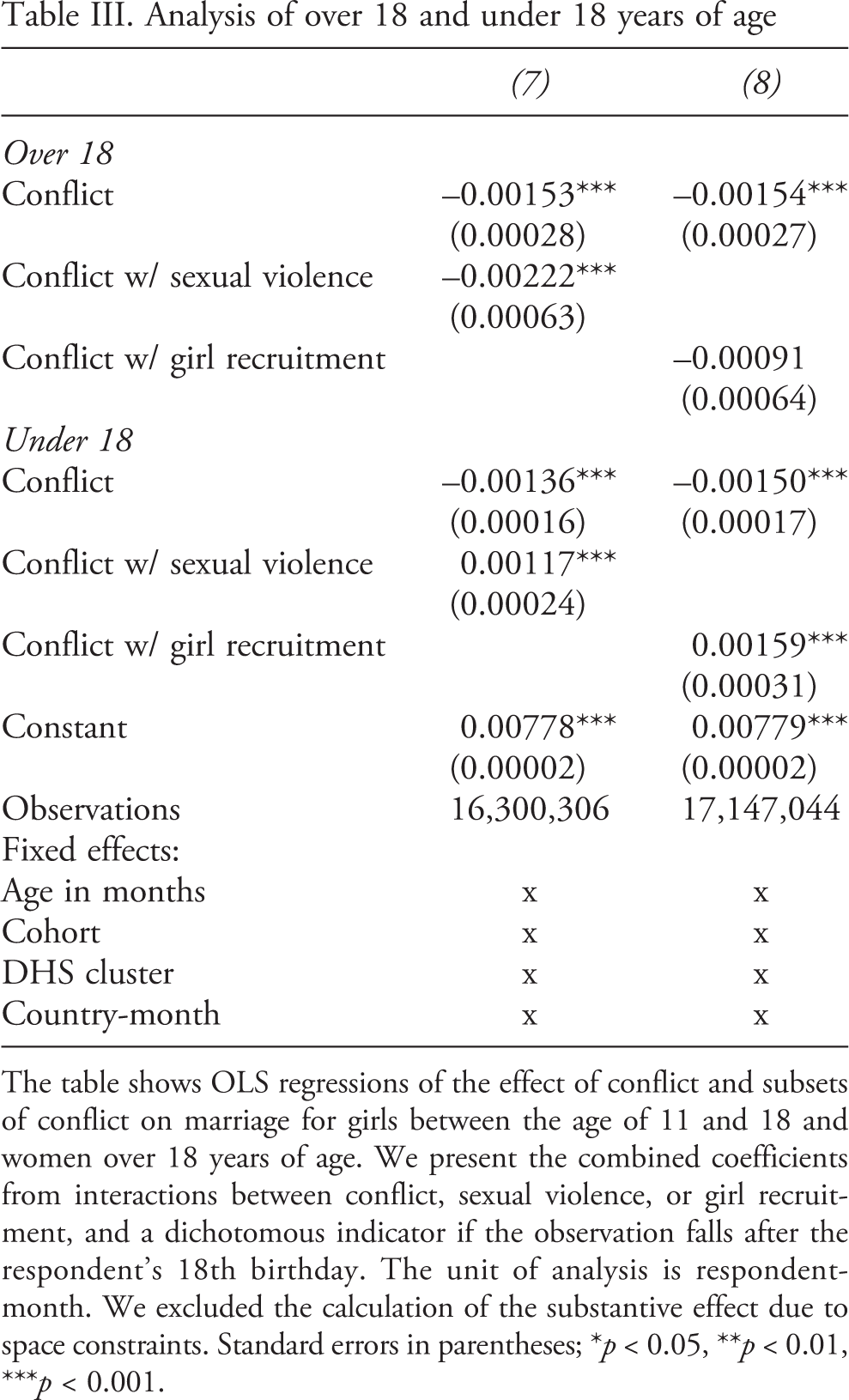
The table shows OLS regressions of the effect of conflict and subsets of conflict on marriage for girls between the age of 11 and 18 and women over 18 years of age. We present the combined coefficients from interactions between conflict, sexual violence, or girl recruitment, and a dichotomous indicator if the observation falls after the respondent’s 18th birthday. The unit of analysis is respondent-month. We excluded the calculation of the substantive effect due to space constraints. Standard errors in parentheses; *p < 0.05, **p < 0.01, ***p < 0.001.
Conclusion
Little systematic empirical research has been conducted to examine the association between armed conflict and child marriage. This general lack of attention is surprising for two reasons. First, much of the existing research examines the consequences of armed conflict for human security, that is, how armed conflict influences the well-being of people. Second, the international policy community has emphasized the positive link between insecurity and the occurrence of child marriage.
We examined the association between armed conflict and child marriage by combining several West African DHS with geo-located information on conflict and conflict tactics. Our analysis suggests a generally negative relationship: armed conflict decreases the overall occurrence of child marriage. However, we see a strong positive relationship between conflicts in which girls are threatened by sexual violence and girl recruitment and the probability of child marriage. During conflicts in which these tactics are used, early marriages are substantially increasing.
While this is, to our knowledge, the first systematic study that examines the relationship between armed conflict and early marriage, many questions remain and multiple avenues for further research exist. Because of a lack of available data, it is not possible to determine whether the observed positive effect is due to supply factors or whether it is primarily driven by demand. Moreover, it is empirically difficult to distinguish between those marriages occurring within armed groups and those outside these groups. Further quantitative and qualitative information is necessary to examine these avenues in more detail. Another potential threat to our identification strategy that we cannot rule out entirely comes from the fact that we are considering the effect of armed conflict in the respondent’s location at the time of the survey rather than at the time of first marriage. Unfortunately, the DHS elicits information on where a woman currently resides, but not on where she resided around the time of her first marriage (Corno, Hildebrandt & Voena, 2020).
Concerning policy implications, our work highlights the importance of human security: armed conflict affects young girls in a disproportional manner. By improving, for instance, family resources, the policy community can impact the supply of girls to be married off. Moreover, by developing specific programs that are focused on empowering girls, the international community can increase awareness, enhance attitudes, and counter this practice. At the same time, the international community can change the demand-side of the market of early marriage by not only raising awareness about the potentially devastating consequences of this practice but also by raising the costs of using early marriage as a war tactic. Addressing these supply and demand drivers for early marriage will not only improve the position of these girls but can also positively affect entire households.
Footnotes
Authors’ note
Names ordered alphabetically and equal authorship implied.
Replication data

Acknowledgments
This article has been presented at the AK-Methoden (Bonn, 2019) and the Amsterdam Conflict Research Network (ACRN) meeting (Amsterdam, 2020). We would especially like to thank Kerstin Frisk, Marius Mehrle, Xander Slaski, and Nils B Weidmann for all their suggestions and comments.
Funding
Matthew DiGiuseppe would like to acknowledge the support of European Research Council grant no. 852334.