




Abstract
Why do some countries host more refugees than others? Previous research has focused on the role of geographical, political, and economic determinants, and little attention has been paid to civil conflict dynamics. In this article, I examine how a host country’s support for rebel groups may affect the number of refugees that it accommodates. Countries that support rebels host a higher number of refugees than others, as accommodating refugees can be the continuation of that support and help rebel groups in their armed struggle. By hosting people, countries may offer a sanctuary from which rebels can operate some of their insurgent activities. Rebel groups can exploit these camps for recruitment, training, and benefiting from the main services such as health care. In addition, when rebels operate in host countries, these countries may monitor, impact, or even direct the strategies of insurgent groups. Analysis of refugee flows between 1968 and 2011 suggests that countries which support rebel groups host twice as many refugees as others. Results are robust to various model specifications, two different sources for the main explanatory variable, matching analysis, and additional checks. Findings of this article highlight the importance of conflict dynamics in explaining the variation in refugee flows.
Countries vary greatly in space and time in the number of refugees they host. In 2016, for example, Turkey hosted more than
The variation in refugee flows poses an empirical puzzle as the existing literature can only explain it to a certain degree. Previous studies have focused on the ‘push’ factors in the source country, the ‘pull’ factors in the host countries, and dyadic determinants such as geographical, historical, and political relations. Little attention, however, has been paid to the particular dynamics of civil conflicts. The literature has treated civil conflicts as uniform, largely ignoring their distinct aspects. Yet, understanding these varying dynamics is critical since most refugees come from countries in conflict.
Here, I argue that the particular aspects of civil conflicts – who is fighting whom and who is backing them – are a key answer to this puzzle. In this study, I show that refugee flows vary depending on the host country’s involvement in the conflict. In particular, countries that support rebels host a larger number of refugees than others. The main rationale for foreign countries to support rebels is to empower them to win the conflict, as a victory for rebels is also one for the supporting country. Accommodating refugees can be the continuation of that support and help rebel groups win the conflict. By hosting refugees, countries offer a sanctuary for rebels and their families. Refugee camps can serve as ‘refugee warrior communities’ – a base for the armed group. In these camps, rebel groups can expand their insurgent activities such as recruitment and training. Additionally, the more rebels operate in the destination, the more likely the host is to increases its influence, leverage, and power over rebel groups, and thus over the ongoing conflict.
I analyze refugee flows from countries that experienced civil conflict between 1968 and 2011. Results corroborate the main argument and are robust to various model specifications and two different sources for the main explanatory variable. Countries that support rebel groups host twice as many refugees as others. In addition, I employ matching to balance the data and to overcome model dependence. This analysis also corroborates the main argument and concludes that supporting rebels increases the number of refugees countries host on average by 2,000.
This article makes several important contributions to the civil conflict and refugee literature. By analyzing the effect of supporting rebels, it argues that conflict dynamics play a significant role in explaining the variation in refugee flows. Civil conflicts should not be treated as a binary variable, and their dynamics should be further explored. Secondly, previous studies analyze the effect of civil conflicts on forcing people to leave, but neglect to address how these conflicts may affect their destination. This article suggests that host countries’ involvement in the conflict has a significant and robust impact on the number of refugees that they host. Lastly, existing studies generally treat host countries as passive actors in refugee movements with an understanding of refugees choosing destinations with regards to countries’ proximity and political and economic situation. However, this study suggests that host countries – by being active players in the displacement process – may make the movement and influx of refugees easier or more difficult.
The findings of this study are relevant not only for academic research but also for policymaking, especially for international and nongovernmental organizations. Understanding why some countries host more refugees than others is of critical importance for emergency responses. How the international community responds to the initial displacement crisis plays a significant role in alleviating detrimental impacts and preventing the crisis from escalating. Evidence of a systematic relationship between rebel support and refugee hosting will allow the international community to better anticipate where people go, to develop faster and more effective policies, and to minimize the negative impacts of population flows for both host societies and displaced people.
Explaining where refugees go
Previous scholarship on refugee flows analyzes monadic and dyadic characteristics. For the former, studies focus on push and pull factors 1 and mainly examine variation in violence, economic development, and democracy in source and host countries, respectively. There is a near consensus regarding civil conflict and genocide being positively and significantly correlated with the number of refugees as people escape persecution (Davenport, Moore & Poe, 2003; Iqbal, 2007; Melander, Oberg & Hall, 2009; Moore & Shellman, 2004; Neumayer, 2005; Schmeidl, 1997; Turkoglu & Chadefaux, 2019; Uzonyi, 2014). People also flee from poverty, bad living conditions, and oppression, escaping to places where they will not experience such problems. Therefore, the higher the level of economic development and democracy in the source country, the lower the number of refugees. Similarly, increased economic development and democracy in the host increase the number of refugees due to better living conditions, making the host more attractive to those who flee, though support for the democracy argument is mixed (Davenport, Moore & Poe, 2003; Iqbal, 2007; Melander, Oberg & Hall, 2009; Moore & Shellman, 2007; Moorthy & Brathwaite, 2019; Neumayer, 2005). Additionally, regime transition increases the number of refugees as these countries are less stable than others (Davenport, Moore & Poe, 2003; Moore & Shellman, 2007).
For dyadic characteristics, previous research analyzes geographical, historical, and political relations between source and host countries. An increase in distance decreases the number of refugees as it is easier to travel to nearby areas (Iqbal, 2007; Moore & Shellman, 2007; Moorthy & Brathwaite, 2019). Also, an increase in the number of countries adjacent to the source decreases the number of refugees in each host country because people have more alternative destinations to which they can flee (Moore & Shellman, 2007).
The historical determinant of a shared colonial past makes refugees more familiar with the host country, making the destination more attractive. Therefore, countries with colonial ties to the source country host more refugees than others (Moore & Shellman, 2007; Moorthy & Brathwaite, 2019). As dyadic political determinants, rivalry and alliance improve our ability to explain why some countries host more refugees than others. Rival states try to achieve outcomes unfavorable to their adversaries, attempting to undermine each other. Refugees can provide an opportunity for the host to weaken its rival because they can indicate problems at home. For instance, during the Cold War, the United States facilitated the asylum application process for people from communist countries. It used the influx of refugees from communist regimes as a propaganda tool to cast those regimes in an unfavorable light (Jackson & Atkinson, 2019; Salehyan & Rosenblum, 2008). A similar argument could also be applied to alliances. Since allied countries develop a benevolent relationship, they are less likely to host refugees. However, analysis suggests that the effect of alliance is moderated by contiguity. While contiguous allies host fewer refugees, non-contiguous allies accommodate more refugees (Moorthy & Brathwaite, 2019).
The existing literature analyzes variation in the political, economic, and violent conditions in host and source countries, as well as geographical, historical, and political relations between them. Yet, most studies pay little attention to the dynamics of the civil conflict itself. However, in recent years, we see an increase in the number of articles that examine the effect of conflict characteristics. Generally, researchers scrutinize how these dynamics affect people’s decision to leave (Schon, 2019; Steele, 2011) and how they impact the security situation in the host (Bove, Gleditsch & Bohmelt, 2019; Fisk, 2019; Rüegger, 2019; Salehyan & Gleditsch, 2006). But the effect of conflict processes on accommodating people is largely neglected. In 2017, nearly 80% of refugees were from countries experiencing civil conflict. A phenomenon which causes the most refugees to leave their homes should not be treated as a uniform concept but further disaggregated. I aim to advance the literature by analyzing the variation in host country’s support for rebel groups – as one of the civil conflict dynamics – and how it affects refugee flows.
Supporting rebels and hosting refugees
Rebels may receive support from foreign countries in various forms such as troops, intelligence, logistics or material. Any type of assistance incurs costs for the supporting countries, but they are often willing to shoulder those costs when they have an interest in the ongoing conflict. Countries that support rebels may want to weaken or even topple the warring government to change regional balances in their interest. Using rebels to achieve their goals may be more favorable for foreign countries than directly going to war. This more indirect involvement in the conflict might be a less risky option, as countries do not have to deploy their own armed forces and may avoid international sanctions and blame. For example, in the 1970s, South Africa supported rebels in Mozambique and Angola to weaken the anti-apartheid states. Similarly, the USA provided military intelligence to Nicaraguan Contras to topple the Sandinista government (Salehyan, Gleditsch & Cunningham, 2011). Destabilizing rival countries is not the only reason to support rebel groups. In general, rebels strive to gain independence or to capture power. Therefore, they are candidates for governing an existing state or a new one. By helping rebels, countries also increase their influence over new potential rulers and thus, their soft power. For instance, in 2011, Turkey started supporting rebel groups in the Syrian conflict because it believed, much like in other Arab Spring countries, that the fall of the Assad regime was imminent and rebels would soon seize power. If Turkey had greater influence over a new Syrian government, Turkey would gain in its conflict with Kurdish rebels, which happens to be in a zone bordering Syria (Öniş, 2014).
Countries that support rebels want them to win because a victory for rebel groups is also a victory for the parties that support them. Accommodating refugees may help rebels in the conflict; therefore, hosting refugees can be the continuation of that support. Refugee status as an international protection system is granted to people who have a well-founded fear of persecution. Insurgent groups might exploit this asylum system and use refugee camps as military bases from which they can continue their insurgency activities such as recruitment and training (Zolberg, Shurke & Aguayo, 1989). 2 This exploitation may happen in several ways. First, rebels can use these camps for recruitment. 3 For example, in the 1970s, Khmer Rouge was in conflict with Cambodia and recruited militias in camps in Thailand. The Thai government turned a blind eye to these activities because the Khmer Rouge was not only fighting against Cambodia but also against Vietnam, which had invaded Cambodia. The presence of Vietnam on Cambodian soil presented a clear danger to Thailand and the Thai government supported the Khmer Rouge to undermine Vietnamese interests (Robinson, 2000; Stedman & Tanner, 2003).
Second, rebels may also use refugee camps as training centers. The host state may facilitate or even lead trainings, as better trained armed forces are more likely to win the conflict. 4 For instance, in the 1980s and 1990s, Pakistan supported Afghan rebel groups, particularly the Taliban, and helped them train armed men in refugee camps. Pakistan supported these insurgents because they were against a pro-Soviet government in Afghanistan and in favor of a government that they could influence and dominate (Byman et al., 2001).
Third, rebels may use refugee camps to collect their needs and supplies, and to benefit from public services such as health care. In some instances, rebels might be in a disadvantaged position or in a deadlock and need a break to strike harder. In those times, they can rest in the host country and prepare for the coming battles. Since it might be challenging to distinguish who is a combatant or non-combatant, insurgent groups can take advantage of that, by registering as refugees and enjoying the benefits available to refugees (Biryabarema, 2013). 5
Furthermore, the greater number of refugees, the more likely rebels are to operate in the host country. Thus, the host country may monitor, impact or even direct the strategies of rebel groups. For example, Turkey allowed the Syrian opposition to open an office in Istanbul (Al Jazeera, 2011) and hosted their meetings (Doherty & Bakr, 2012). Turkey let them operate on its soil and use Syrian rebels for its military operation in Northern Syria. On the other hand, Jordan did not support rebels in Syria and did not want any military activities on its soil. Thus, Jordan deported Syrian refugees who were in contact with military groups in Syria (Yahya, Kassir & el-Hariri, 2018). Similarly, the location of camps might be another strategy used by the host. Camps on the border might be more suitable for rebels to exploit, whereas camps away from the border or dispersed populations might be challenging to manipulate. Depending on their support to insurgents, host countries may open camps on the border or far away. For example, Kenya opened camps on the border for Sudanese refugees and camps mostly away from the border for Somali refugees. In Sudan, Kenya supported rebels, while in Somalia Kenya was on the side of the government. Similarly, Tanzania, which sided with the Mozambican government in the conflict with Renamo, dispersed refugees across the country and Renamo could not exploit them (Camerana, 2019).
Accommodating refugees is costly. In this regard, Jackson & Atkinson (2019) improve our understanding by arguing how rivalry plays a role in the cost–benefit analysis. By admitting people from states that are their ideological rivals, states can shame the source country and bolster their superiority. Thus, the benefits of hosting people outweigh its costs. Here, I agree with their conclusion but argue that the effect of support is larger than the rivalry and goes beyond symbolic gains. When the rebel group that is supported by the host wins the conflict, the host can affect policies in that country and increase its influence in the region. The benefits of supporting rebels are more tangible and can easily outweigh costs. 6 In addition to its benefits, accommodating refugees may cause economic and security problems for the host (Salehyan, 2008). Host countries that support rebels do not encourage people to leave their country and settle elsewhere. They are simply more willing to accept refugees than others if people have to flee the source country. 7
Here, I argue that countries that support rebel groups host a higher number of refugees than countries that do not support rebel groups. We should observe giving support to rebels increasing the number of refugees hosted. 8 For example, in the Ethiopian case above, according to the existing research, we should have seen an increase in the number of Sudanese refugees in Ethiopia. In 1989 and 2009, both conflicts took place between the Sudanese government and the same ethnic groups. During this time, dyadic characteristics (e.g. distance and ethnic relations) between Ethiopia and Sudan stayed the same. While push factors such as the level of democracy and economic development stayed stable in Sudan, pull factors improved in Ethiopia. However, what we see is a drastic decrease. The vital difference between 1989 and 2009 is that Ethiopia supported rebel groups during the former but not during the latter conflict. In 1989, Ethiopia supported the insurgency in Sudan to retaliate for Sudan’s support to Eritrean secession (Ronen, 2002). In 2009, Ethiopia did not back rebels because at that time the two countries had benevolent relations and Ethiopia was in favor of a stable Sudan rather than a conflict-driven neighbor (Mesfin, 2012).
Furthermore, countries might be selective in accommodating refugees. In other words, countries that support rebels may host refugees only from ethnic groups which fight against the government of the source country but not from other ethnic groups.
9
For example, in 2006, SLM/A, JEM, NRF, SLM/A MM rebel groups fought against the Sudanese government. All groups fought for the Massalit and Zaghawa ethnic groups (Wucherpfennig et al., 2012) and were supported by Chad (Cunningham, Gleditsch & Salehyan, 2009). In this year, the total number of refugees that originated from Sudan was 686,311, and Chad accommodated 233,025 of them. Moreover,
Here, I argue that hosting refugees can be the continuation of support for the rebels. However, not every country hosts refugees with the intention of supporting rebel groups. Most countries accommodate people with alternative motivations including humanitarian considerations and economic and political interests. For example, Germany hosts hundreds of thousands of Syrian refugees, which may not be considered as support for rebels in Syria. 11 However, Turkey hosts millions of Syrian refugees in support of rebel groups, as Turkey was already supporting rebels before it started hosting refugees and continued to facilitate rebels’ operations on its soil. Furthermore, this article does not stipulate a close relationship between refugees and rebels. Theoretical explanations that I propose are applicable regardless of the support from refugees for the insurgency and related to the exploitation of the asylum system and the vulnerability of refugees to rebel groups.
Data and operationalization
This study analyzes refugee flows from countries experiencing civil conflict between 1968 and 2011.
12
Following general practice, civil conflict is operationalized using the Armed Conflict Dataset from the Uppsala Conflict Data Program/Peace Research Institute in Oslo (UCDP/PRIO) (Gleditsch et al., 2002). The unit of observation is directed-dyad-civil conflict-year, an ordered pair of countries:
The dependent variable is the flow of refugees from
The main independent variable is Rebel support, operationalized via Non-State Actor Data (NSAD) (Cunningham, Gleditsch, & Salehyan, 2009) and UCDP External Support Data (Croicu et al., 2011). It is defined as support by the government of a foreign state to rebels, given to assist them in an ongoing conflict. 15 This support can be military (e.g. sending troops) or non-military (e.g. financial aid). For example, in the civil conflict between Malaysia and the Clandestine Communist Organization (CCO), Indonesia supported CCO with their troops. In the civil conflict between Ethiopia and the Ethiopian Democratic Union (EDU), the USA and Saudi Arabia provided economic assistance to EDU (Cunningham, Gleditsch & Salehyan, 2009). This is a binary variable indicating the presence or absence of support from the host country to rebels.
Both sources for the main explanatory variable have advantages and shortcomings. The temporal domain of NSAD is comprehensive, 1946–2011, but almost time-invariant. It shows whether rebels received support during the conflict without indicating in which particular year(s) rebel groups were supported. According to NSAD, rebels received support in 1,788 dyads between 1968 and 2011. Contrary to NSAD, UCDP External Support Data is time-variant and indicates in which particular year(s) rebel groups were supported but covers conflicts 1975–2009. Overall, in
I control for push and pull factors. Democracy, economic development, regime transition, interstate war, and genocide in the source country are commonly studied push factors that explain the variation in refugee flows. For democracy, I use Polity 2 variable (Source polity) (Marshall, Gurr & Jaggers, 2017). Economic development is operationalized through logged GDP per capita (Source GDP per capita) from Gleditsch (2002). For regime transition, following Moore & Shellman (2007), I use a dichotomy for Polity variable
For dyadic determinants of refugee flows, I first control for the logged distance between host and source countries (Distance), operationalized as minimum distance between borders. Following Moore & Shellman (2007), the number of source country neighbors is also included in the model; the higher the number of neighbors, the more alternatives there are for people to flee and the fewer to each host country (Source neighbors number). Also, neighboring countries are more likely to support rebels than others (Salehyan, 2007). Thus, the more neighbors countries have, the more likely rebels are to be supported. To define neighbor, following Weidmann, Kuse & Gleditsch (2010), I use a threshold of 500 km. For both distance and the number of neighbors, I use CShapes Data (Weidmann, Kuse & Gleditsch, 2010). Host countries that share colonial history with the source country accommodate more refugees than others (Moore & Shellman, 2007). Therefore, I add a binary variable (Colonial tie) operationalized via Issues of Correlates of War Project (Hensel, 2014). Following Moorthy & Brathwaite (2019), I control for Alliance and Rivalry, as political relations between origin and destination may affect refugee-hosting behaviors. Both are dichotomous, and while the source for the alliance 17 is the Correlates of War Project, Formal Alliances Data (Gibler, 2008), the rivalry is extracted from Thompson & Dreyer (2011). Lastly, I control for transnational ethnic relations between the host country and groups in the conflict zone since countries might be more willing to accommodate people of the same ethnicity (Ethnic relations). This variable is also binary, operationalized using the Transborder Ethnic Kin Dataset (Vogt et al., 2015).
To control for countries’ potential to generate and host refugees, I include the logged population of the source and host countries in the model (Source population and Host population), with data extracted from Gleditsch & Ward (1999). To account for temporal effects, I also include cubic polynomials of Year in conflict (Carter & Signorino, 2010). Finally, observing a high number of refugees in a host country may result from the source country having generated too many refugees. For example, in 2016, Germany hosted around 400,000 Syrian and 1,000 Egyptian refugees. In total, there were
Model and results
The model of this study is defined as:

where Refugeesijt
denotes the number of refugees from
The dependent variable – count of refugees – can only take non-negative integer values. For more than
Results are reported under two sections. First, I estimate the model above with raw data, discussing the effect of rebel support on refugee hosting. Afterward, I run matching procedures and analyze the same model with matched data. For the regression analysis, I use two sets of control variables. In the first, I only account for polity, GDP per capita, the population of host and source countries, total number of refugees, and distance between origin and destination. The second set of controls covers all variables explained above.
ZINB results are presented in Table I. Incidence rate ratios (IRRs) are reported to make interpretation easier.
19
Values higher than 1 indicate an increase and values lower than 1 imply a reduction in the percentage of the expected count given a one-unit increase in the explanatory variable. For example, an IRR of
Zero-inflated negative binomial regression of the yearly number of refugees in civil conflicts
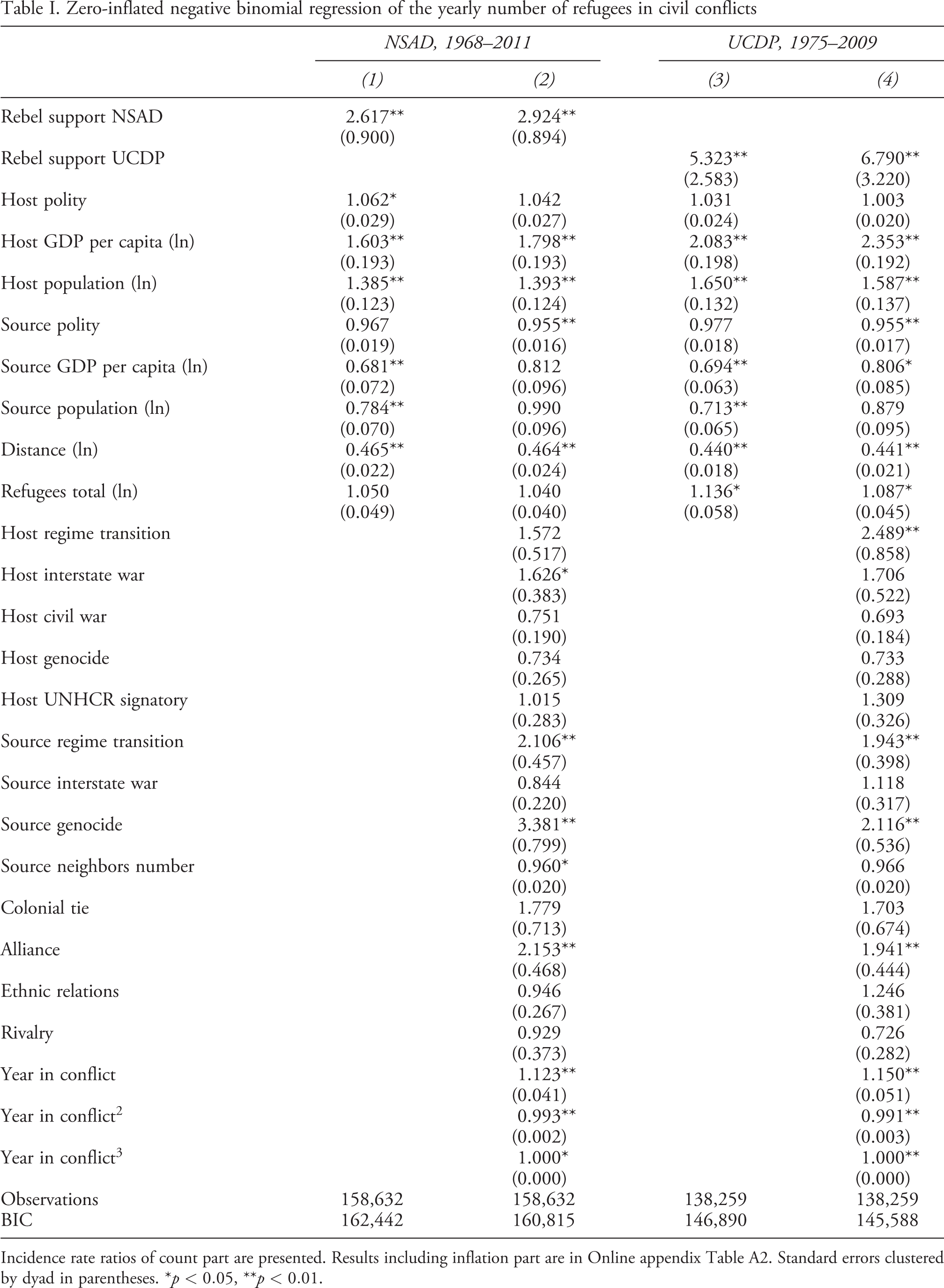
Incidence rate ratios of count part are presented. Results including inflation part are in Online appendix Table A2. Standard errors clustered by dyad in parentheses. *
The regression analysis corroborates the argument. Rebel support is positively and significantly correlated with the number of refugees that countries host, robust to different model specifications and data sources. Countries that support rebels tend to accommodate more refugees than countries that do not support insurgents. Overall, according to NSAD, supporting rebels increases the number of refugees hosted by 200%. For instance, when a country starts supporting rebels, the number of refugees it accommodates increases from 10,000 to 30,000. Results with the UCDP dataset are slightly higher and suggest supporting rebels increasing the number of refugees hosted by 500%.
Findings on the control variables corroborate previous studies. While host GDP per capita and population have a positive and significant effect, host polity score lacks explanatory power. 22 Civil conflict and genocide in the destination decreases the number of refugees hosted, as people who escape from violence do not want to get caught in violence in another country. However, these variables are not statistically significant. 23 Interstate war in the destination has a positive and significant effect according to NSAD but insignificant when UCDP is employed. 24 While regime transition and genocide in the source country increase the number of refugees, democracies generate fewer refugees than others. Increased GDP per capita at source decreases refugee flows as it signals better living conditions. Unsurprisingly, distance has a robust negative effect. Finally, increase in the number of a source country’s neighbors leads to a decrease in the number of refugees in the host.
Among historical and political dyadic determinants, only the alliance variable is statistically significant. Rivalry and colonial tie variables do not have explanatory power. Contrary to expectations, the ethnic relations variable is not statistically significant. This unforeseen result might stem from the high collinearity with distance. To further investigate, I run the Models in Table I excluding distance. Then, ethnic relations are positively and significantly correlated with refugee flows (Online appendix Table A10).
Matching
In total, there are 158,632 observations, and the data are highly imbalanced, 25 as there are many covariates from a long time span. The analysis of raw data supports the main argument. However, with this high number of observations and high level of imbalance, model dependency might raise concerns. Therefore, I also perform matching and run the analysis with matched data. As a powerful non-parametric approach for improving causal inferences, matching reduces model dependence, estimation error, and bias by discarding observations outside the region of common empirical support (Ho et al., 2007; Iacus, King & Porro, 2019).
Different matching techniques, such as propensity score matching (PSM) and coarsened exact matching (CEM), can be used in the analysis. 26 In general, matching is an effective way of reducing model dependence; PSM may, however, increase imbalance and exacerbate causal inference concerns. CEM, on the other hand, guarantees a reduction in imbalance and estimation error, is robust to measurement error, restricts data to common empirical support, and meets the congruence principle (Iacus, King & Porro, 2012; King & Nielsen, 2019). Therefore, I opt for CEM over PSM. 27
Zero-inflated negative binomial regression of the yearly number of refugees in civil conflicts, coarsened exact matched data
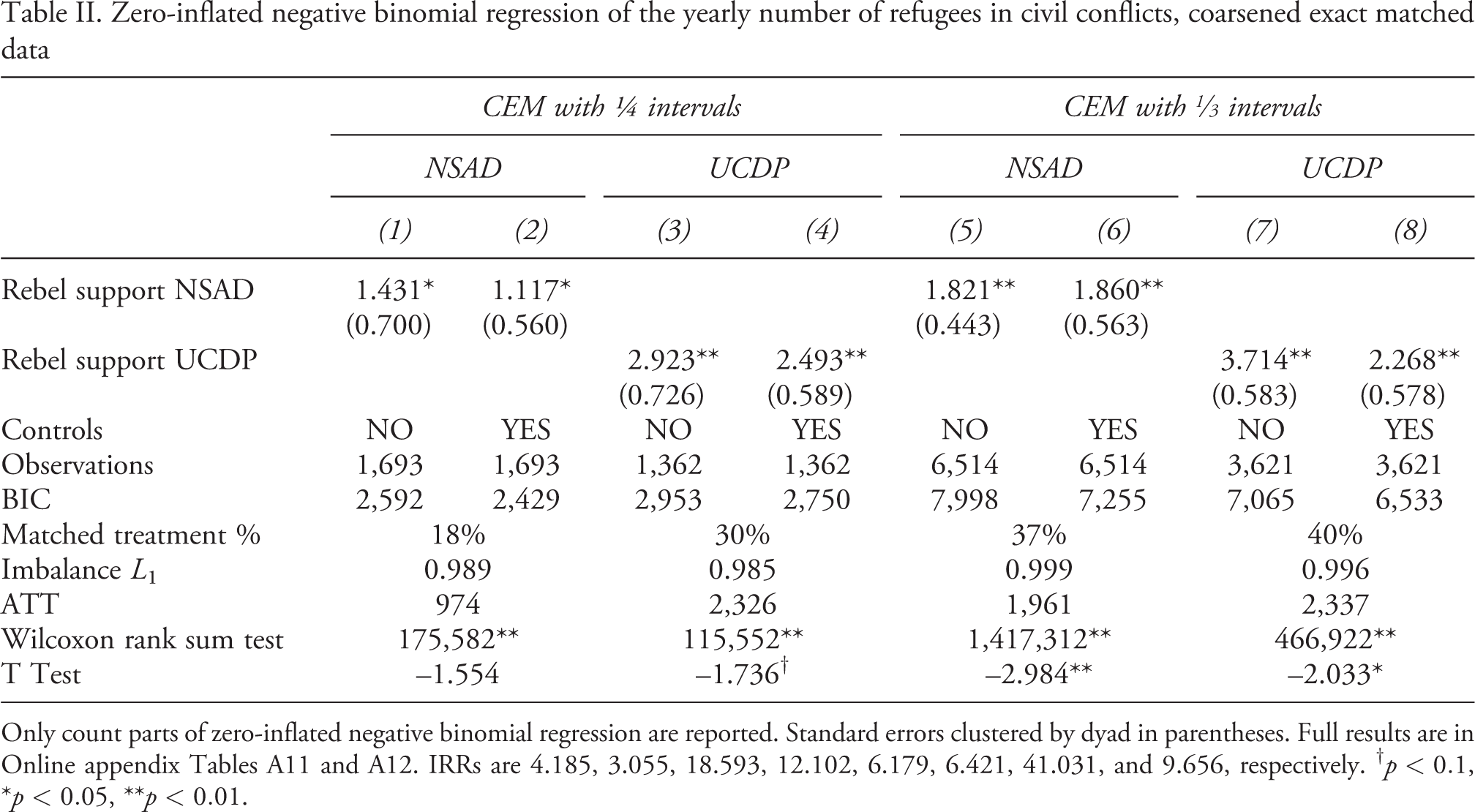
Only count parts of zero-inflated negative binomial regression are reported. Standard errors clustered by dyad in parentheses. Full results are in Online appendix Tables A11 and A12. IRRs are 4.185, 3.055, 18.593, 12.102, 6.179, 6.421, 41.031, and 9.656, respectively.
The matching results show strong statistical corroboration for the argument. The analysis indicates a positive and significant effect of rebel support on accommodating refugees across various specifications. Countries supporting rebels host a higher number of refugees than those that do not. On average, rebel support increases the number of refugees hosted by five times. I also run t-test and Wilcoxon rank sum tests (aka Mann-Whitney test) for refugees by rebel support. These tests also suggest dyads with rebel support are significantly different from dyads without rebel support. Furthermore, to facilitate substantive effect interpretation, I also plot the average treatment effect on the treated (ATT) and its
Robustness checks
In this article, the dependent variable is the flow number of refugees and alternatively, I use the stock number and results still corroborate the argument (Online appendix Table A14). Additionally, to account for network dependencies, I employ the Neumayer & Plümper (2010) directed dyad contagion spatial-effect variable (row-standardized weighted by distance). Results still support the argument (Online appendix Table A15).
Like many other political science articles, this study is not free from endogeneity concerns. Does hosting Average treatment effect on the treated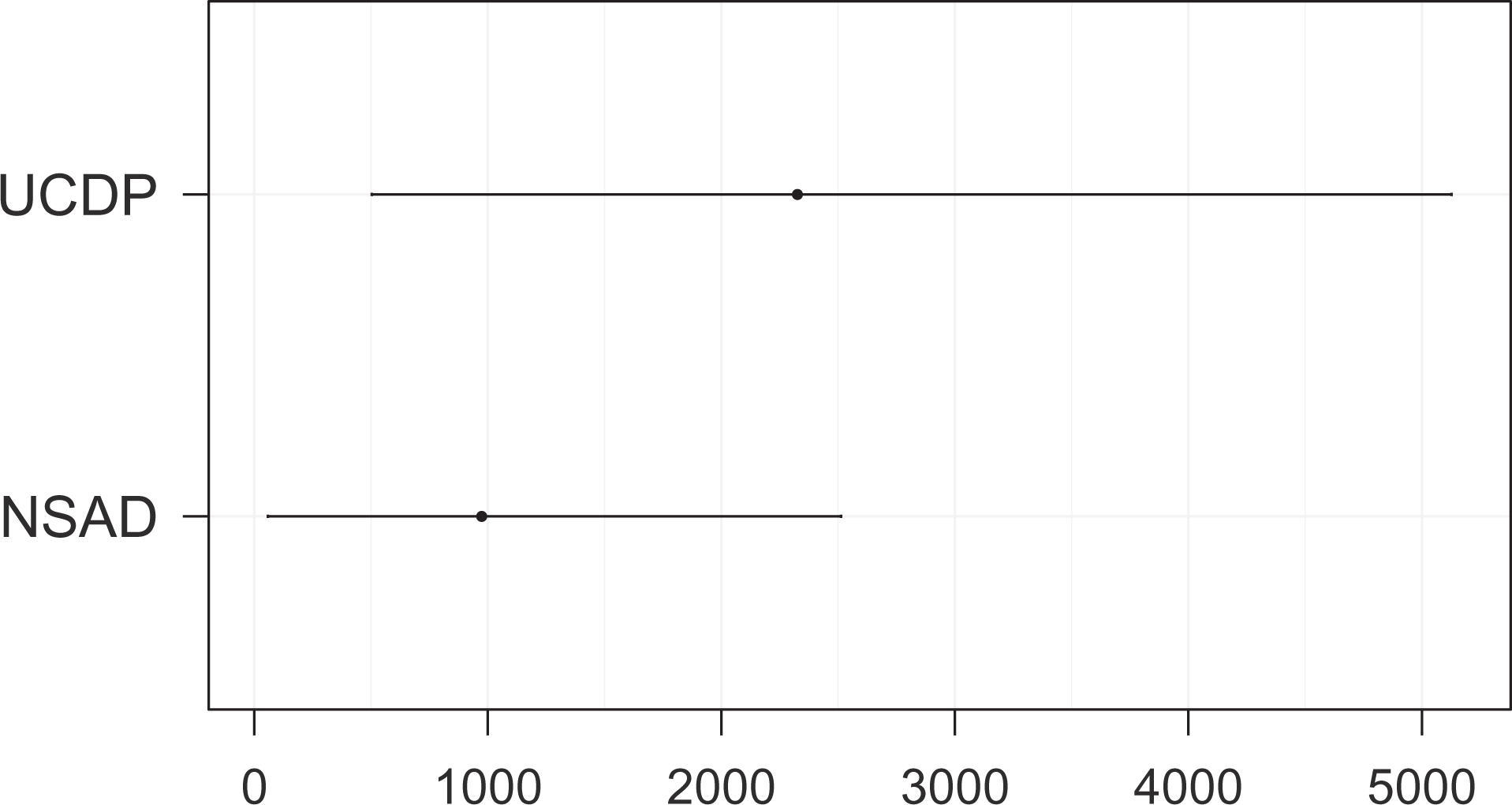
In operationalizing rebel support, I adopt a strict approach, coding only explicit cases as support. Alleged cases are coded as if there is no support in that dyad. Including alleged cases as support (Online appendix Table A18), dropping them from the analysis (Online appendix Table A19), and splitting the support into military (Online appendix Table A20) and non-military (Online appendix Table A21) do not affect my inferences. However, the effect of military support is higher than the effect of non-military.
Countries are more likely to support rebel groups when they have ethnic relations with people in the conflict zone and when rebels fight against their rival (Salehyan, Gleditsch & Cunningham, 2011). In addition to controlling for these in the regression, I also subset the data and run the analysis for when there is rivalry (Online appendix Table A22), no rivalry (Online appendix Table A23), ethnic relations (Online appendix Table A24), and no ethnic relations (Online appendix Table A25). Results still support the argument.
Furthermore, Cold War dynamics may play a role in supporting insurgent groups since ideology is an important driver of foreign policy in this period. Thus, I run the models in Table I by adding a Cold War variable (Online appendix Table A26), subsetting the dataset as Cold War era (Online appendix Table A27) and post-Cold War era (Online appendix Table A28). Across different models, the analyses constantly detect a positive and significant effect of rebel support on refugee hosting.
To account for regional dependencies and other conflict characteristics, I run the analysis by adding regional dummies (Online appendix Table A29) and by incorporating territory incompatibility, internationalization of civil conflict, and conflict severity (Online appendix Table A30). Results still corroborate the argument.
This article studies the effect of rebel support on refugee flows, and a similar logic may be applied to government support such that countries that support the government will host fewer refugees than others. However, the mechanisms that lead to government and rebel support are different (Regan, 2002; Salehyan, Gleditsch & Cunningham, 2011). Thus, their effects will also vary. Therefore, I do not expect government support to have an impact similar to rebel support. To test this argument, I run the models in Table I by replacing rebel support with government support (Online appendix Table A31). There is no statistical support for this argument.
Finally, in addition to the in-sample analysis, I also perform out-of-sample cross-validation procedures, which can be an effective indicator of the model’s success (Chadefaux, 2014, 2017b; Ward, Greenhill & Bakke, 2010). This procedure reinforces the causal claim and helps to overcome the overfitting problem (Beck, King & Zeng, 2000; Chadefaux, 2017a). Results support my argument, and including rebel support in the model furthers our understanding of why some countries host more refugees than others. 35
Conclusion
The literature on refugee flows has overlooked the specific dynamics that vary among civil conflicts. Here, I investigate the role of host countries’ support to rebels – as one of the civil conflict dynamics – in explaining the variation in the number of refugees hosted. I argue that backing rebels in the source country increases the number of refugees that countries accommodate. In other words, countries that support rebels host a higher number of refugees than countries that do not. The reasoning for this argument is that accommodating refugees can be the continuation of support for the rebels. 36 Empirical analysis of the raw data corroborates this hypothesis and supporting rebels is positively correlated with the number of refugees hosted. Countries that support rebel groups accommodate twice as many refugees as others. Various model specifications strengthen the robustness of results and suggest that incorporating rebel support into the analysis improves our ability to explain variation in refugee flows.
This article employs matching to balance data and to alleviate model dependence concerns. Through an examination of similar dyads, the matching analysis also corroborates the main hypothesis and concludes that on average, supporting rebels raises the number of refugees that countries host by 2,000. As a limitation, even though matching can account for observable covariates, it fails to control for unobservable ones, which is a general limitation in political science research and can be overcome by experimental methods.
The results of this study are also important for policymaking. When international organizations and NGOs expect high levels of displacement, they should pay additional attention to countries supporting rebels as there will be more people going to these countries than others. Therefore, they can allocate their resources more efficiently and develop better policies at earlier stages of crises, mitigating negative effects for displaced people and host societies.
There are important caveats that must be taken into consideration when interpreting these findings. The main independent variable is dichotomous, accounting only for the presence of support and not for the variation in its intensity. However, depending on the level of host countries’ backing of rebel groups, attitude towards accommodating refugees may vary. Theoretically, the more support host countries provide to insurgents in the source country, the more refugees they will accommodate. Unfortunately, due to the lack of fine-grained data, this study could not account for this variation. With more detailed information, future studies could overcome this shortcoming. Similarly, the effect of support might be moderated by ethnic power relations both in host and source countries. However, given the space limitations, this is beyond the scope of this study. Additionally, this article controls for various political and economic factors in the host country but does not include specific policies such as the open door policy that Turkey and Germany adopted for Syria because of data availability. It is an important factor to explain the variation in where refugees go, but data collection on this issue is beyond the scope of this study and needs further consideration.
This study set out to analyze why some countries host more refugees than others in line with the literature that emphasizes refugees as significant players (passive or active) in security matters in both source and host countries. This article underscores the importance of considering civil conflict dynamics when analyzing variation in refugee flows and displacement. It advocates a disaggregated approach, rather than treating civil conflicts as a unitary concept. Encouraging results from this study will show the importance of hitherto neglected conflict characteristics – incorporating them in studies on refugee flows and extending the present results – and hence of collecting additional data.
Footnotes
Replication data

Acknowledgments
I thank Eman Abboud, Constantine Boussalis, Thomas Chadefaux, Rebecca Florrison, Liam Kneafsey, David Moore, Gavin Morrison, Christian Oswald, Will Phelan, Giulia Saydon, Claire Scott, and participants of Friday Seminars at TCD for their helpful comments and suggestions.
Funding
I thank the Irish Research Council, Government of Ireland Postgraduate Scholarship Programme for financial support (Project no. 207922, Award no. 15275).