




Abstract
Moderate (or ‘limited’) rebel goals and inclusive political institutions have been suggested to increase the chances of rebel–government negotiations. This article attempts to shed light on the politics of rebel–government negotiations by presenting new, systematic data on the scope of rebel goals and demonstrating both theoretically and empirically that it is the interaction of moderate rebel goals and inclusive political institutions – rather than each variable in isolation – that helps disputants overcome bargaining problems and engage in negotiations. Particularly, the article contends that while moderate rebel goals allow the disputants to recognize that negotiations may be mutually beneficial, the presence of a dual commitment problem – where rebel groups and governments are both concerned about the opponent’s commitment to negotiated settlements – hinders them from negotiating. In such cases, the institutional features of polyarchy, defined by Dahl as competitive and inclusive elections accompanied by civil liberties, alleviate this dual commitment problem and induce moderate rebels and the government to follow through with their incentives to negotiate. Statistical results from newly collected data on rebel group goals and rebel–government negotiations support this claim: rebel–government negotiations are significantly more likely to occur when rebel groups espouse moderate goals and the level of polyarchy in a country is sufficiently high. Results indicate that the influence of rebel goals and institutions on negotiations is better understood in conjunction.
Introduction
Civil conflicts have devastating costs; research suggests that there were almost 1.2 million battle-related deaths during 1989–2016 (Allansson et al., 2017) and that civil conflicts lead to severe economic losses and infrastructure destruction. Given the staggering costs of civil conflict, studies have extensively explored how negotiated settlements, peace accords, or power sharing pacts facilitate and prolong peace (Hartzell and Hoddie, 2007; Mason et al., 1999; Stedman, 2002; Wallensteen and Svensson, 2014). Especially, negotiations that take place even before the warring parties broker negotiated settlements are arguably one of the most crucial steps to end costly disputes (Findley, 2013; Thomas et al., 2016; Walter, 2009; Zartman, 2001). Then, under what conditions are rebel groups and governments more likely to negotiate?
To answer this question, I employ insights from the bargaining approach to civil conflict to examine the likelihood of rebel–government negotiations. In doing so, I build upon the growing literature on how rebel features influence rebel–government negotiations and conflict dynamics (e.g. Basedau et al., 2022; Chu and Braithwaite, 2018; Cunningham and Sawyer, 2019; Heger and Jung, 2015; Kaplow, 2016; Nagel, 2021; Nilsson and Svensson, 2020; Ogutcu-Fu, 2016; Tokdemir et al., 2021). Yet, I provide a more comprehensive picture of rebel–government bargaining by considering the effects of rebel traits in the context of domestic political institutions. This allows me to examine how certain domestic institutional features may also shape the bargaining environment and influence the prospects of negotiations.
Specifically, I theorize that it is the interactive effect of moderate rebel goals and higher levels of polyarchy that increase the prospects for rebel–government negotiations. During civil conflict, rebel groups publicly advertise their goals via various mediums, such as manifestos, fliers, and, more recently, social media, to both garner constituent support and communicate their demands to the government. Broadly, rebel goals fall into two categories: (i) moderate goals that preserve the current territorial boundaries and the political regime; and (ii) maximalist goals that jeopardize the security interests of the government by threatening the territorial integrity or the survival of the current regime. The limited nature of moderate goals reveals a range of mutually acceptable agreements between rebel groups with moderate goals – labelled as moderate rebels for simplicity – and the government, which allows both parties to recognize ex ante that they can mutually benefit from negotiations (Fearon, 1995; Reiter, 2003). Yet, this is not enough for negotiations to occur due to a dual commitment problem where both moderate rebels and the government fear that the opponent may engage in ex post opportunistic behaviour (e.g. Fearon, 2004; Walter, 2002).
Here, I theorize that higher levels of polyarchy – characterized by competitive and inclusive elections and civil liberties (Dahl, 1971) – alleviate the dual commitment problem. This is because moderate rebel goals and polyarchy, conceptualized as the most comprehensive form of electoral democracy (Bartusevičius and Skaaning, 2018), are complementary factors. First, from the moderate rebels’ perspective, the institutional features of polyarchy allow the government to credibly tie its hands to the negotiated settlement and also co-opt moderate rebels into the political arena as legal political actors. This attenuates moderate rebels’ concern that the government may renege ex post on the negotiated deal. Moreover, since rebel groups with moderate goals may achieve their moderate goals through legal political participation in polyarchies, they also have a vested interest in preserving polyarchy. This, in turn, assures that governments in countries with higher levels of polyarchy that moderate rebels will not deviate from the negotiated settlement or jeopardize the persistence of polyarchy. As such, in countries with higher levels of polyarchy, moderate rebels and governments will follow through with their incentives to negotiate. Statistical results from a newly developed sample of 198 rebel–government dyads across 47 countries during 1980–2011 support this claim.
A key contribution of this paper is that it enhances scholars’ understanding of the politics of rebel–government negotiations by incorporating moderate rebel goals and inclusive political institutions in a unified theoretical framework, rather than considering each variable in isolation. While earlier studies have separately examined the effects of rebel goals and inclusive political institutions on rebel–government negotiations, a systematic and comprehensive analysis of their effects has been both challenging and inconclusive due to the lack of systematic data on the scope of rebel goals 1 and the inconsistent findings regarding the effect of inclusive political institutions 2 on negotiations. In turn, this study sheds light by introducing new systematic data on the scope of rebel goals and demonstrating both theoretically and empirically that it is the interactive effect of moderate rebel goals and inclusive political institutions (i.e., polyarchy) that increases the likelihood of rebel–government negotiations. Moreover, the study adds to the large body of literature on the role of elections and electoral provisions in promoting peace (e.g. Bartusevičius and Skaaning, 2018; Keels, 2018; Matanock, 2017). Specifically, results indicate that the probability of a rebel–government negotiation is significantly higher when a rebel group espouses a moderate goal and the level of polyarchy in a country is greater than approximately 0.51 in the 0-to-1 Varieties of Democracy (V-Dem) polyarchy measure. 3 This indicates that even a moderate level of polyarchy in a country is sufficient to alleviate commitment problems, which echoes the extant literature that emphasizes the importance of electoral institutions in fostering peace.
Literature review and motivation
Scholars have spilled much ink to identify the determinants of peaceful conflict resolution. Early studies focused, for instance, on how mutually hurting stalemates stemming from conflict intensity, duration, or power parities influence the likelihood of peaceful resolution of conflict (e.g. Mason et al., 1999; Zartman, 2001). Others have typically, but not always, employed insights from bargaining theory 4 to explain how peace is influenced by third-party actors (Wallensteen and Svensson, 2014), electoral and power-sharing provisions (Hartzell and Hoddie, 2007; Keels, 2018), the design of peace agreements (Mattes and Savun, 2009), sexual violence (Chu and Braithwaite, 2018), or characteristics of the polity such as the governing party’s vote-share (Ogutcu-Fu, 2016). More recently, scholars have increasingly focused on how the organizational, functional and other extrinsic features of rebel groups – such as leadership selection process, provision of social services, age, ideologies, territorial control and mobilization capacity – influence rebel–government negotiations (e.g. Cunningham and Sawyer, 2019; Heger and Jung, 2015; Kaplow, 2016; Nilsson and Svensson, 2020). 5
In contrast to the prolific research on the role of rebel features in negotiations, the effect of domestic political institutions on rebel–government negotiations has received less attention both theoretically and empirically. In fact, many studies that focus on rebel features simply include institutional features (e.g. democracy) among a litany of control variables in their statistical models and find mixed results regarding their effects. 6 This is surprising since rebel groups and governments operate in the context of domestic political institutions, which can influence the bargaining environment and ultimately their incentives to negotiate. To fully understand the conditions that facilitate rebel–government negotiations, it is crucial to identify the specific domestic institutions in which the disputants operate and also how these institutions, together with specific rebel features, affect bargaining. Doing so will provide explanatory leverage to account for the likelihood and variation in rebel–government negotiations.
In this study, I build on recent studies that highlight the effect of rebel features on negotiations (e.g. Cunningham and Sawyer, 2019; Nilsson and Svensson, 2020) but also depart from them by theoretically unpacking not merely how but also which rebel group-specific feature interacts with certain domestic institutions to facilitate rebel–government negotiations. Specifically, I draw insights from the rich literature on bargaining (e.g. Fearon, 1995, 2004; Powell, 2006; Reiter, 2003; Walter, 2009) to elaborate how the interaction of rebel groups’ publicly-declared goals (categorized as moderate and maximalist goals) and the level of polyarchy (i.e., the institutional context) matters for bargaining between the government and rebel groups, the ex ante credibility of government concessions and consequently the probability of rebel–government negotiations.
Theory
I develop my theoretical framework in two steps. First, I explain how publicly-declared rebel goals determine whether or not there exists a range of mutually acceptable agreements between rebel groups and the government and why the presence of a range of mutually acceptable agreements alone does not induce rebel–government negotiations. I then explain how the institutional context in which these combatants interact (i.e., sufficiently higher levels of polyarchy) helps them to overcome their apprehensions about the ex post opportunistic behaviour of their opponent and lead to negotiations between rebel groups with moderate goals and governments in countries with higher levels of polyarchy.
Rebel goals, bargaining, and mutually acceptable agreements
I first define and classify the term rebel goals and then explain what this implies for bargaining between rebel groups and the government. I define rebel goals in my theory as the publicly-declared changes that a rebel group wishes to make to the status quo, rather than the rebel group’s type, which can be private information in a game-theoretic approach. 7 These goals directly correspond to the scope of the rebel group’s demands in a bargaining situation. 8 During civil conflicts, rebel groups publicly advertise and openly communicate their goals through various means – such as speeches, manifestos, constitutions and social media – to not only recruit members and garner civilian support (e.g. Weinstein, 2006), but to also use them as an anchor point when bargaining with the government (Walter, 2009). Hence, governments are cognizant of the rebels’ goals and demands. Moreover, these goals (as my data presented later reveal) largely remain stable over time.
Rebel goals can be broadly classified into two main categories based on their scope (or extent). The first is moderate goals that neither violate the territorial integrity of the country in which they operate nor threaten the country’s existing political regime. Typically, moderate goals centre around political concessions, such as greater opportunity for formal political representation, electoral reforms, recognition of certain languages and cultures, a fair share of oil revenue, or political decentralization. As such, moderate rebels focus on making domestic changes within the confines of both the country’s de facto boundaries and the existing political system. Examples of moderate rebels include the All Bodo Students Union (ABSU) in India, whose constitution notes that the group’s objective is to ‘struggle to achieve the rights and privileges [for the Bodo people] given in the Indian Constitution through democratic process’ 9 and the Guerrilla Army of the Poor in Guatemala that defended the rights of the ‘poor Indian majority against the rich Ladino minority’ (De La Pedraja, 2013: 279) and whose manifesto harshly criticized the ‘regime’s treatment of indigenous people as an ethnic group’ (Garrard-Burnett, 2010: 43).
The second category is maximalist goals that violate the territorial integrity of the country in which they operate or pose an existential threat to the government and the existing political regime. Rebel groups with maximalist goals – labelled as maximalist rebels – typically aim to create an entirely new regime by either overthrowing the government or seceding from the country. For example, they may wish to overthrow the current democratic government and instead establish a communist dictatorship or gain independence to create a new country that is ethnically or religiously exclusive. Examples of maximalist rebels include the Al Ittihad Al Islamiya in Somalia and Ethiopia, whose manifesto explicitly indicated an Islamic state as its primary goal, 10 and the Balochistan Liberation Front in Pakistan, whose leader openly stated that its goal was to push Pakistan to ‘recognize Balochistan as an independent state.’ 11
The aforementioned publicly-declared moderate and maximalist rebel goals shape bargaining between rebel groups and the government in two ways. First, in a bargaining framework, rebel goals (i.e., the changes they seek) influence the rebels’ bargaining position in civil conflicts, since the goals represent the anchor point that rebel groups adopt when interacting with the government. In other words, rebel goals correspond to their demands in the context of rebel–government bargaining and dictate their bargaining relationship with the government. Second, rebel groups and the government have a common understanding of the rebel groups’ anchoring point (Fearon, 1995, 2004), as rebel goals are publicly advertised by both moderate and maximalist rebels. As such, rebel goals are public information, and the government has complete information about the goals of the rebel group with whom it is dealing. This has important implications for bargaining, which are crucial for rebel–government negotiations.
To understand these implications, first consider maximalist rebels. As emphasized above, maximalist rebels seek to overthrow the leader or the entire government, pursue an independent homeland, or even dismantle the political regime. That is, at a minimum, maximalist rebels jeopardize the security of the country in which they operate and threaten not only the incumbent but also the regime’s political survival. This suggests that the least acceptable deal sought by maximalist rebels will be greater than – and thus incompatible with – the maximum concessions that the government is willing to concede (Fearon, 1995, 2004; Reiter, 2003). Hence, there will simply be no overlap in the minimum terms to which both the maximalist rebels and the government are willing to agree. This negates the prospects for negotiations. Instead, each side in this situation may believe that they can achieve more through continued fighting (Fearon, 1995; Walter, 2002).
In contrast, moderate rebels, by definition, pursue limited aims that neither violate the territorial integrity of the country nor threaten the regime’s security. Rather, moderate rebels seek changes within the confines of both the country’s de facto boundaries and its existing political system. Hence, their demands for domestic reforms are able to be accommodated via the regime’s domestic institutions. Such goals increase the possibility that the minimal concessions that moderate rebels are willing to accept will be less than – and hence compatible with – the maximum concessions that the government is willing to concede. This implies that there will be an overlap in the minimum terms to which both the moderate rebels and the government are willing to agree. In this case, a range of mutually acceptable agreements between the disputants will appear. Consequently, moderate rebels and the government will recognize that negotiations can potentially be mutually beneficial. This is crucial because ‘disputants who wish to end their conflict in a negotiated settlement need to reach mutually acceptable settlements’ (Walter, 2009: 258).
However, even in the presence of a range of mutually acceptable agreements, both moderate rebels and the government could desist negotiations as each side may fail to credibly commit itself to implementing the terms of the negotiated settlement (Fearon, 1995; Reiter, 2003; Walter, 2002). In the next section, I explain how higher levels of polyarchy in the country alleviate this dual commitment problem.
Polyarchy, credible promises, and negotiations
As briefly mentioned above, a dual commitment problem propels the government and moderate rebels to continue fighting even though a range of mutually acceptable agreements exist between them. To further elaborate on the dual commitment problem, moderate rebels, like any other rebels, are usually required to demobilize and disarm as a part of a negotiated settlement. This compels them to return the monopoly on the use of force to state actors (Walter, 2002), which leaves the moderate rebels vulnerable to the possibility that the government may renege ex post on the negotiated deals and revert back to fighting after the rebels disarm and become militarily weak during the negotiation process (Fearon, 2004; Reiter, 2003). Accordingly, moderate rebels could anticipate that the government is using negotiations as a tactical manoeuvre to entrap them rather than negotiating in good faith to address their concerns.
On the other hand, governments are also often concerned that rebel groups are ‘far less forthcoming with the truth’ (Walter, 2009: 246) and tend to ‘make large demands’ to make their threats to incumbents credible (Thomas et al., 2016: 479). The government may hence presume that moderate rebels are not genuinely seeking peace but are using negotiations as a stalling tactic to bide their time or to bargain harder in the hope of getting a better deal, which might not be in the interests of the government. Further, as bargainers, the government and moderate rebels may possibly recognize that they ‘are in effect trying to divide a flow of benefits or ‘pies’ in a setting in which […] the bargainers cannot commit to future divisions of the benefits’ (Powell, 2006: 181), which further exacerbates the dual commitment problem.
Here, I theorize that when moderate rebels and the government interact in a polity where the level of polyarchy is sufficiently high, their concerns about the opponent’s ex post opportunism are significantly reduced. This induces the warring parties to negotiate. The theoretical rationale underlying this claim is based on two key institutional features of polyarchies identified by Dahl (1971): (i) a competitive and inclusive electoral democracy; and (ii) civil liberties that allow a greater ‘variety of preferences and interests […] to be represented in policy making’ (Dahl, 1971: 26). I argue that these two main institutional components of polyarchy substantially curtail both parties’ concerns about the credibility of the opponent’s commitment, thereby facilitating negotiations.
To see why, first consider the moderate rebels’ perspective in countries with higher levels of polyarchy. Since competitive and inclusive elections are central in countries characterized by higher levels of polyarchy, incumbents in these countries not only require domestic endorsement to survive in office but are also directly accountable to their domestic audience. Indeed, citizens in polyarchies can replace their incumbent with an alternative one through elections should they be dissatisfied with the incumbent’s policies or policy outcomes. Studies show that incumbents who are held accountable by their citizens through competitive elections are more likely to refrain from entering into and continuing costly wars, including civil conflicts, since citizens bear the material and humanitarian costs of wars (Russet, 1994; Stanton, 2013). Likewise, when failed negotiations or unilateral defection from negotiations by the government lead to a recurrence of a civil conflict, popular support for the incumbent will decrease sharply due to the costs borne by citizens. Given the domestic costs of such defections, it is unlikely that the government will use negotiations as a ploy to revert to fighting in the future. Such potential domestic costs incurred by an incumbent in a polyarchy are common knowledge among the disputants and thus alleviate the moderate rebels’ concerns about the government’s commitment to negotiated settlements.
Next, the inclusive nature of the electoral system in countries with higher levels of polyarchy is a vital political carrot for moderate rebels, as it provides them with a greater opportunity to participate in the domestic political arena as legitimate political actors (e.g. political parties) rather than remaining as actors that militarily challenge the state. Doing so ultimately increases moderate rebels’ chances of successfully obtaining their ‘limited’ goals – such as constitutional reforms or federalization – in policy-making forums as legal actors. Scholars have indeed noted that electoral reforms, electoral participation provisions and rebel-to-party provisions are among the most sought-after provisions in peace agreements as they tie the hands of the government and permit rebel groups to participate in the electoral process in the post-conflict period (e.g. Hartzell and Hoddie, 2007; Keels, 2018; Matanock, 2017). These factors altogether incentivize moderate rebels to strike deals with governments in polyarchies and preserve the regime’s inclusive institutions once deals are struck. This in turn makes it easier for the government to credibly coopt moderate rebels in the political arena, which facilitates trust between the belligerents. Ultimately, this alleviates apprehensions about the opponents’ commitment to negotiated settlements.
Furthermore, substantial civil liberties within countries with higher levels of polyarchy ensure that competitive and inclusive elections in these states are not tarnished by corruption. This sensitizes citizens to ‘remain vigilant and courageous in the face of corruption and anti-democratic actions by government[…] [and] return to the streets when their government deviates from constitutionality and democracy’ (Little, 2020: 114). Civil liberties of this sort provide moderate rebels with the necessary freedom to form and join civil organizations, which can be employed to effectively constrain current and successor governments in polyarchies from reneging on the promised concessions. Such political empowerment of moderate rebels in polyarchies further alleviates their concerns about the ex post opportunistic behaviour by current and future governments, thereby reinforcing their incentives to follow through on negotiated agreements.
Inducing moderate rebels to persevere with negotiated deals by coopting them into the political arena in countries with higher levels of polyarchy also reduces the government’s apprehension that moderate rebels are using negotiations as a stalling tactic to re-arm or enhance their leverage. First, since polyarchy’s inclusive institutions and civil liberties help moderate rebels to attain their publicly-declared goals through legal political participation, governments can rationally believe that moderate rebels have little incentive to deviate from negotiated settlements. This assures governments that moderate rebels will reciprocate the government’s offer in negotiations and remain faithful to negotiated settlements. Second, moderate goals and polyarchy are complementary factors that are mutually compatible, meaning that moderate rebels also have a vested interest in preserving polyarchy. This is because higher levels of polyarchy assure moderate rebels about the government’s commitment to negotiated deals and make them more likely to attain their goals. Therefore, moderate rebels are not incentivized to derail polyarchy and its institutions after negotiated settlements are reached.
Accordingly, governments that interact with moderate rebels in countries with higher levels of polyarchy will recognize that negotiated settlements are self-enforcing in polyarchies since moderate rebels: (i) are assured that they will obtain their desired concessions owing to polyarchy’s inclusive institutions; and (ii) are incentivized to be committed to negotiated settlements and maintain polyarchy. For these reasons, the incentives of moderate rebels in polyarchies as well as the expectation that polyarchy will persist even after a negotiated settlement is implemented alleviate the government’s apprehensions about the ex post opportunistic behaviour of moderate rebels. Accordingly, this will encourage governments in polyarchies to follow through on deals with moderate rebels, especially given that they can incur electoral punishment if negotiations fail and trigger the recurrence of civil wars.
Put together, the theoretical arguments presented in the previous sections lead to:
Hypothesis: Moderate rebel goals increase the probability of rebel–government negotiations when the level of polyarchy in a country is sufficiently high.
The hypothesis predicts that it is the interactive effect of moderate goals and higher levels of polyarchy, rather than separately, that increases the likelihood of rebel–government negotiations. Before statistically testing this hypothesis, I briefly explore the separate effects of the constitutive components of the interaction term of interest. In regard to the individual effect of rebel goals on rebel–government negotiations, maximalist rebels generally seek to create an independent homeland, overthrow the government, or undercut and replace the existing political regime with a new one. As such, maximalist rebels pose an existential threat to the survival of the extant political regime and dissuade governments, including those in polities with high levels of polyarchy, from negotiating with maximalist rebels.
Unlike maximalist rebels, there exists a set of mutually acceptable agreements between the government and moderate rebels who have limited aims. If the government and moderate rebels interact in a polity characterized by higher levels of polyarchy, then it is likely – as described in the theory section of this article – that rebel–government negotiations will occur. However, in the absence of polyarchy, governments will lack the institutional mechanisms, such as competitive elections and civil liberties, to make credible promises to moderate rebels. Susceptibility to the government’s ex post opportunistic behaviour will discourage moderate rebels from negotiating with the government. This leads to the prediction (labelled as Corollary 1) that rebel goals, independently, are not likely to have a significant influence on rebel–government negotiations.
Turning to the independent effect of polyarchy on rebel–government negotiations, governments in countries with low levels of polyarchy lack accountability due to lower levels of electoral institutions and civil liberties. Such institutional weaknesses impede the government’s ability to not only tie its hands tightly enough to make credible promises to rebels but also to credibly offer sufficient concessions that meet the rebels’ minimal demands. Accordingly, this will deter rebels from negotiating with the government in polities with low levels of polyarchy.
Finally, consider governments in polities that have higher levels of polyarchy. If rebel goals are known to governments in such polyarchies, then, as the hypothesis predicts, rebel–government negotiations occur when rebels have moderate goals. Conversely, if information on rebel goals is sparse or absent, governments of all stripes – including those in polities with higher levels of polyarchy – may believe that the rebels are exaggerating not merely their capabilities but also their demands to obtain a more favourable deal (Thomas et al., 2016; Walter, 2009). This will make it extremely difficult for governments in higher polyarchies to ascertain whether there is a range of mutually acceptable agreements with the rebels. This may also accentuate their fear of rebels’ ex post opportunistic behaviours, thereby diminishing the prospects for rebel–government negotiations. This leads to the prediction (labelled as Corollary 2) that the independent effect of polyarchy on rebel–government negotiations will be statistically negligible.
Empirical analysis
Sample, variables, and statistical methodology
To test the hypothesis, I use a rebel–government–dyad–year dataset drawn from dyads common to the Uppsala Conflict Data Program (UCDP) Dyadic Dataset version 1-2014 (Harbom et al., 2008) and the Non-State Actor (NSA) Dataset (Cunningham et al., 2013). The resultant dataset includes 198 rebel–government dyads in 47 countries (1980–2011). The size and temporal range of the data are determined by the availability of primary and secondary sources used to operationalize the dependent and independent variables described below. See the Online Appendix for detailed information on the construction of the dataset.
The binary dependent variable Negotiation is coded as 1 for dyad-years in which a rebel group and the respective government engaged in a negotiation(s) and as 0 otherwise. The Negotiation variable includes all types of recorded or observed dialogues between rebels and governments, such as formally announced meetings, conferences, or peace talks. However, it does not include the actual signing of peace agreements. The Negotiation dependent variable is coded using primary sources such as the LexisNexis database, Google News and both governmental and non-governmental peace process monitoring websites. 12 Secondary sources include books, handbooks, encyclopedias and information collected by Thomas’ (2014) 13 Stanford University’s Mapping Militant Organization, UCDP Conflict Encyclopedia, Global Security, University of Maryland’s START, and Tracking Terrorism. There are a total of 519 dyad-years of negotiations in the data. Negotiations are also observed in all five regions of the world, indicating that they are not region-specific.
To test my hypothesis on the interactive effect of moderate rebel goals and the level of polyarchy, I require two independent variables. The first independent variable, denoted Moderate, is a binary variable coded as 1 for dyad-years in which a rebel group espoused moderate goals that neither violate the territorial integrity of the country in which they operate nor threaten the survival of the extant political regime. These goals include, but are not limited to, the sharing of revenue gained from natural resources, official recognition of an ethnic group’s culture and language and/or political representation, or federal decentralization. Approximately 40% of rebel groups in the data, at some point in the sample period, explicitly stated and sought moderate goals. Conversely, the variable is coded as 0 for dyad-years in which a rebel group espoused maximalist goals such as independence or government takeover. Various sources were consulted to code the Moderate variable, including public documents published by rebel groups such as manifestos, constitutions, pamphlets, fliers, or their websites. When primary sources were unavailable, the same sources for the Negotiation variable were used. Examples of public documents that clearly state rebel group goals are provided in Table A.1 (Online Appendix).
The second independent variable is a continuous variable labelled Polyarchy, operationalized using Coppedge et al. (2021) measure of polyarchy from the V-Dem dataset Version 12. The variable operationalizes Dahl’s (1971) concept of polyarchy and captures whether, in a country, there exists electoral competition, extensive suffrage, free operation of political and civil society organizations, clean elections ‘not marred by fraud or systematic irregularities,’ and ‘elections [that] affect the composition of the chief executive of the country’ (Coppedge et al., 2021: 43). Moreover, the variable captures whether ‘there is freedom of expression and an independent media capable of presenting alternative views on matters of political relevance’ in between elections (Coppedge et al., 2021: 43). To test the interactive effect posited in the hypothesis, I interact the Moderate variable with the Polyarchy variable to introduce the Moderate × Polyarchy interaction term. I anticipate from the hypothesis that this interaction term will have a positive influence on Negotiation.
I also control for various factors that may influence the prospects of peaceful rebel–government interactions. First, for rebel-related controls, I follow the extant literature to include two prominent rebel ideologies (Basedau et al., 2022; Nilsson and Svensson, 2020) – Islam and Communism – and whether rebel groups have Territorial Control or a Political Wing (Kaplow, 2016). Next, I control for variables related to third-parties: Mediation from the Civil Wars Mediation Dataset (DeRouen et al., 2011) as well as Rebel Support and Government Support variables from the NSA Dataset, as suggested by scholars (e.g. Balch-Lindsay et al., 2008; Wallensteen and Svensson, 2014). Lastly, I control for battlefield-related variables as disputants may search for peaceful alternatives to conflict when it becomes mutually hurting (e.g. Zartman, 2001): the log of Battle Deaths from the UCDP Battle-Related Deaths Dataset (V.17.2), the power Parity between a rebel group and the government from the NSA dataset, and conflict Intensity, coded as 1 for years in which there were more than 1,000 battle-related deaths according to the UCDP Dyadic Data V.1-2014. For more information on the variables and sources, see Table A.2 (Online Appendix).
To evaluate the hypothesis, I use probit models estimated with robust standard errors to account for heteroskedasticity as well as time cubic polynomial 14 (Carter and Signorino, 2010) to account for temporal dependence (denoted as T1, T2 and T3). Furthermore, I conduct several specification and econometric robustness tests, as described in more detail below.
Results
Table 1 presents the main model results. Model 1 is the baseline model that only includes the Moderate × Polyarchy interaction term and its constitutive components. Model 2 further incorporates rebel-related controls and Model 3 additionally controls for third-party-related variables. Lastly, Model 4 is the fully specified model that also includes conflict-related control variables. The coefficient estimates for the Moderate × Polyarchy interaction term are consistently positive and statistically significant in Models 1–4, as expected by the theory. In turn, the constitutive Moderate variable is negative and statistically significant in all models, while the individual Polyarchy variable is statistically insignificant in most models. These results indicate that it is indeed the interaction of the two independent variables, rather than each variable individually, that is positively and significantly associated with the likelihood of rebel–government negotiations, corroborating the hypothesis.
Main model results.
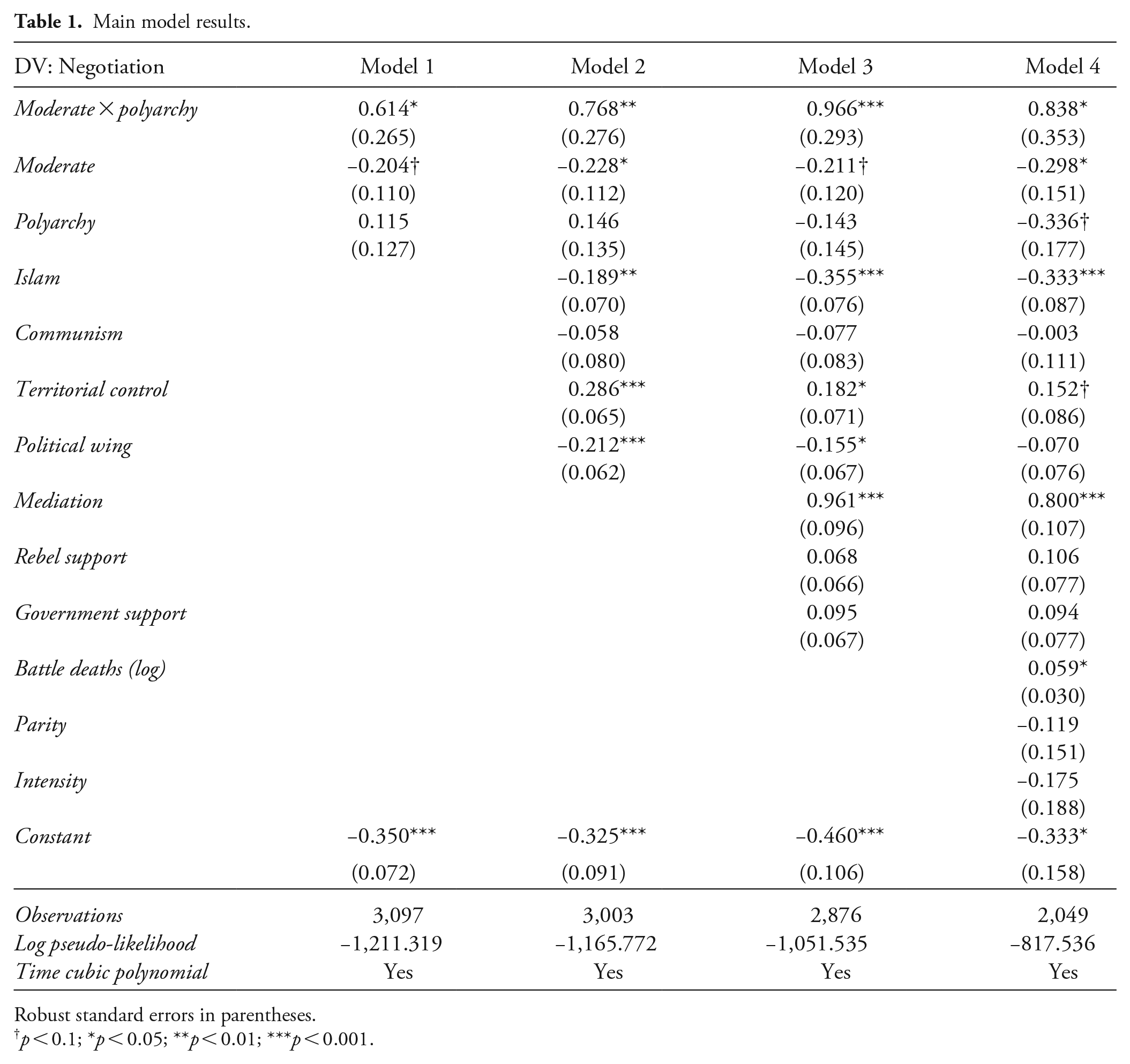
Robust standard errors in parentheses.
p < 0.1; *p < 0.05; **p < 0.01; ***p < 0.001.
To better understand the substantive effect of the Moderate and Polyarchy variables, I conduct two exercises using parametric bootstraps. 15 First, I compute and plot in Figure 1a the change in the predicted probability (with 95% confidence intervals) of Negotiation when the Polyarchy variable increases from 1 standard deviation (SD) below the mean to one SD above the mean for Moderate = 0 (maximalist goals) and Moderate = 1 (moderate goals). Figure 1a shows that when a rebel group espouses a moderate goal, the predicted probability of a negotiation increases by about 10 percentage points on average when the Polyarchy variable increases from 1 SD below the mean to 1 SD above the mean. This effect is statistically significant, providing strong substantive support for my hypothesis. In turn, for maximalist goals, the marginal effect of Polyarchy is statistically insignificant. These effects show unambiguously that higher levels of Polyarchy in a country increase the likelihood of rebel–government negotiations only when rebel groups espouse moderate goals.
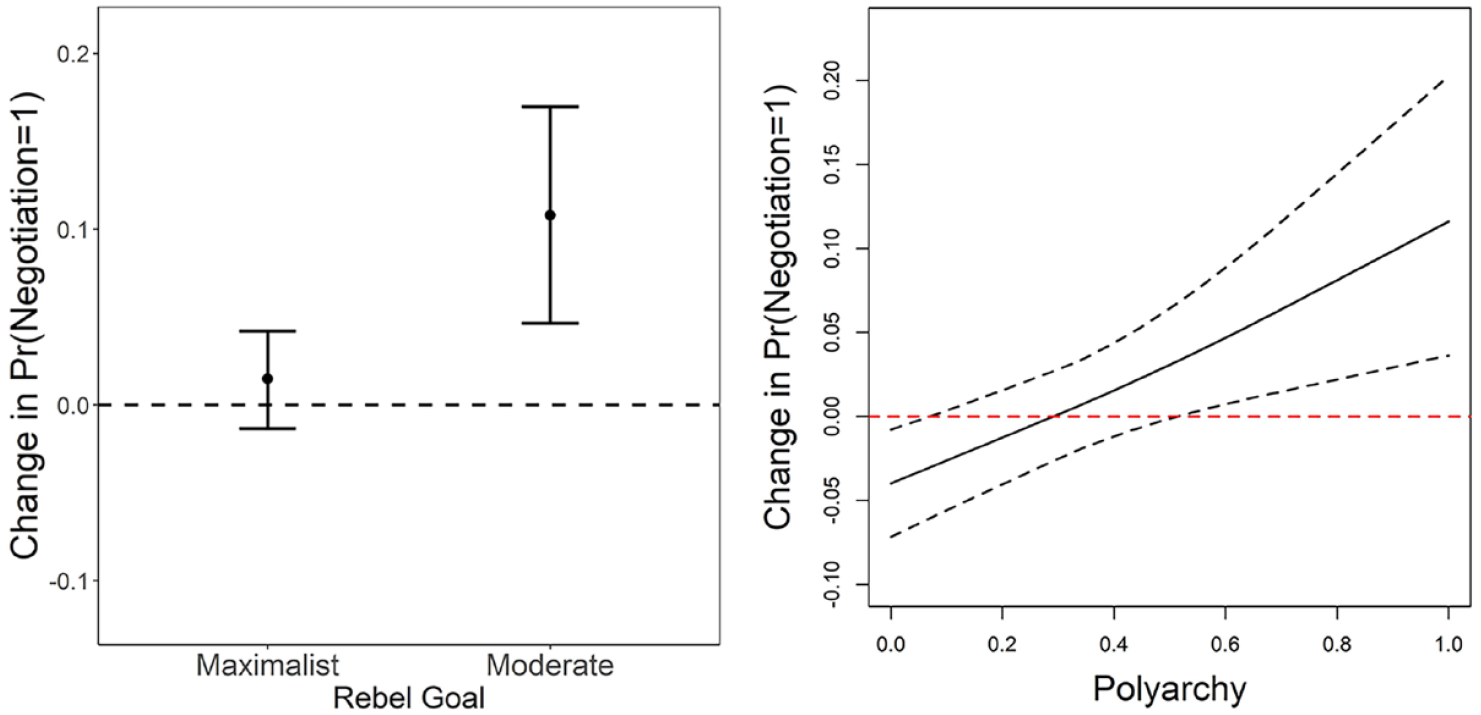
Substantive effect plots.
Second, I compute the substantive effect of a 0-to-1 change in the binary Moderate variable on the change in the predicted probability of Negotiation across the theoretical range of the Polyarchy variable (0 to 1). As Figure 1b shows, the effect of the Moderate variable becomes positive and statistically significant only when the level of Polyarchy is 0.51 (approximately a half SD above the sample mean) or higher. At lower levels of Polyarchy, there is barely any substantively or statistically significant change in the predicted probability of Negotiation even when a rebel group espouses moderate goals. Again, this provides strong support for my hypothesis.
Robustness tests
I conduct a battery of robustness tests. In Models 5–7 (Table 2), I estimate full specification models that include either the Moderate, Polyarchy, or both constitutive components of the interaction term of interest, but not the interaction term itself. In Models 5–7, the Moderate and Polyarchy variables are statistically insignificant, indicating that the individual effect of each constitutive component on Negotiation is insignificant, as suggested by the two corollaries. Additionally, I control for the following variables and find support for my hypothesis (Table A.3, Online Appendix): GDP/pc Growth, log of Official Development Aid (ODA (log)), the Number of Rebel Groups (Cunningham, 2006), Women’s Inclusion in society (Nagel, 2021), and the types of rebel leader selection methods (Cunningham and Sawyer, 2019). As an econometric test, I estimate logistic regression models with robust standard errors in lieu of probit models and find that the main results hold (Model 8, Table 1; Table A.4, Online Appendix).
Robust test results.
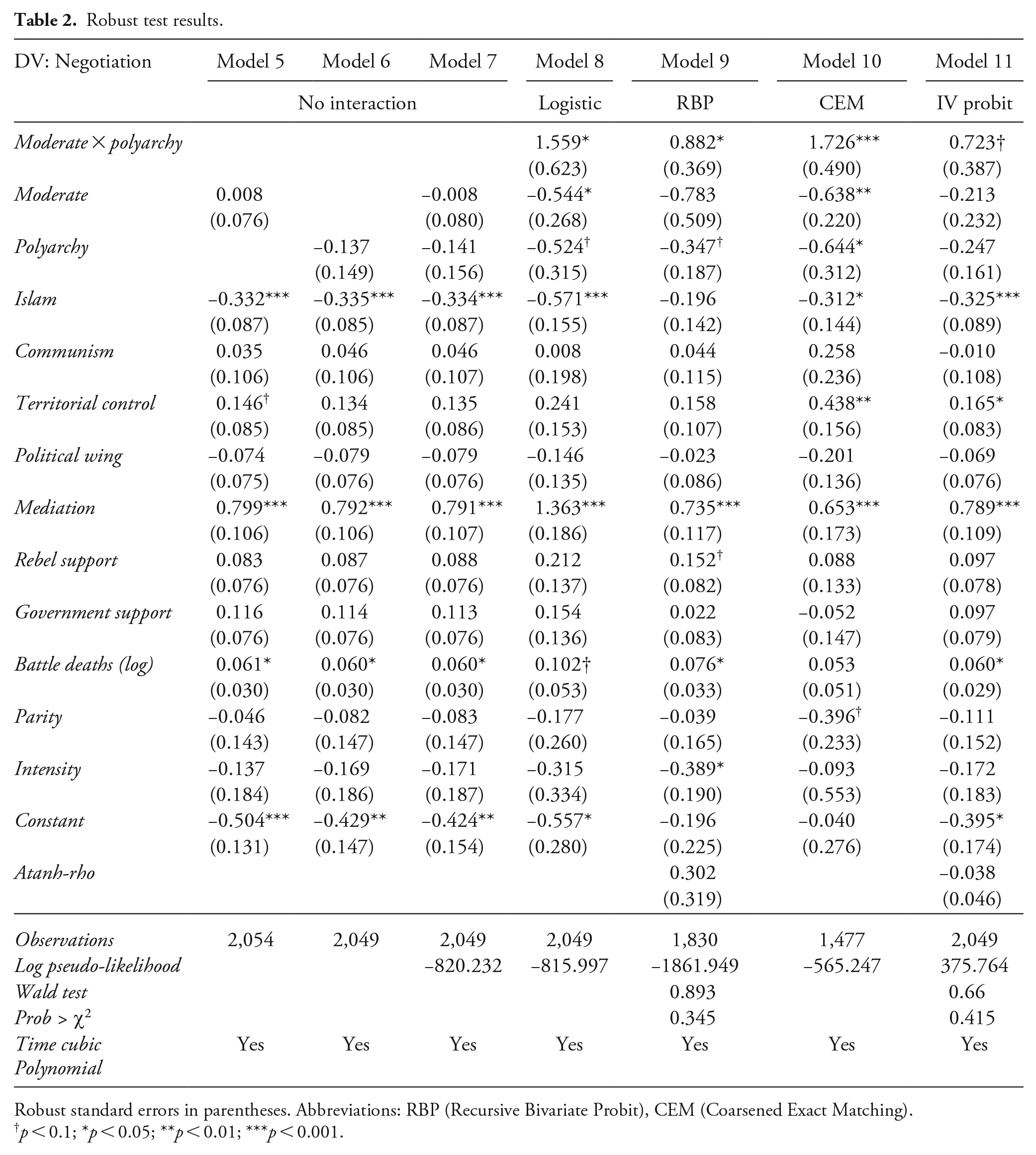
Robust standard errors in parentheses. Abbreviations: RBP (Recursive Bivariate Probit), CEM (Coarsened Exact Matching).
p < 0.1; *p < 0.05; **p < 0.01; ***p < 0.001.
Next, I account for various econometric challenges that may arise when studying rebel–government negotiations. To begin with, I examine the relationship between Moderate rebel goals and the probability of Negotiation in more depth. First, there is a concern for endogeneity stemming from simultaneity since rebel goals may be influenced by the prospects for negotiations. Thus, I calculate the predicted probabilities of rebel–government negotiations from five different probit model specifications that model Negotiation and label them as Pr(Negotiation) Spec 1 to Spec 5 (Table A.8, Online Appendix). I then include each Pr(Negotiation) variable as an independent variable in five probit models that estimate Moderate goals (Models 12–16, Table 3). In addition, I account for the presence of a Negotiation or a past negotiation – Negotiation (lag) – in Models 17 and 18, respectively. In Table 3, the five Pr(Negotiation) variables and (the lag of) Negotiation variables are statistically insignificant in all models except for Model 13, where Pr(Negotiation) Spec 2 is negative and statistically significant. However, the lack of statistical support from other models suggests that Moderate rebel goals are not likely to be influenced by (the prospects for) negotiations.
Moderate rebel goals.
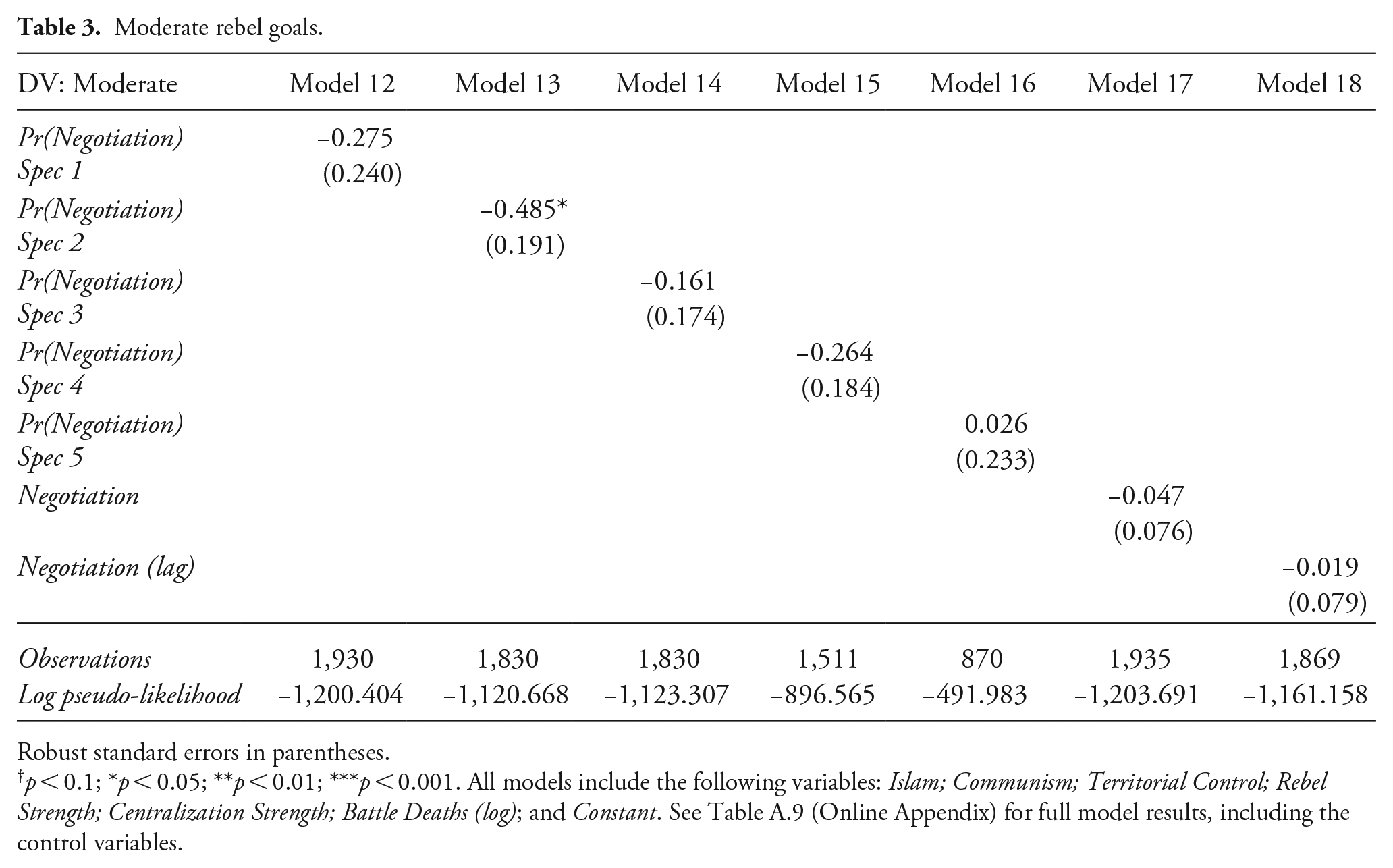
Robust standard errors in parentheses.
p < 0.1; *p < 0.05; **p < 0.01; ***p < 0.001. All models include the following variables: Islam; Communism; Territorial Control; Rebel Strength; Centralization Strength; Battle Deaths (log); and Constant. See Table A.9 (Online Appendix) for full model results, including the control variables.
I also address this endogeneity problem by estimating recursive bivariate probit (RBP) models that use a two-stage model to account for the potential presence of unobserved factors that are correlated with both the independent and dependent variables (Coban, 2021). In the first Moderate-stage equation, I include rebel ideologies (Islam and Communism), rebels’ Territorial Control, the presence of a rebel Political Wing, three measurements of rebel strength to account for Thomas et al. (2016) – Rebel Strength, Centralization Strength Rebel Support – and Battle Deaths (log) to account for battle stalemates (e.g. Zartman, 2001). The second Negotiation-stage specifications are the same as those in Models 1–4. Results from the RBP models (Model 9, Table 2; Table A.5, Online Appendix) show that the atanh-ρ 16 and the Wald test of ρ=0 are statistically insignificant, indicating that the Negotiation and Moderate variables are not endogenous. Therefore, a regular probit model is more appropriate. Yet, the Moderate × Polyarchy interaction term in the RBP models remains positive and statistically significant.
Another concern is that there may be uncontrolled confounding variables that distort the covariate balance between rebel groups with moderate goals and those with maximalist ones. Moreover, there may be a self-selection bias where certain features of rebel groups that adopt Moderate goals also influence their propensity to negotiate with governments. Thus, to compare rebel groups that are generally similar except for the goals, I estimate coarsened exact matching (CEM) models (Iacus et al., 2012), which approximate an experimental design by balancing the distribution of covariates in the treatment and control groups. For the CEM models, I match on Islam, Communism, Territorial Control, Rebel Strength, Centralization Strength and Battle Deaths (log). Results from the CEM models (Model 10, Table 2; Table A.6, Online Appendix) indicate that the effect of the Moderate × Polyarchy variable on Negotiation remains positive and statistically significant even when statistically accounting for the imbalance between moderate and maximalist rebels.
Lastly, it is possible that unobservable factors that affect the non-random emergence of key institutional features of polyarchy also influence governments’ incentives to engage in negotiations. To account for this potential endogeneity, I use the Instrumental Variable (IV) probit model that corrects for potential endogeneity and provides consistent estimates for binary dependent variables and continuous endogenous regressors (Newey, 1987). I instrument the Polyarchy variable using the Democratic Spell variable coded as the number of years since a country became a democracy. 17 The level of polyarchy in a country is theoretically likely to be associated with the length of democracy since the quality of elections and civil liberties are reinforced as democracy matures and consolidates over time. 18 In turn, theoretically, the length of democracy in a country is not expected to influence the probability of negotiations other than through the theoretical mechanism of Polyarchy laid out in the theory section. The atanh-ρ and the Wald test results from the IV probit models are insignificant, indicating that endogeneity is not an issue and that a regular probit model should be preferred. Yet, the Moderate × Polyarchy coefficient remains positive and statistically significant in the IV probit models (Model 11, Table 2; Table A.7, Online Appendix).
Moderate goals and polyarchy
To better understand the results, I examine the association between Moderate goals and Polyarchy. I provide a brief overview of the results here due to space constraints, but detailed information is available in Section 7 of the Online Appendix. Briefly stated, results from a difference of means test (Table A.10, Online Appendix) and a Chi-square test (Table A.11) indicate that moderate rebels are more likely to form when opposing countries with lower levels of polyarchy than higher levels of polyarchy. Given that rebel groups form their goals around shared grievances that would increase their membership and constituent support, I speculate that this relationship may be related to the types of grievances that are more likely to be prevalent in different political institutions. More specifically, since citizens are often deprived of even the most basic levels of political participation and civil liberties in lower polyarchies, rebel groups may be more likely to form shared grievances and pursue moderate goals – that is, increased political participation, freedom of speech and association, or judicial reforms – in such regimes compared to those in higher polyarchies, whose citizens may already enjoy a considerable level of free and fair elections and civil liberties. Then, moderate rebel groups that operate in countries with higher levels of polyarchy and successfully negotiate are more likely to be those that espouse moderate goals specific to certain marginalized and/or minority groups (e.g. ethno-religious groups) that lack access to inclusive institutions rather than widespread political grievances. While the case of the Oodua Peoples Congress (OPC) presented below substantiates the claims laid out above, more fine-grained data on rebel goals are required to test the claims, which are subject to further empirical scrutiny and theoretical development.
Case illustration
The OPC, a Yoruba ethno-nationalist militant organization, in the south-west region of Nigeria and the Ijaw groups in the Niger Delta region provide a good illustration of my theoretical claims. Since 1954, the domination of the political arena by the Northern region’s ‘power elites’ (Ukeje and Adebanwi, 2008: 577) had ‘sidelined [other ethnic groups] from the mainstream of Nigerian politics’ (Akinyele, 2001: 625). This structurally disadvantaged marginalized regions and ethnic groups, fostering grievances. In 1993, when a presidential election that would have ended in a Yoruba candidate’s victory was annulled and the candidate was incarcerated by the Nigerian military regime (Guichaoua, 2009), grievances fuelled and propelled Frederick Fasehun to create the OPC in 1994 to ‘defend Yoruba interests in Nigeria and push for self-determination’ (Ukeje and Adebanwi, 2008: 574).
The OPC’s goals are consistent with my theoretical definition of Moderate goals; it never sought to overthrow the government or gain total independence. Rather, it sought domestic reforms, including the establishment of federalism and the ‘convocation of a Sovereign National Conference (SNC) of all ethnic nationalities’ (Gilbert, 2013: 4) and the fairer distribution of oil revenue (Guichaoua, 2009). These goals were shared by many of the OPC’s allies and other ethno-nationalistic movements in the Niger Delta. While these moderate goals left room for negotiations with the Nigerian government, under the military regime, there was almost no tolerance for political opposition and respect for human rights, let alone elections and civil liberties. Such an illiberal political environment ‘made the OPC members feel that the Nigerian problems could not be solved peacefully’ (Albert, 2001: 282). The Nigerian military government was not a credible negotiation partner.
However, when the military dictator Sani Abacha suddenly died in 1998, Nigeria started to transition towards polyarchy. Abacha’s successor General Abubakar ‘relaxed political restrictions and announced a rapid transition to democracy’ (Lewis, 2003: 132), establishing the Independent National Electoral Commission to lay out the electoral rules and certifying the formation of three parties (Lewis, 2003). Moreover, under Olusegun Obasanjo’s rule in 1999, freedom of speech revived (Guichaoua, 2009), increasing civil liberties. Especially for the OPC, the ‘2003 elections[…] confirmed the legitimacy of the state as an arena of political negotiation and reform’ (Nolte, 2007: 220). Such institutional changes toward polyarchy fostered the opening of negotiations. For example, the OPC leader, Fasehun, claimed that ‘ethnic groupings have a role to play in our democracy and its agitation must be addressed through dialogue[…]’ and asked that the ‘Federal government will pave way for far-reaching dialogue.’ 19 Rebel members from the Niger Delta also requested the government to ‘open a new chapter for a national dialogue.’ 20
The Nigerian government officials also acknowledged some legitimacy in their struggles and invited members from the OPC and other ethnic rebel groups for talks and peace conferences. 21 For example, Gani Adams from the OPC was ‘appointed into a national peace committee inaugurated by the president’ (Ukeje and Adebanwi, 2008: 583) and Alhaji Dokubo, an Ijaw from the Niger Delta, ‘was invited to peace talks by the president’ (Ukeje and Adebanwi, 2008: 584) and signed a cease fire agreement in 2004 (Uppsala Conflict Data Program, 2016). In 2007, dialogues regarding an amnesty programme convened (Omobowale, 2016: 6), and while its launch in 2009 did not instantly bring peace, violence eventually subsided as the OPC and remaining Niger Delta militias called for continued dialogues with the government to achieve the ‘convening of a Sovereign National Conference that will give Nigeria a truly Federal Constitution.’ 22
Conclusion
This paper examined how a specific rebel feature – moderate rebel goals – combined with a particular domestic political institution – higher levels of polyarchy – enable rebel groups with moderate goals and governments to negotiate by creating a range of mutually acceptable agreements and alleviating a dual commitment problem. Results from statistical tests using a newly developed dataset on rebel–government negotiations and rebel goals provide robust support for the theoretical claim that negotiations are more likely when the level of polyarchy in a country is sufficiently high and rebel groups espouse moderate goals.
This study has several contributions and some policy lessons. Theoretically, the study builds on existing research on the effects of rebel features on rebel–government negotiations (e.g. Cunningham and Sawyer, 2019; Heger and Jung, 2015; Kaplow, 2016), but also improves upon it by emphasizing the role of domestic political institutions in conjunction with rebel characteristics as they may shape the bargaining environment in which the belligerents interact and, ultimately, the prospects of negotiations. The study also expands on the growing literature on the role of elections and electoral provisions on peace (e.g. Bartusevičius and Skaaning, 2018; Keels, 2018; Matanock, 2017) by theorizing how electoral systems accompanied by civil liberties (i.e., polyarchy) may facilitate negotiations by alleviating commitment problems during civil conflicts. An important policy implication is that designing domestic institutions that guarantee inclusive and competitive elections as well as civil liberties may help to foster a congenial environment for rebel–government negotiations. Empirically, this research adds to studies that analyse civil conflicts more systematically through collecting substantively rich data on rebel group traits such as their organizational structure (Cunningham et al., 2013), rebel governance (e.g. Heger and Jung, 2015), or their origins and leadership structure (e.g. Braithwaite and Cunningham, 2020; Cunningham and Sawyer, 2019). New data on rebel goals introduced in this study can be used by researchers to study rebel groups’ tactics, behaviour and policy preferences more closely.
Future work can be extended in various directions. For instance, examining the relationship between rebel goals and other civil conflict dynamics – such as conflict duration or the use of terrorism – would be an interesting area of future research. This study can also be theoretically extended to understand how governments process information about the rebel groups’ objectives when developing strategies to deal with them. Finally, a direct theoretical implication from the study is that moderate rebel goals and the level of polyarchy may also facilitate rebel groups and governments to reach an agreeable peace agreement. It is worth testing this implication empirically and examining whether the same factors contribute to both engagement and the successful outcome of negotiations.
Footnotes
Acknowledgements
The author thanks Bumba Mukherjee, Angelica Durán-Martínez as well as the two anonymous reviewers and the editor for their helpful comments and suggestions. The author also wishes to thank Glenn Palmer, Douglas Lemke, and the participants at the 2016 Peace Science Society (I) Annual Conference for their feedback in the early stages of the manuscript.
Replication data

Funding
This resaerch was supported by the Pennsylvania State University and the University of Massachusetts Lowell.
Notes
MINNIE MINHYUNG JOO, PhD in Political Science (The Pennsylvania State University, 2019); Assistant Professor, Department of Political Science, University of Massachusetts Lowell (2019–present); her research centres around the study of civil conflicts, with a special focus on how the organizational characteristics of rebel groups influence rebel behaviour and civil conflict dynamics.