




Abstract
This article presents a model describing a symbiotic relationship between criminals and a partnership of protection providers, called the Firm. The partners of the Firm earn profits as they have market power in the supply of protection. The Firm recruits its new partners among criminals. As a result, the prospect of graduating to the Firm adds an incentive for violent crime. The result is a violence multiplier where more violence increases the profits to the partners of the Firm, in turn contributing to the incentive for violence. The violence multiplier also generates an incentive for the protection providers to welcome new partners, even though new partners dilute the profits. The model combines elements from contest theory and rent-seeking theory but, nevertheless, generates results that are in contrast to standard results from the rent-seeking literature. For example, due to the interdependence between protection providers and criminals, a decrease in the cost of violence increases violence more than pari passu and increases the value of being a criminal. Also, tougher competition between criminals may benefit all of them. The empirical relevance of key elements of this framework are confirmed by exploring unique data on incarcerated youth in South Africa. The empirical results confirm a hierarchical gang structure and indicate that this structure does indeed promote violence.
Introduction
The world is witnessing a large and global expansion in private security. In contexts where law enforcement is weak and crime rates are high, the result has been a mushrooming of illicit private security companies. These companies take advantage of high levels of violence and unrest to make a profit.
We introduce a new understanding of the symbiotic relationship between criminals and protection providers. The literature discusses how protection providers profit from increases in violent crime (an early reference is Clotfelter, 1978). Our contribution is to show how the prospect of graduation from criminal to protection provider gives an extra incentive to exert violence. We model how violent criminals compete for graduation to a partnership of protection providers (hereafter called the Firm). This results in a violence multiplier effect, where more violence increases the incentives for violence.
The model describes a stable institutional arrangement where violent criminals generate demand for protection. Protection is provided by ‘graduated’ criminals in the Firm. The first stage of a criminal career is as a violent young thug posing a threat to property owners and thereby generating profits for protection providers. Conditional on being infamous for violence, the criminal later in his career graduates to the Firm and profits as a provider of protection to property owners, who now face a new cohort of thugs. This arrangement is potentially highly stable: the Firm does not have to engage directly in crime and therefore needs not fear law enforcement; the Firm is an efficient protection provider; and the resulting crime levels lead property owners to embrace the services of the Firm.
The private provision of security has both complemented and substituted many of the tasks traditionally performed by the public police and in some cases by the military. Private security companies differ from the public police force in ways that matter for the pattern of crime and violence. One important aspect is accountability: whereas the police are accountable to the government and therefore to the public at large, the private security industry is accountable only to its clients. An implication may be that only the rich are protected. This is observed for instance in Jamaica and South Africa, where poorer areas are left to themselves, resulting in vigilante groups or gang members taking the role as protectors. Another aspect is that private companies may face perverse incentives not felt by the public police. A private security company benefits from higher levels of violence and crime, as this increases the number of clients or their willingness to pay for protection, thereby increasing the company’s profits. This may tempt the company to adopt aggressive strategies rather than strategies that minimize violence. The company may itself benefit from representing the violent threat, so that ‘protection’ takes the form of extortion. In our model extortion is indirect: the protection industry tolerates violence not directed towards its clients, while criminals know that a violent reputation makes them attractive partners in the protection industry. The existence of private security thus motivates criminal violence without the private security industry having to break the law.
In this article we model the symbiotic relationship between criminal gangs and protection firms. The private protection discussion is related to Dixit (2004) and Anderson & Bandiera (2005), who study private protection and compare the case of free entry versus monopoly pricing among protection providers. We concentrate on the cartel case and focus on the violent competition that arises as criminals compete to be recruited to the cartel – the Firm. We envisage a hierarchy with crime rents and advancement prospects at the bottom and protection business at the top. In this respect our model relates to Mehlum, Moene, & Torvik (2002) and Levitt & Venkatesh (2000). Levitt & Venkatesh find that foot soldiers in gangs earn much less than officers and leaders, and that officers are recruited in a tournament. Underlying our analysis is the idea that violence goes hand in hand with protection. This finds support in the mafia literature. Gambetta (1993: 42) defines the mafia as ‘a specific economic enterprise, an industry which produces, promotes, and sells private protection’. In a similar manner, violence is key in our model for a gangster to ensure he wins the contest and graduates to become a partner of the Firm.
Our model is also inspired by Olson (1993) who assumes that the ‘stationary bandit’ takes on full state authority, neutralizes other ‘roving bandits’ and taxes the producers. Yet, our story is less drastic. State authority is not up for grabs, and the Firm thrives only as long as there are still some credible bandits to provide protection services against. The Firm also bears similarity to Nozick’s (1974) ‘dominant protection provider’, but the dominance of the Firm is lower as it operates side by side with formal protection providers.
More specifically, our work is inspired by the literature on weak states and mafias and extortion, in particular Fiorentini & Peltzman (1995), Konrad & Skaperdas (1997, 1998), Grossman (2001), and Skaperdas (1992, 2001). We build on the theory of rent-seeking with Tullock’s early contributions (1967, 1980), and with Skaperdas (1996) as another significant reference.
Contrary to previous and well-established results from the rent-seeking literature, we find that (i) tougher competition between criminal gangs benefits all of them and (ii) restricting graduation to the Firm may hurt the insiders of the Firm. Both of these results hinge on the violence multiplier obtained in the model; increased violence generates a need for protection for producers. This raises the profits for the Firm, and therefore increases the value of graduation for the criminals. The upshot is more violence, and so the cycle continues.
To document the relevance of our framework, we use a unique dataset on youth offenders in South Africa to examine the relationship between gang membership and violence. The data, collected by the Centre for Justice and Crime Prevention (CJCP) in 2006, includes information about almost 400 incarcerated youth and their gang membership. We document the relevance of the underlying assumptions of our theoretical model, rather than attempting to identify causal effects. Our results indicate that the hierarchical gang structure does indeed promote violence.
Background: The private security industry
South Africa is an example of a country where violent crime is rife, public law enforcement weak and uneven, and the private security sector flourishes. South Africa’s murder rate of 34 in 100,000 people in 2016 was the seventh highest in the world for that year. 1 Almost 40% of South African firms identify crime, theft, and disorder as major constraints on doing business and 75% paid for security, compared to 55% worldwide.
This vacuum in law enforcement attracts not only legitimate private security companies but also illicit ones, along with mafia-like organizations or syndicates. Somewhere in this spectrum is Mapogo a Mathamaga, a security provider with 60,000 clients that are charged a yearly fee to protect their businesses against crime. They pride themselves in their efficiency by the threat, or use, of ‘African medicine’ in the form of swift, violent punishment. They are more concerned with repairing the damage done to the victim, than with the rights enjoyed by the accused (von Schnitzler et al., 2001).
Hard Livings and the Americans are the two largest and most violent gangs in Cape Town, involved in a range of activities including drug running and trading, protection, and more legitimate business operations. 2 Other gangs include the Mongrels, the Sexy Boys, the Dixie Boys, Wonder Kids, and the prison gangs, including the 26s and the 28s. In the empirical part of this article we use survey data of criminals, where we identify members of these infamous groups. According to Kinnes (2017: 74), these gangs value violence as a skill. ‘Merchants of violence in this respect are men in gangs whose daily work consists of dispensing violence as a tradable commodity. They sell this commodity to the highest bidder inside other gangs and outside such gangs. The use of violence becomes a saleable asset in the hands of these organized, armed violent gangs.’ Kinnes (2017: 80) notes that a violent reputation is ‘the hard currency of the street gangs and is what provides the authority and power to the gang leader’.
The model below describes the essence of the symbiotic relationship between criminals and protection providers. First, criminals generate violence and demand for protection that private security companies profit from. Second, profits from protection accrue to partners with a violent record. These profits incentivize criminals to be violent. We examine the ‘industrial organization’ of such a hierarchical violent economy with interdependency between criminals and protectors.
The model
The violent economy consists of N agents which in period t are distributed between

The total number of agents, N, is constant over time and is determined by a fixed inflow of new agents and an exogenous death rate
The regular criminals are uncoordinated and earn income from drugs and trafficking, and they pose a constant threat to producers. The Firm is monolithic and earns its income by selling protection to the producers. The Firm’s income is shared equally among its partners. The Firm depends on the criminals in two distinct ways. First, the price they can charge for protection services depends on the extent of violence in society. Second, the criminals represent a pool from which the Firm can recruit new partners.
The criminals interact strategically with each other. Investing in violence comes with two rewards: a higher share of crime rents and an increased probability of graduating to become partner of the Firm. The Firm, however, has a given set of recruitment rules and shares its returns equally between its partners. It is not assumed to adjust its behavior strategically in response to the criminals. Hence, we first derive the value of partnership before deriving the incentive to exert violence in the strategic interaction between criminals.
The value of being a partner of the Firm
The productive formal sector has high value and has an inelastic demand for protection against a criminal attack. Consequently, in equilibrium, sufficient protection is procured, and producers are not attacked. The sufficient level of safeguarding depends on the extent of criminal violence in the economy. The assumption is that criminals pose a constant threat to any property and that this threat increases with the general level of violence. Preventing an attack can be done in two ways: by hiring guards from a formal sector guarding company, or by paying for the services of the Firm.
The formal guarding business is assumed to be competitive with the cost of one guard being fixed and exogenous. The number of formal guards needed by one single property in order to prevent an attack, when all other properties also prevent attacks, is assumed to increase with criminal violence Yt
, which will be solved for below. When relying on regulated protection providers, a property owner’s outlay for protection will be

By building on the violent reputation of its partners, the Firm is an efficient protection provider. Taking the price of formal guarding services as given, the Firm acts as a monopolist with fringe competitors and undercuts marginally the price of the formal-sector guarding firms. As the number of partners determines the Firm’s manpower capacity, the Firm will target businesses where its cost advantage is the highest. The Firm’s business model causes heterogeneity in the cost advantage across various types of properties. Prevention of daytime robbery at a grocery store, where the culprit is typically observed, may require zero manpower, as the Firm’s sticker suffices, whereas prevention of nighttime burglary from a construction site may require substantial use of patrolling manpower.
Maximizing profits, the Firm will, under the capacity constraint given by

where the restriction on

where Ft is the number of producers under protection by the Firm. Solving the integral for Ft and inserting in (2) yields:


which is decreasing, or constant, in Np
since

where the discount rate
4
d reflects both time preferences and the exogenous probability of dying
The value of being criminal
The criminals can be thought of as individual bosses, each controlling a crew of subordinate members. By the use of violence,
The value of graduating is given by the difference between the present value of being a partner,

where
The share

The probability

where the parameter α is the expected number of graduations per period. 6 Hence, violence has a dual role as a strategic variable. First, it determines the share of R that each criminal obtains via Tullock rent seeking. Second, it determines the probability of graduation via a Tullock contest success function. 7
It then follows that the value of starting in period t as criminal is given by (11).


Hence,
The recursive value function (11) is the object function that criminals maximize, subject to the expected action of other criminals and subject to the value of graduation, as given by (7). This latter value function is taken as a given by the criminals as the partners of the Firm do not engage in strategic interaction with the criminals. The first step in solving the model is to derive the optimal fighting effort, assuming that the criminals have correct expectations about the prize,

From the symmetry requirement that all i are identical and are assumed to act symmetrically, so that

consequently, total violence in equilibrium is

where
The stationary equilibrium
The exogenous graduation intensity α determines the inflow of partners per unit of time. Consequently, in a stationary environment the inflow to partnership is equal to the outflow, and the stationary values Np and Nc are given by


Within this stationary environment, we limit our attention to Markov perfect, symmetric, stationary, forward-looking equilibria. In order to derive such an equilibrium we proceed in steps. First, we derive values
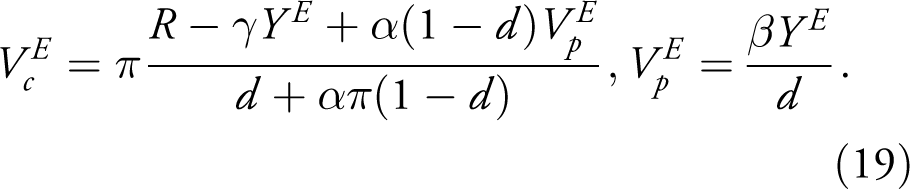
Inserting in (12) yields the prize in period t

Inserting the equilibrium choice of effort in the game in period t, based on (16), equilibrium Yt follows, conditioned on expectations about a stationary value of future violence YE ,



The last step in finding a stationary equilibrium is to derive the fixed point for violence, where

where the requirement for existence of an interior solution is that



(24)–(27) together with (6) and (15) give the solution for the six main endogenous variables,
We restrict our attention to cases where graduation is attractive, that is,

It follows from (6) that this is assured when
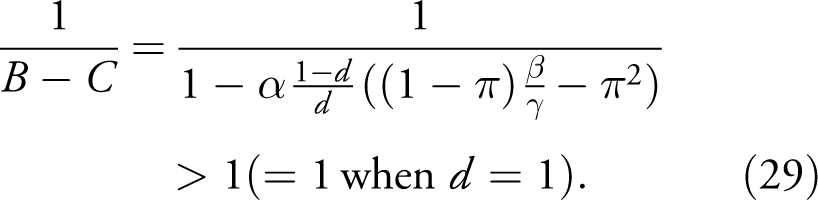
This factor captures the cumulative effect of violence. The cumulative effect, the multiplier, is increasing in the weight placed on the future. The essence of (24), combined with (29), is as follows:
Proof: The value of graduation prospects depends on the discount rate. The lower the d, the more valuable is the prospective graduation. It follows from (29) and (24) that
In a situation with graduation prospects, the violence caused by crime rents cumulates. We call this effect the violence multiplier. The violence multiplier can be disentangled when going back to (21)

Here, Yt
is the violence in the current period, while YE
is expected future violence. Keeping YE
constant, a permanent increase in R has an immediate effect on Yt
due to the increase in the prize. This immediate effect is moderated by
When C gets larger than B (or close to B) a minimal crime rent can support massive violence. In such cases the violent spiral will be checked by a constraint on how much the producers can pay and still remain in business. With such a zero-profit condition for producers, an equilibrium would exist in the form of a corner solution. Such an outcome is perfectly conceivable and it would imply that the main incentive for violence is graduation, while the income of the firm is given exogenously by the producers’ zero profit condition. The current cost for the criminals will be large – possibly larger than current income – and balanced mainly by a large reward associated with graduation.
In the following we focus on the internal solution where C is sufficiently below B to assure that profit in production is not completely wiped out. Under that condition the income of the Firm is positively related to violence and the comparative statics contain the feedbacks between the value of partnership in the Firm and the incentive for violence, which is at the core of this article.
This violence multiplier modifies well-known effects in static conflict models. In a model like ours, but without graduation, violence is homogeneous with respect to the inverse of the unit cost of violence. Due to the multiplier this homogeneity is no longer there.
Proof: From (24) it follows that when
Lower cost of violence instigates more violence, and without graduation prospects (
The proposition was derived under the assumption that the unit cost of effort
Law enforcement could also reverse the violence multiplier. Within our model, an improvement in law enforcement could lead to a lowering of the rent from crime R, both of which would reduce violence and set the violence multiplier in reverse. Alternatively, making the Firm illegal would remove the incentive for graduation and neutralize the violence multiplier. In the absence of legal enforcement these measures could make private property owners worse off, as an admittedly effective supplier of protection would have been removed.
The Firm’s optimal choice of graduation intensity
We have so far assumed that the graduation intensity α is given. How would a change in α affect the payoffs to the partners in a new steady state?
12
From (24) and (26) we know that an increase in α affects both violence and the returns to partners. From (17) and (18) it follows that an increase in α increases the number of partners of the Firm and lowers the number of criminals. An increase in α therefore has a positive effect on the returns to the partners of the Firm as violence increases, but has a negative effect on the returns as the number of partners increases and profits consequently are diluted. If the effect that stimulates violence is strong, existing partners of the Firm may benefit from increasing the graduation intensity even though their own share of the Firm’s profit is reduced.
Proof: The proposition is a statement of a possibility. In order to prove it, it is sufficient to demonstrate that there are parameter values for which it is true. Inserting from (6), (15), (17), and (18) in (26), taking the derivative with respect to α, and evaluating for
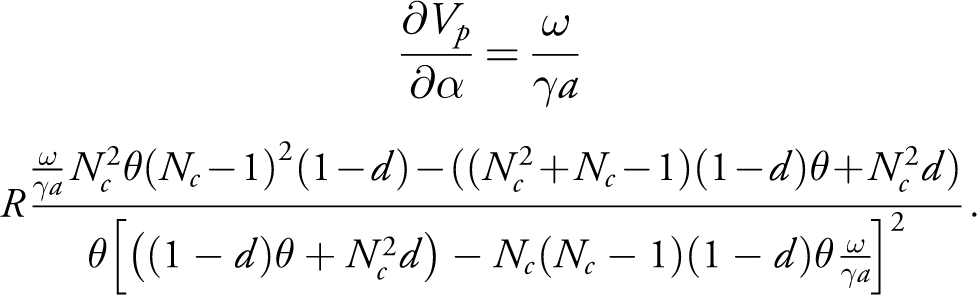
It is readily seen that when
This proposition highlights the potential profit-boosting effect of admitting new partners. The proposition is not trivially true, and three examples are given in Figure 1. The figure illustrates that increasing α eventually brings Vp
down to zero. For intermediate values of α, however, Vp
might increase with α. As the illustration highlights, a key parameter for this to happen is the economies of scale parameter
Irrespective of the value of Steady state returns to partners of the Firm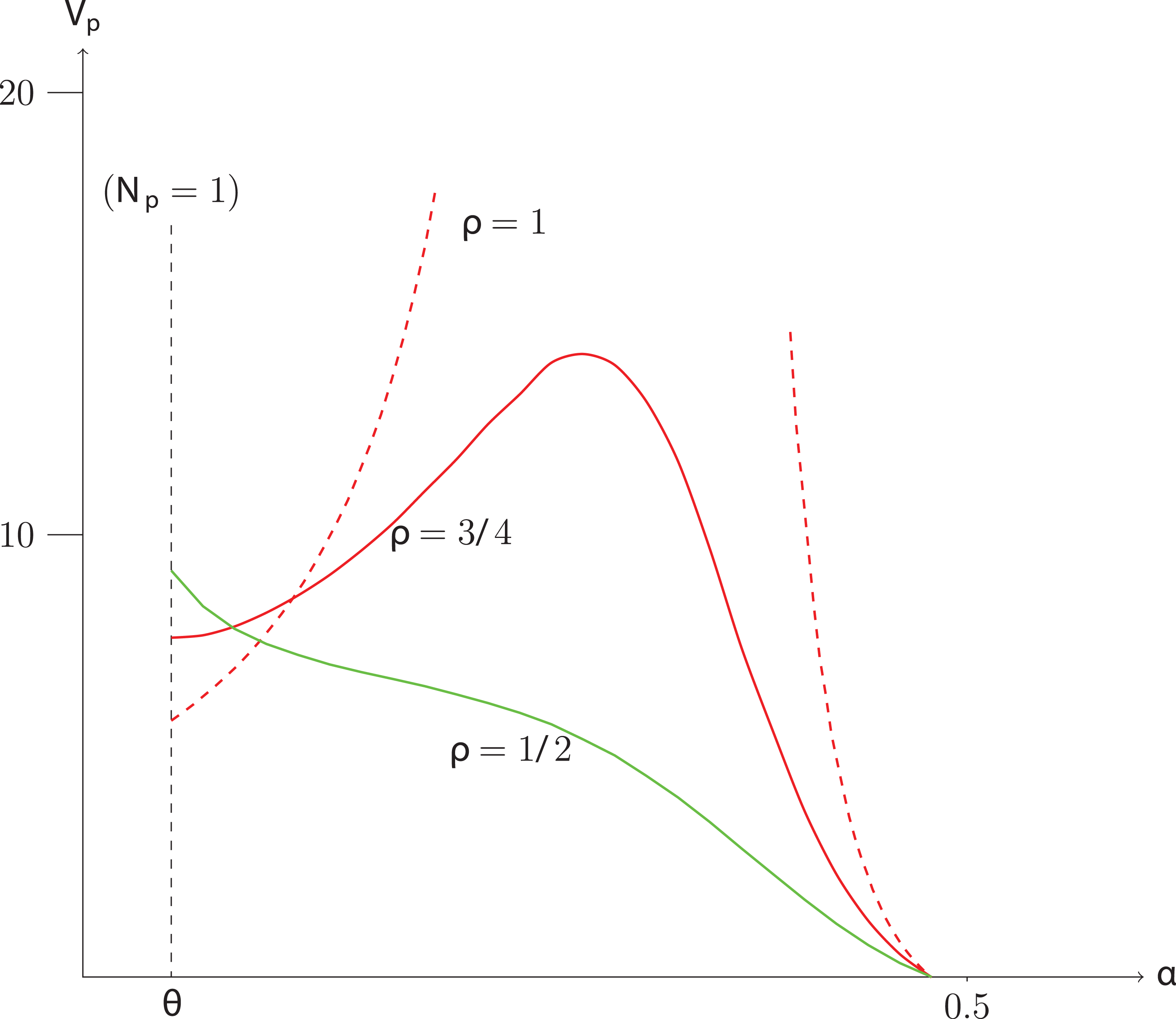
This balancing of the business-magnifying effect and dilution effect of admitting new partners echoes Sánchez-Jankowski’s (1991)
15
discussion of gang recruitment in New York: Gangs that adopt ‘fraternity recruiting style’ are usually quite secure within their communities. They have relatively large membership and have integrated themselves into the community well enough to have both legitimacy and status. […] [They] have often become relatively prosperous. Having built up the economic resources of the group to a level that has benefited the general membership, they are reluctant to admit too many new members, fearing that increased numbers will not be accompanied by increases in revenues, resulting in less for the general membership. (p. 51)
The patterns of violence
The theoretical model outlined above builds on the assumption that the interaction between criminal gangs and protection providers enhances violence among gangs. The gangs fight both for their share of ordinary crime rents and to become partners of the Firm. Competency in violence is required for gangs aspiring to graduate and become partners of the Firm. Once these gangs are established as partners of the Firm, however, they do not necessarily exert violence. Their mere reputation is enough to secure the protection fees being paid by producers. Are these assumptions supported by the data?
We analyze a unique dataset collected in a study on South African youth offenders. We are able to distinguish between offenders according to gang membership status prior to incarceration, and we refer to these individuals as ‘gang members’ and ‘non-gang members’, respectively. One unique feature of the dataset is that it contains the names of the gang that the offender belonged to, often corresponding to the names of the infamous gangs described in Section 2. In our analysis we refer to offenders belonging to these gangs as ‘infamous gang members’ and those who belong to lesser known gangs as ‘ordinary gang members’. With this, we capture a hierarchy in the gang structure.
That gang members generally are violent is a trivial fact. Whether gang membership in itself is a determinant of violence or whether background variables determine both violence and gang membership is nevertheless an open question. We therefore start by addressing the relationship between gang membership and a violent record. We show that also after controlling for relevant background variables, gang membership remains a strong predictor of a criminal offender’s violent record.
According to the theoretical model one should observe a hierarchy with non-gang members at the bottom, followed by ordinary gang members in the middle, and infamous gang members at the top. A key question, therefore, is whether the same hierarchy is reflected in individual offenders’ violent records. In other words, are criminals with a violent record more often found in infamous gangs? We find support for this in our analysis. The relationship between gang membership and a violent record is strong for members of ordinary gangs, and it is further strengthened for members of infamous gangs.
Moreover, do we find support for our claim that gangs earn their reputation by virtue of having members with a violent record? We address this issue by examining the relationship between a violent record and current violence for non-gang members, ordinary gang members, and infamous gang members. We show that relative to non-gang members, gang members have a more violent record but are less likely to serve for violent offense. This effect is strengthened for members of infamous gangs, who are even more likely to have a violent record and even less likely to be involved in violent crime currently.
These are the three issues we address in our empirical analysis. We test the underlying assumptions of the theoretical model rather than the propositions. Nevertheless, our results support the idea that there are incentives for violent behavior at the bottom of the hierarchy that decrease as a criminal works his way to the top. Criminals know that it pays off to have a violent reputation, as they observe that infamous gangs consist of individuals with a violent past. Also, violence is required to be initiated as a gang member.
Data
The data used in this study were collected by the Centre for Justice and Crime Prevention in 2006, with the aim of understanding factors that strengthen resilience to crime among youth. This population cohort is at the same time the one most at risk of engaging in criminal activity, and the most vulnerable to violent crime. The study juxtaposed two samples: an offender sample of young offenders and their families, and a non-offender sample of young non-offenders and their families. Both samples contain information about a respondent’s life history, community context, family and peer networks, access to resources and services, education, life opportunities, and employment possibilities (Bonora, Burton & Leoschut, 2009). 16
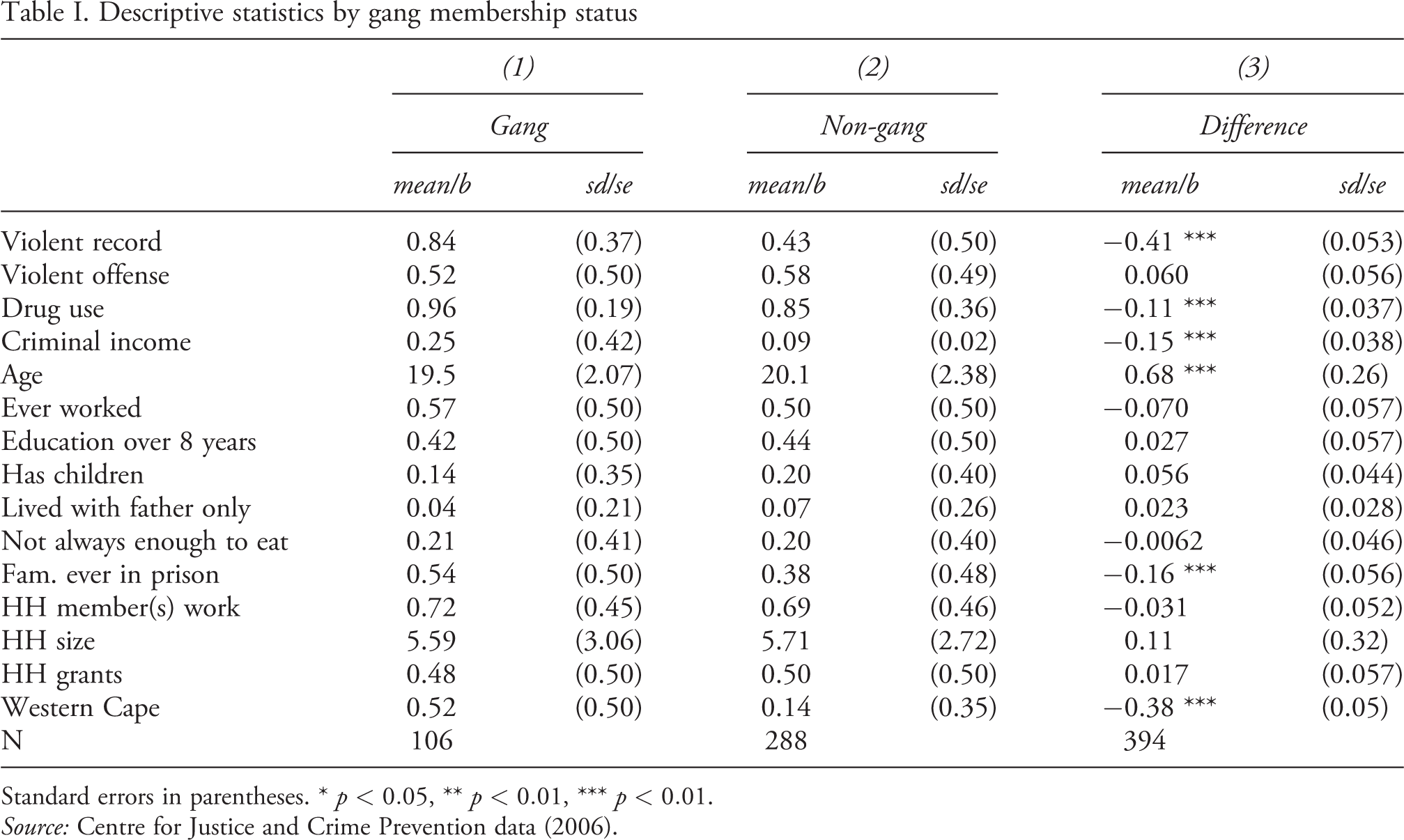
In this article we use the youth offender sample, which consists of data on around 400 incarcerated youth aged 10 to 26. The sample is not random as it examines incarcerated youth only. Yet this allows us to compare gang members with non-gang members, avoiding some of the common selection issues related to comparing criminal with non-criminal individuals. We use information on prior gang membership to examine background variables for gang versus non-gang members, as reported in Table I. Gang members make up about a quarter of the offenders.
Descriptive statistics by gang membership status
Standard errors in parentheses. *
Source: Centre for Justice and Crime Prevention data (2006).
Gangs and recruitment criteria
Source: Centre for Justice and Crime Prevention data (2006).
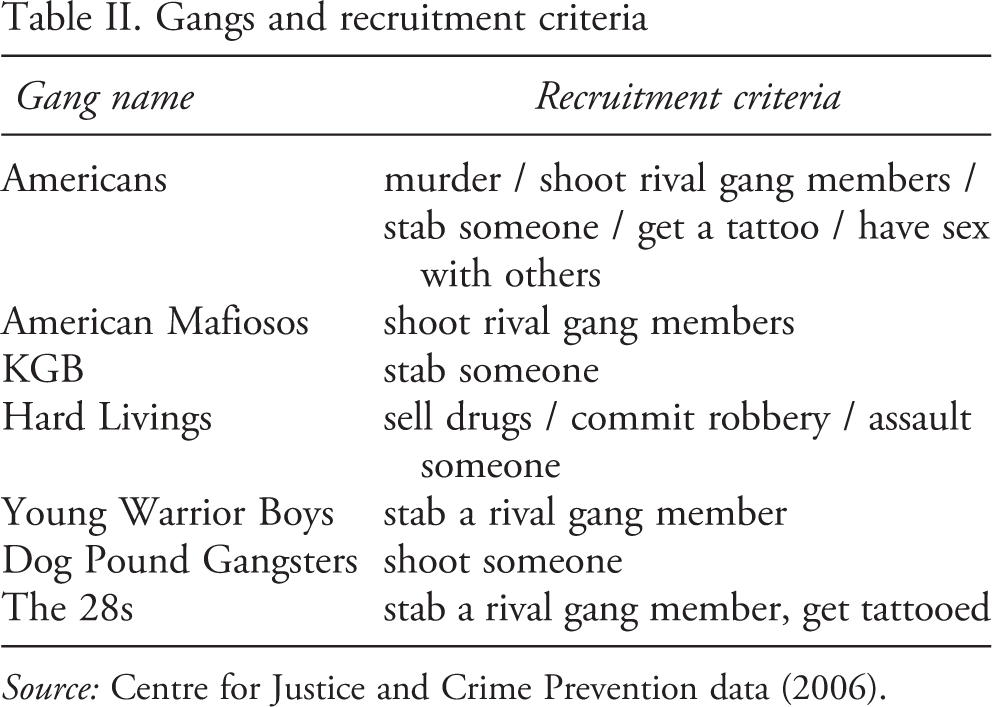
Several of the interviewed offenders are members of infamous gangs featuring in South African news media and academic literature, such as the Americans, Hard Livings, Mongrels, and Dixie Boys, as well as prison gangs such as the 26s and the 28s. 18 As described in Section 2, we know that several of these gangs are involved in protection. Table II shows criteria used for recruiting gang members. Almost half of the gang members (46%) had to go through violent initiation. Most of these criteria are strikingly brutal and include murder, robbery, and violent assaults. These criteria are a supplement to the key mechanism we focus on. Yet they speak clearly to a violent record being a valuable asset in infamous gangs.
Violence as an initiation criterion is not exclusive to South Africa. In Canada for example, Descormiers & Corrado (2016) report from the ‘Incarcerated Serious and Violent Young Offenders Study’ that among gang members 74% were initiated, and of those who shared their gang member initiation criteria 3/4 reported violence while 1/4 reported criminal acts. 19
Analysis: The gang as facilitator of violence
Correlations between gang type and criminal history
Other controls include age and age squared, size of the household, and dummies for being incarcerated in the Western Cape province, for education level of eight years or more, for having children, having ever worked, living with father only, sufficient food in the household, any household member working, household receiving a government grant.
Standard errors in parentheses. *
Source: Centre for Justice and Crime Prevention data (2006).
The question of interest here is whether gang membership matters for the degree to which a criminal engages in violent behavior. If so, this can be because gang members are more violent types than other criminals, or it can be that the gang itself makes them more violent. This standard selection problem is also acknowledged in the criminology literature (Guay, 2012). 20 We estimate the following relationship using OLS: 21

Here InfamousGang is a dummy taking the value 1 if the incarcerated youth was a member of an infamous gang prior to incarceration. OrdinaryGang is a dummy taking the value 1 if the incarcerated youth was a member of an ordinary gang prior to incarceration. X is a vector of individual and family background variables and
The theoretical model tells a story where causality between gang membership and violence runs both ways. Violent criminals become gang members and the prospect of gang membership stimulates violence. In our regression model, therefore, we cannot identify which effect is the strongest. Gangs can either recruit individuals with a record of violence, or gangs stimulate individuals to gain such a reputation. What we want to show is that the correlation between gang membership and a violent reputation is a substantial one and that is does not represent a spurious relationship. The next paragraphs will demonstrate this.
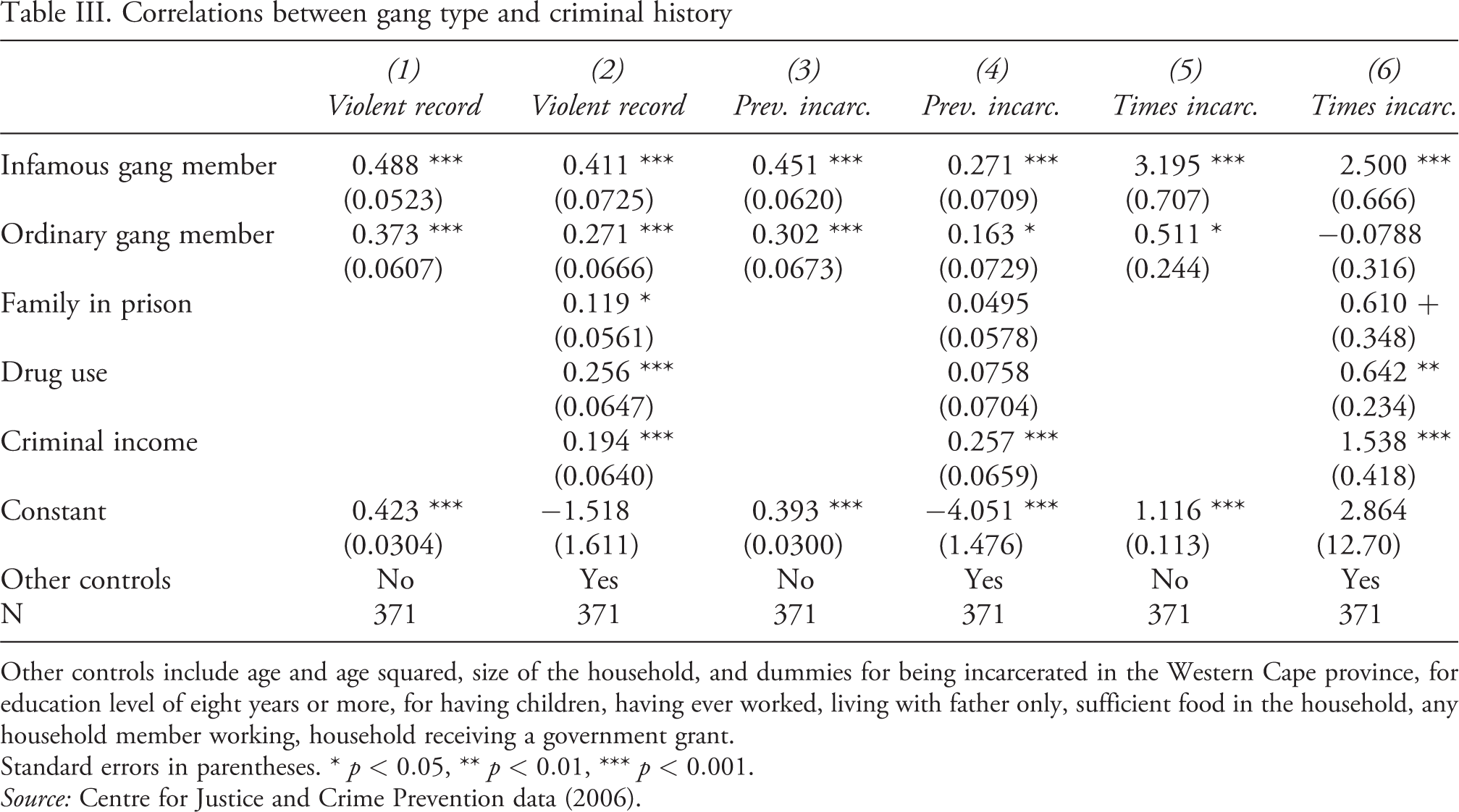
Table III presents the results from the OLS regression. The model in the first column regresses violent record on gang membership without any controls. It shows that there is a positive and significant correlation between belonging to a gang, and the likelihood of having a violent record. In addition, the effect of being a member of an infamous gang is stronger relative to that of being in an ordinary gang. In fact, the likelihood of having a violent record more than doubles for a member of an infamous gang, relative to an independent criminal.
The estimate may suffer from omitted variables bias, so we want to make sure that there is no omitted variable that is correlated both with gang membership and with violent record. In column 2 of Table III we therefore add a number of controls that are likely to influence both these factors. The selection problem alluded to above is whether criminals who join gangs are different from criminals who do not join gangs. Personality traits are typically unobservable, and it is therefore not obvious that one can make this distinction. One possibility, however, is to control for background factors that may cause an individual to be violent, but that pre-date gang membership. The second column includes a family background dummy variable that indicates whether a close family member has ever been in prison. This variable is in itself an important predictor of violence, yet does little to change the coefficients of interest,
More insights into the hierarchy in the types of criminals we examine can be found in the criminal history of the incarcerated. We regress the same model on two different measures of criminal experience. First, we examine the relationship between criminal type and whether the offender has been incarcerated previously. Second, we examine the number of times that the offender has been incarcerated in the past. The results, presented in columns 3 to 6 of Table III, paint a similar picture to the one in the first regression. Gang members are significantly more likely to have been incarcerated before, and infamous gang members even more so than ordinary gang members. Also, infamous gang members have been incarcerated three times more than criminals who operate individually, and this changes only marginally when adding controls. The infamous gang members in particular stand out relative to ordinary gang members when examining this last outcome, which suggests that criminal experience pays off in terms of making it into an infamous gang. The literature on the infamous prison gangs in South Africa speaks of highly violent and hierarchical organizations, see for example Roloff (2014). 22
The regression analysis indicates a hierarchy in crime, where violent reputation is a quality that is increasingly valued as a criminal progresses to the top. As shown in the first column of Table III, this is a feature observed for 42% of criminals not involved in gang activity, 78% of ordinary gang members, and for 91% of all infamous gang members.
23
‘Infamous’ gangs seem to have an even stronger tendency to hire based on violent record than do ‘ordinary’ gangs. Although all gangs value a violent record, this is indeed amplified for the infamous gangs. The infamous gangs are also more likely to have been incarcerated, and with a longer arrest history. This fits with our theoretical model in that the Firm recruits those who have the longest or most brutal track record of violence. We arrive at the first result.
Result 1: There is a hierarchy in the gang structure defined by the violent record of members.
This result is also confirmed when examining the gangs’ recruitment criteria. While 63% of infamous gang members report a recruitment criterion involving stabbing or shooting, only 20% of ordinary gang members report the same. Gang membership seems to have an independent effect on violent record. Moreover, members of infamous gangs are more likely to have a violent record than members of ordinary gangs, again confirming the hierarchy previously defined. It does not seem to be a coincidence that many gang members have a violent record. The gangs either recruit individuals with a record or they stimulate them to gain a reputation. Either way, gaining a violent record is a core criterion for becoming and remaining a member of a gang, and especially for the infamous gangs at the top of the hierarchy. We know from the news media and academic research that these gangs are involved in a variety of criminal activities, legitimate businesses, and protection. This leads to our second result.
Result 2: A violent record is an essential part of gang membership.
The third issue we address is whether gangs earn their reputation by having members with a violent record without necessarily exercising this violence today. We do this by comparing the variables Violent record and Violent offense, where the latter measures whether the youth is incarcerated for a violent offense. Whereas the former is a measure of a violent past, and therefore a measure of violent reputation, the latter is a measure of current violent behavior.
These two variables are described at the top of Table I, where we noted that gang members are more violent than non-gang members, while there is no significant difference in current violent behavior. This lack of relationship between Violent record and Violent offense for gang members is not only an aggregate phenomenon. First, we see that it is confirmed, even enhanced, for subgroups of gang members: 91% of infamous gang members have a violent record, while only 37% of them are incarcerated for a violent offense. Second, the correlation coefficient between ‘violent record’ and ‘violent offense’ for the whole sample is 0.2. Hence, overall, there is a substantial relationship between the individual feature of having a violent record and that of being in prison for a violent offense. Yet, when splitting the sample we see that this correlation only holds for non-gang members, with a correlation coefficient of 0.3. For gang members the correlation is exactly zero.
The analysis suggests that although members of infamous gangs are more likely to have a violent record and a history of incarcerations, they are less likely to be incarcerated for a violent criminal offense currently. This pattern is in accordance with our theory and our interpretation that gangs can profit from their violent reputation even without currently being violent. We have arrived at the third and final empirical result:
Result 3: Gang members have a more violent record but are less often incarcerated for violence than non-gang members.
In the theoretical model we saw how the Firm values violence and therefore recruits the toughest thugs. Hence, criminals who want to graduate to the Firm have an additional incentive to exert violence. The empirical results are in accordance with such a violence incentive.
Concluding remarks
The theoretical model described an environment where a partnership of private protection providers, the Firm, has an incentive to create a violent environment to increase the demand for its services. The Firm achieves this by recruiting protection partners through an implicit competition, where criminals compete over the prospect of graduating to become part of the Firm. In addition, criminals compete over ordinary criminal rents. As explained, this creates a multiplier that contrasts with standard results from the rent-seeking literature. We showed how a decrease in the cost of violence increases violence more than pari passu and increases the value of being a criminal. The violence multiplier additionally generates an incentive for the protection providers to invite new partners into the Firm. Another finding is that increased graduation intensity in some cases improves total returns to each partner of the Firm. Such a shared interest between all partners to the Firm can explain the viability of many violent structures. The empirical relevance of our framework was confirmed in an analysis of unique data on incarcerated youth in South Africa.
Footnotes
Replication data
Due to the sensitivity of the collected survey data, the replication data will not be made publicly available. Individual researchers may contact the authors directly to obtain data for replication purposes or other valid research objectives. All analyses were conducted using Stata.
Acknowledgments
We want to thank Eliana La Ferrara, Katja M Kaufmann, and Kjetil Bjorvatn for inspiring discussions and suggestions.