




Abstract
Drawing on longitudinal ethnographic research that has been ongoing since 1996, this article explores the way that gangs socialize individuals into violent norms and practices in Nicaragua. It shows how different types of gang violence can be related to distinct socialization processes and mechanisms, tracing how these dynamically articulate individual agency, group dynamics and contextual circumstances, albeit in ways that change over time. As such, the article highlights how gang socialization is not only a variable multilayered process, but also a very volatile one, which suggests that the socialization of violence and its consequences are not necessarily enduring.
Introduction
Youth gangs are one of a small number of truly global social phenomena, present across time and space in almost every society on the planet (see Hazen & Rodgers, 2014). Although significant variation can be observed between different contexts, a universal feature of gangs is their intimate association with violence. At the same time, as Stretesky & Pogrebin (2007: 85) have remarked, ‘few studies have examined how violent norms are transmitted in street gangs’. Most of the scholarly literature generally tends to assume that youth who join gangs are either violent by nature or due to factors associated with their social environment, or else that they will be institutionally ‘socialized’ into diverse practices of violence by the gang. As Checkel (2017) points out in the introduction to this special issue, however, socialization – that is to say, the means through which individual actors adopt particular norms, rules, and practices associated with membership of a given group – is neither obvious nor predetermined, and may be underpinned by a range of different processes and mechanisms.
Understanding how these operate and interact is obviously critical for coherent violence reduction and peacebuilding. Drawing on longitudinal ethnographic research carried out in the poor neighbourhood barrio Luis Fanor Hernández, 1 in Managua, the capital city of Nicaragua, this article therefore explores how local gang members have assimilated and put into practice a range of different forms of violence over the past quarter century, unpacking the way these processes have changed over time, and highlighting how socialization is a fundamentally multilayered and contingent process. It begins by situating gangs and their violence within the Central American and Nicaraguan contexts. It subsequently offers an overview of theories of gang socialization, before arguing for a tripartite approach focusing on the variable configuration of individual agency, group dynamics and contextual circumstances. This is then empirically illustrated in relation to a range of distinct forms of violence associated with different iterations of the barrio Luis Fanor Hernández gang, before a conclusion offers some general reflections and an agenda for future research.
Gangs in Central America and Nicaragua
Although gangs are a global phenomenon, nowhere are they currently more the focus of attention than in contemporary Central America, where they are widely reported to be among the most important actors in a landscape of criminal brutality characterized by levels of violence that often surpass those that afflicted the region during the revolutionary wars and conflicts of the 1970s and 1980s (see Kruijt & Koonings, 1999). At the same time, estimates of the total proportion of contemporary regional violence attributable to gangs vary wildly from 10% to 60% (UNODC, 2007: 64), while the criminal activities with which they are associated range from localized forms of petty delinquency such as theft, muggings and extortion, to more large-scale organized criminality including migrant trafficking, kidnapping and drug trafficking. This uncertainty is further fuelled by the fact that Central American gangs have been the focus of a steady stream of highly sensationalist publications over the past decade, for example speculating that gangs constitute ‘a new urban insurgency’ (Manwaring, 2005).
As Hagedorn (2008) has remarked, ‘branding gangs a “national security threat” […] is consistent with a[n] […] attitude that divides the world into good and evil’, thereby establishing the basis for highly distorted interpretations. For example, there exists significant diversity both between gangs and between countries within the region. Certainly, a critical distinction must be made between pandillas, on the one hand, and maras, on the other. Maras are a phenomenon with transnational roots, linked to the refugee flows from Central America to the USA in the 1980s and the subsequent deportation of refugee youth exposed to US gang culture in the 1990s (see Valdez, 2011). Pandillas, on the other hand, are more localized, home-grown gangs that are the direct inheritors of the youth gangs that have long been a historic feature of Central American societies. Maras are generally associated with much more intense and spectacular forms of violence than pandillas, partly because they are less embedded within their local institutional context than the latter, and are therefore less rule-bound and constrained (see Rodgers & Baird, 2015: 479–483). 2
Pandillas are only significantly visible in Nicaragua, having been almost completely supplanted by maras in El Salvador, Honduras and Guatemala during the post-Cold War period; 3 this is one reason why Nicaragua suffers less violence than the latter three countries. 4 At the same time, even if they are less violent than maras, pandillas remain a major source of insecurity in Nicaragua. Certainly, this is something that has been highlighted by numerous ethnographic investigations over the past two decades (see e.g. Núñez, 1996; Rocha, 2007, 2013; Rodgers, 2000, 2006, 2007a,b, 2014, 2015, 2016; Weegels, 2017), as well as opinion polls. A 1999 survey conducted by the Nicaraguan NGO Ética y Transparencia, for example, found that 50% of respondents identified gangs as the principal threat to their personal security (Cajina, 2000: 177). More than a decade later, the 2011 Citizen Security Perception Survey carried out by the Managua-based Institute for Strategic Studies and Public Policy found that almost 60% of respondents considered gangs the most important security threat in Nicaragua (Orozco, 2012: 8).
Pandillas are not a new feature of Nicaraguan society, and can be traced back to the 1940s and 1950s, when the country urbanized on a large scale. These first gangs were spontaneous groups of youths that emerged organically in urban slums and squatter settlements, and only lasted so long as the specific peer group underpinning them stayed together. Gangs subsequently declined during the 1970s as a consequence of the intensification of the long-standing Sandinista revolutionary struggle against the Somoza dictatorship, and disappeared almost completely following the triumph of the revolution in 1979 due to the introduction of universal military service – the age of conscription being 16 – and also because of the grassroots organization that was a hallmark of Sandinismo, including youth work brigades and extensive local neighbourhood watches. Gangs, however, began to re-emerge during the late 1980s due to the war-fuelled erosion of the Sandinista welfare state, declining levels of local organization, the decreasing legitimacy of the revolutionary regime and increasing numbers of youths deserting their military service (Lancaster, 1992: 132).
These new gangs principally involved groups of young men 5 who had been conscripted together and who joined forces in order to protect their families and friends from the rising crime and insecurity, thereby displaying something of a vigilante ethos. Following regime change in 1990, gangs began to proliferate exponentially as a result of peace and mass demobilization, becoming a ubiquitous feature of poor urban neighbourhoods in the country’s major cities (see e.g. Núñez, 1996; Rodgers, 2000). By the mid-1990s, a full-blown gang culture had institutionalized, with gang members engaged in a wide range of petty delinquency, while rival gangs collectively fought each other for territorial control. These conflicts principally revolved around protecting local neighbourhood inhabitants from rival gangs; due to their fixed nature and their adherence to processes of regular escalation, they provided a measure of predictability within an otherwise chaotic and highly insecure broader social context. In that sense, the original vigilante ethos of the first postwar generation persisted, despite individual turnover due to gang members ‘maturing out’ between the ages of 19 and 22 (Rocha, 2000a,b; Rodgers, 2006, 2007a).
Gangs changed radically around the turn of the century, however. In particular, they shifted from offering localized forms of protection and social order to being much more parochial, predatory and feared organizations. This shift was largely linked to the spread of cocaine in Nicaragua. The drug began to move through the country in substantial quantities from 1999 onwards, 6 and its consumption in the form of crack rapidly became a major element of gang culture. Although gang members in the early and mid-1990s consumed drugs, cocaine was practically unknown at that time and they mainly smoked marijuana or sniffed glue. Unlike the latter, crack makes its users extremely aggressive, violent and unpredictable; its consumption thus led to a rise in spontaneous, random attacks by addicted gang members looking to obtain money for their next fix. Contrary to the past, gang members began to actively target local residents, generating a widespread and tangibly heightened sense of fear in urban neighbourhoods in Managua and other Nicaraguan cities, from around 2000 onwards. In other words, crack consumption fundamentally changed the nature of the relationship between gangs and their local communities (Rocha, 2007).
In some neighbourhoods, gang members integrated into the emergent Nicaraguan drug economy as street dealers, further increasing insecurity in those areas. For the most part, dealers worked independently, selling irregularly on street corners in their neighbourhood and sourcing their crack cocaine from one of a small number of neighbourhoods in the city, where it was initially distributed by individual distributors on a rather ad hoc basis (see Rodgers, 2016). These were often ex-gang members who drew on their historical links to their local gang to enrol current members as their security apparatus. In these neighbourhoods, gang activities shifted from community protection to ensuring the proper functioning of the drug economy, which they achieved by imposing local regimes of terror that went beyond the more diffuse crack consumption-related violence. To reduce the risk of denunciation, gang members fostered a climate of fear by repeatedly threatening and committing arbitrary acts of violence against local community inhabitants (Rodgers, 2006, 2007b; Rocha, 2007).
From the beginning of the 21st century – but most visibly around 2005 – the number of gangs in Nicaraguan cities began to decline (Rocha, 2007). The trend was attributable partly to the atomizing effect of crack consumption (see Rodgers, 2006), and partly to the emergence of more professional drug-dealing groups, often referred to as cartelitos (little cartels). These groups generally involved individuals from several different neighbourhoods, and even different parts of Nicaragua, and brutally repressed local gangs to prevent them from challenging them (Rodgers, 2015). This violence reached a peak around 2009–10, after which it eased up significantly as cartelitos began to either fall apart due to internecine fighting or were taken over by rivals. Those that remained began to reduce their involvement in local drug dealing and refocused on drug trafficking, which has much higher profit margins. Instead of dominating local communities, cartelito members began to minimize their visibility, which led to improvements in local security in the urban neighbourhoods where they had previously operated. While drug dealing continues to be widespread in Nicaraguan cities, it has become much smaller in scale, disorganized and more individualized. Gangs, for their part, continue to be a feature of many poor urban neighbourhoods in present-day Nicaragua, but not to the same degree as during the 1990s and the early years of the following decade (see Rodgers & Rocha, 2013: 58–59).
Theorizing gang socialization
Broadly speaking, there exist three major approaches to explaining gang violence within the scholarly literature. The first sees it as linked to the individual personality traits of gang members. This encompasses approaches that see gang members as psychopaths – see Yablonsky (1963), for example – to more nuanced analyses that consider them to be representative of specific psycho-social personalities, such as ‘defiant individualism’ (Sánchez Jankowski, 1991; see also Bernard, 1990). This conception of gang violence is rather self-serving, and no investigation has convincingly shown that gang members consistently display any particular personality type (see Covey, 2003; Curry, Decker & Pyrooz, 2014: 38–42; Klein & Maxson, 2006). Moreover, for every gang member who might plausibly be categorized as a psychopath or a ‘defiant individual’, there are generally at least an equal if not a greater number of non-gang members displaying the same personality type within any given context (as well as gang members who are not ‘defiant individualists’). Having said this, while violence cannot be said to be an innate trait of gang members, numerous studies have highlighted the importance that specific individuals can have in relation to the socialization of violence within a gang, whether as influential leaders (Whyte, 1943; Decker & van Winkle, 1996), or as providers of specialized expertise (Keiser, 1969; Rodgers, 2016), although as Fischer (1975) points out, individuals by themselves do not make a gang, and there clearly needs to be a demographic ‘critical mass’.
The second major way in which gang violence has been understood within the scholarly literature is as a corollary of group dynamics. This makes sense from a socialization perspective considering that at its most basic it involves a process whereby an individual is assimilated into a collective. The gang group is in other words a source of socialization, shaping members’ sense of self and identity, including the internalization of specific norms and practices. The question, however, is how this actually takes place beyond simply joining the gang. In his foundational study of early 20th-century Chicago gangs, Thrasher (1927: 29–30) famously argued that their violence was the result of ‘spontaneous play-groups’ acquiring ‘group-consciousness’ through ‘opposition’ to ‘a rival or an enemy’, a process that effectively amounts to the institutionalization of gang dynamics through conflict. Such an assertion has been widely repeated by gang scholars in numerous contexts over the years – see Suttles (1968), Lepoutre (1997), or Jensen (2008), for instance – yet Thrasher’s observation arguably applies to any competitive sports team, and he never explains what it is about ‘opposition’ that institutionalizes gangs as violent organizations. The notion of ‘spontaneous’ group formation is moreover similarly glossed over, except to the extent that Thrasher relates gang formation to race and ethnicity, effectively suggesting that they emerge based on pre-existing group dynamics.
The third major approach to explaining gang violence is contextually. Certainly, there exists a long tradition associating gangs with ‘social disorganization’ (Thrasher, 1927), or in other words, as social consequences of poverty and marginality. This correlation derives from an epistemological conception that sees youth socialization as normally occurring via a range of ‘primary’ social institutions such as families and schools, which when absent or deficient (due to poverty and marginality), are replaced organically by more ‘secondary’ – and frequently dysfunctional – local social institutions such as gangs. According to Vigil (1988, 2002), however, gangs provide their members with a form of ‘street socialization’ that has been particularly well described by Anderson (1999) in his famous study of the ‘code of the streets’ characteristic of poor inner-city black neighbourhoods in Philadelphia. Due to the pervasive scarcity and increased competition resulting from poverty and discrimination in these communities, Anderson (1999: 32–33) argues that ‘an oppositional culture’ based on ‘the use of violence’ emerges, ‘at the heart of [which] is the issue of respect – loosely defined as being treated “right” or being granted one’s “props” (or proper due) or the deference one deserves’. This most evidently shapes interactions on the streets and other public spaces in poor neighbourhoods, and as one of the major social institutions physically occupying the streets in such contexts, gangs effectively come to crystallize a heightened expression of this ‘code’, which their members adopt as their principal way of being.
While there is no doubt that gangs are generally street-based organizations, and that they can be linked to broader structural processes such as poverty and marginalization, generally invoking contextual factors to account for their violence fails to explain why only a minority of youth – generally less than 10% within any given context (Vigil, 1988: 422) – ever join a gang and become regularly involved in violence. Contextual circumstances by their very nature impact on all those living within a given context; indeed, Anderson’s (1999) study of the ‘code of the street’ repeatedly illustrates that it is a way of acting that is not specific to gangs. To this extent, the idea of ‘street socialization’ can be said to implicitly associate violence with gang membership in a rather singular manner. While the notion that material circumstances might lead to processes of socialization of particular norms and practices is by no means unreasonable, these will clearly be mediated by other factors, including most obviously more individual and group-based forms of socialization. Having said this, there clearly also exists something of a feedback mechanism here; as Ayling (2011) has pointed out, gangs are generally highly volatile social institutions, and their internal dynamics are particularly susceptible to changing contextual factors (see also Sánchez Jankowski, 2003).
Ultimately, what these different ideas about gang socialization arguably implicitly highlight is that socialization must be conceived as a multifaceted process rather than a singular event, and that it can potentially involve a range of different factors, including in particular individual agency, group dynamics and contextual circumstances. These can, however, clearly play out in variable ways; there are, for example, differences between the effects of pre-existing, institutionalized and organic group dynamics, while different types of contextual constraints impact on individual and endogenous group logics in a similarly mutable manner. At the same time, the existing scholarly literature also suggests that such patterns are likely to be highly variable across time and space – meaning that trying to determine whether one factor is more important than another is very likely a fruitless exercise – and what is perhaps most important and interesting to understand instead is how and why individual agency, group dynamics and contextual circumstances connect and articulate together in order to produce specific socialization configurations, practices and outcomes.
In other words, it is not only important to identify how different forms of socialization can be associated with distinct forms of violence, but also how different iterations of individual agency, group dynamics and contextual circumstances can combine with each other in order to produce particular outcomes. It is critical that this is unpacked to understand whether there exist socialization configurations that lead to more or less – as well as more durable or more volatile – patterns of violence. The next section of this article therefore draws on the empirical example of the evolution of a specific gang in a poor Managua neighbourhood called barrio Luis Fanor Hernández to explore how such a tripartite and interconnected conception of socialization might allow for a better understanding of the dynamics of gang violence. 7 More specifically, it seeks to trace the changing patterns of violence associated with different temporal iterations of the local gang, and relate their socialization to distinct configurations of individual agency, group dynamics and contextual circumstances. It aims to identify how these different elements connected to each other, as well as chart the way their relationship transformed over time, focusing on three specific issues, namely whether the connection between different forms of socialization is systemic or contingent, whether any form or socialization configuration is more durable than another, and finally, whether the form of violence being socialized makes a difference in the process of socialization.
Gang socialization in barrio Luis Fanor Hernández
Barrio Luis Fanor Hernández is a poor urban neighbourhood located in southeast Managua, the capital city of Nicaragua. The locality was originally founded as an illegal squatter community by rural-urban migrants in the early 1960s, one of many such informal settlements that mushroomed on the edge of Managua at that time. Due to its inhabitants’ extreme poverty, the settlement was initially known as La Sobrevivencia (Survival), but was completely rebuilt during the early 1980s as a beneficiary of the revolutionary Sandinista state’s housing development programme, and renamed barrio Luis Fanor Hernández (after a local ‘martyr of the Revolution’), although socio-economically it remained in the lowest quartile of Managua neighbourhoods. The settlement has always been infamous for its high levels of criminality, but became extremely notorious in the early 1990s due to the emergence of a very brutal local gang. This bad reputation has persisted into the present, although the gang has changed significantly over the past two decades, even disappearing completely for a few years during the latter half of the 2000s.
Gang evolution in barrio Luis Fanor Hernández
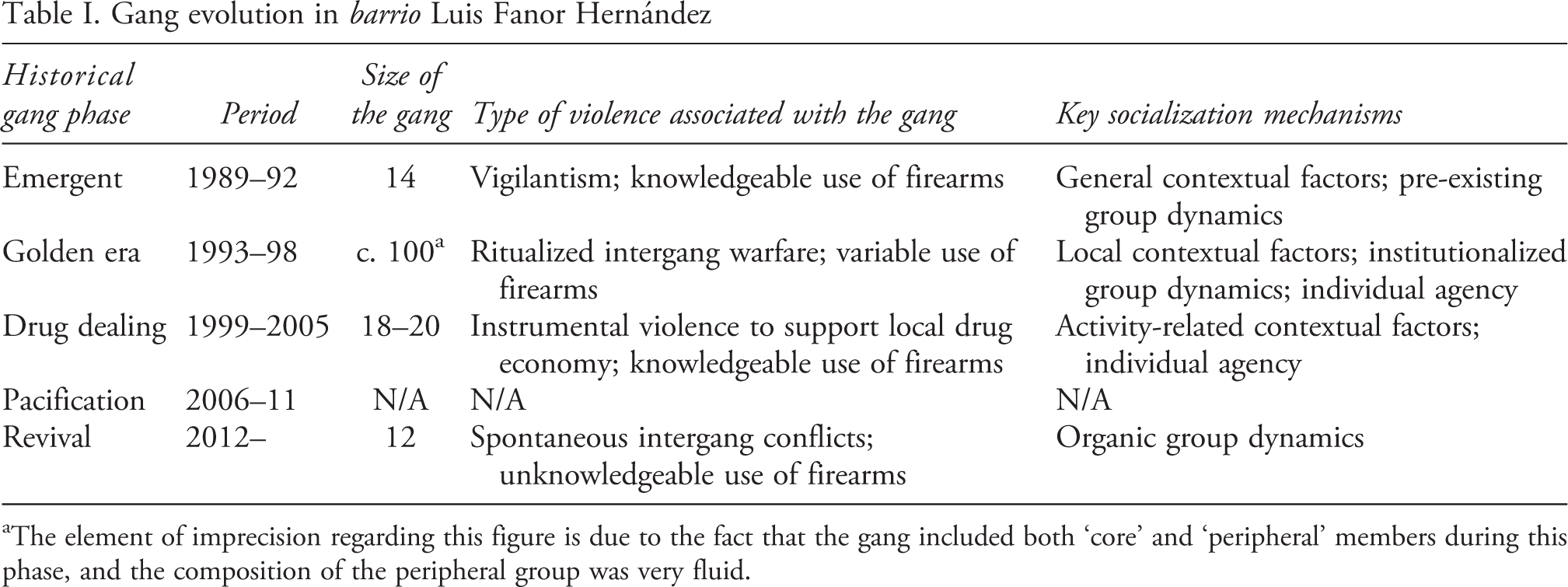
aThe element of imprecision regarding this figure is due to the fact that the gang included both ‘core’ and ‘peripheral’ members during this phase, and the composition of the peripheral group was very fluid.
The different phases of the gang’s evolution, and in particular its changing patterns of violence, can clearly be related to distinct processes and mechanisms of gang socialization encompassing individual agency, different types of group dynamics and varyingly influential contextual factors, as Table I highlights. For example, the vigilante violence of the first post-1990 iteration of the barrio Luis Fanor Hernández gang was clearly directly connected to the fact that most of its members were demobilized Sandinista Popular Army conscripts. The core of the gang was a group of eight youths aged between 18 and 20 years old who were demobilized more or less simultaneously in 1989. They began to hang out together on a neighbourhood street corner, along with four slightly older youths aged between 20 and 23 years old, three of whom had also been conscripts, as well as two younger individuals aged respectively nine and ten years old who gravitated to the group for idiosyncratic reasons (see Rodgers, 2016). This group was quickly labelled a ‘pandilla’, both by its members and inhabitants of barrio Luis Fanor Hernández more generally, particular once the members of the group began to engage regularly in a range of violent activities. Most of the time these involved beating up individuals who had robbed, attacked or threatened the friends or family of gang members, something that happened frequently in the post-war context of heightened flux and uncertainty that characterized Nicaragua in the early 1990s.
The impulse for this particular pattern of violence was clearly related to the ex-conscript nature of gang members. Certainly, all the members of the gang from this period whom I interviewed systematically highlighted three basic reasons for forming a gang and acting as they did, all of which were directly related to their ideological experiences as conscripts. Firstly, the change of regime in 1990 had led to an abrupt reduction of their social status. Their role as conscripts ‘defending the nation’ and ‘the Revolution’ had previously been held in very high esteem in their community, and forming a gang and being violent had offered them a means of reaffirming their status vis-à-vis a wider society that seemed to forget them very rapidly in the post-conflict period. Secondly, becoming gang members had been a way for them to recapture some of the adrenaline-charged energy of war, while also reconstituting a comradeship and solidarity reminiscent of their wartime experiences as conscripts. But perhaps most importantly, they saw becoming gang members as a natural continuation of their previous role as soldiers. The early 1990s had been highly uncertain times, marked by political polarization, violence and spiralling insecurity, and these youths felt they could better ‘serve’ their families and friends by joining a gang than attempting to ‘protect’ them as individuals (see Rodgers, 2006: 283–284). From a socialization perspective, then, the first generation of post-conflict barrio Luis Fanor Hernández gang members had clearly been collectively ‘pre-socialized’ into their distinct pattern of violence due to the group’s experience of conscription as well as, more indirectly, general contextual factors in the form of their general experience of Sandinista revolutionary ideology. This highlights very well the interrelation between group dynamics and contextual circumstances, which also included more contingent ones in the form of the local ambient chronic insecurity.
From 1992 onwards, however, the ex-conscript members of the first postwar iteration of the barrio Luis Fanor Hernández gang began to ‘mature out’ of the gang.
9
They were replaced by new members who had no military background or significant experiences of Sandinismo, and moreover after 1994 no direct link to the first generation of ex-conscript barrio Luis Fanor Hernández gang members. Yet, the vigilante norms and practices of previous gang members continued to influence new members due to a transformation in the way that contextual factors such as Sandinista revolutionary ideology were internalized by gang members. Rather than being based on gang members’ ideological experience of ‘defending the Nation’ and ‘the Revolution’, the barrio Luis Fanor Hernández gang’s vigilante impulse became linked to a local contextual sense of belonging to the neighbourhood, as became clear during a conversation I had one morning in October 1996 with a gang member called Julio. I came across him as he was cleaning up graffiti from the 1980s, which extolled the virtues of the Sandinista youth organization; a person or persons unknown had crudely painted it over in bright red – the colours of the anti-Sandinista Constitutionalist Liberal Party – the night before. As Julio angrily berated the ‘hijos de la setenta mil putas’ (‘sons of seventy thousand whores’) who had done this, I initially assumed that this was an exemplification of his Sandinista sympathies, but it quickly became apparent that he saw this act of vandalism less as an attack on Sandinismo and more as a desecration of a material manifestation of barrio Luis Fanor Hernández’s identity: Those jodidos [assholes] don’t respect anything in the neighbourhood, Dennis, nothing! OK, so they don’t like Sandinismo, that’s how it is, I don’t like their politics either, but this is more than just a Sandinista pinta [graffiti], it’s a part of the neighbourhood history. Our history, bróder! It’s something that belongs to the community, to all of us; it shows us who we are, where we come from, how Sandinismo built our houses and made us into a community. It shows what the neighbourhood is, and people should therefore respect it, whatever their political opinions.
Gang warfare was in and of itself clearly constitutive of both the gang group and individual gang members, as the latter were collectively socialized through combat, learning to fight for and with each other, as well as from each other, with younger gang members in particular learning from the actions of older ones. This meant that rather than deriving from a ‘pre-socialized’ group sharing a life trajectory of conscription, the gang’s violence became institutionalized into the group’s dynamics, and it was not necessary for new members to have shared prior experiences in the same way that the first wave of conscript-gang members had. To this extent, gang violence responded to a different socialization configuration, one that still combined group dynamics – but newly institutionalized rather than pre-existing – and contextual circumstances – but purely local rather than ideological.
At the same time, the gang’s violent practices also owed much to the fact that the two younger members of the first iteration of the barrio Luis Fanor Hernández gang had remained as members of its second incarnation. In particular, Milton and Bismarck played an active role in facilitating the practical transmission of certain types of violent practices that were directly linked to the conscript experiences of the first postwar generation of barrio Luis Fanor Hernández gang members, including more specifically those concerning the use of firearms. Guns have of course long been associated with gangs; as Arendt (1969: 4) famously pointed out, violence ‘always needs implements’. The use of firearms, however, requires specialized knowledge; guns are by no means intuitive, as a former gang member called Jorge highlighted during the course of an interview in 2012, when he recounted the first time that he had tried to use a gun in the early 1990s: I was 13–14 years old […] The gun was my father’s, he’d brought it back from military service after the war. He kept it locked in a drawer, but whenever he’d get drunk, he’d take it out, and wave it at the neighbours, pretending to shoot them. One day, I broke into the drawer and took the gun, you know, to go and mug somebody. I’d been hanging around with the gang, you see, and the day before one of them got a really nice pair of Nike shoes by pulling a gun on some rich kid, and I thought ‘why don’t I get myself some nice shoes too’, and so went to the Colonia Las Condes with the gun to find somebody to hold up. It didn’t go as planned, though, as the guy I tried to rob refused to give up his shoes. When I tried to shoot him, nothing happened, because the safety catch was on! I was so dumb, I didn’t know that guns had safety catches then, and so I just dropped the gun and ran away, because he was much bigger than me. I can laugh about it now, but I was scared shitless […] You know what the worse thing was, though? I lost the gun, and so my father really beat me up afterwards […] Today I was interviewing Milton when he suddenly interrupted our conversation to summon over Chucki, who was passing by. ‘Oye Chucki,’ he shouted, ‘venivé, I want to show you something.’ Chucki duly sauntered up to us, only to be knocked hard to the ground when Milton sucker-punched him in the balls. Writhing in pain, Chucki screamed ‘why the fuck did you do that, hijuéputa?’, to which Milton coolly replied, ‘because you’ve got to learn, maje, you’re new to the gang and you don’t know anything yet.’ He then turned to me, and said, ‘ves, Dennis, that’s how you teach the young ones. They’ve got to learn how to take it and to be prepared for anything. Otherwise they don’t last long. That’s how I learnt after I joined the gang, from the older bróderes (brothers) – they taught me how to fight, how to defend myself, all that kind of stuff […] Now that I’m one of the older guys and I know what I’m doing, it’s my job to teach the new guys […]
Indeed, in an interview in 2002, Bismarck explicitly linked the rising number of accidents to weapons becoming increasingly defective due to lack of care, as well as the fact that gang members did not always understand how to use their weapons, often unintentionally shooting themselves or others. ‘Gang members nowadays don’t take proper care of their weapons, so they’re breaking down all the time, sometimes even blowing up in their face,’ he told me, before then going on to discuss the case of a young gang member who had recently shot himself in the foot: He had no idea what he was doing. He’d got this pistol, and thought that made him a poderoso (big man), but you know, you’ve got to know how to use a gun to be able to do something with it. He shot himself because he put it in his belt without the security turned on […] The problem was that he hadn’t had proper training, because there’s nobody left in the gang who really knows, and so he’d only half understood things, or hadn’t been told properly, and that’s why he shot himself. [The Army is] where I learnt to use firearms, the AK-47, the sniper rifle, the RPG – which is a rocket-launcher – all kinds of weapons! I had classes, it was like school, and they taught us to shoot, to strip and clean our weapons, and there were also exams. I can strip and re-assemble any kind of weapon – I know everything, I tell you! The basic weapon in the Army was the AK-47, but because I could shoot really well, I became a sniper, and so used a special rifle. I went and trained in Martinique and Marie-Galante, they’re French islands, and I trained with the French Army and also the Venezuelan Army […] All of this helped me when I came back to the neighbourhood afterwards […] During my service I’d come back every 15 days, and whenever I came, all the bróderes would say, ‘bring me a gun, mon, bring me an AK’, but I’d just say to them, ‘oye maje, do you know how to use a gun?’ I’d tell them that I wasn’t going to bring anything if they didn’t know how to take care of their guns, if they couldn’t strip and re-assemble them. I told them that they needed to learn all of this, and so they asked me to teach them. So after a while, I brought back an AK-47 and taught them all, in groups of five […] You see, an AK-47 isn’t complicated, but there’s a specific order you have to follow to strip it in order to be able to clean it. The first thing you do is release the magazine catch, then you remove the magazine, then you cock the rifle, and – then – you take off the receiver cover and the recoil mechanism […] Then you remove the bolt carrier and then the bolt, and then you release the catch on the right side of the rear sight, and take off the hand guard, and then all that’s left is the skeleton, which you clean. Afterwards, to re-assemble it, you just put everything back together in the reverse order.
These contextual circumstances, however, changed quite rapidly due to the evolution of drug dealing in barrio Luis Fanor Hernández, and more specifically its professionalization. By 2005, the local drug economy was being run by a cartelito which sought to suppress the barrio Luis Fanor Hernández gang, as a potential rival for the local monopoly over violence. In 2006, after a series of confrontations that left several gang members critically injured and one dead – executed ‘as a warning to the others’, as a member of the cartelito called Mayuyu put it in an interview in 2012 – the gang effectively ceased to exist as a collective unit in barrio Luis Fanor Hernández. Former and wannabe gang members were actively ‘de-socialized’ from becoming involved in violence by cartelito enforcers who would regularly patrol the neighbourhood and intimidate them.
From 2009 onwards, the cartelito reduced its involvement in local drug-dealing activities, refocusing instead on drug trafficking, which opened up a space for a barrio Luis Fanor Hernández gang ‘revival’, as the cartelito no longer sought to dominate the neighbourhood but rather aimed to be invisible instead. By mid-2012, a group of a dozen 14–15-year olds had organically come together, regularly hanging out on local street corners, effectively (re)occupying the sociospatial vacuum left by the cartelito’s withdrawal. This group’s patterns of violence were much more ad hoc and circumstantial, but rapidly became regular. In July 2012, for example, the new gang attacked a local rival gang in a nearby neighbourhood with machetes and a home-made handgun in a manner reminiscent of the gangs in the mid-1990s. Although they were repelled, with several individuals being injured – one due to the handgun exploding in his hand when he tried to shoot it – this event led to the beginning of a perception in barrio Luis Fanor Hernández that ‘the gang is back’, as an inhabitant called Doña Yolanda put it.
Interviews with members of this new gang, however, suggested that the motivation for attacking the other neighbourhood’s gang had been one individual seeking revenge for a personal slight rather than any territorial impulse, and when I tried to explain something of the neighbourhood gang history to one of the new gang members called Ronnie, he rapidly cut me off, saying ‘who gives a shit about what those old guys did?’ To this extent, the new gang’s violence was arguably underpinned by a different form of socialization to the past. More specifically, it seemed to be related to the organic emergence of a tight-knit peer group and associated adolescent practices, and can be said to have represented yet another different iteration of socialization into violence through group dynamics. The patterns of violence that this more organic form of group socialization led to were clearly much less durable than those based on the pre-existing group dynamics of the early 1990s or the more institutionalized ones of the mid-1990s, since when I returned to barrio Luis Fanor Hernández in 2014, the new gang had dissipated after several of the youth involved found regular employment and were no longer able to hang out with the group. This was also the case in 2016, although the lack of a new gang seemed to be largely due to increased police repression, a contextual factor that was clearly structurally equivalent to the cartelito’s crushing of the gang in 2006. At the same time, new forms of virtually organized collective violence were also in the process of emerging, although their dynamics seemed to relate first and foremost to a changing local sexual political economy rather than any form of group socialization (see Rodgers, 2017).
Conclusion
This article has sought to explore the various ways in which gang members in barrio Luis Fanor Hernández, a poor urban neighbourhood in Managua, the capital city of Nicaragua, have assimilated norms and practices of violence over the past two decades. It has shown how different types of violence can be related to distinct forms of socialization, and traces how some of these changed over time, often for very contingent reasons, but also how there existed continuities and connections between different forms of socialization and violence. At the same time, distinctions could clearly be made between types of socialization based on specific forms of individual agency, others derived from collective group dynamics, while yet others related to broader, more contextual factors. This is important because there is a sense in which socialization processes are often considered rather monolithically. This is certainly the case of gang socialization, which is often viewed as a singular event rather than a process (see e.g. Vigil, 2002; Melde & Esbensen, 2011). The material presented above on the barrio Luis Fanor Hernández gang suggests instead that socialization – as Checkel (2017) argues in his introduction to this special issue – is a multilayered process that articulates together different mechanisms and process of socialization in a contingent and constantly evolving manner.
The evolutionary trajectory of the barrio Luis Fanor Hernández gang also illustrates how different gang member generations since 1990 dynamically experienced different configurations of socialization where individual agency, group dynamics and contextual factors interrelated in variable ways. While the latter two forms of socialization can be broken down into different iterations, with the distinction between pre-existing and institutionalized group dynamics or general, local and activity-related contextual factors both important to consider, it is striking how all tend to be systemic in their logic. This is in stark contrast with individual agency, which emerges as a highly contingent mechanism for socialization. At the same time, the latter often emerges as a socializing ‘bridge’ between different phases of the gang’s evolution, and as the means through which the most extreme forms of violence are transmitted. Having said this, it is striking how the barrio Luis Fanor Hernández gang’s trajectory highlights that none of these different socialization configurations institutionalized for more than a single phase. To a certain extent, this can be related to the specific nature of some of the practices of violence being socialized, including for example in relation to the knowledgeable use of firearms, which requires specific and accurate information that clearly need to be regularly re-asserted first hand across generations. In relation to contextual factors, it can also be argued that these either fostered the internalization of unsustainable norms – for example in the form of a shrinking social imaginary and individual entrepreneurial dynamics linked to drug dealing – or critical disjunctures in the local political economy – as exemplified by the rise of the cartelito. It is less clear why group dynamics do not necessarily institutionalize, except possibly in relation to demographic considerations of ‘critical mass’, although their sensibility to contextual factors is clearly a major element in explaining their volatility.
Understanding how and why socialization processes wax and wane, and why their effects are so volatile, is obviously a critical endeavour. In order to truly understand this issue, however, we arguably need a new research agenda, one which moves away from an organizational focus on gangs towards a closer study of the longitudinal individual life trajectories of gang members. Getting to grips with gang socialization arguably requires not just focusing on the processes and mechanisms through which norms and practices of violence are transmitted to individuals, but also a sense of how they shape their lives in the long term, including after they leave the gang. Indeed, the latter inevitably highlights the inherent volatility of socialization, as most youth who join a gang will eventually leave it through ‘natural desistance processes’ (Decker and Pyrooz, 2011: 16), and consequently generally resort less to violence (Rodgers & Jensen, 2015). How and why this takes place is not well understood, however. Does desistance signal a transformation in the way individuals absorb and process norms and practices related to violence? If this is the case, then does it indicate that socialization is primarily a group rather than an individual process, and dissipates once an individual leaves the group, or does it suggest that socialization is in fact not important in explaining violence and that other factors – such as rational choice and individual cost–benefit calculations (see Weinstein, 2007; Gates, 2017) – need to be taken into account? Or does it simply indicate the limits of socialization, suggesting for example that it is a time-bound process? Only by answering these sorts of questions can we open up the possibility for truly sustainable forms of violence reduction and peacebuilding.
Footnotes
Acknowledgements
Thanks to participants at the first Socialization and Organized Political Violence workshop held at Simon Fraser University, Vancouver, Canada, 12–14 September 2013, including especially Jeff Checkel and Liz Cooper, as well as to three anonymous reviewers, for useful and constructive comments.
Notes
References
Supplementary Material
Please find the following supplemental material available below.
For Open Access articles published under a Creative Commons License, all supplemental material carries the same license as the article it is associated with.
For non-Open Access articles published, all supplemental material carries a non-exclusive license, and permission requests for re-use of supplemental material or any part of supplemental material shall be sent directly to the copyright owner as specified in the copyright notice associated with the article.
