



Abstract
How does exposure to aerial bombing influence voting for the target country’s leadership? Do voters tend to punish incumbents for policy failure? These questions are relevant for understanding the target country’s postwar politics because aerial bombing remains one of the deadliest and most widely used military options for coercive bargaining. Despite the historical and contemporary relevance of these questions, there are only a few studies in the air-power literature arguing that strategic bombing produces a temporary rally effect but no subsequent political consequences other than political apathy. Most studies ignore important variation within states even though leadership responsibility can vary tremendously on the substate level. This article analyzes the effect of the 1999 NATO bombing of Yugoslavia on Serbian local elections using the difference-in-differences identification strategy and identifies the effect of airstrikes on the vote-share of Slobodan Milosevic’s regime. The results show that the regime’s vote-share is 2.6% lower in municipalities exposed to the bombing. Challenging prior studies, this finding demonstrates that retrospective voting applies to aerial bombing even in competitive authoritarian regimes.
Introduction
How does exposure to aerial bombing influence voting patterns? Do voters tend to punish incumbents for policy failure? These questions are relevant for understanding the target country’s postwar politics because aerial bombing remains one of the deadliest and most widely used military options for coercive bargaining (Pape, 1996; Horowitz & Reiter, 2001; Allen & Vincent, 2011). Existing knowledge provides few explicit predictions about the effect of aerial bombing on the incumbent’s approval in the aftermath of airstrikes, and much less about whether airstrikes shape voting patterns absent free and fair elections, as happens in electoral democracies. Most studies ignore important variation within states even though leadership responsibility can vary tremendously on the substate level (Croco & Weeks, 2016). Those studies that examine the use of aerial bombing for coercive bargaining argue that punishment strategies produce a rally effect during the operation but no tangible postwar political consequences other than political apathy (Pape, 1996; Horowitz & Reiter, 2001; Slantchev, 2003). Other studies analyze how exposure to terrorist bombings influences voting for incumbents in democracies: some argue that such bombings shore up right-wing incumbents (Kibris, 2011; Getmansky & Zeitzoff, 2014), while others provide evidence to the contrary (Montalvo, 2011).
This study improves on the existing work in several ways. It examines the 1999 NATO bombing of Serbia, which lasted for 78 days, claimed 755 lives (Humanitarian Law Center, 2014), and damaged or destroyed over 1,000 objects (Smiljanić, 2009: 72–73). The magnitude of this event exceeds average terrorist bombings, offering a unique opportunity to analyze the effect of a prolonged exposure to violence on voting. This is the case of competitive autocracy that deters domestic upheaval in the aftermath of defeat only to lose in the elections. Competitive autocracy is a non-democratic form of government in which multiparty elections are subject to frequent government manipulation through media censorship, voter intimidation, and fraud (Schedler, 2015: 1). While these regimes are non-democratic, they are also different from full-blown authoritarianism in that competitive authoritarians are unable to eliminate elections or reduce them to a formality and prefer institutional harassment to physical elimination of political opponents (Levitsky & Way, 2002). The literature finds that Milosevic’s government resembles competitive authoritarian regimes (Levitsky & Way, 2002; Schedler, 2015; Vladisavljević, 2016). Such cases as postwar Serbia are rare among non-democratic governments because military defeat usually unseats authoritarian leaders (Bueno de Mesquita & Siverson, 1995; Goemans, 2000).
Following retrospective voting theory (Achen & Bartels, 2008; Kayser & Peress, 2012), 1 this article argues that the electorate attributed the responsibility for the failure to remedy the negative economic consequences of the bombing to Slobodan Milosevic’s regime. Analyzing the results of the local elections in 1992 and 1996 versus 2000 using the difference-in-differences (DID) identification strategy, this article shows that the incumbent’s vote-share dropped in municipalities exposed to the bombing. The estimated effect of being bombed is a decrease of 2.6% in Milosevic’s vote-share; in comparison, Milosevic lost the 2000 election by a 4% margin. Furthermore, the article finds that the bombing also led to a 3.8% decline of Milosevic’s junior coalition partner, the right-wing Serbian Radical Party (SRS), showing that the incumbent suffers as a result of policy failure irrespective of its ideology. The results also show that the bombing had no effect on voter turnout, ruling out a possibility that Milosevic’s electoral decline was driven by the abstention of his voting base. Finally, this article demonstrates that the incumbent’s vote-share was not driven by either population change or immigration.
These findings contribute to the theory of retrospective voting, suggesting that accountability mechanisms might apply even in non-democratic regimes. This study also contributes to the air-power literature: while punishment strategies may not be the most effective tool of coercion (Pape, 1996; Horowitz & Reiter, 2001; Slantchev, 2003), this article shows that aerial bombings could damage the regime politically after the war. Regarding the literature on the Kosovo war, this study corroborates anecdotal evidence by Byman & Waxman (2000) that NATO’s selection of targets, aimed to undermine public support for the regime, ultimately harmed Milosevic’s electoral performance. But, contrary to Allen & Vincent (2011), who suggest that NATO’s degradation of Milosevic’s political structures weakened the regime’s ability to perpetuate electoral fraud in the affected localities, this article finds that voters punished the regime for suffering the fall-out from the bombing. Finally, this article contributes to an emerging literature on audience costs in the postwar environment (Croco, 2011, 2015; Croco & Weeks, 2016). The local effects of the bombing are under-explored in this body of work, even though they occupy a prominent place in the literature’s theories. Using a within-country research design, this article sheds more light on the mechanisms under which competitive authoritarians face punishment in the aftermath of war.
Voting in the aftermath of bombings
How does exposure to bombings affect voting for the incumbent? There are two strands of the literature that address this question: (1) general studies on the effect of war devastation on postwar public support for war-time leaders; and (2) specific studies on how terrorist bombings influence the government’s vote-share.
More general studies on war devastation and postwar public support for the incumbent arrive at inconclusive findings. While Douhet (2019: 53–54) posits that strategic bombing may ruin the morale of target population and brew into a domestic uprising against the defending government, the air-power literature counter-argues that such punishment strategies are bound to fail as affected leaders can resist the domestic political consequences of bombing (Pape, 1996; Horowitz & Reiter, 2001; Allen, 2007; Allen & Martinez Machain, 2019). The latter holds that a more intense bombing campaign boosts domestic support for the incumbent irrespective of the nation’s political system (Pape, 1996; Horowitz & Reiter, 2001: 25). For instance, the British public rallied around Churchill during the 1940 Battle of Britain while German workers continued to work in factories under heavy Allied bombing even after their disillusionment in government propaganda (United States Strategic Bombing Survey, 1947).
However, the air-power literature concurs that rallies are short-lived. For instance, President George H. W. Bush enjoyed public approval during and shortly after the 1991 Gulf War, but 18 months later he was voted out of office. A similar rally effect may have favored the Serbian leadership during the bombing and shortly after. But the elections took place 15 months after the war was over, and the rally effect could have diminished, leading the public to embrace a retrospective assessment. Indeed, previous work shows that individuals in democracies are more sensitive to rises in war losses at local level than at national level (Gartner, Segura & Wilkening, 1997; Gartner, 2004; Gartner & Segura, 2008).
Moreover, there is evidence of a shift in support for wartime leaders even in non-democratic contexts. Driscoll & Maliniak (2016), for instance, find that Georgian respondents who lived in close proximity to areas impacted by the 2008 Russo-Georgian war had a more negative opinion of Saakashvili’s regime. The electorate may, therefore, punish or reward leaders for their involvement in a war. Culpable leaders – senior state officials perceived to be responsible for the results of war – are particularly vulnerable to evaluation (Croco, 2011, 2015). Those who handle the war badly are sending a signal to their electorate that they are incompetent at selecting and prosecuting wars (Croco & Weeks, 2016). Mishandling or losing wars might damage the public support for the culpable leader in those areas where the population has suffered the most. Failure to protect the population from violent death and material destruction should influence public opinion more than government attempts to transfer culpability to their foes.
Some of these findings concerning democracies are echoed in the second strand of the literature on terrorist bombings and electoral politics. One segment of this literature finds that terrorist bombings favor the opposition parties in the elections. Bali (2007) and Montalvo (2011) show that the 2004 Madrid bombings mobilized pro-left opposition voters against the government. Another segment of this literature employs valence theory, which posits that terrorist bombings tend to empower right-wing parties at the ballot box as they might be viewed as more competent in dealing with terrorism (Berrebi & Klor, 2008; Kibris, 2011; Getmansky & Zeitzoff, 2014). Kibris (2011) shows that the electorate rewards the Turkish nationalistic parties following attacks by Kurdish militants against the police. In the context of the Israeli–Palestinian conflict, Getmansky & Zeitzoff (2014) show that being in range of rocket attacks increases the share of right-wing votes both for the opposition and government. However, there is also evidence that bombings are likely to harm the incumbent’s vote-share for failing to protect the population, as retrospective voting theory would expect (Montalvo, 2011).
Following retrospective voting theory, this study argues that voters might scrutinize the incumbent’s performance retrospectively in the aftermath of aerial bombing even in a non-democratic context (Achen & Bartels, 2008; Kayser & Peress, 2012). In democracies, voters tend to evaluate the government’s economic performance one year prior to the election (Arnold & Samuels, 2011), so governments could attribute misfortunes to the enemy, and exploit casualties for the rally effect (Pape, 1996). But these attempts may fail to win over the population that was exposed to such a devastating event as aerial bombing. Voters might observe negative results from the bombing (for example, high inflation, poverty, and unemployment) and remedial policies enacted by the incumbent (Healy & Malhotra, 2013). Once the affected electorate has formed its opinion about the incumbent, it may seek to attribute responsibility for war effects to particular officials in power. In democracies, voters may translate their competence assessment into voting decisions, punishing poor performers in elections, seeking leaders that would be most competent for the job or falling prey to their own cognitive and emotional biases (Healy & Malhotra, 2009). The electorate might seek to replace the culpable leader in order to prevent them from repeating the mistake and deterring prospective leaders from similar reckless behavior (Bueno de Mesquita & Siverson, 1995). A largely overlooked possibility is that aerial bombing may expose competitive authoritarian leaders to similar scrutiny. 2 For these leaders, elections serve as the most effective tool to allocate the spoils of office among members of the elite (Gandhi & Lust-Okar, 2009). 3 Elections provide a legalistic façade to this process and legitimize the regime (Levitsky & Way, 2002). Competitive authoritarian regimes are essentially non-consolidated regimes that organize and compete in multiparty elections with a possibility of losing at the ballot box (Schedler, 2015). Therefore, winning elections is a priority in order to avoid elite defections and opposition unification (Reuter & Gandhi, 2011).
While such elections are fraught with irregularities, using electoral fraud may be insufficient to stay in power as many incumbents have learned in Yugoslavia (2000), Georgia (2003), Ukraine (2004), and Kyrgyzstan (2005). To ensure regime survival, the regime must provide public goods and services even in more authoritarian contexts such as Algeria, Egypt, Jordan, and the Palestinian territories (Lust-Okar, 2009). The control over these resources often tilts votes in favor of incumbents as voters seek to remain sufficiently close to the regime to reap patronage benefits (Gandhi & Lust-Okar, 2009: 408–409). The opposition voters, too, may not be immune to such distributive policies even if it means no change in power (Gandhi & Ong, 2019). Thus, failure to provide employment, timely salaries, and pensions may undermine state patronage networks and, ultimately, deplete public support for the regime.
This study argues that airstrikes disrupt these essential services, and that, in turn, voters will tend to punish competitive authoritarians in the elections. This article contributes to understanding the link between airstrikes and voting in several important ways. First, aerial bombings overshadow terrorist bombings in durability and magnitude allowing for a more direct test of the effect of violence on voting patterns. Second, the focus on a competitive authoritarian context sheds light on potential political changes in nearly one-third of the countries with formal yet rigged elections. 4 This theory does not seek to explain how aerial bombing affects leadership tenure in full-blown autocracies such as Nazi Germany, Imperial Japan, North Korea, North Vietnam, or Iraq under Saddam Hussein because the government either does not organize elections or there is no de facto competition (Lührmann, Tannenberg & Lindberg, 2018). Third, the article applies the DID empirical strategy to analyze the impact of the bombing on voting on the municipal level. The benefit of the focus on municipalities is that it captures where the regime is becoming vulnerable by analyzing how its electoral performance varies over space.
Political context
The dissolution of socialist Yugoslavia in 1991–92 heralded the emergence of parallel institutions in Kosovo under Ibrahim Rugova, a key Albanian political leader, in opposition to the nullification of Kosovo’s political autonomy within Serbia, one of Yugoslavia’s federal units. Following the 1995 Dayton Peace Agreement, Rugova’s nonviolent approach was challenged by the militant Kosovo Liberation Army (KLA), which launched attacks against Serb civilians and police stations in Kosovo. Initially, the United States tacitly supported the Yugoslav government against the KLA (Woodward, 2007). However, sporadic clashes had erupted into a full-blown insurgency by 1998, and the White House changed course, putting pressure on the warring sides to accept a ceasefire. After a US-brokered ceasefire deal failed (Crawford, 2001: 500), Western powers forced both sides to show up at the Rambouillet peace talks in early 1999. The talks broke down after the Serbian delegation refused to sign the final document that envisioned the stationing of NATO troops in the province as well as the right to a referendum vote within three years.
On 24 March 1999, NATO intervened on the KLA side and launched airstrikes against the Yugoslav military, factories, transport and communications infrastructure, and government buildings. On 9 June 1999, the Yugoslav military representatives signed the Kumanovo Treaty, agreeing to withdraw their forces from Kosovo in return for the cessation of the bombing and stationing of NATO troops in the province. The conflict officially ended on 10 June 1999 with the adoption of UN Resolution 1244, which granted the deploying NATO troops a UN mandate and confirmed the sovereignty and territorial integrity of the Federal Republic of Yugoslavia, while also emphasizing ‘a political process designed to determine Kosovo’s future status’ (UN, 1999).
The NATO bombing dealt a strong blow to Yugoslavia’s economy. Industrial production went down by 21% in 1999 compared to 1998, and by 40% compared to 1989 (Teodorović, 2000). Dozens of factories were either damaged or destroyed, including some owned by Milosevic’s close associates (Hosmer, 2001: 67). NATO hit the country’s two biggest oil refineries in Pancevo and Novi Sad, and the Zastava car factory in Kragujevac, which employed around 15,000 workers, as well as chemical, cigarette, drug, shoe, and light aircraft factories (Dobbs, 1999). The destruction of the industry left 230,000 workers jobless, with a further two million affected by this loss of employment (Teodorović, 2000). A group of 17 independent Yugoslav economists found an estimated $3.8 billion in direct damage excluding Kosovo, a formidable amount for a country under Western sanctions (Vreme, 2000). This report also found that Milosevic’s government allocated $191 million to reconstruct bridges, roads, military, and industrial objects, mostly from Chinese loans. The government managed to reconstruct 35 bridges, replenish 15% of the electric power infrastructure, and recover 3.8% of the communications infrastructure (Vreme, 2000). At this pace, the government would have needed at least 15 years to restore its economy to its pre-bombing level (Hosmer, 2001: 68).
The destruction of the economy had a negative impact on the overall quality of life. According to an opinion poll from August 1999, the majority of respondents were afraid of permanent blackouts, loss of income, and rampant inflation (Milovanović, 1999). The collapse of the electric grid system led to blackouts and cold homes in the winter of 1999 (Komlenović, 1999). An average salary declined by 34% (Teodorović, 2000), while the inflation rate was the worst since the 1993 hyperinflation. The government ran out of money for pensioners – its core base of supporters in previous elections – who went on strike shortly after the end of the bombing (OCHA, 1999). Moreover, the government owed salaries to army reservists who set up roadblocks in protest (Glas Javnosti, 1999). The regime introduced price controls and levied a 2% tax to alleviate national defense costs – measures that would hit the remaining small business owners (Brkić, 1999a).
Some studies highlight the crippling impact of these economic consequences on the regime’s public approval, forcing Milosevic to cave in to NATO’s demands (Byman & Waxman, 2000; Hosmer, 2001); other studies emphasize the damage dealt to the group of individuals that fueled Milosevic’s hold onto power as a major reason for Belgrade’s decision to concede (Gray, 2001; Lambeth, 2001). Among the latter, Allen & Vincent (2011) suggest that the degradation of the ruling party’s headquarters, pro-government TV and radio stations, and police forces may have weakened Milosevic’s capacity to hold onto power. This theory rests on an assumption that Milosevic did not require mass popular support as he depended on a small coterie of economic elites.
However, existing anecdotal evidence shows that none of the regime’s key members defected from Milosevic and that the repression accelerated after the bombings. While the NATO attack on the USCE business building, a headquarters of companies owned by Milosevic’s family members, friends, and close political associates, harmed the interests of his close circle of loyalists, the regime offset the damage through illegal activities. The government distributed concessions for a state-sponsored heroin, cigarette, and gasoline transnational smuggling network to politicians, businesspeople, and security officials (Vasić, 2006). This might explain why the regime’s leading figures remained loyal until Milosevic’s electoral demise. Moreover, the degradation of the police forces did not weaken the regime’s capacity for repression. On the contrary, state repression was much deeper compared to the pre-bombing period and included blatant censorship of the remaining pro-opposition media; the harassment of academic staff, including many scholars of international repute; and political assassinations (Antonić, 2001). If the regime’s reliance on its inner circle and repressive apparatus remained stable post-1999, then the subsequent political shift was due to the economic fall-out from the bombing.
This article paints a picture of the incumbent faced with a difficult economic situation but lacking policies to remedy the economic fall-out. Owing to the bombing, the provision of public services was severed. These conditions are favorable to retrospective voting, which expects voters to seek to reduce moral hazard on the part of the incumbent by punishing the ruling parties at the ballot box.
Research design
The NATO bombing of Yugoslavia, which lasted from 24 March 1999 until 10 June 1999, was the largest air campaign in Europe since the bombing of Britain and Germany in World War II. The air raids lasted for 78 days and hit 108 out of 160 municipalities, excluding Kosovo and Montenegro. As Figure 1 shows, the bombing was spread out and largely aimed at military barracks, industrial facilities, transportation networks, and communication lines.
This article uses a novel dataset with information on over 1,000 targets in the Federal Republic of Yugoslavia, including the date, location, target type, and fatalities.
5
It is one of the most comprehensive and precise datasets on the NATO bombing of Yugoslavia.
6
The dataset was Bombing events (dots), major Serbian towns (squares with labels), and municipal boundaries (lines)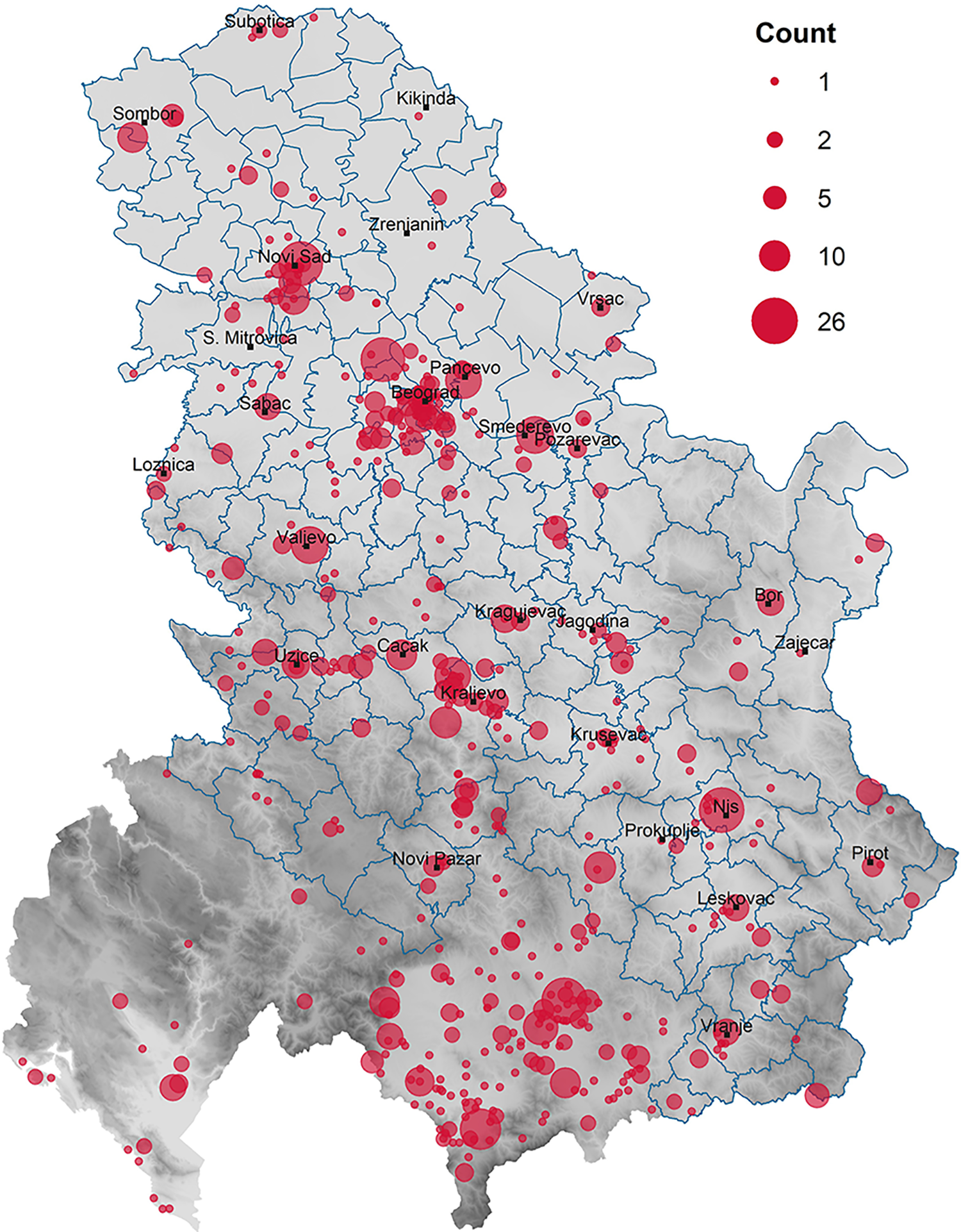
While the dataset does not necessarily include the universe of all strikes, the level of under-reporting is restricted to targets in Kosovo and especially attacks on military forces. The under-reporting in Kosovo originates from limited media presence in the province since the outset of the conflict. Because Kosovo is excluded from the analysis, this issue does not affect the results of this study. The under-reporting of attacks on military units is due to restricted access to the placement of Yugoslav security forces in the field, as well as their mobility in attempts to avoid NATO strikes. Some of these attacks were not reported by the media, while others were reported but lacked information on the exact location. In the latter’s case, the media vaguely referred to strikes in a ‘wider area’ of a region. Such cases were omitted from the analysis. Fortunately, such occurrences were rare, less than ten or equivalently less than 1% of all strikes, and I was able to pin down a few unreported locations using the HLC database of casualties. Any remaining bias from the omission of strikes on military forces may not necessarily affect the inference because the focus of this article is on the bombing events that directly impact on the lives of voters.
The voting data
In the 1990s, elections in Serbia were held for assembly, presidency, and local councils at the federal, state, and local level, using the majoritarian or proportional electoral systems. Milosevic and his Socialist Party of Serbia (SPS) usually ran alone or in coalition with the Yugoslav Left (JUL), the party of Milosevic’s spouse Mirjana Markovic. The opposition was roughly split into a right-wing Serbian Radical Party (SRS), and the democratic bloc composed of the Serbian Renewal Movement (SPO) under Vuk Draskovic, Democratic Party (DS) headed by Dragoljub Micunovic and Zoran Djindjic, the Civic Union of Serbia (GSS) under Vesna Pesic, and the Democratic Party of Serbia (DSS), a DS offshoot, presided by Vojislav Kostunica. These parties were the core members of the democratic bloc although coalitions would come and go by electoral cycle. 7 Because SRS defected to the regime twice – after the 1992 and 1997 elections – the democratic bloc was ultimately the main challenger to Milosevic. Analyzing electoral support for the Milosevic regime, therefore, requires that the democratic bloc ran in elections. This occurred in the 1992 general elections on all levels, the 1993 state assembly elections, the 1996 local elections, and the 2000 general elections on all levels. 8
Another important condition for sample selection is that the voting system is more or less consistent across electoral cycles, so that the vote-share can reasonably be modeled. Federal and state presidential elections could be the closest proxy for electoral support for Milosevic because of direct voting for the leader. Milosevic ran three times in presidential elections: he was a candidate in the 1990 election, and the incumbent running for re-election in the 1992 and 2000 elections. The opposition united around its candidate twice, in the 1992 and 2000 presidential elections, 9 but these were held on different levels.
The local elections offer the most consistent sample in terms of the democratic challenger and voting system. There is a total of three local elections (1992, 1996, and 2000) in which the united opposition participated under a majoritarian system. Except for the 2000 election, which used simple plurality, the local elections were based on run-off voting. This article accounts for this discrepancy by analyzing the results from the first round of each local election. This approach is also reasonable given the electoral fraud in the second round of the 1996 election that triggered nationwide antigovernment protests. Therefore, the main dependent variable is Vote and measures the vote-share for the party of Slobodan Milosevic in the local elections (1992, 1996, and 2000). Additional dependent variables, the vote-share for SRS as well as the Serbian democratic opposition, are measured in the identical fashion. Vote is transformed from percentages into a continuous measure, ranging from 0 to 1.
Elections under Milosevic entailed robust competition and participation, which was accompanied by fraud, intimidation, and restricted access to state-owned media for the opposition parties (Antonić, 2001; Goati, 2001; Pavlović, 2001). VDEM data on the free and fair elections index show that the value for Serbia for 1992–2000 is stable at 1.6–2, which indicates that Serbian elections were a host to substantial competition and freedom of participation but with irregularities that had an unclear effect on the outcome of elections.
10
Similarly, VDEM data on election management body (EMB) autonomy from government suggests that the Serbian EMB had some autonomy in the observed period, but was also partial with ambiguous influence on the outcome of the elections.
11
These characteristics suggest that the fraud and conditions for fraud did not change much over time. At the same time, Milosevic’s vote-share fluctuated in the same period, to the point that he eventually lost the election despite the fraud. Absent a straightforward way Bombing by municipality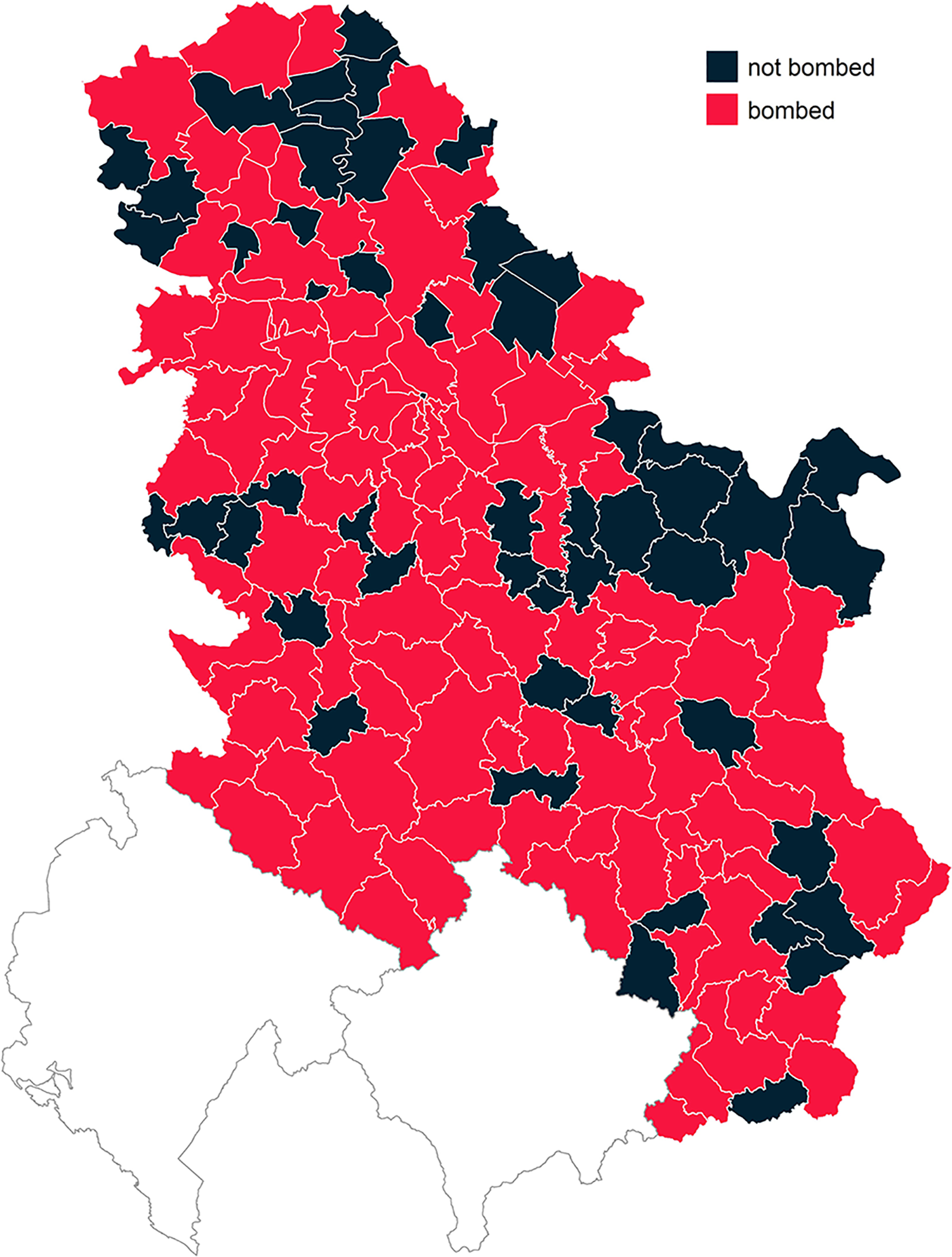
The bombing
To assess the effect of bombing on preferences, I construct a Bombed variable, indicating whether a municipality was bombed or not. Cruise missile strikes and air raids were included if the source contained information on the exact location of the incident. To determine whether an attack falls within municipality boundaries, I intersected each point coordinate with the municipality polygon using a GIS intersection function from QGIS v. 3.6.3. If the point fell within the municipality polygon, then the municipality was regarded as bombed and coded 1, and 0 otherwise. Figure 2 shows the geographic breakdown on the municipality level (108 bombed versus 52 non-bombed).
Control variables
This article follows previous research on Serbian elections in the selection of control variables. Specifically, this article controls for the developmental, economic, and demographic features of Serbian municipalities (Milanović, 2004; Konitzer, 2008). All the control variables are pre-treatment and time-invariant, as social and economic factors are very likely to be affected by bombings and introduce post-treatment bias.
First, this article uses inhabitants per medical doctor and the share of refugees as proxies for development. The Population per doctor variable measures the number of inhabitants per medical doctor of a municipality, and originates from annual publications on Serbian municipalities (Serbian Statistical Office, 1996: 348–351; Serbian Statistical Office, 2000: 336–339). This indicator is the average value for 1995 and 1998. To control for the effect of the wars of Yugoslav succession on voting patterns, this article includes the percentage of refugees in the total population of a municipality, which comes from the Commissariat for Refugees and Migration of the Republic of Serbia (2018) and is labeled Refugees (%). This measure is in decimal form, and is calculated by dividing the total number of refugees from former Yugoslavia in the period 1991–95 by the 1991 population count for every municipality.
Second, this article measures the economic status of municipalities using information on unemployment. Employed per 100,000 inhabitants indicates the number of employed individuals per 100,000 members of the active population. This proxy is the average value for 1995 and 1998 and comes from the annual publications on Serbian municipalities (Serbian Statistical Office, 1996: 112–115; Serbian Statistical Office, 2000: 100–103). Finally, this article controls for the demographics using the share of minority population and females in the total population. Minority (%) shows the percentage of non-Serb inhabitants in the overall population in decimal form, while Females (%) denotes the percentage of females in the total population. Both covariates are presented in decimal form and originate from the 1991 population census.
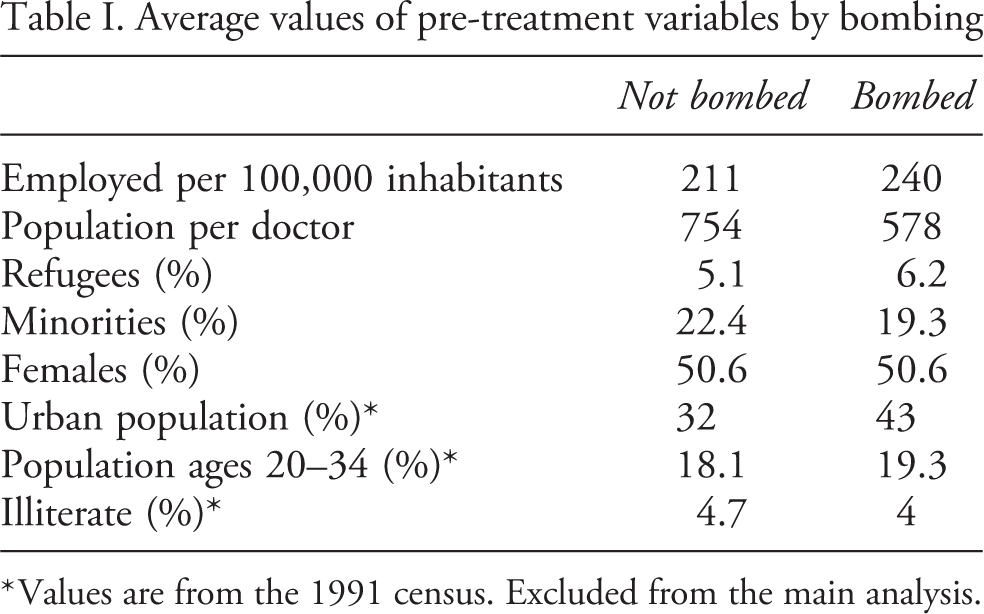
Table I displays the average values of the pre-treatment variables used to compare bombed versus non-bombed municipalities. The values are similar across the affected and non-affected communities especially regarding the demographic features (illiterate and young population, females, minorities, and refugees). Some developmental variables introduce a certain imbalance among the municipalities. The employment rate and the share of urban population are higher in bombed municipalities, but not markedly. Municipalities that experienced bombings have fewer people per doctor, implying a higher level of development. Although these variables are not perfectly balanced, many bombed municipalities are similar to non-bombed municipalities. Additional tests show little association between being bombed and the developmental variables. 12
Empirical strategy
The main identification strategy of this article is to estimate the effect of bombing by comparing the changes in electoral outcomes over time between municipalities that were bombed and municipalities that were not bombed, using the DID identification strategy. This specification estimates the effect of bombing, a non-randomly assigned treatment, by comparing the regime’s vote-share in municipalities that were bombed to municipalities that were not bombed, using pre-bombing local elections data (1992, 1996) and post-bombing elections data (2000).
The treatment in this study yields the effect on the voting that results from being exposed to the bombing. Therefore, the linear model structure is as follows:

where m denotes municipalities, g indexes groups, that is, bombed or non-bombed, and t indexes time. Y is the outcome variable, that is, the share of votes for the incumbent by municipality; A are the district fixed effects for every municipality; 13 each period has its own fixed effect, represented by B; cX are municipality-level, pre-treatment, and time-invariant controls to assure that these are not influenced by the treatment; and βI is a dummy equaling 1 for a bombed municipality in the after period (otherwise it is 0); and ε is the error term. This article estimates the parameter β. The estimate of this parameter should be negatively associated with vote-share for the incumbent in order to demonstrate that Milosevic lost votes in municipalities that were bombed compared to municipalities that were not bombed.
The DID method yields more reliable estimates if the difference between the bombed and non-bombed Adjusted linear prediction of voting for pro-government parties with mean point estimates and 95% confidence intervals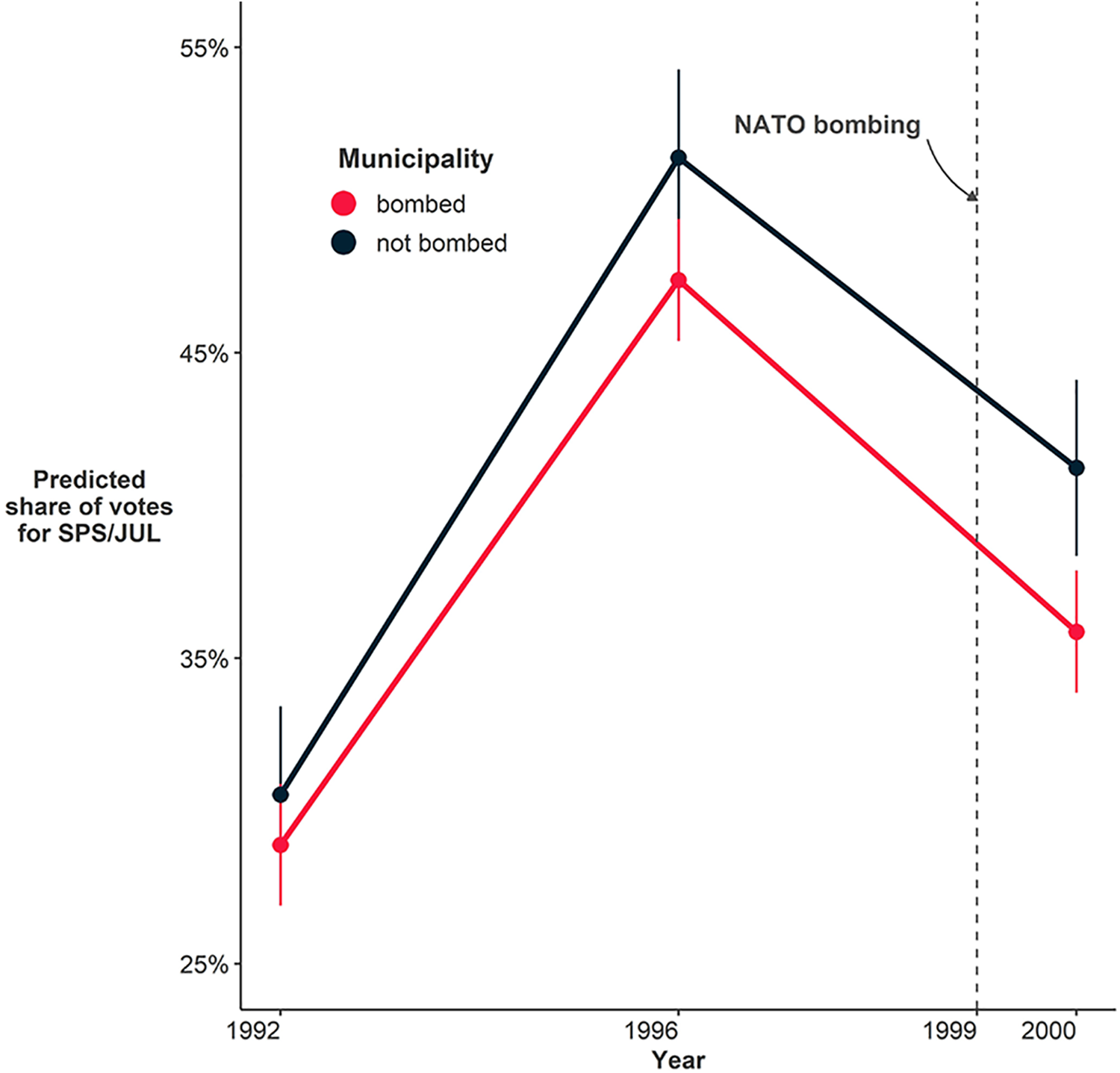
While the polls conducted by the Institute of Social Sciences corroborate a nationwide decline in public support for the regime following the 1996 protests, it was by no means a watershed moment in Milosevic’s electoral performance. In fact, Milosevic’s public approval doubled in 1998 compared to 1997 with the onset of the KLA insurgency in Kosovo and mounting Western pressure on Belgrade, 14 which could be attributed to the rally effect. It is only in the aftermath of the bombing that Milosevic’s public standing reached its lowest point. Following the emergence of the united opposition bloc in January 2000, Milosevic’s public approval slightly increased but remained short of the pre-1999 level.
Results
Main findings
Average values of pre-treatment variables by bombing
* Values are from the 1991 census. Excluded from the main analysis.
Column 3 returns to the parallel trend assumption, which is the fundamental assumption for the identification of the DID effect. To examine this hypothesis, I run a placebo experiment. I estimate the basic specification on a placebo bombing taking place in the year 1996. For this estimation, I discard the year 2000 from the data. If the parallel trend assumption holds, then the results should show that the coefficient for Bombed × Year1996 is not different from zero. Column 3 displays the results of this estimation, and the main finding is that the coefficient on the placebo bombings is indistinguishable from zero. The similarity of the coefficient estimates for controls in columns 2–3 is also present.
Retrospective voting theory expects every member of the ruling coalition to lose votes for policy failure despite their ideology. The radical party was a member of the Milosevic government on several occasions, most notably during the bombing. If the theory holds, then the radicals should also experience a drop in their vote-share and defy the alternative expectation from valence theory that right-wing parties should benefit from security salient issues even when their own electorate is exposed to violence. Table II, column 4, shows the effect of bombing on the share of votes for the radical party using the main model specification. The results demonstrate, in congruence with retrospective voting theory, that exposure to bombing has a negative effect on SRS. The radical party loses an additional 3.8% in municipalities that were bombed. Furthermore, the estimated negative effect of being bombed is not substantially higher for SRS compared to Milosevic’s party. This result demonstrates that other members of the government equally suffer at the ballot box for the failure to enact remedial policies in the wake of aerial bombing irrespective of their ideology. The democratic opposition coalition experiences a minor increase in its vote-share in municipalities exposed to bombing, but this effect is indistinguishable from zero. 15
Another possibility is, as Allen & Vincent (2011) argue, that NATO’s destruction of Milosevic’s political structures weakened the regime’s ability to pursue electoral fraud. To test this mechanism, the bombing variable is recoded to include only attacks against communications, government, and police targets. This measurement is then plugged into the full model specification from Table II. The results demonstrate no statistically meaningful effect of the coefficient measuring the targeting of political structures. 16
Changes in the composition of the electorate
Does bombing influence voter turnout?
Linear regression models (DV: Vote-share for the incumbent)
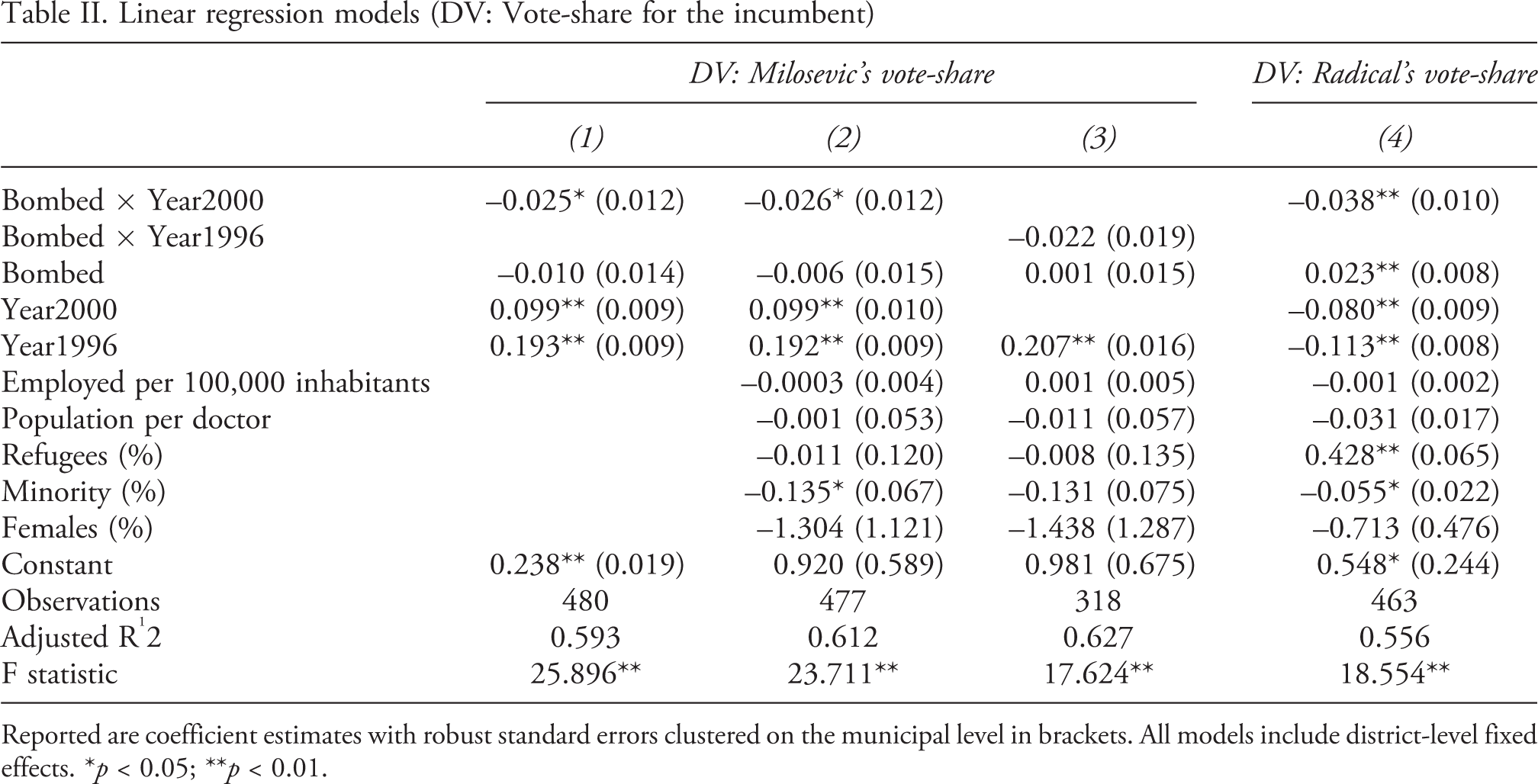
Reported are coefficient estimates with robust standard errors clustered on the municipal level in brackets. All models include district-level fixed effects. *p < 0.05; **p < 0.01.
Linear regression models of electorate changes
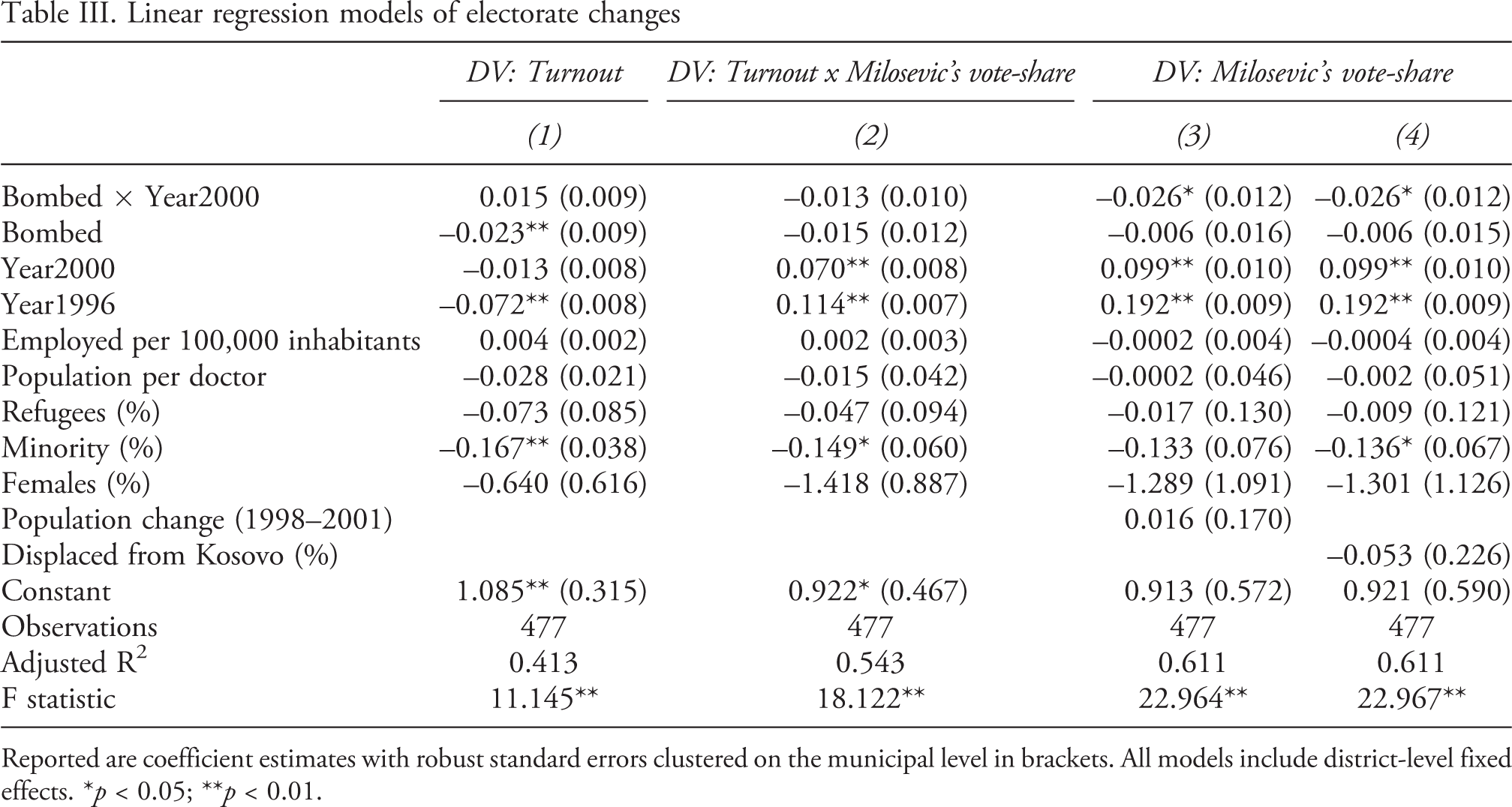
Reported are coefficient estimates with robust standard errors clustered on the municipal level in brackets. All models include district-level fixed effects. *p < 0.05; **p < 0.01.
This finding, nevertheless, does not eliminate the possibility that residing in the affected municipality encouraged abstention among the pro-Milosevic voters. The bombing could have led to changes in the turnout among Milosevic’s supporters, resulting in a lower vote-share. To rule out this possibility, the model should have no effect on turnout and Milosevic’s vote-share combined. I re-estimate the main specification using the share of votes for Milosevic multiplied by voter turnout as a dependent variable. Column 2 reports the effect of being bombed on Milosevic’s vote-share multiplied by voter turnout. The coefficient estimate for being bombed is again positive but not different from zero, indicating that the bombing did not affect the voter mobilization of Milosevic’s supporters.
Is Milosevic’s vote-share affected by population change?
Another potential objection to my argument could be that the composition of the municipal population shifts in the aftermath of the bombing, affecting the vote-share for the incumbent party. For example, a proportion of elderly persons who were identified as Milosevic’s staunchest supporters might have died between 1998 and 2000. Additionally, there could have been an inflow or outflow of municipality residents in the same period, changing the composition of the electorate. Apart from accounting for the refugee influx in the follow-up to the bombing, my previous estimations do not consider this possibility.
To rule out the possibility that population change rather than the bombing influenced the incumbent’s vote-share, there should be no statistically meaningful relationship between population change and Milosevic’s vote-share. I account for this possibility using the percentage change in municipal population between 1998 (one year prior to the bombing) and 2001 (one and a half years after the bombing). Information on the population for 1998 is an official estimate of the Serbian Statistical Office, taking into account the natural change of the population (Serbian Statistical Office, 2001: 93–97), while the 2001 data originate from the 2002 census. Column 3 in Table III reports the regression results of the main specification with an estimate for population change. The coefficient for population change is small and positive but not different from zero. In contrast, the effect-size of the bombing coefficient estimate shows that municipalities exposed to bombing experience a 2.6 percentage point decrease in the incumbent’s vote-share.
Accounting for the effect of net migration on the incumbent’s vote-share is more difficult because Serbian authorities did not publish information on resident movement for the observed period. While the movement of Serbians outside of their municipal residence to a foreign country was strongly limited due to Western sanctions during the period 1998–2000, there is no information about the intermunicipality movement other than an observation that rural population gravitates toward towns. The only publicly available information on movement of people concerns the influx of internally displaced persons (IDPs) from Kosovo in the aftermath of the bombing. The data on 187,302 IDPs was compiled by the Commissariat for Refugees and Migration of Serbia in 2000 and is broken down by municipality (Commissariat for Refugees and Migration of the Republic of Serbia, 2018). The use of these data rests on a strong assumption that IDPs from Kosovo constitute the major population inflow. The expectation of my theory is that this effect does not affect voting patterns. I measure Displaced from Kosovo (%) as the percentage of the IDPs in the total population for every given municipality. This covariate is included in the main specification in column 4 of Table III. The results show that the coefficient estimate for IDPs has a small, negative, but non-substantial effect on the incumbent’s vote-share. Simultaneously, both the direction and effect-size of the bombing coefficient are preserved: municipalities exposed to bombing experience a 2.6% decrease in the pro-government vote-share.
Taken together, these results produce several implications. First, there is evidence that incumbents are punished for policy failure when their constituency is exposed to aerial bombing because Milosevic’s vote-share dropped in the 2000 election compared to the 1992 and 1996 elections. Second, any member of the incumbent coalition irrespective of their ideology will also lose votes. The radical party experienced a drop in vote-share despite being a right-wing party. Third, alternative mechanisms are ruled out: the bombing does not have a statistically meaningful effect on turnout and proxies for population change are not associated with the incumbent’s vote-share. These results are consistent with retrospective voting theory: the incumbent is poised to lose votes if they fail to remedy the negative consequences of aerial bombing.
Conclusion
This study investigates whether aerial bombing affects the election results of competitive authoritarian regimes by modeling the vote-share for Slobodan Milosevic’s regime both before and after the 1999 NATO bombing. The bombing of Serbia provides an unparalleled opportunity to examine the public’s tolerance for paying the costs of war in a competitive authoritarian setting. This study demonstrates that competitive autocratic leaders suffer political consequences for poor war outcomes. It runs against the expectation that mixed regimes are bound to be forcibly removed in the wake of military defeat rather than at the ballot box (Bueno de Mesquita & Siverson, 1995; Goemans, 2000; Colaresi, 2004; Chiozza & Goemans, 2011). While this article does not rule out the possibility that punishment strategies are generally ineffective tools of coercion (Pape, 1996; Horowitz & Reiter, 2001), it demonstrates that aerial bombardment may harm strongmen politically in the postwar context. The results indicate that the NATO airstrikes decisively tilted Serbia’s postwar voters away from the regime, as predicted by retrospective voting theory. Perhaps most surprising, and against previously held beliefs in valence theory, the bombing also had a negative effect on the right-wing radical party. In addition, the results show that the bombing had no effect on voter turnout alone or in combination with pro-Milosevic votes. This implies that the destruction did not encourage pro-government voters to abstain at a critical time for the regime. Ultimately, the models show that certain changes in the population composition also had no effect on Milosevic’s vote-share.
The picture that emerges from this analysis is one of war bringing political changes even to authoritarian regimes with competitive elections. These results are in line with Reuter & Gandhi (2011) who show that competitive authoritarian political outcomes including elections are affected by economic conditions and that autocrats who perform poorly are punished politically. When the war hits home it destroys the economic foundation of society. High unemployment, miserable wages, and mounting prices lead to crumbling confidence in the regime’s competence to ever bring a better life. While the regime offers payments and perks to its inner circle, the population is offered little relief. As the regime turns to repression to preserve unity amid the failure to address grievances, the alienated public is left with no choice but to vote out the regime. Therefore, the key takeaway for the survival of war-hit strongmen is that neither repression nor control over information will strengthen their grip on power – what is required is a stable distribution of material benefits to supporters.
There are a few lessons here for conflict management. First, unilateral military interventions coupled with robust support for the opposition may weaken autocrats to the extent that they may not be able to exploit the rally effect. Second, embattled authoritarian leaders may be more vulnerable to external pressure in the aftermath of war than previously thought. Using this moment of weakness to push for the respect of human rights and rule of law may result in benefits for the society but also boost opposition forces. Finally, foreign governments should not lump all the non-democratic regimes together. This study demonstrates that competitive authoritarian regimes might be vulnerable in elections. Engaging the public through dialogue rather than coercion may pay dividends in the future. If the public ever escapes the sway of the rally effect, it will make the bellicose behavior of at least some authoritarian regimes politically untenable.
Footnotes
Replication data
Replication materials and the Online appendix are available at https://www.prio.org/journals/jpr/replicationdata, https://github.com/milos-agathon/strongmen\_replication and  . All analyses were conducted using R version 4.1.0.
Acknowledgements
The author is thankful to Sinem Arslan, Keith Brown, Lenka Bustikova, Rebecca Cordell, Alexandra Dragojlov, Danijela Dudley, Anja Grujovic, Margaret Hanson, Jaroslaw Kantorowicz, Lara Lebedinski, Juraj Medzihorsky, Valerie Mueller, Harris Mylonas, Fabian Neuner, Cleo O’Brien-Udry, Victor Peskin, Karthika Sasikumar, Robert Schmidle, Sarah Shair-Rosenfield, Glenn Sheriff, David Siroky, Henry Thomson, Carolyn Warner, Reed Wood, and Thorin Wright, as well as the participants of Internationalizing Kosovo (1989–2019), a conference held at the Melikian Center of the Arizona State University (30 January–1 February, 2019) for their suggestions and comments on an earlier version of this article.
Funding
The author acknowledges that this project has received funding from the European Union’s Horizon 2020 research and innovation programme under grant agreement no. 798392.