



Abstract
Relational scholarship is burgeoning across the social sciences and gaining ground in peace and conflict studies. But relationalism is prone to misunderstanding. This article demonstrates that the ‘relational’ is an ontological orientation, with foundational implications for how social scientists know the world, rather than a methodological stance oriented to relationships. It offers a threefold framework that clarifies forms of relational-ontological scholarship and the trade-offs among them without prescribing the methods of relational research. It argues that while all forms of relational-ontological scholarship have value, those that give greater emphasis to relations than to entities help to better analyse dynamism and diversity, and that the normative value of relational approaches lies in considering peace as an effect of relations and turning to relations-in-themselves.
Introduction
Relationalism, or placing greater emphasis on relations, processes or interactions than on substances, entities or ‘things’, is burgeoning in the social sciences and beginning to gain traction in peace and conflict studies. Beyond the philosophical and practical antecedents of relationalism in diverse traditions and peace and conflict studies itself, 1 recent peace and conflict engagement with ideas of relationalism arose in response to the culture challenge in conflict resolution (Brigg, 2008) and the introduction of the idea of a ‘relational sensibility’ linked with the local turn in peacebuilding practice (Chadwick et al., 2013). Subsequent engagements have posited relationality as way to forge cooperation across cultural difference (Brigg, 2014), navigate the complexities of contemporary peacebuilding (Brigg, 2016), to illuminate thinking and analysis about hybrid political orders (Boege, 2018; Hunt, 2017, 2018) and space (Brigg, 2020), and as crucial for understanding the legitimacy of international peacebuilding interventions (Visoka, 2020) and challenges of coherence and agency of United Nations peacebuilding efforts (Torrent, 2021, 2022). The focus on relations resonates with work on the non-linearity of peace processes (Körppen et al., 2011), including in culturally diverse settings (Khuzwayo et al., 2011), and dynamical, networked, and complex systems in peace and conflict resolution (Ricigliano, 2011; Vallacher et al., 2013). Examples of cognate developments underway in international studies include Jackson and Nexon (1999), Adler-Nissen (2015), and two recent Special Issues (see Nordin et al., 2019; Trownsell et al., 2022).
In a recent intervention, Söderström et al. set out to take a ‘relational view of peace seriously’ (Söderström et al., 2021: 484) by ‘delineat[ing] what it means to talk about peace in relational terms and to provide a clear framework that allows us and others to study the phenomenon further’ (Söderström et al., 2021: 484–485). To develop their approach, they seek to define peace in relational terms, including to ‘pinpoint central aspects of what makes peace peace’ (Söderström et al., 2021: 485). These are laudable but challenging goals given the breadth of peace and conflict studies and that peace is a contested and ill-defined concept. Peace is ‘still largely conceived as the absence of war, or negative peace’, and the alternative, positive peace, ‘remains an underdeveloped idea’ (Diehl, 2023). In these circumstances the meaning of peace is invariably political because it transforms as hegemonic actors define peace in terms of their political forms and institutions (Richmond, 2005). This challenges ‘the common assumption [. . .] that peace as a concept is ontologically stable, in terms of representing an objective truth’ (Richmond, 2008: 5).
Meanwhile, relationalism is prone to fundamental and consequential misunderstandings, and to being mobilized in under-theorized ways because traditional substantialist knowledge frameworks, which foreground entities or things, have tended to prevail over relational counterparts. In these conditions, the ‘relational’ risks being read narrowly as referring to relations among entities, thereby occluding more ontologically expansive understandings of relationalism. The risk is compounded because the ‘relational’ is also an everyday term and relatively new in peace and conflict studies. Relationalism does promise innovations in knowledge that disrupt dominant social science approaches, new ways of analysing the dynamics of conflict and peacebuilding, and ways of connecting with diverse peoples. But there is a risk, as in cognate fields, that scholars grapple ‘with the significance of relationality and its diversity of meanings’ as the relational is deployed, inter alia, as a simple descriptive adjective, or to refer to a methodological or normative approach (Bartels and Turnbull, 2020: 1324).
Söderström et al.’s (2021) effort suffers because they interpret relationalism as predominantly connected with relationships and seek to define ‘relational peace’. This is not to say that their framework and approach have no value: they have recently collaborated with others to deploy their framework in the empirical description of peace practices (Jarstad et al., 2023a), resulting in a series of rich studies of diverse peace practices with the operationalization of the framework providing a structure for comparing cases (Jarstad et al., 2023b: 3). But emphasis on relationships and their assertion that ‘taking a relational approach to peace seriously requires us to conceptualize and define the specific components of such peace in order to conduct fine-grained empirical analysis’ (Jarstad et al., 2023b: 3) are misplaced. This article shows that defining relational peace in the way that Söderström et al. (2021) do contravenes foundational and longstanding understandings of relationalism that need to be considered to advance the relational study of peace and conflict, and that the relational study of peace and conflict does not require defining relational peace. Söderström et al. (2021) offer one possible way of pursuing the relational study of peace, but their framework is not capacious enough as an overall approach for advancing relational studies of peace and conflict or relational peace.
As the peace and conflict field begins to engage with relational theorizing and analysis, this article explicates and clarifies what is at stake, and provides a broad framework for supporting the relational study of peace and conflict by using the 2021 article by Söderström et al. as a foil. For consistency, I follow their reliance on Diehl’s (2016) guidelines for conceptualizing peace. The approach adopted here shares Söderström et al.’s goal of advancing approaches to peace in relational and systematic ways (2021: 485) while being more attuned to the ontological challenges and opportunities represented by relationalism. Relationalism involves attending to the dynamic and processual, ‘giving greater importance – and in some cases priority – to relations over entities’ (Brigg, 2018: 355), and this is especially important because it frames how we can and do know. This leads to an argument for a comprehensive approach to relationalism that fully registers its ontological implications. This article thus places Söderström et al.’s (2021) approach within a larger framework but does not seek to dismiss their work. The premise adopted here is that theoretical and methodological agnosticism combined with conceptual clarity, methodological capaciousness and disciplined application, as advocated in the opening editorial of the Journal of Peace Research (The Editors, 1964: 4), is necessary to support the scholarly utilization and development of relational approaches to advance peace and conflict studies.
The first section critiques Söderström et al.’s rendering of the relational as deriving from relationships vis-à-vis the far more established and longstanding scholarly meaning of the relational as an ontological orientation that places greater emphasis on relations (or processes and interactions) than on substances (or entities and things). The section offers a tripartite ontological categorization of relationalism as taking ‘thin’, ‘thicker’ and ‘thick’ forms to conceptualize relational scholarship in peace and conflict studies and to manage the accompanying interplay of relationships and the relational. The second section dispels Söderström et al.’s (2021) insistence on the need to define relational peace to ground relational peace and conflict studies scholarship and documents the advantages and disadvantages of thin, thicker and thick relational-ontological approaches. It shows that thin relational-ontological efforts at definition generate both analytical and normative problems not suffered by thicker and thick approaches while acknowledging that all approaches have advantages and disadvantages. One implication is that peace and conflict scholarship must grapple with trade-offs among approaches in relation to research projects and the overall advancement of relational peace and conflict studies research. The third section shows that a distinctive and normative basis for relational peace and conflict research can be found by turning to relational effects and relations-in-themselves. By turning to relations-in-themselves it is possible to retain a normative orientation without pre-figuring understandings of relations (inadvertently in positivist research; deliberately in normative research) through the putatively ‘good’ content of the researcher or their tradition. Taken together, the proposed approach provides a framework for advancing relational peace and conflict studies research consistent with Diehl’s (2016) guidelines for how to study peace.
What is relationalism? Differentiating three forms of relationality
Seeking to further relational approaches to peace and conflict studies raises questions about the definition of peace. Söderström et al. (2021) take up Diehl’s (2016) five guidelines for conceptualizing peace – which helpfully expand beyond hitherto dominant conceptualizations of peace – while proposing to ‘focus on peace in terms of relationships between actors’ (Söderström et al., 2021: 485, emphasis in original). They hereby take care with defining peace but take less care to define relationalism. Their focus on relations among actors leads to thinking of the relational as deriving from and pertaining to relationships. In this descriptive rendering, relationalism is a quality or phenomenon connected with relationships.
However, the far more established meaning of relational and relationalism is well-rehearsed in a wide range of well-known scholarly literature, including in cognate social science disciplines from sociology (e.g. Emirbayer, 1997; Somers, 1998: 766–768) to international relations (e.g. Jackson and Nexon, 1999; Nexon, 2010). Relationalism also has deep antecedents in a variety of philosophical traditions and religions. In the Western tradition alone, 2 philosophical antecedents include figures such as Heraclitus, Baruch Spinoza, Henri Bergson, Alfred North Whitehead, Martin Buber, and Emmanuel Levinas. Turning to the peace and conflict resolution field, one of the field’s lesser-known pioneers, Mary Parker Follett, was a highly relational thinker (see Brigg, 2018: 357–358; Follett, 1918) and other connections have been noted in recent literature (Torrent, 2022: 210, note 8).
Across the foregoing and related literature, relationalism is well-understood not as a phenomenon connected primarily with relationships but as an ontological orientation that places greater emphasis on relations (or processes or interactions or exchanges) than on substances (or entities or things or monads). Relationality conceptualized in this way has far more promise for addressing three of the five of Diehl’s (2016: 7-8) criteria for conceptualizing peace – moving beyond the state as analytical category, dominant political science, and Western or Eurocentric perspectives – than does the approach of Söderström et al. (2021) which reinstalls monads or dyads by thinking in terms of relationships. Relationalism, by giving greater attention to interactions than entities, does not need to rely upon entities such as the state, individual or other categories routinely relied upon in mainstream political science.
Although relationalism is well-understood it is not readily or easily assimilated by mainstream social science. This problem partly derives from how knowledge training is predominantly conducted in graduate schools of dominant globalized knowledge institutions. As prominent political scientist and sociologist Tilly (1995: 1595) elaborates: We learned and in turn taught a practice of this sort: (1) assume a coherent, durable, self-propelling social unit; (2) attribute a general condition or process to that unit; (3) invoke or invent an invariant model of that condition or process; (4) explain the behavior of the unit on the basis of its conformity to that invariant model.
In these conditions, the relational risks being read, per Söderström et al.’s (2021) article, in the limited sense of referring to relations among entities, thereby occluding more ontologically expansive understandings of relationalism. The risk is compounded because the relational is also an everyday term and relatively new in peace and conflict studies, and because of the understandable temptation to shoehorn ‘new’ and appealing approaches into extant knowledge frameworks (see McCourt, 2016).
In its fuller meaning, relationalism challenges the ‘accomplished sameness’ (Brigg, 2008: 134) of knowers who survey the world of entities arranged in an order that is susceptible to mechanical ways of ordering and knowing, thereby meeting Diehl’s (2016) criteria to turn to non-Western and non-European frameworks. Relationalism as an ontological orientation may place the knower amongst emergent relations that cannot be known before they arise (Brigg, 2008: 145). In the succinct terms of Torrent, relational thought ‘claim[s] that beings and processes of the world co-emerge and compose one another in relation’; it seeks to supplant understandings of the singular and ‘primal essence of the being with a non-essentialized, relational and processual form of becoming, which is never found in isolation, but constitutively entangled with further processes of becoming’ (2022: 210).
Relationalism, then, is about far more than relationships, or relations among entities: it is an ontological orientation that bears upon foundational conceptualizations relied upon to know the world. By directing us to the relations among entities, the approach adopted by Söderström et al. (2021) has little to say about entities themselves or how to know beyond standard social science approaches. By focusing on the ‘relational’ quality as that which occurs between entities, Söderström et al. (2021) greatly curtail their possible theorizing and analysis of peace and conflict by largely subscribing to dominant, modernist, and Western social science ontological assumptions about the social world that Diehl (2016) advises we should look beyond.
Nonetheless, a solution cannot be found through either rejection or simple correction to Söderström et al.’s (2021) interpretation of relationality. This is because attending to relationships places the analyst in the realm of, or contact with, the relational. As Söderström et al. point out, ‘relationship is only manifest when the actors involved have some influence on each other’ (2021: 488, emphasis in original, cf 489, note 2). To exercise influence upon another actor may of course not affect the constitution of the actor. But exercising influence may result in the reconfiguring or reconstituting of an actor, and this behoves the analyst to attend to processes or interactions, exchanges, and the constitution of entities (see Jarstad et al., 2023c: 229) and thus more widely recognized understandings of relationalism. This returns to the need to grapple with relationalism as an ontological orientation rather than as a narrow quality or phenomenon connected with relationships. Söderström et al.’s (2021) approach is limited, but it is relational. And depending upon how their framework is deployed, especially through time, their approach may become more relationally responsive.
One way to deal with the foregoing difficulty to establish an overarching framework to clarify and advance relational scholarship in peace and conflict studies is to differentiate among forms of relationalism in terms of the extent of their ontological commitments. Brigg pursues this through a tripartite categorization among thin, thicker and thick relationality.
Thin relationality refers to relationships among entities (for example individuals, organizations or states) without questioning how entities come into being. This might also be termed minimal or shallow relationality. Thicker relationality identifies the ways entities are mutually conditioned and changed through interaction. This ontologically stronger form of relationality asserts, for instance, that no individual, organization or state can exist unaffected by others. Thick relationality, finally, gives conceptual priority to relations over entities and thus embraces a more fluid and fundamentally dynamic understanding of the social and political world of peacebuilding. (Brigg, 2016: 58)
This schema, in which the distinctions are mostly continuous rather than discrete, enables researchers to be clear about how they are mobilizing the ‘relational’ in their work, thereby meeting scholarly goals of being explicit about theoretical and methodological choices. It also enables agnosticism about relationalism as an ontological orientation, as well as transparency about the accompanying degree of relationalism embraced by analysts. The thin–thicker–thick relational-ontological framing of the peace and conflict field can be broadly represented per Table 1.
Relational-ontological framing in peace and conflict studies.
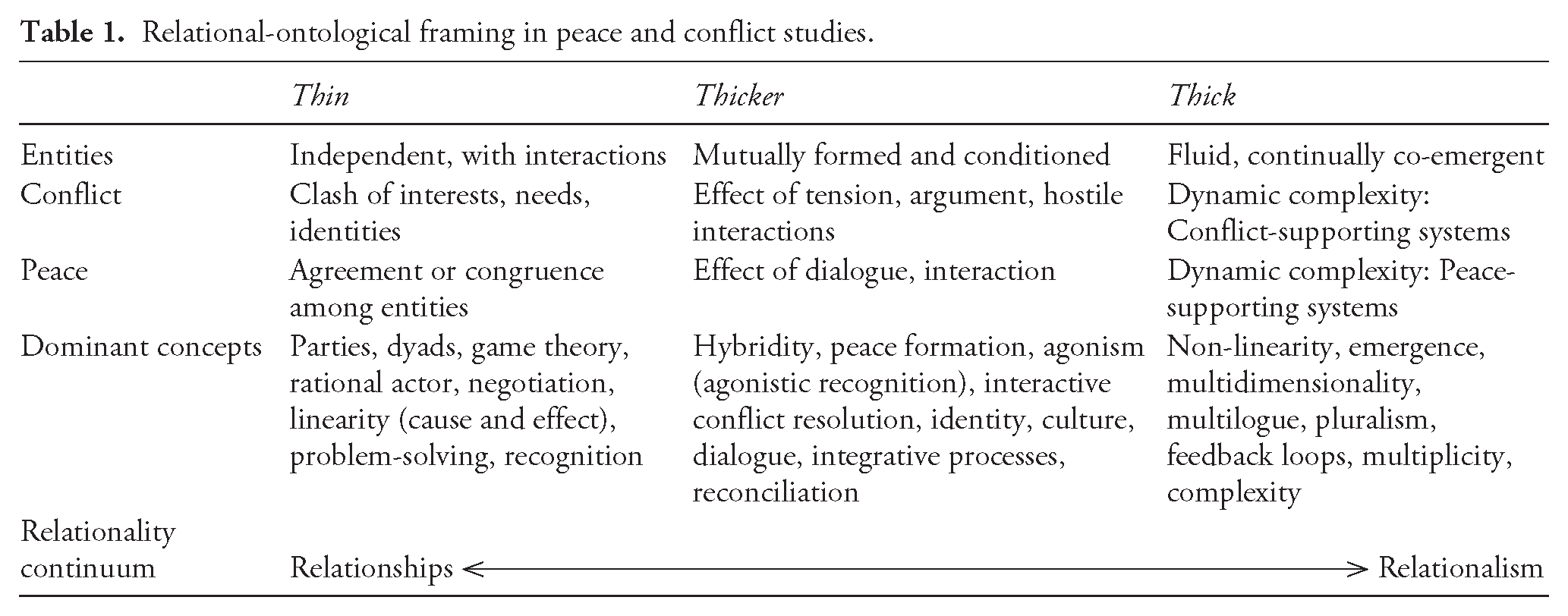
In the thin-thicker-think schema, the framework of Söderström et al. relies upon thin relationality, toward the left-hand-side of Table 1, and this leaves intact the assumed and commonplace ontology of mainstream political science. As they state in a footnote, while they ‘recognize that actors are fluid and that they change with and through relationships’ they ‘are perhaps more optimistic in terms of our ability to identify specific actors’ than scholars who emphasize ‘process, interaction, and experience’ (Söderström et al., 2021: 489). In this way, Söderström et al (2021). unduly narrow the potential of relational scholarship, thereby undercutting the possibility of moving beyond the state (and other dominant analytical categories) and Western or Eurocentric perspectives in conceptualizing peace (Diehl, 2016: 7–8).
Of course, there are trade-offs among ontological approaches, and the approach of Söderström et al. (2021) has obvious advantages to mainstream political science. It allows the proposing of a framework for ‘systematic cross-case comparisons by assessing the quality of peace using deductive criteria’ (Söderström et al., 2021: 504). What is at stake, though, is whether peace and conflict studies should adopt a thin or narrow ontological approach to relationalism, or as is suggested here, a more expansive and properly relational approach that includes the approach of Söderström et al. (2021) as one option. Taking only a thin approach will reinforce European-derived conventional forms of scholarship and struggle to move beyond political science and Western and Eurocentric conceptualizations of peace. Söderström et al.’s (2021) framework can only claim to be systematic, therefore, in a narrower sense that substantially contravenes Diehl’s (2016) guidelines for an expanded approach to studying peace. To meet the goals of an expanded approach to peace and conflict studies requires the mobilization of thicker and thick as well as thin forms of relationalism. This is necessary to challenge and extend beyond ‘conventional modernist ways of knowing and ordering’ (Brigg, 2016: 65) as part of a spectrum of relational approaches to peace and conflict studies. Achieving these and related goals requires avoiding ‘ontological elitism’ that limits scholarship to the pre-specification of deductive criteria. It also requires at least considering the embrace of ‘radical openness’ (Torrent, 2021: 220–221) that opens up ways of conceptualizing peace.
To see the value of thicker relational approaches, consider, for instance, Belloni’s (2012) focus on ‘hybrid peace governance’. Belloni (2012) adopts this term as a way of grappling with the fluidity and tensions that beset interactions among a wide range of actors (e.g. local chiefs, community groups, international nongovernmental organizations, warlords, religious leaders) in peacebuilding settings. A key theme in Belloni’s (2012: 24) analysis is that the emerging complex is ‘not a stable package’ in ways that lend itself to the application of deductive criteria. Or consider Oliver Richmond’s (2013: 379, 383) introduction of ‘peace formation’ to engage with local forms of peace that arise outside the ‘normative universe’ of capitals in the Global North and to understand how extant and dominant entities and mechanisms of peace governance are reshaped through interactions in peace processes. In both cases, accessing possibilities beyond dominant understandings of peace requires moderating or eschewing thin ontology and deductive criteria to lean toward deploying thicker or thick relationalism.
Advancing the application of relational approaches in peace and conflict studies in an overall sense is not well-served by setting different relational-ontological approaches against each other. To seek to replace Söderström et al.’s (2021) narrowing to thin relationalism with a thicker alternative would simply represent another kind of narrowing while also setting up an unnecessary rivalry among approaches. Investing overly deeply in any singular approach is likely to generate problems. For example, enthusiastic advocates of thick relationalism can risk ‘entanglement fetishism’ in which it becomes impossible to discern and analyse entities as separate, or the ‘liberatory, normative and exclusionary projection of a relational world’ (Torrent, 2021: 220).
What is necessary to advance the peace and conflict field is a capacious approach that recognizes relationalism as an ontological orientation per Table 1. To advance relational peace and conflict scholarship, including by expanding the conceptualization of peace through relationalism, it is not tenable to narrow approaches to one form of ontological relationalism, or to lean wholly toward one or other end of the thin–thicker–thick schema. Instead, the peace and conflict studies field is best served by recognizing trades-offs among approaches and drawing upon whichever approach is best for a given research project and for the overall development of relational scholarship in the field. To further understand what is at stake among thin, thicker and thick relational approaches to studying peace, and thus to better recognize trade-offs among relational-ontological forms, requires engaging Söderström et al.’s (2021: 485) insistence on defining relational peace.
Beyond definition for better relational analyses
For Söderström and colleagues, ‘thinking of peace in relational terms’ generates the task of ‘defining relational peace’ (2021: 485, 489). To define relational peace makes sense in an ontologically thin version of relationalism that views the world as predominantly composed of entities and seeks to establish deductive criteria for studying peace. However, conceptualizing relational peace as a ‘thing’ compromises consideration of the dynamism in relations because it directs researchers to a phenomenon or state-of-affairs. This unduly constrains the way that relationalism can be deployed in peace and conflict studies. A second problem arises because defining draws Söderström et al. (2021) into providing a normative definition of peace. While the embrace of normative concerns is appropriate in peace studies (Diehl, 2016: 8), creating a tie between relationalism and peace by defining relational peace risks an exclusionary theory of peaceful relationships derived from Western or Eurocentric perspectives. Ontologically ‘thicker’ and ‘thick’ forms of relationalism have less or no need to specify the meaning of peace or relationships prior to research, including because these ontological orientations direct interest to dynamic processes and a more open approach to meanings of peace.
To consider the peacefulness of relationships Söderström et al. ask what – in terms of behavioural interaction – ‘qualifies as peaceful’, which in turn leads them to arrive at ‘deliberation, non-domination, and cooperation’ (2021: 489, emphasis in original). This orientation focuses a researcher on observation of these patterns of behaviour with changes in interactions relegated to iterative considerations through time (Söderström et al., 2021: 501–502). However, many peace and conflict researchers are directly and understandably interested in dynamic relations rather than the state of relations in a dyad, or movement from relations of conflict or dispute to peace rather than peace as a state. What is often crucial is movement, transition, or transformation in relations and thus the interplay, for instance, of cooperation and competition. Negotiations, for example, are frequently suffused with mixed elements of distributive and integrative bargaining: contest and competition are mixed with cooperation and collaboration. What is at stake are precisely thicker and thick forms of relations in which parties to conflict are at least partially reconstituted in relation with each other as part of moving toward less conflict or more peace. These patterns play out in many settings, including the resolution of large-scale civil war whereby former antagonists are reconfigured in relation with each other (Long and Brecke, 2003).
A striking empirical example of the need to attend to dynamism in an even more fundamental sense – and thus in a thick relational way – comes from Albrecht and Moe’s (2015) examination of the co-constitution of authority through the figure of the post-colonial chief in peacebuilding efforts in hybrid political orders of the Global South: ‘The chief does not merely navigate among different sources of authority [linked to bureaucracy, autochthony, kinship, and legislation] that are external to him’ (Albrecht and Moe, 2015: 8). Rather, he ‘internalises and embodies the varied sources that constitute his subjectivity as an authoritative figure’ (Albrecht and Moe, 2015: 8). The analysis that leads Albrecht and Moe (2015) to this conclusion relies upon a thick relational ontology and would not be possible if the chief were seen as an actor in a dyad in thin relational terms, or indeed as a self-coherent entity in the way that conventional social science conceptualizes personhood. In short, Söderström et al.’s (2021) thin form of relationalism puts limits on relational dynamism, which is a necessary part of relational research for a comprehensive understanding of peace and conflict dynamics.
The fact that many peace and conflict scholars are interested in dynamic relations, including in the movement from relations of conflict to peace rather than in peace as a state, raises the related question of why the relational analytical universe should be especially associated with peace through definition. 3 Söderström et al.’s (2021: 485) focus on relational peace seems misplaced given that they note that it is necessary to understand the ‘coexistence of peace and war’ and their quoting of Kriesberg’s (2007: 43) observation that conflict, ‘is a way of relating’. Indeed, relations are necessary vehicles for perpetuating conflict, violence and war. To seek to turn the field’s attention to relational peace as a key framework goal risks skewing collective understandings of the field in ways that neglect the fact that conflict – in all its forms from interpersonal argument to war – is relational and thus susceptible to relational analyses. Relations are not inherently peaceful or conflictual, so attempting to define relational peace risks unduly narrowing understandings of the realities and practicalities of what is necessary for the pursuit of the ‘peacefulness of relationships’ (Söderström et al., 2021: 489).
Defining relational peace also generates challenges surrounding how to delineate relational peace and specify its normative content. Consider Söderström et al.’s (2021) mobilizing of recognition as central to peaceful relationships. This move makes sense within a thin relational-ontological register. Recognition theory draws on a variety of auguste Western scholarship based originally in the work of Hegel and including contemporary theorists such as Young (1990), Honneth (1995) and Taylor (1995). But recognition has also been the subject of serious critique as a commonsense form of intersubjective engagement. Lingis tackles the foundational premise: ‘How eccentric of Hegel to have imagined that when we go to encounter others, it is recognition we demand, recognition of the freedom and self-consciousness of the ego, confirmation, attestation, certification of our identity’ (2000: 87). Meanwhile, Oliver (2001: 1–6) points out that recognition is bound with ontological commitments to a self-contained and self-same (rather than relational) being that underpins most European-derived social theorizing . And while seeking or struggling for recognition seems to make sense, ‘recognition itself is part of the pathology of oppression and domination’ because ‘only after oppressed people are dehumanized’ through domination do ‘they seek acknowledegment or recognition of their humanity’ (Oliver, 2001: 23–26). Markell (2003) makes cognate arguments.
Peace and conflict studies scholarship has begun to forge parallel critiques of the application of recognition theory in conflict, in part by drawing upon ideas of political agonism drawn from philosophers such as Mouffe (2013). Rumelili and Strömbom (2022), for example, argue that pursuing recognition-based approaches to conflict transformation ‘potentially functions as a double-edged sword’ by encouraging parties toward self-narratives that risk disrupting the ‘continuity and stability of self-narratives and the ideological and moral certainty provided by the conflict’s “formed framework”’ (2022: 1364). This can in turn generate ‘ontological insecurity and dissonance’ that ‘may drive an identity backlash, meaning a mobilization of resistance to changes in self-narratives’ that defeats the goal of conflict transformation through recognition (Rumelili and Strömbom, 2022: 1364). Recognition theory thus appears to make sense as a vehicle and component of peace from within mainstream Western scholarship, but its widespread relevance and efficacy for delivering peace cannot be assumed.
While these philosophical and applied challenges raise serious problems with the centring of recognition theory by Söderström et al., (2021) yet further and arguably more serious problems still lie in the cultural specificity – and indeed idiosyncrasy – of the non-relational form of selfhood that recognition theory operates with and through. To illustrate, consider Azille Coetzee’s reading of Yorùbá feminist Oyèrónké Oyĕwùmí as a relational thinker in the lineage of African philosophers. For the Yorùbá, the self is ‘always already and inevitably being in relation to others’ (Coetzee, 2018: 7, emphasis added). Rather than the self being made of ‘pre-existing relationships as [a] complete and fully coherent autonomous entity’, and thus seeking or being in need of recognition, it ‘is understood to be ontologically and metaphysically dependent on its being in relations with others’ (Coetzee, 2018). As Ghanaian philosopher Kwasi Wiredu (1998: 24) notes, the Western existential notion ‘to be’ has no counterpart in his Akan language: ‘To be or being always prompts the question “To be what, where?” or “Being what, where?”’. In other words, in these – and many other traditions – there is no call or need for recognition because the self is not the conscious isolate assumed by Western social science.
While recognition may make sense in the ontological frame of thin relationalism, it is unlikely to be the primary reference point for many peoples whose selfhood is better characterized as being an effect of thick relationalism. Meanwhile, the mode of theorizing undertaken by Söderström et al. (2021) by implicitly or explicitly foregrounding entities to form their categories of analysis, consistently returns to the relatively closed world of Western social science underpinned by rather specific and idiosyncratic understandings of selfhood ‘within the context of the world’s cultures’ (Geertz, 1979: 229). The result is that Söderström et al. (2021) have constructed a deductive theory of peaceful relationships partly based in recognition theory that is unlikely to apply to large swathes of the world’s peoples. The foregrounding of recognition risks cutting across lived relations in ways that fill up those relations with the putatively imagined (good) relations as conceptualized by the theorist or analyst in their tradition.
Attempting to define relational peace through a thin-ontological approach, then, generates analytical and normative problems. These problems do not invalidate Söderström et al.’s (2021) approach because recognition is only one component of how they characterize relational peace, and it may be that they or others modify their framework through time, perhaps through the insights brought by ‘agonistic peace’ (Rumelili and Strömbom, 2022). More broadly, it is necessary to register trade-offs among relational-ontological approaches across the thin–thicker–thick spectrum. For instance, the relative normative certainty of a definition of relational peace must be traded against relative normative contingency and uncertainty that accompanies thick relational-ontological approaches.
To demonstrate how thicker and thick approaches can offer better analyses, consider the early empirical application of Söderström et al.’s (2021) framework (Jarstad et al., 2023a). Söderström et al. (2021: 497) do not expect a one-to-one correspondence between their framework and relational peace in the world because they characterize relational peace as an ideal type. But problems nonetheless arise. Comparing across case studies Jarstad et al. (2023c) note that variation and nuance in behaviours – including apparent contradictions in behaviours – ‘stresses the importance of also considering how actors and dyads are situated in a larger web of relations’ (Jarstad et al., 2023c: 223). This suggests the necessity of a wider relational approach rather than one focused through dyads. Meanwhile, accessing ideas of relationship requires ‘trying to understand how the relationship is formulated by the actors involved’ including through ‘the actor’s own understanding of the kind of relationship that is in place’ (Jarstad et al., 2023c: 227). In short, prefigured relational peace gets at least partially undone by the complexity of people and their lived worlds. Conversely, a more open (thicker or thick) relational-ontological orientation promises a better job of engaging with empirics by enabling a richer and more responsive engagement with the relations and specifics of cases.
To illustrate this more specifically, consider the analysis of local experiences of the state in the Myanmar conflict by Olivius and Hedström (2023) in the collection edited by Jarstad et al. (2023a). My approach is deliberately immanent (relying on the empirics and analysis of Olivius and Hedström) (2023) and modest (claiming not that Söderström et al.’s (2021) framework is wrong and of no value but that a broader relational-ontological orientation enables better engagement with the case). It is also important to stress that this threefold analysis seeks to highlight the shortfalls in a thin relational-ontological orientation and does not imply criticism of Olivius and Hedström (2023).
1. Entities, dyads, relations. Söderström et al.’s (2021) framework relies upon the specification of actors (entities) in dyads, consistent with their ontologically thin relationalism mapped toward the left-hand-side of Table 1. But designating actors can strain empirical credulity. In their chapter Olivius and Hedström (OH) specify the actors they analyse as the ‘Myanmar state [. . .] and local actors’ (Olivius and Hedström, 2023: 128). Olivius and Hedström refer to the state as ‘often embodied by its military’ (2023: 128) and throughout they refer to a range of state behaviours including land confiscations (2023: 137) and the naming of a bridge as a national monument (2023: 139). This highlights that state entities are aggregations of relations and processes, per Jackson and Nexon’s (1999) landmark article. Olivius and Hedström’s (2023) ‘local actors’ entity is even more loose, comprised of sub-actors ‘such as ethnic armed organizations (EAOs), civil society organizations, and civilian communities’ that are ‘by no means homogeneous’ ((2023: 128). An ontologically thicker relational orientation (mapped toward the right-hand-side of Table 1) and less reliant on entities would enable a more faithful rendering of the empirics in this case.
Specifying entities/dyads can also confound analysis. Söderström et al.’s (2021) framework suggests categorizing actors as exhibiting particular behaviours (deliberation, non-domination, and cooperation) and attitudes (mutual recognition and trust). But Olivius and Hedström find ‘promising developments’ alongside continuity of ‘violence and discrimination’ (2023: 130) and, conversely, the ‘arbitrary exercise of power and coercion’ (2023: 136) alongside ‘the occasional example of deliberation’ (2023: 137). Such mixed rather than discrete behaviours demonstrate ‘the complexity of post-war relationships’ (136). This and similar complexities limit the analysts’ capacity to attribute behaviour/s to an entity. Entities in this case are not uniform or consistent but rather emerge through constant (re-)construction of multivalent relations. An ontologically thicker relational-ontological orientation helps to better analyse these complex and multivalent relations by highlighting fluidity, complexity and non-linearity.
2. Temporality and dynamism. Because Söderström et al.’s (2021) framework foregrounds entities and dyads it is silent about time or relegates time and dynamism to iterations of dyadic relations (see Jarstad et al., 2023a: 5; Söderström et al., 2021: 501). However, Olivius and Hedström (2023) show that time and dynamism are immediately and pressingly present for their case. From the outset Olivius and Hedström state that they explore how local actors’ experience of relationship ‘with the state [. . .] has changed over time’ (2023: 128). Change and dynamism are a central concern throughout the chapter such that ‘post-war behavioral interactions between the state and minority actors are characterized by both change and continuity’ (2023: 137). This is more consistent with and better understood through a thicker rather than thinner ontological approach to relationalism.
3. Distinguishing conflict and peace. Söderström et al.’s (2021) framework relies upon defining relational peace, thus separating it (as an ideal type) from conflict. But Olivius and Hedström’s (2023) case study requires dealing with (dynamic) relations of conflict rather than peace. Olivius and Hedström note that ‘key conflict relationships [. . .] were not transformed by the peace process but merely manifested themselves in new ways’ (2023: 128) and that the approach they adopt ‘challenges the notion of a neat dichotomy between war and peace’ (2023: 129). The framework does not prevent Olivius and Hedström (2023) from considering relations of conflict, but it is unhelpful, distracting and unnecessary to conflate (positive) peace with relationalism because relations are not inherently peaceful or conflictual. Far better to attend to thicker and complex relations-in-themselves to directly reveal the empirics of a case.
Defining peace can also compromise access to diverse meanings of peace. Olivius and Hedström (2023) note that local actors use some of the same terms used by Söderström et al. (2021). However, Olivius and Hedström also note another term, ‘respect’ (e.g. 2023: 141), which is not part of Söderström et al.’s (2021) framework, and we do not get to see the results of the researchers’ facilitated interactive ‘discussion about the meaning of peace’ (Söderström et al., 2021: 133). The latter highlights that Olivius and Hedström (2023) are drawn to an ontologically thicker relational understanding of peace to make sense of and ethically engage with local people’s understandings of peace.
From specifying actors to specifying peace, Söderström et al.’s (2021) framework draws Olivius and Hedström (2023) into constructing entities and categories that strain credibility and distract from the empirics and practice of social and political life in the Myanmar case. Olivius and Hedström (2023) reveal important relational dynamics, but they do so by working around and beyond the thin relational-ontological orientation of Söderström et al.’s (2021) framework and applying thicker forms of relational analysis.
This section shows that the approach pursued by Söderström et al. (2021) suffers problems deriving from the attempt to specify the (normative) content of relational peace, consistently linked with their reliance upon an ontologically thin account of relations. This unduly narrows and forecloses the dynamic dimensions of relational research (by relegating these to iterations/time) and leads to the installation of the normative specificities of a particular tradition (through the notion of recognition) that risks excluding and disavowing diverse peoples. These shortfalls underscore that the adequate study of peace and conflict in relational terms requires substantially broadening beyond the framework proposed by Söderström et al., (2021) and points to some advantages of thicker and thick approaches to relationality. Developing capacious and responsible relational scholarship requires that peace and conflict scholars grapple with the accompanying trade-offs among relational approaches per Tables 2 and 3. Many of these considerations need to be worked through in the development of relational scholarship and particular research agendas through time, but this raises the question of whether there is anything distinctive about relational approaches, especially in terms of normative commitments.
Knowledge claims and responsiveness across relational-ontological approaches.

Trade-offs among relational-ontological approaches.

Relationalism: A normative foundation for the study of (relational) peace?
Thus far this article has shown that the development of relational peace and conflict studies requires an expansive framework taking in thin, thicker, thick relational-ontological forms while registering the trade-offs among them. This implies a more expansive and normatively circumspect endeavour than that proposed by Söderström et al.’s (2021). To meet both social science and peace and conflict professional practice expectations for transparency, rigour and aliveness to ethical considerations it is necessary to be transparent about the form of relational-ontological commitment (thin, thicker, or thick) that relational scholarship subscribes to. This transparency promotes awareness of the range and implications of choices made, but it does not prescribe or limit how relational research should be undertaken, not least because there are many methodological permutations – from thought experiments and philosophical deliberation through to computer-based modelling and various types of fieldwork – across thin, thicker, and thick ontological forms. The approach also aligns with the approach taken by many relational thinkers for whom relationalism is not a noun, doctrine, theory, or method (Nordin et al., 2019: 571–572) but primarily an analytical approach.
However, transparency about the relational-ontological approach and methodological pluralism alone suggest that there is nothing distinctive in an overall sense about relational peace and conflict research. Such a stance would resolve the problems identified with Söderström et al.’s (2021) approach to relationality and specification of the normative content of relational peace but provide no further compass or guide for relational research in peace and conflict studies. It is also misaligned with both Diehl’s (2016: 8) suggestion to embrace normative concerns and the obvious interest in normatively social scientific research in extant relational peace and conflict studies scholarship. Beyond Söderström et al. (2021), Torrent (2021) mobilizes a form of critique based in relational analysis to examine UN peacebuilding efforts in the cases of Sierra Leone, Burundi and the Central African Republic by questioning notions of ‘autonomous and purposeful agency’ and showing how the ‘observed/“locals” are mutually constituted in relation’ (Torrent, 2022: 211). And Brigg argues that the ‘language of relationality is a useful vehicle for navigating the complexities of contemporary peacebuilding and for articulating the best impulses and possibilities of recent developments while retaining a focus on meaningful change and on politics’ (2016: 57).
While Torrent and Brigg do not specify relational peace or peacebuilding as Söderström et al. (2021) do, they are focused on normative questions in peace and conflict studies and the possibility of forms of peace deriving from relations (which is also a focus for Söderström et al. (2021)). Normative commitments are also clearly extant in other relational peace and conflict scholarship. How, then, to provide an orientation for the relational study of peace and conflict that identifies and enables the working out of normative visions of relational peace without suffering the problems of unduly specifying the normative content of peace?
Crucial here is the fact that relations in and of themselves are not intrinsically peaceful. Rather, it is the relational effects of interactions that generate instances and possibilities of (relational) peace. The components of Söderström et al.’s (2021: 486) definition of relational peace – ‘behavioral interaction (deliberation, non-domination, and cooperation), subjective conditions (recognition and trust), and the idea of the relationship (fellowship or friendship)’ – are each an effect of relations. The mutual constitution of actors that Torrent (2021) analyses arise through relations. The possibilities for reshaping dominant entities and mechanisms of peace governance that Richmond (2013) identifies in peace formation arise through interactions. And the possibility that ‘underappreciated forms of kinship-based or otherwise laterally networked political community practised by some indigenous or local peoples in their everyday lives’ might decolonize peacebuilding by reversing ‘the prevailing priority of entity over relation’ (Brigg, 2016: 61–62) lies in relations. More broadly, the so-called ‘peaceful societies’ studied by Kemp and Fry (2004) are effects of relations. In these and other instances, relational peace arises from emplaced interactions that cannot be disconnected from practices, whether these arise through conflict and other forms of sociality or are inscribed in and through rituals, ceremonies, education, or formalized rules and institutions.
Because these effects are emergent and emplaced, they are too diverse to be described comprehensively by pre-specified (relational) qualities as Söderström et al. (2021) seek to do. Such effects arise among people and their processes, histories, institutions and amidst conflict in ways that are often – though not always necessarily – connected to a particular place, context, culture or tradition. Cooperation, for instance, is defined and characterized in myriad ways by the actors engaged in conflict and peace in different settings. Indeed, this phenomenon is demonstrated in the findings of the case studies curated by Jarstad et al. (2023a). As they reflect, ‘one of the main contributions of the book’ is the recognition of the ‘varied’ and sometimes contradictory practices that are revealed as ‘we move beyond the relational peace as an ideal’ (Jarstad et al., 2023c: 225).
Ultimately, the relational study of peace must be grounded in and directed to relations-in-themselves, thus referring researchers to the myriad and diverse ways in which people – around the globe – organize their lives, practices, meanings and being together. Relational research must attend to this diversity of relations, and doing so has the advantage of greatly expanding possible conceptualizations of peace. The relational cannot, in simple terms, be otherwise. Attending to diverse relations-in-themselves may reveal instances of relational peace that are idiosyncratic and particular or resonant across contexts. But because attempts to strongly specify the content of relational peace a priori cuts across and disavows relations-in-themselves, relational peace must necessarily remain somewhat underspecified. While this reduces the prospects for large-scale deductively driven research in the short term, it expands prospects for accessing diverse conceptualizations and practices for processing conflict and generating peace.
Moreover, toward the other end of the continuum of relational-ontological approaches to peace, thick relationalism offers access to more open and less prescribed understandings of relational peace among peoples. For Aboriginal Australian philosopher Mary Graham (1999: 107, 114), the relational practices of looking after land and kin beyond oneself inaugurates the thoroughgoing relationalism of Aboriginal and other Indigenous instances of socio-political ordering that generate long-term security and relative peace. Relational practice ramifies through socio-political systems and dispositions (Brigg et al., 2022), creating and stressing complementarity and interdependence among individuals and groups rather than separate and self-sufficient entities (Graham and Brigg, 2023: 16). Relational peace arises not between dyads per Söderström et al.’s (2021) thin relational-ontological framework, but as a system-effect (per the far-right column of Table 1) that brings actors into being in relational networks.
But what of the relational study of peace in a broader sense, beyond individual peoples and instances or traditions of peace? In Söderström et al.’s (2021) thin relational-ontological approach, dyads can be scaled up to recognize states as instantiations of the contemporary world system. Yet thinking of relational peace in these terms necessarily embraces dominant forms of political ordering borne, in many parts of the world, of the export of political forms through recent centuries of colonialism. Again, thick relationalism offers alternatives that expand our ways of conceptualizing peace. Consider the remarkable vision of global relational possibility found in Glissant’s (1997) Poetics of Relation. Glissant’s (1997) philosophy examines how the effective shrinking of the world that comes with the completion of the Age of Discovery in the 18th century puts diverse peoples of the world into relation with each other in ways that have the ironic potential to undo the ‘[a]rrowlike nomadism’ of colonialism (Glissant, 1997: 12) and the forms of domination (political and other) that come with it. Nonetheless, and this orientation is crucial, the relational effects that arise are contingent and emergent; for the universality that might be pursued here is ‘optative’ (1997: 37), an emergent possibility, rather than susceptible to deduction in the way imagined by Söderström et al. (2021). This affirms the value – and indeed imperative – of turning to relations-in-themselves rather than (only) attempting to lay deductive frameworks over peoples in the articulation and pursuit of relational peace.
Turning to relations-in-themselves as a guiding orientation for the study of relational peace greatly expands ways of studying and conceptualizing peace, so necessarily comes with some normative circumspection. But normative circumspection does not imply normative indifference because attending to relations-in-themselves generates an ethico-normative obligation that makes researchers responsible for the implications of how they conceptualize and analyse the world. This also creates a normative orientation that makes researchers susceptible to diverse human ways of pursuing peace. This orientation has the benefit of being foundational while also being sufficiently flexible to avoid the ossification of hegemonic actors’ definitions of peace through dominant political forms and institutions (Richmond, 2005). In this approach, values that are apparently obvious from within the liberal Western academy (such as human rights, identity recognition, development, and economic participation) can be recognized and engaged with as potential goods but also as orientations to politics borne of a particular heritage that can disavow diverse peoples and traditions. This directs researchers to the heritage of concepts and relational effects in the field, thereby militating against specifying relational peace as borne of the dominant economy of global knowledge production and arising from European-derived dominance forged through imperialism and colonialism.
There is, then, a distinctiveness to relational approaches to peace and conflict that arises beyond definition and without specifying normative content for relational peace. Because this distinctiveness arises beyond definition it follows that it cannot be accessed through deductive frameworks alone. Instead, it requires turning to relations-in-themselves as an overall relational orientation. This is doubtless a challenging and perhaps uncomfortable proposition for some mainstream social scientists, but it has the advantage of casting research and researchers into relation with the diverse peoples, histories and places that process conflict and generate relational peace. There is no single correct way of doing relational research, but the framework offered here, documenting thin, thick, and thicker forms of relational-ontological research with their respective trade-offs per Tables 1 through 3, provides a means for researchers to consider relational approaches vis-à-vis research programs and goals. Within this schema the deductive framework offered by Söderström et al. (2021) is positioned toward the left hand-sides of Tables 1 through 3. With their approach cast into the world through empirical research (Jarstad et al., 2023a), it remains to be seen if they attempt to insist upon their definition of relational peace, or if they are open to expanding beyond the ideas that inform the framework (recognition, trust, fellowship and friendship) and the variegated practice of behaviours (deliberation, non-domination, and cooperation) and thus to turning to and being responsive to relations-in-themselves. The latter approach – for which there is evidence (Jarstad et al., 2023c: 223–225) – would open their approach to broader understandings of relationalism (beyond prescribed relationships) and greater relational responsiveness.
Conclusion
Relational approaches are burgeoning across the social sciences and beginning to be mobilized in peace and conflict studies. The relationalist move to place greater ontological emphasis on relations (or processes and interactions) than on substances (or entities and things) promises, inter alia, innovations in knowledge that disrupt and extend upon dominant substantialist-ontological social science approaches, new forms of analysis of the dynamics conflict and peacebuilding, and ways of connecting with diverse peoples. But relationalism is also susceptible to misunderstandings, and risks being read in the narrow sense of referring to relations among entities, thereby occluding more ontologically expansive understandings of relationalism.
In response, this article has clarified what is at stake for engaging with relational approaches and provided an expansive framework for the relational study of peace and conflict by using a recent article by Söderström et al. (2021) as a foil. The proposed framework distinguishes between thin, thicker and thick forms of relationalism to promote ontological transparency about relational research and to help researchers grapple with the trade-offs among relational-ontological choices. This threefold differentiation conceptualizes relationality as ranging from relations between entities (thin relationalism and the approach broadly followed by Söderström et al. (2021)) through thicker relational conceptualizations in which entities are mutually conditioned to process-relational understandings in which all phenomena are an effect of ceaseless and generative relations (thick relationalism) per Table 1. This expansive framework is necessary to account for diverse forms of relationalism both in scholarship and in a range of philosophical and religious traditions.
Conceptualizing relationalism more broadly than the approach taken by Söderström et al. (2021) reveals that it is possible to undertake relational analysis and pursue a relational normative orientation beyond definition, and without specifying relational peace. Where attempting to define relational peace generates analytical and normative challenges, thicker and thick ontological-relational approaches are relatively more able to engage with dynamism and with empirical diversity while registering peace as an effect of relations. This approach helps to register and elucidate the trade-offs among ontological approaches per Tables 2 and 3, and to provide a foundation for peace and conflict scholars to consider the pros and cons of different relational-ontological approaches for research agendas and the overall advancement of relational research. Meanwhile, the distinctiveness and normative commitment of a relational approach lies in turning to relational effects and relations-in-themselves. By attending to relations-in-themselves, a relational approach casts research and researchers amidst – and makes them responsible to – the diversity of the world’s people and approaches to peace and conflict. The combination of this normative orientation and threefold framework clarifies and enables comparison of relational-ontological approaches and supports the development and deployment of relational approaches in peace and conflict studies.
Footnotes
Acknowledgements
My sincere thanks to the reviewers of this article and Journal of Peace Research editors. Their careful and detailed engagement has significantly improved the quality of the manuscript.
Funding
The author received no financial support for the research, authorship, and/or publication of this article.

Notes
MORGAN BRIGG, b. 1970, PhD in Political Science (University of Queensland, 2005); Deputy Head of School of Political Science and International Studies, The University of Queensland (2022–present); main interests: conflict resolution, governance, Indigenous politics, post-conflict peacebuilding, political theory.