




Abstract
Previous research has indicated that constitutionalized emergency provisions effectively constrain the behaviour of democratic governments subsequent to terrorist attacks. In this article, we ask if this is also true for autocratic governments. Are non-democratic governments equally subject to constitutionalized constraints regarding their reactions to emergencies and particularly to terrorist attacks? To answer the question, we analyse the behaviour of a specific group of predominantly autocratic governments that are particularly subject to frequent terrorist incidents, namely the states that are members of the Organisation of Islamic Cooperation. Employing data on terrorist activity from the Global Terrorism Database and constitutional data from the Index of Emergency Powers, we estimate the association between constitutionalized constraints and terrorist attacks in a dataset covering 48 member-states of the organization observed annually between 1970 and 2014. As hypothesized, we find that emergency constitutions that politically make it relatively cheap for governments to declare a state of emergency are more likely to be invoked. In addition, we find that governments are more likely to increase repression after terrorist events when the constitution allocates more discretionary power to the government in emergencies. Our evidence thus suggests that emergency constitutions also impact on the behaviour of largely autocratic governments.
Keywords
Introduction
Terrorists rely on violence not only to inflict harm on their immediate victims but also to intimidate a large public. Emergency provisions exist to enable governments to react swiftly to terrorist attacks but also to reduce the likelihood of additional attacks being carried out in the future. In a previous study, Bjørnskov & Voigt (2020) inquired into the effectiveness of emergency constitutions by asking whether they affect the likelihood of terrorist events taking place, and what their side-effects are in terms of reduced levels in basic human rights. The findings indicated that the contents of different emergency constitutions do indeed shape both terrorist events and government reactions in typical Western democracies. Yet, they also showed that emergency provisions are frequently abused to increase repression levels. It is, however, an open question to what degree these results also hold for autocratic governments.
This is why we here ask whether these results hold for countries governed by autocrats as well as for democracies. Specifically, we ask whether constitutionalized emergency provisions influence the decision of autocratic governments to declare a state of emergency and their behaviour while running a state of emergency. To answer these questions, we analyse the behaviour of governments of countries that are members of the Organisation of Islamic Cooperation (OIC). These countries, in particular those in the Middle East and North Africa (MENA), are among the most terror-ridden in the world. No other group of countries has had such a consistently high level of terrorist events and terror-related deaths as the OIC (GTD, 2018).
With few exceptions, the group is characterized by having strongly authoritarian political regimes ranging from Iran’s theocracy through Saudi Arabia’s absolutist monarchy to Egypt’s military dictatorship. The combination of being autocratic and subject to many terrorist attacks makes this group of countries ideal for the study of our question. Ex ante, it is unclear whether autocratic governments are more or less likely to declare a state of emergency given a certain threat level. It is also unclear what role constitutional constraints play under autocratic governments in general, which is the overall question that we explore here.
We must emphasize that this is ostensibly not an article about ‘Islamic terror’ but about terrorism in those countries of the world explicitly professing to foster Muslim values. We therefore do not provide any extensive treatment of the phenomenon of Jihad or groups such as Hezbollah or the so-called Islamic State. Neither do we analyse terrorist events originating in the member-states of the OIC, but executed in the West, as we are primarily interested in terrorist events within the region. However, as we recognize that at least some terror occurring in the Muslim world is or could be motivated by religious concerns, we briefly deal with the possible connection between Islam and terror.
We organize the rest of the article as follows. We start by discussing possible reasons why autocratic governments might behave differently from democratic ones given a certain threat level. On this background, we next ask if the predominantly Muslim countries of the group have emergency constitutions that are similar to those in Western countries. In particular, we explore if they are set up to constrain politicians in ways similar to those in typical Western countries, or if the authoritarian tradition in the region implies a different constitutional set-up around emergencies. In the third part of the article, we introduce our data and test if specific features of emergency constitutions in the OIC are associated with different levels of domestic terrorism. We end the article by discussing what might be learnt from our findings.
Conceptualizing emergency constitutions in the OIC
We define an emergency constitution as the set of formal legal provisions encoded in the constitution that specify who can declare an emergency, under which conditions an emergency can be declared, who needs to approve of the declaration, and which actors have which special powers once it has been declared. What we refer to as the ‘emergency constitution’ here is, hence, not a document separate from the ordinary constitution but those formal provisions of it that explicitly deal with emergencies.
Today, some 90% of all constitutions worldwide contain explicit provisions for how to deal with states of emergency (Elkins, Ginsburg & Melton, 2009). The inclusion of emergency provisions into constitutions has thus not only become the norm, but these provisions are also used frequently and their use is often far from innocuous. Between 1985 and 2014, at least 137 countries declared a state of emergency (SOE) at least once. Under a SOE, some individual rights and liberties are usually suspended and the separation of powers is curtailed in favour of the executive or even a single person like the head of state or government and, by implication, to the detriment of the parliament and the courts.
Theorizing about the use of emergency constitutions by autocrats, we propose to separate two distinct aspects, namely the decision to declare a SOE from the concrete means used by government while running a state of emergency. We develop our hypotheses in explicit contradistinction to democratic governments.
Every government will weigh the expected benefits of declaring a SOE with its expected costs. We equate the expected benefits with the additional powers granted to the executive under a SOE, whereas we propose to split the costs into direct and indirect ones. Direct costs refer to the costs of organizing the majorities necessary to declare a SOE. Indirect costs refer to the loss in popularity and legitimacy among the legislature, the judiciary and the citizens.
Benefits here refer to the differences in competences a government enjoys under a SOE compared to ‘normal’, non-emergency times. If one assumes that autocratic governments are less tightly constrained by their constitutions than democracies, declaring a SOE would grant them fewer additional powers than (more tightly constrained) democracies, which would imply that, ceteris paribus, they have a lower propensity to declare a SOE.
Moving on to the cost side, it could be argued that both direct and indirect costs are lower in autocracies compared to democracies. If members of the legislature and (or) the judiciary are handpicked by and loyal to the autocratic executive, the costs of organizing the necessary majorities would be lower than in democracies. In addition, indirect costs can also be lower in autocracies. It has been shown that declaring a SOE is an unpopular event and that such declarations are significantly less likely in election years in democracies, supposedly because such a declaration would reduce government’s chances of being re-elected.
Autocratic governments need not be re-elected fairly. The indirect costs of declaring a SOE are, hence, also expected to be lower for autocratic governments, which increases their propensity to declare. A similar argument holds with regard to the other indirect cost category – namely opposition by parliament and (or) the judiciary. As these are weaker in autocracies to begin with, their opposition could be less relevant in autocracies, which should, again, increase the propensity of autocratic governments to declare a SOE.
Yet, the assumption that autocratic regimes are not concerned with perceived government legitimacy and, hence, their popularity has been challenged in recent years (see e.g. the survey of the institutional turn in the study of autocracies in Pepinsky, 2014). Most autocracies tend to hold regular elections in order to co-opt potential opposition, avoid coup attempts and create a sheen of government legitimacy (Gandhi, 2008; Krishnarajan & Rørbæk, 2020). Williamson (2019) documents the specific efficacy of such strategies in the Arab world.
In several studies, Wintrobe (1990, 2019) has argued that autocrats have two means to secure their survival in office: they can rely on buying loyalty or repressing opposition. A regime having at its disposal substantial amounts of resources can more easily choose to buy loyalty – and needs, correspondingly, to rely less on repression. If the declaration of a SOE is interpreted as increasing the level of repression, then we would expect resource-poor countries to be more likely to declare than resource-rich countries. This type of mechanism may be of particular concern to the oil-rich regimes in the OIC (Ishak, 2019).
An even more fundamental take on the same issue could argue that autocrats can only remain in power because they have been able to secure some support of sufficiently powerful groups in society (see e.g. Acemoglu, Ticchi & Vindigni, 2010; Bove & Nisticò, 2014b). Many autocrats, for example, either use military spending as a way to appease the military elite and to prevent coups from occurring (Bove & Nisticò, 2014a) or attempt to bring the military under civilian control (Besley & Robinson, 2010; Bjørnskov, 2020; Leon, 2014). The argument is, hence, that unpopular autocrats will be unable to stay at the helm indefinitely.
In sum, a view of autocracy as a regime type which allows the incumbent government to take political decisions without constraints, political costs or risks to the survival of the regime might be overly simplistic. However, spelling out a number of more fine-grained arguments does not help us to generate more clearcut predictions regarding the decisions of autocratic regimes to declare a SOE. In brief, the costs of declaring a SOE might be lower in autocracies than in democracies but so might be its benefits. In other words, it is difficult to make predictions and we will need to let the data speak.
We now move on to analyse government behaviour once a SOE has been declared. We are, hence, concerned with the means used by government, their effects and, in turn, the effectiveness of emergency constitutions. The same theoretical ambiguity applies to the question of whether emergency constitutions in autocracies effectively constrain the actions taken by governments in response to terrorist attacks. Although many constitutions explicitly exclude the derogation from a number of basic rights, autocratic governments might simply ignore these constraints. The danger that government will misuse the additional powers it receives under a SOE has been recognized for a long time. It has been observed that democratic governments are significantly more likely than autocratic ones to respect constraints spelled out in a country’s constitution (Gutmann & Voigt, 2015). This is why we expect an increase in repression levels a fortiori among autocratic governments.
When evaluating the effectiveness of emergency constitutions with regard to terrorist activities, a central question is whether their use leads to fewer such incidents. Walsh & Piazza (2010) argue that infringements into basic human rights following terrorist attacks are likely to lead to more, rather than fewer, terrorist incidents because such infringements reduce the loyalty to the regime of those who could serve as whistle-blowers informing authorities of planned terrorist attacks. Expanding their argument, we conjecture that low levels – and not only changes in the levels – of respect for basic human rights would increase the probability of terrorist incidents occurring. Given that the level of respect for physical integrity rights among OIC member countries and other autocracies is significantly lower than among their Western sample, one would expect – all other things being equal – more terrorist events to occur among OIC members. Yet, since the (average) level is already low, we expect changes in these scores subsequent to the declaration of a SOE to be smaller than in the Western sample.
The hypotheses developed so far have all focused on a single aspect prevalent with almost all OIC governments, namely, their being autocratic. In addition, we now ask what consequences may result from the members of this particular organization explicitly declaring themselves to be ‘Islamic’. Supposing that terrorists explicitly acknowledge Islam as a motivation behind their terrorist attack, this situation may create a predicament for governments that acknowledge Islam as a motivation behind their policy decisions because it documents conflicts within Islam, which is supposed to be comprised of a homogeneous umma. 1 In addition, in such societies, the religious establishment may well act as a further veto player. We therefore expect more explicitly Islamic governments to be less likely to declare a SOE, all other things being equal. As basic theoretical considerations thus point to a potential problem, but with ambiguous implications regarding the size of the problem, we assess these government reactions in OIC members in the following.
Emergency constitutions in the OIC
The OIC currently counts 57 members, that is, more than a quarter of all states of the world. On its webpage, it describes itself as ‘the collective voice of the Muslim world’ representing some 1.5 billion Muslims the world over. The core of its member-states is situated in the MENA region. 2 However, the OIC also has an important number of members in Asia and Africa, two South American members – Guyana and Suriname – and a single European member, namely Albania. In its charter, member-states declare their determination ‘to be guided by the noble Islamic values of unity and fraternity’ and ‘to endeavour to work for revitalizing Islam’s pioneering role in the world’. So membership is clearly motivated by religious concerns, which provides a further reason to ask if the emergency constitutions passed in these countries differ systematically from those passed in the West.
Measuring emergency constitutions
In previous work (Bjørnskov & Voigt, 2018a), we have developed an index of emergency powers (INEP) containing three cost elements and three benefit elements. As we hypothesize above, both the cost and the benefit parts of the INEP are likely to influence the decision to declare a SOE. The INEP takes into account (1) the degree to which the right to declare a SOE is concentrated in a single person or limited by multiple veto players; (2) the need to ask other actors within the political system to approve of the decision to declare a SOE; (3) how many different situations are explicitly mentioned in the constitution that can be used to justify the declaration of a SOE; (4) whether fundamental civil and political rights can be suspended during a SOE; (5) whether the parliament can be dissolved during a SOE; and (6) whether the government can introduce censorship of the media and expropriate property during an emergency. The first three variables are, hence, concerned with the rules for declaring a SOE, whereas the last three are concerned with the powers that a government enjoys under a SOE. The first three can also be thought of as the political cost element of declaring a SOE, whereas the last three cover the benefits element of running it from the point of view of the incumbent government.
In the INEP, higher scores imply more discretionary power to the executive. This is manifested in a lower degree of separation of powers captured in the first three components (the cost part of the INEP), where high codings imply a relative ease in declaring an emergency. Each of the six separate components of the INEP are coded on a 0–1 scale, and the entire INEP is subsequently transferred to the same 0–1 scale. A coding of 1 implies that there are no effective limits to the powers of the executive during emergencies, and a coding of 0 implies that limits are maximally tight. 3 To code the INEP for the member-states of the OIC, the initial information was taken from the Comparative Constitutions Project (Elkins, Ginsburg & Melton, 2009). However, every single data point was checked by our own coders, who also filled in missing values.
Quite generally speaking, we expect the likelihood of a SOE being declared subsequent to a terrorist attack to be a function of its (direct and indirect) political costs as well as the policymaking benefits connected to such a declaration. Direct costs can be thought of as the difficulty of securing the consent of those actors whose consent is needed. The direct costs should, therefore, be covered by the cost components of the INEP. The same holds true for the benefits a government hopes to secure from declaring a SOE.
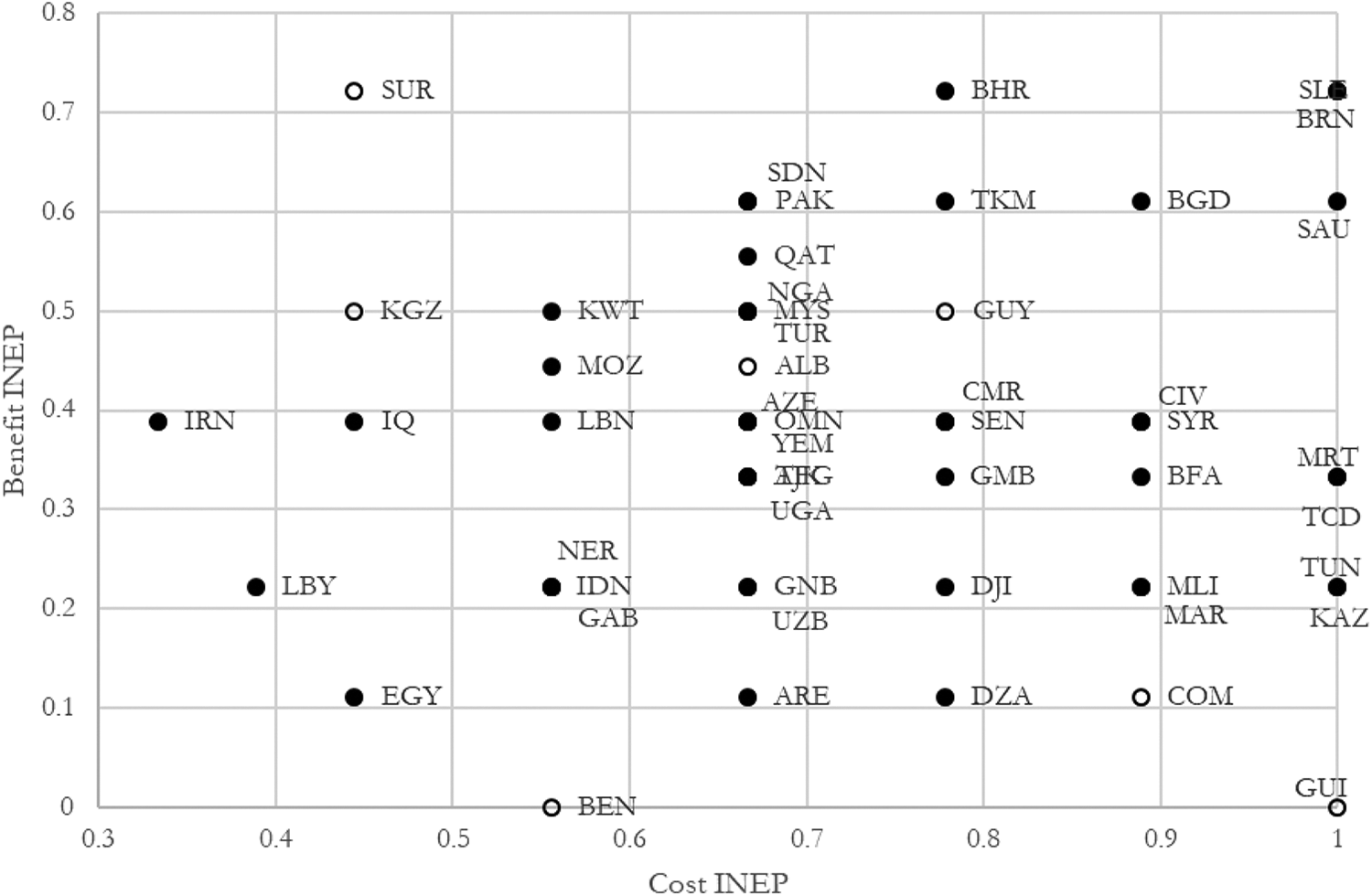
Structures of emergency constitutions in the OIC INEP scores as measured in 2015
Are emergency constitutions in the OIC different?
Exploring the design of emergency constitutions in the OIC suggests that while there is substantial heterogeneity within the group of countries, they are fundamentally different from those of Western democracies in some respects but not in others. In recent years, the permissiveness of emergency constitutions, as measured by INEP scores in the OIC region, has varied between a low of .15 in Egypt and a high of .56 in Sierra Leone, as illustrated in Figure 1. The mean score for the cost INEP among all 48 countries included in our OIC sample is .719, which compares to a mean score for the Western sample (based on 76 countries) of .433. 4 It is, in other words, much easier to declare a SOE in the typical member-state of the OIC. Interestingly, the means of the benefit INEP are far more similar to Western ones with the OIC countries having a slightly and insignificantly higher mean (.397 vs. .333). Despite the predominance of autocracies in the OIC, their de jure provisions thus do not allow them more discretionary emergency powers than Western democracies.
However, these averages contain substantial structural differences, as the figure that plots the difficulty of declaring an emergency (the Cost INEP) and the political benefits of doing so (the Benefit INEP) also shows. In particular, the constitution of Iran (Cost INEP = .17) and the new constitutions of Egypt, Iraq and Libya (.25) make it substantially more difficult and politically costly to declare a state of emergency, while it is comparatively easy in countries such as Jordan, Saudi Arabia, Sierra Leone and Tunisia (.67). At the same time, the emergency provisions in Benin and Guinea provide virtually no additional discretionary powers during emergencies (Benefit INEP = 0), while those of Bahrain, Brunei, Sierra Leone and Suriname (.46) are substantially more permissive by, for example, allowing the incumbent regime to derogate a number of rights as long as an emergency has been declared.
As such, the diversity of constitutional choices in this group of countries mirrors the substantial diversity across countries with Western political institutions covered by Bjørnskov & Voigt (2020). If any clear differences can be observed, they show that the cost components of the INEP are in general more permissive in the OIC than in democratic Western countries. However, given the diversity of OIC emergency constitutions, it is difficult to conclude that they are systematically different. We therefore next turn to exploring their use and effectiveness.
Data and empirical strategy
We follow the approach in Bjørnskov & Voigt (2020) by focusing on three outcomes. We first estimate the likelihood of any terrorist event taking place and next whether the event (or events in case multiple attacks occurred) led the incumbent government to call a SOE. Finally, given any event occurred, we explore whether terrorism affects the level of government repression.
Enders & Sandler (2012) define terrorism as ‘the premeditated use or threat to use violence by individuals or subnational groups to obtain a political or social objective through the intimidation of a large audience beyond that of the immediate victims’. We employ data from the Global Terrorism Database maintained at the University of Maryland (GTD, 2018), which exactly match this definition and which we use to form eight variables for all years between 1970 and 2014. This period is bookended by the absence of complete and comprehensive data on terrorist events before 1970 and the absence of consistent constitutional data after 2014. We first form a dichotomous variable taking the value of 1 if any terrorist events occurred in a given country in a given year, and the logarithm of the number of events (+1). We thus separate the extensive margin – whether any events occurred – from the intensive margin in the form of the number of events. We believe it is necessary to do so for three reasons. First, the data make it clear that terrorist attacks often come in ‘cascades’ such that one is likely to observe either none or several attacks. This may be a major problem in countries such as the OIC group that have particularly high levels of terrorist activity, and where attacks are either coordinated or one successful attack incentivizes other terrorist groups to attempt attacks (however, see Conrad & Milton, 2013). Empirically, this gives rise to a censored distribution of terrorist attacks with relatively many zero observations. Second, multiple attacks on the same or adjacent days may reflect the existence of terrorist organizations with advanced organizational skills that are structurally different from those perpetrated by simpler organizations. In the following, we therefore also create similar variables for three specific types of events: (1) events against the military or police; (2) events against the government and government installations; and (3) events against public infrastructure. 5 Finally, politicians and governments are likely to react quite differently to a single attack than a string of attacks that raise the observable risk of experiencing more attacks in the near future.
In order to capture whether a state of emergency is called, we rely on our own update in Bjørnskov & Voigt (2018b) of the dataset in Hafner-Burton, Helfer & Fariss (2011). This dichotomous variable measures whether the incumbent government officially declared a SOE or martial law as a result of any of these events. Because declaring a SOE formally confers a number of additional constitutionally warranted powers on the executive and thereby increases the discretionary power of either the cabinet or the head of government or state, we treat this as a separate dependent variable.
Our final dependent variable measures the degree to which governments repress the population by, for example, violating human rights. We use the indicator developed by Fariss (2014), which combines all available standards-based and events-based indicators available for many countries and several years since 1950. The index effectively captures the latent degree of absence of repression, that is, higher values indicate less repression. It also serves to emphasize the difference between the present sample and stable democratic Western societies, as the average repression index in the OIC group is –.22 vs. .82 in the sample of Western countries in the study of Bjørnskov & Voigt (2020).
Descriptive statistics
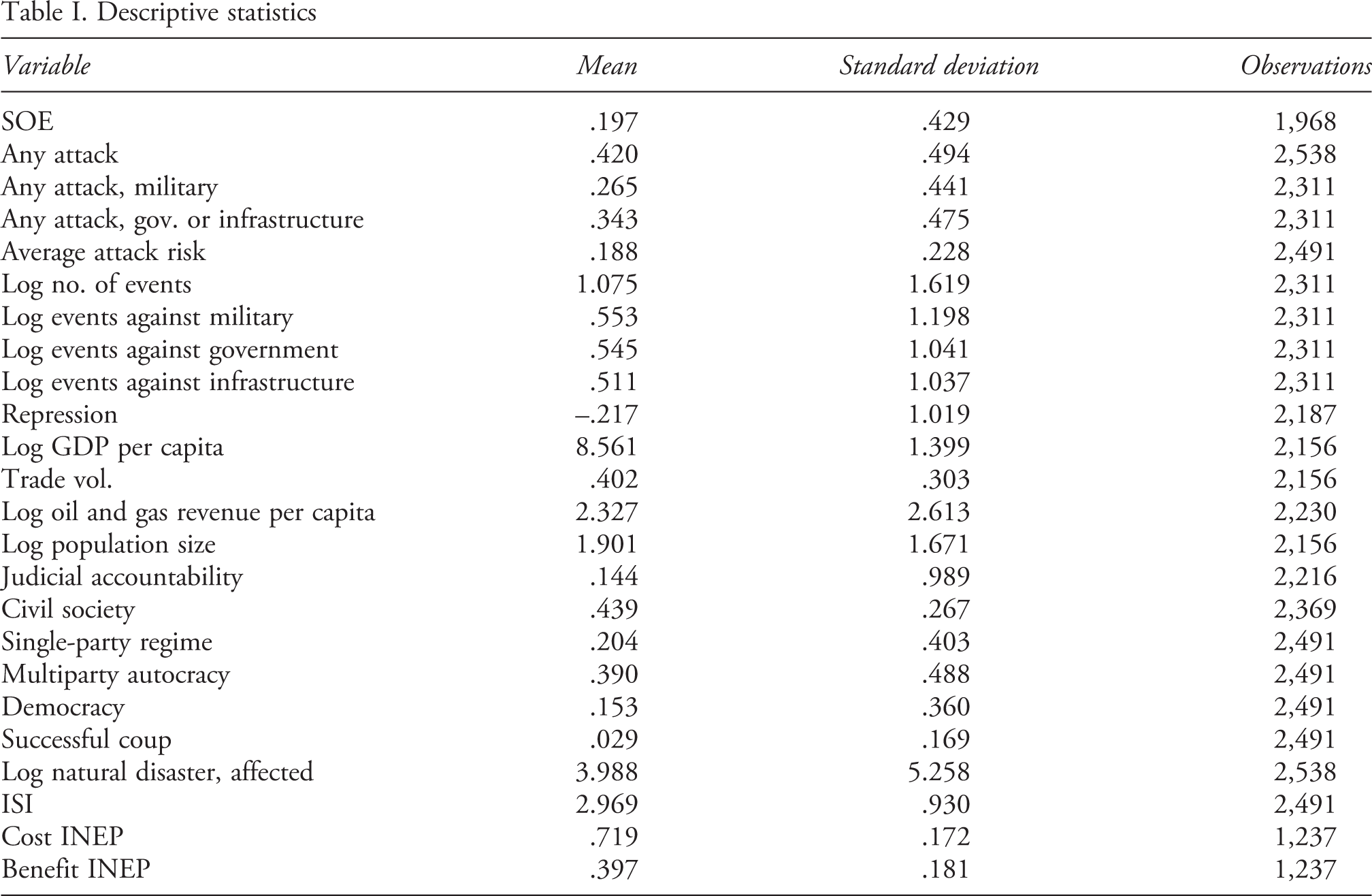
Our empirical strategy consists of two separate parts and follows the general approach in Bjørnskov & Voigt (2020). As we are interested in whether governments in the OIC declare a SOE as a result of terrorist attacks, and whether that behaviour is actually constrained by their emergency constitutions, we first employ Heckman’s two-step estimator. In its first step, we estimate the likelihood of observing any terrorist event while in the second step, we estimate the likelihood of calling a SOE or martial law, given that at least one event occurred. Employing Heckman’s two-step estimator thus allows us to separate the extensive margin (the selection step) from the potential effects of the number of terrorist attacks in a second step.
Two reasons speak in favour of such choice: first, the terrorism data are heavily censored with many zero observations and visible cascades of attacks. This means that ordinary least squares (and similar estimators) will yield potentially strongly biased estimates, because the country-years with non-zero observations, that is, the intensive margin, will constitute a non-randomly selected sample. Second, we employ the Heckman estimator as it allows us to relax the assumption that similar political processes drive the extensive and intensive margins, as would implicitly be the case with a Tobit estimator. The precision and validity of the Heckman estimator nevertheless rests on how well the specification identifies the events and thus provides precise identification of the selection bias. The exclusion restriction required to obtain valid estimates is that there must be one or more variables, which provide identification in the selection stage but are irrelevant in the second stage, and which thus function as instrumental variables. Although the estimator is therefore relatively sensitive to the performance of the specification of the first step, it simultaneously resolves the causality bias that would result from not handling the fact that terrorist attacks do not occur at random (Briggs, 2004).
By including a lagged dependent variable in the first step, we argue that these estimates may also be interpreted causally, although with some caution. 7 In addition, our first-stage specification thus consists of the common set of variables, as well as trade volumes, the log of population size, and fixed effects for five-year periods and regions. We therefore treat these factors as instruments for theoretical and practical reasons. Theoretically, larger countries are more likely to suffer from terrorism, not least because the political impact and publicity of attacks is substantially larger in more populous countries. Similarly, certain regions – in particular, the half of our sample countries situated directly in the Middle East – are systematically more prone to terrorism, just as variations in a common annual risk mainly affect countries at the extensive margin: in years with a higher risk of terrorism in the OIC, countries without persistent terrorism and some years without any attacks will be more likely to experience at least one event. By adding one or more of these variables to the second stage, we tested the practicality of these choices. 8
The common variables for both the first and second stage are the log of GDP per capita and oil and gas revenue, judicial accountability and the strength of civil society, indicators for whether the country is a single-party regime, a multiparty autocracy or a democracy (with regimes without elections as the comparison category), an indicator for the occurrence of a successful coup, and the Cost and Benefit INEP measures. Following preliminary tests, we also include the ISI in the second stage, as well as the log of the number of terrorist events, as this is our intensive margin.
In our second set of estimates, we address the question of whether the terrorist attacks give rise to increased repression. Instead of applying a Heckman estimator here, we condition these estimates on whether any attack occurred in a given year, and thus only include years in which an attack actually occurred, in order to focus on the specific events and not pick up other developments. This choice is not only predicated on the fact that the repression data do not exhibit the same censoring problem as the terrorism data, but also necessary because changes in repression cannot be sorted into an extensive and an intensive margin. Such changes can not only be both negative and positive, but also offer no natural or intuitive cutoff at which to define an extensive margin. Restricting the sample to only years in which at least one terrorist attack occurred is therefore a conservative choice that precludes that we compare with years without events or with fundamentally different events. We estimate the government reactions to attacks the previous year using OLS with five-year fixed effects and the twice-lagged dependent variable, as there is no natural distinction between margins in the repression responses. By adding the twice-lagged dependent variable, we effectively estimate the determinants of changes in repression over two-year periods, given the initial levels of repression. 9
Do emergency constitutions constrain terrorism?
Main results
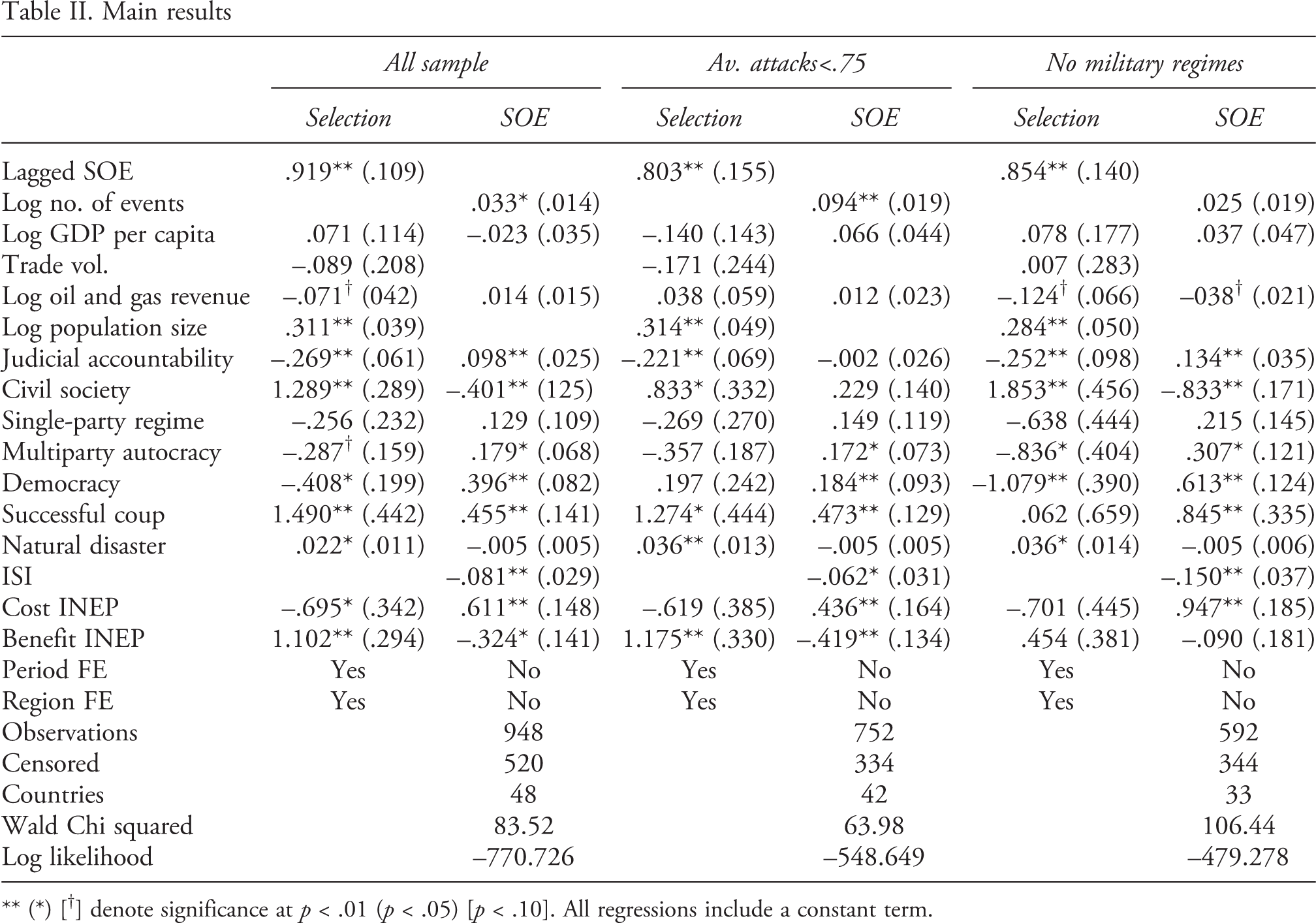
** (*) [†] denote significance at p < .01 (p < .05) [p < .10]. All regressions include a constant term.
The odd-numbered columns show that emergencies are persistent, as indicated by the large coefficient on the lagged dependent variable: if the government called a SOE in year t–1 – potentially due to terrorist attacks – it is highly likely to observe events in year t. Unsurprisingly, we also find evidence that more populous countries are more likely to experience terrorism while a number of other determinants are non-robust: the likelihood of being subject to a terrorist attack is never significantly correlated with GDP per capita and regime differences lose significance when the most terror-prone countries are excluded.
Focusing on our main variables of interest, we find that countries with higher Cost INEP scores – that is, countries in which it is easier and politically less costly to declare a SOE – are less likely to be hit by terrorist events (column 1) but this correlation loses its significance once we exclude the most terror-prone countries or military regimes (columns 3 and 5). Revenues from the export of oil and gas imply a slightly lower chance of being subject to a terrorist attack but once we exclude the most terror-prone countries, this relationship also loses its significance. Coups, on the other hand, are highly correlated with terrorist events only as long as military regimes are not excluded from the sample.
Turning to the robust relationships, we find that higher levels of judicial accountability (here used as a proxy for institutional quality) are always associated with fewer terrorist events, lending support to hypotheses claiming that higher quality institutions make terrorist incidents less likely (Dragu, 2011). Interestingly, countries with more active civil societies are more likely to experience terrorist events although we can claim neither causality nor a specific mechanism. It may, for example, be the case that civil society organizations are stronger because of a need to handle consequences of terrorism through private organizations as well as political action. It also remains an option that strong civil society organizations in OIC countries reflect a weak state or that they lobby against policies that may be repressive but are effective deterrents against terrorism. Finally, we find that natural disasters are positively correlated with terrorist events. This is in line with previous analyses that found the increased vulnerability of a government subsequent to a natural disaster to be employed to instigate additional terrorist attacks (Berrebi & Ostwald, 2011).
Focusing on the determinants of emergency declarations, we do not find that richer countries in the OIC are more likely to declare a SOE when hit by terrorism. This is markedly different from the previous analysis reported in Bjørnskov & Voigt (2020) and based on a Western sample where we found that richer countries are significantly less likely to declare a SOE subsequent to a terrorist event. Democracies and, to a somewhat lesser extent, autocracies with multiparty elections are more likely to declare a SOE as are countries in which government changed through a successful coup d’état. A strong civil society is associated with a lower propensity to declare a SOE, yet this association seems to be driven by the most terror-prone countries as the insignificant relationship displayed in column 4 suggests. Finally, oil and gas revenues are not significantly correlated with the likelihood of declaring a SOE. The data thus do not support the conjecture that oil-rich countries might buy the loyalty of their citizens instead of increasing repression levels.
Focusing on the constitutional differences, the results show that when countries with higher Cost INEP scores experience terrorist events, they are also more likely to declare an emergency. This is, hence, in line with our theoretical priors. Countries with higher values in the Islamic State Index, that is, countries giving pride of place to principles of Islam in their public policies, are less prone to declaring emergencies, also in line with our theoretical priors. Conversely, although the Benefit INEP is strongly significant in columns 2 and 4 (as in columns 1 and 3), the identification here derives almost exclusively from military dictatorships. Overall, our findings indicate that constitutions impact on both terrorism and governments’ reactions to terrorism. These findings are confirmed in Table III where we distinguish between all attacks (repeating our results from columns 1 and 2 in Table II), terrorist attacks on military installations or the police in columns 3 and 4, and government installations and infrastructure in columns 5 and 6. Although the political nature of these terrorist events may arguably be quite different, we find no significant differences between their determinants. 10
The results indicate that when the constitution makes it easier to declare a SOE following events such as terrorist attacks, countries are less likely to experience such attacks. The specific results in Table III nevertheless indicate that this does not hold for attacks against the military, but only for attacks on other targets. Conversely, once attacks occur, the same countries are indeed more likely to declare an emergency. Making it easy for governments to declare a SOE thus is an effective deterrent in the form of a credible threat. Yet, whether countries that actually declare a SOE do so within the limits of the constitution and without violating human rights is an open question to which we now turn.
Do emergency constitutions constrain government reactions to terrorism?
In Table IV, we explore the potential consequences of terrorist attacks for government repression, given the constitutional emergency provisions. In odd-numbered columns, we report results with a similar specification as in previous tables while even-numbered columns also include interaction terms between the Cost INEP and Benefit INEP and the logarithm of the number of terrorist events.
We first note that repression is highly persistent, as indicated by the lagged dependent variable, which indicates that many events most probably do not lead to changes in repression. We also find significant evidence that larger countries tend to repress more, and that economic recessions typically lead to more repression. Most importantly, we find that on average – in columns 1 and 5 – terrorism leads to more repression. However, the size of the effect is limited and corresponds to an increase of about 8% of the within-country standard deviation.
Specific results, types of attacks
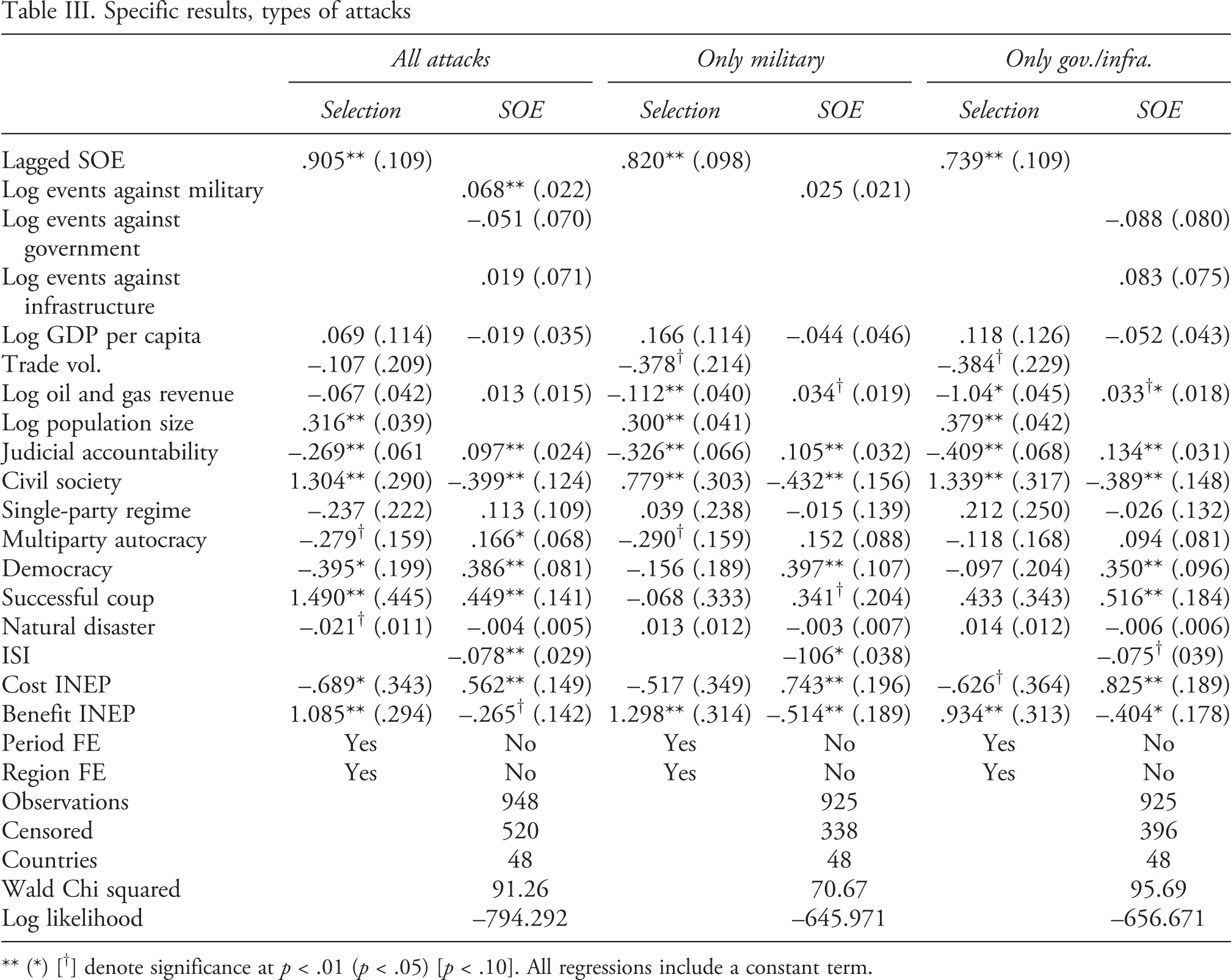
** (*) [†] denote significance at p < .01 (p < .05) [p < .10]. All regressions include a constant term.
Noting that the median country is subject to four attacks on the military or police, once any attacks occur, this is a large effect with potentially important consequences. Overall, we thus find that terrorist attacks give rise to marked government reactions in the OIC countries in the form of both the declaration of SOE and increased repression. These reactions are nevertheless clearly affected by the constitutional design of their emergency provisions, as we discuss in the concluding section.
Discussion and conclusions
Repression effects
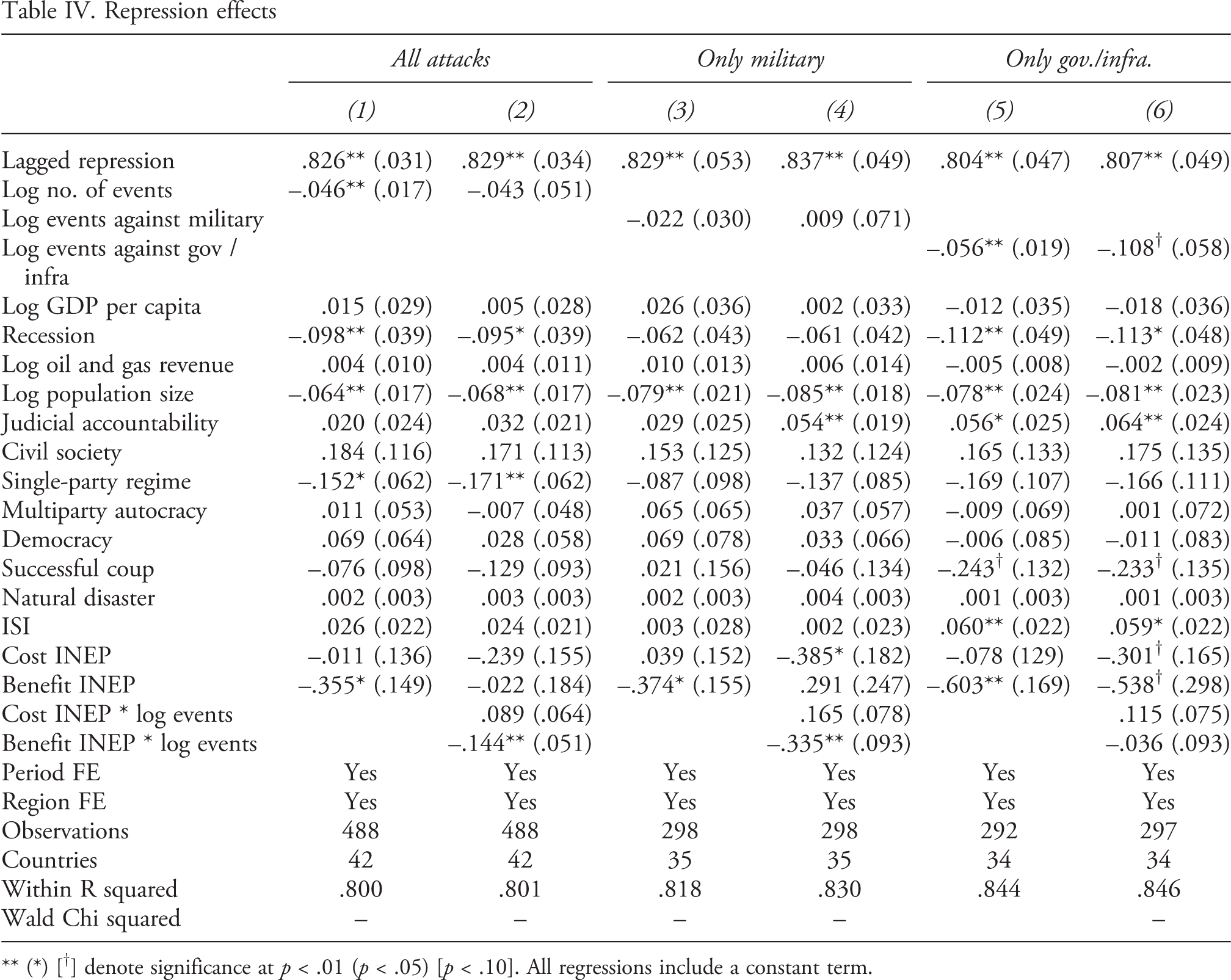
** (*) [†] denote significance at p < .01 (p < .05) [p < .10]. All regressions include a constant term.
We find that the reactions to terrorist events are channelled by the contents of their emergency constitutions even though most of these countries are autocracies. First, if the constitution makes it easier and politically less costly to call a state of emergency, countries in the OIC are less likely to experience terrorist events. Second, if they do so, the regimes with constitutionally easier access to calling emergencies are also more likely to do so. Our estimates are thus consistent with the interpretation that the declaration of a state of emergency in countries where the constitutions make them relatively likely are indeed credible deterrents of terrorism.
Finally, we find that once events occur, it is the benefit side of the emergency constitution that affects the degree to which governments use repression. The more additional discretionary power is constitutionally allocated to the government in emergencies (in the form of the ability to suppress basic rights, censor the press, expropriate property, etc.), the more governments actually increase repression after terrorist events. These reactions follow strongly from terrorist attacks on military and police facilities and to a much smaller extent when the targets of the attacks are government facilities or infrastructure. In addition, the size of the typical repressive reaction is far from negligible.
While we find that OIC member-states in which the emergency constitution does not grant the government any real additional powers during emergencies do not react repressively to terrorist attacks, the median country in the organization does so. A typical year with terrorist activity includes four attacks on the military or police, and the political reaction of a country with a median emergency constitution – as measured by the Benefit INEP – implies an increase in repression of approximately half a standard deviation. Overall, our evidence thus suggests that the predominantly autocratic regimes within the OIC not only react politically to terrorist events, but that their reactions are significantly shaped by the limits and opportunities defined by their constitutional emergency provisions. Whether this occurs because they are de facto constrained by veto players or the judiciary, or if these regimes simply care about how legitimate their policies seem to the population and the international community, are questions for future research.
Footnotes

Acknowledgments
We are grateful to Sina Imhof, Daniel Arce, Roee Sarel, Jerg Gutmann, Katarzyna Metelska-Szaniawska, and participants of the 2019 meetings of the European Public Choice Society (Jerusalem), the 2019 meetings of the European Association of Law and Economics (Tel Aviv), and the 2019 Spanish Public Choice Workshop (Pamplona) for helpful comments on earlier versions. Ghalia Selim provided fantastic research assistance. Voigt acknowledges intellectual support from the Minerva Centre for the Role of Law under Extreme Conditions. All remaining errors are entirely ours.
Funding
Bjørnskov gratefully acknowledges financial assistance from the Jan Wallander and Tom Hedelius Foundation.