




Abstract
The relationship between terrorist activities and states of emergency has never been explored in a cross-country perspective. This article is a first step to change that. Given that a terror act has been committed, what are the factors that lead governments to declare a state of emergency (SOE)—or refrain from declaring it? And given that a SOE has been declared, what are the effects thereof? On the basis of seventy-nine countries all having Western-style constitutions, we find that more terrorist incidents increase the likelihood of a SOE. Interestingly, emergencies are less likely to be declared in election years, supposedly because governments believe them to be unpopular. Once a SOE is declared, it generally leads to substantially more government repression. Finally, countries already under a SOE are more likely to suffer from additional terror attacks, challenging the effectiveness of states of emergency.
Keywords
States of emergencies are declared frequently. Their declaration regularly implies a shift of competences away from the legislature and the judiciary toward the executive on the one hand, and a reduction in civil and political rights for all citizens of a country on the other. Among the reasons for declaring a state of emergency (SOE), terrorist activities have become ever more important. However, the existing terrorism literature has so far not dealt with SOEs or their constitutionalization.
We therefore focus on three questions in this article: (1) What factors determine the declaration of a SOE subsequent to terrorist attacks? (2) Given that a terrorist act has occurred and a SOE been declared: what are the consequences on civil and political rights? Terrorist acts are endogenous to government behavior. So we go full circle and (3) ask whether changes in the degree to which civil and political rights are implemented as a consequence of a SOE impact the likelihood of experiencing other terrorist incidents? We deal with these three questions as a precondition for answering an overarching one, namely whether emergency provisions that allow governments to declare a SOE are effective in preventing future terrorist incidents from occurring.
A seasoned advice of successful scholars is never to deal with more than one question in a single paper. We explicitly violate that advice here because we argue that the three questions are intimately linked. In the theoretical section, we argue that they can be thought of as constituting a circular relationship: the government response to a terrorist incident might well result in a reduction of civil and political rights which might, in turn, be the cause for additional terrorist events. Adequately dealing with endogeneity is thus key for reaching reliable results. We do so for the first questions by estimating the determinants of suffering from any terrorist attack and the subsequent probability that the government calls a SOE using Heckman’s two-step estimator. Subsequently, we separately estimate the dynamics of the potential repression of citizen’s rights around such events for which causality must remain an open question.
Based on up to seventy-nine countries with a Western-style constitution, the main findings with regard to the three questions just sketched are (1) the higher the number of terrorist events in a given country and a given year, the higher the probability that a SOE will be declared. SOEs are more likely to be declared when the emergency constitution simultaneously makes it easy to declare a SOE and allocates substantial additional powers to the executive. Ceteris paribus, right-of-center governments are more likely to declare a SOE. Moreover, SOEs are less likely to be declared in election years. (2) Regarding the effects in terms of civil and political rights, more terrorist events go along with government being more repressive. Governments that have called a SOE subsequent to a terrorist attack are increasing repression levels. Compared to parliamentary systems, presidential democracies, civil autocracies, and military autocracies all repress significantly more following terrorist incidents. (3) Asking whether increases in repression levels cause additional terrorist incidents, we find evidence in support of that conjecture, which is in line with previous findings. We add to these findings by exploring the use of a particular policy instrument: declaring a SOE and thus invoking the country’s constitutionalized emergency provisions. This may often cause increased repression levels, although the emergency provisions do not always allow such action. We also find that countries already under a SOE are more likely to suffer from terrorist incidents at least casting doubt on the effectiveness of emergency declarations. Confining the models to democratic countries only, we find that a strong civil society is significantly correlated with fewer terrorist events.
This article adds to two research areas: a very tiny literature on the effectiveness of constitutionalized emergency provisions. These are pertinent here because it is these provisions that define who has the power to declare a SOE but also what additional powers are granted to government under a SOE. Bjørnskov and Voigt (2016) inquire into the effectiveness of emergency provisions with regard to natural disasters where endogeneity concerns are largely absent. As already alluded above, endogeneity is a central issue to take into account when trying to ascertain the effectiveness of emergency provisions with regard to terrorist activities. We are not aware of any other paper that has analyzed the effectiveness of emergency constitutions with regard to terrorism. The second area this article adds to is a fast-growing literature analyzing terrorism from a rational choice perspective, that is, assuming that terrorists react rationally to changes in relative prices. Within this literature (summarized in Sandler 2014), a number of contributions focus on the effectiveness of counterterrorism policies. As far as we can see, however, to date, no paper has dealt with the effectiveness of emergency constitutions as a part of counterterrorism policies.
The article is structured as follows: in the second section, we propose a way to delineate terrorist events from other, nonterrorist events. In the third section, we present our theoretical approach. Our data as well as our estimation approach are described in the fourth section. We report our empirical findings in the fifth section. The sixth section concludes and spells out a number of open questions.
Defining Our Key Terms
Terrorism has been defined as “the premeditated use or threat to use violence by individuals or subnational groups to obtain a political or social objective through the intimidation of a large audience beyond that of the immediate victims” (Enders and Sandler 2012, 4). The definition refers to both the means and the goals of the relevant actors. Two means need to be present, one direct and the other more indirect: use of violence is quite direct, whereas the intimidation of a large audience is more indirect. Assassination of a leading politician is an act of violence—but as long as there is no intention to intimidate a large audience, it would not count as a terrorist act.
National terrorism is often distinguished from transnational terrorism (e.g., Enders, Sandler, and Gaibulloev [2011] and Sandler [2014, 9] with a number of arguments in favor of such distinction). Among the many potential differences between domestic and international terrorism offered by Sandler, two are of particular relevance in our context. He conjectures that the effectiveness of counterterrorist policies may differ depending on whether we deal with domestic or international terrorism. Further, the costs of counterterrorist policies might also depend on the kind of terrorism one is dealing with. In a word, transnational terrorism and governments’ responses to it are fraught with a number of border-crossing externalities that are largely absent with regard to domestic terror. Another reason not mentioned by Sandler but potentially relevant in our context is that declaring a SOE implies a shift of competences away from the legislature and the judiciary to the executive. It usually also implies that some civil and political rights are being suspended. We argue that the perceived legitimacy of a SOE might also be a function of whether terror is domestic or international.
In addition, we propose to analyze terrorism taking into account whether carrying out a terrorist attack is logistically demanding or not. The events around 9/11 were logistically demanding. Meticulous planning was necessary, substantial amounts of money were needed, many terrorists needed to coordinate their behavior. On the other hand, there are attacks that are carried out by only a handful of people or even single individuals. Using a car to run into a crowd or a knife to kill bystanders are examples of terrorism not implying any logistical challenge. We assume that counterterrorism policies—including all those made possible by calling a SOE—will affect these two kinds of terrorism very differently. In the following, we therefore try to separate types by whether or not the attacks were heavily armed and which types of institutions they targeted.
In this article, we often refer to the term emergency constitution. By this term, we simply mean those provisions found in a country’s constitution that deal with emergency situations. Emergency constitutions typically spell out the kind of incident that justifies the declaration of a SOE, the players who need to consent to such a declaration, the additional competences a government enjoys under a SOE, but also possible limits as, for instance, their maximum time length.
Theory
In this section, we develop a number of potential answers to the three questions formulated above. As already argued, it might prove useful to think of the various cause–effect relationships as being in a circular relationship to each other: terrorist activities might induce government to declare a SOE, which might lead to higher repression levels, which might, in turn, lead to a higher—or lower—number of terrorist incidents. Such a conceptualization constitutes a challenge for the empirical analysis, as terrorist activities are endogenous to government behavior. For the theoretical part, it implies that the causes underlying terrorist activities should be incorporated explicitly into the analysis.
Since terrorist activities are endogenous, it is important to take the factors driving them explicitly into account. Terrorists strive to acquire some social or political change, and their behavior can thus be analyzed as a reaction to government behavior. It has been argued that nonrespect for physical integrity rights could lead to more terrorist activities because the communities from which (potential) terrorists are drawn will be alienated from the rest of society and will, in turn, be less likely to monitor potential terrorists and report suspicious activities to the police. Drawing on game theory, Dragu and Polborn (2014) present a model consisting of an interaction between a representative voter, an elected executive, and members of the community whose support can help prevent terrorist activities. If voters demand tougher counterterrorism policies, governments are likely to supply them because they want to be reelected. However, tougher policies can lead to additional alienation between government and communities from which terrorists might emerge, making it more difficult to discover terrorist activities before the event (cf. Londregan and Poole 1990). Tough antiterror policies could also potentially curtail the ability of civil society to counteract terrorism and the attraction of joining terrorist organizations. Being tough on terrorists could therefore lead to more, rather than less, terrorist activities (Dragu 2011).
Walsh and Piazza (2010) discuss two other potential transmission channels that could lead to fewer terrorist incidents as a consequence of respect for physical integrity rights. In addition to the channel just discussed, they hypothesize that nonrespect could cause conflicts with other political groups in the country and could also reduce other governments’ willingness to cooperate. They find that improvements in government respect for physical integrity rights reduce the likelihood of terrorist attacks substantially (p. 566): “Raising respect for physical integrity rights from its lowest level of 0 by only one unit reduces the expected number of terrorist attacks by between 17% and 40%, depending on the measure of terrorism.” 1
Walsh and Piazza (2010) point out that their finding might be subject to reverse causality: it could be that it is not low levels of physical integrity rights that cause terrorist acts to be committed but that as a consequence of terrorist acts, physical integrity rights are curtailed. They admit not having found a convincing instrument to establish causality from the nonrespect of physical integrity rights to terrorist incident but are fairly confident that the causation runs this way due to a number of plausibility tests. Gassebner and Lüchinger (2011) point at the same problem but are less confident regarding the direction of causality. In addition, there might even be something like a vicious cycle: a low level of civil and political rights induces some terrorist activities. As a consequence, civil and political rights are curtailed, which induces still more terrorist activities and so forth.
We have presented a number of possible transmission channels according to which little respect for basic human rights could lead to more terrorist activities. These considerations point to a number of factors that may affect the probability of observing terrorist attacks, which we treat in the following section. We now move on to discuss under what conditions we expect governments to declare a SOE, given that a terrorist incident has occurred. We pay particular attention to the contents of the underlying emergency provisions as they may be an important determinant in government’s choice to declare—or not—a SOE. We propose to distinguish between direct and indirect costs of such declaration.
Direct costs of declaring a SOE can be thought of as the difficulty of securing the consent of those actors whose consent is needed: the higher the number of veto players, the less likely is it that a SOE will be declared. If parliamentary consent is needed, then the fractionalization of parliament is one determinant of the declaration costs: highly fractionalized legislatures are less likely to approve of a SOE simply because it is more difficult to secure their consent.
But there are also more indirect costs: declaring a SOE implies a shift in competences from the legislature and (or) judiciary toward the executive but also a potential reduction in civil and political rights for everybody. Reductions in civil and political rights are generally unpopular but might be accepted by large parts of the population if the terrorist threat is perceived as real and emergency provisions are generally thought to be effective means to deal with such threats. Formulated differently: the higher the number of incidents, the lower the indirect costs of declaring due to a loss in popularity.
If voters perceive a high threat level—and indirect costs of declaring a SOE are correspondingly low—governments might use the perceived threat level as a welcome pretext to declare a SOE if that increases their discretionary powers and allows them to bypass regular veto institutions. Governments could thus rationally use terrorist attacks as a pretext to implement policies that would either be unconstitutional or vetoed outside of a SOE. It should be noted that this argument holds even if reductions in civil and political rights are ineffective means of combatting terrorism. We thus have two separate reasons to hypothesize that the number of terrorist attacks as well as their severity in terms of number of people killed are two important factors determining this decision. 2
Ideological preferences and differences in political issue ownership can also impact on the indirect costs the declaration of a SOE causes. Prima facie, one could expect right-of-centre politicians of a “law and order” variety to experience less costs by declaring a SOE than more liberal politicians. One would, accordingly, expect right-of-center majorities to declare more often than left-of-center majorities.
But this reasoning might well be shortsighted. Based on a game-theoretic model, Di Lonardo (2019) predicts that left-wing governments respond to terrorist attacks more aggressively than right-wing governments because they want to signal to the electorate their firm stance on fighting terrorism, which is taken for granted with right-wing governments. In his model, incumbents’ responses to terror events are also a function of the perceived threat level (if it is low, then voters weigh liberty more heavily than security. The inverse is true if the threat level is perceived as high). The entire model is, hence, based on the perceived trade-off between liberty and security, which might be empirically wrong but may well be right according to the perceptions of many voters. Transferring the results of that model to our question, one would, hence, expect left-wing governments to display a higher propensity to declare a SOE than right-wing governments.
Finally, the potential benefits accruing to government are also expected to impact its decision. The more additional competences come with the declaration of a SOE, the more attractive is its declaration for government. We thus expect effects to be conditional on the contents of constitutional emergency provisions, given that politicians actually respect the constitution.
Declaring a SOE is not the only possible reaction of government to terrorist events. Governments might be convinced that to fight terrorism, they need some of the additional competences currently reserved to times of emergency or, as noted above, use terrorist threats as a pretext to gain more discretionary competences. To make these competences permanent, counterterror legislation might be passed. The more encompassing the counterterror legislation, the less likely calling a SOE in the future. In a sense, then, counterterror legislation may be a substitute to declaring a SOE.
This leads us to the third and final cause–effect relationship. Once a SOE has been called subsequent to a terrorist attack, we are interested in its effects. We propose to distinguish immediate from intermediate effects. With regard to the former, we hypothesize that a SOE will diminish the level to which civil and political rights are implemented. Intermediate effects of a SOE include changes in the behavior of terrorists. If, due to a SOE, supervision of some buildings is improved or public vigilance increases, terrorists are likely to change their behavior by, for example, attacking those buildings whose supervision has not been improved. In other words, terrorists may rationally change their targets instead of abandoning their plans when policies change.
The rational choice analysis of terrorist behavior implies that changes in the costs of certain terrorist activities need to be taken into account. If a SOE increases the costs of particular modes, other modes become (relatively) less costly and we would expect terrorists to resort to them. Sandler (2014, 6), for example, shows that the improved protection of one target group (say officials) led terrorists to move on to another one (say the military). With regard to the effects of retaliatory raids, Enders and Sandler (1993) found intertemporal substitution, that is, terrorists moved planned attacks to be executed in the future to the present in order to protest against the raid. Adding an international element, making terrorist activities more costly in one country might lead to increased activity elsewhere, hence inducing border-crossing externalities (Krieger and Meierrieks 2017).
We propose to ask whether these findings also apply to the use of states of emergency. Declaring a SOE could provoke terrorists to protest against such measures by carrying out planned attacks sooner than originally planned. Regarding the potential substitution of specific attacks by alternative ones, we propose the following argument: states of emergency shift competences to the executive. The executive can use the additional powers to survey and monitor potential perpetrators more closely, which is likely to make large and complex terrorist attacks—such as 9/11—more difficult and thus more costly for terrorists. We propose to call this kind of terrorism “logistically challenging.” This implies, however, that very simple attacks, we propose to call them nonchallenging, become relatively cheaper. 3 Formulated as a hypothesis: in the wake of SOEs declared subsequent to terrorist attacks, logistically challenging attacks will be substituted for nonchallenging ones.
Data and Estimation Approach
Dependent Variables
In the following, we focus on three specific outcomes: (1) whether any terrorist event occurred; (2) whether the event or events resulted in the government calling a SOE; and (3) whether the government changed its level of repression as a result of the event or events. For (1) and (2), we employ data from the Global Terrorism Database (GTD 2017) maintained at the University of Maryland.
The GTD includes a very large number of events, starting in 1970 and ending in 2016. We include all events that satisfy the criteria and definition of a terrorist event as “the threatened or actual use of illegal force and violence by a nonstate actor to attain a political, economic, religious, or social goal through fear, coercion, or intimidation” (GTD 2017, 9), which in the present sample amounts to a total of 60,649 episodes from eighty-two countries that satisfy a particular set of criteria outlined further below. We aggregate the data on a yearly basis because our control variables are only available on a yearly basis. This reduces the potential data set to 3,585 country-year observations in which an event took place in almost exactly half of the observations. Our first main dependent variable is a dummy that captures whether any such events occurred in a given calendar year. In addition, we include the logarithm to the number of events (plus 1) in a calendar year. We cover all available years from 1970 to 2014.
Data from GTD also allow more precise analyses because they include measures of how many events targeted government functions, and how many targeted the military or police. In separate tests, we also use a dummy of whether any events targeted the government or the military or police, respectively, instead of the dummy for whether any events took place. In addition, we create an alternative measure of the number of attacks with multiple targets (“multiple targets events”), which we think of as a proxy for logistically challenging events, versus nonchallenging with a single target. The Online Appendix provides two alternative ways of separating more from less challenging events relying on the type of weapons used and whether or not there were repeated attacks during more than one day.
Our second dependent variable derives from an update of the data set in Bjørnskov and Voigt (2018b), which itself is an update and expansion of the data set in Hafner-Burton, Helfer, and Fariss (2011). The variable captures whether the incumbent government officially declared a SOE or martial law as a result of any of these events. We treat this as a separate dependent variable, as declaring a SOE confers a number of additional constitutionally warranted powers on the executive and thus increases the discretionary power of the government or head of government (Bjørnskov and Voigt 2018a).
Finally, our third dependent variable measures the degree to which governments repress the population by, for example, violating human rights. We use the indicator developed by Fariss (2014), which combines all available standards-based and events-based indicators available for many countries and several years since 1950. The index effectively captures the latent degree of absence of repression, that is, higher values indicate less repression.
Explanatory Variables
Above, we argued that the likelihood of calling a SOE subsequent to a terrorist attack is mainly driven by the (direct or indirect) costs as well as the benefits connected to such a declaration. In previous work (Bjørnskov and Voigt 2018a), we have developed an index of emergency powers (INEP) containing three cost elements and three benefit elements. Both parts of the INEP are likely to influence the decision to call a SOE which is why we include them. The INEP is based on constitutional information in the Comparative Constitutions Project (Ginsburg, Elkins, and Melton 2009) and our own updates. It explicitly takes into account three cost dimensions as well as three benefit dimensions: the ease of declaration, the ease of having a SOE approved, and how comprehensive is the list of events that define a legal emergency from the cost INEP while whether the emergency constitution allows the dissolution of parliament, if some or all basic rights can be suspended, and if the emergency constitution allows expropriation and censorship from the benefit INEP. In all cases, we code the component as 0 if the executive has no influence, 1 if the executive faces no obstacles or vetoes, and 0.5 if the provisions are uncertain. The index is thus coded such that higher values indicate a higher utility for the executive (i.e., less costs, more benefits) on a scale between 0 and 1. We employ the two separate indices of Cost and Benefit INEP in the following. We also include a dummy capturing whether the constitutional emergency provisions in total are uncertain or the country does not have an emergency constitution. When this is the case, we set the INEP at 0.5 such that the “Uncertain provisions” dummy captures whether governments (and potential terrorists) in such situations behave differently.
One additional cost component refers to the fractionalization of parliament because it makes it more difficult to declare a SOE. We include the Herfindahl–Hirschman index of the legislature, which captures the degree of fractionalization of the parliament. The Herfindahl–Hirschman index is coded between 0 and 1 such that higher values imply less fractionalization and 1 means that a single party holds all seats in parliament. Further, legislator ideology was hypothesized to influence the likelihood of agreeing to a SOE. We include a measure of the average political ideology of the legislature. This index is calculated by first placing all parties in parliament in five categories: −1 (unreformed communist or socialist), −0.5 (reformed or modern socialist), 0 (modern social democratic), 0.5 (conservative or moderate liberalist), and 1 (classical liberalist and libertarian). Next, we calculate an average of these positions weighted by the seat share in parliament. We get these data from Berggren and Bjørnskov (2017).
Finally, we argue that more terrorist incidents would lower political opposition to declaring a SOE, which would make its declaration more likely. Data on the (logarithm to the) number of incidents in a given year are also from the GTD.
Covariates
Regarding economic covariates, we include the income per capita in log form because we assume richer countries will be better equipped to deal with terrorist events. We further include a dummy capturing recessions—years in which gross domestic product growth was negative—as terrorist attacks could be more likely when government is perceived to be weak and unpopular. These data are all purchasing power adjusted and from the Penn World Tables, mark 9.0 (Feenstra, Inklaar, and Timmer 2015). 4 From the same sources, we include the logarithm to the size of the population, as larger countries are more likely to experience terrorist attacks.
With regard to political covariates, we first include separate forms of political institutions. We do this based on the assumption that autocratic governments might react quite differently to terrorist events than democratic ones. To tease out the most of this distinction, we follow Cheibub, Gandhi, and Vreeland (2010), as updated in Bjørnskov and Rode (forthcoming), and distinguish between parliamentary (our comparison category), mixed (i.e., systems with weak presidents), and presidential democracies on the one hand and civilian and military autocracies on the other. 5 The difference between civilian and military autocracies derives from whether or not the head of state or government has military status or not. We include a dummy for the occurrence of coups d’état, which we get from the same source. We also include a dummy for election years, based on the assumption that governments may have different incentives immediately before elections. All of these variables derive from the background data for Berggren and Bjørnskov (2017), which in bicameral systems provides data on the lower house.
In further tests, we account for the de facto quality of formal institutions by using three variables from the V-Dem database (Coppedge et al. 2016). These variables capture civil society strength, judicial accountability, and judicial corruption; each variable is scored such that higher scores imply stronger civil society, and more accountable and less corrupt judicial institutions. 6
Finally, to the degree that states of emergency aim at reducing the likelihood of terrorist events occurring in the future, they can be interpreted as one type of counterterrorism measure. To be able to evaluate the effectiveness of SOE declarations, other policies should therefore be controlled for.
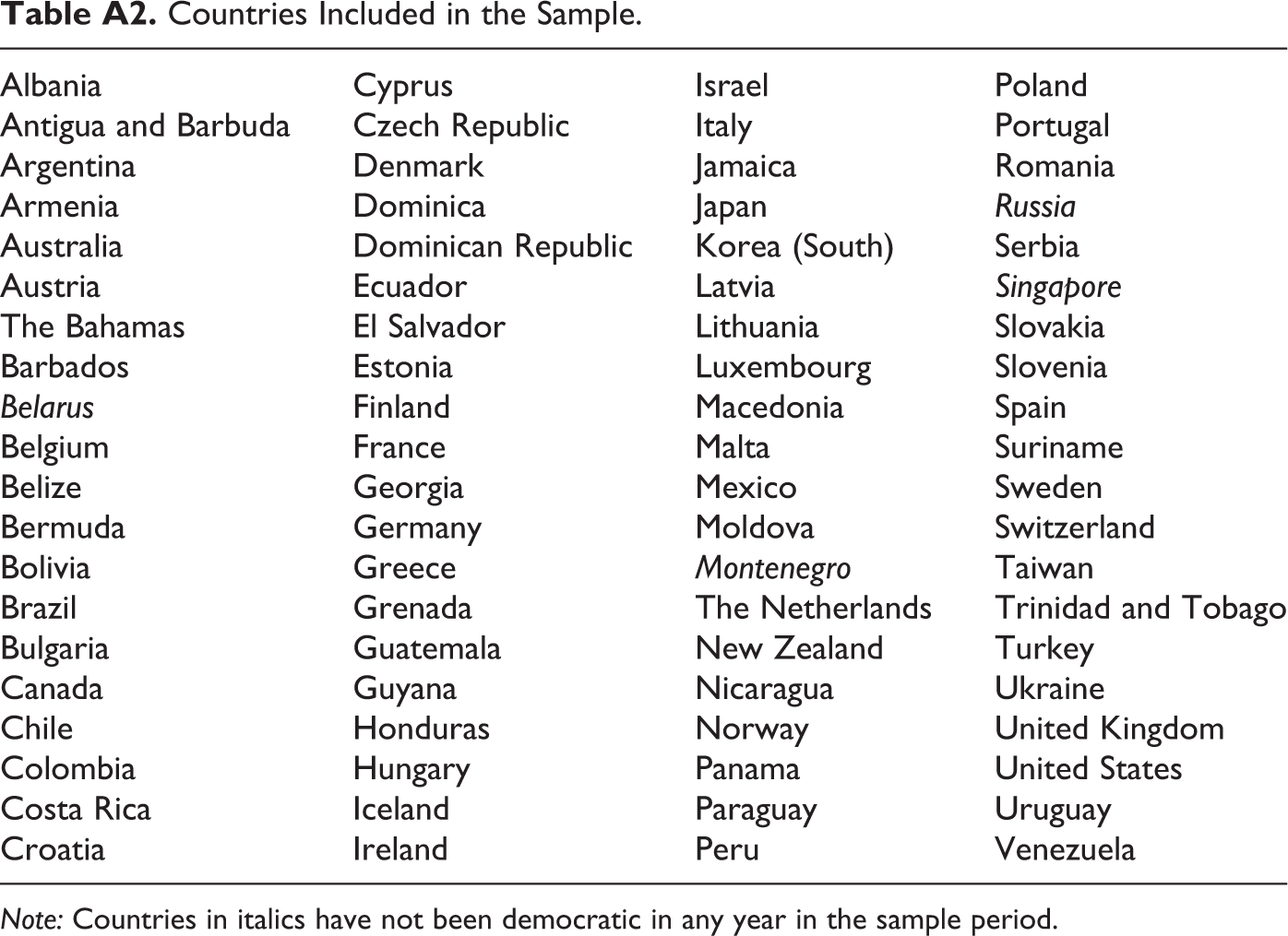
Table 1 summarizes our data. Our sample consists of 2,925 observations from seventy-nine countries with full data between 1970 and 2014; when using the additional data from V-Dem, the data set is reduced to 2,586 observations from seventy countries. Each of the seventy-nine countries has either democratic political institutions or formal constitutional institutions that resemble those of Western democracies. We thus ensure that the de jure political institutions are similar in all countries within the sample such that politics and political reactions are formally structured in similar ways. These seventy-nine countries cover Europe, the Americas, and Australasia. We include fixed effects for the regions in the data, as well as a set of decadal fixed effects. Finally, we also include dummies for whether countries were communist or postcommunist as an effective way of handling any events around the transition away from communism in Central and Eastern Europe.
Descriptive Statistics.
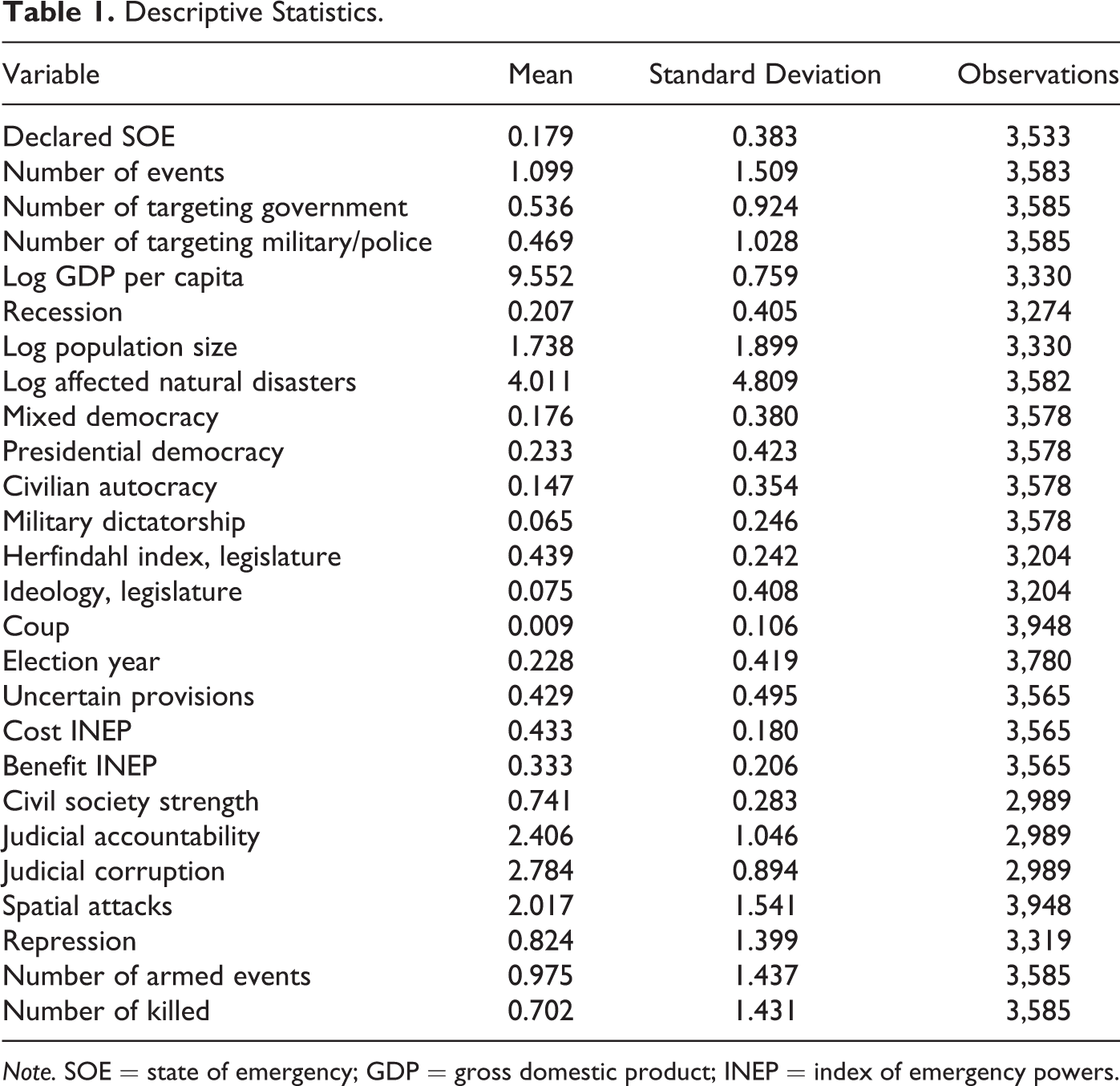
Note. SOE = state of emergency; GDP = gross domestic product; INEP = index of emergency powers.
Estimation Strategy
Due to the structure of our data, we report a set of estimates using Heckman’s two-step estimator. In the first step, we estimate the likelihood of observing any potential terrorist event, while in the second step, we estimate the likelihood of calling a SOE or martial law, given that at least one event occurred. As such, we solve the selection bias that would be inherent in estimates in which we either used the entire sample or only focused on cases in which some event occurred. While the Heckman model is known to be sensitive to the specification of the first step and particularly how well it identifies the events (i.e., handles the selection bias and thus separates the extensive margin from the intensive margin of a mechanism), we argue that it effectively resolves the causality issue (Briggs 2004). Given that the first step is reasonably precisely identified, and where variables not included in the second step are similar to instrumental variables in other types of estimators, the second step estimates can be interpreted causally. As we include the lagged SOE variable, that is, whether or not a SOE was called in the preceding year, we argue that our first-step estimates may also be interpreted causally, although with some care. 7
Since we cannot exclude that the SOE was declared due to some other event such as a natural disaster, we always include a variable “log affected by natural disasters.” In addition, as Berrebi and Ostwald (2011) claim that natural disasters are occasionally followed by terrorist attacks, including natural disasters implies that our first-step estimates are likely to be conservative if disasters incentivise terrorist attacks. Although it may seem counterintuitive to include the Cost and Benefit INEP, that is, controlling for the specific emergency provisions in the first stage, we nevertheless do so as it also helps us to alleviate most endogeneity concerns. Terrorist attacks may, for example, be more likely when the constitution prevents governments from reacting sufficiently, and the emergency constitution could in principle also reflect the historical threat level. Using the Heckman estimator thereby alleviates a number of endogeneity concerns in the second stage where we estimate whether government calls a SOE and thus invokes the set of constitutional provisions. In addition, as noted, we include a dummy capturing whether or not the government called a SOE in the preceding year in the first step, as this captures both a general willingness to call an emergency and whether previous states of emergency might help prevent future attacks.
In our second set of estimates, we are interested in assessing if and when governments react to potential terrorist events by increasing repression. We estimate these reactions using OLS with decadal fixed effects, and including a twice-lagged dependent variable, given that any event took place. As such, we only explore changes in repression following terrorist attacks, given the initial level of repression.
While causality can never be perfectly established, the inclusion of a twice-lagged dependent variable in these regressions implies that we can be reasonably certain that the characteristics of the emergency constitution do not simply reflect the repression environment and that it cannot be the existing level of repression of human rights that creates more events. The twice-lagged dependent variable should capture the initial repression level and thereby reflect these characteristics, before the onset of any of our potential terrorist events. 8 We also only include the 1,505 observations with full data in which there was an event. The repression estimates can therefore also be interpreted as a quasi–second stage to the first-stage results using the Heckman estimator.
Descriptive Statistics
The data exhibit substantial variation across time and countries. While some countries have been very prone to declaring states of emergency, other countries have refrained from ever declaring an official emergency. Israel has been in a perpetual SOE for its entire existence, and the United Kingdom has called emergencies in thirty-six years since 1970, most of which were related to attacks by the Irish Republican Army. Conversely, although Denmark has had a number of events, it has never declared a SOE since the current constitution was implemented in 1953, even though the option is formally available to government.
Figure 1 illustrates the development in our sample between 1970 and 2014. The figure first of all shows that terrorist attacks were about as likely at the beginning of the 1970s as they have been in the most recent years. The threat of terrorism peaked in the very early 1990s after having been at a high level all through the 1980s. Similarly, from the early 1970s until recent years, the likelihood that government would call a SOE approximately doubled. These trends have been similar in the total sample (the black lines) and a smaller subsample consisting of countries without any communist past (the gray lines). The decline after 1990 is therefore not a result of the new countries emerging out of the Soviet sphere being less prone to experiencing terrorism. 9,10
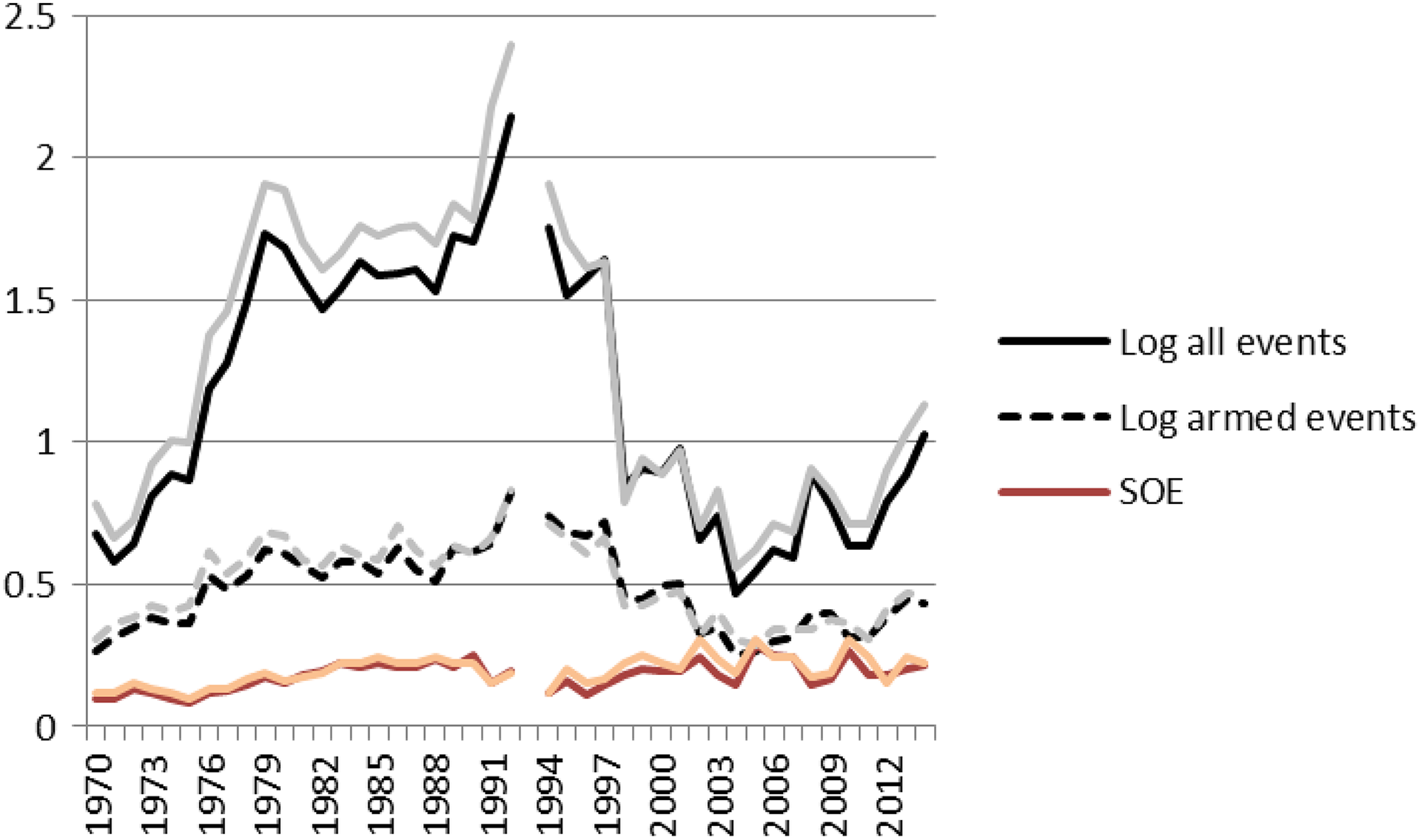
Terrorist attacks and states of emergency, 1970 to 2014.
However, the character of the typical terrorist attack also changed over the years. In the 1970s and 1980s, the typical threat was often motivated by political ideology. Left-wing terrorist organizations, such as Rote Armee Fraktion (the Red Army Faction) that was active in Germany from 1970 to 1989, Brigate Rosse (the Red Brigades) in Italy, and Sendero Luminoso (the Shining Path) in Peru, all subscribed to some form of revolutionary Marxism. Conversely, in more recent years, the typical threat has been due to organizations motivated by extreme forms of fundamentalist Islam. In addition, the share of attacks that are heavily armed has increased from about half in the 1970s to 60 percent in more recent years, while the share of attacks with multiple targets has remained roughly constant. These differences across countries, variation over time, and changes in event characteristics allow us to estimate the potential effects of emergency constitutions on terrorist events.
Estimation Results
Calling a SOE
We begin this section by outlining our main findings in Table 2 where column 1 reports the first step and column 2 the second step of the Heckman estimates. Column 1 provides the estimates of whether or not an event took place—that is, what we think of as an extensive margin—and shows substantial persistence in terrorist events. We also find that larger countries are significantly more prone to experiencing terrorist attacks, whereas countries with a stronger presence of right-wing parties in their legislatures experience fewer attacks. If these societies are more open and tolerant in general, fewer people might be tempted to resort to terrorism as a means of politics. We also observe weak evidence for positive effects of recessions, and some indications that terrorist attacks may be less likely at the same time of natural disasters 11 and in mixed democracies.
Main Results, All Observations.
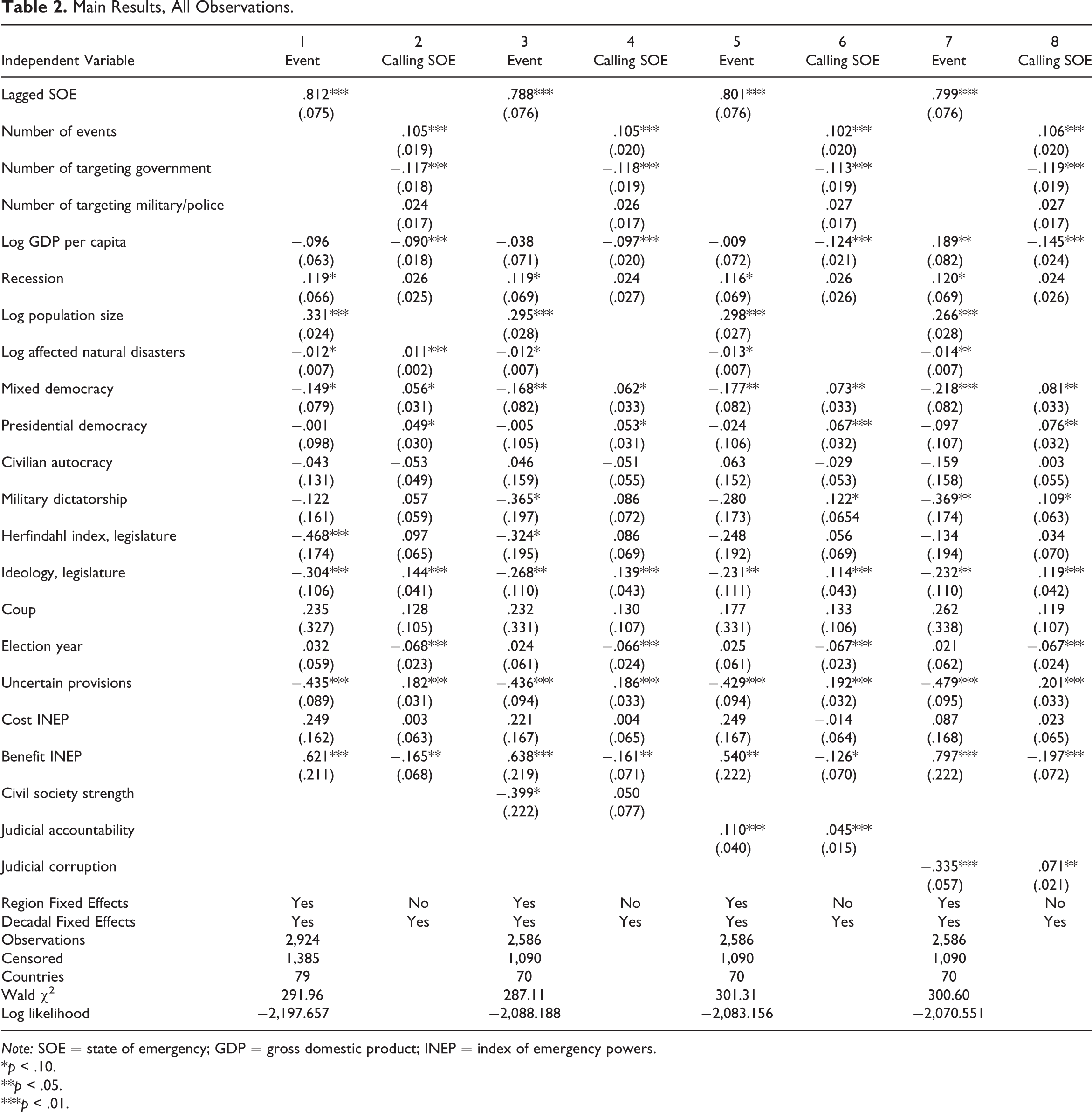
Note: SOE = state of emergency; GDP = gross domestic product; INEP = index of emergency powers.
*p < .10.
**p < .05.
***p < .01.
Most importantly, we find that countries that have either no or uncertain emergency provisions experience significantly fewer terrorist attacks, as do countries in which the emergency constitution allows the executive access to no or few additional benefits during emergencies. While elements of the emergency constitution may deter attacks, it also reflects the historical threat environment, not least as the estimates clearly show that the likelihood of terrorist attacks is substantially persistent over time. Although we therefore cannot claim, based on these estimates, that these particular features of the emergency constitution are causally associated with the likelihood of terrorism, additional analysis in the Appendix lends credibility to a causal interpretation. 12
Conversely, in the second step in column 2, we can establish causality. We observe throughout Table 2 that more events make it more likely that a SOE is called as a reaction to terrorist events. However, as the estimates on the number of events targeting the government and the military or police, respectively, should be interpreted as an additional effect of attacks on these specific targets, it occurs that attacks on the government are not associated with the likelihood of calling a SOE. 13 In addition, poorer countries and countries with right-wing legislatures are more likely to call a SOE, while election years seem often to prevent governments from calling a SOE. 14 This last finding might come as a surprise as one might expect that a majority of voters would be in favor of reacting swiftly against terrorist attacks. Previous research has shown that one (terrorist) strike is often sufficient to prevent the reelection of government (Gassebner, Jong-A-Pin, and Mierau 2008). The nondeclaration subsequent to a terrorist attack but during an election year therefore appears perfectly rational: by declaring a SOE government would signal that the attack was a grave incident. By not declaring, in turn, it might want to downplay the relevance of the event to maintain its reelection chances.
We also observe the opposite association as the likelihood of observing terrorist events when it comes to the emergency constitution: countries with uncertain emergency provisions and provisions that provide more benefits to the executive are significantly more prone to calling a SOE when an event happens.
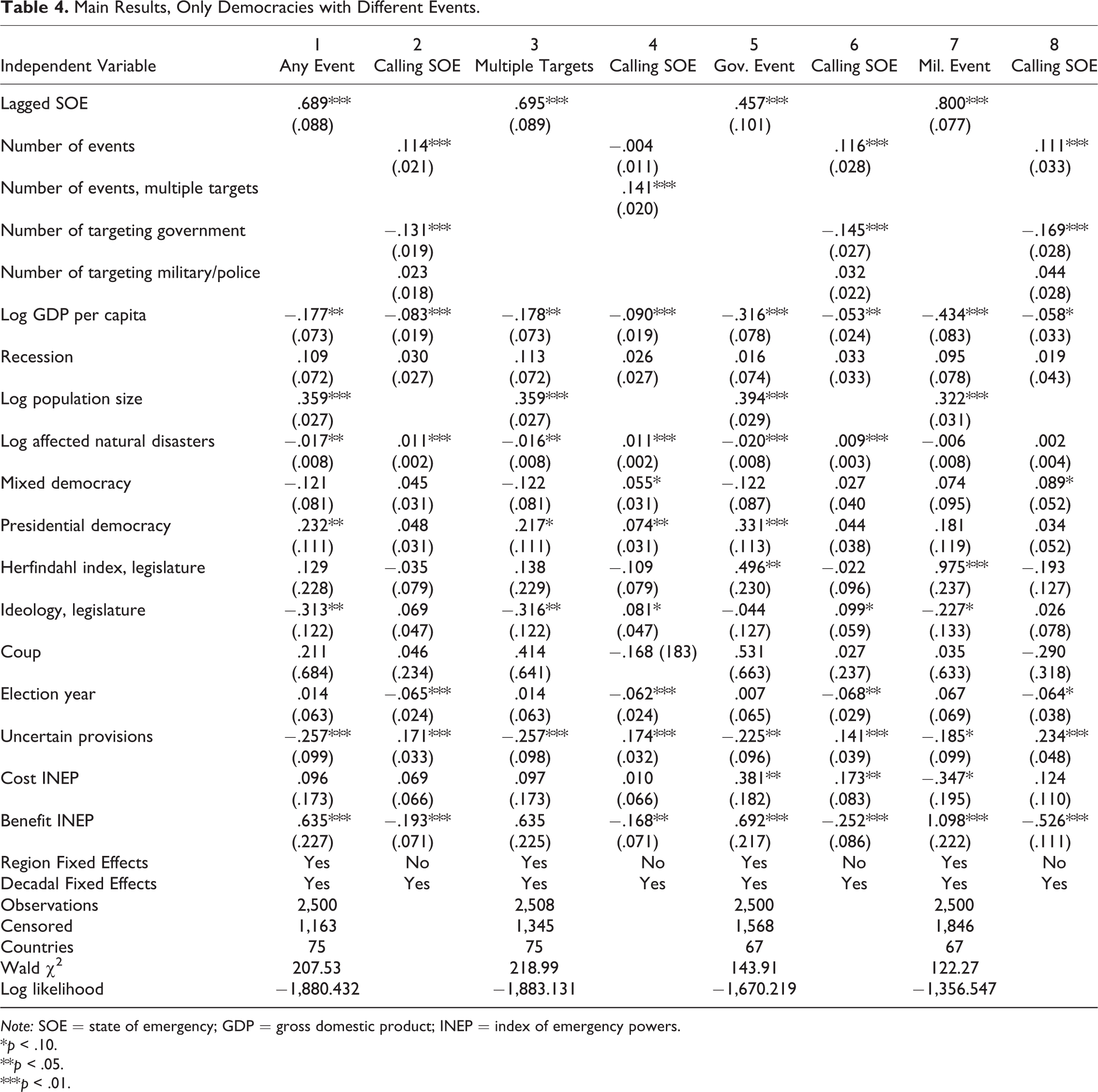
In the rest of the table, we test the potential effects of a set of institutional characteristics: the strength of civil society, judicial accountability, and judicial corruption. We find clear support for effects of judicial corruption, as more corruption is associated with more terrorist attacks, and also weakly with more SOEs. 15 We also confirm in Table 3, which repeats the estimates in Table 2 but excluding all country-years without full democracy, that no finding is driven by autocracies. In addition, we find only minor differences across types of events. In Table 4, we repeat our main estimates in columns 1 and 2, and focus in subsequent columns on attacks with multiple targets—and thus logistically more complicated—attacks against the government, and attacks against the military or police. We find three clear, significant differences. The estimates exhibit less persistence in terrorist attacks against the government, and the benefit components of the emergency constitution are more important to whether or not a SOE is called after attacks on the military or the police. Finally, we see clear indications in column 4 that SOE declarations are predominantly driven by the logistically more challenging terrorist attacks with multiple targets instead of simpler events.
Main Results, Only Democracies.
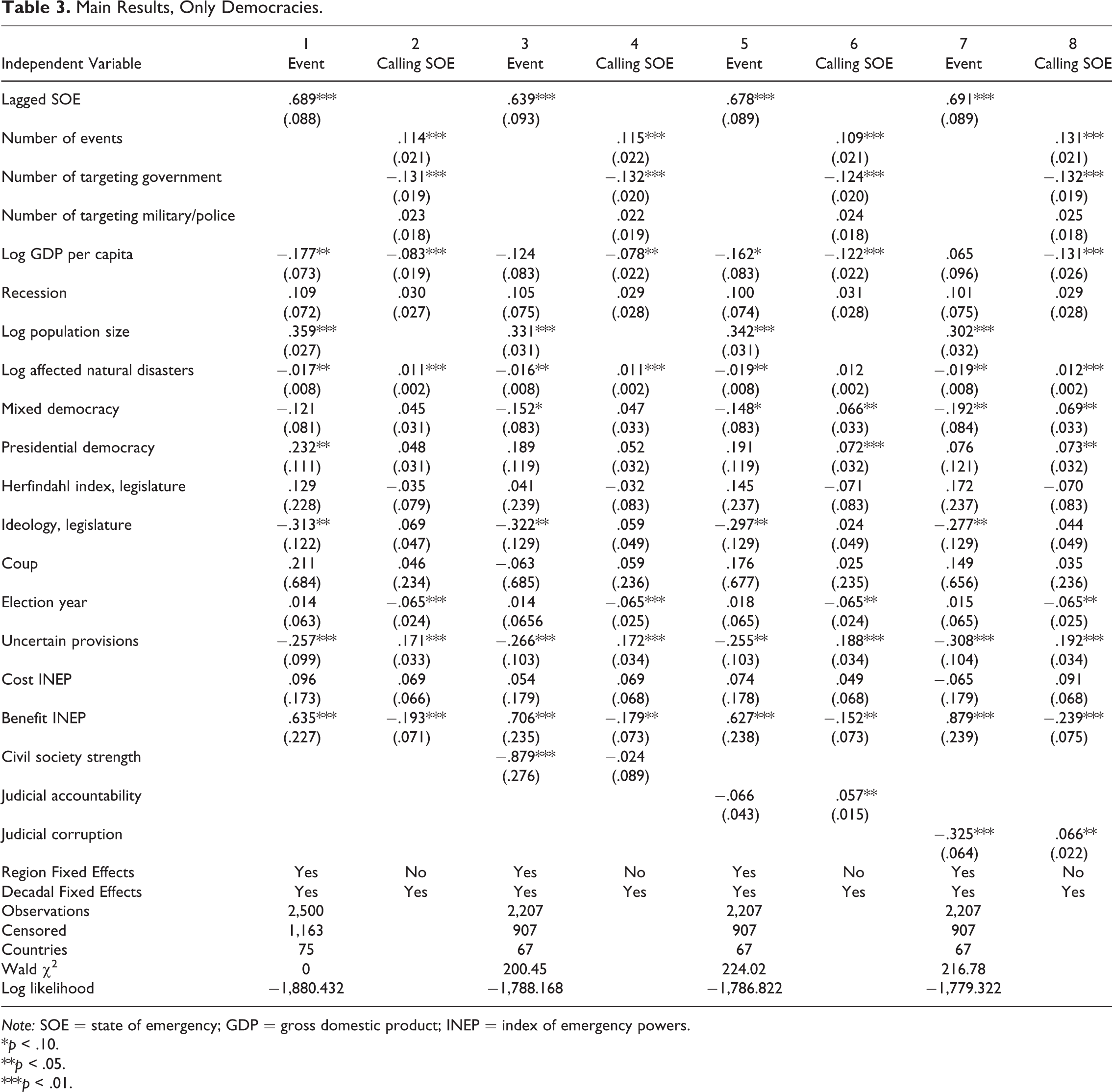
Note: SOE = state of emergency; GDP = gross domestic product; INEP = index of emergency powers.
*p < .10.
**p < .05.
***p < .01.
Main Results, Only Democracies with Different Events.
Note: SOE = state of emergency; GDP = gross domestic product; INEP = index of emergency powers.
*p < .10.
**p < .05.
***p < .01.
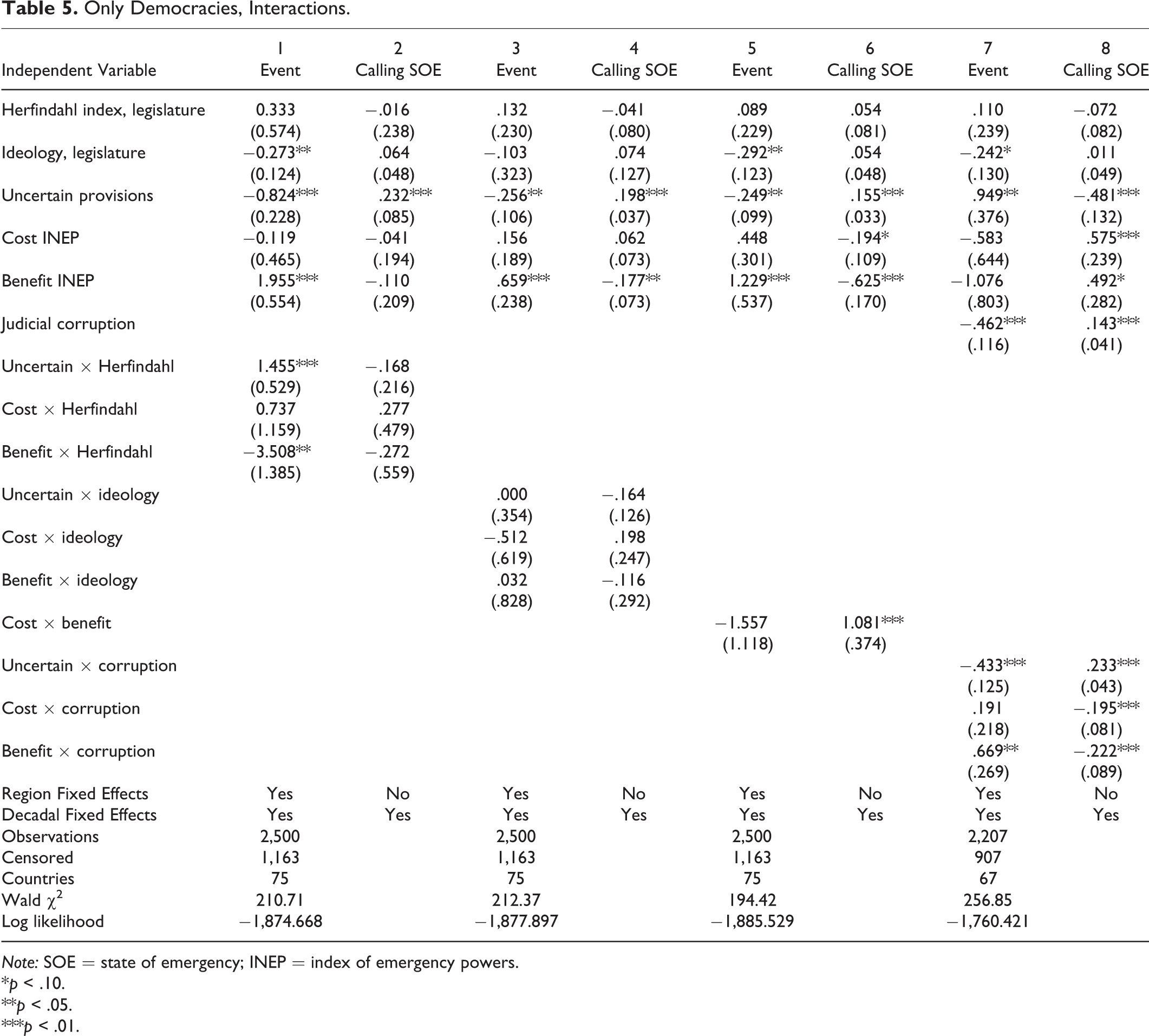
Finally, in Tables 5 and 6, we test whether elements of the emergency constitution exhibit heterogeneous effects. In Table 5, we find only minor differences except two: interacting with judicial corruption, we find significant negative effects on the likelihood of calling a SOE of having uncertain emergency provisions and significant positive effects of having high Cost and Benefit INEP in societies with relatively substantial corruption. Second, we find that the two elements of the emergency constitution are substitutes. The more substantial the benefits the constitution confers on the executive once a SOE is called, the stronger and more significantly is the Cost INEP associated with the likelihood of calling a SOE.
Only Democracies, Interactions.
Note: SOE = state of emergency; INEP = index of emergency powers.
*p < .10.
**p < .05.
***p < .01.
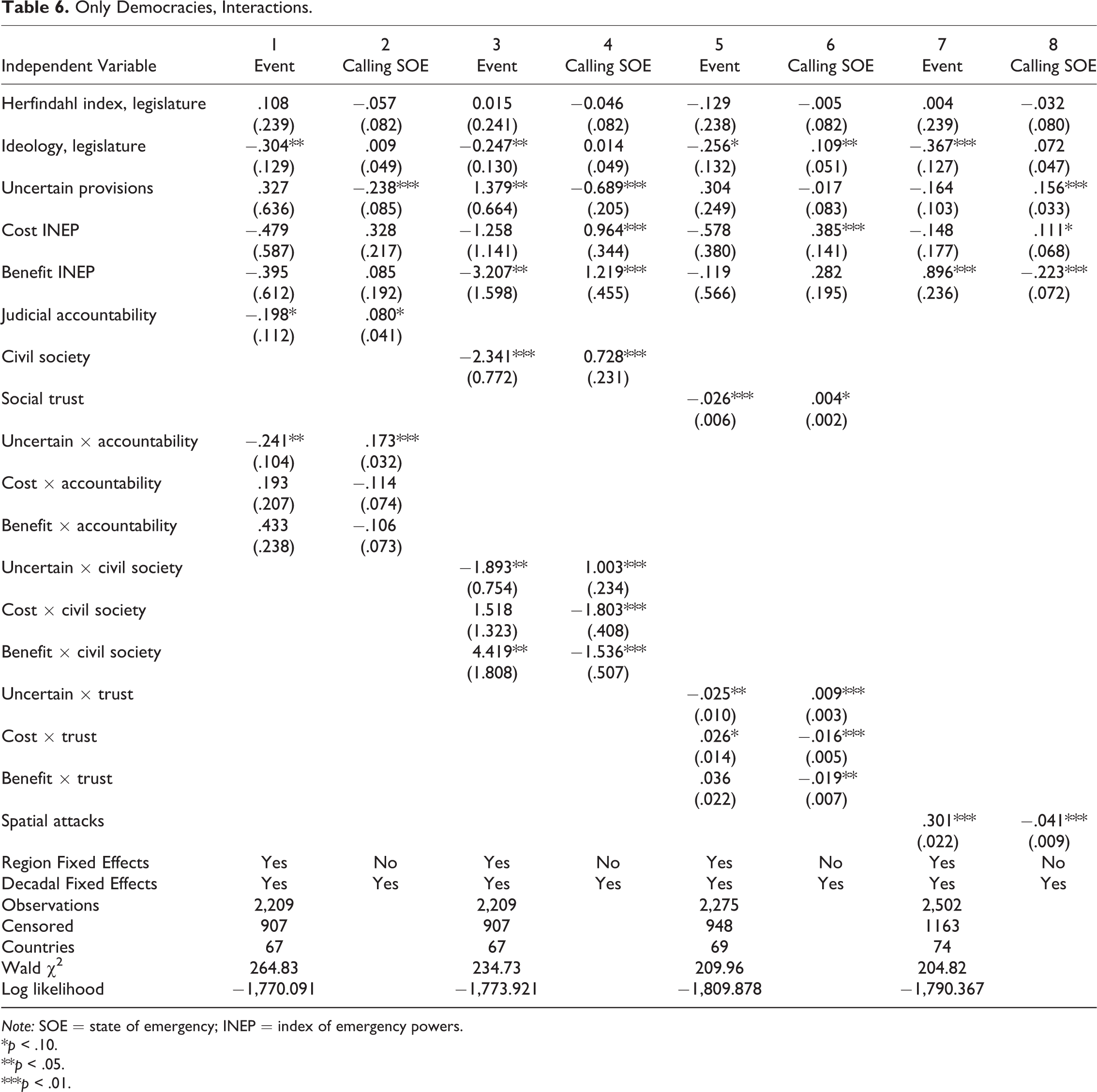
Only Democracies, Interactions.
Note: SOE = state of emergency; INEP = index of emergency powers.
*p < .10.
**p < .05.
***p < .01.
In Table 6, we test further interactions with judicial accountability, civil society strength, and social trust, which in general yield similar heterogeneity as in Table 5. Finally, we add a spatial measure of terrorist attacks, which captures the potential association with terrorist attacks in neighboring countries. If, for example, terrorists choose to attack a neighboring country, if policies make attacks on a given country particularly difficult, we would expect to see a negative association. We nevertheless find a significantly positive association with the likelihood of experiencing terrorist attacks and a significantly but small negative effect on the likelihood of calling a SOE.
Consequences on Repressive Policy
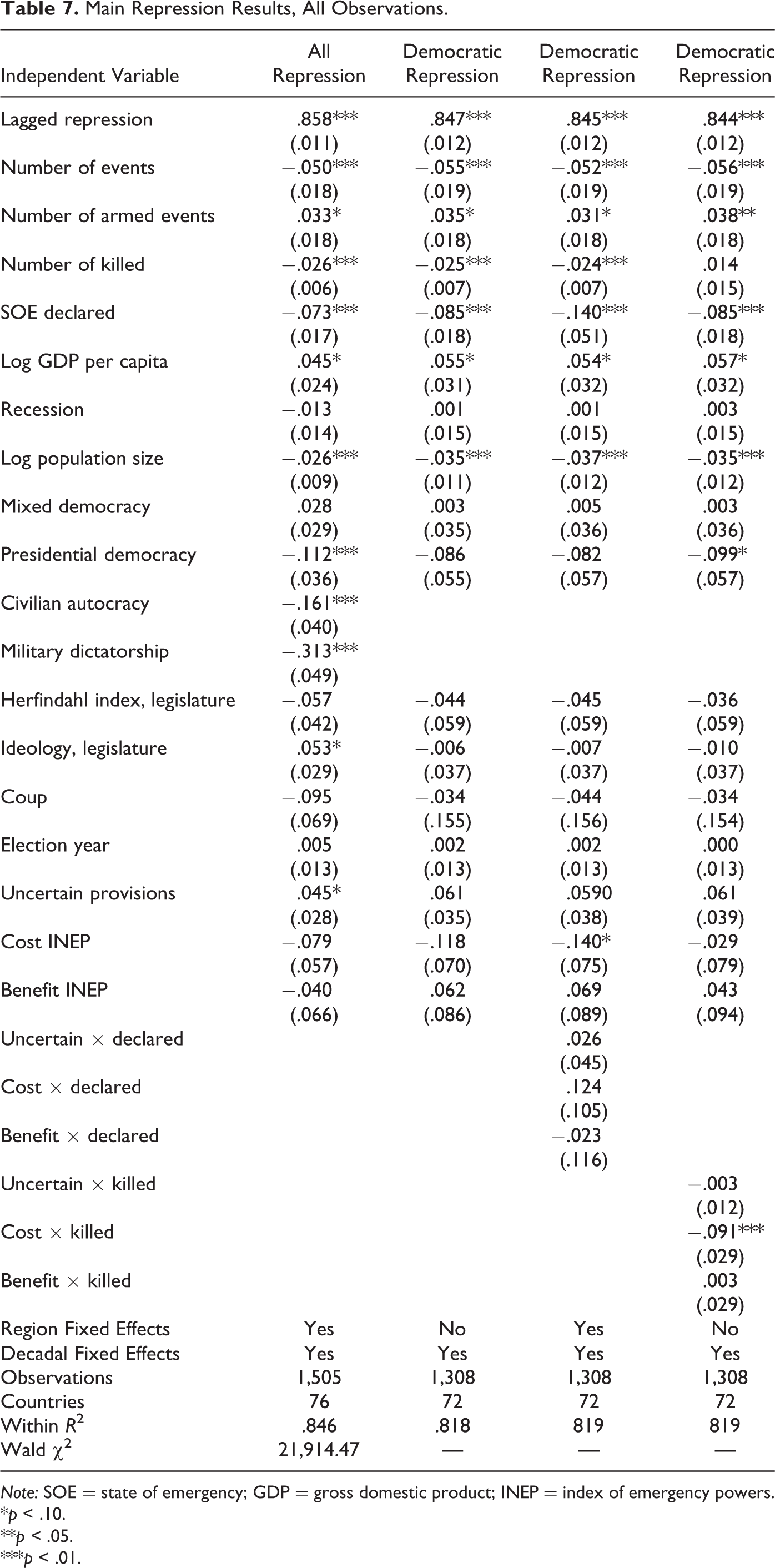
Our final question is whether terrorist attacks cause an increase in repressive policy, which we test in Table 7. We here include lagged repression, such that we effectively identify the determinants of changes around terrorist attacks. The sample used in Table 7 therefore only includes years in which a country was subject to an attack.
Main Repression Results, All Observations.
Note: SOE = state of emergency; GDP = gross domestic product; INEP = index of emergency powers.
*p < .10.
**p < .05.
***p < .01.
With respect to the control variables, we first observe policy declines, that is, more repression, following years with more events and events in which more people were killed. 16 We also see more repression in smaller countries, yet must note that this may be spurious, as the control for population size effectively “scales” the number of events and number of people killed to the size of the country. Using the full sample in column 1, we also find indications that presidential democracies, civilian autocracies, and military dictatorships react to terrorist attacks with more repressive policy than parliamentary democracies. However, restricting the sample to include only democracies in columns 2 to 4, we find no indications that presidential democracies are different from other forms.
Turning to the emergency constitution, the results strongly suggest that the declaration of a SOE is associated with significantly more repression as a result of terrorist attacks. In other words, in societies in which the government uses the emergency provisions actively, it is likely to react to terrorism with repression. Finally, we find that while attacks in which more people are killed are more likely to lead to repressive policy, this effect does not occur when the emergency constitution makes it very difficult to call a SOE (the Cost INEP). Larger events in which more people are killed only tend to lead to more repression when the constitution makes it relatively easy for the executive to call a SOE.
Overall, we thus find that while the emergency constitution may arguably reflect the historical threat level, uncertain emergency provisions are associated with a higher likelihood that governments call a SOE after terrorist attacks, while emergency constitutions that confer larger benefits on the executive are associated with a lower likelihood, in particular when the constitution makes such calls more politically costly. When governments do so, they tend to repress the population substantially more, and in particular during larger attacks when the constitution makes declarations difficult.
Conclusions and Open Questions
While a number of studies have explored the relation between terrorism and government repression, this is the first article explicitly analyzing the relationship between terrorist events and states of emergency. It deals both with the determinants that lead to the declaration of a SOE following a terrorist event and with one of the main consequences that follow such a declaration. We find that more terrorist events are correlated with a higher likelihood of a SOE being declared. Richer countries are less likely to declare, whereas countries with a presidential form of government are more likely to declare. Interestingly—and in contrast to some theoretical arguments found in the literature—governments soon facing an election are less likely to declare a SOE. When the emergency constitution makes it easy to declare (i.e., a high value of the Cost INEP) and allocates substantial additional powers to the executive (high values of the Benefit INEP), governments are more likely to declare.
Our further results suggest that once a government calls a SOE, it strongly tends to implement more repressive policies, potentially to counteract the consequences of terrorism. However, the specific provisions of the constitution do not matter, and we find the same repressive response regardless of whether or not the constitution yields larger discretionary power during emergencies. To some extent, it seems sufficient even for democratic governments to call a SOE to repress civil society and its citizens.
In this article, we have analyzed the effectiveness of SOEs from the point of view of those who suffer from terrorism. In principle, it is, of course, possible to analyze the effectiveness of emergency provisions from a different angle by asking to what degree terrorists have reached their goals? There are various possibilities to do so. One could, for instance, ask whether governments have given in to the demands of terrorists? Abrahams (2008, 83) claims that this has never occurred, whereas Jones and Libicki (2008) find 132 campaigns where terrorist groups renounced terrorism. These findings show how difficult it is to evaluate results: these events can be counted as successes for the terrorists; on the other hand, one can also argue that they led to an end of terror, hence prove the effectiveness of counterterrorism measures.
This article can also be read as contributing to a discussion on the foundations of the state that has been ongoing for centuries. Many thinkers have discussed a tension between security on the one hand and freedom on the other. Whereas for Hobbes, securing order over anarchy was of utmost importance—and for him, the value of security clearly trumped the value of freedom—Locke had already moved toward a trade-off attributing freedom relatively more weight. It was de Spinoza ([1670] 1891, 258 f.) who wrote: “It follows, plainly, from the explanation given above, of the foundations of a state, that the ultimate aim of government is not to rule, or restrain, by fear, nor to exact obedience, but contrariwise, to free every man from fear, that he may live in all possible security; in other words, to strengthen his natural right to exist and work without injury to himself or others…In fact, the true aim of government is liberty.”
Our finding that respect for physical integrity rights is negatively correlated with terrorist incidents sheds new light on this debate. Higher levels of freedom (as proxied with both physical integrity rights and economic freedom rights) go hand in hand with higher levels of security (as expressed as the absence of terrorist incidents). In other words, freedom and security are not competing with each other. Quite to the contrary, they complement each other. This finding is directly policy relevant.
Finally, terrorist activities are only one type of event that challenge order and stability within the state. Others include mass demonstrations, general strikes, and civil war. Future studies should inquire into the effectiveness of emergency constitutions regarding these other events.
Supplemental Material
Supplemental Material, Appendix_tables_JCR_resub_final - When Does Terror Induce a State of Emergency? And What Are the Effects?
Supplemental Material, Appendix_tables_JCR_resub_final for When Does Terror Induce a State of Emergency? And What Are the Effects? by Christian Bjørnskov and Stefan Voigt in Journal of Conflict Resolution
Supplemental Material
Supplemental Material, terror_dataset_JCR_final - When Does Terror Induce a State of Emergency? And What Are the Effects?
Supplemental Material, terror_dataset_JCR_final for When Does Terror Induce a State of Emergency? And What Are the Effects? by Christian Bjørnskov and Stefan Voigt in Journal of Conflict Resolution
Supplemental Material
Supplemental Material, Terror_SOE_JCR_do_file - When Does Terror Induce a State of Emergency? And What Are the Effects?
Supplemental Material, Terror_SOE_JCR_do_file for When Does Terror Induce a State of Emergency? And What Are the Effects? by Christian Bjørnskov and Stefan Voigt in Journal of Conflict Resolution
Footnotes
Appendix
Countries Included in the Sample.
| Albania | Cyprus | Israel | Poland |
| Antigua and Barbuda | Czech Republic | Italy | Portugal |
| Argentina | Denmark | Jamaica | Romania |
| Armenia | Dominica | Japan | Russia |
| Australia | Dominican Republic | Korea (South) | Serbia |
| Austria | Ecuador | Latvia | Singapore |
| The Bahamas | El Salvador | Lithuania | Slovakia |
| Barbados | Estonia | Luxembourg | Slovenia |
| Belarus | Finland | Macedonia | Spain |
| Belgium | France | Malta | Suriname |
| Belize | Georgia | Mexico | Sweden |
| Bermuda | Germany | Moldova | Switzerland |
| Bolivia | Greece | Montenegro | Taiwan |
| Brazil | Grenada | The Netherlands | Trinidad and Tobago |
| Bulgaria | Guatemala | New Zealand | Turkey |
| Canada | Guyana | Nicaragua | Ukraine |
| Chile | Honduras | Norway | United Kingdom |
| Colombia | Hungary | Panama | United States |
| Costa Rica | Iceland | Paraguay | Uruguay |
| Croatia | Ireland | Peru | Venezuela |
Note: Countries in italics have not been democratic in any year in the sample period.
Authors’ Note
This article has been produced as part of the Minerva Center “The Rule of Law under Extreme Conditions” jointly run by the Law Schools of the Universities of Haifa and Hamburg. Previous versions of the article have been presented at the conference “State of Exception—An Overview” organized by Matthias Lemke at the German Historical Institute in Paris, the economics seminar at the University of Freiburg, the annual Danish Public Choice Conference, the annual conference of the Public Choice Society, and the workshop on Legal Challenges of Terror held at the Minerva Center in June 2018.
Acknowledgments
The authors thank Marek Endrich, Jerg Gutmann, Daniel Hicks, Tim Krieger, Stephan Michel, Konstantinos Pilpilidis, José Reis, and two anonymous reviewers for their suggestions. They also thank workshop participants for their critical questions and suggestions.
Declaration of Conflicting Interests
The author(s) declared no potential conflicts of interest with respect to the research, authorship, and/or publication of this article.
Funding
The author(s) received no financial support for the research, authorship, and/or publication of this article.

Supplemental Material
Supplemental material for this article is available online.
Notes
References
Supplementary Material
Please find the following supplemental material available below.
For Open Access articles published under a Creative Commons License, all supplemental material carries the same license as the article it is associated with.
For non-Open Access articles published, all supplemental material carries a non-exclusive license, and permission requests for re-use of supplemental material or any part of supplemental material shall be sent directly to the copyright owner as specified in the copyright notice associated with the article.
