




Abstract
The complexity of planning and implementing peacebuilding processes has been discussed using various approaches, for example, adaptive peacebuilding, and the “local turn” in peacebuilding. These theories argue that peacebuilding is a nonlinear and contextual process, contrary to the linear, static conception of the liberal peace paradigm. This paper contributes to this field and seeks to learn how peacebuilding processes can be planned better, by integrating the concepts of adaptive and urban peacebuilding. Using action research and organizational ethnographic analysis of an EU-funded peacebuilding process between Palestinians and Israelis in Jerusalem, this article lays out four general steps to improve planning for future peacebuilding initiatives: (1) integrate flexibility; (2) balance inherent asymmetries; (3) “localize” planning; and (4) plan for indirect alternatives. In conclusion, we discuss the implications for peacebuilding processes in other contested and settler-colonial cities.
Introduction
In December 2021, the U.S. Congress passed the Nita M. Lowey Middle East Partnership for Peace Act (MEPPA). 1 Over the next five years, USD 250 million will be available for people-to-people (P2P) initiatives, that is, a significant increase in funds to build support for peace from the bottom up. While this is generally good news, using these funds to make a difference in the peace process is complicated. In the past 20 years, these P2P initiatives have elicited criticism (Maoz, 2011; Maoz et al., 2002; Ron et al., 2010), emphasizing the asymmetrical relations between the two groups in the conflict (Abu-Nimer, 2004). In addition, extant studies have found that dialog groups can harm the peace process when not planned appropriately, strengthening participants’ beliefs in their morality and the enemy's inability to make meaningful compromises (Bar-tal, 2001). Others have noted how a lack of local ownership and the international peacebuilding system's colonialist structure have led to project designs that are fit for the donor agency's reporting requirements but fundamentally are irrelevant, and sometimes harmful, to the local context (Autesserre, 2014; Campbell, 2018; Goetze, 2017; Springer, 2015). Another criticism points out that more than states, cities remain resistant to liberal peacebuilding efforts, with static efforts focusing on the state level, liberal democratic states’ security, and the norms of territorial sovereignty strand (Björkdahl, 2013, p. 216). Moreover, in some Middle Eastern cities, the city logic of dense networks of encounters, commerce, spaces, and people, is a space of possibilities in civil resistance efforts despite systematic violence (Stanley, 2017). Finally, an aspect that may accompany all criticisms as an overarching theme is that peacebuilding endeavors are complex, not complicated, and need nonlinear planning approaches, not log frames (De Coning, 2018).
Against this backdrop, which includes the significant increase in funds for P2P projects on the one hand and the intense criticism of these projects on the other, we ask: How can we plan peacebuilding projects to tackle complexity and context-specific settings? We understand peacebuilding, within this article, as a long-term, multi-track, transformative contribution to social change, helping to create a just and sustainable peace beyond the narrow definition of a post-conflict period (Paffenholz, 2015, p. 13). First, we argue that the complexity of peacebuilding efforts in general, and in contested cities, necessitates a planning approach that prioritizes learning over task execution and applies extreme flexibility to benefit the overall goal instead of fixating on outcomes, including funding modalities. Second, in asymmetrical conflicts like in Israel/Palestine, peacebuilding projects actively need to tackle this asymmetry in the planning phases. They should integrate external guidance and facilitation that allows for awareness of all actors’ positionality, that is, their identities, interests, and positions regarding the conflict (Williams, 2020). Third, a fundamental shift toward local actors in planning these projects can elicit more relevant outcomes. It requires not simply bringing them all to the table but fundamentally means shifting decision-making power to the local level while dynamically balancing the different interests of all actors involved, including those of residents, implementing organizations, and funding bodies. Finally, we argue that by focusing on indirect peacebuilding, thereby addressing local needs on the ground, we can overcome ineffective, state-centric, abstract, liberal peacebuilding approaches, particularly in urban settings. The complexity of peacebuilding efforts in general, and in contested cities, necessitates a planning approach that prioritizes learning over task execution.
We attempt to support these arguments by examining one project in which we—a Palestinian, an Israeli, and a German—have been involved: “Building Visions for the Future of Jerusalem” (Leonard Davis Institute for International Relation Research, 2020). Using action research and organizational ethnography, we scrutinize three project adaptations in which the management team decided to deviate from the original planning. We are focusing on these adaptations because we assume that this is where we can see how successful the planning was in accommodating the contingencies of reality. These adaptations are examined against the criticisms cited above, resulting in four recommendations for planning peacebuilding projects.
Two of the authors of this paper played an active role in the project's management. However, we complement their necessarily subjective perspectives on this project with a third author familiar with it through sporadic consultancies during the implementation cycle. We analyze decision-making within project management, considering significant and surprising changes in Jerusalem during the project's cycle, tensions within the project's management team, and between the management team and the EU, the project's primary funder. We describe cities as complex systems, carving out the peculiarities of peacebuilding in urban contexts. Later we apply this to Jerusalem, the scene of the peacebuilding project and a contested and setter-colonial city. We briefly describe the method we used and describe our three project adaptations, which we distill into four main recommendations for future peacebuilding projects in our conclusion.
Cities as Complex Systems
Since the 1960s, cities, particularly contested cities, have been described as complex systems (Allegra et al., 2012; Bettencourt, 2015; Bollens, 2012; Lewis, 2011; Yiftachel, 2016). Their ethnic, political, cultural, socioeconomic, and spatial divisions create an environment that defies conventional linear thinking, classical project management methods, and the cause-and-effect logic that helps understand simple or complicated systems. Complex systems, particularly cities, share several characteristics that distinguish them from simpler physical systems and make their management by conventional linear methods less appropriate (Bettencourt, 2015, pp. 221–222): (1) heterogeneity, which refers to economic capabilities, such as types of professions or businesses, wealth disparities (inequality), race and/or ethnicity. (2) Interconnectivity refers to the fusion of different logics, for example, economic development issues are connected to physical places and urban services. (3) The scale reflects the magnitude of the urban setting. Larger cities, on average, are spatially denser and make more intense use of their infrastructures (e.g., more cars per road surface), eliciting different benefits and cost structures. Larger cities are also more productive economically and expensive in terms of cost of living. (4) Circular causality, which complexes the way we understand causality in the city—is a city more violent because it has higher inequities or vice versa? (5) Development in this paper means that cities are processes rather than objects. Hence, we must adapt current and past policies to future developments. Finally, (5) conflict exacerbates all these characteristics in a contested city (Yiftachel, 2016), and other conflict-related themes, including international interventions (Goodhand & Walton, 2009), violence (Bhavnani et al., 2014), municipal grievances (Shlomo, 2017), democracy deficits (Avni et al., 2021), or political and social fragmentation (Blokland et al., 2015; Rosen & Shlay, 2014).
In such a complex setting, a need exists for constant adaptation. As Cedric De Coning (2018) suggested, the adaptive peacebuilding approach departs from the assumption that by pre-designed intervention, we can achieve desired results. Instead, he argues for an approach that acknowledges the complex nature of peacebuilding processes and puts local ownership at the forefront of any peacebuilding effort. Adaptive peacebuilding recognizes that our ability to understand complex systems fully inherently is limited (Schneider & Somers, 2006). Instead of the classical analysis—that is, the planning-implementation-evaluation “cycle,” which more often than not is simply a flat line with an arrow pointing in one direction—adaptive peacebuilding calls for a continuous process of exploration and adaptation (De Coning, 2018, p. 310). De Coning argues that the complex nature of peacebuilding demands structured learning in iterative cycles and understands development as a process that resembles evolution rather than project cycle management. Evolution needs variety and selection, and peacebuilding today needs various approaches, rigorous selection and continuation of helpful interventions, and emphatic elimination of interventions that have proven ineffective or underperforming. Adaptive peacebuilding also considers social systems’ entropy, that is, what has worked until now might be ineffective or even counterproductive tomorrow. Complex systems’ nonlinearity requires peacebuilders to monitor the intended and unintended results and impacts and adjust the program design accordingly. It is a process facilitation approach that involves the peacebuilding program's assumed beneficiaries, positioning uncertainty at the center of the planning process, thereby acknowledging that analytical tools, like conflict analysis or needs assessments, are provisional at best and require constant iteration. Adaptive peacebuilding calls to make a conscious distinction between complicated and complex processes. Moreover, to understand peacebuilding as an infinite game with no beginning or end, nor does it know “failure” or “success”—only the journey itself.
To provide a more focused understanding of contested cities, we interlaced it with the concept of urban peacebuilding. Björkdahl (2013, p. 207) has defined it “…as a prism through which to view and understand peacebuilding processes localized in the city space and describe whereby the urban conditions the construction, maintenance, or resistance to peace.” In that sense, Urban peacebuilding is fundamentally different from national peace processes. The city is the scene of social processes that offer an opportunity to implement practical local collaborations, coexistence, and tolerance—not just solutions entailing territorial division or establishing sovereignty (Avni et al., 2021; Brenner et al., 2022; Shtern & Yacobi, 2019). Simultaneously, the city, which generates frequent meetings between groups and includes sacred spaces for rival groups, is also a scene for frequent outbursts of conflict, inequality problems, and national or international external interventions (Rokem et al., 2018). These urban environments include multiple actors with different interests. Moreover, external players’ interventions can impact it dearly, radically changing the city's way of life from a state of relative serenity to an outbreak of violence between rival groups (Benvenishti, 1983; Bhavnani et al., 2014).
Both approaches extend the liberal peacebuilding doctrine by focusing on the complexities and local situations that persist uniquely within contested cities. Björkdahl (2013) argues that contested cities resist liberal peace efforts because liberal peacebuilding ignores urban aspects, such as employment, housing, or transportation, and local values, like equity or recognition. Moreover, it ignores the expectational nature of contested cities, by which residents live as “intimate enemies” (Bollens, 1999). As a result, they are the first to experience conflict and peace in their daily encounters.
Jerusalem as a Complex System
Jerusalem is well-recognized in the literature on contested cities (Allegra et al., 2012; Bollens, 2013; Gaffikin & Morrissey, 2011). But it has been conceptualized as an extreme case and described as polarized (Bollens, 1998), deeply contested (Bollens, 2001), and colonial-settler city (Salem, 2016). El-Atrash (2016) explained the evolution of the nature of Jerusalem from a city of peace in the Ottoman times, where many religions and ethnic group lived together, to a city of piece, where the city is fragmented and polarized. These descriptions of Jerusalem as extreme mainly stem from its central and sensitive position in the Israeli–Palestinian conflict. The status of Jerusalem is one of the primary and unresolved issues in every negotiation between the two sides (Arieli, 2013), and a recurring scene for violent outbreaks of the conflict due to its sanctity, containing the holiest places for the world's three largest monotheistic religions (Cohen, 2007). East Jerusalem, including its Israeli and Palestinian neighborhoods, is considered an occupied territory and a settler-colonial city (Salem, 2016). Israel occupied East Jerusalem from Jordan in 1967, including the old city and 22 Palestinian villages. Since then, Israel developed new neighborhoods beyond the 67′ line (see Map 1) to integrate new Jewish immigrants into Jerusalem. These neighborhoods are still considered illegal settlements by the international community (El-Atrash, 2016). In 2003, after the second Intifada, Israel erected the security wall (aka the separation wall; Rokem & Vaughan, 2018) and a net of crossroads, which cut off Jerusalem from the West Bank, and increased the Palestinian residents’ dependency on Israel.
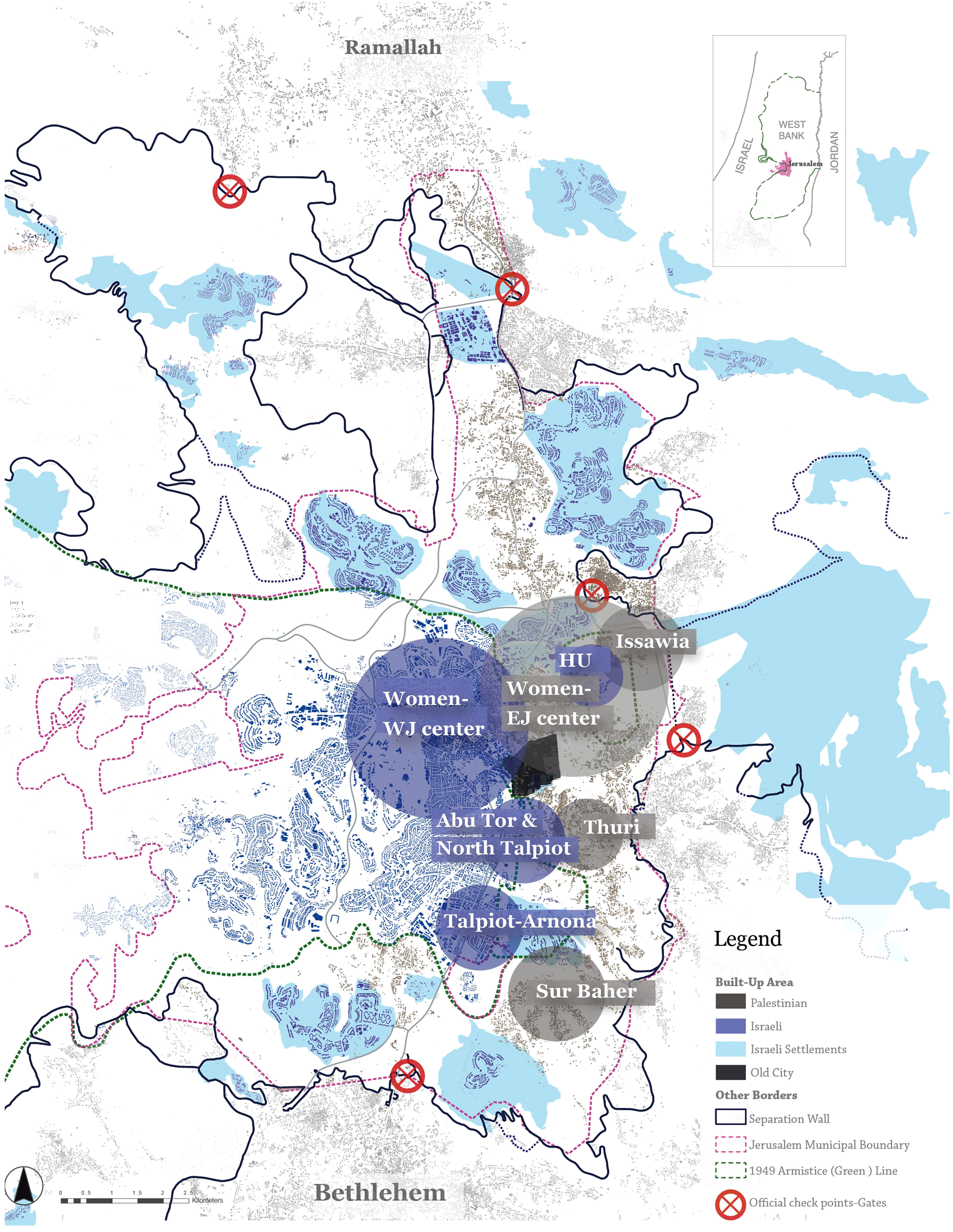
The neighborhood groups and Jerusalem Geopolitics.
Moreover, Israeli rule is highly asymmetrical and ethnocratic and favors the Jewish majority (Jabareen, 2010; Yiftachel & Yacobi, 2003). Palestinian residents do not hold Israeli citizenship but a residence permit in Jerusalem. They have voting rights in the municipal elections but refrain from exercising them not to recognize Israel's sovereignty. Hence, they are not represented in local politics and depend on Israel's decisions (Barakat, 2018).
This colonial-settler urban reality is different and more complex than an ongoing “direct” conflict as it mixes ordinary and contentious logic. In Jerusalem, nominally rival groups live and work together, meet daily, and even create friendships. It is also a city where many international and local actors are willing to invest in fostering better relations. This hybrid setting of colonial, neo-liberal, political, and other logic makes Jerusalem highly complex in many ways.
Jerusalem is politically, socially, economically, and physically heterogeneous. It is divided into districts and communities based on religious or ethnic-demographic factors (Shlay & Rosen, 2015). Each community has its ideology, culture, religion, language, and even education systems, and all compete for the same scarce resources. However, the Jewish–Israeli groups have better access than the Palestinian groups. Jerusalem's complexity is also reflected in its interconnectedness between the different logics that form the city (Yiftachel, 2016). For example, colonialism is interconnected with neo-liberalism in spontaneous meetings in the shopping centers (Shtern, 2016), politics are mixed with the social on Facebook communities (De Vries et al., 2015), or nationalism is mixed with gender in women's clothing (Greenberg Raanan & Avni, 2020). In that sense, people live “double” lives as they compromise one value in favor of the other. Jerusalem's complexity also lies in its scale, infrastructure, and demographic developments. Due to its ethnocratic regime, all these factors are distributed unequally and contribute to the conflict at large (Chiodelli, 2013; Haramati & Hananel, 2016). In terms of scale, the Israeli Settlements in East Jerusalem are expanding spatially, while the Palestinian neighborhoods are only getting crowded. It is due to an Israeli government policy not to approve building permits in Palestinian neighborhoods and even demolish new construction sites and homes (Jabareen, 2010).
Furthermore, in neighborhoods beyond the security wall where the state does not supervise, residential towers are being constructed on a considerable scale and without engineering permits (Zugayar et al., 2021). These developments in the Palestinian neighborhoods are examples of how the Palestinians attempt to “own” their city in informal ways. In this paper, we ask to rethink how we should plan peacebuilding initiatives to address these contingencies.
Action Research and Applied Organizational Ethnography
To understand how we can improve the planning of peacebuilding projects in this complex setting, we return to the project's organizational archive—the data, protocols, interviews, and documents. We ask: what did we do? How did we deal with the dynamic reality? Why did we act in this way? The study focuses on “us” and is mainly a retrospective of the organizational processes that motivated the management team's work. We combine two methods—action research and organizational ethnography. The action research method puts researchers’ selves at the forefront by conducting systematic studies that monitor their actions. For example, a teacher may follow a new teaching method while conducting self-reflection and interviewing her students. This research aims to improve how work is done in the future or during the project she leads. The purpose of publishing the study is to improve future projects within the field of practice in which the study's context is located (McNiff & Whitehead, 2010). Organizational ethnography is a research method that includes various collection tools: in-depth interviews, participatory observations, and organizational archives (Van Maanen, 1979). It enables a retrospective analysis of organizational processes. In recent years, scholars have primarily integrated this field into the applied anthropology approach to producing practical insights through various anthropological tools (Rylko-Bauer et al., 2006). These methods allow us to reexamine the management team's processes, validate the findings through various positions and data, and present our reflections and insights on peacebuilding planning in contested cities.
We followed the peacebuilding process in our analysis, marking the main changes since initial planning. Our corpus includes the project's log frame, the management team's protocols, evaluation reports, and interviews with the management team and participants. In addition, we identified the management's decisions and the reasons behind them. Finally, we reflected on the requirements for planning peacebuilding in a contested city. We considered issues such as indirect peacebuilding, the conflict's asymmetry, and the need to localize peacebuilding.
From Planning to Learning: Three Project Adaptations
“Building Visions for the Future of Jerusalem: A Bottom-Up Approach” was a project that worked between 2017 and 2020 and engaged residents from eight different yet adjacent neighborhoods (See Map 1) to generate acceptable solutions for all residents regarding local and national problems. The bottom-up approach of the project was designated to voice out the ideas of the ordinary residents of the city. The groups were paired by their geographical proximity: Abu-Tor & A-Thuri, Talpiot-Arnona & Sur-Baher, Mount Scopus & Issawia, and two only women groups. Each group was led by a trained facilitator and was comprised of 10–15 regular residents of different ages and gender (Leonard Davis Institute for International Relations Research, 2020).
The project's planning was designed following EU standards using the logical framework approach (log frame), laying out the entire process in detail by time and goals onto one matrix; and setting the main objective, other objectives, activities, and outcomes (Grove & Zwi, 2008). It also considers prospect failures and conditions that might endanger initial planning (Bakewell & Garbutt, 2005). As described in the log frame, the project's overall objective was “Increased engagement and efficacy of residents of Jerusalem in shaping the future of their city, promoting coexistence and conditions for a negotiated solution.” The project's three specific objectives were: (1) “increased engagement of Jerusalem residents in identifying local needs and mapping solutions for Jerusalem”; (2) “attitude change on the potential of coexistence and a negotiated solution to Jerusalem and residents empowered to advocate for solutions to the city”; and (3) “adopted policy recommendations (to) change realities in Jerusalem and strengthened the potential for a negotiated solution.”
This section provides insights into three adaptive instances from the project. These adaptations describe significant changes the project underwent during its life cycle, touching on essential issues: the management team's composition, the process of generating action plans, and a change in the working method. We provided the initial planning on the subject, described the deviation and its consequences, and closed each case study with a learning section.
First Adaptation: Management Team's Composition
In our first adaptation instance, we examine the management team's composition, how it has changed over time, and how this has affected our arguments.
After shifting the management team's composition toward a balanced Israeli-Palestinian coordination, the project's character fundamentally shifted.
This change in management composition point into valuable lessons for future peacebuilding projects. First, pay attention to the conflict's asymmetry by listening to and integrating the Palestinian side's local expertise versus designing a project according to an assumed symmetry that does not match the reality on the ground. Second, integrate the local perspective—sometimes even against the donor's opinion versus following the donor's demands while disregarding local needs. Third, emphasize indirect peacebuilding aspects versus abstract ones based on the liberal peace paradigm. Fourth, consider the complexity by giving the authority to lead to locals who understand it versus sticking to the original logframe.
Second Adaptation: Generating Action Plans
In this case study, we examine two adaptations from the original planning regarding the choice of working approaches in response to residents’ emerging needs.
Later, as the action plans were formulated and the management team observed residents’ desire to promote them, they decided that empowering communities was no less important than the goals they set in the logframe. Thus, it was decided that each group would begin with a small manageable project—“big enough to matter and small enough to work”—to foster more positive attitudes toward possible change. Successful completion of small projects, especially among the Palestinians—such as planting gardens, beautifying a neighborhood, and participating in community activities—reflects the complex logic of the residents between their daily life and their national struggle. As one Palestinian facilitator said: “We should do things on the ground rather than talk about peace. Peace happens when people fill empowered.”
Apart from illustrating the conflict's asymmetry, this case study also emphasizes the need for shifting decision-making power to the
Another meaningful learning here is that activity planning occurs on a different level of abstraction in complex processes. While planning is a compromise between the hubris of total control on the one hand and fateful surrender to external forces on the other, more complex processes require a higher degree of flexibility than more straightforward, linear processes. This case study aptly demonstrates the need for a shift in focus from the bureaucratic monitoring of pre-set indicators to flexibly responding to local needs. For example, as a response to the unforeseeable shock of the U.S. administration recognizing Jerusalem as the capital of Israel, many Palestinian participants across all groups refrained from further participation in any peace-related projects. The management team's response was to deviate the discussion to the urban level rather than the state level focusing on community-based projects, as presented above. An adaptation that was found fruitful as a action to keep the project going.
Third Adaptation: Changing the Working Method
This significant adjustment to our initial plan came in response to an unpredicted exogenous shock from the United States’ decision to move the U.S. embassy to Jerusalem. The statement shook the entire city, particularly the Palestinian population, with Palestinian organizations declaring days of rage in the West Bank (Harel, 2017). In Jerusalem, Palestinian residents held public protests and clashed with Israeli police. The days preceding the declaration and those that followed it aggravated corresponding relations between the parties in the city and halted any desire for cooperation (Hasson, 2017). As a result, the project stopped its activities, and most of the Palestinian participants stated that they would not continue and were not interested in meeting with the Israeli side. Thus, the groups dissolved before they had the chance to meet the other side, which was the project's original idea. External guidance from Rothman led to the decision to "meet the data" instead of the participants physically meeting. Most participants viewed this exposure to the other side's thoughts, ideas, and challenges as a positive experience, but it was not strong enough to evoke a desire to meet the other side. Rothman then suggested using the Photovoice method, a second effort to create a "data meeting," but in a visual way. This innovative approach generated some interest within the community, and the management team eventually secured engagement through collaboration with solid local organizations (Kids4peace, Hitorerut, Urban Clinic).
Conclusion: The Adaptive Way Forward
With the Lowey Peace Act's (MEPPA) adoption, interest in peacebuilding initiatives in the Palestinian–Israeli conflict is rising again. This paper sought to rethink how peacebuilding initiatives are planned and offer new suggestions for future ones. In our examination of an EU-financed peacebuilding project, "Building Visions for the Future of Jerusalem," we found that peacebuilding in contested or colonial cities is complex but can be promising when planned flexibly. The different logic in action, such as the colonial, political, or national logic (Yiftachel, 2016), significantly limit the ability to promote agreements on critical issues in dispute. On the other hand, the urban logic concerning gender or neoliberalism can produce agreements at a lower level. Therefore, the planning of new initiatives should think of a fusion between the different logics so that handling, for example, the gender issue will also provide an answer to the colonial aspect; and to adapt and renounce this fusion when it is not possible for reasons beyond the control of the initiative's leaders. We found supporting evidence for our four main arguments: (a) A shift toward the local level in the decision-making benefits the project's outcome; (b) by focusing on indirect aspects of peacebuilding, the project maintained support for this peacebuilding effort even though political events led to a massive radicalization; (c) by balancing out Israeli and international actors’ initial dominance on the management team, the project made changes that led to results that were in line with the project's overall goal; and (d) responding to urban peacebuilding's complexity required drastic changes, such as changing the work method and outputs to achieve new goals.
Our analysis points to four general insights that complement and contribute to theories on adaptive (De Coning, 2018) and urban (Björkdahl, 2013) peacebuilding in the context of a contested and colonial city: (1) integrate flexibility; (2) balance inherent asymmetries; (3) “localize” planning; and (4) plan indirect alternatives. First, we pointed to the urban setting's complex nature. If dealing with complex systems requires constantly working with feedback loops (De Coning, 2018), then implementing such activities requires flexibility. It is not only about semantics or twisting the existing design. It also entails altering budget lines, allocating relevant resources, and allowing budgetary flexibility to adapt planning according to the feedback generated constantly. The standard evaluation approach of using a pre-designed metric according to the logframe can result only in perceptions of “success” or “failure”—categories that do not exist in complex systems (Bakewell & Garbutt, 2005). Due to the dynamic nature and multitude of interrelations between logics, planning in complex systems requires constantly exploring what works and feeding that learning into the program design. For example, the city can change significantly in funded initiatives where there is a long time (a year or more) between submitting the proposal and putting it into action. Therefore, the proposal also needs to adapt. Ongoing learning needs to be integrated into project design, including allocating appropriate time and financial resources for learning, consultations, and external guidance. Ongoing learning needs to be integrated into project design, including allocating appropriate time and financial resources for learning, consultations, and external guidance.
Second, we call for a balance between partners in contexts of asymmetrical power relations, especially in a colonial setting. Our reflection presents the management team as a mirror of the conflict system: Internationals and Israelis planned a project that did not work, mainly because they needed to include the Palestinian perspective. Although they invited Palestinians to participate, the latter rejected the initial idea because it did not appeal to them. However, balancing the team by adding two Palestinian managers and letting them lead, even against the funding body's decisions, allowed the project to pursue new directions and overcome the challenges and resistance from Palestinian participants. Following recent arguments regarding recurring asymmetry in peace initiatives (Gawerc & Lazarus, 2016; Khoury, 2016), we propose to plan a symmetrical management team, not only in a matter of numbers, but mostly in decision-making, responsibility, and freedom of action. In a settler-colonial setting, we should make planning conditional on the approval or review of the ruled party. We also propose using external guidance to facilitate different voices within the management team and between the funding body and the management.
Third, localization of planning means we need to incorporate local communities in the planning process. Planners should look for local figures standing between different logic in the city. For example, young adults can talk about living in a colonial setting or businesswomen who can see the shared interests beyond the national ones. In our results, the project shifted toward the local population's needs after integrating one of the Palestinian facilitators, an urban planner, into the management team. In addition, it helped us overcome the Palestinian participants’ resistance due to Trump's declaration.
Finally, we emphasized urban peacebuilding's indirect aspects. Peacebuilding in contested cities generally resists interventions designed according to the static liberal peace paradigm (Bollens, 1999). It can be overcome by focusing on urban issues. The third deviation demonstrates the shift in focus from national to urban topics—such as infrastructure or access to services. Furthermore, it presents the use of a creative, nonverbal method, like Photovoice, which proved to be a powerful antidote to the radicalized environment caused by the U.S. embassy move, allowing the project to continue and redefine its goals.
This notion of indirect peacebuilding aligns with the "joint project" P2P style, in which residents form a shared vision and action plan (Maoz, 2011). Our results present the urban setting as a fertile ground to foster joint projects. Nevertheless, since urban P2P initiatives are integrating municipal politics with peacebuilding and making the political into nonpolitical, we should be critical of them. In a settler-colonial context, attempts to include the ruled group in the ruler's political game might normalize the conflict. It is important to stress that the indirect approach has its limits. While it fosters shared projects and better intergroup relations, it avoids the central political questions of the conflict it aims to resolve. Colonial-settler scholars advised policymakers to consider supporting only initiatives recognizing international law and Palestinian rights and striving for justice (Hawari, 2021).
Nevertheless, P2P peace initiatives are not justice initiatives and are still worthwhile, primarily because they can shift the discussion from distributive justice focusing on interests to procedural justice focusing on voices and needs. Moreover, it is a valuable change in intractable conflicts, which has better potential to foster shared visions, especially in the urban setting. In such a context, P2P projects can carry fundamental implications for cities’ residents and contribute significantly to the peace process through the old notion of creating positive contact, despite increasing tensions. Furthermore, it can help leverage inequalities at the city level. Lastly, P2P can foster new and shared policies, ideas, and identities beyond (or beneath) the contentious national level. Thus, as peacebuilders, we need to equip ourselves better to deal with the complexity, including unpredictability, in improving these important initiatives. Finally, the conflict remains constant and prominent in the everyday lives of the city despite contested cities’ uncertain and complex environments. Hence, peacebuilders must remain strong as well, learn from their past work, collaborate with international and local actors, and improve their practice.
Footnotes
Declaration of Conflicting Interests
The authors declared no potential conflicts of interest with respect to the research, authorship, and/or publication of this article.
Funding
This work was supported by the EU Peacebuilding Initiatives under Grant (ENI/2016/ 383-058; PI: Prof. Dan Miodownik, The Hebrew University of Jerusalem).