




Abstract
Elections held outside of advanced, industrialized democracies can turn violent because elites use coercion to demobilize political opponents. The literature has established that closely contested elections are associated with more violence. I depart from this emphasis on competitiveness by highlighting how institutional biases in electoral systems, in particular uneven apportionment, affect incentives for violence. Malapportionment refers to a discrepancy between the share of legislative seats and the share of population, violating the ‘one person, one vote’ principle. Drawing on recent work on malapportionment establishing that overrepresented districts are targeted with clientelist strategies, are more homogenous, and are biased in favor of district-level incumbent parties, I argue that overrepresented districts present fewer incentives for using violence. In contrast, elites in well-apportioned or underrepresented districts exert less control over electoral outcomes because such districts have more heterogenous voter preferences, raising incumbent and opposition demands to employ violence. I examine the effects of malapportionment on violence using constituency-level elections data and new, disaggregated, and geocoded event data on the incidence of election violence in India. Results from six parliamentary elections from 1991 to 2009 show that electoral violence is less prevalent in overrepresented constituencies, and that violence increases in equally apportioned and moderately underrepresented districts. The analysis establishes additional observable implications of the argument for district voter homogeneity and incumbent victory, accounts for confounders such as urbanization and state-level partisanship, and validates measures of election violence. The findings illustrate that institutional biases shape incentives for electoral violence.
Keywords
Introduction
Violence during elections is a form of manipulation intended to affect election outcomes, and still occurs routinely outside of advanced, industrialized democracies. The intent of campaign violence is to influence the dynamics of electoral competition, in particular to reduce turnout among opponents (Bratton, 2008; Collier & Vicente, 2012). If violence is used strategically to demobilize opponents, it follows that parties should be most interested in deploying violence in areas where it matters most, such as locations where they are concerned about losing. Yet how do parties determine which areas will be closely contested? Existing work has assumed that parties infer competitiveness from previous performance or partisan preferences. I argue instead that parties, in particular local incumbents, also benefit from institutional biases that affect the demand for violence. Procedural or institutional biases such as the unfair apportionment of electoral districts have been neglected in the literature, despite having important implications for whether and where violence is an attractive tool to influence election outcomes.
The article makes theoretical and empirical contributions to the literature. In terms of theory, work on election violence has overlooked pre-existing biases in electoral systems. I explore how the presence of an uneven playing field affects elites’ incentives to use violence to influence election outcomes. I focus on malapportionment, a particular form of institutional bias that confers long-term strategic advantages to some participants in the electoral process. Malapportionment refers to the discrepancy between the shares of legislative seats and the shares of population held by geographical units, which is distinct from gerrymandering, the biased drawing of electoral districts. Discrepancies in apportionment can produce districts that are overrepresented, well-apportioned, or underrepresented (Samuels & Snyder, 2001; Snyder & Samuels, 2001, 2004). I argue that malapportionment affects party strategies and hence incentives for violence. The theoretical argument expects divergent effects of malapportionment in overrepresented districts compared to well-apportioned or slightly underrepresented ones. Specifically, the smaller size of overrepresented districts offers strategic advantages for regionally or nationally influential parties that make them attractive for investments in clientelism, render them more homogenous in terms of voter preferences, and bias them in favor of local incumbent parties. These biases in overrepresented districts imply that neither the incumbent nor challengers have incentives to use violence in areas of respective strength or weakness. In contrast, well-apportioned and moderately underrepresented districts are more electorally competitive, have more heterogenous voter preferences, and are less subject to biases. The electoral uncertainty of these districts implies that they should see more violence from incumbents and opposition. I confirm these patterns empirically.
The article makes an empirical contribution by examining the observable implications of the argument with a quantitative constituency-level analysis of national elections in India held between 1991 and 2009. The focus on constituencies as the primary locus of electoral competition in parliamentary systems is an improvement on earlier work, which has focused primarily on the macro or micro level, neglecting how subnational electoral features affect the dynamics of election violence. I select India, a parliamentary system with majoritarian electoral rule, as the empirical case because it fits the scope conditions of the argument. The argument requires that regimes hold minimally competitive elections, but violence still occurs routinely. In India, election violence happens regularly and takes a variety of forms, including partisan clashes, communal violence, and armed groups aiming to disrupt elections. Further, the argument is most relevant for elections in which electoral districts are the focus of electoral contestation, suggesting a focus on parliamentary elections. Finally, the argument applies to countries that delimit electoral boundaries. While malapportionment can occur in elections with multimember districts (i.e. proportional representation), its implications are most obvious in countries with majoritarian electoral systems and thus single-member districts. Empirical findings show that overrepresented districts in India experience less violence, while the risk of violence increases for equally apportioned and moderately underrepresented constituencies. These findings are robust to controlling for confounders and a variety of additional sensitivity analyses. The empirical analysis also establishes additional observable implications of the argument for district homogeneity and incumbent victory.
Election violence as a campaign strategy
This article conceptualizes election violence as a campaign strategy intended to influence the electoral process through the coercion of candidates or voters with threats and violence. 1 Election violence is widely understood as strategic, emerging from the electoral incentives encountered by political elites (Höglund, 2009; Wilkinson, 2004). Two strands of literature are most relevant for the argument developed here; first, work on the competitiveness of elections and incentives for violence, and second, research on institutions and implications for election violence. 2
First, scholars have explored how expectations on electoral performance affect the use of coercive strategies at the micro, macro, and meso levels. Formal theoretical work explains that parties concentrate coercive targeting in close electoral contests, and that they use voters’ partisan preferences for deciding who to target, although predictions disagree on whether swing or core opposition voters in competitive areas are targeted more (Robinson & Torvik, 2009). The available micro-level evidence is more supportive of the core voter hypothesis, with several studies showing that core supporters of the opponent in competitive areas are more likely to be targeted (Bratton, 2008; Gutiérrez-Romero, 2014; Kasara, 2014; Rauschenbach & Paula, 2019). At the macro level, Hafner-Burton, Hyde & Jablonski (2014) argue that incumbents fearful of losing power – especially if unconstrained by institutions – are more likely to use state repression and support this claim with cross-national data. Other cross-national studies similarly show that elections with smaller victory margins are more likely to see social conflict (Salehyan & Linebarger, 2015). Finally, a handful of studies explore electoral competition and violence at the subnational level. In seminal work on India, Wilkinson (2004) argues that close electoral competition at the local level leads to communal rioting in towns, but that state governments will intervene against such violence and suppress it if they rely on the votes of minorities to win elections. Town- and state-level empirical results indicate that greater party competition increases violence (Wilkinson, 2004). Recent work on Zambia, however, indicates that dominance rather than close competition leads to more violence (Wahman & Goldring, 2020). Rauschenbach & Paula (2019) also find that African voters in opposition strongholds are more fearful of violence.
A second strand of the literature examines the effect of institutions on election-related violence. Focusing on authoritarian institutional legacies, Brosché, Fjelde & Höglund (2020) argue that exclusionary regimes undermine the prospect of peaceful electoral politics, and present qualitative evidence from Kenya in support of these expectations. Research on electoral systems has linked majoritarian electoral systems to greater electoral manipulation, including violence (Birch, 2007; Fjelde & Höglund, 2016). Fjelde & Höglund (2016) argue that majoritarian rule raises the perceived cost of losing and the fear of permanent exclusion from political power, inducing both incumbents and their opponents to resort to more violence. Empirically, they show that African countries with majoritarian rule are more likely to experience electoral social conflict. Furthermore, the presence of electoral management institutions, especially if autonomous, has been linked to a lower risk of violence (Opitz, Fjelde & Höglund, 2013; Ruiz-Rufino & Birch, 2020). Fjelde (2020) explores the consequences of party institutions, arguing that institutionalized parties rely on means of mobilization that are less costly than violence, and that such parties are also better able to constrain the use of violence. Cross-national evidence confirms that institutionalized party systems experience less election violence (Fjelde, 2020).
The literature has shown that the competitiveness of elections increases the risk of violence and that some institutional configurations, such as majoritarian electoral rule or weakly institutionalized party systems, are more prone to electoral violence. However, missing from this work is a discussion of how procedural or institutional biases affect the demand for election violence.
Uneven apportionment and election violence
Outside advanced, industrialized democracies, parties can choose from a range of licit and illicit campaign strategies when competing in elections (Schedler, 2002). Illicit strategies include short-term manipulation such as vote buying, intimidation, tampering with ballots or the vote count (among others), but also less visible, more long-term forms of manipulation such as distorting the voter registration process, media access, or boundary delimitation. Moreover, even if parties are not in direct control of instruments that affect the evenness of electoral competition, pre-existing imbalances still affect their calculation for where violence will be most consequential. I focus on how institutional biases in electoral systems influence the use of violence as a campaign strategy, which – just as other manipulation strategies – aims to affect election outcomes.
Existing work linking electoral competitiveness to violence rests on the assumption that competition takes place on a level playing field until parties decide on the use of violence. However, parties, in particular incumbents, can benefit from a wide spectrum of manipulation strategies across the entire electoral process (Schedler, 2002), which has consequences for the competitiveness of electoral campaigns. For example, incumbents (and to a lesser extent the opposition) can limit the scope or jurisdiction of electoral office, manipulate or limit voter registration, or influence the drawing or apportionment of electoral districts (Schedler, 2002: 39). Further, even if parties are unable to influence these processes on their own, the presence of distortions has consequences for their behavior. The presence of biases thus affects parties’ incentives for whether, when, and where they employ blatant manipulation occurring closer to election day.
My argument focuses on malapportionment, proposing that institutional biases emerging from malapportionment affect motivations and opportunities for violence. As mentioned above, malapportionment refers to the discrepancy between the shares of legislatives seats and the shares of population in electoral districts. Electoral apportionment can produce districts that are overrepresented, equally apportioned, or underrepresented. Overrepresented districts have more electoral influence than their population share suggests, while well-apportioned ones correspond to democratic ideals, and underrepresented districts are less influential electorally than they should be according to population size. Malapportionment thus relates to the electoral weight of districts relative to the district population, and is distinct from gerrymandering, which refers to the biased drawing of electoral districts. Unequal electoral apportionment has fundamental, long-term implications for electoral competition, but has received less scholarly, policy, and media attention compared to more blatant forms of manipulating elections (Samuels & Snyder, 2001; Snyder & Samuels, 2001, 2004). Political parties, however, recognize the strategic electoral advantages conferred by unequal apportionment, and these advantages plausibly influence whether and where they have to employ other, more short-term forms of manipulation. The small emerging literature on the consequences of malapportionment highlights the pro-incumbent, conservative, and rural biases it induces (Boone, 2014; Boone & Wahman, 2015; Samuels & Snyder, 2001; Snyder & Samuels, 2001), but has not explored the implications of these biases for the use of more blatant manipulation strategies, including violence. I now discuss the implications of uneven apportionment for electoral violence.
Incentives for violence in overrepresented districts
Electoral districts that are overrepresented in the legislature (and also in the executive in parliamentary systems) are much smaller than well-apportioned or underrepresented districts. Building on work on malapportionment, I argue that overrepresented districts offer strategic advantages for large parties (Bhavnani, 2015), display more homogenous voter preferences (Lee & Oppenheimer, 1997), receive more government resources (Gibson, Calvo & Falleti, 2004; Horiuchi & Saito, 2003), and exhibit biases in favor of the incumbent party (Boone & Wahman, 2015; Snyder & Samuels, 2001). Consistent with the emphasis on constituency-level dynamics in this article, I use ‘incumbent’ to refer to the party of the incumbent at the constituency level rather than national incumbent party status. Incumbents of particular electoral districts could thus be members of national-level governing or opposition parties.
I argue that biases in overrepresented districts produce incentives for large parties to secure the support of relatively small constituencies. 3 By large parties, I mean parties that compete regionally or nationally in elections, meaning that they have the ability to deploy campaign resources strategically to districts they expect to be competitive. Regardless of malapportionment’s origins, once present, uneven apportionment will shape the electoral strategies of parties even if they did not initiate it. Because of the smaller size of overrepresented districts, large, regionally or nationally influential parties thus have incentives to try and garner the support of overrepresented districts with clientelism in order to secure the support of such districts and shape the preferences of voters. Compared to large, underrepresented constituencies, these districts require convincing fewer and less heterogenous voters and are thus more attractive locations for investments in clientelism instead of coercive strategies. Clientelism is a costly strategy that is efficient only if voter support is predictable and can be monitored, explaining why parties aim to establish long-term clientelist exchange (Hicken, 2011; Kitschelt & Wilkinson, 2007). Parties with regional or national influence will thus privilege smaller, rural, and more homogenous electoral districts for investments in clientelism. Over time, clientelism could become more competitive because other parties may also try and invest in the same electoral districts (Chandra, 2004). Nevertheless, I expect that clientelism – competitive or not – dominates in overrepresented districts.
The homogeneity of voter preferences and biases in favor of local incumbent parties in overrepresented districts resulting from these processes implies that neither the incumbent party nor the opposition face strong incentives to deploy electoral violence. Incumbents will prefer to target voters in districts where they expect to benefit from deterring turnout, rather than those where their electoral position is already strong. This expectation is consistent with theoretical and empirical work suggesting that incumbents invest in clientelism and patronage in areas where they are strong, but refrain from using coercion in safe districts and instead supply violence in contested areas (Rauschenbach & Paula, 2019; Robinson & Torvik, 2009). It is also in line with empirical findings showing that voters in rural constituencies experience less violence and intimidation (Dercon & Gutiérrez-Romero, 2012; Rauschenbach & Paula, 2019), but are more often targeted with clientelism (Berenschot, 2018; Kramon, 2019; Rauschenbach & Paula, 2019; Stokes et al., 2013). 4 Regarding incentives for local opposition parties, the logic of opposition weakness would seemingly imply that they use violence in districts with a bias in favor of local incumbents. However, this seems unlikely for two reasons. First, it is presumably more difficult to try and flip an electoral contest with violence where the opposition is very weak, suggesting that less biased districts are more attractive. Second, opposition parties may not have the coercive apparatus necessary to organize violence in areas of profound weakness, lacking the opportunity to engage in violence even if motivations were strong. I therefore expect that the opposition would target incumbent supporters in districts where electoral outcomes are not already heavily biased in favor of their opponents.
Incentives for violence in well-apportioned and underrepresented districts
Well-apportioned districts reflect the democratic principle of ‘one person, one vote’, and should ceteris paribus offer a more level playing field for electoral competition. Since such constituencies are less biased in favor of incumbents (and are thus more contested for both incumbents and opposition), greater uncertainty about electoral outcomes suggests more incentives to use violence. Lacking the strategic advantages of much smaller districts, the preferences of voters in these districts are also more heterogenous than overrepresented districts. Furthermore, these districts are also more urban and thus reflect greater oppositional tendencies. I therefore expect both incumbents and opposition to use violence to demobilize their respective opponents, in particular compared to overrepresented districts.
The votes of citizens in underrepresented districts count far less than those in equally apportioned or overrepresented districts. For the historical and strategic reasons discussed above, underrepresented constituencies will be more urban, with stronger opposition parties and more robust civil society organizations; hence, overall they will be less biased in favor of local incumbent parties (Boone & Wahman, 2015). Over time, patterns of underrepresentation in urban areas likely become exacerbated because of differential growth rates that benefit rural, already overrepresented constituencies, since people move from many rural areas to fewer urban ones (Bhavnani, 2015). Empirically, this means that there are more overrepresented districts relative to underrepresented ones, and that the proportion of overrepresented districts increases over time. While the effectiveness of violence might decrease at extreme levels of underrepresentation because of the large number of voters that would have to be deterred, moderately underrepresented districts could still experience similar or even higher levels of violence than well-apportioned ones. In both equally apportioned and underrepresented districts, incumbent and opposition parties know that elections are potentially more contested than in overrepresented ones. Yet parties’ ability to successfully deter voters in the most competitive districts depends on accurately estimating their strength, which is more difficult in constituencies that are less reliably biased in favor of incumbents.
Empirical implications
The above discussion implies the following empirical implications. Because malapportionment distorts the playing field, I expect that incentives for election violence are lowest in overrepresented districts and increase with greater evenness in representation. Since I expect that parties can shift campaign strategies as a function of the evenness of competition, these incentives apply to parties that are competitive in more than one constituency. Governing parties and large opposition parties should be most able to adjust their strategies, while regional or single-state parties would be more limited geographically in redeploying campaigning as a result of uneven apportionment.
Effects on violence are more ambiguous for extremely underrepresented districts. One the one hand, we would expect these constituencies to see more electoral competition and violence, but on the other hand, they require deterring large numbers of voters with violence. While the discussion has thus far focused on ideal types, malapportionment can be thought of as a scale, ranging from most overrepresented to most underrepresented, and equally apportioned districts in the middle.
The hypothesis below does not distinguish among agents of violence, since determining perpetrators is empirically challenging. Incumbents may have incentives to rely on non-state agents of violence for plausible deniability, partisans could exploit communal divisions to foster violence, and political elites could also delegate decisions on the use of violence to local party brokers. Partisan-motivated violence could therefore involve a variety of agents, including the state, parties, ethnic or religious groups, armed groups, gangs, or youth groups (Klopp & Zuern, 2007; Matanock & Staniland, 2018; Staniland, 2015).
Hypothesis 1: Overrepresented constituencies are less likely to experience election violence than equally apportioned or moderately underrepresented constituencies.
The argument has observable implications beyond violence, including the heterogeneity of voter preferences, pro-incumbent bias, and clientelist practices. The empirical section and Online appendix examine these implications.
Malapportionment and violence in India
I select India as the case for subnational analyses because its parliamentary system with majoritarian rule fits the scope conditions discussed in the introduction. It is also an unconsolidated democracy where the use of violence during elections is still fairly routine. The section first describes the origins and extent of malapportionment in India. I then briefly discuss patterns of election violence in India.
According to the 1949 constitution, boundary delimitation in India takes place after each national census, held every ten years (McMillan, 2008). The allocation process requires that the ratio of the number of seats to the population of each state should be the same for all states, and further specifies that the ratio of population of each constituency to the number of seats allocated to it should be the same throughout each state. 5 Effectively, equal apportionment in line with the constitution thus means that population size would be the same across all single-member constituencies in India to approximate the ‘one person, one vote’ principle. Until the 1970s, district boundaries were drawn in accordance with constitutional requirements. However, during a quasi-authoritarian period known as the Emergency from 1975 to 1977, the government announced a constitutional amendment that froze electoral boundaries until after the 2001 census, meaning that there has not been a full boundary delimitation. The origins of malapportionment in India remain contested. The official rationale – supported also by scholars such as Bhavnani (2015) – was that the freeze avoided electoral punishments for states that followed (sometimes violent) population control campaigns. Others claim political motives, noting that the Congress party had been facing greater electoral competition since the 1960s, leading Indira Gandhi to institute a variety of new clientelist networks benefiting rural areas (Wilkinson, 2006: 14). The coinciding centralization of poverty alleviation programs also opened up opportunities for rent-seeking and corruption at state and national levels (Chhibber & Verma, 2018: 192–193). Consistent with partisan motives, Ziegfeld (2018: 706) shows that Congress had better electoral results in overrepresented constituencies than the BJP. Yet others point to the growing role of regional parties in South Indian states (Sivaramakrishnan, 2000), noting that the Congress party was challenged much earlier in South Indian states. A limited reapportionment within (but not between) states was carried out in 2008, but was unable to address major imbalances between states (see Figure A1.3 in the Online appendix).
The rationale behind malapportionment in India is debated, but its presence will nevertheless influence politicians’ strategies. How might it affect party strategies in election campaigns? While research on party and electoral competition in India does not explicitly focus on malapportionment, Bhavnani (2015) shows that large parties focus on winning comparatively cheaper small constituencies. Further, political parties in India have organizations that run sophisticated campaigns operating at different levels (national, regional, and local). The electoral competitiveness of constituencies is a key consideration for election campaigns in which swing constituencies receive the attention of star campaigners, money, and media campaigns. While candidates’ personal wealth plays an increasing role, 69% of MPs report receiving party funds in a recent survey (Bussell, 2018: 241). Presumably, then, overrepresented and hence less competitive districts receive less attention during electoral campaigns. Consistent with this claim, Chauchard (2018) links increases in campaign spending to the size of constituencies. In an ethnographic study of an urban constituency in Mumbai, he furthermore shows that younger, more urban voters are more difficult to mobilize through clientelist exchange (Chauchard, 2018).
Election violence has occurred in all elections in India analyzed in this article (1991–2009). However, more serious violence, in particular deadly violence, has declined in recent elections, in particular those held in 2004 and 2009. Election violence in India takes place in various forms. Clashes between party supporters or members are one such type, occurring most frequently in Bihar, Gujarat, Uttar Pradesh, and West Bengal. Communal violence between Hindus and Muslims in India is also common, especially in Uttar Pradesh and Gujarat. These riots are often influenced by electoral dynamics and thus understood to be strategic rather than spontaneous (Berenschot, 2011, 2020; Brass, 1997; Dhattiwala & Biggs, 2012; Wilkinson, 2004). While not usually themselves engaged in violence, politicians and party officials play a key role in contracting violent state-level or local brokers and providing them with weapons and other logistics (Berenschot, 2011: 14–17; 2020). Finally, there are also multiple armed groups challenging the state since or before 1991. Armed groups’ alignments can overlap with those of major parties and groups are sometimes recruited as agents by political parties; however, armed actors can also pursue anti-systemic goals, intending to disrupt or boycott elections rather than influencing outcomes. Since only the former dynamics are consistent with my argument, empirical analyses present results for two dependent variables, one excluding events involving armed groups, the other measure including them.
Empirical analysis
Data
I construct a dataset consisting of 543 constituencies for six parliamentary elections held between 1991 and 2009. 6 Constituency-election-years are the appropriate unit of analysis because constituencies are the locus of electoral competition in parliamentary elections with single-member districts. The use of constituencies creates some empirical challenges because districts can and should change after boundary delimitation. In the time frame under consideration, districts were redrawn only once in 2008 (and only within states), thus requiring the construction of pre- and post-2008 datasets that were then merged. Data and shapefiles for constituencies and their boundaries come from Sukhtankar (2011) for elections held before 2009, and from Susewind (2014) for the 2009 elections. Not all pre- and post-2008 constituencies could be matched, meaning that the number of constituencies in the 2009 elections is smaller. 7 Data for all variables were matched separately for these two datasets; using pre-2008 districts and their boundaries for 1991–2004 elections, and post-2008 districts and boundaries for the 2009 elections.
Dependent variable
Hypothesis 1 summarizes how malapportionment affects the risk of violence. To test this hypothesis, I create two dependent variables measuring the presence or absence of election violence in each constituency-election-year before or on election day. Data for events of election violence come from the Electoral Contention and Violence Data (ECAV) described in Daxecker, Amicarelli & Jung (2019a). The data are coded by human coders from newswire articles from three sources. Electoral contention is defined as ‘public acts of mobilization, contestation, or coercion by state or non-state actors that are used to affect the electoral process or that arise in the context of electoral competition’ (Daxecker, Amicarelli & Jung, 2019a). 8 I drop nonviolent events, those occurring after election day, and those without subnational location information. 9
The first dependent variable excludes events committed by armed groups. As discussed above, a concern with including events perpetrated by armed groups is that their preferences may not align with any political parties, leading them to use violence to target parties far from their preferred policies – often the government – rather than being controlled by party interests (Matanock & Staniland, 2018). Between 1991 and 2009, several groups were engaged in armed conflict. 10 This procedure results in 393 violent events committed before or on election day for the time period under analysis. The second dependent variable includes events of election violence by armed groups. Including armed groups, there were 698 events of election violence across the six elections.
The most common events included clashes, killings, attacks, bombings, and violent protests. I used ArcGIS to associate election violence events with constituencies (for pre-and post-2008 constituencies). Both dependent variables are coded 1 if a district experienced one or more events (0 otherwise). Because the dependent variables are dummy variables, I use logistic regression. Descriptive statistics are shown in Table A1 in the Online appendix. The Online appendix (A2) also presents additional validations of the election violence measure.
Independent variables
The theoretical argument expects that violence is less common in overrepresented districts, but more common in equally apportioned or somewhat underrepresented constituencies. To measure apportionment, I calculate the inverse of the relative representation index (RRI), following Ansolabehere, Gerber & Snyder (2002) and Bhavnani (2015). The attractiveness of RRI compared to malapportionment scores used in other work is that it allows for distinguishing overrepresented constituencies from underrepresented ones, which is crucial for the argument. RRI is calculated as the population size in a constituency normalized by the average population size per constituency in India (
To calculate RRI scores, I first need data for population size for each constituency, which I calculate with raster data on population size from CIESIN (2005). 12 Data from CIESIN are available at 2.5 arc minute resolution, which is equal to cell sizes of approximately 5 km. The data are available for 1990, 1995, and 2000. I spatially join constituencies with population raster data for all three time periods in ArcGIS, calculating the sum of population in each constituency. Calculation of RRIs is then straightforward using the above formula, although RRIs do not change for each election-year in the data. For the 1991 elections, I use 1990 population estimates; for the 1996, 1998, and 1999 elections, I rely on the 1995 estimates; and for the 2004 and 2009 elections, I use population data from 2000. Empirically, malapportionment ranges from 0.12 to 4.3, confirming that there are very large inequities across constituencies. 13
A concern for the argument on unequal apportionment of electoral districts is that institutional biases themselves are subject to partisan influences, creating endogeneity concerns. Regarding malapportionment, the extent of this bias should depend on how open the process is to tampering from parties. In India, the electoral commission is an independent body in charge of apportionment, but it has not been able to fully delimit electoral boundaries since 1970, implying that changes in uneven apportionment result from changes in population growth. Regardless of whether parties influence boundary delimitation, however, imbalances in apportionment will affect party strategies in political competition. A related concern is reverse causality, meaning that violence could influence the evenness of apportionment. Most likely, districts with greater violence would experience more displacement and thus decreases in population size, which should reduce the extent of malapportionment, going in the opposite direction of reverse causality concerns.
Control variables
Empirical models include standard control variables using data from the PRIO GRID by spatially joining PRIO GRID cell data with constituencies (Tollefsen, Strand & Buhaug, 2012). First, I control for how rural constituencies are by calculating the (logged) average travel time (in minutes) to the nearest urban center with a population of 50,000 or more for each constituency. Controlling for rural status is important because overrepresented constituencies are often more rural, making it important to show that malapportionment has an effect beyond the rural or urban status of a constituency. Furthermore, controlling for rural status is important because of concerns over reporting bias. I expect more violence in more populated areas, yet because data on violence rely on media reporting, an urban bias in reporting could produce a positive correlation between malapportionment and violence. Second, I control for the (logged) average gross cell product in each constituency adjusted for purchasing power parity. Third, I control for the logged area size of each constituency. Fourth, I control for the proportion of urban land in each constituency. Fifth, I include the total votes cast in each constituency with data from Bhavnani (2015). One of the most robust findings in the literature on conflict is the positive correlation between population size and political violence and civil war. Measures of malapportionment correlate with population size because imbalances in the number of citizens across electoral districts are the foundation of such indicators. While I therefore cannot control for population size, I include total votes as a control, which correlates with malapportionment at corr = 0.33. Finally, I control for the pre-existing risk of violence with a dummy coded 1 in constituencies that experienced one or more UCDP GED conflict event in the year before the election. In the year before elections, 9% of constituencies had at least one deadly conflict event. In Model 2, I add an additional control for temporal dependence in electoral violence. I create a variable counting the number of years since the last event of election violence. To create this measure, I first code election violence in the 1989 elections, since these elections are not included in the ECAV data. I then create a count of years since the last event in each constituency. This variable ranges from 0 to 20.
Existing literature highlights the importance of electoral competitiveness, which suggests controlling for these indicators. However, these measures are most likely post-treatment variables and hence ‘bad controls’, that is, they could be outcome variables rather than confounders (Angrist & Pischke, 2009: 64–68; Acharya, Blackwell & Sen, 2016). Since overrepresented districts are more homogenous and favor local incumbents, I would also expect them to be less competitive. I therefore do not control for commonly used measures of competition such as victory margins or party fractionalization (Wilkinson, 2004; Nellis, Weaver & Rosenzweig, 2016).
Election-year and state fixed effects are included to account for differences in levels of violence across elections and states. In the Online appendix, I also present models with constituency and state-election-year fixed effects. All models include standard errors clustered on constituencies.
Results
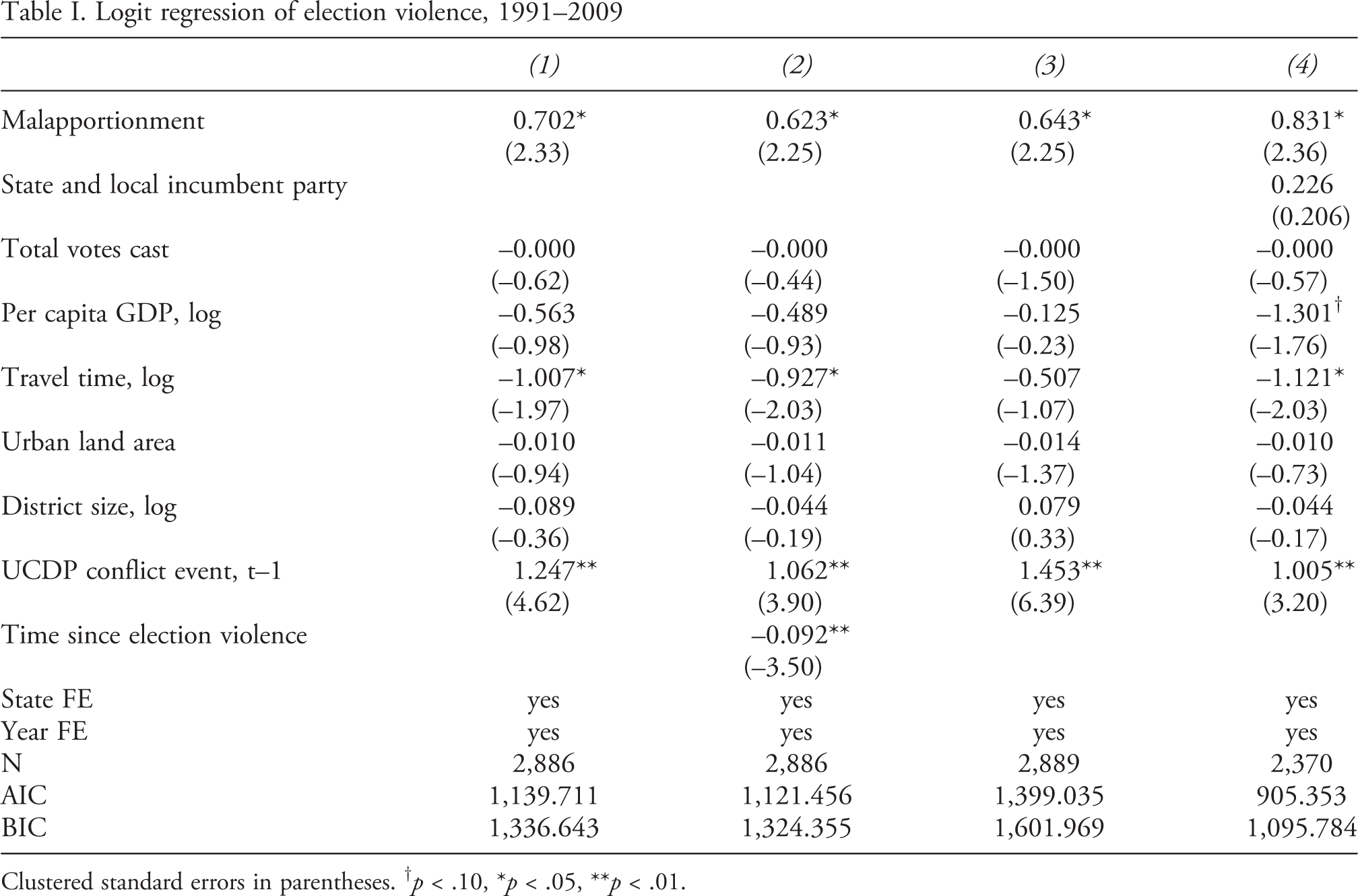
Table I presents four models that assess the effect of malapportionment on the probability of election violence. I first present a model that includes the malapportionment indicator and all controls. As discussed in the theory, incentives for violence should be lowest in overrepresented constituencies and increase as they become more well-apportioned. The results support my claims, showing that the coefficient for malapportionment is positive and significant. The probability of violence increases as constituencies become less overrepresented.
In Model 2, I add a control for temporal dependence of election violence, counting the number of years since the last electoral violence event. Results for malapportionment remain consistent, and also suggest strong temporal dependence. In Model 3, the dependent variable counts all events of election violence, including those involving armed groups. Results for malapportionment remain again consistent. In Model 4, I control for the partisan identity of the chief minister and the local incumbent. Since states are in charge of law and order, local incumbents belonging to the same party as the current chief minister might have an advantage in organizing violence. However, while positive, the coefficient is not statistically significant.
For control variables, the coefficient for past political violence is consistently significant and positive, confirming the path dependence of violence. The variable for travel time is negative and significant in most models, showing that constituencies with longer average travel times to the next city are less likely to experience violence. Across all models, results for malapportionment are significant at the 95% confidence level.
Logit regression of election violence, 1991–2009
Clustered standard errors in parentheses. † p < .10, *p < .05, **p < .01.
Observable implications for district homogeneity and incumbent victory
This section presents results for two additional implications of the argument. First, I have argued that overrepresented constituencies are more homogenous in terms of voter preferences than underrepresented ones. To test this implication, I create an indicator of district vote homogeneity using the Herfindahl-Hirschman (HH) concentration index. To create the HH index, I first calculate the proportion of votes for each party that received at least 5% of the vote in each constituency and for each election using constituency-level elections data from Bhavnani (2014). I square and then sum the
Predicted probability of election violence (Model 1, Table I) Logit regression of district vote homogeneity, 1991–2009 Clustered standard errors in parentheses. †
p < .10, *p < .05, **p < .01.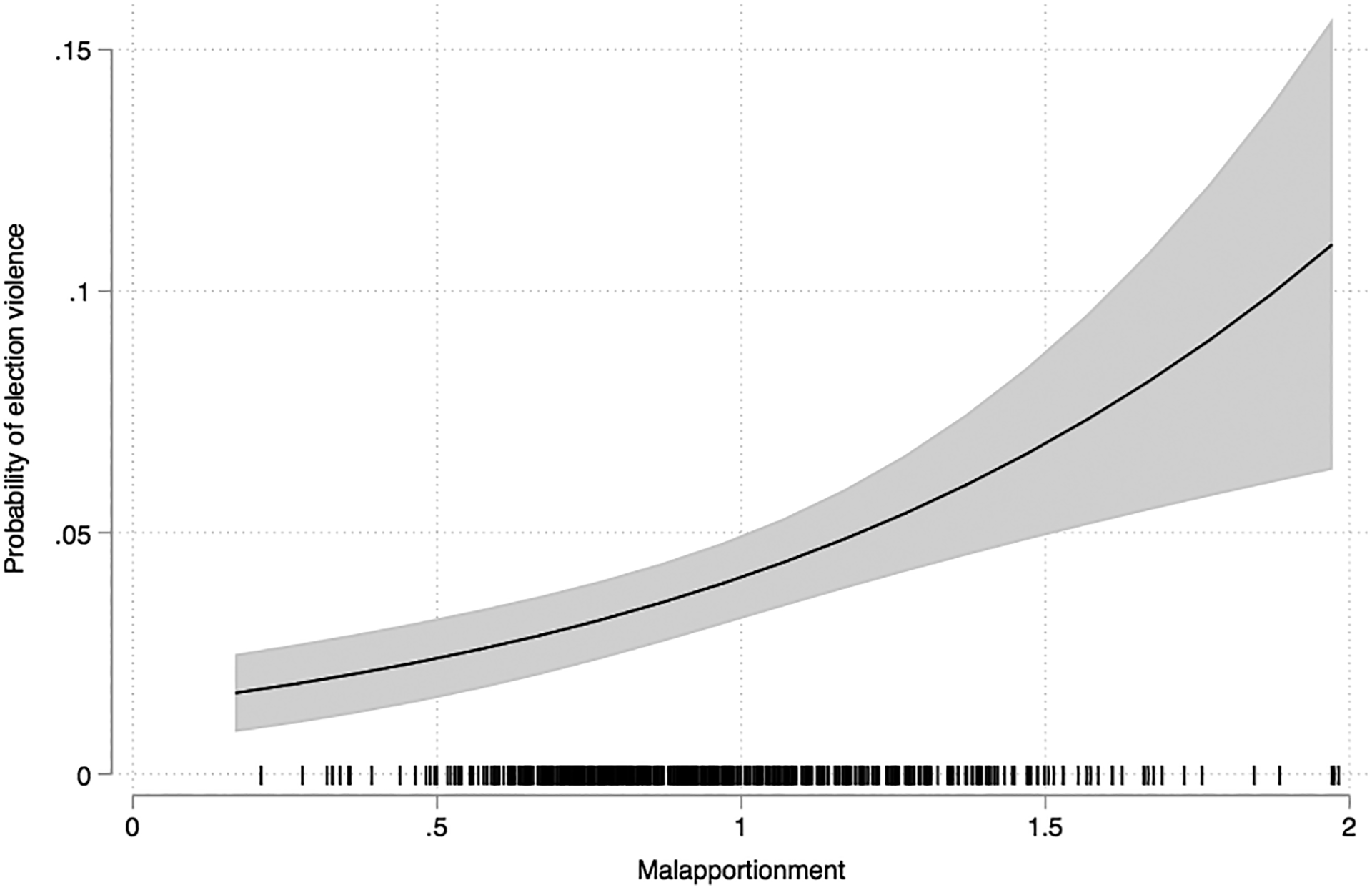
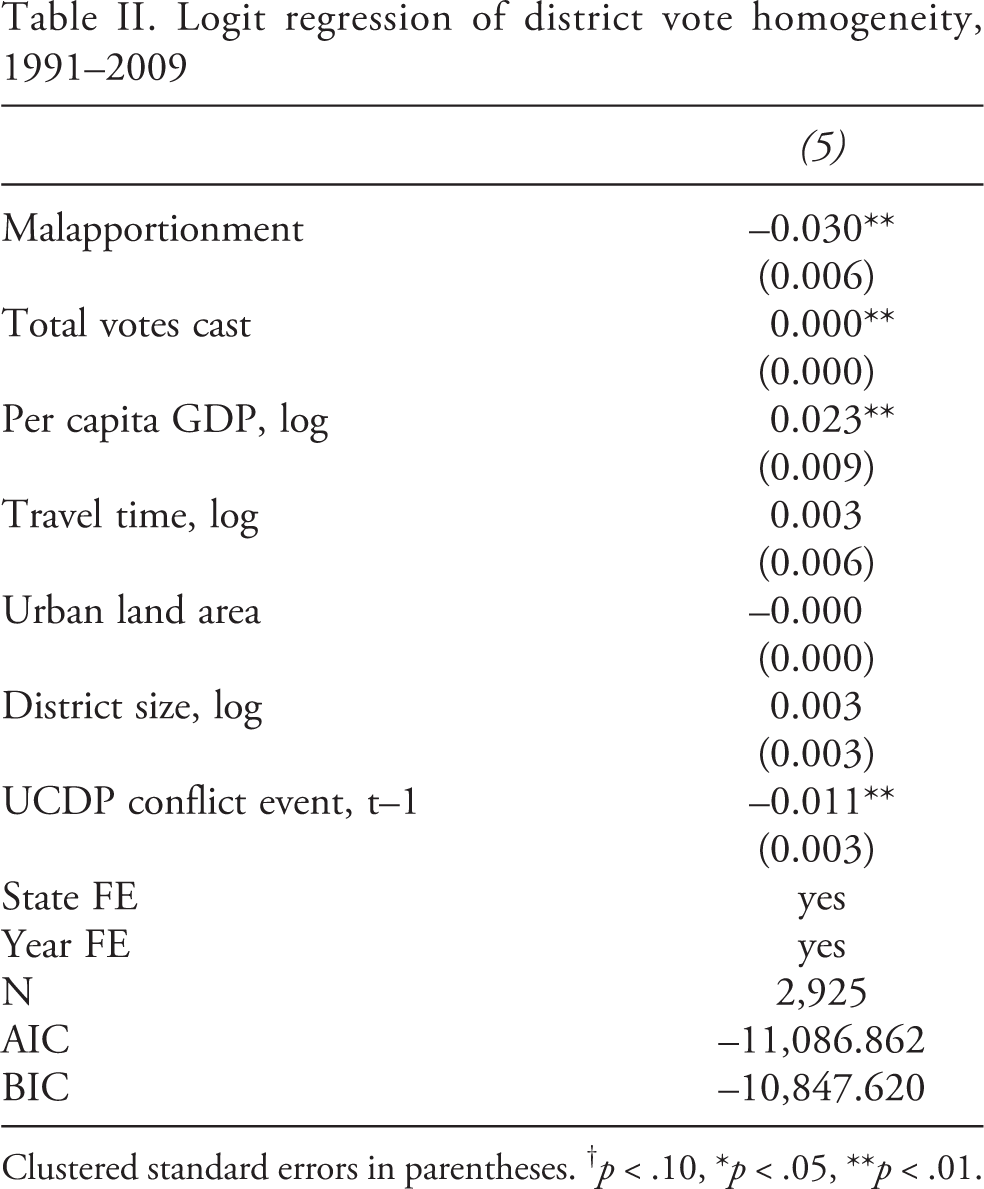
Table II presents the results, which confirm that the coefficient for malapportionment has a negative and significant effect on district homogeneity. Districts that are more evenly apportioned or underrepresented are less homogenous in terms vote preferences, which confirms expectations.
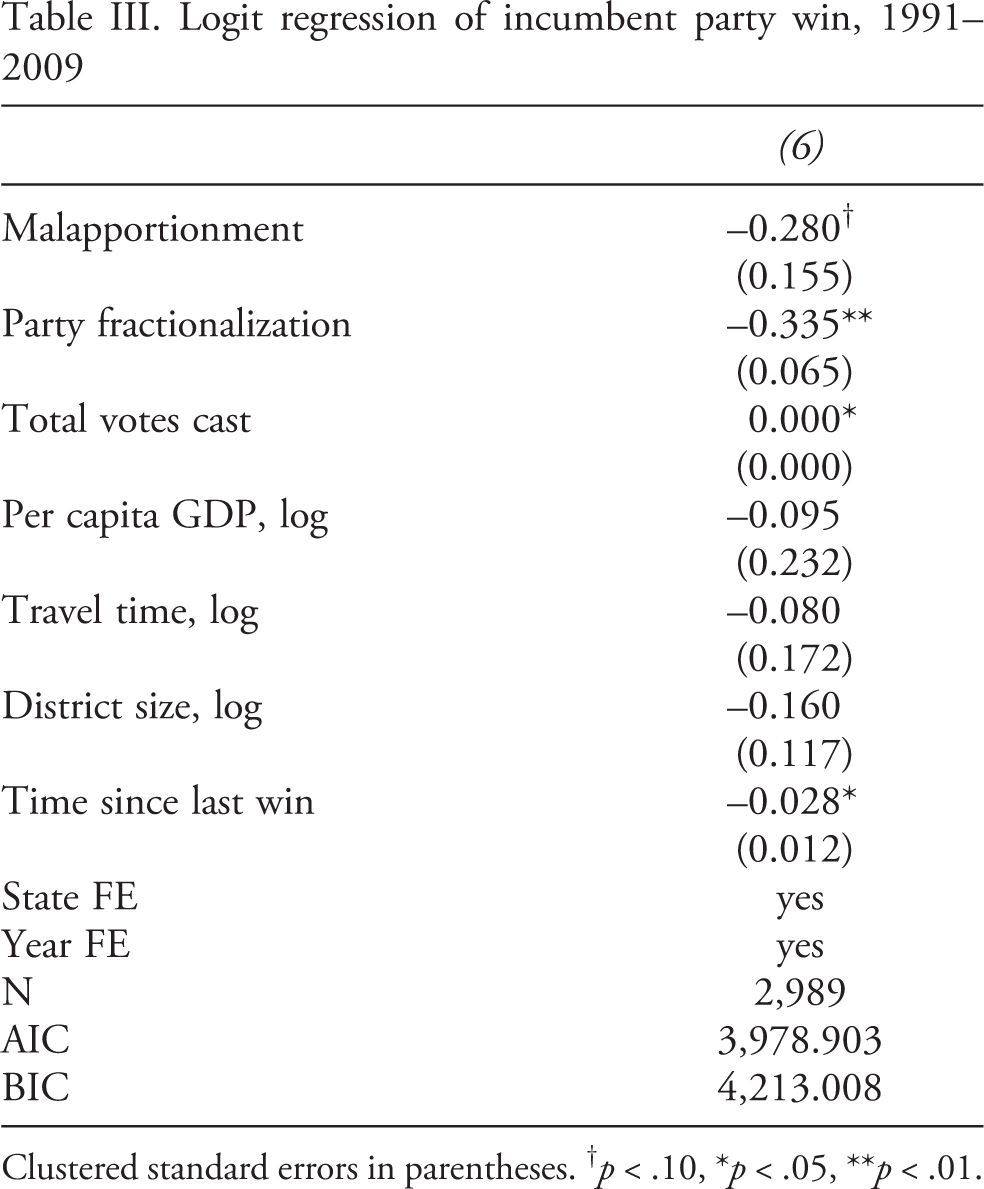
Logit regression of incumbent party win, 1991–2009
Clustered standard errors in parentheses. † p < .10, *p < .05, **p < .01.
Online appendix
In the Online appendix, section A1 presents descriptive statistics of all variables, a histogram of malapportionment, and maps showing average malapportionment and the incidence of election violence in India. In section A2, I present additional robustness checks and validations of the election violence measure. I correlate events of election violence with data on fear of violence from the National Election Studies in India and from Varshney & Wilkinson (2004), examine whether results hold if I limit the dependent variable to deadly violence, and show that election violence reduces turnout in line with observational implications from literature. Section A3 specifies additional robustness tests, including a rare events estimator, controlling for the percentage of Muslims, including constituency fixed effects and state-year fixed effects, and separate models for South and North India, respectively. Findings for malapportionment are robust across specifications. Section A4 examines whether overrepresented districts are more often targeted with clientelism. Section A5 presents scatterplots comparing malapportionment to other indicators of electoral competition. Section A6 shows cross-national patterns of malapportionment and election violence.
Conclusion
Political scientists recognize that elites in unconsolidated democracies can choose from a long menu of manipulation, but research often studies different forms of manipulation in isolation. I argue here that the presence of institutional biases such as uneven electoral apportionment has important consequences for elites’ incentives to use other, more short-term and blatant manipulation strategies such as pre-election violence. The argument puts forward divergent expectations for overrepresented districts compared to well-apportioned or moderately underrepresented ones. In overrepresented districts, parties have strategic incentives to invest in clientelist strategies, creating constituencies that have more homogenous voter preferences, and leading to pro-incumbent bias. In these districts, neither incumbents nor opposition benefit from encouraging violence. In contrast, well-apportioned or slightly underrepresented districts have more heterogenous voter preferences, are more competitive, and less biased in favor of incumbents, creating incentives for district-level incumbents and opposition parties to use violence. The empirical analysis explores the argument’s observational implications in India, a country with significant subnational variation in malapportionment and the incidence of violence. I show that overrepresented districts experience less violence in national elections held from 1991 to 2009 and also establish additional observable implications. Some caveats remain; in particular, malapportionment could be endogenous to party strategies, and might be subject to various selection effects emerging from pre-existing differences in exposure to malapportionment and the risk of violence across constituencies. A promising avenue to address such threats to inferences could be to compare localities in close proximity yet located in different constituencies and thus exposed to different levels of malapportionment, allowing researchers to hold constant demographic and socio-economic factors. In addition, future research should explore whether these findings hold outside the Indian context. Aside from contemporary cases where malapportionment remains widespread, such as Malaysia or many Latin American countries, it could also be valuable to study historical cases such as the United Kingdom, where uneven apportionment and election violence were once common.
Understanding the consequences of uneven apportionment for the risk of electoral violence is important for several reasons. First, the growing literature on campaign violence usually analyzes electoral competition as if it happens in an even playing field, neglecting that unevenness in electoral competition has important consequences for elites’ incentives to employ violence. As this article shows, elites consider the strategic incentives produced by malapportionment, using less violence in overrepresented districts. Future research should thus consider such biases in empirical analyses.
Second, the article underlines the importance of considering the electoral process in its entirety, a concern often raised by policymakers. International organizations active in the monitoring of electoral processes stress the importance of addressing not just fraud or violence happening on election day, but also manipulation occurring earlier in the electoral process. The European Union, for example, assesses infractions throughout the electoral cycle, starting from the legal framework all the way through election day and the publication of results. Yet in practice, much attention and funding still centers on reducing blatant fraud taking place closer to elections or on election day, such as election violence. For example, several governmental and international actors, such as the United States Institute for Peace and the EU, are currently funding large-scale programs to help avert election violence. This emphasis can lead policymakers to overlook less visible forms of manipulation.
Third, the article’s findings on the interdependence of manipulation strategies suggest potential unintended consequences of reducing blatant forms of manipulation. If the costs of election violence increase, elites may respond by trying to benefit from less visible manipulation strategies. Accepting the persistence of these biases may be an acceptable trade-off, however, because violence is arguably more normatively problematic than other manipulation strategies. The persistence of malapportionment and gerrymandering in established democracies in the Americas seemingly confirms this notion of acceptable trade-offs.
Footnotes
Replication data
The dataset and files for the empirical analysis in this article, along with the Online appendix, can be found at http://www.prio.org/jpr/datasets. I used Stata 14 for statistical analyses and graphing schemes written by  .
.
Acknowledgements
I thank Imke Harbers, Sabine Otto, Mascha Rauschenbach, Todd Sandler, Hannah Smidt, Abbey Steele, Maya Tudor, and Thorin Wright for comments on earlier drafts. Mantej Pardesi provided valuable research assistance. Earlier versions were presented at the workshop on Political Violence, University of Texas-Dallas, 17–18 May 2018, the Election Violence Workshop at the University of Amsterdam, 15–16 February 2018, the Mixed Methods Workshop at the University of Mannheim, 9–10 October 2017, the Politicologenetmaal, Leiden University, 1–2 June 2017, the Oxford IR Colloquium, 12 May 2017, and the International Studies Association meeting, Baltimore, MD, 22–25 February 2017.
Funding
This project received funding from the Netherlands Organization for Scientific Research (NWO), Innovational Research Incentives Scheme Veni no. 451-13-030, the European Commission, Marie Curie Career Integration Grant (CIG) no. 618422, and the ‘Stimulering Europees Onderzoek’ initiative of the Dutch Ministry of Education, Culture and Science.
Notes
References
Supplementary Material
Please find the following supplemental material available below.
For Open Access articles published under a Creative Commons License, all supplemental material carries the same license as the article it is associated with.
For non-Open Access articles published, all supplemental material carries a non-exclusive license, and permission requests for re-use of supplemental material or any part of supplemental material shall be sent directly to the copyright owner as specified in the copyright notice associated with the article.
