




Abstract
This article introduces the global Pro-Government Militias Database (PGMD). Despite the devastating record of some pro-government groups, there has been little research on why these forces form, under what conditions they are most likely to act, and how they affect the risk of internal conflict, repression, and state fragility. From events in the former Yugoslavia, Iraq, Sudan, or Syria and the countries of the Arab Spring we know that pro-government militias operate in a variety of contexts. They are often linked with extreme violence and disregard for the laws of war. Yet research, notably quantitative research, lags behind events. In this article we give an overview of the PGMD, a new global dataset that identifies pro-government militias from 1981 to 2007. The information on pro-government militias (PGMs) is presented in a relational data structure, which allows researchers to browse and download different versions of the dataset and access over 3,500 sources that informed the coding. The database shows the wide proliferation and diffusion of these groups. We identify 332 PGMs and specify how they are linked to government, for example via the governing political party, individual leaders, or the military. The dataset captures the type of affiliation of the groups to the government by distinguishing between informal and semi-official militias. It identifies, among others, membership characteristics and the types of groups they target. These data are likely to be relevant to research on state strength and state failure, the dynamics of conflict, including security sector reform, demobilization and reintegration, as well as work on human rights and the interactions between different state and non-state actors. To illustrate uses of the data, we include the PGM data in a standard model of armed conflict and find that such groups increase the risk of civil war.
Introduction
The activities of pro-government militias have been a feature of recent uprisings, as illustrated by events in Libya, Bahrain, and Syria. Pro-government militias have been active in many different contexts around the globe, but research has not kept pace with this development, largely due to lack of systematic data. The Pro-Government Militias Database (PGMD) intends to fill this gap by identifying these militias and irregular armed groups that are linked to government authorities between 1981 and 2007.
The PGMD enables research on state capacity, human rights, and civil war to address new questions. While we know of the impact of poverty, natural resources, terrain, regime type, and ethnicity on armed conflict (e.g. Collier & Hoeffler, 2004; Fearon & Laitin, 2003; Hegre & Sambanis, 2006), less attention has been paid to agents and organizations that carry out the violence – although the importance of the organization of the security sector is recognized (Toft, 2009). Recent research has examined the fragmentation of rebel groups (e.g. Bakke, Cunningham & Seymour 2012; Cederman & Gleditsch, 2009; Cunningham, 2011), but the government usually is assumed to be a unitary actor. Case evidence suggests that this conceptualization is often misleading. Despite the effect that pro-government militias can have on the political, economic, and social stability and security of civilians, with the notable exception of Ahram’s (2011a) analysis of Janowitz’s (1977) data, there is little quantitative research on these groups. This research lags behind the case study literature in analyzing the impact of these groups with, for example, studies of death squads in El Salvador (Stanley, 1996) and paramilitary groups elsewhere in Latin America (Centeno, 2002; Mazzei, 2009), the military’s arming of political party organizations in Indonesia (Cribb, 2001: 233; see also Robinson’s (1995: 228) discussion of ‘semi-official armed gangs’), or the use of the Bakassi Boys by a state governor in Nigeria (Reno, 2002). 1 There are currently no systematic measures of these informal violent organizations that act on behalf of the government.
To evaluate the conditions under which these groups form, to understand the relationship between them and the governments of the countries in which they operate, to know what is case specific and what is more general about them, and to analyze their consequences for the nature of conflict and for the prospects for peace, we need such measures. The PGMD allows researchers to examine under what conditions these informal actors form and operate. It provides a missing element useful for the study of state strength, violence and human rights violations, security sector issues and the prospects for peace, and possibly political cleavages and electoral violence. As case researchers (Staniland, 2012: 23) note, there are ‘daunting’ challenges to collecting such data. The data collection is an observational process designed to capture the variety of informal armed groups across continents while organizing knowledge of them in a coordinated and systematic way. A complete listing of all such groups would be ideal, as would comprehensive listings of all episodes of political violence or human rights violations (see Morrow, 2007: 563). Our data provide a basis for examining patterns and associations and a platform for further observations. In this article we give an overview of the theoretical argument that initiated the project, the data collection procedure and its challenges, and the features and limitations of the database. We show how the data can usefully be added to standard models of armed conflict.
Pro-government militias (PGMs)
The project stems from the puzzle of why governments with regular forces delegate to informal groups. Governments face more severe agency problems with militias, yet may be tempted to use these groups to add numbers or local knowledge, or to evade accountability for strategically useful violence as in the Sudan. The question is whether governments can’t control or won’t control these groups (Mitchell, 2004). This logic offers a general explanation of these groups beyond cultural explanations or Weberian accounts of militias as constitutive of state failure (Bates, 2008). We distinguish the formation of these groups from a particular condition of a country, such as disorder, civil war, or state failure. If there are general incentives to delegate to these groups (e.g. increasing deployed forces or avoiding accountability) we expect them to work across cultural, geographical, and even political systems and these groups to be more numerous and more widely distributed than Weberian conceptions of states seeking to monopolize violence would suggest. Our data collection supports this assumption. We have identified 332 pro-government militias distributed around the world between 1981 and 2007. The relationship between these groups, disorder, civil wars, and state failure are empirical questions that can be evaluated with this new dataset.
We define a PGM as a group that
is identified as pro-government or sponsored by the government (national or subnational),
is identified as not being part of the regular security forces,
is armed, and
has some level of organization.
Criterion 1: The group is identified by the media source, which is discussed in more detail below, as pro-government or sponsored by the government, either on the national or subnational level. There are a variety of possible links between the group and the government, including information sharing, financing, equipping, training, and an operational link. We adopt a conservative approach. Simply sharing an enemy with the government or evidence that a group does not oppose the government or is simply tolerated by the government is insufficient for the group to be considered as pro-government. Depending on the available information, the data include more details on the nature of the link to government.
Criterion 2: The group is not part of the regular state security force. However, the PGM may operate with the regular forces, or even be composed of members of the security forces organized clandestinely as an unofficial or informal group (e.g. death squads). This relationship with the regular forces might include, in addition to sharing of personnel, information sharing, joint operations or training.
Criterion 3: The group is equipped for violence, but does not have to commit violence to be included. This criterion is not limited to firearms; some groups are equipped with machetes or clubs.
Criterion 4: The group has some evidence of organization, for example an identifiable leader, name, or a geographical, ethnic, religious or political basis. We exclude ‘flash’ or spontaneous mobs.
We do not select groups on how long they are pro-government, but only on these four criteria. When a group fails to fulfil these, then the group is coded as terminated as a PGM according to our definition. This includes the disarmament or banning of the group by the government or its integration into the regular security forces. If a president or party ceases to be in government, then the PGMs affiliated with them also cease to be PGMs. Groups can also cease to be classified as PGMs as a result of a border change. For example, armed groups linked to the Indonesian government were active in East Timor, fighting the independence movement. These pro-Indonesia groups end in our dataset with the transition government that was put in place in East Timor in December 1999, although some of these groups were still active within Timor-Leste after 1999. But they were then linked to the Indonesian government, so no longer fitted our definition of a domestic pro-government militia.
Affiliation with government: Informal and semi-official PGMs
While all groups in the database are pro-government, their affiliation with government varies. In some instances the government tries to keep the group at arm’s length, while in other cases governments openly create, train, and pay such groups. For example, village defense forces that have been created by governments fall under this second category, where the link to the PGM is far more open and institutionalized than in the case of the Janjaweed. As an initial effort to capture affiliation with the government we use two categories, informal and semi-official PGMs.
Informal PGMs are armed, supported by or act on the side of the government and are described as pro-government, government militia, linked to the government, government-backed, or government-allied. Examples include the Young Patriots in Cote d’Ivoire, the Ansar-e Hezbollah in Iran, and the Interahamwe Militia in Rwanda during the early 1990s. ‘Death squads’, even when closely linked to the government, are normally informal and clandestine, and are categorized as informal PGMs.
A semi-official PGM has a recognized legal or semi-official status, in contrast to the looser affiliation of informal PGMs. A semi-official PGM is separate from the regular forces and identified as a distinct organization. Examples of semi-official PGMs include Village Defence Committees in India, the Revolutionary Committees in Libya under Gaddafi, and the Rondas Campesinas in Peru. In many countries, the term ‘paramilitary’ refers to regular forces, or police units with some military status which are not included in the PGM dataset.
Overview of the PGMD
The PGMD contains open source information about pro-government armed groups obtained from LexisNexis searches of news sources from around the world. The sources include transcripts translated into English in BBC World Summaries of local news, Agence France Presse, Xinhua General News Service, and major international newspapers. Search terms included ‘government militia’, ‘paramilitary’, ‘government death squads’, ‘government irregular forces’, and ‘vigilante’, and returned numerous documents, many of them off-topic. While this broad search strategy was heavily labour-intensive, we reduced the risk of missing information. Users of the data have access to over 3,500 key sources that informed the coding decisions. The dataset covers 178 countries for the time period from 1981 to 2007, and for 88 countries we found evidence of at least one PGM during this time period. 2 We focus on pro-government groups active within their own borders. Acknowledging the scope of the dataset, the dynamic nature of the relationship between groups and governments, and the complicated task of imposing a uniform coding scheme on disparate open source information on a global scale, researchers made a concerted effort to cross-check the information to ensure consistency. The coding has been checked independently by at least three researchers, more in most cases. But no further claims are made about the accuracy of this information.
The PGMD consists of a relational data structure that links 16 tables representing aspects of the data, from armed groups themselves and their membership and target characteristics, to group actions, to the documentary evidence researchers used to create the dataset. Although we focus here on combinations of groups, countries, and years as units of analysis, the relational structure allows separate data matrices to be constructed for any combination of our 16 tables of information. The data structure is realized as a Sqlite database. 3 The database supports distributed web-based coding and a searchable website that can be used to browse and download the PGM data.
In the following, we discuss the key variables and provide details on specific datasets drawn from our database. The data that use the pro-government militia as the unit of analysis include variables on their links to their government and membership characteristics. The database contains information on the alleged targets and purpose of the PGMs, as well as other information discussed below.
Origin and termination
For each PGM we recorded formation and termination dates. When no such date was given in the sources, we recorded the date the group was first mentioned. 4 As a termination date we coded the date when a group ceased to be a pro-government militia according to our definition. One difficulty was patchy information on termination. In many instances, the groups simply ceased to be mentioned in the news reports. Therefore, there is often missing data on group termination. This problem of establishing group ‘life-cycles’ is not a problem particular to PGMs, but extends to research on groups more generally (e.g. Berkhout & Lowery, 2008).
PGM characteristics
As outlined above, we distinguished between informal and semi-official PGMs. Furthermore, we identify how the PGM is linked to the government, for example to the state or military institution, an individual person, such as the president or a minister, a political party, or the subnational government. We recorded all links that are identified in the sources.
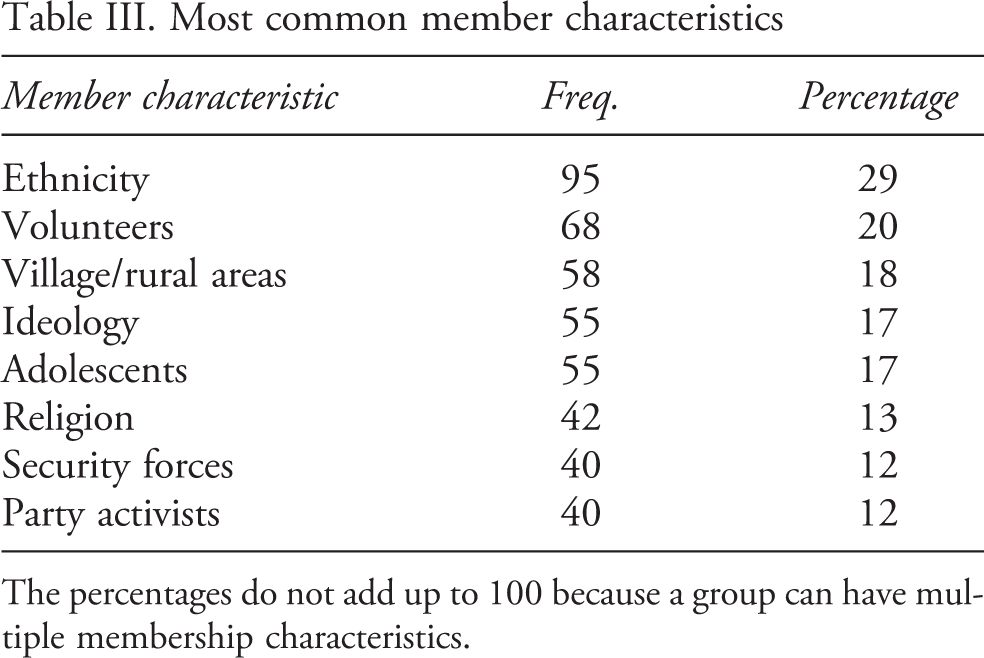
The database includes variables that capture various other characteristics including the sources of support for the groups, such as a foreign government, landowners, or being self-maintained through plunder and looting. We recorded the geographical location of the activities of the groups as precisely as possible and include a minimum and maximum headcount of each group where the sources provide these kinds of information. We recorded membership characteristics, for example whether it was ethnic or ideology-based, whether the group recruits children or adolescents, or whether their membership was urban or rural-based. We also coded alleged targets, such as armed and unarmed political opposition, criminals, and civilians, as well as group purposes, such as fighting insurgents, intimidating civilians, or gathering intelligence.
Procedures and missing data
Some countries or groups receive more attention than others in the news media. But we expect that the range of sources used and the length of the period for which data are collected reduce the problem of overlooking groups in less prominent countries or conflicts. Nevertheless, we expect that the dataset underrepresents PGMs, which is partly a function of differences in the availability of sources across the time period.
PGM types
Links to government
The percentages do not add up to 100 because a group can have multiple links to government.
The data
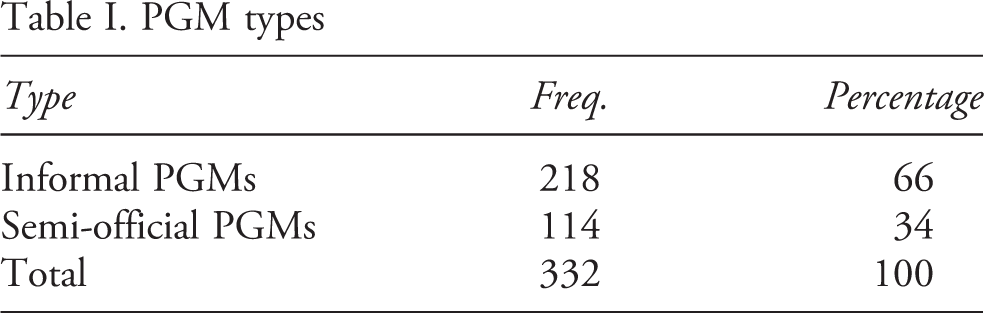
For the period between 1981 and 2007 we have coded 332 PGMs. As shown in Table I, about two-thirds are classified as informal PGMs, which are loosely affiliated with and linked to the government, while one-third are identified as semi-official PGMs.
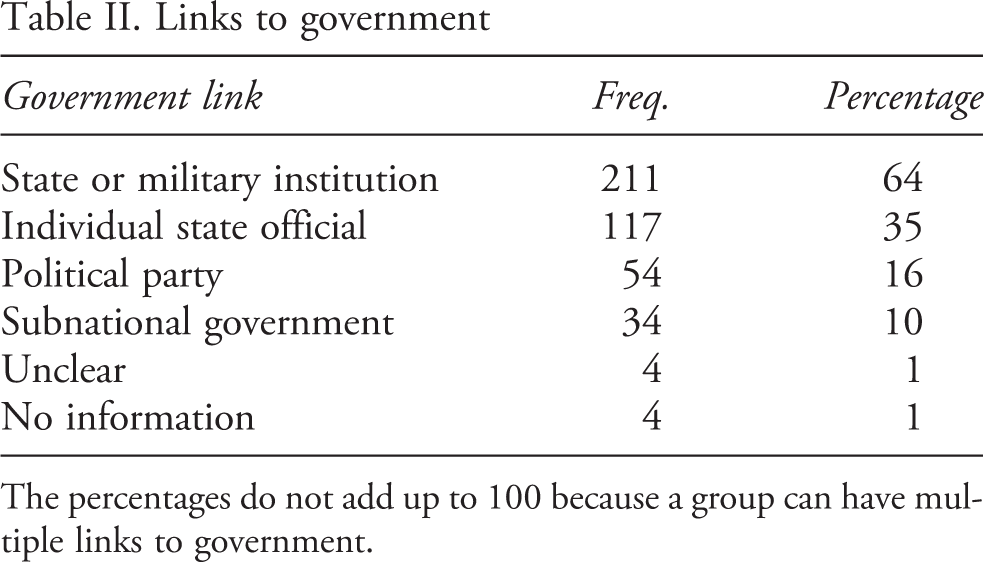
In Table II we identify four possible links between the militias and the government: to an institution of the state or the military, to individual members of the state apparatus, to the governing political party, or to a subnational government. Groups can have more than one link to government. For 64% of PGMs the link was to an institution, either to the state or to the military. About one-third of PGMs are linked to an individual, such as the president, prime minister or another government minister. In 16% of cases the PGM is connected to the political party in power and in only 10% to the subnational government. More localized groups may be less easy to observe using our search procedure.
Most common member characteristics
The percentages do not add up to 100 because a group can have multiple membership characteristics.
Most common PGM targets
A group can have multiple targets. The percentages do not add up to 100 because a group can have multiple membership characteristics.
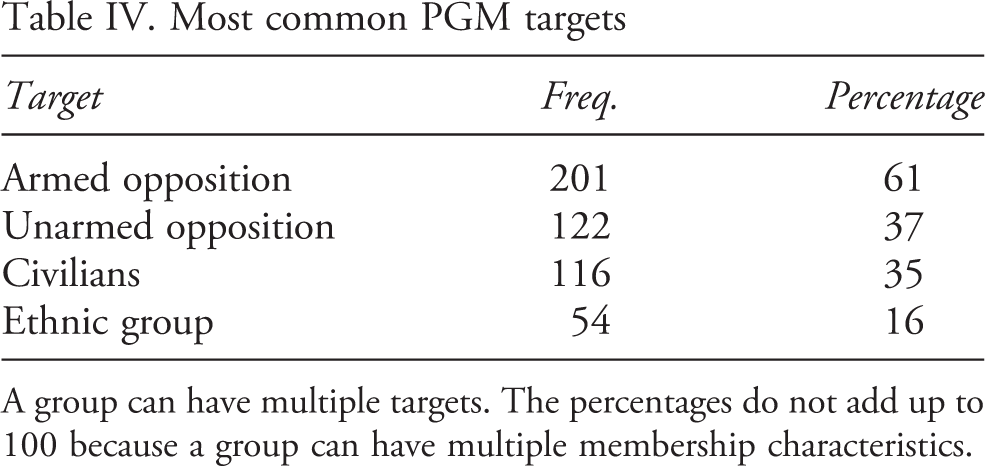
For alleged targets, we coded one or more mentions of any alleged target. Just over 60% of PGMs targeted armed opposition groups. In most cases, governments use informal armed groups to counter a threat to their rule in the form of armed opposition. At some distance, unarmed opposition, such as members of opposition parties or outspoken government critics (in 37% of cases) and civilians (in 35% of cases) emerged as the next most common targets of PGMs. Our data collection also shows that ordinary civilians were often targeted by PGMs. Ethnic groups were also frequently identified as targets, but at 16%, ethnic groups appear to be a less frequent target. It may be that opposition groups have an ethnic dimension that is not picked up in the reporting of the conflict.
In addition to the data that use the group as the unit of analysis, we provide datasets
with the country-year as unit of analysis, containing basic information on the number of
active PGMs and the number of countries with at least one PGM in a particular year between
Number of PGMs worldwide, 1981–2007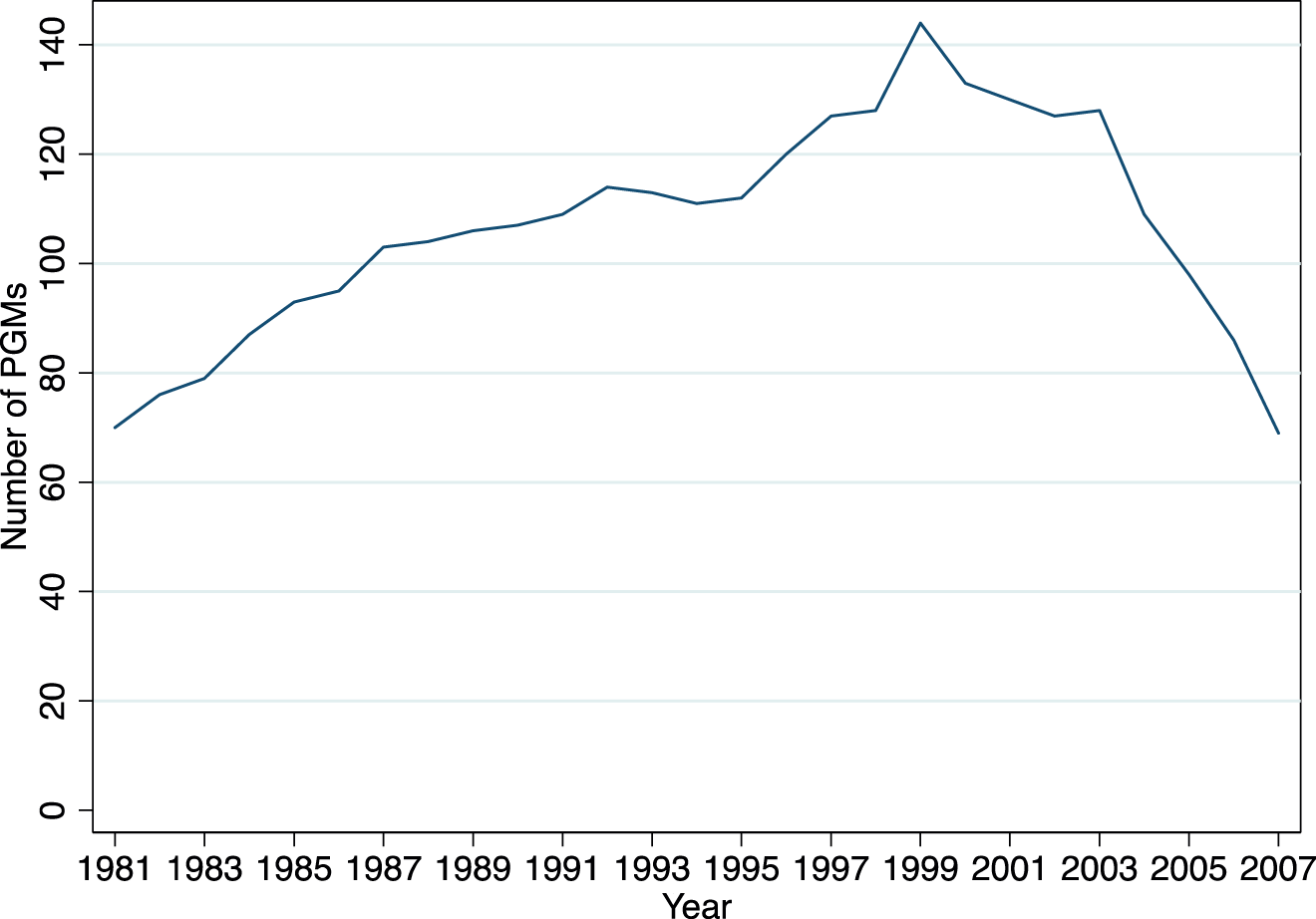
Figure 1 presents the total number of active groups annually from 1981 to 2007. The figure shows a general upward trend throughout the 1980s and 1990s. The number of pro-government militias peaks in 1999 and then drops off substantially. We are not yet sure of the reasons behind the sharp decline of PGMs. In part this pattern could be a result of lagged reporting. Sometimes news reports published several years after the event provide further details on PGMs and their activities in earlier years.
Figure 2 graphs the total number of countries with at least one PGM per year. As for the data presented in Figure 1, groups with unspecified dates of dissolution are estimated to have ended in the year of their last recorded activity. Our data show a slight downward trend in the number of countries with PGMs during the 1980s, and a drop after a small increase in 2004. Again the decline towards the end of the data collection could partly be due to limited information available for the most recent time period. Countries with the highest number of PGMs are Indonesia with 37, Sudan with 21, and the Philippines with 19, possibly suggesting an ‘archipelago effect’ where difficult terrain induces a government to rely on local forces.
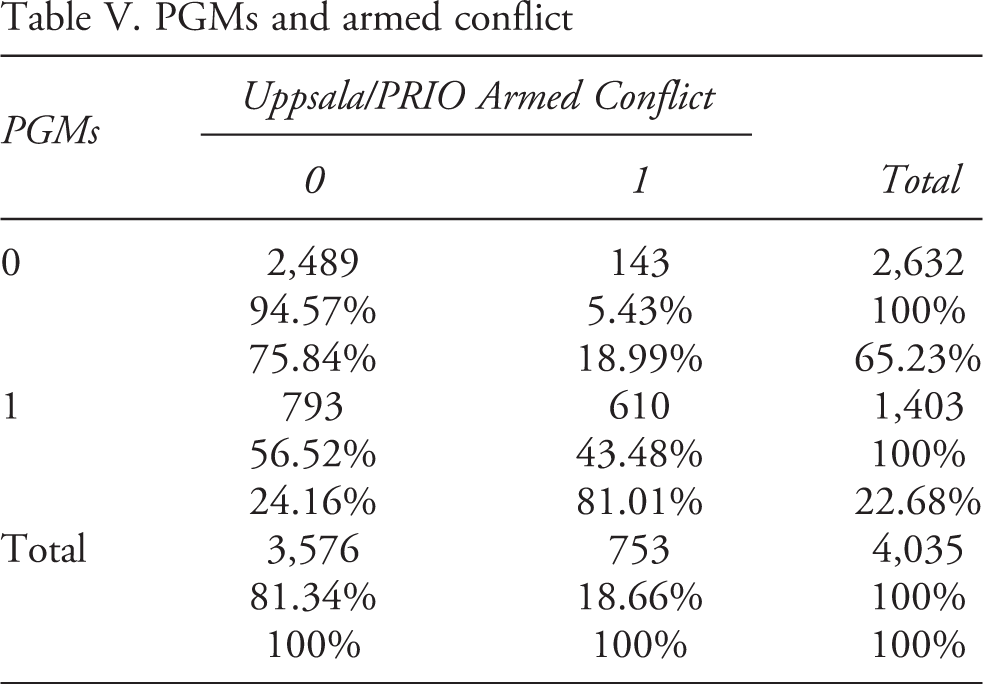
Table V shows the correlation of PGMs with civil war, using the 25 battle-related deaths threshold from the UCDP/PRIO Armed Conflict Dataset (ACD) (Gleditsch et al., 2002). Using country-years as the unit of analysis, 43% of PGMs are present in countries experiencing civil war. Most of the time PGMs are found outside of armed conflict. Focusing on civil wars, most civil wars are characterized by the presence of militias (81% of civil wars). In short, accounting for militias fighting on the government side is likely to be important for capturing the dynamics of internal conflict and the prospects for peace, but these groups cannot be treated as simply epiphenomenal to civil wars.
Usefulness of the data
To illustrate uses of the data, we analyze civil war, adding our PGM measure to a standard
model of armed conflict. We expect PGMs to increase the risk of armed conflict because they
offer governments a low-cost response Number of countries with at least one PGM, 1981–2007 PGMs and armed conflict Logit estimates on the incidence of intrastate conflict, 1981–2007 Values are coefficients with robust standard errors in parentheses, clustered on
countries. *p < 0.05, **p < 0.01,
***p < 0.001.
a The natural log was taken of these variables, with 0.5 being added to
all values beforehand.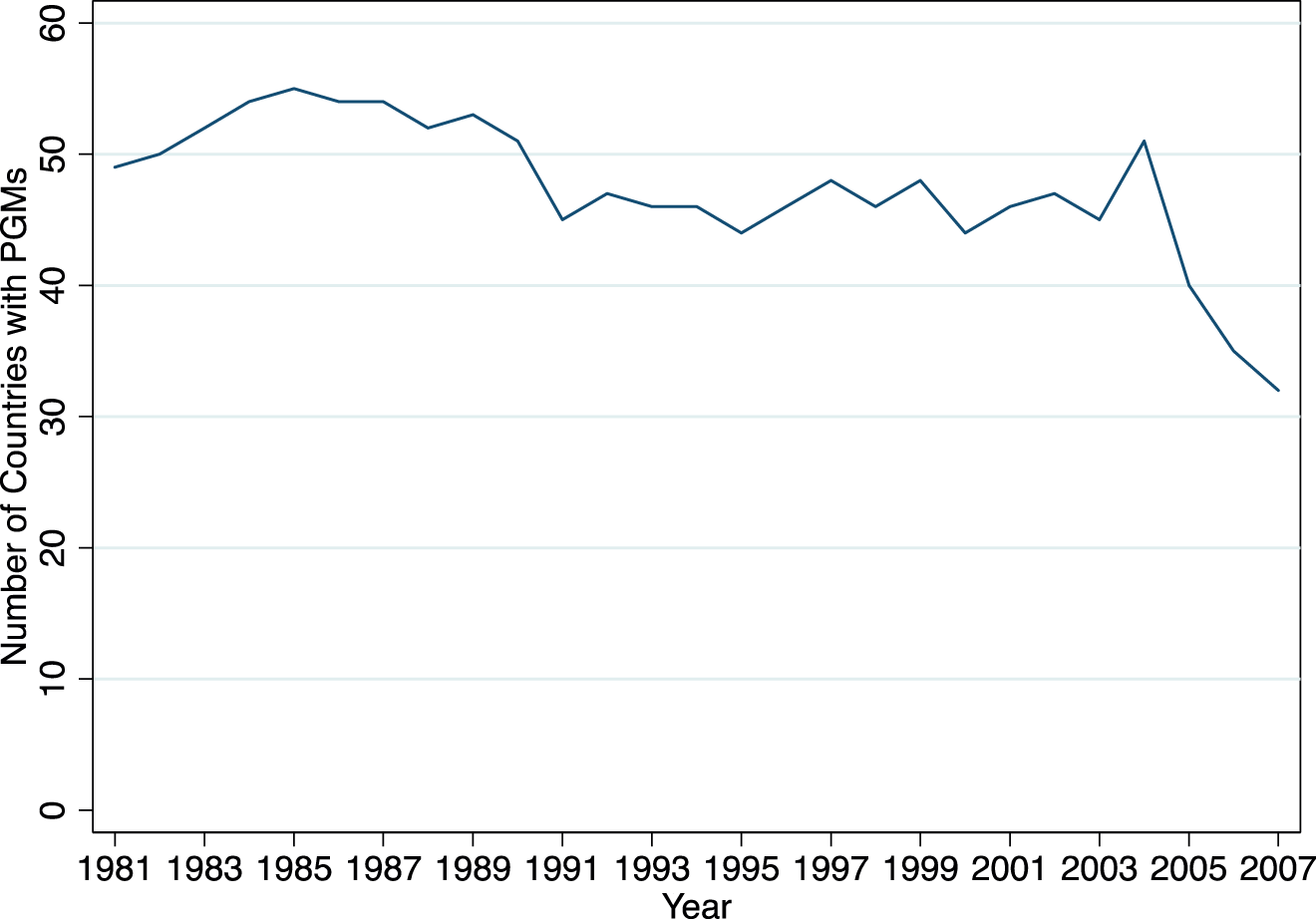
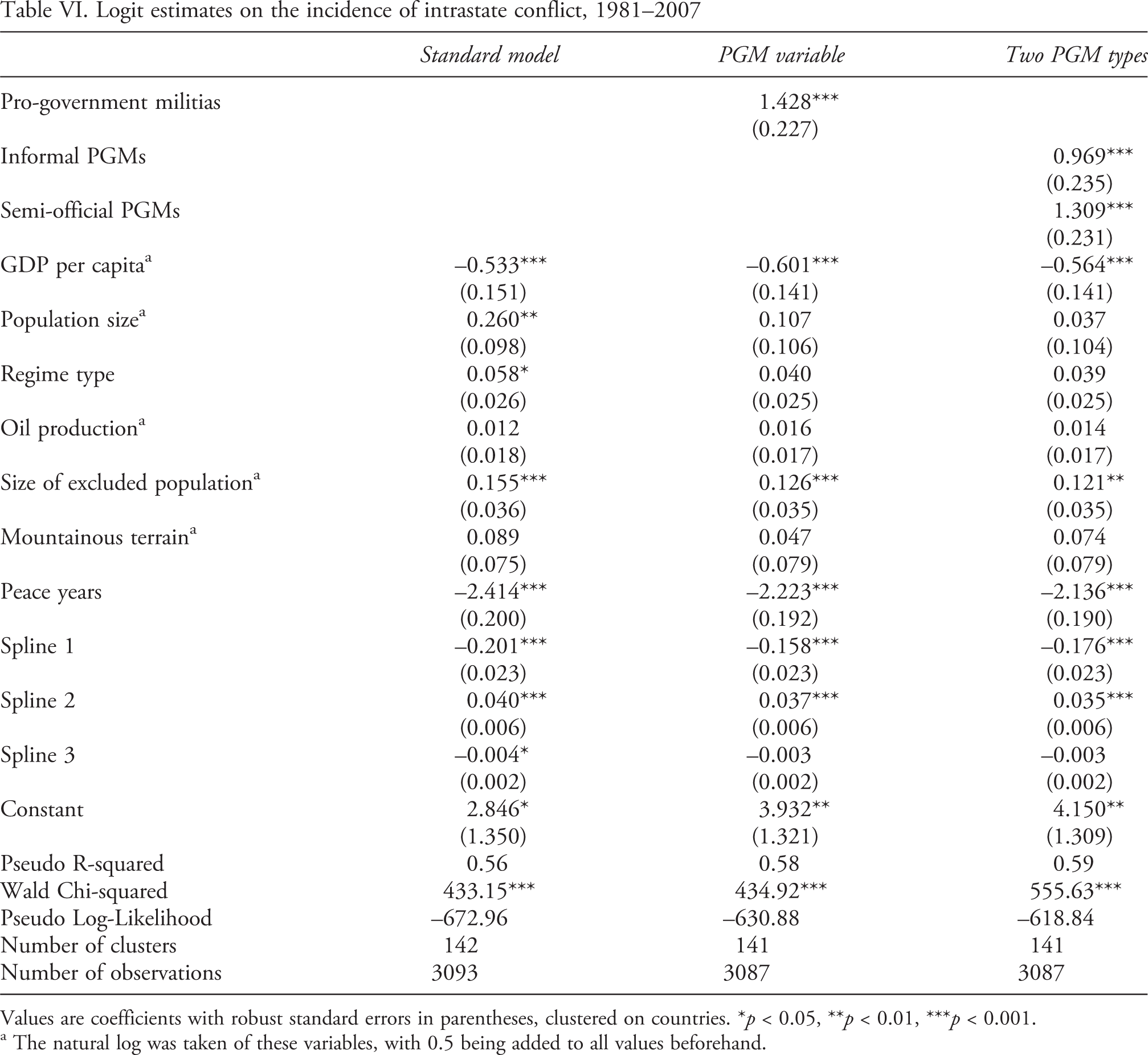
There are further issues to investigate including likely endogeneity between PGMs and conflict, yet this brief analysis of intrastate conflict suggests that information on PGMs may provide valuable insights beyond the standard models. For conflict scholars, informal actors are likely to influence the nature and duration of conflict. They may have incentives to act as ‘spoilers’ and prolong the conflict. The consequences of governments deciding to use these sorts of groups may be assessed in terms of their impact on the well-being of civilian populations and on human rights protection using the new PGM dataset. For scholars interested in the well-being of the state, ethnic and political cleavages, and the institutional bases of collective action, party politics and election violence, these groups provide an opportunity for theory development and empirical analysis.
Conclusion
Despite the sometimes highly visible activities of pro-government militias in Europe, Latin America, Asia and Africa, there has been no large-scale systematic comparative research on why these forces form and how they affect the risk of internal conflict, civil war and harm to civilians. Because of the increasing role of non-state actors generally, and the significant presence that they have had in conflicts across countries, it is important to collect information on these groups and to seek to improve transparency on their links to governments, assuming that governments that back these groups have a responsibility for their actions. The PGMD enables the academic community to investigate the conditions under which these groups are formed and dismantled and what impact they have on the security and stability of their host countries. The data will likely be useful to scholars working on state capacity and control, conflict and repression and collective action more broadly. Given the span across time and space, we expect our database to be more useful for making cross-country and cross-time comparisons than for carrying out in-depth qualitative case studies for specific countries – although given the amount of information we have gathered on the groups, we hope that our database will provide a useful starting point for such endeavours. We anticipate that the PGMD will also be of interest to policymakers, the media, and non-academic users concerned with conflict and human rights related issues. By focusing on these organizations, these data allow researchers and policymakers to obtain a more comprehensive estimate of the repressive apparatus of a country than that provided by relying on the size of formal security forces alone. Beyond the problem of theories focusing attention on state actors rather than non-state actors, there is simply a lack of available data on these groups. The Pro-Government Militias Database addresses this deficit.
Footnotes
Replication Data
The dataset, codebook and do-files for the empirical analysis in this article can be found
at http://www.prio.no/jpr/datasets and at  .
.
Acknowledgements
We are particularly grateful to our research assistants, Jonathan Sullivan, Tim Veen, Bronia Flett, Catriona Webster, Damaris Veen, Martin Ottmann, Anke Roexe, Philip Hultquist and Adam Scharpf and to Anita Gohdes for database maintenance. We would like to thank Chris Butler, University of New Mexico, and the late Elinor Ostrom and Mike McGinnis, at a presentation at the Workshop in Political Theory and Policy Analysis, Indiana University (October 2010), for their valuable contributions.
Funding
This project has been funded by the Economic and Social Research Council (ESRC), UK, RES-062-23-0363. Additional support has come from the Centre for the Study of Civil War (CSCW) at the International Peace Research Institute Oslo (PRIO).