




Abstract
Observations of product and service reviews suggest that textual product reviews may contain statements about the overall experience (“We had a great time”) or, similarly, about whether to recommend a particular product. The authors argue that such statements encapsulate an overall assessment and hence are not independently informative about, but rather reflect, overall ratings. The authors propose a model that allows for the distinction between topics that contribute to and topics that merely reflect an overall evaluation and apply the model to a dataset consisting of luxury hotel reviews. The findings show that, compared with a standard supervised latent Dirichlet allocation, the proposed model better fits the data and improves customer insights by resulting in more semantically coherent topics that point at specific aspects with positive and negative relationships to customers’ evaluation of their experience.
Product reviews and product ratings provide marketers the opportunity to understand the reasons for product success and failure. Written reviews give customers the opportunity to describe their experience with a product and to rationalize, argue for, and explain their overall rating in the same way they explain their opinions in real life, by stating what is important to them and providing an overall assessment. The analysis of product reviews among customers identifies commonalities in the relationship between what people say is important and their evaluation of the product that are useful for identifying features that could be improved.
A challenge in analyzing the relationship between product reviews and product ratings comes when some statements in a review rationalize the corresponding overall rating while other statements merely replicate the overall evaluation in the rating (e.g., “We had a great time”). The distinction between contributing and reflective statements, or topics, becomes important when quantifying the predictive relationship between reviews and ratings. The inclusion of statements that are merely reflective of the overall evaluations artificially inflates estimates of predictive accuracy and biases downward estimates of the importance of statements rationalizing the rating. At the limit, the estimated importance of statements that rationalize the rating is driven to zero when reflective statements are included in an analysis. This is a problem of model specification that will persist even at the limit of an infinite amount of data. Moreover, supervised models of—in practice necessarily finite—text data that ignore the possibility of reflective statements may fail to uncover a meaningful structure of distinct topics.
The purpose of this article is to develop a model that separates topics that contribute to overall ratings from topics that reflect an overall rating verbally, but without specifying what contributes to the rating. Our model addresses a key challenge in supervised text analysis, where document labels provide overall evaluations. Specifically, it deals with the tension between achieving accurate predictions and finding the most concise representation of text within the analyzed documents. This challenge arises in all analyses of finite datasets that aim to simultaneously reduce dimensionality and make predictions. There is a trade-off between reducing the complexity of data X while preserving essential information and creating a simplified representation that effectively predicts labels y. In finite datasets, resolving this conflict based solely on overall fit often leads to dimensions that lack clear individual significance and are difficult to interpret beyond their strong predictive power. 1
Contributing or formative topics are those that provide a rationale for the rating, whereas reflective topics verbally reexpress the evaluative label. Separation of these is needed to capture the rationale customers provide for their product ratings. Reflective topics are not informative about the rationale for a review, that is, more detailed and concrete evaluations of and experiences with features of a product or service. The goal of our model is to improve topic inference to obtain better insights into the origin of consumer ratings. By definition, reflective topics cannot provide such insights. In our empirical analysis, we find that our data contain multiple reflective topics that talk about consumers’ experience in general with little to no reference to particular aspects of the object rated (hotel stay). We also find that our model identifies more coherent formative topics with a stronger relationship to actual product attributes.
Models of text data do not generally allow for restrictions on what the words in a set of documents will describe (Boyd-Graber, Blei, and Zhu 2007; Yang, Boyd-Graber, and Resnik 2017). The problem with specifying a model relating the overall rating to the topics in a text analysis is that it is not clear how to incorporate statements that merely reflect on an overall evaluation in this context. Topics derived from such statements fail to explain a numerical overall evaluation because they may, for example, only replicate the overall evaluation verbally (“This is a great restaurant”). Our integrated model simultaneously identifies reflective topics and conducts inference about separate formative topics and their relationship to the overall rating. In our empirical analysis we show that our dataset contains multiple reflective topics and that accounting for reflective content in textual customer satisfaction data changes inference regarding topics that contribute to the rating. Only contributing (formative) topics offer potential for successful managerial intervention.
Our analysis proceeds as follows. We start by reviewing extant literature that explores the relationship between features of text and consumer evaluations. In the following section, we develop our structural rating-topic model (henceforth SRTM) and outline our estimation approach. The essence of our approach is integration of model selection into the Markov chain Monte Carlo (MCMC) for simultaneous dimension reduction and allocation of topics to be either formative or reflective with respect to the rating, as detailed subsequently. The advantage of our approach is that it adaptively identifies formative and reflective topics by allowing for a theory-based structure between these two topic classes while preserving the key feature of topic models, that is, a reduction in dimensionality when moving from the word space to the topic space. We then provide an overview of the dataset used in our empirical analysis and present results from the empirical application of our model. A discussion of results and future research questions concludes the article.
Literature
Our article builds on research in statistical text analysis and marketing that explores the relationship between textual features of text data and consumer evaluations. An important contribution to the literature is the use of topic models to predict consumer ratings. This analysis is facilitated by latent Dirichlet allocation (LDA) models, which provide accessible high-level summaries of documents (McAuliffe and Blei 2007) that identify sets of frequently co-occurring terms (topics) and the topical composition of documents by way of topic counts or shares. This enables researchers to link topics directly to ratings by using document-topic counts as predictors of the rating in a regression model (Agarwal and Chen 2010; McAuliffe and Blei 2007), lending topics sentiment by way of their (conditionally) positive or negative (or lack of) relationship to the rating. A variant of this idea is to employ (normalized) topic shares as regressors (Büschken and Allenby 2016, 2020) given that topic counts often correlate highly with total word counts, confounding the two quantities in an unconditional analysis (Nguyen, Ying, and Resnik 2013). Li, Wu, and Mai (2019) propose a variant of supervised LDA by assuming that topics are a priori associated with positive or negative sentiment. Table 1 summarizes contributions to this literature relevant to the research at hand. Ansari, Li, and Zhang (2018) augment their topic-rating model with product attributes and user characteristics. Our article departs from this research by considering that topics are a reflection of the rating.
Literature Linking Features of Text Data to Consumer Evaluations.
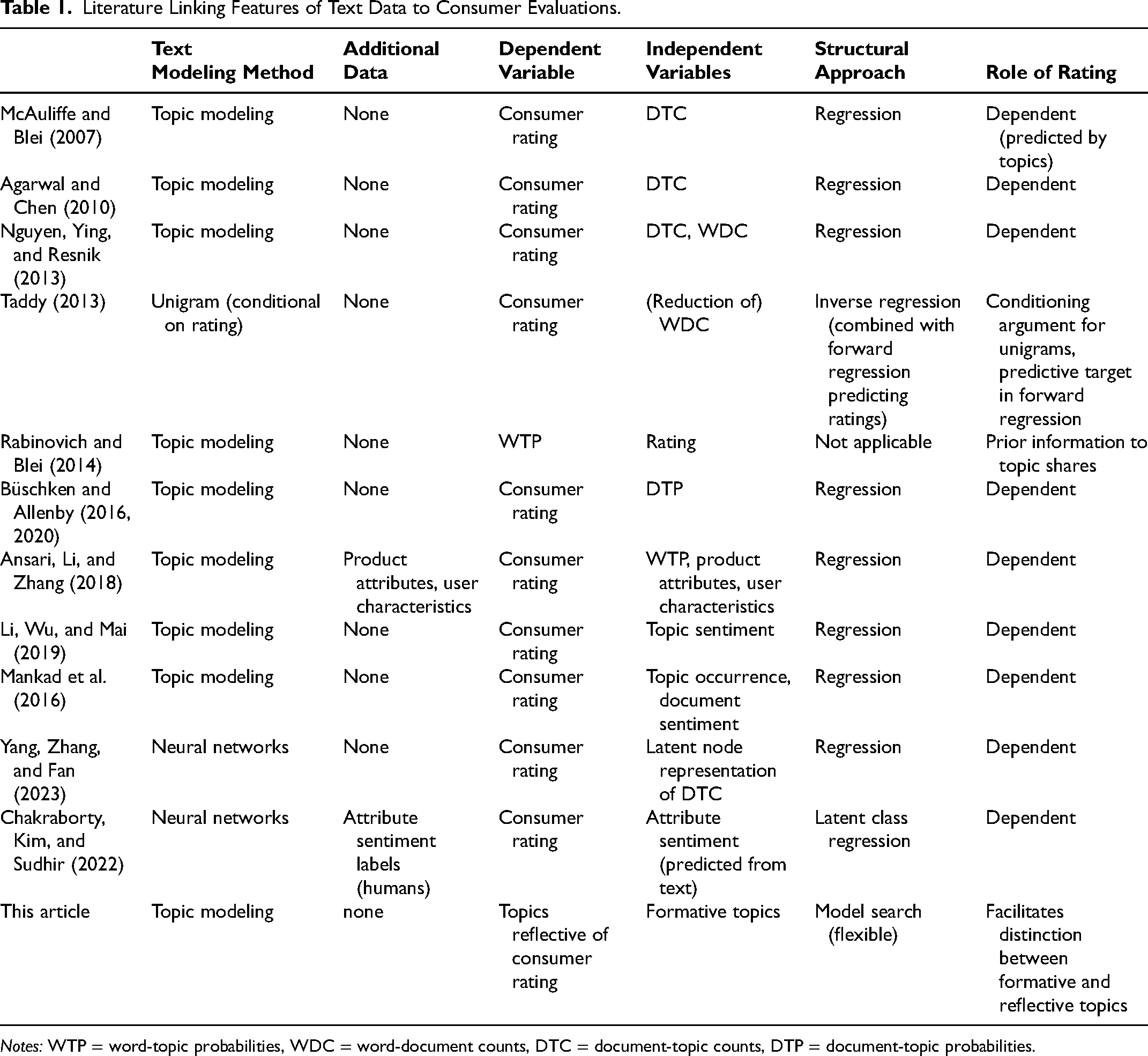
Notes: WTP = word-topic probabilities, WDC = word-document counts, DTC = document-topic counts, DTP = document-topic probabilities.
The advantage of LDA models compared with direct approaches (e.g., word counts) lies in the reduction of dimensionality of the model. Using observable word counts on the document level as predictors requires solutions in which the rating regression incorporates design matrices where the number of columns may exceed the number of cases by orders of magnitude. Taddy (2013) proposes to use ratings as priors to unigrams and uses forward regression to predict ratings. His goal was to reduce the (observed) word-document counts to a more manageable number of predictors of the rating. LDA solves this problem by reducing the number of predictors from the size of the vocabulary to the number of topics in a corpus.
An empirical analysis of the relationship between ratings provided by reviewers and topics often reveals that ratings are closely linked to topical features of consumer reviews. For example, from the regression models linking topics to ratings (Table 1), analysts often find strong relationships between topic occurrence and evaluations (Mankad et al. 2016). In other words, ratings provide a priori knowledge on topical composition (labels) of reviews. The standard method in the literature is to use topics as predictors in a regression (supervised LDA); an alternative approach is to specify prior distributions to word-topic probabilities by way of the rating (Rabinovich and Blei 2014). In both cases, the goal is to exploit a priori knowledge about ratings and topics. When ratings are used, topics simply differ between reviews that give a bad rating and those that give a top-box rating.
More recently, advances in neural network modeling have been proposed to link latent features of text to consumer ratings. Yang, Zhang, and Fan (2023) propose a variational autoencoder model with (total) word counts as inputs and outputs. Nodes in this neural network model represent document-level topic distributions and word-topic distributions, as in LDA. Document-topic distributions are linked to the rating by way of (additional) latent nodes. Thus, their model can be viewed as a supervised LDA with more flexible links between word, topic, and document labels. It integrates the idea of (supervised) topic modeling into the hierarchical latent variable approach of neural networks (Dieng, Ruiz, and Blei 2020).
Chakraborty, Kim, and Sudhir (2022) use such a neural-networking approach to predict unobserved attribute evaluations from text data. This addresses the issue of topics from LDA not necessarily being related to product attributes that managers can adjust in order to improve customer satisfaction. In LDA, topics are only revealed a posteriori by (empirically) co-occurring terms, whatever these may be. It can therefore be difficult to map topics to actual areas of action. Chakraborty, Kim, and Sudhir obtain unobserved attribute evaluations by way of a neural network model that is trained on a sample of (observed) attribute-sentiment scores provided by human readers. Attributes are defined a priori, making the approach more similar to obtaining attribute-level customer satisfaction scores by way of surveys. The model then predicts evaluations of (all) predefined attributes, which are linked to the rating by way of regression, revealing their relative importance. Similarly, Timoshenko and Hauser (2019) propose a neural-network model to (simultaneously) identify consumer needs in a particular product category (e.g., toothbrush) and sentences in a textual dataset that talk about these needs. As in Chakraborty, Kim, and Sudhir, their model is trained on a sample of sentences, some of which talk about needs, as labeled by human readers. The model is then used to predict which sentences outside the training sample are informative about needs.
These approaches are different from ours in several ways. First, and in accordance with LDA-type models, we specify our model as a generative model of (all) text. Neither Chakraborty, Kim, and Sudhir (2022) nor Timoshenko and Hauser (2019) specify a likelihood of the words in a dataset. Second, they avoid the issue of reflective topics by limiting the analysis to sentences that talk about predefined product attributes or needs. In comparison, we consider all (text) data, including topics that merely reflect the rating. We note, however, that the proposed distinction of formative and reflective content in product review data could be integrated into their modeling approach.
To summarize, our research departs from the literature in several ways. First, and most importantly, we allow for unobserved topics to be a mere reflection of the rating, not predictors of the rating in the way of a standard supervised approach to text modeling. We call these topics reflective. Anecdotal, qualitative analyses of textual product and service review data strongly suggest the existence of such topics (e.g., in reviewer statements such as “we had a wonderful time” or “this is a great movie”). As a consequence, our model does not treat all topics a priori as predictors of the rating. We use the rating to facilitate the distinction between reflective topics and (with respect to the rating) predictive topics, which we call formative. To the best of our knowledge, this has not been attempted before. Second, our approach to exploring the origin of consumers’ ratings builds on the distinction of formative versus reflective topics: We use only the formative topics to predict the rating. No set of (predefined) attributes (or needs) is necessary to achieve this. Third, we document that this approach results in more coherent topics both in terms of statistical fit to the text and substantively.
Model Development
Overview
Formative versus reflective topics in product review data
Figure 1 provides a stylized overview of our model, explaining the basic motivation behind our modeling approach. For this presentation, we use actual results from our model, using reviews of luxury hotels in Manhattan, New York (see the “Data and Preprocessing” section). In accordance with the LDA model, we assume that topics are unobserved and are to be inferred from data. Each topic is characterized by a vector of word-topic probabilities given the vocabulary in a corpus, and a vector of topic-document probabilities that are specific to the review.
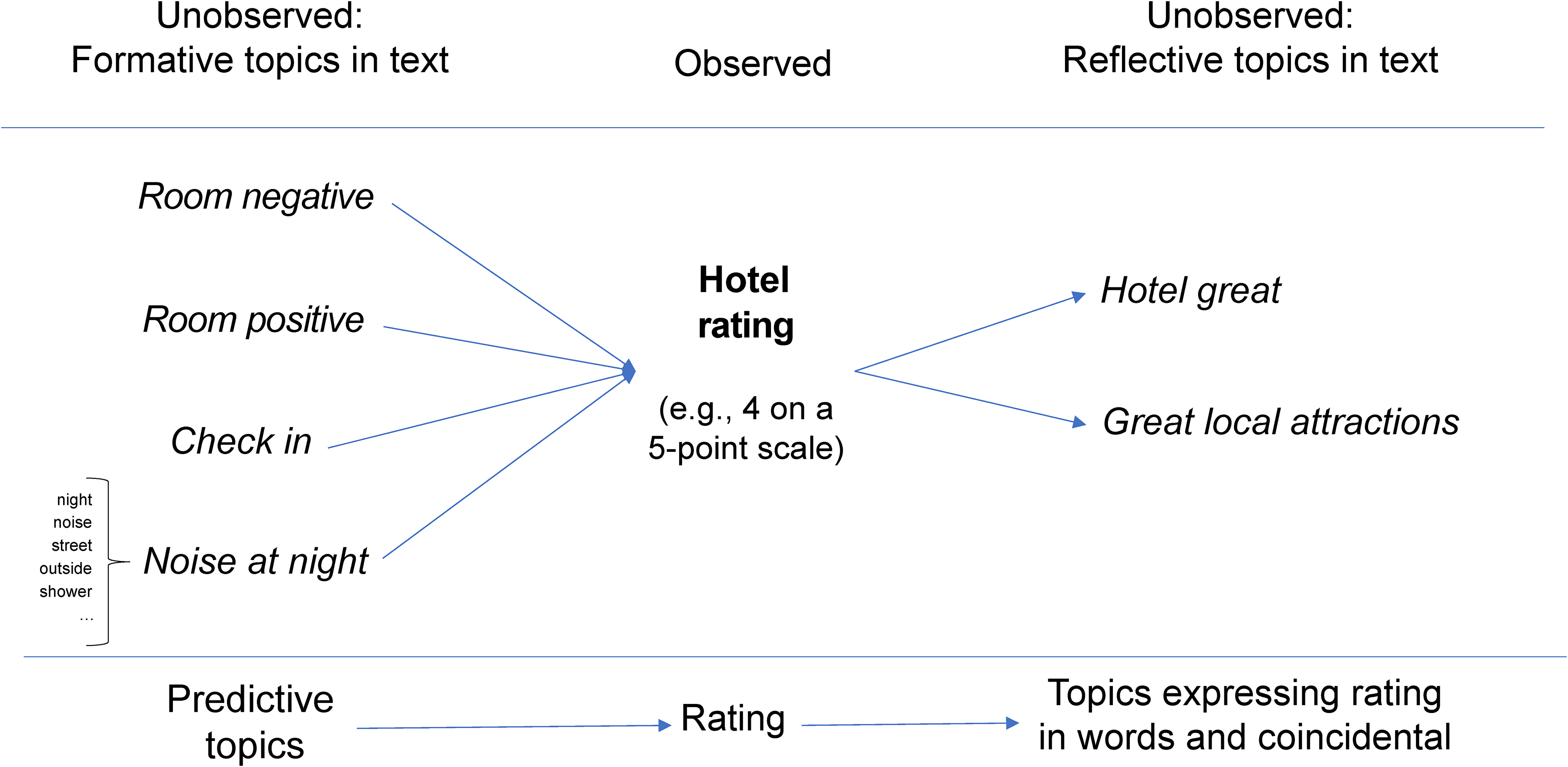
Overview of Proposed Model.
Let us assume that the topics on the left side of the figure (e.g., “room,” “noise”) are formative of the overall rating, while the topics on the right (e.g., “hotel great,” “great local attractions”) are reflective, in a stylized preview of our empirical results. The configuration of formative topics on the left side of the figure predicts an overall evaluation in a generalized regression model. So, the arrows on the left originate from the topics and terminate in the rating. The reflective topic “hotel great,” in this case, is a mere reexpression of a high rating, and so the arrows begin with the rating and end with the reflective topics listed on the right. When our model identifies a topic as reflective but ex post consideration of topical terms shows that the topic does not qualify as a reexpression of a high rating, our model picks up that reviewers will only muse about this topic conditional on a good hotel experience (assuming a positive connection between the ratings and the prevalence of this topic), as with the topic “great local attractions” in our example. Our model assumes that product reviews may contain a mixture of formative and reflective topics. The goal of our analysis is to jointly identify topics and their role as contributing to the rating (formative) versus reflecting the rating without making an independent contribution as to why a rating is high versus low.
The stylized model displayed in Figure 1 bears resemblance to the classic multiple indicator–multiple causes (MIMIC) model in marketing (Jöreskog and Goldberger 1975). As in the MIMIC model, we assume that relationships between formative and reflective indicators are mediated by a single variable (Bollen 1989), which results in conditional independence of reflective and formative indicators (Fornell and Bookstein 1982). In the MIMIC model, formative and reflective indicators are observed and the mediating variable is assumed to be latent. The distinction between formative and reflective indicators stems from the observation that, under certain conditions, causal indicators may better correspond to the relation of indicators to a (latent) construct than reflective measurement (Bollen and Lennox 1991). More recent contributions to this literature critically focus on these conditions (Bollen and Diamantopoulos 2017; Jarvis, MacKenzie, and Podsakoff 2003; Lee, Cadogan, and Chamberlain 2013; Podsakoff, Shen, and Podsakoff 2006).
Our model is different from the MIMIC approach as it assumes all indicators (i.e., topics) to be latent, only indirectly observed by way of words in reviews, and the mediating variable (rating) to be observed. In a sense, compared with the MIMIC model, our model flips the role of latent and observed variables. Formative topics, in our model, are unobserved and assumed to contribute to the (observed) rating. Reflective topics are equally unobserved and assumed to result from a rating, not contribute to it. More importantly, the split of any set of topics into formative versus reflective is assumed to be a priori unknown and part of our inference approach.
Why does our approach matter?
We use a simulation to illustrate why our approach matters to marketers interested in (conditional) dependencies between topics and evaluative labels. We first abstract away from the dimension reduction inherent to text analysis and proceed as if latent variables corresponding to the prevalence of topics in documents were given, focusing on how reflective topics may bias inference. We note that this bias cannot be overcome by collecting more data. We then revisit the need to jointly conduct dimension reduction and infer (conditional) dependencies when given text data with labels.
Consider the following example:
We generate 100 observations from this model and run regressions using y1 as the dependent variable and (X, y2) as covariates, given different values of ψ. We explore the effect of using a reflective indicator of the dependent variable as regressor. Figure 2 shows how inference with respect to β changes as ψ changes. It reveals that all estimates of β go to 0 as ψ goes to 0. In other words, the inclusion of a perfectly reflective indicator of y1 in the model effectively leads to excluding the actual predictors. It also leads to inflation of the predictive relationship of y1, because y2 explains nearly all of its variance. Thus, β estimates of formative indicators will be biased toward zero when the model contains reflective indicators. In this case, estimates of β and σ are inconsistent—adding data to the analysis will not change the bias introduced by including endogenous y2 among the regressors.
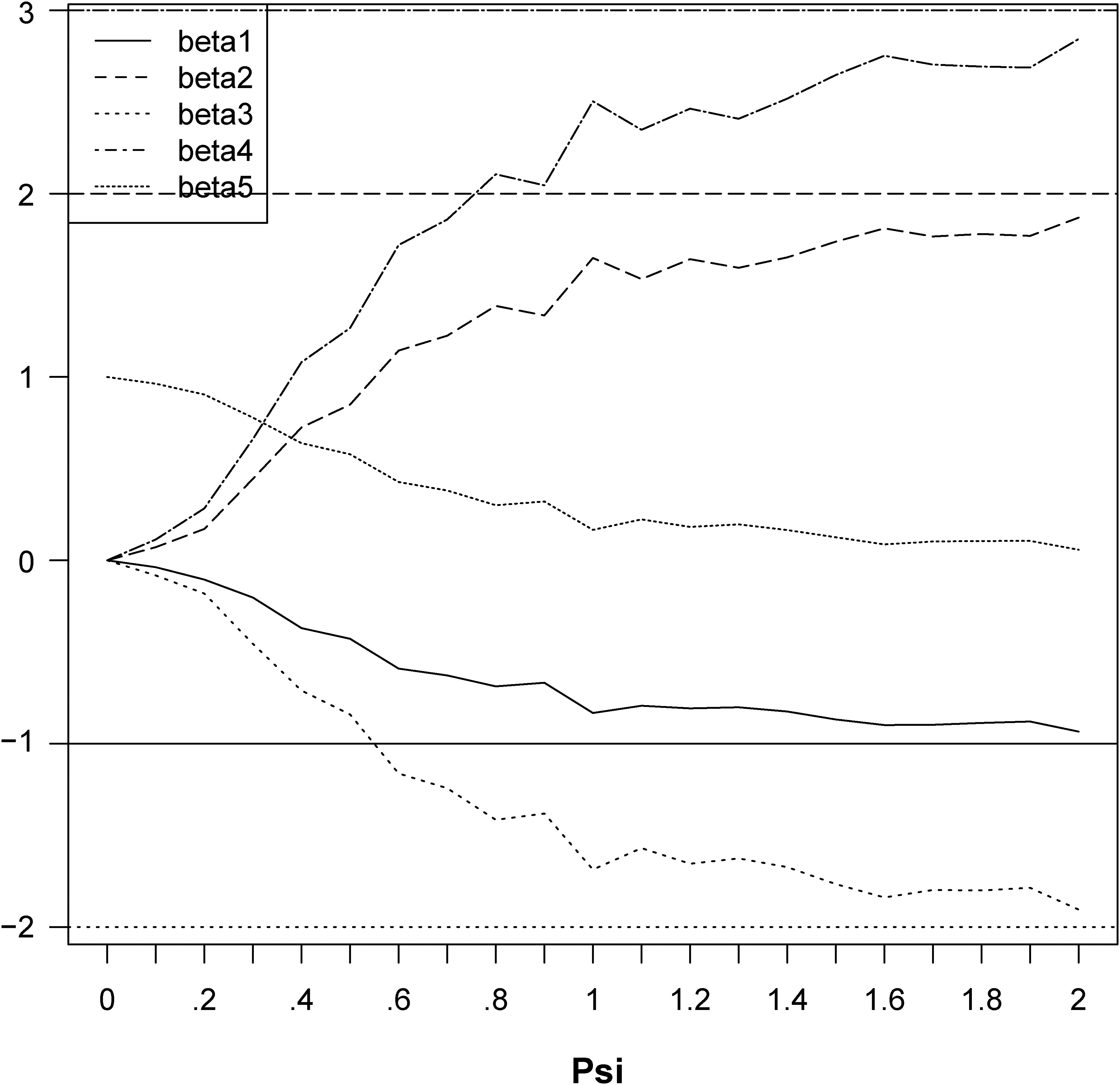
Results from Regression That Includes Reflective Indicator of Dependent Variable as Covariate, Given Different Values of ψ.
The preceding illustrative simulation assumes away the need to identify variables, except of the label y, by dimension reduction in the applications we study here. In supervised LDA and related models that aim at predicting document labels from text subject to dimension reduction, the likelihood of the label y (the loss associated with predicting the labels y) will contribute information about how to reduce the dimensionality of the text data. In principle, this is helpful in necessarily finite datasets, and especially in situations where individual documents are short. However, a misspecified predictive model can disadvantage the dimension reduction in the sense that latent dimensions (topics) that result in minimal loss in predicting y are both statistically and substantively worse representations of the underlying text.
In an extended simulation study reported in Web Appendix A in which we fit a standard supervised LDA to a corpus containing reflective and formative topics, we demonstrate that ignoring the possibility of reflective topics leads to biased estimates of the model connecting the rating to topics. As in the preceding simulation, the coefficients linking formative topics to the rating go to zero, and the error variance is greatly deflated. We also find that estimates of the topics themselves are biased. In other words, a misspecified model changes how the text is represented in a lower-dimensional space. In our empirical analysis using textual review data (see the “Model-Based Results” section), we find that allowing for reflective topics improves the statistical representation of the text as measured by fit and results in a more coherent topic structure. 2
Data-Generating Process of the Proposed SRTM
Our model builds on the standard LDA topic model (Blei, Ng, and Jordan 2003; Hofmann 1999), which assumes that the data originate from a mixture of latent topics. The probability of observing word n in document d is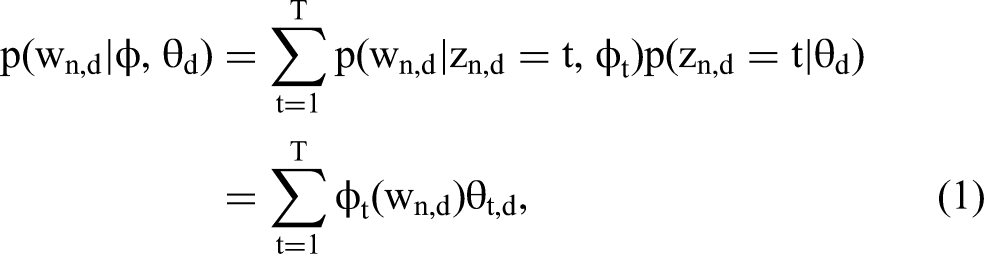
Our model assumes the following data-generating process, given an a priori fixed number of topics T and size of vocabulary V:
For each topic, draw word probabilities ϕt ∼ Dirichlet(α), a vector of length V. The vector α is a fixed prior vector of (homogeneous, positive) scalar entries of length V, resulting in a symmetric Dirichlet prior. For each topic, draw (binary) indicator It ∼ Bernoulli(δ) with δ being the (a priori fixed) prior probability of It = 1. Let It = 1 indicate a reflective topic and It = 0 a contributing topic with respect to the rating. Draw (scalar) error variance σ2 ∼ IG(aσ, bσ), with aσ and bσ as fixed prior quantities. Then draw β ∼ MVN(0, σ2Σβ), a vector of regression coefficients of length equal to the number of formative topics plus an intercept. The mean and the covariance Σβ are fixed prior quantities. For each reflective topic, draw a scalar error variance ψt ∼ IG(aψ, bψ) with aψ and bψ as fixed prior values. Then draw λt ∼ MVN(0, ψtΣλ), where the mean and the covariance Σλ are again fixed prior quantities. Each λt is a vector of length two containing an intercept (λ0,t) and a slope coefficient (λ1,t). Collect all λt in matrix Λ, a matrix of coefficients with dimensionality two times the number of reflective topics. For each document (i.i.d.):
Draw vector Draw scalar ɛd ∼ N(0, σ2). Compute (continuous) scalar rating For each reflective topic, draw (i.i.d.) scalar-valued ρt,d ∼ N(0, ψt); collect in vector ρd. Compute Concatenate For each word n in document d (and continue as in LDA):
Draw topic indicator zn,d ∼ Multinomial(θd). Draw word
Next we discuss the two distinguishing components of our model in detail. The first component relates topic probabilities to overall ratings, using a regression model:
Here, rd is the (scalar) rating associated with document d, ɛd is a (scalar) error component, and β weighs document-specific 
Here yd is the observed rating and c a vector of cut points mapping underlying continuous evaluations rd to ordinal scale categories
The second component of our model allows for some topics to be reflective of the overall rating using a factor model where the topic probability is an outcome of the rating:
Here, ρd is a vector of residuals, λ1 is a vector of loadings, and λ0 is a vector of intercepts. Topics and document-specific topic distributions are latent. As a result, topic–word relations and partitioning of topics into those that contribute to an overall rating (form) versus those that verbally reexpress this overall rating (refl) are subject to inference that is described subsequently. Figure 3 displays the directed acyclic graph of our model. Note the deterministic relationships between I and the splitting of θ* into formative and reflective topics as well as between θ* and θ, with the latter generated from the former by way of the softmax transformation.
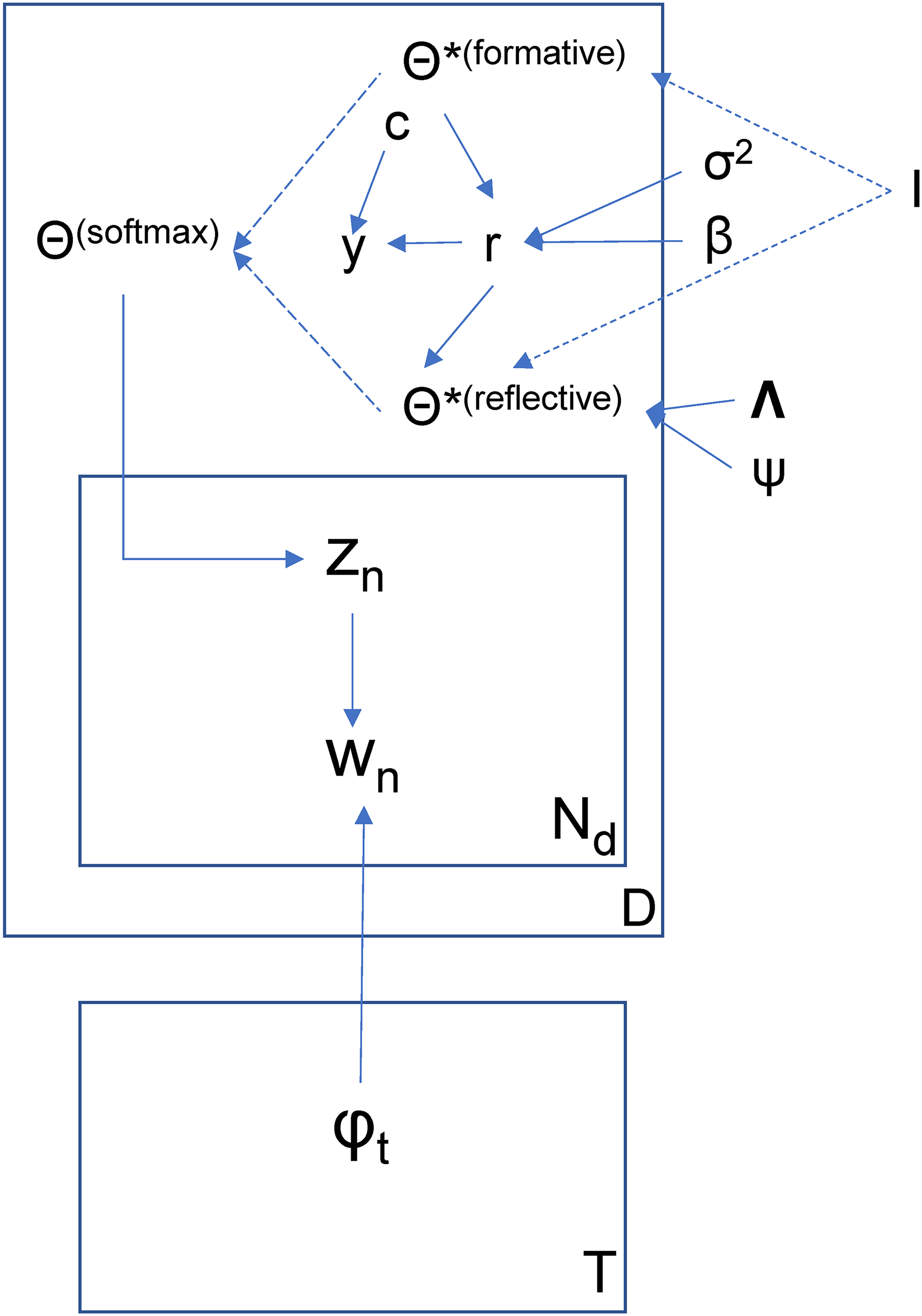
Directed Acyclic Graph of Proposed SRTM.
Note that neither I nor the resulting split into formative and reflective topics are known a priori. Next, we explain how we approach the problem of inferring I from data. The essence of our inference strategy is to respecify our model as a super-model that allows for all topics to enter both Equations 2 and 4 and to constrain coefficients in this super-model to 0, given estimates of I, similar to variable selection in a regression model (George and McCulloch 1995). In other words, when a topic is identified as reflective, its β becomes 0, and when a topic is identified as formative, its λ becomes 0. This facilitates model selection (inference regarding I) by way of stochastic search (George and McCulloch 1995).
A Super-Model Framework for Topic Partitioning
Our estimation framework builds on an oversaturated super-model that simultaneously includes all topics in Equation 2, that is, on the right-side of the equation, for observed numeric document labels, and also those in Equation 4, that is, on the left-hand side. Thus, we associate each of the t = 1, …, T topics with an element in the indicator vector I = (I1, …, IT). Elements in this vector determine whether topic t reflects the overall assessment (It = 1), on the left-hand side, or combines into the overall assessment (It = 0), on the right-hand side. The indicator vector I is unobserved, and thus the parameter in our model that maps from the oversaturated super-model into the space of identifiable models with extreme points
The 2T models implied by different configurations of I correspond to the following constraints of parameters in the underlying super-model expressed in the form of prior distributions for regression coefficients β and loadings λ in Equations 2 and 4:



Since each indicator It can only take values 0 or 1, our approach effectively allocates each topic either to Equation 2, the “right-hand side” of the model for the label, or Equation 4, the “left-hand side” of that model. When It = 1, βt is zero, and the tth topic does not independently contribute to the overall sentiment or evaluation in r. Similarly, when It = 0, λt is zero, and the tth topic cannot be (another) expression of overall sentiment or evaluation. An extension of our model could explicitly account for topics that neither independently contribute to observed ratings nor reflect these ratings. However, we cover this possibility a posteriori upon finding combinations of It = 0 and βt concentrated around zero, or It = 1 and λt concentrated around zero, or a mixture of both in the posterior. Note that the standard approach to linking topics to ratings is a special case of our model: It = 0, Ɐt.
In our analysis, we use
The partitioning of topics implied by our model contributes to structuring the dependence between topics across documents. In turn, this structure can aid in the identification of more meaningful topics from finite amounts of data at the document level. Different from the specification of a more flexible dependence structure as proposed by Blei and Lafferty (2007), the dependence structure implied by our model derives from linguistic arguments. For example, upon recognizing that two different topics both express overall sentiments, one positive and one negative, our model implies that these two topics cannot be jointly present in documents with a very good or a very bad observed rating.
In Web Appendix C, we demonstrate by way of an additional simulation study that topic inference is biased when all topics are falsely assumed to be formative. In this analysis, we generate data from formative topics contributing to an observed numerical rating and reflective topics arising from that rating. We show that, when a standard supervised approach is applied, topic inference and inference regarding the contribution of topics to the rating are biased.
Joint Distribution and Identification
Joint Distribution and Factorization into Sampling Steps
We arrive at the following joint distribution of knowns and unknowns (suppressing indices n, d, and t):
The essence of our model is to impose a (cross-sectional) structure on the topics based on the rating. Topic allocation is achieved by way of a mixture prior for β and λ. As shown previously, θd can be obtained from
The conditional independencies characterizing the joint distribution give rise to the following complete set of conditional distributions:







We detail our MCMC estimation procedure for all steps in Web Appendix A. To generate I, that is, to draw from the posterior of all possible configurations of indicators identifying topics as formative or reflective, we combine Steps 1 to 3 into a single joint move. This way we overcome the (deterministic in the limit) link between I and “essentially zero” elements of β and λ preventing conditional sampling from these steps. Our approach is facilitated by conditional independence between the formative part in Equation 2 (Step 2) and the reflective part of our model in Equation 4 (Step 3). Conjugate priors in the form of p(β, σ2 | Vβ, I, aσ, bσ) = IG(σ2 | aσ, bσ)N(β | 0, σ2Vβ(I)) (and analogously for p(λ, ψ | Vλ, I, aψ, bψ)) allow for a direct evaluation of the normalized posterior density. We then use the candidate's formula to obtain the normalizing constants of the formative and the reflective model as ratios of the respective nonnormalized densities over their normalized counterparts (evaluated at direct draws from the corresponding conditional posteriors). The normalizing constant required for sampling from the posterior distribution of I is then the product of these two normalizing constants, again as a consequence of conditional independence.
Identification
Empirical identification of the model structure comes from two sources: first, the word co-occurrences in the corpus to be rationalized by the topic model, and, second, the relationship among the topics and between the rating and the topics across documents. Different from LDA and supervised LDA, the proposed model implies that reflective topics are independent conditional on the rating (see Equation 4). In contrast, conditioning on the rating introduces dependence between formative topics, as in an indifference curve or surface that traces out combinations of formative topics while keeping the rating constant. 3
More specifically, the proposed model implies that reflective topics are independent from formative topics conditional on ratings as in a model of full mediation (e.g., Laghaie and Otter 2023) and hence that the covariance of θ* can be fully rationalized by as many factors as there are formative topics (plus one from the error term in the formative regression model). Importantly, the rank reduction (in the covariance structure) implied by the presence of reflective topics as well as the conditional independence between formative and reflective topics can be assessed before uniquely identifying the associated model parameters. This is because conditional independence and the rank reduction (implied by a particular classification of topics into reflective and formative) occur for any draw of parameter values from a continuous prior.
The rank reduction in the covariance structure is another consequence of conditional independence given the overall rating and will contribute additional overidentifying restrictions once two or more topics are classified as reflective. The covariances between the tth reflective topic score in θ* and all formative topic scores in θ* are equal to the product of formative regression coefficients and this reflective topic's loading λ1,t. The covariances between the tth reflective topic score in θ* and all other reflective topic scores in θ* are proportional to the product of this topic's loading λ1,t and those of all other reflective topics. 4 Together, this implies that covariances between any two reflective topic scores and all other topic scores will be perfectly linearly dependent, resulting in a rank reduction (factor structure) of covariances from classifying two or more topics as reflective. However, even with only one reflective topic, conditional independence between reflective and formative topics already overidentifies (relative to supervised LDA or standard, unsupervised LDA). The error term associated with the rating captures unmentioned formative topics in this context.
The covariance rank reduction from reflective topics and the implied conditional independence relations also distinguish the model qualitatively from a model that treats all topics as formative (as in supervised LDA) and from standard, unsupervised LDA, which has implications for what substantive topics can be identified from the data. As we will demonstrate subsequently, the implied prior over the joint distribution of topics has important implications for what topics can be identified from the data. Intuitively, a topic that only verbally reflects the overall evaluation in the rating should be independent from all other topics conditional on that rating. And the model's ability to isolate statements that merely reflect the overall evaluation and associate them with a topic is uniquely facilitated by allowing for the possibility of reflective topics.
However, conditional on a model structure, the implied distribution of θ* is only partially identified. To see this, consider that the structural model is specified on the level of unconstrained θ*, which are (deterministically) related to document-level topic proportions θ by way of the softmax transformation. Identification of θ is provided by the LDA part of the model. However, θ resides on the simplex, implying that each θd contains only T − 1 independent topic shares. More formally: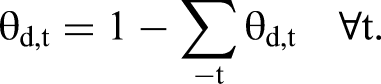
The softmax mapping from θ* to θ implies that we can only identify θ* up to an additive constant. In addition, this deterministic relationship implies that what can be empirically identified about the covariance structure of θ* is limited by the rank deficiency of the θs' covariance from the adding-up constraint. Hence, we need constraints to uniquely identify parameters in the mean and covariance structure of θ*.
We point identify model parameters, fixing the intercept (λ0,t) and the slope (λ1,t) of one reflective topic to zero and one, respectively. Here, the first constraint identifies the mean of θ*, and the second constraint is due to the rank deficiency of the covariance of the identified θs (which are obtained as the softmax mapping from θ*). In addition, we apply the usual constraints to identify the scale and location of latent r. Specifically, we fix the smallest and the largest (finite) cut point relating latent continuous ratings to observed ordinal ratings, implicitly defining proper uniform priors for the remaining cut points in between. Together, these constraints point identify all remaining parameters in our model.
As already mentioned, the classification of topics into formative and reflective can proceed in the absence of point identification. This is useful because it allows for imposing the constraints λ0,t = 0 and λ1,t = 1 for some topic t classified as reflective, which obviously requires knowledge about the classification of topics, only after learning this classification from the data. Empirically, we first learn the topics jointly with the conditional independence structure between topics given the ratings in an unidentified space with respect to the distribution of θ* and hence without point identifying intercepts and slope parameters. Upon identifying topics and their interrelationship, we apply the constraints necessary for point identifying parameters to a topic reliably classified as reflective, as follows:
Run the MCMC until the sampler converges to reliably identified topics allocated to be formative or reflective. Then select one reflective topic. Set λt,0 = 0 and λt,1 = 1 for this topic for point identification of parameters in all possible models where the topic chosen for identification is classified as reflective. The choice of t is arbitrary as long as the corresponding topic is reliably classified as reflective. Run MCMC with λt fixed for this topic until convergence of all remaining estimable parameters is achieved.
Empirical Analysis
Data and Preprocessing
In our empirical analysis, we use a dataset of (initially) 3,481 reviews of luxury hotels in Manhattan, New York. The dataset was obtained from Expedia. Hotels were selected because of their similarity in terms of hotel category rating (five stars, luxury category), location (all in downtown Manhattan, near Times Square/Broadway), and price point. We view this dataset as an example for (targeted) analysis at the intersection of product category, location, and price point. A priori, it seems reasonable to assume that a selection of reviews based on such criteria would facilitate an analysis centered around few, but focused topics. Table 2 shows summary statistics of the reviews after preprocessing. In preprocessing, we first eliminated stopwords, changed capital letters to small letters, omitted punctuation, and eliminated words appearing ten or fewer times in the corpus. Words were not stemmed (e.g., note the difference in meaning of “accommodating” and “accommodation”). In our model-based analysis, we exclude reviews containing fewer than ten tokens. This leads to 2,264 reviews remaining in the analysis. 5 In analyses not reported here, we find that short reviews are typically made up of a single topic. When the share of single-topic reviews in a corpus becomes too large, the empirical distinction between formative and reflective topics becomes tenuous.
Descriptive Statistics of Product Review Dataset (After Preprocessing and Eliminating Short Reviews).
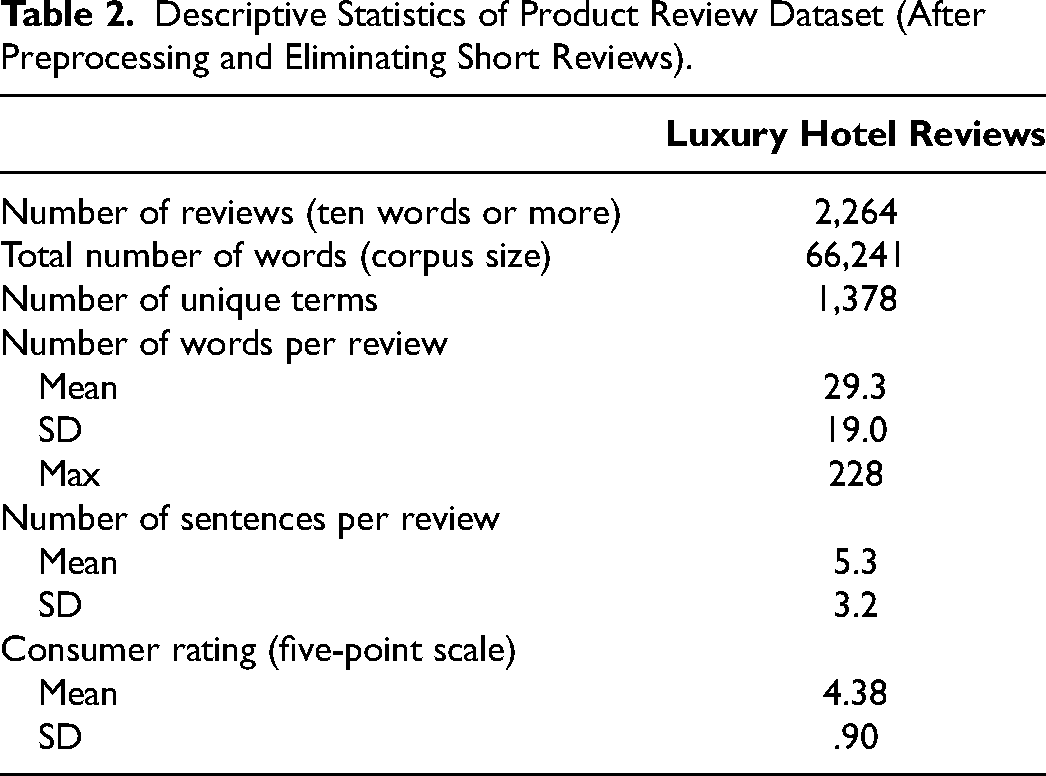
After preprocessing, the hotel reviews initially contained 1,078 unique terms. Prior to model-based analysis, we investigated the frequency of terms and found the typical exponential distribution of (marginal) word counts and n-grams. Bigrams (e.g., “front desk”) and trigrams (e.g., “within walking distance”) specifically exhibited extreme distributions: Relatively few bigrams and trigrams accounted for nearly 100% of all occurrences. For better topic interpretability, we identified the 200 and 100 most frequent bigrams and trigrams, respectively, in our data and added these to our vocabulary for 1,378 unique terms in total (Table 2). We then modified the reviews accordingly. For example, if the sequence “within walking distance” (which is a top trigram) appeared in a review, we concatenated these words (“within-walking-distance”) and treated the sequence as a single (unique) token (Timoshenko and Hauser 2019). We did not do this if the observed sequence was, for example, “within easy walking distance” because it is not a (top) trigram. Adding n-grams enlarges the vocabulary while reducing the total count per token. By design, the n-gram tokens in our data contain the context in which words are used, lending lists of top topic terms more contextual information (see Web Appendix D). After our preprocessing, reviews in our dataset contained 29 tokens on average, with a corpus size of 66,241 tokens (Table 2). The reviews range in length from 11 to 228 words, indicating large differences in linguistic complexity and heterogeneity in topic composition. The distribution of ratings exhibits the typical skew toward top-box ratings.
Model-Based Results
We apply our model to the luxury hotel reviews, using a fixed number of topics. We compare different topic solutions based on predictive fit, using a standard supervised LDA, and find T = {10} to be optimal. Note that a plain-vanilla LDA yields similar results. We find that a larger number of topics only improves in-sample fit, indicating that such models overfit the data. We start by comparing our model to several benchmark models in terms of fit and in terms of its capacity to generate unique and coherent topics.
Comparing model fit
In this section, we compare the fit of the proposed SRTM to benchmark models. A natural benchmark for our model is the (standard) supervised LDA, which assumes all topics to be formative with respect to the rating. In our implementation, the supervised LDA is a constrained version of the SRTM with It = 0 Ɐt. We also compute fit for a plain-vanilla unsupervised LDA and an LDA with a single topic only, both of which do not use the rating for topic inference. Comparing fit results from these two models reveals the contribution of introducing a mixture of topics. Comparing LDA and supervised LDA reveals the contribution of the rating as likelihood information to topic identification and topic shares. Comparing the supervised LDA and SRTM reveals the contribution of allowing for topics to be reflective of the rating. Our set of benchmark models is limited to LDA-type models of text. However, we believe that our model for the joint distribution of topics and ratings across documents will be useful regardless of what lower-level model of text is assumed. We revisit this point in our discussion.
Table 3 shows fit results for all models. Reported is the log marginal likelihood (LML) of observing all words in the hotel review corpus. LML is a measure of how well a model fits the data after integrating over its parameter space. Integration is achieved by computing the likelihood of all words in the corpus, given draws from the posterior distribution of unobserved quantities (Rossi, Allenby, and McCulloch 2005). LML allows for a direct comparison of models fitted to the same data that differ with respect to their parameter space. 6 To assess predictive fit, we report perplexity, a measure of how surprised a model is after seeing new data. We follow the approach in Blei, Ng, and Jordan (2003) to compute (per-word) perplexity and use 1,247 independently obtained customer reviews of luxury hotels in Manhattan (same source, location, rating, and brands) as holdout data. A lower value of perplexity indicates better generalization performance. Table 3 reveals that the proposed SRTM fits our data best with respect to both in-sample and out-of-sample fit. In the following section, we present results from the SRTM and show that the corpus contains multiple reflective topics that are not predictors of the rating. From Table 3, we also find that a standard supervised LDA performs about on par with a plain-vanilla, unsupervised LDA. This implies that assuming that all topics contribute to the rating does not improve representation of the corpus by the model. The slightly worse perplexity measure from supervised LDA relative to LDA is consistent with a tension between dimension reduction and prediction of ratings in this model.
Model Fit.
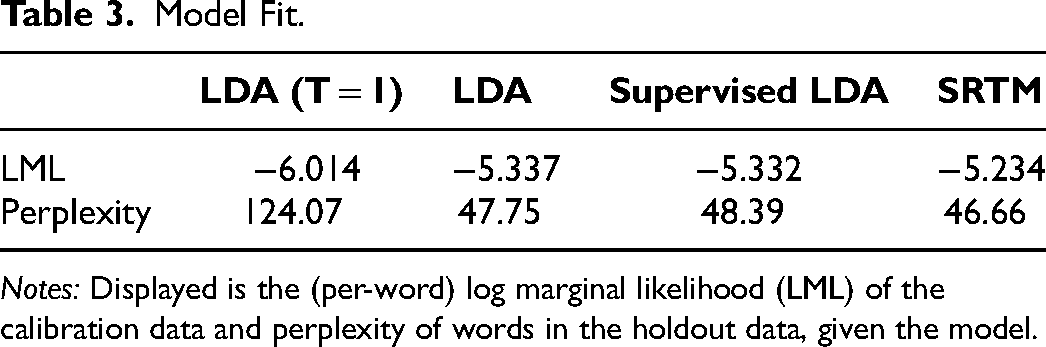
Notes: Displayed is the (per-word) log marginal likelihood (LML) of the calibration data and perplexity of words in the holdout data, given the model.
Comparing topic coherence
A key feature of topic models is that they identify sets of frequently co-occurring terms describing the themes that authors use in their reviews. Ideally, topics identify unique and coherent sets of terms that describe the context in which words are being used. In the following, we compare the proposed SRTM’s capacity to identify unique and coherent topics with that of benchmark models. We apply the following measures to evaluate topics:
We assess semantic topic coherence by way of comparing embeddings of top topic terms. Word embeddings are high-level representations of the local context in which words appear. Higher similarity of embeddings of topic terms indicates that the top words from a topic generate similar contextual terms (Aletras and Stevenson 2013; Schütze 1998). We obtain embeddings using the same vocabulary extended by the most frequent bigrams and trigrams. We employ a skip-gram model with a 2 + 2 window surrounding focal words and 100 latent nodes linking focal tokens to context tokens. Given topic results (i.e., posterior means of ϕt | Model), we then compute cosine similarity of the top topic term pairs. If desired, topics can then be evaluated by averaging their top terms’ pairwise similarity scores (Newman et al. 2010). Alternatives to using embeddings are using observed (normalized) counts of term pair co-occurrences within documents or using rolling windows of contextual terms (pointwise mutual information). Coherence measures such as UCI and UMass coherence scores are based on that approach (Mimno et al. 2011). The advantage of using model-based embeddings instead of counts lies in the projection of focal terms onto context terms through a flexible model structure that projects focal terms onto the whole vocabulary.
Figure 4 displays the distribution of all (20 × (20 − 1)/2 × T) similarity scores of the top 20 words over topics, given a model. Figure 4 reveals that the SRTM shifts the distribution of the embedding of similarity across the range of scores, compared with a standard supervised approach. 7 It also suggests that topic coherence does not improve when the rating is used as information on document-topic probabilities in the standard way, compared with a simple LDA.
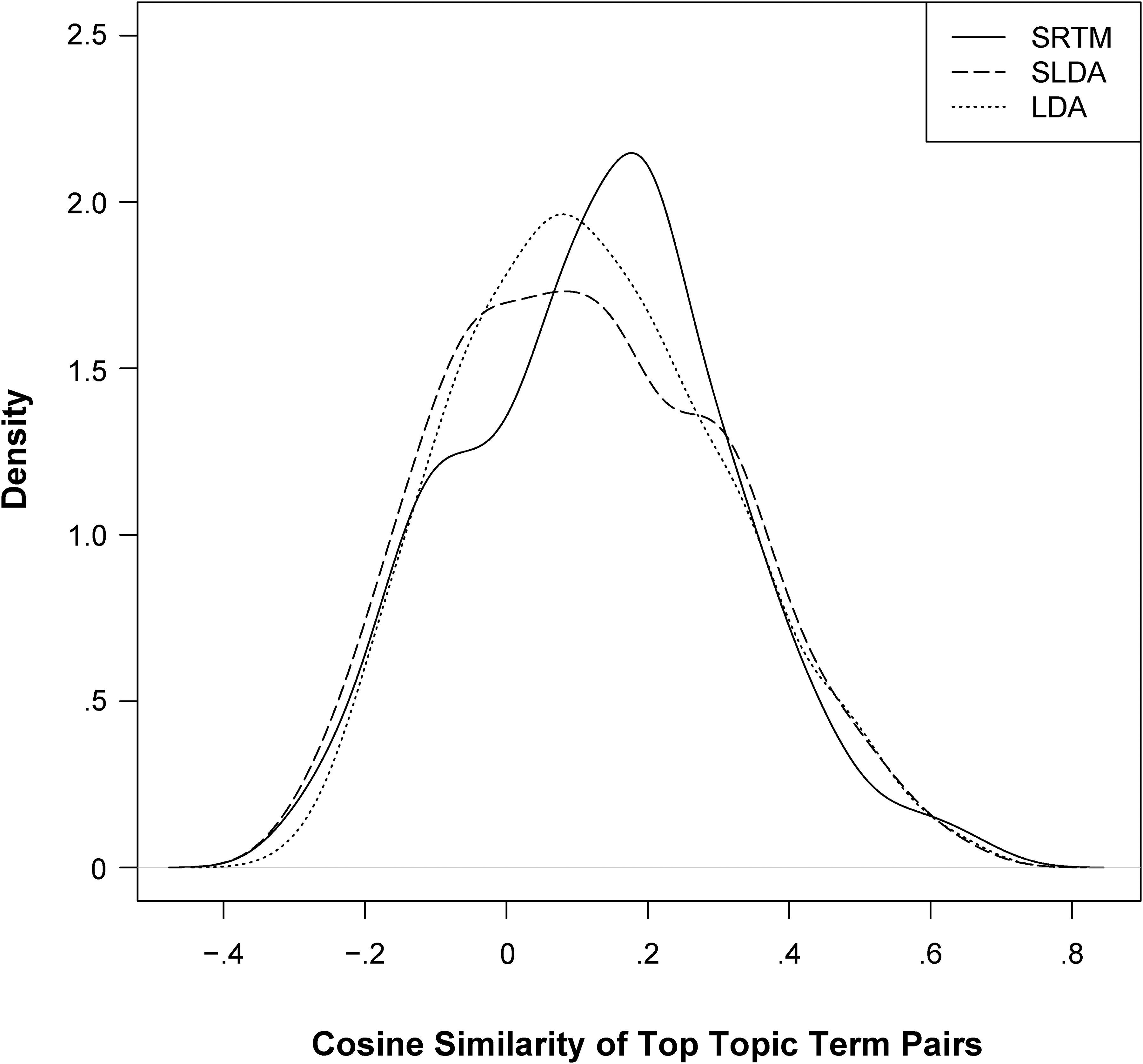
Distribution of Semantic Similarity of Top 20 Topic Words.
Figure 5 shows the distribution of topic correlation (Panel A) and topic overlap scores (Panel B) among topics for the SRTM and benchmark models. A topic solution given T topics gives rise to T(T − 1)/2 correlations and overlap scores. A set of unique topics from a model is characterized by a distribution of topic correlations (or overlap scores) skewed to the right and with a mode close to 0, indicating that topics are uncorrelated (do not share top terms). From Figure 5, we find that the proposed SRTM generates topics that exhibit both less overlap of top terms and lower correlation across the whole vocabulary. In fact, it pushes topic correlation practically to 0. In summary, we find the SRTM to outperform benchmark models with respect to all measures of topic coherence and uniqueness considered here.
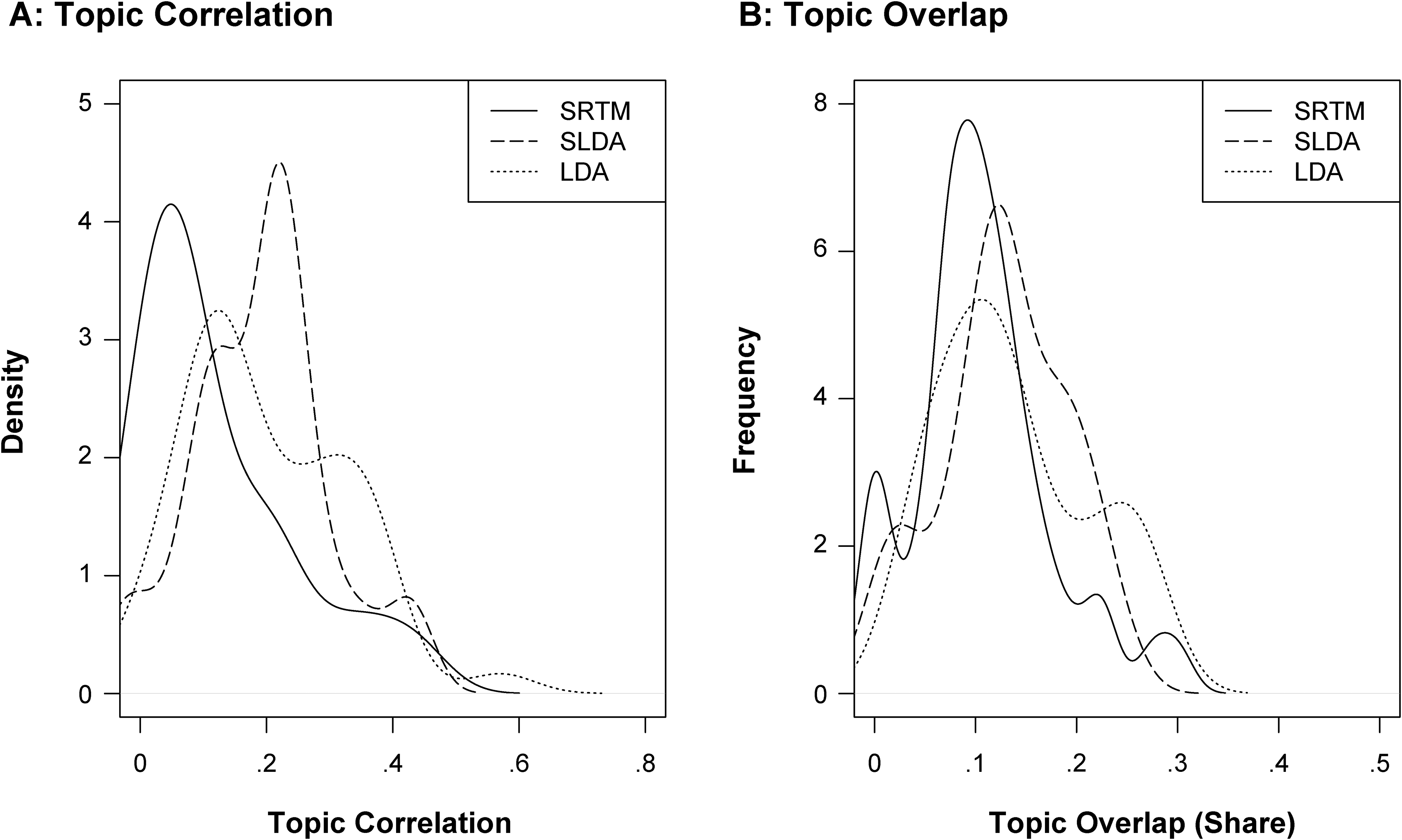
Distribution of Topic Correlation and Topic Overlap, Given the Model.
Results from SRTM
Model structure
In the following, we investigate the a posteriori structure of the SRTM, given our hotel data. For point identification of parameters, we apply the strategy outlined in the “Identification” section. Table 4 displays the posterior mean of It, that is, the assignment of topics as reflective for the hotel reviews. A posterior mean of It > .5 implies a posterior mode allocation of a topic as reflective (It < .5 implies formative).
Rating Model Structure for Hotel Data.
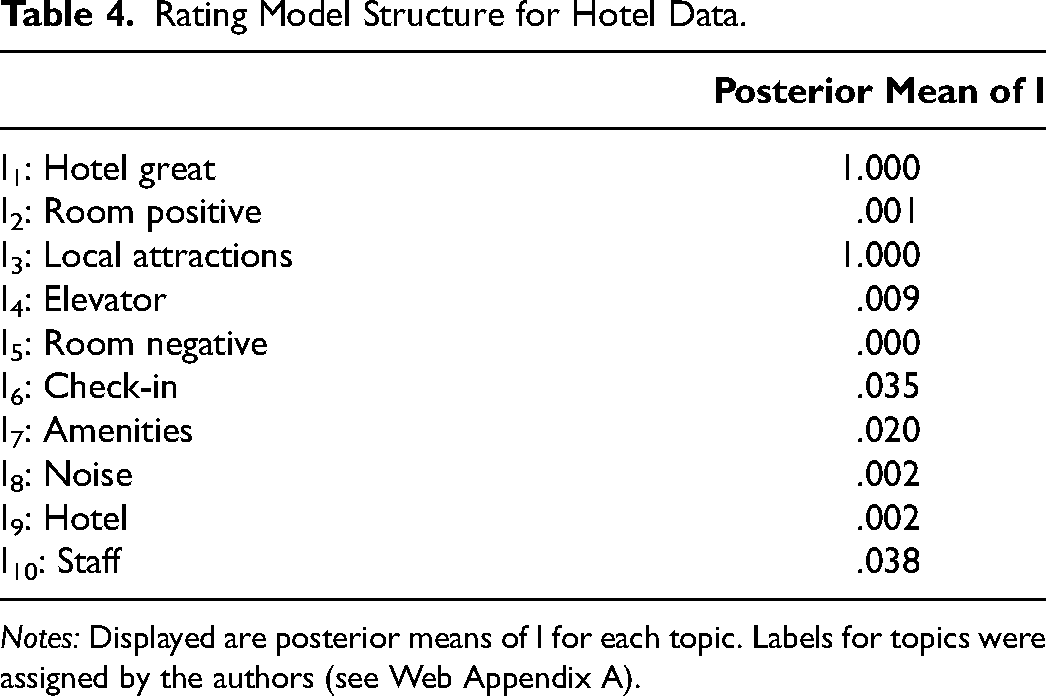
Notes: Displayed are posterior means of I for each topic. Labels for topics were assigned by the authors (see Web Appendix A).
From Table 4 we find that the hotel reviews contain two reflective topics, both of which are reliably identified as indicators of the rating (I = 1). The reliability of identification of formative topics ranges from 1 (T = 5) to .96 (T = 10). For all topics, the posterior mode of It is well away from .5. The presence of reflective topics in our data calls into question the standard way of connecting the rating to topics in textual customer satisfaction data (Büschken and Allenby 2020; McAuliffe and Blei 2007; Yang, Zhang, and Fan 2023). The implication for a supervised LDA model is that inference regarding origin of the rating may be biased (see the “Model Development” section). Across all reviews in the hotel data, we find reflective topics to account for 38% of the corpus, implying that, in general, hotel reviews are rich in content that does not independently contribute to explaining the rating, including verbal representations of ratings. We also find that the number of words originating from reflective topics correlates highly (.45) with the total number of words in a review.
Model estimates
Table 5 displays posterior estimates of the coefficients of the structural rating model, conditional on the posterior mode of I. Here, λ0 denotes the intercepts of the reflective Equation 4, and β0 denotes the intercept of the formative Equation 2. Note that when a topic is classified as reflective (It = 1), the corresponding coefficient βt shrinks to 0. When a topic is classified as formative (It = 0), both λ0,t and λ1,t shrink to zero. We find reflective topics to be associated with positive ratings only (Table 5). This implies that reviewers present content associated with negative ratings using a formative, argumentative approach, combining positive and negative aspects of their experience into an overall assessment. In other words, reviewers presenting a critical account of their experience typically formulate a structured argument for its defense and not merely a (short, bad) overall verbal assessment.
Estimates of β and λ from the Rating Model.
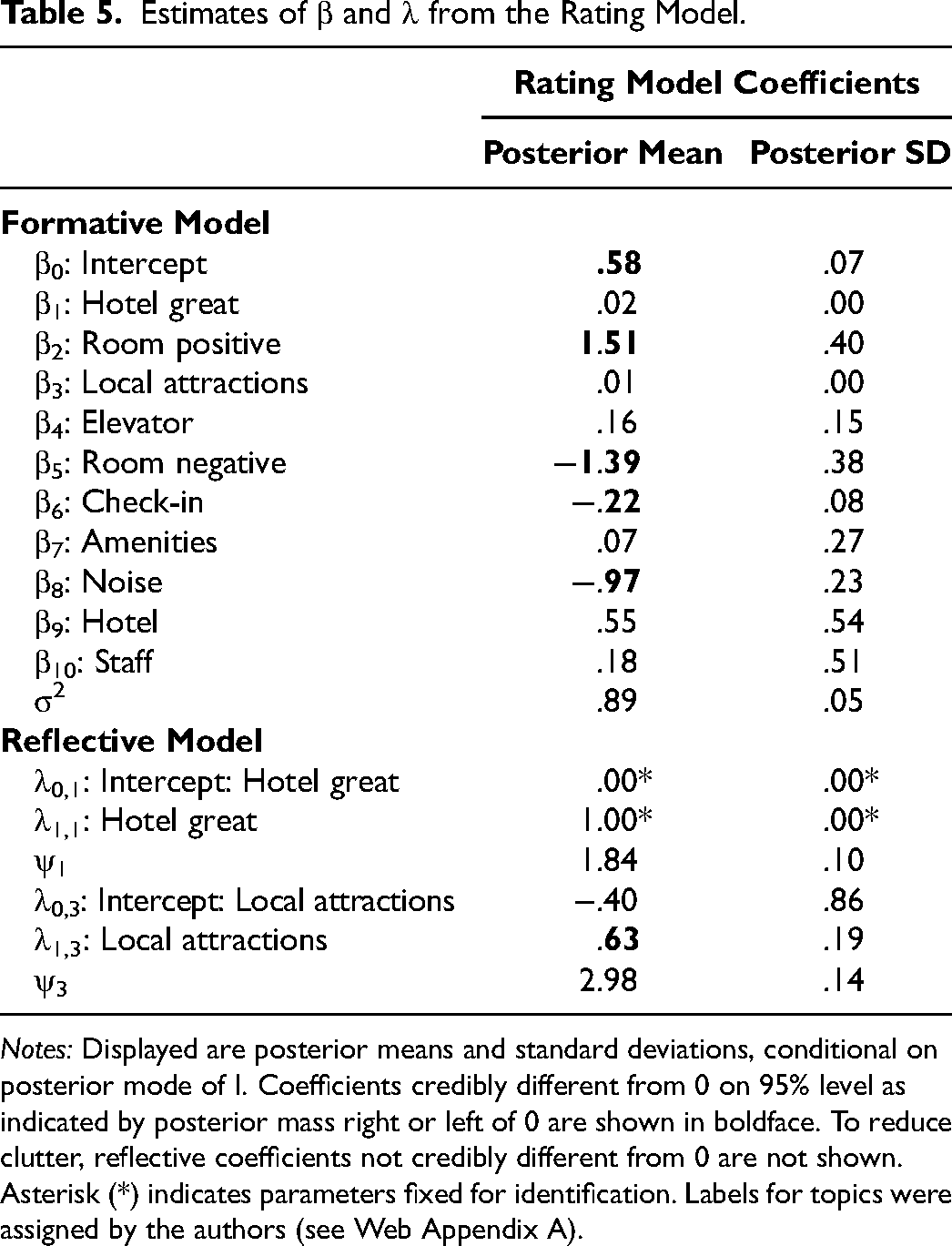
Notes: Displayed are posterior means and standard deviations, conditional on posterior mode of I. Coefficients credibly different from 0 on 95% level as indicated by posterior mass right or left of 0 are shown in boldface. To reduce clutter, reflective coefficients not credibly different from 0 are not shown. Asterisk (*) indicates parameters fixed for identification. Labels for topics were assigned by the authors (see Web Appendix A).
Equation 2 of our model allows us to investigate the relationship between ratings and (formative) topics (Table 5). A first result from our data is the presence of multiple formative topics with coefficients credibly different from zero and exhibiting positive and negative signs.
Topic most predictive of consumer rating
In Figure 6, we show word clouds of the topic most predictive of the rating from the SRTM and the supervised LDA. Interest in analyzing this topic results from the model identifying the potentially most potent managerial intervention to improve customers’ evaluations. From the SRTM, this is the formative topic (I = 0) with the largest (absolute) β. From the supervised LDA, this is the topic with the largest (absolute) β across all topics.
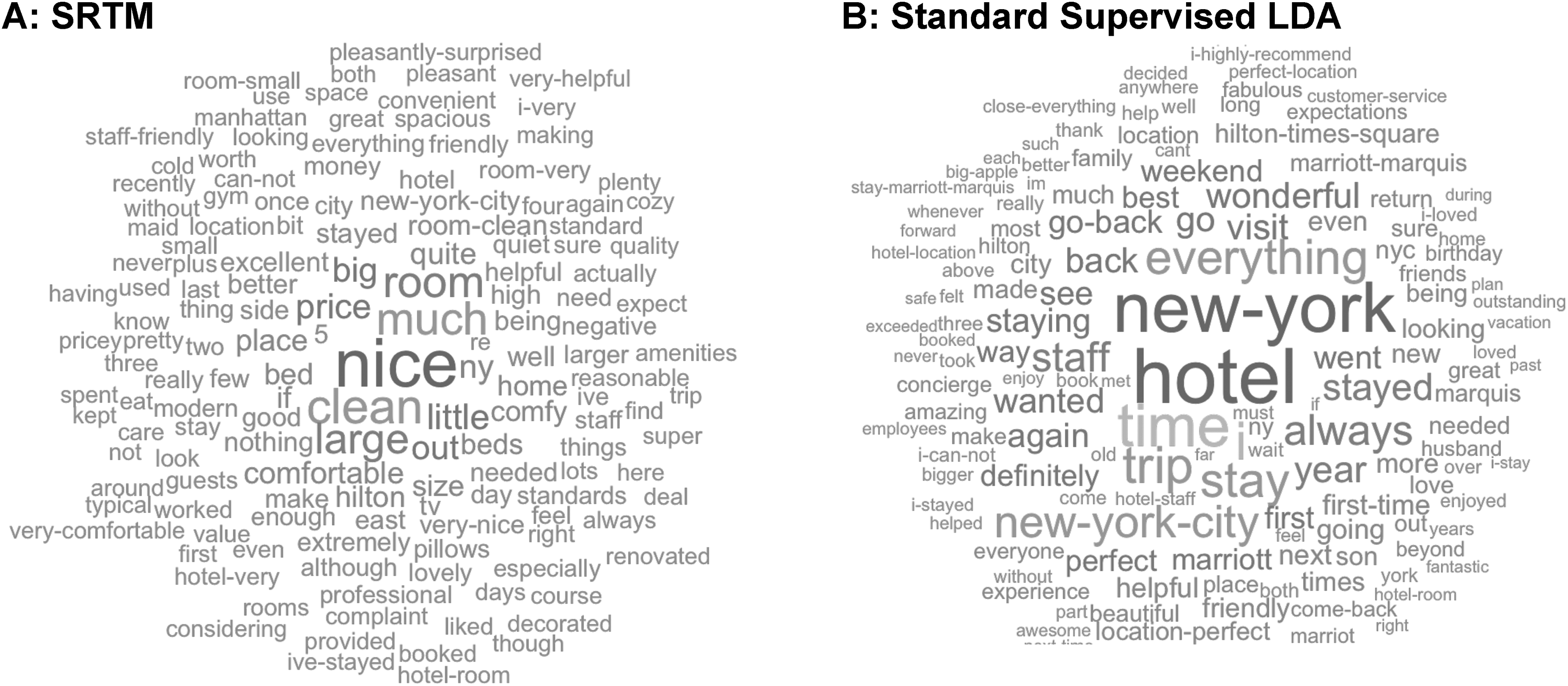
Word Clouds of Topic Most Predictive of the Rating.
The standard supervised LDA (Figure 6, Panel B) identifies as the top predictor of the rating a topic that talks about a (“wonderful,” “fabulous”) visit to New York and stay at the hotel. Note that this is a priori known, given our data selection. The topic also indicates that reviewers would return (“go-back,” “definitely”) to the hotel, mention its brand (“Marriott,” “Hilton”), and recommend their choice (“I-highly-recommend”). However, the topic provides little to no information as to why the stay was great or why the brand is recommended. In contrast, the most predictive (formative) topic from the SRTM (Figure 6, Panel A) describes (positively evaluated) features of the hotel room (it was “clean”/“room-clean,” “large,” “nice,” with a “comfortable”/“comfy” “bed”). In summary, the most predictive topic from the supervised LDA describes an overall positive experience (which is largely redundant given the observed rating), whereas the SRTM identifies as most important predictor a product attribute (i.e., the room and how it was appointed). We note that the topic describing a positive overall evaluation is identified as reflective by the SRTM (see next section) and, therefore, does not enter the formative model. In Web Appendix D, we show the top 20 words for all topics from our dataset for both the supervised LDA and the SRTM.
Reflective topics from SRTM
An important feature of our model is the identification of topics that merely reflect the overall rating. Figure 7 shows world clouds of the two topics identified as reflective by our SRTM. Several observations from Figure 7 are noteworthy. Topic 1 (Panel A) talks about a hotel stay in general. The topic is rich in evaluative terms such as “perfect,” “excellent,” “wonderful,” “fantastic,” “best,” “fabulous,” and “amazing.” Reviewers also indicate their intention to return (“go-back”) and recommend (“highly-recommend”). In summary, this topic talks about a very positive hotel experience in general.
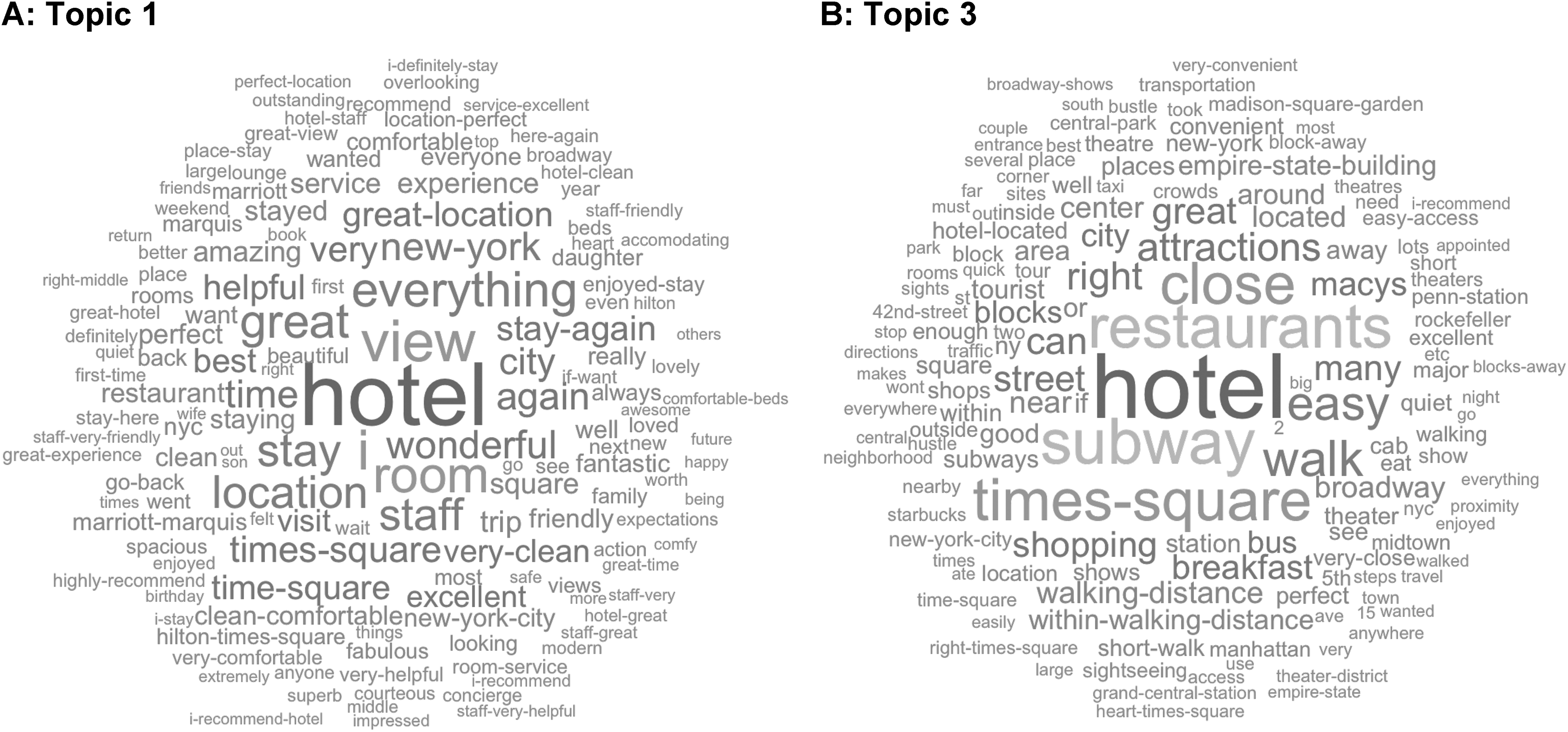
Word Clouds from Topics Identified as Reflective by SRTM.
In comparison, Topic 3 (Panel B) consists mainly of terms describing the hotel's closeness to attractions (e.g., restaurants, tourist spots) and convenient access (e.g., “subway,” “short-walk”) to them. This topic is not simply a reexpression of the rating in words. Instead, it expresses an element of consumers’ experience (nightlife, entertainment). While closeness to attractions (relative to another hotel with less convenient access) could contribute to a positive rating as a formative topic, all hotels in this sample are only a few blocks away from Broadway and Times Square. Hence, closeness to local attractions is not a differentiating feature in this dataset. Nevertheless, we find that reviewers with better ratings spend more of their review on local attractions (see the credibly positive slope coefficient λ1,3 linking ratings to the prevalence of this topic in a review in Table 5). Our ex post interpretation of this result is that an overall positive experience with the hotel leads reviewers to expand on other positive aspects of their New York City trip/experience such as their use of world-class local attractions and how these contributed to their (positive) New York City experience.
Discussion
In this article, we introduce a structural model relating topics in textual product reviews to the rating provided by consumers in a novel way. Our model builds on supervised text models that use observed labels for inference regarding latent model variables (McAuliffe and Blei 2007; Yang, Boyd-Graber, and Resnik 2017). We propose that the standard way of relating the label (i.e., rating) to document-level latent variables (document-topic probabilities) ignores the possibility of reflective topics. The innovation introduced by our model allows for topics to be formative or reflective with respect to the rating. In simulation, we show that inference based on the (standard) supervised approach is biased and inconsistent in the presence of reflective topics. In our empirical application, we show that allowing for reflective topics in reviews changes topic inference in general.
Allocation as reflective in our model stems from a topic being an indicator and not a driver of the (overall) rating. Technically, identification results from the conditional independence relationships implied by classifying topics as reflective and the corresponding reduction in the dimensionality of the covariance among topics. From our empirical analysis, we find that reflective topics exist, consistent with the idea that reviewers build an argument that culminates in verbalized overall assessments. We also find that topics are statistically identified as either formative or reflective with high reliability. Reflective topics in our data are indicative of positive ratings of the hotel or a great overall experience in New York City. They are rich in evaluative terms (“great,” “recommend,” “perfect,” “very-convenient”), which is consistent with their classification as reflective of an evaluation. In comparison, formative topics identified by our model tend to be rich in nouns that describe a particular aspect or attribute of a product or service. 8
The finding that one of our reflective topics, great local attractions, does not qualify as a simple reexpression of a high rating as per the topical terms suggests that reviews may well go beyond immediate aspects and attributes of the product/service in focus and their evaluation. The mechanism behind the empirical observation that reviewers are more ready to digress into other positive things experienced as part of their trip, conditional on a positive experience with the hotel, requires further study that we leave for future research.
Our model results in semantically more coherent and also more unique topics than a standard supervised LDA. In fact, we find that the topics from our model differ greatly from those identified by benchmark models. This, in conjunction with improved fit to the data, suggests that accounting for topics reflective of an overall rating may improve topic inference from review data in general, which, after all, is the key idea of inference from text models, in which meaning of words is inferred from term co-occurrence. Improved topic inference, in particular with respect to formative topics, aids managers in identifying potential interventions to improve customers’ experience. 9
An important feature of our model is that it constrains topic discovery with respect to topics’ relationship with the rating. There is, however, a priori no constraint in our model on relating topics to attributes (Chakraborty, Kim, and Sudhir 2022). Topic-attribute relationships are only revealed a posteriori (if they exist). Marketers may find this insufficient when their interest lies in specific attributes (e.g., a restaurant owner interested in the impact of recent menu changes on customer satisfaction). Such a targeted analysis can be conducted by introducing domain knowledge through lexical priors to LDA's word-topic probabilities (Jagarlamudi, Daumé, and Udupa 2012) or word-based lexicon approaches (Chakraborty, Kim, and Sudhir 2022). Our SRTM can potentially accommodate such prior knowledge. We leave this extension of our model to future research.
Our set of benchmark models is limited to LDA-type models of text. However, we believe that our model for the joint distribution of topics and ratings across documents will be useful regardless of what lower-level model of text is assumed. Substantively, topic models might suffice for the type of analysis conducted here because relatively targeted datasets consisting of shorter documents exhibit characteristics that do not require the capacity of deep-learning models (Goodfellow, Bengio, and Courville 2016). In a sense, our data from the intersection of hotel category (five-star luxury rating), brands, location (Manhattan near Times Square/Broadway), and price point that results in a relatively smaller vocabulary is typical of text data analyzed in practice, which often accounts for a focal brand or company, a particular set of competing brands, locations, quality levels, prices, and so forth. It is, of course, possible that a different selection of data would result in a large and highly diverse vocabulary that may benefit from a deep-learning approach as proposed by Dieng, Ruiz, and Blei (2020). We leave the integration of our structural rating model that distinguishes between formative and reflective topics with deep-learning models of text to future research.
Supplemental Material
sj-pdf-1-mrj-10.1177_00222437251315745 - Supplemental material for Accounting for Formative and Reflective Topics in Product Review Data for Better Consumer Insights
Supplemental material, sj-pdf-1-mrj-10.1177_00222437251315745 for Accounting for Formative and Reflective Topics in Product Review Data for Better Consumer Insights by Joachim Büschken, Thomas Otter and Greg M. Allenby in Journal of Marketing Research
Footnotes
Acknowledgments
The authors thank participants at the Bayesian Marketing and Machine Learning Workshop at the Cambridge Judge Business School and seminar participants at Nova School of Business and Economics, Purdue University, and Hong Kong University for their contributions to this article.
Coeditor
Brett R. Gordon
Associate Editor
Christophe Van den Bulte
Declaration of Conflicting Interests
The authors declared no potential conflicts of interest with respect to the research, authorship, and/or publication of this article.
Funding
The authors received no financial support for the research, authorship, and/or publication of this article.

Notes
References
Supplementary Material
Please find the following supplemental material available below.
For Open Access articles published under a Creative Commons License, all supplemental material carries the same license as the article it is associated with.
For non-Open Access articles published, all supplemental material carries a non-exclusive license, and permission requests for re-use of supplemental material or any part of supplemental material shall be sent directly to the copyright owner as specified in the copyright notice associated with the article.
