




Abstract
Gaining access to elite categories is challenging for nonelite producers. This longitudinal analysis of the evolution of the fashion market explains how some nonelite streetwear producers gained access to the elite high fashion category by creating an interstitial hybrid category—luxury streetwear—that bridged the two. Nonelite producers create a hybrid category by establishing commensurability with the elite category and generating appeal through cultural consonance. The hybrid category challenges the elite boundary while potentializing value creation for elites. In response, elite producers subsume the hybrid category, which resolves the challenge posed by nonelite producers and allows elites to capture the value introduced by nonelites by absorbing and exerting control over them. By doing so, elite producers rejuvenate their category's cultural relevance and strengthen its elite status, while some nonelite producers gain access to the elite category. This research contributes to the literature by theorizing nonelites’ status gains through categorical hybridization, an empirically prevalent but undertheorized phenomenon. These theoretical insights are leveraged to explain why subsumption solves cooptation issues, distinguish between collective and collaborative market driving, suggest that market actors can concomitantly participate in market maintenance and change, and offer managerial recommendations for nonelites to solidify status gains.
Understanding how firms shape markets—how they transform the structure of a market and the behavior of market actors—has become of central interest to researchers (Flaig, Kindström, and Ottosson 2021; Giesler and Fischer 2017; Jaworski, Kohli, and Sahay 2000). Importantly, markets are complex status-ordering structures (Vergne and Wry 2014). Producers are grouped into categories reflecting different status positions, which mediates their access to rewards and opportunities (e.g., Dion and Borraz 2017; Lockwood, Glynn, and Giorgi 2023). Prior work on the role of status in shaping markets shows that firms in high-status categories—elite producers—use this resource to maintain the status hierarchy. Specifically, elite producers evolve the market in ways that support their status advantage or keep firms in lower-status categories—nonelite producers—out of their high-status category (Delmestri and Greenwood 2016; Humphreys and Carpenter 2018; Lockwood, Glynn, and Giorgi 2023).
How nonelite producers may gain access to an elite category has received little attention. This is an important question: An elite category is “socially esteemed, exclusive, and high in symbolic value [and] stands at the pinnacle of a [market] classification hierarchy” (Lockwood, Glynn, and Giorgi 2023, p. 9). Belonging to an elite category thus confers advantages, such as premium prices and prestige (Delmestri and Greenwood 2016). I answer this question by analyzing changes in the fashion market throughout the 2000s and 2010s. During this period, some nonelite streetwear designers gained entry to the elite category of high fashion by shaping the market through category work that hybridized streetwear and high fashion into the interstitial hybrid category of luxury streetwear. Luxury streetwear then became a ladder for streetwear designers to access high fashion. By category work, I refer to “efforts to influence the defining attributes, boundaries, and membership of a category” (Ozcan and Gurses 2018, p. 1810).
I contribute to research by theorizing how nonelites gain status through categorical hybridization—creating a hybrid between a lower-status category and an elite category within the same market—an empirically prevalent but undertheorized phenomenon. For example, in cinema, movie directors elevated the horror genre and won important awards and critical recognition by blending horror with prestige cinema to create the “elevated horror” category (Church 2020). Similarly, in the culinary world, chefs created a new type of establishment bridging pubs and fine dining, the gastropub, some of which have earned Michelin stars (Lane 2018). These chefs and directors gained elite status, which would have been unlikely had they remained within their nonelite categories (e.g., horror cinema and pub establishments).
Albeit informative, prior work in marketing strategy and market shaping says little about how nonelite producers may gain access to an existing elite category. Marketing strategy research has examined intracategory status to explain the status-related strategies of producers in the same category, such as two luxury car makers (Schmidt and Steenkamp 2022; see Delmestri and Greenwood [2016] and Sharkey [2014] for a similar critique of research in management and sociology). Hence, this literature does not consider how producers may transform their status from nonelite to elite—the kind of “radical status change” I theorize (Delmestri and Greenwood 2016). This is an essential distinction. Since markets function as status-ordering structures, the strategies that confer higher status to one firm over another firm in the same category are unlikely to enable movement between categories of different statuses.
Instead, radical status change requires transformations of the structure of the market itself (e.g., Delmestri and Greenwood 2016; Khaire 2014; Khaire and Wadhwani 2010). These market transformations are likely to be analogous to those theorized for gaining legitimacy or redressing stigmas (Humphreys 2010; Sandıkcı and Ger 2010; Scaraboto and Fischer 2013). However, the market-shaping strategies used to achieve these objectives, although insightful, might differ from those associated with status. Prior work has examined producers who are refused entry to a category or more generally negatively affected in their markets because they are illegitimate and lack normative, regulative, or cultural acceptance (Humphreys 2010) or because they are stigmatized and negatively labeled and stereotyped based on “discrediting attributes,” such as bodily features (Scaraboto and Fischer 2013, p. 1239). They may also face barriers because they lack the means to develop their markets (Maciel and Fischer 2020).
By contrast, a distinct feature of status dynamics in markets is elite producers’ boundary work (a type of category work) to maintain the cultural distance necessary for status distinction (e.g., Delmestri and Greenwood 2016; Dion and Borraz 2017). When status is at play, nonelite producers are denied entry to elite categories because their inclusion might compromise the prestige and endurance of these categories and their producers. Therefore, when attempting to shape a market for entry into an elite category or to elevate their status, nonelite producers must navigate the boundary work of elites to address their perceived threats to status and ensure the persistence of elite prestige. Nonelites struggle to overcome elites’ boundary work, as elites are quite adept at maintaining market structures through defensive and proactive efforts, keeping a distance from nonelites and preserving their status (e.g., Dion and Borraz 2017; Humphreys and Carpenter 2018; Lockwood, Glynn, and Giorgi 2023). This dynamic plays out in many markets, such as those for the arts, cuisine, high fashion, hotels, literary publishing, and wine (e.g., Anand and Jones 2008; Delmestri and Greenwood 2016; Dion and Borraz 2017; Humphreys and Carpenter 2018; Khaire 2014; Lockwood, Glynn, and Giorgi 2023; Rao, Monin, and Durand 2003).
Although status has rarely been the focus of prior research on market shaping outside market maintenance work (Flaig, Kindström, and Ottosson 2021), two approaches are central to the research question. The first approach explains how a single producer can elevate the status of an existing nonelite category. Delmestri and Greenwood (2016) theorize how Giannola Nonino, a grappa producer, successfully elevated the status of grappa by positioning it alongside high-status spirits categories. The nonelite producer minimized boundary work by elite producers by avoiding direct contestation with competing high-status spirits. Instead, he elevated the status of grappa by alluding to high-status categories that were not direct competitors, such as high-end French wine, explaining how nonelites can become elites through status recategorization. However, Delmestri and Greenwood (2016) do not address the empirically prevalent case of the hybridization of nonelite and elite categories or how nonelites can move from a nonelite category to an elite category. The second approach explains how producers can create an elite category that operates on alternative status markers and addresses alternative stakeholders. Khaire (2014; see also Khaire and Wadhwani 2010) theorizes how elite categories can emerge parallel to dominant ones, such as modern Indian art and high-end Indian fashion. In this case, nonelite producers skirt competitive boundary work by elite producers because the former do not represent a threat to the status of the latter. Albeit informative, the creation of a parallel elite category does not allow for the movement of nonelite producers into an existing elite category, nor does it explain the phenomenon of hybridization.
Two previously theorized approaches do not inform the prevalent case in which nonelite producers radically change their status by accessing an existing elite category. My findings explain how nonelite producers capitalize on elite producers’ efforts to cultivate their elite status by defending the symbolic boundary that demarcates them from nonelites and maintaining their cultural consonance—their alignment with widely held cultural values, tastes, and practices (Lockwood, Glynn, and Giorgi 2023). To do so, nonelite producers create an interstitial hybrid category between their own and the elite category by establishing commensurability—a common basis for comparison—and exploiting their cultural consonance to create value around their practices, products, and identities. In contrast to the two previous strategies in which nonelite producers avoid the boundary work of elite producers, this third approach challenges the symbolic boundary separating nonelites from elites and introduces potentially valuable practices and identities that address elites’ challenges, thereby catalyzing upward integration of nonelites. In response, elite producers subsume the hybrid category; this resolves the challenge posed by nonelite producers and captures the value they potentialized by absorbing and exerting control over them. By doing so, elite producers rejuvenate their category's cultural consonance and strengthen its elite status, while some nonelite producers gain access to the elite category. This approach may be more likely to succeed in contexts where transformations in widely held cultural values and tastes undermine the consonance of an elite category, a recurring situation that elite producers face (Lockwood, Glynn, and Giorgi 2023). Table 1 compares the three approaches.
Comparison of Nonelite Approaches to Gain Status.
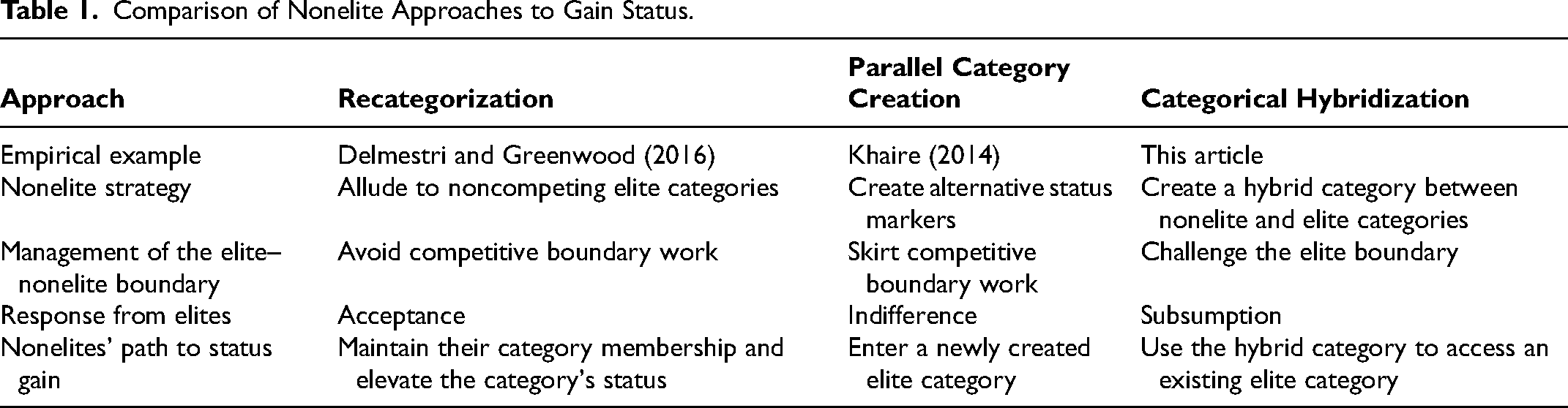
To summarize, I contribute to extant work on market shaping by introducing an approach through which nonelite producers gain access to an elite category by using categorical hybridization, which differs from previously theorized strategies in which nonelite producers gain status by recategorizing a nonelite category or creating a parallel elite category. Additionally, I expand on my findings by discussing why subsumption addresses issues associated with cooptation, distinguishing between collective and collaborative market driving, and arguing that market actors can concomitantly participate in market maintenance and change. I also offer managerial recommendations for nonelites to further solidify status gains. I next focus on my theoretical approach to answering the research question.
An Institutional Approach to Status and Market Categories
To theorize how nonelite producers shape a market to access an elite category, I draw from an institutional approach to categorization (Vergne and Wry 2014). Categories are sociocognitive and normative structures that group entities (e.g., actors, products) around common characteristics and enable evaluation and exchange in markets (Delmestri and Greenwood 2016; Khaire 2014; Khaire and Wadhwani 2010; Lockwood, Glynn, and Giorgi 2023; Vergne and Wry 2014). They reflect producers’ and consumers’ “mutual understanding of the material and symbolic resources that serve as a basis to assess membership” (Vergne and Wry 2014, p. 68).
This institutional approach to categorization provides important conceptual tools and insights to answer the research question. First, categories structure organizational action by shaping expectations, valuation criteria, and standards for products, practices, and identities (Vergne and Wry 2014). I refer to the characteristic elements constituting a category and anchoring their structuring effect as categorical elements. Stakeholders enforce categorical structures by pressuring firms to perform certain identities, adopt specific practices, adhere to certain norms and values, and create products that conform to category prototypes, limiting strategic latitude—what is referred to as the “categorical imperative” (Vergne and Wry 2014; Zuckerman 1999).
Second, a market is usually composed of multiple hierarchically organized categories. By market hierarchy, I refer to “the structural relationships between categories that have achieved some consensus among category members and/or audiences” (Vergne and Wry 2014, p. 68). Market hierarchies structure the status and value of categories and the organizations and products within and between them, influencing competitive dynamics (Vergne and Wry 2014). Elite categories occupy the top position of a market hierarchy. They embed shared understandings of heightened competence, status, and value—the sociocognitive and normative foundations for higher prices—and offer consumers status symbols that support distinction from nonelites (Bellezza 2023; Delmestri and Greenwood 2016; Lockwood, Glynn, and Giorgi 2023).
For example, high fashion and streetwear categorical elements shape firm identities, practices, products, and stakeholder expectations differently, distinguishing streetwear from high fashion. High fashion has the highest status within the hierarchy of the fashion market. As a result, high fashion producers sell products at a high price, have high status, and benefit from coverage by highly reputable fashion magazines, such as Vogue and Women's Wear Daily (WWD), and fashion critics. In contrast, streetwear producers sell products at a lower price, have lower status, and generally do not benefit from similar media or critical coverage.
Status is based on the differentiation between elites and nonelites (Bellezza 2023; Dion and Borraz 2017; Langley et al. 2019). Elite categories persist over time by maintaining distance from nonelite categories and renewing their cultural consonance—the alignment with widely held cultural values, tastes, and practices (Bellezza 2023; Lockwood, Glynn, and Giorgi 2023). Nonelite producers sometimes work to undermine status differentiation, thus threatening the exclusivity and prestige of an elite category, and elite producers work to protect the symbolic boundaries separating them from nonelites (Langley et al. 2019). To defend boundaries, elite producers gatekeep access to their category from nonelite producers who do not possess status-conferring resources, such as identity, experience, or social connections (e.g., Dion and Borraz 2017; Rao, Monin, and Durand 2003). Elite producers are remarkably adept at enforcing boundaries and maintaining their exclusivity (e.g., Dion and Borraz 2017), which is “evident … in the continued prestige and high standing of top categories ranging from … wine producers to … educational institutions, some of which retained their designation as elite for centuries” (Lockwood, Glynn, and Giorgi 2023, p. 12).
Importantly, status is a societally valued difference (Bellezza 2023), and elite producers must maintain their cultural consonance to be valued (Bellezza 2023; Lockwood, Glynn, and Giorgi 2023). When elite producers fail to maintain their cultural consonance, they risk devaluation. For example, Bellezza (2023, p. 2) notes how “traditional luxury goods are increasingly stigmatized” and associated with inauthenticity, selfishness, and immorality, suggesting that the cultural consonance of traditional luxury is slipping. Maintaining cultural consonance requires active and collective work from elite producers, and prior research has identified cooptation and appropriation of nonelites’ work as key mechanisms through which elites do so (Lockwood, Glynn, and Giorgi 2023).
Studying Category Work
I answer the research question of how producers in a nonelite category may shape a market to access an elite category by conducting an interpretive analysis of the hybridization of two categories of different statuses in the fashion market: the nonelite category of streetwear and the elite category of high fashion. This is an ideal context to answer the research question: Elite critics have noted the significant impact of nonelite producers on the elite category, and many nonelite producers who were initially excluded from high fashion have gained access to the elite category.
The analysis of a single market is a widespread approach to theorizing the role of producers in transforming markets (e.g., Ertimur and Coskuner-Balli 2015; Humphreys 2010; Humphreys and Carpenter 2018). My findings are derived from the theoretically enabled analysis of a longitudinal archival dataset (Dolbec, Fischer, and Canniford 2021). Table 2 presents an overview of the dataset. In the table, each data type is identified by a letter and then referenced accordingly in the text.
Summary of Data Sources.
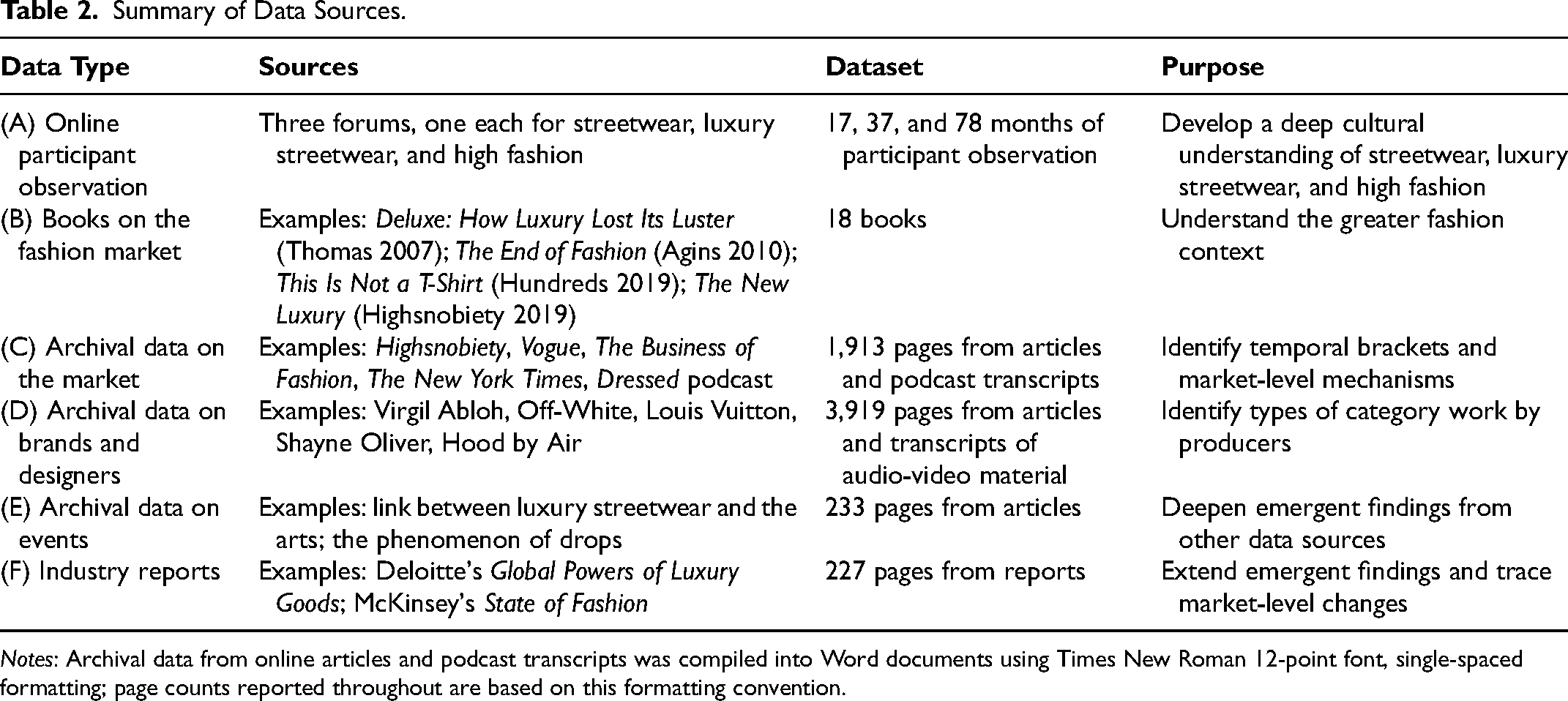
Notes: Archival data from online articles and podcast transcripts was compiled into Word documents using Times New Roman 12-point font, single-spaced formatting; page counts reported throughout are based on this formatting convention.
To develop the cultural understanding necessary to identify and situate transformations in the fashion market and phenomena related to streetwear and high fashion hybridization, I engaged in participant observation (data type A) on three web forums for consumers interested in high fashion (78 months), streetwear (37 months), and luxury streetwear (17 months). These forums varied in their founding date (between 1999 and 2012), number of participants (from 20,000 to more than 90,000 members), topics of conversation, and perspectives on nonelite and elite categories. I combined participant observation with the reading of streetwear, luxury streetwear, and high fashion books (data type B), such as Thomas’s (2007) Deluxe: How Luxury Lost Its Luster and Highsnobiety’s (2019) The New Luxury.
The findings are based primarily on the analysis of 6,294 pages of archival data (data types C, D, and E) covering the evolution of streetwear, luxury streetwear, and high fashion from mainstream and specialized media and podcasts. I collected this data with the help of research assistants. First, we gathered articles on streetwear in high fashion for the period 1980–2024 from streetwear publications (e.g., Highsnobiety, Hypebeast), fashion publications (e.g., Dazed, i-D, Vogue), trade publications (e.g., The Business of Fashion, WWD), and mainstream publications (e.g., The New York Times, The Wall Street Journal) (data type C). We collected these articles using searches with keywords related to the phenomenon in specific publications using search engines and databases (e.g., “streetwear AND fashion IN: New York Times” using Factiva). I chose this broad data collection approach to cover the phenomenon from the perspectives of market actors in each category and more general perspectives of journalists, critics, and analysts, which allowed for data triangulation. We also collected 55 podcast episodes. We identified podcast episodes using search engines and the same keywords used in the searches for articles. After identifying a specific podcast episode, we reviewed the series to identify other relevant episodes. The podcast episodes provided access to interviews with experts (e.g., fashion journalists and critics) for specific points in time as the market developed. Podcasts were transcribed in their entirety.
I started my analysis by focusing on the hybridization of streetwear and high fashion and then examined how nonelites worked to gain access to the high fashion category. First, I inductively analyzed the data to understand market transformations and establish temporal periods. This meso-level analytical approach contextualized the next step of my analysis and transformed the dataset from “a shapeless mass of process data” into “a series of more discrete but connected blocks” (Langley 1999, p. 704; see also Giesler and Thompson 2016). I identified three temporal periods: the cooptation of streetwear, the hybridization of streetwear and high fashion, and the subsumption of luxury streetwear into high fashion.
At this stage, I chose institutional categorization as the enabling lens since it offered useful concepts for making sense of the phenomenon (Dolbec, Fischer, and Canniford 2021). I also collected additional data on key actors to support the analysis (data type D). I created a list of market actors associated with luxury streetwear based on my knowledge of the market. I complemented this list with a systematic review of online luxury retailers. The research assistants identified luxury retailers based on ads on the three forums where I conducted the netnography and by examining the stockists for four luxury streetwear brands. We identified 136 stores. For each store, the research assistants listed the streetwear, luxury streetwear, and high fashion brands they carried. We determined the number of brands carried by each store. These brands included streetwear brands (e.g., Supreme), luxury streetwear brands (e.g., OAMC), and high fashion brands that had engaged in a shift toward luxury streetwear (e.g., Louis Vuitton). We collected articles, interviews, podcasts, and YouTube videos on 20 of the most represented brands and their designers. We searched for these using web and podcast search engines and brand and designer names as keywords.
My review of the literature on market shaping revealed that the status gains of nonelite producers were a phenomenon that lacked theorization. My data analysis efforts at this stage evolved jointly with the identification of this gap, and I reanalyzed the data on luxury streetwear producers to understand how they shaped the market to gain access to high fashion. I concentrated on a subset of 11 luxury streetwear designers, whom I selected based on my understanding of their importance in the phenomenon that emerged from my prior analysis (Web Appendix A lists the designers in this subset). The research assistants and I drafted professional biographies of these designers. Then, I abductively analyzed the data on these designers. I first coded data on each individual at a descriptive level around their work (e.g., produces in Italy, uses social media extensively, collaborates with artists). Then, to identify themes that informed how nonelites gained status in the market (e.g., reflect commensurable logics), I looked for patterns in my descriptive codes, relating them to one another using their empirical relationships and informed by institutional categorization and my broader empirical and theoretical knowledge. At this stage, I compared and contrasted codes between designers while bounding my analysis to each period. Last, I grouped the themes into aggregate dimensions that offered a parsimonious theoretical answer to the research question (e.g., establish commensurability). This approach aligns with enabled analytical strategies (Dolbec, Fischer, and Canniford 2021).
Throughout my analysis, I expanded the dataset around emergent findings when needed (data type E). For example, many luxury streetwear designers referenced the arts, but I lacked data that directly touched on this phenomenon. I addressed this gap by collecting additional data on specific “events,” such as Abloh's use of quotation marks as a design element.
Finally, the research assistants and I collected industry reports from various sources (e.g., Council of Fashion Designers of America, McKinsey) (data type F). I used industry reports in two ways: to extend and support the emergent findings (e.g., an emergent finding was that high fashion producers increasingly acquired luxury streetwear brands, and I used industry reports to trace mergers and acquisitions) and to assess general market changes such as growth.
In the next section, I present the findings. I distinguish between references to academic work and archival data by citing the latter using both the publication and the author's name (e.g., “The New York Times, Friedman 2018”). Web Appendix B provides references for archival data, and Web Appendix C offers a complete list of market actors cited and the categories to which they belong.
How Streetwear Producers Entered High Fashion
I trace streetwear's growing integration into high fashion across three distinct periods. During the 1990s, streetwear and high fashion were distinct categories. High fashion producers appropriated stylistic elements from streetwear while defending the symbolic boundary separating them from streetwear producers. In the early 2010s, the hybrid category of luxury streetwear emerged from nonelite producers’ collective category work and bridged streetwear and high fashion. By the mid- to late 2010s, high fashion producers subsumed luxury streetwear into high fashion. Figure 1 illustrates these evolutionary, intercategorical dynamics.

Evolution of Streetwear, Luxury Streetwear, and High Fashion Categories.
My analysis finds that nonelites (streetwear producers) created a hybrid category (luxury streetwear) that linked the nonelite category (streetwear) and the elite category (high fashion), which facilitated the upward trajectory of some notable nonelites. Nonelites did so through two forms of category work: establishing commensurability between the nonelite and elite categories and exploiting their cultural consonance. The successful category work of nonelites challenged the symbolic boundary separating the elite and nonelite categories and introduced valuable alternatives for elite producers.
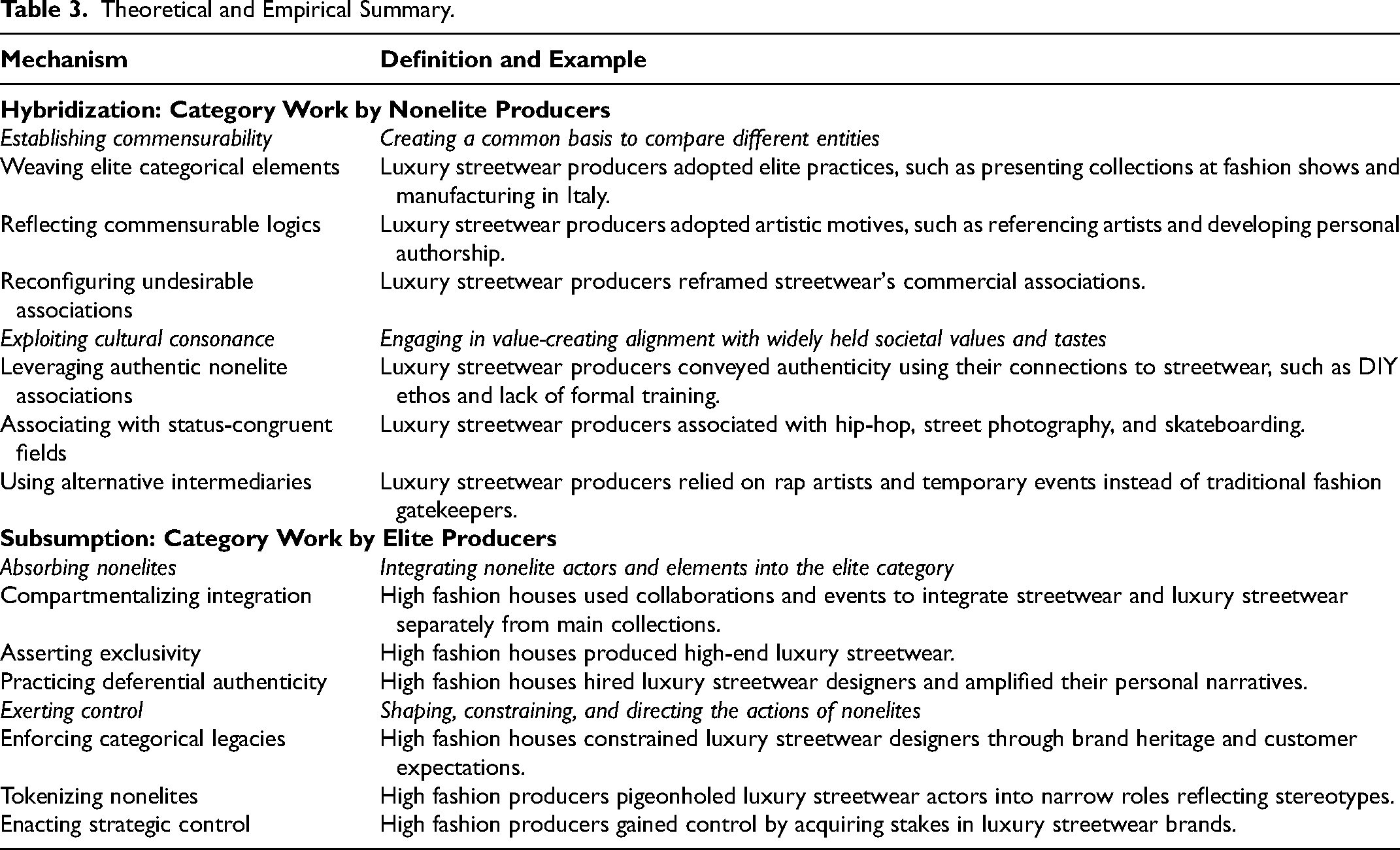
In response, elite producers subsumed the hybrid category by absorbing nonelites and exerting control over them, catalyzing some nonelites’ upward movement. By doing so, elites resolved the challenge posed by the hybrid category and captured the value potentialized by nonelite producers. Elite producers thus maintained their status and renewed their cultural consonance, while some nonelite producers gained access to the elite category. Figure 2 presents a visual summary of the findings. Table 3 offers a theoretical and empirical summary.
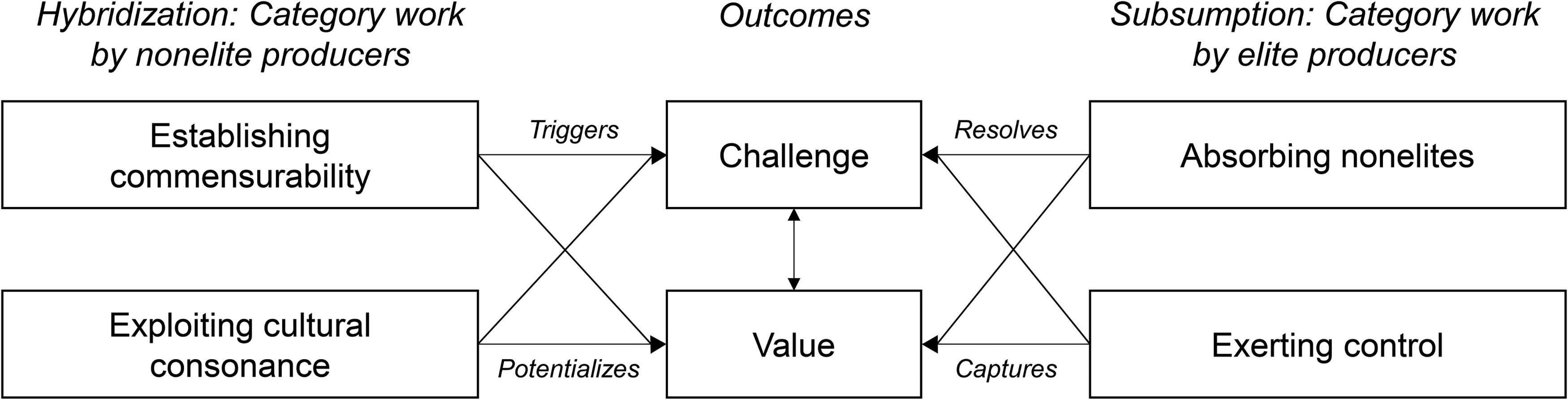
How Nonelites Gain Status Through Hybridization.
Theoretical and Empirical Summary.
The Cooptation of Streetwear
While my research question and analysis concentrate on the hybridization of streetwear and high fashion and the resulting consequences, I open the findings by briefly describing the entry of streetwear into high fashion to contextualize my theorization.
High fashion producers have coopted streetwear styles since at least the early 1990s (e.g., Marc Jacobs’ Perry Ellis Spring 1993 grunge collection, Karl Lagerfeld's Chanel Spring 1994 hip-hop collection, and a few mod- and punk-inspired collections from Tom Ford in the mid-1990s [The New York Times, Spindler 1995]). The cooptation of streetwear sparked debates in the early 1990s, exemplifying boundary work to maintain a distance between the nonelite and elite categories. Perry Ellis fired Marc Jacobs following his 1993 “grunge” collection, and fashion critic Cathy Horyn stated that “grunge is anathema to fashion and for a major Seventh Avenue fashion house to put out that kind of statement at that kind of price point is ridiculous” (The Washington Post, Horyn 1992). Customers “were too distinguished to wear anything associated with grunge, or if they were hip clients, they were turned off by Marc Jacobs's coopting grunge” (Allure, Bateman 2016).
Streetwear became better received over the next decade. Importantly, Raf Simons created “compatibility” between the categories (Cappetta, Cillo, and Ponti 2006). His “first couple of seasons [in 1995 and 1996] established [his] focus on combining youth subcultures, presenting the concept in a way that … fashion critics … could understand and enjoy” (Complex, Babcock 2017; emphasis added). Critics have since acknowledged three of his collections—Spring–Summer 1998 “Black Palms,” Spring–Summer 1999 “Kinetic Youth,” and Fall–Winter 2001 “Riot Riot Riot”—as market-defining work that reoriented menswear toward streetwear (e.g., The New York Times, Fury 2017; GQ, Johnson 2017; Vogue, Yotka 2017). These collections are now iconic, and streetwear and high fashion producers routinely reference them (Highsnobiety, Luecke 2017; The Business of Fashion, McDowell 2016). The cooptation of streetwear elements continued into the 2000s, and some of the most lauded and successful high fashion designers in that period appropriated streetwear. Examples include Kim Jones, the “designer who brought streetwear to Louis Vuitton” (GQ, Woolf 2018), and Riccardo Tisci for Givenchy, who “was among the first contemporary designers to experiment with … streetwear” (Harper's Bazaar, Alexander 2018).
Although cooptation made streetwear and high fashion compatible, elites refused nonelite producers access to the elite category. For example, high fashion houses sued “Harlem couturier” Dapper Dan out of business in the 1990s for his high fashion-inspired “streetwear couture” (The New York Times, Cooper 2017), and Louis Vuitton “hit [New-York based cult streetwear brand Supreme] with a cease and desist letter” in 2000 for adorning its skateboards with the famed “LV” logo (Highsnobiety, Banks 2017). My theorization looks beyond cooptation to explain the transformations associated with the creation of a hybrid category that allowed some nonelite producers to enter the elite category of high fashion.
Two significant changes in luxury catalyzed the rise of luxury streetwear. First, by the late 2000s, high fashion faced issues associated with its elite status. High fashion producers’ mass-marketing strategies (e.g., diversification to lower-priced products, collaborations with fast fashion retailers, and opening of outlets) and corporatization had made their brands “available to anyone, anywhere, at any price point” (Thomas 2007, p. 14), leading to a crisis of exclusivity. High fashion had “lost its luster” (Thomas 2007; see also Bellezza 2023). Second, societal tastes and values shifted, impeding high fashion's cultural consonance. “Elite taste [had] become omnivorous” (Smith Maguire 2018, p. 6), and “traditional snobbery frequently appear[ed] to almost disqualify … high status” (Johnston and Baumann 2007, p. 183). Instead, authenticity—a core aspect of streetwear—became a key marker of exclusivity (Bellezza 2023; Johnston and Baumann 2007). This shift in taste, which was especially prevalent among younger consumers, was “at odds with the business models of many traditional [fashion] brands” (The Business of Fashion, Hoang 2017). Consumers’ belief that participating in cooptation might undermine their authenticity arguably further threatened the cultural consonance of the high fashion producers that were appropriating streetwear (Cruz, Seo, and Scaraboto 2024).
The Hybridization of Streetwear and High Fashion
Nonelite producers performed two types of category work to hybridize streetwear and high fashion, challenging the symbolic boundary separating them from elite producers and creating value for their identities, products, and practices. They established commensurability with the elite category to make luxury streetwear and high fashion comparable, and they exploited consonance with changing societal tastes and values to generate appeal. I discuss each in turn.
Establishing Commensurability
Nonelite producers established commensurability by weaving elite and nonelite categorical elements, reflecting commensurable logics, and reconfiguring undesirable associations. This made luxury streetwear comparable with high fashion and distanced the hybrid category from streetwear. Commensuration refers to the creation of a common basis to compare different entities, such as products, practices, and producer identities. Entities that were originally incomparable can be made commensurate by transforming their qualities, which can change what is valued in a market and alter power relations (Espeland and Stevens 1998).
Weaving elite categorical elements
First, nonelite producers integrated high fashion elements with streetwear, such as prices, stylistic elements, and promotional tactics. For example, Off-White was “as outrageously expensive as any other big luxury brand” (Darling 2022, p. 12). The luxury streetwear brand's Spring–Summer 2019 collection “used as [its] main ingredients … denim, T-shirts and sweatshirts … reinterpreting basics from street culture” (WWD, Foreman 2018). High fashion design elements came into play as the collection incorporated “Margiela-esque” proportions (a reference to designer Martin Margiela), “clear sequins, glitter pens, a floral fabric, and signature off-kilter seaming and pockets everywhere” (The Hollywood Reporter, Robinson 2018).
Nonelite producers also adopted the practice of presenting collections at fashion shows. Between 2010 and 2015, luxury streetwear brands increased their presence at major fashion shows such as Paris Fashion Week from approximately 5% in 2010 to approximately 25% in 2015 (see Web Appendix D). Several influential luxury streetwear brands emerged around this time (e.g., En Noir [2012], Off-White [2012], Fear of God [2013], and Vetements [2014]) or held their first fashion show during this period (e.g., Hood by Air [Spring–Summer 2014], Off-White [Spring–Summer 2015], Gosha Rubchinskiy [Spring–Summer 2015], and Vetements [Spring–Summer 2015]). The presence of luxury streetwear brands at fashion shows fostered interactions with the high fashion critics who reviewed the collections. For example, Vogue reviewed Hood by Air's first show, stating that it was “certainly the most out-of-the-box and compelling” brand with “well deserved” hype (Singer 2013). Since magazines and their editors are important high fashion gatekeepers, the generally positive reviews of luxury streetwear collections boosted the status of the hybrid brands, distancing them from streetwear brands and creating comparability with high fashion.
Reflecting commensurable logics
Second, nonelite producers reflected the logic of art that governs high fashion. Elite producers foster exclusivity by distancing themselves from commercial motives, which defines the activities of mass fashion producers, and by associating their activities with artistic motives (Dolbec and Fischer 2015; Wilson 2003). Nonelite producers similarly adopted practices that reflected artistic motives. I provide three examples.
First, high fashion reflects the logic of art by using labor-intensive production practices (Dolbec and Fischer 2015). Similarly, luxury streetwear brands manufactured their collections in Italy, creating proximity with high fashion houses and distance from streetwear brands that produced garments in countries such as China and Vietnam. This is perhaps most evident with Italian luxury streetwear production and distribution holding company New Guards Group, which owned stakes in and manufactured many luxury streetwear brands, such as Ambush, Heron Preston, Marcelo Burlon, Off-White, Opening Ceremony, and Palm Angels.
Second, high fashion fosters associations with art by referencing and collaborating with artists (Rees-Roberts 2015), a practice luxury streetwear producers adopted. For example, a frequent quote from luxury streetwear designer Virgil Abloh—“Duchamp is my lawyer”—references the basis of his conceptual fashion practice, “the art-historical grounds onto which he can absorb preexisting intellectual property into his reference system” (032c, Bettridge 2018). Additionally, a review of his collections (Darling 2022) highlights his many artistic references, from Lucio Fontana (Fall–Winter 2016) to Duchamp (Fall–Winter 2018) to Donald White (Spring–Summer 2019). He also collaborated with artists such as George Condo, Jenny Holzer, and Takashi Murakami and was the subject of a retrospective in 2019 at the Museum of Contemporary Art of Chicago.
Third, high fashion fosters associations with art through authorship. Authorship creates authority and meanings around a person, separates them from the anonymity of mass production, and grants status (Wilson 2003). High fashion designers develop authorship through their positions as creative directors, by “heading their own, sometimes eponymous, entrepreneurial labels,” by cultivating an online person-brand (Parmentier and Fischer 2021, p. 114), and by their involvement in artistic fields related to fashion (Kim 1998). Luxury streetwear designers did the same. For example, Jerry Lorenzo founded Fear of God and cultivated a social media following of hundreds of thousands, Heron Preston launched his eponymous luxury streetwear brand and produced art, fashion, and music (Hypebeast, Roazen 2016), and Samuel Ross founded A-WALL* and practiced painting and sculpture (Financial Times, Prempeh 2023).
Reconfiguring undesirable associations
Last, luxury streetwear producers reconfigured undesirable associations: their association with commercial motives. While elite categories such as high fashion push against commercial associations, nonelite categories such as streetwear are associated with utility and commerce, which nonelite producers transformed into an advantage.
Luxury streetwear brand Vetements offers a salient example. Its Spring–Summer 2017 collection was the “big ta-da opener of couture week”—the year's highest symbolically positioned high fashion event. The brand “satirically contravened half a dozen arcane regulations of what is supposed to be the correct way for a label to operate” (Vogue, Mower 2016). Satire is a well-acknowledged form of social commentary that questions power dynamics. In contradiction of the norms and values orchestrating high fashion, the collection almost exclusively featured collaborations with streetwear brands (e.g., Levi's, Champion, and Dr. Martens), who participated heavily in the design and manufacturing of the collection (The Cut, Horyn 2016). The show “was so far from being traditional haute couture that it was shown, cheekily, in a department store—during regular hours, at that” (Vogue, Mower 2016). While the satirical show used commercial associations to critique high fashion norms and values, the use of streetwear in a sacrosanct haute couture event also upended the association between streetwear and commercial motives. It was, like the brand's Balenciaga IKEA bag (see Web Appendix E), “an ironic gesture … taking something … and moving it into the luxury realm” (Vetements creative director Demna Gvasalia, known as Demna, in The Business of Fashion [Cronberg 2017]).
Another example is luxury streetwear designer Abloh's frequent use of quotation marks to transform mass-produced commodities (see Web Appendix F for examples), which served a similar purpose—an ironic decontextualization that “transformed anything [he] touched into a Readymade” (Fast Company, Wilson 2021). Readymades are unaltered, ordinary, and often mass-produced objects elevated as art by an artist choosing to designate them as such (MoMA 2014). Quotation marks strip “the word of its old meaning and create a white space for new interpretation … making you question” objects’ intended uses and “opening up possibilities … for reimagining” (chief curator of the Museum of Contemporary Art, Chicago, in Fast Company [Wilson 2021]). It problematizes objects’ role as commodities and the logic of commerce.
Exploiting Cultural Consonance
Exploiting cultural consonance refers to value-creating alignments with widely held societal values and tastes. Luxury streetwear producers exploited their cultural consonance to create value for their products, identities, and practices, leading them to resonate with Gen Z and millennial consumers who “often see fashionable streetwear labels like [streetwear brand] Supreme, [and luxury streetwear brands] Gosha Rubchinskiy and Vetements to be cooler than traditional luxury brands” (The Business of Fashion, Morency 2017a). They did so by leveraging authentic nonelite associations, associating with status-congruent fields, and using alternative intermediaries.
Leveraging nonelite categorical elements
First, luxury streetwear producers capitalized on their associations with streetwear to convey authenticity. For example, streetwear is characterized by a do-it-yourself (DIY) ethos (Hundreds 2019), which nonelite producers reflected: They lacked formal training and typically started their fashion careers in streetwear, such as by screen printing designs on tees (e.g., Virgil Abloh, Shayne Oliver). As a result, they were generally less technically skilled than high fashion producers. Luxury streetwear producers’ lack of technical fashion expertise put them at a disadvantage in creating the highly complicated clothing designs that would typically gain recognition in high fashion, which some critics used to enforce the high fashion boundary (e.g., Highsnobiety, Rabkhin 2019).
Instead of competing on the expertise-reliant products characterizing high fashion, luxury streetwear producers created resonant collections by drawing from the connoisseurship culture that characterizes streetwear (Davis 2022). Creative director Luke Meier provides a salient example. Before launching his luxury streetwear label OAMC, Meier was the creative director of the iconic streetwear brand Supreme. At OAMC, he drew from the typical references that characterize streetwear, such as alpinism and mountaineering (Fall 2015; i-D, Pfeiffer 2015), military influences (Fall 2016; WWD, Szmydke 2016), and tactical elements present in police uniforms (Fall 2017; Vogue, Holgate 2017). High fashion critics and consumers lauded Meier's collections. WWD, a high fashion trade publication, qualified OAMC's collections as “a rare combination of street cred and sophistication” (WWD, Szmydke 2016). By exhibiting core streetwear elements, luxury streetwear producers conveyed authenticity. Renowned critic Fury explains: [Luxury streetwear designer Nasir] Mazhar's clothes have legions of fans who buy them until they sell out, in a manner more akin to sneaker freaks bagging the latest releases than fashionable types. Mazhar's buyers are a mix of the two. So are those of Vetements. … Perhaps that's the reason these [luxury streetwear] designers are resonating so loudly now: their aesthetic honesty. Hood By Air doesn’t look street—it is street. It can function on a catwalk and interest the fashion press (and, more importantly, consumers), but there's an authenticity. None of these labels is a streetwear cop-out nor a fashion pretender. … They’re real. And selling to couture clients and hooligans alike. (The Independent, Fury 2016b)
Associating with status-congruent fields
Second, in addition to creating associations with the arts to create commensurability with high fashion, luxury streetwear designers associated themselves with fields complementary to streetwear, such as hip-hop (DJing, rap music, graffiti), pop music, skateboarding, and tattooing. In interviews and their work, luxury streetwear producers drew from their experiences in these status-congruent fields to build their reputation as authentic streetwear designers. For example, some worked with pop and rap artists to design merchandise and performance looks (e.g., Abloh for Ye, Rob Garcia for Justin Bieber, and Matthew Williams for Lady Gaga). Abloh, Preston, and Williams founded the DJ collective Been Trill. Rob Garcia and Gosha Rubchinskiy were involved in tattooing (GQ, Gayomali 2015; SVD n.d.), Jerry Lorenzo used to throw “parties he called JL Nights” (Complex, Sanchez 2017), and Shayne Oliver was a club promoter who funded his fashion venture by “creating music and also DJing” with his “friend Venus on Ghe20 G0TH1K” (Fashionista, Street 2015).
Using alternative intermediaries
Third, luxury streetwear producers bypassed high fashion's gatekeepers by using alternative cultural intermediaries—“the tastemakers [who] define what counts as good taste and cool culture” (Matthews and Smith Maguire 2014). For example, the Instagram accounts of some of the hippest rap artists, DJs, and online influencers, such as Travis Scott, Rihanna, Ye, and the Kardashians, routinely featured luxury streetwear brands, such as Fear of God, Hood by Air, and Off-White (Fader, Frank 2015; Vogue, Marlowe 2017). Delistraty (Esquire, Delistraty 2017) highlights how endorsements from alternative intermediaries such as Ye and Kylie Jenner supplanted—or at least complemented—those from fashion critics: In the new era of fashion populism, the critic is cut out of the equation. Who cares what Schneier thinks of Abloh or West's design? (Or what Cathy Horyn, Suzy Menkes, or Vanessa Friedman thinks for that matter?) For much of the fashion world, if the likes of [Kanye] West [Ye] or [Kylie] Jenner … approve of you … little else matters.
The use of alternative cultural intermediaries also included distribution channels, where luxury streetwear brands overcame their lack of official distribution at luxury retailers by participating in direct-to-consumer sales, pop-up shops, and temporary events. For example, they drew from streetwear distribution practices, such as “drops”—the “controlled release of new products at a clip that's far faster than the traditional fashion cycle and designed to drive consumer excitement with a stream of constant newness” (The Business of Fashion, Deleon 2016). They opened pop-up stores such as the one created by Heron Preston in 2017, which included a tattoo artist station and a DJ set from Virgil Abloh. They also capitalized on high fashion retailers that dipped their toes into distributing the rising hybrid category because of its commercial potential with temporary pop-up events (The Business of Fashion, Morency 2016b). For example, Maxfield launched the event series “ReadyMade” to host “high-end streetwear and luxury pop-ups … such as Fear of God, Enfants Riches Déprimés and Amiri” in “limited-time offerings” that “bring to life brands [that] have never had the opportunity to have their own retail space” (WWD, Hamanaka 2017). This physical and symbolic boundary—the temporary inclusion of luxury streetwear brands at some of the most highly regarded luxury stores—also maintained the distinction between authentic luxury streetwear brands and high fashion houses.
Outcomes of Hybridization
Luxury streetwear producers’ category work led to two outcomes: It introduced value creation potential for high fashion houses while challenging the symbolic boundary that separated nonelite and elite producers.
Potentializing value creation
Luxury streetwear producers introduced novel alternatives that could help elite producers address current challenges. I provide two examples. First, they introduced alternatives that could improve the profitability of the high fashion business model, at a time when major fashion conglomerates were consolidating and aiming for greater profits (Amed et al. 2017). Under the high fashion business model, high fashion houses produced expensive clothing and fashion shows to build their brand and promote the sale of more affordable, high-profit products, such as handbags, sunglasses, perfumes, diffusion lines with mass retailers, and outlet products (The Business of Fashion, Business of Fashion Team 2019; Thomas 2007; WWD, Conti 2017). However, this approach diminished the luster and perceived exclusivity of high fashion (Thomas 2007).
By contrast, the core offering of luxury streetwear brands—tees, hoodies, jeans, and sneakers—comprised high-profit-margin products (The Business of Fashion, Morency 2018a). They were also highly desirable: At luxury retailer Net-a-Porter, “sweatshirts ($580), t-shirts ($350) and track pants ($520) [were] part of [the] most popular categories, making up around half of [the] overall sales [for luxury streetwear brand Off-White]” (The Business of Fashion, Morency 2016a). Other luxury streetwear practices could similarly replace status-threatening approaches (e.g., using outlets) or complement costly high fashion elements. An example is drops, which drove interest, gave greater control over inventories, and minimized discounted sales.
Second, the cultural consonance of luxury streetwear helped elite producers restore their luster and rejuvenate their customer base. High fashion faced a “generation gap”; it struggled to attract younger consumers who had “radically different behaviors and attitudes” (The Business of Fashion, Hoang 2017). These consumers would become the main driver of growth in high fashion (D’Arpizio et al. 2023; The New York Times, Paton 2017). The success of luxury streetwear brands with younger consumers provided a potential pathway for rejuvenation (GQ, Marino 2017).
Challenging the elite boundary
As luxury streetwear gained commercial and critical recognition, the hybrid category broke the “glass ceiling that once separated streetwear brands from fashion and luxury brands” (The Business of Fashion, Morency 2017b). The boundary between luxury streetwear and high fashion eroded to such a degree that, to many critics, luxury streetwear and high fashion were indistinguishable. Within the span of a few months, The Business of Fashion (Morency 2017b), Highsnobiety (Leach 2017), and The Guardian (Cochrane 2017)—respectively, a high fashion trade publication, a streetwear magazine, and a mainstream newspaper—published articles arguing the same. Highsnobiety (Leach 2017) stated: “It's official: streetwear and luxury fashion are the same thing.”
The blurring of luxury streetwear and high fashion reflects challenges to the symbolic boundary that maintains high fashion's exclusivity. I offer three examples. First, drops represented an important departure from the typical fashion calendar of high fashion houses—a strict seasonal schedule enforced by a network of actors (e.g., textile producers, designers, buyers, retailers, and events such as fashion weeks) that interlocked the design, manufacturing, retailing, and distribution of high fashion products (Şen 2008). The “seasonless” approach (Forbes, Baron 2018) of drops upset the fashion calendar by operating faster than the traditional fashion cycle, challenging conventions, practices, and professional roles.
Second, the success of luxury streetwear designers who lacked fashion expertise undermined the legitimacy and status value of high fashion expertise. High fashion designers typically graduated from top fashion and design schools, interned and trained at high fashion houses, and slowly built their resumes before being recruited as the creative director of a well-established high fashion house. By contrast, luxury streetwear designers developed expertise in streetwear and congruent fields (e.g., nightclubbing, tattooing) and carved a space for themselves as creative directors of brands that they created rather than as employees of high fashion houses.
Last, luxury streetwear seduced younger lower-class consumers, threatening the symbolic boundary distinguishing elite and nonelite consumers (e.g., Dion and Borraz 2017; Lockwood, Glynn, and Giorgi 2023). While high fashion producers excluded these demographics to maintain prestige, luxury streetwear embraced class diversity. Critics heralded this transcendence of class boundaries as marking a new era of accessibility and democratization in luxury (Grailed, Silbert 2017; Strategy&, Leeb, Menendez, and Nitschke 2019; Vox, Tiffany 2018).
The Subsumption of Luxury Streetwear
To respond to the challenge posed by luxury streetwear producers, high fashion producers subsumed them. By absorbing and exerting control over luxury streetwear producers, high fashion producers maintained the symbolic boundary marking high fashion's elite status and captured value from luxury streetwear. In the process, some luxury streetwear producers gained access to high fashion.
Absorbing Nonelites
Absorbing nonelites refers to the integration of nonelite actors and elements by elite producers, which they accomplished by compartmentalizing integration, asserting exclusivity, and practicing deferential authenticity. Absorption renews cultural consonance and incorporates value-creating elements while protecting the category's elite status.
Compartmentalizing integration
To attract luxury streetwear consumers, high fashion houses engaged in a balancing act, as integrating nonelite elements could alienate their existing customer base. Some high fashion houses addressed this challenge by compartmentalizing integration—separating integration within demarcated initiatives.
Compartmentalized integration is perhaps most evident in collaborations that elevated streetwear brands into high fashion, such as Louis Vuitton and Supreme, Dior and Stussy, and the recurring Moncler Genius series. In these collaborations, time and scope bound the integration of luxury streetwear. Take, for example, the Louis Vuitton and Supreme limited collection, one of the most discussed examples of collaborations in which “both [brands] are archetypal … Supreme epitomizes streetwear, and Louis Vuitton … high fashion” (Highsnobiety, Danforth 2017). The collaboration jointly used the two brands’ names and signature stylistic elements. Louis Vuitton also borrowed pages from streetwear's distribution handbook, using drops in Louis Vuitton–branded pop-up stores to launch the collection and separate its distribution from the house's regular collection (Financial Times; Nicolaou and Kao 2017).
By practicing compartmentalized integration, high fashion producers renewed the cultural consonance of their category by integrating styles, products, and actors that resonated with Millennials and Gen Z. For these consumers, streetwear was “the de facto way of dressing … and therefore a perfect way for a luxury house to get their legacy across” (Highsnobiety founder David Fischer in The Business of Fashion, Morency 2017a).
Compartmentalized integration also helped high fashion producers perform boundary work and limit potential contamination between existing and new customer segments that could have undermined elite consumers’ identity projects (Avery 2012). Evidence from online forum data indicates that the existing customer base of high fashion houses responded positively. An online thread of more than 1,600 comments by existing Louis Vuitton customers on the Louis Vuitton and Supreme collaboration featured comments such as “it's a collection aimed at everything that [we] DON’T represent … But I recognize that it is a genius move,” to which another consumer replied, “brand expansion, exposure, appeal to a completely different customer base … I agree it's genius.” The thread had many similar comments suggesting that consumers believed the fashion house's foray into streetwear would not harm their connection with the house or alter its identity.
Asserting exclusivity
Although luxury streetwear producers integrated elite categorical elements such as distribution approaches, stylistic elements, and price points, their category was still a hybrid of streetwear and high fashion. It did not fully participate in the highest luxury echelon. High fashion producers further absorbed nonelites by heightening exclusivity.
For example, luxury streetwear products manufactured in Italy and sold at a higher price point were still authentically “street,” which critic Fury stressed by stating that “their [luxury streetwear producers’] leather jackets aren’t lined in mink” (The Independent, Fury 2016b). High fashion producers—and luxury streetwear designers now working for high fashion houses—asserted the exclusivity of the elite category by centering high fashion categorical elements when absorbing luxury streetwear. For example, Virgil Abloh, a luxury streetwear designer who became creative director of Louis Vuitton, reimagined the streetwear staple bomber jacket for the famed French high fashion house. He crafted it in mink and featured a streetwear-inspired camouflage print at a staggering price of $30,000.
Luxury streetwear consumers bought sneakers or tees at expensive, but not outrageous, prices. The introduction of products at price points at the higher end of the luxury range conspicuously asserted the exclusivity and opulence of high fashion, which provided status markers for elite consumers to differentiate themselves from newcomers to the category who were attracted by the subsumption of luxury streetwear.
Practicing deferential authenticity
Although elite consumers and critics at times shunned elite producers’ cooptation efforts, they perceived nonelite producers as authentically representing their consumption culture. This is important in a market environment where consumers have shifted toward authenticity as a key marker of exclusivity. High fashion houses responded by practicing deferential authenticity—ceding authority to and amplifying attention toward subsumed nonelites. For example, some high fashion houses hired luxury streetwear designers as creative directors, such as Virgil Abloh at Louis Vuitton, Shayne Oliver at Helmut Lang, and Matthew Williams at Givenchy (Web Appendix G offers additional examples).
Elites not only ceded authority and attention to nonelites; they also amplified their profiles, promoted their stories, celebrated their achievements, and highlighted the synergistic blend of their streetwear roots with fashion houses’ heritage. Fashion media further drew attention to nonelite producers who gained access to high fashion, “featuring them as protagonists” in “dramatic narratives” that explained the subsumption of luxury streetwear and contributed to their celebrification (Rindova, Pollock, and Hayward 2006, p. 56). The coverage of the hiring of Virgil Abloh by Louis Vuitton in Vogue exemplifies this approach: Louis Vuitton announced today that Virgil Abloh is the new artistic director of men's collection … a watershed moment for both the 164-year-old French luxury brand and the Off-White founder … his appointment is history making … Louis Vuitton is the conglomerate's main moneymaker, producing nearly one quarter of its overall revenue in 2017. … Certainly, the LVMH brass has also taken notice of Off-White's phenomenal success … “The kids, they idolize him; he's such a reference for them,” SSENSE's Brigitte Chartrand said … streetwear is very much the foundation of Abloh's Off-White … I am thrilled to see how his innate creativity and disruptive approach have made him so relevant, not just in the world of fashion but in popular culture today,” said Michael Burke, Louis Vuitton's chairman and CEO, in a statement. “His sensibility toward luxury and savoir faire will be instrumental in taking Louis Vuitton's menswear into the future.” (Phelps 2018)
Exerting Control
Exerting control refers to the shaping, constraining, and directing of the actions of nonelite producers by elite ones. The high fashion houses that integrated luxury streetwear designers did so in ways that limited these designers’ disruptive power, reproducing existing power dynamics and maintaining elites’ stewardship over their category. They did so by enforcing categorical legacies, tokenizing nonelites, and enacting strategic control.
Enforcing categorical legacies
Absorbing nonelites, such as hiring them as creative directors, could have disruptive consequences. The creative director is the top position at a fashion house. Their responsibilities extend beyond fashion direction and “include store strategy, social media and advertising campaigns, and global brand vision” (Vogue Business, Mondalek 2019). They have the power to transform a high fashion house's identity, products, and practices.
However, the structuring effect of high fashion brands’ histories and the categorical imperative of high fashion constrained nonelite producers’ creative and strategic autonomy. The need for luxury streetwear designers to respect a fashion house's heritage to fulfill customer and critic expectations was particularly important. For example, Balenciaga hired luxury streetwear designer Demna in 2015. The success of his integration of luxury streetwear elements into Balenciaga depended on the creation of interlinkages between luxury streetwear elements and the history of the high fashion house: What made [Demna] Gvasalia's debut so compelling was the fusion of tradition with innovation, of a new aesthetic with an old approach. A rethinking of the Balenciaga legacy … It was, however, distinctly Balenciaga … “You’re not coming to a blank page. There are certain recipes you need to consider,” comments Gvasalia … Do you understand why it is Balenciaga? It can be jogging pants, but why?” … fundamentally, what Gvasalia wants to do is to return Balenciaga to its core values – no party tricks, no catwalk theatrics. Pure clothing, true and simple. A real wardrobe (AnOther Magazine, Fury 2016a)
In this excerpt, Demna exhibits self-governance as a luxury streetwear designer who is now part of a long-storied fashion house. He understands the limit imposed by the reception of his collection by critics and customers alike, as he “wants people at Balenciaga to wear the clothes. First and foremost, above all else.” He states how “for [him] it was really this challenge … I want Balenciaga to sell clothes, to dress women” (AnOther Magazine, Fury 2016a).
Tokenizing nonelites
Second, elite producers restricted the agency of nonelite producers through tokenization, as they essentialized characteristics associated with nonelite producers, such as professional, cultural, and racial backgrounds, pigeonholing them. They also arguably pressured luxury streetwear producers to present themselves in “acceptable” ways.
According to some, the luxury streetwear producers who moved into high fashion were “forced into playing limited and caricatured roles” reflecting “preexisting generalizations” (Kanter 1977, p. 980). Streetwear has close ties to hip-hop and black culture (Highsnobiety, Deleon 2018; BBC, Laux 2019), and racial and market categories intersected to catalyze tokenization. For example, commenting on the hiring of Virgil Abloh by Louis Vuitton, famed high fashion designer Joe Casely-Hayford stated that “black designers have only been accepted in very narrow and predetermined roles: street style, sportswear and afro-fetishism are the main, easy to digest categories” (Hypebeast, Dike 2019). Abloh similarly commented that “when you’re black in the arts, in order to be seen you must perform. It's like, ‘Hey! You! … entertain us!’ Dark skin is acceptable if it belongs to someone in front of the camera” (Vestoj, Cronberg 2021). Such remarks highlight the “exclusionary boundaries in the marketplace … that sustain” forms of discrimination characteristic of tokenism (Drenten, Harrison, and Pendarvis 2023, p. 19).
Nonelite producers’ agency may have been restricted further by the need to appear respectable (Crockett 2017). For example, Abloh explained how, when he joined the fashion market, “it was basically taboo to talk about race in an all-white setting of power. I never made my race the forefront issue when it came to my work.” Then, with “the summer of 2020 [and] the racial uprising,” he felt that “everyone is like, ‘Hey, I’m ready now, let's talk about race … So [I could] do some work above ground and it's not seen as threatening anymore” (Vestoj, Cronberg 2021). Hence, despite gaining one of the highest symbolically powerful positions in fashion in 2018 as creative director of Louis Vuitton, Abloh was still constrained by the need to appear respectable until a major societal upheaval potentialized greater agency by making engaging with race valuable for his employer.
Enacting strategic control
The final way high fashion houses integrated luxury streetwear actors was through explicit strategic control, where high fashion producers gained access to strategic decision-making at luxury streetwear brands through investments and acquisitions, such as LVMH's acquisition of a majority stake in Off-White and Farfetch's acquisition of luxury streetwear holding company New Guards Group (Web Appendix H offers additional examples). When an elite producer acquires or invests in a nonelite brand, they gain a direct stake in its operations and control over strategic decisions. This extends existing work discussing how firms use acquisitions to limit technological disruption by demonstrating that firms follow the same strategy to limit cultural disruption (Lemley and Wansley 2024).
Outcomes of Subsumption
High fashion producers’ category work led to two outcomes: It captured the value potentialized by luxury streetwear producers and resolved the challenge they posed. Importantly, the subsumption of nonelites allowed some of them to gain access to the elite category.
Capturing value
By subsuming luxury streetwear, high fashion producers captured the value that nonelite producers introduced to the market, renewed the cultural consonance of their category, attracted a new customer segment, and adopted lucrative new practices.
Subsumption renewed cultural consonance by adapting the “underlying meanings that [the elite category] references” (Granqvist, Grodal, and Woolley 2013, p. 396). Critic Morency commented in The Business of Fashion (Suen 2019): “The biggest impact streetwear has had on the wider luxury industry is its subversion of what ‘luxury’ stands for,” Morency said, arguing that luxury has gone from being driven by high price points, exclusivity or heritage to focusing on “cultural credibility, community and responsive product that reacts to the wider cultural conversation.”
While my analysis suggests high fashion producers carefully managed the “subversion” that Morency discussed to ensure the persistence of their category and existing power dynamics, his comment on the transformation of “what luxury stands for” to more closely align with the wider cultural conversation clearly reflects the renewal of the cultural consonance of the elite category.
The second key example of value capture is the attraction of younger consumers. High fashion houses successfully used luxury streetwear to renew their consumer bases. Balenciaga saw sales explode under Demna, fueled by younger consumers (Reuters, White 2018), and Virgil Abloh's first Louis Vuitton collection outsold the house's widely successful previous streetwear collaboration with Supreme (WWD 2019). As for high fashion more generally, between the late 2010s and early 2020s, millennial and Gen Z consumers became the category's main growth driver. McKinsey (Amed et al. 2017) qualified this shift as “a generation tipping point,” and Bain & Company estimated that youth generated 85% of the growth in luxury in 2017 (The New York Times, Paton 2017) and 100% in 2022 (D’Arpizio et al. 2023).
Third, subsuming luxury streetwear allowed high fashion producers to adopt valuable streetwear alternatives to transform their business models and heighten profit margins. For example, the distribution practice of drops was adopted “as an improvement on the ‘see now, buy now’ concept” (The Wall Street Journal, Smith 2018) as-is by high fashion actors, such as retailers (e.g., Barneys and SSENSE) and high fashion houses (e.g., Balenciaga, Burberry, Celine, Fendi, Gucci, Louis Vuitton, and Moncler) (The Business of Fashion, Morency 2018a). Second, high fashion producers from “Gucci and Balenciaga to Prada and Louis Vuitton” integrated luxury streetwear staples such as “sneakers, hoodies, and tees” (The Business of Fashion, Morency 2018a). In 2017, sales of luxury tees grew by 25%, while sales of luxury sneakers grew between 40% and 50% at multiple luxury retailers (Bain & Company, D’Arpizio et al. 2017; The Business of Fashion, Morency 2018a).
Last, there was an expansion in the types of actors perceived as legitimate, a consequence of the challenge to the legitimacy of the expertise of high fashion designers. In addition to welcoming nonelite designers and less wealthy, younger consumers, high fashion producers also embraced hip-hop artists—a category of actors closely aligned with streetwear and luxury streetwear who had historically been bounded out of high fashion—who took on various roles in the elite category. For example, Rihanna, Frank Ocean, and Kendrick Lamar fronted high fashion campaigns, and rappers such as A$AP Rocky and Travis Scott walked the runway for high fashion houses and worked on high fashion collections. This development led The Business of Fashion to claim that “rappers are fashion's new royalty” (The Business of Fashion, Morency 2018b).
Resolving the challenge
Nonelites’ hybridization work eroded the boundary between the nonelite and elite categories. Subsumption resolved this challenge by reasserting the status of the elite category by capturing the value and neutralizing the potentially disruptive power of luxury streetwear. Together, these outcomes strengthened the symbolic boundary protecting the exclusivity of the elite category.
Importantly, the compartmentalized integration of streetwear maintained the symbolic boundary separating high fashion from nonelite categories by constraining the integration of luxury streetwear in time and scope. Asserting exclusivity transformed streetwear staples into exclusive high fashion items, distancing high fashion from streetwear while providing clear status markers for elite consumers to differentiate themselves from newcomers to the category. Enforcing categorical legacies constrained nonelite producers’ creative and strategic autonomy, while tokenizing nonelites confined them to specific roles. Last, high fashion producers gained strategic control over nonelite brands and guided the evolution of luxury streetwear, arguably contributing to the maintenance of existing power dynamics and the exclusivity of high fashion. Thus, subsumption reasserted the boundary with nonelites and limited the degree to which they could challenge the norms and dynamics of the high fashion world.
Discussion
My theoretical insights into how nonelite streetwear producers accessed the high fashion elite category contribute to research on market shaping by explaining status gains by nonelites through categorical hybridization. Prior research informs how elite producers use their status to shape markets to their advantage and how elite categories persist through time. Elite producers maintain the endurance of their elite status by protecting the symbolic boundary that separates them from nonelites and demarcates their exclusivity (e.g., Bellezza 2023; Delmestri and Greenwood 2016; Dion and Borraz 2017; Humphreys and Carpenter 2018; Lockwood, Glynn, and Giorgi 2023). Nonelite producers are thus refused entry to elite categories.
However, nonelite producers sometimes gain access to an elite category, and existing work identifies two strategies by which they do so: alluding to other elite categories against which they do not directly compete and creating a parallel elite category—a category operating on alternative status markers and addressing alternative sets of stakeholders (Delmestri and Greenwood 2016; Khaire 2014; Khaire and Wadhwani 2010). Albeit insightful, such work does not inform a third, empirically prevalent strategy by which nonelite producers access an elite category: creating an interstitial hybrid category that operates between the nonelite and elite ones. My key contribution is theorizing this third approach, wherein nonelite producers establish commensurability with the elite category and exploit their cultural consonance to create value around their products, practices, and identities. Their category work creates two significant outcomes. First, unlike the previous two strategies, which avoid boundary work from elite producers, this third approach involves nonelite producers directly challenging the symbolic boundary that separates them from elites. Second, nonelites introduce value potential for the elite category. By doing so, nonelites turn elites’ boundary work to their advantage: Elite producers respond by subsuming the hybrid category, opening access to the elite category for nonelite producers. Elite producers resolve the challenge posed by nonelite producers and capture the value they introduced by absorbing nonelites and exerting control over them. In the process, elite producers rejuvenate their category's cultural relevance and strengthen its elite status.
Transferability and Boundary Conditions
There are many cases of nonelite producers accessing an elite category through the process I theorize. Take, for example, the creation of the gastropub hybrid category, which blended the fine dining and pub categories and supported status gains for nonelite chefs (Lane 2018). Hybridizing involved establishing commensurability (e.g., gastropub chefs integrated fine dining elements) and exploiting cultural consonance (e.g., gastropub chefs maintained authentic pub elements). Subsuming involved absorbing nonelites (e.g., fine dining chefs opened gastropubs) and exerting control (e.g., food critics enforced fine dining standards), leading to status gains for nonelite chefs. Categorical hybridization has also occurred in other markets, such as cinema with the creation of the “elevated horror” category by movie directors who hybridized the horror and prestige cinema categories. Table 4 provides specific examples for each mechanism for the gastropub case. The Web Appendix provides additional supporting evidence for both cases.
Transferability: The Gastropub Example.
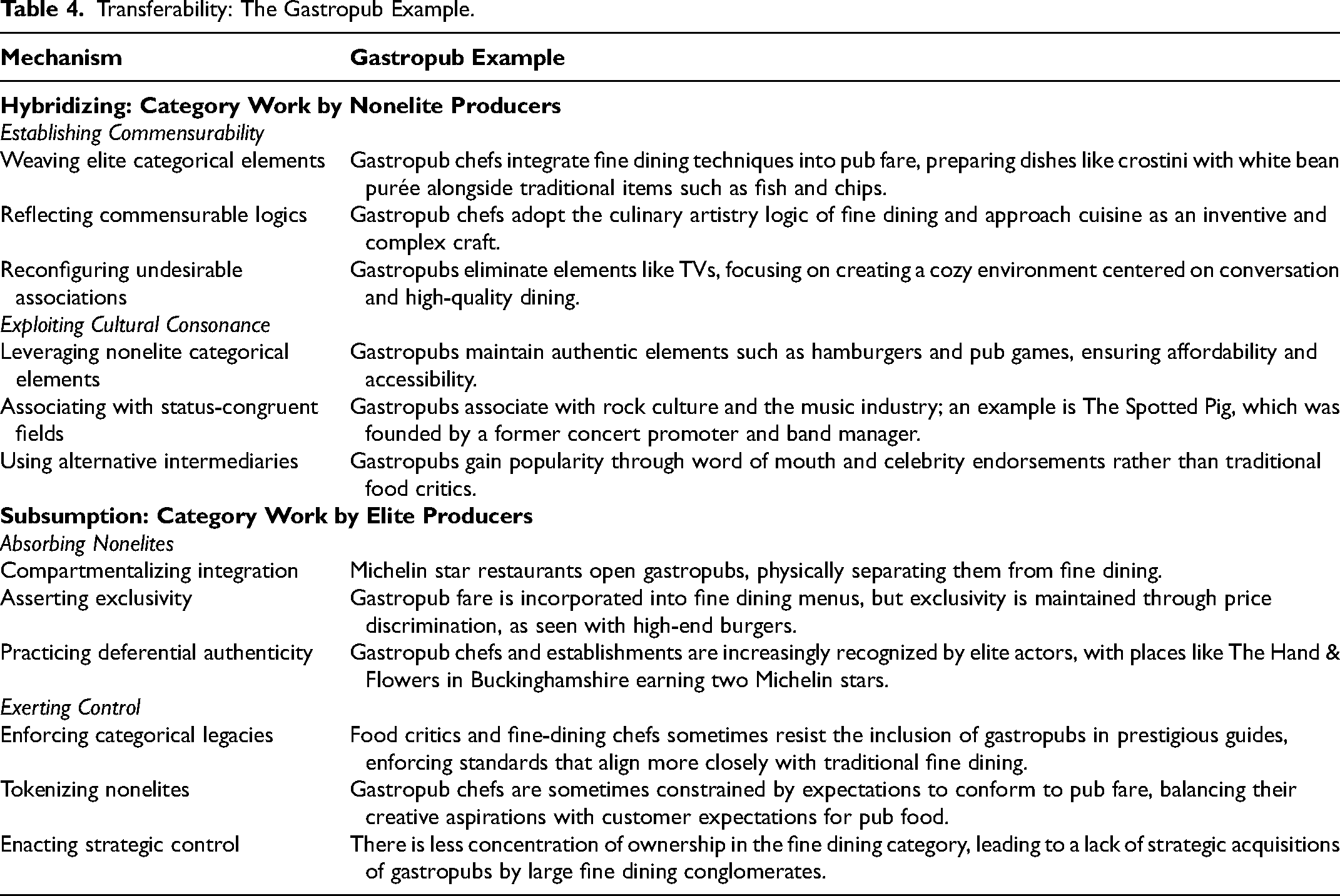
However, categorical hybridization may not always allow nonelite producers to gain status. I identify five boundary conditions that are important for transferability. First, the nonelite category should possess cultural consonance. Without it, nonelites may struggle to generate appeal for the hybrid category. If elite status is not conferred on some cultural ground, cultural consonance may not be necessary. Future research may endeavor to identify alternative drivers of elite status that support categorical hybridization.
Second, some elite actors must stand to benefit from the creation and elevation of the hybrid category. These benefits could be cultural, such as renewed cultural consonance, or economic, such as improved profitability. For example, whereas high fashion houses embraced the hybrid category because it helped renew their cultural consonance, luxury fashion retailers likely did so because it helped their bottom lines. Hence, nonelite actors could employ the different logics that structure organizational action in the market to generate support for their category-creation efforts. Support from elite actors may also be linked with the life cycle of the elite category (Suarez, Grodal, and Gotsopoulos 2015). These alternatives represent future research avenues.
Third, nonelite categories are more likely to be subsumed by elites if they show some compatibility, which provides coherence between categories (Cappetta, Cillo, and Ponti 2006). In the case of luxury streetwear, elite category actors potentialized the creation of the hybrid category by heightening compatibility during cooptation. A nonelite category coopted by elite ones is likely positioned for categorical hybridization, while one lacking compatibility with an elite category might evolve in parallel or in resistance to the elite category (e.g., Khaire 2014; Khaire and Wadhwani 2010). Future work may examine other factors that increase compatibility.
Fourth, both the nonelite and elite categories should be well-institutionalized, with clear boundaries, established actors, and a recognized history (Zucker 1977). For the nonelite category, institutionalization should provide stability and a critical mass of producers to support hybridization and subsequent status gains. Outcomes may differ if an elite category is more recent or is experiencing destabilization. For example, in the absence of institutionalization of the elite category, a hybrid category could supplant an elite one, or elite actors might be less welcoming and perform boundary work to first institutionalize their category.
Fifth, although not a boundary condition per se, windows of opportunity likely exist. I identified two catalysts in my findings: luxury's crisis of exclusivity (Thomas 2007) and a shift in elite tastes toward authenticity (Johnston and Baumann 2007). These context-specific facilitating conditions seem transferable to some contexts, such as gastropubs and fine dining. Other catalysts may exist. The case of nouvelle cuisine provides an example: The May 1968 revolts in France brought a general dislike for hierarchy and traditions, giving rise to changes in the arts, cuisine, literature, and film (Rao, Monin, and Durand 2003). Importantly, in some cases, nonelites might engage in only some of the mechanisms I identified, which could limit their potential for status gains. Future studies should examine these ambiguous situations.
Actors Working Together to Shape Markets
My theorization of how nonelite producers can gain access to an elite category brings into focus their collective work in instigating market changes and how their roles evolve, informing our conception of collective market driving and the role of producers in shaping markets.
First, the types of category work I identify represent a form of collective action: “situations … in which a group of actors have an interest in the construction of a collective good … which cannot easily or fully be withheld from others” (Lee, Struben, and Bingham 2018, p. 243). I compare this approach with work on collaborative market driving (Maciel and Fischer 2020). Collective and collaborative market driving represent two distinct yet related approaches that firms can take to transform markets when they individually lack the resources to drive change. Collective market driving produces fragmented progress toward a common goal. It may solely require producers to work toward constructing a collective good, such as market infrastructure (e.g., a new category), without direct or intentional collaboration (Lee, Struben, and Bingham 2018). Peer firms recognize common constraints but continue to operate largely individually, privileging self-interest over collaboration with competitors, and market shaping results from the firms’ separate visions and resources. By contrast, collaborative market driving involves formal coordination and extensive collaboration among peer firms, where producers with a shared vision and cause jointly strategize and cooperate through ongoing economic and political efforts that increase their joint competitiveness (Maciel and Fischer 2020). They pool resources and cohesively transform market structures, behaviors, and preferences. Suprafirms such as trade associations help mobilize and coordinate resources and action (Maciel and Fischer 2020).
Second, prior work has tended to portray producers as taking on a single role in driving a market, that is, either “defensive” or “offensive” intentions (Flaig, Kindström, and Ottosson 2021). By contrast, my theoretical insights propose that producers may jointly participate in market change and maintenance. Nonelite producers such as Virgil Abloh and elite producers such as Louis Vuitton took on dual roles, acting as both defenders of the status quo and agents of change. While nonelite producers strived for change and, when successful, were recruited to reproduce status dynamics, elite producers initially aimed to defend their category's boundary and then participated in change efforts as it benefited them. This paints a more complex picture of how producers of different statuses adapt to and participate in market transformations. It also suggests that some nonelite market actors may paradoxically gain status despite the maintenance of the status hierarchy.
Future research should explore these key conceptual distinctions. For example, studies could examine when nonelite producers should adopt collective versus collaborative market driving or how they can combine these two approaches into different patterns over time. Research could also explore how producers may strategically combine their roles as defenders of the status quo and agents of change to maintain their competitive advantage or drive market transformations.
Value Capture by Elites
Elite producers are remarkably effective at maintaining their status. Cooptation has been identified as a key mechanism by which elite producers maintain their cultural resonance and adapt to changes in consumer preferences (Bellezza 2023; Lockwood, Glynn, and Giorgi 2023). However, cooptation is problematic in today's consumer culture due to potential concerns about authenticity threats and cultural appropriation (Cruz, Seo, and Scaraboto 2024; Thompson and Coskuner-Balli 2013).
My work shows that subsumption allows elites to concomitantly rejuvenate cultural consonance and defend the symbolic boundary separating them from nonelites, contributing to explaining how they renew their status. Importantly, in the fashion context, subsumption worked effectively where cooptation did not. I propose that this is because subsumption provides the allure of social progress and authentic status signals, thus addressing the potential issues associated with cooptation. Rather than outrightly appropriating streetwear work, subsumption seemingly elevated nonelite producers and gave the illusion that they had transformative power. The celebratory discourses about how streetwear disrupted high fashion's hierarchy and race dynamics reflect this interpretation (e.g., Vogue, Phelps 2018; i-D, Salter 2018; British Vogue, Singer 2018). Thus, subsumption may be yet another tool that elites can use to ensure the endurance of their status, as it acts as a market-based form of elite capture—or how “projects can be hijacked … by the well positioned and resourced” when institutions fail to address the unequal distribution of resources and privilege the already privileged (Táíwò 2020).
Still, in the fashion context, subsumption had clear beneficial outcomes for the nonelite producers who accessed the elite category, highlighting the complex dynamics of status gains. While subsumption created a ladder for a select group of notable nonelites, it also hid the reproduction of power dynamics. By integrating some nonelites, high fashion producers positioned themselves as progressive and inclusive. Yet, they did little to create more equitable power structures or improve conditions for the nonelites more generally associated with streetwear. In the remainder of this article, I expand on how nonelites may further materialize status gains and, potentially, enact more equitable changes to market structures.
How Can Nonelite Producers Counter Elites’ Subsumption Efforts?
The types of category work through which elites perform subsumption offer avenues for nonelites to further benefit from categorical hybridization. For each type I introduced in the findings, I offer a countertype that may provide greater status mobility and inclusion for nonelites. Table 5 summarizes these countertypes and provides brief examples. Web Appendix J offers supporting evidence.
Recommendations for Nonelites to Productively Respond to Elites’ Category Work.
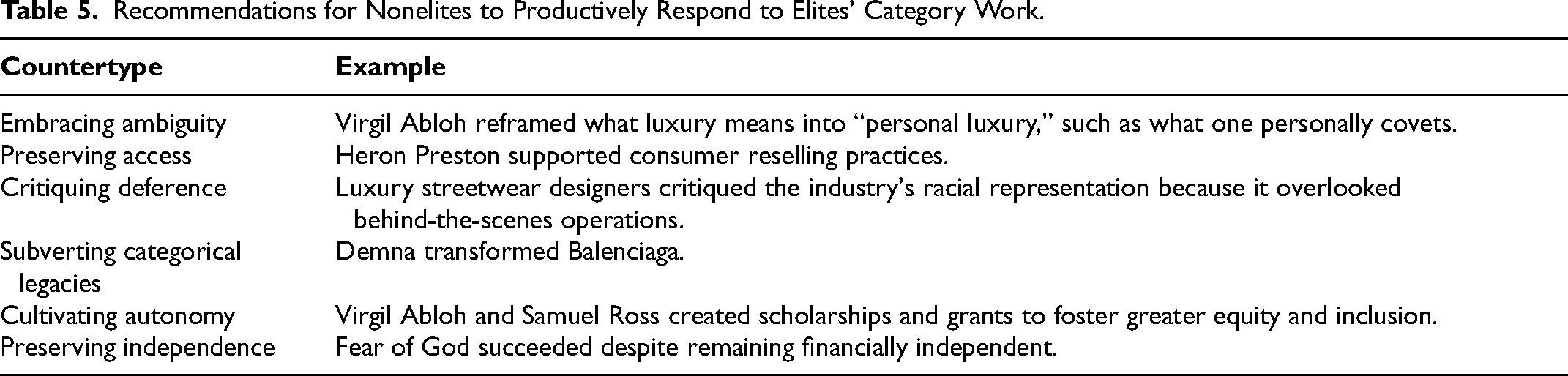
Embracing ambiguity
To counter compartmentalized integration, nonelites can embrace ambiguity and challenge categorical demarcation. Nascent hybrid categories are ambiguous and have fuzzy boundaries because they bridge divergent elements (Chliova, Mair, and Vernis 2020). By undermining the categorical imperative, ambiguity in interpretations and meanings increases possibilities for action (Casasnovas and Ferraro 2022). Nonelites could use these possibilities to blur distinctions between themselves and elite producers, creating proximity with elites, gaining visibility, and exploiting cultural consonance. They could also highlight hybridity to question strict eligibility criteria for the elite category and push the boundaries of what is understood as luxury in high fashion. As my findings show, when successful, this bridging of categorical boundaries incrementally stretches perceptions of what belongs in the elite category.
Preserving access
Elites’ assertions of exclusivity protect the symbolic boundary with nonelites. In fashion, asserting exclusivity is partly related to wealth and is enacted through pricing strategies. To counter this, nonelites can work toward preserving access. In stark contrast to high fashion brands, a core feature of hybrid actors is their close and authentic relationships with nonelite consumers, which they could emphasize and leverage by introducing alternative markers of exclusivity to counter pricing barriers (Bellezza 2023). For example, nonelites could use limited runs and difficulty of access to prized products as exclusivity markers, shifting what bestows elite status. They could also support consumer practices, such as reselling, that address price barriers and facilitate the entry of nonelite consumers.
Critiquing deference
Deferential authenticity suggests that nonelites may hold some authenticity-based advantages through access to forms of cultural capital that elites do not possess. At first glance, deference may seem beneficial for nonelites. However, it facilitates elites’ capture of value by easing their responsibility for participating in the systemic reproduction of power imbalances (Tilton and Toole forthcoming). To critique deferential authenticity, nonelites can engage in consciousness-raising efforts to highlight the complexities associated with the power imbalances inherent to the practice, point out inconsistencies or biases, and start critical conversations about this seemingly inclusive strategy.
Subverting categorical legacies
To counter elites’ enforcement of categorical legacies, nonelites can subvert brand heritage to increase strategic autonomy. Brand longevity demands a balance between continuity and change, where “internal elements of the brand heritage” are reconfigured to ensure the brand's “evolution in line with external sociocultural contexts” (Preece, Kerrigan, and O’Reilly 2019, p. 345). Over time, nonelites can manage this balance to their advantage by practicing nested coupling (Dolbec et al. 2022). Specifically, they can identify the core heritage elements that elites exploit to enforce categorical legacies and gradually transform these elements by blending them with nonelite elements, redefining what is considered core heritage. Elite brands that embrace the commercial logic may be more open to change if it leads to financial success (see Dolbec et al. 2022).
Cultivating autonomy
To counter elites’ efforts to restrict nonelites’ agency, nonelites can cultivate autonomy through collective capacity building (Harris 2011) to obtain, develop, and retain skills, knowledge, connections, and other resources for success. Collective capacity building would likely require funding, training programs, mentorship initiatives, workshops, and other collective support systems and potentially need endorsements from established and notable nonelites. By equipping other nonelites with the means to actively participate, manage resources, and promote accountability, nonelites could mitigate elite capture by increasing the volume and distribution of resources.
Preserving independence
Last, to counter elites’ efforts toward strategic control, nonelites could try to preserve their independence. This may entail only allowing minority investments by elites and ensuring through contractual agreements that financial investments do not affect creative autonomy. Nonelites may also explore funding opportunities outside of their focal markets, such as partnering with investors from related industries (e.g., technology or entertainment for fashion), to mitigate elites’ strategic control efforts.
Like the category work underlying hybridization, these countertypes are more likely to be effective when performed collectively. In the context of luxury streetwear, while collective action may have facilitated subsumption by lowering elites’ perception of threats, it might also have reduced the collaborative power wielded by nonelites. I see potential for nonelites to move from a collective to collaborative approach to market driving by grouping around the prevailing ethos that all should benefit from reshaping the market (Maciel and Fischer 2020).
Market structures are important mediators of access to opportunities. While addressing systemic power imbalances would demand greater institutional change, theorizing how nonelites can access an elite category offers tools to promote more inclusive economic participation and address elite value capture. In addition to greater market equity, such efforts may enhance competition and encourage innovation and growth, creating a more resilient economy.
Supplemental Material
sj-pdf-1-mrj-10.1177_00222437251314372 - Supplemental material for From Streetwear to High Fashion: How Nonelite Producers Use Hybridization to Enter an Elite Category
Supplemental material, sj-pdf-1-mrj-10.1177_00222437251314372 for From Streetwear to High Fashion: How Nonelite Producers Use Hybridization to Enter an Elite Category by Pierre-Yann Dolbec in Journal of Marketing Research
Footnotes
Acknowledgments
The author thanks Zeynep Arsel, Joel Bothello, Rodrigo Castilhos, Eileen Fischer, Markus Giesler, Robert V. Kozinets, Marie-Agnès Parmentier, Marcus Phipps, and Anissa Pomiès for their comments on versions of the manuscript.
Coeditor
Rebecca Hamilton
Associate Editor
Julie Ozanne
Declaration of Conflicting Interests
The author declared no potential conflicts of interest with respect to the research, authorship, and/or publication of this article.
Funding
The author disclosed receipt of the following financial support for the research, authorship, and/or publication of this article: This work was supported by the Social Sciences and Humanities Research Council of Canada (grant number 430-2016-00446) and by Concordia University.

References
Supplementary Material
Please find the following supplemental material available below.
For Open Access articles published under a Creative Commons License, all supplemental material carries the same license as the article it is associated with.
For non-Open Access articles published, all supplemental material carries a non-exclusive license, and permission requests for re-use of supplemental material or any part of supplemental material shall be sent directly to the copyright owner as specified in the copyright notice associated with the article.
