




Abstract
Although food waste is an urgent issue with widespread economic, societal, and environmental impacts, it remains understudied in the marketing discipline. This is surprising, since most food waste occurs at the retail and consumption stages of the food life cycle. This research fills this gap by examining how resource mindset and self-construal jointly shape consumer food waste. Specifically, inducing a scarcity mindset signals that there is no resource to waste, mitigating consumer food waste regardless of self-construal. In contrast, under an abundance mindset, where there is resource to waste, activating an interdependent (vs. independent) self-construal can effectively reduce consumer food waste. The authors identify sharing obligation, the tendency to share valuable resources with in-groups, as a key mechanism behind the effect. In support of this mechanism, enhancing sharing obligation (e.g., highlighting the sharing concept, highlighting others’ food needs) or diminishing it (e.g., highlighting family resource abundance) attenuates the effect of self-construal on consumer food waste under an abundance mindset. The results from one large-scale field study, four controlled experiments, and a country-level secondary data analysis provide convergent support for the proposed framework. This research not only contributes to the related literature but also provides actionable strategies for mitigating consumer food waste.
Consumer food waste is one of the most urgent issues of the century. Globally, consumers waste approximately one-third of the food produced for human consumption (Gustavsson et al. 2011), an approximate total of 1.3 billion tons of food/year or 185 kg per capita (Graham-Rowe, Jessop, and Sparks 2014). Wasting food not only results in a monetary loss of approximately $1,500 per U.S. household annually (Block et al. 2016) but also causes serious societal and environmental problems. On the demand side, food waste adds to food price inflation and makes foods less accessible to consumers in impoverished countries (Stöckli, Niklaus, and Dorn 2018). On the supply side, food waste comprises more than a quarter of total freshwater consumption and uses 300 million barrels of oil/year in the United States (Stancu, Haugaard, and Lähteenmäki 2016). From an environmental standpoint, the decomposition of wasted food in landfills generates approximately 20% of the world's total greenhouse gas emissions (Schanes, Dobernig, and Gözet 2018).
Given that most food waste occurs at the retail and consumption stages of the food life cycle, it is surprising that this issue remains understudied in the marketing literature (cf. Mookerjee, Cornil, and Hoegg 2021; Williamson, Block, and Keller 2016). Accordingly, leading marketing scholars advocate for more research on food waste to help understand the psychological mechanisms that drive consumer food waste behavior (Block et al. 2016; Porpino 2016; Van Doorn 2016). With an enriched understanding of this issue, marketers can take actions to mitigate consumer food waste, which can not only decrease a company's operation costs (e.g., a reduced need to clean up leftovers in restaurants) but also boost its environmental social governance image.
This research examines how self-construal and decision context jointly shape consumers’ food waste behavior. Specifically, we propose that when contextual factors facilitate an abundance mindset or make the concept of resource abundance (e.g., time, money, assets) salient in consumers’ minds, food waste is shaped by their self-construal. For consumers who view themselves as separate from others (i.e., independent self-construal, or independents; Markus and Kitayama 1991), having abundant resources simply means the affordability of wasting some resources, including food. However, for consumers who view themselves as closely connected with others (i.e., interdependent self-construal, or interdependents; Markus and Kitayama 1991; White, Argo, and Sengupta 2012), having abundant resources means something different. Given their strong commitment to group welfare over that of their own (Gardner, Gabriel, and Lee 1999; Oyserman, Coon, and Kemmelmeier 2002), interdependents feel a strong obligation to share their abundant resources with in-groups rather than waste the resources, resulting in relatively less food waste. In contrast, when contextual factors activate a scarcity mindset or make the concept of resource scarcity salient in their mind, consumers, regardless of their self-construal, should waste less food, as there is no resource to waste in the first place.
Through a field experiment (N = 10,317), four controlled experiments (N = 1,345), a country-level secondary analysis (N = 63), and two supplementary studies reported in Web Appendix A (Studies WA1 and WA2; N = 600), we provide converging support for our theory that inducing an interdependent self-construal under an abundance mindset or activating a scarcity mindset regardless of one's self-construal can effectively mitigate consumer food waste. More importantly, we identify sharing obligation as the mechanism underlying the food waste mitigation. Affirming this sharing obligation mechanism, which is only applicable under an abundance mindset or when there is resource to share in the first place, we demonstrate that increasing sharing obligation by activating the sharing concept or highlighting others’ food needs reduces food waste among independents. In contrast, decreasing sharing obligation by highlighting family resource abundance (i.e., no need to share with in-groups anymore) increases food waste among interdependents.
In doing so, we contribute to the understudied topic of food waste from a marketing perspective by identifying interdependent self-construal and scarcity mindset as contributors to consumer food waste mitigation. In addition to providing causal evidence for the proposed effects, we reveal sharing obligation as a new mechanism through which self-construal impacts consumer behavior. We also contribute to the resource mindset literature by explicitly and systematically showing that activating a scarcity mindset can produce a benevolent consequence in terms of mitigating consumer food waste. Practically, our research provides useful marketing guidelines to mitigate consumer food waste. By developing a set of actionable marketing interventions based on self-construal, resource mindset, and sharing obligation, our research has profound implications for effectively designing marketing communications and restaurant decor to mitigate consumer food waste at the consumption stage.
Theoretical Development
Consumer Food Waste
We define consumer food waste as the discarding of any foods produced for human consumption while the foods are still edible (Stancu, Haugaard, and Lähteenmäki 2016). Specifically, we focus on the unnecessary waste of leftovers, such as unfinished meals. Although consumers are inherently waste averse (Bolton and Alba 2012), food waste is pervasive. Thus, it is theoretically interesting to study what factors drive consumer food waste and, more importantly, what actionable interventions could be developed based on the identified factors (Block et al. 2016; Porpino, Wansink, and Parente 2016). In the scope of our research, food waste mitigation focuses on properly storing leftovers to consume later while they are safe to eat. Thus, food waste mitigation does not entail consuming unsafe food or overeating, which may lead to health-related issues such as obesity (Raghunathan and Chandrasekaran 2021).
Regarding the antecedents of food waste, prior correlational research has examined how consumer demographics (e.g., age, gender, education level, household size, income; Aschemann-Witzel et al. 2015; Quested et al. 2013), attitudes and social norms (Hamerman, Rudell, and Martins 2018), financial and environmental concerns (Graham-Rowe, Jessop, and Sparks 2014; Watson and Meah 2012), and shopping and cooking habits (Visschers, Wickli, and Siegrist 2016) impact consumer food waste (for more extensive reviews, see Block et al. [2016], Porpino [2016], and Schanes, Dobernig, and Gözet [2018]).
From a marketing-relevant perspective, research has shown that sales promotions (e.g., buy one, get one free; Ellison and Lusk 2018), large packages (Qi and Roe 2016; Quested et al. 2013), inaccurate expiration dates (Watson and Meah 2012), and low food prices (Ellison and Lusk 2018; Hebrok and Boks 2017) induce overacquisition and thus more food waste. In addition, consumers who use larger (vs. smaller; Van Ittersum and Wansink 2012) or disposable (vs. nondisposable; Williamson, Block, and Keller 2016) plates are more wasteful in buffet settings.
For consumers, cognitive, social, and perceptual factors can also contribute to food waste. Cognitively, consumers are inherently biased when estimating food inventory, which leads to foods being forgotten or spoiled (Chandon and Wansink 2006). Socially, consumers may consider saving leftovers to be embarrassing, especially in public settings, which may prompt them to discard the leftovers (Hamerman, Rudell, and Martins 2018). Perceptually, when consumers perceive leftovers to be trivial, they are more likely to throw them away (Huang et al. 2019). In this research, we advance the related literature by examining how a contextual factor (i.e., resource mindset) and self-construal jointly impact consumers’ food waste decisions. Next, we elaborate on how and why this should be the case.
Resource Mindset and Consumer Food Waste
According to the mindset literature (Xu and Wyer 2007), when a concept or procedure is activated in one context, it will remain salient and induce a mindset that will impact decision making in a subsequent context. Importantly, a mindset concerns general rather than specific concepts. Applying mindset theory to consumer resources, researchers proposed a resource mindset to describe how an activated resource-related concept (abundance vs. scarcity) impacts subsequent consumer decision making (Mehta and Zhu 2016; Zhu and Ratner 2015). Specifically, an abundance (vs. scarcity) mindset describes a situation in which the concept of abundant (vs. scarce) resources is activated in a consumer's mind, which in turn shapes the consumer's responses to any decision contexts that are related to resources. According to the resource mindset, any contexts that trigger the perception of sufficient (vs. insufficient) resources, including money, time, or product availability (Cannon, Goldsmith, and Roux 2019), will activate a general mindset of abundance (vs. scarcity; Zhu and Ratner 2015). The activated resource mindset will impact subsequent related or seemingly unrelated decisions. For instance, Mehta and Zhu (2016) activated a scarcity (vs. abundance) mindset with either product (a context related to product usage) or financial resources (a context unrelated to product usage) availability, both of which increased consumers’ creativity in product usage in a subsequent task. Accordingly, in this research, we activate an abundance (vs. scarcity) mindset with either food-related (e.g., perception of food amount in Study 1) or food-unrelated (e.g., overall living condition in Study 2 or financial resources in Studies 5 and 6) resource contexts, which will impact consumer food waste in subsequent decision contexts.
Specifically, we argue that resource mindset is a precondition for food waste. When a scarcity mindset is activated, consumers are unlikely to waste food or other resources, as there is no resource to waste in the first place. Consistent with this prediction, prior research has shown that a scarcity (vs. abundance) mindset enhances consumers’ perceived value of a product (Cialdini 2008; Sevilla and Redden 2014). Relatedly, consumers with a scarcity (vs. abundance) mindset are more likely to stretch their resources for more efficient use (Fernbach, Kan, and Lynch 2015; Hamilton et al. 2018; Shah, Mullainathan, and Shafir 2012). Along the same lines, economic research has shown that impoverished people (Graham-Rowe, Jessop, and Sparks 2014) or people who prioritize saving money (Watson and Meah 2012)—who presumably hold a scarcity mindset (Cannon, Goldsmith, and Roux 2019)—waste less food. Indeed, Van den bos Verma et al. (2020) showed that people with a daily expenditure lower than $6.70 tend not to waste food at all. These findings suggest that a scarcity mindset inhibits food waste.
We argue that, in contrast to the role of a scarcity mindset, an abundance mindset serves as a necessary yet insufficient condition for food waste. In other words, although an abundance mindset allows for food waste by indicating that consumers have plenty of resources to be wasteful, consumers have the choice to waste food or not. In support of this proposition, prior research has shown that although developed countries (i.e., where an abundance mindset is prevalent) on average waste more food than less developed countries (i.e., where a scarcity mindset is prevalent), there are large variances among developed countries with regard to food waste (Graham-Rowe, Jessop, and Sparks 2014; Thyberg and Tonjes 2016). Relatedly, empirical research within developed countries such as Canada, the United Kingdom, and the United States has shown mixed findings regarding the relationship between income and food waste (Hebrok and Boks 2017; Schanes, Dobernig, and Gözet 2018). These findings imply that when consumers are in an abundance mindset, something besides the availability of resources influences food waste behavior.
The question then becomes when consumers have the resources to waste (i.e., in an abundance mindset), what factors may impact their tendency to do so? Answering this question is critical for both marketers and public policy makers who aim to tackle the issue of consumer food waste. On the one hand, consumers in developed countries tend to hold a default mindset of abundance (Zhu and Ratner 2015) and are responsible for most food waste (Gustavsson et al. 2011). On the other hand, in emerging markets and developing countries, the growing middle class also tends to hold an abundance mindset and waste a large amount of food (Porpino, Wansink, and Parente 2016). Thus, understanding what strategies could be used to reduce food waste among these consumers will effectively contribute to food waste mitigation. In the next section, we address this critical issue by examining the role of self-construal.
The Role of Self-Construal
Self-construal refers to whether people see themselves as separate from or connected with others (Markus and Kitayama 1991). Specifically, people with an independent self-construal (independents) emphasize their own free will and distinctiveness from others, whereas those with an interdependent self-construal (interdependents) are oriented toward maintaining harmony and connectedness with others (Aaker and Lee 2001; Lalwani and Shavitt 2013). Self-construal manifests at both the cultural (e.g., individualism/collectivism) and individual (Lalwani and Wang 2019; Winterich and Barone 2011; Wu, Moore, and Fitzsimons 2019) levels. Importantly, given the malleable nature of self-construal, a specific (interdependent vs. independent) aspect of self-construal can also be situationally activated within the same individual. Thus, developing actionable marketing interventions to trigger a specific type of self-construal among target consumers is highly feasible and effective (Aaker and Lee 2001; Hamilton and Biehal 2005; Ma, Yang, and Mourali 2014; Ng and Houston 2009; Zhang, Feick, and Price 2006).
In this research, we propose that self-construal interacts with resource mindset to jointly impact food waste. Interdependents view group membership as well as the entailed relationships as permanent, fixed facts of life that are indefinitely obligating (Chen et al. 2018; Oyserman, Coon, and Kemmelmeier 2002). Thus, interdependents tend to feel a strong group bond and obligation to help in-group members in need (Gardner, Gabriel, and Lee 1999; Winterich and Barone 2011). They are willing to sacrifice their own valuable resources, even their lives, to help close others or benefit their group (Triandis 1995; Zhu and Meyers-Levy 2009). Due to such mutual obligations to help each other, interdependents (e.g., Chinese individuals) are also confident that in the event of financial losses, their in-group members (e.g., family and friends) would provide them with the necessary help, which serves as a buffer during crises (Hsee and Weber 1999; Mandel 2003). In contrast, independents are relatively more concerned with their autonomy, self-reliance, and self-enhancement than with others’ needs or helping others (Jain, Desai, and Mao 2007; Krishna, Zhou, and Zhang 2008; Winterich, Mittal, and Ross 2009).
Drawing on interdependents’ obligations to help in-groups, we propose that when they are in an abundance mindset, which means they have more resources than they can use, interdependents (vs. independents) feel a strong obligation to share what they have with their family, friends, and close others. In this research, we call this the sharing obligation, referring to individuals’ internal belief that they should not keep all the resources to themselves but instead should share the resources with their in-groups. Furthermore, when consumers feel obliged to share their resources, they should be less likely to waste their resources, including food. Thus, we expect interdependents to show a stronger sharing obligation than independents when an abundance mindset is activated, which in turn should lead to less food waste.
What happens when a scarcity mindset is activated? In this case, consumers recognize that they do not have enough resources even for themselves (Sevilla and Redden 2014; Zhu and Ratner 2015). Under such circumstances, people tend to choose to preserve the self rather than share limited resources with others (Cialdini 2008), resulting in lower intention to help in-groups among both independents and interdependents (Oyserman, Coon, and Kemmelmeier 2002; Winterich, Mittal, and Ross 2009). In other words, under a scarcity mindset, we expect both independents and interdependents to show relatively low levels of sharing obligation. Furthermore, given that the low level of sharing obligation is due to a lack of resources, they should exhibit less food waste because they have no resource to waste in the first place. Combining the previous discussions, we hypothesize the following:
Notably, our proposed sharing obligation construct applies to the general readiness and willingness to share many different types of resources. Thus, it is different from the narrower concept of sharing food with someone else (Lazell 2016). In other words, the sharing obligation triggered by an interdependent self-construal due to resource abundance reduces the waste of various resources, including food, our focal interest. Under an abundance mindset, there are available resources (e.g., money, time, products, food) for interdependents to share and for independents to waste. Under a scarcity mindset, given that no resource is available to share or waste, consumers tend to show lower sharing obligation and less food waste regardless of self-construal.
Theoretically Motivated and Practically Actionable Moderators
Going beyond examining the joint effect of self-construal and resource mindset on consumer food waste, this research also aims to provide practically actionable interventions to mitigate food waste. In identifying the potential interventions based on our proposed mechanism of sharing obligation, we only focus on conditions that activate an abundance mindset for three primary reasons. First, there is no need for interventions to mitigate food waste in conditions that activate a scarcity mindset, given that food waste is already unlikely in this case. Second, the mediating effect of sharing obligation only manifests under an abundance mindset. Third, given that our samples for testing these moderating effects exclusively target Americans, whose default mindset is abundance (Zhu and Ratner 2005; Web Appendix A), eliminating the scarcity mindset condition simplifies the experimental design and facilitates the execution of the studies. Following this logic, we propose three theoretically motivated and practically actionable interventions that mitigate consumer food waste under a default or activated abundance mindset by either directly or indirectly altering sharing obligation to different levels.
Salience of the sharing concept
One direct way of enhancing sharing obligation is to make the concept of sharing salient in one's mind. According to our theory, sharing obligation arises naturally among interdependents (Hsee and Weber 1999; Oyserman, Coon, and Kemmelmeier 2002). However, it is not a spontaneous reaction for independent individuals; instead, it requires external activation. Thus, making the sharing concept salient and accessible will increase sharing obligation among independents but not among interdependents, who are naturally obliged to share even without an external reminder. As a result, highlighting the sharing concept should attenuate the effect of self-construal on consumer food waste under an abundance mindset because independents with a boosted sharing obligation should waste less food, similar to their interdependent counterparts. Formally, we hypothesize the following:
Salience of others’ food needs
An indirect way of activating sharing obligation is to highlight the needs of others. Interdependents tend to have a stronger sharing obligation because they are more sensitive to others’ needs (Wu, Moore, and Fitzsimons 2019). Their constant monitoring of others’ needs, desires, and goals (Oyserman, Coon, and Kemmelmeier 2002) drives them to show greater concerns for their in-group members than for their self-interest (Chen et al. 2018; Hong and Chang 2015). In contrast, independents tend to focus more on self-enhancement and autonomy (Zhu and Meyers-Levy 2009), which drives them to be less concerned with others’ needs or pay less attention to others’ desires (Winterich and Barone 2011; Zhang, Feick, and Mittal 2014). Accordingly, highlighting others’ needs, especially their need for food (e.g., highlighting the population in hunger), should trigger a relatively stronger sharing obligation among independents and consequently reduce their food waste. Formally,
Salience of family- versus self-resource abundance
If enhancing independents’ sharing obligation directly or indirectly attenuates our proposed effect, it follows that highlighting others who do not need external aid would also attenuate our proposed effect, though in a different direction to reduce interdependents’ sharing obligation. When interdependents realize that their in-groups also have abundant resources and thus do not require external aid, they should feel less obliged to share their valuable resources. In other words, when an abundance of family resources is made salient, interdependents’ sharing obligation should be reduced to a quasi-independent level. In this case, interdependents should show a higher level of food waste, similar to that of their independent counterparts. Formally, we hypothesize the following:
Next, we present six main studies (plus supplementary studies in Web Appendix A and pretests or posttests reported in Web Appendices) to test our framework (Figure 1). Study 1 provides preliminary tests for H1 in a restaurant setting, where we manipulated both self-construal and resource mindset in subtle and realistic manners and measured the actual amount of consumer food waste. The field setting plus the consequential behavioral measure grant high external validity to our findings. In Study 2, we used a controlled experiment to provide a causal test for H1. More importantly, we measured sharing obligation to test H2 regarding the underlying mechanism. In a supplementary study (Study WA1), we further ruled out several alternative explanations. After establishing that consumers in developed countries have an abundance mindset by default (Studies WA2, WA3, and WA4), in Studies 3, 4, and 5, we tested the proposed moderators to not only provide further support for the mechanism of sharing obligation but also offer practically actionable solutions to mitigate food waste among consumers with a default abundance mindset. Specifically, the results show that highlighting the concept of sharing (H3), highlighting the food needs of others (H4), and highlighting the abundance of family resources (H5) all attenuate the effect of self-construal on consumer food waste under resource abundance. Finally, Study 6 corroborates our core proposition with country-level secondary data from multiple sources.

The Overall Theoretical Framework.
Study 1: Field Evidence from a Restaurant
The purpose of Study 1 is to provide a preliminary test for H1 in a field setting. Importantly, by manipulating both self-construal and resource mindset in subtle ways within a real restaurant context, we aim to create actionable marketing interventions that could be easily adopted by marketers and public policy makers to mitigate consumer food waste.
Method
We collected the data from a restaurant in China for this field experiment, which adopted a 2 (self-construal: independent vs. interdependent) × 2 (resource mindset: scarcity vs. abundance) between-subjects design. During a four-month period (November 1 to December 31, 2019, and May 1 to June 30, 2020), a total of 10,317 observations were recorded (the data collection was suspended between the two periods due to the outbreak of COVID-19).
We employed subtle yet actionable operationalizations for self-construal and resource mindset. Specifically, we manipulated self-construal with a print ad placed on food trays (Web Appendix B). The ads in the independent and interdependent conditions had similar designs with only one difference: in the independent condition, the slogan highlighted “individualism” and declared, “I enjoy great food by myself,” while in the interdependent condition, the slogan highlighted “collectivism” and proclaimed, “We enjoy great food together.” A posttest reported in Web Appendix B showed that this self-construal manipulation was successful.
To manipulate resource mindset, we altered the sizes of plates following Zhu and Ratner (2015). Specifically, consumers in the abundance condition received their main dish on a relatively small plate (diameter: 22 cm/8.7 in), whereas those in the scarcity condition received their main dish on a relatively large plate (diameter: 28 cm/11 in; Web Appendix C). Given that the serving sizes of all the main dishes were similar and that consumers usually ordered only one main dish per visit, a larger plate should activate the feeling of scarcity due to the perception of emptiness, while a smaller plate should activate the feeling of abundance due to the perception of fullness (Zhu and Ratner 2015). A posttest reported in Web Appendix C verified the effectiveness of plate size as an indirect manipulation of resource mindset.
The restaurant was running in a typical fast-food restaurant mode, and the procedure of the study was as follows. First, each consumer took a tray of their own with one of the self-construal manipulation ads preplaced on the tray based on random assignment. Next, consumers ordered their food and drinks at the counter. The cashier taking the order wrote the order number onto the self-construal ad and printed two receipts: one to give the consumer and the other to be taped on the back of the tray. Then, the consumers received the food they ordered and sat at a table of their choice. Finally, after the consumers finished dining and left the table, the server cleaning the table recorded the following information:
The ad on the tray, recorded as “we” (interdependent self-construal) or “I” (independent self-construal); The plate size of the main dish, recorded as small (activating an abundance mindset) or large (activating a scarcity mindset); The total amount of food waste recorded in grams (0 g to 839 g; M = 252.38 g, SD = 225.38). The server poured all the food leftovers (but not drink leftovers) from the tray onto a scale and recorded the number observed. If there were no leftovers due to consumers finishing all the food or taking the leftovers home, we assumed no food waste and recorded a 0. Confirming this assumption, we conducted a posttest (N = 58), in which 100% of respondents from the same population as in the field experiment reported that they would eat the packed leftovers later at home rather than discard the packed leftovers; The total amount in RMB paid on the receipt. It was important to measure the total amount paid because consumers had the freedom to order any amount of food they preferred. Although most consumers tended to order only one main dish, the number of side dishes ordered could vary significantly from one consumer to another. By including the bill amount in our analysis, we controlled for the variance in food waste driven by the amount of food initially ordered; and The date of the visit, which allowed us to include two additional covariates: whether the visit occurred before (November to December 2019) or after (May to June 2020) the outbreak of COVID-19, and the temperature of the day given that temperature may affect appetite and food intake (Mandic et al. 2019).
Results
To test H1, we conducted a full-factorial analysis of covariance on the food waste amount with plate size (as a trigger of resource mindset), self-construal, and their interaction as the independent variables. We also controlled for the bill amount, daily temperature, and period. The results indicated that among the control variables, only the effect of period was significant (Mprepandemic = 231.76 g, SD = 222.63 vs. Mwithin pandemic = 289.34 g, SD = 225.56; F(1, 10,310) = 31.90, p < .001). The main effect of self-construal was not significant (F(1, 10,310) = 1.04, p = .309). The main effect of plate size (resource mindset) was significant (F(1, 10,310) = 41.35, p < .001): those who received a small plate (inducing an abundance mindset) wasted significantly more food than those who received a large plate (inducing a scarcity mindset; Msmall plate = 266.73 g, SD = 221.87 vs. Mlarge plate = 238.20 g, SD = 227.94).
More importantly, the two-way interaction effect was marginally significant (F(1, 10,310) = 3.74, p = .053). Follow-up contrasts indicated that in the large plate (i.e., scarcity mindset) condition, consumers wasted a similarly small amount of food, regardless of their exposure to the interdependent or independent slogan (Mindependent = 240.77 g, SD = 228.39 vs. Minterdependent = 235.61 g, SD = 227.51; F < 1). In contrast, in the small plate (i.e., abundance mindset) condition, although the amount of food waste was generally higher, exposure to the interdependent slogan reduced the amount of food waste compared with exposure to the independent slogan (Mindependent = 272.66 g, SD = 225.42 vs. Minterdependent = 260.97 g, SD = 218.25; F(1, 10,310) = 4.34, p = .037; Figure 2). Thus, H1 is supported. Importantly, the interaction effect was robust without the inclusion of the covariates (F(1, 10,313) = 3.81, p = .051).
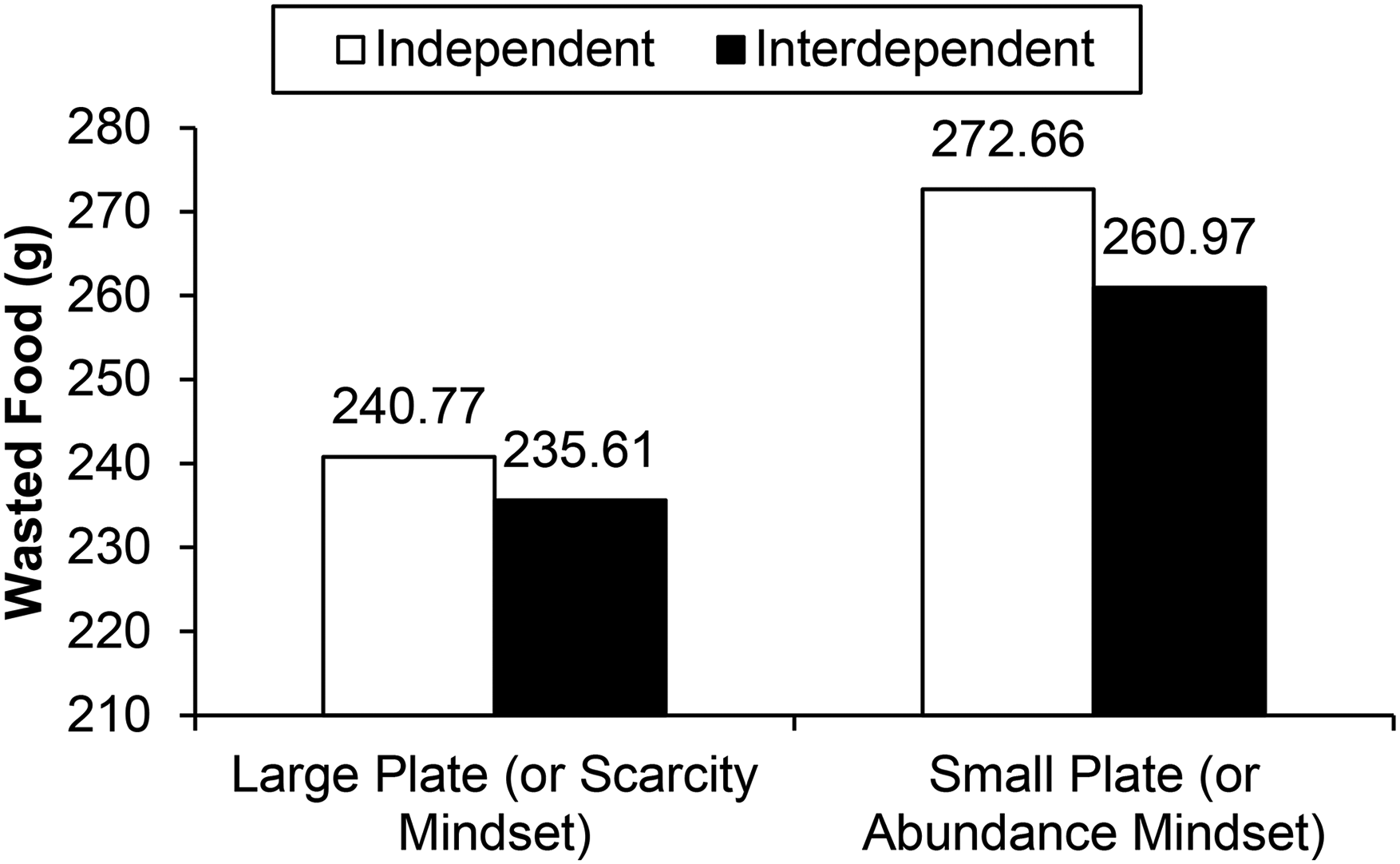
The Effects of Self-Construal and Plate Size on Food Waste (Study 1).
Discussion
The results of Study 1 provide preliminary support for our core proposition in a field setting (H1). Specifically, when a small plate was used to activate an abundance mindset, consumers primed with an interdependent self-construal wasted less food . In contrast, when a large plate was used to activate a scarcity mindset, consumers wasted less food regardless of their self-construal. The field context provides strong external validity for our findings.
Importantly, our manipulation approaches for both self-construal and resource mindset offer important practical implications for restaurants to reduce food waste. Our results indicate that using a larger plate to create a scarcity mindset reduced food waste from 266.73 g to 238.82 g per customer—an 11% reduction equal to approximately 287.95 kg of food saved from being wasted during the four-month period of our data collection, translating to an annual approximation of one ton of food potentially saved from being wasted at the restaurant. Moreover, by activating an interdependent self-construal via a very subtle manipulation of merely changing the slogan on a print ad, we reduced consumer food waste by 5%, a total of 120.61 kg of food during the entire observation period at the restaurant.
Notably, in this study, we found that in a restaurant setting where serving size is predetermined, using larger plates results in less consumer food waste. In contrast, prior research has shown that in buffet settings where consumers can increase the serving size by themselves, using larger plates could result in more food waste because consumers put more food than needed on larger plates in the first place (Van Ittersum and Wansink 2012). Combining the results from Study 1 with these prior findings provides a more nuanced understanding of how plate size impacts consumer food waste, depending on whether consumers are dining in a buffet setting versus a regular restaurant setting.
Given the nature of the field setting, we could not completely eliminate several noises. First, the perception of more food on a small plate might also trigger eating restraint and thus reduce the food intake of health-conscious consumers (Do Vale, Pieters, and Zeelenberg 2008). Second, to make the servers’ workload manageable, we did not ask them to record what kind of food and how much food of each kind was ordered. Although bill amount served as a reasonable proxy of the amount of food initially ordered, some food items (e.g., Organic Old Chicken Soup Noodles, 35 RMB [approximately $5]) were more expensive than others (e.g., Vegetable White Noodles, 10 RMB [approximately $1.40]). Thus, the bill amount may measure food price rather than food amount. Third, we assumed that consumers in the restaurant made their food waste decisions independently. Although the focal fast-food noodle restaurant was not a place for large parties, there were instances in which several consumers dined together. In such instances, although they used separate trays to hold their food, it is possible that they may have noticed that their own plate or the ad placed on the tray differed from those of their companions. Given that we did not record whether consumers dined alone or with companions, we could not analyze how group dining might impact our findings. To address these limitations, we conducted follow-up controlled experiments to provide more stringent support for our hypotheses.
Study 2: Causal and Mediating Evidence
Study 2 serves two main purposes. First, it directly manipulated self-construal and resource mindset in a controlled experimental design to provide causal evidence for our hypotheses. Second, it tested the mediating role of sharing obligation (H2). This study was preregistered (https://aspredicted.org/h3sj7.pdf).
Method
This study followed a 2 (self-construal: independent vs. interdependent) × 2 (resource mindset: abundance vs. scarcity) between-subjects design. We posted 400 slots for U.S. respondents on Prolific and received 402 responses. Their ages ranged from 18 to 80 years (Mage = 38.14 years, SD = 14.38); 49.25% were female, 50% were male, .5% were nonbinary, and two participants preferred not to answer (we requested a gender-balanced sample); and 64% indicated an annual household income above $50,000.
We randomly assigned participants to one of the four experimental conditions. First, we manipulated both self-construal and resource mindset within a single writing task (Web Appendix D). Specifically, we asked participants to imagine that they were moving to a new city. In the interdependent (vs. independent) condition, the culture of the new community was described as valuing interdependence, social connection, and group membership (vs. independence, individual autonomy, and distinctive identity). Furthermore, in the resource abundance (vs. scarcity) condition, participants learned that in this new city, they would have a nice (vs. basic) job with plenty of (vs. limited) resources such as high income, a flexible work schedule, and access to many benefits (vs. minimal income, strict and long hours, and limited access to benefits). After reading the scenario, participants were instructed to put themselves in the scenario and describe how they would feel and/or what they would do if they were in such a position. A pretest (reported in Web Appendix D) showed that this task was successful in manipulating both self-construal and resource mindset simultaneously.
Next, we measured food waste intention following Ellison and Lusk (2018). Specifically, we asked participants what they would do if they could not finish eating dinner at a restaurant and had some remaining dinner using three items: “I would throw away the remaining dinner” (1 = “strongly disagree,” and 5 = “strongly agree”), “I would save the remaining dinner to eat tomorrow” (1 = “strongly disagree,” and 5 = “strongly agree”; reverse-coded), and “Think more precisely about the scenario and your potential actions, what would you do?” (1 = “I’d definitely throw away what's left of the dinner,” and 5 = “I’d definitely save the leftovers to eat tomorrow”; reverse-coded). We averaged the three items to form a food waste index (α = .95), with higher values indicating stronger food waste intention. Given that the measure directly asked participants for their intention to throw away food, the scores tended to be low partly due to social desirability (Ellison and Lusk 2018).
Then, we measured sharing obligation with a four-item scale: “At the moment, I feel I am obligated to share what I have with my family, relatives, and friends,” “At the moment, I feel that I should share what I have with my family, relatives, and friends,” “At the moment, I feel I am responsible for sharing my resources with my family, relatives, and friends,” and “At the moment, I feel it is a duty to share what I have with my family, relatives, and friends.” We averaged the four items to form a sharing obligation index (α = .96), with higher values indicating a stronger sharing obligation. Finally, we collected demographics.
Results
Food waste
To test our hypotheses, we conducted a full-factorial analysis of variance (ANOVA) of food waste with resource mindset, self-construal, and their interaction as the independent variables. The results indicated that the main effect of resource mindset was significant (F(1, 398) = 8.25, p = .004), with those in the abundance mindset condition indicating significantly stronger food waste intention (Mabundance = 1.57, SD = 1.08 vs. Mscarcity = 1.31, SD = .67). The main effect of self-construal was also significant (F(1, 398) = 5.77, p = .017). More importantly, the interaction effect was significant (F(1, 398) = 8.04, p = .005).
Follow-up contrasts indicated that in the abundance mindset condition, interdependents indicated lower food waste intention than independents (Mindependent = 1.79, SD = 1.33 vs. Minterdependent = 1.33, SD = .65; F(1, 398) = 13.45, p < .001). In contrast, in the scarcity mindset condition, both interdependents and independents showed a similarly lower level of food waste (Mindependent = 1.29, SD = .66 vs. Minterdependent = 1.33, SD = .68; F(1, 398) = .10, p = .758; Figure 3). Thus, H1 is supported. Furthermore, inducing a scarcity mindset was effective in mitigating independents’ food waste (Mabundance = 1.79, SD = 1.33 vs. Mscarcity = 1.29, SD = .66; F(1, 398) = 16.62, p < .001; Figure 3).

The Effects of Resource Mindset and Self-Construal on Food Waste and Sharing Obligation (Study 2).
Mediation analysis
According to H2, when an abundance mindset is activated, interdependents (vs. independents) tend to have higher sharing obligation, resulting in lower food waste. In contrast, when a scarcity mindset is activated, given that there is no resource to share in the first place, the mediation is attenuated, with both independents and interdependents showing lower sharing obligation and lower food waste. To test the prediction, we conducted a mediation analysis (PROCESS Model 8; Hayes 2013). We defined self-construal as the independent variable, sharing obligation as the mediator, food waste as the dependent variable, and resource mindset as the moderator. The results indicated that sharing obligation significantly mediated the interaction effect of resource mindset and self-construal on food waste (effect = −.0933, boot SE = .0484, 95% CI: [−.2057, −.0191]). Conditional analyses indicated that in the abundance mindset condition, the indirect effect of self-construal on food waste through sharing obligation was negative and significant (effect = −.0860, boot SE = .0403, 95% CI: [−.1795, −.0228]), with interdependents showing stronger sharing obligation (Mindependent = 4.21, SD = 1.55 vs. Minterdependent = 5.04, SD = 1.66; F(1, 398) = 13.10, p < .001; Figure 3), leading to lower food waste (β = −.16, SE = .05, t(194) = −3.46, p < .001). In contrast, in the scarcity mindset condition, the indirect effect was not significant (effect = .0074, boot SE = .0248, 95% CI: [−.0426, .0593]): both independents and interdependents showed similarly low levels of sharing obligation (Mindependent = 4.06, SD = 1.69 vs. Minterdependent = 3.99, SD = 1.62; F < 1; Figure 3), and the effect of sharing obligation on food waste was negative and marginally significant (β = −.05, SE = .03, t(205) = −1.82, p = .071). These results support H2.
Discussion
By directly manipulating resource mindset and self-construal within a single task, this study provides causal evidence for our core hypothesis on food waste mitigation. Furthermore, it supports sharing obligation as a key mediator underlying the effects of resource mindset and self-construal on food waste. Consistent with our theorizing, interdependent consumers do not always have a higher sharing obligation than independents. Instead, both interdependents and independents tend to show similarly low levels of sharing obligation when they are in a scarcity mindset. In a follow-up study reported in Web Appendix A (Study WA1), we further replicated the mediating role of sharing obligation and ruled out alternative explanations, including need for status, care for society/social welfare, and motivation to save for a rainy day.
Next, building on the process explanation of sharing obligation, we test some theoretically relevant and practically actionable boundary conditions. As mentioned in the development of H3–H5, we explicitly focus on consumers with a default mindset of abundance. Specifically, the following studies examine how to mitigate the effect of self-construal under an abundance mindset by highlighting the sharing concept (Study 3), others’ food needs (Study 4), and family resource abundance (Study 5).
Study 3: The Moderating Role of the Sharing Concept
In Study 3, we further test the explanatory role of sharing obligation following the moderation-of-process paradigm (Spencer, Zanna, and Fong 2005). We expect that when the concept of sharing is not made salient in consumers’ minds, we will replicate the positive effect of interdependent self-construal on food waste mitigation under a default mindset of abundance. In contrast, when the concept of sharing is made salient, independents’ sharing obligation should be boosted to a higher level similar to that of their interdependent counterparts, which in turn attenuates the effect of self-construal on food waste (H3). We preregistered this study at https://aspredicted.org/wb72q.pdf.
Method
This study employed a 2 (self-construal: independent vs. interdependent) × 2 (salient concept: sharing vs. listening) between-subjects design. We posted 400 slots for U.S. participants on Prolific and received 403 responses (Mage = 34.03 years, SD = 11.91; 46.65% were male, 48.64% were female, 3.47% were nonbinary, and 1.24% preferred not to answer; 59% indicated an annual household income above $50,000). In Studies WA2 and WA3 reported in Web Appendix A, we provided empirical support that U.S. consumers on Prolific have a default abundance mindset.
We randomly assigned participants to one of the four experimental conditions. First, they completed a well-established self-construal manipulation task adapted from Trafimow, Triandis, and Goto (1991; see Web Appendix E). Specifically, we asked participants to read a story about a fictitious ancient figure, Sostoras, who was a great Sumerian warrior and was rewarded with a small kingdom to rule. In the story, Sostoras needed to choose an officer to command his detachment in an upcoming battle. In the interdependent condition, participants read that Sostoras selected a family member as his commander, a decision benefiting his family. In contrast, in the independent condition, participants read that Sostoras selected a talented general, a decision benefiting himself. To ensure that participants carefully processed the story, we asked them to imagine themselves in Sostoras’ situation and write a short paragraph describing “What do you think of Sostoras’ decision? Would you make the same decision if you were him?” (Zhang and Mittal 2007; Zhang and Shrum 2009).
Next, we presented participants with the same dining scenario used in Study 2 and asked them to imagine having dinner at a local restaurant. Participants imagined that while they were waiting for the food they ordered, they noticed a sticker on the table featuring a campaign called “One Virtue a Day.” Those in the sharing (vs. listening) salient condition viewed a sticker of “Sharing” (vs. “Listening”) and learned that the idea was about “giving a portion of your things to others” (vs. “paying attention to what others are saying”; Web Appendix F). Afterward, we asked participants to further imagine having not finished all the food ordered and to indicate what they would do with the unfinished food on the same three items used in Study 2 (α = .91). Finally, we collected demographics.
Results
We conducted a full-factorial ANOVA on food waste with self-construal, concept salience, and their interaction as the predictors. The results indicated that the main effect of concept salience was marginally significant (F(1, 399) = 3.23, p = .073), and the effect of self-construal was significant (F(1, 399) = 7.57, p = .006). More relevant to our prediction, their interaction effect was significant (F(1, 399) = 8.34, p = .004).
Planned contrasts indicated that in the listening-concept-salient condition (i.e., serving as the control condition), interdependents indicated less food waste than their independent counterparts (Mindependent = 1.85, SD = 1.09 vs. Minterdependent = 1.39, SD = .68; F(1, 399) = 16.06, p < .001), replicating our previous studies. In contrast, in the sharing-concept-salient condition, both interdependent and independent participants exhibited similarly low levels of food waste (Mindependent = 1.47, SD = .72 vs. Minterdependent = 1.48, SD = .74; F(1, 399) = .01, p = .924; Figure 4), attenuating the effect of self-construal on food waste and supporting H3.

The Effects of Self-Construal and Sharing Concept Salience on Food Waste (Study 3).
Discussion
Following the moderation-of-process paradigm, Study 3 further demonstrates sharing obligation as a key mechanism underlying the observed effect of self-construal on food waste. When the sharing concept was not made salient (i.e., in the listening-concept-salient condition), self-construal affected food waste in a similar fashion as in our previous studies. In contrast, when the sharing concept was made salient, the effect was attenuated, with all consumers showing a relatively lower level of food waste regardless of their self-construal.
Accordingly, the findings of this study have strong implications for marketing practice. We show that both activating an interdependent self-construal and making the sharing concept salient facilitate food waste mitigation among U.S. consumers, who have a default mindset of resource abundance. Notably, the sharing concept demonstrated as effective in food waste mitigation in our experiment was generic rather than specific to food sharing. The easy-to-implement intervention that we created to highlight the sharing concept suggests that companies and public policy makers could simply print and display the word “sharing” on a sticker to effectively mitigate food waste in resource-abundant societies.
Study 4: The Moderating Role of Others’ Food Needs
In Study 4, we test H4 regarding the moderating role of others’ food needs. Specifically, we expect that when consumers realize that others need food, their general sharing obligation will be enhanced regardless of their self-construal. As a result, when others’ food needs are made salient, the effect of self-construal on food waste should be attenuated. Importantly, we examined consumers’ real food waste as the measure of our dependent variable. Notably, although we planned to recruit approximately 200 participants for this preregistered study (https://aspredicted.org/gn5wd.pdf), we were only able to collect 141 valid responses given a higher-than-expected rate of no-shows in our lab sessions.
Method
This study employed a 2 (self-construal: independent vs. interdependent) × 2 (salient concept: others’ food needs vs. others’ anxiety) between-subjects design. Participants were 141 undergraduate students from a large public U.S. university (Mage = 22.49 years, SD = 5.33; 45.39% female, 53.90% male, .71% nonbinary). As in Study 3, we did not explicitly manipulate resource mindset and assumed that the focal U.S. undergraduate students had a default abundance mindset. This assumption was verified in Study WA4 reported in Web Appendix A.
We randomly assigned participants to one of the four experimental conditions. First, participants completed the same self-construal manipulation used in Study 3. Next, we introduced participants to a food consumption context. Specifically, we informed participants that the purpose of this study was to test the taste of a new trail mix. Then, we asked them to open a package of the snack in front of them and eat as much of the snack as they liked throughout the lab session. They then read some information about the snack brand sponsoring this study. We intentionally kept the brand name anonymous to ensure that food intake and reported taste perception were not impacted by preexisting attitudes. Importantly, participants learned that this brand engaged in corporate social responsibility activities by supporting a nonprofit organization to help American people fight against hunger (others’ food needs salient) or anxiety (others’ anxiety salient). Accompanying the corporate social responsibility description, a picture illustrated that in the United States, one in six people struggles with hunger (vs. anxiety; Web Appendix G). A pretest reported in Web Appendix G showed that the manipulation was effective and that making others’ food needs salient significantly increased consumers’ sharing obligation.
Afterward, participants took their time eating the snacks, during which they could browse the internet as they wished. Before the session ended, we measured their taste perception of the snacks with a three-item scale (“tasty,” “pleasurable,” and “delicious;” α = .95; Yamin, Mai, and Werle 2020). Finally, we collected demographics. To avoid interrupting their decision making, we did not specifically tell participants whether they should take the leftovers with them. If they decided to take the leftovers, we did not stop them and simply recorded the food waste as zero. After participants left the lab, we weighed how much food was left behind, which served as our dependent measure of actual food waste.
Results
To test H4 regarding the moderating role of others’ food needs, we conducted a full-factorial ANOVA of food waste with self-construal, salient concept (others’ food needs vs. others’ anxiety), and their interaction as the independent variables. Given that the food waste measure was skewed, we took a log-transformation of the original weight in grams to form a food waste index as our dependent measure. The results indicated that neither the main effect of self-construal (F(1, 137) = .61, p = .437) nor the main effect of others’ needs (F(1, 137) = 2.65, p = .106) was significant. Importantly, their interaction effect was significant (F(1, 137) = 4.28, p = .041).
Follow-up contrasts indicated that in the others’-anxiety-salient condition, we replicated the findings from previous studies: interdependents wasted significantly less food than their independent counterparts (Mindependent = 3.38, SD = 1.62 vs. Minterdependent = 2.18, SD = 2.01; F(1, 137) = 7.09, p = .009). In contrast, in the others’-food-needs-salient condition, the effect was attenuated: both interdependents and independents showed similarly low levels of food waste (Mindependent = 2.46, SD = 2.06 vs. Minterdependent = 2.59, SD = 2.00; F < 1; Figure 5). Furthermore, highlighting others’ food needs significantly decreased independents’ food waste (Mothers’ anxiety = 3.38, SD = 1.62 vs. Mothers’ food needs = 2.46, SD = 2.06; F(1, 137) = 3.97, p = .048; Figure 5). Thus, H4 is supported.
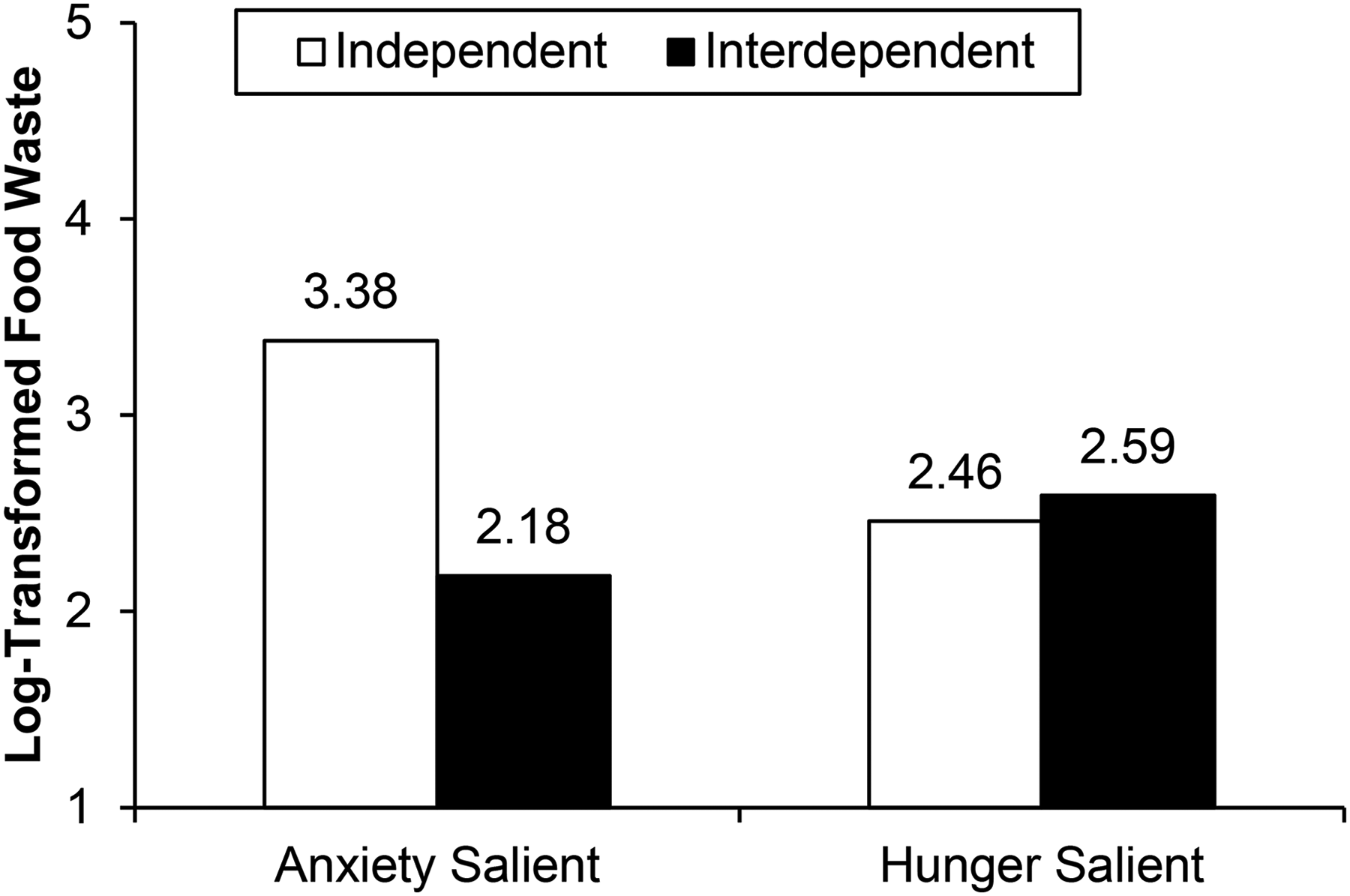
The Effects of Self-Construal and Others’ Food Need on Food Waste (Study 4).
Discussion
This study provides support for H4 that the salience of others’ food needs decreases independent consumers’ food waste and thus attenuates the effect of self-construal on consumer food waste under resource abundance. In doing so, we provide another practically actionable way to mitigate consumer food waste. Furthermore, we measured food waste with actual behavior, which enhances the external validity of our findings. To check the robustness of the findings, we conducted an additional analysis in which we controlled for consumers’ perceived taste of the food, which may negatively impact food waste. The results indicated that the interaction effect was robust (F(1, 136) = 3.94, p = .049). In contrast to Studies 3 and 4, which focused on increasing sharing obligation among independents to turn off the proposed effect, the next study offers further evidence for the mechanism based on sharing obligation by decreasing sharing obligation among interdependents.
Study 5: Manipulating Family Resource Abundance
In our theorizing, interdependents waste less food than independents because interdependents have a stronger obligation to share their resources with their in-groups. Nevertheless, if interdependents are aware that their in-groups, such as their family members, also have abundant resources, this awareness should diminish their obligation to share, which in turn should increase their food waste (H5).
Method
Study 5 followed a 2 (self-construal: independent vs. interdependent) × 2 (resource abundance: self vs. family) between-subjects design. We posted 400 slots for U.S. participants on Prolific and received 399 responses (Mage = 32.83 years, SD = 12.43; 53.88% female, 43.61% male, 2.51% nonbinary).
We first manipulated self-construal by asking participants to complete a word-searching task in a paragraph about a trip to a city (Brewer and Gardner 1996), which is an established manipulation for self-construal in the literature. Specifically, participants in the independent (vs. interdependent) condition were asked to highlight all instances of the pronouns I, me, and my (vs. we, us, and our). Then, we asked participants to report the total number of pronouns they had highlighted (Web Appendix H). We next manipulated resource abundance with a writing task (Web Appendix I). Those in the self-abundance condition learned that they had received a large amount of compensation for owning a successful business. In contrast, those in the family-abundance condition learned that both they and their family members had received a large amount of compensation for owning a successful family business. Reported in Web Appendix I, a posttest confirmed the effectiveness of the manipulation, such that sharing obligation was lower in the family- (vs. self-) abundance condition. After reading the description, participants wrote how they would feel and what they would do if they were in such a scenario.
Next, participants imagined what they would have for dinner. They could either order fresh food or finish leftovers in their refrigerator. Both food options came from their favorite restaurant. Next, we measured food waste tendency by asking them to indicate what they would do if they were in such a scenario with the following two items: “I’d rather order fresh food from the restaurant” and “I’d rather eat the leftovers in my fridge” (reverse-coded). We averaged the two items to form a food waste index (r = .73, p < .001), with higher values indicating stronger food waste intention. Finally, we collected demographics.
Results
To test H5, we conducted a full-factorial ANOVA on food waste with resource abundance, self-construal, and their interaction as the independent variables. The results indicated that the main effects of resource abundance (F(1, 395) = 9.25, p = .003) and self-construal (F(1, 395) = 4.84, p = .028) were both significant. More importantly, their interaction effect was significant (F(1, 395) = 5.37, p = .021). Follow-up contrasts indicated that under the self-abundance condition, we replicated the significant effect of self-construal on food waste: individuals with an accessible interdependent self-construal reported less food waste (Mindependent = 3.58, SD = 2.06 vs. Minterdependent = 2.73, SD = 1.60; F(1, 395) = 10.09, p = .002). In contrast, under the family-abundance condition, the effect was attenuated: both interdependent and independent participants reported similarly high levels of food waste (Mindependent = 3.71, SD = 1.78 vs. Minterdependent = 3.74, SD = 2.03; F < 1; Figure 6).

The Effects of Self-Construal and Self- (vs. Family) Abundance on Food Waste (Study 5).
Discussion
When consumers and their close family both enjoy abundant resources, it becomes less urgent for consumers to share their resources. Thus, family resource abundance reduces their sharing obligation, even if consumers have an interdependent self-construal and a default abundance mindset. These results therefore further demonstrate that sharing obligation is a key mechanism driving the effect of self-construal on food waste under an abundance mindset.
Study 6: Country-Level Secondary Data Analysis
Study 6 aims to provide further support for our core proposition with country-level secondary data from multiple sources. Specifically, we examine whether country-level individualism, as a proxy for self-construal (Zhang and Shrum 2009), and gross domestic product (GDP) per capita, as a trigger for resource mindset (Cannon, Goldsmith, and Roux 2019), jointly impact average consumer food waste in a country.
Method
We operationalized the key dependent variable with data from the Food Sustainability Index (Barilla Center for Food and Nutrition 2018), which provides sustainable food data from 67 countries. Specifically, we measured food waste with the food waste per capita per year index (1.0 to 95.1 kg/person/year; M = 36.47 kg, SD = 27.52). This index captures only the food waste incurred among end consumers at the consumption stage, which is consistent with the scope of our research. On this food waste index, high values indicate more consumer food waste.
We used the country-level individualism index from Hofstede Insights as a proxy for self-construal. According to prior research, country-level individualism and individual-level self-construal tend to exert similar effects on consumer behavior (Oyserman, Coon, and Kemmelmeier 2002; Zhang and Shrum 2009). There are four cultural values in Hofstede's original cultural dimension framework (2001): individualism, power distance, masculinity, and uncertainty avoidance. We used individualism as our key independent variable, with higher values indicating stronger individualism or independent self-construal (i.e., weaker interdependent self-construal). We also controlled for the other three cultural values.
We retrieved the data on each country's GDP per capita from the National Accounts Dataset of the World Bank (2018). Specifically, consumers from countries with higher GDP per capita should have a stronger abundance mindset (Graham-Rowe, Jessop, and Sparks 2014; Zhu and Ratner 2015). To match the timeline of this measure with that of the food waste measure, we used the GDP per capita data in 2018, the same year for which our food waste index was computed. Finally, we collected the average annual temperature for each country because temperature may influence appetite and food intake and, in turn, food waste (Mandic et al. 2019). Matching these data sets resulted in a total of 63 country-level observations.
Results
In our core proposition, resource mindset (i.e., operationalized as one of its triggers, GDP per capita) and self-construal (i.e., operationalized as individualism) jointly shape end consumers’ food waste, and this effect should be independent of other cultural values. To test this prediction, we conducted three regression analyses, which are summarized in Table 1. Given the inclusion of the interaction in the models, we centered all the predictors to make the main effects interpretable. Specifically, in Model 1, we only examined the interactive effect of individualism and GDP per capita without including any of the control variables. The results indicated that the main effect GDP per capita was positive and significant (b = 13.80, SE = 1.78, t(59) = 7.73, p < .001), indicating that countries with higher GDP per capita or an abundance mindset wasted more food than those with lower GDP per capita or a scarcity mindset. In addition, the main effect of individualism (b = .28, SE = .11, t(59) = 2.47, p = .017) was positive and significant, indicating that consumers from collectivistic cultures or those with an interdependent self-construal tended to waste less food.
Regression of Food Waste Index on GDP per Capita and Individualism (Study 6).
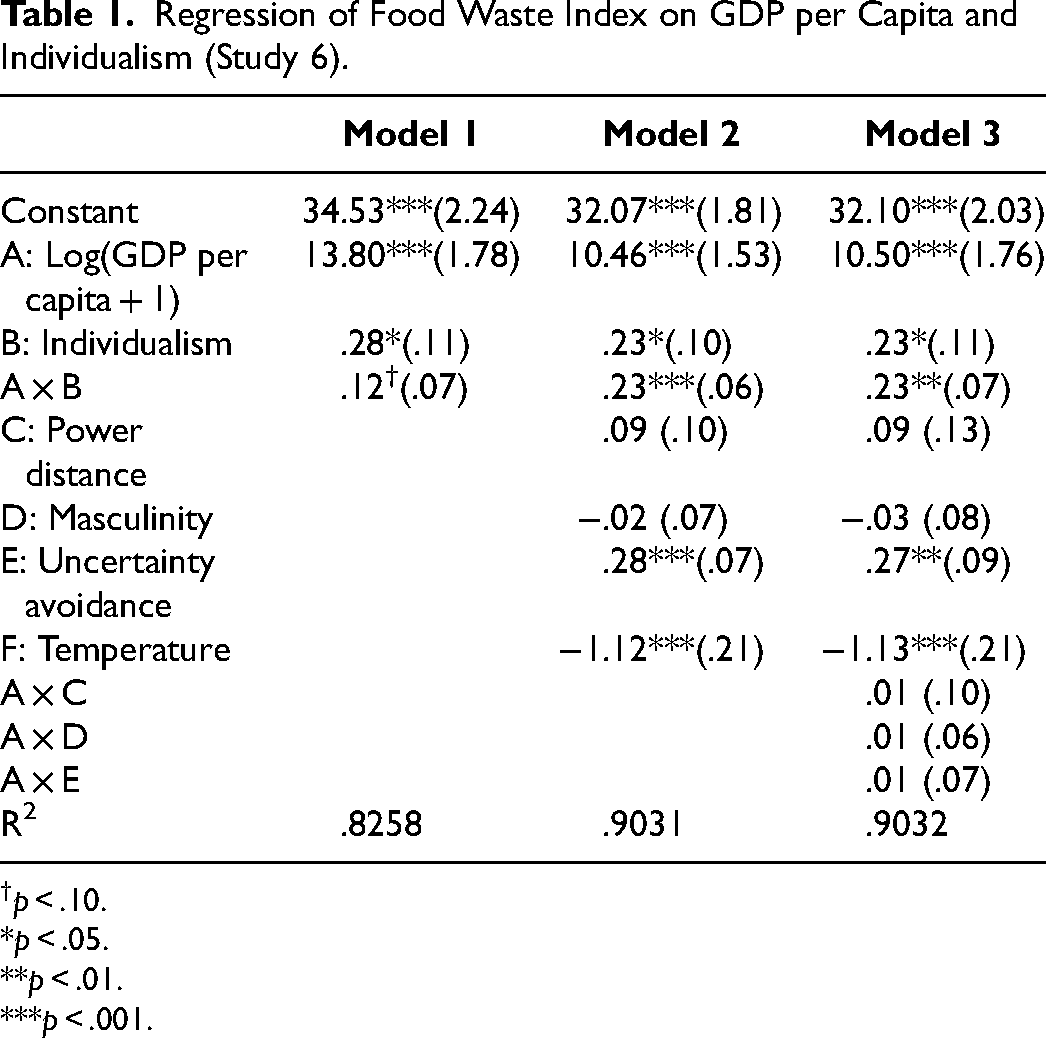
p < .10. *p < .05. **p < .01. ***p < .001.
More importantly, their interaction effect was marginally significant (b = .12, SE = .07, t(59) = 1.84, p = .072). We depict the interaction effect in Figure 7 employing a floodlight analysis. Specifically, we identified one Johnson–Neyman point of 8.993 on the logarithmically transformed GDP per capita (approximately $8,046.56 per capita). In other words, in countries with GDP per capita equal to or higher than $8,046.56, indicating resource abundance, individualism was positively associated with food waste. In contrast, in countries with GDP per capita lower than $8,046.56, indicating relative resource scarcity, the effect of individualism was attenuated to nonsignificance. This is consistent with the prediction of H1.

The Effects of Individualism and GDP per Capita on Food Waste (Study 6).
We also conducted two robustness checks. Regardless of when the other three cultural values (i.e., power distance, masculinity/femininity, and uncertainty avoidance) as well as the annual temperature of each country were added as control variables (Model 2 of Table 1) or when the interactions between GDP per capita and the other three cultural values were entered (Model 3 of Table 1), the interaction effect between GDP per capita and individualism was significant.
Discussion
Study 6 provides further support for our hypotheses with country-level data and stronger external validity. Specifically, we operationalized self-construal with the cultural value of individualism and resource mindset with GDP per capita. The results support the interaction effect of self-construal and resource mindset. That is, in countries with low GDP per capita or a scarcity mindset, all consumers show relatively less food waste regardless of differences in individualism or self-construal. In contrast, in countries with high GDP per capita or an abundance mindset, although food waste is generally higher, interdependents tend to waste less food than independents. Given the nature of the data, the results are suggestive. Despite this limitation, by combining the individual-level primary data with the country-level secondary data, we provide an overall comprehensive test for our theory.
General Discussion
In this research, we propose and establish that consumer food waste is influenced by not only contextual factors that trigger a resource mindset but also consumers’ self-construal. Specifically, we demonstrate that contexts that activate a scarcity mindset mitigate consumer food waste regardless of self-construal. More importantly, an abundance mindset is a necessary yet insufficient condition for food waste; that is, interdependents are less likely to waste food than independents under the same abundance mindset. Furthermore, we reveal that sharing obligation to in-groups is a key mechanism underlying the effect. In line with the proposed sharing obligation mechanism, we identify the salience of the sharing concept, the salience of others’ food needs, and the salience of family resource abundance as three boundary conditions in which the effect of self-construal on food waste under an abundance mindset is attenuated.
We find convergent support for our theorization with a field experiment, a lab experiment with actual food consumption, five controlled online experiments, and a country-level secondary data analysis. Specifically, Study 1 provides preliminary support for our theory in a restaurant field setting. Together with supplementary Studies WA1 and WA2, Study 2 replicates these findings and provides clearer causal evidence for our central proposition with a controlled experimental design. More importantly, these studies shed light on the underlying mechanism by showing sharing obligation to in-groups as the key mediator driving the effect. Studies 3, 4, and 5 further support the explanatory role of sharing obligation by increasing it directly (i.e., highlighting the concept of sharing via a sticker) or indirectly (i.e., highlighting others’ food needs), or by decreasing sharing obligation (i.e., highlighting family resource abundance). Finally, Study 6, using country-level secondary data, shows that consumers from countries with a relatively higher GDP per capita (i.e., consumers with an abundance mindset) waste significantly more food than those from countries with a relatively lower GDP per capita. Furthermore, among these resource-abundant consumers, those with stronger collectivistic values (i.e., interdependent self-construal) waste significantly less food than those with stronger individualistic values (i.e., independent self-construal). By documenting these effects, we make several contributions to the literature, as detailed next.
Theoretical Contributions
First, the current research contributes to the understudied area of consumer food waste by introducing a marketing perspective. As a highly important issue, the topic of food waste has attracted a significant amount of attention from scholars in various fields, including food security, waste management, sustainability, economics, and psychology (Ellison and Lusk 2018; Graham-Rowe, Jessop, and Sparks 2014; Qi and Roe 2016; Schanes, Dobernig, and Gözet 2018). However, food is mostly wasted at the retail and consumption stages of the food life cycle. Surprisingly, scant research has studied the phenomenon or contributed to the conversation of mitigating food waste from a marketing or consumer perspective. Accordingly, scholars advocate more marketing research to identify the antecedents of consumer food waste and, more importantly, the psychological processes that drive the phenomenon (Block et al. 2016; Porpino 2016; Van Doorn 2016). The present study directly answers this call by establishing consumers’ resource mindset and self-construal as important antecedents of consumer food waste. That is, an abundance mindset is a precondition for consumer food waste. When consumers have a scarcity mindset, their food waste is reduced. More importantly, activating an interdependent (vs. independent) self-construal helps mitigate food waste, even under an abundance mindset.
Furthermore, by revealing sharing obligation as a key psychological mechanism underlying the effect of self-construal on consumer food waste under an abundance mindset, we fill an important gap in the consumer food waste literature, which has largely focused on descriptive and correlational statistics without investigating the underlying psychological factors (Porpino 2016; Van Doorn 2016). Our findings show that inducing a sharing obligation is the key to mitigating consumer food waste. Accordingly, future marketing research could further our understanding of consumer food waste by identifying other marketing-relevant antecedents and uncovering additional psychological mechanisms driving consumer food waste.
We also advance the resource mindset literature by integrating it with a new research area and discovering a benevolent consequence of a scarcity mindset. Previous research has shown that activating a scarcity mindset increases high-calorie food consumption (Laran and Salerno 2013), selfishness (Roux, Goldsmith, and Bonezzi 2015), preference-inconsistent variety seeking (Zhu and Ratner 2015), biased product information processing (Hamilton et al. 2018), and consumer aggression (Kristofferson et al. 2017). Recently, consumer researchers have found that a scarcity (vs. abundance) mindset can benefit society by increasing consumers’ creativity (Mehta and Zhu 2016) and their consumption of sustainable products (Goldsmith, Roux, and Wilson 2020). We add to this literature by explicitly showing how activating a scarcity mindset can help mitigate consumer food waste. Importantly, whereas previous research has indicated that food waste is a more severe problem in developed (vs. developing) countries (Graham-Rowe, Jessop, and Sparks 2014; Thyberg and Tonjes 2016) and when consumers purchase large quantities (Qi and Roe 2016; Quested et al. 2013), this is the first study to examine how the general concept of resource mindset impacts consumer food waste. In doing so, we provide not only a new perspective to integrate the previous findings but also a broader theoretical understanding of why consumers waste food.
Moreover, we contribute to the self-construal literature by identifying a new consequence of self-construal. As one of the most studied concepts in consumer research, self-construal has been found to impact risk taking (Hsee and Weber 1999; Mandel 2003), product evaluation (Swaminathan, Page, and Gürhan-Canli 2007), promotion preference (Aaker and Lee 2001; Lalwani and Wang 2019; Winterich and Barone 2011), service evaluation (Yang, Mao, and Peracchio 2012), donation (Duclos and Barasch 2014; Winterich, Mittal, and Ross 2009), and joint consumption choice (Wu, Moore, and Fitzsimons 2019; Zhang and Mittal 2007). In this research, we discover a novel link between self-construal and consumer food waste by showing that activating an interdependent self-construal helps mitigate consumer food waste.
Importantly, we also identify a new mechanism through which self-construal exerts its effect on consumer behavior. Prior research on the effect of self-construal has relied on well-established psychological mechanisms such as regulatory focus (Aaker and Lee 2001; Hamilton and Biehal 2005), holistic versus analytic thinking (Lalwani and Shavitt 2013; Ng and Houston 2009; Yang, Mao, and Peracchio 2012), or agentic versus communal orientation (Winterich, Mittal, and Ross 2009; Zhang, Feick, and Mittal 2014). Our research provides direct evidence for the role of sharing obligation as a novel mechanism through which self-construal exerts its effect on consumer food waste. Importantly, self-construal and sharing obligation are two distinct constructs. That is, only under an abundance mindset will interdependents have a stronger sharing obligation. In contrast, under a scarcity mindset when there is no resource to share, interdependents tend to show a similarly low sharing obligation as independents. Future research may apply the sharing obligation mechanism to explain other effects of self-construal.
Practical Implications
Mitigating food waste is a global, urgent, and pressing issue that must be addressed soon. Accordingly, the United Nations has identified “halv[ing] per capita global food waste at the retail and consumer levels” by 2030 as one of its Sustainable Development Goals (United Nations 2015). Major countries such as China (the Clean Plate Campaign), the United Kingdom (the Waste and Resources Action Programme or WRAP), and the United States (the U.S. Department of Agriculture and the Environmental Protection Agency's Food Waste Reduction Goals) have promoted similar plans to reduce food waste.
In the short term, mitigating food waste enhances consumers’ psychological and economic well-being. Most consumers acknowledge that it is morally wrong to waste food while millions of people around the world struggle with hunger and food insecurity (Porpino, Wansink, and Parente 2016). More importantly, the economic benefits of reducing food waste are significant, annually saving U.S. consumers approximately $1,500 per household (Block et al. 2016) or every U.K. family £680 (Graham-Rowe, Jessop, and Sparks 2014). Given that 40% of Americans cannot afford a $400 emergency expense (Youn 2019), these critical savings could help relieve many Americans’ dire financial situations.
In the long term, mitigating food waste helps improve worldwide food equity and accessibility. One consequence of food waste is that it creates an artificial demand for food products in developed regions, which not only increases global food prices but also causes global food distribution to favor countries that can afford higher prices (Graham-Rowe, Jessop, and Sparks 2014; Schanes, Dobernig, and Gözet 2018). By reducing food waste and, consequently, the inflated food demand it causes, we can help lower global food prices and make foods more accessible to people in less developed countries. This is critical given that the global population is expected to reach 9.3 billion by 2050 (Ellison and Lusk 2018).
More importantly, by mitigating food waste, we can help reduce soil degradation, freshwater pollution, and excessive fossil fuel use in farming (Ellison and Lusk 2018; Stöckli, Niklaus, and Dorn 2018). We can also facilitate the reduction of greenhouse gas emissions in the food waste management process. According to a recent United Nations report (UN Environment Programme 2021), immediately reducing methane emissions is the swiftest method to help slow climate change. The worst of the greenhouse gases, methane, is mostly generated by landfills as organic waste such as food scraps decompose (Graham-Rowe, Jessop, and Sparks 2014).
This research provides several practically actionable approaches to mitigating consumer food waste. First, in developed countries such as the Unite States, most consumers have an abundance mindset due to living in a relatively affluent society with a wide availability of foods (Zhu and Ratner 2015), which results in unnecessary consumer food waste. A scarcity mindset could be easily activated by recalling a personal scarcity experience, by reminders of financial deprivation, or by news about economic downturns (for a review, see Cannon, Goldsmith, and Roux [2019]). Thus, marketers and public policy makers in developed countries may mitigate consumer food waste by using these strategies to activate a scarcity mindset. For instance, restaurants can serve food on larger plates to mitigate food waste by inducing perceived scarcity, similar to what we did in our field experiment (Study 1).
Second, even among consumers with an abundance mindset, we can help mitigate consumer food waste by activating an interdependent (vs. independent) self-construal. As previous research has shown, this could be done by highlighting culture-associated icons (Hong et al. 2000), customizing marketing communications (Winterich, Mittal, and Ross 2009; Zhang, Feick, and Mittal 2014), or using a specific language when communicating to bilingual individuals (Hong and Chang 2015). As shown in our field experiment (Study 1), marketers could easily activate an interdependent self-construal by highlighting collectivistic values with keywords or slogans on food packages or in-store displays to effectively mitigate food waste. In addition, since certain consumer segments, such as male (vs. female), White non-Hispanic (vs. Hispanic), and Western (vs. Eastern) consumers, typically have a stronger independent self-construal, special initiatives should be designed to mitigate food waste in these segments.
Furthermore, we show that making the sharing concept salient also helps mitigate consumer food waste. Following Study 3, marketers may print sharing-related concepts or words on stickers or brochures. Similarly, public policy makers may encourage the promotion of sharing-related messages by offering sharing-related stickers to consumers or encouraging the printing of sharing-related words on food packages to help mitigate food waste. Additionally, as shown in Study 4, emphasizing others’ food needs, such as through a reminder of the current food insecurity reality, can also help reduce food waste. Most Americans are generally unaware that one in six children living in the United States experiences food insecurity. Increasing awareness of these facts and clarifying how consumers can help may not only increase charitable donations but also produce an unintended yet positive consequence in terms of mitigating consumer food waste. Companies may collaborate with nonprofit organizations to promote charitable-giving initiatives, which will both elevate corporate reputations and induce customers to reduce food waste.
Some may argue that mitigating food waste conflicts with the goal of reducing obesity (Raghunathan and Chandrasekaran 2021). This assumes that consumers either eat all the food they order/prepare or dispose of their leftovers. However, our research indicates that this choice is not binary: consumers can always choose to preserve food in proper storage for later consumption. Therefore, food waste mitigation does not contradict obesity reduction. Some may also argue that it is not marketers’ responsibility to address the food waste problem. We believe that marketers should take active responsibility to help reduce consumer food waste. For restaurants, food waste mitigation can reduce operation costs related to disposing of leftovers. For food and retailing companies, although prioritizing such a social responsibility may harm short-term profits, it will foster a better brand reputation, create stronger consumer identification, and encourage future purchases (Sen and Bhattacharya 2001). This may explain why major food retailers (e.g., Walmart, Whole Foods) actively launch campaigns to mitigate waste.
Directions for Future Research
In this research, we have developed actionable interventions based on resource mindset, interdependent self-construal, and sharing obligation to mitigate consumer food waste. We call for future research to further this endeavor by creating other easy-to-implement interventions based on our theory, which can be effectively tailored to settings where food waste mitigation is relevant and imperative.
The current research focuses solely on the role of self-construal at the food consumption and disposal stages. However, food waste can also be influenced by consumer behaviors during other stages, such as the overacquisition of food (Block et al. 2016). Future research can therefore further explore how self-construal influences food acquisition decisions. For example, following our sharing obligation mechanism, interdependents may exercise greater restraint in their acquisition of food items, which may generate less food waste at later stages. Exploring this issue would contribute to a more nuanced understanding of the role of self-construal in mitigating food waste at various stages of the customer journey.
Supplemental Material
sj-pdf-1-mrj-10.1177_00222437231162615 - Supplemental material for Resources Available for Me Versus Us: Implications for Mitigating Consumer Food Waste
Supplemental material, sj-pdf-1-mrj-10.1177_00222437231162615 for Resources Available for Me Versus Us: Implications for Mitigating Consumer Food Waste by Huachao Gao, He (Michael) Jia and Bingxuan Guo in Journal of Marketing Research
Footnotes
Acknowledgments
The authors thank the JMR review team for their constructive comments in improving the article. The authors also appreciate the invaluable comments from Karen Page Winterich and Yinlong Zhang on earlier versions of the manuscript.
Special Issue Editor
Maureen Morrin
Associate Editor
Gergana Nenkov
Declaration of Conflicting Interests
The author(s) declared no potential conflicts of interest with respect to the research, authorship, and/or publication of this article.
Funding
The author(s) disclosed receipt of the following financial support for the research, authorship, and/or publication of this article: This research is supported by the General Research Fund (HKU17503121; HKU17503420) of the Research Grants Council of Hong Kong, the National Natural Science Foundation of China (72032004), and the HKU Seed Funding for Strategic Interdisciplinary Research.

References
Supplementary Material
Please find the following supplemental material available below.
For Open Access articles published under a Creative Commons License, all supplemental material carries the same license as the article it is associated with.
For non-Open Access articles published, all supplemental material carries a non-exclusive license, and permission requests for re-use of supplemental material or any part of supplemental material shall be sent directly to the copyright owner as specified in the copyright notice associated with the article.
