






Abstract
Consumers, retailers, and public policy makers all strive to engage in sustainable behavior. However, such actions often conflict with existing regulatory, normative, or cultural-cognitive structures, preventing legitimation on a broad scale. This article shows how activist consumers initially tackle the problem of food waste through a practice—namely, dumpster diving—that is at odds with marketplace structures, leading to the practice's marginalization and stigmatization. However, through dialectical adaptation strategies that alter both the practice of dumpster diving and respective marketplace antecedents, the practice of foodsharing emerges, becomes legitimated, and contributes significantly to the primary goal of dumpster diving: the reduction of food waste. The author identifies goal congruency as the underlying mechanism that allows for this process of dialectical adaptation. This study contributes to the literature on sustainable behavior by showing how the process of dialectical adaptation has the potential to resolve trade-offs as experienced by public policy makers, companies, and consumers. Finally, this article examines a case in which consumers and companies resolve a public policy problem without regulatory intervention, by opting out of public policy.
Sustainable Practices in the Marketplace
Even with all these efforts, becoming sustainable is not a straightforward task, as behavioral changes often conflict with existing social norms and political, geographical, and technological structures (Phipps and Brace-Govan 2011). I refer to those structures in this article as “marketplace antecedents.” In the research at hand, sustainable consumption practices—such as dumpster diving for food waste or cast-off consumer goods—conflict with mainstream marketplace rules, norms, and cognitive preconceptions (i.e., antecedents) and thus often occur at the fringes of society and within the context of subcultures (Brosius, Fernandez, and Cherrier 2012; Edwards and Mercer 2012; Fernandez, Brittain, and Bennett 2011; Guillard and Roux 2014; Hill and Stamey 1990).
This research shows how a consumer-driven sustainable consumption practice gained legitimacy through a dialectical adaptation process of the focal practice and the marketplace antecedents. Dialectical adaptation is based on the interdependence of the focal practice and the marketplace structures and thus shows how legitimation might be achieved through adaptation of the focal practice and the respective marketplace structures. I identify three adaptation strategies in this process that influence the regulatory, normative, and cultural-cognitive dimensions of legitimacy at the level of both the focal practice and the marketplace antecedents. In so doing, I address the call by Prothero et al. (2011) for research into macro-institutional solutions to major sustainability problems.
This article strives to answer the following research questions:
What are the marketplace antecedent barriers to sustainable consumption?
What strategies do consumers use to overcome those barriers?
What role do companies and regulators play in this dialectical adaptation process?
An institutional perspective helps account for the embeddedness of exchange and consumption structures within large societal networks encompassing consumers, firms, and policy makers (Varman and Costa 2008). Grounded in ethnographic research, this article identifies three adaptation strategies—namely (1) cooperating, (2) reframing, and (3) structuring—that allow for a dialectical adaptation process of practices and marketplace antecedents. Goal congruency acts as the underlying mechanism. The result is the emergence and legitimation of foodsharing through the approximation of the initial practice of dumpster diving and the respective marketplace structures.
Using the institutional and market dynamics perspective, this article conceptualizes the adaptation strategies around the three institutional pillars (regulatory, normative, and cultural-cognitive). I show that sustainability challenges are not exclusively solved through public policy with command-and-control or market-based policies (e.g., Phipps and Brace-Govan 2011) but also through consumer-driven dialectical adaptation strategies that allow for the legitimation of a sustainable practice. This article offers implications for public policy makers and discusses the broader transferability of the findings.
Literature Review
The Food Waste Challenge
Food is essential in our lives and continues to evoke strong emotions in private and public discussion as the awareness of food shortages increases in Western society (Lindeman 2012). The global food crisis of 2008 showed consumers, firms, and policy makers in developed countries the harsh realities of food resources in poorer countries and raised public concern (Almås and Campbell 2012; Rosin, Stock, and Campbell 2013). In this context, the food waste problem is becoming more visible (Evans, Campbell, and Murcott 2012), forcing Western society to address the fact that a staggering 1.3 billion tons of edible food—equal to one-third of annual food production worldwide—is wasted or lost each year (Food and Agriculture Organization of the United Nations 2011).
The European Union raised awareness of this issue by publicly declaring 2014 as the “European year against food waste.” Other initiatives reconsider the problematic role of the best-before date in food waste or push retailers to target a zero-waste policy by donating their food waste to food banks (Chrisafis 2015; Waterfield 2014). Retailers, prone to huge amounts of waste as they deal with fast-moving consumer goods, acknowledge the importance of reducing food waste in their corporate social responsibility (CSR) statements.
Consumers are also increasingly taking an activist stance regarding (food) waste and sustainability. By participating in consumer movements (Kozinets and Handelman 2004) or by reducing their own consumption (Etzioni 2004), concerned consumers try to counter unsustainable and wasteful behavior. Although public policy makers, industry players, and consumers all strive for sustainability, not all sustainable practices are accepted and enacted on a broad level.
Sustainable Practices in the Marketplace
Waste is an inevitable part of our prevailing consumption–production cycle (Hardin 1998), and indeed the life cycle of a product is theorized to end with its disposal (O'Brien 1999). Sustainable practices may include absorbing and repurposing waste or unused capacities (Martin and Schouten 2012; McDonough and Braungart 2010) with the goal of achieving resource efficiencies (Hawken, Lovins, and Lovins 1999). We observe this in the sharing economy (Botsman and Rogers 2011) and in other practices, such as scavenging for discarded items (Edwards and Mercer 2012; Guillard and Roux 2014). Practices based on (non)monetary exchanges such as secondhand markets (Bardhi and Arnould 2005), car sharing (Bardhi and Eckhardt 2012), dumpster diving (Eikenberry and Smith 2005; Fernandez, Brittain, and Bennett 2011), toy sharing (Ozanne and Ozanne 2011), or freecycling (Nelson and Rademacher 2009) make more efficient use of resources that would otherwise be wasted in traditional business models and practices.
Those newly emergent markets, systems, or practices often encounter resistance from marketplace antecedents such as regulation, social norms, or cultural factors (Kilbourne, McDonagh, and Prothero 1997; Press et al. 2014). This is especially true of economic models based on nonmonetary trade mechanisms, which run counter to traditional market systems and challenge established business models. For instance, the hospitality platform Couchsurfing (Couchsurfing. com; Bialski 2012; Hellwig et al. 2014) enables travelers to find a free place to stay instead of paying for a hotel room. Residents and guests make more efficient use of existing resources (i.e., couches). Such alternative arrangements may be viewed as forms of consumer resistance, anticonsumption, or ethical consumption (Chatzidakis and Lee 2013; Lee, Fernandez, and Hyman 2009). Tensions may arise in the marketplace because such countervailing practices compete with the interests, goals, or logic of established industries (Varey 2013). When these industries feel threatened—such as when alternative markets rise above the status of niche phenomena—they often try to fight the emerging models (Giesler 2008), co-opt them (Belasco 1989; Thompson and Coskuner-Balli 2007), or relegate them to a temporally and spatially distinct sphere (Kozinets 2002a). In the example of Couchsurfing, the hospitality industry first co-opted the business model through Airbnb, offering private places to stay, but for monetary exchange; Airbnb has since been ruled illegal in certain places (Smith 2013).
In addition to resistance from existing marketing institutions, consumption models aiming for sustainability may also face challenges to their legitimacy in the area of public policy. For instance, “gleaning,” or scavenging for bulky items or for food waste, often happens in a legal gray zone (Brosius, Fernandez, and Cherrier 2012; Fernandez, Brittain, and Bennett 2011; Guillard and Roux 2014). Such practices may also face normative or attitudinal barriers (Prothero et al. 2011). For example, a majority of citizens may regard gleaning or scavenging for objects in trash bins or dumpsters as unhygienic and stigmatizing (Edwards and Mercer 2012; Guillard and Roux 2014). These are a few of the ways that emergent economic and consumption practices aiming for sustainability encounter resistance from marketplace antecedents.
Market Dynamics and Institutional Theory
To frame the inquiry into the legitimation of alternative economic and consumption practices with respect to food waste, this manuscript turns to studies of market dynamics. This literature often draws on the overarching framework of institutional theory (North 1990; Scott 2008), which deals directly with the legitimacy and acceptance of new markets or market actors (Dolbec and Fischer 2015; Ertekin and Atik 2014; Scaraboto and Fischer 2013). Legitimacy is a form of social acceptability and credibility that prevails when the actions of an entity are aligned with a socially constructed system of rules, norms, beliefs, and values (Scott 2008; Suchman 1995). Institutional theory proposes the following three pillars of legitimation: regulatory, normative, and cultural-cognitive. These three pillars all play important roles in stabilizing organizations or other social systems because they enhance the enactment of practices that are authorized, are accepted on normative ground, and draw on shared understandings, respectively. Once a new action or organization is legitimated or accepted as a social fact, consumers adopt the practices associated with it more readily.
To illustrate the importance of these dimensions in the legitimation of emergent sustainable practices, I examine two examples: one that gained legitimacy (the practice of car sharing) and another (the practice of gleaning) that stayed at the fringes of society (Brosius, Fernandez, and Cherrier 2012). The regulatory pillar of legitimacy refers to coercive rules and enforcements that legally sanction noncompliant behavior. Initially, car sharing emerged as a consumer-driven market alternative (Bardhi and Eckhardt 2012; Dervojeda et al. 2013). At this stage, users encountered uncertainties regarding the regulatory dimensions because only implicit sanctions were foreseen for car abuse. The industry's co-optation of this model (Bardhi and Eckhardt 2012) led to the introduction of a clear regulatory framework enforcing desirable behavior and sanctioning nondesirable behavior. However, for gleaners of bulky items, such as discarded furniture, multiple changes in the local policy regarding the practice of gleaning resulted in confusion about legal enforcement (Guillard and Roux 2014). As these examples show, the regulatory dimension heavily draws on policies or guidelines and sanctions established by an authoritative organization and often enforced by rule of law.
The normative pillar draws on the concept of morality resulting in shame, honor, and/or the feeling of social obligation regarding a certain practice or behavior. In contrast to regulatory pressure, normative pressures are more implicit. Norms, ideologies, and conventions drive our consumption behavior (Crockett and Wallendorf 2004; McAlexander et al. 2014). By drawing on normative underpinnings, sociocultural notions such as stigma (Sandikci and Ger 2010) or the fear of contagion (Douglas 2013; Frazer 1984) might hinder the emergence of alternative marketplaces. For example, some users might not want to display their car sharing status because it might invoke the perception that they are carpooling out of necessity; moreover, they might not want to be reminded by “traces” (e.g., hair, odors, personal belongings) of former users (Bardhi and Eckhardt 2012). Similarly, in the case of scavenging for items such as furniture, people feel ashamed and are torn between concerns about hygiene on the one hand and sustainability on the other (Edwards and Mercer 2012; Guillard and Roux 2014). Emergent sustainable practices need some normative legitimation to be adopted by the larger society; this might be accomplished by changing the normative viewpoint or by protecting users from normative judgments of others.
The cultural-cognitive pillar operates on a shared understanding and a certain “taken-for-grantedness” of the behavior. Cultural-cognitive legitimacy operates on the basis of positive feelings such as certitude and confidence rather than negative feelings such as confusion and disorientation. As a framework of cultural beliefs, it provides people scripts of action (Shank and Abelson 1977; Ventresca and Mohr 2002). Social reality is formed through symbols, signs, words, and gestures, and these guide the behaviors of individual actors. Finally, the ultimate acceptance of a social behavior occurs with the actual realization of this behavior (Berger and Luckmann 1991). The symbolic structure for cultural-cognitive legitimacy might be achieved through a formalized frame that triggers the repetitive realization of practices, interactions, and behaviors. In the case of car sharing, this frame was offered by the car sharing provider, whereas in the case of gleaning, people did not encounter an appropriate symbolic frame.
As observed in the examples of gleaning and car sharing, and in contrast to traditional commercial marketplaces that operate on clear rules, structures, and quid pro quo exchange principles, emergent sustainable practices need to eventually develop the three pillars of legitimacy. In reality, the three pillars overlap. However, for the sake of analysis, I treat them as distinct.
The Context
The context of the study is safe food waste in the retail sector. Safe food waste is food that is safe to be consumed but is still disposed of, for one reason or another. This article illustrates the close link between the wasting of safe food and the respective marketplace antecedents—explicitly, regulation. Then, I turn to two connected practices that strive to reduce the amount of wasted food.
Food Waste and Regulation
During the past few years, food waste has received increased attention in the
media, social media, and public policy. Documentaries such as
The best-before date is one of the major causes of safe food waste in retail stores (Bundesministerium für Ernährung und Landwirtschaft 2012a). The best-before date (not to be confused with the use-by date) was introduced in Germany in 1981 and acts as a warranty. It is a form of consumer protection. The producer is responsible for the quality of the product up to the indicated date. Once a food item passes the specified date, the producer is no longer responsible for its quality, but the retailer is. Retailers could continue to sell these food items; however, disposing of them is often cheaper because selling food items after the best-before date requires intensive screening and sorting (Office Journal of the European Union 2004). The best-before date was meant for consumer protection; an unintended consequence has been large amounts of safe food waste. A recent public policy intervention regarding food waste in France illustrates how policy interventions and unintended consequences often go hand in hand: French law forces large supermarkets to donate all of their safe food waste to charity (Chrisafis 2015). There is resistance not only on the part of the supermarkets but also on the part of the benefiting charities. In receiving these large donations, charities are often confronted with higher costs because they do not have the capacity to accommodate and to store such large amounts of food. Charities also complain that they do not need such large amounts of food because they already have enough to cater to the needy (Schofield 2015). There seems to be a mismatch between the public policy intervention and the respective marketplace antecedents.
Such a top-down approach imposing sustainable behavior on actors in the marketplace is not uncontested. In Germany, there is currently an active discussion about how to deal with food waste. Whereas some people favor the classic top-down approach, others view the key task of public policy “as building a framework, wherein companies and consumers meet at eye level and come up with bilateral benefits” (Die Lebensmittelwirtschaft 2013). Clearly, public policy plays a major role in the fight against safe food waste, but other actors such as companies and consumers may play a significant role as well.
Dumpster Diving and Foodsharing
This article studies two related sustainable practices: dumpster diving by affluent people and foodsharing (compare Figure 1). Those practices are closely related because foodsharing has its roots in dumpster diving.
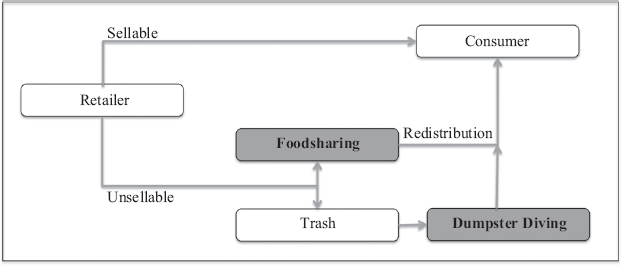
Modus Operandi of Foodsharing and Dumpster Diving
Affluent dumpster divers scavenge for retailer-discarded food in trash bins instead of shopping for their groceries at the supermarket. They do this for political and ideological reasons because of concerns over sustainability and as a means to reduce the amount of safe food waste. Although dumpster diving is a sustainable practice leading to the reduction of safe food waste, it also runs counter to marketplace antecedents of a regulatory, normative, and cultural-cognitive nature. A majority of people in the West regard dumpster diving as a highly disgusting and undignified human behavior; even less-privileged groups such as homeless people agree with this assessment (Duneier 1999; Eikenberry and Smith 2005). The practice is illegal in most European countries, and people can be prosecuted for scavenging (Beutner and Shuhaiber 2014). Because of its stigmatization, prevailing cultural conventions, and legal restrictions, dumpster diving remains on the margins of society and is not accepted or legitimated by other actors in the marketplace (Fernandez, Brittain, and Bennett 2011).
As a sustainable practice, dumpster diving is a good example of the tensions created by alternative practices or models in the context of marketplace antecedents (Phipps and Brace-Govan 2011). Some dumpster divers who encountered those barriers engaged in a dialectical adaptation process: both the practice of dumpster diving and the marketplace antecedents experienced change in the form of dialectical adaptation leading to the legitimation of the practice. This dialectical adaptation leads to the emergence and finally to the legitimation of the practice of foodsharing. Foodsharing.de—a consumer activist organization whose goal is to reduce food waste—can be viewed as a development of dumpster diving: it was initiated by former dumpster divers, and a large number of the site's members are, or were, dumpster divers as well. The goal of both practices is to reclaim discarded supermarket waste to reduce safe food waste.
In contrast to dumpster divers, foodsharing members intercept the food before it finds its way into the trash. Rather than discarding the food, retailers allow foodsharing members to collect it for redistribution. From 2012 to 2015, Foodsharing.de managed to save 1,300,000 kg of still-edible food, with the help of more than 6,000 active “food savers” and almost 2,000 retailers. Although the concept of redistributing food already exists in the form of food banks or other charitable organizations (Hill and Stamey 1990; Riches 2002), Foodsharing.de goes a step further, redistributing the food to all regardless of their level of need. During data collection, I ensured that all of the informants had a regular source of income; thus, they were not forced to engage in dumpster diving or foodsharing out of neediness or for monetary reasons.
Methodology and Data Analysis
To understand how an emergent sustainable practice with roots in a culture of resistance (Williams 2005) gains legitimacy in the marketplace, I engaged in intensive ethnographic fieldwork beginning in December 2012. The fieldwork focused first on dumpster diving to achieve a deep understanding of the phenomenon and the respective problems and struggles between this activity and marketplace antecedents. Data collection at this stage consisted of participant observation, 14 in-depth interviews (average length: 43 minutes), and online data retrieval. As a second and separate stage of the research, I have been engaged in Foodsharing.de since nearly its inception at the end of 2012. I have developed a close rapport, credibility, and valuable research relationships within the organization, resulting in hundreds of hours of observation at various levels of the organization. The data set includes 13 in-depth interviews with active members of the Foodsharing.de (average length: 47 minutes), which I have transcribed verbatim. Almost half of the informants are engaged in or used to be engaged in both foodsharing and dumpster diving. This underscores the connection between the practices and the advent of foodsharing from dumpster diving practices. I also conducted six interviews with decision makers (average length: 36 minutes) in food retailing corporations.
The interview guide started with general questions, grand tour questions (McCracken 1988), and continued with questions about the motivations, perceptions, experiences, and thoughts of the informants regarding dumpster diving and/or foodsharing. To augment the observation and the interview data, triangulate the findings, and understand the political and legislative aspects of the emergence of Foodsharing.de, I also conducted extensive analyses of online data (Kozinets 2002b).
Data analysis followed a hermeneutic approach and resulted in an iterative process of coding, theorizing, and collecting additional data (Arnold and Fischer 1994). My deep immersion in the world of dumpster divers and food savers resulted in an in-depth understanding of this phenomenon. The use of the hermeneutic circle included intratextual analysis to establish individual narratives and intertextual analysis to contextualize the narratives. I also examined similarities and differences among and between sites for dumpster diving and foodsharing. The findings reported here reflect analyses from the perspective of institutional theory.
Findings
The present research into dumpster diving discovered consumers challenging regulations, social norms, and other preconceptions in the marketplace—namely, marketplace antecedents. In their activities, dumpster divers encountered regulatory barriers such as antiscavenging laws, normative barriers such as the stigma and contagion effects associated with rooting around in waste bins and getting something for nothing, and cultural-cognitive barriers such as a missing intervening institution that grants legitimacy. Dumpster diving was, and still is, considered an illegal and stigmatized practice in the marketplace. However, activist consumers engaged in a dialectical adaptation process regarding the practice of dumpster diving and the respective marketplace antecedents. Dialectical adaptation occurs through the approximation of marketplace antecedents and the focal practice. The initial practice of dumpster diving and the marketplace antecedents came into conflict. Approximation allowed the conflict to be mitigated because it literally closed the gap between the focal practice and the marketplace antecedents. I map out the dialectical adaptation process by defining three dialectical adaptation strategies that describe this approximation: collaborating, reframing, and structuring. Changes to the marketplace antecedents include an altering of regulations, social conventions, and taken-for-granted conceptions at the level of the marketplace. Changes in the focal practice refer to, for instance, changes in the distribution or disposal process. I identify goal congruency as the underlying mechanism of the dialectical adaptation process. Given the theoretical lens of institutional theory, the findings are structured according to the three institutional dimensions (regulatory, normative, and cultural-cognitive). The presentation of the findings follows Figure 2.
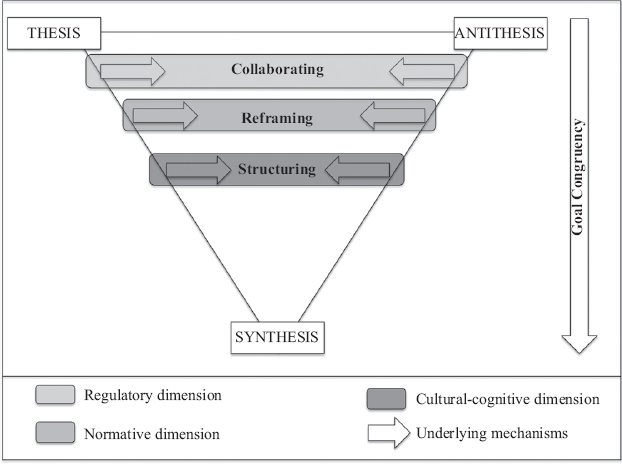
Dialectical Adaptation Strategies for Legitimation
The sustainable practice of dumpster diving (antithesis) challenged the wasteful behavior of retailers and other marketplace actors that were grounded in marketplace antecedents (thesis). Dialectical adaptation strategies (i.e., collaborating, reframing, and structuring) on the three institutional dimensions allowed for the emergence and the legitimation of foodsharing (synthesis; Donaldson 1995). I identify goal congruency (i.e., the main actors all sought for ways to resolve the problem of safe food waste) as the underlying mechanism that allows for dialectical adaptation.
The findings are presented as follows: For each institutional pillar, I map out the tensions created by dumpster diving and uncover the underlying structures of the marketplace. Then, I highlight how the practice of dumpster diving and the respective marketplace antecedents are modified and approximated, resulting in the emergence and legitimation of foodsharing based on goal congruency. Furthermore, I highlight the interplay between consumers, retailers, and public policy makers within this process. The institutional dimensions as well as the adaptation strategies themselves are interdependent and influence each other; however, for the sake of analysis, I treat them as analytically distinct.
Collaborating for Regulatory Legitimacy
In general, waste is embraced as integral to production and to consumer choice and convenience (Hardin 1998). In the realm of food production and marketing, food waste is institutionalized as a necessity for maintaining product freshness, abundance, variety, and, consequentially, consumer satisfaction. Regulations and public policies support the institutionalization of waste. Best-before dates trigger the discarding of large amounts of perfectly edible food by retailers. Although German retailers are allowed to continue to sell those items after the best-before date, few do so because it demands a lot of screening and sorting to ensure the quality of the food (as reported by all of the decision makers in food retailing I interviewed). However, regulations such as antiscavenging laws prevent consumers from taking discarded food items for consumption or further distribution. This results in a death sentence for the food item: once the product is discarded, it remains the property of the retailer until it is picked up by the garbage haulers, who legally become the new owners of the discarded food item. Taking discarded supermarket waste can be considered “theft” in Germany because it is not an ownerless item. Gina, an interviewee, illustrates these tensions:
Gina: You find tons of good food. After Easter, for instance, we found so many delicious chocolates from Lindt…. They were probably sorted out because of the best-before date. Too much to distribute to our friends…
Interviewer: Did you ever encounter problems when dumpster diving?
Gina: I was caught twice. By employees of the supermarket chain. There was a guy coming out of the supermarket, he saw me, I was scavenging, and he told me, “Back off quickly.”
Gina describes the high quality and quantity of food that is discarded because it is past its best-before date. She illustrates the regulatory challenges—manifested by employees, who, in compliance with the legal rules, protect their trash—when going dumpster diving. The interplay between the best-before date logic and antiscavenging laws means that many edible food items end up in the dumpster.
The large amounts of food waste might be viewed as an unintended consequence caused by public policy (Phipps and Brace-Govan 2011) because the reduction of food waste is high on the agenda of German public policy. Ilse Aigner, 2013 Minister for Consumer Protection, states,
We in Germany are on a good path: business, industry, churches, organizations, and consumer initiatives pull together…. We can reach the goal of the European Commission to reduce by half the amount of safe wasted food. (Bundesministerium für Ernährung und Landwirtschaft 2013)
Aigner emphasizes that she views the battle against food waste as a responsibility not only of public policy but also of other stakeholders in the marketplace such as consumers and businesses. Other European countries rely more directly on public policy to tackle the problem of safe food waste by reconsidering the use of the best-before date (Waterfield 2014) or by banning food waste through forced donations to charities (Chrisafis 2015). German public policy emphasizes an approach through cooperative action such that explicit regulatory interventions for the reduction of food waste are absent.
Although dumpster divers pursue a laudable goal that is aligned with public
policy— reducing food waste—they encounter strong resistance in the form of
antiscavenging laws. Through a dialectical adaptation approach, the dumpster
divers adapt their practice as well as the marketplace antecedents. This is
mainly achieved through an adaptation strategy that I call “collaboration.”
Foodsharing members approach retailers in the fight against safe food waste, a topic with which the retailers themselves are deeply concerned. A chief executive officer (CEO) of a large organic supermarket chain sums up the sustainable concerns of his company:
Our goal is to throw away as little as possible. We want to fight food waste. We have to bring back the appreciation or food items, for farmers, for animals and for nature. (Bio Company 2013)
This CEO states that the battle against food waste is a major goal of his company. He sees a fruitful way to achieve this goal by reinstalling appreciation for the food items and thus reducing safe food waste. This is an overall trend that is also reflected in CSR statements of leading supermarket chains throughout Germany. Most retailers strive to maximize efficient use of safe food items. Often, they list “anaerobic digestion”—food waste used as a source of renewable energy—as their sustainable measure to fight food waste. However, this form of “down-cycling” (Steinhilper and Hieber 2001) diverts safe food items from human consumption to energy production. In contrast, Foodsharing.de offers a way to use food items according to their initial purpose, as human nutrition. Through collaboration, activist consumers no longer have to “steal” the food from retailers (as in the case of dumpster diving); it is voluntarily given to them.
The best-before date as a warranty for a food item partly represents the marketplace antecedents on the regulatory dimension. The best-before date acts as a warranty for the quality of the food item and is transferred from the producer to the retailer when a food item has reached the best-before date. The selling of food items after the best-before date is time intensive and costly because it demands a lot of screening and sorting. Consequently, it is often cheaper and more convenient to discard the food items. Foodsharing.de shifts the responsibility from the retailer to the consumer: every member of Foodsharing.de has to sign a disclaimer of warranty that holds him or her responsible for the received food. So, in contrast to charities or food banks, which are responsible for the quality of the food they distribute, foodsharing enables consumers to take “critical” items such as those with open packaging, after the best-before date, or with traces of decay. It is incumbent on foodsharing members to verify with their senses and to draw on their own experience when deciding about the product's viability. The legal disclaimer allows consumers to opt out of the consumer protection that is offered by the best-before date. The effective implementation of this warranty is underpinned by the fact that foodsharing is not a loose initiative, but an organized consumer collective. This organization lends support to the acceptance and the enactment of the legal disclaimer.
Public policy does not oppose this ability to opt out, because it allows regulators to offer consumer protection to those who want it while also allowing for the reduction of safe food waste. The use of this disclaimer represents a way to mitigate the unintended consequences caused by the best-before date.
As I have shown, the dialectical adaptation process refers to an approximation of the focal practice and the regulatory marketplace antecedents. The outcome is the regulatory legitimation of foodsharing. The regulatory marketplace antecedent was not altered through a direct regulatory intervention but through collaboration between retailers and consumers based on a disclaimer of warranty.
Reframing for Normative Legitimacy
Market antecedents are reflected not only through regulatory frameworks but also through certain normative structures in the form of stigmas and contagion. Germany is a highly industrialized country based on capitalist thinking and supported by an extensive welfare system. The capitalist system implies a certain merit or quid pro quo logic (“You pay for what you get”), whereas the welfare system believes that people should be sustained, but only in the case of need. This means that the practice of not paying for a service or item is only accepted in the case of sheer necessity. Activities or practices outside this normative framework encounter social effects such as stigmas (Sandikci and Ger 2010; Van Gennep 1904). A stigma refers to a disapproval of a certain behavior that differs from cultural norms (Goffman 1963). In Germany, the idea of dumpster diving by affluent people is virtually unthinkable because dumpster divers who have the financial means to buy food are perceived as taking something for free. Dumpster diving thus represents a form of free riding (Andrade et al. 2004) and is mainly accepted only in the case of homeless people who beg for food. Says one informant:
I felt like a bum…. I had this picture in my head that only bums do it. I think most of the people think only bums do it. Out of necessity because they are hungry…. It was really an awful image for me…. Initially, I felt strange. I was thinking about getting a costume for dumpster diving…. Or masquerading like a cat. (Melissa)
Scavenging for food transgresses normative boundaries and results in stigmatization. As Melissa reports, she feels like and is perceived as a homeless person without any financial means to participate at the official marketplace. She tries to deal with this stigmatization by masquerading.
A similar link to identity is illustrated by the concept of contagion (Frazer 1984). Contagion beliefs are based on the assumption that negative as well as positive characteristics (physical or mental) can be transferred from one item/person to another item/person. Michaela says,
At the beginning it was difficult for me, the awareness that someone has thrown these items away. It was depreciated, there was no value left, and I take the stuff that has no value. Does this depreciate me? I think it is a psychological reasoning as others tell you that you cannot use those items any longer. (Michaela)
The discarded food items seem to have a meaning of their own. They are not only food items but also carriers of a deeper meaning: that “of being rejected.” Because of contagion effects, this meaning might transfer to consumers who interact with the rejected item. This mental contagion effect is complemented by a physical contagion effect. Physical contagion refers to the transference of physical properties such as when a safe food item comes into contact with waste. The strong effect of physical contagion from discarded food items in dumpsters is clearly linked to the stigma encountered when dumpster diving.
While normative market antecedents such as stigma and contagion problematize the
practice of dumpster diving, activist consumers rely on adaptation strategies
such as reframing at the practice level and at the level of marketplace
antecedents. Reframing is defined as “changing the conceptual and/or emotional
viewpoint in relation to which a situation is experienced and placing it in a
different frame that fits the ‘facts’ of a concrete situation equally well,
thereby changing its entire meaning” (
Through the adaptation strategy of reframing, sustainable values are attached to the act of taking something for free. Victoria explains her mental reframing:
I think it is a question of attitude, of inner attitude. Do I beg for food? Or do I save food? Especially in the beginning I had this feeling, “I am dependent on you. I ask for food.” But it is really a matter of inner attitude, you can decide in a certain manner: Do I want to feel ashamed or not? Now, when I enter I have the attitude: “Hey, I save food before it gets thrown away, I think that is pretty cool and I don't feel ashamed any longer.” (Victoria)
Victoria no longer views taking discarded food as an expression of necessity or dependence, reframing it in her effort to fight food waste. For her, it is an expression of sustainability. One of the roles of Foodsharing.de is to help people reframe the practice by providing countervailing meanings rooted in sustainability, turning a stigma into a moral victory. This reframing was aided by Foodsharing.de's communication and media appearances, renegotiating the stigma attached to taking something for free:
Foodsharing is primarily about directing attention towards food waste, reducing food waste, and making a contribution to saving our valuable resources. One side effect of enacting those objectives may be that individuals in need are supported. (Foodsharing.de)
It is important to note that in contrast to the philanthropic purposes of food banks (Hill and Stamey 1990; Riches 2011), the primary goal of foodsharing is not to help the needy. Philanthropy is not part of the mission but rather a potential side effect of foodsharing. Foodsharing actively tries to distance itself from the prevailing image that taking discarded food is done out of necessity. This sustainable reframing is supported by an extensive media campaign featuring the motivations and the objectives of foodsharing. Public messages such as “Share food instead of throwing it away” and “Happy without scraps” support the desired sustainable image of taking discarded food items. The official support of public policy further emphasizes the mission of saving food by featuring it as way toward a more sustainable society (Bundesministerium für Ernährung und Landwirtschaft 2014). Politicians recognize and publicly declare foodsharing to be an effective way to fight food waste. They do not take any explicit regulatory interventions but instead create a normative environment in which the idea of foodsharing can flourish.
The strategy of reframing was supported by the strategy of collaboration that not only provides regulatory legitimacy to the practice of foodsharing but also counters mental and physical contagion effects: changes in the distribution process mean that discarded food does not come in contact with actual waste. This is supposed to diminish the fear of mental and physical contagion and contributes to the legitimation of foodsharing on the normative dimension.
Structuring for Cultural-Cognitive Legitimacy
The social acceptance of foodsharing practices is enhanced through the pillar of cultural-cognitive legitimacy because the formalization of rules prevents confusion and creates a shared understanding. Cultural-cognitive legitimacy exists when a practice has entered people's habitual way of acting and is no longer questioned. An example might be the case of recycling, in that the usefulness of the practice is not challenged or questioned but is taken for granted (Brosius, Fernandez, and Cherrier 2012).
Divergent media reports on the legality of dumpster diving (Herr 2015), the legal pursuit of dumpster divers, or the different ways to dumpster dive (e.g., time of day, equipment to use) have led to a state of confusion among the relatively affluent people who approached dumpster diving for ideological reasons. This uncertainty was increased by the diffused nature of the dumpster diving community. Owing to regulatory and normative barriers, many dumpster divers practiced individually, with little opportunity to interact with others. Those same barriers prevented mentoring, or the passing along of instructions or guidelines for how to dumpster dive. Thus, dumpster diving failed to offer the taken-for-grantedness or shared understanding that produces cultural-cognitive legitimacy.
Through the dialectical adaptation process of structuring, the practice of dumpster diving and the cultural-cognitive marketplace antecedent are adapted and approximated. Structuring occurs when adaptation of the practice is aided by the introduction of scripts and rules, leading to a certain taken-for-grantedness. Further support for the legitimation is offered by an institutionalization of the foodsharing mission at the level of the marketplace antecedents.
Through the interplay with consumers, retailers, public policy makers, and other institutional dimensions, foodsharing engages in a form of structuring that allows the creation of a shared taken-for-grantedness with formalized rules and organization. Basic knowledge, scripts, and rules of interpersonal interaction seem to be at the root of a shared understanding. To create this shared understanding, Foodsharing.de relies on scripts that formalize structure and behavior and enhance common knowledge. The goal of the structuring process is not to convince other stakeholders of the worthiness of the mission of foodsharing, but to establish trustworthiness regarding reliability of the food savers and food security. First, entry barriers such as complex sign-up processes ensure that only those people who are really interested and motivated join the organization. As Franziska from Foodsharing.de reports,
You have to sign up online, then get a foodsharing ID. It was kind of complicated, because you have to look for all the information, the entry criteria are pretty high, and not everyone can sign up. You have to invest, think about it, and look for it. That is the first barrier you have to pass. (Franziska)
As Franziska states, signing up demands some cognitive and physical effort. It is perceived as “complicated” and as a barrier. Furthermore, to obtain a foodsharing identification card, the interested person has to take a quiz regarding the mission of Foodsharing.de and desired behaviors, such as how to interact appropriately with retailers or other foodsharing members. This quiz assures the reliability of the food savers as well as the food security because it includes explicit directives how to handle and store the food that is picked up at the retailer store.
To take a more responsible position within the organization of Foodsharing.de and move up the hierarchical structure (Schouten and McAlexander 1995), the food savers have to attend several training sessions. Says food saver Sabine:
I think it is hierarchical, but on the other hand, … I just find it also good, because I would not know how it should work otherwise. So for me…. For example, there is a rule. Nobody is allowed to just talk to a business. You must attend training before. (Sabine)
On the one hand, this procedure is perceived as hierarchical, but on the other, it seems necessary to create a cultural-cognitive shared understanding with other stakeholders in the marketplace.
The structuring goes hand in hand with a certain form of institutionalization at the level of the marketplace antecedents. The cultural-cognitive marketplace antecedents—in an interplay with the other institutional dimensions—allow for a form of institutionalization that accommodates the practice of foodsharing. This institutionalization guarantees reliability of the food savers and food security and thus makes foodsharing a legitimate behavior in the marketplace.
This institutionalization is reinforced by permanent media presence, support of public policy, and clear structures. After a certain practice is exercised through scripts and rules, an emergent institution at the marketplace level seems to provide strong legitimate support.
Although this article has depicted the process of the dialectical adaptation process in a linear way, I would like to emphasize that rules, norms, and meanings arise through interactions (Scott 2008). Activist consumers engage in regulatory, normative, and cultural-cognitive work (all interdependent) to gain wider acceptance of foodsharing. The adaptation strategies affect not only the practice itself but also the marketplace antecedents. One of the informants outlines the dialectical adaptation process as follows:
It is the same goal, per se, but the means differ. One way is stealing food items from retailers…. Another way tries to work with co-operation. Actually, foodsharing is the solution to the legal way to save food items…. In dumpster diving, there are problems, like being arrested, and it is not a trivial offense but theft, and that is bad. One has to look for a way, how to make it legal in order to create mutual trust. Creating an organization that issues special IDs and then approaches retailers. Or other grocery store, “Don't throw your food away, give it to us!” (Adrian)
Adrian explicitly mentions the adaptation strategies of cooperating and structuring. Dumpster diving is still a marginalized practice. Activist consumers, however, have managed to adapt the practice as well as marketplace antecedents leading to the legitimation of foodsharing. An approximation of the sustainable action and the respective marketplace antecedents has led to the legitimation of a sustainable action (Scott 2008; Suchman 1995). The adaptation of the practice and the marketplace antecedents enabled foodsharing to gain the support of public policy makers and retailers, both of whom were concerned with the question of safe food waste and initially struggled with trade-offs and unintended consequences.
Goal Congruency as the Underlying Mechanism
Marginalization of a practice often occurs when a focal practice is not consistent with prevailing marketplace structures (Sandikci and Ger 2010; Scaraboto and Fischer 2013). Unlike other consumer-driven practices aimed at sustainability that occur at the margins of society (e.g., dumpster diving), activist consumers managed to legitimize foodsharing through an approximation of the focal practice and the respective marketplace antecedents. Next, I aggregate some of the previous results and illustrate the underlying mechanism that allows for the dialectical adaptation process. I refer to this mechanism as “goal congruency” (i.e., in the present case, activist consumers, retailers, and public policy makers pursue a common goal). This goal is embedded in a larger environmental perspective in Germany, where similar phenomena and activities emerge and flourish. One popular example might be restaurants that cook with discarded food waste (e.g., CulinaryMisfits.de). Furthermore, German public policy strives to induce sustainable behavior by relying on an educational program regarding food waste (Bundesministerium für Landwirtschaft 2012b). Thus, analogous ideas with similar practices flourish in German society under the umbrella of sustainability and environmental concern. Thanks to their status and their education, affluent activist consumers were able to embed the practice of taking discarded food in the larger environmental frame instead of associating it with a practice of getting food for free. For instance, they tried to convey their status and education through a sophisticated way of dressing (field notes) and professional communication with retailers: they offered checklists, clear procedures, and an economic advantage to retailers (in that foodsharing helps retailers reduce costs related to garbage disposal; Lebensmittelrettenwiki 2015). Unlike homeless people who scavenge for food out of necessity, food sharers actively promote the image that they take discarded food for environmental reasons. Activist consumers have been able to position foodsharing in such a way that it contributes to public policy makers’ and retailers’ goal of reducing safe food waste. Initial concerns about the goal of dumpster diving that were especially reflected on the regulatory and normative dimensions were dispersed by clearly positioning foodsharing as a sustainable and legal practice.
Discussion
Different actors such as marketers, public policy makers, and consumers pursue goals to support sustainability (e.g., the reduction of food waste). This research shows how, through a dialectical adaptation process, a marginalized and stigmatized sustainable consumption practice (i.e., dumpster diving) is altered, as are the respective marketplace antecedents. The approximation of the practice and the marketplace antecedents allow the sustainable practice of foodsharing to emerge, flourish, and be legitimated. I discuss three adaptation strategies that describe this process: collaborating, reframing, and structuring. Goal congruency is identified as the underlying mechanism that allows for dialectical adaptation and the legitimation of the sustainable practice.
According to prior research, beliefs about sustainability do not always turn into actions related to sustainability (Holt 2012; Prothero et al. 2011). This finding has been, for instance, attributed to regulatory or inherent normative tensions such as considerations about hygiene versus sustainability (Guillard and Roux 2014; Phipps and Brace-Govan 2011). In line with Phipps and Brace-Govan (2011), I argue that market structures, namely marketplace antecedents, play a crucial role in the development, enactment, and the legitimation of sustainable practices in the marketplace. Prior research has emphasized the role of public policy intervention (Phipps and Brace-Govan 2011; Schor 2005) or top-down approaches (Andreasen 2002; Barr 2003) in enhancing sustainable practices. In the present case, activist consumers drive the legitimation process. Through dialectical adaptation strategies, the sustainable practice and the marketplace antecedents become approximated. Dialectical adaptation is based on the interdependence of the focal practice and the marketplace structures. In the case of foodsharing, regulatory change did not follow behavioral change or vice versa, but they were interdependent and influenced each other. Furthermore, the findings highlight that a change not only in marketplace antecedents (Phipps and Brace-Govan 2011) but also in practices might be a fruitful path to sustainable consumption. Schouten, Martin, and Tillotson (2014) observed a similar finding when they documented a successful program of municipal collection and composting of household food waste. In this case, the initiative was top down, driven by policy makers who altered marketplace antecedents as well as the practice of composting. It seems that aligning practices and marketplace antecedents for the sake of legitimation is of utmost importance (Scott 2008; Suchman 1995). This finding also has the potential to enrich other studies drawing on institutional theory by unpacking the legitimation process: legitimation might be gained through an approximation of practice and marketplace antecedents on the three institutional dimensions (regulatory, normative, and cultural-cognitive). To gain legitimacy, an entity's actions may be aligned with or approximated to the broader institutional environment, and vice versa.
Furthermore, the process of dialectical adaptation allows for the mitigating of trade-offs as experienced by different actors in the marketplace. Often, goals to achieve sustainability conflict with other goals (Guillard and Roux 2014). For instance, public policy pursues partly conflicting goals such as consumer protection and the reduction of safe food waste: the best-before date is meant for consumer protection but causes large amounts of safe food waste. This safe food waste might be viewed as an unintended consequence (Phipps and Brace-Govan 2011; Stewart 2014) or trade-off (Mittelstaedt, Duke, and Mittelstaedt 2009) of public policy. By approximating at the practice level and the level of marketplace antecedents, activist consumers mitigate the trade-offs experienced by public policy. This is mainly achieved through the strategy of collaborating with retailers on a legal disclaimer. The legal disclaimer enables consumers to actively opt out of the consumer protection that is provided by the best-before date. Furthermore, the disclaimer allows retailers to hand over food items that have passed the best-before date without fearing any legal consequences. A legal disclaimer is not a direct regulatory intervention. Though initiated by activist consumers, it allows public policy to offer protection to interested consumers while simultaneously allowing other consumers to engage in the sustainable practice of foodsharing.
According to prior research, public policy makers have three main tools to solve issues such as the problem of safe food waste: law, incentives, or education (Rothschild 1999). I propose that public policy makers should think about allowing people to opt out under certain circumstances. However, opting out seems to be fruitful only when all of the marketplace actors are highly motivated for a certain cause (Rothschild 1999). Furthermore, public policy makers must ensure that consumers are empowered to make responsible decisions because consumers might not be able to make a wise decision for certain cases (e.g., opting out of a retirement plan). This article illustrates how regulatory adaptation can be achieved without direct regulatory interventions such as command-and-control policies or market-based interventions (Phipps and Brace-Govan 2011). Allowing people to opt out of certain public policies might be a fruitful way to counter unintended consequences while still catering to other public policy goals such as consumer protection.
I also identify three adaptation strategies of activist consumers that enable them to shape the focal practice and the marketplace antecedents around the different institutional dimensions. This way, I map out how activist consumers can collaborate with retailers to resolve a public policy challenge. In contrast to public policy interventions regarding safe food waste, such as the reconsideration of the best-before date (Waterfield 2014) or the ban of food waste for retailers (Chrisafis 2015), I suggest that these adaptation strategies have fewer unintended consequences: they should align practices with marketplace antecedents, marketplace antecedents among themselves, and different actors in the marketplace. Thus, dialectical adaptation strategies might contain and mitigate potential struggles and conflicts.
Collaboration enables activist consumers to address barriers and tensions encountered on the regulatory dimension. Without violating existing regulations, activist consumers found a way to cooperate with retailers. Collaboration compensates for the activists’ missing regulatory power by aligning different actors in the marketplace. Reframing allows for approximating at the practice level and at the level of market antecedents on the normative dimension. In the present case, taking something for free is no longer stigmatized and is now seen as sustainable behavior. Structuring plays a crucial role in aligning the focal practice and the marketplace antecedents on the cultural-cognitive dimension as well as with the institutional dimensions among themselves. Structuring imposes a form of organization and reinforces the legitimation process on the other institutional dimensions. Goal congruency allows for this outcome: by pursuing the same goal—the reduction of food waste—consumers, retailers, and public policy makers are able to negotiate and adapt the focal practice and the respective marketplace structure.
This finding informs other studies concerned with sustainable consumption (e.g., Brosius, Fernandez, and Cherrier 2012; Guillard and Roux 2014). For instance, gleaning for bulky objects—a consumer-driven practice in support of sustainability—encounters resistance from market structures (e.g., unclear regulations). By using adaptation strategies, those activist consumers could achieve broader enactment and legitimation of their practice. On this point, this article highlights the importance of the regulatory dimension: using collaboration strategies, activist consumers can skirt legal regulations and gain legitimacy on the regulatory dimension without direct regulatory intervention. Emphasizing the common goal of sustainable use of bulky objects could lead to collaboration with industry leaders and public policy makers.
Conclusion
This research examines the legitimation of a sustainable consumption practice through dialectical adaptation processes. Nevertheless, the study has limitations. First, Foodsharing.de is still a young organization, and its long-term legitimation remains to be seen. Second, I identified a set of strategies of activist consumers that allow for alignment of practices and marketplace antecedents, marketplace antecedents among themselves, and actors in the marketplace. Legitimating sustainable actions and behaviors is a complex goal, and I call for more macro analyses to complement the findings. Furthermore, this article highlights a case in which activist consumers drive a sustainable action. It would be worthwhile to explore similar actions driven by public policy or businesses and document how they unfold. For instance, studies examining plastic bottle deposits (driven by public policy) from a macro perspective that emphasizes a dialectical adaptation process could provide further insights into how sustainable practices are introduced and legitimated.