




Abstract
Rising income inequality is taking a toll on people's subjective well-being (SWB), and many commentators have implicated the role of material possessions, and thereby marketing, in this regard. Making a more nuanced argument, this research proposes that certain material possessions—namely, favorite possessions—can mitigate the detrimental psychological effect of income inequality on SWB. In support of this proposition, experimental data from nine countries (N = 3,687) and social media posts from 138 countries (N = 31,332) converge to show that, while SWB generally declines as income inequality increases, encouraging consumers to attend to their favorite possessions can mitigate the negative effect of inequality on SWB. This is because attending to favorite possessions reduces consumers’ tendency to make social comparisons related to material resources and wealth, which otherwise arise when income inequality is high. Consequently, even when they perceive high income inequality, consumers feel less deprived relative to others, which buffers their SWB. These findings have meaningful consumer welfare implications. In particular, one way consumers can feel happier with their quality of life in an unequal society is to avoid comparing their material wealth with that of others and instead attend to the material possessions most special to them.
Oh Lord, won’t you buy me a Mercedes Benz?
My friends all drive Porsches, I must make amends.
The adage that “money buys happiness” has garnered limited empirical support. While earning a higher income can improve one's well-being, the gains come with diminishing returns (Cummins 2000; Diener et al. 1993). Moreover, independent of one's actual income, the perception that one lives in an unequal society makes everyone less happy (Oshio and Urakawa 2014). Yet many consumers continuously attempt to buy happiness, particularly when income inequality is high. Many, for instance, will purchase conspicuous, status-signaling goods in an attempt to “keep up with the Joneses.” But “keeping up” feels impossible in a highly unequal society, so even high-income earners are left feeling relatively deprived of material resources and wealth (Sharma and Alter 2012). Many then fall victim to needless material acquisition, increased debt, and dwindling savings (Christen and Morgan 2005; Jaikumar and Sarin 2015; Walasek and Brown 2015). Consequently, although people facing income inequality tend to buy and spend more, they are no happier as a result.
Is there a way, however, for material acquisition to promote happiness? Answering this question is critical to multiple stakeholders who recognize the importance of cultivating and safeguarding happiness, particularly as income inequality rises globally. Indeed, research has established that subjective well-being (SWB), or the perception that one's overall quality of life is good, positively influences outcomes such as health, longevity, creativity, delay of gratification, social relationships, and trust (De Neve et al. 2013; Sirgy 2021). For these reasons, SWB can affect public policy and is an outcome of interest to governments and nongovernmental organizations across the world (Kahneman et al. 2004; Kahneman and Deaton 2010). Private organizations also take steps to improve employees’ SWB, because happy employees are more productive (DiMaria, Peroni, and Sarracino 2020). Happy people also benefit the society around them, as SWB increases prosocial and proenvironmental behaviors (Sirgy 2021; Sulemana 2016). Happiness also benefits people themselves, as SWB is arguably the ultimate pursuit of all humans (Diener, Lucas, and Oishi 2018; Diener, Scollon, and Lucas 2009).
In this research, we explore the interplay among SWB, income inequality, and material possessions. Specifically, we examine how material goods can mitigate the negative effect of income inequality on consumers’ SWB. Prior research suggests that buying material goods makes consumers less happy than buying experiences (Gilovich, Kumar, and Jampol 2015) or time (Whillans et al. 2017). Such findings imply that one way to protect the SWB of consumers facing income inequality is to redirect their attention away from material goods and toward other types of consumption. In contrast with that approach, we explore the possibility that consumers can derive SWB from material goods and can do so not by buying new goods but by focusing on the material goods they already own. We argue that attending to favorite possessions—material possessions that consumers subjectively consider special and meaningful—can reduce the negative effect of perceived income inequality on SWB.
The value inherent to favorite possessions cannot be readily quantified or socially compared (Holbrook 1994; Kopytoff 1986; Price, Arnould, and Curasi 2000). We draw on this inherent quality of favorite possessions to argue that consumers who attend to their favorite possessions (e.g., by recollecting and writing about them, by posting online about them) will make fewer social comparisons related to material resources and wealth. Consequently, by reducing social comparisons, consumers facing income inequality will feel less deprived relative to others and, in turn, happier with their lives.
Our research offers three key insights. First, whereas prior research tends to show that material goods have limited effects on happiness, we demonstrate that drawing consumers’ attention to their favorite possessions is one way material acquisition protects rather than hurts consumers’ SWB under high income inequality. Second, we extend prior findings that material possessions tend to foster social comparison (Carter and Gilovich 2010; Howell and Hill 2009) by showing that a certain type of material possession—namely, a favorite one—can reduce social comparison when income inequality is perceived as high. Third, we show that perceived income inequality does not invariably reduce SWB. Rather, consumer interventions can mitigate the link between perceived income inequality and feelings of relative deprivation. Feelings of relative deprivation are evident when we examine baseline conditions (and thus, presumably, are prevalent by default), but such feelings are reduced among consumers who attend to favorite possessions. In what follows, we bring together the literature on income inequality, material consumption, and SWB to develop our key hypotheses.
Conceptual Development
Income, wealth, and socioeconomic status (SES) are related to, but different from, income inequality. While income, wealth, and SES are micro, individual-level variables, income inequality is a macro, society-level assessment, reflecting “the extent to which income is evenly distributed within a population” (International Monetary Fund 2022). Further, whereas income and SES positively predict SWB (Diener, Diener, and Diener 1995; Diener, Lucas, and Oishi 2018; Minkov 2009), income inequality tends to negatively predict SWB.
Income Inequality and SWB
Measures of income inequality can be subjective or objective. Objective measures capture the actual level of inequality across a society. The Gini index, a common measure, scores a given society from 0 (where every person has the same income) to 100 (where one person has all the income and others have none; Gini 1912). 1 In contrast with objective measures, subjective measures capture perceptions of income inequality—that is, the extent to which an individual believes that income is distributed evenly among members of their society. Perceived income inequality thus varies among individuals within a society (Oshio and Urakawa 2014).
People may overestimate (Chambers, Swan, and Heesacker 2014) or underestimate (Norton and Ariely 2011) actual income inequality for various reasons, and subjective and objective measures may correlate only moderately or weakly (Loveless 2013). However, even people who underestimate inequality tend to perceive it as higher than ideal (Norton and Ariely 2011), and even when actual income inequality is relatively low, people may perceive it as high. For example, perceptions of high inequality spurred outcry and led to France's recent “yellow vest movement,” a grassroots call for economic reform, despite France's relatively low inequality (Gini index 29.3, ranked 136th of 157 countries; CIA 2018).
Psychology research thus tends to examine perceived income inequality (Gimpelson and Treisman 2018; Kuhn 2019; Loveless 2013; Ordabayeva and Chandon 2010). In terms of its effects on SWB, income inequality reduces SWB, whether it is actual or perceived. Using objective measures of actual income inequality, both cross-country research (Hagerty 2000; Pickett and Wilkinson 2010) and longitudinal research (Oishi, Kesebir, and Diener 2011) show that income inequality reduces SWB (but for a qualification, see Alesina, Di Tella, and MacCulloch 2004). Similarly, within a given society, perceived income inequality reduces SWB (Oshio and Urakawa 2014). Considering these findings, both perceived and actual income inequality should have negative effects on SWB. Keeping with prior research, we focus our conceptualization primarily on the effects of perceived income inequality, noting that “it is not the factual but the perceived inequality to which individuals respond” (Schneider 2016, p. 1731). We also examine the effect of actual income inequality in Studies 4 and 5 and revisit the relationship between actual and perceived income inequality in the “General Discussion” section.
Income Inequality and Relative Deprivation
Income inequality can affect SWB through various psychological mechanisms. It may, for instance, reduce interpersonal trust and perceived fairness in a society (Oishi, Kesebir, and Diener 2011). More pertinent to our research, people facing income inequality often feel deprived of wealth and material resources relative to others and thus feel less happy with their lives (Podder 1996; Runciman 1966; Yitzhaki 1979). Feelings of relative deprivation arise because income inequality increases the gap between the rich and the poor, and as the rich get richer, people perceive a greater gap between themselves and those above them in income distribution. Such feelings of deprivation arise independent of one's own income level because, in a highly unequal society, there is usually someone better off with whom one can compare oneself (Sharma and Alter 2012).
For consumers to feel deprived of resources relative to others, they must engage in social comparison and, specifically, upward comparison. Indeed, social comparison is ubiquitous in daily life, and people do tend to compare upward rather than downward (Festinger 1954; Sánchez-Rodríguez, Jetten, et al. 2019; Wood 1989). This tendency to look upward explains why, under income inequality, people compare themselves with members of their society whose wealth and resources surpass their own. Upward social comparison also explains why factors that precipitate social comparison (e.g., earning a relatively low income) exacerbate unhappiness under income inequality (Cheung and Lucas 2016). If part of the reason consumers are unhappy in unequal societies is that inequality increases social comparison, it follows that factors that reduce social comparison should reduce unhappiness under income inequality.
Income Inequality and Material Consumption
Income inequality fuels social comparison specifically related to material resources and wealth (Walasek and Brown 2019), hereinafter called “material comparisons.” High inequality directs people's attention to positional, status-signaling goods, because these and other material resources are visible cues people can rely on to identify each other's relative standing in an income hierarchy (Walasek, Bhatia, and Brown 2018; Walasek and Brown 2015). High inequality also drives conspicuous consumption, as people want to send favorable signals about their own relative standing (Walasek, Bhatia, and Brown 2018). This is most noticeable when people try to keep up with the Joneses; that is, inequality has the greatest effect on conspicuous consumption when people try to minimize the gap between themselves and the wealthy (Christen and Morgan 2005; Jaikumar and Sarin 2015; Ordabayeva and Chandon 2010).
Reducing material comparisons is difficult because material resources and wealth lend themselves to social comparison. For example, people who recollect material (vs. experiential) purchases subsequently show greater social comparison motives (Howell and Hill 2009). Carter and Gilovich (2010) posit that a key reason material goods elicit social comparison is that their features are easy to align and compare. Relatedly, Kopytoff (1986) posits that the value of a material good, as a commodity, is quantifiable and thus comparable to that of other material goods because it is based on its economic value (i.e., price). Research comparing material with experiential consumption further suggests that material goods are socially compared because they are relatively less unique (Bastos and Brucks 2017; Rosenzweig and Gilovich 2012).
In summary, the reason consumers fail to derive happiness from material consumption is often rooted in material comparisons. Income inequality exacerbates these material comparisons and thereby exacerbates feelings of relative deprivation. Paradoxical to the idea that rising income inequality has increased feelings of relative deprivation, an average consumer today owns more material goods than ever in human history (MacVean 2014). This simple fact implies, first, that feeling relatively deprived under income inequality is not due to objective resource deprivation and, second, as a corollary, that possessing an objectively high number of material goods does not reduce feelings of relative deprivation. Consequently, consumers may require a different approach to derive happiness from material consumption, one that reduces social comparison. As we describe next, favorite possessions may play a unique role in mitigating social comparison.
The Value of Favorite Possessions
Favorite possessions are linked to personal memories, histories, and meanings (Kleine, Kleine, and Allen 1995; Wallendorf and Arnould 1988). Qualitative research shows that people hold these objects dear independent of their exchange value (Holbrook 1994; Price, Arnould, and Curasi 2000); they are “storehouses for personal meanings” (Wallendorf and Arnould 1988, p. 531), and their “idiosyncratic meanings are central to their worth” (Price, Arnould, and Curasi 2000, p. 180). A possession becomes a favorite for various reasons, including social-relational significance, identity expression, and aesthetic appeal (Kleine, Kleine, and Allen 1995; Mehta and Belk 1991; Richins 1994). The particular reason may vary by age, gender, and culture but is always individual-specific (Wallendorf and Arnould 1988).
A product imbued with personal history and meaning is decommoditized, or singularized, making its value “priceless” or uniquely valued and difficult to compare (Epp and Price 2009; Kopytoff 1986). For example, while the price of one house can be compared with that of another house, a home has value that is unique to the family that inhabits it and it “cannot be compared to others on account of its specificity” (Ilmonen 2011, p. 197). Thus, it is impossible to make a valid comparison between the value an owner ascribes to a favorite possession and the value ascribed to another person's possession, nor is it possible to compare the owner's valuation of a favorite possession with that of a nonowner. Two values are said to be incommensurable when they “cannot be reduced to a common measure” (Hsieh 2020). Favorite possessions thus can be described as possessing incommensurable value.
Conceptual Model and Hypotheses
Our assertion that favorite possessions hold incommensurable value implies that favorite possessions do not lend themselves to social comparison. As this conceptual point has yet to be made in research, we tested it in a pilot survey (see Web Appendix A). Consistent with our theory, respondents reported that they were less likely to socially compare their favorite possession than to socially compare all their possessions or their most expensive possession. Moreover, social comparison was reportedly more difficult for favorite possessions than for all their possessions or their most expensive possession. As previously mentioned, because material goods tend to be socially compared, prompting consumers to attend to (by recollecting) their material purchases increases social comparisons (Howell and Hill 2009). Following the same logic, because favorite possessions tend not to be socially compared, consumers who attend to their favorite possessions should make fewer material comparisons.
If this view is correct, attending to favorite possessions should particularly benefit consumers who perceive high income inequality. Recall that consumers tend to engage in material comparisons as inequality increases and to feel relatively deprived and unhappy as a result (e.g., Podder 1996). If attending to (e.g., by recollecting and writing about or posting online about) favorite possessions reduces material comparisons, doing so should attenuate the detrimental effect of income inequality on material comparisons, which in turn should reduce feelings of relative deprivation and protect SWB. Consequently, attention to favorite possessions should mitigate the negative effect of perceived income inequality on SWB (see Figure 1 for our complete conceptual model). Formally, we hypothesize the following:

Conceptual Model.
Overview of Studies
We test these hypotheses in five studies with experimental data from nine countries and secondary social media data from 138 countries. To experimentally manipulate “attention to possessions” (in Studies 1−4), we followed research on consumption and happiness (Carter and Gilovich 2010; Howell and Hill 2009) and research on SWB interventions (e.g., gratitude listing; O’Leary and Dockray 2015) and adopted a writing task. Our experimental condition is attention to a favorite possession (i.e., to recall and describe a favorite possession). Our comparison conditions include a baseline control (i.e., participants do not recall or describe a material possession in Studies 1 and 3) and an all-possessions condition (i.e., recall all of material possessions in Studies 2 and 4). With the latter comparison condition, we can test whether favorite possessions specifically, rather than the multitude of things consumers own, mitigate the negative effect of perceived income inequality on SWB.
Study 1 shows that attention to a favorite possession (vs. the control) mitigates the negative effect of perceived income inequality on SWB. Study 2 further shows that attention to a favorite possession, but not attention to all possessions, mitigates this effect and that relative deprivation mediates this effect. Study 3 tests the full conceptual model and shows that material comparisons serially mediate the interactive effect of perceived income inequality and attention to possessions on relative deprivation and SWB. Study 4 includes respondents from eight countries. When we control for actual country-level income inequality and its interaction with attention to possessions, perceived income inequality again reduces SWB and attending to a favorite possession mitigates this negative effect. Further, the effects of attending to a favorite possession are parallel under perceived and actual (i.e., country-level) inequality. Finally, analyzing more than 31,000 Instagram posts, Study 5 finds that posts convey less happiness as actual income inequality increases, but this negative relationship is weaker among posts that use favorite-possession-related hashtags. Web Appendix B reports stimuli and measures, and Table 1 provides a summary of the findings of all our studies.
Summary of Results.

For Study 1, the Replication Study, and Study 3, in which perceived inequality was manipulated, the numbers on the left (right) indicate the cell sizes of the low-inequality condition/neutral condition (high-inequality condition).
For Study 1, the Replication Study, and Study 3, in which perceived inequality was manipulated, the cell values indicate the means, and parentheses indicate the corresponding standard errors. For Study 2, Study 4, and Study 5, in which inequality was measured, the cell values indicate the effect coefficients of perceived income inequality, and the parentheses indicate the corresponding standard errors.
The effects reported for Study 4 are the effect coefficients of perceived income inequality on SWB, while controlling for actual income inequality and its interaction with attention to possessions, in a multilevel linear model.
The effects reported for Study 5 are the effect coefficients of country-level Gini on net positive emotions associated with the social media posts in a fixed-effect linear regression.
We preregistered Studies 1 and 3 (links available in Web Appendix C). In all analyses in the experiments, we excluded participants who failed attention checks (e.g., “This is an attention check. Please click on the option labeled ‘somewhat agree’”). Additional exclusions are specified where applicable. We used participants’ income and materialism as covariates in all studies except the multicountry studies (i.e., Studies 4–5), 2 and report the effects of the covariates along with all other supplementary results in Web Appendix C.
Study 1: Income Inequality and Favorite Possessions
Study 1 was an initial test of our prediction that attention to favorite possessions can offset the negative effect of perceived income inequality on SWB (H1). We expected an interaction between perceived income inequality and attention to possessions, such that increases in perceived income inequality should reduce SWB at the baseline (per prior research); however, when consumers are prompted to recall a favorite possession, increases in perceived income inequality should not reduce SWB. We adapted a manipulation of perceived income inequality from prior research (Jetten, Mols, and Postmes 2015; Sánchez-Rodriguez, Jetten, et al. 2019; Sánchez-Rodriguez, Willis, et al. 2019). This paradigm holds constant individuals’ income levels while manipulating societal income inequality, thereby disentangling the effects of perceived income inequality and income.
Method
In exchange for payment, 600 U.S. workers from Amazon Mechanical Turk participated in a 2 (perceived income inequality: high vs. low) × 2 (attention to possessions: favorite vs. baseline control) between-subjects study. We asked participants to imagine that they were living in a society called Bimboola that had three income groups: rich, middle, and poor. We assigned all participants to the middle group, which earns 40,000 Bimboola dollars (BD)/year, and thus held their income level and relative income rank constant across conditions. Only the structure of income distribution varied between conditions. In the high-inequality condition, the rich versus poor earned 77,000 BD/year versus 3,000 BD/year, respectively, while in the low-inequality condition, the rich versus poor earned 50,000 BD/year versus 30,000 BD/year, respectively. We asked participants, as citizens of Bimboola, to choose a house, mode of transport, and holiday destination. For each choice, participants viewed the options available to all income groups but could choose only among the options deemed affordable to their group. The middle-income options were the same across the inequality conditions, while the difference between the options available to the rich and poor was high in the high-inequality condition (e.g., luxurious mansions vs. rundown trailers) and low in the low-inequality condition (e.g., large vs. small houses; Web Appendix B).
To manipulate attention to possessions, we included a writing task before participants made their choices. Those in the favorite possession condition learned that they would bring a favorite possession with them to Bimboola and were asked to describe the possession they would bring. Those in the baseline control condition skipped to the next task (i.e., choosing a house).
After choosing a house, transport, and holiday, participants reported their SWB (e.g., “I am satisfied with my life”; Diener et al. 1985; α = .93) and self-esteem (as a possible alternative explanation; Heatherton and Polivy 1991; α = .93). They also responded to a comprehension check (identifying their income group), a manipulation check (indicating the level of inequality in Bimboola; α = .92; Jetten, Mols, and Postmes 2015), demographic measures (e.g., age, gender, income), an attention check, and materialism (Richins 2004; α = .91). Exclusion of participants who failed the attention (n = 16) and comprehension (n = 8) checks yielded a final sample of 576 (Mage = 39.5 years, SDage = 12.50; 60.8% female).
Results
Manipulation check
The manipulation of perceived income inequality was successful (Mhigh = 6.38, SDhigh = .95; Mlow = 2.75, SDlow = 1.32; F(1, 572) = 1,417.36, p < .001,
SWB
An analysis of covariance on SWB, with perceived income inequality (high = 1, low = −1) and attention to possessions (favorite = 1, control = −1) as factors and income and materialism as covariates, yielded an interaction between perceived income inequality and attention to possessions (F(1, 570) = 10.58, p = .001,
Content analysis
To test whether perceived income inequality affected the type of value ascribed to the possession participants recalled and to gain insight into the reasons participants valued their favorite possessions, two research assistants blind to our hypotheses coded the writing task responses following a coding scheme modeled after Richins’s (1994) framework. The framework categorizes the value of material possessions as utilitarian, enjoyment, interpersonal, self-identity, achievement, financial, appearance, and status (not mutually exclusive). We included two additional categories—brands (i.e., mentioning the possession's brand name) and social comparison (i.e., mentioning how the possession compares with other people's possessions)—to rule out the possibility that the inequality manipulation led participants to recall a possession as a favorite either because of the brand or because the possession tends to be socially compared.
The inequality manipulation did not affect the value ascribed to a favorite possession (e.g., compared with low inequality, high inequality did not lead participants to recall a possession because it signals status or is financially valuable). In terms of the reasons favorite possessions were valued, participants primarily cited interpersonal (53.2%), utilitarian (42.2%), and enjoyment (34%) value. Relatively few mentioned brand (7.8%), financial (5.7%), appearance (4.3%), or status (1.8%) value. In addition, none explicitly compared their favorite possession with others’ possessions, suggesting that the inequality manipulation did not lead participants to recall a possession because they perceived it to be relatively better than others’ possessions. The detailed coding scheme and results are available in Web Appendix D. 3
Discussion
In support of H1, Study 1 shows that while perceived income inequality reduced SWB in the baseline control, this negative effect of perceived income inequality on SWB was offset when consumers were prompted to think about their favorite possessions. As such, when consumers perceive high income inequality in their society, drawing attention to a favorite possession protects their SWB. Moreover, the Bimboola paradigm holds participants’ income level (i.e., 40,000 BD/year) and relative income position (i.e., middle-income group) constant. Thus, this manipulation provides further support that our effects are indeed driven by perceptions of income inequality, rather than a person’s actual income or relative income position. This study also ruled out self-esteem as an alternative mechanism.
Acknowledging the hypothetical nature of our perceived income inequality manipulation, we replicated this study using a different manipulation, in which participants in the inequality (control) condition viewed a short video about research on income inequality in the United States (research on brain science). We report the results of this Replication Study in Web Appendix E.
Furthermore, a follow-up study ruled out the possibility that the observed effect was driven by drawing attention to the general notion of “favorite.” Another follow-up study showed that, consistent with the content analysis, participants in the two perceived income inequality conditions did not differ in their own ratings of the incommensurability, objective quality, or expensiveness of their favorite possessions. We report these studies in Web Appendix A. In the following studies, we test the underlying mechanisms—relative deprivation and material comparisons.
Study 2: The Role of Relative Deprivation
The key objective of Study 2 was to test the role of relative deprivation. Specifically, we tested the hypothesis (H2) that attention to favorite possessions decreases the negative effect of perceived income inequality on SWB because it mitigates the effect of perceived income inequality on relative deprivation. In addition to the favorite possession and baseline control conditions (as in Study 1), we included a third condition—an “all-possessions” condition—to test whether drawing consumers’ attention to their material possessions in general (which presumably include their favorite possession) also can mitigate the negative effect of perceived income inequality on SWB (e.g., by making salient that material resources are available). We theorize, however, that attending to favorite possessions, not possessions in general, should reduce the material comparisons that elicit feelings of relative deprivation and thus mitigate the negative effect of perceived income inequality. We therefore predicted that, compared with the control condition, drawing consumers’ attention to their favorite possessions, but not to all their possessions, would buffer SWB against income inequality (H1) by reducing feelings of relative deprivation (H2).
Pilot Study
We tested the premise that (1) favorite possessions tend not to be socially compared and (2) attending to one's favorite possession (but not one's material possessions in general) reduces material comparisons. In a preregistered study (Web Appendix A), Prolific workers (N = 185) estimated the likelihood that, in general, people socially compare favorite (vs. general) material possessions. Then, they recalled their own favorite (vs. general) possessions and reported the likelihood that they, personally, socially compare such possessions. Finally, they reported their material comparison tendencies. The results showed that both for people in general and for them personally, social comparisons were lower for favorite (vs. general) possessions (people in general: M = 4.63 vs. M = 5.82; F(1, 181) = 33.64, p < .001,
Method
In exchange for monetary payment, 612 U.S. workers from Amazon Mechanical Turk completed a 3 (attention to possessions: favorite, all, and control) × 1 (perceived income inequality, measured) between-subjects study. All participants read a short paragraph about income inequality and the Gini index and then reported their perceptions of income inequality in their society on a perceived Gini scale (anchored by 20 and 65 as endpoints; see Web Appendix B
4
). Next, participants in the favorite (all-) possessions condition recalled a favorite possession (all the possessions they own) and described what came to mind. Those in the control condition skipped this recall task. All participants then reported their SWB (α = .91) and completed a measure of personal relative deprivation (Callan et al. 2008; α = .69). Finally, they reported how difficult it was to complete the writing task (which did not differ between conditions: Mfavorite = 2.33, SDfavorite = .10 vs. Mall = 2.49, SDall = .11; F(1, 371) = 1.14, p = .29,
Results
SWB
Perceived income inequality did not differ across possession conditions (F(2, 568) = .87, p = .42,
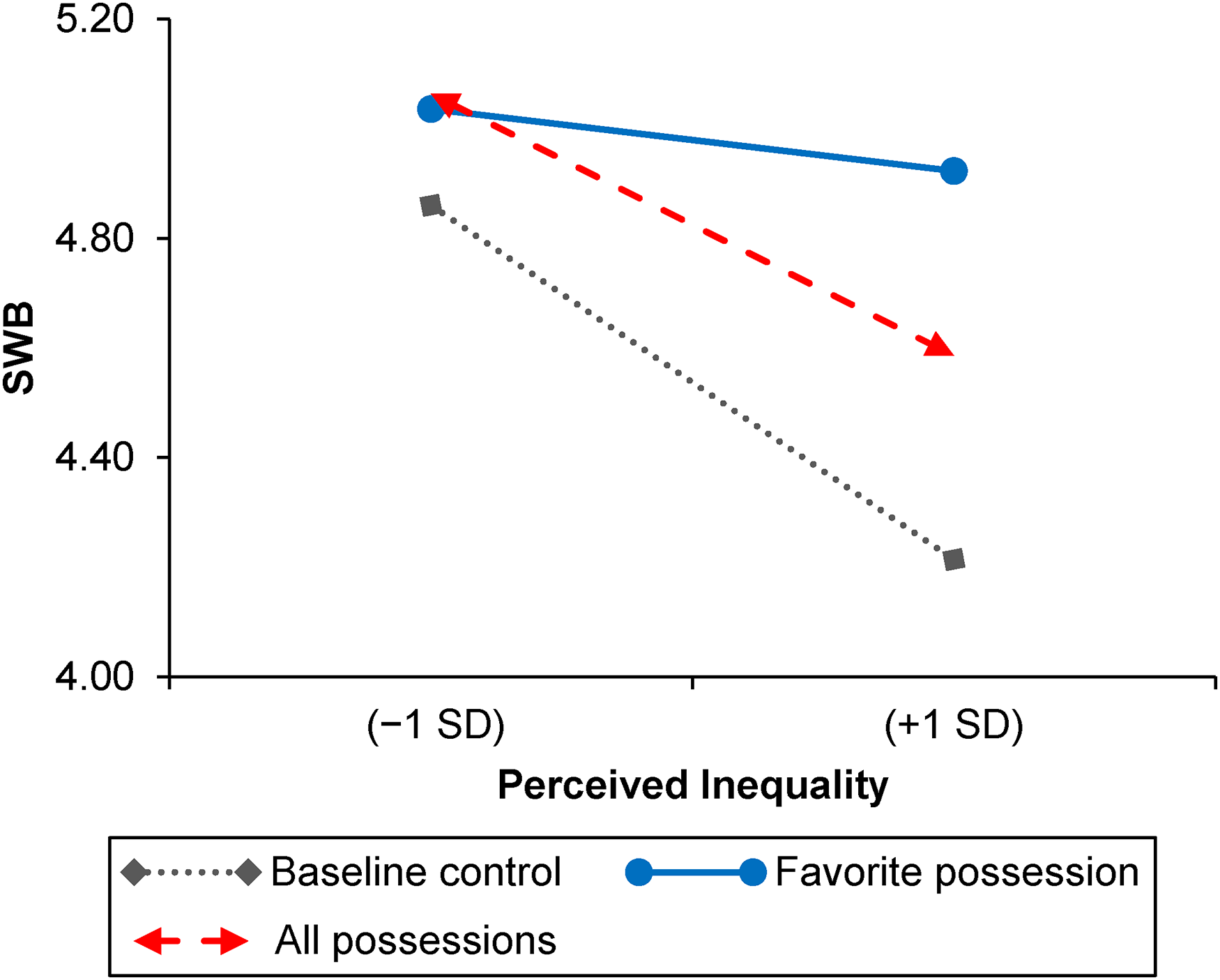
Study 2: Effect of Attention to Possessions × Perceived Inequality on SWB.
Slope analyses showed that increases in perceived income inequality led to reductions in SWB in the control condition (b = −.32, SE = .09, t(563) = −3.64, p < .001) and all-possessions condition (b = −.24, SE = .10, t(563) = −2.51, p = .013); this effect dissipated in the favorite possession condition (b = −.06, SE = .10, t(563) = −.57, p = .57), in support of H1. A floodlight analysis found that participants in the favorite possession condition reported significantly greater SWB than those in the control when perceived income inequality was above 43.4 (on the scale ranging from 20 to 65; i.e., −.55 SD; b = .30, SE = .15, t(563) = 2.00, p < .05) while participants in the all-possessions condition reported significantly greater SWB than those in the control when perceived income inequality was above 46.6 (i.e., −.21 SD; b = .27, SE = .14, t(563) = 1.98). A second floodlight analysis comparing the favorite and all-possessions conditions found that participants in the favorite condition reported marginally greater SWB than those in the all-possessions condition when perceived income inequality was above 54 (i.e., +.59 SD; b = .26, SE = .16, t(563) = 1.65, p < .10). Collectively, these results indicate the beneficial effect of attending to a favorite possession on SWB when faced with high inequality.
Relative deprivation
Factor analysis indicated that the relative deprivation scale items loaded onto two factors: (1) relative deprivation (“When I think about what I have compared to others, I feel deprived” and “I feel resentful when I see how prosperous other people seem to be”; α = .78) and (2) relative privilege (“When I compare what I have with others, I realize that I am quite well off” and “I feel privileged compared with other people like me”; α = .80). We theorized that attention to a favorite possession should minimize feelings of relative deprivation (vs. increasing feelings of relative privilege). We thus focused on the deprivation subscale in our analyses. Additional analyses found no effect on the privilege subscale (see Web Appendix G).
We regressed relative deprivation on the same set of predictors as on SWB (adjusted R2 = .35) and observed the key perceived income inequality × favorite possession interaction (b = −.31, SE = .13, t(563) = −2.37, p = .018,

Study 2: Effect of Attention to Possessions × Perceived Inequality on Relative Deprivation.
As theorized, slope analyses found that increased perceived income inequality was associated with greater relative deprivation in the baseline control (b = .25, SE = .09, t(563) = 2.87, p = .004), but this effect was eliminated in the favorite possession condition (b = −.06, SE = .10, t(564) = −.62, p = .54). In the all-possessions condition, the slope was directionally positive but nonsignificant (b = .13, SE = .09, t(563) = 1.36, p = .18). Moreover, a floodlight analysis found that participants in the favorite possessions condition felt significantly less deprived than those in the control when perceived income inequality was above 46.2 (i.e., −.25 SD; b = −.26, SE = .13, t(563) = −1.96) while participants in the all-possessions condition felt less deprived than those in the control when perceived income inequality was above 49.8 (i.e., .14 SD; b = −.26, SE = .13, t(563) = −1.96).
Moderated mediation
We then conducted a moderated mediation analysis (PROCESS Model 8) with perceived income inequality as the independent variable, SWB as the dependent variable, relative deprivation as the mediator, attention to possessions as a multicategorical moderator (with the baseline control as the benchmark condition), and income and materialism as covariates. In support of H2, the results showed that the effect of inequality on SWB was mediated by relative deprivation, moderated by favorite possessions (bootstrapped sample = 5,000, 95% CI = [.009, .134]). As expected, we found no moderated mediation when all possessions was the moderator (95% CI = [−.036, .093]; Figure 4). 6

Study 2: Moderated Mediation Analysis (PROCESS Model 8).
Discussion
Study 2 shows that perceived income inequality reduced SWB in both the baseline control and the all-possessions conditions, but this negative effect was mitigated in the favorite possession condition. These findings confirm H1 and replicate and extend those in Study 1. In support of H2, relative deprivation mediated the interactive effect of perceived income inequality and attention to possessions on SWB. Specifically, the detrimental effect of perceived income inequality on relative deprivation was reduced among consumers who attended to a favorite possession, which in turn protected their SWB when they perceived income inequality as high.
Unlike attention to one's favorite possession, attention to all of one's possessions did not significantly offset the negative effect of perceived income inequality on SWB. Although “all possessions” presumably includes one's favorite, SWB in the all-possessions condition fell in between the favorite and baseline conditions when participants perceived income inequality as high. Essentially, under high inequality, drawing consumers’ attention to all their material possessions can have an advantageous effect over the baseline condition, and drawing consumers’ attention to their favorite possessions can have an advantageous effect over attending to all possessions. These results imply that attention to material resources, in general, may not effectively protect SWB under income inequality (otherwise, the all-possessions condition also should have moderated the effect of perceived income inequality on SWB).
We found no difference between the favorite and all-possessions conditions on either time spent completing the writing task or its perceived difficulty. These results counter the possibility that differences in engagement or cognitive load drive the observed results. However, though qualified by interactions, we also observed a main effect of favorite possessions on SWB. We conducted a posttest to address the possibility that the observed results are driven by a boost in positive affect in the favorite possession condition (Web Appendix H). Participants recalled and described either a favorite possession or all their possessions and then reported positive and negative affect. We found no significant main effect of attention to possessions on either positive or negative affect, indicating that simply recalling a favorite possession may not boost emotions. Rather, the interactive effect of perceived income inequality and attention to possessions influences SWB.
Study 3: Testing the Full Model
Study 3 tested the full conceptual model. To do so, we manipulated perceived income inequality and attention to possessions and measured material comparisons, relative deprivation, and SWB.
Method
In exchange for monetary payment, 997 Americans recruited from Prolific Academic participated in a 2 (income inequality cue: inequality vs. neutral) × 2 (attention to possessions: favorite vs. baseline control) between-subjects study. We manipulated perceived income inequality using a video cue (same as in the Replication Study of Study 1). Participants in the inequality (vs. neutral) condition watched a video about research on income inequality in the United States (vs. on brain science; adapted from Kurt and Gino [2019]). A pretest revealed that the inequality (vs. neutral) video increased perceptions of income inequality in one's society but did not affect distinct but related constructs, such as perceptions of social mobility or economic optimism. The videos were also similar in enjoyability and length (Web Appendix H).
Following the video, participants in the favorite possession condition recalled and described their favorite possessions and then completed the dependent measures, while those in the baseline control condition completed the dependent measures before writing about their favorite possessions. The dependent measures included material comparisons (e.g., “How often do you find yourself comparing your material wealth with that of other people in the society?” α = .85), relative deprivation (Callan et al. 2008, α = .80; as in Study 2, we focused on the relative deprivation, but not relative privilege, subscale in the analysis), and SWB (Diener et al. 1985, α = .93). We also measured demographics (e.g., age, gender, income), an attention check, and materialism (Richins 2004). Exclusion of those who failed the attention check (n = 12) left 985 participants (Mage = 39.94 years, SDage = 14.13; 49.6% female) for analyses.
Results
Manipulation check
The perceived income inequality manipulation was successful (Minequality = 6.05, SDinequality = 1.69; Mneutral = 5.58, SDneutral = 1.62; F(1, 983) = 19.64, p < .001,
Full model
Following Zhao, Lynch, and Chen (2010), we tested the full conceptual model in a moderated serial mediation analysis (PROCESS Model 83), with inequality cue as the independent variable (inequality cue = 1, neutral cue = −1), SWB as the dependent variable, material comparisons as the first mediator, relative deprivation as the second mediator, and attention to possessions as the moderator (favorite = 1, control = −1), while controlling for income and materialism. The full model was marginally significant (bootstrapped sample = 5,000, index of moderated serial mediation: 90% CI = [.001, .055]). Attention to possessions marginally moderated the effect of perceived income inequality on material comparisons (binteraction = −.07, SE = .04, t(979) = −1.71, p = .088,
Study 3: Serial Moderated Mediation (Process Model 83) Results.

*p < .10. **p < .05. ***p < .01.
Notes: AttPo = attention to possessions; Rel. Dep. = relative deprivation.
Discussion
Study 3 tested our full model and found that perceived income inequality increased material comparisons in the baseline control condition but that the effect attenuated when consumers attended to their favorite possessions. In support of H3, material comparisons mediated the indirect effects of perceived income inequality and attention to possessions on relative deprivation and SWB.
We note that the perceived income inequality × attention to possessions interaction on social comparisons was marginally significant. One reason might be the strength of the inequality manipulation—the effect size of the manipulation check (
Study 4: A Multicountry Examination
Collectively, the previous studies found that perceived income inequality reduced SWB but that this negative effect was mitigated by drawing consumers’ attention to their favorite possessions. Studies 2 and 3 demonstrated the underlying process for this effect. Building on these findings, Study 4 had three objectives. First, we tested whether the observed perceived income inequality × favorite possessions interaction generalized to a multinational sample drawn from eight countries with macro-level differences on several dimensions. Second, because the sample spanned eight countries, we had an opportunity to assess the possible effect of actual income inequality. While our theorizing pertains to perceived income inequality, in this study we tested whether perceived income inequality and its interaction with attention to possessions affect SWB even when controlling for actual country-level inequality. Third, because country-level income inequality can affect SWB (Hagerty 2000; Pickett and Wilkinson 2010), we tested the possibility that attention to a favorite possession moderates the effect of actual country-level income inequality on SWB. Positive results would indicate the robustness and generalizability of the interactive effect of perceived income inequality and attention to possessions (H1).
Method
We collected data from eight countries (Chile, China, India, Mexico, Pakistan, Russia, Spain, and the United Kingdom) that vary in country-level income inequality (measured by their Gini index), region, population, language, and level of economic development. We recruited participants (N = 1,610) from Qualtrics Panels and screened them to be between the ages of 18 and 70 years. They completed a survey in exchange for monetary payment (a professional team translated questions into each country's main language). The study adopted a 2 (attention to possessions: favorite vs. all) × 1 (perceived income inequality, measured at individual levels) design.
Participants in the favorite (all-) possession condition recalled and described their favorite clothing item (all the clothing items) they purchased in the past year. We limited the writing task to clothing purchased in the past year to make the task feasible for the all-possessions condition. By holding constant product category and ownership duration, we also minimize country-level differences in the types of possessions recalled, a factor potentially confounded with the country-level variable actual income inequality. After the writing task, participants reported their SWB (α = .90), demographics, attention checks, the number of clothing items they purchased in the past year, perceived income inequality (“Income inequality exists in my country”; 1 = “strongly disagree,” and 7 = “strongly agree”), and a few unrelated items. We measured perceived income inequality after SWB to minimize any demand effect on the dependent variable. We excluded those who failed an attention check and those who purchased no clothing in the past year, which left 1,370 participants across eight countries for analyses (Mage = 43.27 years, SDage = 13.57; 46.0% female; see Web Appendix C for the countrywise breakdown). We measured actual income inequality with country-level Gini indices retrieved from the World Factbook (CIA 2018). 7 The Gini indices of the eight countries ranged from 30.7 to 50.5 (with higher values indicating greater country-level inequality).
Results
An analysis of variance revealed that perceived income inequality did not differ across conditions (Mfavorite = 5.00, SDfavorite = 2.23; Mall = 5.13, SDall = 2.17; F(1, 1,368) = 1.07, p = .30,
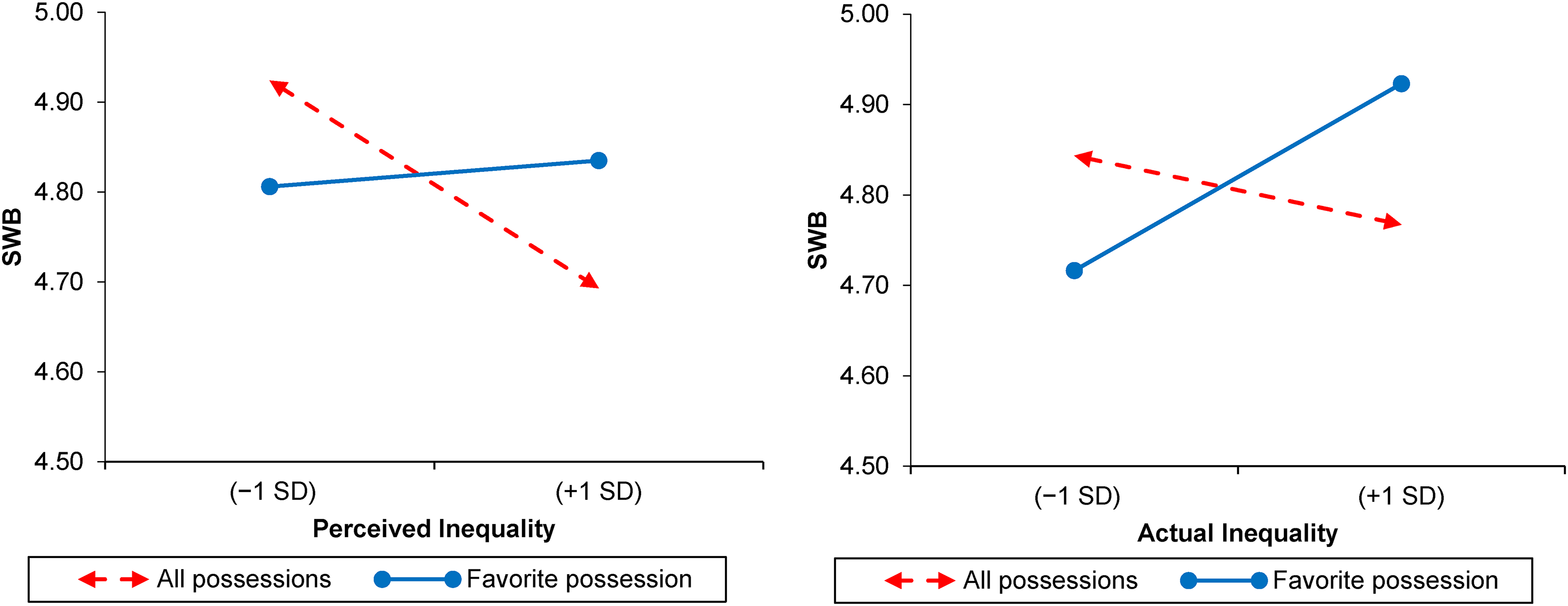
Study 4: Attention to Possessions × Perceived and Actual Income Inequality.
Replicating the results of Study 2, slope analysis showed that increasing perceived income inequality reduced SWB in the all-possessions condition (b = −.12, SE = .05, z = −2.15, p = .03) but not in the favorite possession condition (b = .01, SE = .05, z = .27, p = .79). This indicates that attention to a favorite possession mitigated the negative effect of perceived income inequality on SWB, even when we controlled for country-level Gini and the attention to possessions × Gini interaction.
Another slope analysis showed no effect of country-level actual income inequality (Gini) on SWB in either the favorite possession condition (b = .10, SE = .19, z = .54, p = .59) or the all-possessions condition (b = −.04, SE = .19, z = −.20, p = .84). However, a floodlight analysis showed that prompting consumers to recall a favorite possession (vs. all possessions) had a marginally positive effect on SWB when Gini reached 48 or above (b = .08, SE = .05, z = 1.66). Thus, attending to favorite possessions might benefit consumers who live in societies with high Gini coefficients.
Finally, in exploratory analysis, we tested whether country-level actual income inequality moderated the interactive effect of perceived income inequality and attention to possessions on SWB. A multilevel mixed-model analysis, including attention to possessions, perceived income inequality, Gini, and all interactions yielded no three-way interaction (b = .02, SE = .03, z = .54, p = .59,
Discussion
Attention to possessions moderated the effect of perceived income inequality on SWB (as observed in Studies 1–3), even when we controlled for country-level actual income inequality and its interaction with attention to possessions. This result suggests that the focal perceived income inequality × attention to possessions interaction is robust and generalizes to a sample drawn from populations across eight countries. Moreover, the lack of a three-way interaction indicates that this focal interaction does not depend on country-level actual income inequality.
Notably, attention to possessions also moderated the effect of actual income inequality on SWB when we controlled for perceived income inequality and its interaction with attention to possessions. As mentioned, both actual and perceived income inequality negatively affect SWB (Hagerty 2000; Oshio and Urakawa 2014). While these two constructs ideally would align, perceptions are shaped by many personal and social factors (Du and King 2022; Hauser and Norton 2017). As a result, the two constructs often correlate only moderately to weakly (Loveless 2013; Schalembier 2019). 8 As such, while actual income inequality should inform perceived income inequality to some extent (Oshio and Urakawa 2014), both have independent effects. We revisit this issue in the “General Discussion” section.
Study 5: Social Media Posts
Studies 1–4 draw consumers’ attention to their possessions through experimental prompts. In daily life, however, consumers attend to their possessions spontaneously and in a variety of contexts. One way to gauge what consumers attend to is to monitor their social media activity. Accordingly, by observing social media posts we can assess the relationship between consumers’ attention to possessions and their happiness. In Study 5, we therefore tested whether income inequality interacts with the content consumers post (i.e., posts about favorite possessions or not) to affect the happiness associated with the posts (as a proxy for SWB). While SWB is often referred to as happiness (Diener, Scollon, and Lucas 2009), SWB is a multifaceted construct that includes multiple correlated components that are both cognitive (reflecting life satisfaction) and affective (reflecting positive and negative feelings). Studies 1–4 relied on a cognitive measure of SWB (i.e., Diener et al. 1985). In Study 5, given the secondary nature of the data, we instead use linguistic text analysis tools to measure the affective component of SWB. The use of secondary data broadens the scope of contexts in which we test our theory and its ecological validity, and this correlational, observational analysis serves to complement the experimental results.
Method
We extracted data from all public Instagram posts available in the week of January 24−30, 2022, that satisfied two criteria: (1) revealed identifiable country location of the post, which enabled us to retrieve the country-level Gini index corresponding to that location and (2) contained at least one of several hashtags (#s) from three categories: favorite possessions (e.g., #favthing, #favoritething; hereinafter referred to as “#favorite-possession”), general consumption (e.g., #luxury, #swag, #expensive), and nonpossession “favorite” (e.g., #myfav, #favorite, #favoritepeople, #favoriteholiday). Among these, #favorite-possession constituted our target group and the other hashtags formed a comparison group. We selected hashtags based on the results of a qualitative pilot study (see Web Appendix J). To serve as a conservative comparison, we selected hashtags for the comparison group (i.e., hashtags about consumption and favorites in general) that are distinctive from but related to favorite possessions. We extracted 31,332 Instagram posts from 138 countries using these criteria. 9
The secondary data did not include posters’ perceptions of income inequality. Therefore, we used actual income inequality as a proxy: the Gini index corresponding to the post location (World Bank 2022). The large number of countries in our data (138) produced sufficient variation in income inequality to perform analyses. To measure the happiness conveyed in each post, we used Linguistic Inquiry Word Count (Pennebaker et al. 2015) software, which relies on the language used in a text response to compute its positive and negative emotionality. Following Sandvik, Diener, and Seidlitz (2009), we relied on net positive emotions as our measure, which we calculated by subtracting negative from positive emotionality.
Results and Discussion
We tested the interactive effect of #favorite-possession posts and income inequality on happiness. A fixed-effects regression model regressed net positive emotions on #favorite-possession (yes = 1, no = −1), Gini, and their interaction, with country dummy variables as covariates to control for time-invariant country characteristics. We found a significant interaction between #favorite-possession and Gini (b = .02, SE = .01, t(31,192) = 2.27, p = .023) and qualified main effects of Gini (b = −.13, SE = .08, t(31,192) = −1.62, p = .105) and #favorite-possession (b = −1.54, SE = .33, t(31,192) = −4.66, p < .001). Slope analyses showed a negative relationship between income inequality and happiness when posts featured the comparison hashtags (b = −.15, SE = .08, t(31,192) = −1.89, p = .059), but this negative effect attenuated when posts included #favorite-possession (b = −.11, SE = .08, t(31,192) = −1.34, p = .18). This interactive effect echoes the key interaction observed in Studies 1–4. A multilevel linear model with country entered as the group-level variable yielded similar results, which we report in Web Appendix C along with additional auxiliary analyses.
The results of Study 5 converge with and complement those of Studies 1–4: higher income inequality was associated with less happiness in the posts when consumers used hashtags about consumption in general or favorites in general. Critically, however, this negative relationship attenuated when consumers used hashtags about favorite possessions. The data are observational, and we had no access to unobserved variables that may affect likelihood of posting (e.g., individual materialism, income), creating a potential endogeneity issue. Thus, we refrain from drawing causal inferences here. However, it is noteworthy that the interaction observed in Study 5 aligns with the interaction between perceived income inequality and attention to possessions observed in the previous studies (which were experiments that established the causal relationships posited in the conceptual model).
General Discussion
Across five studies, we find that the negative effect of income inequality on SWB is mitigated if consumers attend to their favorite possessions. Study 1 shows that, while perceived income inequality reduces SWB by default, recalling a favorite possession offsets this negative effect (H1). Study 2 replicates the finding that attention to a favorite possession mitigates the negative effect of perceived income inequality. However, attention to all of one's possessions has no such effect. Study 2 further shows mediation by relative deprivation (H2). Study 3 tests the full conceptual model and shows that attention to one's favorite possession weakens the effect of perceived income inequality on material comparisons, which in turn reduces relative deprivation and protects SWB (H3). Study 4 uses data from eight countries and finds that H1 holds when controlling for actual (i.e., country-level) income inequality and its interaction with attention to possessions. This attests to the robustness and generalizability of the effect across countries that vary in income inequality. Finally, analyzing Instagram posts from 138 countries, Study 5 finds that actual income inequality interacts with the hashtags consumers use in their posts to predict the happiness they express in the posts.
Theoretical Contributions
Material possessions
Our findings contribute to the literature on material possessions and, specifically, favorite possessions. First, prior research finds that material possessions tend to be socially compared and that focusing on material possessions increases social comparisons (Carter and Gilovich 2010; Howell and Hill 2009); by contrast, we show that favorite possessions tend not to be socially compared and that focusing on a favorite possession reduces social comparisons, which in turn mitigates the effect of perceived income inequality on relative deprivation and SWB. Thus, we demonstrate that favorite possessions represent “an exception to the rule” that material possessions are readily used for social comparison. In doing so, we also contribute to a small but important set of studies that document conditions under which material acquisition can improve SWB (e.g., Goodman, Malkoc, and Stephenson 2016; Lee, Hall, and Wood 2018).
Second, while prior research suggests that the value of a special possession is incommensurable (e.g., Kopytoff 1986; Price, Arnould, and Curasi 2000; Wallendorf and Arnould 1988), little is known about the implications of this incommensurability. We show that the incommensurability of favorite possessions matters: By reducing social comparison, favorite possessions can safeguard well-being under income inequality. This insight about favorite possessions is practically and broadly useful because, though reducing social comparison is difficult, everyone has a favorite possession that can serve as a resource to help them do so.
Income inequality
We also contribute to the literature on income inequality and material acquisition. Prior research shows that income inequality increases attention to and acquisition of material goods (Christen and Morgan 2005; Jaikumar and Sarin 2015; Walasek, Bhatia, and Brown 2018; Walasek and Brown 2015). This increased consumption can precipitate debt without improving SWB and thus is a suboptimal way to cope with inequality. Yet, with income inequality rising globally and public opinion that inequality is higher than ideal (Norton and Ariely 2011), identifying ways to alleviate the negative psychological impact of income inequality and protect consumer well-being is critical. To this end, we find that material acquisition can play a positive role in coping with income inequality. While consumption might help consumers cope with income inequality in other ways, a key strength of our approach is that it relies on existing possessions (i.e., goods consumers have already acquired) and thus is costless to implement (both financially to the consumer and in its environmental impact).
Our research also makes empirical contributions to the income inequality literature. Prior research documents relationships between actual income inequality, actual relative deprivation, and SWB (Podder 1996; Runciman 1966; Yitzhaki 1979). It also documents relationships between actual income inequality, relative income (as a proxy for social comparison tendencies), and SWB (Cheung and Lucas 2016). While the findings in prior research are consistent with our theorizing, that literature is limited by its reliance on objective measures, which are necessarily correlational and thus do not lend themselves to experimental manipulations and tests of psychological processes through statistical mediation. Also noting this limitation, Schneider (2016) calls for further research on the psychological mechanisms related to income inequality. In this vein, Oishi, Kesebir, and Diener (2011) establish how income inequality influences interpersonal trust and perceived fairness. Here, we do so with relative deprivation. Our study is the first to offer experimental evidence that (perceived) income inequality reduces SWB through feelings of relative deprivation.
In light of prior research findings (Podder 1996; Runciman 1966; Yitzhaki 1979) and our findings (Studies 2–3), both actual and perceived income inequality appear to affect SWB through relative deprivation. Oshio and Urakawa (2014, p. 755) also posit that perceived income inequality “links actual income inequality to SWB.” Yet research has also found that perceived and actual income inequality correlate moderately or weakly (Loveless 2013; Schalembier 2019), possibly because factors such as media attention (Hauser and Norton 2017), political ideologies, and personal experiences (Du and King 2022) may shift perceptions away from reality. In addition, actual and perceived income inequality have different correlates that may drive their respective effects on SWB through mechanisms other than relative deprivation. For example, actual income inequality is linked to violence, obesity, and educational outcomes in a society (Pickett and Wilkinson 2010), which all could affect SWB but play lesser roles in shaping perceptions of inequality. The different correlates may explain why actual and perceived income inequality only weakly correlate with each other, though both reduce SWB.
Limitations and Future Research Directions
The limitations of our research suggest several possible directions for future research. First, we find that attention to favorite possessions reduces consumers’ tendencies to engage in material comparisons, but the exact mechanism warrants further investigation. One possibility is that this process is cognitive. Because consumers tend not to compare their favorite possessions with others’ possessions, prompting them to think about a favorite possession might reduce their cognitive readiness to engage in social comparisons. Another possibility is that the process is motivational. Favorite possessions are central to people's sense of self (Kleine, Kleine, and Allen 1995). Because the value of a favorite possession cannot be reduced to its price, thinking about a favorite possession might make consumers feel that the value of their “self” cannot be reduced to their material wealth. That is, they may perceive the value of favorite possessions and, thus, the value of the self as sacred, so quantifying it is morally unacceptable (McGraw and Tetlock 2005). As such, consumers would avoid comparing themselves with others in material wealth.
Second, while the value of a favorite possession is incommensurable, it need not have unalignable product attributes (i.e., attributes that cannot be objectively compared, such as taste; Zhang and Fitzsimons 1999). Similarly, while a favorite possession is special and unique to its owner, it need not be unique or scarce in the market (Sharma and Alter 2012). Our content analyses found that most of the favorite possessions recalled were common products, such as clothing, jewelry, and electronic devices (Web Appendices D and F). Participants seldom recalled a favorite possession because of its uniqueness or scarcity in the market (which would be categorized as status value). In a follow-up experiment (Web Appendix A), we drew participants’ attention to the similarities between their favorite possessions and another product's attributes. This did not cause participants to perceive their favorite possession as any less special, incommensurable, or unique. Thus, even when prompted to perceive a favorite possession's attributes as alignable with or even identical to another product's attributes, its owner would still perceive its value as incommensurable. While this indicates that attribute alignability does not undermine the specialness of favorite possessions, future research should address whether alignability or product scarcity affects whether a product elevates to the status of a favorite. Research might also examine whether recalling a favorite possession may reduce the importance of money or other means of quantifying the value of material possessions.
Third, we observed the effects of attention to favorite possessions both without imposing constraints on product category or time of purchase (Studies 1–3) and with constraints (participants in Study 4 recalled their favorite clothing item purchased within the past year). The replicability of the effect implies that favorite possessions can buffer SWB against income inequality regardless of the type of possession or time of acquisition. We do, however, expect boundary conditions to exist. On the one hand, the effect may not hold in all product categories. For example, although many consumers have a favorite grocery product (e.g., a favorite flavor of ice cream that they associate with childhood), recalling a grocery product may not mitigate the effect of inequality because grocery products tend not to be socially compared. On the other hand, the effect may strengthen with products owned for a longer time, as they may become increasingly meaningful.
Fourth, future research should examine individual and cultural differences that moderate the link between income inequality and SWB, in particular factors that affect the extent to which people accept inequality and hierarchy (e.g., their social dominance orientation; Pratto et al. 1994), political orientation, or a culture's power distance belief (Hofstede 2001). Perceived inequality should have less impact on SWB among those who find inequality more acceptable (e.g., people with a high social dominance orientation, societies with a high power distance belief). Acceptance of inequality also affects perception of inequality—those who accept inequality tend to perceive lower levels of inequality in their society (Du and King 2022). Thus, political conservatives may evidence weaker effects because they are more accepting of inequality and also are more likely to make vertical social comparisons (Ordabayeva and Fernandes 2018). In addition, we found that income did not reliably moderate our effect, and from our data, we cannot draw any conclusions about people who live in extreme poverty. Future research with a wider range of incomes in the sample should further examine the role of income. Moreover, as discussed, actual income inequality has other correlates that can potentially influence SWB.
Finally, future research should examine downstream consequences of attention to favorite possessions. As mentioned, SWB is associated with various positive outcomes. Thus, by protecting SWB, the consequences of attention to favorite possessions should be mainly positive. However, concerns about social inequality can motivate behaviors that address it (e.g., donating, supporting income redistribution; Ordabayeva and Lisjak 2022). By mitigating the effect of income inequality, attention to favorite possessions may reduce these prosocial actions.
Practical Implications
Understanding how macro trends influence consumers is a priority research area in marketing (Marketing Science Institute 2020). We show that prompting consumers to think about their favorite things can be an effective way to mitigate the negative psychological impact of perceived inequality on their SWB. Income inequality is a major social issue that needs addressing, and in parallel, there is a need for implementable strategies that protect consumers’ well-being. Our approach is useful across favorite possessions of different types and in the face of both actual and perceived income inequality. While we mainly rely on a recall task to draw consumers’ attention to their favorite possession, there are many ways to draw attention to favorites, some of which are readily scalable. Study 5 suggests that social media presents promising opportunities—for example, an Instagram campaign that trends posting and sharing stories of one's favorite possessions. Auxiliary analyses in Study 5 also found that higher income inequality correlated with a lower likelihood to post #favorite-possession (Web Appendix C). Thus, consumers may not intuit the type of content that could help them cope with inequality, underscoring a need for interventions. Other consumer contexts can increase consumers’ attention to their favorite possessions through, for example, consumption, sharing, and storytelling.
More broadly, our findings suggest that maintaining well-being under income inequality may not depend on how many or even what material goods consumers own. Instead, well-being depends on whether consumers have meaningful relationships with their acquired goods. Mindful consumption that focuses not on amassing material goods but on appreciating and fully enjoying one's possessions may help imbue possessions with special meanings. Indeed, the growing popularity of the notion that possessions should “spark joy” (Kondo 2016) reflects a trend toward cultivating meaningful relationships with material possessions.
In conclusion, our argument is not that favorite possessions can mitigate the various and serious negative impacts of income inequality on individuals and societies (e.g., poor health, increased crime rate, increased mortality); rather, our findings suggest one way consumers can cope with the psychological effect of perceived income inequality on their sense of well-being. Despite the great income inequality in the world, everyone has a few favorite things that can make them happy. We do not all need a Mercedes-Benz.
Supplemental Material
sj-pdf-1-mrj-10.1177_00222437221141053 - Supplemental material for Favorite Possessions Protect Subjective Well-Being Under Income Inequality
Supplemental material, sj-pdf-1-mrj-10.1177_00222437221141053 for Favorite Possessions Protect Subjective Well-Being Under Income Inequality by Jingshi (Joyce) Liu, Amy N. Dalton and Anirban Mukhopadhyay in Journal of Marketing Research
Footnotes
Acknowledgments
This article is based on the first author's doctoral dissertation, jointly supervised by the second and third authors. The authors sincerely thank Cassie Mogilner Holmes, Jiewen Hong, Nailya Ordabayeva, Robert S. Wyer Jr., Michelle Yik, and Rongrong Zhou for their thoughtful comments and suggestions. They also thank the JMR review team, members of the Marketing Group at Bayes Business School, members of the Department of Marketing at HKUST, participants at the Center for Retailing Research Seminar at the Stockholm School of Economics for their helpful feedback, and Jeremy Lee, Tristen Lee, Esther Nip, and Jiabi Wang for their research assistance. The third author tips his hat to his beautiful big red car, a self-reward for attaining tenure, whose memory he fondly recalls.
Special Issue Editor
Vikas Mittal
Associate Editor
Gergana Nenkov
Declaration of Conflicting Interests
The author(s) declared no potential conflicts of interest with respect to the research, authorship, and/or publication of this article.
Funding
The author(s) disclosed receipt of the following financial support for the research, authorship, and/or publication of this article: This project has been funded by the HKUST Institute for Emerging Market Studies with support from EY (IEMS17BM04; IEMS19BM04), and the Hong Kong Research Grants Council (GRF 16507119).
Notes
References
Supplementary Material
Please find the following supplemental material available below.
For Open Access articles published under a Creative Commons License, all supplemental material carries the same license as the article it is associated with.
For non-Open Access articles published, all supplemental material carries a non-exclusive license, and permission requests for re-use of supplemental material or any part of supplemental material shall be sent directly to the copyright owner as specified in the copyright notice associated with the article.
