




Abstract
Cause-related marketing (CM), which links corporate donations to consumer purchases, has ongoing momentum in marketing. As the magnitude and direction of consumers’ response to CM are inconclusive, this meta-analysis synthesizes evidence on main and moderator effects from 237 studies. On average, the authors find a moderate effect for attitudinal response (d = .458) and a weak effect for behavioral response (d = .283; both ps < .001), both with high underlying heterogeneity. A multivariate meta-regression on CM moderators grounded along four conceptual pillars—transparency, signals of sincerity, purchase context, and consumers’ emotional attachment to CM—shows that attitudinal effects hinge mostly on emotional attachment. Suboptimal execution and poor communication of the donation appeal in particular can even have detrimental effects on attitudes. In addition, various moderators from other pillars play a relevant role. For behavioral outcomes, both emotional attachment and signals of sincerity are equally important. The visual prominence of the donation is the most relevant individual moderator, with only a few others related to the two pillars following at some distance. Therefore, CM requires different priorities depending on corporate objectives. This research further compares the effects of CM with those of discounts and other corporate social responsibility marketing instruments, simulates practical examples, and provides avenues for further research.
Keywords
Over the past decade, annual average investments in cause-related marketing (CM) grew by 6%, reaching $2.24 billion in 2019 in the United States alone (IEG 2019). This level of increase exceeds that of overall marketing spending and indicates an ongoing interest in CM as a marketing instrument.
Successful CM campaigns include Procter & Gamble joining forces with UNICEF to implement a tetanus vaccination program in Africa that offered one vaccine for every P&G product sold, Starbucks supporting the Global Fund for people living with AIDS in Africa by offering $.25 for every Starbucks coffee of selected flavors sold, and Yoplait's breast cancer campaign, which donated $.10 to the Susan G. Komen breast cancer foundation for each yogurt sold. Varadarajan and Menon (1988, p. 6) describe CM campaigns like these as “an offer from a firm to contribute a certain amount to a designated cause when a customer engages in a revenue-providing exchange.” The use of CM has the potential to raise awareness for the charitable cause while also driving brand equity and revenues for the brands involved.
In contrast to these successful examples, CM can also have negligible marketing impact (Schamp, Heitmann, and Katzenstein 2019), and, in extreme cases, poorly conducted campaigns can even backfire (Yoon, Gürhan-Canli, and Schwarz 2006). A prominent example of negative response to CM is KFC's collaboration with the Susan G. Komen foundation: the “Buckets for the Cure” campaign, which offered $.50 for every KFC bucket sold, resulted in a public outcry, a consumer boycott, and a public relations disaster (McVeigh 2012).
Despite the differences in the outcomes for KFC and Yoplait, these CM campaigns had commonalities: they had the same partner and the same cause, both were transparent about their donation sizes, and both were executed by well-known consumer brands from the same country and cultural context. However, there are several notable differences. Most evidently, Yoplait's brand positioning based on health fit more naturally with the cause than did KFC's fast-food brand, which focuses on taste and convenience. Other less apparent differences may also have played a role: KFC's communication emphasized eliminating the negative (“end breast cancer”), whereas Yoplait's messaging had a positive sentiment (“save lives”). Yoplait also positioned the cause at the center of its communication, even at the expense of the visibility of its own brand logo, whereas KFC treated its campaign like any other promotion, with a conventional brand and product focus and the cause appearing as a side note (see Web Appendix Figure W1 for the respective advertisements). Whether these differences actually played a role for the different outcomes or which of them are most relevant is not clear.
Mirroring practical interest, several hundred empirical studies of CM have been published in the marketing, psychology, business ethics, and strategic management literature, which allows for a systematic meta-analysis to determine the average effectiveness of CM and how best to optimize CM campaigns. Although a few studies evaluate outcomes related to employees (e.g., Drumwright 1996) or financial markets (e.g., Woodroof et al. 2019), most studies investigate attitudinal and/or behavioral responses of consumers, making these outcomes the focus of our analysis.
Empirical investigations examine CM effectiveness in two ways: The first group measures CM's main effect by comparing experimental conditions with and without CM and (sometimes) tests moderators of this main effect. These studies provide insights on the lift from CM, that is, whether attitudinal and behavioral responses are more favorable with CM than without. Collectively, these studies provide valuable information on the effectiveness of CM to help managers understand its potential as a marketing instrument. However, whereas several studies report strong positive effects (Cohen's d > .80; e.g., Baghi and Antonetti 2017; Barone, Miyazaki, and Taylor 2000), other studies find only small positive effects (Cohen's d < .10; e.g., Andrews et al. 2014; Dubé, Luo, and Fang 2017), and others even report small negative effects of CM backfiring in terms of brand-related outcomes (e.g., Jung et al. 2017; Park, Nam, and Lee 2017). Thus, the literature is not informative yet about the average effectiveness of CM, how much this effect varies, and which moderator effects can be generalized beyond the settings of individual studies.
The second group of studies focuses exclusively on moderators by comparing different CM scenarios (e.g., the same CM conducted by a well-known brand vs. an unknown brand to understand if CM effectiveness is a function of brand strength). For many moderators, findings remain inconclusive. For example, fit between the brand and the nonprofit organization (NPO) or cause is one of the most studied moderators. Often, a positive role of fit is found (e.g., Brown and Dacin 1997; Lichtenstein, Drumwright, and Braig 2004; Menon and Kahn 2003), but replication attempts sometimes fail (e.g., Nan and Heo 2007; Samu and Wymer 2014), and some studies even report that negative fit leads to higher consumer responses (e.g., Ellen, Mohr, and Webb 2000; Koschate-Fischer, Stefan, and Hoyer 2012). Similar inconsistencies exist regarding the size of the donation (e.g., Arora and Henderson 2007; Olsen, Pracejus, and Brown 2003; Strahilevitz 1999), the strength of the brand conducting CM (Arora and Henderson 2007; Lafferty 2009), the hedonic versus utilitarian product category of the CM brand (e.g., Das et al. 2016; Strahilevitz and Myers 1998), or the focus of the campaign on the brand versus the NPO/cause (e.g., Menon and Kahn 2003; Samu and Wymer 2009). See Table 1 for an overview of all moderators and consistency of results.
Expected Effects of CM Moderators.

Notes: The designation “(+/−)” indicates inconclusive results in the CM literature as both positively and negatively significant effects have been reported.
Importantly, many of these experimental studies of the second group lack control conditions on baseline brand interest without CM, which makes these studies different from those in the first group. Since the no-CM experimental condition is missing, the main effect of CM cannot be estimated, and pure moderator studies are not informative about how moderators relate to the impact of CM itself. Thus, these studies can provide indications of potentially relevant moderators but cannot indicate the direction and size of CM effects under different conditions.
Given this controversy and heterogeneity in research approaches, we still do not know what average effect to expect from CM. Moreover, the average impact and relative importance of moderators is unknown. Some narrative reviews of the CM literature are available (Brønn and Vrioni 2001; Gupta and Pirsch 2006; Lafferty, Lueth, and McCafferty 2016), and one meta-analysis inspects one moderator at a time, predominantly on the basis of the second group of studies (Fan et al. 2020; see Web Appendix Table W1 for more detail). None of these reviews quantifies the average impact of CM on relevant marketing outcomes, provides insights on which moderators are most relevant in terms of CM effectiveness, or quantifies the size of this impact.
This gap in the literature leaves managers with several relevant open questions. Given the lack of knowledge about CM effectiveness, it is not clear whether CM is generally worth considering as an instrument for attaining marketing objectives. It is also not clear which brands are in a reasonable position to benefit from CM. The KFC and Yoplait examples suggest that certain brands may not be, whereas other brands appear to be better positioned. In terms of execution, it is not clear what to focus on to manage the impact of CM effectively. Answers to the latter question are further complicated by the large number of moderators that have been studied. In this research, we identify 15 different moderators that are discussed in more than five studies. Taking all the moderators into account and investigating their role can be complex and, in many applications, impractical. It is not clear whether all these factors are equally relevant or whether a focus on a single factor or a few factors is a better strategy.
Furthermore, managers follow different corporate objectives. Some focus on building brand reputation to indirectly drive long-term demand, whereas others have a more transactional perspective and are more interested in direct sales effects (Stahl et al. 2012). The latter behavioral outcomes are likely of greater interest for involved NPOs, as donations are linked to transactions rather than to brand image. Whether marketing managers and NPOs should form different expectations and focus on different moderators depending on behavioral versus attitudinal objectives is an open question.
We provide answers to these questions by making three main contributions: First, we collect all experimental evidence that compares CM with no-CM benchmarks and compute an average CM effect size. To further set the average CM effect in perspective, we also synthesize studies comparing the influence of CM with discounts and other corporate social responsibility (CSR) activities. This approach provides guidance on the potential of CM in the marketing mix.
Second, we distinguish between attitudinal and behavioral outcomes. CM is likely normatively appealing to consumers. However, actual prosocial behavior can deviate from attitudes because making product decisions can divert attention toward other relevant purchasing factors (e.g., Nguyen et al. 2022). It is therefore possible that managers can reach very different conclusions about CM depending on their main corporate objectives.
Third, we make the decision of when and how to implement CM more manageable. We do this in two ways. We develop a model of four conceptual pillars—transparency, signals of sincerity, purchase context, and emotional attachment—that structures the moderators of CM effectiveness. We integrate all relevant moderators into a concise framework based on a review of all CM research, including studies that lack a no-CM control group (the second group of studies). To derive empirical generalizations and estimates of relative importance, we need to observe how the resulting 15 moderators relate to the main effect of CM. We do this by developing a coherent coding scheme and collecting additional survey data to obtain values across all moderators for all experimental studies that contain a no-CM control group (i.e., have an estimate of the main effect of CM). This approach enables us to follow the recommendations of Grewal, Puccinelli, and Monroe (2018) and run a multivariate meta-regression model that simultaneously controls for all moderators and measures the impact of each moderator over and above all others. Specifically, we regress both attitudes and behavioral outcomes on all 15 moderators in hierarchical random-effects models. We then aggregate these various effects to the four conceptual pillars and compare their impact on attitudinal and behavioral outcomes.
In total, we identify 237 empirical studies on consumer responses to CM. Of those, 67 studies, including 205 effect sizes based on 118,582 observations, report main-effect evidence on CM. Regarding the first and second contribution of our meta-analysis, we find that CM has a small (behavioral responses, d = .283, p < .001) to moderate (attitudinal responses, d = .458, p < .001) average main effect. These values are comparable to those of other CSR instruments. Although the impact of CM on short-term behavioral responses is lower than what sizable discount promotions attain, CM has a more positive impact on attitudes than discounts do. However, the average CM effects are qualified by a large heterogeneity across effect sizes.
Regarding the third contribution, we quantify the drivers behind this heterogeneity. An aggregated analysis on the collective influence of individual moderators in the form of the conceptual pillars reveals that attitudinal outcomes depend mostly on emotional attachment. Our simulations show that campaigns with low levels of emotional attachment and poor CM framing in particular even risk overall negative effects of CM on brand reputation. Beyond that, the level of the donation size, the visual prominence of the donation target, and the brand and cultural context also have a relevant impact. For behavioral outcomes, emotional attachment plays a smaller role than it does for attitudes, such that both emotional attachment and signals of sincerity are equally important. The visual salience of the donation target is by far the most relevant individual moderator, with several others related to the two pillars following with some distance.
Taken together, these findings suggest that CM is a feasible marketing instrument. However, conducting successful CM requires clear corporate objectives because both average CM effectiveness and the number and type of relevant moderators differ for attitudinal and behavioral objectives.
The remainder of this article is structured as follows. First, we discuss the conceptual framework and four pillars that underlie CM's main and moderator effects. Next, we describe the data collection and meta-analytical approach. Then, we present the results for the average impact of CM and compare it with other CSR instruments and discounts. Using a hierarchical meta-regression, we determine and test the moderator effects. We conclude with a discussion of when CM's effects might turn negative, recommendations for CM execution, and suggestions of further research directions.
Theory on Consumer Response to CM
Consumer Responses to CM
A CM campaign ties a purchase to a donation benefiting a charitable donation target. Conceptually, CM is therefore a CSR instrument with promotional character. Other forms of promotions have an impact on immediate purchase decisions, but also on attitudes toward the brand (Gedenk, Neslin, and Ailawadi 2010; Grewal et al. 1998). Similarly, brand-related attitudes and purchase-related behavior are the most frequently studied CM responses (Gupta and Pirsch 2006; Lafferty, Lueth, and McCafferty 2016). Whereas most studies postulate a high correlation between both types of consumer responses and see positive brand attitudes as antecedent to positive behavioral response (e.g., Fan et al. 2020), other streams of research highlight a gap between attitudinal and behavioral outcomes regarding prosocial behavior (Carrington, Neville, and Whitwell 2014). From a managerial perspective, both objectives are relevant. Thus, CM could be suitable to build brand reputation by associating the brand with a good purpose. At the same time, CM directs attention to the brand and serves as an additional emotional product attribute; that is, it is also executed to attain short-term promotional objectives (Arora and Henderson 2007; Schamp, Heitmann, and Katzenstein 2019; Winterich and Barone 2011).
Following most advertising and CM research, we define attitudinal response as the overall favorable or unfavorable judgment about the focal brand and its CM campaign. Behavioral response, in turn, measures an (intended) behavior, in this case the purchase of a CM-linked brand (e.g., Ajzen and Fishbein 2005).
Similar to other marketing activities (e.g., Stahl et al. 2012), the average effectiveness of CM and the role of moderators might differ between these two responses. For example, CM might affect attitudes because of simple affect transfer or identification with the campaign (e.g., I like the CM campaign, so I like the brand; e.g., Du, Bhattacharya, and Sen 2011; Lafferty, Goldsmith, and Hult 2004), but also more complex cognitive processes (e.g., the CM campaign is believable and therefore I trust this brand; e.g., Müller, Fries, and Gedenk 2014; see also Campbell and Kirmani 2000). Behavioral responses, in contrast, involve deliberations about competing alternatives or trade-offs between CM and other attributes, such as monetary payments and product quality (e.g., McFadden 1999; Schamp, Heitmann, and Katzenstein 2019). Thus, although positive effects can be expected for each outcome, effect sizes (both overall and for underlying moderators) may differ empirically between attitudinal and behavioral responses.
Four Conceptual Pillars of Consumer Response to CM
In contrast to traditional price promotions, CM does not provide consumers direct economic benefits but rather indirect, noneconomic emotional benefits. Economists and psychologists argue that contributions to a good cause provide intrinsic rewards, and thus charitable donations also have self-serving benefits. This argument has led economists to coin the term “impure altruism” (Andreoni 1990), and psychologists to refer to “psychological egoism” (Batson and Shaw 1991). In addition, CM research argues that consumers feel a normative obligation to “do their part” in society (e.g., Arora and Henderson 2007) and that CM offers a convenient solution to do so (Cialdini et al. 1997), which is reflected in positive attitudinal and behavioral responses. Consumers also can benefit from choosing CM to signal their moral values to others (Jung et al. 2017) or develop and maintain a positive self-image (Winterich and Barone 2011). Aside from such donation-related rewards, CM may result in more favorable attitudinal and behavioral responses by resolving feelings of guilt associated with consumption, in particular when consuming for personal pleasure (Strahilevitz and Myers 1998).
At the same time, consumers are likely aware of the brand's economic interests in conducting CM (Campbell and Kirmani 2000; Shiv, Edell, and Payne 1997). This awareness can make consumers sensitive to potential exploitation attempts driven mainly by economic objectives (Brown and Dacin 1997; Chernev and Blair 2015; Drumwright 1996; Koschate-Fischer, Stefan, and Hoyer 2012). Accordingly, corporate motives behind a CM engagement (e.g., Barone, Miyazaki, and Taylor 2000; Becker-Olsen, Cudmore, and Hill 2006; Chernev and Blair 2015) or potential green- or cause-washing attempts (e.g., Basil and Herr 2006; Gupta and Pirsch 2006) could be detrimental to CM effectiveness. In the context of CM, exploitation appears to be a particularly improper persuasion attempt that not only takes advantage of consumers’ ethical motives but also takes advantage of the associated NPO and cause (Ellen, Webb, and Mohr 2006; Forehand and Grier 2003). Although these lines of research demonstrate that exploitation is detrimental to attitudinal and behavioral responses, it is not clear whether the overall CM impact would turn negative.
These positive and negative effects of CM can be summarized in four pillars. In CM campaigns, consumers do not donate directly to a donation target and so must understand and trust the corporate motives. To address concerns about corporate exploitation, marketers must provide both (1) transparency and (2) signals of sincere CM engagement. Transparency summarizes the subjective impression of consumers that no relevant information about the CM campaign is hidden to them. It refers to the amount of information that is available and straightforward to understand. Lower information-processing difficulties result in higher levels of consumers’ trust and confidence (McKay 2008), making a CM campaign more attractive. Signals of sincerity refer to what the available information about a CM campaign conveys about corporate motives. Importantly, according to persuasion knowledge, plausible and coherent communication can result in greater credibility and more favorable responses (Isaac and Grayson 2017), whereas ambiguous or unexpected information has the opposite effect (Campbell and Kirmani 2000; Shiv, Edell, and Payne 1997).
(3) A CM campaign's appeal hinges on the emotional value consumers ascribe to CM in terms of feeling good about the donation, relieving their conscience, and increasing their positive self-image. Emotional attachment to a donation target—that is, the consumer’s feeling that they can make a meaningful difference for a purpose they can personally connect to—is also a main theme in research on prosocial behavior. Emphasizing consumers’ contribution to a greater good (Cryder, Loewenstein, and Seltman 2013; Gneezy, Keenan, and Gneezy 2014) or providing tangible details about a cause (Duncan 2004) are driving forces of personal donation decisions.
Finally, CM is not executed in a vacuum but happens in a (4) purchase context. This factor summarizes the setting of CM that is not altered by the campaign itself, including the brand's overall competitive position and the brand's operating environment. Contexts that fit CM, like hedonic products and interdependent cultures, are likely conducive to CM (e.g., Strahilevitz and Myers 1998; Winterich and Barone 2011), whereas those that divert attention away from CM, such as contexts requiring trade-offs with other important attributes like price, likely are not (e.g., Barone, Miyazaki, and Taylor 2000; Chang 2008).
These four conceptual pillars (transparency, signals of sincerity, emotional attachment, and purchase context) are driving consumer response to CM. They are exhaustive and relate to all CM moderators studied at least five times in the literature. They are also mutually exclusive in that each moderator maps onto one of these four pillars on the basis of related mechanisms that we discuss in more detail next. Figure 1 provides an overview of the moderators that we identified on the basis of the conceptual framework and literature analysis.

Conceptual Framework.
Table 1 lists representative empirical work on each moderator and summarizes our main conclusions based on the conceptual pillars of CM. Although the conceptual pillars suggest theoretical predictions, several inconsistent empirical findings have emerged in the literature. Before we conduct a systematic quantitative synthesis to investigate this, we first discuss the theoretical impact of each moderator.
Transparency
Transparency is a critical factor in persuading consumers that an action is based on selfless motives (Kang and Hustvedt 2014). With regard to CM, transparency typically requires details about the NPO, the cause, and the amount of the donation.
Perhaps the primary approach to avoiding doubts about a campaign is the disclosure of the NPO partner. However, CM campaigns do not always mention NPOs as Yoplait and KFC did. Disclosing an independent NPO with primary interest in the cause likely improves the potential of CM (Yoon, Gürhan-Canli, and Schwarz 2006). This means CM benefits from transparent information on an external NPO that verifies and ensures donations with an impact (Mohr, Eroǧlu, and Ellen 1998). When selecting a partner NPO, marketers can choose between a well-known NPO and a relatively unknown one (NPO awareness), perhaps even establishing a new NPO. In general, perceptions of transparency correlate with consumers’ familiarity about an entity (Kirmani 1990). For consumers, a well-known NPO is likely easier to evaluate than an unknown one since consumers have a better idea of what to expect and can build on existing knowledge; that is, better NPO knowledge makes campaigns appear more transparent. Choosing a well-established NPO can also signal willingness to accept control by a more potent partner, which may itself ensure transparent reporting of accomplishments (Lafferty, Goldsmith, and Hult 2004). Consequently, we expect more favorable attitudes and more positive consumer responses to well-known NPOs and less favorable ones to collaborations with unknown NPOs.
Similarly, transparency of cause specifics clarifies more openly what exactly the CM intends to achieve, which improves trust and positively influences CM effects (Becker-Olsen, Cudmore, and Hill 2006; Chen and Huang 2016). In addition, more specific cause information induces more concrete mental images, which also results in more favorable attitudinal and behavioral responses (Ellen, Mohr, and Webb 2000). Conversely, CM campaigns that do not disclose cause details or that describe actual cause contributions in vague terms can appear to hide information. They make it harder for consumers to form reasonable expectations about the actual contributions of the CM campaign. This likely attenuates CM effects for both marketing outcomes because the relative balance of economic and altruistic motives is not clear (Menon and Kahn 2003).
Most campaigns contain information about the donation size (e.g., the aforementioned examples of KFC and Yoplait), while a few do not. The latter refer only to some undefined share of revenue they expect to donate (e.g., “a portion of sales will be donated”), with nebulous terms bearing the risk of casting doubts on what a campaign can achieve (Olsen, Pracejus, and Brown 2003). Price promotion research finds that transparent information about discounts drives the effectiveness of discounts in terms of behavioral responses, whereas nontransparent communication can deter customers (Chen, Monroe, and Lou 1998; Grewal, Marmorstein, and Sharma 1996). Thus, we expect larger CM effects if the campaign is transparent about the donation size.
Some marketers frame donation amounts in terms of percentage of the product price to conceal low donation levels (Baghi, Rubaltelli, and Tedeschi 2010). Olsen, Pracejus, and Brown (2003) argue that relative percentage framing leads to confusion, even for consumers with high mathematical literacy.
Conversely, from a transparency perspective, absolute framing of the donation amount in cents is easier to process and results in higher levels of transparency about the actual cause support (Chang 2008). Although empirical results in the literature are not in agreement, the transparency perspective suggests that absolute framing is superior to relative percentage framing.
Signals of Sincerity
Whereas transparency refers to the accessibility of information, signals of sincerity reflect how consumers evaluate the motives of the brand on the basis of the presented CM information. The most intuitive way to signal sincere interest in a cause is to donate a large amount (level of donation size). Larger donations reflect corporate trade-offs in favor of the cause and against their own bottom lines. Conversely, consumers can become skeptical about whether the campaign has a sincere purpose when the donation amount appears to be low (Skarmeas and Leonidou 2013). Although larger donations are more likely to appear sincere, there is debate over the size of the effect. Specifically, CM brands typically compete with brands without CM, making the size of the donation an attribute that is difficult to compare across alternatives (Zhang and Markman 1998). The donation amount may therefore have a stronger impact on evaluation-oriented outcomes such as attitudinal responses than on more comparison-oriented outcomes like behavioral responses and purchase decisions. Empirically, about half of the studies report larger effects of CM for larger donations (e.g., Pracejus and Olsen 2004), whereas the rest find no influence of donation levels on the effects of CM (e.g., Chang 2008; Strahilevitz 1999).
The most prominent moderator in the CM literature is perceived fit between the brand and the NPO/cause. Research on brand alliances and cobranding suggests that a close fit signals more meaningful collaborations, which result in more favorable attitudinal responses (Simonin and Ruth 1998). Furthermore, when consumers perceive consistency between brand and cause, they link the partners easily and expect sincere motivations (e.g., Brown and Dacin 1997; Menon and Kahn 2003; Pracejus and Olsen 2004). In addition, CM campaigns with higher fit are likely more fluent to process than incongruent campaigns. More fluent processing, in turn, is related to higher levels of trust and more favorable behavioral intentions (Dohle and Montoya 2017). Conversely, surprising partners that appear inconsistent with corporate values and seem arbitrarily selected can trigger suspicion about the brand's motivations (e.g., Becker-Olsen, Cudmore, and Hill 2006; Boush, Friestad, and Rose 1994; Menon and Kahn 2003). Thus, we expect the impact of CM on attitudes and behavior to improve with higher levels of perceived fit.
A core communication decision for marketers is the prominence of the NPO compared with brand logos or related corporate images in visual depictions of the alliance in ads or on product packaging. The focus of the campaign can center on the brand, the NPO/cause, or both (cf. KFC vs. Yoplait). These differences in visibility can send powerful messages to consumers about what the marketers consider most important (Lafferty and Edmondson 2014). Consumers have few other cues to help them identify the brand's actual motives, so the campaign's focus—on the brand, as in KFC's case, or the cause, as in Yoplait's case—is likely to have a strong impact on both attitudinal and behavioral responses. However, empirical reports are mixed, with both small and large effects, probably because of very different experimental manipulations (Menon and Kahn 2003; Samu and Wymer 2009).
Emotional Attachment
Several factors of CM campaigns appeal to consumers’ emotional attachment to the cause, resulting in more favorable responses than nonemotional appeals do. Moral and emotional attachment is larger when consumers can imagine themselves or their immediate environment being affected. Research on the mental construal of social events finds that information on more distant events is psychologically less available and less tangible, which results in more schematic and prototypical processing (Fujita et al. 2006). This makes psychological distance a function of geographic distance, such that emotional attachment increases with the geographic proximity to the cause. Marketers can therefore enhance emotional attachment by supporting local and national causes, rather than more distant, international ones (Grau and Folse 2007).
Another way to create attachment is to let consumers choose their donation target. For example, Amazon does not collaborate with a single NPO but allows its Smile customers to choose one. This approach may have multiple benefits in terms of emotional attachment. Assuming heterogeneity of consumer preferences for causes to support, choice makes it more likely that customers will find a cause with which they have a high affinity. Furthermore, the active decision-making process involves consumers' involvement in the campaign design. Greater involvement, in turn, facilitates more positive responses (Chambers and Windschitl 2004). This is similar in spirit to personal causality (Botti and McGill 2006) or the “I created it myself” effect (Franke, Keinz, and Steger 2009) that makes customized products attractive and personally relevant (Robinson, Irmak, and Jayachandran 2012). Note that the impact of consumer choice of NPOs/causes must not be limited to behavioral responses as the ability to choose also signals firm interest in consumer opinions and willingness to take these into account, which likely results in more favorable attitudes than preselected donation targets do.
Finally, communication is key to creating emotional attachment. Promotion research (e.g., DelVecchio, Henard, and Freling 2006; Krishna et al. 2002) and research on prosocial behavior (e.g., Chang and Lee 2009; Small and Loewenstein 2003) suggest that communication can be at least as important as the promotion itself. In the context of CM, the same cause can be communicated as promotion oriented (e.g., “save lives”) or prevention oriented (e.g., “end cancer”; Grau and Folse 2007). Research on regulatory focus indicates that messages expressing a positive sentiment lead to higher levels of engagement and result in more favorable responses than those that express a negative sentiment (Higgins and Scholer 2009), especially for low-level elaboration as associated with CM (Block and Keller 1995; Maheswaran and Meyers-Levy 1990; Menon and Kahn 2003). Similarly, campaigns can either highlight the motivation for the donation (the “why”) or focus on how the donations will be collected and used (the “how”). Compared with “how” frames that mainly stress the efforts of the for-profit partner, “why” frames clarify the purpose of contributions, which likely creates higher levels of attachment (e.g., Cryder, Loewenstein, and Scheines 2013; Duncan 2004; Gneezy, Keenan, and Gneezy 2014). This type of CM communication is still one of the least researched areas. Findings in related domains suggest potentially strong effects, in particular regarding attitudinal responses, with emotional connection to a donation target outweighing rational considerations about social welfare (Berman et al. 2018).
Purchase Context
While the previous factors can be influenced by the brand, purchase context is the unchangeable environment in which CM operates. Contextual factors are practically relevant because marketers can examine them to estimate the potential of a CM campaign given their setting. Most prominently, extant research discusses hedonic versus utilitarian product types, the former of which generates both more pleasure and more guilt than the latter (Dhar and Wertenbroch 2000). CM may help in offsetting guilt, such that warm-glow feelings benefit hedonic products more than utilitarian ones (Strahilevitz and Myers 1998). Therefore, we expect CM effects to increase with higher levels of hedonic benefits.
When consumers screen and compare products, CM may go unnoticed because few—often a single product per category—feature CM (Schamp, Heitmann, and Katzenstein 2019). Depending on their overall role in the product category, more prevalent attributes such as price and brand value can trump CM. Consequently, the more important the trade-offs between price levels and brand propositions versus CM, the lower the chances that CM will be a strong factor in consumers’ purchase decisions (Barone, Miyazaki, and Taylor 2000).
Furthermore, lesser-known and smaller brands with more malleable brand images have more to gain from CM than well-established, stronger brands (Arora and Henderson 2007). This difference in CM response is most likely relevant for attitudinal outcomes, as brand attitudes for highly familiar brands adjust more slowly. Similarly, costly products direct attention towards price and away from CM. Consumers may also suppose that CM-related promotional costs are simply passed on to consumers. Empirical evidence on prices is mixed, perhaps because other unobserved factors differ when comparing high-priced and low-priced categories (Chang 2008; Childs and Kim 2019).
Successful CM is also a function of the cultural context. Consumers in cultures that feature high levels of individualism, as is the case for many Western cultures, tend to focus their purchasing more on individual goals and accomplishments than collectivist ones, such as many Asian cultures, do. The latter emphasize group relationships, consider the group they belong to more important than the individual in the group, and strive for group success over advantages for individuals (e.g., Zhang and Shrum 2009). Accordingly, consumers from collective cultures are expected to be more receptive to CM than people from individualistic ones (Winterich and Barone 2011).
Our theoretical considerations make predictions about the directions of expected effects. However, it is not possible to infer effect sizes or predict the relative importance of moderators on the basis of theory alone. The available empirical evidence does not involve simultaneous control for these various moderators. We also did not consider methodological factors like the composition of the sample yet. We therefore turn to a simultaneous empirical assessment to test our predictions and to determine the average size of the CM effect and the actual impact of the discussed CM moderators.
Research Method
Collection of Studies
We conducted a four-step literature search to identify scientific articles on CM. First, we examined the electronic databases ABI/INFORM, Business Source Complete, ECONIS, Emerald, Google Scholar, JSTOR, ScienceDirect, and SpringerLink. For the search terms, we used keywords that are most relevant to CM: “altruistic buying behavior,” “cause-brand alliance,” “cause marketing,” “cause-related marketing,” “charitable giving,” “charity marketing,” “corporate giving,” “corporate social responsibility,” “embedded premium,” “prosocial behavior,” “social attributes,” and “social marketing.” Then we manually searched for articles published in the journals that are most relevant to CM research: Journal of Marketing, Journal of Marketing Research, Journal of Consumer Research, Journal of the Academy of Marketing Science, International Journal of Research in Marketing, Journal of Business Research, Journal of Nonprofit and Public Sector Marketing, International Journal of Nonprofit and Voluntary Sector Marketing, Journal of Advertising, and Journal of Business Ethics. Next, we applied the snowball method by examining the reference lists of the articles we identified and added relevant articles to our list. Finally, we looked for gray literature, that is, publications other than journal articles, by searching the online presence of the authors we identified; the working paper databases of DART-Europe, Deutsche Nationalbibliothek, EconPapers, Networked Digital Library of Theses and Dissertations, Research Papers in Economics, SSRN, and WorldCat; marketing conference proceedings; and dissertation databases in a variety of languages.
The final data set contains all publications that appeared by the end of 2021 and met the following criteria: a paper had to report an empirical study on CM with a dependent measure of either an attitudinal response (i.e., attitude toward the brand, the product, the ad, or the campaign) or a behavioral response (behavioral intention, willingness to pay, or product choice), with a successful manipulation of treatments and sufficient information on effect sizes. Other dependent variables that have not been studied sufficiently (e.g., perceived price fairness, as in Habel et al. [2016] and Koschate-Fischer, Huber, and Hoyer [2016], or likelihood to select an indulgent food choice, as in Chang and Chu [2020]) or are not directed toward the brand (e.g., attitude toward the charity or NPO, as in Basil and Herr [2006] or Samu and Wymer [2014]), were not included in our meta-analysis. During the coding process, we encountered and excluded 33 studies with insufficient information (e.g., missing standard deviations).
Our final overall sample consists of 159 papers, reporting on 237 studies. 1 We categorized these publications into 151 articles from 65 journals, five dissertations, one paper in conference proceedings, and two working papers, all published between January 1992 and December 2021. We retained articles from lower-tier and regional journals in our sample. They report replication studies and their inclusion can mitigate the possibility of publication bias (Eisend and Tarrahi 2014). Fifty-one papers that report on 67 studies (205 effect sizes) include a no-CM control condition and so are suitable for our analysis on CM's main effect (Figure 1). The other publications lack a no-CM control group and do not allow us to meaningfully quantify the impact of moderators on the CM main effect.
Coding
Individual experiments manipulate only a single or few moderators. An analysis of experimental manipulations themselves would also be limited to studying one moderator at a time on the basis of the studies that tested an individual moderator. In our data many moderators were tested in fewer than five studies, so a meta-analytic summary provides little value. Studying one moderator at a time also does not permit multivariate control, and such a study may suffer from omitted variable bias. To obtain a larger sample per moderator and estimate a multivariate model with full control, we developed a coding manual with detailed descriptions of each variable and coded all relevant studies we identified accordingly (see Web Appendix Table W2). This is what our main analysis is based on. In total, we coded all attributes of all 15 theoretical moderators (Figure 1) plus methodological controls, reflecting all moderators that were investigated in at least five prior research studies.
Two coders independently coded subsamples of 50 studies each to ensure the reliability of the coding process. Their interrater reliability is reflected in a satisfactory Cohen's kappa coefficient of .92, where a coefficient higher than .80 is considered a reliable measurement (Landis and Koch 1977). After we resolved disagreements through discussion, a single coder coded the other studies. For 33 studies that report only the direction of the effect and the significance level, we imputed the average p-value of the same directional effect from other studies on the same manipulation group.
External data sources were available for two moderators. First, we used a country's level of individualism based on Hofstede's cultural dimension framework and the respective country comparison surveys (Hofstede 1984; Hofstede Insights 2021) to measure the level of individualism of the cultures of the study sample. We reversed the original coding to be in line with our theoretical expectation (scale from 1 = “Very individualist” to 100 = “Very collectivist”). The values for our sample range from 9 for the most independent country (the United States) to 82 for the most interdependent country (South Korea). Second, we obtained an objective coding of positively versus negatively framed campaigns based on automated sentiment extraction, using LIWC (Linguistic Inquiry and Word Count), and the difference between positively versus negatively valenced words in the CM campaign's description (following the recommendation of Hartmann et al. 2022 on when to use which sentiment method).
Finally, we conducted two surveys to measure two subjective characteristics that could not be coded on the basis of objective outside data: utilitarian versus hedonic product categories and fit between the brand and the NPO/cause. In the first survey, 348 panel respondents rated the products in our sample on a five-point Likert scale in terms of their hedonic versus utilitarian benefits (Strahilevitz and Myers 1998). The intraclass correlation ICC2(k), which refers to a random sample of k judges rating n products each (Shrout and Fleiss 1979), equaled .99, indicating that the average rating is a highly reliable measure to capture the differences across product categories (Koo and Li 2016). Regarding fit, five marketing and nonprofit experts from practice and academia rated the fit of the 89 unique brand–NPO alliances in our sample on a five-point Likert scale (Robinson, Irmak, and Jayachandran 2012). An ICC2(k) of .95 again indicates a reliable measurement. Therefore, we based the following analysis on the average fit scores (see Web Appendix Table W3 for a detailed specification of all variables, including examples of our coding, and Web Appendix Table W4 for a summary of our coding). We also compared this main analysis with a synthesis of studies that evaluate only the effects of CM moderators without control conditions and coded the respective manipulations and their bivariate effect sizes for all studies (see Web Appendix Table W5 for a sample overview).
Control Variables
Studies on CM differ in additional ways not captured by the moderators of substantive interest. We control for these factors empirically since they could be correlated with the moderators we study. For example, although most studies explicitly mention a target product or service with which CM is associated, some experimental studies do not contain this level of detail (e.g., Tsiros and Irmak 2020). Only a few studies mention product prices (e.g., Arora and Henderson 2007; Krishna and Rajan 2009), whereas most studies assume customers have reference prices in mind. Another small subset of studies implement incentive-compatible designs with actual monetary consequences, whereas the vast majority measure hypothetical consumer response as the primary dependent variable. Because of hypothetical and social desirability bias in ethical decision making, effects in incentive-compatible experiments may be weaker than those from other study designs (Burnett and Wood 1988). Finally, we control for student versus nonstudent samples, since effect sizes from student samples can differ from those of nonstudent samples (Peterson 2001) and younger people have been reported to be particularly receptive to CM (Cone Communications 2014).
In addition to these design characteristics, we follow other meta-analyses in controlling for study- and publication-related characteristics (e.g., Babić Rosario et al. 2016; Eisend and Tarrahi 2014), such as year of publication, the potential for publication bias (by including quality of the research based on whether it is published in a top-tier journal), and the studies’ publication status (published or unpublished). We add these controls because more positive and significant results may result in better publication prospects, whereas unpublished work like dissertations and working papers may feature weaker and less significant effects. By controlling for these factors, we can estimate the impact of CM considering factors beyond methodological choices and potential publication bias.
Measures of Effect Size
To generalize findings from multiple studies, we measured the effect sizes as standardized mean difference using Cohen's d (Cohen 1988), a widely accepted meta-analytical effect measure in the experimental marketing literature (e.g., Chernev, Böckenholt, and Goodman 2015; Zlatevska, Dubelaar, and Holden 2014). Cohen's d is computed as the mean difference between experimental groups in terms of a continuous dependent variable, divided by the pooled within-group standard deviation (see Borenstein 2009). The difference between group means is divided by the standard deviation to create an index that can be compared across studies. Cohen's d can be classified as a small (.2), medium (.5), or large (>.8) effect, with positive values indicating positive impact of CM and negative values indicating negative impact of CM (Cohen 1988). We converted all reported effect sizes (i.e., means, standard deviations, and sample sizes or means, p-values, and sample sizes) into Cohen's d. Web Appendix Table W6 contains our entire data coding, specifying all variables and Cohen's d for each study.
To clarify the actual impact of CM and its moderators, we also transformed Cohen's d into common language effect size (CLES; McGraw and Wong 1992). For the main effect of CM, CLES reflects the probability that a randomly selected consumer who is confronted with a CM campaign will have a more favorable response than a randomly selected consumer who does not see the campaign. In addition, we compute the I2 index to evaluate the underlying heterogeneity of the individual studies (e.g., Babić Rosario et al. 2016). Values less than 25% are considered low levels of heterogeneity, values of 25%–75% are considered medium levels, and values greater than 75% are considered high levels relative to what would be expected by chance (sampling error) alone (Higgins and Thompson 2002).
Meta-Analytic Methodology
After establishing the degree of heterogeneity, we perform meta-regressions to study the role of the drivers of the variation in CM main effects. We differentiate between studies that measure attitudinal responses (i.e., combining measures of attitude toward the brand, the company, the advertisement, and the brand–cause alliance) and behavioral responses (i.e., combining measures of purchase intent, hypothetical choices, willingness to pay, and actual purchases). The meta-analytic data structure presents two challenges in conducting the meta-regression: First, some studies contain multiple effect sizes, causing statistical dependency between effect sizes. Thus, we apply a meta-analytic model with hierarchical random effects for the effect size ESij, with indices i denoting the effect size and j denoting the study, as a function of explanatory variables Xk,ij, k = 1, …, K, varying at effect-size level (i.e., all substantial moderators except cultural context of the study), and explanatory variables Zl,j, l = 1, …, L, varying at study level (e.g., study characteristics). This hierarchical meta-regression model also contains a nested error structure with error terms eij at the effect-size level and uj at the study level (Bijmolt and Pieters 2001; Konstantopoulos 2011). The second challenge is that differences in studies’ sample sizes lead to differences in the sampling error of the effect size. One can account for this known sampling error by including an additional error term vij in the meta-regression, with a mean of zero and a known variance (Konstantopoulos 2011). The resulting model equation is shown in Equation 1 (see Web Appendix Table W7 for further detail on which variable enters the model at the effect size Xk,ij and the study level Zl,j).
Fourth, we analyze all studies that lack a no-CM control on the basis of actual experimental manipulations to investigate whether similar conclusions can be reached with this simpler analysis. Note that this approach has maximum omitted variable bias (one moderator at a time), a much smaller sample (limited to the number of studies that included that manipulation), and is not based on actual CM impact; that is, we do not know which limitation may cause potential differences between the analyses.
Publication Bias
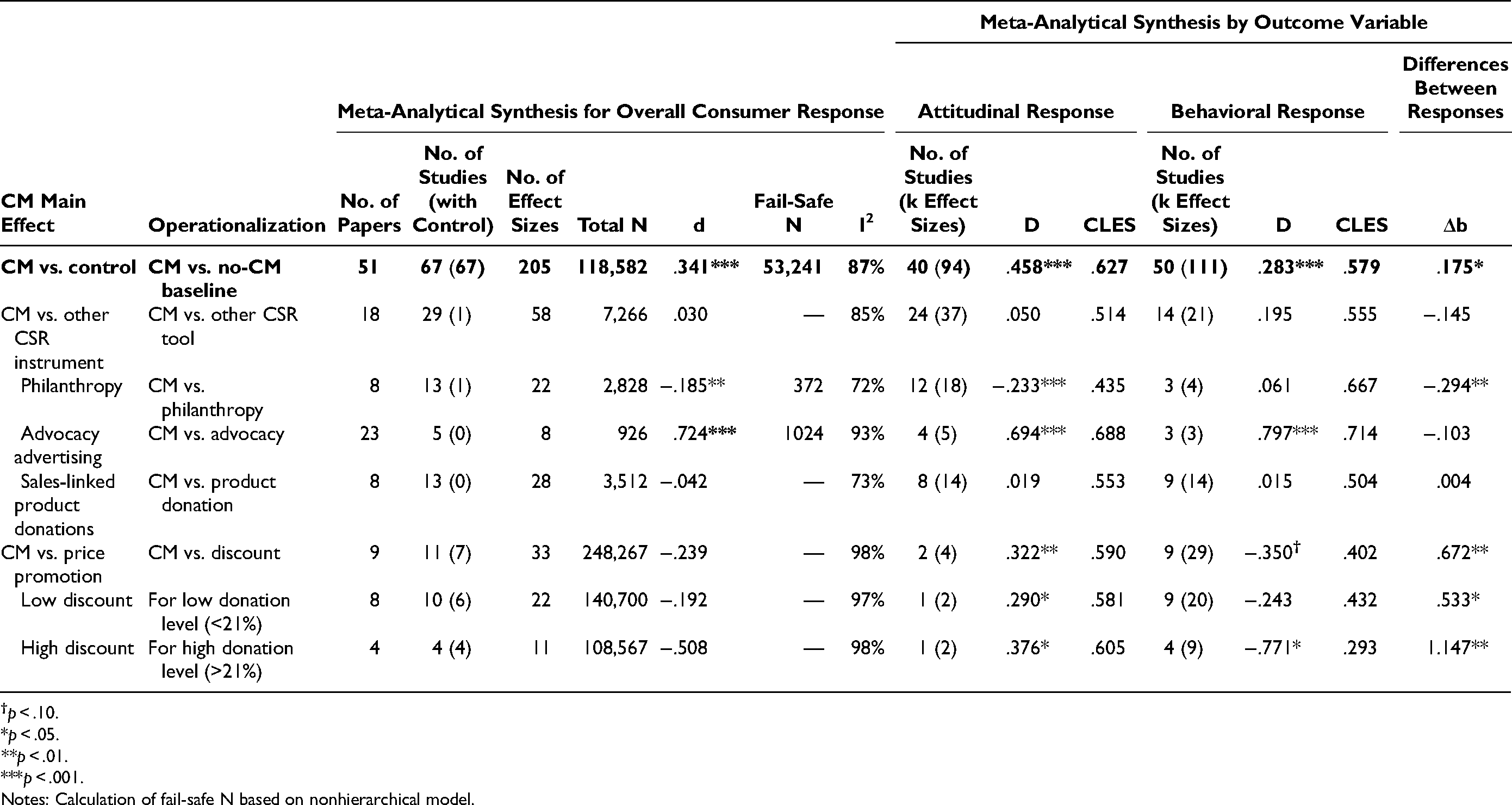
To minimize publication bias, we adopted several approaches at various stages of our data collection and analysis. First, we identified and retrieved unpublished work across multiple research streams (Eisend and Tarrahi 2014). As a result, we include a considerable amount of effect sizes from unpublished studies, namely working papers, conference proceedings, and doctoral dissertations (20% of effect sizes for attitudinal responses, 18% for behavioral responses; see Web Appendix Table W5 on the primary studies included in our analysis). Second, the set of observed effect sizes contains substantial proportions of positive and negative as well as significant and nonsignificant effects (see Web Appendix Figure W2). Third, we calculate Rosenthal's (1991) fail-safe N for unconditional hierarchical models for each significant effect to measure the number of zero-effect studies that, if added to the sample, would reduce a statistically significant effect to nonsignificance (Rosenberg 2005). As a reference, we apply the established threshold from Rosenthal (1991): 5k + 10 (where k reflects the number of effect sizes). The results of Rosenthal's fail-safe N (Table 2) indicate that comparatively large numbers of zero effects are needed to make the overall CM effects nonsignificant; that is, it is unlikely that our conclusions are driven by publication bias. Specifically, 12,400 and 14,148 studies with effect sizes of zero would be needed to render the CM effect on attitudinal and behavioral responses, respectively, nonsignificant (p > .05).
Meta-Analytical Synthesis of CM Main Effects.
Notes: Calculation of fail-safe N based on nonhierarchical model.
Finally, we use funnel plots for both the attitudinal and behavioral models to assess the potential for publication bias influencing main CM effects. We examine a contour-enhanced funnel plot (Peters et al. 2008) of the observed effect sizes versus the standard errors of the effect sizes and find that the contour-enhanced funnel plot is slightly asymmetric, with some observations missing for low effect sizes with high standard errors (see Web Appendix Figure W3, upper part). This result suggests a moderate publication bias for the CM main effect on both consumer response measures. After we conduct the meta-regression, we again compute a funnel plot that presents the residual of the meta-regression versus the standard errors of the effect sizes (see Web Appendix Figure W3, lower part). This funnel plot is symmetric around zero across the standard errors, indicating that the meta-regression accounts for potential publication bias. Overall, we conclude that publication bias is not severe and that our meta-analysis approach controls for the moderate level that does exist.
Analysis of Outliers and Influential Cases
We test for outliers in our analysis by means of standardized residuals and Cook's distances as influence diagnostics (Viechtbauer and Cheung 2010). With regard to the standardized residuals (observed residuals divided by the corresponding standard errors), we find only one study that had values greater than 3 and that might, therefore, qualify as an outlier (Andrews et al. 2014, with a sample 100 times larger than that of any other study). Further, we identify cases that may have influenced our results by analyzing the Cook's distance of each effect to account for both the leverage and residuals of each effect size. To determine whether outliers have an impact on our conclusions, we exclude all influential candidates with critical values of distances larger than three times the observed average effect. After these cases are removed, only one of the regression coefficients of the relevant moderators changes significantly (less than what would be expected because of chance alone; see Web Appendix Tables W8.1 and W8.2). Specifically, the negative effect of “how” framing becomes significant in the reduced analysis and therefore is in the expected theoretical direction, although we do not reach directional conclusions for the full model. Since outliers seem to have little impact and it is challenging to distinguish between sampling errors and true outliers, we keep all observations in our sample instead of arbitrarily eliminating selected cases (Viechtbauer and Cheung 2010).
The Main Effect of CM on Attitudinal and Behavioral Responses
Average Size of the Main Effect of CM
Sixty-seven studies in our sample test the main effect of CM, comparing attitudinal and behavioral responses with and without CM. These studies provide 205 effect sizes based on more than 118,000 individual participants (see Table 2). In these studies, 94 effect sizes (40 studies) are available to test CM's impact on attitudes, and 111 effect sizes (50 studies) are available to test its impact on behaviors.
For both types of outcomes, empirical evidence on the main effect of CM differs considerably across studies in terms of its direction and significance, with Cohen's d ranging from −.825 to 1.301 for attitudinal responses and from −.370 to 1.673 for behavioral responses. Across both outcomes, 82% of the effect sizes indicate a positive main effect of CM (53% are statistically significant), and 18% of effect sizes are negative (3% are statistically significant). This result suggests that an average campaign is more likely to benefit the brand than to hurt it.
To control for nested errors at the effect size and study levels as well as variations in sample sizes, we estimate the meta-regression model presented in Equation 1 without including any moderator, so the intercept represents the average impact of CM. The model estimation results in a medium and significantly positive effect of CM on attitude (d = .458, p < .001) and a small to moderate significantly positive effect on behavioral responses (d = .283, p < .001). The difference in effect sizes of these outcomes is statistically significant (p < .05). Translated into CLES, this finding means that there is a 62.7% probability that a CM campaign will have a positive effect on the attitude of a randomly selected individual and a 57.9% probability that it will have a positive effect on that individual's behavioral responses. This difference is consistent with research on an attitude–behavior gap that can arise in ethical choices (Burt and Popple 1998). It suggests that CM is a more effective marketing instrument to build brand reputation than it is to drive short-term sales.
The I2 heterogeneity scores, which approach 90%, indicate a high overall level of heterogeneity and suggest that the size of the average impact can be misleading for an individual campaign. We return to this question when we test observable moderators that might explain this level of heterogeneity.
Comparison of the Main Effect of CM with Other Marketing Instruments
To obtain additional insights into CM's economic impact and relative effect size, we compare CM's effectiveness with that of other CSR activities and discount promotions on the basis of the studies that report such comparisons. The results of these comparisons are presented in Table 2.
We identify 29 studies with 58 effect sizes that compare the response to CM with the response to other CSR activities, that is, general philanthropy, advocacy advertising, or sales-linked product donations. On an aggregated level, we do not find significant differences between the effects of CM and the average of other CSR instruments (dattitudinal = .050, n.s.; dbehavioral = .195, n.s.). However, we do find significant differences between CM and individual CSR instruments. Specifically, attitudinal responses to CM are significantly lower than those of philanthropic CSR activities that contain no self-interest or promotion intention (d = −.233, p < .001). We also find that CM's effects on both attitudinal and behavioral responses do not significantly differ from those of product donations or buy-one-give-one promotions (dattitudinal = .019, n.s.; dbehavioral = .015, n.s.), which are similar in spirit to CM but donate an identical product rather than money for each product sold. Finally, for attitudinal as well as behavioral responses CM effects are significantly greater than those for advocacy advertising (dattitudinal = .694, p < .001; dbehavioral = .797, p < .001), that is, advertising messages that encourage consumers to engage in a behavioral change (e.g., quit smoking to prevent cancer), possibly because these advertisements often highlight prevention of negative outcomes, which creates less emotional attachment (Menon and Kahn 2003).
Eleven studies with 33 effect sizes compare CM to discount promotions with rebate levels identical to donation levels. We find asymmetric effects for the two outcome variables: while CM has a stronger impact on attitude (d = .322, p < .01), discounts have a stronger impact on behavioral responses, although this latter effect is only marginally significant (d = −.350, p < .10). These observations are in line with research that shows that discounts can harm a brand's image (e.g., Grewal et al. 1998). With regard to behavioral responses, consumers likely respond to different levels of donations and discounts. We therefore compare CM and equivalently sized discounts and find that the relative effectiveness of CM versus discounts is a function of the underlying promotion level, with a significant effect favoring discounts greater than 21% (d = −.771, p < .05). With increasing levels of the promotional benefit, self-related, rather than other-related, motives might be more relevant to the consumer. In addition, consumers may be less sensitive to the depth of the donation than to the depth of an equivalent discount (Arora and Henderson 2007). These reasons make price promotions a relatively more attractive promotional instrument at higher values (Müller, Fries, and Gedenk 2014).
We caution that some comparisons between CM and other marketing instruments are based on only a few effect sizes with considerable heterogeneity in the studies. Further primary research in these areas seems useful. So far, all conclusions are also based on average CM effects. To clarify the impact of CM impact under specific circumstances, we study the moderators of CM next.
Empirical Generalizations About CM Moderators
Our results regarding CM's main effect show a substantial amount of variability among the effect sizes in our sample (see also the caterpillar plots in Web Appendix Figure W2). Therefore, we examine whether the effect size d is driven by the moderators in our conceptual framework (see Figure 1). Given the correlations among the moderators in our framework (see Web Appendix Tables W9.1 and W9.2), a meta-regression that assesses the impact of these moderators simultaneously must be conducted to lower omitted variable bias. Therefore, we estimate the meta-regression model as presented in Equation 1, where the effect size d is predicted by the moderators of our conceptual framework (Figure 1) and methodological control variables.
Following similar analysis (e.g., Kirca, Jayachandran, and Bearden 2005), we compute the squared correlation between predicted and observed values to determine model fit for the full model with all moderators. We find reasonably high values of R2 = .687 for the attitude model and R2 = .793 for the purchase model. Variance inflation factors indicate that multicollinearity does not seriously affect the results and all significant effects are in the expected direction even when influential cases are removed (see Web Appendix Tables W8.1 and W8.2). We therefore continue to interpret the individual standardized and unstandardized coefficients and the difference in coefficients between the two regression models (Table 3).
Influence of Moderators on CM Consumer Response.

p < .10. *p < .05. **p < .01. ***p < .001.
Operationalization might differ from multivariate model (indicated in brackets), and manipulation levels differ across studies. Missing values indicate that less than five effect sizes are available (i.e., no meaningful synthesis possible). An enhanced analysis (including number of studies and effect sizes per moderator) can be found in Web Appendix Table W10.
Table 3 compares these meta-regression results with two alternative but conceptually inferior meta-analytic summaries. First, we conduct a subgroup analysis by including each moderator separately in Equation 1 and obtain estimates for the impact of only that particular moderator. Note that this subgroup analysis lacks simultaneous control; that is, it has maximum omitted variable bias. For meta-analyses, multivariate control is particularly important as the values of the explanatory variables follow from primary research studies that are not independent of each other (see correlations in Web Appendix Tables W9.1 and W9.2). Statistically, multivariate control can result in smaller, but also larger (suppression) effects. In addition, better control can result in lower standard errors of the parameter estimates, that is, lower p-values. We observe both in our case, with several significant effects in the multivariate model that we cannot detect without simultaneous control but also significant effects without control that become insignificant in the multivariate model.
Second, we run another analysis on publications lacking control conditions without CM (moderator studies; see last two columns of Table 3). This analysis is based on very few observations per moderator (Web Appendix Table W10) and also cannot simultaneously control for all moderators. Recall that, because of the lack of a control condition, we cannot estimate a main effect of CM or understand the size of the moderator effect. Furthermore, experimental manipulations differ between the moderator publications, making the meta-analytic summary less meaningful than the other two models.
Studies without a no-CM control group risk confusing the main effect of the moderator with the moderation of the CM effect. For example, comparing purchase intent for a strong versus a weak brand both having the same NPO/cause can confuse the main brand effect (strong brands having more favorable attitudinal and behavioral baseline effects) with the moderator effect (strong brands with stronger CM impact). We find this exact pattern in the data. The moderator studies (six on attitudes, eight on behavior) suggest higher levels of brand attitudes and behavioral responses for stronger brands, which may reflect the main effect of brand strength. When focusing on studies with an estimate of the actual CM effect, that is, studies that include a no-CM control, we find the opposite pattern, such that CM is less effective for well-established brands where consumers are less likely to update brand attitudes or modify behavior. Similarly, the meta-regression reveals theoretically consistent effects of donation size, whereas the moderator studies find no impact, presumably because manipulation levels differ considerably in these studies. Likewise, the synthesis of the moderator effects does not reveal differences between a campaign that focuses on the brand versus the NPO/cause and the framing of the campaign (five studies each), whereas the meta-regression reveals strong effects. From these findings, we caution that studies lacking a no-CM control should be carefully interpreted with regard to the actual moderating impact on CM effectiveness. Next, we therefore interpret the results of the meta-regression model (Table 3) that is based on the coherent coding of all studies with an actual main effect of CM.
Transparency
The meta-regression enables us to disentangle the influence of transparent NPO- versus cause-related information on CM performance. Whereas we do not find significant differences regarding the influence on behavioral responses of explicitly disclosing a known or unknown NPO partner, we observe a positive significant effect of specifying the cause or charitable project on behavioral responses (β = .068, p < .05), suggesting that consumers value transparency about the donation target. In addition, transparency about the donation size benefits a campaign, as mentioning the absolute donation amount drives behavioral responses (β = .040, p < .05), whereas mentioning a percentage of product price is detrimental to attitudes (β = −.084, p < .10). Apparently, not only whether the donation size can be retrieved but also how easily it can be retrieved influences CM success. Overall, specifics about the cause seem to play a strong role in terms of transparency, and transparency drivers are more related to behavioral responses than they are to attitudinal responses, which is consistent with the view that a lack of transparency casts doubt and has a negative effect on purchase decisions.
Signals of Sincerity
All hypothesized drivers that allow consumers to infer the sincerity behind CM have a significant impact on CM outcomes. Donation size has a stronger effect on attitude than on behaviors (p < .01), perhaps because other factors in the purchase decisions dominate the comparatively low variation in donation sizes. In terms of the direction of effects, high donation levels appear to signal sincere brand commitment, which is indicated by more positive attitudes (β = .118, p < .01) and behaviors (β = .028, p < .01). Similarly, fit between the brand and the NPO/cause has consistently positive effects on both outcomes (βattitudinal = .061, p < .05; βbehavioral = .068, p < .01), indicating that better fit is more likely to result in positive assumptions about sincerity than is a campaign in which the cause is unrelated to brand values. Interestingly, the impact of cause–brand fit on attitude is smaller than the impact of donation size, suggesting that how much is donated matters more than how well the partners align.
The pictorial representation of the NPO/cause and the brand are the strongest drivers of sincerity, for both attitudinal and behavioral marketing objectives. Pictorial representations play a particularly strong role for behaviors, with visual representations of the NPO increasing CM effects (βNPO = .143, p < .001) and brand logos decreasing CM effects (βbrand = −.091, p < .001). Collectively, these two effects indicate that visual cues regarding the relative visibility of the NPO and brand can serve as strong signals of sincerity and have strong effects on purchase decisions, likely because they do not require a lot of elaboration (Pieters and Wedel 2004).
Emotional Attachment
All moderators related to emotional attachment drive consumers’ attitude in the expected direction. Giving consumers a choice of cause to support (β = .090, p < .001) and having local instead of more distant donation targets (β = .089, p = .01) both have a positive impact on attitudes, but are not significant or only marginally significant for behavioral outcomes (βconsumer choice = .039, p < .10; βproximity = .036, n.s.). This result indicates that nearby causes and campaigns that involve consumers create emotional attachment and positive attitudes, but these preferences are less likely to translate into purchase decisions.
Donation appeals with a higher emphasis on positive benefits and a promotion focus exert stronger CM responses compared with appeals that use a negative or prevention framing (βattitudinal = .075; p < .01; βbehavioral = .066 p < .01). Moreover, “why” framing has a strong positive effect on attitudes (β = .177, p < .001), whereas the effect of “how” framing is negative (β = −.115, p < .001). This may be due to the fact that procedural framing ties the campaign to the economic transaction and thereby highlights the brand's economic benefits and the fact that consumers are ultimately paying for each donation with their purchases. These considerations may weaken attitudinal responses when CM is improperly framed. Apparently communicating CM requires careful communication choices that focus on why the cause deserves support as opposed to procedural issues regarding how donations will be used. The effects of both “why” framing and “how” framing are significantly smaller in absolute terms for behavioral responses than they are for attitudinal responses (p < .01), with a significant impact of “why” framing (β = .06, p < .05) and an insignificant impact of “how” framing (β = .016, n.s.), suggesting that detailed explanations are more relevant to opinion formation than they are to eventual decision making. Web Appendix Table W11 summarizes the empirical generalizations of CM moderators that can be drawn from our meta-regression analysis.
Purchase Context
We find that CM has potential to influence behavioral responses more strongly in hedonic than in utilitarian product categories (β = .045, p < .05), whereas we find no average impact of this distinction for brand attitudes. This pattern may be due to the role of CM in offsetting anticipated guilt related to hedonic consumption (Strahilevitz and Myers 1998), which is more pronounced for consumption and buying decisions than for brand attitudes. Conversely, cultural context has a relatively strong impact on attitudes (β = .097, p < .001), whereas its effect on behaviors is significantly smaller (β = .008, n.s., pdifference responses < .01). Collectivist cultures appear to appreciate CM more than individualist cultures do, but we find no evidence that this translates to actual behavior.
We observe a similar pattern and effect size for brand strength such that CM can improve attitudes about unknown brands more than it can improve attitudes about well-known brands (β = .093, p < .001), whereas the impact of brand strength on behavioral responses is in the same direction but not significant (β = .018, n.s.) and significantly smaller (pdifference responses < .05). In terms of actual transactions, unknown brands may not be able to enter consideration; that is, CM cannot offset low brand equity (Schamp, Heitmann, and Katzenstein 2019). Attitudes, in contrast, are not a function of consideration set formation. An unknown brand with a more malleable brand image in the minds of consumers is apparently able to benefit more from CM.
Methodological Control Variables
Several control variables are influential. Cohen's d is smaller in studies that feature actual monetary consequences (b = −.192, p < .01), indicating the strong role of social desirability in studies on CM. Similarly, student participants tend to respond more favorably in terms of both attitudinal responses (b = .485, p < .001) and behavioral responses (b = .328, p < .001), possibly because of greater interest in ethical consumerism among younger generations (Cone 2014). However, we caution that the number of observations without student participants and with actual monetary consequences is low. In line with previous findings on transparency, studies that are more precise in terms of promoted products or actual prices for the presented products observe stronger CM effects. Our results indicate no significant influence of publication year on both CM effects (ps > .10), but we find greater effects of CM on measures of behavioral responses in published studies than in unpublished studies (b = .143, p < .01) and in higher-ranked journals than in lower-ranked journals (b = .137, p < .05). Unlike the subgroup analyses, our meta-regression model controls for these differences related to publication status, sample composition and incentive alignment (Eisend and Tarrahi 2014).
Comparison of the Role of Individual Moderators and Conceptual Pillars
Using the standardized regression coefficients of the meta-regression models, we can identify the most influential individual moderators for CM execution from Table 3. For brand attitude, framing of the donation appeal is by far the most critical driver of optimal CM outcomes, with “how” framing attenuating and “why” framing improving the impact of CM. But consumer choice of cause and geographic proximity, related to emotional attachment, also have some of the highest effect sizes. Further, the actual donation amount and the pictorial prominence of the NPO (both signals of sincere CM engagement), as well as brand strength and the cultural context (related to the purchase context), are relevant drivers of CM success. Interestingly, the fit between the NPO/cause and the brand as well as the hedonic nature of the product, which have been studied most frequently in prior research, have only a small to moderate impact on attitudinal outcomes.
This pattern is different for behavioral responses. Specifically, portraying the NPO and cause of the campaign on the product packaging is by far the most effective way of signaling a strong CM commitment, likely also because visual images tend to get more attention in heuristic-driven purchase decisions (Schamp, Heitmann, and Katzenstein 2019). Other factors that follow in order of importance, such as “why” framing of the donation appeal, donation appeal sentiment, or brand–cause fit, have considerably lower impact.
To understand how these results for the moderators translate into the higher-order conceptual pillars of CM effectiveness, we compute the minimum and maximum possible impact of each pillar based on the parameter estimates from Table 3, and present these in Figure 2. For example, the weakest possible combination of moderators underlying transparency diminishes CM attitudinal effects by −.069, whereas the best possible combination improves its effectiveness by .103 (in terms of Cohen's d, see the notes for Figure 2). All differences between the minimum and maximum predicted outcomes for each pillar are significant at p < .001.

Relative Influence of Conceptual Pillars.
According to Figure 2, emotional attachment is by far the main driver of attitudinal response, followed by signals of sincerity. Purchase context and level of transparency have smaller effects. Marketers who are interested in increasing brand image can gain strong CM effects (Cohen's d > 1) with an optimal emotional attachment: choosing local donation targets, involving customers in selecting the cause, and framing campaigns in positive terms that most importantly highlight the relevance of the shared purpose. However, suboptimal emotional attachment and CM communication can, in the worst case, harm brand reputation, with a moderate Cohen's d of −.459.
In contrast, emotional attachment plays a relatively less important role in behavioral responses, making signals of sincerity similarly effective for this objective. Marketers can communicate sincerity by choosing the right visual emphasis that also showcasing a positive fit between the partners and focusing more on the cause/NPO than on the brand. Other relevant factors that follow in order of importance play a subordinate role. In summary, obtaining strong CM effects for behavioral outcomes requires attention to two pillars that both have smaller effects. However, these in turn are driven by fewer relevant moderators.
Conclusions on the Effectiveness of CM
In both research and practice, CM campaigns have received increasing attention. The present study provides meta-analytic generalizations about whether and under what conditions CM influences consumers’ responses to for-profit brands. It provides an estimate of the average effectiveness of CM for attitudinal and behavioral marketing objectives. It also reveals high heterogeneity of these average effects and clarifies which moderators and conceptual pillars are particularly relevant for CM.
Main Effect and Its Drivers
On average, we find that CM is weakly related to behavioral outcomes (d = .283, p < .001) and moderately related to attitudinal responses (d = .458, p < .001), suggesting that CM is more promising for long-term image building than for reaching short-term sales objectives. The average effectiveness of CM is comparable to that of other CSR instruments. Although CM's impact on behavioral responses is lower than what sizable discount promotions attain, CM has a more positive impact on attitudes than discounts do. However, we find that CM has much stronger potential than these average values suggest. Therefore, knowledge of the moderators of CM is essential.
For brand attitude objectives, concentrating on drivers of emotional attachment has much promise to attain strong CM effects. These effects can be further amplified with signals of sincerity, although the return is smaller. At the same time, emotional attachment is also the single pillar with the highest risk of CM backfiring when executed poorly. For short-term behavioral outcomes, we observe a lower average impact of emotional attachment and also find that the levers to optimize CM are smaller. Instead, emotional attachment and signals of sincerity must be optimized jointly to reach strong CM effects, because individual moderators have lower impact on average.
Potential Overall Negative Effects
A major question with regard to both academic debate and practical concern is the risk of CM backfiring. Both the anecdotal evidence from KFC's “Buckets for the Cure” and the descriptive distribution of effect sizes (Web Appendix Figure W2) illustrate that negative effects occur, although significant negative effects are the exception. For both outcome variables, we therefore estimate predicted values on the basis of the least favorable value for each moderator (Table 3) while holding all other variables at their means (see Web Appendix Tables W9.1 and W9.2 for descriptives). We find that no single substantial moderator can turn CM effects negative. Instead, the question of positive versus negative CM effects is driven by a combination of multiple factors that should be jointly considered in the design of CM campaigns.
We further investigate this question in terms of conceptual pillars by computing predicted values of Cohen's d for all high and low combinations of the four pillars (Figure 3). We find that CM is more of a double-edged sword for attitudinal objectives than for purchase-related ones. The best combination of pillars can result in more favorable CM effects for attitudinal responses than for behavioral responses, but an inferior combination also runs higher risks of CM backfiring. This finding suggests that marketers should be more mindful about when and how to execute CM when they have attitudinal objectives in mind. Behavioral objectives, in contrast, have a lower risk but also lower return. This finding is in line with research on the attitude–behavior gap. According to our results, the gap might be driven by a higher variance of attitudinal effect sizes, such that attitudinal response is more sensitive to CM execution than behavioral response is.

Simulation of the Overall CM Effect as a Function of Its Conceptual Pillars.
Further, we find that the differences between outcome variables are not constant across combinations of the underlying pillars. Overall, different combinations suffice as protection against negative effects. 2 Specifically, high emotional attachment is sufficient to expect a positive outcome on both attitudes and behavior (upper half of Figure 3). When emotional attachment is low, high signals of sincerity suffice for a positive return of CM for behavioral responses but not for brand attitudes (Figure 3). Conversely, signals of sincerity are necessary to expect the possibility of a positive CM return for both marketing outcomes despite low emotional attachment. For low emotional attachment, attitudinal responses are only (weakly) positive if (1) high signals of sincerity appear with (2) high transparency and (3) a favorable purchase context. If any of these conditions are not met, marketers risk a negative impact of CM.
Managerial Implications for Designing CM Campaigns
Generalizations of moderator effects
The meta-regression results of our study help guide CM execution as the literature provides conflicting predictions about several CM moderators. Five major practical recommendations for improving consumers’ responses to CM can be drawn from our findings:
Make sure consumers understand what is being donated. Clearly specify causes and donation amounts, the latter ideally in absolute terms. This is particularly important for behavioral objectives. Select settings that fit CM. Some characteristics of the for-profit partner fit a CM campaign better than others do. For behavioral objectives, beneficial settings include hedonic instead of utilitarian products. For attitudes, smaller rather than larger established brands in the product portfolio and markets with collectivistic cultures are conducive to successful CM. Engage in CM with sincere commitment. Observable campaign elements signal corporate motives. According to our findings, the extent to which marketers put the donation target in the foreground and the visual space marketers allocate to it are particularly critical to achieve behavioral objectives. The perceived fit between the partners is relevant too, but plays a less important role than the number of studies on fit might suggest. Focus on campaign communication that drives customers’ emotional attachment to CM. When a CM alliance is established, companies should carefully consider how CM is portrayed in their campaign communication. Our results highlight that consumers’ responses to CM are greater when they have an emotional connection to the donation target. This connection can be achieved by using appeals that emphasize consumers’ contributions to doing good, such as choosing local partners and causes that consumers can relate to, and by highlighting the ends rather than the means of the campaign, that is, by focusing on the potential benefits and positive aspects of donating. With optimal emotional attachment, strong effects on attitudes can be attained and backfiring of CM prevented. Evaluate which marketing objectives are most important. On average, CM has higher potential for attitudinal objectives such as brand reputation than for sales objectives. However, moderators also play a stronger role, and mistakes in execution risk a negative impact of CM. The latter is less likely for short-term behavioral outcomes. Yet, CM is also less effective for behavioral responses on average, and the impact of individual moderators is also weaker.
Predictions of CM performance
Our model explains about two-thirds of the variance in observable consumer response, so managers can leverage it to get useful indications on CM design alternatives. Beyond overall CM performance, the model's coefficients can further indicate which driver to focus on and what to expect from individual moderators. To understand this better, we can make predictions of the likely effect under specific conditions based on our model coefficients. For example, we can compute the expected effect of CM for the market of a high-priced utilitarian product, or for a customer segment from a specific country. This level of precision and nuance is not available from any of the primary CM studies or the summaries published so far. To obtain a better overview, we aggregate the various effects from Table 3 to the conceptual pillars of CM.
To illustrate how our findings can be used to simulate effects for actual or planned CM campaigns, we revisit the examples of KFC and Yoplait. We can utilize our model coefficients (Table 3), code all moderators of these two campaigns according to our coding manual (see Web Appendix Table W3), and compute predicted values for Cohen's d. Our model predicts a strong positive effect for Yoplait: .952 for attitudinal responses and .675 for behavioral responses (about double the impact of an average campaign). In contrast, predicted values for KFC are negative: −.254 and −.263 for attitudinal and behavioral responses, respectively, suggesting negative returns. This result matches the anecdotal evidence on the success and failure of these campaigns. According to Web Appendix Figure W4, the contrast in CM effectiveness is driven by the two pillars signals of sincerity and emotional attachment: Yoplait chose the more favorable campaign communication in terms of “why” framing, thus creating more emotional attachment. It also signaled more sincere motives with better brand–NPO fit and stronger visual representation of the cause. The KFC campaign scored lower on these two aspects and did not succeed in other critical factors to compensate for this deficit. The example illustrates our general finding that a combination of factors, not a single factor alone, explains differences in effectiveness.
Directions for Further Research
There are of course limitations to this research. Any meta-analysis is constrained by what is observable in the literature and which variables feature enough variance. Several further variables are mentioned in the literature but have not been measured often enough to be included in our analysis. In addition, we lack observations for some dependent variables, such as product choice or willingness to pay, and cannot reach differential conclusions. Further research on more nuanced outcome distinctions would be useful and promising given our findings on overall attitudinal and behavioral responses.
Since our analysis is based on a coding of the literature, we could not test psychological mediators like warm glow (e.g., Arora and Henderson 2007; Müller, Fries, and Gedenk 2014) and skepticism (e.g., Andrews et al. 2014). Empirical evidence on these mediators and their relative role as related to the moderators of CM remains scarce. Similarly, the four conceptual pillars of CM effectiveness relate to psychological states that we cannot observe by coding the literature. We obtain an indirect idea by aggregating related observable moderators, but additional primary research is needed to measure these subjective states and study actual mediating mechanisms. More knowledge about the psychological mechanisms may help identify additional moderators. The moderators we test in this research collectively explain more than two-thirds of the variance of CM effectiveness. It would be useful to study which additional moderators explain the variance that is left unaccounted for.
We believe our framework is collectively exhaustive and that our pillars are mutually exclusive such that future studies can map any new theoretical moderators along our framework to provide clear expectations about their impact. Among the pillars, emotional attachment seems particularly promising since it has strong effects and is also the least researched pillar so far. Specifically, research on more nuanced effects of campaign framing and communication and their influence on attitudes and further research on the role of campaign focus and pictorial communication and their influence on behavior would be useful. We found a few studies (e.g., Barone, Miyazaki, and Taylor 2000) that use multiple donation targets, but they lack enough observations to make credible claims. However, we explored the bivariate difference in the effectiveness of CM and found a strong impact of multiple donation targets (dattitudinal = .369, p < .05 ; dbehavioral = .444, p < .001). Additional primary research would be useful to verify this initial observation, determine whether (and when) multiple donations are better than one, and explain what combinations of donation targets and how many are ideal.
We lacked degrees of freedom to test higher-order interaction effects between the moderators of CM in more detail. Many different types of interactions are conceivable. For example, the impact of donation amount may be a function of donation framing, as lower-value donations might be less apparent in percentages than they are in absolute framing. Similarly, visual and verbal representations of causes and the reasons to support them may mutually reinforce each other, which could result in additional interactions. In addition, sales promotion research suggests that the influence of donation size should be more pronounced if a clear reference price is given to set the donation amount in perspective (e.g., Lichtenstein, Burton, and Karson 1991). Similar effects could play a role for CM but have not been studied so far. In addition, various nonlinear effects are possible, for example, regarding the level of donation size or the cultural context of hedonic product values. Further research could test these potential nonlinear and interaction effects.
Perhaps unsurprisingly, social desirability appears to play a role in CM effectiveness. More field experiments on CM effects would be valuable, as only a few extant studies include actual monetary consequences (e.g., Andrews et al. 2014; Lichtenstein, Drumwright, and Braig 2004). Although we found that the impact of CM on short-term purchase decisions is weaker than that of traditional price promotions, CM might produce beneficial long-term effects on brand image, as indicated by stronger effects on attitudinal responses than on behavioral responses. In contrast to discounts, where repeated executions of the campaign can have negative effects on consumers’ responses, a long-term commitment to a CM alliance might have beneficial outcomes in terms of brand loyalty or brand engagement (Lafferty, Lueth, and McCafferty 2016). Additional studies could use transaction data to replicate experimental findings, evaluate CM in actual market settings, and assess the adoption and effectiveness of CM over time.
Our results are also informative with regard to the design of properly powered studies on CM effects. Using G*Power analysis (Faul et al. 2009), we determined that one would need a sample of 60 participants per group to have 80% power to find the observed average main effects for attitude and, because of the smaller effect size, a sample of 156 participants per group for behavioral outcomes. More than a quarter of the effect sizes in our sample are based on underpowered studies with sample sizes below these thresholds, which may have inhibited those studies’ ability to detect significant effects. The expected power for other absolute and relative CM effects can be calculated from the effect sizes reported in Table 3 so that researchers can construct well-powered studies. Moreover, our findings underscore the importance of including no-CM control conditions in experimental designs to be able to disentangle CM moderator effects from brand-related and price-related main effects.
Above all, we encourage researchers and practitioners to think about CM's opportunities and potential drawbacks to contribute to making CM a win-win-win situation for brands, NPO partners, and consumers. We hope that this study helps improve CM campaigns’ performance, increase their use, and establish their value as marketing tools that complement more traditional instruments.
Supplemental Material
sj-pdf-1-mrj-10.1177_00222437221109782 - Supplemental material for The Effectiveness of Cause-Related Marketing: A Meta-Analysis on Consumer Responses
Supplemental material, sj-pdf-1-mrj-10.1177_00222437221109782 for The Effectiveness of Cause-Related Marketing: A Meta-Analysis on Consumer Responses by Christina Schamp, Mark Heitmann, Tammo H.A. Bijmolt and Robin Katzenstein in Journal of Marketing Research
Footnotes
Acknowledgments
The authors thank the participants of the European Marketing Academy Conference doctoral colloquium, Marc Fischer and Don Lehmann for helpful feedback; Sarina Mansour Fallah for her excellent and committed support in coding; and the JMR review team for their constructive and helpful comments. All authors contributed considerably to the project.
Editor
Rajdeep Grewal
Associate Editor
Vikas Mittal
Declaration of Conflicting Interests
The author(s) declared no potential conflicts of interest with respect to the research, authorship, and/or publication of this article.
Funding
The author(s) disclosed receipt of the following financial support for the research, authorship, and/or publication of this article: The work was supported by the German Research Foundation (DFG) research grand number 460037581.

Notes
References
Supplementary Material
Please find the following supplemental material available below.
For Open Access articles published under a Creative Commons License, all supplemental material carries the same license as the article it is associated with.
For non-Open Access articles published, all supplemental material carries a non-exclusive license, and permission requests for re-use of supplemental material or any part of supplemental material shall be sent directly to the copyright owner as specified in the copyright notice associated with the article.
