




Abstract
In the context of romantic relationships, partners regularly observe each other's unsustainable behavior. But how do these unsustainable behaviors influence each member of the couple? This research shows that how consumers respond to their partners’ unsustainable behaviors depends on the amount of relationship power they possess: high-relationship-power individuals compensate for their partners’ unsustainable behavior by acting in a more sustainable manner relative to their baseline tendencies, but low-relationship-power individuals do not increase their own sustainable behavior. This effect occurs because high-relationship-power partners feel more responsible for the reconstruction of the couple identity after it has been damaged by their partner's unsustainable choice; as a result, they have a stronger desire to signal a positive couple identity (i.e., a positive couple sustainable identity). Consistent with this theory, this effect is attenuated for high-relationship-power individuals who have weak green identities. Seven studies provide evidence for these findings by measuring and manipulating relationship power and assessing hypothetical and actual sustainable behaviors. This research contributes to the sustainable behavior literature and highlights effective ways to promote sustainable behavior in households.
In an effort to slow the increase in global temperatures, many policy makers and scientists have emphasized the urgency of taking action and changing our consumption patterns (Fritsche et al. 2018). Thus, the social norm urging consumers to adopt sustainable behaviors is more prevalent than ever (Chen et al. 2019; Moons and De Pelsmacker 2012). Even though people report positive attitudes toward sustainable behavior (Edinger-Schons et al. 2018; Trudel and Cotte 2009), many fail to behave accordingly (White, Habib, and Hardisty 2019). Therefore, consumers are repeatedly exposed to others’ unsustainable behaviors (Sparkman, Howe, and Walton 2020), which in turn fuels their own unsustainable behavior (e.g., Cialdini, Reno, and Kallgren 1990; Schultz et al. 2007), creating a vicious cycle of unsustainability.
Prior research indicates that others’ unsustainable behaviors have important implications for consumers’ own sustainability-related decisions (Cialdini, Reno, and Kallgren 1990; Goldstein, Cialdini, and Griskevicius 2008). This line of research has primarily examined how the unsustainable behaviors of socially distant others (e.g., hotel guests, neighbors, out-group members) can influence one's behavior (Goldstein, Cialdini, and Griskevicius 2008; Schultz et al. 2007; White, Simpson, and Argo 2014). Although prior research suggests that consumers’ choices are more strongly influenced by the behaviors of others with whom they share (vs. do not share) a relationship (Cavanaugh 2016), the literature has not yet considered the influence of one's relationship partner on sustainable behavior. This is an important gap, because relationship partners, who have strong interdependence and impact each other's decisions every day (Simpson et al. 2015), might exert the most powerful influence on consumers’ sustainable behavior. The distinctive interpersonal dynamics in a relationship make this context unique and worth studying. Our work aims to address this gap in the literature by examining how consumers’ own sustainability-relevant behaviors are influenced by their romantic relationship partners’ unsustainable behaviors.
For example, consider a married couple: John and Alex. If John did not recycle at home, would that make Alex more or less likely to select a sustainable product at the grocery store? We suggest that one unique interpersonal dynamic in relationships—the amount of relationship power the members of the couple possess (i.e., their ability to influence and control decisions and outcomes in the relationship; Brick et al. 2018; Dunbar 2004; Simpson et al. 2015)—will determine how they act in response to their partner's unsustainable behavior.
Across seven studies involving married couples and partners in committed relationships, we demonstrate that high-relationship-power individuals compensate for their partners’ unsustainable behaviors by acting in a more sustainable manner relative to their baseline tendencies. This response occurs because the partner's unsustainable behavior triggers high-relationship-power partners’ responsibility to reconstruct the couple identity and, as a result, increases their desire to signal a positive couple identity (i.e., couple sustainable identity), leading to greater sustainable behavior relative to their baseline tendencies. By contrast, low-relationship-power individuals are not influenced by their partners’ unsustainable behaviors and exhibit similar levels of sustainable behaviors relative to their baseline tendencies. Moreover, we also show that these effects are attenuated for high-relationship-power individuals who have weak green identities.
This research contributes to the existing literature in several important ways. First, we contribute to the literature examining social influence on sustainability, which has examined the effects of the unsustainable behaviors of in-group members (Goldstein, Cialdini, and Griskevicius 2008), out-group members (White, Simpson, and Argo 2014), friends (Meijers et al. 2019), and strangers (Schultz et al. 2007). Our research is the first to examine the effects of one's relationship partner, which are distinct due to the unique sharing of resources and goals in a relationship context (Hasford, Kidwell, and Lopez-Kidwell 2018).
Second, our research adds new insights to the emerging literature examining consumer behavior in a relationship context (e.g., Dzhogleva and Lamberton 2014; Etkin 2016; Garbinsky and Gladstone 2019; Garbinsky et al. 2020; Hamilton et al. 2021; Wight et al. 2022). While this stream of literature has focused on joint dyadic decision making (e.g., Dzhogleva and Lamberton 2014; Nikolova, Lamberton, and Coleman 2018; Wu et al. 2021), we extend this literature by focusing on dyads making sequential choices in the context of sustainable behavior. In addition, we also contribute to the limited literature examining the influence of relationship power on consumption (Brick et al. 2018, 2022; Nikolova and Nenkov 2021).
Whereas prior research has shown that an individual state of power can enhance one's ability to resist social influence (Mourali and Yang 2013), we show that relationship power has different effects. We find that relationship power actually increases susceptibility to social influence from one's romantic partner: high-relationship-power partners are more likely to be influenced by and balance their partners’ unsustainable behaviors, whereas it is low-relationship-power individuals who resist social influence and do not change their baseline tendencies. In a related vein, prior research on relationship power has argued that high-relationship-power partners are less likely to prioritize others’ interests over their own (Righetti et al. 2015; Simpson et al. 2015). However, we show that a high-relationship-power status can trigger other-benefiting behaviors (i.e., more sustainable behavior relative to baseline tendencies) after exposure to a partner's unsustainable behavior. Finally, by establishing the role of couple identity signaling in driving this increased sustainable behavior for high-relationship-power individuals, we also contribute to the identity literature, which has mostly examined identity at the individual level (Nikolova and Lamberton 2019).
The present research offers important practical implications. First, our findings can be beneficial to marketers targeting couples with various sustainable products (e.g., eco-friendly vacations, conflict-free diamond rings, sustainable household products). Given the growth of such products in the marketplace (Ballentine 2020), encouraging consumers to take responsibility for the construction of the couple sustainable identity and highlighting how choosing such sustainable products will reflect positively on the couple identity may help these companies boost sales. Similarly, governmental and nonprofit organizations designing campaigns to encourage sustainable behavior among households (The Wall Street Journal 2021) should empower married individuals by highlighting that they are responsible for the construction of their couple sustainable identity (e.g., “It is your responsibility to make your household sustainable! Your choices will reflect who you are as a couple”).
Conceptual Framework
Social Influence and Sustainable Behavior
Prior research has examined the social influence of in-group members (Goldstein, Cialdini, and Griskevicius 2008), out-group members (White, Simpson, and Argo 2014), close others (e.g., friends, coworkers; Meijers et al. 2019), or strangers (Schultz et al. 2007) and has shown that observing others’ unsustainable behaviors can affect consumers’ own sustainable behaviors (Griskevicius, Cantú, and Van Vugt 2012). For instance, when people learn that their neighbors do not conserve energy, they increase their energy consumption as well (Schultz et al. 2007); similarly, consumers are more likely to litter after observing another individual's littering behavior (Cialdini, Reno, and Kallgren 1990). In addition, research has shown that people use others’ sustainable behaviors to license their own unsustainable actions, but do not compensate for others’ unsustainable behaviors by engaging in sustainable behaviors themselves (Meijers et al. 2019).
However, this stream of research has not studied the impact of one's romantic relationship partner. Due to the unique sharing of resources and goals in a relationship context (Hasford, Kidwell, and Lopez-Kidwell 2018), the interpersonal influence of one's romantic partner might differ from the influences of others with whom one does not share a relationship. In the context of romantic relationships, individuals incorporate their relationship into their self-concept (Acitelli, Rogers, and Knee 1999) and construct a couple identity (Walsch and Neff 2018), which can have significant implications in determining how they respond to their partners’ unsustainable behaviors.
Couple Identity Signaling and Sustainable Behavior
Prior research suggests that people might engage in sustainable behaviors to signal a positive identity to both themselves and others around them (Trudel 2019). Research on self-signaling at the individual level has shown that people make prosocial choices to signal information to themselves about their own values and identities (e.g., green identity [Dixon and Mikolon 2021], altruistic values [Savary, Goldsmith, and Dhar 2015]). For instance, choosing a green product over a conventional product signals positive moral standards to one's own self (Dixon and Mikolon 2021). Further, research on other-signaling has shown that consumers engage in sustainable behaviors to make a positive impression on others (Green and Peloza 2014; Zhang, Ao, and Den 2019). Thus, consumers’ (un)sustainable choices serve both self-signaling and other-signaling functions (Trudel 2019; White, Habib, and Hardisty 2019).
While prior research has examined identity signaling at the individual level (Nikolova and Lamberton 2019), when consumers are in a relationship, their individual self-concept is fundamentally reshaped to account for the relationship dynamics (Emery et al. 2020). Specifically, in the context of a relationship, individuals perceive themselves as part of a collective unit (Agnew et al. 1998) and develop a couple identity, which is jointly constructed by both partners and their behaviors (Ahmad et al. 2017). A couple identity represents the couple as a single entity rather than as two separate individuals (Acitelli, Rogers, and Knee 1999; Badr, Acitelli, and Carmack Taylor 2007) and can influence consumers’ responses to their partners’ unsustainable behaviors.
Due to prevalent proenvironmental social norms (Chen et al. 2019; Moons and De Pelsmacker 2012), making unsustainable choices would have important implications not only for the self but also for the couple identity (Dixon and Mikolon 2021; Trudel et al. 2019; White, Habib, and Hardisty 2019). Indeed, when married consumers (n = 104; 54% female) were presented with the statement, “Behaving in an environmentally friendly way is important to the couple identity my partner and I develop,” their indicated agreement was significantly above the midpoint (M = 5.02, SD = 1.57, midpoint = 4; t(103) = 6.619, p < .001; see Pretest 1 in Web Appendix A), suggesting that they perceive sustainable behavior to be important to their couple identity. Thus, when one of the partners in a committed relationship makes an unsustainable choice, their unsustainable behavior may serve as a negative identity signal for the couple as a whole. Therefore, the other partner may feel the need to signal a positive couple identity to themselves and those around them by increasing their own sustainable behavior.
We argue that just as individuals vary in their engagement in identity signaling through sustainable behaviors, partners in a committed relationship can also vary in their couple identity signaling—the extent to which members of the couple signal positive couple identity to themselves and others around them. We propose that relationship power determines the extent to which romantic partners engage in positive couple identity signaling after witnessing their partners’ unsustainable choices.
Relationship Power and Sustainable Behavior
Relationship power, defined as the ability of one partner to influence outcomes and decisions in a relationship (Brick et al. 2018; Dunbar 2004; Simpson et al. 2015), is an essential interpersonal dynamic in close relationships (Righetti et al. 2015). Researchers suggest a dyadic view of power: in a relationship setting, power is not a characteristic of the individual and should be viewed as a shared construct that incorporates the dynamics between both individuals (Dunbar 2004; Dunbar and Abra 2010).
We expect that high- (but not low-) relationship-power individuals would feel a greater sense of responsibility for the reconstruction of the couple identity when they are exposed to their partners’ unsustainable choices, which are viewed as undesirable and negative (White, Simpson, and Argo 2014). Responsibility for the reconstruction of the couple identity is related to the need to protect the couple identity and is triggered when this identity is damaged. This construct is positively correlated with, but conceptually different from, relationship power, which is associated with greater influence on joint decision making. Moreover, while a high level of relationship power is associated with greater influence on both positive and negative joint decisions (Nikolova and Nenkov 2021; Tost and Johnson 2019), we expect that responsibility for the reconstruction of couple identity would be heightened only when the partner behaves in an undesirable way (i.e., engaging in unsustainable behavior), because this behavior damages the couple identity.
In support of this notion, prior research suggests that high power can be appraised as the responsibility to fix things, as high-power individuals perceive themselves as the only ones who can repair a situation (Fast et al. 2012; Scholl et al. 2020). This perceived sense of responsibility is associated with an obligation to consider the welfare of those lower in power (Scholl et al. 2018). Therefore, once power holders’ sense of responsibility is triggered by an adverse outcome or situation, they engage in behaviors that benefit others, even at their own personal cost (Scholl 2020; Zhu, Wong, and Huang 2019). In the context of relationships, high relationship power is also associated with increased feelings of responsibility for any adverse effects on the couple identity (Körner and Schütz 2021). Indeed, when partners in a romantic relationship experience a situation that damages their couple identity, high-relationship-power individuals behave in a prorelationship manner and attempt to reconstruct their couple identity (Karremans and Smith 2010).
When individuals need to reconstruct their identities, they usually respond by engaging in behaviors that send a positive signal to themselves and others (Amatulli et al. 2018). Therefore, when high-relationship-power individuals are exposed to their partners’ unsustainable choices, which are viewed as negative and undesirable (Moons and De Pelsmacker 2012; White, Simpson, and Argo 2014), they feel a greater sense of responsibility to reconstruct the damaged couple identity (i.e., the couple sustainable identity, in our case). Once high-relationship-power individuals’ sense of responsibility is triggered by their partners’ unsustainable behavior, they will have a greater desire to signal a positive couple identity to both themselves and others around them, which will in turn increase their sustainable behavior relative to their baseline tendencies (i.e., when they are not exposed to their partner's behavior). 1
By contrast, low-relationship-power partners are more dependent on their partners (Tost and Johnson 2019). Moreover, a low power state decreases a consumer's propensity to take any responsibility for the behaviors and outcomes of others (Zhu, Wong, and Huang 2019) and leads them to remain passive (Jiang, Zhan, and Rucker 2014). Therefore, we anticipate that when low-relationship-power individuals are exposed to their partner's unsustainable behaviors, they will not show an increased sense of responsibility for the reconstruction of the couple sustainable identity or an increased desire to signal a positive couple identity; as a result, the level of their sustainable behavior will be similar to their baseline tendencies (i.e., when they are not exposed to any partner's behaviors). Formally,
High-relationship-power partners are more likely to engage in sustainable behaviors after being exposed to a partner’s unsustainable behavior, as compared with their baseline tendencies (i.e., no exposure to a partner’s behavior). Low-relationship-power partners are equally likely to engage in sustainable behaviors after being exposed to a partner’s unsustainable behavior, as compared with their baseline tendencies (i.e., no exposure to a partner’s behavior).
Figure 1 presents our conceptual model.

Conceptual Framework.
Overview of Studies
We provide evidence for our predictions in five studies, three conducted online and two conducted in the field. Throughout all studies, we examine hypothetical and real, private and public sustainable behaviors—defined as behaviors that reduce the environmental impact on the planet (White, Habib, and Hardisty 2019)—by measuring intentions to perform sustainable behaviors (e.g., reduce food waste, recycle at your household; Study 1 and Study 2a), actual donations to environmental organizations (Study 2b), choice of sustainable versus conventional products (Study 3), and interest in taking action to learn more about sustainable services (Study 4).
In Study 1, we measure relationship power and demonstrate that high- (but not low-) relationship-power individuals compensate for the unsustainable behaviors of their relationship partners (H1), but not for those of other individuals with whom they do not share a close relationship (i.e., neighbors). In Study 2a, we replicate these findings with a manipulation of relationship power and, importantly, demonstrate our underlying mechanism, illuminating the roles of perceived responsibility for the reconstruction of the couple's sustainable identity and the desire to signal a positive couple identity in driving the effects (H2). Study 2b (preregistered) provides additional evidence for our mechanism by using an incentive-compatible dependent variable. In Study 3, we provide evidence for our hypotheses in the field by recruiting both partners in committed relationships. Finally, in Study 4, we demonstrate the actionable insights of our findings in a setting with high ecological validity, using Facebook Ads and gender (a frequently used segmentation variable by marketers; Libert 2014; Melnyk, Van Osselaer, and Bijmolt 2009) as a proxy or relationship power. We do not exclude any participants in any of the studies unless we preregistered the exclusion criteria.
Study 1
The objective of Study 1 was to test H1. Furthermore, we aim to demonstrate that our predicted effects occur when consumers are exposed to the unsustainable behaviors of their relationship partners, but not to the behaviors of others with whom they do not share a close relationship (e.g., neighbors). Our theory predicts that high-relationship-power partners feel more responsible for the reconstruction of the couple sustainable identity, which increases their desire to signal a positive couple identity, leading them to engage in more sustainable behaviors. If this prediction is correct, then high-relationship-power individuals should not increase their sustainable behaviors in response to unsustainable behaviors of others with whom they do not share a relationship (because there is no shared identity in this case). We expect that, consistent with H1, high-relationship-power partners will increase their sustainable behavior relative to their baseline tendencies when exposed to their partners’ unsustainable behaviors, but not when exposed to their neighbors’ unsustainable behaviors. By contrast, low-relationship-power partners will show levels of sustainable behavior similar to their baseline tendencies regardless of whether they are exposed to the unsustainable behavior of their partner or neighbor.
Participants and Procedure
This study used a 3 (behavior: partner's unsustainable behavior, neighbor's unsustainable behavior, control/no behavior) between-subjects design with relationship power as a second continuously measured factor. We recruited 391 married participants (Mage = 37.14 years, SD = 8.18 years; 59% female; Mrel. length = 12.02 years, SD = 7.33 years) on Prolific Academic. After providing consent, participants were asked to read a scenario in which we manipulated the behavior of either their relationship partner or a neighbor. Depending on the condition, participants read that they and their partner (their neighbor) were (was) cleaning the apartment and needed to separate a large amount of waste to be taken to the garbage collection point. Their partner (neighbor) did not recycle properly and placed all the waste in a single bag (adopted from Meijers et al. [2019]). In the control condition, there was no information about the partner's/neighbor's unsustainable behavior; participants simply imagined that they were at home and doing some cleaning over the weekend. Detailed descriptions of all stimuli and measures are available in Web Appendix B. A pretest confirmed that the partner's and neighbor's behaviors were perceived as equally unsustainable (see Pretest 2 in Web Appendix A).
Next, participants completed a seven-item scale adopted from prior research 2 asking them to indicate how often they intend to perform seven sustainable behaviors over the next three months 3 (e.g., “Go out of your way to seek out green products,” “Switch to high efficiency light bulbs”; Eom, Kim, and Sherman 2018) using a six-point scale (1 = “never,” and 6 = “very frequently”). We combined these seven items to create a sustainable behavior intentions index (α = .71). Finally, participants completed the relationship power scale (e.g., “I can get my partner to listen to what I say”; 1 = “strongly disagree,” and 7 = “strongly agree”; Brick et al. 2018; α = .85) and provided demographic information (gender, age, and income). In all studies, demographic variables did not interact with any of the independent variables; as such, we do not discuss them further.
Analyses and Results
We created two dummy variables to represent the experimental condition using partner's unsustainable behavior condition as the baseline comparison category: dummy variable 1 (partner's unsustainable behavior condition = 0, neighbor's unsustainable behavior condition = 1, control condition = 0), which contrasts the partner's unsustainable behavior condition with the neighbor's unsustainable behavior condition, and dummy variable 2 (partner's unsustainable behavior condition = 0, neighbor's unsustainable behavior condition = 0, control condition = 1), contrasting the partner's unsustainable behavior condition with the control condition. We regressed participants’ sustainable behavior intentions on their relationship power (M = 5.31, SD = 1.08), the two dummy variables, and the two interaction terms. The results revealed a significant effect of relationship power (b = .19, SE = .06, t(385) = 3.24, p = .001, 95% confidence interval [CI95]: [.07, .30]), a marginally significant effect of dummy variable 2 (b = −.15, SE = .09, t(385) = −1.77, p = .08, CI95: [−.33, .02]), and a nonsignificant effect of dummy variable 1 (b = −.04, SE = .09, t(385) = −.44, p = .66, CI95: [−.21, .13]). Importantly, there was a significant interaction of relationship power × dummy variable 1 (b = −.16, SE = .08, t(385) = −1.98, p = .05, CI95: [−.33, −.001]) and a marginally significant interaction of relationship power × dummy variable 2 (b = −.15, SE = .08, t(385) = −1.82, p = .07, CI95: [−.31, .01]; see Figure 2).
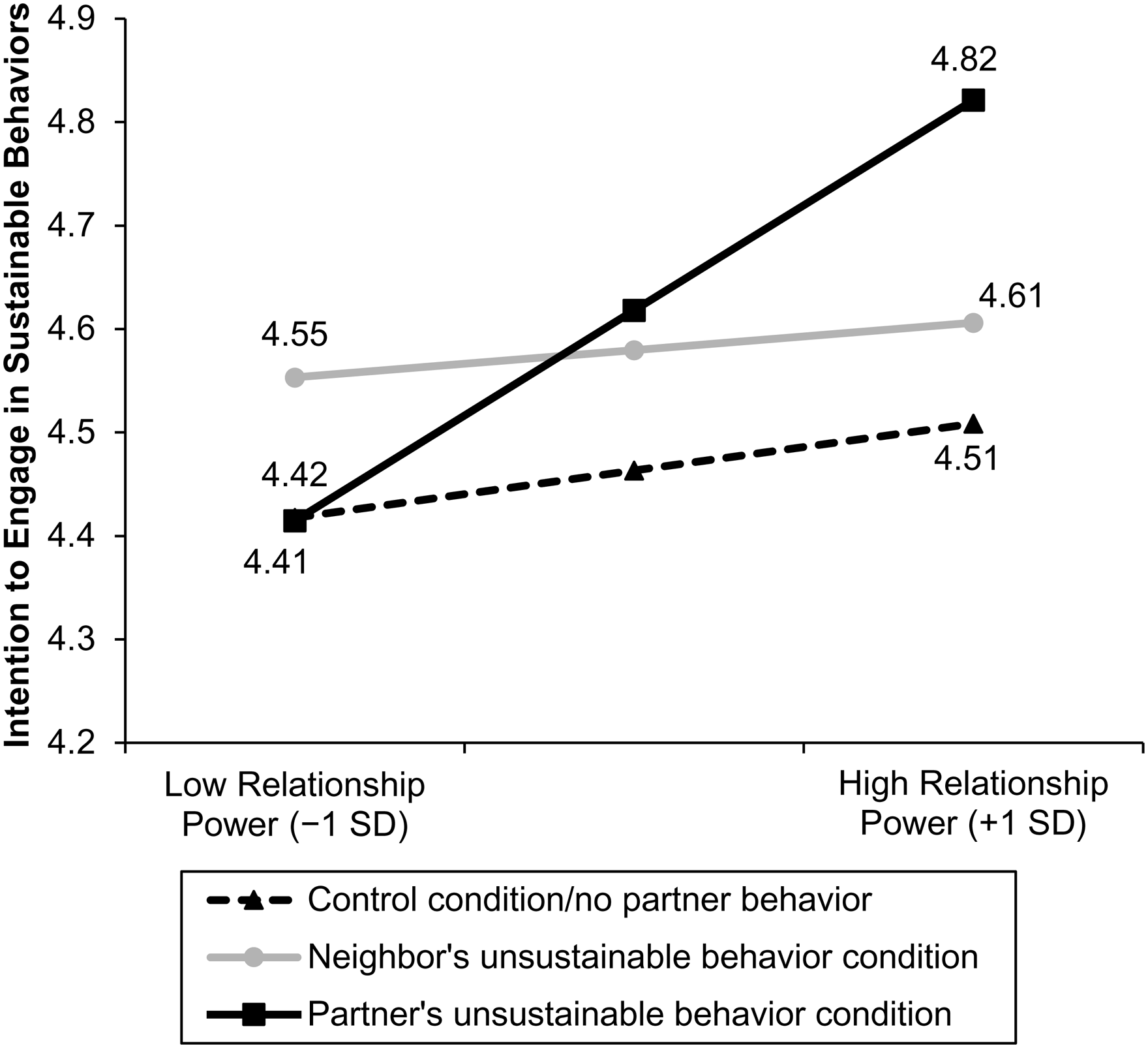
Romantic Partner's Versus Neighbor's Unsustainable Behavior (Study 1).
A Johnson–Neyman (JN) floodlight analysis (Spiller et al. 2013) revealed that at high levels of relationship power, participants had higher sustainable behavior intentions in the partner's unsustainable behavior condition than in the control condition (JN value ≥ 5.44; b = .17, SE = .09, t(385) = 1.97, p = .05) or the neighbor's unsustainable behavior condition (JN value = 7.00, b = .32, SE = .16, t(385) = 1.94, p = .05); furthermore, at high levels of relationship power, participants showed similar sustainable behavior intentions in the neighbor's unsustainable behavior and control conditions (there was no significant JN point; all ps > .05). At low levels of relationship power, the differences between partner's and neighbor's behavior conditions, the partner's behavior and control conditions, and the neighbor's behavior and control conditions were not significant (no significant JN points were identified for any of the comparisons; all ps > .05). 4
These results confirm our prediction that high- (but not low-) relationship-power partners increase their own sustainable behavior after observing their partner's unsustainable behavior (as compared with observing their neighbor's unstainable behavior or not receiving any information on another's behavior). In addition to these predicted contrasts, we further examined the sustainable behavior of high- versus low-relationship-power partners in the different conditions. Results showed that relationship power did not predict participants’ intentions to engage in sustainable behavior in the control/no partner behavior condition (b = .04, SE = .05, t(385) = .80, p = .42, CI95: [−.06, .15]) or in the neighbor's unsustainable behavior condition (b = .02, SE = .05, t(385) = .41, p = .67, CI95: [−.09, .14]). However, higher relationship power was associated with greater sustainable behavior when participants were exposed to their partner's unsustainable behavior (b = .18, SE = .05, t(385) = 3.24, p < .001, CI95: [.07, .30]). These analyses contrasting the behavior of low- and high-relationship-power partners after exposure to a partner's unsustainable behavior (which are not focal to our hypothesis) are reported in Web Appendix C for all other studies.
Discussion
Study 1 provides the first evidence in support of H1: high-relationship-power consumers compensate for their partners’ unsustainable behavior by increasing their own sustainable behavior (relative to their baseline tendencies), whereas exposure to a partner's unsustainable behavior did not increase the sustainable behavior of low-relationship-power consumers relative to their baseline tendencies. Importantly, the results also show that the effects are specific to exposure to the unsustainable behaviors of one's romantic relationship partner but do not occur after exposure to unsustainable behaviors of others with whom one does not share a relationship, consistent with prior literature (Meijers et al. 2019). These results confirm the uniqueness of the romantic relationship context and highlight the importance of studying it.
Study 2: Process Evidence
We argue that exposure to a partner's unsustainable behavior will raise high- (but not low-) relationship-power partners’ perceived responsibility for the reconstruction of the couple sustainable identity, which in turn will heighten their desire to signal a positive couple identity, resulting in higher sustainable behavior relative to their baseline tendencies (H2). Studies 2a and 2b provide evidence of this serial mediation via perceived responsibility for the reconstruction of the couple sustainable identity and desire to signal a positive couple identity. In Study 2a, we manipulate relationship power and assess the mediator items after the dependent variable; in Study 2b we measure relationship power, counterbalance the order of the mediator items and dependent variable, and use an incentive-compatible dependent variable.
Study 2a: Manipulated Relationship Power and Process Evidence
Participants and Procedure
We recruited 360 married participants (Mage = 39.98 years, SD = 12.10 years; 48% female; Mrel. length = 13.97 years, SD = 11.25 years) on Prolific Academic. Participants were randomly assigned to one of four conditions in a 2 (partner's behavior: unsustainable, control/no behavior) × 2 (relationship power: high, low) between-subjects design. Participants first completed the relationship power manipulation adopted from Brick et al. (2018). Specifically, participants in the high- (low-) relationship-power condition were given the following instructions: Please recall a particular incident in which you had power over your partner (your partner had power over you). By power, we mean a situation in which you (your partner) controlled the ability of your partner (you) to get something they (you) wanted, or were in a position to evaluate your partner (you). Please describe this situation in which you had power—what happened, how you felt, etc.
A pretest confirmed that those in the high-relationship-power condition felt more powerful than those in the low-relationship-power condition (see Pretest 3 in Web Appendix A).
Following the writing task, participants read the same scenario used to manipulate their partner's unsustainable behavior and were provided with the same information in the control condition as in Study 1. Subsequently, participants reported their intentions to engage in sustainable behaviors over the next three months on a six-point Likert scale (1 = “never,” and 6 = “very frequently”). In addition to the seven items included in Study 1, we added six other sustainable behaviors (e.g., ride a bike, eat more plants and less meat). We combined these 13 items into an index measure of participants’ sustainable behavior intentions (α = .76).
Next, participants completed two items to measure their feelings of perceived responsibility for the construction of the couple sustainable identity (“It is my responsibility to ensure that we are an environmentally conscious couple” and “It is my duty to ensure that we, as a couple, behave in an environmentally conscious way”; r = .85, p < .001) and two items to assess their desire to signal a positive sustainable identity of the couple (“I want to present us [my partner and I] in a positive way through engaging in sustainable consumption” and “I want us [my partner and I] to make a positive impression through engaging in sustainable consumption”; r = .86, p < .001). Items were specific to the sustainability domain consistent with prior research that conceptualizes identity as domain-specific (e.g., Lalot et al. 2019) and were assessed on a seven-point scale anchored by 1 (“strongly agree”) and 7 (“strongly agree”). Finally, participants completed demographic information.
Analyses and Results
Intentions to engage in sustainable behaviors
We conducted a 2 (relationship power: high, low) × 2 (partner's choice: sustainable, unsustainable) analysis of variance (ANOVA) on participants’ intentions to engage in sustainable behavior. The results revealed a marginally significant effect of partner's behavior (F(1, 356) = 3.344, p = .068,

Study 2a results.
Planned contrasts showed that in the high-relationship-power condition, participants exposed to their partner's unsustainable behavior indicated greater intentions to engage in sustainable behavior than those in the control condition (Munsustainable = 4.43, SD = .62 vs. Mcontrol = 4.10, SD = .68; F(1, 356) = 10.130, p = .002,
Perceived responsibility for the construction of the couple sustainable identity
A two-way ANOVA using relationship power and partners’ behavior as independent variables and perceived responsibility for the construction of the couple sustainable identity as the dependent variable revealed nonsignificant effects of the partner's behavior (F(1, 356) = 1.876, p = .172,
Desire to signal a positive couple identity
A two-way ANOVA using relationship power and the partner's behavior as independent variables and the desire to signal a positive couple identity as the dependent variable revealed a significant effect of the partner's behavior (F(1, 356) = 11.853, p < .001,
Process evidence
Using Hayes’s PROCESS Macro (Hayes 2017), we conducted a moderated mediation analysis (Model 86, with 5,000 bootstrap samples, 95% bias-corrected intervals) with intentions to engage in sustainable behavior as the dependent variable, the partner's behavior as the independent variable (coded as 0 = control condition, 1 = partner's unsustainable behavior condition), relationship power as the moderator (coded as 0 = low relationship power, 1 = high relationship power), perceived responsibility for the construction of the couple sustainable identity as the first mediator, and desire to signal a positive couple identity as the second mediator. The index of moderated mediation was significant (b = .09, SE = .04, CI95: [.02, .18]). As we expected, the indirect effect of partner's behavior on participants’ intentions to engage in sustainable behavior through perceived responsibility for the construction of the couple sustainable identity and the desire to signal a positive couple identity was significant in the high-relationship-power condition (b = .07, SE = .03, CI95: [.02, .13]) but not in the low-relationship-power condition (b = −.02, SE = .02, CI95: [−.07, .03]).
Study 2b: Measured Relationship Power and Process Evidence
In Study 2b, we replicate the results from Study 2a in a preregistered study that measures (instead of manipulates) relationship power and uses an incentive-compatible measure of sustainable behavior. More importantly, one limitation of Study 2a was that by assessing the mediator items after the dependent variable, we might have inadvertently created demand effects (i.e., indicating greater intentions to engage in sustainable behaviors might have led participants to indicate greater desire to signal a sustainable identity). To address this concern, in Study 2b we counterbalance the order of the mediator items and dependent variable.
Participants and Procedure
This study used a 2 (partner's behavior: unsustainable, control/no behavior) between-subjects design with relationship power as a second continuously measured factor. We aimed to recruit 700 married participants using Amazon Mechanical Turk (MTurk) via CloudResearch Prime Panels (Litman, Robinson, and Abberbock 2017). In the end, 701 participants completed the study (Mage = 46.05 years, SD = 14.04 years; 58% female; Mrel. length = 18.52 years, SD = 11.34 years). Before collecting the data, we preregistered this study on AsPredicted.org (https://aspredicted.org/Y4F_ZYT).
Because this study included incentive-compatible rather than hypothetical choices, consistent with prior research, we only recruited participants who were interested in the domain (Mookerjee, Cornil, and Hoegg 2021). Specifically, in the beginning of the study, participants were presented with two different types of environmentally friendly behavior 6 (recycling and reducing food waste) and were asked to choose the behavior that was most important and relevant to them. Participants also had the option to choose “neither.” Consistent with the preregistration criteria, those participants who did not find either recycling or reducing food waste relevant were screened out, and we did not collect any data from them.
Eligible participants were randomly assigned to a partner's unsustainable behavior or control condition. In the partner's unsustainable behavior condition, depending on participants’ sustainability issue choice at the beginning of the study (58% chose recycling and 42% chose food waste reduction), participants were asked to read a scenario about their partner engaging in an unsustainable recycling or food waste behavior. Participants who chose recycling read the same scenario as in Studies 1 and 2a; those who chose food waste read a scenario in which their partner did not feel like packaging up leftover food and threw all leftovers in the garbage bin (Pretest 6 in Web Appendix A confirmed that there was no significant difference in the perceived unsustainability of recycling and food waste). In the control condition, participants imagined cleaning their apartment over the weekend.
Following this, depending on participants’ sustainability issue choice at the beginning of the study, we presented them with one of two nonprofit organizations: one that aims to reduce plastic pollution and improve recycling infrastructure (i.e., Plastics for Change for participants who selected recycling as the sustainability issue most important to them) or another whose mission is to create a less wasteful food system (i.e., Community Food Rescue for participants who selected reducing food waste as the most important sustainability issue). A pretest confirmed that these nonprofit organizations have similar levels of recognizability and garner similar liking (see Pretest 7 in Web Appendix A). We informed participants that ten people would receive a $20 bonus payment and asked whether they were willing to donate part of their bonus payment to the nonprofit organization. Participants’ donations to their respective nonprofit organizations (a 21-point sliding scale ranging from 0 to 20) served as our dependent variable.
Because the order of the mediator items and the dependent variable was counterbalanced, participants answered the mediator items either before or after the dependent variable. They completed the same items for perceived responsibility for the construction of the couple sustainable identity (r = .87, p < .001) and desire to signal a positive couple identity (r = .90, p < .001), as in Study 2a. Finally, participants completed the relationship power scale (Brick et al. 2018; α = .90) and provided demographic information. We also included exploratory measures assessing participants’ green identity (e.g., “Acting environmentally friendly is an important part of who I am”; α = .82; 1 = “strongly disagree,” and 7 = “strongly agree”; Van der Werff, Steg, and Keizer 2013) and environmental concerns (“In general, how concerned are you about the environment?”; 1 = “not at all,” and 7 = “very much”) to examine whether they moderate our effects.
Analyses and Results
Donation behavior
We ran PROCESS Model 1 (Hayes 2017) with the partner's behavior as the independent variable (coded as 0 = control condition, 1 = partner's unsustainable behavior condition), relationship power as a moderator (M = 5.13, SD = .98), and participants’ donations (in $) as the dependent variable. The results revealed a nonsignificant effect of the partner's behavior (b = .39, SE = .44, t(697) = .90, p = .37, CI95: [−.47, 1.26]) and a marginally significant effect of relationship power (b = −.61, SE = .33, t(697) = −1.81, p = .07, CI95: [−1.26, .05]). Importantly, we found a significant interaction effect of relationship power and the partner's behavior (b = .99, SE = .45, t(697) = 2.19, p = .03, CI95: [.10, 1.88]). 7 A JN floodlight analysis (Spiller et al. 2013) revealed that at high levels of relationship power (JN value ≥ 5.77; 25.53% of respondents), the partner's unsustainable behavior increased participants’ donations relative to the control condition (b = 1.03, SE = .53, t(697) = 1.96, p = .05). There was no significant JN point at low levels of relationship power (all ps > .05). 8
Perceived responsibility for the construction of the couple sustainable identity
An analysis of moderation (PROCESS Model 1; Hayes 2017) revealed a significant interaction of relationship power and the partner's behavior on perceived responsibility for the construction of the couple identity (b = .24, SE = .10, t(697) = 2.35, p = .02, CI95: [.04, .45]). At high levels of relationship power (JN value ≥ 5.30; 48.65% of respondents), the partner's unsustainable behavior led to greater perceived sense of responsibility for constructing the couple sustainable identity relative to the control condition (b = .20, SE = .10, t(697) = 1.96, p = .05). There was no significant JN point at low levels of relationship power (all ps > .05).
Desire to signal a positive couple identity
A similar analysis of moderation (PROCESS Model 1; Hayes 2017) revealed a marginally significant interaction effect of relationship power and partner's behavior (b = .20, SE = .11, t(697) = 1.83, p = .07, CI95: [–.01, .42]). At medium and high levels of relationship power (JN value ≥ 4.50; 76% of respondents), the partner's unsustainable behavior led to stronger desire to signal a positive couple identity relative to participants’ baseline tendencies (b = .25, SE = .13, t(697) = 1.96, p = .05). There was no significant JN point at low levels of relationship power (all ps > .05).
Process evidence
Using Hayes’s PROCESS Macro (Hayes 2017), we conducted a moderated mediation analysis (Model 86, with 5,000 bootstrap samples, 90% bias-corrected intervals) with participants’ donations as the dependent variable, the partner's behavior as the independent variable (coded as 0 = control condition, 1 = partner's unsustainable behavior condition), relationship power as the moderator, perceived responsibility for the construction of the couple sustainable identity as the first mediator, and desire to signal a positive couple identity as the second mediator. The index of moderated mediation was marginally significant (b = .06, SE = .05, CI90: [.0007, .15]). The indirect effect of the partner's behavior on participants’ donations through perceived responsibility for the construction of the couple sustainable identity and the desire to signal a positive couple identity was marginally significant for high-relationship-power individuals (b = .10, SE = .07, CI90: [.006, .23]) but not for low-relationship-power individuals (b = −.02, SE = .04, CI90: [−.10, .04]).
Moderation by the strength of participants’ green identity
To analyze the interaction of green identity (M = 5.35, SD = 1.14), relationship power (M = 5.13, SD = .98), and partner's behavior in predicting participants’ donation behavior, we used PROCESS Model 3 (Hayes 2017), which is designed to interpret three-way interactions in regression analysis (Hasford et al. 2022). The results showed a nonsignificant effect of the partner's behavior (b = .14, SE = .44, t(693) = .33, p = .74, CI95: [–.72, 1.00]), a significant effect of relationship power (b = –.80, SE = .33, t(693) = –2.40, p = .02, CI95: [–1.45, –.15]), and a significant interaction of relationship power and the partner's behavior (b = .98, SE = .46, t(693) = 2.16, p = .03, CI95: [.09, 1.88]). No other significant two-way interaction effects were observed (p > .24). There was a significant effect of green identity on donation behavior (b = 1.10, SE = .26, t(693) = 4.26, p < .001, CI95: [.60, 1.61]). Importantly, the three-way interaction between green identity, relationship power, and the partner's behavior was significant (b = .78, SE = .36, t(693) = 2.16, p = .03, CI95: [.08, 1.45]).
Floodlight analysis using the JN technique (Spiller et al. 2013) showed that the two-way interaction between relationship power and the partner’s behavior was significant at medium and high levels of green identity (JN value ≥ 5.23; 60.48% of the sample; b = .89, SE = .45, t(693) = 1.96, p = .05) but not at low levels of green identity (there was no significant JN point; all ps > .05). To probe the interaction further, we examined the interaction effect of the partner's behaviors and relationship power at high levels of green identity. Replicating our previous findings, for participants with strong green identity, the partner's unsustainable behavior increased participants’ donations relative to the control condition at high levels of relationship power (b = 1.24, SE = .63, t = 1.97, p = .05; JN value ≥ 5.71; 36.32% of the sample). Interestingly, for participants with a strong green identity, at low levels of relationship power (JN value ≤ 4.01: 11.79% of the sample), the partner's unsustainable behavior decreased participants’ donations relative to the control condition (b = −1.87, SE = .95, t = −1.97, p = .05). This could be because low-power individuals who have strong green identities by definition have a high propensity to engage in sustainable behaviors in the control/baseline (Yan, Keh, and Wang 2021), making the contrast between the control and partner's unsustainable behavior condition significant. We obtained similar results with participants’ environmental concern as the moderator (see Web Appendix C).
Discussion
Studies 2a and 2b provide additional evidence for H1, demonstrating that high- (but not low-) relationship-power consumers compensate for their partners’ unsustainable behavior by increasing their own sustainable behavior (relative to their baseline tendencies). More importantly, these studies support the underlying mechanism (H2): for high- (but not low-) relationship-power consumers, exposure to a partner's unsustainable behavior increases their perceived responsibility for the construction of the couple sustainable identity, which in turn heightens their desire to signal the positive identity of the couple by increasing their own sustainable behavior. The results also show that the effect is attenuated for high-relationship-power individuals who have weak green identities. This moderation is consistent with our theory—consumers with low concern for the environment (i.e., a weak green identity), for whom sustainable identity is not an important part of who they are (Van der Werff, Steg, and Keizer 2013), did not feel the need to reconstruct and signal a positive couple identity after being exposed to their partner's unsustainable choices. An additional study reported in Web Appendix D rules out alternative explanations for our effects (i.e., identity threat, guilt, shame, and mood regulation; see Web Appendix Study 1). In Study 3, we provide evidence for H1 and H2 in the field.
Study 3: Field Study
In this field study, we recruited couples in committed relationships, allowing one partner to make an unsustainable (or sustainable) product choice, and then asking the other partner to make a different product choice after being exposed to their partner's behavior. This procedure allowed us to replicate our findings in a more ecologically valid context.
Participants and Procedure
We recruited 98 couples on the campus of a private U.S. university (i.e., 196 participants; Mage = 44.06 years, SD = 9.95 years; 51% female; Mrel. length = 15.73 years, SD = 12.66 years). Research assistants visited administrative offices across campus to recruit participants for a study about household decision making. Participants were eligible to participate only if they were married or living together with a partner and if their partner was willing to participate as well. They received $10 and two small gifts (one for each partner) for participating in the study.
Research assistants visited participants’ offices twice. On the first visit, they gave them a paper-and-pencil survey to take home to be completed by their partner (hereinafter referred to as Partner 1). On the second visit, research assistants collected the first partner's completed survey and distributed the second part of the survey, to be completed by the employee (hereinafter referred to as Partner 2). Before participants handed in their partner's survey, we instructed the research assistants to ask each participant about their partner's product choice. The research assistant then handed Partner 2 the gift chosen by Partner 1 and provided the second part of the survey for them to complete.
In the survey completed by Partner 1, participants first answered some questions about their relationship status (whether they are married and living together, how long they have been married and living together). Next, we told participants that we would be offering a small gift as a thank you for participating in the study. Participants could choose between two products, a small (4 oz.) bag of multiseed gluten-free crackers of the Crunchmaster brand in compostable packaging, or a larger (6 oz.) bag of Crunchmaster crackers in plastic packaging (see Web Appendix B for stimuli; a pretest confirmed that participants perceive the compostable packaging to be more sustainable; see Pretest 8 in Web Appendix A). Consistent with prior literature, the sustainable option was smaller to introduce a trade-off (Trudel et al. 2019). Finally, participants completed the relationship power scale (α = .86; Brick et al. 2018); indicated their hunger level (1 = “not at all,” and 7 = “very high”), how much they liked crackers (1 = “not at all,” and 7 = “very much”), and their familiarity with the Crunchmaster brand (1 = “not at all,” and 7 = “very high”); and provided demographic information (gender, age).
In the second survey, completed by Partner 2, participants were asked to indicate their partner's product choice to ensure that they remembered it. Then, Partner 2 made their own product choice, which was the dependent variable in this study: a choice between a bag of six assorted fair-trade tea bags or ten assorted conventional tea bags (see Web Appendix B for stimuli; a pretest confirming that the fair-trade tea was perceived as more sustainable is available in Web Appendix A; see Pretest 9). Participants also indicated their relative preference between the two options (1 = “strongly prefer an assortment of six fair-trade tea bags,” and 7 = “strongly prefer an assortment of ten tea bags”). Participants’ preference responses were reverse-scored, such that higher numbers indicated greater likelihood of choosing the sustainable product. Next, participants completed the same items for perceived responsibility for the construction of the couple sustainable identity (r = .69, p < .001) and desire to signal a positive couple identity 9 (r = .92, p < .001) as in Studies 2a and 2b. Finally, participants completed the relationship power scale (α = .91; Brick et al. 2018), indicated whether they drink tea (1 = “I do not drink tea,” and 4 = “multiple times per day”), stated whether anybody in their household is a tea drinker, and provided demographic information (age, gender). Including tea-drinking status and demographic variables as covariates in our analyses does not change the results.
Analyses and Results
Sustainable product preference
We ran the PROCESS macro (Model 1; Hayes 2017) with relationship power as the independent variable (M = 4.97, SD = 1.26), partner's behavior as the moderator (coded as 0 = sustainable product choice, 1 = unsustainable product choice), 10 and participants’ preference for the fair-trade tea bags as the dependent variable (1 = “an assortment of ten tea bags,” and 7 = “an assortment of six fair-trade tea bags”). The results revealed a significant effect of the partner's behavior (b = −.92, SE = .33, t(89) = −2.79, p = .006, CI95: [−1.58, −.27]) and a nonsignificant effect of relationship power (b = .22, SE = .21, t(89) = 1.006, p = .32, CI95: [−.21, .64]). As we expected, there was a significant interaction of relationship power and partner's behavior (b = 1.08, SE = .27, t(89) = 3.93, p < .001, CI95: [.53, 1.62]; see Figure 4, Panel A). 11

Study 3 results.
To create a realistic choice, we asked Partner 1 to choose between a sustainable and an unsustainable product; as a result, we did not have a control (no partner behavior) condition in this study. Since our focus is to understand how consumers’ respond to their partner's unsustainable behaviors, here we examine the difference between low- and high-relationship-power consumers after they are exposed to their partner's unsustainable choice. Therefore, we conducted simple slope analyses to examine the effect of relationship power on consumers’ sustainable behavior after exposure to their partners’ unsustainable or sustainable choices.
Results show that when participants saw that their partner made an unsustainable product choice, the more relationship power they had, the more likely they were to prefer fair-trade tea bags (b = 1.29, SE = .17, t(89) = 7.569, p < .001, CI95: [.96, 1.63]). However, when participants saw that their partner made a sustainable product choice, the effect of relationship power on participants’ preference for the fair-trade tea bags was not significant (b = .22, SE = .21, t(89) = 1.006, p = .32, CI95: [−.21, .64]). We obtained similar results with participants’ tea choice dependent variable (for additional analyses, see Web Appendix C).
Furthermore, we applied the JN technique to identify regions of significance of the effect of partner's behavior across different levels of relationship power. At high levels of relationship power (JN value ≥ 6.75; 1.08% of respondents), the partner's unsustainable behavior (i.e., choosing the larger bag of crackers in plastic packaging) marginally increased participants’ preferences for fair-trade tea bags relative to the sustainable partner's behavior (i.e., choosing the smaller bag of crackers in compostable packaging; b = .95, SE = .57, t(89) = 1.66, p = .10). Surprisingly, at medium and low levels of relationship power (JN value ≤ 5.25; 40.86% of respondents), the sustainable partner's behavior increased participants’ preferences for fair-trade tea bags relative to the partner's unsustainable behavior (b = −.67, SE = .33, t(89) = −1.99, p = .05). It is worth noting that although we replicate our findings for high-relationship-power individuals, the results for low-relationship-power individuals differ from those of previous studies, as the sustainable partner's choice condition is not the same as the control condition (i.e., no partner's behavior) included in prior studies. Interestingly, the partners’ sustainable product choices positively influenced low-relationship-power individuals’ sustainable behaviors, which aligns with previous research showing that low-relationship-power individuals are likely to conform to their partners’ charity donation decisions (Laurin et al. 2016).
Perceived responsibility for the construction of the couple sustainable identity
A similar analysis of moderation revealed a significant interaction of partner's behavior and relationship power on perceived responsibility for the construction of the couple identity (b = .67, SE = .27, t(88) = 2.471, p = .02, CI95: [.22, 1.12]). In the partner's unsustainable behavior condition, as participants’ relationship power increased, they indicated a stronger perceived sense of responsibility for the construction of the couple sustainable identity (b = .97, SE = .17, t(88) = 5.76, p < .001, CI95: [.69, 1.25]). In the partner's sustainable behavior condition, the effect of relationship power on perceived responsibility was not significant (b = .30, SE = .21, t(88) = 1.44, p = .15, CI95: [−.05, .66]; see Figure 4, Panel B). Furthermore, at high levels of relationship power (JN value ≥ 4.49; 72% of respondents), the partner's unsustainable behavior led to greater perceived sense of responsibility for the couple sustainable identity relative to the sustainable partner's behavior (b = .72, SE = .36, t(88) = 1.99, p = .05), whereas there was no difference between the two conditions at lower levels of relationship power (all ps > .05).
Desire to signal a positive couple identity
A similar analysis of moderation revealed a significant interaction of partner's behavior and relationship power on participants’ desire to signal a positive couple identity (b = .92 SE = .28, t(89) = 3.24, p < .01, CI95: [.45, 1.39]). In the partner's unsustainable behavior condition, as participants’ relationship power increased, they indicated a stronger desire to signal a positive couple identity (b = .85, SE = .18, t(89) = 4.77, p < .001, CI95: [.55, 1.14]). In the partner's sustainable behavior condition, the effect of relationship power was not significant (b = −.08, SE = .22, t(89) = −.34, p = .73, CI95: [−.45, .30]; see Figure 4, Panel C). Furthermore, for high-relationship-power participants (JN value ≥ 6.40; 6.45% of respondents), the partner's unsustainable behavior led to stronger desire to signal a positive couple identity than the partner's sustainable behavior (b = 1.02, SE = .51, t(89) = 1.99, p = .05). For low-relationship-power individuals (JN value ≤ 4.47; 26.88% of respondents), the partner's unsustainable behavior decreased the desire to signal a positive couple identity relative to the partner's sustainable behavior (b = −.76, SE = .38, t(89) = −1.99, p = .05).
Process evidence
As mentioned previously, due to the study design, we could not include a control condition in this study; observing a partner's sustainable behavior is not the same as a control condition that assesses one's baseline sustainability tendencies without exposure to another's behavior. Therefore, to test our process in this study, we conducted a moderated mediation analysis with participants’ preference for the sustainable product as the dependent variable, relationship power as the independent variable, the partner's product choice as the moderator, perceived responsibility for the construction of the couple sustainable identity as the first mediator, and the desire to signal a positive couple identity as the second mediator (Hayes 2017; Model 86, with 5,000 bootstrap samples). We expected the serial mediation proposed in H2 to be significant in the partner's unsustainable behavior condition, but not in the partner's sustainable behavior condition. Results indeed revealed a significant index of moderated mediation (b = .15, SE = .08, CI95: [.01, .33]). The indirect effect of relationship power on participants’ preference for the sustainable product through perceived responsibility for the construction of the couple sustainable identity and the desire to signal a positive couple identity was significant when the partner made an unsustainable choice (b = .22, SE = .10, CI95: [.03, .43]), but not when the partner made a sustainable choice (b = .07, SE = .06, CI95: [−.01, .20]). We obtained similar results with participants’ tea choice dependent variable (see Web Appendix C).
Discussion
Study 3 provides additional evidence in support of both H1 and H2 in the field. Results showed that a partner's unsustainable choice prompts high- (but not low-) relationship-power partners to subsequently behave more sustainably themselves, and that this effect is mediated by perceived responsibility for the couple sustainable identity and desire to signal a positive couple identity. An additional study reported in Web Appendix D (Web Appendix Study 2) replicates these findings using married couples recruited from MTurk and a different consequential measure of sustainable behavior.
Study 4: Facebook Ads Campaign
In Study 4 we conducted a field experiment using Facebook Ads, which aimed to demonstrate the actionable practical insights of our findings. We used gender (a frequently used segmentation variable by marketers; Libert 2014; Melnyk, Van Osselaer, and Bijmolt 2009) as a proxy for relationship power in a specific context where it is possible to identify high- and low-relationship-power partners based on gender: wedding planning. 12 Prior research shows that women traditionally have more power and influence over the joint decision making of the couple in wedding planning, while men usually act as “companions or assistants” (Blakely 2008; Engstrom 2008). A pretest confirmed this assumption, showing that women are perceived to have more relationship power in the wedding planning context than men (see Pretest 10; Web Appendix A).
Participants and Procedure
This study used a 2 (advertisement type: partner's unsustainable behavior vs. control [no partner behavior]) × 2 (relationship power: high [women] vs. low [men]) between-subjects design. We ran two campaigns using Facebook Ad Manager's A/B testing capability: one for the partner's unsustainable behavior advertisement and one for the control advertisement. Both advertisements featured the headline “How to have a sustainable wedding?” and contained a call to action to click on the ad to learn how to reduce the carbon footprint of one's wedding. The only difference between the two ads was that in the partner's unsustainable behavior condition, we highlighted the partner's unsustainable behavior: “Your partner will likely make many unsustainable wedding choices like plastic water bottles and disposable decorations, which ultimately damage our environment.” A pretest confirmed that both advertisements garnered similar liking and were perceived to be similar in informativeness, believability, and other dimensions (see Pretest 10 in Web Appendix A).
Using Facebook Ad's audience selection feature, we targeted individuals who were currently engaged and expressed interest in weddings. For each campaign we created two ad sets, one for male and one for female Facebook users. Presentation of the two ad sets was not random and was determined by the Facebook algorithm. The campaign ran for four consecutive days in March 2021. Our dependent variable was whether participants clicked on the ad (Castelo, Bos, and Lehmann 2019; Kupor and Laurin 2020). If a Facebook user clicked on the ad, the campaign was charged for the click, and the user was directed to a website we created, which provided information about the study and links to information about sustainable weddings.
We expected that an advertisement that highlights the unsustainable behavior of a partner would generate more interest (i.e., greater likelihood of clicking on the ad) among women (i.e., high-relationship-power partners in wedding planning), relative to the control ad. In contrast, there should be no difference in the likelihood of clicking on the ad between the two ads for men (i.e., low-relationship-power partners in wedding planning).
Analyses and Results
We ran a logistic regression, in which we regressed whether participants clicked on the ad (coded as 0 = did not click on ad, 1 = clicked on ad) on advertisement type (coded as 0 = control ad, 1 = partner's unsustainable behavior ad), participants’ relationship power (coded as 0 = high relationship power [i.e., female], 1 = low relationship power [i.e., male]), and their interaction. The results revealed a nonsignificant effect of relationship power (i.e., gender; b = −.118, SE = .13, Wald χ2 = .823, p = .364) and a significant effect of advertisement type (b = .298, SE = .12, Wald χ2 = 6.338, p = .012). Importantly, the interaction of advertisement type × relationship power (i.e., gender) was significant (b = −.46, SE = .179, Wald χ2 = 6.631, p = .01).
Follow-up analyses showed that, as predicted, the advertisement that highlighted the partner's unsustainable behavior increased the likelihood of clicking on the ad among high-relationship-power participants (women) relative to the control ad (b = .298, SE = .12, Wald χ2 = 6.338, p = .012; the click-through rates, calculated as the number of clicks divided by the number of impressions [Castelo, Bos, and Lehmann 2019; Kupor and Laurin 2020], for the two ad conditions are presented in Table 1). Conversely, the difference between the control ad and the partner's unsustainable behavior ad was not significant for low-relationship-power individuals (men; b = −.16, SE = .13, Wald χ2 = 1.46, p = .23; see Table 1).
Facebook Ad Campaign (Study 4).

Notes: CTR = click-through rates; CPC = cost per click.
Discussion
Study 4 provides additional evidence in support of H1 in a setting with high ecological validity in which we manipulated the partner's behavior using ads and relied on a frequently used segmentation variable as a proxy for relationship power: high-relationship-power consumers (women in the context of wedding planning) took more action to obtain information about sustainable weddings when they saw an advertisement highlighting their partners’ unsustainable behaviors relative to a control advertisement with no partner behavior information, but there was no such difference for low-relationship-power consumers (men in this context). Even though gender might be an imperfect proxy for relationship power in the wedding planning context, it is a commonly used segmentation variable and, as such, enables us to demonstrate the actionable managerial insights of our findings.
Despite the robust results presented so far, one could question the ecological validity of our findings, arguing that in natural settings high-relationship-power consumers might use their power to confront their partner and ask them to change their unsustainable behavior rather than compensate for it by increasing their own sustainable behavior. For this reason, we conducted two additional studies to examine consumers’ perceptions of these possible responses to a partner's unsustainable behavior (for details, see Studies 3A and 3B in Web Appendix D). In Web Appendix Study 3A (n = 298; Mage = 47.01 years, SD = 22.01 years; 62% female; Mrel. length = 17.77 years, SD = 12.04 years), married participants first read a scenario in which they and their partner were cleaning the apartment, and their partner did not recycle properly. Next, participants imagined their response to their partner's behavior was to (1) do nothing (i.e., not tell their partner anything or not do anything), (2) compensate for their unsustainable behavior by engaging in various sustainable behaviors themselves, or (3) confront their partner and make them change their behavior. For each possible response, participants rated the extent to which the response can benefit the relationship (four items, e.g., “Maintain harmony between me and my partner”; 1 = “not at all,” and 7 = “very much”; α = .97), can create conflict in the relationship (four items, e.g., “Create conflict between me and my partner”; 1 = “not at all,” and 7 = “very much”; α = .88), and can benefit the environment (one item; 1 = “no benefit to the environment,” and 7 = “great benefits to the environment”). Results show that even though the two responses are perceived to be equally beneficial to the environment (Mcompensate = 5.00, SD = 1.60 vs. Mchange = 4.87, SD = 1.73, p = .86), confronting one's partner and asking them to change is perceived to be less beneficial to the relationship (it is less likely to allow for the preservation of harmony in the relationship [Mchange = 3.02, SD = 1.77 vs. Mcompensate = 5.13, SD = 1.66; p < .001] and more likely to create conflict between the partners, than compensating for the partner's unsustainable behavior through one's own sustainable actions [Mchange = 4.29, SD = 1.62 vs. Mcompensate = 2.66, SD = 1.64; p < .001]). Thus, given that both responses are equally beneficial to the environment, but confronting one's partner is costlier to the relationship than compensating through one's own actions, in Web Appendix Study 3B, when we gave married participants (n = 189; Mage = 43.81 years, SD = 11.89 years; 49% female; Mrel. length = 17.99 years, SD = 12.20 years) both options, they were more likely to adopt the latter response (Mchange = 2.69, SD = 2.03 vs. Mcompensate = 4.62, SD = 2.05; p < .001; for details, see Web Appendix Studies 3A and 3B).
The findings of these additional Web Appendix studies are in line with prior research showing that partners in a committed relationship, who have a goal to maintain the relationship, tend to use their power in a manner that is in the best interest of the relationship (Kim, Visserman, and Impett 2019), choosing strategies that maintain harmony in the relationship (Dzhogleva and Lamberton 2014; Karremans and Smith 2010). Nevertheless, we acknowledge that a different pattern of results might emerge in a natural setting, which might give rise to other possible reactions to a partner's unsustainable behavior than the compensatory behavior demonstrated in our work; future research should explore this possibility further.
General Discussion
The present research is the first to shed light on how the unsustainable behaviors of one partner in a relationship influence the other partner's sustainability-relevant behaviors. In five online studies, one field study, and one study using Facebook Ads in which we recruited couples in committed relationships and assessed different types of sustainable behavior (both hypothetical and real, private and public), we demonstrate that how consumers react to their partners’ unsustainable behaviors depends on the amount of relationship power they possess. Specifically, our results show that after exposure to a partner's unsustainable behavior, high-relationship-power consumers increase their sustainable behavior relative to their baseline tendencies, whereas low-relationship-power consumers are not influenced by their partner's unsustainable behavior. We demonstrate that this effect occurs because a partner's unsustainable behavior heightens high- (but not low-) relationship-power individuals’ perceived responsibility for the construction of the couple sustainable identity. This in turn increases their desire to signal a positive couple identity by increasing their own sustainable behavior. Consistent with this theory, this effect is attenuated for high-relationship-power individuals who have weak green identities. Finally, we show that these effects are specific to observing the unsustainable behavior of one's partner and do not occur when observing a neighbor's sustainable behavior (Study 1); the effects are also unique to sustainable behaviors: high-relationship-power partners do not compensate for other negative decisions of their partners, such as unhealthy eating choices (see Study 4 in Web Appendix D).
Theoretical Implications
Our research makes several theoretical contributions. First, it contributes to the understanding of social influence in the context of sustainable behavior. Although previous research demonstrates that the sustainable behaviors of others (e.g., strangers, neighbors, out-group members, in-group members, friends) can influence an individual's sustainable behavior (Cialdini, Reno, and Kallgren 1990; Goldstein, Cialdini, and Griskevicius 2008; Meijers et al. 2019; White, Simpson, and Argo 2014), the influence of consumers’ romantic partners has not been previously examined.
In addition, our work contributes to the emerging literature examining consumer behavior in a relationship context (e.g., Dzhogleva and Lamberton 2014; Etkin 2016; Garbinsky and Gladstone 2019; Garbinsky et al. 2020). Previous literature in this nascent field has focused on joint dyadic decision making (Dzhogleva and Lamberton 2014; Nikolova, Lamberton, and Coleman 2018), whereas our work focuses on sequential decisions made by relationship partners. Although the existing literature acknowledges that romantic partners are a powerful source of influence on an individual's decision-making process (Hasford, Kidwell, and Lopez-Kidwell 2018), no previous studies have examined how one partner's unsustainable behavior might affect the other partner's sustainability-relevant behaviors.
Our findings also contribute to the literature on identity and highlight the significance of couple identity. Despite the importance of the couple identity concept, the consumer behavior literature has previously examined identity only at the individual level (Nikolova and Lamberton 2019). As a relationship develops, the members of the couple tend to view themselves less as separate entities and instead develop an identity as a couple (Walsh and Neff 2018). This shared identity is linked to important aspects of relationship functioning, such as quality, stability, and commitment (Pagani et al. 2020). While our results demonstrate the implications of the couple identity in the sustainable behavior domain, this type of identity can affect couple members’ behaviors and choices in other consumer domains.
Relatedly, prior research demonstrates that when an in-group (vs. out-group) member behaves in an undesirable way, individuals tend to ostracize this member to protect the group's identity (Coull et al. 2001). However, we argue that in a romantic relationship context, individuals’ responses to their romantic partners’ undesirable behaviors differ because individuals develop a couple identity that is jointly constructed by both partners (Ahmad et al. 2017), and their partners’ behaviors impact their couple identity (Forbes and Stella 2022). Indeed, our results in Study 1 show that consumers’ responses to their partners’ unsustainable behavior differ from their responses to in-group others, such as their neighbors. Despite the fact that individuals perceive their neighbors as in-group members (confirmed in a pretest; see Pretest 11 in Web Appendix A), neither high- nor low-relationship-power individuals are influenced by the in-group member's unsustainable behavior (Study 1). However, high-relationship-power individuals compensate for their romantic partners’ unsustainable behavior due to their perceived responsibility for constructing the couple identity and desire to signal a positive couple identity. Our work therefore highlights the importance and implications of couple identity, an underresearched construct in consumer behavior.
Finally, we contribute to the literature on relationship power dynamics. Previous research has demonstrated that low-relationship-power individuals have a stronger tendency to pursue their partner's goals (Laurin et al. 2016) or conform to their partner's brand choices (Brick et al. 2018), whereas high-relationship-power individuals are more likely to prioritize their self-interests (Righetti et al. 2015). However, in the context of sustainable behavior, our research shows that high-relationship-power individuals act in a way that benefits the couple (rather than themselves), contributing to the growing body of literature showing that under specific circumstances, power can increase socially responsible behavior (Scholl 2020; Williams, Lopiano, and Heller 2022).
Practical Implications
As sustainable behavior is becoming increasingly important (White and Simpson 2013), companies and policy makers are developing new types of programs (Giebelhausen et al. 2016) and campaigns (Theotokis and Manganari 2015) to boost sustainable behavior. Married couples make up nearly 60% of the U.S. population (Statista 2019), and therefore campaigns targeting couples (rather than individual consumers) are becoming more popular in different domains (e.g., healthy couples’ grocery lists). However, our research did not find any existing couples-targeted campaigns that aim to increase couples’ sustainable behavior. Such campaigns might be an effective tool in increasing consumers’ sustainable behavior.
Our research identifies important factors that can increase the sustainable behavior of married couples: perceived responsibility for the construction of the couple sustainable identity and a desire to signal a positive couple identity. These two factors can have important implications for both marketers and policy makers who want to increase sustainable household behavior. For example, the United States Environmental Protection Agency has a presence on social media where it shares information and pictures (on Instagram) that aim to increase household recycling rates. As our research demonstrates, these government agencies can use appeals that enhance one's perceived responsibility for the construction of the couple sustainable identity. Policy makers, for example, can create advertisements that encourage partners to take responsibility for their couple sustainable identity (e.g., “It is your responsibility to make your household sustainable”). This could increase low-relationship-power individuals’ desire to signal a positive couple identity after being exposed to their partners’ unsustainable behavior, which might prompt them to act like their high-relationship-power partners and balance their partner's unsustainable behavior by engaging in more sustainable behavior themselves.
Firms that sell sustainable products for couples (e.g., luxury honeymoons that focus on natural services and tours or conflict-free diamond rings) can also appeal to the desire to signal a positive couple identity in their advertisements. After reviewing these companies’ websites, we noticed that all of these products used self- or other-benefit appeals. Our research indicates that using appeals that highlight couple-benefit appeals (i.e., highlight couple identity) may help these companies increase their sales. Moreover, as illustrated in our last study, social media channels such as Facebook allow for very precise targeting (Facebook 2022) and can enable marketers to target romantic couples with advertising campaigns that encourage them to take responsibility for the couple sustainable identity or make their couple identity more salient, increasing the sales of sustainable products to couples.
Limitations and Future Research Directions
Our research has several limitations that offer opportunities for future research. First, we assessed consumers’ green identity and environmental concerns in Study 2b and found that our effect was attenuated for high-relationship-power individuals who have low concern about the environment or a weak green identity. Future research should examine whether these individual differences are consistent moderators across various contexts and whether other individual traits, such as a consumer's political identity or belief in climate change, can influence people’s responses to their partners’ unsustainable behaviors.
While our results show that high-relationship-power individuals increase their sustainable behavior after brief exposure to their partner's unsustainable behavior, it is important to understand whether their increased engagement in sustainable behavior is only temporary or persists in the long term. Indeed, when given the option to engage in sustainable behavior in a multiple-choice setting, we observed that high-relationship-power individuals compensate for their partners’ unsustainable behaviors only once, immediately after they were exposed to their partners’ choice, but not in subsequent sustainability-relevant decisions (see Study 5 in Web Appendix D). These results suggest that high-relationship-power individuals do not repeatedly compensate for their partners’ behavior and engaging in sustainable behavior once might be enough to fulfill their signaling goal. Future research should explore this further.
In a related vein, we also examined whether high-relationship-power individuals are equally likely to compensate for their partner's unsustainable behavior when this behavior is recent and temporally distant (i.e., occurred yesterday vs. six months ago). We found a boundary condition for our effect: high-power partners compensated for their partner's behavior only when it occurred recently, and not when it occurred a long time ago (see Study 5 in Web Appendix D). Future research should examine the factors that might prompt high-relationship-power partners to compensate even for temporally distant unsustainable behavior of their partners.
Our research focuses on (un)sustainable behavior, but future research could examine whether relationship power dynamics play out similarly in response to other type of behaviors that violate social norms, such as moral transgressions. While we did not find evidence of the influence of power dynamics for behaviors that have negative implications for the self, high-relationship-power individuals might compensate for their partners’ behaviors when those behaviors have implications not only for the self but also for others, such as prosocial behavior. We encourage future research to explore the influence of power dynamics in different contexts.
Supplemental Material
sj-pdf-1-mrj-10.1177_00222437221108891 - Supplemental material for I Will Be Green for Us: When Consumers Compensate for Their Partners’ Unsustainable Behavior
Supplemental material, sj-pdf-1-mrj-10.1177_00222437221108891 for I Will Be Green for Us: When Consumers Compensate for Their Partners’ Unsustainable Behavior by Aylin Cakanlar, Hristina Nikolova and Gergana Y. Nenkov in Journal of Marketing Research
Footnotes
Associate Editor
Eileen Fischer
Author Note
This article was a part of the first author’s doctoral dissertation, written at Stockholm University, Sweden.
Declaration of Conflicting Interests
The author(s) declared no potential conflicts of interest with respect to the research, authorship, and/or publication of this article.
Funding
The author(s) disclosed receipt of the following financial support for the research, authorship, and/or publication of this article: This research was supported in part by a Transformative Consumer Research Grant (from the Association for Consumer Research) and by grants from the Boston College (to Hristina Nikolova and Gergana Y. Nenkov) and the Media, Management and Transformation Center at Jönköping University (to Aylin Cakanlar).

Notes
References
Supplementary Material
Please find the following supplemental material available below.
For Open Access articles published under a Creative Commons License, all supplemental material carries the same license as the article it is associated with.
For non-Open Access articles published, all supplemental material carries a non-exclusive license, and permission requests for re-use of supplemental material or any part of supplemental material shall be sent directly to the copyright owner as specified in the copyright notice associated with the article.
