




Abstract
Retailers routinely present a posted or sale price together with a higher advertised reference price, in an effort to evoke a perception of the discount the consumer is receiving. However, if prices can be negotiated, what impact does this initial perceived discount (IPD) have on the ultimate discount, demand, and revenue? With data from consumers of a large durable goods retailer, in a natural decision-making environment, this study provides evidence that a greater IPD is associated with smaller negotiated discounts. Then, a lab experiment involving negotiation and purchase decisions for multiple products, with randomly assigned values of the IPD, establishes that a $1 increase in IPD lowers the negotiated discount by 5.7 cents. Furthermore, 55% of this decrease can be attributed to reduction in the participants’ likelihood to initiate a negotiation. Under bargaining, almost one-third of the increase in revenue from a higher IPD stems from an increase in the negotiated price, which is unlike fixed pricing, in which setting an increase in IPD affects revenue only through changes in demand. Finally, the optimal advertised reference prices a seller would post under bargaining and fixed pricing are similar, but the benefit from posting this price is significantly higher under bargaining. These findings in turn have implications for researchers, retailers, consumers and policy makers.
Keywords
In the common retail practice of comparative price advertising, retailers post two prices on a sales tag: a sale or posted price, which is the amount the consumer will pay for the product, and the advertised reference price (ARP), often signaled by terms such as “compare at,” “regular price,” or “manufacturer suggested retail price,” which creates a perception of an initial discount (for examples, see Figure 1). The resulting comparison, prevalent in various product categories from dry groceries to automobiles, has been the focus of substantial research in marketing and economics in studies that show that such price comparisons influence purchase likelihood by providing additional transaction utility (Huang 2018; Thaler 1985) and changing consumers’ internal reference prices (Biswas and Blair 1991; Kopalle and Lindsey-Mullikin 2003). In particular, increasing the difference between a fixed, posted price and ARP increases the initial perceived discount (IPD), which then enhances purchase likelihood. I posit that changes in IPD also might affect negotiated discounts, purchase likelihood, and revenues differently if consumers have the option to negotiate the prices they pay. 1

Examples of comparative pricing.
Such a purchase setting—with different prices available on a price tag and negotiations as an option—is common for expensive products such as automobiles, furniture, electrical goods, and appliances. According to Consumer Reports (Rechtin 2016), 70% of all used car buyers negotiated the price, and 83% were able to bargain a lower price. Similarly, Jindal and Newberry (2021) find negotiated prices for more than 90% of purchases in their data, and Zhang, Manchanda, and Chu (2021) indicated that 80% of mobile phone sellers allow for negotiated discounts on Taobao.com. 2 In turn, negotiations have become more common for less expensive products, such as collectibles, sports memorabilia, clothing, toys, and books, such that online retailers often list two different prices (see the bottom panel in Figure 1). As of 2015, 10% of all transactions on eBay involved bargaining, up from 1% just a decade prior (Backus et al. 2020), and more than half of those products sold at prices of $30 or less. Understanding how IPD affects negotiated prices and demand thus is important for both retailers of big ticket items and various parties on online platforms, among others.
To inform these actors, I pursue three main research objectives. First, I attempt to quantify the effect of an increase in IPD on the negotiated price. If an increase in IPD does not influence the negotiated price, then IPD can determine profit only through its impact on demand, which has been studied extensively. Relatedly, I decompose the effect of an increase in IPD on the change in negotiated price into that arising from a change in the consumer's likelihood to initiate a negotiation versus the change in negotiated price conditional on negotiating. Second, I explore the influences of increased IPD on demand and revenues in price negotiations, such that I can quantify how much of the change in revenue stems from changes in the negotiated price rather than changes in demand. In fixed-price settings, an increase in IPD usually increases demand (and revenue), but in bargaining contexts, its impact also depends on how IPD affects the negotiated price. If an increase in IPD increases the negotiated price, and the resulting disutility offsets any increase in marginal utility from a higher IPD, then the increase in IPD lowers demand. In turn, if an increase in IPD increases the negotiated price but lowers demand, the net impact of IPD on revenue is ambiguous. 3 Third, I take on the topic of exaggerated ARPs (Alford and Engelland 2000; Krishna et al. 2002) and assess whether a seller's incentive to increase IPD to an extreme differs for bargaining relative to fixed pricing.
With transaction data from a large, U.S. durable goods retailer, I explore the first question. The variation in IPD, within and across products of the same brand and a narrowly defined product category, reveals that a $1 increase in IPD is associated with a 6.6-cent reduction in the negotiated discount. Thus, I document the impact of comparative pricing, using actual transaction data, and highlight the key research challenges related to analyzing data when prices are negotiated. 4 Specifically, consumers’ product choices and the negotiated price both reflect the marginal utility associated with an IPD and consumers’ propensity to negotiate. The lack of a panel structure and the risk of missing information about the prices negotiated for unpurchased items creates the strong possibility of unobserved correlation between the propensity to negotiate and the marginal utility from IPD. Therefore, researchers are limited in their ability to explore how the impact of IPD varies with different pricing strategies. 5
As a potential solution, I supplement the transaction data approach with an incentive-aligned laboratory experiment, in which undergraduate students at a large public university make negotiation and purchase decisions for multiple products. Because the IPD within and across participants for different products in the lab can vary exogenously, I can address the econometric challenges posed by the transaction data. In detail, I vary whether the seller allows bargaining over prices and, thus, can contrast the effect of IPD on demand and revenue across pricing strategies. The experimental data indicate that a $1 increase in the IPD lowers the negotiated discount by 5.7 cents; 55% of this decrease reflects a reduced likelihood to initiate a negotiation. These findings complement existing research on the factors that affect a consumer's decision to initiate a negotiation (Desai and Purohit 2004).
With regard to demand, I further find that a $1 increase in IPD increases purchase likelihood by 2.02% with fixed pricing and 2.78% with bargaining. The positive effect under fixed pricing is consistent with extant literature, but for bargaining, I find that the marginal utility a consumer gains from an increase in IPD is greater than the disutility from an increase in the negotiated price. Therefore, an increase in IPD benefits the seller's intensive margin (by increasing the negotiated price) as well as the extensive margin (by increasing purchase likelihood). At an average value of IPD, a $1 increase in IPD increases revenues by 33.85 cents under bargaining, and 71% of this increase can be attributed to demand effects, in the form of greater purchase likelihood. The increase in the negotiated price due to an increase in IPD accounts for almost one-third (29%) of the revenue bump, and ignoring that influence would lead to underestimates of the seller's benefit from enhancing the IPD in bargaining settings. Finally, the optimal ARP a seller should set under bargaining is similar to that under fixed pricing; its benefit from posting this optimal ARP, however, is 33% higher in the bargaining scenario than in fixed pricing. Thus, whereas the observed ARPs under bargaining are likely to be as exaggerated as those under fixed pricing, sellers have stronger incentives to post these ARPs when bargaining is allowed.
The qualitatively similar effect of IPD across the two studies with different methods, participants, and products speaks to its generalizability and thus strengthens the contributions of this study to the marketing and economics literature. First, to the best of my knowledge, this article provides the first documentation, using actual transaction data, of the effect of ARPs on negotiated prices in bargaining settings. In doing so, I extend insights into the role of anchoring in price negotiations. Second, the finding that IPD lowers the negotiated discount by decreasing consumers’ likelihood to negotiate is novel and highlights the importance of including this decision in further research. Third, in revealing that the effect of IPD on the negotiated discount is comparable in magnitude to its effect on demand, I suggest the need for research into the mechanism by which comparative pricing affects price negotiations. Fourth, by identifying the optimal ARP a seller should set, and by quantifying the corresponding benefit across pricing strategies, I can establish that the seller’s benefit from posting exaggerated ARPs is higher under bargaining even though the ARP itself is similar to that under fixed pricing. This latter contribution in particular raises policy and practice implications, in that the incentives to post higher ARPs, which have previously been documented in the context of fixed pricing, persist under bargaining and can exacerbate deceptive pricing concerns. 6 Finally, as a methodological contribution, the lab findings confirm that carefully designed experiments can mimic consumer behavior in the field (List 2007).
The rest of the article is organized as follows. I first provide a brief review of the relevant literature. Next, I provide empirical evidence of the impact of IPD on negotiated prices using transaction data. I then describe the experimental design, and follow this with a description of the patterns in the experimental data. Next, I report the main empirical results based on the experimental data. Finally, I conclude with a discussion on implications for retailers and some research limitations.
Literature Review
Reference price literature broadly pertains to the effect of ARP and unadvertised reference prices on outcomes such as purchase intentions, brand choice, search likelihood, and price beliefs. That is, substantial research investigates the impact of reference prices on consumer behavior according to the presence of previously exposed or paid prices, current period prices, expected future prices, and so forth. These studies refer to settings in which prices are fixed. 7 They show that reference prices can determine consumers’ perceptions of prices (Kalwani and Yim 1990; Kalwani et al. 1990; Kim and Joo 2020; Winer 1986), savings (Blair and Landon 1981; Urbany, Bearden, and Weilbaker 1988), the transaction utility of the deal (Huang 2018; Thaler 1985), price fairness (Lichtenstein and Bearden 1989; Xia, Monroe, and Cox 2004), quality (Armstrong and Chen 2020; Dodds, Monroe, and Grewal 1991; Rao and Monroe 1989), and market prices (Biswas and Blair 1991; Chandrashekaran and Grewal 2006; Grewal, Monroe, and Krishnan 1998; Kopalle and Lindsey-Mullikin 2003), as well as their intentions to purchase or search for more information (Bearden, Lichtenstein, and Teel 1984; Biswas and Blair 1991; Bitta, Monroe, and McGinnis 1981). While the extant literature reports a positive effect of the presence of IPD on demand, Anderson and Simester (2009) find that presence of an IPD can also lower demand by resolving the uncertainty around the depth of the discount. Researchers also note how comparative pricing might help consumers use price-related information and semantic cues (Berkowitz and Walton 1980; Olson 1977) and test whether consumers accept an ARP according to assimilation-contrast theory (Blair and Landon 1981; Fry and McDougall 1974; Monroe 1973). Researchers have also studied how framing the IPD by contrasting it with the ARP versus the sale price affects consumer choices (Guha et al. 2018) as well as the effect of exaggerated or implausible ARPs (Krishna et al. 2002; Suter and Burton 1996; Urbany, Bearden, and Weilbaker 1988).
Moving beyond experiments and surveys, Mayhew and Winer (1992) and Ngwe (2018) use actual transaction data to study how comparative pricing influences consumer choices. With yogurt purchase data, Mayhew and Winer (1992) find that IPDs, in combination with internal reference prices, affect purchase likelihood, seemingly driven by the presence, rather than the magnitude, of the perceived discount. Ngwe (2018) also considers the impact of real and fake discounts on purchase likelihood using apparel transaction data. Furthermore, Bruno, Che, and Dutta (2012) investigate business-to-business transactions and show that reference prices affect both purchase quantity and transacted prices. However, none of these prior studies address price negotiations. In addition, the current research explicitly addresses the impact of the perceived discount, not internal reference prices, on negotiated prices, demand, and profitability.
Another relevant stream of research pertains to how supplied prices and unadvertised reference prices might function as anchors in price negotiations. This body of work primarily details roles for anchor points (Kristensen and Gärling 2000), aspiration and reservation prices (Kristensen and Gärling 1997a, b, c), market information (White et al. 1994), and the buyer's and seller's initial offer (Galinsky and Mussweiler 2001; Van Poucke and Buelens 2002) in settings where consumers always negotiate. For example, Northcraft and Neale (1987) show that list prices act as anchors to inform consumers’ estimates of fair market value in the housing market. Bhatia and Gunia (2018) also consider phantom anchors, which are similar to ARPs but differ conceptually in that they are not necessarily displayed on price tags. Moreover, Wiltermuth, Gubler, and Pierce (2020) and Jiang (2021) study the effect of left-digit bias and anchoring based on previous sale prices and monthly payments in the real estate and auto loans markets, respectively. For the current study, I posit that ARPs might serve as anchor points, and the resulting IPD informs consumers’ negotiation and purchase decisions. By including a consumer's decision to initiate a negotiation as a relevant factor, this study offers, to the best of my knowledge, the first evidence that ARP not only influences negotiated discounts but also determines the consumer’s decision to even initiate a negotiation.
Finally, I turn to research that compares profits earned under fixed pricing versus negotiations, which explains differences on the basis of isoperfect price discrimination, competition, product quality, relative bargaining power, and bargaining costs (e.g., Arnold and Lippman 1998; Bester 1993; Myatt and Rasmusen 2011; Wang 1995). Another consideration is hybrid pricing, such that sellers post a price but also negotiate with consumers (e.g., Chen and Rosenthal 1996; Cui, Mallucci, and Zhang 2019; Desai and Purohit 2004; Gill and Thanassoulis 2016; Riley and Zeckhauser 1983; Zeng, Dasgupta, and Weinberg 2014). According to contributions in this research stream, competition (Huang 2020; Zhang, Manchanda, and Chu 2021), the fixed costs of initiating a negotiation (Jindal and Newberry 2018), cognitive dissonance, and sunk cost fallacy (Desai and Jindal 2021) all influence the profitability of a hybrid pricing strategy. My goal is not to compare the profitability of pricing strategies, though I explore and clarify the retailer's incentive to set an exaggerated ARP under bargaining, and I establish the profit implications of posting an optimal ARP for different pricing strategies.
Empirical Evidence from Transactions Data
I first document the impact of IPD on the negotiated discount using data gathered from consumers in a natural decision-making environment. They reflect all in-store sales by a large U.S. durable goods retailer over a two-year period, from October 2015 to September 2017. It sells home appliances, electronic goods, and home improvement items to both individual consumers and business customers, though almost 90% of sales involve consumers. 8 In the data, the product prices vary from as little as $10 to thousands of dollars. This analysis focuses on products with price tags that show both the ARP and a posted sale price, which represent more than 80% of the retailer’s sales. The retailer does not advertise quantity discounts for its products, which are routinely purchased in bundles. The ARP and posted price reflect contracts negotiated between manufacturers and the retailer; the ARP also is similar to prices available from other retailers, as I confirmed by comparing the prices of randomly chosen products charged by local stores within a 50-mile radius and on retail websites.
In-store salespeople are trained to sell all types of products and match randomly with consumers (though repeat consumers can be assigned to a salesperson with whom they worked previously). Negotiations between salespeople and consumers typically are back-and-forth, and salespeople either accept or make counteroffers; they do not terminate negotiations. The salespeople enter each offer in a centralized system, but this information periodically gets deleted by the retailer or salespeople. Therefore, I can observe only the negotiated price. Salespeople's compensation scheme includes a profit-based commission for each product sold and bonuses based on monthly revenue-based quotas, set at an aggregate level across all product categories. The commission rate on all products included in the analysis depends on the profit margin, together with the selling price, and this formula is the same across all products. That is, there is no variation in the commission structure across products, nor does the commission depend on the ARP of the product. In addition to the posted price and ARP, salespeople know the wholesale cost, which is used to calculate profits and commissions. Finally, for each product, the retailer sets a reservation price, such that sales below it would result in penalties to the salesperson's commission rate.
Data Description
The sample comprises 220,554 products purchased through 43,534 orders placed by 28,849 consumers. Six broad product groups collectively account for more than 50 narrowly defined product categories. Among the orders, 24% involve a single product, 40% include two to five products, and 36% pertain to six or more products. The orders with multiple products might feature individual products that belong to the same bundle or different bundles, and within the same product category or across different product categories. Furthermore, consumers might buy multiple units of the same product. I identify discounts on all purchased products in 77% of all orders, no discounts for 13% of orders (i.e., consumers paid the posted price and did not negotiate at all), and some discounts in 10% of the orders.
In addition to the ARP, posted price, and transacted price, for each product, the retailer's wholesale cost and salesperson's reservation price was obtained. Identifiers also indicate the specific order, salesperson, consumer, brand, and delivery method, as well as whether the product was special-ordered or sold from inventory. I know the retailer's anticipated cost, which is typically used for contracting and exhibits less variation than the wholesale cost (e.g., due to unanticipated shocks to the manufacturer's input cost). Finally, at the order level, I observe the delivery fee and the price paid for a protection plan, if purchased.
Because multiple purchases of the same product in an order have identical prices, I delete these occurrences and retain a final estimation sample of 146,941 observations. Table 1 contains the average values for the different variables. The posted price and ARP were subject to scaling by a unique (different) factor, and I mask the wholesale cost and margins, in compliance with the nondisclosure agreement. On average, 81% of products sell for less than the posted price, with an average negotiated discount of $11 (3%), but I also identify variation in negotiation likelihood across product groups. The data show substantial heterogeneity in ARP, posted prices, transacted prices, wholesale costs, and margins across products within a product group and across product groups. The average IPD is $102, roughly 22% of the ARP. On average, an order comprises six products (four unique stockkeeping units [SKUs]); more sales come from groups B and E than the other groups (Table 1).
Descriptive Statistics (Transactions Data).
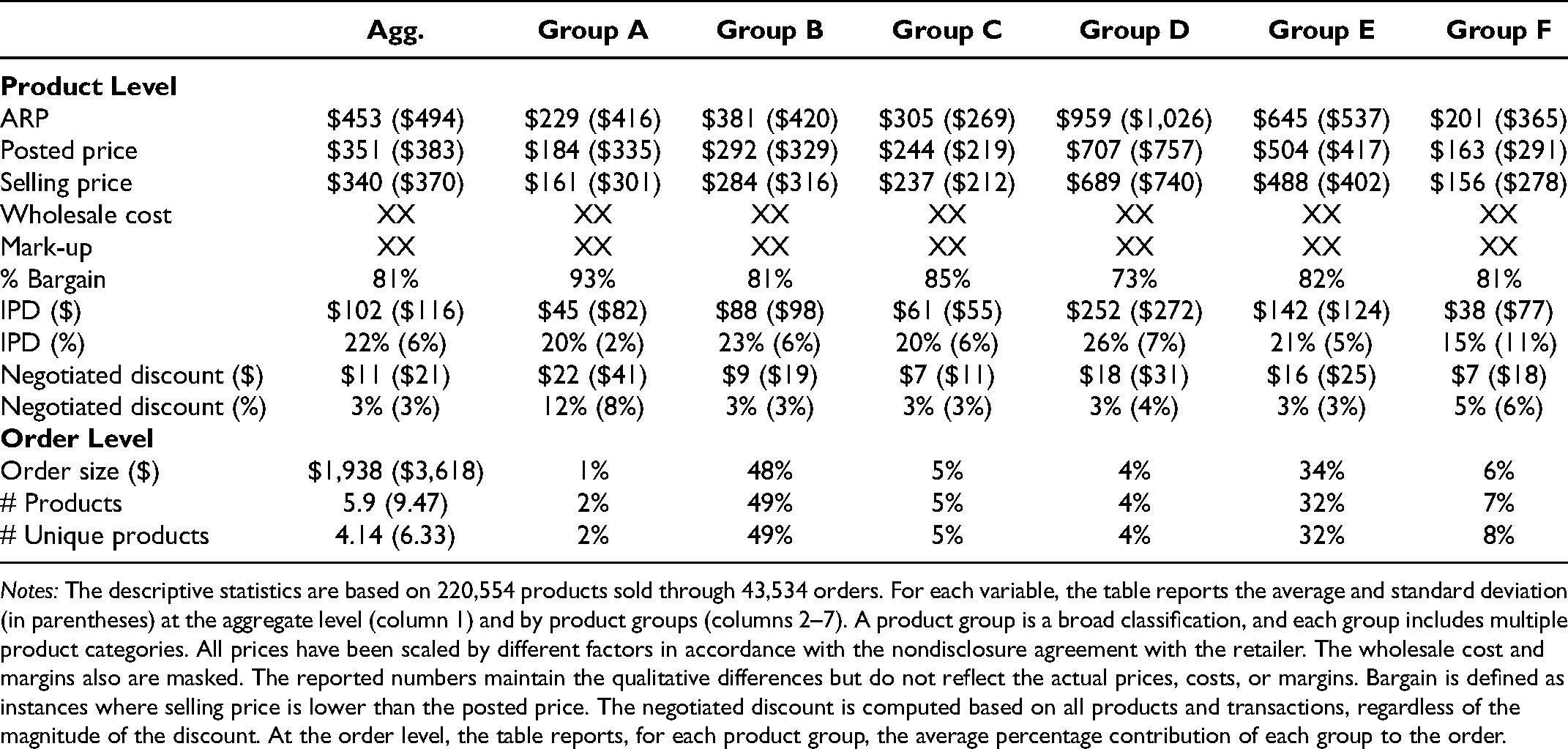
Notes: The descriptive statistics are based on 220,554 products sold through 43,534 orders. For each variable, the table reports the average and standard deviation (in parentheses) at the aggregate level (column 1) and by product groups (columns 2–7). A product group is a broad classification, and each group includes multiple product categories. All prices have been scaled by different factors in accordance with the nondisclosure agreement with the retailer. The wholesale cost and margins also are masked. The reported numbers maintain the qualitative differences but do not reflect the actual prices, costs, or margins. Bargain is defined as instances where selling price is lower than the posted price. The negotiated discount is computed based on all products and transactions, regardless of the magnitude of the discount. At the order level, the table reports, for each product group, the average percentage contribution of each group to the order.
In the data, 54% of the variation in IPD stems from differences in products belonging to different brands and product categories (brand-category), 43% from differences in products within the same brand-category, and the remaining 3% from temporal variation within a product. Consider Panel A of Figure 2, which indicates temporal variation in IPD for a frequently purchased product. Such within-product variation in IPD results from relative changes in the ARP and posted price, both of which are monotonic functions of the wholesale or anticipated costs, depending on their relative magnitudes. The parameters of these functions also vary over time, resulting in within-product variation in IPD that is independent of the wholesale or anticipated costs. 9 Figure 2, Panel B, also reveals, for the same product, temporal variation in the IPD in percentage terms. 10 This observed variation in perceived discount, measured in percentage terms, is not driven by the magnitude of wholesale or anticipated costs; it depends only on the parameters of the functions used to compute the ARP and the posted price. The sudden change in the perceived discount in the middle of the data period comes from an exogenous change in how the ARP and posted price were calculated for all products (i.e., a change in the function itself, rather than its parameters) and was done for the retailer's accounting needs.

Product-level variation in initial perceived discount.
Because each product is sold only 2.24 times on average (median and modal purchases are both 1), I cannot rely solely on within-product variation in IPD and instead rely on brand-category variation. 11 Across products within a brand-category, variation in IPD comes from two sources: (1) across-product variation in the wholesale and anticipated costs and (2) practical constraints. That is, the retailer carries more than 70,000 SKUs and thus cannot change the price tags of all products at the same time, which creates an exogenous variation in IPD for otherwise similar products in the same category. Figure 3, Panel A, shows the variation in perceived discount (percentage terms) for products in one of the most frequently purchased brand-category combinations; Panel B shows, for the same products, variation in the negotiated discount (y-axis) as the perceived discount (x-axis) changes.

Variation in initial perceived discount and negotiated discount at brand-category level.
Model Specification and Main Results
To understand how the IPD determines the negotiated discount, I run a model in which the discount that consumer 
Table 2 contains the results from various specifications, with the negotiated discount as the dependent variable. Before controlling for order-level and brand-category–level differences, I estimate a negative, significant coefficient of −.061 and a positive, significant coefficient of .001 for the linear and quadratic terms of IPD, respectively (Column 1, Table 2). When I include fixed effects at the brand-category level, I account for differences in quality across brands and categories, which could affect both the IPD and the negotiated discount. At the order level, the fixed effects address the consumer's average propensity to negotiate; temporal demand shocks; and time-varying factors specific to the consumer or salesperson, such as bargaining costs, outside options, total order size, purchase of a service contract, salesperson's distance to quota, and the end-of-month effect, which might influence the negotiated discount (Jindal and Newberry 2021).
Initial Perceived Discount and Negotiated Discount (Transactions Data).

*p < .10.
**p < .05.
Notes: FE = fixed effects. The table reports results from the main regression models of the impact of IPD on the realized (negotiated) discount. Different columns vary in the number of control variables, model specification, and whether the standard errors are clustered. The dependent variable is the negotiated discount. Standard errors are in parentheses. “Cons-SP” indicates that standard errors are clustered by consumers and salespeople (i.e., two-way clustering).
In these data, 50% of the variation in IPD comes from differences in products across orders. Within each order, products offered by different brands in various categories explain an additional 37% variation in the IPD. Of all the multiple-product orders, 80% contain at least two distinct products belonging to the same brand-category. Thus, within-brand-category differences across distinct products in an order explain the remaining 13% variation in IPD. Using this 13% within-order and within-brand-category variation, I estimate the effect of IPD on the negotiated discount. Then, I cluster the standard errors by consumers and salespeople (two-way clustering) to allow for correlations in the error terms across products purchased by the same consumer or sold by the same salesperson. I again find a negative, significant effect (−.054) of the linear term of IPD (Column 2, Table 2). The coefficient on the quadratic term, though positive, is insignificant after I control for brand-category and order-level differences. A Tobit model, which establishes that the negotiated discount is nonnegative, produces coefficients that enable me to estimate, using the average value of IPD in the data, that a $1 increase in IPD is associated with a 4.4-cent reduction in the negotiated discount.
Any correlation in unobserved demand shocks and temporal variation in the IPD and posted price could bias the IPD estimate toward 0, such that the true impact of IPD would be more negative than predicted. Therefore, I run a two-stage regression to instrument for IPD and posted price. For IPD, I exploit the variation created by the retailer's inability to change all the price tags at the same time. Specifically, for the linear IPD term, I use the average IPD of all other products within the brand-category that have different parameters to compute ARP and posted prices. 12 These instruments are motivated by the observation that the IPD of all other products sold in the same brand-category should correlate with the IPD of the focal product, because they are set by the same manufacturer (brand), but they are unlikely to correlate with the demand shocks of the focal product. Following Wooldridge (2010), I use the square of the predicted value of IPD from the first-stage regression as an instrument for the squared term of IPD. For posted price, I use the retailer's anticipated cost, which does not exhibit the same degree of variation as wholesale cost and is unlikely to correlate with unobserved demand shocks. 13 The partial F-statistic for IPD and posted price from the first-stage regressions are 47.47 and 65.64, respectively, which alleviates concerns about weak instruments. After instrumenting for the endogenous variables, I again identify a negative, significant (positive, insignificant) coefficient of −.068 (.001) for linear (quadratic) terms of IPD (Column 4, Table 2). Thus, I estimate that a $1 increase in IPD is associated with a 6.6-cent reduction in the negotiated discount.
Among the other variables, I note a positive, significant coefficient of .933 for posted price and a negative, significant coefficient of −1.019 for wholesale cost. Therefore, if the posted price is held fixed, any increase in wholesale cost is almost entirely passed on to the consumer; if the wholesale cost is held fixed, increases in the posted price do not alter the transacted price. These findings make sense; a salesperson's compensation depends on the wholesale cost and the transacted price but is independent of the posted price. An increase in the salesperson's reservation price also lowers the negotiated discount. Both products sold from inventory and those for which salespeople have a higher incentive to reallocate prices tend to have lower discounts, all else equal. Finally, I do not find any significant effect of the manufacturer's stated minimum restricted price, beyond the effect of the retailer's reservation price.
Summary of Transactions Data
In summary, I estimate that an increase in IPD is associated with a reduction in the discount that a consumer negotiates. Web Appendix A presents robustness checks to account for alternate explanations based on proportional thinking, mental accounting, and unobserved product quality. I also check robustness of the results to functional form assumptions by including the natural logarithm of IPD and of ARP and find qualitatively similar estimates, as reported in Web Appendix A.
I acknowledge that the analysis suffers from potential selection issues. First, the negotiated discount is observed only for consumers who negotiate. Assuming that a consumer's decision to initiate a negotiation is based on the trade-off between the cost of negotiating and the expected benefit of negotiating, I do not observe the negotiated discount for consumers for whom the expected benefit is lower than the cost. The resulting sample selection issue is similar to the one discussed by Heckman (1979). I use the physical distance of the consumer, measured using the zip code of the consumer and the retailer, as an exclusion restriction that informs the consumer's decision to negotiate but not the negotiated discount conditional on negotiating. The validity of this exclusion restriction rests on the assumption that the distance of the consumer to the retailer affects the fixed cost of initiating a negotiation but is uncorrelated with the variable cost of negotiating, which determines the negotiated discount. The distance measure does not vary by products within an order. Thus, controlling for selection using distance is similar to including order-level fixed effects that capture the consumer's propensity to negotiate. This analysis acts as a robustness check on the main specification. I discuss the validity of the exclusion restriction and the results in Web Appendix A, but briefly, accounting for this selection issue does not exert a qualitative impact on the effect of IPD on the negotiated discount.
Second, consumer assignment to IPD is not random, because the consumer selects the products to purchase. The negotiated price of the chosen product thus could be driven by a propensity to negotiate or the marginal utility the consumer attains from the IPD. The analysis includes order fixed effects to account for order-specific average propensity to negotiate, but the decision to negotiate the price of a specific product could correlate with the marginal utility of the IPD for that particular product. In the absence of exogenous variation in IPD, repeated purchases for the same product, or information about the price the consumer would have negotiated for other nonpurchased products, I cannot identify the impact of IPD on the propensity to negotiate separately from its impact on the consumer's marginal utility and thus cannot establish how changes in IPD affect demand and profitability.
Third, the analysis is conditional on purchase. Not accounting for the discounts that nonpurchasers receive might bias the effect of IPD due to selection based on purchasers. This concern disappears if prices are fixed, because I could observe the prices that would have been charged to nonpurchasers and their choices are driven by their willingness to pay. But in a negotiated price setting, the choices of nonpurchasers depend on unobserved, negotiated prices, which involve both WTP and a propensity to negotiate. When two prices are posted, their choices also might reflect the marginal utility of the IPD. Correcting for this sample selection issue would require data on the number of nonpurchasers and the last price they negotiated or were offered before they refused, which is almost never observed.
To overcome these limitations and determine if the impact of IPD varies by pricing strategy, the lab experiment requires participants to make negotiation and purchase decisions in the presence of exogenous variation in IPD. Thus, I can observe their choices and the prices at which the transactions were consummated or resulted in an impasse, such that I can determine the impact of IPD on negotiated prices, demand, and revenue. By randomizing the pricing strategy within and across participants, the experimental design also enables us to contrast the impact of IPD and the retailer's incentives to set an exaggerated ARP across bargaining and fixed pricing contexts.
Experimental Design
In September 2020, 181 undergraduate students of a large public university participated in a lab experiment and made purchase decisions about eight university-branded products: mug, glass, wallet, foam football, lanyard, cap, key chain, and acrylic emblem. These products typically sell for $10–$16 and can be classified as collectibles or sports memorabilia, a category that often prompts negotiations on online platforms such as eBay. 14 The participants were told that each product was being sold by a different seller, which may or may not allow price negotiations. The order in which the products were presented was random, and for each participant, four randomly chosen products involved fixed pricing, and the other four products represented the bargaining condition. Web Appendix B includes the initial screenshots and instructions provided before the participants made any negotiation or purchase decisions, noting that a listed “regular price” refers to the nonsale price at which the product usually sells, which also can be interpreted as the price at which the product might be purchased from other sellers.
In the fixed pricing conditions, for each product, respondents saw this “regular price” (ARP) and “your price” (posted price), as in the top panel of Figure 4, then indicated if they would purchase at the posted price. Different presentations of ARP, whether as the seller's previous price or as other sellers’ prices, can increase consumers’ purchase intentions (Berkowitz and Walton 1980), and their relative benefit depends on the shopping context (Grewal, Roggeveen, and Lindsey-Mullikin 2014), the concreteness of the presentation format (Krishnan, Biswas, and Netemeyer 2006), and the discount size (Grewal, Marmorstein, and Sharma 1996; Krishnan, Biswas, and Netemeyer 2006; Lichtenstein, Burton, and Karson 1991). I therefore choose to operationalize ARP with the more commonly used “regular price” format, but I explicitly note that it might be a price previously offered by the same seller or the price demanded by other sellers.

Screenshots from the Experiment.
In some cases, retailers might include the IPD, along with the ARP and posted price, on the price tag, framed as a dollar or percent discount (e.g., DelVecchio, Krishnan, and Smith 2007; Suri, Monroe, and Koc 2013). According to Chen, Monroe, and Lou (1998), the effectiveness of the discount framing depends on the product price. The prices of products in the lab experiment differ greatly from those in the transaction data study, which might create a risk of confounded results. Therefore, consistent with the presentation available for the transaction data, I list only the ARP and posted price. I leave the question of how discount framing affects negotiated prices for further research.
Table 3 summarizes the posted price and the implied IPD corresponding to each ARP level in the experiment for each product. I held the posted prices fixed; only the ARP varied. Yet I also ensure substantial variation in the IPD. Across participants, I varied the level of ARP for each product; within participants, I varied the level of ARP across products. Furthermore, I confirmed that each participant was exposed to each ARP level at least once and at most twice.
Posted Price and Initial Perceived Discount Levels (Experiment Design).
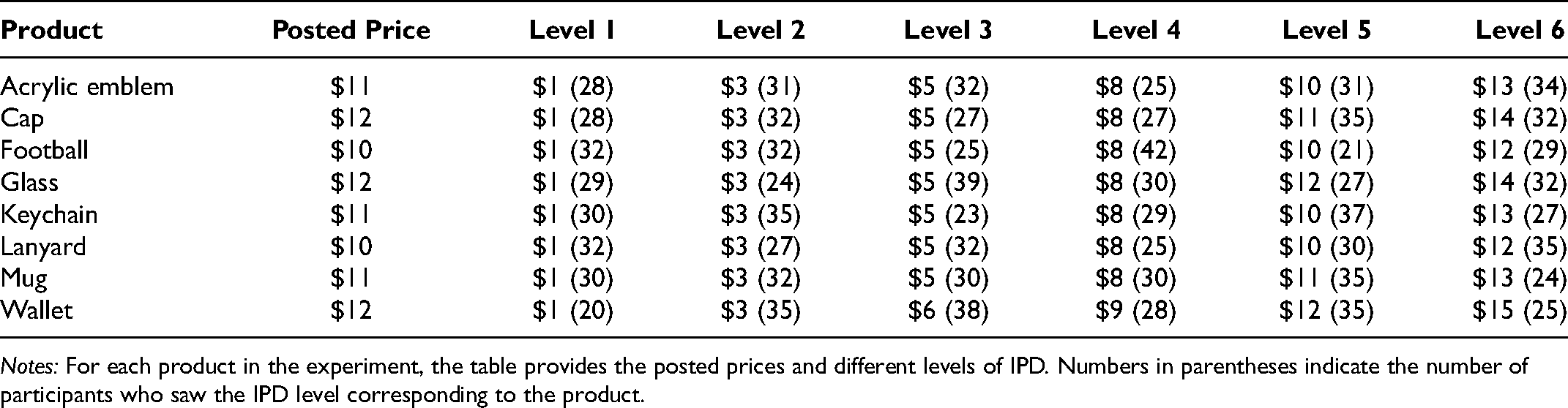
Notes: For each product in the experiment, the table provides the posted prices and different levels of IPD. Numbers in parentheses indicate the number of participants who saw the IPD level corresponding to the product.
In the bargaining conditions, participants saw the ARP and posted price (bottom-left panel, Figure 4) and could purchase the product at the posted price, not purchase the product and terminate the negotiation, or negotiate with the seller by making a counteroffer. The decision-making screen available during the negotiation indicates the payoff from each decision. If a participant chooses to make a counteroffer, the seller (computer) accepts the offer or makes a counteroffer, which might be the same as the offer in the previous round (posted price in first round) or lower by 25, 50, or 75 cents, with equal probability. In every round, participants can accept the offer, make a counteroffer, or terminate the negotiation. However, the participant's offer in any round could not be lower than the offer in the previous round. Both sides had 40 seconds to make a decision in each round. The seller was a computer, but it displayed its decision randomly at any time between 20 and 40 seconds. The negotiation continued until either the seller or the participant accepted the offer or terminated it. For each negotiation, I set a threshold (25-cent increments) between $7 and $8; any offer below this threshold would be rejected by the seller, and any offer of $10 or more would be accepted. In the range in between these values, the likelihood that the seller would accept the offer was ten times the participant's offer (e.g., an offer of $9 had a 90% chance of being accepted).
Before each negotiation, participants indicated their familiarity with and liking of the product (seven-point scales), as well as their predictions of its price at the university bookstore. At the end of the experiment, participants were asked for their attitudes toward negotiations and whether their negotiation and purchase decisions were influenced by the IPD. To align the incentives in the experiment, participants were informed that they had a 10% chance of being compensated according to their purchase decision for a product: If they had decided not to purchase the product, they received $15, but if they had decided to purchase, they received the product and $15 less the price, which was the posted price in the fixed pricing conditions or the negotiated price in the bargaining conditions.
Data Description
According to Table 3, on average, 30 participants were exposed to each IPD level for any given product. Of the 181 participants, 10 made the same purchase decision for all eight products and were excluded from the analysis. Table 4 provides key descriptive statistics, both at the aggregate level and separately for each product. Overall, 42% of fixed pricing and 54% of bargaining interactions resulted in a purchase. The higher purchase likelihood in the negotiation conditions applies to almost all products but is especially striking for keychains and lanyards. Participants initiated a negotiation in 44% and received discounts in 41% of all occasions in which the seller allowed negotiations, and they earned positive discounts in 92% of the cases in which they actually initiated a negotiation. The average negotiated discount was 55 cents, with higher discounts negotiated for wallets and glasses but lower discounts for footballs and lanyards. I also note substantial within-product variation, as indicated by the high standard deviations in Table 4.
Descriptive Statistics (Experiment Data).

Notes: AE = acrylic emblem. This table contains average values of different variables based on the experimental data at the aggregate level, and separately for each product. Standard deviations are in parentheses.
On average, the participants were familiar with and liked all the products, with some variation. I also find heterogeneity in the predicted prices across products and participants. The products are available in the university bookstore for $10–$16, and accordingly, the participants predicted the prices reasonably accurately. According to their responses to the attitudinal questions (five-point scales) at the end of the survey, they found it socially acceptable to negotiate prices for products such as home appliances and furniture (average rating of 3.12), their decision to negotiate depends on the initial discount offered (3.62), they feel they should negotiate more if the initial discount is smaller (3.64), and they are more likely to purchase if the sale price is much lower than the regular price (4.30). Each of these ratings is significantly different (at 99% confidence level) from the neutral value of 2.5 and provides preliminary evidence that the negotiated price depends on the IPD, as detailed in Figure 5, Panels A–C.

Initial perceived discount, negotiated prices, and negotiation and purchase decisions.
Consistent with the transaction data, I find that an increase in IPD lowers the negotiated discount at the aggregate level (solid black line) and separately for each product (red lines that correspond to individual products). The participants are less likely to initiate a negotiation as the IPD increases, consistent with the attitudinal ratings, which suggests the mechanism through which IPD affects the negotiated price. Figure 5 also indicates the impact of IPD on purchase likelihood (revenue) for fixed pricing (left column) and bargaining (right column). The increased purchase likelihood and revenue achieved with fixed pricing is consistent with extant findings; I offer the first evidence that they increase under bargaining too. Specifically, an increase in IPD increases the negotiated price (lowers the discount), along with the marginal utility a consumer obtains from the product. The net impact of IPD on purchase likelihood and revenue thus depends on its relative impact on the negotiated price (price effect) and the marginal utility it provides (demand effect). These data establish that the marginal utility of higher IPD outweighs the disutility due to higher price, which has pertinent implications for the optimal IPD (or ARP) a seller should set if it plans to allow bargaining.
Empirical Results
With a more formal analysis, I aim to quantify the magnitude of the effect of IPD on prices and demand for different pricing strategies, to establish implications for sellers. Specifically, I run regressions of the form
IPD, Negotiated Discount, and Decision to Bargain
I first focus on the negotiations data and how IPD affects the negotiated discount and decision to initiate a negotiation. In the absence of any controls (Column 1, Table 5), I estimate that a $1 increase in IPD lowers the negotiated discount by 5.8 cents. When I include a quadratic term of IPD and control for attitudes and participant and product fixed effects, I again find a negative effect of the linear term of IPD, but the coefficient on the quadratic term is not significant at the 95% confidence level. Two-way clustering of the standard errors by participants and products results in qualitatively similar results (Column 3, Table 5). Together with the negative coefficient for the linear term, these estimates imply that at the average IPD value of $7.13, a $1 increase lowers the negotiated discount by 5.7 cents. 17
Initial Perceived Discount and Negotiated Discount (Experiment Data).

*p < .10.
**p < .05.
Notes: Sub-prod = standard errors (in parentheses) are obtained from two-way clustering based on participants and products. Different model specifications, based on the lab experiment, include the negotiated discount or the decision to initiate a negotiation as the dependent variable. The first row reports the average and standard deviation (in parentheses) of the dependent variable. All specifications are run on 684 observations corresponding to the bargaining purchase occasions.
A priori, there is no reason to believe that the marginal effect of IPD on the negotiated discount should be the same in the experimental and transaction data, yet the similarity of their magnitude (6.6 cents vs. 5.7 cents) suggests the generalizability of the finding. The seller in the negotiation was a computer, directed by deterministic rules that did not depend on IPD, so the estimated effect of IPD on the negotiated discount can only be attributed to participants. I also check for any evidence of learning through repeated exposure to negotiation tasks and find that the marginal effect of IPD on the negotiated discount does not vary with the number of completed tasks. Web Appendix D discusses these results in greater detail. In testing for influences of ethnicity, gender, or nationality, I determine that the effect of IPD is less pronounced for White men, directionally consistent with previous research (see, e.g., Ayres and Siegelman 1995), yet the effects are not significantly different from 0. 18
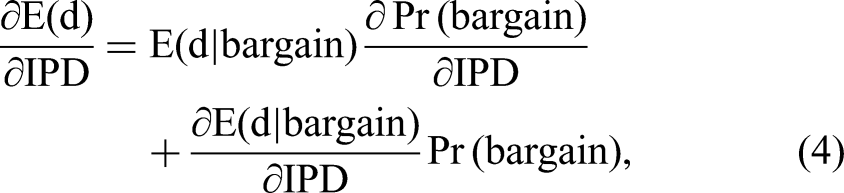
The decrease in the negotiated discount might be because participants negotiate a lower discount as the IPD increases; alternatively, however, the negotiated discount may be independent of IPD, and participants instead might be less likely to initiate a negotiation as IPD increases. In a linear regression with the participant's decision to initiate a negotiation as the dependent variable, I estimate a negative effect of the linear term of IPD (Column 4, Table 5) and, additionally, a positive effect of quadratic term of IPD (Column 5, Table 5). Together, these coefficients imply that a $1 increase in IPD lowers the likelihood of initiating a negotiation by 2.53%. To assess how much of the variation in the negotiated discount is driven by the decision to initiate a negotiation, the expected discount, 
The impact of IPD on the decision to initiate a negotiation is important from academic and managerial perspectives. Research on anchoring in price negotiations (e.g., Kristensen and Gärling 2000; White et al. 1994) takes place in settings where consumers always negotiate, but I show that to understand the true impact of anchoring and reference prices, one must allow for the possibility that participants actively choose not to initiate a negotiation in the presence of reference prices. Furthermore, this study indicates that higher IPD has an impact similar to that of increasing the fixed costs of initiating a negotiation for consumers, which has implications for retailers’ optimal pricing strategies and profitability (Jindal and Newberry 2018).
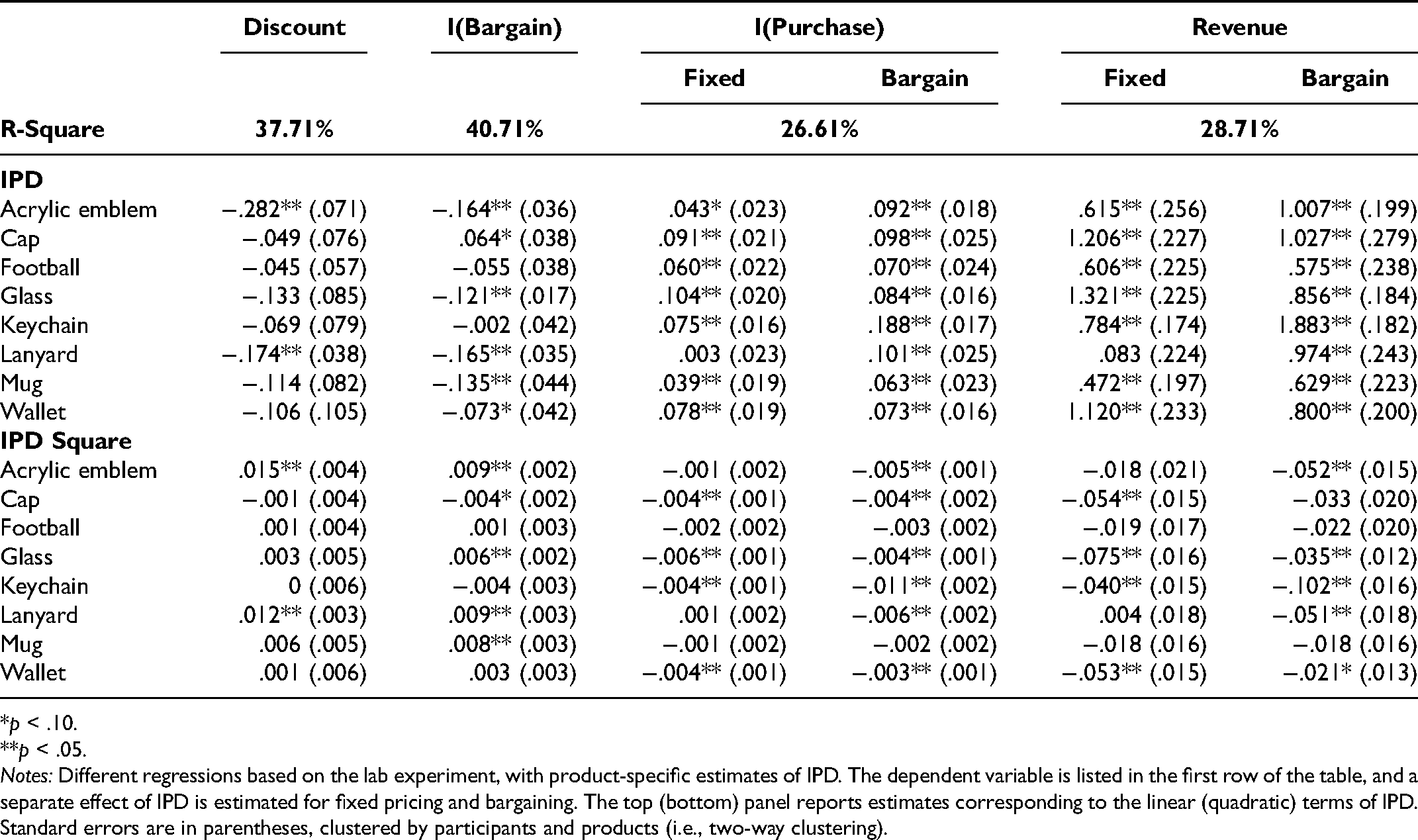
To ensure that the results reflect within-product variation in IPD, I also estimate product-specific effects on the negotiated discount and negotiation likelihood, as detailed in Table 6. The impact of IPD on negotiated discounts and purchase likelihood is not significant for all products, but the coefficients are all directionally consistent with the aggregate-level data. Furthermore, I find substantial heterogeneity in the magnitude of effects across products, as also evident in Panel A of Figure 5.
Product-Specific Impact of Initial Perceived Discount (Experiment Data).
*p < .10.
**p < .05.
Notes: Different regressions based on the lab experiment, with product-specific estimates of IPD. The dependent variable is listed in the first row of the table, and a separate effect of IPD is estimated for fixed pricing and bargaining. The top (bottom) panel reports estimates corresponding to the linear (quadratic) terms of IPD. Standard errors are in parentheses, clustered by participants and products (i.e., two-way clustering).
Negotiated Discount Versus Purchase Likelihood
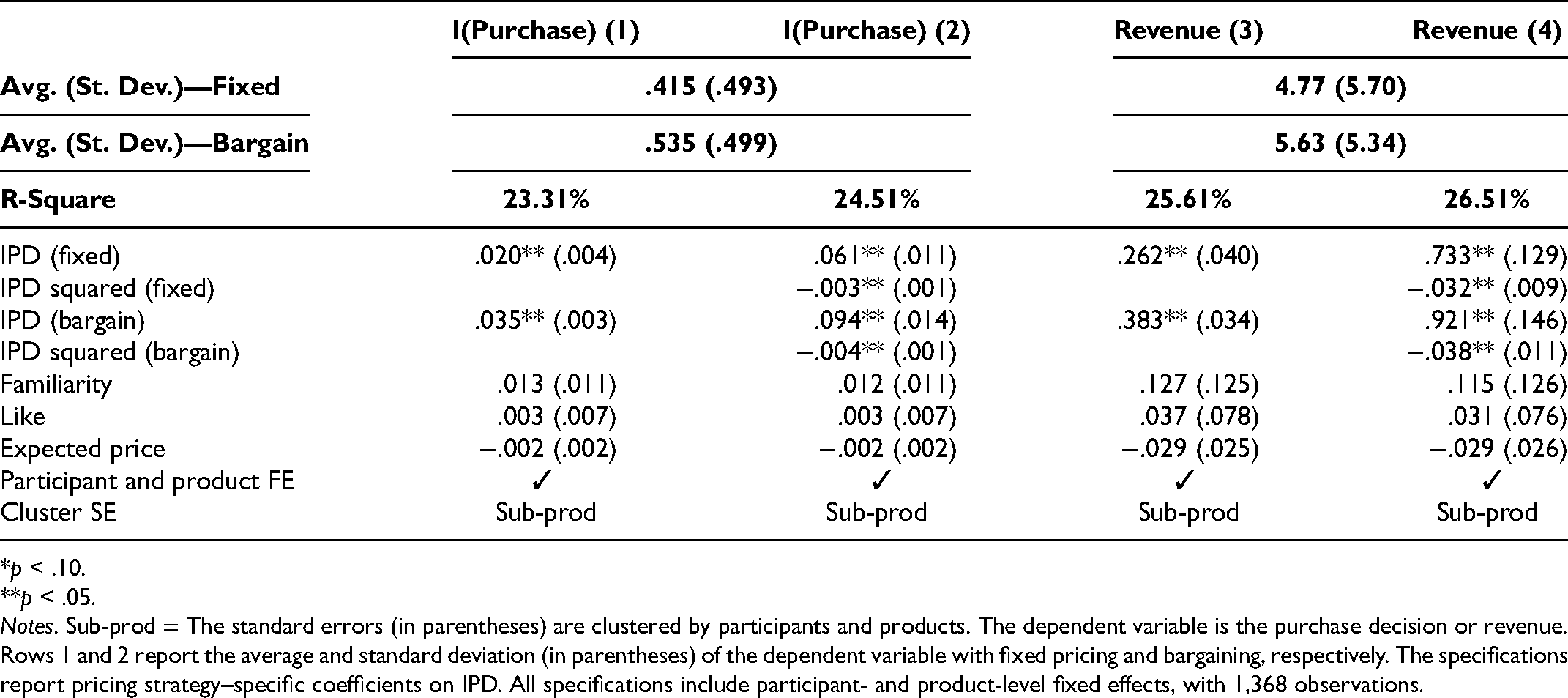
As noted previously, the net impact of IPD on purchase likelihood depends on the relative magnitudes of its impact on transaction utility (demand effect) versus the negotiated price (price effect). If the disutility from the increase in the negotiated price offsets the increase in transaction utility, an increase in IPD could lower the purchase likelihood in bargaining scenarios. 19 According to the results in Table 7, for fixed pricing first, the positive (negative) coefficient corresponding to the linear (quadratic) term of IPD in Columns 1 and 2 implies that an increase in IPD increases purchase likelihood, but the marginal effect of IPD decreases in the value of the IPD. These findings are consistent with evidence that higher ARPs increase purchase likelihood (Compeau and Grewal 1998; Krishnan, Dutta, and Jha 2013) but also are more likely to be discounted by consumers (Gupta and Cooper 1992). At the average IPD value of $7.13, a $1 increase in IPD increases the purchase likelihood by 2.02% when prices are fixed. Web Appendix D reports that under fixed pricing, the effect of IPD on purchase likelihood decreases with experience or the number of purchase tasks completed.
Initial Perceived Discount, Demand, and Revenue (Experiment Data).
*p < .10.
**p < .05.
Notes. Sub-prod = The standard errors (in parentheses) are clustered by participants and products. The dependent variable is the purchase decision or revenue. Rows 1 and 2 report the average and standard deviation (in parentheses) of the dependent variable with fixed pricing and bargaining, respectively. The specifications report pricing strategy–specific coefficients on IPD. All specifications include participant- and product-level fixed effects, with 1,368 observations.
Turning to bargaining, I again find a positive and significant effect of IPD on purchase likelihood, and the marginal effect of IPD is greater for this scenario than for fixed pricing. The coefficients in Table 7 imply that a $1 increase in IPD increases the purchase likelihood by 2.78%. Furthermore, the difference of the linear coefficients corresponding to bargaining and fixed pricing is statistically significant (p = .0018 for Column 1, p = .058 for Column 2). Therefore, the increase in transaction utility due to an increase in IPD outweighs the disutility of the increase in the negotiated price. Again noting Jindal and Newberry’s (2018) finding that an increase in fixed costs lowers the likelihood of initiating a negotiation and, thus, the retailer's profit, I clarify that an increase in IPD similarly lowers the likelihood of initiating a negotiation, yet it can increase the retailer's profit through its impact on demand. The marginal effect of IPD on purchase likelihood is significantly higher for bargaining than fixed pricing, which points to a higher marginal effect of IPD on transaction utility in the former case (marginally significant at 95% confidence level, p = .061).
To quantify the relative importance of the effect of IPD on negotiated price and purchase likelihood, which together determine total revenue, I leverage Equation 2 and regress revenue on IPD to quantify its marginal effect. 20 In Table 7 (Column 3), an increase in IPD increases the retailer's revenue for both fixed pricing and bargaining, but the marginal effect of IPD on revenue is significantly greater for bargaining (p = .001). For both fixed pricing and bargaining, the marginal effect of IPD on revenue diminishes as IPD increases, but the difference between the coefficients corresponding to the IPD terms is statistically insignificant. At the average value of IPD, the estimated coefficients imply that a $1 increase in IPD increases revenues by 24.17 cents under fixed pricing and 33.85 cents under bargaining; this difference is statistically significant at the 95% confidence level (p = .035). 21
Revenue is the product of quantity (purchase likelihood) and transacted price. When I take its derivative with respect to IPD, I get
IPD and Pricing Strategy
Finally, I explore whether the optimal ARP (and IPD), and the seller’s incentives to post these ARPs vary by pricing policy. If the seller is assumed to set IPD to maximize revenue for either pricing strategy, and using the regression with revenue as the dependent variable, the optimal IPD for strategy
Ideally, the investigation of whether a seller's incentive to post an exaggerated ARP (and IPD) varies by pricing strategy would involve setting optimal posted prices and ARPs for bargaining and fixed pricing, then quantifying and comparing the effect of ARP on revenues across the pricing strategies. In these data though, the posted price remains constant, so there is no within-product variation in the posted price. Accordingly, I compute and compare changes in revenue due to an optimal IPD across pricing strategies. For each pricing strategy, I compute the increase in revenue when shifting from a null IPD discount to an optimal IPD value. Mathematically, for pricing strategy
Various retailers have faced lawsuits alleging deceptive practices in fixed price contexts (Popken 2016). Our findings show that the optimal ARP a seller would set under bargaining is similar to that under fixed pricing (i.e., concerns pertaining to deceptive pricing persist under bargaining). Crucially, however, the higher revenue from posting this ARP under bargaining implies that the seller is more likely to post it when prices can be negotiated upon. Put differently, although we may not see more exaggerated ARPs, we are more likely to see ARPs being posted under bargaining than under fixed pricing.
Discussion and Conclusion
This research explores how changes in the IPD, as implied by an ARP, influence the negotiated price, demand, and revenues in settings where consumers can negotiate prices. With expansive retail transaction data, I establish that a $1 increase in IPD is associated with a statistically significant reduction of 6.6 cents in the negotiated discount. Thus, I build on extant studies of ARPs and document how changes in the ARP (IPD) affect actual consumer behavior. This analysis exploits variation in IPD at very finely defined brand-category level and accounts for possible endogeneity of the IPD and posted prices, but it suffers from possible selection bias due to the lack of data from nonpurchasers and selective matching of consumers to products with different IPD levels. Thus, I cannot explore the impact of IPD on demand and profits.
In response, I undertake a lab experiment in which participants make purchase decisions for products, in both negotiation and fixed pricing settings. The exogenous variation in IPD, combined with the ability to observe all negotiated prices, allows me to assess the impact of changes in IPD on demand and profitability. Consistent with the transaction data, I find that a $1 increase in IPD lowers the negotiated discount by 5.7 cents. Furthermore, 55% of this reduction stems from the participants’ lower likelihood to initiate a negotiation. Despite the increase in negotiated price, an increase in IPD increases purchase likelihood in bargaining scenarios. The result is a positive, significant effect of IPD on the seller's revenue. Compared with fixed pricing, 71% of the increase in revenue from an increase in IPD in bargaining can be attributed to the demand effect; the remaining almost one-third stems from an increase in the negotiated price. Finally, the optimal IPD (ARP) a seller sets under bargaining is similar to that under fixed pricing, but the benefit from posting this IPD is significantly higher under bargaining.
To the best of my knowledge, this is the first study to offer insights into the anchoring effect of ARP, and the implied IPD, in situations in which consumers negotiate prices. With the diverse data, I can demonstrate an effect of IPD in the real world, then address the underlying mechanism and relative importance of the effect of IPD on the negotiated discounts (cf. purchase likelihood). In showing that higher IPD lowers the negotiation likelihood, I also establish the need for further research into anchoring effects in negotiations. The finding that the benefit from posting ARPs is higher when consumers negotiate prices is also important for policy makers, because deceptive pricing that relies on an unfair comparison of selling price with ARP is more likely a concern. Finally, whereas we do not find evidence that exposure to purchase tasks influences the marginal effect of IPD under bargaining, understanding how repeated exposures to ARP might differentially affect behavior in fixed pricing and bargaining settings is an interesting topic for continued research.
Several limitations of this study suggest additional directions for research. First, in all the analyses, the seller posts an ARP, but when price negotiations are allowed, sellers might prefer to avoid an IPD (ARP). According to Huang (2018), demand in the absence of ARP is the same as that when ARP equals the sale price, or IPD is null. In the current context, purchase likelihood and revenue then might be lower in the absence of ARP (IPD). I explicitly explore if the absence of IPD can increase purchase likelihood and revenue in a follow-up study (see the Appendix). With a simple 2 × 2 between-subjects design, I find that the absence of IPD increases the negotiated discount and negotiation likelihood but lowers purchase likelihood and revenue. Thus, the absence of IPD might lead to lower revenue, but a more thorough investigation of this effect clearly is warranted and should include negotiated prices and demand too. 23
Second, my exploration of a seller's incentive to post an exaggerated ARP does not account for the optimal posted price the seller would set. Thus, I cannot compare the benefit of posting a higher ARP with that of posting an optimal posted price in bargaining settings. Relatedly, the analysis does not include competitive responses to a higher ARP, the credibility of a higher (exaggerated) ARP as a signal of discount, or the impact of a higher ARP on consumer surplus. Exploring these issues could further understanding of the seller's incentives to post exaggerated ARPs, as well as shed more light on consumer welfare implications. Third, I do not find significant effects of ethnicity or gender, which could reflect the relatively homogeneous sample. But establishing whether the effect of IPD varies by consumer demographics, or else by product characteristics and purchase channels, could help sellers target consumers more effectively with price discrimination based on product and channel characteristics.
Fourth, in both the transaction and experimental data, I provide only the ARP and posted price, without framing the discount in percentage or dollar terms. Tests of how discount framing affects the negotiated discount would shed light on the impact of IPD on negotiated prices, which may be especially relevant in markets in which retailers sell expensive products that include less expensive add-on contracts or options. Finally, studying how much of the change in the negotiated price stems from changes in product valuation (through transaction utility) versus changes in beliefs about sellers' likelihood to negotiate might clarify the role of IPD when prices are negotiated. I believe these considerations provide some compelling opportunities for more research in this area.
Supplemental Material
sj-pdf-1-mrj-10.1177_00222437211034443 - Supplemental material for Perceived Versus Negotiated Discounts: The Role of Advertised Reference Prices in Price Negotiations
Supplemental material, sj-pdf-1-mrj-10.1177_00222437211034443 for Perceived Versus Negotiated Discounts: The Role of Advertised Reference Prices in Price Negotiations by Pranav Jindal in Journal of Marketing Research
Footnotes
Appendix: Effects of the Absence of IPD
The experimental design for the main study does not explicitly test conditions without IPD. When prices are fixed, demand in the absence of IPD (ARP) is the same as that when ARP equals the sale price, such that IPD equals 0 (Huang 2018). Yet the analysis does not explicitly rule out the possibility that for bargaining, revenue could be higher in the absence of IPD. I exclude the condition with no IPD from the main experiment because within-participant variation in the presence versus absence of IPD could bias responses, especially in tasks without IPD (Blair and Landon 1981). Thus, I conduct a follow-up study to test whether the absence of IPD increases purchase likelihood and revenue with bargaining, though I also account for fixed pricing to test whether the effect varies by pricing strategy. In a simple 2 × 2 between-subjects design, I manipulate the pricing condition (fixed pricing vs. bargaining) and presence of IPD (present vs. absent). In the absence of IPD, participants see the selling price; in its presence, they see both the ARP and the selling price, fixed at $16 and $11. The participants negotiate (if applicable) and make purchase decisions for only one product (mug).
The 502 participants, recruited from Amazon Mechanical Turk, took no more than six minutes to complete the study and received $.75 for their participation. Each participant was equally likely to be assigned to each pricing and IPD condition, such that 125 (127) participants made purchase decisions with bargaining in the absence (presence) of IPD, and 116 (134) made purchase decisions with fixed pricing in the absence (presence) of IPD. When negotiation was allowed, 61% of occasions resulted in a purchase; 58% of fixed pricing occasions prompted a purchase. On average, participants negotiated a discount of $.35, and they initiated negotiations in 34% of occasions in which it was allowed. The presence of IPD increases the purchase likelihood from 55% to 64%, consistent with previous research on ARPs.
Table 8 reports the results from the regressions with different dependent variables. The presence of IPD lowers the negotiated discount by $.10 (Column 1) and the likelihood to negotiate by 12% (Column 2). Over pricing conditions, it has a positive and significant effect on both purchase likelihood (Column 3) and revenue (Column 4). When the findings are separated by pricing condition, I estimate that for bargaining, the presence of IPD increases purchase likelihood by 13% and revenue by $1.42, and the marginal effects are greater than those for fixed pricing. The difference in the marginal effect of IPD across pricing strategies is not statistically significant for the tested value of IPD ($5), but the results are qualitatively similar to those in the main experiment, for which the marginal effect of an increase in IPD on purchase likelihood and revenue is greater with bargaining.
The presence of IPD has a positive, statistically insignificant effect on purchase likelihood and revenue with fixed pricing; the lack of statistical significance is seemingly at odds with extant literature. Closer inspection reveals though that this lack of significance is driven by participants who complete the task very quickly or take substantially longer. Eliminating participants whose response times rank in either the bottom or top 5% of the response time distribution produces a positive, statistically significant effect of IPD on purchase likelihood and revenue. In summary, the effect of the presence of IPD is qualitatively similar to the marginal effect of increasing IPD in the main experiment, and the absence of IPD lowers a seller's revenue when prices are negotiated. This experiment substantiates the main findings and shows that a seller cannot benefit from not posting an ARP.
Acknowledgments
The author thanks Eric Anderson, Anocha Aribarg, Sridhar Balasubramanian, Bryan Bollinger, Preyas Desai, Rajdeep Grewal, Kristopher Keller, Minkyung Kim, Carl Mela, Peter Newberry, Jan-Benedict Steenkamp, and Sriraman Venkataraman for helpful comments and suggestions. This research also benefited from the comments of seminar participants at the 2018 Marketing Science Conference at Temple University, UNC Marketing Brownbag, and 2020 Virtual Quant Marketing Seminar, as well as discussions with Isaac Dinner and Daniel Ringel. The author acknowledges the anonymous retailer partner that provided the data. The author is grateful to Claudia Kubowicz Malhotra for making the experiment a possibility. Prior versions of this article were circulated under the titles “Reference Dependence and Price Negotiations—The Role of Advertised Reference Prices” and “Anchoring in Price Negotiations—The Role of Advertised Reference Prices.”
Associate Editor
Yesim Orhun
Declaration of Conflicting Interests
The author(s) declared no potential conflicts of interest with respect to the research, authorship, and/or publication of this article.
Funding
The author(s) received the following financial support for the research, authorship and/or publication of this article: The author acknowledges support from the M.W. “Dyke” Peebles, Jr. Faculty Development Fund.

Notes
References
Supplementary Material
Please find the following supplemental material available below.
For Open Access articles published under a Creative Commons License, all supplemental material carries the same license as the article it is associated with.
For non-Open Access articles published, all supplemental material carries a non-exclusive license, and permission requests for re-use of supplemental material or any part of supplemental material shall be sent directly to the copyright owner as specified in the copyright notice associated with the article.
