




Abstract
The authors examine how gender identity and local–global identity—two important consumer identities and segmentation bases—affect consumer price sensitivity. These identities may be associated with similar behavioral norms such that a female identity and a local identity are associated with the norms of small groups and intimate relationships, whereas a male identity and a global identity are associated with the norms of large groups and broad relationships. Thus, a female identity and a global (vs. local) identity, as is the case with a male identity and a local (vs. global) identity, results in identity incongruence (vs. congruence). The authors argue that identity incongruence depletes cognitive resources and induces affective processing, which in turn activates a sacrifice mindset and results in lower price sensitivity. Five studies with different research designs, divergent measures of key constructs, and diverse samples support the theories and identify boundary conditions of the focal relationship. The findings expand the literature on multiple consumer identities and price sensitivity and provide useful guidelines for global companies’ pricing strategies.
Companies frequently face the prospect of having to increase prices. Recently, Pfizer’s proposed price increase for more than 40 different drugs resulted in consumer backlash and triggered presidential and congressional action, forcing the firm to postpone the price increase (Pear 2018). As Mittal (2016) states, Price increases, done incorrectly, often result in customer dissatisfaction and brand switching. It’s no wonder raising prices is a stressful, contentious, and unpleasant process. When harried, some firms avoid raising prices by taking “self-harming” measures, such as reducing head count, lowering product quality, and reducing services.
Gao, Zhang, and Mittal (2017) demonstrate that consumers with a local identity are less price sensitive than those with a global identity. Building on their research, we examine how multiple identities jointly shape consumers’ price sensitivity. It is common for consumers to have multiple identities (e.g., parent, female, athlete) that can be simultaneously salient (e.g., parent and female vs. female and athlete) and jointly shape consumer responses (Benet-Martínez et al. 2002; Reed et al. 2012; Saint Clair and Forehand 2012). Specifically, we examine the joint effect of gender identity and local–global identity on price sensitivity. Gender identity is a consequential identity for many customers (Meyers-Levy and Loken 2015) and has been identified as an important antecedent of price sensitivity (Puccinelli, Chandrashekaran, and Grewal 2013). We build on gender identity research (Melnyk, Van Osselaer, and Bijmolt 2009) and local–global identity research (Arnett 2002; Tu, Khare, and Zhang 2012; Yang et al. 2019; Zhang and Khare 2009) to postulate that both female identity and local identity are associated with norms of identification with smaller groups and intimate personal connections, causing consumers to experience greater congruence (vs. incongruence) when their female and local (vs. global) identities are accessible (i.e., when the corresponding identity or identities are salient in consumers’ minds). In contrast, both male identity and global identity are associated with norms of identification with larger social groups of impersonal connections; thus, consumers with a male identity should experience greater congruence (vs. incongruence) when their global (vs. local) identity is accessible. We predict an interactive effect of gender identity and local–global identity on price sensitivity such that identity incongruence should lead to depleted cognitive resources, which in turn triggers affective processing and facilitates a sacrifice mindset, making consumers less price sensitive. We identify a theoretically driven process and boundary conditions, including cognitive resource depletion, processing mode, self-focus, and social class (see Web Appendices P and Q), which can enhance or suppress the activation of a sacrifice mindset and the resulting price sensitivity. Figure 1 shows our conceptual framework.

The overall theoretical framework.
We present five studies to test our theories. Study 1 is a single-paper meta-analysis of Gao, Zhang, and Mittal (2017), which shows that consumers who experience identity incongruence (female identity and global identity; male identity and local identity) are less price sensitive than consumers who experience identity congruence (female identity and local identity; male identity and global identity). Study 2 replicates the effect with high external validity in a field setting. Study 3 establishes the causal effect of identity (in)congruence on price sensitivity and tests the underlying mechanism of a sacrifice mindset. We identify theoretically relevant boundary conditions of this effect in Study 4 (cognitive resource depletion) and Study 5 (cognitive vs. affective processing mode). We operationalize gender identity in three different ways to establish generalizability: we measure biological sex (Studies 1, 2, and 4), manipulate gender identity through priming (Study 3), and measure gender identity using a multi-item scale (Study 5). Consistent results from the three operationalizations of gender identity support prior research showing that biological sex is an effective indicator of gender identity 1 (Winterich, Mittal, and Ross 2009; Zhang, Feick, and Mittal 2014).
Theoretically, we extend Gao, Zhang, and Mittal (2017), which only shows a main effect of local–global identity on price sensitivity. We identify gender identity as an important moderator, showing that identity incongruence decreases price sensitivity. Importantly, our findings suggest that firms can trigger a sacrifice mindset in consumers with global identity when their female identity becomes chronically accessible (biological sex or measured gender identity) or temporarily activated (manipulated gender identity). Thus, the current research provides a nuanced view of when a sacrifice mindset mediates the effect of local–global identity on price sensitivity.
Executives can use these findings to mitigate consumers’ price sensitivity by strategically increasing or decreasing the salience of key consumer identities. For instance, many companies, such as Talbots (which primarily targets females) and Brooks Brothers (which primarily targets males) may benefit from activating a global or a local identity to mitigate consumers’ potential negative responses to price increases. Our field study shows that managers can effectively use local–global advertising or brand positioning to influence consumers’ price sensitivity.
Price Sensitivity
Price sensitivity, or consumers’ reactions to price increases and/or decreases (Monroe 1973), has been widely studied in marketing (Bijmolt, Van Heerde, and Pieters 2005; Web Appendix A summarizes pertinent studies). We examine price sensitivity by focusing on consumers’ purchase propensities or purchase intentions following a price increase (Bolton, Warlop, and Alba 2003; Gao, Zhang, and Mittal 2017).
Research on price sensitivity has found that an increase in consumers’ reference price by means of advertising may reduce price sensitivity by increasing perceived transaction value (Grewal, Monroe, and Krishnan 1998). Campbell (2007) and Bolton, Warlop, and Alba (2003) find that a price increase framed as being fair decreases consumers’ price sensitivity. Price sensitivity is also influenced by perceived quality (Rao and Monroe 1989), price versus quantity changes (Chen et al. 2012), brand positioning (Huber, Holbrook, and Kahn 1986) and the addition of product and service features that increase perceived value (Grewal, Monroe, and Krishnan 1998).
Adding to these perspectives, research has shown that consumers may associate a price increase with a sacrifice—giving up their limited monetary resources—which can decrease their subsequent purchase likelihood (Chen et al. 2012; Dodds, Monroe, and Grewal 1991; Monroe 1973). Specifically, consumers perceive a price increase that is not explicitly associated with quality enhancements as a sacrifice; consequently, consumers who are more willing to make sacrifices are more likely to accept the price increase and exhibit lower price sensitivity. Gao, Zhang, and Mittal (2017, p. 71) posit this concept as a sacrifice mindset, which they define as “consumers’ readiness and willingness to give up valuable resources for something important and worthy.” They base their argument on behavioral mindset theory (Xu and Wyer 2007), which argues that an activated mindset influences consumer tendencies that are directly and indirectly related to the mindset. As an example, a choice mindset activated by an election can influence tendencies that are both directly related (e.g., which candidate to choose) and indirectly related (e.g., which product to choose) to the mindset. In our case, the activated sacrifice mindset is posited to influence price sensitivity, a behavior that is indirectly related to sacrifice. Accordingly, we propose identity incongruence between gender identity and local–global identity is likely to decrease consumers’ price sensitivity through an activated sacrifice mindset.
Gender Identity and Local–Global Identity
Marketing scholars have examined gender identity for its theoretical relevance as well as its managerial importance as a basis of customer segmentation (Argo and Dahl 2017; Busse, Israeli, and Zettelmeyer 2017; Meyners et al. 2017; Otterbring et al. 2018; Puccinelli, Chandrashekaran, and Grewal 2013). Although early research examined the communal-agentic dimension of gender identity (Bakan 1966; Winterich, Mittal, and Ross 2009), recent research has focused on the relational interdependence versus collective interdependence aspects of gender identity (Meyers-Levy and Loken 2015). Although females and males are likely to have an equally strong desire to belong to social groups and connect with others, they differ in terms of the nature of groups and the types of relationships they prefer. Specifically, females exhibit relational interdependence, which entails a preference for smaller entities and close-knit, dyadic relationships. In contrast, males favor collective interdependence, which entails a preference for larger collectives that foster loose relationships (Gabriel and Gardner 1999).
Our argument that female-identity consumers seek closer relationships within small groups based on mutual dyadic intimacy whereas male-identity consumers seek looser social connections within a broader sphere or in larger groups is consistent with previous studies in marketing. Melnyk, Van Osselaer, and Bijmolt (2009) argue that females identify more easily with small groups and personal relationships, whereas males identify more easily with larger groups and impersonal relationships. As such, females are more loyal to individual service providers, whereas males are more loyal to companies or brands. Hess and Melnyk (2016) find that male gender identity cues make consumers more inclusive and more accepting of new companies. Eagly (2009) finds that females (vs. males) are less likely to help strangers and more likely to support their family and their community because females identify with close-knit, smaller groups, whereas males identify with larger social groups. Porter, Donthu, and Baker (2012) find that females are likely to use the internet to strengthen their relationships with members of their existing social circle, whereas males are likely to use the internet to search for new information from different sources around the world. Zhang, Feick, and Mittal (2014) find that females tend to show concern for people with whom they have strong ties, whereas males are equally concerned with strong and weak ties. These empirical results provide consistent support for our theoretical argument that a female identity is associated with behavioral norms favoring relatively small groups with close-knit relationships such as families or local communities. In contrast, a male identity is associated with behavioral norms favoring larger groups with diffuse connections, such as the whole world or the global community. This difference between female and male identity (i.e., differential norms associated with small groups vs. large groups) forms the basis of our theories in the context of a local–global identity.
According to Arnett (2002), a local identity activates consumers’ mental associations with local traditions, local culture, and people in the local community, whereas a global identity activates associations with a global culture, diffuse connections, and people around the world. As such, we theorize that a local or global identity is associated with different types of groups. Consumers with an accessible local identity tend to identify with their local community, which represents a relatively small group. Consumers within the local community or a local group can more easily visualize having more intimate, close-knit, and personal connections. In contrast, consumers with an accessible global identity tend to identify with the broader world, which represents a much larger group with more strangers and fewer personal connections.
We propose that aspects of gender identity and local–global identity can be congruent or incongruent with each other. According to identity congruence theory, when two identities within the same person suggest a similar set of norms, the person experiences identity congruence. However, when two identities within the same person suggest a different or opposing set of norms, the person experiences identity incongruence (Hirsh and Kang 2016). Benet-Martínez et al. (2002) find that consumers who simultaneously experience salient identities may experience different levels of congruence or incongruence. For instance, Mexican Americans may find themselves in situations in which both their national identity and their cultural identity are simultaneously salient. Those with a salient Mexican identity and a salient interdependent identity, or those with a salient American identity and a salient independent identity, tend to experience greater identity congruence, or high identity integration. In contrast, those with a salient Mexican identity and a salient independent identity, or those with a salient American identity and a salient interdependent identity, tend to experience greater identity incongruence, or high identity conflict. Saint Clair (2013) argues that multiple consumer identities suggesting similar norms lead to identity association. In contrast, multiple consumer identities suggesting contradictory norms lead to identity disassociation/dissonance.
This reasoning leads to our argument that an accessible local identity and an accessible female identity will result in identity congruence because female identity and local identity represent behavioral norms associated with smaller groups, intimacy, and close-knit personal relationships. In contrast, an accessible global identity and an accessible female identity will result in identity incongruence because they suggest opposing behavioral norms. Similarly, an accessible global identity and an accessible male identity will result in identity congruence because both identities represent behavioral norms associated with larger groups and impersonal relationships. In contrast, an accessible local identity and an accessible male identity will result in identity incongruence. Accordingly, identity incongruence occurs when female identity and global identity, or male identity and local identity, are simultaneously salient. In contrast, identity congruence occurs when female identity and local identity, or male identity and global identity, are simultaneously salient.
To clarify, we are not theorizing a direct effect of gender identity on local–global identity, or vice versa. Nor are we theorizing a direct effect of these identities on price sensitivity. Rather, we are arguing that the congruence and/or the incongruence between different dimensions of the two identities differentially affect price sensitivity. So far, we have theoretically argued that gender identity and local–global identity can exhibit (in)congruence. In Web Appendix B, we empirically test the proposed (in)congruence. The results in Web Appendix B support our key premise: consumers with a female identity experience more identity incongruence when their global (vs. local) identity is salient, and consumers with a male identity experience more identity incongruence when their local (vs. global) identity is salient. Next, we discuss sacrifice mindset and its mediating role in the association between identity incongruence and price sensitivity.
Antecedents of a Sacrifice Mindset
Consumers with a strong sense of morality (Kateb 2008), high perceived social support (Dawley, Houghton, and Bucklew 2010), a strong belief in honor (Mandel and Litt 2012), a greater sense of belongingness (Hoogervorst et al. 2012), greater ecological concerns (Hutter and Hoffmann 2013), and a higher level of integration with their own group (Swann et al. 2014) tend to exhibit a higher willingness to sacrifice. In most instances, sacrifice tends to be based on affect rather than careful cognitive or deliberative thinking. For instance, participants in single-shot dictator games 2 kept more money for themselves if they engaged in deliberative thinking, whereas those who engaged in intuitive thinking were more willing to sacrifice and give more money to others (De Dreu, Dussel, and Ten Velden 2015). Swann et al. (2014) find that individuals who rely on affective criteria, such as emotional attachment with their in-groups, are more likely to engage in self-sacrificing acts, even sacrificing their own lives. Rand, Greene, and Nowak (2012) find that consumers primed with an intuitive mindset are more likely to make a sacrifice than those primed with a deliberative mindset. This means that, presumably, thinking that is fast and intuitive rather than slow and deliberative induces a higher willingness to sacrifice.
This body of research suggests a key theoretical conclusion: factors that facilitate affective (vs. cognitive) processing should instantiate and strengthen a sacrifice mindset and therefore lower consumers’ price sensitivity. In addition, researchers have found that consumers with limited cognitive resources are more likely to rely on affective (vs. cognitive) processing (Hagger et al. 2010). Pocheptsova et al. (2009) find that cognitive resource depletion impairs consumers’ ability to engage in deliberate processing, making them more reliant on affective/intuitive processing. Conditions that deplete cognitive resources should make affective (vs. cognitive) processing more likely, which in turn should activate a sacrifice mindset, leading to lower price sensitivity. As we argue next, the relative (in)congruence between different dimensions of local–global identity and gender identity can instantiate depletion of cognitive resources.
Identity Incongruence and Price Sensitivity
Hirsh and Kang (2016) argue that identity incongruence tends to deplete consumers’ limited cognitive resources. When multiple incongruent or conflicting identities are salient, consumers tend to spend their limited cognitive resources resolving inconsistencies between the identities, which depletes cognitive resources (Johns, Inzlicht, and Schmader 2008). Research has shown that perceived inconsistency in one’s self-concept can lower cognitive performance (Baumeister, Twenge, and Nuss 2002) and reduce working memory (Coleman, Williams, and Morales 2019) because cognitive resources are expended to cope with the inconsistency. Saint Clair (2013) argues that consumers with incongruent identities are highly motivated to resolve the incongruence by engaging in identity regulation—a process that is cognitively demanding and depletes consumers’ mental resources. Along the same lines, Reed et al. (2012) argue that consumers are motivated to maintain harmony among multiple identities. When multiple identities are in conflict, consumers may invoke a variety of self-regulatory processes to resolve the conflict and thus deplete their cognitive resources.
Taking this reasoning into account, we propose that identity incongruence depletes cognitive resources and activates affective (vs. cognitive) processing in decision making, which in turn induces a sacrifice mindset and subsequently lowers price sensitivity. More specifically, females with a global identity, or males with a local identity, will experience greater identity incongruence and use their limited cognitive resources to resolve this incongruence. The subsequent state of resource depletion would increase their reliance on affective processing and instantiate a sacrifice mindset. When encountering price increases that represent pure monetary sacrifices, consumers experiencing identity incongruence will be more willing to accept the price increase, thus exhibiting lower price sensitivity. Formally, we hypothesize the following:
Study 1: Single-Paper Meta-Analysis of Gao, Zhang, and Mittal (2017)
Gao, Zhang, and Mittal (2017) find that consumers with a local identity are less price sensitive than those with a global identity. Although they do not specifically consider the moderating role of gender identity, they do measure biological sex and manipulate local–global identity in four of the six studies they report (Studies 2, 4, 5, and 6 in their article). We use data from those four studies, which measure gender (as biological sex) to examine and test the identity incongruence effect predicted in H1. We summarize these studies in Table 1.
Summary of Results: The Effect of Identity Incongruence on Price Sensitivity Across Studies.

Notes:
a GZM represents Gao, Zhang, and Mittal (2017). Studies starting with GZM indicates the data was obtained from Gao, Zhang, and Mittal (2017).
b The numbers on the left (vs. right) side indicate the cell size in the corresponding local (vs. global) condition.
c We obtained these values using analyses similar to the original article. The values in parentheses indicate the standard deviation of the corresponding mean.
d We obtained these values using analyses with standardized dependent measures to adjust for differences in measurement. The values in parentheses indicate the standard deviation of the corresponding mean.
e The standardized price sensitivity was calculated by using the difference between purchase quantities of the price-increased period versus the baseline period and then standardizing them.
f WA indicates the corresponding Web Appendix study results.
We performed a single-paper meta-analysis (McShane and Böckenholt 2017) using the original means. Results support the interaction effect of gender and local–global identity (effect size = 1.06, SE = .32, 95% confidence interval [CI]: .4429 to 1.6787). However, the heterogeneity estimates indicate a major concern with I2 (estimated at 99.56% with a 95% CI of 99.49%–99.63%), suggesting significant variance across different studies. A closer inspection of the data reveals that a major source of heterogeneity emanated from the different measures of the dependent variable across the studies in Gao, Zhang, and Mittal (2017). 3 To address this issue, we standardized all the dependent measures by converting them to the number of standard deviations the results differed from the sample average. Positive values indicate lower price sensitivity, and negative values indicate relatively higher price sensitivity. 4 The results from the standardized dependent variables appear in Table 1.
We reran the analysis based on the standardized dependent variables, and the corresponding results are reported in Table 1. The I2 of the new meta-analysis is 0, indicating that the results across studies are fully comparable after standardizing the dependent variables. Importantly, the interaction effect of gender and local–global identity is statistically significant (effect size = .87, SE = .13, 95% CI: .604 to 1.131). Contrast estimates indicate that among males, local-identity consumers have a lower price sensitivity (effect size = .65, SE = .09, 95% CI: .466 to .872). Among females, global-identity consumers have a lower price sensitivity (effect size = −.22, SE = .09, 95% CI: −.413 to −.028). Figure 2 depicts the pattern of results across the four studies based on the weighted averages of the cell means (weighting based on relative sample size). Following Grewal, Puccinelli, and Monroe (2018), we calculated the average weighted binomial effect size display for both males and females by comparing local- versus global-identity consumers. Among males, r = .29 indicates that in a hypothetical set of 2,000 males, half with a local identity and half with a global identity, 645 of the local-identity males would be less price sensitive, whereas 355 of the global-identity males would be less price sensitive. Among females, r = .28 indicates that in a hypothetical set of 2,000 females, half with a local identity and half with a global identity, 640 of the global-identity females would be less price sensitive, whereas 360 of the local-identity females would be less price sensitive.

Study 1: Interaction of gender and local–global identity based on a single-paper meta-analysis of Gao, Zhang, and Mittal (2017).
Discussion
The single-paper meta-analysis of Gao, Zhang, and Mittal (2017) provides initial support for H1. Next, we report a field study that tests the effect of identity incongruence on real consumers’ actual purchase behavior after they experience a consequential price increase.
Study 2: Field Evidence from a Restaurant in China
Method
This study used a 2 (local–global identity: local vs. global, manipulated) × 2 (gender: female vs. male, measured) × 2 (period: baseline vs. price increased) between-subjects design. We conducted the study in China in one location of a chain restaurant, Noble Point Catering. The study lasted for 92 days, from July 6 to October 5, 2017, and included 3,287 participants.
When we approached the owner, he was contemplating increasing prices for some of the items (7 out of 43 total items) due to higher input costs. This created an ideal situation for examining consumers’ responses to price increases (i.e., their price sensitivity). On August 18, 2017, the owner raised prices on seven items by .5 RMB, representing a 25%–100% price increase for different items. This allowed us to collect consumption data for 43 days before the price increase (N = 1,547) and for 49 days after the price increase (N = 1,740). We labeled this variable time period as follows: 0 = base line period, and 1 = price-increased period. Notably, the price increase was implemented only for a subset of items.
In total, we obtained 3,287 data points (66.26% of the respondents were female). The restaurant is well-known for its skewer dishes, which are very small (average weight = 67 grams, range = 30 grams–140 grams). Consumers typically purchase one of the three items from the main food section of the menu and then purchase many different types of skewers.
Procedure
Upon entering the restaurant, consumers sit down and examine the menu. For this study, we created a special two-page menu (Web Appendix C). The left page of the menu had a local–global identity manipulation task, and the right page displayed the actual menu items. Thus, consumers first saw the local–global identity manipulation and then the menu items. After this, the server would mark the date and the consumer’s gender on the menu. This procedure maintained the naturalism of the task.
Local–global identity manipulation
Following Gao, Zhang, and Mittal (2017), we manipulated local (global) identity as a leaflet in the menu. The local identity version described a Local Thinking Movement featuring local community support, attention to local news, and preserving local culture/traditions. The global identity version described a Global Thinking Movement featuring globalization, attention to global news, and appreciating different cultures/customs. Customers were randomly assigned to either a local or a global identity manipulation (Web Appendix C).
Price sensitivity (baseline period vs. price-increased period)
We measured price sensitivity by comparing consumers’ actual item purchases during the price-increased period (post) to purchases in the baseline period (pre). We compared quantity purchased during the baseline period (when there was no price change) to quantity purchased during the price-increased period (when prices for some items increased). The time period was coded as a dummy variable (0 = baseline period, and 1 = price-increased period).
In each period, a menu item chosen by consumers was coded as 1 (otherwise 0). We ascertained price sensitivity by comparing consumers’ purchase propensities for the focal items during the baseline period to their purchase propensities for the focal items during the price-increased period. This is estimated through a logistic regression with period (0 = baseline, 1 = price-increased period) as the predictor and purchase propensity as the dependent variable. As an example, this effect was significant for Pumpkin Cake (χ2(1) = 8.76, p = .003): consumers’ purchase propensity was significantly lower in the price-increased period (9.08%) versus the baseline period (12.35%), indicating relatively higher price sensitivity. In contrast, the effect was not significant for Seaweed (χ2(1) = .04, p = .839): the purchase propensity was similar during the baseline (16.29%) and price-increased periods (16.55%), indicating lower price sensitivity. Thus, in testing H1, we expect a three-way interaction between local–global identity, gender identity, and period (baseline vs. price-increased) on purchase quantity.
Results
According to H1, under identity incongruence (female with global identity and male with local identity), consumers’ purchase propensities should show smaller change in quantity purchased between the baseline period and the price-increased period, indicating lower price sensitivity. In contrast, under identity congruence (female with local identity and male with global identity), purchase propensities should show significant decreases from the baseline to the price-increased period, indicating higher price sensitivity.
We test this prediction using a separate multivariate probit model for each menu item, with actual purchase as the dependent variable. The independent variables include local–global identity, gender, time period, and all two- and three-way interactions, as well as the control variables. Following Gao, Zhang, and Mittal (2017), we include the specific month’s local Consumer Price Index, log-10-transformed daily revenue of the restaurant, and whether a specific day represents the weekend (1 = weekend, and 0 = weekday) or holiday (1 = holiday, and 0 = not a holiday) as covariates. We also include the volume of rain and average daily temperature as covariates, as the restaurant owner strongly believes the business is affected by weather. 5
For the 36 menu items whose prices did not change, the three-way interactions of local–global identity, gender, and time period (baseline vs. price increased) in the probit models were statistically nonsignificant (χ2 < 1.92, p > .166; see Web Appendices D and E for detailed results). Thus, local–global identity and gender did not influence the sales of these items between the baseline period and the price-increased period. Essentially, these items represent a control group showing that any observed effects of gender and local–global identity on the seven focal menu items whose price increased during the price-increased period could not be due to chance alone.
Table 2 shows the results for the seven menu items whose prices increased on August 18, 2017. That is, relative to the baseline period, these items experienced a price increase during the price-increased period. Six of the seven menu items (except for Seaweed) showed a significant interaction of local–global identity, gender, and time period on consumers’ actual purchases. As all six items display a similar pattern, we only describe the results for Pumpkin Cake to save space (Table 1). Among the six control variables, only the effect of the weekend was marginally significant (b = .131, SE = .072; χ2(1) = 3.31, p = .069), and consumers were slightly more likely to purchase Pumpkin Cake during the weekend than on weekdays. No other control variable was significant (χ2 < 2.64, p > .102). Among the three main effects, only the effect of gender was statistically significant (b = −.061, SE = .031; χ2(1) = 3.94, p = .047), indicating that males are more likely to purchase Pumpkin Cake than females. The main effects of local–global identity (χ2s < 1) and time period (b = −.075, SE = .047; χ2(1) = 2.46, p = .115) were not significant. The two-way interaction of local–global identity and gender was significant (b = .079, SE = .031; χ2(1) = 6.58, p = .010). The remaining two-way interactions were not significant (χ2s < 1).
Study 2: Probit Model Estimates for the Seven Focal Items Whose Prices Were Increased.
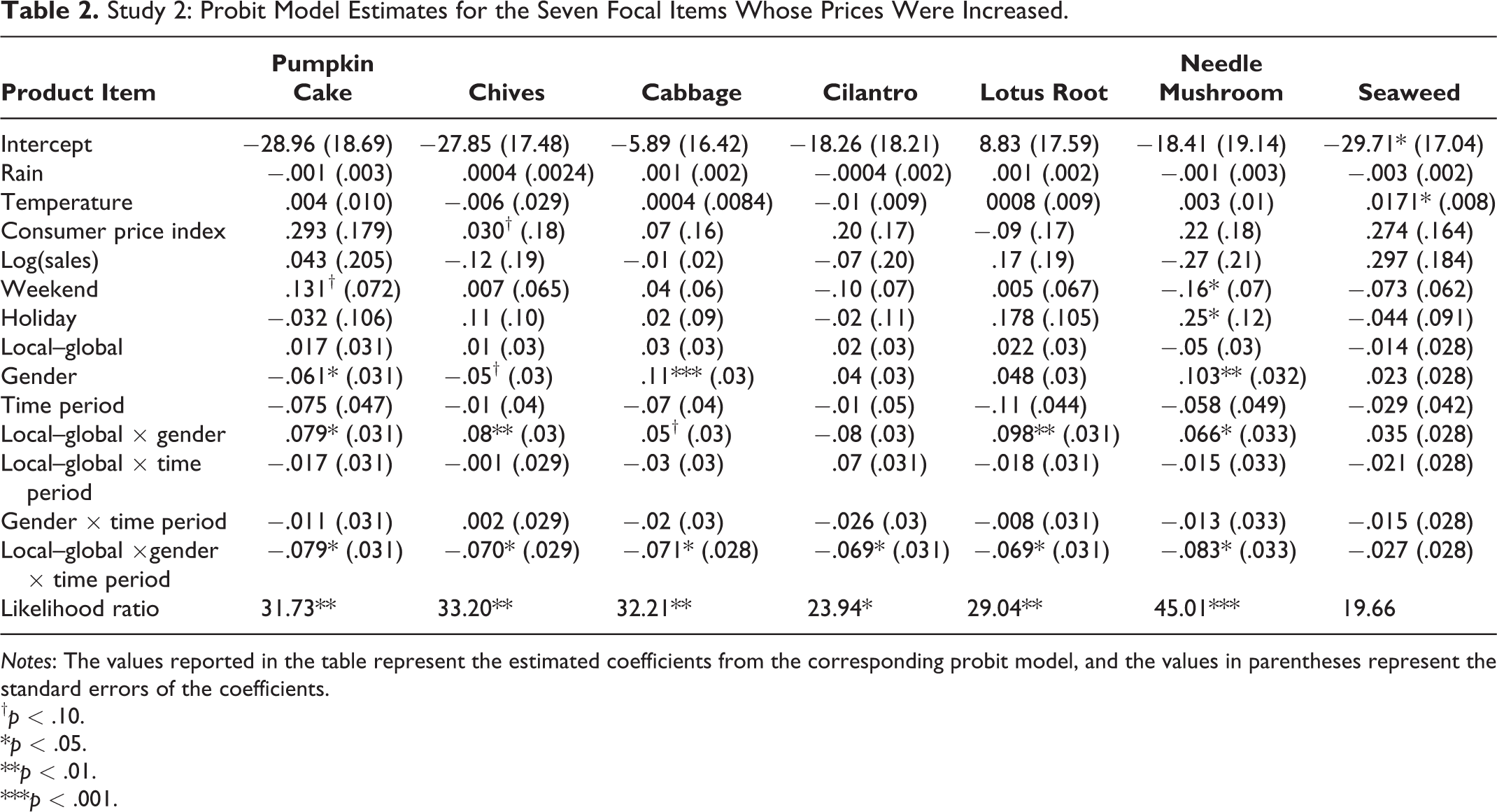
Notes: The values reported in the table represent the estimated coefficients from the corresponding probit model, and the values in parentheses represent the standard errors of the coefficients.
†p < .10.
*p < .05.
**p < .01.
***p < .001.
In support of H1, the three-way interaction of local–global identity, gender, and time period was statistically significant (b = −.079, SE = .031; χ2(1) = 6.44, p = .011), indicating that identity incongruence significantly influences consumers’ purchase propensities between the baseline period and price-increased period. Follow-up analyses indicated that female–local identity consumers are more price sensitive than female–global identity consumers. That is, female–local identity consumers significantly decreased their purchase propensities of Pumpkin Cake in the price-increased period relative to the baseline period (Pbaseline period = 11.22% vs. Pprice-increased period = 6.63%; χ2(1) = 7.07, p = .008; d = .25), whereas female–global identity consumers showed no significant change (Pbaseline period = 11.38% vs. Pprice-increased period = 10.40%; χ2(1) = .267, p = .605). In other words, identity incongruence (female and global) results in lower price sensitivity (lower likelihood to decrease purchase after price increase). Importantly, in the baseline period, females showed no significant difference in their purchase behavior regardless of local or global identity condition (Plocal = 11.22% vs. Pglobal = 11.38%; χ2 < 1). However, in the price-increased period, females with an accessible global identity condition purchased more (Plocal = 6.63% vs. Pglobal = 10.40%; χ2(1) = 5.31, p = .021; d = .22), indicating lower price sensitivity (Figure 3).

Study 2: The effect of identity incongruence (vs. congruence) on purchase probability: baseline vs. price-increased period.
In contrast, male–global identity consumers were more price sensitive than male–local identity consumers. Male–global identity consumers reduced their purchase propensity during the price-increased period (Pbaseline period = 14.39% vs. Pprice-increased period = 6.99%; χ2(1) = 7.97, p = .005; d = .26), whereas male–local identity consumers showed no significant change (Pbaseline period = 14.23% vs. Pprice-increased period = 12.98%; χ2(1) = 1.14, p = .567). Identity incongruence (male–local identity) results in lower price sensitivity (lower likelihood to decrease purchase in the price-increased period). Furthermore, during the baseline period, purchase propensity among males was similar for the local and the global identity conditions (Plocal = 14.23% vs. Pglobal = 14.39%; χ2 < 1). In the price-increased period, males with an accessible local identity showed higher purchase propensity (Plocal = 12.98% vs. Pglobal = 6.99%; χ2(1) = 6.77, p = .034; d = .24), indicating lower price sensitivity during the price-increased period relative to the baseline period (Figure 3).
Discussion
Study 2 supports H1 by showing that identity incongruence between gender and local–global identity significantly affects consumers’ purchase propensities for Pumpkin Cake and five other menu items during the price-increased period relative to the baseline period when price was unchanged (see Tables 1 and 2 and Web Appendix F for the visual depiction of the effects). No such effect emerged for the 36 other menu items that did not change in price between the baseline and price-increased period, thus enabling us to rule out demand effects as a potential explanation (see Web Appendices D and E). We also discussed the nonsignificant result for Seaweed with the owner. He indicated that Seaweed tends to have a loyal group of consumers who believe that it offers benefits for their health and inner-body balance during the hot season (when the data were collected). The owner’s understanding of this matter was corroborated by results that showed a significant and positive effect of temperature on the likelihood to purchase Seaweed (b = .017, SE = .008; χ2(1) = 4.09, p = .043). The real-life setting of this study—an actual price increase and real purchase behavior in a naturalistic restaurant setting—provides evidence with strong external validity.
Web Appendix G provides additional analyses of the field data using actual prices instead of the time periods, combining the seven items together and estimating price sensitivity on the basis of purchase behavior and actual prices. The results are consistent with the current analysis. Study 3 seeks to provide causal evidence by manipulating both gender identity and local–global identity and by testing the mediating role of a sacrifice mindset.
Study 3: Causal Evidence and Mediation
Method
We randomly assigned MTurk respondents based in the United States (N = 335) to a 2 (local–global identity: local vs. global) × 2 (gender identity: female vs. male) between-subjects design. The average age was 34.99 years (SD = 11.70), 152 were female, and 48% had an annual income over $50,000.
Procedure
Participants first completed the local–global identity and gender identity manipulations (counterbalanced and no order effects; Fs < 1). Next, they indicated their likelihood of purchasing a pair of headphones after a price increase. They also provided demographics and completed the sacrifice mindset scale and manipulation checks.
Local–global identity
We adapted the local–global identity manipulation from Gao, Zhang, and Mittal (2017; see Web Appendix H). We asked respondents in the local identity condition to support a “Think Local Movement,” which featured the local community, focused on local news, and worked to preserve local traditions. Those in the global identity condition were asked to support a “Think Global Movement,” which featured global businesses and focused on global news and cultures from different parts of the world. To reinforce the manipulation, participants initialed the stimuli to signify support for the movement. Three items checked the effectiveness of this manipulation (Zhang and Khare 2009): “For the time being, I mainly think…,” “At this moment, I feel that…,” and “On top of my mind right now are thoughts in agreement with saying that…” (1 = “I am a global citizen,” and 7 = “I am a local citizen”). We averaged the items (α = .96; a higher value indicates stronger local identity).
Gender identity
We adapted the gender identity manipulation task from Winterich, Mittal, and Ross (2009), framing male and female identity as follows:
Price sensitivity
Participants read the following excerpt to establish the price scenario: You have been planning to buy new headphones for a while. Last week, you found USonic headphones (Web Appendix I) priced at $89.99 in an electronics store. You tried it on and found it suits you very well. Today, you finally decided to go to the electronics store to make the final purchase and bring the headphones home with you. However, you found the price of the headphones is now $95.99.
Sacrifice mindset
We measured sacrifice mindset as the average of seven items from Gao, Zhang, and Mittal (2017). A sample item is “I believe sacrifice is a great virtue.” Higher values on this index indicate a stronger sacrifice mindset (α = .92; see Web Appendix J).
Results
Manipulation checks
We conducted a full factorial analysis of variance (ANOVA) on the local–global identity manipulation index, with local–global identity, gender identity, and their interaction as the independent variables. We also controlled for biological sex, age (F(1, 323) = 4.03, p = .046), income, and ethnicity. The main effect of local–global identity was significant (F(1, 323) = 27.38, p < .001; d = .59). Participants in the local identity condition reported having a stronger local identity (Mlocal = 4.06 vs. Mglobal = 2.99). Neither the effect of gender identity (F < 1) nor the interaction effect (F < 1) was significant. Thus, the local–global identity manipulation was successful and unaffected by gender.
We conducted similar analyses on the gender identity manipulation check. Among the control variables, the effect of biological sex (F(1, 323) = 50.35, p < .001) and age (F(1, 323) = 7.01, p = .009) were significant. The main effect of gender identity manipulation was significant (Mfemale = .24 vs. Mmale = −.31; F(1, 323) = 9.50, p = .002; d = .38). Neither the effect of local–global identity nor their interaction effect was significant (Fs < 1.92, ps > .166). Thus, the manipulation of gender identity was successful.
Price sensitivity
H1 postulates that consumers with a female and global (vs. local) identity and those with a male and local (vs. global) identity have lower price sensitivity. We ran a full factorial ANOVA on the price sensitivity index, with gender identity and local–global identity as well as their interaction as the independent variables. We included biological sex (F(1, 323) = 1.04, p = .309), age (F(1, 323) = 9.32, p = .003), income (F(1, 323) = 1.80, p = .180), and ethnicity (F < 1) as covariates. The main effect of local–global identity (F < 1) and gender identity (F < 1) were not significant. The interaction of local–global identity and gender identity was statistically significant (F(1, 323) = 10.13, p = .002). Participants with an accessible female and global identity showed lower price sensitivity than those with an accessible female and local identity (Mfemale–local = 4.12 vs. Mfemale–global = 4.66; F(1, 323) = 3.93, p = .048; d = .34). Those with an accessible male and local identity showed a higher purchase intention after the price increase (lower price sensitivity) than those with an accessible male and global identity (Mmale–local = 4.73 vs. Mmale–global = 4.07; F(1, 323) = 6.43, p = .012; d = .40). These results support H1 (Figure 4).
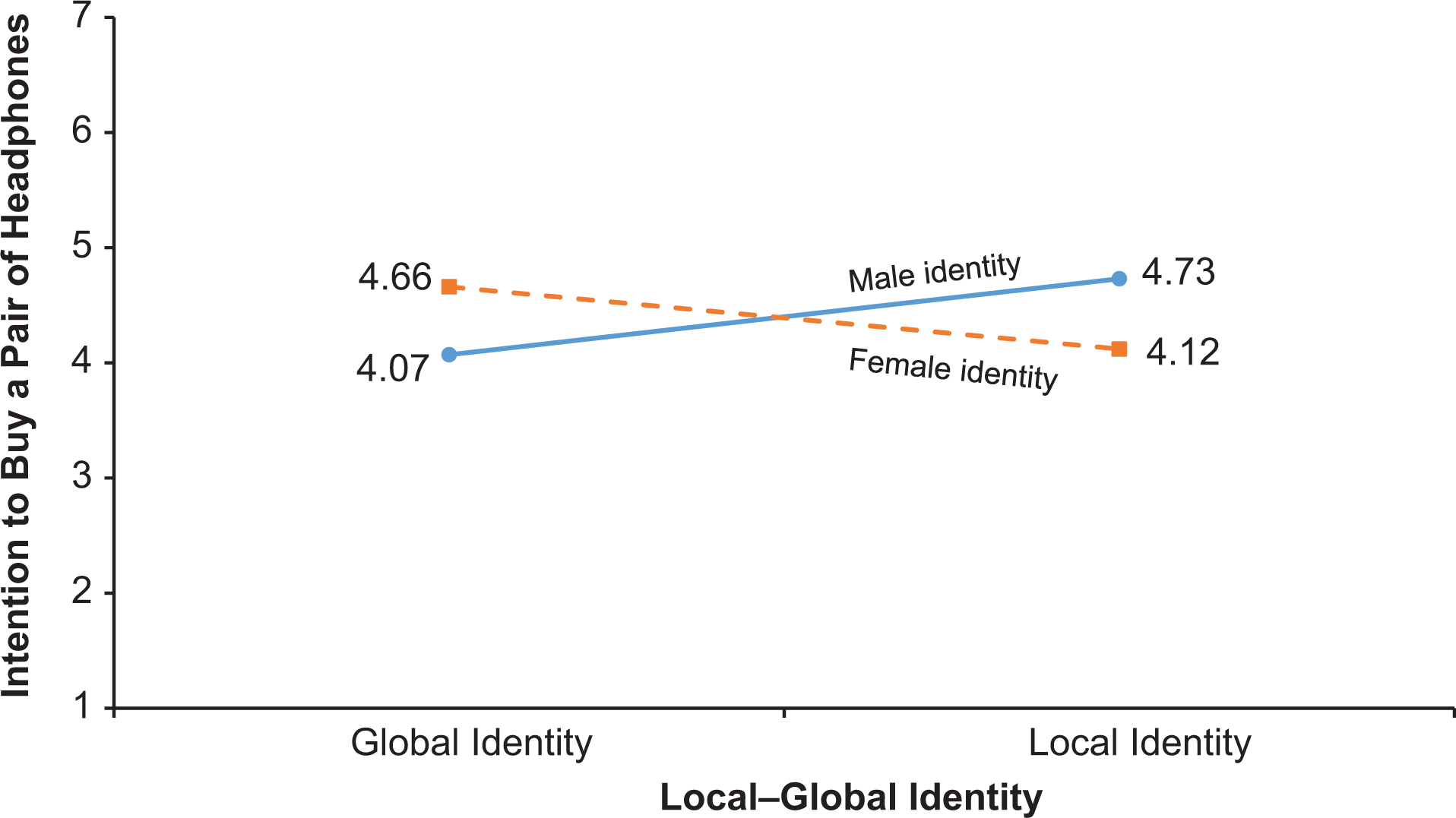
Study 3: The interaction effect of gender identity and local–global identity on price sensitivity to headphones.
Sacrifice mindset
We theorize that the interactive effect of gender identity and local–global identity on price sensitivity is mediated by a sacrifice mindset. That is, when facing price increases, consumers with a female and global identity as well as consumers with a male and local identity should show a stronger sacrifice mindset. To test this hypothesis, we conducted a full factorial ANOVA on the sacrifice mindset index, with gender identity, local–global identity, and their interaction as independent variables. We included biological sex (F < 1), age (F(1, 323) = 16.36, p < .001), income (F(1, 323) = 6.27, p = .013), and ethnicity (F(5, 323) = 1.12, p = .351) as covariates. The main effects of local–global identity and gender identity were not statistically significant (Fs < 1), but their two-way interaction effect was significant (F(1, 323) = 8.13, p = .005). Specifically, participants with an accessible female and global identity (incongruent identity) showed a stronger sacrifice mindset than those with an accessible female and local identity (Mfemale–local = 3.45 vs. Mfemale–global = 4.01; F(1, 323) = 3.69, p = .056; d = .38). Similarly, participants with an accessible male and local identity (incongruent identity) showed a stronger sacrifice mindset than those with an accessible male and global identity (Mmale–local = 3.99 vs. Mmale–global = 3.44; F(1,323) = 4.54, p = .033; d = .35). Confirmatory factor analyses indicated that a sacrifice mindset and price sensitivity are different constructs (Web Appendix K).
Mediation through a sacrifice mindset
H2 posits that a sacrifice mindset mediates the joint effect of local–global identity and gender identity on price sensitivity. We conducted a mediation analysis with Model 8 in PROCESS (Hayes 2013) as follows: local–global identity was the independent variable, gender identity was the moderator, price sensitivity was the dependent variable, and sacrifice mindset was the mediator. We controlled for biological sex, age, income, and ethnicity. The results show that a sacrifice mindset mediates the interactive effect of gender identity and local–global identity on price sensitivity (indirect effect = .258, SE = .114, 95% CI: .0813 to .5545). In the female identity condition, the indirect effect of local identity on price sensitivity due to the sacrifice mindset is negative and significant (indirect effect = −.132, SE = .069, 95% CI: −.2995 to −.0206). In the male identity condition, the indirect effect of local identity on price sensitivity due to the sacrifice mindset is positive and significant (indirect effect = .126, SE = .079, 95% CI: .0081 to .3252). Thus, the results of this study support H2.
Discussion
Study 3 accomplishes several objectives. First, it provides causal evidence for H1 by manipulating both gender identity and local–global identity. Second, it provides process evidence for H2 by showing that sacrifice mindset is a key mediating mechanism. Notably, the nonsignificant simple main effect of local–global identity may seem inconsistent with Gao, Zhang, and Mittal (2017). We believe this is not the case for two reasons: (1) we directly manipulated gender identity, which may have overwhelmed the simple main effect of local–global identity, and (2) we examined the interaction effect of gender identity and local–global identity, which makes the simple main effect under this interaction effect theoretically irrelevant.
Next, we seek to identify theoretically relevant boundary conditions on the basis of the moderation-of-process approach to theory testing (Spencer, Zanna, and Fong 2005). Accordingly, conditions that strengthen or weaken the sacrifice mindset to similar levels across participants should attenuate the interactive effect of gender identity and local–global identity on price sensitivity. Our theory posits that incongruence between local–global identity and gender identity depletes cognitive resources and activates affective processing. This triggers a sacrifice mindset and thereby lowers price sensitivity. Thus, the proposed interactive effect of gender identity and local–global identity should only manifest when consumers have relatively more cognitive resources before they experience identity incongruence. Consumers whose cognitive resources have already been depleted, irrespective of the identity congruence or incongruence they experience, will show a higher sacrifice mindset and will thus have lower price sensitivity.
Study 4: The Moderating Role of Cognitive Resource Depletion
Method
Study 4 is a 2 (cognitive resources: depleted vs. control) × 2 (biological sex: female vs. male) × 2 (local–global identity: local vs. global) between-subjects design. We recruited 608 U.S. consumers through MTurk (Mage = 35.22 years, SD = 14.12; 288 were female; 56% reported an annual income above $50,000) and randomly assigned them to the four cells.
Procedure
Participants first completed the cognitive resources and local–global identity manipulations. We counterbalanced the order of the two manipulations with no impact on our dependent measure (F < 1). Next, we obtained the price sensitivity measure, manipulation checks, and demographics.
Cognitive resource depletion manipulation
We used the Stroop Task, adapted from Pocheptsova et al. (2009). We exposed participants to different colored words and presented the words in colors that were different from their semantic meaning. For example, the word “green” might appear in orange, red, or blue font. In the depleted condition, participants were asked to identify the color of each word, which is more cognitively demanding. In the control condition, participants were asked to identify the semantic meaning of the word. For instance, when exposed to the word “green” presented in an orange color, those in the depleted condition should choose “orange,” whereas those in the control condition should choose “green” as the correct answer. Participants in both conditions were given five trials and then shown 30 sets of colored words in the main task. To check the manipulation, we also recorded the time the participants spent on each word and averaged their time across the 30 words. We expected those in the depleted condition to have spent more time completing the task.
Local–global identity manipulation
For the local–global identity manipulation, we used the same task from Study 3 with the same manipulation check items (α = .95). Please see Web Appendix H for details.
Price sensitivity
Participants read the following scenario: You have been thinking about becoming a member of a gym, called EXPace (detailed description in Web Appendix L), near your place for a while. Last week, you went online and found that you have to pay a $99 initiation fee and a $24.99 per month fee to become a member of this gym. Today you decided to personally visit the gym to finally become a member. During the visit you found out the monthly fee you have to pay is now $29.99.
Results
Manipulation checks
We first conducted a full factorial ANOVA on the local–global identity check index with local–global identity, biological sex, cognitive resource depletion, and all their higher-level interactions as predictors. We also controlled for age (F(1, 593) = 5.12, p = .024), income (F < 1), and ethnicity (F(5, 593) = 2.81, p = .016). The effect of local–global identity was significant (Mlocal = 4.03 vs. Mglobal = 3.14; F(1, 593) = 41.52, p < .001; d = .49). Thus, the manipulation of local–global identity was successful. For cognitive resource depletion, we conducted a similar full factorial ANOVA on the timing index. Among the control variables, age (F(1, 593) = 8.89, p = .003) and ethnicity (F(5, 593) = 4.39, p < .001) were significant. Participants in the depleted condition spent more time completing the task than those in the control condition (Mdepleted = 4.37 seconds/word vs. Mcontrol = 3.28 seconds/word; F(1, 593) = 13.23, p < .001; d = .32). Thus, the manipulation of cognitive resource depletion was successful.
Hypothesis testing
We expected to replicate the identity incongruence effect on price sensitivity in the control condition but not in the cognitive resource depletion condition. We conducted a full factorial ANOVA on the price sensitivity index. Among the control variables, age (F(1, 593) = 14.99, p < .001) and ethnicity (F(5, 593) = 3.15, p = .008) were significant. The effect of cognitive resources was significant (F(1, 593) = 4.76, p = .030). Among the two-way interactions, only the interaction of gender and local–global identity was significant (F(1, 593) = 4.21, p = .041). More importantly, the three-way interaction of cognitive resources, gender, and local–global identity was significant (F(1, 593) = 11.48, p < .001).
Follow-up analyses indicated that in the cognitive resources control condition (i.e., no depletion), the two-way interaction effect of gender and local–global identity was significant (F(3, 593) = 5.19, p = .002). Females with an accessible global identity (incongruent condition) were less price sensitive, as evidenced by a higher likelihood of joining the gym after the price increase (Mlocal = 3.64 vs. Mglobal = 4.26; F(1, 593) = 5.26, p = .022; d = .33). Similarly, males with an accessible local identity (incongruent condition) were less price sensitive (Mlocal = 4.45 vs. Mglobal = 3.44; F(1, 593) = 9.94, p = .001; d = .63). However, in the depleted cognitive resources condition, the interaction effect of gender and local–global identity was attenuated to nonsignificance (F(3, 593) = .95, p > .414), with all participants displaying relatively lower price sensitivity (i.e., a higher likelihood to join the gym after the price increase; see Figure 5). These results support the moderating role of cognitive resource depletion.

Study 4: The moderating role of cognitive resource depletion.
Discussion
Study 4 provides evidence for the underlying process: under cognitive resource depletion, the interactive effect of gender identity and local–global identity is attenuated for all identities. In contrast, when there is no resource depletion, the effect is only observed for the incongruent identity condition. This finding supports the proposed mediating mechanism.
According to our theorizing, incongruence between local–global identity and gender identity depletes cognitive resources and activates affective processing, which triggers a sacrifice mindset and thereby lowers price sensitivity. As such, if consumers focus on cognitive processing, we should replicate the identity incongruence effect, as those under the identity congruence condition would have the cognitive resources to rely on cognitive processing. In contrast, those under the identity incongruence condition would rely on affective processing given they do not have the cognitive resources to engage in cognitive processing. In contrast, under the affective processing condition, the effect should be attenuated because all consumers would rely on affective processing and thus have a higher sacrifice mindset and lower price sensitivity.
Study 5: Moderating Role of Affective Versus Cognitive Processing Mode
Method
Study 5 is a 2 (processing mode: affective vs. cognitive) × 2 (local–global identity: local vs. global) × continuous (measured gender identity) between-subjects design. Participants were 563 U.S. consumers recruited through MTurk (Mage = 34.63 years, SD = 11.01; 255 were female; 48% reported an annual income above $50,000), and we randomly assigned them to the four cells.
Procedure
Participants first completed the processing mode and local–global identity manipulations (counterbalanced with no impact on our dependent measure; F < 1). Next, participants completed the price sensitivity measure, the manipulation check, and demographics.
Local–global identity manipulation
For the local–global identity manipulation, we used the task from Study 3. Please see Web Appendix H for details.
Processing mode manipulation
To manipulate processing mode in a managerially relevant way, we used the stimuli from Klein and Melnyk (2016), which was based on a real advertisement. Specifically, participants read: You are shopping for a new pair of shoes with your friend. You find a suitable one from S&C, a famous shoe brand. From the following in-store poster, you learned the price of the pair of shoes is currently $54.95. Your friend told you that s/he remembers the price of the same pair of shoes was $49.95 last week. After talking to the store clerk, you learned that the prices of some of the S&C shoes have been increased in the last week.
Price sensitivity
We measured price sensitivity with the same five-item scale used in Study 3 (α = .97). A higher average score indicates a stronger intention to purchase the pair of shoes even after the price increase, or lower price sensitivity.
Gender identity
We measured gender identity with the Bem Sex-Role Inventory (Bem 1974; see Web Appendix J), including 20 items corresponding to female identity (α = .92) and 20 items corresponding to male identity (α = .93). Following Winterich, Mittal, and Ross (2009), we used the difference score to capture the consumers’ overall gender identity, with a higher positive number indicating a stronger female identity, and a lower negative number indicating a stronger male identity (range: −4.55 to 4.80, M = .03, SD = .97).
Results
We conducted a regression analysis with the price sensitivity index as the dependent variable. Local–global identity, gender identity, and processing mode, as well as all their two-way and three-way interactions were the independent variables. We included biological sex, age, income, and ethnicity as controls. The results are summarized in Table 3.
Study 5: Regression Results with Local–Global Identity, Gender Identity, and Processing Mode as Predictors.

Note: N.S. stand for “not significant.”
†p < .10.
*p < .05.
**p < .01.
***p < .001.
Among the control variables, the effects of age (b = −.034, t(551) = −4.86, p < .001) and ethnicity (b = .246, t(551) = 4.84, p < .001) were significant. Among the independent variables, only the effect of processing mode was marginally significant (b = −.360, t(551) = −1.41, p = .082). Importantly, the three-way interaction of local–global identity, gender identity, and processing mode was significant (b = −.746, t(551) = −2.56, p = .011). As predicted, the interaction between local–global identity and gender identity was significant (b = −.709, t(551) = −3.39, p < .001) in the cognitive processing condition. To further explore this significant two-way interaction, we used MODPROBE by Hayes (2013). Figure 6 shows the pattern of results based on the MODPROBE results. 6 In the affective processing condition, the two-way interaction between local–global identity and gender identity was not significant (b = .071, t(551) = .34, p = .733). Thus, these results are consistent with our theorizing.

Study 5: The moderating role of processing mode.
Discussion
Study 5 replicates the identity incongruence effect on price sensitivity in a new product category (shoes) and identifies affective versus cognitive processing mode as a boundary condition. In the affective processing mode, the identity incongruence effect on price sensitivity is attenuated. We tested additional boundary conditions such as self-focus and social class (see Web Appendices P and Q), confirming our proposed mediating mechanism of sacrifice mindset.
General Discussion
We started with the notion that a female identity is consistent with a local identity, given that both reflect an emphasis on norms associated with smaller groups and more intimate personal relationships. In contrast, a male identity is consistent with a global identity, given that both emphasize norms associated with larger groups and more impersonal relationships. By demonstrating that identity incongruence (females with a global identity; males with a local identity) lowers price sensitivity through a sacrifice mindset, we theoretically advance the literature on price sensitivity. We also identify theoretically relevant boundary conditions: the sacrifice mindset is strengthened when consumers experience cognitive resource depletion or rely on affective processing, but it is weakened when consumers are self-focused or of low social class (see Web Appendices P and Q). In addition, Web Appendix S replicates the main results using a shorter local–global identity manipulation consisting of a single sentence. This prime can be readily applied by most companies in practice.
Combining the results from the studies reported herein and in the Web Appendices, we conducted a single-paper meta-analysis on the basis of the standardized dependent variables (McShane and Böckenholt 2017). Table 1 indicates that the interaction effect of gender identity and local–global identity on price sensitivity is robust and significant (effect size = .637, SE = .061, 95% CI: .517 to .756), with an estimated binomial effect size display of r = .32. 7 The results also replicate Gao, Zhang, and Mittal (2017), finding a main effect of local–global identity on price sensitivity (Mlocal = .12 vs. Mglobal = −.02; effect size = .168, SE = .067, 95% CI: .049 to .287). In addition, the effect of local–global identity on price sensitivity is stronger among male-identity consumers (effect size = .402, SE = .043, 95% CI: .317 to .487) than their female-identity counterparts (effect size = .234, SE = .043, 95% CI: .151 to .318).
Theoretical Contributions
First, adding to research by Gao, Zhang, and Mittal (2017), which only found a main effect of local–global identity on price sensitivity, we identify gender identity as an important boundary condition. Specifically, local identity decreases price sensitivity for those with male identity but increases price sensitivity for those with female identity, which reverses the main effect previously observed by Gao, Zhang, and Mittal (2017). In addition, whereas previous research shows that only consumers with a strong local identity exhibit a sacrifice mindset, our findings suggest that a global identity can also trigger a sacrifice mindset, especially among females or those with a female identity.
Second, a plurality of identities is a core aspect of human existence in a modern society (Reed et al. 2012; Saint Clair and Forehand 2012). In line with this reasoning, we show a robust effect of gender identity by measuring it as biological sex, temporarily activating gender identity through priming, and using a self-reported gender identity scale (Winterich, Mittal, and Ross 2009). Beyond the identities studied in this article, marketing scholars can examine the congruence versus incongruence of other social identities in the context of behaviors other than price sensitivity. This can be done through the lens of consistency or inconsistency among the different dimensions of the identities examined. The intriguing finding in our research is that inconsistency in consumer identities may often be desirable for managerial purposes such as decreasing price sensitivity. Clearly, additional research is needed to extend our results by going beyond the focal constructs examined herein.
Third, we advance the emerging research on local–global identity by relating it to other identities and showing how these identities can be differentiated along a social continuum on the basis of group interactions. Within the context of globalization, it is critical to delineate the similarities and differences between local–global identity and other consumer identities such as gender identity. Future research can examine a person’s political identity, which may be relevant to them favoring local citizens versus citizens of the world at large.
Fourth, our results encourage marketing scholars to take a customer-focused view when examining the perceived sacrifice customers may be making (Monroe 1973; Zeithaml 1988). By identifying identity incongruence and a sacrifice mindset as key drivers of price sensitivity, we can examine pricing decisions from a broader perspective, going beyond instrumental benefits affecting consumers. We also note that, in this research, price sensitivity is narrowly defined on the basis of consumers’ responses to price increases only. The identified effect may not manifest for price decreases or general price sensitivity as a consumer trait since these may not be necessarily related to making sacrifices, the key driving force of our findings.
Practical Implications
Executives may reduce target consumers’ price sensitivity through identity incongruence by activating the appropriate local or global identity according to the consumers’ biological sex, an effective indicator of gender identity. In Study 2, we find that matching male consumers with a local- (vs. global-) identity movement menu increased the likelihood of buying the price-increased items by 25.50%, and matching female consumers with a global- (vs. local-) identity movement menu increased purchase likelihood by 14.83%. The local–global advertising we used was subtle and not closely related to the restaurant’s core business or identity. Nevertheless, we observed robust effects, suggesting a wide range of applications. For instance, a recent study indicated that brands such as Dove, Ferrero, and L’Oréal are universally associated with feminine images, whereas brands like Ford, Gillette, and Heineken are universally associated with masculine images (Lieven 2017). As such, in the case of a global price increase, the former group of brands can benefit from activating consumers’ global identity, whereas the latter group of brands can benefit from activating consumers’ local identity. Companies can adapt our local–global identity manipulation based on local- vs. global-thinking movements as part of their positioning mix. Recently, Procter & Gamble launched a Global Citizen Movement across the world, which is not only similar to our local–global identity manipulation but also may activate their customers’ global identity.
Companies like Amazon, Netflix, and Google require consumers to complete their personal profile, which includes gender, before using their sites and apps, and they have multiple opportunities to activate local versus global identity through banner ads and wording of content. When Netflix raised prices from $10.99 to $12.99, it could have benefited from directing local-identity related messages to male consumers or global-identity related messages to female consumers. As a result, consumers may have been more likely to accept the price increase. The boundary conditions we identify may offer firms additional insights for managing price increases. For instance, many Chinese retailers ask consumers to solve a difficult puzzle for a chance to win a prize. The task is usually cognitively depleting and may focus consumers on affective processing and activate a sacrifice mindset. Retailers may use similar techniques to deplete cognitive resources when it comes to price increases. According to the findings from Study 5, companies contemplating price increases may also benefit from emphasizing the affective or hedonic attributes of their products. According to the findings in Web Appendix P, firms may also ask consumers to focus on themselves in their product communications to decrease relative price sensitivity. A recent example of putting self-focus into practice is Amazon’s ad campaign, “A special deal just for you. Yes, you.” Firms can implement these ideas to manage price increases by understanding their customers’ identities.
Limitations and Future Research Directions
Although our studies provide converging supports for the theorized framework, it is possible that there are other underlying mechanisms that can be explored in future research. We only measure price sensitivity as consumer responses to price increases. Future studies can explore consumer responses to price decreases, which may provide additional insights. Price decreases may not instantiate a sacrifice mindset; as such, other process explanations and potentially different results for price decreases may ensue relative to price increases.
We tested our theory with everyday ordinary products in which a price increase induces a sense of sacrifice. This may not be the case for luxury status brands or collectables, in which increased prices may signal a gain rather than a sacrifice. In addition, it should be ascertained if the observed effects differ according to the duration of customers’ relationship with the company. Finally, (in)congruence of local–global identity with other identities—moral, political, and professional—should be examined.
Supplemental Material
Supplemental Material, jmr.18.0234-File003 - The Differential Effect of Local–Global Identity Among Males and Females: The Case of Price Sensitivity
Supplemental Material, jmr.18.0234-File003 for The Differential Effect of Local–Global Identity Among Males and Females: The Case of Price Sensitivity by Huachao Gao, Vikas Mittal and Yinlong Zhang in Journal of Marketing Research
Footnotes
Acknowledgments
The authors thank the JMR review team for their feedback throughout the review process; Michael He Jia, Linda Hui Shi, and Hari Sridhar for their comments on earlier versions of the manuscript; and Noble Point Restaurant, Hefei Feixi branch, for providing the field data.
Associate Editor
James Bettman
Declaration of Conflicting Interests
The author(s) declared no potential conflicts of interest with respect to the research, authorship, and/or publication of this article.
Funding
The author(s) received no financial support for the research, authorship, and/or publication of this article.

Notes
References
Supplementary Material
Please find the following supplemental material available below.
For Open Access articles published under a Creative Commons License, all supplemental material carries the same license as the article it is associated with.
For non-Open Access articles published, all supplemental material carries a non-exclusive license, and permission requests for re-use of supplemental material or any part of supplemental material shall be sent directly to the copyright owner as specified in the copyright notice associated with the article.
