




Abstract
Despite the ubiquity of numerical information in consumers’ lives, prior research has provided limited insights to marketers about when numerical information exerts greater impact on decisions. This study offers evidence that judgments involving numerical information can be affected by consumers’ sense of personal control over the environment. A numerical attribute’s format communicates the extent to which the magnitude of a benefit is predictable (Study 1a), such that people who experience a control threat and want to see their external environment as predictable (Study 1b) rely on point value (vs. range) information as a general signal that the environment is predictable (Study 2). A personal control threat changes consumers’ preferences as a function of whether the numerical information appears as a point value or a range (Studies 3–4). This heightened focus on format may lessen the impact of a product benefit’s predicted magnitude, if a lower magnitude is specified in a more precise format (Study 5). Study 6 provides first evidence that the interactive effect of personal control levels and numerical formats can affect consequential choices.
Numerical information is available for judgments in many domains: Managers use revenue forecasts to make budget allocation decisions, doctors rely on blood pressure values to assess patients’ health, and policy makers can use historical data to predict the impact of policy changes. For marketing, numerical information is particularly relevant, because consumers have ample options to rely on it in their evaluations and decisions. For example, a consumer may prefer a tablet device with a predicted battery life of 12–14 hours, choose a healthy snack that contains only 20 calories, or evaluate a vehicle favorably if its fuel efficiency promises 30–35 miles per gallon. Despite the ubiquity of numerical specifications, however, prior research has provided limited insight to marketers about when numerical information has especially strong impacts on consumer decisions (Hsee et al. 2009).
Consumer decisions based on numerical information reflect both the magnitude conveyed and the inferences that this information affords them. Most prior work has considered how people map numbers onto magnitudes (Dehaene and Akhavein 1995; Kahneman and Tversky 1979) or how alternative expressions of the same magnitude (Monga and Bagchi 2012; Wong and Kwong 2005) and evaluation mode (Hsee 1996; Schley, Lembregts, and Peters 2017) might affect evaluations. We focus instead on the role of inferences about the precision of the numerical information being expressed in determining consumer reactions to it.
Product attributes function as proxies for actual performance or benefits, so their (numerical) precision may lead to inferences about how predictable the benefits are. A precise point value format (“storage capacity of 30 gigabytes”) suggests a more predictable benefit than a less precise range format (“battery life between 12 and 14 hours”) because the former gives the impression that consumers can be certain about the magnitude of the benefit they will get, whereas the latter leaves some uncertainty. When a company specifies numerical information about battery life in a point value format, such as “13 hours,” it might give the (initial) impression that the actual battery life is completely predictable (even if it is not).
We propose and demonstrate that consumers’ sense of personal control over their environment determines their desire to see their environment as predictable and may therefore affect their judgments of numerical attributes in their decision making. Specifically, consumers whose personal control is threatened might react more positively to numerical attributes if they are specified in a point value rather than a range format, compared with consumers who do not experience a personal control threat. This investigation is pertinent not only because numerical information is ubiquitous in consumers’ lives but also because they frequently confront it in situations in which they experience a lack of personal control (e.g., traffic jams, unexpected weather, computer crashes, crowded stores, stockouts). In addition, advertising often appears amid control-threatening news or entertainment programming that features accidents, natural disasters, financial crises, or terrorist threats.
The present research contributes to several research streams. First, we add to emerging literature on numerical information (e.g., Aribarg, Burson, and Larrick 2017; Pandelaere, Briers, and Lembregts 2011; Thomas and Morwitz 2009) by documenting when and why consumers are more likely to prefer and rely on numerical information; this study is among the first to adopt a motivational perspective. Second, we extend recent consumer behavior literature on the effect of personal control losses (Chen, Lee, and Yap 2016; Consiglio, De Angelis, and Costabile 2018; Cutright 2012; Cutright, Bettman, and Fitzsimons 2013) by showing how the level of personal control affects reactions to a prevalent form of information (i.e., numerical). Third, our research contributes to more general literature on compensatory control theory (Kay, Gaucher, and Napier 2008; Landau, Kay, and Whitson 2015). Prior studies have shown that a loss of control drives people to seek and identify structure (e.g., Whitson and Galinsky 2008). The present research shows that the desire for predictability may lead people to develop stronger preferences for precision.
Judging Numerical Product Attributes: Inferences About Precision
Consumers rely on numerical product attributes to predict actual performance or benefits that, in many situations, are difficult to experience directly before purchase (Nelson 1970; Van Osselaer and Janiszewski 2012). When people confront numerical information, they automatically map it onto a magnitude judgment (Dehaene and Akhavein 1995; García-Orza et al. 2016; Girelli, Lucangeli, and Butterworth 2000; Schley and Peters 2014; Tzelgov, Meyer, and Henik 1992). Generally, the larger the perceived magnitude of a benefit (cost) expressed by a given number, the more (less) appealing it becomes (e.g., Kahneman and Tversky 1979). Yet the impact of numerical information on decision making also depends on the inferences it affords and the feelings it elicits, which depend on the way information is presented (Kardes, Posavac, and Cronley 2004). For example, consumers infer that product benefits appear more long-lasting when the corresponding attributes are expressed in round numbers (Pena-Marin and Bhargave 2016). They find it easier to process large numbers in larger fonts (Coulter and Coulter 2005) and easier to process attributes specified in default units (Lembregts and Pandelaere 2013), which may then prompt more positive evaluations.
We focus on inferences stemming from the precision of numerical attributes, and specifically how the precision of attribute descriptions affects inferences about the (un)certainty and predictability of the benefits. Uncertainty (and its relation with precision) has been conceptualized differently in prior literature (see Table 1), and we mainly build on a classic distinction between two loci to which it can be attributed (Kahneman and Tversky 1982): internal (i.e., due to a gap in one’s own knowledge) or external (i.e., due to dispositions of causal systems in the outside world). Depending on the level of precision and the source to which the uncertainty is attributed, people seem to infer more or less uncertainty from more precisely specified information. On the one hand, information specified in an extremely precise format (e.g., a house price of $385,873) can violate consumers’ expectations of price presentation and create more internal uncertainty (Thomas and Park 2014; Thomas, Simon, and Kadiyali 2010). On the other hand, for more conventional levels of precision that do not violate such expectations, more precision seems associated with less uncertainty, for both internal (Rothschild, Landau, and Sullivan 2011; Welsh, Navaro, and Begg 2011) and external (Brun and Teigen 1988; Du et al. 2011; Erev and Cohen 1990; Wallsten and Budescu 1995; Wallsten et al. 1993) variants.
Review on Relevant Research on Uncertainty and Precision

Notes: The options in bold font appear more relevant to our research findings. Rather than an exhaustive overview, this table lists potentially relevant research pertaining to uncertainty (and its relation to precision).
In the current work, we focus on more conventional levels of numerical precision (point values vs. ranges) and hypothesize that a more precisely specified product attribute may communicate that the magnitude of the actual benefit is more predictable. Specifically, a product attribute functions as a predictor for the actual benefit (e.g., battery life specification is a proxy for what true battery life will be; Hsee et al. 2009), so there may be some external uncertainty surrounding the magnitude of the available benefit (e.g., “Will I have a battery life of 13, 14, or 15 hours?”). People typically expect to encounter the most appropriate level of precision (Grice 1975), such that consumers may infer that the magnitude of a benefit is less predictable if an attribute specification appears in a less precise, wide range (“battery life between 5–20 hours”). However, if the same attribute is specified in more precise formats, such as a narrower range (e.g., 12–17 hours) or a point value (e.g., 15 hours), consumers may sense that the magnitude of the benefit is more predictable, because they feel more certain about the benefit they will get. More formally,
Personal Control Threats and Desire for Predictability
Humans are strongly motivated to make sense of the world (Kelley 1973; Lombrozo 2006; Rutjens 2012; Waytz et al. 2010). It is impossible to make sense of a world that is fundamentally unpredictable, and the thought of living in such a world is existentially threatening, so people are strongly motivated to regard their environment as somewhat predictable (Kay, Gaucher, and Napier 2008; Lerner 1980). A key means to maintain this perception is to develop a feeling of personal control over the environment, which invokes various positive consequences (Glass et al. 1973; Rothbaum, Weisz, and Snyder 1982; Rutjens 2012). Specifically, a person who perceives personal control sees the environment as predictable because (s)he decides what to expect in the future (Averill 1973; Mineka and Hendersen 1985). For example, a sense of personal control over a car implies that the driver decides where the car will go and when it will stop. In contrast, if a person perceives a lack of personal control, his or her personal actions do not appear to have any consistent impact on future events, which increases feelings of external uncertainty, because the environment seems largely unpredictable. For example, when stuck in a traffic jam, the person’s sense of personal control may drop, thereby raising uncertainty about what will happen next in that environment.
Because of the central role of perceptions of personal control for determining perceptions of predictability, experiencing a loss of personal control leads people to seek reassurances that the world is still predictable (Kay et al. 2009; Rutjens, Van Harreveld, and Van der Pligt 2013). Such reassurance might come from support by benevolent governmental and societal institutions or a belief in a God that is responsible for events (Kay, Gaucher, and Napier 2008). For example, if a benevolent God is in control, some force is deciding what will happen next (which is perceived as better than complete randomness, with events subject to chance; Kay, Gaucher, and Napier 2008). An emerging stream of research shows that a personal control threat motivates people to find order and structure in their environment, as a signal that their environment is predictable (Cutright 2012; Kay et al. 2009; Rutjens et al. 2012; Whitson and Galinsky 2008). In line with this body of research, we advance the following hypothesis:
Personal Control Threats and Numerical Judgments
Building on the preceding reasoning, we propose that experiencing a personal control threat may affect people’s judgments of numerical product attributes (Figure 1 provides a conceptual overview). Relative to those who have personal control, people who experience a personal control threat may approach judgments with increased sensitivity for signals that can reassure them that the environment is predictable. If people infer that the magnitude of a benefit is more predictable, because of the numerical attribute’s precision (H1), those who recently have lost personal control also should perceive an attribute specified in a precise format as a more general signal that the environment is still predictable. However, when people sense that they still have personal control, the precision of the description of product attributes is unlikely to prompt inferences about environmental predictability, because their perceptions of predictability still are intact. Among those who have experienced a personal control loss, the varying levels of numerical precision also should invoke different inferences about environmental predictability. A point value format suggests a completely predictable benefit and a more predictable environment; a range, even a narrow one, acknowledges the existence of some unpredictability and thus signals a less predictable environment. Formally,

Conceptual model.
Experiencing a loss of personal control also might have downstream consequences for decisions based on and evaluations of numerical information. We therefore compare reactions to numerical information specified as a point value (e.g., 14 hours) versus a narrow range format (e.g., 13–15 hours). Both formats suggest a predictable benefit, with low uncertainty about the magnitude of the benefit, so we might expect little difference in people’s judgments, as long as the expected magnitude remains constant. For example, judgments based on either 13–15 hours or 14 hours should be similar; both formats give a very similar idea of what the actual magnitude will be. However, the narrow range format leaves at least some uncertainty about what the exact magnitude will be (13, 14, or 15 hours), but a point value format can offer an (initial) impression of certainty (14 hours). The latter thus implies that the magnitude of the benefit is completely predictable. Considering this difference in the implied predictability of the product benefit, we anticipate that when consumers have a strong desire to see their external environment as predictable, they prefer to receive numerical information specified in a point value format, rather than a narrow range format, and their decisions are more affected by numerical information that is specified in their preferred format. On a more general level, we may find some support for the idea that some people prefer more precise information after an experience of internal uncertainty (Rothschild, Landau, and Sullivan 2011; see Table 1).
Because product evaluations and choices also depend on the magnitude of the associated benefit, irrespective of the temporary level of personal control, consumers should react more positively to a battery life of 20–24 hours than to one of 16–20 hours. Still, we predict that when an inferior battery life is specified as a point value (e.g., 18 hours), the negative reaction to its inferior magnitude could be offset by positive reactions to the precise format, if the latter serves the purpose of alleviating a personal control threat. People with lower perceived control may be so focused on the format and the comfort it provides that their evaluations and choices are less likely to differentiate a normatively better magnitude, specified as a range, from an inferior one specified in point value format (manipulated between subjects). For people with higher perceived control, for whom the point values do not provide the additional benefit of reassurance that the world is predictable, we expect consistent choices and evaluations of the superior option, even if it is communicated slightly less precisely. To reiterate:
Study Overview
We test our predictions in seven studies (Table 2 provides a summary of the results). In Study 1a, we establish support for the first central tenet of our theorizing: Consumers infer that the magnitude of a benefit is more predictable if the numerical attributes feature a more precise format (H1). In Study 1b, we confirm the second central tenet of our theorizing: Lacking personal control over the environment induces a stronger desire for a more predictable environment (H2). Then in Study 2, we demonstrate that numerical information in a point value format, rather than in a narrow range, functions as a general signal that the world is a predictable place for those who experience lower control but not for those who sense a higher level of control (H3). Next, Study 3 reveals that when the format of the numerical information has little impact on judgments, such as in higher personal control conditions, experiencing a personal control threat increases consumers’ reliance on numerical information specified as a point value but not as a narrow range (H4a). Study 4 confirms this effect in a relevant marketing context and also includes a neutral condition to show that the effect is driven by the lower-control, rather than the higher-control, conditions (H4a). Rather than holding the magnitude of the benefit constant across formats, in Study 5, we present evidence that lacking personal control may lead consumers to overvalue attribute information specified in a point value format, such that they fail to react more positively to an objectively better attribute value that is provided as a range (H4b). Finally, with Study 6 we offer some initial evidence that the interactive effect of personal control levels and numerical formats can affect actual consumption choices (H4b).
Summary of Results.

Notes: pc = precision; pd = predictability; LC = lower personal control; HC = higher personal control; NEU = neutral; RA = range; PV = point value.
Study 1a–b
Study 1a
We first aim to find a positive association between the perceived precision of a product attribute and the perceived predictability of its product’s benefits and performance. Moreover, we want to find initial support for our contention in H1: consumers infer that the magnitude of a benefit is more (less) predictable when an attribute is specified in a more (less) precise format.
Design
This study contains eight between-subject conditions (four formats: very wide range, wide range, narrow range, and point value × two rating scales: precision and predictability) and four within-subject conditions (attributes: battery life, weight, screen size, and warranty). Participants were randomly assigned to one of the between-subjects conditions. We opted to manipulate the format of the numerical information and rating scales between-subjects to avoid potential demand effects; each participant saw the four attributes in a similar numerical format (e.g., only very wide range) but in random order. For the analysis, we first calculated, for each attribute described in a specific format (i.e., 16 attribute descriptions), the mean perceived precision and perceived predictability. Thus, the analysis refers to the attribute description level.
Procedure
We recruited 283 participants (Mage = 34 years, 122 women) from Amazon’s Mechanical Turk (MTurk). Participants rated four smartphone attributes (battery life, weight, screen size, and warranty) on either the precision of the attribute descriptions or the perceived predictability of the benefits. Participants who rated the precision of the four product attribute descriptions answered the following question: “How precise is the following description?” (1 = “not precise at all,” and 7 = “very precise”). Participants who rated predictability answered: “To what extent do you feel that the following description signals that the actual benefit or performance is very predictable?” (“I feel that the following description signals that the actual battery life/weight/screen size/warranty of this product is…” [1 = “not predictable at all,” and 7 = “very predictable”]).
For all studies, we employed the same predetermined exclusion rules. If an attention check was present (Studies 1b, 2, and 4), we first excluded any participant who failed it. Then we excluded participants whose responses on the dependent variable were more than three standard deviations from the mean of the condition (none in Study 1a). In studies in which we manipulated personal control with a writing task (Studies 1b and 3), we checked whether the reports entered were appropriate (e.g., excluded completely nonsensical answers or participants who failed to come up with a relevant instance). When we exclude participants, we also report the study results with all cases in the Web Appendix specific to that study.
Results
The analysis confirms our central assumption. Participants rated the attribute descriptions as more precise and perceived a higher level of predictability of the product’s benefits and performance (r = .88, p < .001, 95% confidence interval [CI] = [.68, .96]; Figure 2). With respect to the perceived predictability of the benefits, all four format conditions (collapsed over attributes) differ significantly from each other (all ps < .01; Means in Table 2): attributes specified in more precise formats were rated as having more predictable benefits relative to when the same attributes were specified in less precise formats.

Level of predictability as a function of precision (Study 1a).
Study 1b
We next seek evidence for H2, proposing that a lack of personal control over the environment leads to a stronger desire for environmental predictability. This prediction follows directly from literature on personal control (e.g., Kay et al. 2009; Rutjens, Van Harreveld, and Van der Pligt 2013): because of the central role of perceptions of personal control for determining perceptions of predictability, experiencing a loss of personal control leads people to seek reassurances that their environment is still predictable.
Design
Participants were randomly assigned to one of two between-subjects conditions. To manipulate the sense of control between subjects, we used a recall task, in which participants described an incident in which they either did not have any control or were in complete control. This manipulation has appeared frequently in prior research (Whitson and Galinsky 2008); we confirmed its effectiveness in a pretest. For more details on the manipulations, stimuli, pretests, and results with the full sample (including outliers and participants who did not follow/understand instructions), see Web Appendix A.
Procedure
We recruited 199 participants (Mage = 36 years, 88 women) from MTurk, who first completed the writing task we used to manipulate personal control. Participants then indicated whether they understood the instructions (yes/no) before responding to eight items related to their desire for predictability. We adapted the eight-item desire for predictability scale (subscale of Need for Closure scale; Webster and Kruglanski 1994) and made it clear that we were interested how they were feeling right now (“It is important to treat the statements as relevant to what you are feeling right now”). Items include, “At this moment, I would not like to go into a situation without knowing what I can expect from it,” “At this moment, I feel that I dislike unpredictable situations” (reverse-scored), and “At this moment, I would like to go to places where I have been before so that I know what to expect” (1 = “completely disagree,” and 6 = “completely agree”; see Web Appendix A). The averaged items create an index of desire for predictability (Cronbach’s α = .87). Two coders also checked that the reports entered in the recall task were appropriate (intercoder reliability = 97.4%; disagreements resolved by discussion), which prompted us to exclude 11 participants; we also removed 1 participant who indicated a lack of understanding of the instructions.
Results
In line with H2, the independent samples t-test reveals that when their level of personal control is lower, participants report a stronger desire for predictability relative to when their personal control is higher (Mlower = 4.46, SD = 1.02; Mhigher = 4.10, SD = 1.07; t(185) = 2.41, p = .02; Cohen’s d = .35, 95% CI = [.06, .64]).
Discussion
Taken together, Studies 1a and 1b provide evidence of two central tenets of our theorizing. Study 1a provides correlational evidence for H1: When a numerical product attribute is expressed in a more (less) precise format, consumers infer that the magnitude of the corresponding product benefit is more (less) predictable. Study 1b shows that experiencing lower personal control instigates a stronger desire to have a predictable environment than does an experience of higher personal control.
Study 2
In Study 2, we test whether a personal control threat causes people to view numerical information in point value format (vs. range format) as a more general signal that the external environment is more predictable. If so, point value information may help alleviate personal control threats. To test H3, we use a novel, managerially relevant manipulation of personal control (i.e., advertisement) and exclude some potential alternative mechanisms. For example, in Study 1b we followed prior research and used a writing task to induce feelings of a loss of personal control, but this manipulation would be difficult to apply in real-world settings. With the manipulation in Study 2, we control for mood, potentially relevant emotions such as anger or fear, confidence (Thomas, Simon, and Kadiyali 2010), and self-esteem (un)certainty (Rothschild, Landau, and Sullivan 2011).
Method
Design
In an experiment with a 2 × 2 between-subjects design, we manipulated the format of numerical information (range vs. point value) and sense of personal control (lower vs. higher). Participants were randomly assigned to one of the four between-subjects conditions. For the format, in the point value conditions, the information was specified as “delivery time will be 4 days,” “discount on the next purchase will be 5%,” and “battery life will be 17 hours.” In the range conditions, the descriptions indicated, “delivery time will be between 2 and 6 days,” “discount on the next purchase will be between 0 and 10%,” and “battery life will be between 15 and 20 hours.” A pretest confirmed that the point value descriptions signaled more predictable benefits than the ranges. Web Appendix B contains more details on the manipulations, stimuli, and pretests.
To manipulate a sense of personal control, we used advertisements that warned about the potential loss of computer data. In the lower personal control conditions, participants read a description of a situation in which their computer suddenly shut down, and they had no personal control over it. In the higher personal control conditions, the description indicated that their computer suddenly shut down because of an inconsiderate act on their part. We pretested this manipulation, to ensure it affected the perception of personal control and to exclude the effects of mood, specific emotions (fear and anger), and internal uncertainty (uncertainty about self-esteem and confidence).
Procedure
In total, 201 people (Mage = 36 years, 107 women) from MTurk participated. They were assigned to either the higher or lower personal control manipulation. On the next page, they indicated whether they had carefully read the advertisement (yes/no). All participants indicated yes, so no one was excluded. Next, they were asked to imagine that they read numerical information about a smartphone on a website; the next pages presented either the point value or range information (one attribute per page). After participants indicated whether they had read this information (all participants indicated they did), they learned that people sometimes view product information as a more general signal/indication of how much predictability there is in the world (see Web Appendix B). In turn, they noted how they felt about the predictability of the environment in general when they read the product descriptions (“While reading these numerical descriptions, I feel that things in general and the world at large are…” [1 = “not predictable at all,” and 7 = “very predictable”]).
Results
A 2 (format: range vs. point value) × 2 (personal control: lower vs. higher) analysis of variance (ANOVA) of participants’ preferences yielded no significant main effects of numerical format (F(1, 197) = 2.29, p = .13,
Discussion
Study 2 provides support for the proposition that a point value specification can reassure people who experience lower personal control that the external environment in general is predictable (H3). We next investigate whether people who have experienced a personal control threat become more sensitive to the format of a numerical product attribute, such that they react more positively to attributes specified in a point value rather than in a range format (H4), presumably because the experience of lower personal control leads them to infer greater environmental predictability after they have been exposed to point value information (H3).
The predicted difference in sensitivity to the format also might be explained by a difference in the perceived predictability of the benefit rather than the external environment. That is, different levels of personal control may be associated with differences not only in the likelihood of inferring environmental predictability but also in the perceived predictability of the product benefit, which also could produce distinct levels of sensitivity to the attribute format. To test this possibility, we conducted an ancillary study (Web Appendix C), in which we use the same stimuli but ask about the predictability of the benefit, instead of the external environment (similar to Study 1a). The format exerts only a main effect on the predictability of the benefit (i.e., people infer a more predictable benefit from a more precisely specified product attribute, which replicates the results of Study 1a). We do not find an interaction between format and the level of personal control, suggesting that it is unlikely that the difference between lower and higher perceived personal control with regard to sensitivity to the attribute format is due to inferences about the predictability of the benefit.
Study 3
In Study 3, we test whether consumers are more sensitive to the specification of numerical information (point value vs. range format) when they experience diminished personal control relative to when they do not (H4a). Because of the uncertainty (about the magnitude of benefits or performance) inherent to range information, even for narrow ranges, participants may rely less on numerical information specified as a range, rather than as a point value, when they experience a loss in personal control. If participants do not experience a loss in personal control, the impact of the numerical information should depend less on its format (point value vs. narrow range). That is, when consumers must choose between an option that is superior on quantitative attributes and an option that is superior on qualitative attributes, those who experience a loss of personal control should prefer the former more if the attributes are specified as a point value (rather than as a narrow range), even if both specifications suggest the same level of a benefit.
Method
Design
We conducted an experiment with a 2 × 2 between-subjects design in which we manipulated sense of control and the format of two MP3 player product attributes (battery life and weight). Participants were randomly assigned to one of the four between-subjects conditions. To manipulate the sense of personal control, participants completed the recall task from Study 1b. We also manipulated the format in which the product attributes were specified by presenting the battery life and weight in either a point value format (“13 hours” and “5.2 oz.,” respectively) or a narrow range format (“12–14 hours” and “5.1–5.3 oz.,” respectively). A first pretest confirmed that the point value descriptions signaled more predictable benefits than the range descriptions; a second pretest also confirmed our assumption that, for participants in a neutral state, preferences do not change as a function of format. The details about the manipulations, stimuli, pretests, and results with the full sample for this study are in Web Appendix D.
Procedure
The 280 participants (Mage = 29 years; 83 women) from MTurk first completed a recall task that manipulated their sense of control (similar to Study 1b). Next, they indicated their preference between two MP3 players (stimuli were loosely based on Nam, Wang, and Lee [2012]). In the point value conditions, MP3 Player A was specified as superior on two quantitative attributes (battery life and weight), and MP3 Player B was superior on two qualitative attributes. In the range conditions, participants considered an alternative pair of MP3 players, whose battery life and weights were specified in a narrow range rather than as point values. We recorded which alternative participants preferred on a seven-point scale (1 = “strongly prefer product A,” and 7 = “strongly prefer product B”). For this analysis, as represented in Figure 3, we used reversed scales to facilitate the interpretation of the results, so higher scores imply a stronger preference for the alternative superior on quantitative attributes. Two coders checked whether the reports entered in the recall task were appropriate (intercoder reliability = 98.3%; disagreements resolved by discussion). Following this quality check, we dropped two participants from the study.

Preference as a function of level of control and attribute format (Study 3).
Results
The 2 (format: range vs. point value) × 2 (personal control: lower vs. higher) ANOVA of participants’ preferences yielded a significant effect of format (F(1, 274) = 3.75, p = .05, η2 = .01), a nonsignificant main effect of personal control (F(1, 274) = .77, p = .38,
Discussion
Study 3 provides evidence that the lack of personal control leads consumers to rely more on numerical information when it is specified in a point value rather than in a narrow range format. However, no such preference shift occurs among people who perceive their own personal control. Admittedly, the use of numerical information could have affected the ease of comparison (i.e., point values are easier to compare than ranges), but the stimuli used in the following studies render such an interpretation unlikely.
Study 4
With Study 4, we pursue three aims. First, we study preferences for point values over range specifications in a managerially relevant context, using the advertising manipulation from Study 2. Second, we empirically rule out an interactive effect between control levels and format on mood, emotions (anger or fear), confidence, or self-esteem certainty. Third, we aim to demonstrate that the effect is driven by lower- rather than higher-control conditions. Therefore, we add neutral conditions to rule out the possibility that having personal control, rather than experiencing a personal control threat, drives the preference for precise numerical information. People generally possess unrealistically high feelings of personal control (e.g., Langer 1975), so consistent with prior research (Cutright 2012; Rutjens et al. 2012), we expect little difference across the higher control and neutral conditions in terms of preferences for precise numerical information.
Method
Design
This experiment features a 2 (format: range vs. point value) × 3 (personal control: lower vs. higher vs. neutral) between-subjects design. Participants were randomly assigned to one of the six between-subjects conditions. To manipulate sense of control, we used advertisements similar to those in Study 2, warning of the potential loss of computer data. Participants in the neutral conditions were exposed to a similar advertisement but with no specific mention of control loss. We also manipulated the format in which the product attributes were specified. In the more precise, narrow range conditions, participants read that the manufacturer indicated a narrow range for the screen size of a tablet (e.g., 7–9 inches); in the point value conditions, the manufacturer offered a point value (e.g., 8 inches). For more details on the manipulations, stimuli, pretests, and additional analyses, see Web Appendix E.
Procedure
In total, 400 people (Mage = 35 years; 191 women) from MTurk participated in this study. All participants were asked to imagine a scenario in which they wanted to buy a new tablet. They were planning to enter a store, and an advertisement displayed at the entrance caught their attention. On the next page, they saw the ad (lower-control, higher-control, or neutral condition), which they were to read carefully and think about for a couple of moments. Participants indicated on the next page whether they had carefully read the ad (yes/no). All participants indicated yes, so no participants were excluded.
Next, they imagined they were interested in a tablet manufactured in the United States by a reliable manufacturer, so they asked a salesperson about screen sizes. The salesperson noted that the brand-new tablet would only be introduced a week later, so the screen size could only be described in a wide range format (“screen size is between 4 and 12 inches”). However, the salesperson offered to contact the manufacturer to get more precise information. For half of the participants, this more precise information was specified in a narrow range format, while for the other half, the salesperson provided it in a point value format.
All participants indicated the extent to which they desired the more precise information, how useful they would consider it, and how happy they would be with it, on a ten-point scale (1 = “not at all,” and 10 = “very much”). These three items were averaged into an index of predicted satisfaction with precise information (Cronbach’s α = .91). To control statistically for the effects of the reliability or reputability of the manufacturer, we included pertinent measures (“How reliable is the manufacturer of this tablet?” [1 = “not reliable at all,” and 10 = “very reliable”] and “How reputable is the manufacturer of this tablet?” [1 = “not reputable at all,” and 10 = “very reputable”]).
Results
To analyze predicted satisfaction with more precise information, we first conducted a 2 (format: range vs. point value) × 3 (personal control: lower vs. higher vs. neutral) univariate ANOVA, which revealed a marginally significant main effect of format (F(1, 394) = 2.70, p = .10,
Discussion
An advertisement can affect consumers’ preferences for more precise numerical information, depending on its format. We find no significant differences as a function of format when participants see a neutral or higher-control advertisements, but an advertisement that instigates a lack of personal control leads consumers to prefer more precise information in a point value format rather than a narrow range. Furthermore, this study rules out other accounts based on mood, specific emotions, confidence, and self-esteem certainty.
Study 5
Study 5 has two aims. First, we want to provide more evidence for the proposed effect by investigating whether the desire for point value information (generated by a lack of personal control) clouds consumers’ judgments (H4b). Product evaluations and choices depend on both the feelings and inferences elicited by attribute information, as well as the magnitude of the benefit. For example, if battery life specifications cite 10–20 hours versus 10 hours, the former may be more representative of reality, and it also implies a higher expected value (around 15 hours vs. 10 hours). Normatively speaking, it should be perceived as indicating a better battery life. A pilot study (N = 82) confirms that most participants (94%) prefer a tablet with a 10–20-hour battery life description over one with a 10-hour description. However, the inferior battery life is specified as a point value (10 hours), so the negative reaction to its inferior magnitude could be offset by positive reactions to the very precise format, if that format serves the purpose of alleviating a personal control threat. Therefore, we predict that consumers with higher perceived control are more likely to follow normative expectations (10–20 hours > 10 hours), but those who lack personal control may be so focused on the point value that they are less likely to differentiate the objectively better value range from the inferior point value.
Second, we test whether the proposed effect generalizes to a media advertising context. Advertising often appears among control-threatening news reports about weather disasters, financial crises, or terrorist threats. Thus, the format for the numerical information in an advertisement might evoke distinct evaluations depending on whether it follows content that reminds people of uncontrollable events.
Method
Design
We manipulated two factors—attribute information format (range vs. point value) and sense of personal control (lower vs. higher)—between-subjects. Participants were randomly assigned to one of the four between-subjects conditions. For the manipulation of sense of control, we relied on a news article describing a tsunami. In the lower-control conditions, participants read that victims were unable to do anything about their fate, had no personal control over their lives, and will continue to suffer this status in the future because scientists cannot predict tsunamis. In the higher-control conditions, the focus shifted to the devastating consequences of the tsunami, with the implication that humans could improve their outcomes and regain more control over their lives because scientists are getting better at predicting tsunamis. A pretest confirmed that we manipulated the level of personal control and not mood (though to a lesser extent than in Studies 2, 4, or 6), specific emotions (fear and anger), or internal uncertainty (self-esteem and confidence). Web Appendix F details the manipulations, stimuli, pretests, and additional analyses.
To manipulate the attribute information format, we specified battery life in a point value or range format, such that the battery life described with the point value format had a lower expected value than that described with a range format. Normatively, battery life in the point value format should be evaluated as worse. A pretest confirmed that “10 hours battery life” signaled more predictable benefits than “10–20 hours battery life” (Appendix F).
Procedure
We recruited 705 participants (Mage = 35 years; 331 women) from MTurk; with this large sample, we would be more likely to detect relatively small effect sizes in the lower personal control conditions (which we anticipate). In the first part of the task, all participants read a news article; they could not immediately click through to the next page but instead were instructed to read the whole article. After 15 seconds, an advertisement appeared, briefly describing a tablet with a battery life of either 10 hours or 10–20 hours, depending on the condition. On the next page, we asked participants to evaluate the battery life of the tablet on a seven-point scale (“How good is the battery life of this tablet?” [1 = “not good at all,” and 7 = “very good”]). We excluded three observations classified as outliers (three standard deviations above the mean).
Results
The 2 × 2 ANOVA of battery life evaluation revealed a nonsignificant main effect of personal control (F(1, 698) = .49, p = .49,
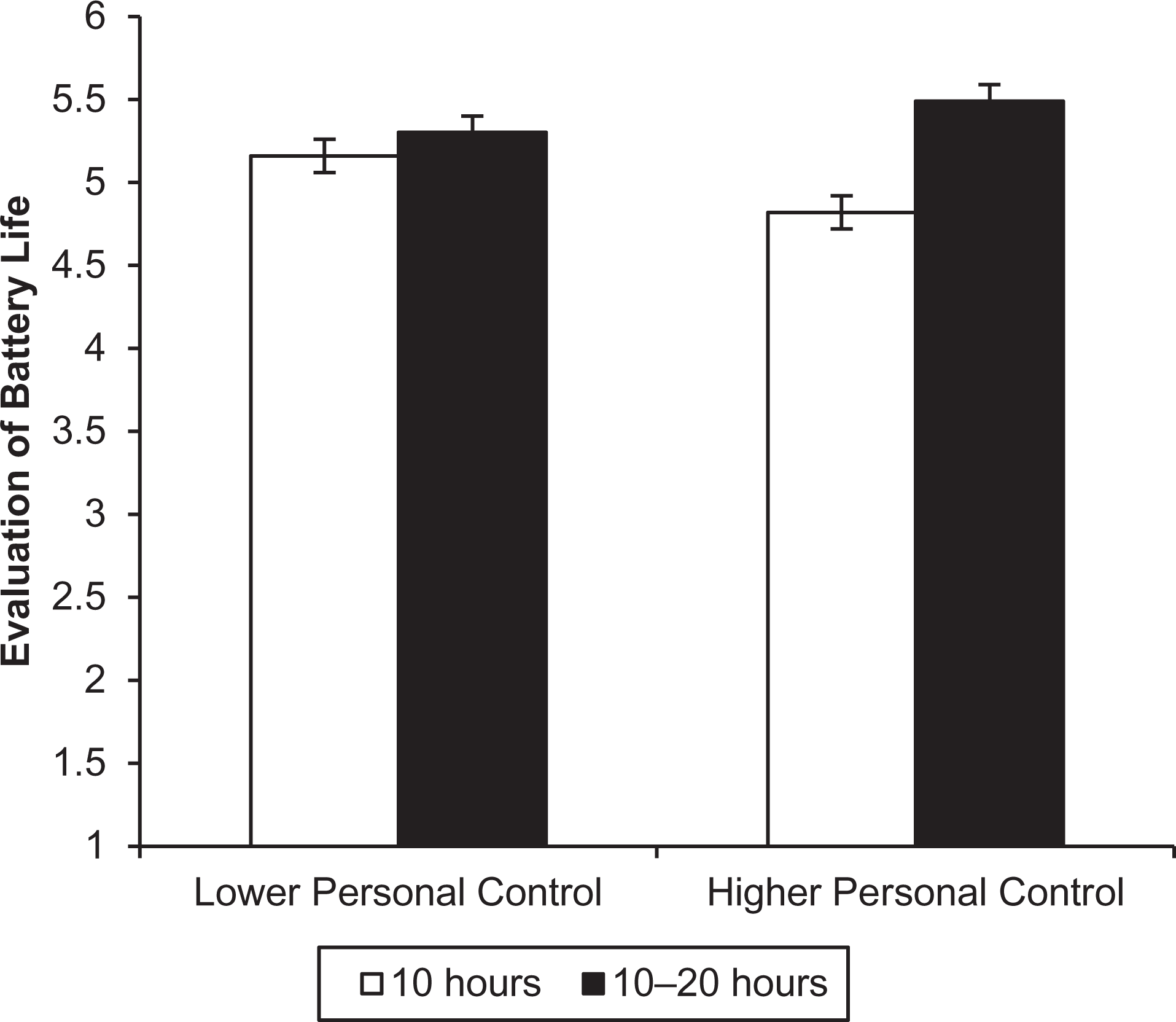
Evaluation of battery life as a function of personal control and attribute format (Study 5).
Discussion
Study 5 shows that consumers who lack a sense of personal control are less likely to differentiate between an objectively inferior battery life specified in a point value format and one that is objectively better but specified as a range. Consumers who lack personal control appear so keen to receive point value information that it clouds their judgments. In addition, this study provides a first test of the effect of personal control loss instigated by a news article—a highly prevalent context for triggering a sense of personal control loss. Specifically, we show that the quantitative information presented in advertisements may be evaluated differently as a function of both the content of unrelated news articles and the format in which the information is specified (range vs. point value).
Study 6
The final study has one principal aim: to explore the consequences of experiencing a personal control threat in the context of actual consumption choices, rather than the hypothetical scenarios featured in the previous studies. Accordingly, we gain further evidence that a lack of control may cloud consumers’ judgments (H4b). We use a choice between a pen and a notepad and then manipulate (between-subjects) the number of blank pages in the notepad: 67 versus 100–110. Normatively speaking, the choice share for the notepad containing 100–110 blank pages should be higher than that for a notepad described as having only 67 blank pages, because the latter is predicted to contain almost 40 fewer pages. In a pilot study (N = 102), we confirm this prediction, such that the notepad with more pages was chosen significantly more often (50% of participants) than when it had only 67 pages (23%; χ2(N = 102) = 7.99, p < .01).
We predict in turn that consumers who sense a higher level of control follow normative expectations and opt more for a notebook if it is predicted to have 100–110 pages rather than 67 pages. However, consumers who lack personal control may be so driven by their desire for point value information that they display a stronger (weaker) preference for the objectively worse (better) notebook when it is described more (less) precisely.
Method
Design
We manipulated attribute information format (range vs. point value) and the sense of personal control (lower vs. higher) between-subjects. Participants were randomly assigned to one of the four between-subjects conditions. For the manipulation of sense of personal control, we used the manipulation from Studies 2 and 4 (without the attention check, because Study 6 took place in a lab). The attribute information format specified the number of blank pages of a notepad as either “67 pages” or “100–110 pages.” The pretest confirmed that the point value information appeared more predictive of benefits than the range information. Details about the manipulations, stimuli, and pretests are in Web Appendix G.
Procedure
In total, 269 students (Mage = 19 years; 137 female) from Erasmus University were recruited, in exchange for partial course credit, to take part in a series of unrelated lab studies, including the current one. The entire lab session took approximately 30 minutes to complete. Near the end of the session, participants saw an advertisement that manipulated their sense of personal control, after which they completed a short filler task. Next, they were told that they would make a choice between a pen and a notebook and would receive their chosen product. The description indicated that both products had been used once and that the pen would write in blue, and the notepad would have 67 blank pages or 100–110 blank pages, depending on the condition. After participants made their choices, they received the products from a research assistant who registered their choice. Two participants did not complete the task because they failed to follow instructions (and were dropped from the analyses).
Results
In a logistic regression, personal control (lower vs. higher) and numerical format (range vs. point value) served as predictors for product choice; we found a significant interaction between the control manipulation and numerical format (Wald χ2(N = 267) = 5.09, p = .02). Consistent with our expectations, in the higher-control conditions, 63% of participants opted for the notepad that contained 100–110 pages, whereas only 46% did so when their notebook had 67 pages (marginally significant difference: 16.4%; 95% CI = [−.4%, 32%], Wald χ2(N = 267) = 3.61, p = .06). However, in the lower personal control conditions, we observed a reverse pattern, albeit a nonsignificant one (Wald χ2(N = 267) = 1.66, p = .20): The majority of participants (57%) preferred the notebook when it was described as having 67 pages, and only 46% preferred it when was described as having more pages in a range (difference: −11.2%; 95% CI = [−27.2%, 5.7%]). Somewhat unexpectedly, the difference between lower and higher control within the point value conditions did not reach significance (57% vs. 46%; difference: 11.1%; 95% CI = [−5.6%, 27%], Wald χ2(N = 267) = 1.66, p = .20), whereas the difference in the range conditions was marginally significant (46% vs. 63%; difference: −16.5%; 95% CI [−32.2%, .4%], Wald χ2(N = 267) = 3.60, p = .06). For further discussion of the comparisons within the format conditions, see the “General Discussion” section.
Discussion
This study identifies an interactive effect of personal control and numerical format on actual consumption choices. When people have a higher sense of control, they choose a product more when an attribute specified in a narrow range format is associated with a higher-magnitude benefit compared with when the product is described to have to a lower-magnitude benefit but is specified in a point value format. However, when people lack personal control, they value point value information so much that they express preferences for a product with a lower benefit but that is specified as a point value, compared with when its benefit is higher but specified as a range. The pilot study indicated a 27% difference in choice shares between the attribute descriptions of “100–110 pages” versus “67 pages,” leading us to anticipate a larger difference for choices in the higher-control conditions because people generally possess relatively high levels of personal control in their neutral state (e.g., when filling out a pilot study; Rutjens et al. 2012). Several explanations might apply to this smaller effect size (e.g., random variation, scenario vs. real consequences, other differences between neutral and higher control states), which researchers should keep in mind when designing further studies. In the lower-control conditions, we also were surprised to find a stronger (though nonsignificant) preference (+11%) for the notebook predicted to have 67 pages rather than between 100–110 pages. Originally, we anticipated a substantially weakened but still more positive evaluation of the objectively better option in the lower personal control conditions (as in Study 5). Again, different reasons may account for this finding (e.g., predictability of benefits may be more important for consequential choices), which further research could investigate.
General Discussion
For many decisions in many domains, people rely on numerical information, so an understanding of when they prefer different versions of this type of information is both theoretically and practically relevant. In particular, numerical information is of great interest to marketers, because consumers may frequently rely on it to make judgments and decisions. Despite the ubiquity of numerical product specifications in the marketplace, the current state of knowledge offers little insight to marketers about when and how they should leverage numerical information to influence consumers’ choices (Hsee et al. 2009).
We have aimed to address this gap by distinguishing numerical product attributes that are specified in a point value versus a range format; depending on whether they have a fundamental feeling of personal control over the environment, consumers seem to rely more on numerical attributes as a point value, such that those who lack a sense of personal control prefer and rely more on numerical information specified this way, relative to a range format. We hypothesize that this effect reflects an increased desire for predictability after a personal control threat, which prompts people to look for ways to strengthen their belief that their environment is predictable. As we demonstrate, product attributes specified in a point value format signal to lower-control consumers that the environment is indeed predictable.
Results from seven experiments confirm our predictions (see Table 2). Study 1a establishes support for the first central tenet of this research: when a numerical product attribute is expressed in a more (less) precise format, consumers infer that the magnitude of the corresponding product benefit is more (less) predictable (H1). Study 1b provides evidence for the second hypothesis: lacking personal control induces a stronger desire for predictability than having personal control (H2). Study 2 affirms that numerical information in a point value format, relative to a range format, may be interpreted as a stronger, general signal to lower-control consumers that the environment is predictable, but it does not serve this purpose for higher-control consumers (H3). In Study 3, we find that consumers who lack personal control display a stronger preference for an alternative that is superior on quantitative attributes (vs. one that excels on qualitative attributes) if those quantitative attributes are described with a point value rather than in a range format, but not when they have personal control. Study 4 demonstrates that an advertisement can elicit preferences for precise point values over range information, and it confirms that lower, rather than higher, control drives the changes in preference for numerical information. Study 5 demonstrates that, in situations of higher control, participants evaluate the higher magnitude (of a benefit), represented by an attribute specified in a narrow range format, as better than a lower magnitude represented in a point value format, but when experiencing lower control, they fail to do so. Study 6 provides initial evidence of these proposed effects in actual consumption choices.
Theoretical Contributions, Limitations, and Future Research
This article adds to understanding of numerical judgments by identifying when and why consumers prefer and rely on numerical information; in this sense, it is among the first studies to apply a motivational perspective to literature on numerical judgments. The effect of a lack of personal control, such that it alters preferences for point value information relative to range information, is not due to internal uncertainty or low self-confidence (Studies 4–6) but rather stems from the desire to see the environment as predictable (Studies 1 and 2). In addition, prior research has primarily focused on the magnitude conveyed by numerical information (e.g., Dehaene and Akhavein 1995; Kahneman and Tversky 1979; Schley and Peters 2014), but we also consider the feelings and inferences that precise numerical information can elicit, depending on the experienced level of personal control. Our findings extend consumer behavior literature related to the effect of personal control losses (Chen, Lee, and Yap 2016; Cutright 2012; Cutright, Bettman, and Fitzsimons 2013; Cutright and Samper 2014) and general literature on compensatory control theory (Kay, Gaucher, and Napier 2008; Landau, Kay, and Whitson 2015). Prior work has generally noted how structure can help restore a sense of predictability (e.g., Cutright 2012; Whitson and Galinsky 2008); we show, for the first time, that the precision of (marketing) information also may create a means to alleviate personal control threats and reestablish a sense of the world as a predictable place.
In the current study, we mainly focus on comparisons between different attribute formats within levels of personal control. With respect to comparisons within formats (viz. between levels of personal control), our results generally indicate that a lower sense of personal control leads people to express stronger desires for point value information, rather than a stronger aversion to range information. Only the Study 6 results might be taken as evidence that lower-control consumers exhibit aversion to range information, rather than a preference for point value information. In contrast, other studies provide stronger evidence of point value preferences, rather than range aversion (e.g., Study 4), with cleaner, direct tests of this prediction. For example, Study 6 cannot exclude the possibility that the personal control manipulation affected preferences for the pen, which could have reduced the overall choice share for the notebook. Moreover, a preference for point value information resonates more clearly with extant research that identifies positive reactions among people with lower personal control to stimuli that confirm that the world is a predictable place, rather than negative reactions to stimuli that do not confirm it (e.g., Cutright 2012). Future research might investigate this issue further.
Consumers who lack personal control prefer a point value format over a narrow range format; further research also might consider whether they prefer a narrow range over a wide range interval or if the effect is specific to a point value format. On the one hand, a narrow range might signal a more predictable environment than a wide range. On the other hand, lower control leads people to look for signs of a fully predictable environment, so both a narrow range and a wide range might offer equally unattractive signals that their environment entails some unpredictability. Empirical tests could add wide range conditions, in addition to the point value and narrow range format conditions, in an experiment such as Study 4. The results of such an experiment would require careful consideration, because a narrow range might be preferred over a wide range not because the former suggests a more predictable world but because the latter offers less informational value (Van Dijk and Zeelenberg 2003). In our studies, the informational value provided by a point value and a narrow range is very similar. It may be difficult to determine whether different responses to narrow and wide ranges in lower-control conditions are due to differences in general predictability or in informational value.
Another worthwhile avenue for research would be to test how consumers who experience a personal control threat respond to verbal qualifiers of point value estimates. For example, what would happen if the battery life were specified as “approximately 16 hours” or “up to 16 hours” (with no lower limit)? On the one hand, this qualifier could evoke a lower sense of predictability than a specific range, because people can at least be sure of the worst-case scenario for the latter. On the other hand, consumers might simply ignore such qualifiers and heuristically rely on the presence of a single number. In any case, it suggests an interesting inquiry, along with more detailed investigations of how our findings might apply to levels of precision in verbal or pictorial information. For example, people who lack control could have stronger preferences for detailed pictures or paintings; does a control threat generate a preference for more realistic art over impressionistic forms? These speculations could produce interesting results for the images and wording used in marketing communications.
We focus primarily on how numerical precision communicates external uncertainty; internal uncertainty levels also might shift when people rely on precise numerical attributes. That is, are people more or less confident after they have relied on precisely specified product attributes? We do not measure internal uncertainty, so we can only speculate in accordance with prior literature (see Table 1), but we believe that at conventional levels of precision, people likely feel more confident about their knowledge and judgments, at least initially. However, after using the product and experiencing its actual performance, consumers with lower personal control may experience a perceived discrepancy between the precision of the product attribute and their reality, which could lead to internal uncertainty (“Can I make these judgments?”; Thomas, Simon, and Kadiyali 2010), together with even greater external uncertainty (“Is it possible to represent reality this precisely?”; Du et al. 2011). In a related note, though our manipulations do not refer explicitly to internal uncertainty, we cannot completely exclude the possibility that in some situations, people seek increased internal certainty, as well as external forms, after a personal control threat (or any reminder of external uncertainty), such that they prefer information that can grant them more confidence. Investigating these questions could yield notable results.
Potential Marketing and Welfare Implications
Our findings may have several implications for marketing managers, consumer policy advocates, and society in general. First, the most salient function of numerical information is to communicate magnitudes: a larger screen (e.g., 50 vs. 60 inches), fewer calories (e.g., 30 vs. 20 kilocalories), or larger discounts (e.g., 10% vs. 20% off). The current work highlights the (possibly underestimated) importance of precision (achieved through format) for determining consumers’ evaluations of numerical attributes. In some situations, a manager who wants to offer a 10% discount could attract as many customers as a manager who decides to promote a (more costly) 10%–20% discount (Studies 5 and 6). Alternatively, a battery presented as having a lifespan of 12 hours may be evaluated more positively than an equivalent battery with 12–14 hours if consumers confront this information after some reminder of their personal control losses. As these examples illustrate, managers should consider the format in which they specify numerical information carefully.
Second, this work offers guidance for (re)designing company stimuli when customers experience personal control losses or external uncertainty. Given current advances in advertising targeting technology (e.g., morphing; Urban et al. 2014), managers might leverage our findings to design targeted product advertising that displays numerical information in appropriate formats. Other applications could arise in stores, for services, or even in relation to attributes for which consumers typically experience less personal control (e.g., stores in train stations, roads prone to traffic jams). It may be worthwhile for managers to provide or emphasize point value information about what will happen next in lower personal control situations, such as after a product stockout or in a customer repair center (e.g., “The product will be fixed in 4 hours”). In these instances, providing point value information may improve customer experiences.
The findings could potentially also have interesting implications for managers or customer policy advocates aiming to direct consumers to numerical rather than other types of product information (e.g., verbal or experiential attributes). For example, if managers know that their product is superior on numerical attributes, they could communicate this information in a point value format while also including a subtle cue of potential control loss or external uncertainty in their communication (as in Studies 2, 4, and 6) or embed their offers in situations that elicit such feelings. Customer policy advocates typically want consumers to use more factual information when judging products, so including subtle cues of personal control loss or external uncertainty may nudge people to rely more on numerical information (e.g., lower calories, better fuel efficiency, higher cost savings), at least if it is provided as exact numbers.
The current findings speak to a central distinction in marketing literature between attributes and benefits (Levitt 1960); that is, consumers buy products for their benefits rather their attributes. But consumers must rely on the attributes to predict future benefits, so they consider the predictability of the benefit in their decisions by looking at the precision of the focal attribute. Imprecisely specified attributes get discounted in decisions (Van Dijk and Zeelenberg 2003). Adding to this classic work, we propose that the perceived predictability of a benefit (communicated by attributes) may have a stronger impact than previously anticipated. In situations marked by lower personal control, the perceived predictability of the benefit, communicated by the attribute format, becomes more important. Assuming a constant actual benefit, a precisely specified attribute may have advantages over a slightly less precisely specified one, because it provides a more general signal of predictability.
Finally, this article sheds new light on a general question: Why is numerical information (or precision in general) sometimes so appealing, particularly when reality proves too unpredictable to make precise forecasts? Although expert decision makers (e.g., investors) seem to realize that they should avoid overly precise information (Du et al. 2011), they may sometimes still rely on it, particularly when they have to operate in very unpredictable environments, in which precise (numerical) information becomes very appealing (as our studies suggest). For example, decision makers who experience personal control threats may attend more closely to precise, quantitative indices of performance instead of less precise performance assessments, even if the former are less representative of reality. Experiencing a control threat also could lead hiring managers to judge job candidates on more precise criteria (e.g., number of publications, number of awards) instead of more qualitative indicators (e.g., how confident and knowledgeable a candidate appears). Stock brokers might be tempted to prioritize numerical information in a point value format (e.g., exact stock performance indicators) because it gives them the comforting feeling that the world of stocks is far more predictable and less random than it actually is. But such preferences also could lead to inappropriate choices and risk taking. In general, managers who operate in unpredictable environments, which adversely affect their perceived levels of personal control, may gravitate to precise but potentially inaccurate information, which ironically reduces their control even further. Testing these ideas present fruitful avenues for further research.
Supplemental Material
Supplemental Material, JMR-16.0042_web_appendix - Falling Back on Numbers: When Preference for Numerical Product Information Increases after a Personal Control Threat
Supplemental Material, JMR-16.0042_web_appendix for Falling Back on Numbers: When Preference for Numerical Product Information Increases after a Personal Control Threat by Christophe Lembregts, and Mario Pandelaere in Journal of Marketing Research
Footnotes
Acknowledgments
The authors sincerely thank Gizem Yalcin for her help with the data collection of Study 6. The authors also thank Ioannis Evangelidis and Stijn M.J. van Osselaer for their help with the design of  . The authors appreciate comments on previous drafts and presentations from the review teams that handled this paper, Sara Janssens, Stefano Puntoni, and the marketing research groups at IÉSEG School of Management, Ghent University, Rotterdam School of Management, and University of Amsterdam.
Associate Editor
James Bettman served as associate editor for this article.
Declaration of Conflicting Interests
The author(s) declared no potential conflicts of interest with respect to the research, authorship, and/or publication of this article.
Funding
The author(s) disclosed receipt of the following financial support for the research, authorship, and/or publication of this article: Financial support from the Flemish Science Foundation and the National Bank of Belgium is gratefully acknowledged.
References
Supplementary Material
Please find the following supplemental material available below.
For Open Access articles published under a Creative Commons License, all supplemental material carries the same license as the article it is associated with.
For non-Open Access articles published, all supplemental material carries a non-exclusive license, and permission requests for re-use of supplemental material or any part of supplemental material shall be sent directly to the copyright owner as specified in the copyright notice associated with the article.
