




Abstract
Retailers frequently advertise price promotions with purchase preconditions (i.e., minimum spending). This research provides a novel perspective for evaluating preconditions: treating them as external reference points (ERPs) that override consumers’ internal reference points (IRPs) and thus alter perceived discount magnitude. Specifically, consumers evaluate a discount without a precondition by comparing it with an IRP based on past experiences. Conversely, a discount with a precondition creates a new, salient benchmark (ERP) against which the discount is more likely to be evaluated. Due to this change in reference point, a precondition resets the consumer's discount magnitude calculus, influencing their intentions to shop at the store. This can create dominance violations in which restricted discounts are preferred to their unrestricted counterparts, contingent on whether the precondition is below or above the IRP. The influence of a precondition as an ERP on discount magnitude perceptions is attenuated when the IRP is highly accessible in memory, or when the discount magnitude is already explicit in relative (e.g., percentage) terms. Additionally, similar effects can be produced with a product category restriction equivalent in value to the precondition, and the effect of adding a precondition is attenuated when the equivalent value reference is already present.
Keywords
Many price promotions include purchase preconditions (i.e., minimum spending), requiring consumers to spend a certain amount before qualifying for a discount. Others offer discounts with no such restrictions. To illustrate this distinction, Figure 1 presents two real-world ads from food delivery services. The left ad, from SkipTheDishes, offers $10 off with no preconditions. The right ad, from DoorDash, offers the same $10 discount but only after a $30 purchase (Web Appendix A contains more examples of price promotions with and without preconditions). Both types of promotions are quite common: In a sample of dollar-saving promotions from two coupon websites, approximately 40% had a precondition, while 60% did not (full details in Web Appendix B), with preconditions being especially common in the electronics and clothing industries.
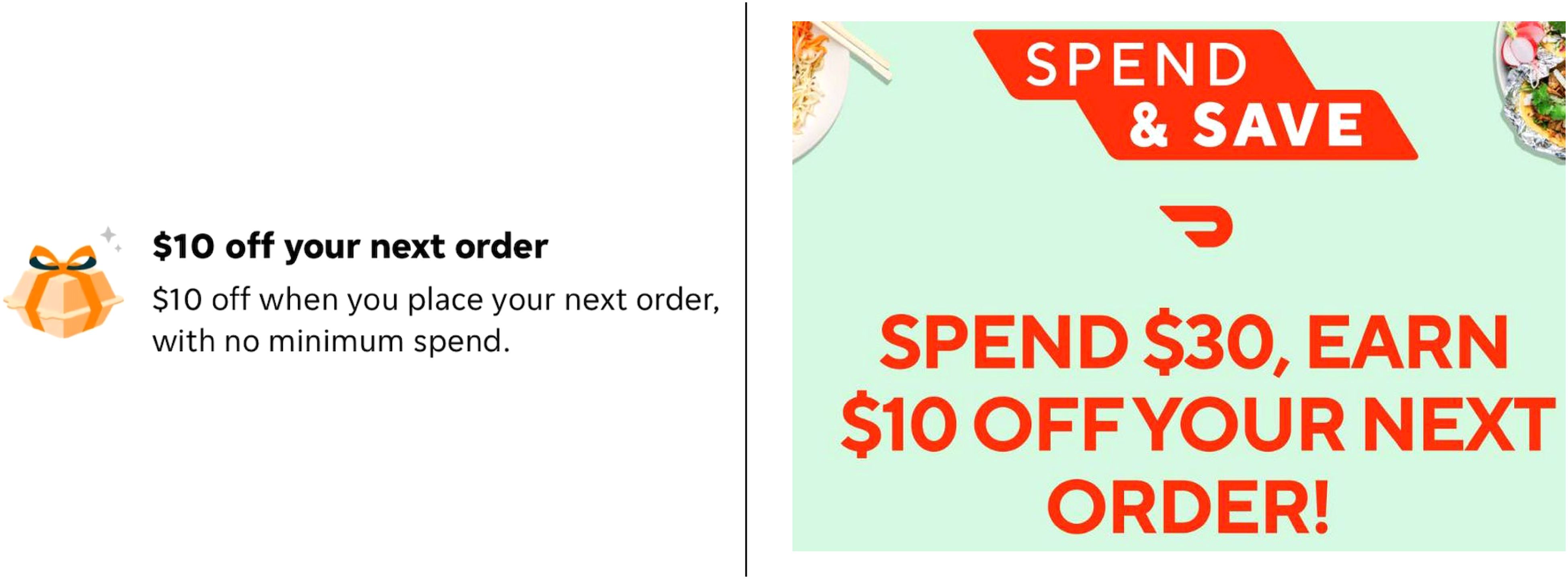
Price Promotions from SkipTheDishes (Left) and DoorDash (Right).
How do these preconditions influence customer acquisition? To explore this question, we surveyed marketing professionals on Centiment. We asked them which promotion for an electronics store they thought would attract more customers to visit and redeem the offer: “save $20 on any purchase” or “save $20 on any purchase above $40.” Only 17% of marketing professionals predicted that the latter, restricted promotion, would lead to more redemptions. Similarly, in a separate survey of lay consumers on Prolific, just 10% made the same prediction (details for both surveys are provided in Web Appendix C). Yet, across multiple lab and field studies, we consistently find support for the opposite: A precondition can increase potential consumers’ intentions to shop at the store and redeem the promotion if it is set below consumers’ typical spending amount.
Why might a promotion with a precondition be more attractive to consumers than one without such a restriction? To answer this question, this research introduces a new perspective on the role of preconditions, through the lens of reference effects (Thaler 1985). We propose that a precondition serves as an external reference point, altering consumers’ perceptions of the discount's magnitude and, in turn, influencing their intention to redeem the promotion. The perception of discount magnitude is critical because it plays an important role in how consumers evaluate the attractiveness of a price promotion and decide whether to redeem it. The theoretical rationale of our proposition comes from the finding that consumers often judge the value of a price discount by comparing it with a reference point, which may be either external or internal. External reference points (ERPs) are observed information (Mayhew and Winer 1992), such as seeing the prices of smartphones on a website, whereas internal reference points (IRPs) are developed from experience and based on memory, such as the prices someone has previously paid for smartphones. People tend to use an IRP as a default to evaluate a target unless an ERP is available (Biswas and Blair 1991). For example, when seeing the price of a smartphone, consumers will judge how expensive it is with respect to previous prices they have seen, unless another smartphone price is immediately at hand for comparison.
Building on these findings, we propose that a precondition acts as an ERP that shifts consumers’ reference point. For example, consider a $2 price discount offered by a department store. When the discount is unrestricted, consumers will compare $2 with an IRP, such as how much they typically spend at the department store. A survey we conducted indicated that the typical spending of U.S. consumers at a department store is approximately $42 (Web Appendix D), so a $2 off discount might be compared with $42 and feel like a 5% discount ($2/$42 ≈ 5%). Conversely, when the $2 off discount is exclusive to purchases above $4, consumers might compare the $2 discount with the $4 precondition and perceive the discount as 50% off ($2/$4 = 50%). Therefore, a precondition acts as an ERP that alters the perceived magnitude of a discount, and whether it increases or decreases the perceived magnitude may depend on whether it is below or above the IRP.
This research makes three key contributions to theory. First, it advances the literature on price promotions by offering the first investigation into the role of preconditions as ERPs and how this influences consumer reactions to restricted versus unrestricted promotions. We contribute to theory by providing this novel phenomenon-to-construct mapping (Lynch, Van Osselaer, and Torres 2025). This insight not only reveals a specific mechanism through which a precondition affects consumers’ assessment of restricted versus unrestricted price promotions but also enables the modeling of when and how a precondition may influence consumer reactions. Specifically, this new lens uncovers a key contingency under which preconditions either increase or decrease redemption intention: the relative magnitude of the precondition compared with consumers’ IRP. This reference effect perspective offers important insights into Inman, Peter, and Raghubir’s (1997) finding that preconditions accentuate deal evaluations and redemption intentions, while the specific mechanism behind the effect remained unclear in their study. Our reference effect perspective provides a theoretical explanation for this phenomenon. Furthermore, this perspective, in particular the key contingency of the precondition relative to consumers’ IRP, helps explain why previous studies have found both positive (Inman, Peter, and Raghubir 1997) and negative (Gneezy 2005) effects of preconditions on redemption intentions.
Second, the current research contributes novel moderators of the effects of preconditions (vs. promotions without preconditions). In addition to revealing the relative magnitude of the precondition to the IRP as a key contingency, we also (1) find that the effect is attenuated when the IRP is made more accessible in memory (e.g., when consumers plan or think more carefully about their purchase), as this makes the IRP less likely to be overridden by external frames of reference. Furthermore, the effect of preconditions is eliminated when (2) the magnitude of a discount is already explicit in relative terms (e.g., presented as a percentage), which eliminates the possibility for an ERP to influence magnitude perception. Finally, we find that (3) the effect of a precondition on discount magnitude perceptions can alternatively be induced by a product category restriction of equivalent value (e.g., when a promotion applies only to a product category that costs about the same as the precondition), and the effect of adding a precondition is attenuated when an equivalent value reference is already present.
Third, this research contributes to the existing literature on reference effects in consumer decision making. The marketing literature has demonstrated reference effects in price perceptions and deal perceptions (Biswas, Wilson, and Licata 1993; Krishna et al. 2002; Monroe 1973), such as those induced by adding an externally supplied frame of reference. For example, contrasting a competitor's price with a marketer's lower sale price leads to a higher perceived benefit (Compeau, Grewal, and Chandrashekaran 2002). Other reference effects are caused by reframing the existing information. For example, when presenting a double discount (e.g., taking 10% off, followed by an additional 40% off), the first discount serves as a reference point for the second and influences overall deal evaluations (Davis and Bagchi 2018; Gong, Huang, and Goh 2019). In either case, the reference point does not objectively alter the subject of the evaluation (the marketer's price in the former example and the double discount in the latter). The current research expands the previous literature on reference effects by showing that an externally supplied reference point can lead consumers to react more positively to a dominated option (i.e., worse on at least one attribute and no better on any other attribute), thus demonstrating a novel dominance violation of rational choice.
Our research also offers valuable insights for practitioners by identifying a strategy to enhance the conversion of promotions to purchases. Retailers often advertise price discounts, which are featured on platforms like Coupons.ca and Couponfollow.com, popular websites in Canada and the United States for discovering retailer discounts and deals. We examined the price discounts listed on these two sites and found that 60% of the dollar discounts had no preconditions (see Web Appendix B for details and distributions across industries). According to our earlier survey of marketing professionals, many assume that discounts without preconditions will lead to more purchase conversions compared with their restricted counterparts. However, our findings suggest this is not always the case. In fact, retailers can potentially increase the effectiveness of these promotions for purchase conversion by strategically adding a precondition that falls below consumers’ IRPs. Furthermore, as such preconditions do not reduce spending amount (at least, not in the context we studied, discussed next), they can be used to increase not only purchase intention but total revenue as well.
The remainder of the article is organized as follows: First, we review the literature on precondition promotions and reference effects to provide theoretical support for our hypotheses. Next, seven lab experiments and one field study demonstrate the proposed effect, the underlying psychological process, and the moderators. We conclude with a discussion of the implications for theory and practice.
Conceptual Background
Deal restrictions have been shown to produce positive consumer reactions (Aggarwal and Vaidyanathan 2003; Inman, Peter, and Raghubir 1997), although sometimes they can also lead to negative consequences (Cheng and Stadler Blank 2025; Kristofferson et al. 2017). As summarized by Inman, Peter, and Raghubir (1997), deal restrictions can take three different forms: quantity restrictions (e.g., “$2 off, applicable to no more than five purchases per consumer”), time restrictions (e.g., “$2 off, deal expires in two days”), or purchase preconditions (i.e., minimum spending, such as “$2 off an order above $5”). The present research focuses on the latter type of restriction, preconditions.
Precondition Promotions
Despite being a common marketing strategy, preconditions have received limited attention from researchers. Prior research has primarily examined the impact of preconditions in four domains: how they influence redemption intention, shopping experience, spending amount, and customer loyalty (Web Appendix E presents a summary table). Like our study, some previous research has focused on how preconditions affect consumers’ intentions to redeem promotions and make purchases. Specifically, Inman, Peter, and Raghubir (1997) found that preconditions increase deal evaluations and redemption intentions compared with a promotion without preconditions, but a specific psychological mechanism behind this effect was unclear. The authors suggested that the three types of deal restrictions may influence consumer information processing in distinct ways and called for further research to gain deeper insights into the psychological process involved. Gneezy (2005) also investigated redemption and purchase intentions but focused on perceived deal fairness as the underlying mechanism. The author conceptualized a store coupon as a “gift” from a store to consumers and viewed a store coupon with a precondition as a “gift with restrictions.” Expanding previous research on gifting in a social context to a marketing context, the author found that adding a precondition to a store coupon leads consumers to perceive the “gift” as unfair and thus reduces their intentions to redeem the coupon in the store.
This stream of research leaves two key questions unanswered. First, what psychological mechanism might explain the accentuating effect of preconditions on deal evaluation and redemption intention, as proposed and demonstrated by Inman, Peter, and Raghubir (1997)? Second, why do previous studies observe opposite findings? Specifically, Inman, Peter, and Raghubir’s argument that deal restrictions, in general, have a positive effect does not explain the negative impact of preconditions on purchase intentions found by Gneezy (2005), and Gneezy's unfairness account also cannot account for Inman, Peter, and Raghubir's findings. Given that consumer behavior is generally multiply determined (Kirmani 2015; Pham 2013), both psychological mechanisms may play a role in the context of preconditions, but is there a theoretical perspective that can explain why preconditions sometimes boost and sometimes hinder purchase intentions? If so, what is the key contingency condition?
These questions motivate the current research and lead us to investigate a distinct role that preconditions play: They serve as ERPs that shift consumers’ reference point and thus shape consumers’ perceptions of discount magnitude. Our theorizing starts from the observation that preconditions possess a unique property: congruence of units. To illustrate, consider three types of restrictions (in the context of a food delivery app): (1) $2 off, five orders max per consumer, (2) $2 off, this weekend only, and (3) $2 off, minimum spending of $5. The precondition (“minimum spending of $5”) is unique in that it is denominated in the same unit as the discount itself ($2). Therefore, we posit that a precondition creates a salient reference point, which is defined as a stimulus with which other stimuli of the same category are compared (Rosch 1975).
The Reference Effect
Prior research has established that consumer evaluations of price discounts are not absolute. Instead, their assessments are often affected by various contextual factors, influencing the deal's appeal. In particular, research has shown that the perceived value of a price promotion is often based on an assessment of the discount value relative to a reference point (Monroe 1973). For example, comparing a lower selling price with a higher advertised reference price (e.g., “was $200, now $150”) tends to enhance buyers’ value perceptions (Grewal, Monroe, and Krishnan 1998). This observation is consistent with prospect theory (Kahneman and Tversky 1979), which specifies that outcomes are often evaluated as gains or losses with respect to a reference point.
Researchers have identified two broad types of reference points, namely external and internal. ERPs are directly observed pieces of information present in the decision-making environment (e.g., the regular retail price presented next to the discount price; Kumar, Karande, and Reinartz 1998; Mayhew and Winer 1992). In contrast, IRPs are not present in the immediate environment but are developed from experience and based on memory (e.g., what consumers believe to be the typical price for a smartphone; Biswas, Wilson, and Licata 1993; Kalyanaram and Little 1994). Since an ERP is an observed stimulus, it is precise and objective, whereas an IRP tends to be more subjective and flexible (Biswas, Wilson, and Licata 1993; Jacobson and Obermiller 1990). Furthermore, research has shown that in the absence of an ERP, people tend to use an IRP as a default to evaluate a target; however, people adjust their reference point accordingly if an ERP is available (Biswas and Blair 1991; Chandrashekaran and Grewal 2006; Lichtenstein and Bearden 1988). For example, in a field study, researchers found that contextual reference prices present in the shopping environment tend to have a stronger effect than consumers’ IRPs due to the primacy of contextual factors (Rajendran and Tellis 1994).
Building on prior work regarding reference effects in decision making, we propose that a precondition serves as an ERP. This will increase or decrease the relative magnitude of the discount as perceived by consumers, depending on the difference between the ERP and IRP. To illustrate, consider a “$2 off” discount for a grocery store. When the price discount is unrestricted, consumers will compare $2 with their IRP. Given that an IRP often reflects some “weighted average” of past experiences (Emory 1970; Urbany, Bearden, and Weilbaker 1988), we believe one salient IRP in the context of our study (which is concerned with store price discounts) should be how much consumers typically spend at the store. If a consumer typically spends $10 at the grocery store, the consumer will evaluate the $2 discount against $10 and perceive the discount as roughly 20% off ($2/$10 = 20%). To support our argument that consumers are aware of and use store-level IRPs when encountering an unrestricted price discount, we conducted supplementary study S1, in which we used a between-participants design to compare deal evaluations of a $5 off discount for a grocery store or a furniture store. If consumers just view price discounts as a positive attribute without attending much to the size of the positive benefit, then deal evaluations should be comparable across conditions. Conversely, if consumers possess usable IRPs, then given that a typical purchase at a furniture store costs more than that at a grocery store, the offer will be evaluated less favorably in the furniture store condition, which was confirmed by the results (p < .001, d = 2.83; details are reported in Web Appendix F).
However, if consumers can only apply the $2 off discount on a purchase above $5, they will be more likely to compare $2 to $5 and perceive the deal as a 40% discount ($2/$5 = 40%). Therefore, a precondition provides a more explicitly defined frame of reference, which shifts consumers’ reference point, thereby altering their perception of the magnitude of the discount and their evaluations of the price promotion (more precisely, we posit that preconditions as ERPs partly or completely override IRPs). Formally, our hypotheses are as follows:
Beyond the magnitude of the precondition relative to consumers’ IRP as a key contingency condition that moderates the effect of preconditions, our theoretical framework introduces three additional moderators. First, the effect should depend on the likelihood that consumers’ IRPs are influenced by the ERP. Prior research suggests that the extent to which consumers rely on an IRP when making decisions depends on the accessibility of the IRP in memory—that is, how easily consumers can recall or access this information (Mazumdar, Raj, and Sinha 2005). ERPs, which are immediately available in the decision-making environment, are highly accessible, whereas IRPs, which must be retrieved and constructed from memory, are less so (Hamilton 2023). In general, more accessible information tends to exert greater influence on consumer judgments (Biehal and Chakravarti 1983). When an IRP is made more accessible in memory, consumers are more likely to use it and less likely to be influenced by ERPs (Mazumdar and Papatla 2000). Given these findings, we expect the impact of preconditions to depend on the accessibility of consumers’ IRPs.
Third, we have argued that a precondition introduces an ERP into the decision-making environment (which is absent in an unrestricted price discount). This suggests that other types of deal restrictions that may introduce ERPs (such as a product category restriction) should have a comparable effect, and therefore the effect of adding a precondition should be attenuated when another reference point of equivalent value is already present in the environment (e.g., when a promotion applies only to a product category that costs the same as the precondition), because it limits the extent to which the precondition can induce a novel reference effect.
Overview of Studies
Eight studies test our hypotheses and demonstrate a violation of rational consumer choice. Studies 1a and 1b examine our hypothesis that a precondition serves as an ERP that influences consumers’ perceptions of a discount's magnitude and, in particular, that the effect is contingent on whether the precondition is below or above the IRP (H1, H2). We manipulate the magnitude of preconditions relative to consumers’ IRP using different methods. In Study 1a, we vary the precondition cutoff while keeping consumers’ IRP unchanged, whereas in Study 1b, we manipulate the IRP and hold the precondition cutoff constant.
In the following studies, we focus on preconditions that fall below consumers’ IRP—a scenario that is both theoretically and managerially important, where a dominated option elicits more favorable consumer responses than a dominating one. Study 2 demonstrates a positive effect of preconditions on enhancing online promotion ad engagement using Facebook ads. Study 3 provides direct evidence for our proposed mechanism, which posits that a precondition leads people to perceive a discount in relative terms. We test a serial mediation path: The precondition increases people's perceived discount percentage, which in turn raises their perceived discount magnitude, ultimately resulting in higher redemption rates. Study 4 extends the basic effect: Due to biased perceptions of discount magnitude, a precondition can make a price promotion with a lower dollar discount more appealing than an unrestricted promotion with a higher dollar discount (e.g., a $1 off discount with a $2 precondition vs. a $2 off discount with no precondition), demonstrating a novel dominance violation.
In Studies 5, 6, and 7, we examine three theory-driven moderators. Specifically, Study 5 demonstrates that the effect is attenuated when consumers’ IRP is made more accessible (H3). Study 6 shows that the effect diminishes when the discount's magnitude is already explicit in relative terms (H4). Study 7 reveals that a product category restriction can be used to create an ERP and produce similar effects on perceived magnitude as a precondition, thus extending the phenomenon. Furthermore, Study 7 shows that the impact of adding a precondition is attenuated when another equivalent value reference is already present (H5).
To gauge consumers’ IRPs, we conducted separate pretests in which participants estimated how much they typically spend at different stores (Web Appendix D). The smoothed mode (identified using the maximum kernel density estimate) of participant reports was used to identify the most common IRP, described in each study as appropriate. We preregistered all experiments at AsPredicted.org, and no participants were excluded from the analysis. Rationales for sample sizes are included in Web Appendix G. All preregistrations, study materials, data, and analysis syntax are available at OSF (https://osf.io/wc57a/).
Study 1a: Manipulating the Proposed ERP
In Study 1a, we manipulate precondition cutoffs and provide initial evidence for our proposition that preconditions are ERPs that influence the magnitude of a discount as perceived by consumers. Specifically, we predicted that setting a precondition below consumers’ IRP would enlarge the perceived magnitude of the discount and enhance intentions to redeem the promotion compared with both (1) its unrestricted counterpart and (2) a precondition above consumers’ IRP. This study was preregistered (https://aspredicted.org/s8d3-933t.pdf).
Method
Participants and design
One thousand eight hundred one U.S. participants from Prolific took part in the study (Mage = 40.77 years; 55.4% women, 42.5% men, 1.9% nonbinary, .1% other, .2% prefer not to answer). We randomly assigned participants to one of three precondition conditions (below IRP vs. above IRP vs. unrestricted control) in a between-participants design.
Procedure
Participants were asked to imagine that they found a coupon in a flyer for a supermarket. In the unrestricted condition, the promotion was “$3 off.” In the below-IRP and above-IRP conditions, the promotion was “$3 off a $6 purchase” and “$3 off a $20 purchase,” respectively. All participants in this study were from the United States. In a separate survey, we estimated U.S. consumers’ IRP for supermarkets to be $13.40 (Web Appendix D). The $6 cutoff is below their IRP, and the $20 cutoff is above their IRP. Participants first indicated how large they thought the discount was (1 = “very small,” and 7 = “very big”), and then reported how likely they were to visit the store to redeem the promotion (1 = “very unlikely,” and 7 = “very likely”).
Results and Discussion
Perceived discount magnitude
One-way ANOVA revealed a significant difference in perceived magnitude of the discount between conditions (F(2, 1,798) = 494.61, p < .001). Pairwise comparisons (least significant difference tests) revealed that participants in the below-IRP-cutoff condition perceived the discount to be larger compared with those in the unrestricted control condition (Mbelow IRP = 5.69, SD = 1.07; Munrestricted = 3.88, SD = 1.51; t(1,197) = 23.88, p < .001, d = 1.38) and compared with those in the above-IRP-cutoff condition (Mabove IRP = 3.44, SD = 1.31; t(1,199) = 32.51, p < .001, d = 1.88). Additionally, participants in the above-IRP-cutoff condition perceived the discount to be smaller compared with those in the unrestricted condition (t(1,200) = 5.35, p < .001, d = 0.31).
Redemption intention
Similarly, one-way ANOVA showed a significant difference in redemption intentions between conditions (F(2, 1,798) = 144.94, p < .001). Pairwise comparisons (least significant difference tests) showed that participants in the below-IRP-cutoff condition were more likely to visit the store to redeem the coupon compared with those in the unrestricted control condition (Mbelow IRP = 5.84, SD = 1.25; Munrestricted = 4.74, SD = 1.68; t(1,197) = 12.85, p < .001, d = 0.74) and compared with those in the above-IRP-cutoff condition (Mabove IRP = 4.39, SD = 1.64; t(1,199) = 17.16, p < .001, d = 0.99). Additionally, participants in the above-IRP-cutoff condition were less likely to redeem the coupon compared with those in the unrestricted control condition (t(1,200) = 3.62, p < .001, d = 0.21).
Mediation
Mediation analysis using PROCESS Model 4 (5,000 bootstrapped samples; Hayes 2018) showed that perceived magnitude mediated the differences in redemption intention between the below-IRP-cutoff condition and unrestricted control condition (indirect effect = 1.12, SE = .07, 95% CI = [.98, 1.26]; direct effect p = .791), between the below-IRP-cutoff condition and above-IRP-cutoff condition (indirect effect = −1.45, SE = .09, 95% CI = [−1.62, −1.28]; direct effect p = .949), and between the above-IRP-cutoff condition and unrestricted control condition (indirect effect = −.14, SE = .03, 95% CI = [−.20, −.09]; direct effect p = .456). Path coefficients are reported in Web Appendix H.
Although the three price promotions offer the same dollar discount, consumers’ perceived discount magnitude and redemption intention differ across conditions. Importantly, the effect is contingent on the relative magnitude of the precondition and the IRP. Study 1a suggests that a precondition is an ERP that resets consumers’ discount magnitude calculus. One limitation of this study is that the order of measurement between the mediator and the dependent variable was not counterbalanced. In the next study, as well as in most of the subsequent studies, the order was counterbalanced.
Study 1b: Manipulating the IRP
We aimed to provide additional process evidence by manipulating the relative magnitude of the IRP and precondition using a different method. In Study 1a, we did this by changing the precondition cutoff. In Study 1b, we keep the precondition constant across conditions while manipulating consumers’ IRP. Additionally, we address alternative explanations for the effects observed in Study 1a. One such explanation is that a purchase precondition below the IRP might lead some consumers to believe they can exploit the discount by splitting their purchases into smaller parts, curating each around the purchase precondition, and using the promotion repeatedly. This intended use of the coupon could contribute to the increased perceived discount magnitude observed in Study 1a. In this study, we preclude this by explicitly limiting the promotion to a single use. Another potential alternative explanation is that consumers may think unrestricted promotions would allow them to obtain low-priced merchandise for free, leading them to perceive these unrestricted promotions as too good to be true, lowering their evaluation of the promotion. In this study, we eliminate this possibility by strategically setting the store's products and prices to avoid this. If the effect persists, it would provide evidence against these alternative explanations. This study was preregistered (https://aspredicted.org/yqbf-vr58.pdf).
Method
Participants and design
Four hundred eight students from the University of British Columbia took part in the study (Mage = 19.96 years; 62.3% women, 36.0% men, .5% nonbinary, .5% other, .7% prefer not to answer). We used a 2 (IRP: above vs. below the precondition) × 2 (precondition: restricted vs. unrestricted control) between-participants design and randomly assigned participants to conditions.
Procedure
Participants were told that the study aimed to understand how people process information in the marketplace. They were shown a menu from a Japanese restaurant named Umami Haven, which contained ten dishes and their prices (see Web Appendix I for the stimuli). The items were identical across conditions. In the IRP-below-the-precondition condition, the prices were [$11.00, $9.00, $10.50, $9.50, $11.00, $9.00, $10.00, $9.50, $10.50, $10.00], averaging $10. In the IRP-above-the-precondition condition, the prices were [$31.00, $29.00, $30.50, $29.50, $31.00, $29.00, $30.00, $29.50, $30.50, $30.00], averaging $30. Notably, the shape of the price distribution was constant across conditions, with the only difference being the distribution mean. This design helps prevent alternative explanations related to different distribution skewness based on range frequency theory (Parducci 1965). After viewing the menu, participants were told that they would answer some questions about this restaurant later in the session and were instructed to proceed to the next study in the session, which was unrelated in topic and served as a distraction task. It lasted about 15 minutes. Thus, after this delay and distraction, the previously “external” menu prices became IRPs in the minds of the participants.
The study resumed after the distraction task. Participants were then asked to imagine that they received a coupon from the Umami Haven restaurant in their mailbox, which allowed for “one coupon per order.” In the restricted condition, the coupon offered “$5 off a $15 order,” with the precondition being 50% higher than the low IRP and 50% lower than the high IRP. In the unrestricted condition, the coupon offered “$5 off.” Participants rated (in counterbalanced order) how large they thought the discount was (1 = “very small,” and 7 = “very large”) and how likely they would be to visit the restaurant to redeem the coupon (1 = “very unlikely,” and 7 = “very likely”).
Results and Discussion
Perceived discount magnitude
A 2 × 2 ANOVA revealed a significant main effect of IRP size (Mabove precondition = 3.48, SE = .10; Mbelow precondition = 4.81, SE = .10; F(1, 404) = 87.75, p < .001,
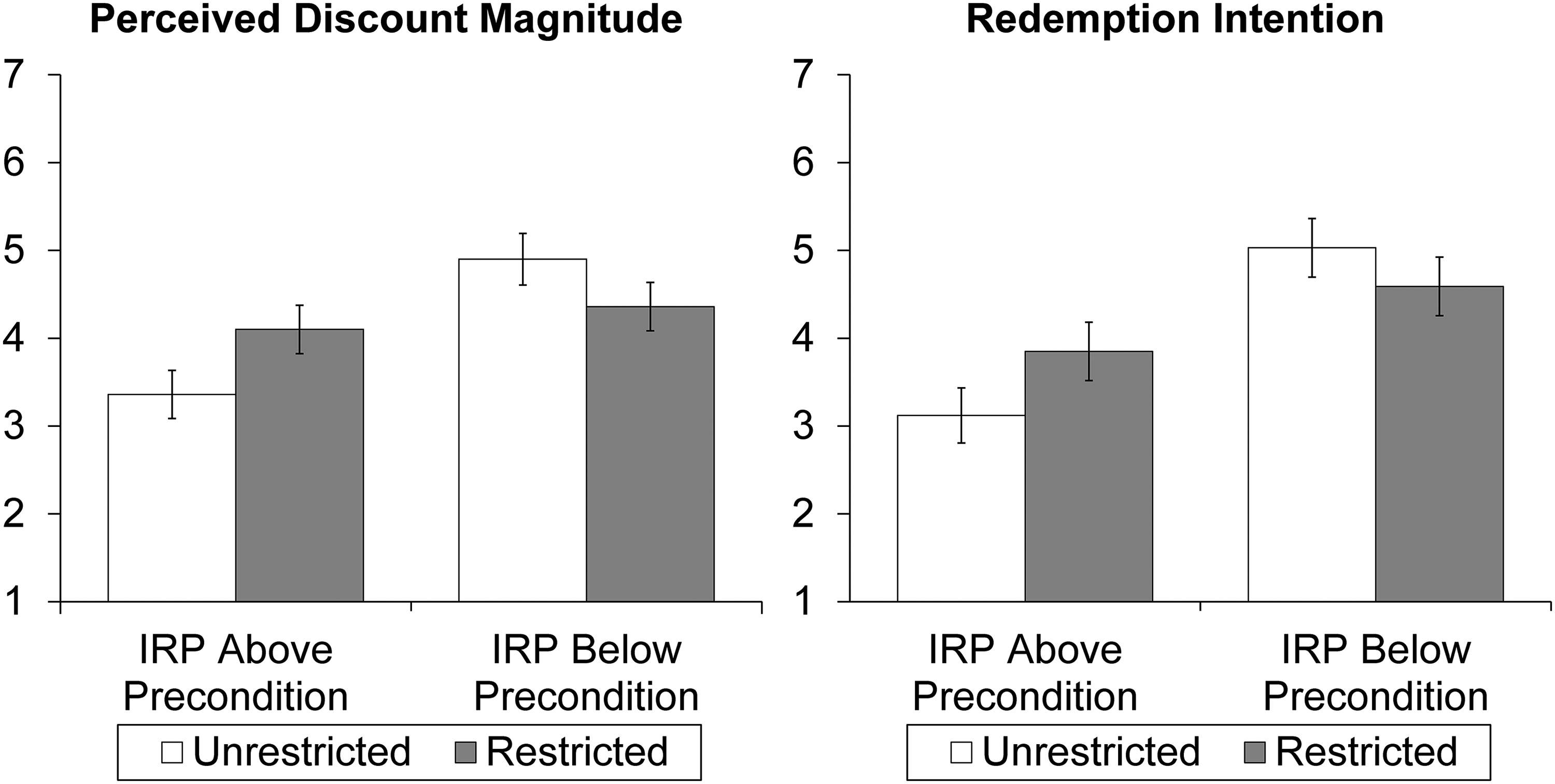
Study 1b: Mean Perceived Discount Magnitude and Redemption Intention as a Function of IRP Size and Precondition.
Redemption intention
A 2 × 2 ANOVA showed a significant main effect of IRP size (Mabove precondition = 3.73, SE = .12; Mbelow precondition = 4.63, SE = .12; F(1, 404) = 29.47, p < .001,
Mediation
A moderated mediation analysis using PROCESS Model 7 (5,000 bootstrapped samples; Hayes 2018) showed that IRP size moderated the indirect effect of precondition on redemption intention through discount magnitude (index of moderated mediation = .71, SE = .19, 95% CI = [.35, 1.10]). There was a positive indirect effect when the IRP was above the precondition (indirect effect = .44, SE = .13, 95% CI = [.19, .71]). However, the sign of the indirect effect was reversed when the IRP was below the precondition (indirect effect = −.27, SE = .12, 95% CI = [−.51, −.03]).
Using different manipulations of the relative magnitude between the IRP and precondition, Studies 1a and 1b provide evidence that preconditions serve as ERPs that shape how large consumers perceive the discount to be, depending on whether it is above or below consumers’ IRP.
Study 2: Testing the Effect in the Field
Beginning with this study, we focus on preconditions below consumers’ IRP—the theoretically and managerially important case where a dominated restricted option generates more positive consumer reactions than a dominating unrestricted option. We field-tested consumer reactions to a $1 price discount ad for a grocery store with a precondition below their IRP (in a separate survey, we estimated U.S. consumers’ IRP for grocery stores to be $11.72; Web Appendix D). We posted different versions of a price promotion ad through Facebook Ads Manager and used its A/B test function to compare promotion ad engagement using click-through rates (CTRs) as a proxy. Note that due to the ad optimization algorithms used on Facebook, A/B tests cannot be used as a clean test of causal inference (Boegershausen et al. 2025). Rather, this study is intended as a case example to demonstrate the potential for real-world impact and provide managerial implications, as a complement to the previous, fully controlled studies. This study was preregistered (https://aspredicted.org/KBW_WTX).
Method
Participants and design
We created two price promotion ads in a between-participants design (precondition: restricted vs. unrestricted control). The audience was U.S. residents who were at least 18 years of age. We displayed the ads for five days and allocated 200 USD to each ad. Web Appendix J contains all technical details.
Procedure
Both ads had the following elements in common: the name of the ad sponsor, “Grocery Store Coupons” (a fictitious coupon website we created); the words “Get a coupon for your local grocery stores!” underneath; and a button inviting consumers to “LEARN MORE.” In the unrestricted control condition, the ad was a poster that read “$1 OFF,” while in the restricted condition, the ad was a poster that read “$1 OFF if you spend $2 or more.” People who clicked on the ad were redirected to another webpage and introduced to real coupon websites where they could receive coupons from local grocery stores.
Results and Discussion
The dependent variable was the CTR, defined as the number of link clicks divided by the number of impressions (Kupor and Laurin 2020; Mookerjee, Cornil, and Hoegg 2021). The ad in the restricted condition generated a CTR of 1.14% (479 link clicks and 42,148 impressions), which was higher than the CTR of .88% generated by the ad in the unrestricted control condition (429 link clicks and 48,833 impressions; z = 3.84, p < .001). More ad performance data is reported in Web Appendix J. Although the overall CTRs may appear low, they were consistent with the .90% average CTR of Facebook ads across all industries (Irvine 2022). Capturing naturalistic consumer behavior, Study 2 demonstrates that a precondition (below consumers’ IRP) can generate positive marketing outcomes.
Study 3: Preconditions Shape Perceived Discount Percentage
We have argued that a precondition makes consumers process the discount in a relative manner (e.g., a percentage) and thus shapes perceived discount magnitude. In Study 3, we aimed to provide a more direct test of our proposed mechanism by measuring perceived discount percentage in addition to perceived magnitude and tested a serial mediation model (precondition → perceived percentage → perceived magnitude → redemption) using an incentive-compatible design. This study was preregistered (https://aspredicted.org/nkyh-g85q.pdf).
Method
Participants and design
Four hundred four U.S. participants from Connect (Mage = 37.64 years; 56.4% women, 40.8% men, 2.5% nonbinary, .2% other) were randomly assigned to one of two conditions in a between-participants design (precondition: restricted vs. unrestricted control).
Procedure
Participants were informed that, as a token of appreciation for completing the survey, one participant would be randomly selected to receive a $50 bonus payment in addition to the study compensation. They were also told that the survey was conducted in collaboration with an online gift card store, Giftogram. Participants were shown a catalog of gift cards offered by Giftogram, which included many popular stores in the United States (see Web Appendix K for the stimuli). Participants learned that Giftogram was currently running a promotion where consumers could receive either a $1 discount on a purchase (in the unrestricted condition) or a $1 discount on a purchase of $2 or more (in the restricted condition). For most U.S. stores, available card denominations typically range from $20 to $500, so the $2 precondition was below participants’ IRP for gift cards. Participants were (truthfully) told that they had a small chance of receiving a large bonus payment and had the opportunity to use a portion of their bonus payment to purchase an e-gift card from Giftogram if they wished. If selected for the bonus, they would receive the e-gift card code (if they make a purchase) and any remaining unspent balance as a bonus payment through Connect (for example, if they spend $X to purchase a Sephora gift card, they will receive an e-gift card code and a $(50 − X) bonus payment), or they would receive their full bonus entirely in cash if they did not choose to purchase a gift card.
We counterbalanced the order in which the dependent variable (redemption) and the two mediators (perceived percentage → perceived magnitude) were measured. Redemption behavior was assessed with a yes/no item asking whether participants would like to make a purchase. To measure perceived discount percentage, participants were asked: “What percentage discount (%) do you think this promotion provides?” (0–100). Perceived discount magnitude was measured on a seven-point scale (1 = “very small,” and 7 = “very large”). At the end of the study, participants were again informed that if they were selected for the bonus payment, they would be contacted to finalize the gift card purchase if they had indicated that they would like to make a purchase.
Results and Discussion
Redemption
The precondition increased the promotion redemption rate (χ2(1) = 6.94, p = .008, Cramer's V = .13), which rose from 34% in the unrestricted condition to 47% in the restricted condition.
Perceived percentage
Participants in the restricted condition indicated that the promotion offered a larger discount in percentage terms (M = 31.50, SD = 21.30) compared with those in the unrestricted condition (M = 7.51, SD = 11.64; t(402) = 14.04, p < .001, d = 1.40).
Perceived magnitude
Participants perceived the restricted discount (M = 3.46, SD = 1.95) as larger than the unrestricted one (M = 1.91, SD = 1.18; t(402) = 9.67, p < .001, d = 0.96).
Mediation
We tested the proposed serial mediation path using PROCESS Model 6 (5,000 bootstrapped samples; Hayes 2018). The indirect effect of precondition on redemption via perceived percentage and perceived magnitude was significant (indirect effect = .88, SE = .19, 95% CI = [.56, 1.31]. Path coefficients are reported in Web Appendix H.
Using an incentive-compatible design, this study provides direct evidence for our proposed mechanism. Consistent with our theorizing, the presence of a precondition led consumers to perceive the discount as a larger percentage and, in turn, a larger overall discount, ultimately leading to a higher redemption rate.
Supplementary Studies: How Preconditions Affect Revenue
So far, our studies have focused on demonstrating the positive effect of below-IRP purchase preconditions on redemption intentions. A potential concern is that although below-IRP preconditions may increase redemptions, they could reduce consumers’ spending and total revenue. For example, consumers may opt for the cheapest product that qualifies for the promotion. We therefore examined implications of restricted promotions for overall revenue in supplementary study S2 (Web Appendix L). Revenue is a function of both the redemption rate and the spending of those who redeem the coupon, both of which were measured in this study. We used a similar incentive-compatible gift card purchase design as in Study 3, except that when presenting the gift card menu, we told participants that available denominations included $30, $40, and $50. Participants who indicated that they wished to make a purchase then selected one of the three denominations. Results showed that the precondition significantly increased redemption rates but did not significantly affect the spending level of those who redeemed the coupon. Consequently, the precondition significantly increased the average revenue generated by each distributed coupon. Moreover, among participants who made a purchase, 40% in the unrestricted condition and 34% in the restricted condition chose the lowest denomination ($30), suggesting that the precondition neither produced a majority choosing the cheapest option nor increased the proportion relative to the unrestricted condition.
In supplementary study S3 (Web Appendix M), we explored implications for consumer spending using a different design. Participants were asked to imagine receiving a supermarket coupon, and we used a between-participants design (restricted vs. unrestricted). In addition to redemption intention, participants indicated how much they expected to spend on a shopping trip if they were to redeem the coupon. Results again showed that the precondition significantly increased redemption intention but did not significantly influence anticipated spending. Taken together, these studies suggest that below-IRP preconditions do not necessarily reduce spending or revenue. We discuss these implications for spending further in the general discussion.
Study 4: A Precondition Can Make a Smaller Discount More Appealing Than a Larger One
The previous studies demonstrate that due to reference effects, a precondition below the IRP can increase consumers’ perceived magnitude of the discount compared with its unrestricted counterpart. One implication of this result is that due to biased discount magnitude perceptions, consumers may find a restricted price discount that offers a lower dollar discount more attractive than an unrestricted price discount that provides a higher actual dollar discount (e.g., a $1 off discount with a $2 precondition vs. a $2 off discount with no precondition). We test this novel “dominance violation” possibility in Study 4. This study was preregistered (https://aspredicted.org/L9H_MV6).
Method
Participants and design
Six hundred one U.S. participants from Prolific (Mage = 40.41 years; 49.1% women, 49.1% men, 1.5% nonbinary, .3% prefer not to answer) participated in the study. We randomly assigned participants to one of two between-participants conditions: precondition (restricted vs. unrestricted control).
Procedure
Participants were asked to imagine that they found a coupon in a flyer for a supermarket (in a separate survey, we estimated U.S. consumers’ IRP for supermarkets to be $13.36; Web Appendix D). In the unrestricted control condition, the coupon offered a “$2 off a product” discount, while in the restricted condition, the coupon offered a “$1 off a $2 product” discount. Participants first indicated how large they thought the discount was (1 = “very small,” and 7 = “very big”) and then reported how likely they were to visit the store to redeem the coupon (1 = “very unlikely,” and 7 = “very likely”).
Results and Discussion
Although the unrestricted price promotion strictly dominates the restricted one in terms of both dollar value and the absence of restrictions, participants rated the restricted discount as larger (Mrestricted = 5.50, SD = 1.34; Munrestricted = 3.82, SD = 1.35; t(599) = 15.24, p < .001, d = 1.24) and expressed stronger intentions of visiting the store to redeem the promotion (Mrestricted = 5.23, SD = 1.55; Munrestricted = 4.32, SD = 1.60; t(599) = 7.06, p < .001, d = 0.58). Mediation analysis using PROCESS Model 4 (5,000 bootstrapped samples; Hayes 2018) revealed that the perception of a larger discount mediated the effect (indirect effect = 1.08, SE = .10, 95% CI = [.89, 1.28]; direct effect p = .191). Path coefficients are reported in Web Appendix H.
This study demonstrates an extension of the basic phenomenon and provides further process evidence. Results suggest that a precondition below the IRP can increase the appeal of a price discount to the extent that an unrestricted price discount that offers a higher-dollar discount becomes less appealing. One way to interpret this phenomenon is transaction utility theory (Thaler 1983), which divides total utility into two components: transaction utility and acquisition utility. The reference effect makes the transaction utility large enough to overcome a lower acquisition utility, making the overall discount more attractive.
Study 5: The Effect Is Less Pronounced When the IRP Is Made More Accessible
Study 5 examines the moderation effect of IRP accessibility (H3), which refers to how easily consumers can recall or access such information (Mazumdar, Raj, and Sinha 2005). Prior research suggests that IRPs tend to be more accessible, and thus less likely to be influenced or overridden by external information, when consumers feel more certain about the price information they hold in memory, such as how much they need to spend for a certain purchase (Biswas and Blair 1991; Yadav and Seiders 1998). Building on this insight, we manipulated IRP accessibility by increasing participants’ certainty about their anticipated purchase and its associated cost. Specifically, we asked participants to list the items they would buy and estimate the total cost of their intended order. These tasks encourage participants to concretely simulate their upcoming purchase, thereby clarifying not only what they plan to buy but also how much they expect to spend. This process fosters a more accessible IRP, making it more likely to guide subsequent judgments. As a result, we expect the externally imposed precondition to exert less influence on perceived discount magnitude in this condition. This study was preregistered (https://aspredicted.org/g289-yknh.pdf).
Method
Participants and design
Using Connect's built-in screening function, we invited respondents who indicated in their profile that they use food delivery apps. Participants were unaware of this screening criterion. Six hundred respondents participated (Mage = 38.00 years; 46.0% women, 52.0% men, 1.7% nonbinary, .3% prefer not to answer). We randomly assigned participants to one condition in a 2 (IRP accessibility: relatively high vs. relatively low) × 2 (precondition: restricted vs. unrestricted control) between-participants design.
Procedure
Participants were asked to imagine that they are about to order a typical meal for delivery. Before providing further information, participants in the high-accessibility condition answered two additional questions. First, using a free-response format, they listed each item they would like to order. Then, they estimated and entered the total cost of their order, including taxes, tips, and delivery fees. Participants in the low-accessibility condition did not answer these questions. All participants were then asked to imagine that a new food delivery service was launching in their city, and they received a coupon code offering a discount. In the unrestricted condition, the coupon code offered $3 off. In the restricted condition, the coupon offered $3 off a $6 order. A national survey suggested that the average expenditure per order on the most popular food delivery apps in the United States is $34 (Reinblatt 2022), so the precondition was below the IRP. Participants rated (in counterbalanced order) how large they thought the discount was (1 = “very small,” and 7 = “very large”) and how likely they were to redeem the discount and order food through the new delivery service (1 = “very unlikely,” and 7 = “very likely”).
Results and Discussion
Perceived discount magnitude
A 2 × 2 ANOVA revealed a nonsignificant main effect of IRP accessibility (Mhigh = 3.83, SE = .09; Mlow = 4.04, SE = .09; F(1, 596) = 2.70, p = .101) and a significant main effect of precondition (Mrestricted = 4.71, SE = .09; Munrestricted = 3.17, SE = .09; F(1, 596) = 147.28, p < .001,
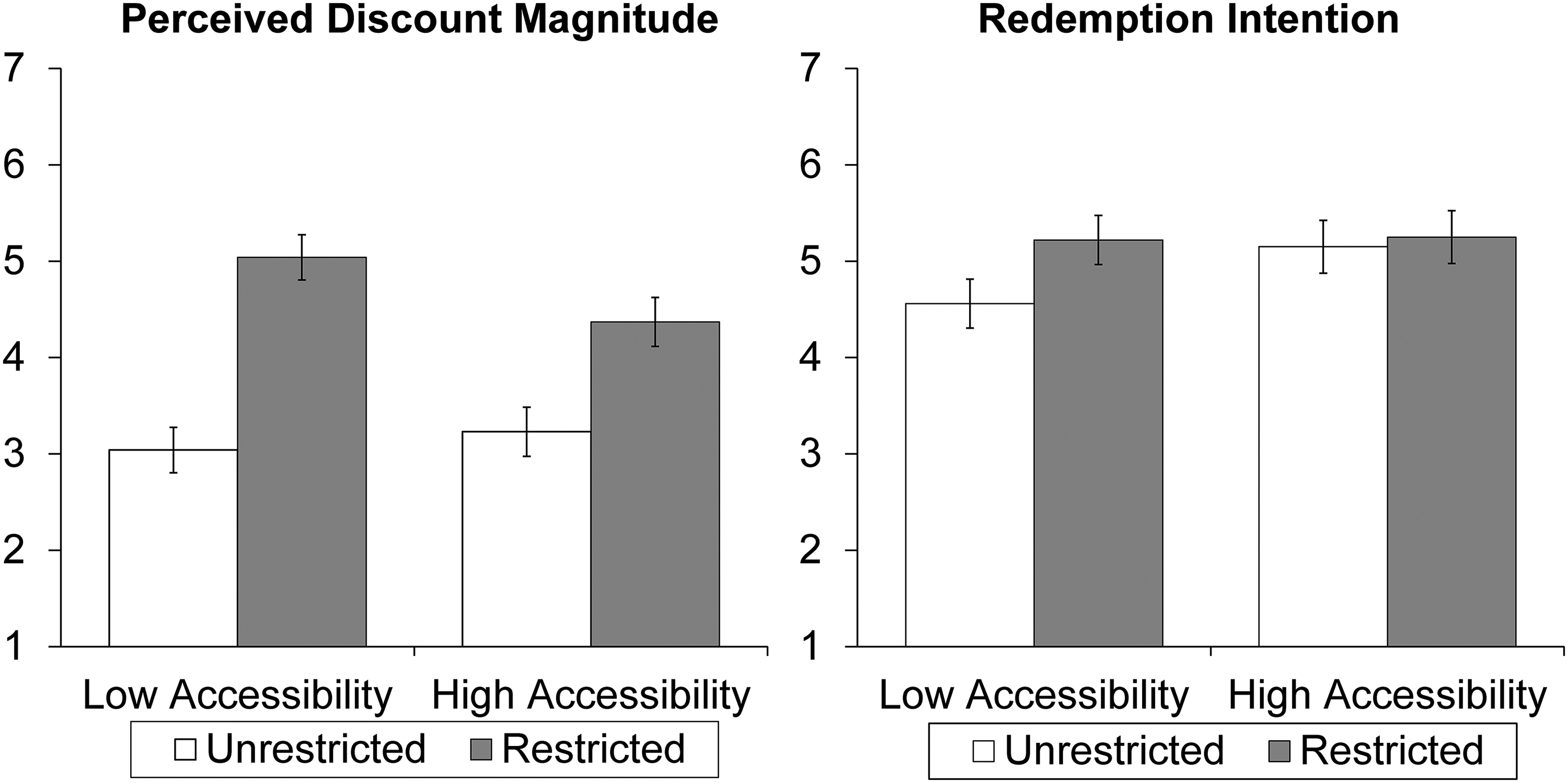
Study 5: Mean Perceived Discount Magnitude and Redemption Intention as a Function of IRP Accessibility and Precondition.
Redemption intention
A 2 × 2 ANOVA revealed a nonsignificant main effect of IRP accessibility (Mhigh = 5.20, SE = .10; Mlow = 5.04, SE = .09; F(1, 596) = 1.45, p = .229), and a significant main effect of precondition (Mrestricted = 5.39, SE = .10; Munrestricted = 4.85, SE = .10; F(1, 596) = 15.45, p < .001,
Mediation
Moderated mediation analysis using PROCESS Model 7 (5,000 bootstrapped samples; Hayes 2018) revealed that IRP accessibility moderated the indirect effect of precondition on redemption intention through perceived magnitude (index of moderated mediation = −.55, SE = .15, 95% CI = [−.86, −.25]). The indirect effect was significant in the low-IRP-accessibility condition (indirect effect = 1.17, SE = .13, 95% CI = [.93, 1.43]) but was attenuated in the high-IRP-accessibility condition (indirect effect = .62, SE = .12, 95% CI = [.40, .86]).
Building on our theoretical framework that preconditions function as ERPs that shift consumers’ reference point, this study demonstrates a theory-driven moderator: the accessibility of the IRP. In this study, we manipulated IRP accessibility by altering participants’ purchase certainty. Notably, other factors can also influence how accessible a consumer's IRP is. For instance, IRPs may be more accessible when consumers have recently (vs. a long time ago) shopped at a store. Likewise, IRPs may be more accessible among consumers with stable shopping habits (i.e., those who routinely purchase a similar basket of items on each trip). The results of this study suggest that including a below-IRP precondition as a strategy will have less impact in these situations.
Study 6: The Effect Diminishes When a Discount Is Already in Relative Terms
If a precondition below the IRP is an ERP that amplifies consumers’ perceived magnitude of the discount, then the effect should be attenuated when the magnitude of the discount is already explicit in relative terms (H4). In a retail context, this occurs when a price promotion offers a percentage (vs. absolute) discount, which already makes the relative magnitude of the discount explicit. Thus, we expect the effect to be attenuated for a percentage discount versus an absolute discount. To explore the generalizability of the effect, we test two percentages. Percentage one is the ratio of the absolute discount to the precondition, and percentage two is the ratio of the absolute discount to the IRP. Importantly, Study 6 does not aim to directly compare those three discount formats, as they are not inherently equivalent, but rather examines how the precondition differentially affects consumer perceptions within each format condition. This study was preregistered (https://aspredicted.org/jb7w-q3cm.pdf).
Method
Participants and design
One thousand five hundred two U.S. participants from Prolific (Mage = 41.42 years; 50.2% women, 48.6% men, .7% nonbinary, .1% other, .4% prefer not to answer) were randomly assigned to one of six conditions in a 3 (format: absolute vs. percentage based on the precondition vs. percentage based on the IRP) × 2 (precondition: restricted vs. unrestricted control) between-participants design.
Procedure
Participants were asked to imagine that they received a coupon for a department store near where they live (in a separate survey, we estimated U.S. consumers’ IRP for department stores to be $42; Web Appendix D). The coupon was limited to one-time use. In the absolute condition, the coupon offered either “$2 off any in-store purchase” or “$2 off any in-store purchase of $4 or more.” In the percentage-based-on-the-precondition condition, the coupon offered either “50% off any in-store purchase” or “50% off any in-store purchase of $4 or more.” In the percentage-based-on-the-IRP condition, the coupon offered either “5% off any in-store purchase” or “5% off any in-store purchase of $4 or more.” Participants then rated (in counterbalanced order) how large they thought the discount was (1 = “very small,” and 7 = “very large”) and how likely they were to redeem the coupon (1 = “very unlikely,” and 7 = “very likely”).
Results and Discussion
Perceived discount magnitude
A 3 × 2 ANOVA revealed a significant two-way interaction (F(2, 1,496) = 55.27, p < .001,
Redemption intention
Similarly, a 3 × 2 ANOVA showed a significant two-way interaction (F(2, 1,496) = 7.01, p = .001,
Mediation
We conducted moderated mediation analyses using PROCESS Model 7 (5,000 bootstrapped samples; Hayes 2018) with discount format as the moderator. As preregistered, we conducted two analyses, comparing the absolute condition with each percentage condition, respectively. Discount format moderated the indirect effect through perceived magnitude when comparing the $2 discount with the 50% discount (index of moderated mediation = −1.11, SE = .12, 95% CI = [−1.35, −.89]) and when comparing the $2 discount with the 5% discount (index of moderated mediation = −1.11, SE = .16, 95% CI = [−1.43, −.80]). Path coefficients are reported in Web Appendix N.
The results support preconditions’ role as ERPs that reset perceived discount magnitude and provide evidence against several alternative explanations. For example, it could be argued that a precondition draws consumers’ attention to the offer or makes the offer appear scarce, thus creating the perception that the discount is of higher value. Or, it could be argued that the precondition makes consumers think of a specific product (near the cost of the precondition level), improving the imaginability of the potential purchase and thereby making it more attractive. However, had the phenomenon been driven by these alternative explanations, the precondition in this study should have boosted perceived discount magnitude and redemption intentions in both the absolute and percentage format conditions, yet we found that it did so only in the absolute format condition. This study also provides important managerial implications, suggesting that when implementing below-IRP preconditions as a promotional strategy, the format of the promotion matters.
Study 7: Product Restrictions Can Also Serve as ERPs
So far, we have demonstrated that a precondition influences the magnitude of a discount as perceived by consumers. We argue that this phenomenon occurs because the precondition level acts as a numerical ERP (which is absent in an unrestricted price discount). This proposition implies that other deal restrictions that may act as ERPs could affect perceived magnitude in similar ways. For example, consider a promotion that offers $2 off a product above $4 and a promotion that offers $2 off a 12 oz bottle of juice. Although the category restriction (12 oz bottle of juice) does not provide a definite numerical benchmark in the way a precondition does, a pretest (Web Appendix O) shows that most consumers know how much a 12 oz bottle of juice costs, and the estimated IRP for this product category is $4, which is equivalent in value to the $4 precondition. Therefore, we expect the category restriction to produce a similar ERP effect as the $4 purchase precondition on consumers’ perceptions of discount magnitude. Of course, the category restriction may also turn off some consumers who are not interested in that category (e.g., some people do not want to buy juice), so we expect the equivalent value category restriction to primarily influence perceived magnitude rather than redemption intentions. Additionally, if a category restriction of equivalent value is already present, the effect of adding a precondition (i.e., $2 off a 12 oz bottle of juice vs. $2 off a 12 oz bottle of juice above $4) on perceived discount magnitude should be attenuated or entirely eliminated (H5) because the equivalent value category restriction limits the additional reference effect the precondition may induce. Study 7 was preregistered (https://aspredicted.org/hntt-hfbr.pdf).
Method
Participants and design
One thousand three hundred seven U.S. respondents from Prolific participated in the study (Mage = 41.57 years, 53.9% women, 43.5% men, 2.1% nonbinary, .4% other, .2% prefer not to answer). Participants were randomly assigned to one condition in a 2 (precondition: restricted vs. unrestricted control) × 2 (equivalent value category restriction as another reference: present vs. absent) between-participants design.
Procedure
Participants were asked to imagine that they found a $2 off coupon in a flyer for a supermarket (in a separate survey, we estimated U.S. consumers’ IRP for supermarkets to be $13.40; Web Appendix D). In the category-restriction-absent conditions, the coupon offered a discount of either $2 off or $2 off a product above $4. In the category-restriction-present conditions, the coupon offered a discount of either $2 off a 12 oz bottle of juice or $2 off a 12 oz bottle of juice above $4. Participants then indicated (in counterbalanced order) how large they thought the discount was (1 = “very small,” and 7 = “very big”) and how likely they were to go to the supermarket to redeem the coupon (1 = “very unlikely,” and 7 = “very likely”).
Results and Discussion
Perceived discount magnitude
A 2 × 2 ANOVA revealed a significant main effect of equivalent value category restriction (Mpresent = 5.02, SE = .05; Mabsent = 4.02, SE = .05; F(1, 1,303) = 190.10, p < .001,
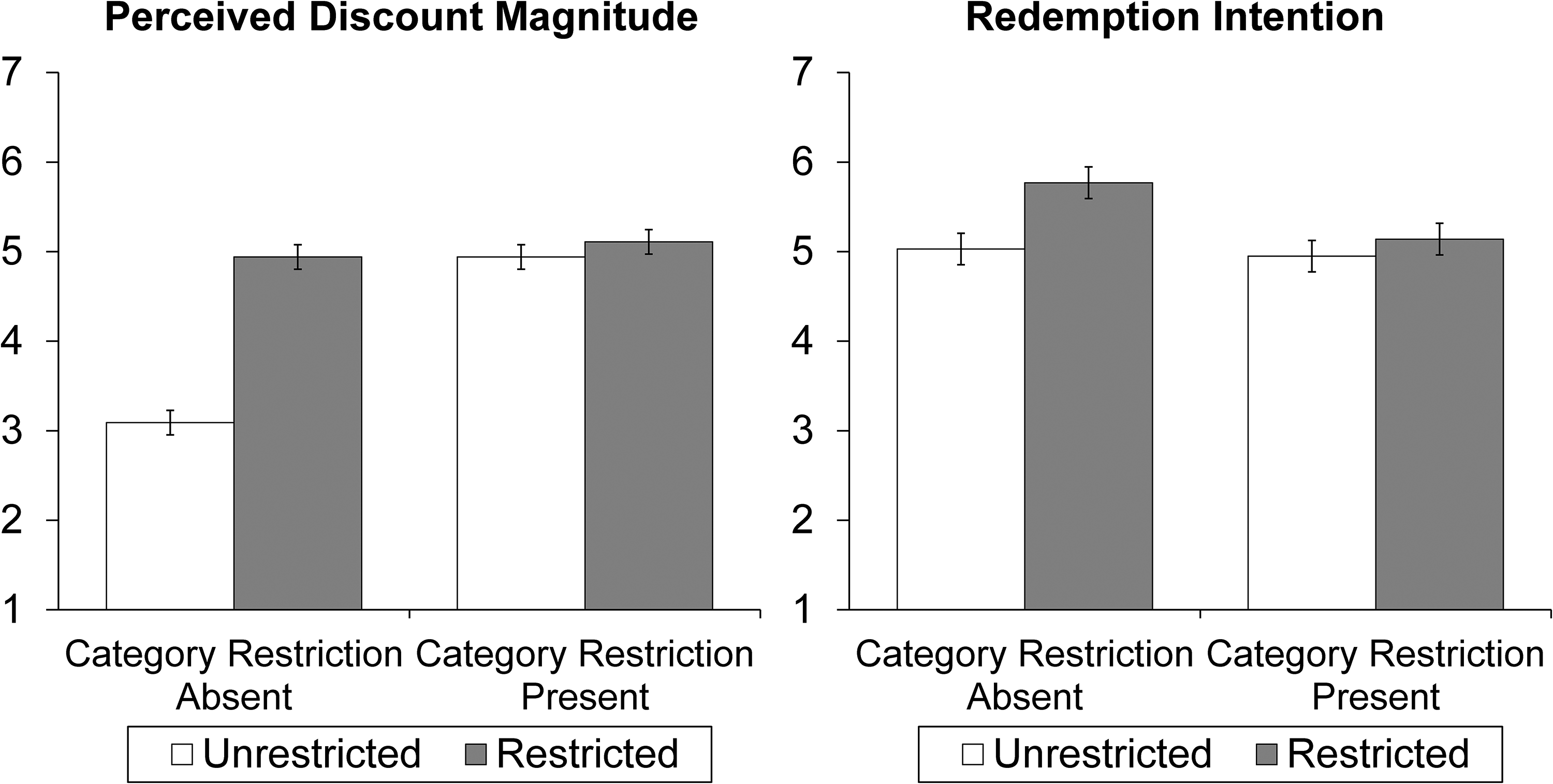
Study 7: Mean Perceived Discount Magnitude and Redemption Intention as a Function of Equivalent Value Category Restriction and Precondition.
Redemption intention
A 2 × 2 ANOVA showed a significant main effect of equivalent value category restriction (Mpresent = 5.05, SE = .07; Mabsent = 5.40, SE = .07; F(1, 1,303) = 14.33, p < .001,
Mediation
Moderated mediation analysis using PROCESS Model 7 (5,000 bootstrapped samples; Hayes 2018) suggested that equivalent value category restriction moderated the indirect effect of preconditions on redemption intention through perceived magnitude (index of moderated mediation = −.66, SE = .08, 95% CI = [−.82, −.51]). The indirect effect was significant when the category restriction was absent (indirect effect = .73, SE = .08, 95% CI = [.59, .88]) and nonsignificant when the category restriction was present (indirect effect = .07, SE = .04, 95% CI = [−.01, .14]). Path coefficients are reported in Web Appendix H.
When a price discount is accompanied by a product category restriction equivalent in value to a precondition, it produces a comparable ERP effect on discount magnitude perceptions, making the reference effect of adding the precondition less pronounced. Notably, the precondition in this study was intentionally set equal to consumers’ IRP for the product category for theory-testing purposes. Thus, the observed attenuation does not imply that preconditions are ineffective in all product-specific scenarios. More broadly, this study shows that the reference point lens can also be applied to product category restrictions, improving the external validity of this theoretic lens and also its usefulness for managers.
General Discussion
Retailers frequently advertise price promotions to consumers, and many of these promotions come with preconditions. The current research introduces the novel proposition that a precondition functions as an ERP, influencing consumer perceptions of the discount's magnitude. Whether the precondition enlarges or diminishes perceived discount magnitude depends on whether it falls below or above consumers’ IRP. Eight preregistered studies provide evidence for this reference point account, demonstrate theory-driven moderators, and examine various marketing outcomes, including promotion redemption intention, online promotion ad engagement, promotion redemption behavior, and revenue per distributed promotion.
Theoretical Implications
This research makes three key theoretical contributions. First, it advances the price promotions literature by providing a novel lens for examining preconditions, showing that they act as ERPs that influence discount magnitude perceptions. We make a theoretical contribution by mapping a common price promotion phenomenon to an important construct in consumer decision-making (i.e., a novel phenomenon-to-construct mapping; Lynch, Van Osselaer, and Torres 2025). This perspective is crucial as it provides a theoretical explanation for the accentuation effect of preconditions on deal evaluation and redemption intention (Inman, Peter, and Raghubir 1997) and helps explain why both positive (Inman, Peter, and Raghubir 1997) and negative (Gneezy 2005) effects of preconditions on redemption intention have been observed in previous studies. In fact, in supplementary study S4 (Web Appendix P), we used the same context (a university bookstore promotion) and participant population (university students) as in Gneezy (2005). We replicated the negative effect seen in Gneezy when the precondition was set above university students’ IRP for university bookstores, and reversed the effect when the precondition was set below the IRP. Additionally, given the easily quantifiable nature of this new perspective, it offers empirical and analytical modelers a new avenue for modeling this prevalent retail strategy.
Second, building on our proposed reference effect framework, this research reveals important moderators of the effect. Specifically, whether a precondition enlarges or diminishes perceived discount magnitude depends on a key contingency: whether the precondition is lower or higher than consumers’ IRP. Moreover, the extent to which a precondition influences discount magnitude perceptions is moderated by factors including the accessibility of the IRP, whether the discount magnitude is already explicit in relative terms, and whether another equivalent value reference is already present.
Third, we contribute to research on reference effects in consumer decision making. Existing research has shown that consumers’ evaluation of a marketing offer often depends on a reference point (Monroe 1973) and that marketers can leverage the reference effect to make their offers more appealing to consumers, for example, by contrasting their sale price with a competitor's higher sale price (Compeau, Grewal, and Chandrashekaran 2002) or by changing the order in which multiple discounts are presented (Davis and Bagchi 2018; Gong, Huang, and Goh 2019). In such situations, inducing the reference effect does not objectively alter the subject of the evaluation itself. Our work enriches the understanding of the reference effect in consumer behavior by documenting a situation in which an ERP generates more positive consumer reactions even though the option without it is the dominating option, documenting a novel violation of dominance.
Managerial Implications
From a managerial perspective, our research reveals that adding a precondition can be a tool for controlling discount magnitude assessment: By more precisely defining the discount calculus, below-IRP preconditions can increase the appeal of a price promotion advertised to consumers. For our research, we asked a random sample of participants how much they typically spend at a store and used the smoothed mode as an estimator for the most common IRP. In practice, retailers often have access to their customers’ purchase history, so they can make this tool more potent by individualizing the precondition for each consumer. Moreover, product category restrictions are an alternative means of introducing an ERP (if consumers know how much a product category typically costs) and thereby of influencing perceived magnitude (Study 7).
There are also boundary conditions that marketers should be aware of: Below-IRP preconditions do not significantly enhance redemption intentions when consumers’ IRPs are salient (Study 5), when a marketer offers a percentage rather than an absolute discount (Study 6), and when the precondition is applied to a product category for which consumers’ IRP is equal to the precondition (Study 7).
Notably, the managerial insights offered by the current research may seem opposite but are actually compatible with previous work. Lee and Ariely (2006) found that preconditions can serve as spending goals for people who were already shopping at a store, received a promotion with a precondition while in the store, and ultimately made a purchase. In one experiment, they discovered that this effect is more pronounced when shoppers receive the coupon at the store's entrance (i.e., early in the shopping process, when goals are less well-defined) compared with when they receive the coupon in the back aisles (i.e., later in the shopping process, when goals are more fixed). The authors argued that the reference effect, which may shape perceptions of discount magnitude and is the focus of our current research, is an unlikely mechanism for their findings, as it does not explain the interaction with the location of coupon distribution. Instead, they suggested that preconditions function as spending goals. Their findings suggest the benefits of setting preconditions higher, to increase per-customer spending. In contrast, the current preconditions-as-references lens suggests setting preconditions lower, to increase redemption intention.
These seemingly contradictory findings are, in fact, compatible because they focus on different marketing metrics. Lee and Ariely (2006) examined how much people spent among those who had already started shopping at a store and ultimately made a purchase. Thus, the question of whether a precondition would attract a potential consumer to shop at the store (i.e., customer acquisition) was irrelevant in their study. This managerially important metric, however, is the key focus of our research. While it is reasonable for a precondition to act as a spending goal for a shopper who received a promotion during the shopping process in a store, this may not apply when a potential consumer is deciding whether to shop at the store in the first place, such as when a consumer finds a price promotion in their mailbox and deliberates on whether it represents a good deal. Therefore, the preconditions-as-references perspective provides a novel theoretical lens and distinct managerial insights for a different marketing metric in the earlier stages of the marketing funnel (Strong 1925). It also responds to Lee and Ariely's call for future research to gain a deeper understanding of the complete set of inferences consumers can derive from conditional price promotions.
The optimal ERP
To further explore the most effective use of preconditions and provide additional managerial implications, we conducted two supplementary studies. Consider the following question: When holding the ratio of the base discount to the precondition constant (e.g., 50%), which restricted promotion ($1 off $2, $5 off $10, or $9 off $18) is most effective compared with its unrestricted counterpart ($1 off, $5 off, or $9 off), assuming all preconditions are below the IRP? According to our framework, in the absence of a precondition, consumers compare the discount with their IRP (i.e., 1/IRP, 5/IRP, 9/IRP). Thus, the restricted promotion should appear more attractive when the base discount is smaller. We tested this prediction in supplementary study S5 (Web Appendix Q). As predicted, the positive effect of the restricted promotion on both perceived magnitude and redemption intentions became less substantial as the base discount increased.
We also examined a second question: Keeping the base discount constant, which restricted price promotion ($5 off $6, $5 off $12, or $5 off $18) will be most effective compared with the equivalent unrestricted promotion ($5 off), assuming all preconditions are below the IRP? According to our framework, when a precondition is present, consumers compare the base discount with the precondition (i.e., 5/6, 5/12, 5/18). This implies that the perceived magnitude of the discount will be greater when the precondition is lower. We tested this prediction in supplementary study S6 (Web Appendix R). Consistent with our prediction, the increase in perceived magnitude and redemption intentions became less substantial for larger preconditions. Taken together, these results suggest that preconditions are most effective when both the discount and the precondition are low, though a retailer's specific cost structure will also have to be taken into consideration when determining its profit-maximizing strategy. Furthermore, while we have focused our investigation on the effectiveness of restricted versus unrestricted promotions, managers should also consider the effects of promotions versus no promotion. Recent research has found that high-precondition, high-discount promotions can actually decrease purchase intentions compared with offering no promotion at all (Cheng and Stadler Blank 2025).
Joint evaluation
In the current research, we examined consumer responses to promotions with and without preconditions using between-participants designs. A follow-up question is whether the observed effect holds when consumers evaluate multiple promotions side by side. This question is managerially important, as retailers may advertise through shared channels, such as aggregator apps, circulars, or deal forums, simultaneously. We hypothesized that the positive effect of a precondition would diminish under joint evaluation, as it becomes clear in a comparison context that the offer with a precondition is the dominated option. To test this, we conducted three supplementary studies. In supplementary study S7 (Web Appendix S), we used a within-participants design in which participants chose between two coupons from two stores offering the same base discount, one with a below-IRP precondition and one without. As predicted, the precondition lost its advantage: The majority of participants chose the unrestricted promotion.
In supplementary studies S8 and S9 (Web Appendix T and U), we adopted a hybrid design (Hsee 1996), combining between- and within-participants conditions to directly compare redemption intentions under separate and joint evaluations. Supplementary study S8 involved two direct competitors (CVS and Walgreens) offering identical base discounts. The precondition increased redemption intentions in separate evaluations but decreased them in joint evaluations. Supplementary study S9 involved two nondirect competitors (CVS and Best Buy, where some product categories may overlap, such as small electronics or accessories), offering different base discounts. The precondition increased redemption intentions in separate evaluations but had no significant effect in joint evaluations. These findings suggest that preconditions are most effective when consumers evaluate a promotion in isolation, as is often the case with app notifications, email offers, or in-store signage. However, when consumers compare promotions directly, preconditions will become less persuasive in stimulating redemptions. Thus, the primary role of a precondition may not be to outperform competing offers in head-to-head promotion comparisons, but rather to enhance redemption likelihood among reachable consumers evaluating the offer on its own.
Alternative Explanations
In this research, we examined and provided evidence against several alternative explanations for the effect. Despite the converging evidence supporting the role of preconditions as ERPs, it is possible that other processes may also operate in this context. First, if a precondition provides an external frame of reference, it could be asked whether the basic phenomenon merely reflects an increase in the evaluability (i.e., how hard it is to evaluate a target; Hsee 1996) of the discount. Indeed, introducing a reference point can make a target easier to evaluate, but increased evaluability alone is not a sufficient explanation for the phenomenon because a target being easier to evaluate does not imply that it would be judged to be larger in magnitude. To further demonstrate that the basic phenomenon is not a mere evaluability effect, we conducted supplementary study S10 (see Web Appendix V), in which we measured evaluability, used it as a covariate, and replicated the basic effect and mediation.
Another alternative explanation relates to whether a precondition could alter consumers’ expectations for the price distribution of products sold by the store. For example, a precondition below consumers’ IRP may signal that the products in the store are overall cheaper, potentially encouraging store visits and promotion redemptions. Exploring this alternative explanation holds significance not only from a theoretical perspective but also from a managerial one, as a lower overall expected store price level can lead to various inferences, such as lower product quality, which can be detrimental to a store. In supplementary study S11 (Web Appendix W), we directly tested this alternative explanation by utilizing Goldstein and Rothschild's (2014) distribution builder paradigm. We found that a precondition did not alter expected price distribution, suggesting that the positive effect observed in a precondition promotion is unlikely to be driven by its alternative function as an expected overall price level shifter.
It is possible that other mental accounting processes also contribute to consumers’ perceived discount magnitude. Prior research in mental accounting suggests that consumers have separate mental accounts for different product categories (Cheema and Soman 2006). For example, a consumer's IRP for a supermarket trip might be $40 in total, mentally divided into separate accounts, such as $15 for produce and $25 for household items. When offered a $5 off $10 coupon, the consumer may mentally allocate the $5 savings to their $15 produce account, rather than comparing it with the $10 precondition, and still perceive it as a better deal than the unrestricted discount. A related possibility is the phenomenon of double mental accounting (Cheng and Cryder 2018). This happens when consumers mistakenly account for a discount more than once, leading to an inflated sense of discount magnitude. In the previous example, the consumer might compare the $5 discount both with the $10 precondition and with their $15 produce account, making the discount feel twice as good. While we did not directly assess alternative mental accounting processes, Study 3 provides insight into the mental math consumers use. In that study, perceived discount percentage in the restricted condition ($1 off $2) clustered strongly around the ratio of the discount to the precondition (50%), suggesting that consumers primarily evaluated the discount relative to the precondition. While additional mental math processes may contribute, these results indicate that the comparison between the discount and the precondition is the dominant process.
Additionally, preconditions may spark consumers’ curiosity to explore what they could buy to maximize their transaction utility and thereby increase perceived magnitude and redemption intention. In supplementary study S12 (see Web Appendix X), we measured curiosity in addition to perceived discount magnitude. We found that curiosity was indeed higher for the precondition promotion than for the unrestricted promotion (p < .001), and that curiosity partially mediated the effect of the precondition on redemption intentions. However, the effect size of curiosity was much smaller than the effect size of perceived discount magnitude (d = .45 vs. d = 1.36). A parallel mediation analysis revealed that the indirect effect through perceived discount magnitude remained significant when curiosity was included as a parallel mediator, and pairwise indirect effect contrasts showed that the indirect effect through perceived discount magnitude was significantly stronger than that through curiosity. These results suggest that consumer curiosity is not the primary psychological mechanism. Indeed, curiosity cannot explain the observed moderation by IRP demonstrated in multiple studies in this article. We believe it does not play a significant role in the context of our research because our studies feature common stores that people are familiar with, such as grocery stores and supermarkets. Consumers already know what products these stores typically offer and how much they generally cost. However, if consumers are unfamiliar with a store, such as a store that sells niche products, we believe a precondition may make consumers more curious about what they could buy in the store, and in this situation, curiosity may play a more substantial role.
Opportunities for Future Research
Future research could explore the effects of preconditions as ERPs beyond their influence on perceptions of discount magnitude. For example, preconditions may also shape perceptions of nonprice attributes, such as brand image. A key distinction between IRPs and ERPs is that IRPs are consumer-generated, reflecting individuals’ personal expectations, whereas ERPs are marketer-provided and represent deliberate strategic actions by the firm. Given this distinction, ERPs are more likely to be attributed to a brand's intent and positioning and play a particularly important role in shaping long-term brand perceptions, especially when used consistently over time. For instance, in the long run, a low precondition may erode brand prestige or exclusivity. In addition, future research could examine whether ERPs recalibrate IRPs over time. Prior work on reference effects suggests that IRPs evolve based on consumers’ past experiences and spending habits. If consumers are repeatedly exposed to ERPs that differ from their existing IRPs, the repeated ERP may begin to reshape what consumers perceive as normal or appropriate. Over time, this could lead to an adjusted IRP that incorporates the external standard, particularly if the ERP is seen as credible and applied consistently.
Moreover, in the current research, we focused on basic absolute and percentage discounts, two of the most common formats in the marketplace. Future research could explore how preconditions impact more complex discount structures. One example is percentage discounts with a cap (e.g., 15% off, up to $30). Compared with simple percentage discounts, capped offers introduce ambiguity, as consumers may find it harder to estimate the actual savings without performing more calculations. These formats can also raise fairness concerns (Yi et al. 2025). We speculate that in this context, adding a precondition (e.g., 15% off, up to $30, if you spend $20 or more) may further complicate consumers’ mental math, increase confusion, and even lead to perceptions of retailer manipulation, ultimately reducing redemption intentions. Another example of a complex discount structure is tiered pricing models. Suppose a retailer offers a tiered pricing program with three levels ($3 off if spending $X1, $5 off if spending $X2, and $9 off if spending $X3) where the discount percentage increases with spending (i.e., 3/X1 < 5/X2 < 9/X3). If the retailer wishes to personalize the program for a consumer, what is the optimal way to set the preconditions relative to the IRP? We hypothesize that setting only X1 below the IRP would be most effective for increasing spending, as it maximizes initial uptake by making the first tier feel easily attainable and valuable. Once consumers are engaged, the higher-value tiers may encourage them to spend more beyond their IRP. Future research could explore these hypotheses.
Lastly, in Study 3, approximately half of the participants in the restricted condition ($1 off if purchasing $2) reported a perceived discount of 50%. This suggests that while some participants fully adopt the ERP, adoption is partial for many, consistent with Bayesian updating, where prior beliefs are integrated with new information rather than entirely replaced. Future research could examine the conditions under which consumers rely more or less heavily on ERPs when evaluating promotions.
Supplemental Material
sj-pdf-1-mrj-10.1177_00222437251397971 - Supplemental material for When Do Purchase Preconditions Increase Purchase Intention? The Role of External Reference Points
Supplemental material, sj-pdf-1-mrj-10.1177_00222437251397971 for When Do Purchase Preconditions Increase Purchase Intention? The Role of External Reference Points by Guanzhong Du and David J. Hardisty in Journal of Marketing Research
Footnotes
Coeditor
Karen Page Winterich
Associate Editor
Haipeng (Allan) Chen
Declaration of Conflicting Interests
The author(s) declared no potential conflicts of interest with respect to the research, authorship, and/or publication of this article.
Funding
The author(s) disclosed receipt of the following financial support for the research, authorship, and/or publication of this article: The financial support from the Social Sciences and Humanities Research Council of Canada is gratefully acknowledged.

References
Supplementary Material
Please find the following supplemental material available below.
For Open Access articles published under a Creative Commons License, all supplemental material carries the same license as the article it is associated with.
For non-Open Access articles published, all supplemental material carries a non-exclusive license, and permission requests for re-use of supplemental material or any part of supplemental material shall be sent directly to the copyright owner as specified in the copyright notice associated with the article.
