



Abstract
Though the role of influential consumers in shaping brand sentiment has been well recognized, especially with the advent of digital and social media and the rise of influencer marketing, little effort has been made to extrapolate their influence for impression management, which is critical for brand legitimacy and brand recovery following brand crisis. To address this gap, this conceptual article adopts a theory synthesis and model approach to develop a theoretical framework that explains and predicts the relationships characterizing the utility of influential consumers for impression management following brand crisis. In doing this, this article consolidates existing research streams, identifies novel connections, and presents a set of theoretical propositions that explain the sequence of events, including the boundary conditions, that translate the power of influential consumers into an impression management asset that brands can rely upon to reaffirm brand legitimacy and navigate toward brand recovery following brand crisis. Therefore, this article pioneers a strategic reevaluation of influencer marketing, extending its application from promoting brand positivity in stable times to a critical tool for brand restoration during crises.
Keywords
Introduction
Brand crisis refers to highly publicized allegations or claims suggesting that the focal brand’s proposition is false or unsubstantiated (Dawar & Lei, 2009). In 2014, Apple faced its #bendgate controversy where consumers claimed their new iPhone 6+ had a bending issue. When product critic Lewis Hilsenteger demonstrated how easy it was to bend the newly released phone on his Unbox Therapy YouTube channel, the video went viral on the Internet (Goldman, 2014). Despite Apple’s response to the crisis by issuing a statement claiming that the bending problem was not widespread and that rigorous tests were conducted during the research and development (R&D) phase, the news garnered widespread attention and a massive wave of negative sentiments began to spread on social media (Chamary, 2014). The Lewis Hilsenteger example provides a glimpse into the power of influential consumers, who we defined as a consumer who has the power to yield a substantial influence onto other consumers, and thus may be an opinion leader (i.e., a consumer who is held in high esteem by people who rely on their opinions) (Casaló et al., 2020), a market maven (i.e., a consumer who is highly engaged and involved in the marketplace and thus sought after for the latest insights) (Goldring & Azab, 2021), or an early adopter (i.e., a consumer who adopts a product as soon as it becomes available to the market (H. Zhang et al., 2018), thereby become “trendsetters” for other potential adopters). Such personal influences are heightened in today’s hyperconnected digital era (W. M. Lim, 2023), where individuals could capitalize on online social networks to derive power from one another (Christodoulides, 2009).
Following a brand scandal, it is inevitable that firms face consumer negativity toward their corporate and product brands (Baghi & Gabrielli, 2019), including in service settings (Rasoulian et al., 2017). More alarmingly, negative publicity is often weighed more salient than positive information (i.e., the negativity bias) (Esmark Jones et al., 2018; Filieri et al., 2021). Consumer sentiments are often shaped by individuals who have earned their influential status through their expert power, as well as ongoing interactions with and voluntary contributions to consumer forums and platforms (Casaló et al., 2020; Teichmann et al., 2015). Supportive word of mouth from these influential consumers is essential for mitigating unfavorable post-crisis brand evaluations (Liao & Cheng, 2014). For example, food influencers’ endorsements helped McDonald’s in turning around consumer backlash following its launch of masala dosa brioche burger in India (Aw & Labrecque 2023). Considering that information from secondary sources is perceived as more trustworthy than those disseminated by the affected firms during a brand crisis (Van Norel et al., 2014), a critical question one should ask is, “How can firms leverage influential consumers for safeguarding brands during crises?”
Several studies have examined the role of secondary sources in alleviating the impact of crisis events. For example, Singh et al. (2020) investigated the impacts of employing social media influencers on consumers’ perception of corporate brands responding to crises and identified shortcomings of using such influencers in crisis communications. In contrast, Van Norel et al.’s (2014) experimental study revealed that celebrities could contribute to the restoration of a damaged reputation, while Casais and Gomes (2022) analyzed the potential and challenges of employing opinion leaders as brand agents for the management of corporate crises. Yet, these studies seem to have neglected the value of influential consumers for impression management (IM) during a brand crisis. Characterized in organizational studies as activities firms adopt to influence the public’s perception of their corporate image (C. H. Kim & Yi, 2016), the notion of IM is fundamentally analogous to brand management (Agyemang & Williams, 2013). However, IM and brand management are often regarded as isolated streams despite their underlying commonalities. This conceptual article posits that IM underlies the roles of influential consumers in shaping consumer sentiments in brand crises.
Brand legitimacy is another concept crucial within the hyperconnected digital environment (Gustafson & Pomirleanu, 2021), particularly when the brand is threatened by a crisis event (Hegner et al., 2018). A brand’s legitimacy, defined as the generalized perception or judgment that the brand is commonly accepted within a socially constructed system of norms and values (Suchman, 1995), is considered an asset or resource possessed by a firm (Hakala et al., 2017). More importantly, legitimate brands are often protected from scrutiny in the event of a crisis (Bansal & Clelland, 2004), and brand legitimacy is critical for trust repair (Guo et al., 2018). Hence, theoretical insights into the interplay among IM, brand legitimacy, and brand recovery present a promising avenue to propel conceptual advances in the literature. This is in line with MacInnis (2011, p. 136), who asserts that “conceptual advances are critical to the vitality of the marketing discipline.”
In this conceptual article, we pursue the line of inquiry that integrates the disparate literature of brand crisis, crisis management, influential consumers, IM, brand legitimacy, and brand recovery into a coherent piece, crafting a psychological process underpinning the role of influential consumers in brand crisis. To do so, we adopt Jaakkola’s (2020) theory synthesis and model approach to present a conceptual discussion and theoretical framework addressing the following research questions: What are the antecedents of influential consumers’ IM behavior during brand crisis? How and when do influential consumers’ IM behavior contribute to brand recovery? In so doing, we respond to Yadav’s (2010) call for non-empirical articles that advocate for more conceptual discussion, and Hollebeek et al.’s (2024) call for conceptual proposition-based research, which can strengthen the theoretical core and future direction of the marketing discipline (Kozlenkova et al., 2025), as well as Kraus et al.’s (2022) and W. M. Lim et al.’s (2022) call for consolidating the body of knowledge to advance understanding in the field, in this case, influential consumers for IM in brand crisis.
The contribution of this conceptual article is threefold. First, this article synthesizes the disparate literature to advance our thinking in brand recovery (i.e., theory synthesis approach for conceptual studies; Jaakkola, 2020). Marketing literature offers insights into brand perception and the dynamics of influencer marketing, whereas management literature illuminates how firms maintain their legitimacy to align with stakeholder expectations. Public relations literature complements this by offering frameworks for fostering positive stakeholder relationships, while crisis communication literature provides strategic insights and tools for effective crisis response and mitigation. This multidisciplinary approach to conceptual research in marketing (Kozlenkova et al., 2025) allows us to develop a comprehensive understanding of the significance of leveraging influential consumers for IM to facilitate brand recovery in times of brand crises, where we offer critical theoretical insights into the antecedents of IM and introduce the moderating process of consumer-related, macro-environmental, as well as message- and source-related boundary conditions that explain the impact of influential consumers’ IM behavior on brand recovery. Second, this article introduces an integrative model of crisis management that serves as a blueprint for presenting theory and research on influential consumers for IM in brand crisis (i.e., model approach for conceptual studies; Jaakkola, 2020). Noteworthily, we advance theory by developing propositions that underpin the integrative model (Hollebeek et al., 2024). Third, we offer a forward-looking research agenda that directs future research (i.e., advancing knowledge approach for non-empirical studies; Kraus et al., 2022; W. M. Lim et al., 2022). This enables our work to act as a springboard for further frontiers on brand crisis, crisis management, influential consumers, IM, brand legitimacy, and brand recovery. In summary, our conceptual article contributes to the field through (a) theory synthesis by linking previously unrelated theories and research streams in a novel way, (b) introducing a model with propositions to explain the psychological process by which brand recovery can be achieved through influential consumers, and (c) charting the ways forward to advance knowledge on how brands can leverage the power of influential consumers in times of crises.
Background literature
Influential consumers and the value they bring during brand crisis
Brand crises can emerge in numerous ways such as the circulation of negative factual information (e.g., product/service failures, scandals), including disinformation (i.e., false or misleading information that is deliberately created/distributed to deceive others) and misinformation (i.e., false or misleading information that is unconsciously shared) (W. M. Lim, 2024). Within the crisis management literature, crises are categorized into two broad types, namely performance-related or values-related (Dutta & Pullig, 2011). The former involves defective product (e.g., Samsung Galaxy Note smartphone battery explosion) or service failure (e.g., United Airline’s passenger dragged from overbooked flight) that reduces a brand’s functional benefits (Dutta & Pullig, 2011; Hansen et al., 2018; D. Yuan et al., 2020), whereas the latter occurs when a brand violates ethical or social norms that dilute the brand’s symbolic value (e.g., the exclusion of females from the Saudi Arabian IKEA catalogue) (Tsarenko & Tojib, 2015; Whitler et al., 2021). Some scholars label these types of crises as product-harm crises and moral-harm crises (e.g., Hegner et al., 2018; D. Yuan et al., 2020). More recently, Whitler et al. (2021) introduced two types of brand crises that occur through no fault of the focal brand, which they termed as brand infection (i.e., an outcome due to its shared associations/similarities with a transgressing brand) and brand contamination (i.e., an injury that caused by unexpected, unrelated event despite no shared associations with the transgressing brand). Taken collectively, crises entail hidden costs as they can harm corporate reputation, jeopardize its social legitimacy, and damage the relationships and trust between the firm and its stakeholders (Bentley, 2018).
Crises are negative events. According to situational crisis communication theory (SCCT), stakeholders will make attributions about crisis responsibility. Such attribution will affect how they interact with the firm in crisis (Coombs, 2010). Crisis communications thus play vital roles in firms’ response strategies as they could influence “how people perceive the reputation of [a firm] during crisis and their subsequent affective and behavioral responses” (Coombs, 2010, p. 38). Yet, firms often do not manage crisis in isolation as diverse publics can engage in crisis communication and assume roles such as information provider, critics, and supporters (Kochigina et al., 2021). Public relations play a significant role in crisis management and communication only if it facilitates authentic communication (Macnamara, 2021). Indeed, successful crisis management requires strategic planning, which involves both effective information dissemination and managing meaning to shape individuals’ perception toward the crisis (Bentley, 2018). One approach to achieve this is by partnering with ordinary influential consumers or the public. Another category of influential consumer, labeled as influential social media creators or influencers by public relation scholars (Zhu et al., 2017), plays a crucial role in crisis management.
Consumer group labeled as “faith-holders” in the public relations literature actively shares positive sentiments toward firms and engages with these influencers especially on digital platforms (Kochigina, 2020). While not fitting the typical influencers mold, “faith-holders” play a crucial role in co-creating crisis meaning and can influence crisis communication strategies (Kochigina et al., 2021). Other influential consumer types include brand advocates, socialites, and trendsetters who have the power to influence consumer sentiment during crises.
Several studies have also investigated the role of influencers in brand crisis management. For example, Casais and Gomes (2022) analyzed how influential Portuguese fashion bloggers’ may act as agents for crisis management through their online discourses regarding fashion brands under corporate crises. Similarly, Van Norel et al. (2014) reported that celebrities’ tweets could repair a damaged corporate reputation, wherein an intelligent celebrity with the best fit with the topic is most impactful. Nonetheless, engaging influencers in crisis communication could be problematic with issues like inference of manipulative intent (Singh et al. 2020). On balance, the literature appears to suggest there is value in engaging influencers in crisis communication, albeit the risks. Influencers are vital in combating brand crisis due to their social position and perceived capability to sway public sentiments (Mangold & Bachl, 2018). However, influencers could also turn against the brand and become a foe. For example, when Shein, a popular online fast-fashion retailer, faced allegations of poor working conditions and unethical practices (Bangalore, 2023), some influencers who had previously promoted the brand distanced themselves to protect their credibility. Some even publicly criticized Shein, which amplified the brand’s crisis. Given their influence, it would be detrimental to the brand if influencers started to support negative publicity.
Past research on influencers noted that influential consumers are more authentic and trustworthy than celebrity influencers, with the former receiving multi-perspective scrutiny (Joshi et al., 2025). In the hyperconnected digital world, influential consumers are also prominent members of online communities, actively engaging in electronic word of mouth (Nadroo et al., 2024) and contributing advice and recommendation for other consumers’ benefit (Casaló et al., 2020; Teichmann et al., 2015). Influential consumers may possess leadership associated with domain-specific product expertise and influence their followers through social leadership and para-social relationship that embeds the influencer’s attributes (e.g., social and physical attractiveness) and account characteristics (e.g., perceived originality and uniqueness of posts) (Farivar et al., 2021). Early research on influential consumers has typically focused on the power of influential consumers in the adoption process of new products (Van Eck et al., 2011) and word-of-mouth communication (Le et al., 2018). More relevant to the present article are the studies demonstrating the role of influential consumers as agents of corporate crisis management (Casais & Gomes, 2022), for example, during the recovery of innovation failures (Liao & Cheng, 2014) and crowd unfollowing crisis (Tang & Ni, 2016). Noteworthily, Dalman et al. (2020) found that consumers’ desire for opinion leadership from influential consumers moderates the effect of brand equity on negative word of mouth during an innovation failure. While these studies have produced valuable insights into the role and impact of influential consumers in crisis communication, the question remains as to how influential consumers’ IM behavior can actively contribute to brand recovery. Clarifying this relationship is crucial, as it could inform targeted strategies that leverage consumer influence to not only mitigate damage during a crisis but also accelerate the rehabilitation of the brand’s image.
Leveraging the power of influential consumers for IM
Organizational behavior scholars and social psychologists have long recognized IM as a crucial aspect of leadership (Westphal et al., 2012). IM can be defined as a deliberate effort to create, maintain, or protect a desired perceived image in real or imagined interactions (Leary & Kowalski, 1990). The IM theory is based upon Goffman’s (1959) influential work that adopts the metaphor of theatre to illustrate human social interaction. Goffman believes that individuals tend to guide or control others’ perceptions toward them. That said, influential consumers can influence the nature of interactions by regulating desirable images or altering undesirable perceptions the community has toward them or the brands and causes that they advocate (Arndt & Bigelow, 2000).
From the IM perspective, public relations encompass strategic effort to manage a firm’s actions and communications to craft favorable impressions among its public (J. S. Lim & Jiang, 2021). IM provides a framework for understanding the relationship between corporate social responsibility and crisis communication, offering strategies and tools to restore legitimacy post-crisis (Rim & Ferguson, 2020). A theory within public relations scholarship that holds relevance to IM is image repair theory (Hong et al., 2023). Originating as an extension of apologia (Coombs, 2010), this theory focuses on texts and rhetorical aspects of crisis responses (Hong et al., 2023). Image repair theory categorizes five image repair strategies: denial (shifting the blame), evasion of responsibility (claiming the event was accidental), reducing offensiveness (showing concern to mitigate negativity), corrective action (implementing solutions or preventing problems), and mortification (accepting responsibility and apologizing) (Hong et al., 2023; Marsen, 2020; Tan et al., 2019). In essence, integrating IM with image repair theory offers firms the opportunity to strategically manage their impressions and mitigate damage to their brand reputation during crises. For example, when McDonald’s was wrongly accused of selling expired food in China, their swift apology and response strategy, which included support from influential bloggers, actually incited the public to defend the firm, an approach that resulted in outcomes that exceeded stakeholder expectations. Not only was their brand reputation restored, but McDonald’s also ultimately gained increased trust from their publics (Zhu et al., 2017).
At the individual level, past consumer and marketing studies have examined how IM behaviors and strategies are employed in anti-consumption (Hogg et al., 2009), behavioral pricing (e.g., coupon redemption, tipping) (C. H. Kim & Yi, 2016; Netter & Raghubir, 2021), creative roles in advertising (Thompson-Whiteside et al., 2021), and consumers’ social image projection (Philp & Nepomuceno, 2020; D. Wang et al., 2017), among others. Noteworthily, several studies (e.g., Ozansoy Çadırcı & Sağkaya Güngör, 2019; Vilnai-Yavetz & Tifferet, 2015) have provided insights into consumers’ personal branding promotion and their IM practices for self-presentation. Taken together, these studies demonstrate that consumers use IM tactics to portray a desirable image and/or avoid an undesirable impression in various consumption situations. To maintain their social standing, influential consumers engage in behavior that allows them to reap these psychological rewards (C. H. Kim & Yi, 2016). When IM is appropriately used, it can generate positive reciprocity and potentially mitigate the negative publicity, which is an essential cornerstone in crisis recovery (S. Kim et al., 2016; Menegatti et al., 2020). This begs the question: If both brands and influential consumers could be motivated by IM (i.e., IM is a common goal although the former is at the corporate-level and the latter is at individual-level), how might brands join hands with influential consumers during a brand crisis? A particularly pertinent crisis communication theory for this discussion is the rhetorical arena theory (RAT), developed by Frandsen and Johansen (2010). The theory addresses the problems of communicative complexity, which typically characterizes the majority of crisis situations (Raupp, 2019). The central idea of RAT is that during a crisis, a space—referred to as a rhetorical arena—opens up, allowing multiple voices from different actors to co-construct the crisis situation (Raupp, 2019). RAT’s multivocal approach in explaining the communicative aspects of crises provides a useful theoretical framework to visualize the roles and influence of consumers in firms’ IM efforts following a crisis (Blasco-Arcas et al., 2022). Furthermore, RAT acknowledges the shortcomings of a dominant firm-centric view in crisis communication, which accentuates the importance of leveraging the power of influential consumers (Raupp, 2019).
Conceptual approach
Conceptual approach to research is a well-established method for attaining theoretical appreciation of the phenomenon being studied, providing a springboard for new research (Jaakkola, 2020). While we acknowledge that literature reviews as independent studies allow a comprehensive examination of prior literature in a transparent and rigorous manner (Kraus et al., 2022; W. M. Lim et al., 2022), our main goal is not to take stock of the entire body of knowledge, but to integrate insights and perspectives from different streams to help us theorize the nexus between brand crisis, crisis management, influential consumers, IM, brand legitimacy, and brand recovery. In this regard, we could not agree more with Snyder (2019) that “systematic reviews are not always the best strategy” (p. 334).
Following Jaakkola’s (2020) classification of conceptual approaches to research, we adopt the theory synthesis and model approach for the present conceptual article, which requires the consideration of three research design principles. The first consideration is the starting point, which pertains to the studied phenomenon, and in this conceptual article, we concentrate on brand crisis and recovery. The second consideration is the choice of domain theories, which pertains to the streams of literature that address the key aspects and components of the studied phenomenon. While we rely on key literature from management (i.e., legitimacy and IM) and marketing (i.e., branding, crisis management, and social influence), we also draw from public relations and crisis communication to ensure a comprehensive understanding of the topic. The third consideration is the choice of method theory, which pertains to the central theory for organizing and explaining the key dimensions and their relationships in the studied phenomenon, and in this conceptual article, we leverage on IM as a lynchpin that links the antecedents and consequences of employing influential consumers for brand recovery from brand crisis. Guided by these principles, we develop propositions aiming collectively to embody the seven Cs of effective conceptual research: clarity, consistency, conciseness, contribution, conceptual distinctiveness, comprehensiveness, and coherence, thereby ensuring that our theoretical contributions are robust and relevant (Hollebeek et al., 2024).
Proposition development
This section develops a theoretical framework that explains and predicts the relationships characterizing the utility of influential consumers for brand IM following brand crisis. Figure 1 depicts a blueprint with theoretical insights that can inform future scholars and practitioners on the influence of influential consumers’ IM behaviors in brand recovery from brand crisis. We identify and explain the antecedents of IM as well as the mediating role of brand legitimacy and three boundary conditions that underpin the influence of influential consumers’ IM on brand recovery: consumer-related, macro-environmental, and message-related conditions. Alongside each path, we develop propositions to substantiate the theoretical framework.
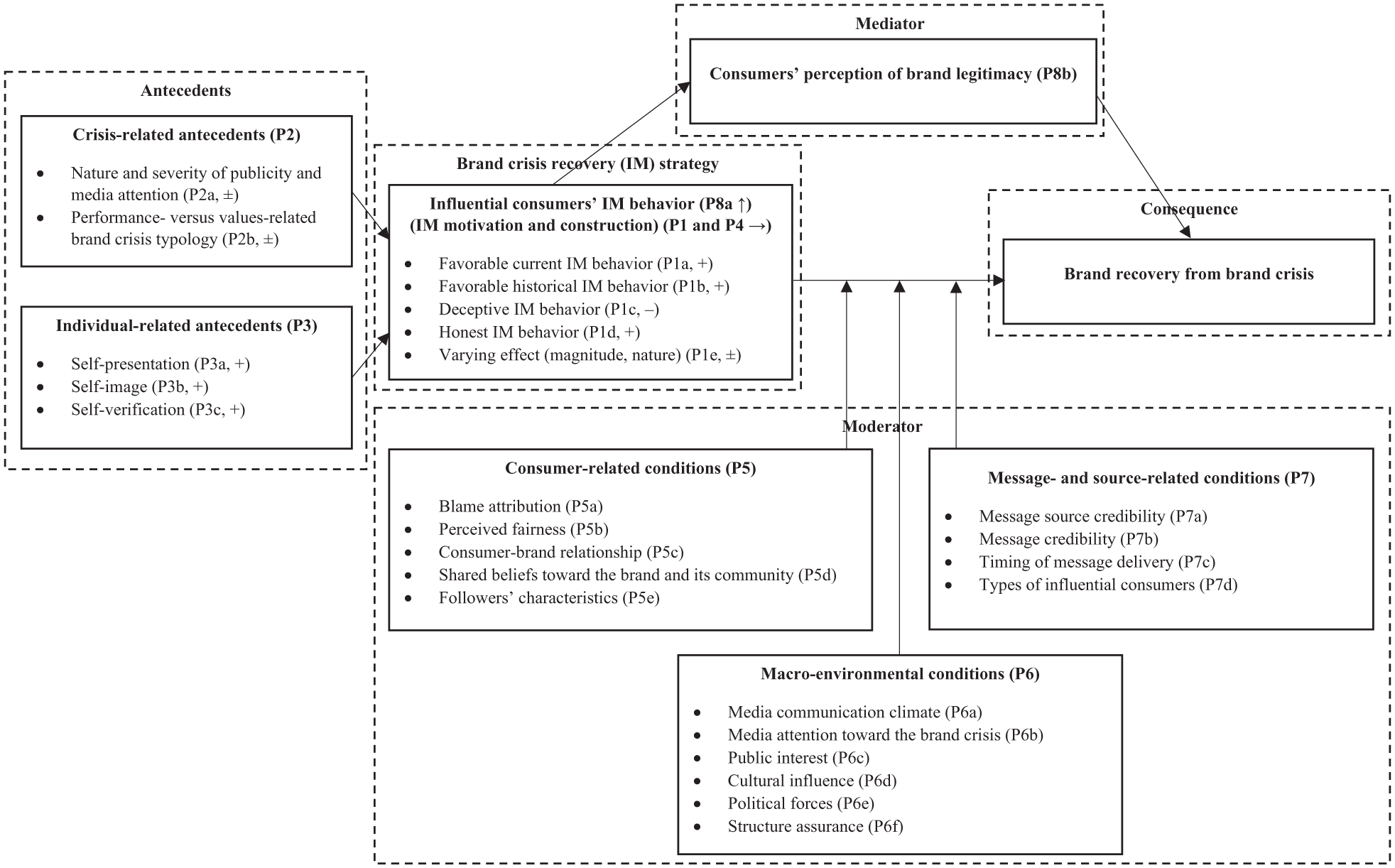
Influential consumers’ impression management (IM) strategy for brand recovery from brand crisis.
IM roles for brand recovery from brand crisis
Influential consumers play a prominent role as a communicator or word-of-mouth generator, and thus, they have the capability to intentionally influence consumer-to-consumer interactions via their social networks (Ki & Kim, 2019) by engaging in appropriate IM behaviors. For example, strategically shifting the focus from the crisis incident to the positive aspects of the product or service can be an effective form of IM behavior (Casais & Gomes, 2022). Another example is to engage in non-verbal IM behavior (i.e., tactics using non-verbal actions) (Srivoravilai et al., 2011), such as continuing to be the users of the affected brand amid the crisis. As social actors, influential consumers can (re)construct symbolic meanings associated with the brand value to create a desirable impression of themselves and/or for the brand (Schultz et al., 2012), which may alter consumer attitudes and behaviors. Signaling theory is useful to explain this process, wherein positive brand signals can be transmitted through influential consumers’ IM, especially when there is information asymmetry between influential consumers and other consumers in the community (Srivoravilai et al., 2011). Likewise, we argue that signals displayed by influential consumers’ IM behavior following a brand crisis may shape how other consumers judge the event, wherein supportive IM behavior is crucial for alleviating negative publicity and reputational damage (Liao & Cheng, 2014).
Past research on external corporate communication often overlooks the complexity of communication, which involves multiple audiences and institutionalized norms (Allen & Caillouet, 1994). More often than not, crisis communication is treated as a reactive strategy to restore corporate reputation following a brand scandal (Tsarenko & Tojib, 2015). While remedial use of IM tactics may potentially be successful, it could also backfire when the targeted audience perceive the communication as manipulative (Singh et al., 2020). This risk is exacerbated by the growing control brands exert over the content shared by influencers, which can lead to messages being viewed as biased and inauthentic, potentially eroding trust in the influencers (Martínez-López et al., 2020).
McGuire’s (1961) inoculation theory, a communication and social psychological theory, explains how individuals’ attitudes or beliefs can be protected against pre-exposed persuasion or influence in a much similar way as to how a body is protected against disease. Despite receiving less attention in public relations, inoculation theory is a well-developed theory in understanding resistance to influence and has proven to be a powerful message strategy that provides opportunities for mitigating damages (Compton et al., 2021) and safeguards against the negative impacts of brand crises (Diddi & Wei, 2022). For example, Einwiller and Johar (2013) discovered that using a refutational inoculation treatment effectively builds resistance to negative information, especially when consumers do not identify with a company. This finding underscores the importance of proactive communication in managing brand crises. In this sense, we argue that influential consumers’ ongoing IM behavior can produce a favorable consumer attitude and effectively protect the brand when exposed to a crisis event (Sharpe, 2019). Consequently, firms may leverage influential consumers’ IM as a proactive crisis communication strategy before negative publicity goes viral. Based on the arguments above, we propose that:
IM comprises two processes: impression motivation and impression construction (Leary & Kowalski, 1990). Impression motivation refers to a process where influential consumers attempt to decode public sentiments and determine the optimal way to regulate and adapt their existing impression (Y. Zhang et al., 2019). Once such motivations become sufficiently salient, influential consumers can construct a favorable impression (i.e., impression construction) that resonates with their followers (Leary & Kowalski, 1990). The two broad types of IM found in the literature are honest IM (i.e., individuals present themselves to the public truthfully), and the darker dimension, deceptive IM (i.e., the act of communicating manipulated information to create a strategically advantageous image) (Carlson et al., 2010). Accordingly, honest IM can encourage favorable reciprocity (Menegatti et al., 2020), drive positive word of mouth (M. Huang et al., 2011), and restore legitimacy (Rim & Ferguson, 2017). Brands could arguably leverage on influential consumers’ honest IM during a brand crisis. However, honest IM might not occur in crises wherein influential consumers are pressured to perform under stressful situations (Carlson et al., 2010). This occurs because they may feel compelled to respond quickly, which can prompt a shift from genuine communication to more defensive or strategic responses. Under such high-pressure circumstances, influential consumers might prioritize protecting their own reputation or meeting immediate expectations over maintaining authentic interactions. Consequently, the honest IM that typically fosters positive engagement could be compromised, resulting in less transparent communication.
Individuals applying deceptive IM rely on multiple falsehoods, such as lying about their competencies to be seen as a credible source of information (Tedeschi, 1981). Brands were found to leverage deceptive IM to create a false impression when managing crisis recovery (Gil-Or et al., 2015) by controlling how the communication is being presented and sensationalized (Chen & Cheng, 2019). Aside from ethical considerations, brands’ crisis recovery efforts built upon deceptive IM run the risks of reducing the efficacy of influential consumers (Craig et al., 2012) as when/if the truth gets revealed, consumers will become skeptical in rebuilding commitment and trust toward the influential consumers (Krishnan et al., 2015). For that reason, influential consumers might be reluctant to use deceptive IM or participate in brands’ deceptive IM if the brand ever chooses to adopt this approach.
We posit that influential consumers could be a “friend in need” for brand managers during a crisis if brand managers could contribute to influential consumers’ impression motivation and impression construction. Honest IM and being authentic would help to promote a cohesive relationship between influential consumers and consumers at large. Truthful communication can help consumers reduce psychological uncertainty and mitigate dissatisfaction, thereby facilitating influential consumers to establish themselves as information brokers during a brand crisis. In contrast, deceptive IM could inculcate a false sense of reality and threaten the formation of genuine influential consumer-general consumer relationships. This could thwart the crisis recovery process and cause further uncertainty and misjudgment. Nevertheless, the effectiveness of honest IM strategies may vary depending on the magnitude of a crisis, as different crises—from local to global—require tailored communication approaches to manage public perception (Hansson et al., 2020). For example, honest IM may be more effective in country-level crises, where it resonates with local cultural values, beliefs, and norms, allowing for a more credible and relatable response. In contrast, global crises pose greater challenges in maintaining consistent messaging across diverse cultures and regions, thus complicating the implementation of honest IM strategies (Kapucu et al., 2022). In addition, the nature of the crisis can influence the effectiveness of honest IM (Dawar & Pillutla, 2000). Noteworthily, L. Wang et al. (2023) report that consumers attribute more blame to companies in values-related crises compared to performance-related ones. This finding suggests that the public expects a higher level of moral responsibility in such situations, making honest communication and transparency particularly vital. Thus, while accountability and honesty are always crucial, they are especially critical in values-related crises, where a genuine commitment to change may be necessary to restore trust. This acknowledges that different types and scales of crises may affect the efficacy of honest, transparent, and persuasive communication (Gass & Seiter, 2022). Building on these arguments, we propose the following:
Antecedents of IM
Existing research does not account for the significant variations in influential consumers’ IM observed across various brand crises and individual circumstances of influential consumers. This section aims to bridge this knowledge gap by discussing the crisis-related factors and the individual characteristics that could prompt different levels of personal relevance and thus induce different IM behavior.
Crisis-related antecedents
Publicity is perceived as a more credible source of information and thus more persuasive on consumer decision-making than other forms of marketer-driven communications (O’Cass & Debra, 2004). For example, information broadcast by news media is perceived as more truthful than that published by the firm during a brand crisis (Ahluwalia et al., 2000). Media attention can vary across brand crisis events. We speculate that the nature of publicity and the direction of media attention influence influential consumers’ motivation for IM behavior and how they decide to construct their IM. For instance, if the crisis receives intense media attention and is dominated by the negative publicity that is held strong among consumers, social actors such as influential consumers may withdraw their support for the firm (Z. Yuan et al., 2019) or could even turn against the brand. However, Cleeren et al. (2013) contend that not all negative publicities are bad. In some cases, negative publicity can boost awareness and accessibility of the brand (Berger et al., 2010), which may enhance influential consumers’ image as an information broker in the marketplace. Thus, we predict that the nature of publicity and media attention surrounding the brand crisis can shape how influential consumers process information and their motivation to engage in IM.
The crisis typology (i.e., performance-related versus values-related) may also impact a firm’s crisis response strategies and consumers’ responses toward a faulty brand (Baghi & Gabrielli, 2019; Dutta & Pullig, 2011). For instance, an assurance of crisis prevention is deemed to be a more crucial response strategy for performance-related than values-related crises by most firms (Dutta & Pullig, 2011). On the demand side, consumers tend to show fewer concerns about the psychological and symbolic benefits associated with values-related crises than they do with the functional benefits related to performance-related crises (Dholakia, 2001). Furthermore, existing literature suggests that the perceived severity of a crisis can affect consumer reactions to the event (Rea et al., 2014), wherein crises perceived as bringing more severe outcomes tend to arouse stronger emotional reactions (Baghi & Gabrielli, 2019). Here, perceived severity refers to consumers’ judgments about the seriousness of the crisis and its potential impact, which can shape their expectations and reactions (Coombs & Holladay, 2010). Analogously, we argue that the perceived severity of a crisis can affect influential consumers’ IM behavior, and their reaction to performance-related and values-related crises would significantly vary.
Individual-related antecedents
Past leadership studies suggest protecting a brand can be a way that influential consumers seek to provide a genuine impression of themselves, particularly when the brand behavior concurs with their beliefs (Shamir & Eilam, 2005). Influential consumers might be motivated to defend the brand out of moral obligation, feelings of empathy (Michie & Gooty, 2005), and out of self-interest (i.e., maintaining a certain public image) (Shamir & Eilam, 2005). Thus, we postulate that self-related constructs are likely to elicit different motivation levels that affect influential consumers’ IM behavior.
Self-presentation, a concept closely tied to IM, posits that perceived benefits, self-esteem, and identity regulation are important considerations governing self-presentation (Colliander et al., 2017). Individuals’ psychological motives like self-presentation can influence their sharing behavior on social media platforms (Ji et al., 2019). Prior work has explored consumers’ self-presentation goals and choice of tactics (Valsesia et al., 2016) and consumers’ motivations for self-presentation in the form of selfie postings (W. M. Lim, 2016; Ozansoy Çadırcı & Sağkaya Güngör, 2019). These studies focusing on consumers’ online self-presentation laid the groundwork for understanding influential consumers’ IM behavior, especially during crises. During a brand crisis, opinion leadership is required to make sense of the problem and compellingly frame the situation to help consumers rationalize the problem (Ruben & Gigliotti, 2016). Self-presentation theory presents a vital foundation to understand how influential consumers might be helpful to brands to recover from a crisis for two reasons. First, self-presentation is ubiquitous in identity development, especially in the hyperconnected online environment in the digital era, whereby influential consumers can leverage on content generation to depict a favorable image of themselves (Bastrygina et al., 2024; Djafarova & Trofimenko, 2019) that could also benefit brand recovery. Second, the unfavorable sentiments and low consumer confidence engendered during a brand crisis make it imperative for influential consumers to determine an ideal self-presentation approach to best soothe public sentiments and recapture consumer confidence. Since self-presentation theory is associated with individuals’ self-identities (Ozansoy Çadırcı & Sağkaya Güngör, 2019), it can help understand influential consumers’ self-image concerns.
London (2002) states that “leaders are often keenly aware of, and hesitant about, how others view them, especially in terms of how they compare to others” (p. 67). In this regard, Chng et al. (2015) found that leaders’ image concerns mediate the effect of publicity on their IM during organizational decline. As leaders’ self-image is closely intertwined with their performance and position in a social setting (Chng et al., 2015), we believe self-image concerns play an important role in influencing influential consumers’ IM behaviors. Influential consumers’ incompetent image concerns might determine what information and opinions to share to avoid undesirable images (Philp & Nepomuceno, 2020) when a focal brand is under crisis. This proposition is built on past studies that have demonstrated consumers’ tendency to portray a smart and competent self-image (Philp & Nepomuceno, 2020). Influential consumers can only influence their followers if they establish a competent and trustworthy self-image (Gray & Densten, 2007). By effectively managing self-presentation during crisis events, influential consumers can boost their self-confidence and sustain desired identities valuable to followers (Chng et al., 2015).
Self-verification, which reflects individuals’ desire to be known and understood by others according to their strongly held self-beliefs (Swann, 1983), is another concept closely linked to IM. People tend to protect their self-views because self-verifying evaluations provide a sense of order, coherence, and stability to their lives, making them feel more secure (Crawford et al., 2019). Within an organizational context, leaders often strive to sustain congruence between their self-concepts and how they are being judged by stakeholders (Whetten & Mackey, 2002). Analogously, influential consumers need to maintain congruence between how they see themselves and how followers perceive them, and they often strive to maintain this congruence with effective IM activities. Aligned with self-verification theory, we expect that influential consumers’ perceived self-congruence will impact their IM motivation and behavior. Therefore, we propose the following:
Consequences of IM
Management literature provides insights into how firms apply IM to manage stakeholders’ perceptions by diverting their attention away from negative events and increasing acceptance of controversial practices or decisions (Arndt & Bigelow, 2000). In the same vein, IM can be used strategically as a crisis communication tool to help repair a damaged brand image (Rim & Ferguson, 2020). When brands are under attack, key brand proposition and values become questionable (Dawar & Lei, 2009). The act of (re)establishing trustworthy and open communication is vital for (re)building the brand, particularly following a brand crisis (Dutta & Pullig, 2011).
The influence the corporate leaders’ IM has on employees’ perception (Peck & Hogue, 2018) is analogous to influential consumers’ IM and influence on their followers. Influential consumers earn their credibility by establishing a social position within the community (Hoch & Kozlowski, 2014), contributing to their ability to influence the formation and direction of consumer sentiments. This leadership establishment puts influential consumers in a strong position to reduce mistrust, influence decision-making, and prevent dispositions from behaving unfavorably (Denton et al., 2020) during brand crises. Empirically, past research has demonstrated that opinion leadership and interactions between corporate brand and stakeholder have an impact on restoring public opinion and brand recovery (Robson & Farquhar, 2021; Van Norel et al., 2014). Hence, we propose that influential consumers’ IM behavior can contribute to brand recovery from brand crisis.
Moderators of IM and brand recovery
The influence of IM on brand recovery involves many contingencies. In this section, we discuss and develop several propositions regarding the contextual conditions that may alter the effect of influential consumers’ IM on brand recovery process, namely consumer-related, macro-environmental, and message-related factors.
Consumer-related conditions
Attribution theory, the psychological process by which individuals make sense of their environment by assigning causes of actions and events (Folkes, 1988), provides a theoretical ground to explain consumers’ responses to negative events and their evaluation of the affected brands (Hegner et al., 2018). When exposed to brand crises, consumers tend to interpret the root causes of the crisis. This attributional thinking provides cues for consumers to assess the credibility of IM messages delivered by the influential consumers during brand crises (Singh & Crisafulli, 2020), which in turn, can shape their attitudes and actions (Rim & Ferguson, 2020). For example, when consumers attribute the responsibility of the incident to the brand and/or perceive influential consumers’ IM tactics as self-serving or manipulative, they tend to lose their trust in the brand and the influential consumers’ IM persuasiveness (Hegner et al., 2018). This can adversely affect the brand recovery process. Indeed, given the concerns for their credibility in the social network, influential consumers’ self-attribution of the event can influence their IM behavior in a similar vein as other consumers (Liao & Cheng, 2014). Future research should consider the attribution of both the general consumer (public) and influential consumers who provide opinion leadership.
Another relevant construct is perceived fairness, which may strengthen the effect of influential consumers’ IM on brand recovery. For instance, Allard et al. (2020) found that activation of empathy (e.g., when negative reviews are perceived as highly unfair for the firm) can lead to positive consumer responses toward the firm. Theoretical understanding of the potential moderating role of perceived fairness on the link between influential consumers’ IM and brand recovery thus merits further attention.
Next, conventional wisdom points to the unfavorable impact of negative publicity on brands. However, we contend that self-brand connection and shared beliefs of brand community members may counter-argue this proposition. First, Wilson et al. (2017) found that when consumers feel a strong connection to the brand, they process negative word of mouth defensively, resulting in counterintuitive favorable outcomes. This led us to question how consumer-brand relationship underlies the influence of influential consumers’ IM on the direction of negative publicity and how this process influence brand recovery efforts. Second, social learning theory proposes that individuals learn and acquire new behaviors by observing and imitating others (Bandura, 1977). According to social learning theory, brand community members will form shared beliefs about the brand and the community through frequent interactions (Bandura, 1977). When the shared beliefs and group identification among brand community members are strong, they will feel their social identities are threatened if the brand exposes to negative publicity (Chang et al., 2013). Hence, we speculate that strong shared beliefs will result in defensive reactions toward negative publicity about the brand and that brands might leverage influential consumers’ IM to turn the situation around. In this case, the social dynamics between community members and influential consumers might work to insulate brands from the impacts of negative events. We thus propose future research to adopt social learning theory as a theoretical foundation for exploring if (and the extent to which) brand community members’ shared beliefs toward the community and brand strengthens the impact of influential consumers’ IM behavior on negative publicity arising from a brand crisis, which in turn, could contribute positively to brand recovery.
Noteworthily, IM is an important mechanism that influences followers’ perceptions (Peck & Hogue, 2018). Future studies could explore if and how such influences might differ across followers’ characteristics, such as their level of brand community engagement (D. Yuan et al., 2020), crisis involvement level (Lee & Atkinson, 2019), how active they are in seeking information during brand crises (Song et al., 2019), their confidence levels, and the degrees of trust (Martínez-López et al., 2020) and intimacy (Conde & Casais, 2023) toward influential consumers.
Based on the above arguments, we propose:
Macro-environmental conditions
Media can act as a special interest group that places pressure on firms during crises due to its capacity to influence consumer-brand trust relationships (Yannopoulou et al., 2011) and shape public opinion and perception on issues (Raupp, 2019). To illustrate, in their examination of Volkswagen’s scandal involving the illegal manipulation of NOx emissions data, Jong and van der Linde (2022) demonstrated how the media extended the narrative beyond the firm, framing the incident as indicative of broader industry practices. This portrayal effectively shifted the discourse from Volkswagen’s specific actions to a potential systemic issue within the entire automotive industry, suggesting a widespread accountability. Nevertheless, the role of mass media is often critical toward negative news given their tendency to create dramatized narratives of crises (McQuail, 2003). The greater media attention a given crisis garnered, the more deeply consumers process the negative information (Hansen et al., 2018). Besides, the construction of IM messages by influential consumers is likely to be influenced by information disseminated via mass media, which holds considerable implications for consumers’ evaluation of the affected brand. Taken together, we believe the media’s ability to set the public agenda and shift consumer sentiment regarding a crisis event (Yannopoulou et al., 2011) will alter the effect of influential consumers’ IM behavior on the brand recovery process.
A corporation’s crisis management strategy also hinges on how their policies impact the broader social system, beyond just shareholders (Bentley, 2018), emphasizing the importance of considering the wider public’s interests since societal members can co-create meaning, build social capital, and foster a thriving society (Ji et al., 2019). Furthermore, activist groups, as members of the public, have the power to challenge firms amid crises (Woods, 2019). In the absence of strong organization-public relationships, stakeholders are likely to respond unfavorably during crises, which can further damage the firm’s reputation (Liu et al., 2020). Consequently, the success of influential consumers’ IM efforts in aiding brand recovery is critically dependent on these efforts aligning with and addressing public interests, which shape the perceptions and responses of the broader community (J. S. Lim & Jiang, 2021).
The perception and adoption of specific crisis response strategies are also influenced by cultural factors. For instance, Zhu et al. (2017) found that culture moderates the persuasiveness of social influencers, with their impact being stronger in collectivistic, high power distance societies. Besides, Y. Wang and Laufer’s (2020) review revealed that public apologies from firms are not common in China due to cultural emphasis on “saving face.” Unlike Western cultures, Chinese societal values prioritize harmonious relationships, leading to the avoidance of defensive responses such as denial and attack the accuser, as proposed in SCCT, in crisis management (Huang et al., 2016). Therefore, societal macro-structures such as culture should be considered for understanding influential consumers’ IM when dealing with crisis communication.
Political forces can be another influential factor especially when a firm’s legitimacy is under scrutiny (Allen & Caillouet, 1994). Hence, it is crucial to consider government and regulatory bodies when leveraging influential consumers’ IM in crisis communication and management. Even more so in increasingly digital environments, individuals might feel more secured when the legal systems and regulatory structures governing online activities can protect them (X. Zhang et al., 2019). In this regard, future research could explore the potential moderating effect of structure assurance (i.e., consumers’ beliefs about the existing protection from institutional structures and mechanisms—for example, guarantees, contracts, or seals of approval) in a virtual marketplace that can reduce safety and security concerns (McKnight & Chervany, 2002). In sum, we posit that environmental factors such as media communication climate, media attention toward the brand crisis, public interests, cultural influence, political forces, and structure assurance are important moderators to be considered.
Message- and source-related conditions
Influential consumers are often seen as information leaders (Casaló et al., 2020); they may defend public interest (Hennequin, 2020), warning stakeholders about misdeeds done by the brand and inciting rectifications for the brand’s misdeed (Park et al., 2018). The effectiveness of influential consumers’ IM messages is largely dependent on the issue of credibility. A distinction should be made between message source credibility and message credibility (Roberts, 2010). Message source credibility refers to consumer perception of the skills, knowledge, and experiences possessed by the information source provider is objective and without prejudice (Visentin et al., 2019), while message credibility is the degree of accuracy, integrity, and comprehensiveness of the information (Roberts, 2010). As a message source, influential consumers with greater confidence and credibility will likely leverage the efficacy of their IM behavior (Westphal et al., 2012). Since message source credibility is an important predictor of consumers’ acceptance of word-of-mouth communication (Filieri et al., 2019), influential consumers’ IM influence on brand recovery will likely depend on their credibility. Elements that characterize message credibility, such as the structure of a message, its linguistic content, attractiveness (Flanagin & Metzger, 2003), authenticity (Borchers & Enke, 2021), and perceived quality (Jin et al., 2020), can impact the influential consumers’ IM behavior. Besides, messages characterized by higher level of transparency and substantiality (i.e., accurate, clear complete, and relevant information with strong arguments) are associated with more favorable attitudes and trust, along with reduced resentment toward the firm (Holland et al., 2021; Zheng, 2023). That is, credible messages increase acceptability and decrease consumer resistance (Martínez-López et al., 2020), thereby exerting a more positive influence on brand recovery.
The timing of the message delivery is also crucial as it can shape the public’s attribution of crisis responsibility (Rim & Ferguson, 2020), particularly within today’s landscape of social media and round-the-clock news cycles (Butler, 2021). Early crisis response can prevent the escalation of negative perceptions and the detrimental effects of being excluded from the crisis conversation (Y. Huang & DiStaso, 2020). Apart from the response promptness, the sequential timing of various responses to a crisis holds significance in competitive crisis communication (X. Zhang & Nekmat, 2023). This parallels the concept of first-mover and late-mover (dis)advantages, demonstrating the potential benefits or drawbacks from the organizational standpoint regarding the sequence of crisis communication efforts.
Moreover, past research (e.g., Bastrygina & Lim, 2023; Conde & Casais, 2023; Koay et al., 2023) has highlighted differences among types of influencers, including not only their reach, number of followers, and popularity but also their level of parasocial relationship, which refers to the one-sided emotional connections that audiences develop with influencers (Horton & Wohl, 1956; Koay et al., 2023; Nadroo et al., 2024). For example, while micro-influencers may have a more localized reach and fewer followers, they often show higher levels of authenticity and intimacy compared to macro-influencers (Hudders et al., 2021). These varying perceptions of influencers can therefore influence their persuasion impact (Boerman, 2020). Noteworthily, the literature has revealed several types of influencers, including nano-influencers (typically in early career stages with fewer than 10,000 followers), micro-influencers (ordinary individuals with 10,000 to 100,000 followers, (meso-influencers) (those with 100,000 to a million followers, often have national visibility), and macro-influencers (or mega-influencers) (established celebrities with over one million followers) (Boerman, 2020; Hudders et al., 2021), with virtual influencers generated by artificial intelligence also becoming increasingly prominent (Conde & Casais, 2023).
In sum, we expect that factors such as message source credibility, message credibility, timing of the message delivery, and types of influential consumers will affect the impact of influential consumers’ IM behavior on brand recovery.
Mediating role of brand legitimacy
Ideas presented in this section are inspired by important contributions of management studies on the power of corporate leaders’ IM in managing organizational legitimacy after controversial or organizational crises. A brand’s legitimacy occurs through a collective effort of actors in which the actions of a brand are seen as proper, desirable, or appropriate and congruent with widely shared social beliefs, norms, and values (Humphreys & Latour, 2013; Suchman, 1995). This broad definition underlies both the cultural and social processes of legitimacy (Coskuner-Balli, 2013), implying brands that lack legitimacy are unlikely to be judged favorably by consumers (Hakala et al., 2017). Yet, it is challenging to acquire and maintain brand legitimacy regardless of how well-established the brand has been in the past (Hakala et al., 2017).
Past consumer and marketing studies have demonstrated how coordinated efforts of actors contribute to legitimating American yoga (Coskuner-Balli & Ertimur, 2017) and casino gambling (Humphreys, 2010), and how brand legitimacy is attained in a non-brand-focused community (i.e., gay men’s community) (Kates, 2004). Other scholars have focused on Star Trek’s legitimating consumption meanings (Kozinets, 2001), the process through which consumers seek legitimacy for mainstream market inclusion of a stigmatized consumer group (Scaraboto & Fischer, 2013), and innovation (e.g., Botox Cosmetic) (Giesler, 2012). Despite these noteworthy insights, much remains to be learned about the role of influential consumers in restoring brand legitimacy during crises and how brand legitimacy intervenes the influence of influential consumers’ IM behavior on brand recovery.
Hakala et al. (2017) propose that “the legitimization practice in [a] community incorporates the perceptions, judgements, and actions of consumers, and that these are intertwined with the actions of the marketer and prior collective legitimacy judgements, shaping consumer perceptions and judgements with regard to the brand” (p. 538). Several scholars echoed this view by implying that legitimation is “actively constructed and changed by social actors” (Humphreys, 2010, p. 492) and that the collective actions of actors contribute to the legitimation process (Coskuner-Balli & Ertimur, 2017; Humphreys, 2010). Notably, the work cited above primarily focused on acquiring legitimacy and the marketplace resources and practices to attain legitimacy. However, less is known about how brands could maintain brand legitimacy during brand crises, which arguably differ from the process of legitimacy acquisition. Legitimacy is partly achieved through “the day-to-day interaction in which society members construct mutually shared impressions” (Beverland, 2005, p. 1005) and “texts produced, circulated, shared, distributed, and incorporated into macro-level brand discourses through stories and narratives” (Gustafson & Pomirleanu, 2021, p. 22). Thus, we propose that influential consumers can uphold brand legitimacy given their continuous interactions with consumers and their social standing in the community.
Scholars posit that improving brand legitimacy will positively affect the brand trust repair effort (Kates, 2004). In their empirical study examining how green brands might repair trust following greenwashing revelations, Guo et al. (2017) reveal that brand legitimacy plays a significant mediating role in the process of brand trust repair, leading them to exert that “green brand legitimacy is critical for obtaining, maintaining, and enhancing green brand trust” (p.131). The literature on IM demonstrates that IM strategies can influence individuals’ legitimacy judgments following controversial events (Arndt & Bigelow, 2000). Srivoravilai et al. (2011) found organizational legitimacy to mediate the effect of IM tactics on firm reputation. Since crisis events are likely to activate skepticisms and attributions of the firm’s manipulative intent (Singh et al., 2020), a brand’s legitimacy is crucial when brands face severe crisis events. We posit that brand legitimacy plays a significant mediating role in the relationship between influential consumers’ IM and brand recovery.
Conclusion
This conceptual work was motivated by knowledge gaps identified in the extant literature, specifically the role and influence of influential consumers’ IM behavior in the brand recovery process. We respond to this knowledge gap via our theoretical arguments to delineate the antecedents, consequences, and boundary conditions that underpin how influential consumers’ IM behavior influence brand recovery effort and how this process is mediated by brand legitimacy. Along with the discussion, we presented corresponding research propositions that could help to propel further conversation and knowledge advancement. We will close this article by identifying the major challenges that deserve further research attention.
First, the foundational understanding of the notion and types of legitimacy (i.e., cognitive, normative, and regulatory legitimacy) is originated from institutional theory (Humphreys & Latour, 2013), mainly guided by sociology and organizational studies. Future research should further clarify and distinguish brand legitimacy from other branding constructs such as brand equity, brand image, and brand value. We call for future work to establish a typology of brand legitimacy because a typology provides “a more precise and nuanced understanding of a phenomenon or concept, pinpointing and justifying key dimensions that distinguish the variants” (Jaakkola, 2020, p. 23). New research in this direction could therefore facilitate a more comprehensive conceptual development of brand legitimacy than a single definition. A well-developed typology can also categorize extant knowledge of the legitimacy construct and discriminate it from other brand-related constructs characterized by differing antecedents, manifestations, or effects (MacInnis, 2011). Additionally, a robust brand legitimacy typology could provide a basis for future operationalization of the construct, allowing measurement scale development that captures the multifaceted aspects of brand legitimacy and considerations of different types, contexts, and conditions that underpin brand legitimacy.
Second, another issue that emerged from our observation is the lack of a clear theoretical basis explaining the interconnection between influential consumers and IM. This shortcoming may be attributable to past studies that examined the two streams in a piecemeal way across different disciplines and domains. Further academic attention is needed to build a solid theoretical foundation that integrates the existing disparate view of influential consumers and IM under a theoretical umbrella. While doing so, we encourage scholars to consider Jaakkola’s (2020) conceptual approaches for theory building that seek to attain conceptual advancement through the development of theory and integration across streams and/or multiple theories.
Third, our article has thus far focused on influential consumers only. We acknowledge that consumers are not necessarily passive information recipients. Consumers could also play the roles of legitimizing agents who, as Lillqvist et al. (2017) describe, “. . .have the power to confer or deny legitimacy in the context of business-society relations” (p. 197). In a hyperconnected digital era, where consumers are empowered through the interactive nature of technologies (Christodoulides, 2009), they can legitimize or revoke legitimacy from influential consumers and brands by being critical of their communication efforts, questioning the authenticity of such messages, and examining these message framing and intent (Jacobson et al., 2020). During a brand crisis, consumers might exhibit caution when interpreting self-presentation and IM strategies employed by influential consumers. This phenomenon foregrounds the consumers’ role as legitimizing agents in brand crises. Further research on the mechanisms underlying consumers’ legitimizing roles, including how this role might enhance or attenuate any brand legitimization and brand recovery efforts by the influential consumers and/or the brand deserves attention. While the central premise of this article is on adults as influential consumers, future work could explore how children might establish themselves as influential consumers during crises. Considering that influential kids do not have the same arsenal of resources as influential adults, we may assume that they face a greater challenge legitimizing themselves or lending a hand to the brand during a crisis. Moreover, ethical considerations are paramount, particularly due to the inherent paradoxes and vulnerabilities associated with children’s media consumption and their developmental well-being (Yap & Lim, 2024).
Last but not least, we acknowledge that conceptual articles often attract criticisms despite their critical role in stimulating thinking and driving novel research on important topics. Therefore, we call for follow-up empirical work. Theory testing through further hypotheses development and empirical studies would help to confirm/disconfirm our theoretical arguments, and in so doing, advance knowledge on this topic.
Footnotes
Author’s Note
Weng Marc Lim is now affiliated with Global Research Centre, Sungkyunkwan University, Suwon, Gyeonggi, Republic of Korea; Jaipuria Institute of Management, Lucknow, Uttar Pradesh, India.
Declaration of conflicting interests
The authors declared no potential conflicts of interest with respect to the research, authorship, and/or publication of this article.
Funding
The authors received no financial support for the research, authorship, and/or publication of this article.
