




Abstract
Consumers often observe how other consumers interact with brands to inform their own brand judgments. This research demonstrates that brand relationship quality–indicating cues, such as brand nicknames (e.g., “Mickey D’s” for McDonald’s, “Wally World” for Walmart), enhance perceived information authenticity in online communication. An analysis of historical Twitter data followed by six experiments (using both real and fictitious brands across different online platforms [e.g., online reviews, social media posts]) show that brand nickname use in user-generated content signals a writer’s relationship quality with the target brand from the reader’s perspective, which the authors term “inferred brand attachment.” The authors demonstrate that inferred brand attachment boosts perceived information authenticity and leads to positive downstream consequences, such as purchase willingness and information sharing. The authors also find that this effect is attenuated when brand nicknames are used in firm-generated content. How consumers’ relationships with brands are portrayed and perceived in a social context (e.g., via brand nickname use) serves as a novel context to examine user-generated content and provides valuable managerial insight regarding how to leverage consumers’ brand attachment cues in brand strategy and online information management.
Sifting “real” information from that which is “fake” is a challenging task for consumers in today’s digital landscape. The large amount of fraudulent information related to brands and products, whether fake reviews or copycat websites, increases consumer information search costs, violates consumer privacy, and enhances the likelihood that consumers may be misled to make less optimal choices (Flanagin et al. 2011; Malbon 2013; Miyazaki and Fernandez 2001). To help consumers identify fake information, researchers have identified possible quantitative factors, including the frequency with which first-person pronouns, emotional words, and conjunctions are used (Anderson and Simester 2014; Berzack 2011; Newman et al. 2003), and have suggested protocols for consumers to follow when navigating the digital world. Despite this, consumers’ success rate for detecting fictitious online information remains low, at around 49%–52%—not much better than guessing by chance (Kronrod, Lee, and Gordeliy 2017).
Consumers’ general inability to accurately identify fake online content has led researchers to ask another fundamental question: What factors influence consumers’ perception and judgment of authentic versus fake brand-related information in the digital world? In other words, how do consumers sift the grain from the chaff when seeking brand-related information online? One answer to that question lies in understanding what it means to be a socially aware human being and how one might transfer knowledge and experiences from the offline world to inform judgments in online contexts. Indeed, a growing body of research now identifies some social and psychological factors that may affect an individual’s judgment of fake information. For example, Jun, Meng, and Johar (2017) show that perceived social presence reduces people’s likelihood of fact-checking statements in social settings.
In the current work, we build on this stream of research to demonstrate that consumers rely on interpersonal communication norms in the social world to evaluate brand-related information they encounter in online communication. Specifically, we show that consumers pick up on a popular relationship quality–indicating cue—brand nicknames—to evaluate the authenticity of online information. Brand nicknames are the “street names” or monikers that serve as the informal substitutes for brands’ trademarked formal names, such as “Mickey D’s” for McDonald’s, “Bdubs” for Buffalo Wild Wings, and “Timmie’s” for Tim Hortons. Considering that prior research shows consumers typically use brand nicknames in the marketplace in a positive manner (Zhang and Patrick 2018), the current work focuses on the use of common brand nicknames that do not have negative connotations (the general discussion looks at possible future research directions to examine negative nicknames) and their contexts, such as online recommendations and positive word of mouth (WOM).
Drawing on the theory of cross-domain knowledge transfer (Gregan-Paxton and John 1997), we theorize that consumers transfer their social knowledge of offline personal nickname use to the realm of brand-related online communication to infer brand relationship quality based on whether one uses a brand nickname in user-generated content (UGC). We show that when a writer (message sender) uses a nickname to refer to a brand, the reader (message receiver) is likely to infer that the writer has a genuine and close relationship with the brand. We conceptualize the reader’s inference of the writer’s relationship quality with the brand as inferred brand attachment (IBA) and show that IBA enhances the perceived information authenticity and leads to downstream consequences such as the reader’s increased purchase intent. Furthermore, drawing on consumer persuasion knowledge theory, we show that when brand nicknames are used in firm-generated content (FGC) as an attempt to persuade, they may no longer be viewed as a relationship signal but rather a promotion tactic, thereby attenuating the effect. Figure 1 presents the full conceptual framework.

Conceptual framework.
By examining a popular yet understudied marketing phenomenon—namely, brand nickname use—this research highlights the importance of brand nicknames as a communication signal among consumers in the digital world. As such, we make two theoretical contributions. First, we extend the brand attachment literature into the interpersonal consumer context. While prior research treats brand attachment as the consequence of a private and binary relationship between a consumer and the brand (Noel and Thomson 2018), the current research demonstrates a novel role of brand attachment in peer-to-peer social interactions (i.e., between consumers online). Specifically, this research captures the social nature of the consumer–brand–consumer interaction by introducing the notion of IBA: the means by which third-party consumers infer the quality of the relationship between a consumer and a brand in a social context. Second, we demonstrate the process by which consumers rely on IBA to discern information authenticity in a social context, thereby highlighting the value of understanding IBA in consumers’ social interactions in today’s connected marketplace.
From a managerial perspective, we underscore the importance of consumer lingo, such as brand nicknames, in effective marketing communication. Prior research has mainly examined the use of language variation on an individual consumer’s personal relationship with the brand (e.g., Sela, Wheeler, and Sarial-Abi 2012), overlooking the influence of consumers’ linguistic choice on other consumers’ brand-related judgments in a social context. We build on Zhang and Patrick (2018) to show when and how brand nickname use in online communication can serve as a means by which brand-related information can be communicated authentically and credibly. Findings from the current research offer practical managerial insights regarding how consumer lingo should be strategically used and communicated in the digital era.
The remainder of the article is organized as follows. We first briefly introduce the phenomenon of consumer brand nickname use. We then theorize how nicknames in UGC in online communication may result in heightened IBA and explain why IBA facilitates consumers’ perception of information authenticity. We present a historical Twitter data analysis with three real-world brands, together with a series of six studies to test our hypotheses. We conclude with a discussion of our findings’ theoretical contributions and emphasize the managerial implications of brand nickname use in the social environment for marketers.
Theoretical Development
Brand Nicknames and Their Use in Online Communication
Many brands are known and referred to by their popular nicknames. Well-known examples include “Big Blue” for IBM, “Wally World” for Walmart, “Chevy” for Chevrolet, and “Tarjay” for Target (for more examples, see Zhang and Patrick 2018). The Cambridge dictionary defines “nickname” as “an informal name for someone or sometimes something, used esp. to show affection, and often based on the person’s name or a characteristic of the person.” In the context of branding, brand nicknames are defined as “the informal and descriptive names that serve as a substitute for a brand’s trademarked formal name” (Zhang and Patrick 2018). While prior studies show that brand nickname use forges consumers’ attachment to the target brand, little research to our knowledge has addressed the role of brand nickname use in a social context.
The online communication context is fertile ground to study brand nickname use. The open, social, and somewhat informal nature of social media and digital communication channels lends a novel context to investigate how informal brand elements such as brand nicknames can be used and perceived. A pilot study (N = 123, %female = 37%, Mage = 33.0 years; see Web Appendix 1a for details) revealed that brand nicknames are used frequently in digital channels. When asked to indicate “How often do you see brand nicknames in online communication, such as online reviews and social media posts, and such? (never, rarely, sometimes, frequently, all the time),” 79% of the participants indicated that they encounter brand nickname use at least “sometimes.” Perhaps most interestingly, and most relevant to the current research, participants inferred that when a brand was referred to by its nickname in an online post, the poster was thought to have a closer and stronger relationship with the brand (Mnickname = 5.28, Mformal name = 3.99, t(121) = 5.67, p < .001, d = −1.02; 1 = “weak/distant relationship,” and 7 = “strong/close relationship”), and the content was believed to be more authentic (Mnickname = 5.26, Mformal name = 4.74, t(121) = 2.61, p = .01, d = −.47; 1 = “fake/lying,” and 7 = “authentic/telling the truth”). In the section that follows, we elaborate on why and how different name references (i.e., formal name vs. nickname) can affect perceived relationship quality and information authenticity in a social context.
Brand Nickname Use and IBA
Names are powerful ways to establish social connections and to indicate relationship qualities. Finch (2008) argues that names and naming are an essential “part of the fabric of daily life” and serve as important social markers that display the nature of certain relationships and shape social perceptions of those relationships. In terms of nicknames, studies have documented their use in a variety of contexts, including the workplace (Fortado 1998), online interactions (Aggarwal 2016; Bechar-Israeli 1995), sports (Dzikus, Smith, and Evans 2017; Nyambi 2018), the automotive industry (Seppälä 2018), and education (Reyes 2013). Names, particularly nicknames, can help people understand the nature of a given relationship in a social context.
The literature on personal idioms reveals that the use of nicknames in interpersonal communication can reflect the intimate nature of a relationship (Bell and Healey 1992; Nyambi 2018). In the context of social relationships, Baxter (1987) suggests that certain words and phrases provide psychological seclusion and convey relationship exclusivity. Human nicknames carry unique meanings and serve as important shorthand for affection that can cue close relational associations (Bolin 2005; Bruess and Pearson 1993). In interpersonal relationships involving romantic partners (Bruess and Pearson 1993), friends (Bell and Healey 1992), family members (Landau 2015), and even celebrities with their fans (Roland 2016), nicknames serve as a linguistic cue to suggest relationship closeness and intimacy. As a product of social interactions, human nicknames have been documented as relationship “tie signs” that make “evident the (close) nature of the relationship to others” (Bell and Healey 1992, p. 310).
What about brand nickname use in the marketplace? Drawing on an understanding of analogy-based knowledge transfer, we theorize that consumers transfer the social signaling value of human nickname use to brand nickname use in consumer–brand interactions within their online communication. Specifically, a message sender’s choice of brand reference (using a nickname versus a formal name) can serve as an indicator for other consumers to infer the sender’s relationship quality with the brand. Analogical learning refers to the process by which consumers transfer their existing knowledge from a familiar domain (the base) to a novel domain (the target) (Gentner 1989; Gregan-Paxton and John 1997; Moreau, Markman, and Lehmann 2001). During this process, consumers are likely to categorize the novel domain into a similar and familiar domain and use their existing knowledge from the familiar domain to make inferences and judgments about the targets in the novel domain (Moreau et al. 2001).
With respect to the interpretation of consumers’ brand nickname use, we argue that the message receiver (i.e., the reader) may apply their knowledge of human nickname use to the realm of brand nickname use, which helps the receiver infer the message sender’s (i.e., the writer’s) relationship with the brand. Berger et al. (2019, p. 3) suggest that language use reflects and signals information about the message sender, which can provide insight into the sender’s “relationship with other attitude objects,” such as brands. The sender’s linguistic choice of brand reference, therefore, will simultaneously impact the message receiver’s attitude and perceptions of the sender’s relationship with the brand. Human nicknames usually indicate interpersonal relationship closeness; therefore, we expect that the receiver (the reader) is more likely to infer that the writer (the sender) has a close and genuine relationship with the brand when a brand nickname is used. We refer to this inference as IBA.
Conceptualized as such, IBA builds on and extends the concept of consumers’ brand attachment from a dyadic (brand–consumer) perspective to a triadic (brand–reviewing consumer–observing consumer) perspective, which illustrates how an individual consumer’s brand relationship is displayed, communicated, and perceived in a social context. Park et al. (2010, p. 2) define brand attachment as “the strength of the bond connecting the brand with the self.” Accordingly, we define IBA as one consumer’s perception of the strength of the bond connecting another consumer with the target brand. This conceptualization of IBA is grounded in prior literature that suggests that self–brand connection and brand prominence are the two fundamental components of consumers’ brand attachment (Khamitov, Wang, and Thomson 2019; Park et al. 2010). As such, IBA captures the inferred brand connection and prominence to indicate an individual’s (e.g., the writer’s) overall relationship quality with a brand from a third party’s (e.g., the reader’s) perspective. Consider an example in which a consumer might personally feel a weak attachment or indifference to Walmart, but that same consumer is able to infer from how a friend speaks about Walmart that the friend has a strong attachment to Walmart (IBA).
In the context of online communication, we expect that the writer’s use of brand nicknames (vs. formal names) may result in enhanced IBA. Park et al. (2010, p. 2) argue that a consumer’s relationship bond with a brand is “inherently emotional.” As brand nicknames are linguistic cues that signal affection and intimacy, readers are more likely to infer the writer has a stronger emotional connection with the target brand when a nickname is used. In addition, the use of a nickname may also reflect one’s cognitive closeness with a brand. When referring to a brand, its formal name and nickname can be used interchangeably, as the two are logically equivalent. However, the fact that the writer chooses to use the brand nickname instead of its formal name suggests the salience of a more casual and intimate relationship between the writer and the brand. Taken together, the use of a brand nickname indicates a closer and stronger relationship that is salient in the writer’s mind and thus leads to an enhanced IBA from the reader’s perspective. Consistent with prior research (Park et al. 2010), we also note that IBA (an indicator of brand relationship quality) is conceptually different from inferred brand knowledge (an indicator of the possession of brand-related information). We discuss this conceptual difference subsequently and empirically disentangle these two constructs in Study 4b. We thus hypothesize the following:
IBA Enhances Perceived Information Authenticity
Information authenticity in UGC
The concept of authenticity generally captures the “dimensions of truth or verification” (Newman 2019, p. 9) and “encapsulates what is genuine, real, and/or true” (Beverland and Farrelly 2010, p. 839). While the broad sense of authenticity pertains to the assessment of truthfulness, being truthful alone is usually “insufficient to capture the complex and varied way in which the concept (of authenticity) is often put to work” (Newman and Smith, 2016, p. 610). Therefore, Newman (2019) suggests that the verification of authenticity can be examined through three fundamental lenses: historical authenticity, categorical authenticity, and values authenticity. Historical authenticity usually applies to the origins of works of art or historical artifacts, which involve “the evaluation of an object’s unique spatiotemporal history” (Newman and Smith 2016, p. 612). An example is an authentic Picasso painting. Categorical authenticity involves the observer’s verification of whether an entity meets the expectation of the category or type that is claimed. This type of authenticity pertains “mostly to objects or physical entities” (Newman and Smith 2016, p. 613), such as authentic Chinese food. Lastly, values authenticity, the authenticity that is most relevant to the current work, is based on authenticity stemming from acting in accordance with one’s true beliefs and values (Dutton 2003) and from being “genuinely committed” to the task or object at hand (Newman 2019, p. 10).
With respect to information authenticity for UGC, we propose that it comes from the assessment that the information genuinely reflects the writer’s real experiences and thoughts about the brand (values authenticity), and thus is deemed truthful. Given that a major source of fake information online is from people who are incentivized by a company to “promote” the brand (Miranda 2019; Stevens 2018), we surmise that the values authenticity lens is critical to the evaluation of UGC because it indicates whether the object (e.g., an online review) is created based on the agent’s (e.g., the review writer’s) true beliefs. Therefore, for UGC, the information is less likely to be perceived as fabricated or fake when the reader believes the information is in accordance with the writer’s own experiences, opinions, and thoughts about the brand. The information thus comes across as truthful and authentic.
IBA enhances perceived information authenticity
Building on the preceding arguments, we propose that a heightened IBA increases the perceived authenticity of the brand-related information. Park et al. (2010) argue that as consumers develop a stronger bond with the brand, they generate “a sense of oneness with brand” (Park et al., 2010, p. 2), and those brand-related thoughts and memories are more accessible in consumers’ minds. Applying this to the context of brand nickname use, heightened IBA can serve as an indicator of a real relationship between the writer and the brand, which reflects the writer’s true thoughts and opinions about the brand. In other words, we posit that brand nickname use signals the writer’s actual interactions and experiences with the brand over time such that the information is retrieved in a casual and instinctive manner. As a result, a heightened IBA suggests that the writer can provide factual information based on his or her spontaneous thoughts, making the content appear authentic. Formally, we hypothesize the following:
Furthermore, when brand-related information is perceived to be more authentic, it also increases the perceived utility of that information. Prior research suggests that the increased diagnosticity of information can increase consumers’ confidence in making a decision (Hovland, Janis, and Kelley 1953). As such, we expect that nickname use will result in important downstream consequences, such as willingness to purchase, enhanced information helpfulness (Moore 2015), or information sharing (Tellis et al. 2019). We expect the following:
Empirical Investigation
We use an analysis of a historical Twitter data set followed by six experiments to test our hypotheses using six real-world brands and two fictitious brands with their corresponding nicknames (see Table 1). We situate these studies in different digital platforms (e.g., online reviews, Twitter, Instagram) to examine our hypothesized nickname effect and showcase the distinct downstream consequences relevant to each context (e.g., information sharing, review helpfulness, willingness to purchase). The analysis of three brands using the Twitter data set (Study 1) provides support for the focal effect—that tweets using brand nickname hashtags (vs. formal name hashtags) lead to more likes and retweets. Studies 2a and 2b replicate the main effect with another real brand (McDonald’s) and provide evidence that brand nickname use (Mickey D’s) enhances perceived information authenticity. Study 3 replicates the main findings and demonstrates that it is the concept of a nickname, rather than the specific word used for the nickname, that serves as the driving force for this effect. This finding helps rule out alternative explanations such as phonetic differences. To confirm that IBA is the underlying mechanism, we use a real brand (Bloomingdale’s) and a fictitious brand in Studies 4a and 4b, respectively. We show that using a brand’s nickname leads the reader to infer that the writer has a stronger attachment to the target brand than when a brand’s formal name is used (Study 4a). This enhanced IBA further boosts the reader’s perception of information authenticity and leads to downstream consequences (Study 4b). Study 5 explores an important managerially relevant boundary condition regarding whether companies should include their popular nicknames in FGC (vs. UGC): an experiment using the Walmart brand suggests that the nickname effect diminishes when companies use the nickname in FGC because of the consumer-based nature embedded in brand nicknames.
Overview of Studies.

Study 1: Historical Twitter Data Analysis
Study 1 provides real-world evidence to support our main argument that brand nickname use facilitates perceived information authenticity and results in downstream consequences such as information sharing. To do so, we used a paid service from twitonomy.com to collate one month of historical Twitter data from June 11 to July 10, 2019. We chose three brands based on a pilot study (see Web Appendix 2) that showed that “Chevy” for Chevrolet, “Bdubs” for Buffalo Wild Wings, and “Pats” for New England Patriots are considered popular nicknames for each brand.
For each brand, we collected tweets that used either the brand formal name or the nickname as a hashtag in the post (e.g., tweets containing either #Chevrolet or #Chevy). We chose to collect tweets with brand name hashtags (rather than those containing the brand names but with no brand name hashtags) because hashtags serve as the “keywords” in tweets and are designed to highlight the topic and help users easily find relevant content they are interested in. If no brand name hashtag appeared in a post, it is more likely that the brand is not central to the content. For instance, Chevrolet is less likely to be used as a hashtag in a tweet like “There’s a major traffic delay on Hwy 59 near the Baytown Chevrolet dealer. #traffic” than in “Just went to the Baytown Chevrolet near Hwy 59, awesome seasonal sale there! #Chevrolet,” as the first tweet is mainly about the traffic but not the brand. In addition, hashtags have been argued to serve as a reflection of one’s sentiment to the public (Campbell 2018), which is consistent with our theorizing of IBA. Therefore, we expect that hashtags are more suitable and focal to the phenomenon of interest.
The collection yielded 12,095 total brand-related tweets (7,163 tweets with formal name hashtags, 4,932 tweets with nickname hashtags). We further categorized the tweets into consumer posts and nonconsumer posts by examining the account names (we considered a Twitter account name containing the brand name a nonconsumer account; e.g., “Tom Gill Chevrolet”). Our focus in this study is on consumer posts, so we excluded nonconsumer accounts from the data analysis, although including these tweets does not change the significance of the results (for the analysis with the full data set, see Web Appendix 2). As a result, the data set of consumer posts we used for hypothesis testing contained 10,703 tweets (6,315 with formal name hashtags and 4,388 with nickname hashtags).
For each tweet, we collected the following measures: (1) the number of retweets (shares), (2) the number of likes, and (3) the number of account followers. We used the number of retweets and likes as the key dependent variables for our analysis, as these real-world behavioral measures are good indicators of the readers’ perceived authenticity of the information. We used the number of account followers as the control variable because posts from accounts with more followers might be more likely to be shared or liked due to higher exposure.
Results
We ran an analysis of covariance (ANCOVA) with the name condition (nickname vs. formal name) as the independent variable, the number of retweets (i.e., shares) as the dependent variable, and the number of followers per individual account as a covariate. This analysis revealed that tweets with brand nickname hashtags were retweeted (Mnickname = 1.24) significantly more than tweets with brand formal name hashtags (Mformal = .58, F(1, 10,700) = 33.73, p < .001, η = .003). A similar ANCOVA analysis with the number of likes as the dependent variable showed that tweets with brand nickname hashtags also received more likes (Mnickname = 8.11) than those with formal name hashtags (Mformal = 2.72, F(1, 10,700) = 47.65, p < .001, η = .004). We obtained similar results when we analyzed each brand separately (all ps < .01); see Web Appendix 2 for details.
Discussion
Across three real-world brands, the historical Twitter data provides initial empirical evidence that when consumers use brand nicknames in social media communication, their posts are shared more and liked more—indicators of perceived information authenticity—than when they use the formal brand names. In the experimental studies that follow, we replicate this finding with both real and fictitious brands to provide evidence for the underlying mechanism, rule out alternative explanations, and identify a boundary condition for our effect.
Study 2: Brand Nickname Use Enhances Perceived Information Authenticity
We designed Study 2 to demonstrate that brand nickname use in online communication can enhance perceived information authenticity and lead to downstream behaviors. To show the robustness of the nickname effect, we replicate the finding on the key dependent variable of information authenticity by using both a behavioral measure (Study 2a) and a scale measure (Study 2b). Using a real-world brand (McDonald’s) as the stimuli, we tested the proposed effect in two online sharing contexts: online reviews (Study 2a) and social media posts (Study 2b).
Study 2a: Capturing Perceived Information Authenticity with a Behavioral Measure
We designed Study 2a to capture consumers’ behavioral responses to an online review. We based this design on the notion that brand nickname use can serve as a filter by which consumers sift real reviews from those that are fake, with the goal of capturing whether consumers are more likely to report a new product review as fake depending on whether it used the brand nickname or formal name. The practice of reporting problematic information (such as a possible fake review) is common, and many professional review platforms (e.g., Google Reviews, Tripadvisor.com, Amazon.com) offer this option to readers to help manage review quality.
Method and procedure
Two hundred nine paid Amazon Mechanical Turk (MTurk) workers participated in this between-subjects study (%female = 52%, Mage = 38.2 years). Participants learned that McDonald’s recently introduced a new “Mozzarella Chicken Sandwich” to its menu. To find out more about this new item, participants were directed to a review website and read an online review about the new sandwich posted by someone named Alex Smith. Alex recommended the sandwich and mentioned an ongoing promotion (buy one, get one free). Depending on the condition, participants read a review in which the brand was referred to by either its formal name (McDonald’s) or its nickname (MickeyD’s); see Appendix 3a for details of the stimuli.
We used participants’ real clicking behavior to measure perceived information authenticity in this study. Participants were informed that the review website was public and anyone could post reviews. They were then cautioned that the website could contain fake reviews. We were interested in capturing perceived information authenticity, so we expected that participants who thought Alex’s review was potentially fake would click on the “Report Review” button to report it to the website. In contrast, if participants believed that the review was authentic, they would not click the button.
Results
A chi-square test showed that the writer’s brand name choice (nickname vs. formal name) significantly influenced whether the review was reported as being fake (χ2(1) = 10.73, p = .001, φ = .23). Specifically, 49.5% of participants in the formal name condition clicked on the button to report the review as fake, whereas only 27.5% of participants did so in the nickname condition. This result supports our theory that the use of the brand nickname suggests to a reader that the information provided is authentic. In Study 2b, we replicate this result by measuring perceived information authenticity.
Study 2B: Measuring Perceived Information Authenticity
Two hundred one paid MTurk workers participated in Study 2b’s between-subjects experiment (%female = 51%, Mage = 38.9 years). Participants learned that when browsing Twitter, they came across a tweet from Alex Smith. Alex tweeted about the iced coffee from McDonald’s, using either the brand formal name (McDonald’s) or its nickname (Mickey D’s), depending on the condition; see Appendix 3b for details of the stimuli.
Measures
We used a scale measure to capture perceived information authenticity in this study (“To what extent do you think…: “Alex’s post is genuine and sincere,” “Alex’s post seems fake” [reverse coded], and “Alex’s post is a paid advertisement” [reverse coded]; we later combined these items into a perceived information authenticity scale [α = .85] 1 ). Participants indicated how likely they would be to “take the recommendation from the post, and give the iced coffee a try,” which serves as a measure of willingness to purchase. For all measures, 1 = “not at all,” and 7 = “very much.”
Results
A t-test with perceived information authenticity as the dependent variable showed that participants in the nickname condition (MMickey D’s = 3.81) perceived Alex’s post to be significantly more authentic than did those in the formal name condition (MMcDonald’s = 3.14, t(199) = −2.91, p = .004, d = −.41). Furthermore, a similar t-test showed that participants were more willing to get an iced coffee from McDonald’s when Alex used the brand nickname Mickey D’s in the post (MMickey D’s = 3.79, MMcDonald’s = 3.06, t(199) = −2.58, p = .011, d = −.36). Finally, as predicted, the result of a mediation analysis (Hayes 2017, model 4: 5,000 bootstrapped samples; independent variable [IV] = name condition, mediator [M] = perceived information authenticity, dependent variable [DV] = willingness to purchase) showed a positive and significant indirect effect (ab = .4267, 95% CI [.1394, .7234]).
Discussion
Studies 2a and 2b use a real brand and its nickname to replicate and extend the Twitter study findings (supplemental study 2 in Web Appendix 5 also serves as a replication using a fictitious brand). They provide support for our main hypothesis that how a brand is referred to (nickname vs. formal name) in online communication influences the reader’s perception of information authenticity, captured via a behavioral measure (Study 2a) and a scale measure (Study 2b). These findings provide empirical support for H2 and H3. Taken together, the results suggest that nickname use can make online information appear more authentic and lead to positive downstream consequences.
Study 2, however, does not answer a key question associated with this effect: whether the observed effect is driven by phonetic differences between the formal name and the nickname (i.e., McDonald’s and Mickey D’s sound different). To demonstrate that the nickname effect stems from the relational associations it implies rather than phonetic differences, Study 3 uses a fictitious brand and includes an additional condition in which the nickname is used as the brand formal name. Because we theorize that it is the concept of the nickname and not the actual word used as the nickname that matters, we expect that the same name when used as a formal name would not serve as a relationship quality cue to influence information authenticity.
Study 3: Implicating the Concept of a Nickname versus Any Name
Three hundred paid MTurk workers participated in Study 3’s between-subjects experiment (%female = 46%, Mage = 39.5 years). We randomly assigned participants to one of three experimental conditions (formal name, nickname, and nickname as formal name conditions; for ease of exposition, we refer to the last condition as the control condition). In the formal name and nickname conditions, participants learned that they were looking to buy a portable humidifier (Sunnwal Ultrasonic Portable Mist Air Humidifier from the brand Sunnwal). They then learned that Sunnwal has a popular nickname—“Sunny”—among consumers due to the product’s bright yellow color. In the control condition, participants were told that the humidifier they were considering was the Sunny Ultrasonic Portable Mist Air Humidifier from the brand Sunny (i.e., “Sunny” as the formal brand name). Participants in the control condition also learned that the Sunny product was a bright yellow color. All the participants were shown a picture of the product so they could visualize the humidifier.
Participants were then directed to read a review written by a consumer named Alex from a review website. In all the conditions, Alex’s review stated that the humidifier was easy to use and was an easy solution to relieve dryness. The only difference across the conditions was how the brand was referred to in the review (“Sunnwal” in the formal name condition, “Sunny” in the nickname condition, and “Sunny” in the control condition).
Measures
We measured perceived review authenticity (α = .90) using the same scale as in Study 2b. We assessed two important downstream consequences that are pertinent to the online review context: perceived review helpfulness (“Was the review helpful to you?”) and WOM (Would you “recommend Alex’s review to another friend who is also thinking about buying the mini humidifier?”). For all the measures, 1 = “not at all,” and 7 = “very much.”
Results
A one-way ANOVA with perceived review authenticity as the dependent variable (F(2, 297) = 4.65, p = .01, η = .03) showed that participants in the nickname condition (Mnickname = 4.89) perceived the review to be significantly more authentic than participants in the formal name condition (Mformal = 4.22, t(297) = −2.98, p = .003, d = −.42). These results replicated our findings from the previous studies. More importantly, participants in the nickname condition believed Alex’s review to be more authentic than those in the control condition, although they viewed the same review with the same brand name “Sunny” (Mnickname = 4.89, Mcontrol = 4.42, t(297) = −2.07, p = .039, d = −.31). In contrast, the difference between the formal name and control conditions was not significant (p > .35, d = −.13). These results suggest that it is not the specific word “Sunny” that drives this effect; rather, it is because “Sunny” is used as a nickname.
A similar one-way ANOVA with review helpfulness as the dependent variable (F(2, 297) = 4.12, p = .017, η = .027) revealed that participants in the nickname condition (Mnickname = 5.43) perceived the review to be significantly more helpful than participants in the formal name condition (Mformal = 4.81, t(297) = −2.86, p = .005, d = −.40) and marginally more helpful than participants in the control condition (Mcontrol = 5.07, t(297) = −1.68, p = .094, d = −.25). The difference between the formal name and control conditions was not significant (p > .23, d = −.16).
A similar one-way ANOVA with WOM as the dependent variable (F(2, 297) = 4.37, p = .014, η = .029) revealed that participants in the nickname condition (Mnickname = 4.86) were more likely to pass along the information to another friend than participants in both the formal name condition (Mformal = 4.08, t(297) = −2.89, p = .004, d = −.42) and the control condition (Mcontrol = 4.31, t(297) = −2.02, p = .044, d = −.29). The difference between the formal name and control conditions was not significant (p > .37, d = −.12).
The results of a mediation analysis (Hayes 2017, model 4: 5,000 bootstrapped samples; IV = name condition, M = perceived review authenticity, DV = review helpfulness) showed that the indirect effect was positive and significant (ab = .2203, 95% CI [.0689, .3831]). A similar mediation with DV = WOM also showed a positive and significant indirect effect (ab = .2499, 95% CI [.0826, .4260]).
Discussion
The results of Study 3 demonstrate that the observed effect comes from the writer’s brand nickname use, rather than the specific word used for the nickname. When the same word was used as the brand’s formal name, the influence on perceived information authenticity and downstream consequences was diminished. In the two studies that follow, we aim to empirically illustrate the proposed mechanism underlying this effect. In Study 4a, we demonstrate that brand nickname use leads to a heightened IBA. In Study 4b, we test the complete model.
Study 4a: Nickname Use Facilitates IBA
In Study 4a, we aim to demonstrate that the use of a brand nickname in online communication can lead readers to make inferences about the writer’s relationship quality with the target brand (IBA). Using the real-world brand Bloomingdale’s, we show that brand nickname use can heighten IBA and lead to perceived information authenticity.
Procedure
Two hundred eighty-seven paid MTurk workers participated in this between-subjects study (%female = 43%, Mage = 38.2 years). We used a real-world brand, Bloomingdale’s, as the stimulus. Participants were told that when browsing Instagram, they came across a post from Alex Smith. Alex posted something about shopping for shoes at Bloomingdale’s department store, using either the brand formal name (Bloomingdale’s) or its nickname (Bloomie's), depending on the condition; see Web Appendix 3d for details of the stimuli.
Measures
Participants reported their IBA using a scale adapted from Park et al. 2010 (“To what extent do you feel that this brand is part of Alex and who Alex is?” “To what extent do you feel that Alex is personally connected to this brand?” “To what extent do you think Alex’s thoughts and feelings toward this brand are automatic, coming to his or her mind seemingly on their own?” and “To what extent do you think Alex’s thoughts and feelings toward this brand come to him or her naturally and instantly?”; 1 = “not at all,” and 7 = “very much”). We then combined all items to generate an IBA scale (α = .90). Participants reported the perceived authenticity of Alex’s post using the information authenticity scale used in previous studies (α = .79).
Results
A t-test with IBA as the DV revealed that participants in the nickname condition reported a significantly higher IBA (Mnickname = 5.22) than those in the formal name condition (Mformal = 4.49, t(285) = −4.59, p < .001, d = −.55). These results support H1. A similar t-test with perceived information authenticity as the DV showed that participants perceived Alex’s post with the nickname (Mnickname = 4.13) to be marginally more authentic than the one with the formal name (Mformal = 3.80, t(285) = −1.87, p = .063, d = −.22).
Mediation analysis (Hayes 2017, model 4: 5,000 bootstrapped samples; IV = name condition, M = IBA, DV = perceived information authenticity) results showed that the indirect effect was positive and significant (ab = .3461, 95% CI [.1807, .5463]). These results suggest that IBA could be the driving force for the effect of brand nickname use on information authenticity, in support of H2.
Discussion
Study 4a shows that brand nickname use can positively influence readers’ inference of the writer’s relationship quality with the brand, captured as IBA in the current study. We further demonstrate that the positive influence of brand nickname use on information authenticity can be explained by IBA. In the following study, we extend these findings by testing the complete model, and we rule out inferred brand knowledge (via nickname use) as an alternative mechanism.
Given brand nicknames are relationship indicators, we expect that they do not systematically influence the reader’s inferences of the writer’s brand knowledge for two reasons. First, many popular brand nicknames are not technical terms; thus, the use of these nicknames does not require specific expertise or unique knowledge about the target brand. For instance, a chemist is likely to use “sodium bicarbonate” to refer to baking soda because of (and to signal) their knowledge and expertise in the specific area. However, given their “street” nature, many brand nicknames constitute common consumer language used in everyday life (e.g., “Chevy” for Chevrolet, “Mickey D’s” for McDonald’s) and thus are more likely to serve as a relationship signal than a knowledge indicator.
Second, brand knowledge alone seems insufficient for consumers to make inferences about information authenticity. Keller (2003) conceptualizes brand knowledge as the descriptive and evaluative brand-related information stored in a consumer’s memory (e.g., brand awareness, general brand attitudes). However, these basic cognitive representations do not necessarily indicate a consumer’s relationship quality with a brand, nor do they reflect whether the information is in accordance with ones’ genuine and true thoughts about the brand. Therefore, we expect that IBA may serve as a more comprehensive explanation than inferred brand knowledge to explain the observed relationship between brand nickname use and perceived information authenticity.
Study 4b: The Mediating Role of IBA
We designed Study 4b with three objectives in mind. First, we aimed to test the full model with a focus on showing that IBA is the driving force for brand nickname use and resulting perceptions of information authenticity. Second, to demonstrate that nicknames signal one’s brand relationship but not their brand knowledge, we measured inferred brand knowledge with a multi-item scale to empirically rule out this competing mechanism. Third, we extended our measure of downstream consequences by showing that increased information authenticity can also improve the acceptance and persuasiveness of the information (e.g., readers are more likely to take the writer’s advice about the product recommendations).
Procedure
Two hundred fifteen paid MTurk workers participated in this between-subjects study (%female = 47%, Mage = 33.3 years). The manipulation and procedure were similar to Study 3. Specifically, participants were told that they were looking to buy a new smart speaker and were considering the AcouTech Voice Activated Smart Speaker from the brand AcouTech. All participants viewed pictures of the AcouTech smart speakers and were told that due to the unique product design (ball-shaped) and advanced artificial intelligence technology (it is a smart device), the speaker is referred to by its popular nickname “Magic Ball” among consumers. Participants were then directed to a popular review website, where they read a product review written by a consumer named Alex. We randomly assigned participants to either the nickname or formal name condition. In both review conditions, Alex said that the speaker was easy to use, responded quickly to voice commands, and was versatile in performing a variety of tasks. Again, the only difference between the conditions was the formal name (AcouTech) and nickname (Magic Ball) Alex used to refer to the brand in the reviews.
Measures
We measured inferred brand attachment using the scale (α = .83) from Study 4a and perceived authenticity of the review using the information authenticity scale from previous studies (α = .90). We assessed three important factors pertinent in an online review context: perceived review helpfulness (“Was the review helpful to you?”), intent to take the advice of the review writer (“I would take Alex’s advice about the product recommendations”), and WOM (“I would recommend Alex’s review to another friend who is also thinking about buying the smart speaker”).
We measured inferred brand knowledge using a multi-item scale that included the following: “To what extent do you think Alex is an expert of this brand?”; “Alex knows the brand well”; “Alex has more knowledge about this brand than other consumers”; and “Alex is very familiar with this brand.” We later combined these items into an inferred brand knowledge scale (α = .92).
Results
A t-test with IBA as the DV revealed that participants in the nickname condition reported a significantly higher IBA (Mnickname = 4.90) than those in the formal name condition (Mformal = 4.36, t(213) = −2.97, p = .003, d = −.40). A similar t-test with perceived review authenticity as the DV showed that participants perceived the review in the nickname condition (Mnickname = 4.31) to be more authentic than that in the formal name condition (Mformal = 3.18, t(213) = −4.90, p < .001, d = −.67). A t-test with perceived review helpfulness as the DV revealed that participants in the nickname condition (Mnickname = 4.64) indicated that the review was more helpful than participants in the formal name condition (Mformal = 4.13, t(213) = −2.02, p = .045, d = −.28). Results of a similar t-test showed that participants in the nickname condition were also more likely to take the advice from the review than those in the formal name condition (Mnickname = 4.02, Mformal = 3.35, t(213) = −2.67, p = .008, d = −.37). Furthermore, a similar t-test with WOM as the DV revealed that participants in the nickname condition were more likely to recommend the review to other friends than were those in the formal name condition (Mnickname = 4.20, Mformal = 3.78, t(213) = −1.96, p = .052, d = −.27). However, a t-test with inferred brand knowledge as the DV revealed no significant difference between the nickname and formal name conditions (Mnickname = 4.28, Mformal = 4.35, t(213) = .32, p > .70, d = .05). The differences for individual items in the scale were not significant (ps > .30). These results suggest that nickname use does not directly influence the reader’s inference about the writer’s brand knowledge. Figure 2 shows the results of a serial mediation analysis with IBA and inferred brand knowledge as parallel mediators (Hayes 2017, model 80: 5,000 bootstrapped samples); they indicate that only IBA mediated the observed effects.

Serial mediation analysis for Study 4b.
Discussion
Taken together, Studies 4a and 4b implicate IBA as the process mechanism underlying our hypothesized effect. A similar study reported in Web Appendix 5a (supplemental study 1) also shows that consumers infer greater brand attachment and are more willing to spread WOM of a recommended local store when the recommender uses the city’s popular nickname (Htown) rather than its formal name (Houston). Importantly, these studies extend research on brand attachment to the realm of individual consumers’ brand relationship in a social environment in which IBA serves as a communication signal for assessing information authenticity. In particular, IBA helps explain why and how brand nickname use can enhance information authenticity and lead to downstream consequences. Furthermore, Study 4b shows that while nickname use positively influences readers’ assessment of information authenticity through IBA, it does not systematically change readers’ inference about the writer’s brand knowledge. This argument, supported by our data, is consistent with the definition of brand attachment Park et al. (2010) propose and provides additional empirical support to differentiate the construct of brand attachment from that of brand knowledge.
The Moderating Role of Information Type: Comparing Nicknames in FGC versus UGC
So far, we have shown that brand nickname use can positively influence readers’ judgments of information authenticity in online communication. However, one important premise of this finding is that the brand nickname is used in UGC, such as in consumers’ online reviews and social media posts. It is reasonable then to ask: Should companies employ this nickname strategy in FGC, such as their own social media posts or marketing campaigns (Kumar et. al., 2016)? For example, if Target refers to itself as “Tarjay” in its own tweets or Instagram posts, would it influence the reader’s perception of information authenticity in the same way as when a consumer uses the nickname? The results from a pilot survey (N = 241, %female = 37%, Mage = 36.9 years; see Web Appendix 1b) show that a majority of the participants believed that brand nicknames originate from consumers (81%), not companies (19%), and are used mostly by consumers (88%), not companies (12%). These findings imply that brand nicknames may not work for FGC because they are street names used by consumers and tend to come from a consumer source, perhaps lending to their street cred.
In line with persuasion knowledge theory, we expect that the nickname effect may be attenuated when brand nicknames are used (or even adopted) by companies to promote their own goods and services. Consumers’ persuasion knowledge refers to consumers’ beliefs and theories of marketers’ motives, tactics, and persuasion attempts (Friestad and Wright 1994). Campbell and Kirmani (2000) argue that persuasion knowledge helps consumers infer and explain marketers’ motives and behaviors with respect to their intent to persuade consumers.
When used in UGC, a brand nickname serves as a cue of relationship quality: it signals one consumer’s relationship quality with the brand to another consumer. In contrast, when a company itself uses the nickname, the relationship quality signal is lost, and brand nickname use becomes yet another promotion tactic the company uses to influence the consumer. For this reason, we expect that nickname use in FGC may activate consumers’ persuasion knowledge and damage information authenticity. Specifically, when brand nicknames are used in FGC, consumers may interpret this as a marketing tactic in which firms utilize consumer lingo to achieve a marketing goal (Campbell and Kirmani 2000). We thus hypothesize the following:
Study 5: The Brand Nickname Effect Is Attenuated in FGC
Procedure and measures
Three hundred twenty paid MTurk workers participated in this 2 (information type: UGC vs. FGC) × 2 (name type: formal name vs. nickname) between-subjects design study (%female = 45%, Mage = 37.8 years). We used another real brand, Walmart, as the stimuli in this study. Participants were asked to imagine that they were planning a party and were looking for some ideas online. When browsing Instagram, they came across a post that recommended the cupcakes from Walmart. To manipulate information type, participants were told that the post is from either Walmart’s Instagram account (FGC) or another consumer named Alex Smith (UGC). Participants then saw an Instagram post with the profile picture of either Walmart or Alex, depending on the condition. In addition, we manipulated name type by how the brand was referred to (Walmart vs. Wally World) in the post (Mathews 2018); see Web Appendix 3f for details of the stimuli.
We measured perceived information authenticity using the same authenticity scale from previous studies with minor changes to adapt to the study context (“To what extent do you think…:” “the post is genuine and sincere,” “the post is an advertisement,” and “the post seems fake”; α = .66). Participants indicated how likely it was that they would “take the recommendation from the post and give the cupcake a try,” which served as the downstream consequence for willingness to purchase.
Results
Perceived information authenticity: A two-way ANOVA revealed a significant interaction of information type and name type (F(1, 316) = 10.77, p = .001, η = .033). The main effects of information type (p = .18, η = .006) and name type (p = .25, η = .004) were not significant. For UGC, nickname use significantly increased information authenticity (MUGC formal = 3.40, MUGC nickname = 4.07, F(1, 316) = 9.87, p = .002, η = .030). However, for FGC, this difference disappeared, and brand nickname use did not increase perceived information authenticity (MFGC formal = 3.69, MFGC nickname = 3.37, F(1, 316) = 2.27, p = .13, η = .007). In addition, nickname use in UGC significantly increased information authenticity compared with nickname use in FGC (MUGC nickname = 4.07, MFGC nickname = 3.37, F(1, 316) = 10.73, p = .001, η = .033). However, we observed no significant difference between UGC and FGC for formal name use (MUGC formal = 3.40, MFGC formal = 3.69, F(1, 316) = 1.89, p = .17, η = .006). Figure 3 presents the results graphically.
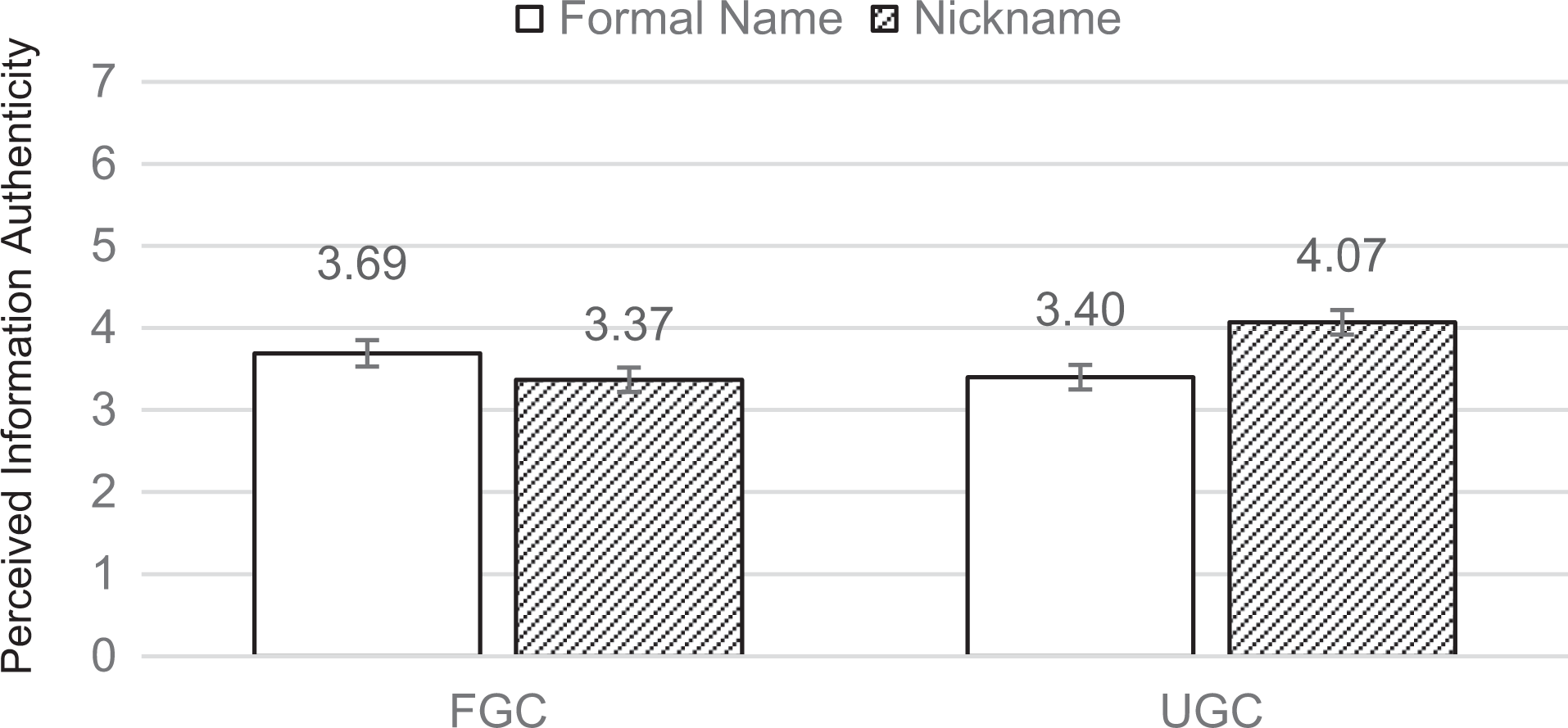
Results of Study 5 on perceived information authenticity.
Willingness to purchase: A two-way ANOVA revealed a significant interaction of information type and name type (F(1, 316) = 4.53, p = .034, η = .014). The main effects of information type (p = .71, η < .001) and name type (p = .71, η < .001) were not significant. For UGC, nickname use increased participants’ willingness to purchase the product (MUGC formal = 3.33, MUGC nickname = 3.86, F(1, 316) = 3.15, p = .077, η = .010). However, for FGC, the effect was diminished (MFGC formal = 3.71, MFGC nickname = 3.33, F(1, 316) = 1.53, p = .22, η = .005). In addition, nickname use in UGC increased participants’ willingness to purchase the product compared with nickname use in FGC (MUGC nickname = 3.86, MFGC nickname = 3.33, F(1, 316) = 3.15, p = .077, η = .010). However, we observed no significant difference between UGC and FGC for formal name use (MUGC formal = 3.33, MFGC formal = 3.71, F(1, 316) = 1.53, p = .22, η = .005). Figure 4 presents the results graphically.
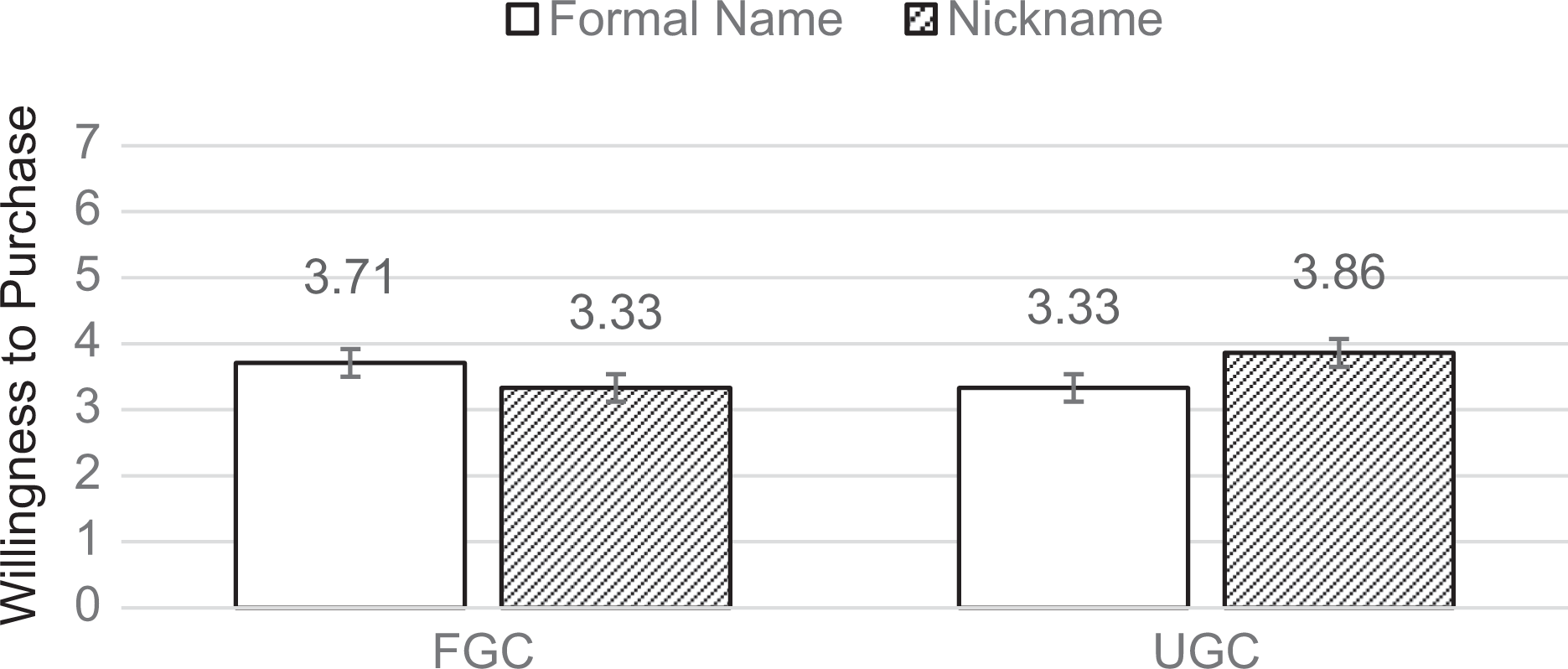
Results of Study 5 on willingness to purchase.
A moderated mediation analysis (Hayes 2017, model 7: 5,000 bootstrapped samples; IV = name type, M = perceived information authenticity, DV = willingness to purchase, W = information type) revealed a significant moderated mediation (index of moderated mediation = .6571, 95% CI [.2746, 1.0857]). The indirect effect of brand nickname use on willingness to purchase via perceived information authenticity was significant for UGC (95% CI [.1307, .7839]). However, the indirect effect was not significant for FGC (95% CI [−.4594, .0150]); see Web Appendix 4a for regression coefficients.
Discussion
Study 5 explores a boundary condition regarding whether companies should adopt and include their nicknames in FGC. The results suggest that brand nicknames work for UGC but not for FGC, possibly due to the activation of consumers’ persuasion knowledge in FGC. Therefore, while brand nicknames are popular with consumers, companies should be careful when appropriating consumer lingo, as it could be perceived as deliberate and less authentic.
General Discussion
A recent Washington Post investigation suggests that on some online commerce platforms such as Amazon.com, the number of fraudulent UGC-like consumer reviews exceeds the number of authentic ones for some popular product categories (Dwoskin and Timberg 2018). As such, communicating brand-related information authentically and building continuous consumer trust is a crucial issue facing marketers today. By investigating brand nickname use in the marketplace, the current research introduces the new concept of IBA to the literature and demonstrates its influence on consumers’ judgment of information authenticity. Specifically, we show that the different ways in which a brand is referred to by a message sender (e.g., the writer) can influence the receiver’s (e.g., the reader’s) perception of the sender’s brand attachment, which in turn shapes the evaluation of information authenticity and results in effects on downstream consequences such as willingness to purchase, review helpfulness, and information sharing.
We present a study using historical Twitter data and a set of six experimental studies with both real and fictitious brands to support our theorizing. These studies provide converging evidence that, in online communication, readers infer the writer’s brand relationship quality (captured as IBA from the reader’s perspective; Studies 4a and 4b) according to how the brand is referred to. These inferences subsequently affect the readers’ evaluation of online information authenticity and lead to downstream consequences (Studies 1–5). We demonstrate that the power of a brand nickname lies in the notion that it is an informal way to address a brand (Study 3) and that it is consumer based (Study 5). The studies also rule out the explanation of inferred brand knowledge (Study 4b) as a competing mechanism underlying this effect. Moreover, we report two supplemental studies in Web Appendix 5 that provide additional evidence for our hypothesized effects. Overall, the current research finds that brand nickname use serves as a means by which consumers infer the authenticity of online information and underscores the significance of recognizing consumers’ brand relationship cues in marketing communication.
Theoretical Contributions
By treating brand attachment as a social signal and examining it from the message receiver’s perspective, the current research offers two theoretical contributions to the branding and marketing communications literature. First, it places brand attachment in a social context so as to shed light on a novel function of brand attachment within consumers’ interpersonal communication. We demonstrate that brand attachment cues can signal a consumer’s relationship quality with the brand and further influence how message receivers perceive and process the sender’s information. By investigating how an individual’s brand attachment via language variation in the social environment may affect other consumers’ judgment and perception, brand attachment is no longer examined as the consequence of the consumer–brand relationship; rather, it serves as an antecedent to important marketing consequences such as information authenticity. This novel perspective opens a new avenue and serves as the basis for future research in the study of brand attachment as a social signal.
Second, by switching the research focus from the consumer–brand relationship to peer-to-peer consumer interaction, the current research highlights the importance of brand attachment in successful marketing communication with respect to UGC. Results from this research suggest that IBA positively shapes the message receiver’s perceived information authenticity. In addition, while previous research has typically focused on how consumers use possessions (e.g., products, brands) to show social status and identity, the current work suggests that relationship-indicating cues, such as brand nicknames, may have the same signaling effects and are thus used by consumers in their social interactions.
Managerial Implications
Embracing brand nicknames and relying on the nicknames to communicate trustworthy brand information
Beginning in the 1910s, Coca-Cola initiated a campaign with the theme “Coca Cola: Ask for it by its full name” and engaged in a 30-year marketing effort to dissuade consumers from using the nickname “Coke” (Smith 2010). For Chevrolet, an internal memo showed that the company had a “swear jar” in the company hallway to “accept a quarter every time someone uses ‘Chevy’” (Chang 2010). A number of brands dissuade nickname use out of fear that these unofficial names might dilute the brand equity and confuse consumers. However, the current findings suggest that brand nicknames reflect genuine consumer language and resonate well in conversations between consumers. We show that brand nickname use can make the brand information appear more authentic and lead to desirable downstream consequences for brands. Therefore, brands should embrace their popular nicknames and be open about consumers using these nicknames. Furthermore, brands can be strategic and creative in how they rely on nicknames to communicate trustworthy brand information. For example, consumer reviews that use brand nicknames could be placed at the top of webpages and labeled as the “top reviews” so they are read first. Brands can also consider highlighting nicknames in other types of peer-to-peer interactions, like referral programs, to convey that the messaging is natural and authentic.
The importance of keeping the brand nicknames part of consumer brand lingo
Findings from the current research suggest that brand nicknames seem more useful in UGC than FGC, highlighting the importance of limiting brand nickname use to consumers. While adopting or even trademarking a nickname may seem to be a convenient way for brands to engage consumers or rebrand, it could potentially discount the street cred of these monikers. As a case in point, McDonald’s rebranded itself after its well-known nickname “Golden Arches” in China (Fuhrmeister 2017). In Argentina, the popular nickname “Pecsi” became the new name for Pepsi in order to match the pronunciation of Spanish consumers (Vescovi 2009). On one hand, the company’s adoption of a nickname may facilitate consumers’ brand recognition and memory (as it naturally is a consumer language). At the same time, the “contamination” of firm elements into consumer lingo could damage the street cred of brand nicknames and result in the loss of their future marketing value. The reason brand nicknames resonate with consumers largely lies in its “street” nature. If a nickname is frequently used in advertisements or shown on the product package, it might not be viewed as consumer-based language anymore and may no longer be perceived as organic and authentic.
Leveraging consumer brand lingo such as nicknames for brand presence in the digital landscape
Finally, the current research suggests that informal brand-related language is popular in online communication among consumers. Therefore, brands should leverage the power of consumer-based language, such as brand nicknames, to maximize brand presence in the digital landscape. While the current research mainly examined nickname use in UGC, one could imagine that nicknames, as a casual way to refer to a brand, can be used by consumers in other types of online activities. For instance, instead of typing in a brand’s formal name, consumers may input its nickname on search engines to look for brand related information. Therefore, marketers should keep brand nicknames in mind during their search engine optimization process to improve the quantity and quality of website traffic.
Limitations and Future Research
Brand nickname use in the marketplace is a broad and nuanced phenomenon. Unsurprisingly, the current research does not fully address every aspect of the phenomenon and, therefore, has some limitations. First, we explore the use of brand nicknames in the context of positive UGC. However, consumers may also include brand-related monikers—even neutral or positive ones—in negative situations such as product failure or brand betrayal. The use of a positive nickname in a negative context could come across as humorous or ironic and influence how the message is understood. Further, not all brand nicknames are positive. Some brand nicknames that convey negative consumer sentiment do exist in the marketplace; consider “Needless Markup” for Neiman Marcus and “Fix it again, Tony!” for Fiat. Future research could explore how negative nicknames are communicated between consumers to provide a more complete picture of brand nickname use in the marketplace.
Second, the current research deals with well-known and popular brand nicknames, and so for the nicknames we use, we find that brand knowledge does not adequately explain the observed effect. However, considering that brand nicknames are “street names,” their widespread use in the marketplace relies on consumers sharing the cultural capital needed to pick up on the significance of the nickname as a relationship quality cue. Relatedly, some brand nicknames may serve as subtle signals of status and being the “in the know” (e.g., “Bolly Darling” for the champagne brand Bollinger, the “255” bag for the iconic Chanel handbag; Berger and Ward 2010). We posit that brand nickname use for specialty goods, like luxury or pharmaceutical products, could serve as an indicator of specialized brand knowledge. Consider that a regular consumer may refer to the Chanel quilted handbag as a Chanel bag, while an expert luxury consumer may use its nickname—the “255” bag—to signal their special brand knowledge (they know the story behind the nickname: Coco Chanel launched the bag in February 1955, giving it a nickname that corresponds to the date). Similarly, nickname use for some drugs might only be decoded by those who share the same brand knowledge or experience, such as “Vitamin V” for Viagra or “Addys” for Adderall. Future research could examine the role of brand nicknames as a means to subtly convey status via signaling specialized brand knowledge.
The current research also raises some interesting questions that could be examined in future research. First, the current research mainly focuses on one important dimension of marketing communication: perceived information authenticity. However, brand attachment signals might also influence other dimensions of marketing communication, such as information accuracy and communication efficiency, which may take place in a variety of communication channels. For instance, when a salesperson uses a brand nickname in a sales pitch, consumers may perceive the salesperson as unprofessional and the information to be less credible. Future research, therefore, could explore how brand attachment cues can affect other aspects of consumers’ information processing. Relatedly, in accordance with prior research (Park et al. 2010), we conceptualized IBA in terms of its two components, self–brand connection and brand prominence. Future research could determine the weights of these two components in terms of how they shape and contribute to information interpretation.
Second, it would be worth investigating how to strategically use brand attachment cues without overdoing it. Brand nicknames are relatively subtle linguistic cues in the manner in which they signal brand attachment. It is possible that overtly signaling brand attachment could backfire. Future research could examine the notion that different levels of IBA might result in an inverted-U shape of information authenticity: too little IBA may suggest the information is fictitious, but too much IBA might backfire and lead to the perception of favoritism or bias.
Third, it would be worthwhile to explore potential moderators that could allow firms to benefit from using their nicknames in FGC. We briefly touch on brand nickname use in FGC (in the context of promoting and selling a product) and show that it may not be an optimal strategy. However, certain conditions could make nickname use desirable and beneficial in a firm’s own brand messaging. For example, perhaps nickname use in FGC related to charity or corporate social responsibility (vs. merely trying to advertise a product) could enhance perceived brand warmth and lead to more positive consumer responses. Individual differences may also affect consumer response to brand nickname use in FGC. Future research could examine factors such as brand loyalty, consumer activist tendencies (Kozinets and Handelman 2004), or whether the FGC gains negative traction on social media inciting consumer groups (Gerbaudo 2012). It could also be worthwhile for future research to investigate brand nickname use in other types of paid content; for instance, if used by (paid) micro-influencers, do brand nicknames still convey authenticity?
Closely related to the issue regarding firms’ brand nickname use is the importance of understanding whether and how firms should promote nickname use among consumers. While we suggest that marketers should not discourage or restrict consumers from using brand nicknames, it is unclear whether it is wise to take the opposite approach by actively encouraging consumers to use brand nicknames. For example, a brand can create a “hashtag us by our nickname” campaign on Twitter. In this case, the brand nickname still appears in UGC eventually; however, because its use is initiated and prompted by the company, it is unclear whether the nickname would still lead to similar benefits as when it is used by consumers organically. On one hand, once companies get involved, it is possible that it dilutes the street cred of brand nickname use. On the other hand, perhaps a certain degree of encouragement from the firm is worthwhile as long as the action is not directly associated with external incentives (e.g., associating using the nickname hashtag with the chance of winning a prize offered by the company). Future research, therefore, could look into whether, how, and to what extent companies should be involved in consumers’ brand nickname use process.
It is often said that “trust decreases transaction costs.” In the current research, we find that when consumers refer to a brand by its nickname, it conveys a true relationship with the brand and increases how much other consumers find the information to be authentic. Given the widespread proliferation of fake information online, it might be useful for brands to rely on the insight revealed herein to establish measures and develop communication strategies that convey and capture true brand attachment, which, in turn, may serve as a means by which more authentic brand messages could be communicated in the current digital era.
Supplemental Material
Supplemental Material, sj-pdf-1-jmx-10.1177_0022242921996277 - Mickey D’s Has More Street Cred Than McDonald’s: Consumer Brand Nickname Use Signals Information Authenticity
Supplemental Material, sj-pdf-1-jmx-10.1177_0022242921996277 for Mickey D’s Has More Street Cred Than McDonald’s: Consumer Brand Nickname Use Signals Information Authenticity by Zhe Zhang and Vanessa M. Patrick in Journal of Marketing
Footnotes
Authors’ Note
This research comprises part of the first author’s dissertation work under the supervision of the second author.
Acknowledgments
The authors thank Edward Blair, Rex Du, Betsy Gelb, and Ye Hu for their thoughtful comments on an early version of this work. The authors are grateful to the review team for their valuable feedback and suggestions on this article.
Associate Editor
Jonah Berger
Declaration of Conflicting Interests
The author(s) declared no potential conflicts of interest with respect to the research, authorship, and/or publication of this article.
Funding
The author(s) received no financial support for the research, authorship, and/or publication of this article.

Notes
References
Supplementary Material
Please find the following supplemental material available below.
For Open Access articles published under a Creative Commons License, all supplemental material carries the same license as the article it is associated with.
For non-Open Access articles published, all supplemental material carries a non-exclusive license, and permission requests for re-use of supplemental material or any part of supplemental material shall be sent directly to the copyright owner as specified in the copyright notice associated with the article.
