



Abstract
This research investigates nickname branding, a novel phenomenon whereby firms incorporate the “street” names consumers give brands into their own marketing (e.g., Bloomingdale's opening a “Bloomie's” store). While practitioners anticipate positive results from deploying this tactic, the current research serves as the first empirical investigation of its likely effectiveness. Drawing on speech act theory, the authors theorize that using a nickname in place of a formal name serves as an act of power redistribution, effectively signaling submission to consumers, thereby reducing the perception of a brand's power and weakening its performance. Through a multimethod approach that incorporates secondary data analyses, field studies, and preregistered experiments, the results support this view across a range of performance metrics. In addition, the authors show that this effect is contingent on two factors, such that nickname branding (1) harms performance more for competent brands than warm brands and (2) is less pronounced when nicknames are used in messages that are communal-oriented (vs. transactional-oriented). This research introduces a new theoretical perspective centering on the illocutionary meanings embedded in the process of naming brands and highlights actionable insights on how marketers should approach or avoid consumer-based slang in their marketing.
“Bloomie's” is no longer just a consumer nickname for Bloomingdale's. Rather, company management decided to officially adopt this popular street name for its new store opened in Fairfax, Virginia in 2021 (Thomas 2021). In fact, Bloomingdale's is one of many brands that incorporates consumer-created nicknames in their marketing: When Nordstrom revamped its loyalty program in 2018, the company announced that a key change was to rename it “The Nordy Club” in honor of the brand's long-standing nickname (Howland 2018). In their social media activities, many brands make use of their nicknames such as BMW (e.g., “You can call us Bimmer, we’re friends at this point”; BMW USA 2020) and Cumberland Farms (e.g., “Coffee comes and goes, but Cumby’s is forever”; Cumberland Farms 2023).
Companies attend to what consumers say about their brands, and consumers enjoy coining and using nicknames for their favored brands (Zhang and Patrick 2018, 2021). In response to this consumer enthusiasm, companies are starting to regularly incorporate brand nicknames into their marketing. Managers expect that doing so will capitalize on the consumer affection reflected by nickname use and improve brand performance. For example, Jeff Gennette, CEO of Macy's (the parent company of Bloomingdale's), suggested that Bloomie's would help retain a share in the luxury market (Thomas 2020) while Scott Meden, CMO of Nordstrom, declared that “Nordy” provided “customers more reasons to engage with us” (Howland 2018).
But will firms benefit from deploying their nicknames? To our knowledge, there is no academic research on the topic. Though brand nicknames have attracted some scholarly attention in recent years, research is limited to understanding the phenomenon from a consumer perspective, focusing on their use of brand nicknames. In general, research shows that when used by consumers, brand nicknames lead to favorable consequences like greater brand attachment (Zhang and Patrick 2018) and perceived information authenticity (Zhang and Patrick 2021). No research has investigated the phenomenon of companies’ incorporating brand nicknames into their marketing, and it is unclear whether the tactic will improve brand performance.
To answer these questions, we examine the concept of “nickname branding” to describe situations where a company employs its brand nickname in its marketing and offer the first systematic academic exploration of its consequences. Counter to the likely expectations of Nordstrom and Bloomingdale’s management, we find that nickname branding is detrimental to brand performance, lowering consumer engagement, reducing brands’ ability to charge a price premium and causing other harms. Drawing on speech act theory (Bach and Harnish 1979), we explain these effects by demonstrating that brand nicknames are associated with consumer perceptions of reduced brand power (see Figure 1). We also show that this tactic hurts performance more for competent brands (vs. warm brands) and that the effect is weaker when nicknames are used in messages that are communal-oriented (vs. transactional-oriented).
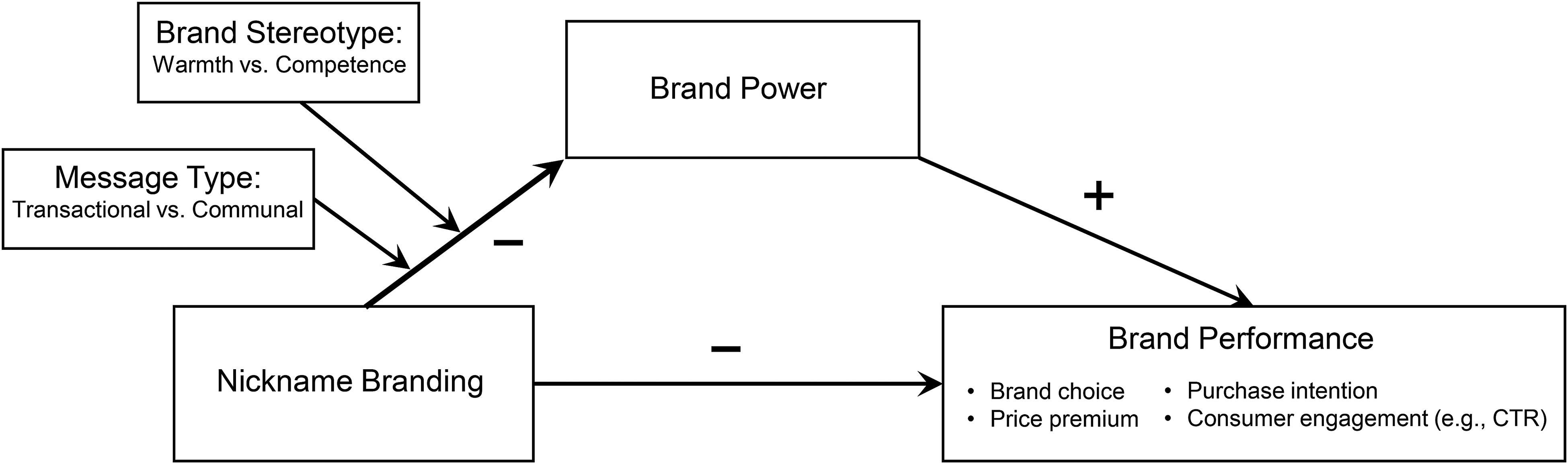
Conceptual Framework.
We make several theoretical contributions. First, unlike previous research's focus on the consumer perspective, this article is the first to explore the use of nicknames by marketers. As well, we employ the novel theoretical lens of a speech act perspective that contemplates the illocutionary meaning behind the act of a company deploying consumer language about its brand (i.e., a nickname). Importantly, while researchers have advanced understanding of the effects of linguistic features (e.g., phonetic characteristics) associated with successful brand names (Pogacar et al. 2021), we are the first to show that who gives versus who uses a brand nickname also matters. We demonstrate that a firm's adoption of a nickname can be detrimental to a brand's performance by reducing its perceived power. Lastly, we highlight two managerially relevant moderators by showing that the same linguistic cue (i.e., brand nickname) can lead to disparate results depending on the brand stereotype (i.e., competent vs. warm) and the message type (i.e., transactional vs. communal).
Next, we describe nickname branding and draw on speech act theory to explain how companies deploying brand nicknames hurt their power and performance. We present the results of analyses tied to secondary data, field studies, and experiments, and conclude with a discussion of contributions, offer managerial insights, and outline future research ideas.
Theoretical Development
The Rise of Nickname Branding
Many brands have nicknames, which in a marketing context are defined as “a descriptive name given by consumers or the public to serve as a substitution for a brand's or product's (trademarked) formal name” (Zhang and Patrick 2018, p. 148). This definition highlights the idea that nicknames are informal labels that reflect consumer language and that consumers can readily distinguish them from formal brand names. The idea that nicknames are initiated by consumers, not companies, is central to our subsequent theorizing. Indeed, in our inquiries into the histories of various brand nicknames, we have yet to secure an example of one that originated with a company and was successful. 1 Marketers appreciate their provenance as well: when explaining the choice to use the Bloomie's nickname, the CEO explained that “Bloomie's has always been a term of affection from our loyal customers” (Vembar 2021). Similarly, Nordstrom admitted in a press release that “the name, The Nordy Club, is directly inspired by how our most loyal customers and even some employees refer to being a ‘Nordy’” (Hall 2018).
Research suggests that there are three types of brand nicknames (Zhang and Patrick 2018; see Table 1). The first is based on a phonetic similarity with the formal brand name, a category that can be further divided into those that connote less or small by employing “-y” or “-ie” diminutives (e.g., “Starbies” for Starbucks) and those that otherwise alter (e.g., “Tarzhay” for Target) the formal name while retaining some similarity to the original. Second, many nicknames are associated with brand characteristics (e.g., “Big Blue” for IBM). Third, particularly true with watch and automobile model brands, nicknames also reflect aesthetic qualities (e.g., “Batman” for Rolex watches; “Bug” for Volkswagen Beetle). While most brand nicknames are positive or neutral (Zhang and Patrick 2018), there are examples that have clear derogatory intent (e.g., “Taco Hell” for Taco Bell). Some brand nicknames span categories: “Needless Markup” (Neiman Marcus) and “Fourbucks” (Starbucks) are phonetically similar to their formal names while depicting an alleged characteristic of the brand (overpriced).
Examples of Brand Nicknames.
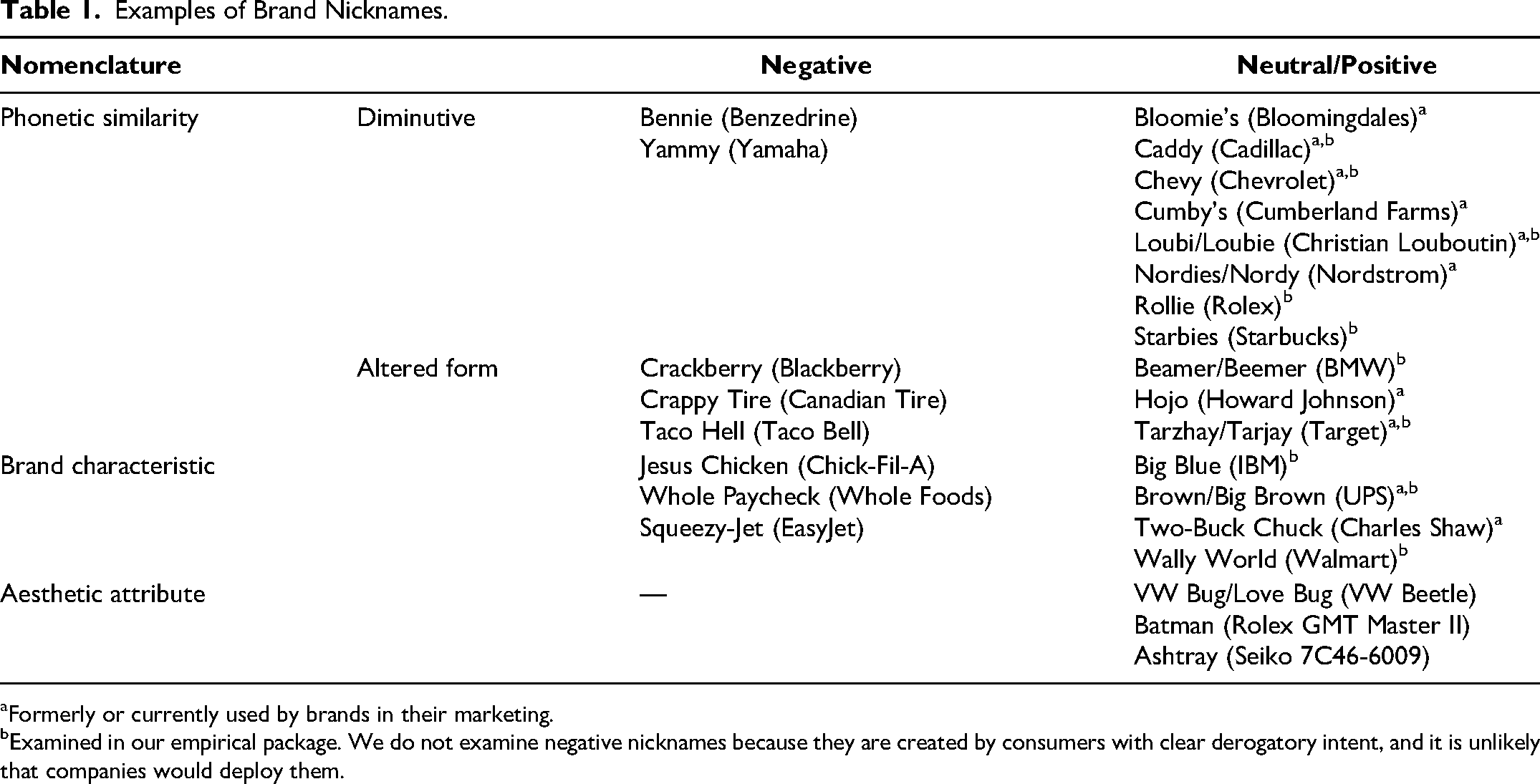
Formerly or currently used by brands in their marketing.
Examined in our empirical package. We do not examine negative nicknames because they are created by consumers with clear derogatory intent, and it is unlikely that companies would deploy them.
Though brand nicknames are consumer derivations, firms have started to embrace them for marketing purposes. We refer to this phenomenon as nickname branding, a term describing situations where companies employ their own brand nicknames in their marketing. Cadillac was one of the first to incorporate its nickname (“the Caddy that zigs”) (Nelson 2019). Other examples include Target's 2018 launch of a style campaign with the tagline “Fall for Tarzhay All Over Again,” McDonald's using “Mickey D's” in advertising at the 2023 World Cup, and the current Howard Johnson hotel chain slogan (“Go Happy. Go HoJo”). Nickname branding is also popular in China, where nicknames are commonly used to advertise premium cosmetics (Jean 2020). The increasing number of marketers embracing nickname branding suggests that the tactic is intended to have a positive impact. This perspective is corroborated by strategy consulting firms: in a recent report, McKinsey recommended that brands should use brand nicknames to improve promotional effectiveness and to create more social buzz (McKinsey & Company 2019). But are there overlooked drawbacks associated with nickname branding?
Next, we draw on speech act theory to explain how a firm's adopting a nickname may impair brand performance. We base our explanation on the idea of illocutionary meaning, which in the context of nicknames revolves around changes in implied power between the brand and consumers. That is, regardless of the specific qualities of the nickname itself (literal meaning, phonetic features, connotations, etc.), it is the social act embedded in the illocutionary meaning that matters to consumers and explains their negative reaction to nickname branding, an explanation we develop next.
Nicknaming, Power Distribution, and Speech Act Theory
Names are important social labels and a part of one's identity (Finch 2008), and the act of naming a person is a privilege (Alford 1988). Through the naming process, the namer not only confers an identity on a target but also signals a degree of hierarchy, control, or ownership (Butler 2010). Naming thus usually involves indications of the power dynamic between the namer and the named. For example, with parents and their newborns, “the right to name a child is an important and significant prerogative” (Alford 1988, p. 36), and in both Egyptian mythology and the Bible's Old Testament, deities would refuse to be named for fear that doing so would allow others to steal their power (Kaplan and Bernays 1997). These examples suggest that the act of naming a target entails political and social nuance that goes beyond the literal meaning of the name itself (Alford 1988).
Consistent with this perspective, the speech act theory posits that utterances are actions that convey a speaker's intentions and motivations (Bach and Harnish 1979; Searle 1975). According to the theory, a speech act may be less focused on the truth value (e.g., the semantic meaning of the utterance) and more on the illocutionary meaning, which is “the effect that a speaker wishes to have on his or her environment” (Katz 2015, p. 45). For example, when someone at the dinner table asks “Is there any salt?,” the semantic meaning might be to question the presence of salt, but the illocutionary meaning could be an intention to criticize (“the food is not salty enough”) or could represent a request (“please pass the salt”). In short, a speech act reflects the speaker's motivations beyond the utterance of any particular word or phrase.
Illocutionary meaning is critical for interpreting nickname usage (Adams 2009). Indeed, nicknames “are labels for people, places, etc., and often seem to have little other meaning” (Saeed 2003, p. 27), and understanding the impact of the act of nicknaming must account for the “revelation of situational and contextual exigencies” (Leslie and Skipper 1990, p. 274). Prior research has identified that an important illocutionary meaning associated with nicknaming someone is the speaker's attempt to exert power (Adams 2009; Butler 2010). Since naming is a prerogative, the speaker wants to assert the right to nickname the target. By so doing, the speaker tries to create a new identity for the target and to set their own rules for relationship functioning.
However, the speaker's attempt will not always succeed: how the named responds to the namer also reflects illocutionary meanings. Unlike formal names, what is unique about nicknames is that the target (the named) has the option to accept or reject a nickname given by the speaker (the namer). Nicknames emerge from extensive social interactions and to some extent, nicknaming is a political battle between the namer and the named and thus “are the result of complex social negotiations” (Leslie and Skipper 1990, p. 273). By observing the outcome of these social negotiations (i.e., whether the named accepts or rejects a nickname), one may implicitly track the power of the named: if the named accepts the nickname, it is a form of deference that legitimizes the namer by affirming their right to do so, potentially reflecting or even affirming a relatively inferior position compared with a formal name. Or, the named may disagree with the namer by not responding to or rejecting the nickname, which helps the named to maintain power (Adams 2009).
In parallel to the human domain, we expect that a brand embracing a nickname is conceptually an act of deference to the namer (i.e., the consumer) that is likely to cause a loss of power in their eyes. In marketing, power is generally defined as the perceived “asymmetric control over valued resources in social relations” (Rucker, Galinsky, and Dubois 2012, p. 353). In the context of the current study, this control over valued resources is reflected in the privileged act of naming, which is asymmetric. That is, not every party in a social relation has this naming privilege; only a powerful party has “the capacity to influence the behavior of others, while resisting the influence of others over oneself” (Brick et al. 2018, p. 994).
In the context of brand names, these ideas are relevant. Traditionally, a brand name is generated internally as marketers create and announce the name of their brand, which reinforces that the naming privilege is owned and controlled by the company. Further, companies have the capacity to influence the behavior of consumers (of what to call the brand) through consistently and over a prolonged period deploying that brand name in their marketing. These two aspects—the control of the naming privilege and the asymmetric capacity to influence name use—jointly confer power to the formal brand name. That is, a company naming its brand is a speech act with a core illocutionary meaning of legitimating the company's control of the brand. The corollary is that consumers are influenced by companies in knowing and using the formal brand names, thereby acquiescing to the brand's power as an independent actor.
When a brand adopts a nickname, which is devised and conferred by consumers, it signifies to consumers a social and political act implying a relatively inferior position compared with persisting with a formal name. A key reason for this argument is that brand nicknames are consumer-generated so a brand's use of or refusal to use the nickname is a social negotiation which may lead to altering the power dynamic (Leslie and Skipper 1990). That is, marketers do not control consumer use of a brand nickname, but refusing to deploy a nickname is itself an act that anchors a brand's power. In cases where marketers use the nickname, the brand (the named) is implicitly submitting or deferring to the consumer (the namer). The nickname branding process thus alters both core components of the brand's power: (1) it admits that the naming privilege is not the exclusive domain of the brand, and (2) it shows that the brand's behavior (e.g., name choice) is influenced by consumers. As such, from the consumer's viewpoint, nickname branding creates the illocutionary meaning of submission and obedience to consumers, giving away the brand's power to determine its identity. In effect, marketers misunderstand the illocutionary meaning associated with this tactic: While the intended illocutionary meaning marketers likely aim to convey is stronger relationships with consumers (Howland 2018), the actual illocutionary meaning perceived by consumers is a weakened brand.
It is also important to note that nickname branding focuses on the “act of adoption,” which is different from the process of “renaming.” It is common for brands to change their names. For example, BackRub changed to Google and Cadabra changed to Amazon (Josephs 2021). These name changes are initiated internally (the brands come up with and adopt the new names) and are thus unlikely to impair brand power because they are still viewed as independent actors. Conversely, nickname branding is initiated externally (consumers come up with the nickname and brands adopt them), which signals that a brand has been influenced by consumers and is less powerful. Thus, nickname branding and brand renaming are distinctive processes with different implied levels of independence and power.
Nickname Branding Impairs Brand Performance
We argue that the loss in power, as viewed by consumers, may have detrimental effects on brand performance. Defined generally as a “brand's success in the marketplace” (O’Cass and Ngo 2007, p. 871), brand performance can be reflected by various indicators such as market share (Keller and Lehmann 2003) and price premium (Chaudhuri and Holbrook 2001). Marketing research suggests that power is a foundation of successful brands and is critical to brand performance (e.g., Crosno, Freling, and Skinner 2009). For example, a major motivation for companies’ developing flagship stores is to project power (Moore, Doherty, and Doyle 2010), which helps influence a brand's command over a product category and provide a privileged position with respect to being top of mind and given consideration by consumers (Sundar and Noseworthy 2014). Similarly, much research has documented that being powerless is an aversive state, suggesting that low-power brands will be chosen less, while the converse is true as consumers may seek powerful brands to help them obtain and restore power (Rucker and Galinsky 2008). Consumers also view more powerful brands as of greater quality and are willing to pay a premium for them (Aaker 1991; Machiels and Orth 2017). In general, powerful brands are more successful because they are more differentiated, are evaluated better, and have greater equity in the mind of the consumer (Crosno, Freling, and Skinner 2009; Keller 2001). Thus, we expect that the loss in power, via nickname branding, will impair brand performance.
The Moderating Roles of Brand Stereotype and Message Type
Next, we explore two moderators. First, brand stereotypes refer to consumer beliefs about brands as intentional agents and reflect two dimensions: competence and warmth (Kervyn, Fiske, and Malone 2022). Warmth captures whether a brand has positive intentions toward the consumer and is measured by such ideas as sincerity and tolerance, while competence captures whether a brand is able to fulfill those intentions, captured by such ideas as confidence, intelligence, and competitiveness (Kervyn, Fiske, and Malone 2012). These brand stereotypes enable us to explore an important issue. Previously, we argued that the illocutionary meaning signaled by a brand using its own nickname is deference, causing the brand to be seen as less powerful and strong, which in turn harms performance in the market. However, is this explanation best suited to brands whose positioning is mainly aligned with competence? That is, though a competent brand may be subject to negative effects from nickname branding, is this less true of a warm brand? Consumers may expect competent brands to show strength and resist the influence of others, but this may not be the case with warm brands (Aaker, Vohs, and Mogilner 2010). It is even possible to make a case that warm brands, generally construed by consumers as friendly, sincere, and approachable, might be well suited for the application of brand nicknames given that consumers themselves are often motivated to generate nicknames out of affection for that brand (Zhang and Patrick 2018, 2021). Using a nickname, in other words, may be welcomed by consumers in reference to a warm brand for whom being approachable (not powerful) may be ideal.
A major assumption about firms and their leaders is that they are self-interested actors mainly concerned with benefiting themselves (e.g., Bosse, Phillips, and Harrison 2009). In the parlance of brands, this tendency represents an exchange or transactional orientation whereby economic motives prevail (e.g., Aggarwal 2004). The exchange orientation thus highlights “what the other party can offer”—the importance of “control over valued resources” (Rucker, Galinsky, and Dubois 2012, p. 353)—which is manifested as power. Firms that appear to be transactional or motivated primarily by exchange may thus reinforce consumers’ “record-keeping” mindset (Clark, Mills, and Powell 1986, p. 333) by continually tracking the benefits obtained with each brand interaction, thereby maintaining the salience of brand power.
However, it is also true that brands can demonstrate a concern for others and transcend their self-interest by centering their activities on more social and other-focused initiatives. That is, while firms’ customary mode of operation is to focus on improving their competitive position, on occasion their efforts reflect more of a communal orientation, acting in a way that consumers view as promoting social benefits and societal well-being (Song, Tao, and Wen 2021). When a brand behaves communally, “record keeping is unnecessary” (Clark, Mills, and Powell 1986, p. 333), suggesting that the lack of focus on advancing self-interest may help reduce the brand power penalty assessed by consumers for brands that deploy nicknames. Because the use of a nickname appears to be in pursuit of benefiting others, consumers may be less critical of the brand's activities, suggesting that impairments to perceptions of brand power may be reduced. This idea is consistent with prior work showing that firms associated with enhancing societal well-being are favored and forgiven more by consumers as well as perceived to be relatively stronger than brands that are more self-focused (e.g., Kim and Kinoshita 2023; Klein and Dawar 2004).
Empirical Investigation 2
We use secondary data, field studies, and preregistered experiments to test our hypotheses (Table 2). Using over a dozen brands, we position our studies in different market situations to examine the effect of nickname branding on various metrics of brand performance including likes and shares of brand posts, price premium, choice, and purchase intention. We intentionally examine different types of nicknames with varying forms and connotations, which helps rule out any explanation based on phonetics and potentially idiosyncratic associations. Study 1a analyzes historical X (formerly Twitter) data associated with a real brand (Chevrolet) and its nickname (Chevy), and Studies 1b and 1c examine the effect of nickname branding of two mass-market brands on social media platforms (Target/Tarzhay in Facebook ads and UPS/Big Brown in TikTok ads, respectively), using a consequential dependent variable of click-through rate (CTR). All provide evidence that nickname branding may hurt brand performance. Studies 2a, 2b, and 2c replicate the main effect in an experimental setting with different types of brands (e.g., luxury, technology, mass-market) and different brand performance indicators to reinforce the robustness of our findings. Studies 3a and 3b test the proposed mechanism of brand power using Walmart and Rolex, respectively, with Study 4 addressing alternative mechanisms (e.g., strength of the consumer–brand relationship). The last two studies focus on moderators: (1) brand stereotypes and (2) message type (transactional vs. communal). Throughout, we also report several supplementary studies (Web Appendix F) to boost robustness and generalizability.
Overview of Studies.
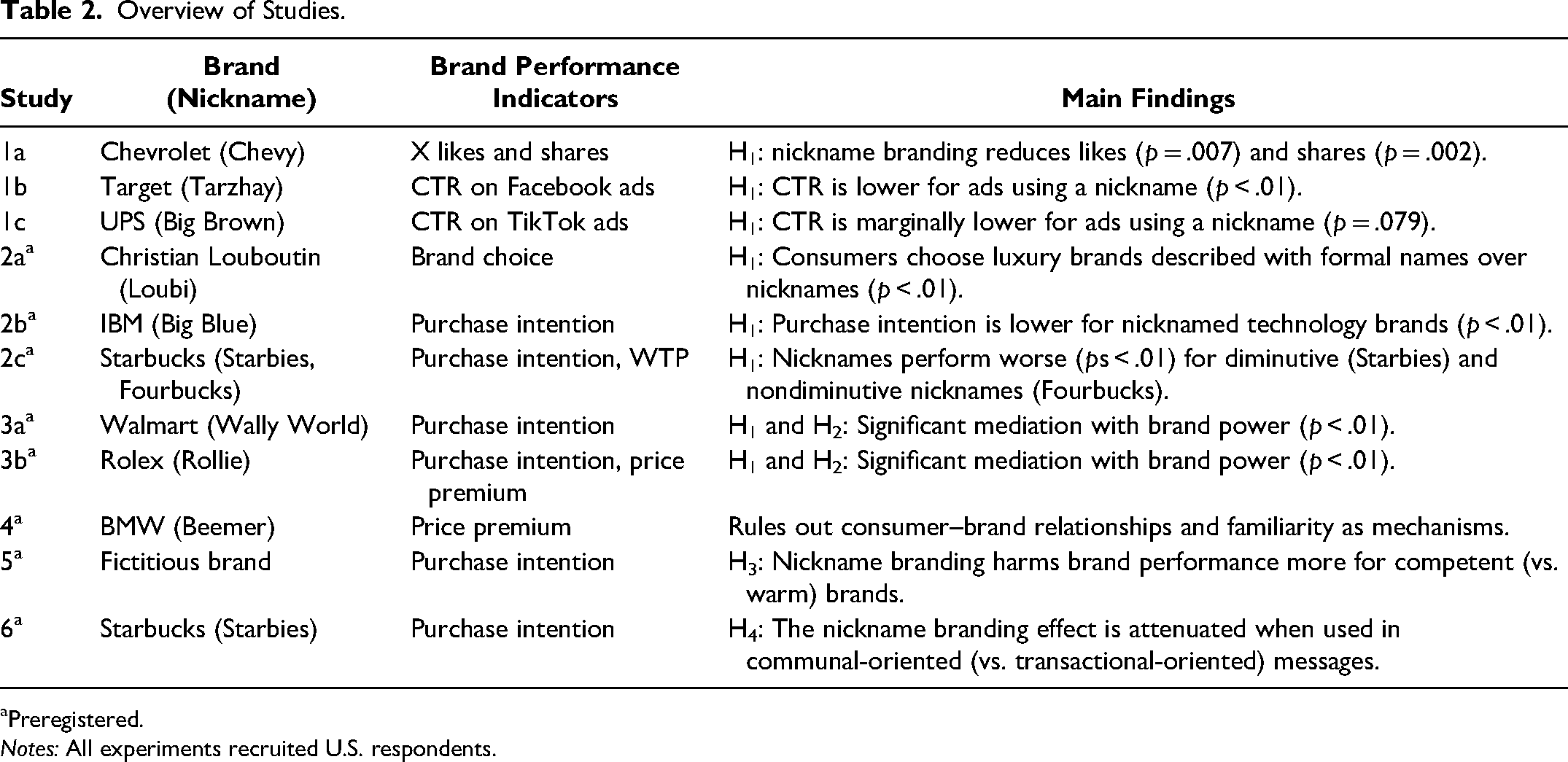
Preregistered.
Notes: All experiments recruited U.S. respondents.
Study 1: Consequences of Using Nicknames in the Market
Study 1 examines the real-world impact of nicknaming branding. We marshal evidence from a variety of sources (e.g., secondary data, field studies) that jointly suggest that nickname branding is an inferior marketing tactic when employed in the field.
Study 1a: Nickname Branding Reduces Likes and Shares of Brand Posts
In line with previous research (Zhang and Patrick 2021), we explore how including a brand nickname in posts on a company's official X account influences the number of likes and shares. 3 Specifically, we reviewed Chevrolet's X account and recorded the number of likes and shares linked to posts where the brand used solely its formal name (n = 42) or included its nickname (n = 361). The results show that posts using the brand nickname are liked less (Mnickname = 143.14, SD = 337.45 vs. Mformal = 421.79, SD = 1,678.93; F(1, 401) = 7.48, p = .007, η2 = .02) and shared less (Mnickname = 29.05, SD = 41.54 vs. Mformal = 117.55, SD = 524.74; F(1, 401) = 9.92, p = .002, η2 = .02).
Study 1b: Evidence from Facebook Ads
We conducted a field study using a Facebook A/B split test to examine how nickname branding influences CTR, a commonly used performance metric (e.g., Paharia and Swaminathan 2019; Sevilla and Meyer 2020). We created a single-factor (formal name vs. nickname) between-subjects test and held all other variables constant such as performance goal (e.g., awareness), budget and schedule (e.g., $50 per ad for one day), audience (e.g., users located in the United States; age range: 18–65+ years), and placement (e.g., Facebook feeds and stories). The two ad versions (see Web Appendix 4a) featured the same brand logo, images, text, and landing page. The only difference between conditions is whether the brand was referred to as Target or Tarzhay. The dependent variable, CTR, was measured as the percentage of ad clicks out of the total number of users who viewed the ad at least once (e.g., reported as “reach” by Facebook)
A total of 38,102 Facebook users were shown a version of the ads, and the results revealed a significantly lower CTR for ads depicting the nickname (.03%) compared with ads depicting the formal name (.09%, χ2(1) = 6.69, p < .01, φ = .01). The CTRs reported in this experiment are in line with prior research reporting rates from .001% to 5.01% (Orazi and Johnston 2020; Wu et al. 2023). In addition, we report a preregistered online study that conceptually replicates this study with purchase intention in Web Appendix 6a.
Study 1c: Evidence from TikTok Ads
We conducted a similar experiment on TikTok ads depicting either a formal brand name (UPS) or a nickname (Big Brown). Both stimuli featured “The UPS Store” at the top, which is commonly used in UPS advertising and should reduce concerns that consumers might not know the brand identity in the nickname condition. Other variables were held constant (e.g., launch timing, campaign goal [awareness], call to action [“shop now”], budget [$75/condition]).
The results reveal a total of 101,056 impressions, with a CTR in the nickname condition (= .34%) that was marginally lower than the formal name condition (= .41%; χ2(1) = 3.08, p = .079, φ = .01). In addition, we report a preregistered online study that conceptually replicates this study with purchase intention and brand choice as outcomes in Web Appendix 6b.
Discussion
Studies 1a–c examine the real-world impact of nickname branding. Collectively, these studies provide converging, externally valid evidence that nickname branding is associated with inferior brand performance, supporting H1. Consistent with the nature of real-world data, some aspects of these studies are difficult to optimize (e.g., unequal cell size in Study 1a). In the remaining studies, we use preregistered experiments in more controlled settings to examine brand performance and to investigate the hypothesized mechanism and potential moderators.
Study 2: Nickname Branding Impairs Brand Performance
The purposes of this study are threefold. First, we aim to test the robustness of the nickname branding effect by replicating it across different types of brands: a luxury brand (Christian Louboutin, Study 2a), a technology brand (IBM, Study 2b) and a large mainstream brand (Starbucks, Study 2c). Second, we assess brand performance with additional outcomes (e.g., brand choice, purchase intention, willingness to pay [WTP]). Third, we gather evidence showing that the nickname branding effect comes from the act of adopting a nickname (the illocutionary meaning) rather than from the nickname itself. We do this by disassociating the proposed effect from various linguistic characteristics. For example, we replicate the effect in Study 2b with a nondiminutive nickname—one that is not a condensed version of the formal name (i.e., “Big Blue” for IBM)—and with nicknames that have different phonetic features and valence in Study 2c (i.e., “Starbies” and “Fourbucks” for Starbucks). These changes reinforce the idea that it is the illocutionary meaning of the nickname and not other features that drive our effects.
Study 2a: Nickname Branding with a Luxury Brand
This preregistered study (https://aspredicted.org/ec6q4.pdf) examines nickname branding with a luxury brand in an online store. We assess brand performance using participants’ choice, captured by their clicking behavior.
Method and procedure
One hundred ninety female participants from CloudResearch completed this study (Mage = 21.9 years). We recruited female participants since they typically are the target market for the category (high-heel shoes) we chose as the stimulus. Participants were told that they would be browsing the Christian Louboutin website, which offered a high-heel rental service. We directed participants to a simulated Christian Louboutin web page that displayed the brand's actual URL and logo. It presented two pairs of Christian Louboutin shoes that were nearly identical in style and color and that were available for rent on the same terms ($49.99 for seven days). In the control condition, both shoe options were referred to by the formal Christian Louboutin name, but in the experimental condition, one option was referred to using the brand nickname (“Loubi”). 4 In both conditions, the left/right presentation of the options was randomized (see Web Appendix 4c for stimuli). Participants were told to make a choice of which option they would like to rent by clicking on the “ADD TO BASKET” button. Our dependent measure, choice, is the percentage of participants choosing the nicknamed option in each condition.
Results
A chi-square test shows that nickname branding significantly reduces the proportion of participants who chose to rent the nicknamed option (χ2(1) = 27.34, p < .001, φ = .38). Specifically, when the brand nickname (i.e., Loubi) was used, the percentage of participants selecting this option (21.5%) was significantly lower than when the formal brand name (i.e., Christian Louboutin) was used (58.8%).
Study 2b: Nickname Branding with a Technology Brand
Study 2b (preregistered: https://aspredicted.org/yq68m.pdf) examines nickname branding with a technology brand, IBM, and compares this formal name with its nickname, Big Blue. While the nickname in the previous study (i.e., Loubi) is a condensed version of the formal name, Big Blue is not, allowing us to test the robustness of the nickname effect in a context where potential connotations of smaller or less (i.e., diminutives) are absent. We assess brand performance using purchase intention.
Method and procedure
This study has a single factor (nickname vs. formal name) between-subjects design. Two hundred Prolific participants (49.0% female, 50.0% male, 1.0% nonbinary; Mage = 38.6 years) were randomly assigned to view an ad from IBM. In both conditions, the ad featured the official “IBM” logo in a corner of the ad as well as either the formal name (IBM) or its nickname (BIG BLUE) centered on the page above an image of tablets (see Web Appendix 4d for stimuli details). The ads were identical in all respects except the brand name. We assessed participants’ purchase intention with two items: “My willingness to buy the tablet from this brand is …” and “The likelihood that I would choose this brand is …” (1 = “very low,” and 7 = “very high”; r = .86), which were averaged into a composite. At the end of the survey, participants answered an attention check and provided basic demographics.
Results
An ANOVA on purchase intention as a function of name condition reveals participants are less likely to make a purchase from the brand when its nickname is used (Mnickname = 3.76, SD = 1.53; Mformal = 4.32, SD = 1.55; F(1, 198) = 6.72, p < .01, η2 = .03).
Study 2c: Nickname Branding with a Mainstream Brand
Prior research (Zhang and Patrick 2018) shows that some brands have multiple nicknames that are phonetically distinct and differ in their connotations and valence. For instance, the popular Starbucks brand has two nicknames, one a diminutive with neutral valence (Starbies) and the other (Fourbucks) a nondiminutive with a negative connotation (expensive). Study 2c (preregistered: https://aspredicted.org/dd5gv.pdf) replicates the nickname branding effect by comparing this brand with its two nicknames. In so doing, we offer additional support for the argument that it is the illocutionary meaning rather than the specific nickname or type of nickname that drives the effect.
Method and procedure
The design replicates Study 2b. Three hundred participants from Prolific (48.0% female, 51.0% male, 1.0% nonbinary; Mage = 36.9 years) were randomly assigned to one of three conditions and shown a Starbucks ad that always featured the brand's siren logo and either the formal name (Starbucks) or one of two nicknames (nickname condition #1: Starbies; nickname condition #2: Fourbucks; see Web Appendix 4e for stimuli details). We measured brand performance in two ways: (1) purchase intention (see Study 2b) and (2) WTP, where participants indicated how much they would pay for a cup of coffee from the brand on a slider scale ranging from $2.50 to $5.50. Lastly, participants answered an attention check, provided basic demographics, and answered the question, “How often do you go to Starbucks?” (1 = “I never go there,” and 7 = “I go there all the time”).
Results
A one-way ANOVA with purchase intention as the dependent variable (F(2, 297) = 12.27, p < .001, η2 = .08) showed that participants in nickname condition 1 (MStarbies = 3.82, SD = 1.96; t(297) = 3.43, p < .001, d = .48) and nickname condition 2 (MFourbucks = 3.45, SD = 1.78; t(297) = 4.81, p < .001, d = .70) are less likely to purchase than those in the formal name condition (MStarbucks = 4.73, SD = 1.87). The difference between nickname conditions was not significant (t(297) = −1.38, p = .17, d = −.20).
A similar one-way ANOVA with WTP as the dependent variable (F(2, 297) = 5.90, p = .003, η2 = .04) showed that participants in nickname condition 1 (MStarbies = $3.48, SD = $.90; t(297) = 2.95, p = .003, d = .40) and nickname condition 2 (MFourbucks = $3.47, SD = $.81; t(297) = 2.99, p = .003, d = .43) are willing to pay less for a cup of coffee from the brand than those in the formal name condition (MStarbucks = $3.85, SD = $.96). The difference between nickname conditions was not significant (t(297) = −.04, p = .97, d = −.01).
On an exploratory basis (i.e., not a preregistered analysis), we examined if being a regular customer of Starbucks moderated either effect (PROCESS Model 1, 5,000 draws), and the results showed neither interaction (βPI = .02, 95% CI = [−.0928,.1352]; βWTP = .01, 95% CI = [−.0448, .0688]) was significant. In other words, these effects are unlikely to be explained by nontargeted customers responding poorly (or positively) to the company's use of a nickname.
Discussion
Studies 2a–c document the nickname branding effect with different types of brands (e.g., technology, luxury, mainstream) and show negative effects persist across different types of nicknames (e.g., diminutive vs. nondiminutive; neutral vs. negative connotations). In Web Appendix 6c (Supplemental Study 3), we report a replication of this effect in the Chinese market with a brand’s formal name and nickname appearing in a different language, further suggesting that specific nickname elements or connotations are not driving the effect. Next, we test the proposed mechanism of brand power.
Study 3: The Mechanism of Brand Power
The main goal of Study 3 is to test the proposed mechanism of brand power (H2). To strengthen the robustness and generalizability of the mechanism, we situate the studies in different contexts (Study 3a: social media post; Study 3b: advertisement) and use contrasting brands (Study 3a: Walmart, a mass-market brand; Study 3b: Rolex, a luxury brand).
Study 3a: Walmart
Method and procedure
This study was preregistered (https://aspredicted.org/m37q6.pdf) and run as a single-factor (nickname vs. formal name) between-subjects design and was completed by 201 participants from Prolific (58.2% female, 39.3% male, 2% nonbinary, .5% agender; Mage = 38.2 years) who were randomly assigned to one of two conditions to see an X post created by Walmart about a seasonal sale. In the post, the company refers to the brand as either Walmart or Wally World (see Web Appendix 4f for stimuli).
Brand performance was assessed with the same measure of purchase intention as above (r = .92). We assessed brand power with an existing scale and asked participants to evaluate to what extent they agree the brand is “powerless, weak” (1) or “powerful, strong” (7; r = .90; Sundar and Noseworthy 2014 5 ). Participants then answered a similar attention check as in previous studies and basic demographics. We also asked whether the respondent was a regular Walmart shopper by asking “How often do you shop at Walmart?” (1 = “I never shop there,” and 7 = “I shop there all the time”; M = 4.49, SD = 1.95).
Results
Brand performance
An ANOVA on purchase intention as a function of name condition reveals that participants are less likely to make a purchase from the target brand when the brand nickname is used (Mnickname = 4.10, SD = 1.63; Mformal = 4.85, SD = 1.68; F(1, 199) = 10.47, p = .001, η2 = .05).
Brand power
We ran an ANOVA on brand power as a function of the name condition. The results show that brand power is weakened when the company uses its nickname (Mnickname = 4.75, SD = 1.55; Mformal = 5.73, SD = 1.36; F(1, 199) = 22.52, p < .001, η2 = .10).
Mediation analyses
We propose that the negative effect of nickname branding on brand performance is driven by brand power. We performed a mediation analysis (Model 4; 5,000 draws) with name condition (0 = formal name, 1 = nickname) as the independent variable, brand power as the mediator, and purchase intention as the dependent variable. The result revealed a significant indirect effect for brand power (B = −.51, 95% CI = [−.7922, −.2637]).
Lastly, we examined if being a Walmart regular would moderate this indirect effect (PROCESS Model 7, 5,000 draws). Since the index of moderated mediation (IMM) was not significant (B = −.04, 95% CI = [−.1629, .0717]), we conclude that the potential liability of employing nicknames does not depend on whether the respondent is a regular customer. Both more dedicated Walmart consumers and those who rarely or never shop there react poorly to the company using its nickname.
Study 3b: Rolex
Many luxury brands deploy nickname branding (e.g., Bloomie's store, Loubi shoes) and Study 3b (preregistered: https://aspredicted.org/hx4jr.pdf) aims to test the proposed mechanism of brand power in a luxury context. We situate the study in an advertising context and operationalize brand performance by using two measures: (1) purchase intention and (2) price premium.
Method and procedure
The design of Study 3b is similar to Study 3a. Two hundred participants from Prolific (54.0% female, 45.5% male, .5% trans man; Mage = 37.6 years) were randomly assigned to view a Rolex ad that features Rolex's logo followed by either the brand's formal name (Rolex) or its nickname (Rollie), depicted alongside a pair of Rolex watches (see Web Appendix 4g for stimuli details).
Brand performance was measured using the same purchase intention scale as before (r = .88) as well as price premium, measured by asking respondents to estimate the price of the pair of watches shown in the advertisement (on a scale from $0 to $40,000; Bredan 2022). We measured brand power (r = .92) with the same scale as Study 3a and assessed the same attention check and demographic questions. We also assessed whether a participant is a target consumer of Rolex with two questions: (1) “Do you own (or have you formerly owned) one or more Rolex watches?” (“Yes, I currently own [or have formerly owned] one or more Rolex watches” vs. “No, I have never owned a Rolex watch”) and (2) “Generally speaking, how many of your friends and/or family own one or more Rolex watches?” (1 = “none,” and 7 = “a lot”). These represented different operationalizations of the moderator.
Results
Brand performance
An ANOVA on purchase intention as a function of name condition reveals that participants are less likely to make a purchase from the brand when its nickname is used (Mnickname = 2.64, SD = 1.79; Mformal = 3.47, SD = 1.97; F(1, 198) = 9.80, p = .002, η2 = .05). In addition, an ANOVA on price premium reveals a significant effect with participants estimating the price for the same pair of watches to be an average of $4,882.52 cheaper when the brand nickname is used (Mnickname = $11,862.20, SD = $9,913.24; Mformal = $16,744.72, SD = $10,995.62; F(1, 198) = 10.86, p = .001, η2 = .05).
Brand power
We ran an ANOVA on brand power as a function of the name condition. The results show that brand power is weakened when the nickname is used (Mnickname = 4.61, SD = 1.92; Mformal = 5.75, SD = 1.20; F(1, 198) = 25.44, p < .001, η2 = .114).
Mediation analyses
We performed mediation analyses (Model 4; 5,000 draws), and the results reveal a significant indirect effect of brand nicknaming thought brand power on both purchase intention (B = −.48, 95% CI = [−.7465, −.2515]) and price premium (B = −3,317.09, 95% CI = [−.2913.82, −528.74]).
Lastly, we investigated moderation (PROCESS Model 7, 95% CIs, 5,000 draws) using both operationalizations, but in all analyses for both dependent measures, no interaction was significant (IMMs uniformly included 0). However, this result should be interpreted with caution, given that only 3% of our sample reported owning or previously owning a Rolex, while the same number had family or friends with a Rolex. To further examine whether consumers who use a brand reflect differently on the use of nicknames compared with nonusers, we conducted a conceptual replication using another luxury brand (Louis Vuitton), where almost half (49%) of respondents were actual brand users (Supplemental Study 4). Again, we found no indication of moderation (IMM spanned 0). Taken together, these findings suggest that for both mass-market (Walmart, Study 3a; Starbucks, Study 2c) and luxury (Rolex, Study 3b; Louis Vuitton, Supplemental Study 4) brands, the nickname branding effect does not depend on being a member of the brand's target market.
Discussion
The results for a mass-market brand (Walmart) and a luxury brand (Rolex) provide converging evidence that nickname branding impairs perceptions of brand power, which in turn harms brand performance. In Web Appendix 6d, we report a replication of the mechanism in the Chinese market, where nickname branding is prevalent (Jean 2020). Results from these studies suggest that the impaired power perception is consistent across different nickname types (e.g., Wally World is a nickname based on the brand characteristic, whereas Rollie is a phonetically similar nickname) and is less likely to depend on the brand type (mass market or luxury) or different cultures and languages. In the study that follows, we further strengthen our findings by ruling out competing mechanisms.
Study 4: A Test of Competing Mechanisms
Study 4 (preregistered: https://aspredicted.org/hb388.pdf) further explores mechanisms by comparing brand power with alternative explanations. Research has shown that when consumers use nicknames, it can strengthen consumer–brand relationships (CBR; Zhang and Patrick 2018), which has been argued to improve a range of outcomes like making consumers more willing to pay a price premium (e.g., Thomson, MacInnis, and Park 2005). If a company using its brand nickname causes consumers to feel more closely connected to the brand, CBR might offer an alternative explanation for the nickname branding effect. We address this explanation next. We also explore if reactions to a company's use of its nickname could be explained by familiarity. That is, if the use of a nickname makes a brand seem less familiar to consumers, it could produce negative feelings and prompt weaker brand performance.
Method and Procedure
The study is similar to Study 3a: participants were randomly assigned to see an X post by BMW in which the company introduces a new car using the formal name “BMW” or using its nickname “Beemer” (see Web Appendix 4h for details). Two hundred ninety-eight male participants from CloudResearch (Mage = 40.3 years) completed the study. We purposely recruited male participants due to research showing that BMW is one of the most popular brands among male consumers (e.g., 85% of BMW M3 owners are male; Maynard 2012) and to mirror the exclusive use of female participants in Study 2a.
Brand performance was measured using a price premium scale similar to Study 3b (ranging from $0 to $100,000). We assessed brand power using the same scale from Studies 3a and 3b. CBR was assessed using the Inclusion of Other in the Self scale (i.e., IOS or zipper scale; see Choi and Winterich 2013). This was followed by participants indicating how familiar they are with the brand (1 = “not familiar at all,” and 7 = “very familiar”). At the end of the survey, participants answered a similar attention check as used in Study 3 and demographic information including socioeconomic status (Griskevicius et al. 2011; α = .90). Because socioeconomic status as a covariate did not substantively change the results (see Web Appendix 7c for details), it was set aside.
Results
Brand performance
An ANOVA on price estimation reveals a significant effect of name type, with participants estimating the price for the same car to be $6,556.40 lower on average when the brand nickname is used (Mnickname = $57,941.95, SD = $17,667.94; Mformal = $64,454.98, SD = $16,372.50; F(1, 296) = 10.90, p = .001, η2 = .04).
Brand power
We ran an ANOVA on brand power as a function of the name condition. The results show that brand power is weakened when the company uses its nickname (Mnickname = 5.27, SD = 1.50; Mformal = 5.93, SD = 1.16; F(1, 296) = 17.76, p < .001, η2 = .06).
Additional measures
An ANOVA with CBR as the dependent variable reveals no significant difference between conditions (Mnickname = 2.57, SD = 1.78; Mformal = 2.78, SD = 1.76; F(1, 296) = 1.00, p = .32, η2 = .003). This suggests that when nicknames are used by companies, the practice does not influence consumers’ relationship with the brand. A similar ANOVA of brand familiarity reveals no significant difference between conditions (Mnickname = 5.36, SD = 1.37; Mformal = 5.51, SD = 1.46; F(1, 296) = .82, p = .37, η2 = .003). Given these results, we do not explore either variable further.
Mediation analyses
We again examined if brand power mediated the effect (Model 4, 5,000 draws), and the results reveal a significant indirect effect on price (B = −2,986.43, 95% CI = [−5,101.62, −1,259.93]).
Discussion
Study 4 provides additional support for our proposed mechanism of brand power and rules out the competing mechanisms of CBR and brand familiarity. While prior research shows that nicknames serve as a relationship quality cue when used by consumers (i.e., Zhang and Patrick 2021), we do not find a similar effect when nicknames are used by companies. Thus, we extend prior research by showing that nicknames are not a universal relationship balm: depending on who uses them, the same nickname may be interpreted with different illocutionary meanings and lead to diverse consequences. In Supplemental Study 5 (Web Appendix 6e), we examined two alternative explanations tied to whether the brand is viewed as counterfeit or lacking authenticity. Importantly, those results show that brand power is a significant mediator even while simultaneously including measures of these alternative explanations.
Study 5: The Moderating Role of Brand Stereotype
In our prior studies, all brands assessed were well-known and successful, which suggests the possibility that they are largely viewed as competent brands. To verify this perspective, we conducted a consumer survey of the brands assessed in previous studies (Pretest 5, Web Appendix 2e), and the results show that all are viewed as considerably more competent than warm. This leads us to ask, do brands that are stereotyped as warm also show the same pattern of effects? We explore this issue (H3) next. In addition, up to now we have exclusively used real brands in our studies, but it would be useful to document the nickname effect where respondents have no priors. As such, we undertook Study 5 with fictitious brands.
Method and Procedure
This study was preregistered (https://aspredicted.org/7ya7u.pdf) and run as a 2 (name type: nickname vs. formal name) × 2 (brand type: competent stereotype vs. warm stereotype) between-subjects design. To operationalize competence, we described the brand as representing a law firm brand, and to operationalize warmth, we described the brand as representing a charity brand. Consistent with prior research (Aaker, Vohs, and Mogilner 2010), a pretest revealed that consumers stereotype law firms as competent and charitable organizations as warm (ps < .01, see Web Appendix 2f for details). With both law firms and charities, we employed the same formal brand name or nickname.
Three hundred twenty participants (53.4% female, 46.3% male, .3% nonbinary; Mage = 41.4 years) from CloudResearch were randomly assigned to one of four conditions. We used a cover story describing Atlantic Eagle (either a law firm or charity), which, over the years, consumers had started to refer to by the nickname “Birdie.” In the formal name conditions, participants were told that the brand exclusively used its formal name in its marketing activities (e.g., advertising, social media posts), but in the nickname conditions, they were told that the brand had started to incorporate the brand nickname into its marketing activities. We measured purchase intention (r = .92) and brand power (r = .91) as in previous studies. Participants also answered an attention check and concluded with basic demographics.
Results
Brand performance
A 2 (name type: nickname vs. formal name) × 2 (brand type: competent vs. warm) between-subjects ANOVA on purchase intention reveals a nonsignificant main effect of name type (F(1, 316) = 1.93, p = .17, η2 = .01), a marginally significant main effect on brand type (F(1, 316) = 3.08, p = .08, η2 = .01), and a significant interaction (F(1, 316) = 8.14, p = .005, η2 = .03). For the competent brand (law firm), nickname use significantly decreases purchase intention (Mnickname = 4.28, SD = 1.64; Mformal = 4.97, SD = 1.39; F(1, 316) = 8.82, p = .003, η2 = .03), but this effect is attenuated for the warm brand (charity) (Mnickname = 4.46, SD = 1.48; Mformal = 4.22, SD = 1.28; F(1, 316) = 1.09, p = .30, η2 < .01; see Figure 2, Panel A).
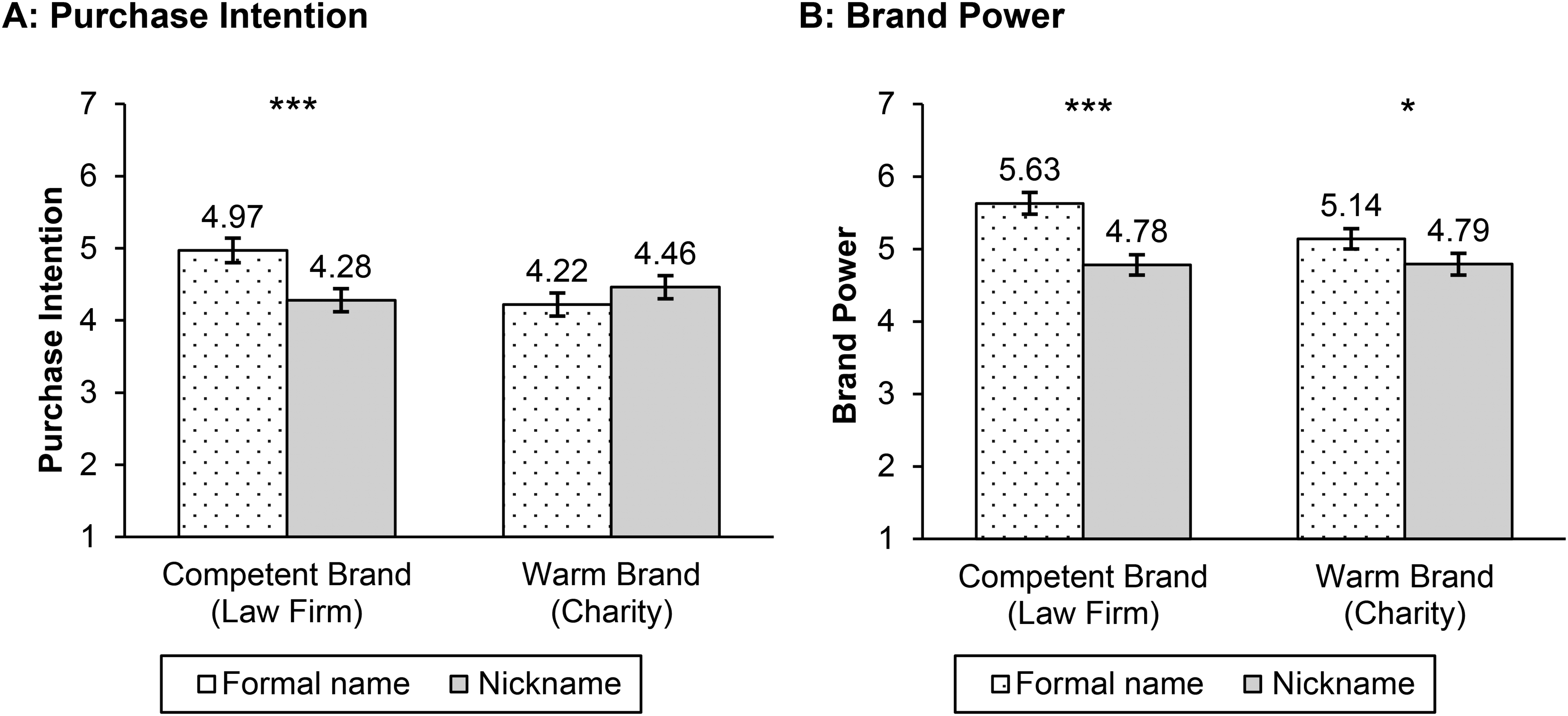
Brand Stereotype Moderates Purchase Intention and Brand Power (Study 5).
Brand power
An ANOVA on brand power reveals a significant main effect of name type (F(1, 316) = 16.86, p < .001, η2 = .05), a marginally significant main effect on brand type (F(1, 316) = 2.69, p = .10, η2 = .01), and a marginally significant interaction (F(1, 316) = 2.96, p = .09, η2 = .01). Specifically, for the competent brand (law firm), nickname use significantly decreases brand power (Mnickname = 4.78, SD = 1.58; Mformal = 5.63, SD = 1.16; F(1, 316) = 16.64, p < .001, η2 = .05), but this effect is mitigated for the warm brand (charity) (Mnickname = 4.79, SD = 1.20; Mformal = 5.14, SD = 1.19; F(1, 316) = 2.91, p = .089, η2 = .01; see Figure 2, Panel B).
Moderated mediation analysis
We test the full moderated-mediation model (Model 7, 5,000 draws; independent variable = name type, mediator = brand power, dependent variable = purchase intention, moderator = brand type). The results reveal a marginal index of moderated mediation (IMM = .41, 90% CI = [.0119, .8117]). That is, nickname branding may reduce brand power and purchase intention for the competent brand (indirect effect = −.69, 90% CI = [−.9962, −.3806]), and this effect is marginally weaker for the warm brand (indirect effect = −.28, 90% CI = [−.5442, −.0277]).
Discussion
Study 5 examines whether the warmth and competence of a brand impacts the nickname branding effect. We find that while nickname branding hurts brand power and subsequently impairs brand performance, the effect is somewhat weaker for warm brands than competent brands, suggesting that for brands positioned in the world as exceptionally warm, nickname branding might not lead to the same deleterious effects as brands that are primarily positioned as competent. Furthermore, because this study employs fictional brands, it cannot be the case that a priori perceptions of the respective brand explain the nickname branding effect. In the following study, we examine a second moderator of the nickname branding effect and investigate whether there is a context in which a marketer can benefit from using a nickname.
Study 6: The Role of Message Type—Transactional Versus Communal
A basic idea running through the studies is that a brand using its nickname may be a tactical blunder. However, H4 proposes that the liability of nickname branding may be attenuated when a brand behaves in a manner that is communal-oriented (vs. transactional-oriented). We explore this idea next.
Method and Procedure
The study (preregistered: https://aspredicted.org/yr4qa.pdf) was run as a 2 (name type: nickname vs. formal name) × 2 (message type: transactional vs. communal) between-subjects design. Eight hundred two participants (49.1% female, 49.3% male, 1.6% nonbinary; Mage = 41.3 years) from Prolific were randomly assigned to one of four conditions. In the transactional conditions, participants saw an ad from Starbucks about its coffee using either the brand's formal name or its nickname (“Starbucks [Starbies] offers the best quality coffee. Enjoy your coffee at Starbucks [Starbies]”). In the communal conditions, participants saw an ad from Starbucks promoting inclusivity (“Starbucks [Starbies] supports the disability community. It is an inclusive space at Starbucks [Starbies]”). A pretest (Web Appendix 2g) revealed that participants believe the message is more transactional when the brand is promoting its coffee and more communal when the brand is promoting inclusivity (ps < .01). See Web Appendix 4i for stimuli details.
Purchase intention (r = .94) and brand power (r = .93) were measured with the same scales from previous studies. Participants concluded by answering basic demographic questions.
Results
Purchase intention
A 2 (name type: nickname vs. formal name) × 2 (message type: transactional vs. communal) between-subjects ANOVA on purchase intention reveals significant main effects of name type (F(1, 798) = 26.06, p = .006, η2 = .009) and message type (F(1, 798) = 22.76, p < .001, η2 = .03). We also obtain a significant interaction (F(1, 798) = 4.42, p = .036, η2 = .006) such that when the message is transactional, nickname branding significantly reduces purchase intention (Mnickname = 3.48, SD = 1.88; Mformal = 4.12, SD = 2.08; F(1, 798) = 11.72, p < .001, η2 = .01). However, when the message is communal, there is no alteration to purchase intention (Mnickname = 4.39, SD = 1.66; Mformal = 4.47, SD = 1.81; F(1, 798) = .20, p = .66, η2 < .01; Figure 3, Panel A).
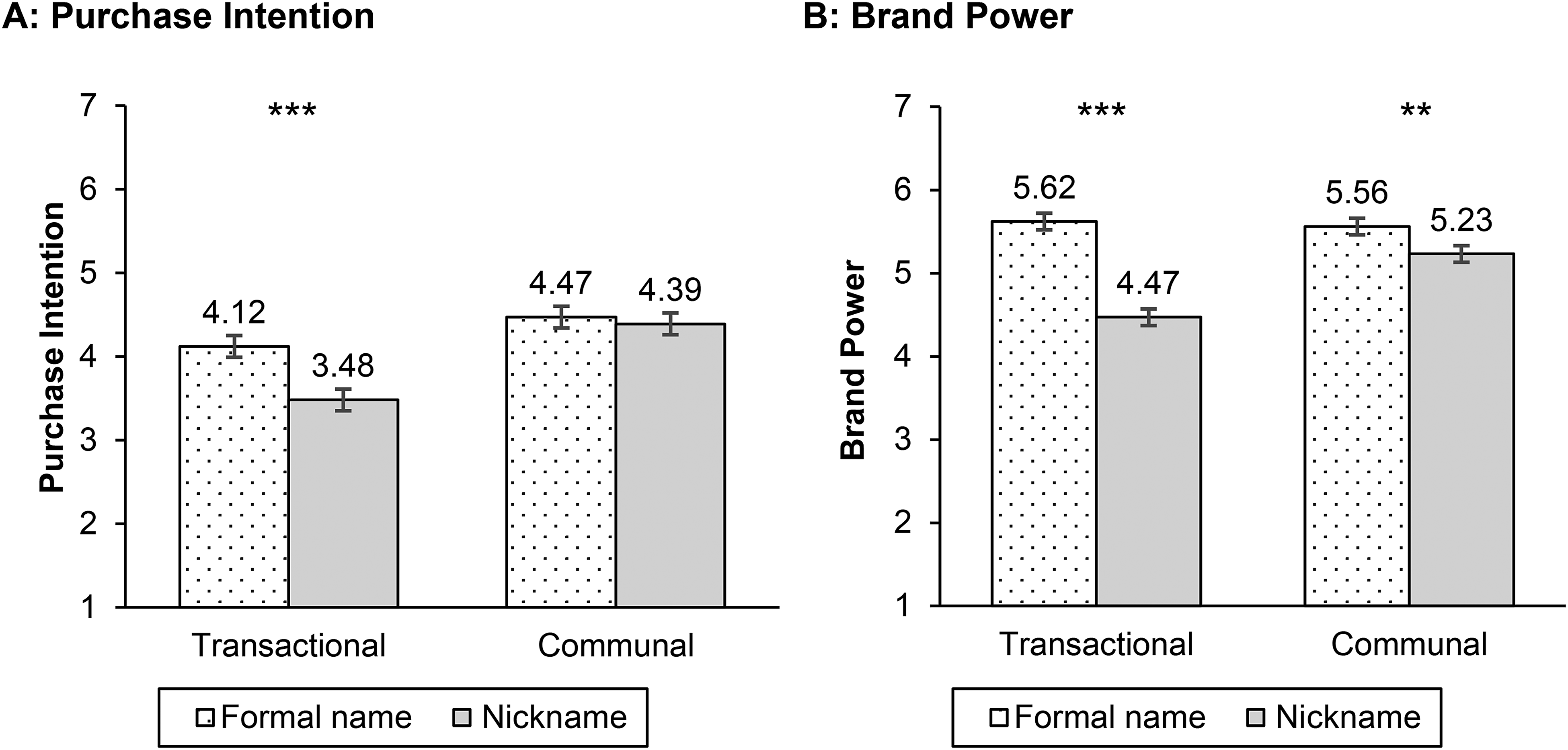
Message Type Moderates Purchase Intention and Brand Power (Study 6).
Brand power
An ANOVA on brand power reveals a significant main effect of name type (F(1, 798) = 51.84, p < .001, η2 = .06) and a significant main effect of message type (F(1, 798) = .11.70, p < .001, η2 = .01). There is a significant interaction (F(1, 798) = 15.89, p < .001, η2 = .02) such that when the message is transactional, nickname branding weakens brand power (Mnickname = 4.47, SD = 1.68; Mformal = 5.62, SD = 1.30; F(1, 798) = 62.72, p < .001, η2 = .07), but the effect is attenuated when the message is communal (Mnickname = 5.23, SD = 1.40; Mformal = 5.56, SD = 1.42; F(1, 798) = 5.15, p = .02, η2 = .006; Figure 3, Panel B).
Moderated mediation analysis
We test the full moderated-mediation model (PROCESS Model 7, 5,000 draws, independent variable = name type, mediator = brand power, dependent variable = purchase intention, moderator = message type). The results reveal a significant moderation of the mediated pathway (IMM = −.57, 95% CI = [−.8692, −.2785]). When nickname branding is used in a transactional message, it lowers purchase intentions via weakened brand power (indirect effect = −.81, 95% CI = [−1.0349, −.5902]) but the effect is attenuated when nickname branding is used in a communal message (indirect effect = −.23, 95% CI = [−.4286, −.0382]).
Discussion
Study 6 points to a possible reprieve for marketers interested in deploying their nicknames while communicating with consumers. The results suggest that nickname branding is less detrimental in the context in which communal motives are highlighted.
General Discussion
Brand nicknames are an organic way for consumers to show endearment toward a beloved brand (Zhang and Patrick 2018, 2021). Managers expect that reflecting this affection in their marketing will effectively engage consumers and produce desirable results. However, the current research is less optimistic about nickname branding, suggesting that the practice is associated with negative consequences that appear to have been overlooked by marketers. We present 11 studies that incorporate both real-world data and experiments to support our theorizing. We find converging evidence that nickname branding may reduce brand performance, operationalized as consumer engagement (Studies 1a, 1b, and 1c), price premium (Studies 2c, 3b, and 4), choice (Study 2a), and purchase intentions (Studies 2b, 2c, 3a, 3b, 5, and 6). We show that these negative effects of nickname branding are driven by consumer perceptions of weakened brand power (Studies 3–6) and moderated by brand stereotypes (Study 5) and message type (Study 6). We also rule out several alternative explanations based on consumer brand relationship strength and familiarity (Studies 4). Additionally, we report several supplemental studies in the Web Appendix that provide further support for our theorizing.
Theoretical Contributions
We make several theoretical contributions. First, the current research examines the “nickname branding” phenomenon and offers the first systematic academic exploration of its likely effectiveness. While prior research on brand nicknames has focused on how consumers use brand nicknames, we break new ground by exploring the consequences associated with companies’ adoption of nicknames in their own marketing.
Second, by extending the idea of illocutionary meaning in the marketing literature, we reveal that important political and social implications are embedded in the brand naming process. We show that a brand nickname is more than just a linguistic symbol and that it is also a product of social negotiations that can signify the power dynamic in a relationship. Because brand nicknames are generated by consumers, companies may signal weakness when adopting them and inadvertently cause detrimental consequences.
Third, we reveal two contingencies associated with nickname branding. We show that deploying a nickname is worse for a competent brand than for a warm brand, likely because the illocutionary meaning embedded in nickname branding is less aligned with the stereotype of competence. We also demonstrate the role of message type underlying brand nickname use. In particular, the negative effect of nickname branding becomes weaker when used in messages that are communal-oriented. The current research therefore highlights the importance of going beyond the literal meaning of marketing communications and understanding the associated illocutionary meanings.
Managerial Implications
While nickname branding seems to be gaining popularity, marketers do not seem attuned to its possible detrimental influences despite fairly prominent examples of failure. For example, RadioShack's adoption of a nickname (e.g., tagline: “Our friends call us the Shack”) was a high-profile example of explicitly submitting to consumer influence and credited with hastening the company's trajectory toward bankruptcy (e.g., Raphael 2009). Indeed, such failures can likely be traced in part to a lack of research, meaning that, until now, there has been no empirically based advice on nickname branding.
The current research thus offers well-timed insights into how marketers should approach nicknames in their branding. While nicknames may seem like a promising way to “please” consumers, they come with costs. First, when a marketer pays attention to what consumers say about their brand, it does not imply that imitating consumers is a good idea. Many brands closely follow consumers’ language use, especially on social media where monitoring has become much easier. However, the purpose of these activities is to generate insights, not to mechanically repeat what consumers say. It is true that brand nicknames are terms of endearment, but only when they are used by the right person (i.e., consumers). When used by marketers, nicknames do not bring consumers closer to the brand (Study 4), and copying what might be construed as the consumers’ “intellectual property” seems to make the brand appear weak, which is particularly worrisome for brands that are supposed to be competent (Study 5). Thus, marketers need to be careful about speaking the consumer's language.
Meanwhile, marketers should recognize that consumer nickname use versus nickname branding are different because the illocutionary meanings associated with these two actions are distinct. Results from our Supplemental Study 6 suggest that because consumer nickname use does not signal that a brand submits to consumer influence, it is less likely to weaken perceptions of brand power. In fact, prior research has shown that brand nicknames may lead to desirable consequences when they are used by consumers (Zhang and Patrick 2018, 2021). Marketers, therefore, should recognize the differences in nickname use by consumers versus marketers and adapt to each. For example, when General Motors banned the use of the “Chevy” nickname within the organization in 2010, the company received enormous criticism for not being consumer-oriented (Chang 2010). However, critics overlooked the fact that the policy was meant to reduce the internal use of the nickname (e.g., when a salesperson talks to consumers) and not to stop consumers from using it externally. While one may want to avoid adopting a nickname for marketing, nickname use within the consumer community should not be discouraged.
In addition, brands must carefully evaluate their brand stereotype (i.e., competent vs. warm) and message type (transactional vs. communal) before adopting a nickname. This is because power signifies one's control over resources, which may not align well with brands that are perceived as approachable and when the message is communal-oriented. Indeed, our results show that nickname branding is less problematic for warm brands (Study 5) and when used in communal messages (Study 6). Therefore, it seems plausible that some brands may benefit from using their nicknames under certain conditions. For example, when a small-town, family-owned restaurant adopts a popular nickname given by the locals for fundraising for the community library, people may not necessarily feel that doing so is inappropriate, because the business was not meant to be powerful and its motive is to benefit the community. Instead, the nickname may become an emotional tie that activates consumers’ community identity and attract more donations to the local community.
Furthermore, it is important for marketers to evaluate the meaningfulness of their brand name change. Renaming a brand is critical and necessary as a brand grows. For example, Apple Computer became Apple, IHOP (temporarily) became IHOb, and Dunkin’ Donuts became Dunkin’ (Whitten 2018). These are meaningful name changes, part of the brands’ repositioning strategies. The new names clearly tell consumers what the brand wants to be: Apple offers more than personal computers, Dunkin’ offers more than just donuts, and IHOP wanted its burgers to be taken seriously (Hoffman 2018). They are internally initiated alterations that signal the brand's new identity and market position, unlike nickname branding activities that are initiated externally (brands being influenced by consumers). If nickname branding is not accompanied by substantial changes to the brand's core identity, it may appear to be a relatively superficial effort to pander to consumers.
Limitations and Future Research
Our research has limitations which may be opportunities for future scholarship. In our studies, the same general design is used whereby a brand directly deploys its own nickname but the marketing landscape contains additional vehicles through which brands speak and act. Does changing the vehicle alter the results? In particular, we wondered if brands might benefit from using their nicknames through vehicles that are somewhat removed from the brand, such as a company employee or a paid influencer. Would consumers evaluate the use of nicknames more favorably when nicknames are deployed by these nonbrand entities? Similarly, are there other situations in which brands can benefit from using their nicknames? For instance, in the context of a brand failure (e.g., customer complaint, product defect), does it make sense for a firm to use a nickname in an apology to consumers because a brand may not need to display power under these circumstances? Perhaps a brand nickname might signal regard for the consumer and would help alleviate tension and to mollify consumers? We call for future research to investigate these issues systematically.
Second, we focus on brand nicknames that are generated by everyday consumers. In the marketplace, there are rare instances where a nickname originates with a third party, such as the case of the French champagne Bollinger, whose nickname “Bolly” was ascribed by the Prince of Wales and future King Edward VII in 1885. Would submitting to a nickname conveyed by a royal still hurt a brand performance? In other words, if a person with superlative social status employs a brand nickname, should the firm embrace it or not? Relatedly, at times highly influential culture influencers use brand nicknames (e.g., “Bally” [Balenciaga] is referred to in the hip hop song “La Di Da Di”; Gallagher 2019). In such instances, what should be the firm's reaction? We call for inquiries into these and related areas.
Another interesting avenue for future research is to explore how marketers can strategically handle different types of nicknames under various marketing situations. In particular, though brand nicknames are largely positive or neutral (Zhang and Patrick 2018; see Table 1) there are examples like “Taco Hell” (Taco Bell), “Whole Paycheck” (Whole Foods), and “Stalkbook” (Facebook) that are obviously negative. We have argued that firms would not consider using these nicknames in their marketing (and certainly we are not aware of any examples of such), but it is not clear what is the best way to approach them. For example, if a consumer leaves a comment using “Taco Hell” on the brand's social media, what should Taco Bell do? Is it possible that a brand with a very particular positioning (e.g., humorous, fierce, irreverent) can profit from using one of these negative nicknames? Indeed, these are questions not addressed by academic research, providing other promising avenues of inquiry.
We also hope for research investigating new forms of brand nickname use. So far, research has examined brand nickname use by consumers (Zhang and Patrick 2018; 2021) and by brands (the current research), but little is known about when brand nicknames are used by other parties, such as a competitor. For example, in 2019 in the United Kingdom, Burger King attacked McDonald's using the latter's local nickname with the ad tagline, “Thank you Maccy D's for having our back in 2019” (Winchester 2019). How would nickname use between rival brands alter the power dynamic in that dyad and influence brand performance for both parties? Do consumers see Burger King as more powerful and McDonald's being weaker when “Maccy D's” instead of “McDonald's” is used? A better understanding of the effects of brand nickname use by different parties offers novel possibilities for companies. Relatedly, it is common in contemporary political marketing for candidates to refer to each other using nicknames. It can be understood that these activities represent the repositioning of human brands, meaning that it may be worthwhile to investigate the utility of such a tactic. Other nontraditional brands such as tourism destinations (“The Big Apple”) and celebrities (Beyoncé is “Queen Bee” and Lewis Hamilton is “Hawkeye”) also bear exploration to understand whether nickname use would harm their branding efforts.
Lastly, future research should investigate long-term effects by assessing whether the negative effect of nickname branding might fade over time. Name changes are often highly unpopular in the short term, but objections may decrease as a result of a firm's persistent, long-term marketing efforts. For example, despite early negative reactions to Facebook's switch to “Meta,” there is now greater acceptance of the name change (Steinmetz 2023). We wonder if a similar pattern might be apparent in the context of nickname branding. Brand building is in large part premised on consistency, and it remains an open question whether a brand committing to the long-term use of its nickname might eventually lead to consumer acceptance. Perhaps the commitment attended by such prolonged nickname use may itself signal something akin to brand power and over time not be interpreted by consumers as weakness. This remains a worthwhile topic for future longitudinal research.
Rick Riordan (2005, p. 67) once wrote, “Names are powerful things. You don’t just go around using them for no reason.” We show that this is also true of brands: When it comes to brand nicknames, firms should approach them with caution.
Supplemental Material
sj-pdf-1-jmx-10.1177_00222429241266586 - Supplemental material for BMW Is Powerful, Beemer Is Not: Nickname Branding Impairs Brand Performance
Supplemental material, sj-pdf-1-jmx-10.1177_00222429241266586 for BMW Is Powerful, Beemer Is Not: Nickname Branding Impairs Brand Performance by Zhe Zhang, Ning Ye and Matthew Thomson in Journal of Marketing
Footnotes
Acknowledgments
The authors thank June Cotte, Shuili Du, Ann Kronrod and the JM review team for their constructive feedback that helped in many ways to improve this manuscript.
Coeditor
Vanitha Swaminathan
Associate Editor
Kristin Diehl
Declaration of Conflicting Interests
The author(s) declared no potential conflicts of interest with respect to the research, authorship, and/or publication of this article.
Funding
The author(s) disclosed receipt of the following financial support for the research, authorship, and/or publication of this article: The first author received an Insight Grant (grant number #435-2023-0288) and an Insight Development Grant (grant number #430-2022-00580) from the Social Sciences and Humanities Research Council (SSHRC) of Canada for this research project.

Notes
References
Supplementary Material
Please find the following supplemental material available below.
For Open Access articles published under a Creative Commons License, all supplemental material carries the same license as the article it is associated with.
For non-Open Access articles published, all supplemental material carries a non-exclusive license, and permission requests for re-use of supplemental material or any part of supplemental material shall be sent directly to the copyright owner as specified in the copyright notice associated with the article.
