




Abstract
Although creativity is often considered a key success factor in advertising, the marketing literature lacks a systematic empirical account of when and how advertising creativity works. The authors use a meta-analysis to synthesize the literature on advertising creativity and test different theoretical explanations for its effects. The analysis covers 93 data sets taken from 67 papers that provide 878 effect sizes. The results show robust positive effects but also highlight the importance of considering both originality and appropriateness when investing in advertising creativity. Moderation analyses show that the effects of advertising creativity are stronger for high- (vs. low-) involvement products, and that the effects on ad (but not brand) reactions are marginally stronger for unfamiliar brands. An empirical test of theoretical mechanisms shows that affect transfer, processing, and signaling jointly explain these effects, and that originality mainly leads to affect transfer, whereas appropriateness leads to signaling. The authors also call for further research connecting advertising creativity with sales and studying its effects in digital contexts.
Creativity is important in marketing and is often considered to be at the heart of the advertising industry. The importance of creativity is highlighted, for example, in the popularity of industry competitions, such as the Cannes Lions International Festival of Creativity, and the growing academic literature on its effects (e.g., Reinartz and Saffert 2013; West, Koslow, and Kilgour 2019). However, the value of creativity is also subject to longstanding debate (Baack et al. 2015; Levitt 1963), and recent reports highlight that marketers are increasingly growing skeptical of advertising creativity (Parsons 2019; Premutico 2019) and decreasing their investments in it (Forrester 2019).
When and how is advertising creativity most valuable? Marketers wanting to answer these questions will find little guidance in the academic literature. Although the link between advertising expenditure and advertising effects has been consistently supported (Joshi and Hanssens 2010; Sridhar et al. 2016), to date, there is no comprehensive account of advertising creativity and its influence on consumer response. Even Vakratsas and Ambler (1999) failed to account for creativity as a factor in their insightful and influential review of how advertising works.
Several factors seem to hold back scholarship in advertising creativity: (1) contrasting empirical results on its effects in terms of ad and brand outcomes (e.g., Lee and Mason 1999; Smith, Chen, and Yang 2008; Till and Baack 2005), (2) disagreements over what creativity is and how it should be assessed (e.g., Modig and Dahlen 2019; Smith, Chen, and Yang 2008), (3) limited understanding of moderators of its effect (e.g., Yang and Smith 2009), and (4) ambiguity about the kind of theories that best explain how creativity works (e.g., West, Koslow, and Kilgour 2019; Yang and Smith 2009). Given the apparent confusion about what advertising creativity is and when it might benefit a brand, it is not surprising that marketers often make the wrong decisions when investing in advertising creativity (Reinartz and Saffert 2013).
In this article, we synthesize the fragmented literature on consumer response to advertising creativity. Based on a literature review, we develop a conceptual framework linking advertising creativity to consumer outcome responses in terms of ad, brand, and sales. Through a meta-analysis, we then integrate 878 effect sizes in the first quantitative empirical overview of the literature. Thus, we capture the impact of advertising creativity on 19 different consumer responses taken from 93 data sets in 67 papers. We thereby contribute a comprehensive and empirically grounded account of how and when advertising creativity works, providing researchers with generalized findings that can serve as benchmarks and a common foundation for future studies of this important topic.
First, we provide an empirically validated account of how advertising creativity works. The results show robust positive effects of advertising creativity on consumer responses but also inform researchers about the relative importance of various consumer responses to advertising creativity. Overall, effects are stronger for ad rather than brand responses (r = .491 vs. .317) and for attitudinal rather than memory outcomes (all below .140). This suggests that the main advantages of advertising creativity are not grabbing attention and making ads memorable but rather the ability to foster positive ad and brand attitudes.
Second, we highlight that advertising creativity is different from originality. Effects on consumer response are greater when creativity is measured as a bipartite construct comprising of originality and appropriateness. Effects of originality only on ad and brand attitudes are comparatively small (.362 and .164), suggesting that marketers who view creativity as synonymous with originality will not reap the full benefits of investments in advertising creativity.
Third, we show that the different theoretical accounts used in the literature to explain how advertising creativity works are complementary. Although previously considered separately, affect transfer, processing, and signaling provide the best account when considered jointly. The results further show that processing is a key mediator of the effects, whereas originality fosters affect transfer and appropriateness signaling. When marketers invest in bipartite creativity, affect transfer and signaling occur in parallel to processing, which can explain the stronger effects of creativity compared with originality only.
Fourth, we find that when the three theoretical accounts are considered jointly, the effects of advertising creativity on brand response are not dependent on ad responses. This is in line with the signaling account of advertising creativity and suggests that to fully understand how advertising creativity works, marketers should assess consumer responses in terms of brand rather than ad outcomes.
For managers, the results provide guidance on how, when, and why to invest in advertising creativity. For example, advertising creativity leads to greater ad responses in high (vs. low) involvement communication contexts (.653 vs. .340) and (marginally) for unfamiliar (vs. familiar) brands (.577 vs. .435). The literature review also highlights the need for more studies on the relationship between advertising creativity and sales, as well as its effects in digital media contexts, two areas that are especially important given the ongoing debate about the value of advertising creativity in contemporary marketing practice.
Conceptual Framework
Figure 1 presents the conceptual framework guiding the meta-analysis. We developed this framework on the basis of a review of the literature on consumer responses to advertising creativity. The framework focuses on consumer responses that have been empirically studied and distinguishes between immediate and outcome responses. The categorization of immediate responses is based on the three main theoretical accounts of how advertising creativity works found in the literature: affect transfer, processing, and signaling (i.e., consumer response in terms of affect, processing, and perceived signals at the time of exposure to creative advertising). The categorization of outcome variables is based on ad and brand responses and characterized in terms of attitudinal or memory responses (i.e., longer-lasting responses related to the ad and brand, such as attitudes, memory effects, and sales). The framework also highlights two moderators of these responses: definitions and assessments of advertising creativity and properties of the communication context (involvement and familiarity).

How and when advertising creativity works: conceptual framework.
Whereas research on advertising creativity generally has found positive effects on immediate and outcome responses (for reviews, see Sasser and Koslow [2008] and Smith, Chen, and Yang [2008]), empirical findings suggest that the effects vary between different types of consumer responses. Findings generally show that advertising creativity has benefits in terms of immediate responses, such as attention (Pieters, Warlop, and Wedel 2002; Smith et al. 2007), positive affect (Haberland and Dacin 1992; Yang and Smith 2009), and signals, such as perceived sender effort (Dahlen, Rosengren, and Törn 2008; Lange, Rosengren, and Blom 2016), but results are inconsistent regarding when and how this might also lead to outcome responses, such as attitudes and intentions (Modig and Rosengren 2013; Smith, Chen, and Yang 2008) or memory effects (Pieters, Warlop, and Wedel 2002; Till and Baack 2005). Results also varied regarding whether attitude and memory outcomes are affected (Baack, Wilson, and Till 2008). In line with the overall literature, we hypothesize that advertising creativity has positive effects on immediate and outcome responses:
However, from a managerial perspective, understanding whether investments in advertising creativity mainly affect ad rather than brand response, and whether advertising creativity is better at stimulating attitude or memory outcomes, is also important. Given the inconsistencies in the literature, we qualify this hypothesis by asking what type of consumer responses are most affected:
Defining and Measuring Advertising Creativity
As indicated in the introduction, a key challenge in the literature is the different views on advertising creativity. Creativity is a general construct that has been widely researched in fields such as psychology and organizational behavior, as well as in marketing (Im and Workman 2004; Sasser and Koslow 2008). Creativity can be used to describe individuals (e.g., an art director at an advertising agency), processes (e.g., design thinking methods used to brainstorm advertising campaigns), or outputs (e.g., the actual ad executions used in a marketing campaign). In this article, we adopt the output perspective.
Drawing on the creativity literature (Amabile 1996; Hennessey and Amabile 2010; Runco and Jaeger 2012), we define advertising creativity as advertising execution(s) that is (are) original and appropriate. This bipartite definition of creativity has been widely adapted in the marketing literature, in which the definition has been applied in advertising (Chen, Yang, and Smith 2016; Kilgour, Sasser, and Koslow 2013), new product development (Burroughs et al. 2011; Im and Workman 2004), and consumer behavior (Burroughs and Mick 2004; Moreau and Engeset 2016). As argued by Amabile (1996), a bipartite definition of creativity is required, because outputs that are original or unique but carry no use or meaning are perceived as weird or bizarre. However, any judgments of creativity are subjective and likely to vary across context and time. For example, judgments about originality and appropriateness in a work of art differ from the same judgments in an advertising context (even if the actual object being judged is the same). Similarly, judgments of the creativity of the same object can vary over time. In the art domain, for example, there are several artists who are now considered creative but whose art was controversial or even rejected in their time (e.g., Monet, Picasso, Dalí). Such works were initially seen as “weird” or “bizarre,” mainly because the type of appropriateness expected of them at the time of creation was a literal representation of reality. Thus, these artists were redefined as creative later, when judgment of appropriateness changed.
In the advertising context, the best documented dimension of creativity is originality. This dimension has also been referred to as novelty, divergence, unexpectedness, and newness (Kim, Han, and Yoon 2010; Koslow, Sasser, and Riordan 2003; Sheinin, Varki, and Ashley 2012; Smith et al. 2007). Originality has positive effects on consumer responses to advertising, as originality makes advertising more likely to be attended and processed (Pieters, Warlop, and Wedel 2002; Smith, Chen, and Yang 2008). Originality also has a positive effect on consumer response, as people have a predisposition to appreciate divergent stimuli and deem them intrinsically interesting (Yang and Smith 2009). Advertising practitioners typically view originality as the most defining aspect of advertising creativity (Koslow, Sasser, and Riordan 2003; Modig and Dahlen 2019), especially when it comes to advertising creativity awards (Choi et al. 2018; Smith et al. 2007). Thus, it is not surprising that many scholars focus primarily or exclusively on originality when assessing advertising creativity (Krishen and Homer 2012; Pieters, Warlop, and Wedel 2002).
When it comes to appropriateness, this dimension complements originality by connecting the advertisement with brand strategy and consumer problem-solving abilities and goals (Ang, Lee, and Leong 2007; El-Murad and West 2004; Modig and Dahlen 2019; Smith et al. 2007). In the advertising literature, appropriateness is also referred to as relevance and usefulness (and when assessed by practitioners as “on strategy”; cf. Kilgour, Sasser, and Koslow 2013; Sasser and Koslow 2008). Appropriateness as such has received much research attention (often using the term “relevance”; e.g., Hayes et al. 2020). However, in contrast with originality, scholars rarely consider appropriateness to be an indicator of creativity in and of itself. Instead, researchers typically view appropriateness as a prerequisite for advertising to be interesting to its intended audience regardless of its level of creativity.
Theoretically, it is clear that creativity is both originality and appropriateness. Some scholars also argue that additional dimensions could be needed to fully understand advertising creativity (Ang, Lee, and Leong 2007; Haberland and Dacin 1992). They argue in favor of including a third advertising-specific dimension of creativity—namely, the quality of the ad execution, also referred to as artistry or production (Modig and Dahlen 2019; Smith et al. 2007). In the literature, we distinguish four approaches to empirically assess advertising creativity. First, some studies measure advertising creativity as a holistic perception of the creativity of an ad, typically by using a single item “creative” or multiple creativity items that do not refer specifically to different dimensions (e.g., Rosengren, Dahlen, and Modig 2013). Second, other studies rely on only one dimension of advertising creativity (typically originality; e.g., Maniu and Zaharie 2014). Third, acknowledging the bipartite definition of creativity, some researchers use the interaction between originality and appropriateness as a creativity measure (e.g., Smith et al. 2007). Fourth, acknowledging the multidimensionality of the bipartite definition, some studies rely on measures of both originality and appropriateness (Kim, Han, and Yoon 2010), sometimes combined with one or more additional dimensions related to the production quality or artistic value (Modig and Dahlen 2019; Reinartz and Saffert 2013).
We argue that researchers who focus on originality only (e.g., Maniu and Zaharie 2014; Pieters, Warlop, and Wedel 2002) are likely to get different results from those who study creativity in terms of a bipartite (e.g., Modig and Dahlen 2019; Smith et al. 2007). Although we cannot test the validity of different assessments, we propose that the best measure of advertising creativity should explain more variance in outcome response variables than alternative measures of creativity, leading to stronger effect sizes (for a similar argument, see Eisend 2015). The approach that has the highest explanatory value should also be the most managerially relevant. Given that creativity is defined as a combination of originality and appropriateness, we propose that the effect sizes should be stronger when both dimensions are considered and weaker when only originality is used. Thus,
When Advertising Creativity Works: Contextual Moderators
Although we expect advertising creativity to generally have positive effects on consumer response (H1), we also expect properties of the communication context to moderate these effects. In the literature review, it was apparent that little attention has been paid to such contextual moderators in the existing literature (Yang and Smith 2009). However, we identified two theoretically relevant moderators: involvement and familiarity. Both variables have been found to affect consumer response to advertising in general, but of interest here is how they affect consumer responses to advertising creativity. Specifically, the literature suggests that advertising creativity (i.e., a combination of originality and appropriateness) has benefits regardless of the type of processing (peripheral vs. central; e.g., Cacioppo and Petty 1984) depending on these moderators.
Involvement
Consumers’ involvement with advertising reflects their level of interest in brand evaluation in any given context and has been found to moderate the effects of advertising processing and response (e.g., MacInnis and Jaworski 1989; Meyers-Levy and Malaviya 1999). Specifically, consumer responses to advertising differ depending on how much effort goes into processing it. For example, high involvement with a product category motivates consumers to pay attention to and actively process advertising. When involvement is low, attention is typically allocated to other things, and consequently, ad processing is limited and utilizes few processing resources and peripheral cues (e.g., Cacioppo and Petty 1984; MacInnis and Jaworski 1989).
Although advertising creativity has typically been thought of as an attention-grabbing device (e.g., Pieters, Warlop, and Wedel 2002), implying that it would work best in low-involvement contexts (where it can foster situational involvement; Cacioppo and Petty 1984), creativity has been found to have additional processing advantages when it comes to high-involvement contexts (Smith and Yang 2004; Yang and Smith 2009). In a low-involvement context, any additional processing stimulated by a creative ad is likely to be shallow (MacInnis and Jaworski 1989; Yang and Smith 2009). In a high-involvement context, however, additional processing makes consumers more likely to actively assess the claims. In this context, the combination of originality and appropriateness fosters more open-minded and less defensive processing of claims made (“willingness to delay closure”; Kardes et al. 2004; Yang and Smith 2009). This means that consumers will be more open to new information about the brand and less likely to use defensive mechanisms when processing advertising messages that are communicated creatively. Whereas advertising creativity in low-involvement contexts stimulates more affective processing, in high-involvement contexts creativity influences affective and cognitive processing (Yang and Smith 2009). In both contexts, advertising creativity should have a positive impact on consumer response, but in a high-involvement context, in-depth processing, coupled with the willingness to delay closure, makes the effects stronger. Thus,
Familiarity
Familiarity reflects the extent of consumers’ direct and indirect experience with a stimulus, such as a product or a brand (Alba and Hutchinson 1987; Campbell and Keller 2003). Consumer response to advertising has been found to vary with familiarity (Machleit, Allen, and Madden 1993; Sethuraman, Tellis, and Briesch 2011). Specifically, the effects of advertising are generally stronger for unfamiliar than familiar brands. This effect is due to consumers not being able to draw from previous experiences (neither their own nor the experiences of others) when evaluating unfamiliar brands, which makes advertising more important for these brands. However, advertising for unfamiliar brands wears out faster (Campbell and Keller 2003). For marketers of unfamiliar brands, this poses a challenge, as they need advertising to build familiarity but also must be careful about how they advertise to avoid negative reactions caused by (too much) repetition.
Familiarity has also been found to moderate the effects of advertising creativity in terms of familiarity with the specific ad (Chen, Yang, and Smith 2016; Pieters, Warlop, and Wedel 2002). Chen, Yang, and Smith (2016) found that advertising creativity has two main benefits when it comes to repetition: (1) it generates more positive effects upon initial exposure, and (2) it resists wear-out over multiple exposures. The latter finding is in line with results showing that advertising creativity (in terms of originality) helps draw attention to familiar ads that might otherwise be overlooked due to tedium (Pieters, Warlop, and Wedel 2002). For unfamiliar brands, these advantages are more important (Campbell and Keller 2003). Overall, this suggests that advertising creativity should be beneficial for unfamiliar and familiar brands, but given its attention-grabbing character (Pieters, Warlop, and Wedel 2002), the immediate wear-in effect that it can generate (Chen, Yang, and Smith 2016), and the higher impact of advertising in general (Machleit, Allen, and Madden 1993; Sethuraman, Tellis, and Briesch 2011), the effects should be stronger for unfamiliar brands. Thus,
How Advertising Creativity Works: Mediators
In the literature, scholars have used three main theories to explain the effects of advertising creativity on consumer responses. These accounts focus on different immediate responses as key mediators of the effects of advertising creativity on outcome responses. The affect transfer model focuses on the potential of creativity to evoke positive feelings that spill over into consumer responses to the ad and brand (i.e., regarding “positive affect” as a key mediator; Yang and Smith 2009). The processing model focuses primarily on the ability of creativity to get consumers interested in the ad and brand (i.e., “ad processing” is the key mediator; Smith et al. 2007). The signaling model proposes that creativity works as a marketing signal, directly influencing perceptions about the sender and thus, consumer responses to the brand (i.e., “perceived sender effort” is the key mediator; Dahlen, Rosengren, and Törn 2008). 1
Affect Transfer Model
A common explanation for the effects of advertising creativity is based on affect transfer (De Houwer, Thomas, and Bayens 2001; also referred to as affect infusion; Forgas 1995). This explanation focuses on the ability of affectively loaded information to transfer into other, more or less unrelated, targets. In the advertising creativity context, the affect transfer model builds on the fact that consumers generally like creative ads (Rosengren, Dahlen, and Modig 2013; Smith, Chen, and Yang 2008). Processing creative ads is seen as intrinsically motivating and pleasurable (Rosengren, Dahlen, and Modig 2013; Yang and Smith 2009), which means that consumers are likely to experience positive affect while exposed to such advertising. This positive affect spills over to the ad and brand, leading them to be evaluated more favorably (Haberland and Dacin 1992; Yang and Smith 2009). According to this explanation, the positive effects are driven by creative ads being more enjoyable and liked, and the positive feelings that this stimulates. Although theoretically exceptions might occur, as may be the case for executions of fear appeal advertising that combines originality and appropriateness, the reviewed literature on advertising creativity unanimously provides empirical support for positive reactions to advertising creativity. Thus,
Processing Model
Explanations of how advertising works often draw on information processing models (e.g., MacInnis and Jaworski 1989; Meyers-Levy and Malaviya 1999). Specifically, they explain consumer responses to advertising based on different levels of ad processing. This is also a common explanation for the effects of advertising creativity. Creativity is said to stand out, thus making creative ads more likely to be attended to and processed (Smith et al. 2007; Yang and Smith 2009). This means that more creative advertising stimulates more ad processing, resulting in longer exposure and greater attention (Haberland and Dacin 1992; Pieters, Warlop, and Wedel 2002), which has positive effects on consumer outcome response. According to this explanation, the positive effects of creativity are driven by creativity being more interesting and therefore, processed more. Thus,
Signaling Model
A third explanation for the effects of advertising creativity focuses on creativity as a signal of brand and company ability (e.g., Dahlen, Rosengren, and Törn 2008; Lange, Rosengren, and Blom 2016). This model builds on research on marketing signals (Kirmani 1997; Kirmani and Rao 2000), showing that certain behaviors on behalf of a firm (e.g., offering long-lasting warranties) can be used to signal unobservable quality to consumers. For example, advertising spending (i.e., monetary investments) has been found to work as a signal of brand quality (Kirmani 1990; Kirmani and Wright 1989). Similarly, advertising creativity has been found to be perceived by consumers as a signal that the sender has invested effort (in terms of time and money) in their brand (Dahlen, Rosengren, and Karsberg 2018; Dahlen, Rosengren, and Törn 2008). Through creative advertising, a brand conveys that it is committed to its advertising and its products, which is interpreted as a signal that positively affects how the brand is perceived and evaluated. According to this explanation, the positive effects of creativity are driven by creativity signaling effort on behalf of the sender, thus affecting the ad and brand positively. In contrast to the other two models, this account considers process reactions to creative advertising to be about the immediate perceptions of the brand rather than the ad. Thus,
Full Model
Although the three theoretical accounts typically have been used in isolation (for an exception, see Yang and Smith [2009]), combining the three models should provide a more comprehensive account of how advertising creativity works. Furthermore, the omission of any one of the intermediary effects might lead to the overestimation of the other (Vakratsas and Ambler 1999). Therefore,
To test this hypothesis, we propose a full model, which incorporates all three theoretical mechanisms (see Figure 2). Given that the initial models focus on different variables, we propose several additional relationships in the full model. First, ad processing is likely to spur stronger perceptions of sender effort. This is because processing facilitates a more careful understanding of the ad (Smith, Chen, and Yang 2008), which should, in turn, enhance perceptions of sender effort stimulated by advertising creativity. Second, affective responses can influence not only the ad and brand but also perceptions of sender effort. The underlying logic is, again, affect transfer (Yang and Smith 2009). Furthermore, affect and processing should be positively related, because feelings ease processing (mood theory), and easy processing is experienced as a good feeling (processing fluency theory).

How advertising creativity works: Full model including estimation results (standardized path coefficients).
Method
Data Set
For this meta-analysis, we selected papers that provide estimates of the effects of advertising creativity on various consumer responses. According to our bipartite definition of advertising creativity, advertising creativity comprises originality and appropriateness. To be able to assess the relevance of different assessments of creativity, we included all studies that identify as “ad* creativity” studies independent of their definition and operationalization of advertising creativity. This means that we also included all studies that relied on advertising stimuli judged to be creative (even if they did not use the bipartite definition), as well as studies that investigated the two main dimensions of creativity, even if they did not use the term “creativity” (Lee and Mason 1999).
To identify relevant papers, we first referred to review articles that provide an overview of previous research on advertising creativity (e.g., Sasser and Koslow 2008). We applied an ancestry tree search by searching all papers that refer to the review papers that were available in the Web of Science database. Second, we performed a keyword search of electronic databases (e.g., ABI/INFORM, Emerald, Elsevier, EBSCO, and ProQuest Dissertation Publishing) using “advertising creativity,” “ad creativity,” “advertisement creativity,” and “advertising creative,” “ad creative,” and “advertisement creative” as key words, followed by a search with key words that relate to the two main dimensions of advertising creativity (“original*,” “novel*,” “newn*,” “unexpected*,” “divergen*,” “innovati*,” “incongru*,” “relevan*,” “appropriate*,” “useful*,” and “meaningful*” combined with “advertis*”). The database search was complemented by a search on Google Scholar. Third, we performed a manual search of the journal outlets that turned out to be major sources for articles on advertising creativity. Fourth, once we identified a paper, we examined the references in a search for additional studies. The search period covered all papers (published and unpublished) that were available by December 2018. The retrieval approach was consistent with recommendations in the literature (Hunter and Schmidt 2004) and closely followed the steps taken in recent meta-analyses published in marketing (Roschk and Hosseinpour 2020; Zlatevska, Dubelaar, and Holden 2014).
After identifying manuscripts for potential inclusion in the data set, we applied inclusion and exclusion criteria to determine which manuscripts to retain. We included all empirical studies that measured or manipulated advertising creativity (as described previously) and provided estimates on its effects on consumer responses. We excluded any manuscripts outside this scope. For instance, we excluded studies that investigated nonconsumer response to creative ads (e.g., advertisers; Wang et al. 2013), or studies on creative media choice, but not creative ads (Dahlen, Friberg, and Nilsson 2009). We also excluded studies that failed to provide sufficient data for the meta-analysis and for which necessary data could not be retrieved from the authors.
To avoid duplications in the data set, a document with original analyses and findings by the same authors (e.g., journal article, working paper, conference paper) is called a “paper.” In some papers, the authors analyzed more than one distinct data set (e.g., a paper with several experiments), while some data sets were analyzed in more than one paper (e.g., a study that was published as a conference paper and a journal paper). The analysis is based on data sets. Each data set can provide single or multiple effect sizes that refer to the effect of advertising creativity on any consumer response variable. The search resulted in 67 usable papers covering 93 data sets (see Web Appendix Table 1). The sample includes journal articles, book chapters, working papers, unpublished theses, and conference proceedings, thus reducing the risk of a biased representation of the state of research because of the source of publication. The variation of sources is similar, and the number of papers and data sets is higher than in other major meta-analyses in marketing (Chang and Taylor 2015; You, Vaddkkepatt, and Joshi 2015).
Coding
We categorized the consumer response variables measured in the studies based on the conceptual framework (see Figure 1). Specifically, we classified consumer responses in terms of immediate responses (affect, processing, and signals) and lasting outcomes related to the ad and brand (none of the data sets provided data for sales). The outcome responses were further divided based on attitude and memory responses. In addition, we identified a few consumer responses that did not fit in either category (e.g., actual creativity, brand familiarity, willingness to pay). Because these consumer response variables appeared either in only one or two data sets or in only one paper, we eliminated them from further analysis. 2 We did this to ensure a minimum degree of generalizability, because a meta-analysis should provide a high degree of generalization and thus, requires more information than a single manuscript or a single-study manuscript followed by a replication study. This left 878 effect sizes. For an overview of the consumer response variables and categorization scheme, see Table 1.
Variables Used in the Meta-Analysis.
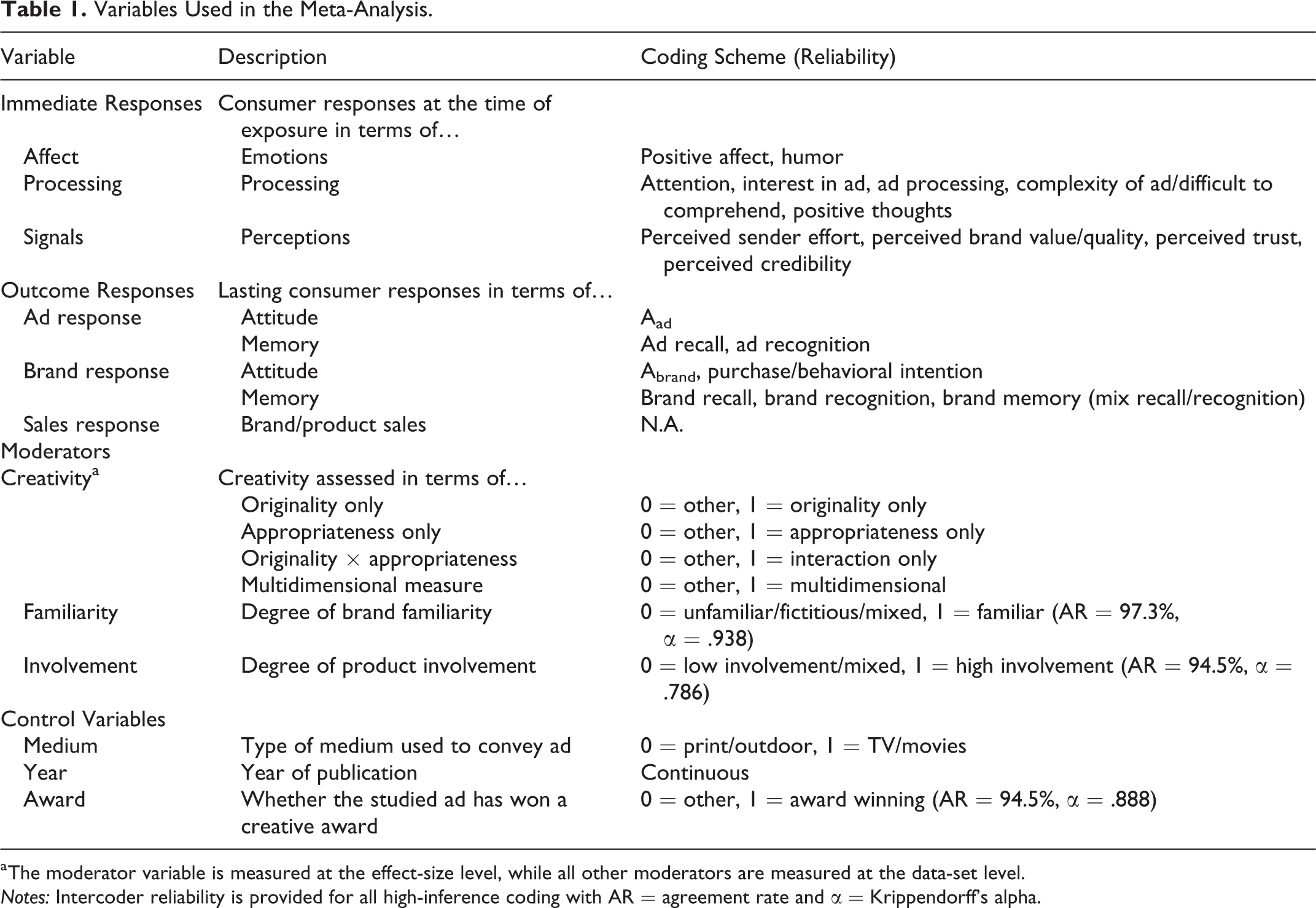
a The moderator variable is measured at the effect-size level, while all other moderators are measured at the data-set level.
Notes: Intercoder reliability is provided for all high-inference coding with AR = agreement rate and α = Krippendorff’s alpha.
In terms of creativity moderators, we coded the variables at the effect size level, meaning that multiple effect sizes from one data set can be assigned different codes. Specifically, we coded whether creativity was assessed as originality only, as appropriateness only, as an interaction effect between originality and appropriateness, as a multidimensional concept (including originality, appropriateness, and potentially more dimensions), or as a holistic concept (measured with a single item “creative” or corresponding multiple items or manipulated as such; this is the base alternative in the model). As an illustration, Yang and Smith (2009) presented results based on originality and appropriateness separately, as well as for the interaction between the two allowing us to code three types of measurements for each of the variables studied. Although our main interest is in comparing a bipartite view of advertising creativity with a view of advertising creativity as originality only, this coding process allows a more complete understanding of how different assessments of creativity affect consumer response.
In terms of communication context moderators, we dummy coded the variables on the data-set level. Specifically, we coded the data sets 1 if the advertised category was a high-involvement product and if the advertised brand was familiar. In addition, we added three control variables that captured substantial differences between studies and that could be related to the context variables (medium, year, and award). Two authors independently assigned variables in the primary studies to consumer responses and coded the moderators and control variables based on the information available in each study. The agreement rate was above 98% (Krippendorff’s alpha = .932), and inconsistencies were resolved by discussion.
Effect Size Computation
The effect size metric selected for the meta-analysis was the correlation coefficient; higher absolute values of the coefficient indicate a stronger influence of advertising creativity on consumer responses. For papers that reported other measures (e.g., Student’s t, mean differences), we converted those measures following guidelines for meta-analysis (Lipsey and Wilson 2001; Peterson and Brown 2005). 3 We adjusted all correlations for unreliability. When a paper did not report the reliability, or when the paper used a single-item measure, we used the mean reliability for that construct across all studies, following the procedure in previous meta-analyses in marketing (e.g., Kirca, Jayachandran, and Bearden 2005).
We dealt with integrating dependencies between effect sizes using the following approach. When a data set provided findings for different consumer response variables, we treated the findings as independent, because we integrated and analyzed the estimates for each consumer response variable separately. Some data sets reported multiple relevant tests for the same consumer response variable. We accounted for the dependencies of the effect sizes and the nested structure of the meta-analytic data by using a mixed-effects multilevel model (Raudenbush and Bryk 2002). We estimated the following model:

where i = 1, 2, 3…I effect sizes, j = 1, 2, 3…J data sets. This formula estimates the average effect size γ00, the deviation of the average effect size in a data set from γ00 (μ0j), and the deviation of each effect size in the kth data set from γ00 (eij). The latter two terms have variances that follow a normal distribution and are uncorrelated.
To address publication bias, we computed fail-safe Ns (Rosenthal 1979), which represents the number of additional effects with null results needed to render the results for an integrated effect size not statistically significant at p = .05. The fail-safe Ns were calculated for all statistically significant integrated effect sizes (p < .05) using the effect size estimates that were adjusted for measurement error. Furthermore, we provided a homogeneity test as an aid in deciding whether the observed effect sizes were more variable than would be expected from sampling error alone. If they are, there is a strong basis for including moderators. The homogeneity test involves the Q statistic, in which the distribution is similar to a chi-square with K − 1 degrees of freedom (Hedges and Olkin 1985).
Moderator Analysis
If the homogeneity test indicated heterogeneity, we proceeded with a moderator analysis. We added the moderators specified by the hypotheses and the control variables simultaneously to Equation 1 and ran multilevel meta-regression models in hierarchical linear modeling separately for the major outcome variables. The model was a mixed-effects model, because fixed effects for the moderators were considered in addition to random components. We specified the following model:

where rij is the ith effect size describing the relationship between advertising creativity and the respective consequence variable reported within the jth data set.
Assuring the robustness of the model required a sufficient sample size. The major restriction is often the higher-level sample size, and the literature recommends a sample of around 50 to avoid biased estimates of the second-level standard errors (Maas and Hox 2005). Thus, we applied the model only to the outcome variables in the data set with a sufficiently large sample of data sets: Aad and Abrand (43 and 44 data sets, respectively).
Structural Model Estimation
To investigate the different processes that explain how advertising creativity works, we developed a correlation matrix including integrated effect sizes of the consumer responses to advertising creativity and added integrated effect sizes for the interrelationships between the consumer response variables. We followed recommendations in the literature about collecting meta-analytic data for the correlation matrix, deciding about sample size, analytical decisions, and reporting (Bergh et al. 2016). We searched the papers in the meta-analysis for correlations for the interrelationships between consumer response variables. For a construct to be included in such analysis, multiple study effects must relate it to every other construct in the model. Therefore, no additional variables shown in Table 1 could be considered. For example, because we did not find correlations between sender effort and recall or memory measures, the latter could not be included in the model. We found at least three correlations for each relationship, which equals or exceeds the requirements of other meta-analytic correlation matrices found in the literature (Geyskens, Steenkamp, and Kumar 1999). We integrated and adjusted the correlations in the same way as the correlations between advertising creativity and consumer response variables. That is, we first adjusted all correlations for unreliability. We accounted for the dependencies of effect sizes and the nested structure of meta-analytic data by using a mixed-effects multilevel model as described previously (Raudenbush and Bryk 2002).
We then used this correlation matrix (see Web Appendix Table 2) as input in a structural equation modeling (SEM) analysis using the maximum likelihood method. The matrix was based on 449 correlations, and the harmonic mean of the cumulative sample size for each cell equaled 1,293. Each construct was measured with a single indicator in the structural model. We fixed the error variances for these indicators to zero because we had already considered measurement errors when we integrated the effect sizes. We used the harmonic mean of the cumulative sample size underlying each integrated effect size (i.e., effect size cells comprising each entry in the correlation matrix) as the sample size for the analysis.
Results
Table 2 reports the integration of the reliability-corrected correlations between advertising creativity and all consumer response variables.
Influence of Advertising Creativity on Consumer Responses (H1).

†p < .10.
*p < .05.
**p < .01.
***p < .001.
a These variables are used to test H2–H7.
Notes: Only relationships for which effects were available in more than one paper and/or more than two independent data sets are shown. The corrected average correlation coefficients (r) are the sample size-weighted, reliability-corrected estimates of the population correlation coefficients. The fail-safe N indicates the number of nonsignificant, unpublished (or missing) effects that would need to be added to a meta-analysis to reduce an overall statistically significant (p < .05) observed result to nonsignificance.
Looking at immediate responses, we found statistically significant effects on affect in terms of positive affect and perceived humor. Interestingly, although positive affect has been studied more, the effects of humor were significantly stronger as indicated by nonoverlapping confidence intervals (95% CI for positive affect [.198, .388] vs. humor [.428, .832]). We also found significant positive effects on processing in terms of attention, interest in the ad, and ad processing, but only a marginal effect on complexity and positive thoughts. The effects on attention, interest in the ad, and ad processing were comparable in size (95% CI for attention [.218, .592], interest in ad [.215, .615], and ad processing [.015, .659]). Furthermore, advertising creativity had statistically significant positive effects on perceived signals: sender effort, brand value/quality, brand trust, and brand credibility. These effects were comparable in terms of size (95% CI for perceived sender effort [.282, .510], value/quality [.171, .407], brand trust [.171, .603], and brand credibility [166, .628]).
Turning to outcome responses, advertising creativity had a statistically significant effect on all ad responses: Aad, ad recall, and ad recognition. The strongest and most widely studied effect was that on Aad. In terms of brand responses, the effects followed a similar pattern: Abrand was the most widely studied variable and statistically significantly affected. We also found a statistically significant positive effect on purchase/behavioral intention and brand memory, but not on brand recall or brand recognition. Overall, the pattern of results support H1 by highlighting that advertising creativity has positive effects on consumer reactions in terms of ad and brand. Answering RQ1, we found that the effect on Aad was statistically significantly larger than that on Abrand and purchase intentions (95% CI for Aad [.407, .575] vs. Abrand [.235, .399]) and purchase intention [.225, .387]), and that the effects on ad recall ([.214, .408]) were significantly larger than the effects on brand memory ([.072, .208]). This suggests that ad responses are more affected than brand responses. Related to RQ2, the pattern of results suggests that effects of advertising creativity are stronger for attitudes than for memory. Aad was statistically significantly different from ad recognition (95% CI for Aad [.407, .575] vs. ad recognition [.107, .307]), and marginally different from ad recall ([.214, .408]). Similarly, the effect on Abrand was significantly stronger than the effect on brand memory (95% CI for Abrand [.235, .399] vs. brand memory [.072, .208]).
All homogeneity tests (except for brand memory) were statistically significant at p < .05 and showed that the variation in effect sizes cannot be explained by sampling error alone. The fail-safe N indicates that the statistically significant integrated correlations do not suffer from publication bias according to Rosenthal’s (1979) rule of thumb (fail-safe N should be at least 5 times the number of effects plus 10).
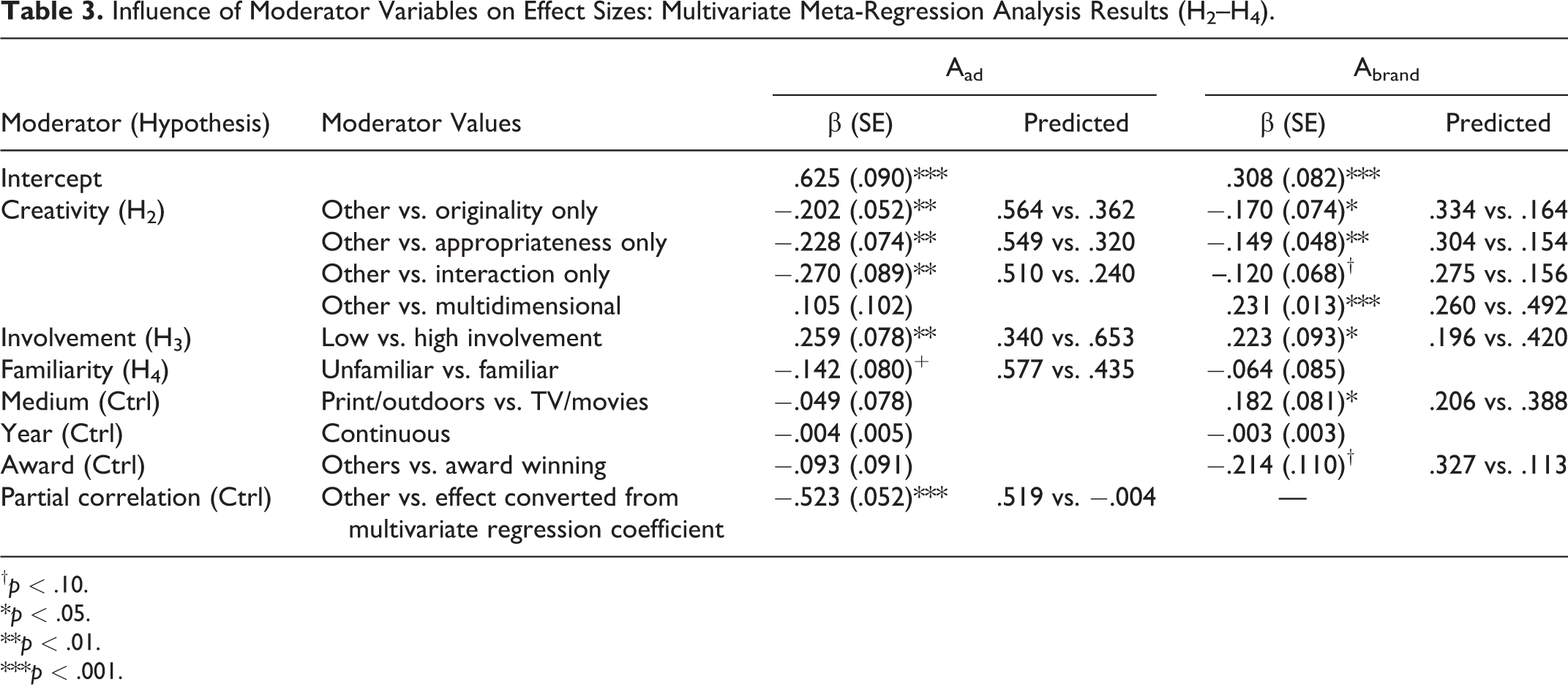
Table 3 presents the results for the multilevel moderator regression model for the relationship between advertising creativity and Aad and Abrand. To investigate whether the positive effects of advertising creativity depend on the type of assessment used, we examined the moderating effect of creativity assessments. The analysis showed that relying only on originality led to lower effect sizes for Aad and Abrand; thus, H2 was supported. We found a similar pattern for assessments relying on appropriateness only and for interaction effects, although the negative effect was only marginally significant for the latter when it came to Abrand. The findings also showed that multidimensional measures of advertising creativity led to stronger effect sizes for Abrand, but not for Aad. Overall, this pattern of results suggests that assessing advertising creativity only in terms of (1) originality, (2) appropriateness, or (3) an interaction effect between the two will lead to an underestimation of the effects. From a managerial perspective, the result also suggests that a multidimensional view of advertising creativity is the most relevant, as brand responses are more important than ad responses.
Influence of Moderator Variables on Effect Sizes: Multivariate Meta-Regression Analysis Results (H2–H4).
†p < .10.
*p < .05.
**p < .01.
***p < .001.
We then turned to the moderating effect of the communication context. The results showed stronger effects on Aad and Abrand for high-involvement products; thus, H3 was supported. Furthermore, the effects on Aad were marginally stronger for unfamiliar products, but there was no statistically significant difference in terms of Abrand. Thus, H4 was only partially supported. The control variables showed that using a partial correlation coefficient led to smaller effects on Aad. None of the remaining control variables affected Aad. However, the effects on Abrand were higher for audiovisual media (TV/movies) and marginally lower for award-winning ads. We did not find any statistically significant differences in terms of year of study. 4
To better understand why advertising creativity has positive effects on consumer responses, we performed a SEM analysis of the different models using the meta-analytic correlation matrix (cf. Web Appendix Table 2). Table 4 presents the results of the SEMs (standardized coefficients and model fit statistics). As we suggested alternative models implying that the relationship between advertising creativity and Aad is mediated by more than one mediating variable, we added a path between advertising creativity and Aad that captured alternative processes to each model. All three individual models showed a very good model fit, and all paths were statistically significant and in line with the suggested effects; thus, H5, H6, and H7 were supported.
Coefficients and Fit Indices of the Meta-Analytic SEMs (H5–H8).

†p < .10.
*p < .05.
**p < .01.
***p < .001.
The model that combines the three individual models showed a comparatively weak fit but was significantly improved by adding the proposed relationships between processing and perceived sender effort and positive affect and perceived sender effort suggested by the full model (Δχ2/d.f. = 96.527/5, p < .001; see Figure 2). To determine whether the full model provided a better explanation than the three parsimonious models that were nested within it, we compared the fit of the full model that was restricted to any of the nested models with the fit of the full model with unrestricted paths. The model fit worsened significantly when it was restricted to the affect transfer model (Δχ2/d.f. = 1,629.935/8, p < .001), the processing model (Δχ2/d.f. = 1,733.093/8, p < .001), or the signaling model (Δχ2/d.f. = 1,528.916/8, p < .001). Thus, the full model provides an explanation that goes beyond the explanatory power of each nested model; H8 was empirically supported. Interestingly, in the full model, the mediating effect of Aad on Abrand dropped from around .5 in the individual models to a marginally significant effect of .078 (Δχ2/d.f. = 96.512/1, p < .001). This suggests that the effect of advertising creativity on brand response is only weakly mediated by ad response, which adds additional insight into RQ1 about the effects of creativity on ad versus brand response.
We performed two additional analyses to further explore how well the three models explain the effects of creativity on consumer response. First, we compared how much of the variance in Aad was explained directly by advertising creativity and indirectly by either process suggested by the three individual models (we could not apply this comparison to Abrand, as there was no direct effect of creativity on Abrand in the model). We computed the proportion of mediation as the ratio of indirect to total effect; that is, the indirect path(s) was/were divided by the sum of the direct path and indirect path(s) (Iacobucci, Saldanha, and Deng 2007). The proportion of mediation via positive affect was 26.8%, via ad processing was 28.3%, and via perceived sender effort was 33.9%. When we tested the mediation paths in the full model against each other by restricting two corresponding paths at a time (see Web Appendix Table 3), we found no differences between the paths from advertising creativity to any of the three mediators (positive affect, ad processing, and sender effort). However, the effect of sender effort on Aad was significantly different and stronger than the effect of either positive affect or ad processing on Aad. The findings indicate that signaling explains more variance in Aad than the two other models, thus providing the strongest explanation for the effect of creativity on Aad of the three models.
Second, we compared the theoretical explanation offered by the full model between the two dimensions of creativity by using correlation matrices that considered the variable relationships with either originality or appropriateness instead of creativity (see Web Appendix Table 4). The results showed that the positive effects on ad processing are equally strong for both dimensions. However, affect transfer mainly explains the effects of originality as indicated by the fact that the path from creativity to positive affect was statistically significant for originality, but not for appropriateness. When it comes to signaling, however, appropriateness seems more important, as indicated by the significantly stronger link between creativity and sender effort.
Discussion
Summary of Findings
In this article, we offer a comprehensive synthesis of the effects of advertising creativity on consumer responses. The study highlights the importance of advertising creativity by showing robust positive effects on a wide range of immediate and outcome responses. The effects are stronger for ad responses compared with brand responses and for attitudinal compared with memory outcomes. Moderation analyses show that the effects of advertising creativity are weaker when creativity is assessed as originality only, compared with a bipartite comprising originality and appropriateness. This suggests that the effects of advertising creativity go beyond those of originality alone. The results further show that advertising creativity has stronger effects in high-involvement contexts, and that effects on ad response are (marginally) stronger for unfamiliar brands. Furthermore, we find empirical support for all three theoretical accounts (affect transfer, processing, and signaling) used in the literature, but also that a full model (where the three accounts are considered jointly) best explains the effects of advertising creativity on consumer outcome response. In the full model, the effect of the three advertising creativity mediators (positive affect, ad processing, and perceived sender effort) on brand response is only marginally mediated by ad response, suggesting that although ad responses are generally more affected than brand responses, they are not needed for advertising creativity affect brand response. Additional analyses show that affect transfer mainly explains the effects caused by originality and that signaling provides the strongest account of advertising creativity in terms of ad response.
Theoretical Implications
Although marketing researchers and practitioners tend to agree that advertising creativity is important, there are contrasting views on what advertising creativity is, and how and when it can lead to positive outcomes. Through this meta-analysis, we provide a synthesis of the growing, but dispersed, literature on advertising creativity, thus building a common foundation for future studies of this important topic. The results inform about important outcome variables and moderators of advertising creativity effects. The meta-analytic findings can serve as benchmarks for future advertising creativity studies, as well as for studies dealing with other ad execution elements. Future findings can be compared against the meta-analytic results in terms of explained variance as a measure of advertising effectiveness. The results also have several implications for future studies of advertising creativity.
First, we offer an empirically validated understanding of how advertising creativity works. The pattern of results suggests that advertising creativity has a role to play in stimulating positive consumer responses that goes beyond being a source of attention. If the attention-grabbing nature of advertising creativity were the key benefit, its effects should be greater for memory rather than attitudinal responses, and in communication contexts where consumers are less likely to attend to and process ads, such as for low-involvement products and for unfamiliar brands (Dahlen, Rosengren, and Törn 2008; Pieters, Warlop, and Wedel 2002), which is not in line with the empirical results. Although claims that advertising creativity enables advertising to “cut through clutter” and make advertising more memorable (Pieters, Warlop, and Wedel 2002) are true, they risk directing focus away from attitudinal consumer responses, which are more affected. The fact that advertising creativity has stronger effects in high-involvement contexts suggests that processing is important for the effects to occur. It also raises the question of what to expect from advertising creativity in contexts where consumers are unlikely to pay attention to and process ads, such as digital and mobile media. The meta-analysis did not include any such studies, but the results suggest that effects should be weaker in media such as smartphones where focus is very directed at other focal tasks (Melumad and Meyer 2020). At the same time, effects should be stronger for advertising content in own channels and in media where consumers voluntarily seek out advertising (Rosengren and Dahlen 2015). However, future research is needed to explicitly study the role of advertising creativity in these contexts.
Second, we contribute insights into how to define and assess advertising creativity. In line with the creativity literature (Amabile 1996; Runco and Jaeger 2012), the results indicate that creativity is not just about originality. A bipartite definition and multidimensional assessments of creativity offer better explanations of the effects (for a similar argument, see Ang, Lee, and Leong 2007 and Modig and Dahlen 2019). This suggests that researchers should be mindful when using the term advertising creativity and restrict it to studies of original and appropriate ads. When studying original advertising only, the term creativity should be avoided. It also suggests that the reliance on advertising awards as an operationalization of advertising creativity is not valid, as such awards tend to focus on originality (Choi et al. 2018; Kilgour, Sasser, and Koslow 2013). The fact that empirical studies have found positive effects of original and award-winning ads, however, is reassuring, as the results suggest that, if anything, those studies underestimate the effects.
Third, we contribute to the theoretical understanding of how advertising creativity works. The findings show that the different theoretical accounts of advertising creativity available in the literature are complementary, but also that they have different relationships with creativity dimensions. Our meta-analytic path analysis show that originality primarily stimulates affect transfer, whereas appropriateness is more important for signaling. We also find that signaling has the highest explanatory value. Again, this reinforces the notion that a bipartite view of advertising creativity is most relevant, as ads that combine originality with appropriateness allow these mechanisms to work simultaneously, whereas original ads do not. It also suggests that future studies of advertising creativity should include more comprehensive theoretical frameworks than what has previously been the case. Together, these insights offer the basic building blocks for a more complete processing model of advertising creativity called for by West, Koslow, and Kilgour (2019).
Fourth, the finding that the three theoretical mediators of advertising creativity have direct effects on brand response (Abrand) that are only weakly mediated through ad response (Aad) adds further to our understanding of how advertising creativity works. 5 It shows that although creativity has stronger effects on ad responses than brand responses, these effects are not necessarily dependent on ad response. Again, this pattern can be understood in terms of the combination of (high) originality and (high) appropriateness in creative ads. In line with Smith et al.’s (2007) finding that originality has advantages in terms of attention and that appropriateness stimulates downstream effects and brand response, advertising creativity allows the two to work in parallel, which also has more direct brand outcomes. This finding is in line with the signaling account of advertising creativity that suggests a more direct effect on the brand. For researchers, it suggests that when studying the effects of advertising creativity, brand (and sales) responses must be included through direct measures rather than relying on Aad or other ad responses as proxies of such effects.
Overall, the empirical results provide convincing evidence of the positive effects of advertising creativity on consumer responses and thus highlight the need for marketing scholars to consider not only media investments (ad spend; Joshi and Hanssens 2010; Sridhar et al. 2016) but also creativity investments in models of how advertising work.
Managerial Contributions
For marketers, we contribute a systematic account and empirical evidence of the value of advertising creativity. Specifically, we offer important insights into how, when, and why to invest in advertising creativity. Given the ongoing debate about the value of creativity in advertising (Forrester 2019; Premutico 2019), this contribution is timely and useful. It also shows no evidence of advertising creativity becoming less (or more) effective over time.
When it comes to how to invest, Reinartz and Saffert (2013) found that many marketers make suboptimal decisions regarding investments in advertising creativity. We suggest that a tendency to focus on originality might be the root of this problem. Creativity is more than originality, and by incorporating appropriateness consumer response will be more positive. To achieve this, marketers must find ways to assess advertising creativity. This is easier said than done, given that creativity judgments are subjective and vary across context and time. We find that award-winning ads lead to marginally weaker brand response, suggesting that consumer rather than professional judgments should be used. This supports Ang, Lee, and Leong’s (2007) argument that marketers should involve consumers more in advertising development. Whereas there is a growing literature focusing on consumers as cocreators of advertising (Dahlen and Rosengren 2016; Thompson and Malaviya 2013), consumers could also be engaged as prejudges of advertising. A post hoc analysis of the role of ad judges provided additional support for this notion. Specifically, we coded a variable that distinguished between ads that were judged to be creative by either consumers, by experts, or selected from award shows. As some studies did not provide details on ad judges, we first ran analysis of variance models for a combination of all three outcome responses (Aad, Abrand, and intentions) to ensure sufficiently large sample sizes. We found significant effects (F(2, 351) = 4.931, p = .008) on outcome response. The effects were stronger when consumers judged advertising creativity (.373) compared with experts (.300) or award shows (.193). When we analyzed the three responses separately, the effect held for Abrand and intentions, but not for Aad. As brand outcomes are more valuable for marketers, this reinforces the potential in allowing consumers to (pre)judge advertising creativity.
When it comes to when to invest, the results suggest that advertising creativity has positive effects in general but also that the effects are stronger for attitudinal rather than memory response and marginally stronger in audiovisual media (TV/movies vs. print/outdoor). Furthermore, the effects are stronger for high-involvement contexts. For marketers, this challenges the established view of advertising as a tool for gaining attention and suggests that creativity is especially valuable in contexts where consumers are likely to process advertising. Although we studied product involvement, this logic should also hold for media context involvement, meaning that creativity is more likely to work in situations where more focused ad processing occurs. Thus, advertising creativity should be more important for media contexts in which consumers voluntarily direct their attention to, or are forced to focus directly on, advertising than in in media contexts that rely on incidental and divided attention (see also Dahlen and Rosengren 2016; Rosengren and Dahlen 2015).
We also find that advertising creativity has marginally stronger effects for unfamiliar compared with familiar brands. However, this effect is related only to ad rather than brand response. As suggested by Campbell and Keller (2003), ad response is a strong indicator of brand response for unfamiliar brands (as consumers have little other information on which to base evaluations), suggesting that this finding is still managerially important. By investing in advertising creativity, such brands can increase the value of their advertising to consumers (“advertising equity”; Rosengren and Dahlen 2015). Taken together, this suggests that advertising creativity is especially valuable when establishing a new brand in the market.
When it comes to why advertising creativity works, the mechanisms underlying its positive effects are more profound than many marketers might think. An in-depth understanding of how affect transfer, processing, and signaling jointly contribute to brand response help make investments in advertising creativity less risky (West, Koslow, and Kilgour 2019). Although marketers who focus on originality can expect positive effects due to affect transfer, they will miss out on the potential effects of signaling and appropriateness. By investing in bipartite advertising creativity, marketers can increase the chances of their ads being liked, processed, and interpreted as signals of what the brand has to offer. It also means that there is little risk that positive effects will be for ad response only.
From a managerial perspective, the effects of signaling are especially important to consider, as they offer the strongest explanation for the effects on ad response and because appropriateness is especially important in high-involvement and low-familiarity contexts, where advertising creativity also has the strongest effects. It suggests that advertisements can produce effects by way of the signals they send rather than the specific messages they convey. Signals are especially important in situations where there is information asymmetry between marketers and their customers (Chase and Murtha 2019; Kirmani and Rao 2000). This is arguably the case for unfamiliar brands and high-involvement products as well as in other situations where the decision-making process is complex, such as in business-to-business, business-to-government, and recruitment contexts (Chase and Murtha 2019; Dahlen, Rosengren, and Karsberg 2018). In fact, recent research suggests that the effect of advertising signals extends beyond consumers to other stakeholders, such as employees and investors (Dahlen, Rosengren, and Karsberg 2018), though this is beyond the scope of the present study.
Limitations and Further Research
Given the nature of a meta-analysis, we could study only consumer responses that previous researchers had investigated. This means, for example, that we could not consider potential negative effects of creativity on, for example, confusion, negative affect, and fear appeals. However, we found a marginally significant negative effect of complexity, suggesting that the potential downsides of creativity warrant further investigation.
Similarly, the literature review revealed a lack of studies on the effects of advertising creativity on sales (for an exception, see Reinartz and Saffert [2013]) and the effects of advertising creativity in digital contexts, such as the effects of advertising creativity on social media influencer engagement (Hughes, Swaminathan, and Brooks 2019). Future studies are needed to explore how advertising creativity works in those contexts. Studies linking the effects of advertising creativity to behavioral measures, such as brand choice or sales, seem especially important. This could be done by combining quantitative (advertising spend) and qualitative (advertising creativity) assessments of advertising investments with behavioral outcomes, for example, adding advertising creativity in marketing-mix models or adding sales as a dependent variable in experimental studies. In such efforts, additional moderators, such as clutter (Pieters, Warlop, and Wedel 2002) and repetition (Chen, Yang, and Smith 2016), should also be considered.
As another limitation, the present study focused on consumer responses to advertising creativity only. There are several related issues in the literature that could contribute to our understanding of advertising creativity. For example, there is a vast literature on creative processes in agencies that foster creativity in advertising (Goldenberg, Mazursky, and Solomon 1999; Kilgour and Koslow 2009), and synthesizing this literature should bring additional insights to marketers. Relatedly, there should be room to further integrate the literature on advertising creativity with creativity research focusing on other marketing contexts (Burroughs et al. 2011; Dean, Griffith, and Calantone 2016) to allow for a more complete understanding of how creativity works in marketing more broadly. It is our hope that this article can contribute to this development.
Supplemental Material
Supplemental Material, 20200503_JM.18.0506.R3_web_appendix - A Meta-Analysis of When and How Advertising Creativity Works
Supplemental Material, 20200503_JM.18.0506.R3_web_appendix for A Meta-Analysis of When and How Advertising Creativity Works by Sara Rosengren, Martin Eisend, Scott Koslow and Micael Dahlen in Journal of Marketing
Footnotes
Acknowledgments
The authors dedicate this article in loving memory of Dr. Sheila Sasser, a brilliant creativity scholar and dear friend. The authors are very grateful to the JM review team for their insightful and constructive comments that greatly benefited the article.
Associate Editor
Wayne Hoyer
Declaration of Conflicting Interests
The author(s) declared no potential conflicts of interest with respect to the research, authorship, and/or publication of this article.
Funding
The author(s) received no financial support for the research, authorship, and/or publication of this article.

Notes
References
Supplementary Material
Please find the following supplemental material available below.
For Open Access articles published under a Creative Commons License, all supplemental material carries the same license as the article it is associated with.
For non-Open Access articles published, all supplemental material carries a non-exclusive license, and permission requests for re-use of supplemental material or any part of supplemental material shall be sent directly to the copyright owner as specified in the copyright notice associated with the article.
