




Abstract
Understanding the individual qualities sustaining students with and without specific learning disabilities (SLDs) is key to supporting their academic achievement and well-being. In this study, we investigated the differences between students with and without SLDs in terms of intraindividual factors (soft skills and study-related factors), academic and nonacademic outcomes (achievement, academic and life satisfaction), and the relationships between such intraindividual factors and the three outcomes. A total of 318 students (79 males; Mage = 22.7; SD = 3.56; age range = 19–45 years; 147 with SLDs) completed self-reported questionnaires and a measure of fluid intelligence. The results showed that students with SLDs reported higher creativity but lower academic self-efficacy, study resilience, and academic achievement, with small-to-medium effect sizes. In both groups, achievement significantly positively related to academic self-efficacy and negatively to creativity. Life satisfaction was positively related to study resilience; and academic satisfaction was related to critical thinking, curiosity, and academic self-efficacy. Nurturing such intraindividual factors can benefit students with and without SLDs.
Recent theoretical models of self-regulated learning (SRL; Ben-Eliyahu, 2019; Ben-Eliyahu & Bernacki, 2015) and disability (Martz & Livneh, 2016) acknowledge the complexity of these phenomena and the need to adopt a strength-based approach—that is, to identify individuals’ positive qualities and abilities, rather than simply focusing on deficits and weaknesses. In line with these strength-based paradigms, we explored soft skills and study-related factors that might sustain academic achievement, life, and university satisfaction among students with and without learning disabilities.
Specific Learning Disabilities
Specific learning disabilities (SLDs) are a group of disorders involving difficulties in the learning and use of scholastic abilities, such as inaccurate or slow reading of words, inability to understand written content, inexact spelling, grammatical or syntactic mistakes while writing, or difficulties organizing the structure of one’s writing (American Psychiatric Association, 2013). Students with SLDs can have difficulties in one or more learning domains. Comorbidities between different types of SLDs are indeed frequent (Willcutt et al., 2019).
Although SLDs are traditionally associated with Grades K–12 school students, as most of the literature focuses on the effect of these disorders on scholastic outcomes, it has been well documented that SLD symptoms and consequences persist during the whole lifespan, although manifestations may vary (Hatcher et al., 2002; Swanson & Hsieh, 2009). These disorders are marked by specific neurobiological patterns which, at the actual state of research, cannot be completely eliminated by any form of treatment. This is why SLD interventions usually focus on compensating for learning impairments to reduce their negative effects on academic achievement, work success, and everyday life (see Deshler, 2005). It is therefore crucial to expand our knowledge of learning disabilities beyond Grades K–12 to university and vocational settings.
The transition from high school to university (i.e., at ages 18–19 years) can be a life-changing challenge for any student (van der Zanden et al., 2018). This may be especially true for students who need to make greater efforts in their studies to overcome learning impairments. Many studies, mostly qualitative, have tried to examine the obstacles that university students with SLDs must face and the strategies they used to obtain good results despite difficulties (MacCullagh et al., 2017; Mortimore & Crozier, 2006; Olofsson et al., 2012; Pino & Mortari, 2014; Sumner et al., 2021). These strategies involve adopting expedients to help take notes and study course materials, searching for social support (among peers, family, or academic tutors), and using compensatory and dispensatory devices (e.g., extra time during examinations).
Understanding the factors that influence the academic success and well-being of university students with SLDs can serve as a baseline to elaborate interventions and policies that can help students improve their careers and enjoy their study paths.
Academic Achievement and Satisfaction Factors
Contemporary models of successful academic learning, such as the integrated SRL model (iSRL, Ben-Eliyahu, 2019; Ben-Eliyahu & Bernacki, 2015), suggest that academic learning is a complex phenomenon in which a learner’s “intraindividual system”—all the internal factors involved in learning—interacts with external systems (e.g., familial and institutional factors) to support positive academic and nonacademic outcomes (e.g., achievement and satisfaction, respectively). In this model, intraindividual factors include study-related factors such as SRL and motivation to succeed, together with general characteristics such as personal skills and genetics (Ben-Eliyahu, 2019).
In this study, drawing from the iSRL model (Ben-Eliyahu, 2019), we considered three important outcomes:
Academic achievement (grades)
Satisfaction with life: a subjective global evaluation of contentment with one’s life conditions, representing the cognitive component of subjective well-being (Diener et al., 1985)
Academic satisfaction: students’ subjective evaluation of the quality of their university lives (Huebner et al., 2012)
We then considered some intraindividual factors possibly related to these outcomes that are crucial for academic achievement and satisfaction. These included personal qualities (i.e., soft skills) and aspects related to studying: SRL, learning goals, academic self-efficacy, study anxiety, and study resilience.
Soft skills are general, acquirable personal qualities that can be applied to different life situations. They are considered crucial for 21st-century students to approach complex challenges and changing environmental conditions (Heckman & Kautz, 2012; Khine & Areepattamannil, 2016; Peterson & Seligman, 2004; World Economic Forum, 2015). According to the classification proposed by the World Economic Forum (2015), soft skills include epistemic curiosity, meaning a drive to know (Litman, 2008). This drive has been positively linked to academic achievement (von Stumm & Ackerman, 2013) as well as life and academic satisfaction (Lounsbury et al., 2009). Creativity—the disposition to think of new and effective ways to do things (Peterson & Seligman, 2004)—has also shown positive relations with academic achievement (Gajda et al., 2017) and life satisfaction (Bruna et al., 2019; Lounsbury et al., 2009). Critical thinking, defined as analyzing learning material critically (Pintrich et al., 1991), has been positively associated with achievement (Fong et al., 2017) as well as life and academic satisfaction (Lounsbury et al., 2009). Similarly, perseverance, the ability to strive despite setbacks (Duckworth et al., 2007), has shown positive relationships with achievement (Credé et al., 2017; Karris Bachik et al., 2021; Lam & Zhou, 2019), life, and academic satisfaction (Bono et al., 2020; Bruna et al., 2019; Lounsbury et al., 2009). Last, social intelligence, the ability to interact with others effectively (Peterson & Seligman, 2004), has been positively related to life and college satisfaction (Lounsbury et al., 2009). There is less evidence that social intelligence is related to achievement, although meta-analytic evidence suggests emotional intelligence (a similar construct) is related (MacCann et al., 2020).
Moving to studying-related factors (i.e., intraindividual qualities that are specifically deployed while studying), self-regulated learning (Zimmerman, 2000) refers to the degree to which students actively adjust during the learning process. They do so by analyzing a learning task, setting goals, planning how to achieve them through specific learning strategies, self-monitoring and self-evaluating their progress, and metacognitively reflecting on their performance, thus adapting their studying behavior (see Panadero, 2017 for a review). SRL has been repeatedly positively related to academic achievement (Mega et al., 2014; Richardson et al., 2012), although evidence of its links with life and academic satisfaction is less robust (Balkis & Duru, 2016; Hofer et al., 2011; Li, 2019).
Similarly, academic self-efficacy, the belief that one can succeed in the university setting (Bandura, 1997), has been indicated as positively promoting achievement (Mega et al., 2014; Richardson et al., 2012) as well as life satisfaction (Capone et al., 2020; Diseth et al., 2012; Kandemir, 2014; O’Sullivan, 2011; Vecchio et al., 2007; Yap & Baharudin, 2016).
Mastery learning goals are goals aimed at acquiring competence, as opposed to simple performance goals (Dweck & Leggett, 1988). Mastery learning goals have also been associated with higher achievement (Mega et al., 2014), greater life satisfaction (Diseth et al., 2012), and greater academic satisfaction (Roebken, 2007).
A growth mindset is a belief that one’s intelligence is malleable and can therefore be increased incrementally (Dweck & Leggett, 1988). Growth mindsets have positive relationships with achievement (Mega et al., 2014; Sisk et al., 2018) and life satisfaction (Lam & Zhou, 2020).
Finally, study resilience can be defined as one’s tendency to stay motivated and willing to succeed despite experiencing repeated difficulties or failures while studying (De Beni et al., 2014). Study resilience has recently been positively associated with achievement (Casali et al., 2022), and general resilience is positively related to life satisfaction (Hu et al., 2015).
Academic Achievement and Satisfaction Among Students With SLDs
Soft Skills and SLDs
Despite the importance that soft skills have gained in recent years (World Economic Forum, 2015), there is still a lack of research about their importance at different educational stages. Research into soft skills and students with SLDs is even more limited. Nevertheless, these skills can represent an important set of tools for students who struggle during their studies due to learning impairments: Soft skills can represent useful strategies to help overcome obstacles and lower the risk of developing distress, thus sustaining students’ well-being.
With respect to the soft skills identified by the World Economic Forum (WEF) (2015) as particularly important for 21st-century students, curiosity has not been studied properly in high school or university students with SLDs. Zisimopoulos and Galanaki (2009) showed that primary school students with and without SLDs shared similar levels of curiosity and interest in learning.
On the contrary, creativity’s association with SLDs has been studied closely, as it was thought that many important and brilliant personalities of the past were dyslexic—among them Picasso, Puccini, Edison, and Walt Disney (Ehardt, 2009). Starting with these observations, some researchers have tried to understand whether students with SLDs actually show higher levels of creativity and have reached different conclusions. In an Italian study on junior high school students, Cancer et al. (2016) revealed that students with dyslexia scored higher on a creative task in which different ideas were combined. However, a recent review (Majeed et al., 2021) noted no significant differences in creative thinking between students with and without SLDs. A difference emerged in adult samples only, possibly because of the longer experience with alternative ways of elaborating information that individuals with SLDs develop to overcome their difficulties.
Research on critical thinking in students with SLDs is more limited: Lombardi et al. (2015) showed that this skill correlated positively with academic success in high school students without disabilities. The relationship seemed weaker among students with disabilities. It should be noted that Lombardi et al. (2015) compared a control group with a heterogeneous group of students with disabilities that included SLDs but also autism and attention-deficit/hyperactivity disorder (ADHD).
Regarding perseverance, a study involving high school students with SLDs (Tuckwiller et al., 2017) revealed that this soft skill seems to be associated with optimism and growth mindset, both considered protective factors that contribute to greater student well-being and improved scholastic results.
Finally, social intelligence has been more deeply investigated in the literature about students with SLDs. Children with SLDs seem to exhibit fewer prosocial behaviors, to be influenced more by peer pressure, and to enact risky behaviors more frequently to avoid rejection by peers (Cavioni et al., 2017). University students with SLDs turn to peers to seek help less frequently and are less willing to take criticism (Reiff et al., 2001). On the contrary, university students with SLDs appeared to have better-developed interpersonal abilities, which allowed them to interact effectively with staff members (Reiff et al., 2001).
Studying-Related Aspects and SLDs
Students with SLDs are often characterized by emotional and motivational difficulties, possibly due to their previous experiences of failures and a pessimistic view of future success (Mugnaini et al., 2009). Primary school students with SLDs (with and without ADHD comorbidity) seemed to display lower perceived scholastic self-efficacy than their peers without difficulties (Tabassam & Grainger, 2002). Junior high school students with SLDs reportedly earned lower grades in many subjects, showing lower levels of self-efficacy compared with their peers without difficulties (Lackaye & Margalit, 2006). Studying students between 10 and 19 years old, Baird et al. (2009) found that students with SLDs manifested lower perceived self-efficacy, a fixed mindset, and performance goal preferences.
As for university students, there is evidence that students with SLDs display lower academic self-efficacy (Hen & Goroshit, 2014), possibly leading to a vicious cycle: When the student thinks that they will not be able to complete a task properly, they will reduce their efforts and use inappropriate strategies. This could lead to a mediocre outcome, which will strengthen the student’s dysfunctional beliefs about their inability to complete the task.
Well-Being and SLDs
Concerning well-being, students with SLDs are more likely to develop psychopathological symptoms (Mugnaini et al., 2009): Dyslexia and reading difficulties are risk factors for anxiety and depression at all educational levels, from primary school to university. Emotional discomfort may originate from poor self-efficacy, loss of interest in scholastic or academic tasks, mechanisms of learned helplessness, or interpersonal difficulties. Ghisi et al. (2016) demonstrated that students with and without SLDs shared similar levels of general resilience, anxiety, and depressive symptoms. However, students with SLDs were still characterized by lower self-esteem. They reported more somatic symptoms (e.g., headache, nausea) and greater interpersonal difficulties, and they suffered from attention or concentration problems (even without comorbid ADHD; Ghisi et al., 2016). The similarity in resilience may suggest that students with SLDs who decide to continue their studies at the university level may have more skills and coping abilities that make them a specific subgroup with its own features within the SLD population.
Scarce attention has been given to life or academic satisfaction among students with SLDs. McCullough and Huebner (2003) underlined that in high school students with SLDs, levels of overall life satisfaction and school satisfaction did not differ significantly from students without SLDs. This suggests that some aspects of well-being may be diminished in students generally, not as a result of experiencing a learning disability.
Furthermore, Rabren et al. (2013) noticed that SLD students with lower status in employment and education/vocational training were less satisfied. Alternatively, Madaus et al.’s (2008) study on graduate students with SLDs found high levels of employment satisfaction. Ultimately, more research is needed to explore the degrees of life and academic satisfaction perceived by university students with SLDs.
To summarize, it appears that more research is needed on emotional and motivational factors among university students with SLDs, especially if considering soft skills, which have only recently received attention. More studies are necessary to understand how all these factors are interrelated and how they affect students’ success and well-being.
Rationale and Hypotheses
We adopted a strength-based approach, focusing on positive individual qualities that may help students thrive rather than deficits to be compensated for. This allowed us to examine the roles of several intraindividual factors (both general and study-related) with respect to three academic and nonacademic outcomes (achievement, life, and academic satisfaction) in students with and without SLDs using an iSRL theoretical framework (Ben-Eliyahu, 2019). More specifically, we hypothesized the following:
Differences between students with and without SLD: Based on existing literature, we expected students with SLDs to report poorer academic achievement (Lackaye & Margalit, 2006), higher creativity (Cancer et al., 2016; Majeed et al., 2021), lower academic self-efficacy (Baird et al., 2009; Hen & Goroshit, 2014; Lackaye & Margalit, 2006; Tabassam & Grainger, 2002), and a more fixed mindset (Baird et al., 2009). No specific hypotheses could be formulated regarding academic and life satisfaction due to contrasting results in the literature (Madaus et al., 2008; McCullough & Huebner, 2003; Rabren et al., 2013).
Associations between intraindividual factors and outcomes: Based on previous studies, we hypothesized the following associations independent of the presence of an SLD, as there was scarce evidence of an influence of the diagnosis on the magnitude of the relationships between these variables (Tuckwiller et al., 2017). Even so, we also checked for model invariance to make sure the pattern of relationships was similar between the two groups. For academic achievement, we expected small-to-medium positive effects for all soft skills (Credé et al., 2017; Fong et al., 2017; Gajda et al., 2017; Lam & Zhou, 2019; MacCann et al., 2020; von Stumm & Ackerman, 2013), and study-related factors (Casali et al., 2022; Mega et al., 2014; Richardson et al., 2012; Sisk et al., 2018). For life satisfaction, we hypothesized that all soft skills (Lounsbury et al., 2009) and studying-related factors (Capone et al., 2020; Diseth et al., 2012; Hofer et al., 2011; Hu et al., 2015; Kandemir, 2014; Lam & Zhou, 2020; O’Sullivan, 2011; Vecchio et al., 2007; Yap & Baharudin, 2016) should also exert small-to-medium positive effects. Last, for academic satisfaction, we anticipated small positive effects to be caused by soft skills (Lounsbury et al., 2009) and some study-related factors, such as SRL (Balkis & Duru, 2016; Li, 2019) or mastery goals (Roebken, 2007).
Method
Participants
As reported in the Procedure section, we collected all data online. Participants received a link that contained the questionnaires and tests. A total of 730 people opened the link, and 725 (99.32%) agreed to the informed consent. Of them, 541 (74.62%) actually went on filling the survey, and 318 (58.78% completion rate, see CHERRIES guidelines by Eysenbach, 2004) completed all measures and were included in the analyses (79 males, Mage = 22.70, SD = 3.56; age range = 19–45 years). The final sample was quite varied in type and level of university program: Participants were enrolled in bachelor’s (58.80%), master’s (26.73%), and single-cycle (14.47%) degree programs of different areas of study (44 in the hard sciences, 41 in the humanities, 145 in the life sciences, and 88 in the social sciences). All participants attended various public Italian universities, mainly in northern Italy (83 from University of Turin, 57 participants from University of Padova, 24 from University of Trieste, and 120 from other Italian universities; 34 participants did not specify their universities, but only their departments).
Of them, 147 participants were students with self-reported valid SLD diagnoses. One-hundred five students indicated a diagnosis received or updated during university, during their last year at high school, or after 2016. Thirty-eight students indicated their diagnoses were received or updated before their last year of high school or before 2016. Four students did not specify when they received their diagnoses. As for the SLDs themselves, 40 students self-reported a diagnosis of dyslexia, and nine students indicated a learning disorder with impairment in written expression. Fourteen students indicated dyscalculia, 69 students indicated two or more learning disabilities, and 15 students did not specify their diagnoses. On average, students received diagnosis when they were 13 years old (SD = 5.33; range = 3–30). Table 1 displays sample characteristics. Additional information is provided in the online supplementary materials (see Tables S1 and S2). The study was approved by the University of Padova Ethical Committee (n. 3883).
Characteristics of the Sample Students With and Without Specific Learning Disabilities (SLDs).
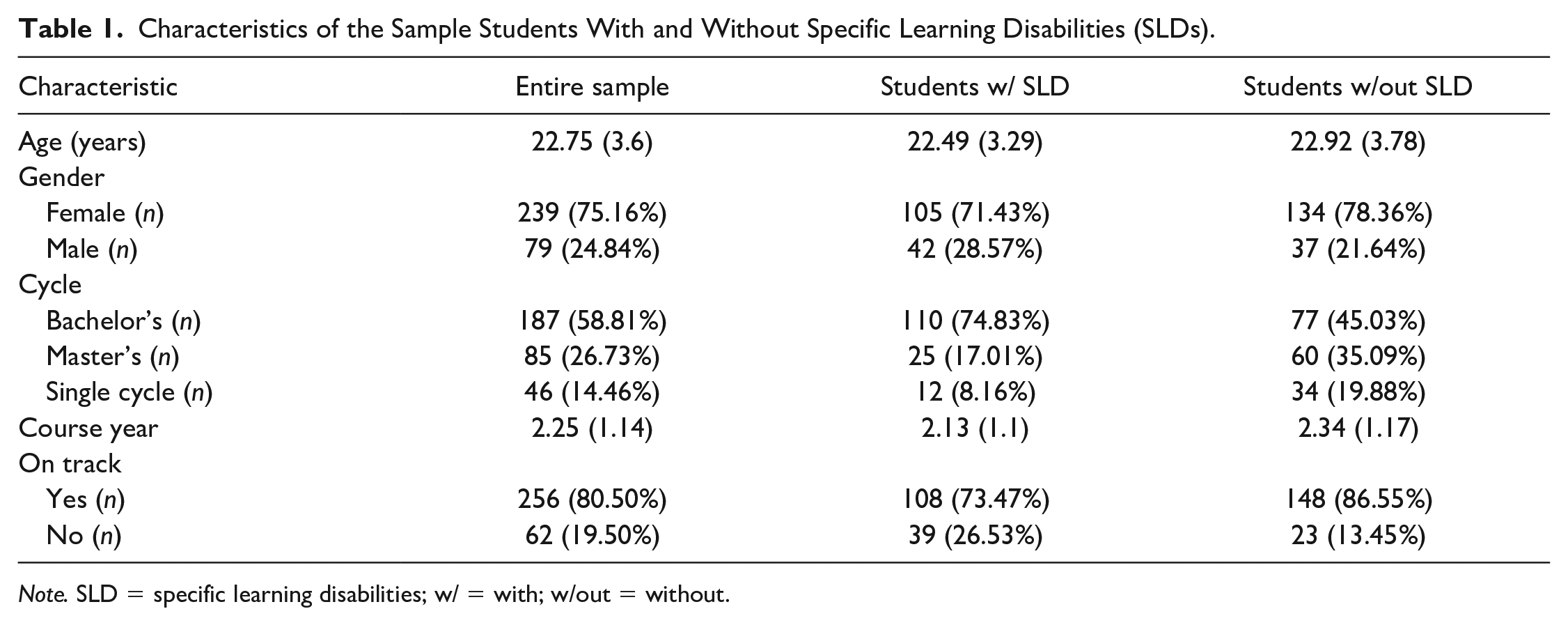
Note. SLD = specific learning disabilities; w/ = with; w/out = without.
To ensure sample size adequacy, we performed power analysis using the pwrSEM Shiny app (Wang & Rhemtulla, 2021). We estimated small-to-medium parameters based on our literature review. Power was then calculated via simulations with 5,000 iterations. With 300 participants, power ranged from .79 to .99 for all effects of our predictors of interest on our three outcomes of achievement, perceived life and academic satisfaction.
Materials
Participants completed an introductory demographic questionnaire containing questions such as age, gender, type of coursework, credits earned, course year, and the use of university services. For all self-reported measures, responses were given on five-point Likert scales from 1 = never/not at all like me to 5 = always/very much like me for the sake of readability.
Soft Skills
I/D Epistemic Curiosity Scale−Type-1 Subscale
The Epistemic Curiosity Scale (Litman, 2008) was translated into Italian by Lauriola et al. (2015). This scale contained five items investigating Type-I (interest) epistemic curiosity, or whether students enjoyed acquiring new information (sample item: “I enjoy exploring new ideas”). The original subscale displayed good reliability indices (α = .82, Litman, 2008) and was reliable in our study as well (α = .88).
Values in Action Inventory of Strengths-120–Creativity and Social Intelligence Subscales
The Values in Action Inventory of Strengths (Peterson & Seligman, 2004) was validated for the Italian version by Feraco, Casali, and Meneghetti (2021). These two subscales involved five items each evaluating original and productive thinking (e.g., “Being able to come up with new and different ideas is one of my strong points”) and effective social interaction (e.g., “I know how to handle myself in different social situations”), respectively. Both scales displayed good reliability in the Italian validation study (αcuriosity = .88, αsocial intelligence = .75; Feraco, Casali, & Meneghetti, 2021) as well as in the present sample (αcuriosity = .90, αsocial intelligence = .79).
Motivated Strategies for Learning Questionnaire–Critical Thinking
The Motivated Strategies for Learning Questionnaire (Pintrich et al., 1991) was validated for the Italian version by Moretti et al. (2018). This involved four items measuring the student’s tendency to question learning material (e.g., “When a theory, interpretation, or conclusion is presented in class or in the readings, I try to decide if there is good supporting evidence”). The Italian version of the entire questionnaire had satisfactory properties (.67 < α < .92, Moretti et al., 2018). The scale showed good internal consistency in our sample, as well (α = .79).
Short Grit Scale–Perseverance of Effort subscale
The Short Grit Scale (Duckworth & Quinn, 2009) was validated in Italian by Sulla et al. (2018). This subscale contained four items assessing prolonged effort despite obstacles (e.g., “Setbacks don’t discourage me”). The subscale displayed an acceptable internal consistency in the Italian version (α = .61, Sulla et al., 2018) as well as in our study (α = .73).
Studying-Related Factors
Self-Regulated Learning Questionnaire–Short Form
The Self-Regulated Learning Questionnaire, adapted from De Beni et al. (2014), contains 20 items assessing five SRL strategies (four items each): organization (e.g., “In the early afternoon, I plan all the things I have to do”), elaboration (e.g., “When studying, I try to present the contents in my own words”), self-evaluation (e.g., “After a written exam, I know whether it went well or not”), preparing for exams (e.g., “I try to anticipate what kind of exam awaits me”), and metacognition (e.g., “When an exam goes wrong, I try to understand the reasons why I failed”). Seven items needed to be reversed to calculate overall scores. The overall score showed satisfactory internal consistency both in the original version (α = .76, De Beni et al., 2014) and in our sample (α = .74).
Learning Goals Questionnaire
The Learning Goals Questionnaire (De Beni et al., 2014) provides four items on mastery and performance learning goals (e.g., “Getting good grades matters to me more than what I learn”). Higher scores indicated mastery-oriented learning goals. The scale displayed good reliability in the original version (α = .78, De Beni et al., 2014). In our study, reliability was acceptable (α = .55).
Academic Self-Efficacy Questionnaire
The Academic Self-Efficacy Questionnaire (De Beni et al., 2014) consisted of five items measuring the belief that one can succeed in studying (e.g., “How do you rate your study skills?”). The scale proved reliable both in the original version (α = .80, De Beni et al., 2014) and in our study (α = .78).
Theories of Intelligence Questionnaire
The Theories of Intelligence Questionnaire (De Beni et al., 2014) offered four items assessing growth mindset (e.g., “You can learn new things, but you can’t change your intelligence”). Higher scores indicated an incremental growth mindset. Internal consistency was satisfactory in the original version (α = .88, De Beni et al., 2014) as well as in our study (α = .74).
Anxiety and Resilience Questionnaire
The Anxiety and Resilience Questionnaire (De Beni et al., 2014) contains 14 items investigating study anxiety (seven items, e.g., “The very thought of taking an exam makes me panic”) and study resilience (seven items, e.g., “I can overcome disappointment over an academic failure”). We calculated overall scores, reversing the anxiety items (α = .88). The original version demonstrated satisfactory psychometric properties (αanxiety = .86, αresilience = .76, De Beni et al., 2014). These were replicated in our sample (αanxiety = .91 and αresilience = .75).
Cognitive Abilities
Cattell Test–Scale 3A
This task (Cattell, 1940) measured fluid intelligence using four different types of timed problems, with a total of 60 items and 12 min 30 s. First, in the Series subtest, participants had to correctly complete a sequence of images (13 items, 3 min). In the Classifications subtest, participants were required to spot the two images that differed from the others in a series of five (14 items, 4 min). In the Matrices subtest, participants were asked to correctly complete a matrix (13 items, 3 min). Finally, in the Conditions subtest, participants had to indicate which image fit specific spatial relationships (10 items, 2 min 30 s). Correct answers scored one point, while zero point was awarded in case of wrong or missing answers. A total score was calculated by summing up all the correct answers. The original paper/pencil measure showed adequate overall internal consistency (α = .74; Cattell, 1940); the internal consistency remains good in the current sample (α = .84).
Outcome Measures
Grades
Students self-reported their average grades. In the Italian university system, grades range from a minimum of 18 to a maximum of 30.
Satisfaction With Life Scale
The Satisfaction With Life Scale (Diener et al., 1985) was validated in Italian by Di Fabio and Gori (2016). This included five items examining overall contentment with one’s life conditions (e.g., “The conditions of my life are excellent”). The scale showed good internal consistency in the Italian validation study (α = .85, Di Fabio & Gori, 2016) as well as in our study (α = .83).
Academic Satisfaction
This was adapted from the Multidimensional Students’ Life Satisfaction Scale–Short Form, School subscale (Huebner et al., 2012). The Italian version was translated by Zappulla et al. (2013). This contained five items evaluating satisfaction with university life (e.g., “I enjoy being at the university”). The scale displayed good internal consistency in the original Italian version (α = .81, Zappulla et al., 2013) as well as in the current adaptation (α = .87).
Procedure
Participants were recruited both through SLD university services of three public Italian institutions in Northern Italy (University of Turin, University of Padova, and University of Trieste) and through a snowball procedure, advertising the study on social media and through personal contacts. Data collection took place in the first months of 2021 (January–May). All participants took part in the study voluntarily and provided informed consent before completing the self-reported measures and the fluid intelligence task. All questionnaires and the objective task were implemented in Qualtrics and took approximately 35 min to complete.
Participants were first asked for various sociodemographic information, then they completed the questionnaires, which were presented in randomized order across participants. Last, they answered questions related to their studies (e.g., average grades, number of credits, academic year).
Data Analysis
We used RStudio (RStudio Team, 2020) to run all analyses. First, to explore the differences between students with and without SLDs with respect to our variables of interest (i.e., soft skills, study-related factors, fluid intelligence, credits earned, achievement, life, and academic satisfaction), we conducted independent t tests and assessed dimensions of differences in terms of Cohen’s d (Cohen, 1988). We considered d = .20 as a small effect size, d = .50 as a medium effect size, and d = .80 as a large effect size. Differences were considered significant when p ≤ .003 (according to Bonferroni correction for number of comparisons).
Then, we ran multivariate regression models on the whole sample using lavaan (Rosseel, 2012) to assess the effect of soft skills (i.e., creativity, curiosity, critical thinking, perseverance, and social intelligence) and study-related factors (i.e., academic self-efficacy, growth mindset, learning goals, SRL strategies, and study resilience) on our outcome variables (i.e., academic achievement and satisfaction with life and academic satisfaction). We added fluid intelligence (Cattell test scores) as a covariate for academic achievement only. Finally, we adopted multigroup confirmatory factor analysis (CFA) to test model invariance across sex (male vs. female) and diagnosis (with vs. without an SLD).
Results
Differences Between Students With and Without SLDs
Our independent t tests indicated significant differences between students with and without SLDs regarding creativity, academic self-efficacy, studying resilience, and academic achievement. More specifically, students with SLDs reported greater creativity, lower academic self-efficacy, lower study resilience, and lower grades (ps < .001). Effect sizes were small for all variables except academic self-efficacy, for which the effect size was medium. Table 2 displays t test results for all variables.
Results of the Independent t Tests.
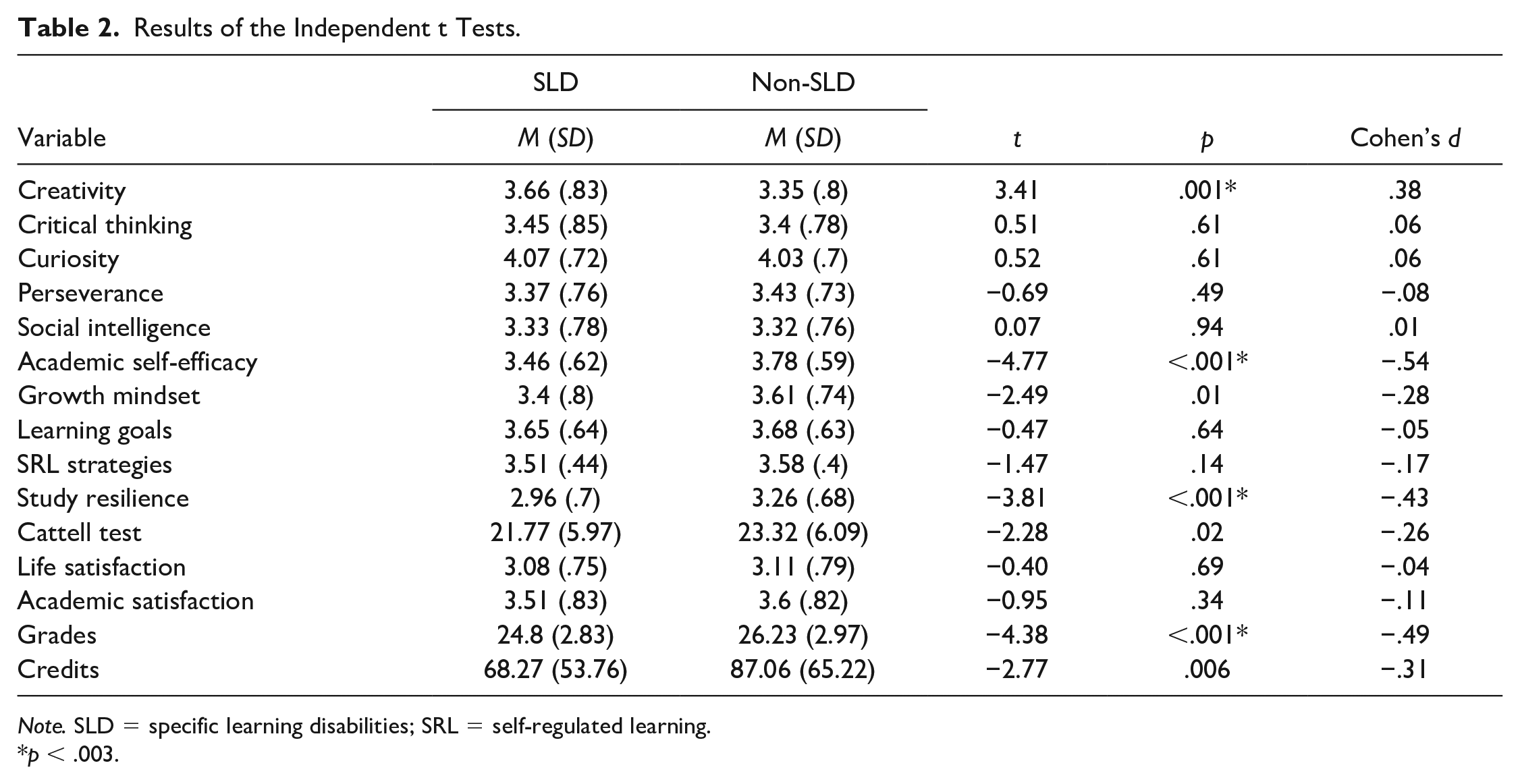
Note. SLD = specific learning disabilities; SRL = self-regulated learning.
p < .003.
Associations Among Intraindividual Factors, Academic, and Nonacademic Outcomes
Supplementary Table S1 in the online supplemental materials summarizes the correlations among all variables. Three regression models were fitted considering achievement (grades), satisfaction with life, and satisfaction with university life as dependent variables. We used soft skills and studying-related factors as predictors. Given the effect of intellectual abilities on academic achievement (Richardson et al., 2012), we added Cattell test scores as a covariate for achievement. The model displayed good fit indices (comparative fit index [CFI] = 1.00; nonnormed fit index [NNFI] = 1.15; root-mean-square error of approximation [RMSEA] = .00; standardized root-mean-square residual [SRMR] = .00).
Our results for academic achievement showed a significant direct effect for academic self-efficacy (β = .21, p < .01), together with an inverse effect of creativity (β = −.19, p < .01). The model explained 13.3% of variance.
Concerning life satisfaction, our model showed a significant direct effect for study resilience only (β = .29, p < .001). The model explained 22.4% of the variance. For academic satisfaction, critical thinking (β = .30, p < .001), academic self-efficacy (β = .30, p < .001), and curiosity (β = .17, p < .01) all emerged as significant predictors. The model explained 36% of the variance. A significant, albeit small, positive correlation emerged between life satisfaction and academic satisfaction (r = .11, p < .01). Table 3 shows all regression models’ results.
Results of the Regression Models.
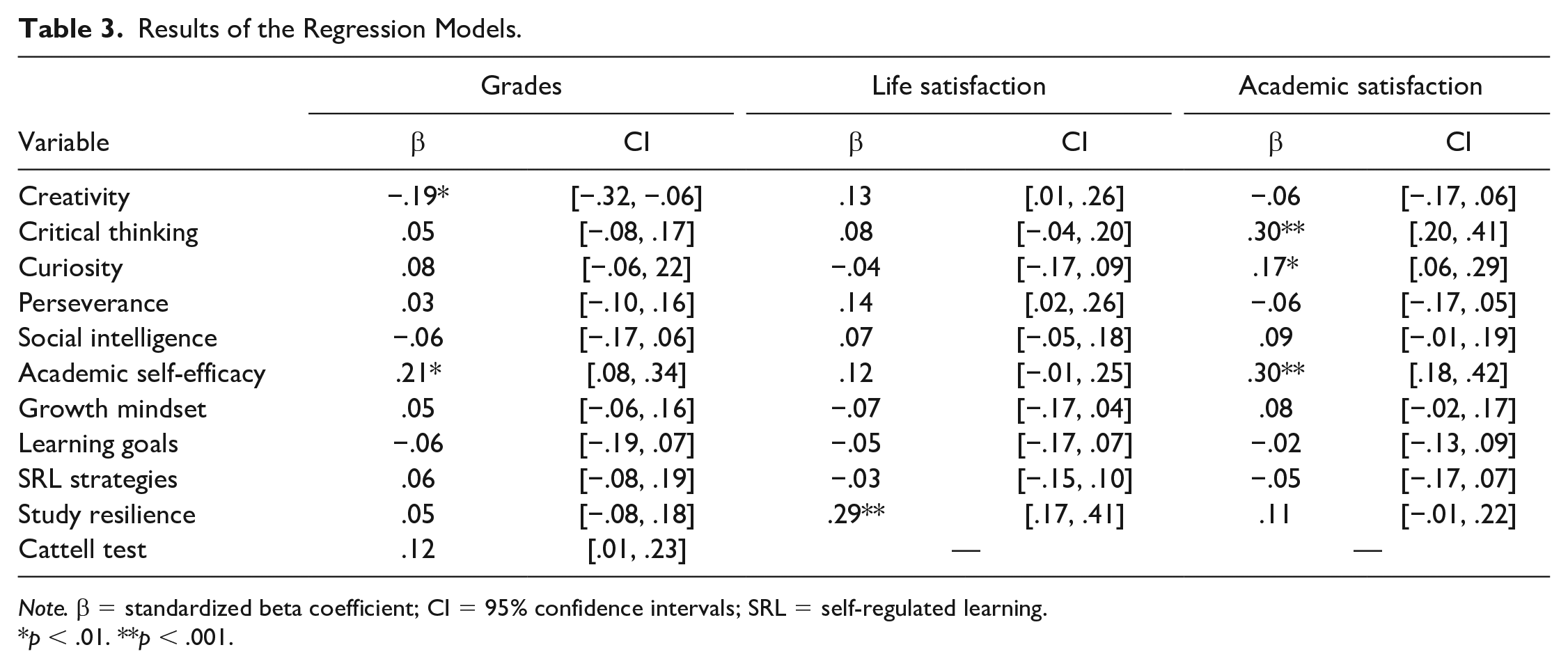
Note. β = standardized beta coefficient; CI = 95% confidence intervals; SRL = self-regulated learning.
p < .01. **p < .001.
Model Invariance
We calculated model invariance to ensure the model did not differ across gender (male vs. female) and diagnosis (with vs. without an SLD) using multigroup CFA. For sex invariance, results suggested scalar invariance (equality of factor loadings and intercepts) between female and male participants (CFI = .98, NNFI = .79, RMSEA = .07, SRMR = 0.01, p = .053). For diagnosis status, our results did not support any scalar invariance between students with and without SLDs (p = .01).
A Lagrange multiplier test suggested that freeing the intercept for academic achievement would result in an improved model. After freeing this parameter, partial scalar invariance was achieved (CFI = 1.00, NNFI = 1.01, RMSEA = .00, SRMR = .00, p = .38). This means that the patterns of relationships between the predictors and the outcomes in students with and without SLDs can be considered similar, except for a difference in academic achievement, which was higher for students without SLDs.
Discussion and Conclusion
Understanding intraindividual characteristics in academic success is paramount for devising interventions aimed at supporting students with and without SLDs throughout their careers. Recent models suggest the importance of adopting a strength-based approach rather than a deficit one—that is, focusing on the resources and favorable dispositions displayed by individuals and nurturing them to positively affect outcomes of interest (Lavy, 2020; Linkins et al., 2015; Niemiec et al., 2017; Ruch et al., 2020). Drawing on iSRL theory (Ben-Eliyahu, 2019), we first explored the differences in various intraindividual factors (both general and related to studying) and three relevant academic and nonacademic outcomes (achievement, life satisfaction, and academic satisfaction) in a sample of students with and without SLDs. Then, we investigated the associations between the intraindividual factors and outcomes in a multivariate regression model.
Concerning group differences between students with and without SLDs, our results indicated that, in line with our hypotheses, students with SLDs reported higher creativity, but lower academic self-efficacy, study resilience, and grades. These findings supported some previous evidence in students of various grades (Baird et al., 2009; Cancer et al., 2016; Hen & Goroshit, 2014; Lackaye & Margalit, 2006; Majeed et al., 2021; Tabassam & Grainger, 2002) and may support the idea that students with SLDs show a specific profile in terms of resources and issues displayed. More specifically, it seems that students with SLDs may struggle with feeling confident in their academic abilities (academic self-efficacy) and ability to bounce back from academic difficulties (study resilience), which may partially explain their lower achievement (Hen & Goroshit, 2014).
On the contrary, these students also reported greater dispositional creativity—they described themselves as able to produce original ideas and find new ways to do things. Interestingly, no other significant differences emerged, meaning that students with and without SLDs were similar in terms of the other soft skills (curiosity, critical thinking, perseverance, and social intelligence) and study-related factors (presence of SRLs, growth mindset, and learning goals), as well as life and academic satisfaction. This may indicate that university students with SLDs are equipped similar to their peers without difficulties in terms of soft skills and study abilities. Most importantly, the students with SLDs reported similar levels of subjective and academic well-being. Our regression models further clarified the relationships between such intraindividual factors and the academic and nonacademic outcomes in the entire sample.
Academic self-efficacy emerged as the most relevant intraindividual factor, as it was significantly positively related to both academic achievement and academic satisfaction. This result was in line with our expectations and with several previous studies (Casali et al., 2022; Mega et al., 2014; Richardson et al., 2012), suggesting the importance of this variable for students’ performance and extending its relevance to academic well-being. On the contrary, and quite unexpectedly considering previous literature (e.g., Gajda et al., 2017), creativity was negatively, although weakly, associated with achievement. Taken together, these two results may help explain the difference in academic achievement we observed between students with and without SLDs: Students with SLDs reported higher creativity (which negatively affected achievement) and lower academic self-efficacy (which instead positively affected achievement). We speculate that within a highly prescriptive and conforming context like a university, creativity may be deincentivized and represent a sort of hindrance to performing well.
Interestingly, two soft skills related to creativity, that is, critical thinking and curiosity (in Peterson & Seligman, 2004 taxonomy, they all belong to the second-order virtue of wisdom & knowledge), emerged as significant predictors of academic satisfaction (as in Lounsbury et al., 2009). It appears that being able to critically analyze and even dispute learning material, as well as eagerness to learn, are both positively related to satisfaction with one’s academic life. Consequently, although students with SLDs’ high creativity may get in the way of performing in a certain way to get higher grades, these two related dispositions may help them feel more at ease with the university context at large. Notably, fluid intelligence was not significantly related to achievement, suggesting the importance of considering noncognitive factors when examining psychological correlates of performance (Heckman & Kautz, 2012; Khine & Areepattamannil, 2016).
Finally, study resilience appeared as the single positive predictor of life satisfaction in accordance with our hypotheses and previous studies on general resilience (e.g., Hu et al., 2015). Being able to overcome study difficulties and manage studying-related anxiety could therefore positively influence students’ subjective well-being more than other soft skills or studying-related factors.
Related to this, it is important to note that not all predicted effects emerged as significant. This lack of significance may be due to several reasons, such as the covariance between the intraindividual factors examined; at the same time, considering them all simultaneously can provide useful information on their relative roles. Future studies could expand on this by trying to disentangle the roles of general and studying-related factors, for example considering studying-related factors as mediators in the relationships between soft skills and outcomes (Feraco, Resnati, et al., 2021; Muenks et al., 2017).
Furthermore, the three outcomes we considered were quite unrelated to one another, confirming the need to consider them as equally important contributors to what success looks like for university students rather than focusing on performance or well-being alone. Moving forward, this kind of comprehensive look could lead to the development of integrated intervention programs aimed at fostering various important dimensions in students.
Limitations
The present study has some limitations. First, its cross-sectional nature did not allow us to make any causal inferences on the direction of the relationships assessed; future studies could adopt a longitudinal design to better assess them. The presence of SLDs was self-reported; therefore, it was not possible to analyze how the severity of SLDs may have affected the relationships among the variables considered. Moreover, gender imbalance in our sample may limit the generalizability of the results. Relying on a convenience sample recruited through a snowball procedure also qualifies as a limitation, as it may have hindered representativeness of the SLD population; similarly, online studies heavily rely on participant truthfulness and should be taken with caution. Future studies with random sampling and in presence data collection should therefore be conducted to try and replicate the present findings. Finally, it should be noted the one of the questionnaires (i.e., the Learning Goals Questionnaire) displayed poor reliability in our sample (differently from the general population validation sample); therefore, the result on learning goals not significantly contributing to our outcomes of interest should be taken with caution, as it may depend solely on a measurement issue.
Implications for Practice
Notwithstanding these limitations, our study newly examined the associations and differences in a host of intraindividual factors possibly related to various dimensions of academic success in terms of both achievement and well-being in a sample of students with and without SLDs. Identifying the specific positive resources that students with and without SLDs may draw upon can support the importance of noncognitive factors in the education field, as recently suggested both theoretically and empirically (Feraco et al., 2022; Feraco, Resnati, et al., 2021; Lavy, 2020). This approach can lay the foundations to develop strength-based intervention programs (Ruch et al., 2020).
By and large, our results could also provide suggestions for devising supporting services at the university level, focusing not only on study specific factors, but also on noncognitive, transversal components to promote achievement and satisfaction in students’ personal academic paths. Having found that the relationships between predictors and outcome variables were similar for students with and without SLDs let us derive an additional implication. It could be argued that universally offered services or interventions can have positive consequences for students with and without SLDs. For example, Newman et al. (2019) reported that postsecondary students with SLDs who accessed universally available supports only continued or completed their postsecondary programs at a higher rate with respect to those who did not receive or seek any support (but see Yu et al., 2018). Providing support universally can also increase the number of students with SLDs who access services, overcoming the need to self-disclose their condition. Self-disclosure may indeed be particularly relevant, considering that a low percentage of students with SLDs disclose their difficulties at enrollment, with a negative effect on their academic careers (see, for example, Lightner et al., 2012).
To conclude, our results could guide researchers and practitioners interested in a strength-based approach to SLDs to devise interventions and expand the research to more deeply examine the positive qualities that sustain students throughout their academic careers.
Supplemental Material
sj-docx-1-ldx-10.1177_00222194221150786 – Supplemental material for Academic Achievement and Satisfaction Among University Students With Specific Learning Disabilities: The Roles of Soft Skills and Study-Related Factors
Supplemental material, sj-docx-1-ldx-10.1177_00222194221150786 for Academic Achievement and Satisfaction Among University Students With Specific Learning Disabilities: The Roles of Soft Skills and Study-Related Factors by Nicole Casali, Chiara Meneghetti, Carla Tinti, Anna Maria Re, Barbara Sini, Maria Chiara Passolunghi, Antonella Valenti, Lorena Montesano, Gerardo Pellegrino and Barbara Carretti in Journal of Learning Disabilities
Footnotes
Declaration of Conflicting Interests
The author(s) declared no potential conflicts of interest with respect to the research, authorship, and/or publication of this article.
Funding
The present work was conducted as part of the Dipartimenti di Eccellenza research program (DM 11/05/2017 n. 262), supported by a grant from MIUR to the Department of General Psychology, University of Padua.

References
Supplementary Material
Please find the following supplemental material available below.
For Open Access articles published under a Creative Commons License, all supplemental material carries the same license as the article it is associated with.
For non-Open Access articles published, all supplemental material carries a non-exclusive license, and permission requests for re-use of supplemental material or any part of supplemental material shall be sent directly to the copyright owner as specified in the copyright notice associated with the article.
