




Abstract
Amendments to the Fair Work Act now allow workers in Australia a right to disconnect. The implementation of this right precipitated a polarised public debate that was not consistently evidence-based, encompassing the often-contradictory perspectives of unions, employers, business lobbies and politicians. This study offers a more nuanced and evidence-based understanding of the right to disconnect, its benefits and challenges and the possible impact on Australian employment practices and relations. It provides an international comparative analysis; it explores the literature on related topics such as work–life balance, occupational stress, management practices and productivity; and it proposes a model of the consequences of technology-enabled flexible work. The comparative analysis and literature review are supplemented with themes identified in Australian media coverage through a Leximancer analysis. The findings discuss the advantages and limitations of diverse top-down legislative or self-regulatory pathways experienced overseas by early adopters. While the right to disconnect can improve work–life balance, health and well-being and productivity, its implementation requires careful consideration of industry-specific contexts, clear policies and cultural shifts in workplaces to mitigate the risks associated with hyperconnectivity. These insights are useful for Australia as it enters the implementation phase of the right to disconnect.
In the digital age, the boundaries between work and personal life are increasingly blurred (Katsabian, 2021). While flexible working arrangements can be a positive development for employees and employers, ‘availability creep’ poses challenges for workers, which can result in stress, anxiety and disturbances in their personal life (Wright, 2024). Following developments in other jurisdictions, amendments to the Fair Work Act have introduced a ‘right to disconnect’, allowing employees in Australia to refuse contact outside of working hours, unless refusal is unreasonable. The modification of all modern awards by the Fair Work Commission is due in August 2024 for larger businesses, and a year later for small businesses (Fair Work Commission, 2024a). The right to disconnect has sparked heated public debate and speculation on its possible impact on work and the economy.
Too often such debates are not informed by research. Regardless of whether one is in favour of the newly introduced right to disconnect provisions, the implementation will require considerable effort. It will entail clear communication between employers and employees, mutual trust and the creation of workplace cultures that respect personal time. Practical challenges are also expected. For example, employers that operate across multiple time zones may find handling out-of-hours work communications challenging. In addition, at the time of writing and in the absence of further guidelines from the Fair Work Commission, it is not clear when an employee's refusal is reasonable and what role compensation, job type, personal circumstances and notice of contact will play. It is clear, however, that in cases where an employer and employee disagree on whether contact is reasonable, they must try to resolve it themselves first before either party can make an application to the Fair Work Commission. 1
This paper explores the possible implications of the right to disconnect for employment practices and relations in Australian workplaces. It does so by bringing nuance to the debate, which is currently polarised and informed by ideology more so than by evidence. This is despite the evidence presented in Senate committee reports and the parliamentary debate leading to the passing of the bills. While there is scarce academic research on the topic (Hopkins, 2024), a combination of policy analysis and academic research can advance the debate in Australia, provide a better-informed sense of the rationale for the introduction of a right to disconnect and highlight what challenges can be expected following its implementation. We build on emerging academic literature and practical evidence drawn from early European adopters (Eurofound, 2023; European Law Institute, 2023; Uni Global Union, 2020).
The rationale for a right to disconnect
The rationale for introducing a right to disconnect stems from the inherent tension between the positive and negative effects of technology-enabled remote work. Emerging literature is published in three areas: law, health and business (Hopkins, 2024). Taken together, these early contributions highlight the benefits and risks of remote work. Remote work is enabled by technological developments that allow workers to conduct many of their tasks outside the traditional office environment. Owing to new work arrangements and enabling technologies, ‘[e]mployees bring home projects, respond to emails, write reports, return phone calls and conduct research. Some workers are never off the clock as they continue to work after hours at home resolving work matters using technology’ (Marcum et al., 2018: 75). Employees can work not only from home but also from alternative locations (Borges, 2023), and when they are in transit and during their holidays (Golding, 2023).
Such arrangements have become commonplace since the pandemic (Borges, 2023; Golding, 2023). According to the Australian Bureau of Statistics, 37 percent of employed people regularly work from home (Australian Bureau of Statistics, 2023). While flexible work benefits employees and employers, it comes with the risks associated with hyperconnectivity (Timellini, 2020). A key question is how to mitigate the risks of technology-enabled flexible work, while retaining its benefits: ‘[t]he challenge, though, is to ensure that the flexibility cherished by a majority of employers and (certain) workers is preserved while safeguarding workers by preventing the intrusion of work into their personal lives’ (Pucheta and Ribeiro Costa, 2022: 968). Introducing a right to disconnect can offer a solution, as ‘[b]etter labor policy and remote-work legislation can help meet the needs of people and organizations’ (Pellerin et al., 2023: 41).
It is essential to understand the risks and benefits of technology-enabled flexible work (Figure 1). The benefits of new work arrangements stem from the increased flexibility they afford employees (Marcum et al., 2018). Employees benefit from autonomy (Borges, 2023), gaining control over where and when they work (Pellerin et al., 2023). They can turn off during the day if they wish (Von Bergen et al., 2019) or work from anywhere. An important advantage is a reduction in commuting time (Borges, 2023; Miernicka, 2024). These risks result from hyperconnectivity (Timellini, 2020). Constant connection puts workers at risk of information overload (Miernicka, 2024) and addiction to technology (Vaghefi et al., 2017). Workers may also be subjected to increased monitoring by employers (Golding, 2023), paving the way for cyberbullying (Borges, 2023). It is alarming that workers do not need to perform work to experience the negative effects of hyperconnectivity: the knowledge of the existence of a constant flow of information and ongoing monitoring can be enough (Becker et al., 2021).
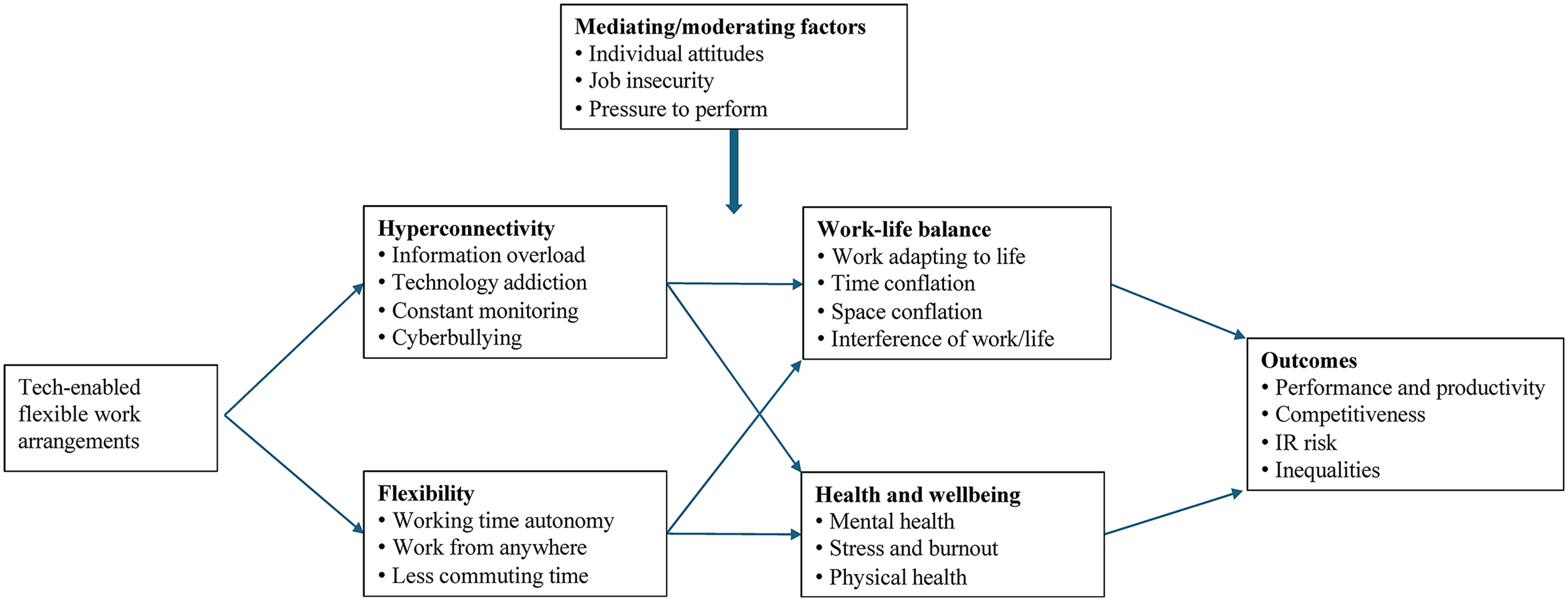
A model of the consequences of technology-enabled flexible work arrangements.
Both flexibility and hyperconnectivity can impact on work–life balance (Chernyak-Hai et al., 2021). On the one hand, flexible work arrangements give employees autonomy to adapt their work schedules to their private life, improving work–life balance (Marcum et al., 2018). On the other hand, hyperconnectivity may have negative effects (Hopkins, 2024; Miernicka, 2024; Pellerin et al., 2023). It can blur the boundaries between work and private life (Golding, 2023; Miernicka, 2024; Pucheta and Ribeiro Costa, 2022). The first boundary is temporal, where work and personal time become less distinct, and workdays never end (Marcum et al., 2018). Being incessantly connected conflates the workspace with private space (Borges, 2023; Fairbairn, 2019). This leads to availability creep (Fairbairn, 2019), which is the encroachment of work on personal and out-of-work hours (Borges, 2023).
Hyperconnectivity can also impact mental and physical health (Borges, 2022; Fairbairn, 2019; Hopkins, 2024). Where hyperconnectivity and the blurring of work–life balance coalesce, workers can feel overwhelmed and anxious (Borges, 2022; Fairbairn, 2019), psychologically exhausted (Pucheta and Ribeiro Costa, 2022), sleep deprived, emotionally exhausted and unable to concentrate (Borges, 2022). An aggravating factor is a possible sense of social isolation (Borges 2023; Miernicka 2024). Combined, these effects can lead to stress, burnout (Avogaro, 2018; Pellerin et al., 2023) and depression (Borges, 2022). In turn, mental health issues linked to long working days and poor working conditions (Ghosheh, 2022) can lead to health problems, including muscle strain and musculoskeletal disorders (Borges, 2023; Miernicka, 2024; Pucheta and Ribeiro Costa, 2022).
Altogether, flexible work arrangements can lead to mixed outcomes for employees and employers. First, it can affect performance (Golding, 2023). Health and well-being affect employee engagement, efficiency (Fairbairn, 2019) and productivity (Borges, 2022; Fairbairn, 2019; Pucheta and Ribeiro Costa, 2022). Second, and connected to competitiveness (Hopkins, 2024), it can improve business continuity and responsiveness (Borges, 2022), decrease overhead (Fairbairn, 2019; Miernicka, 2024), reduce carbon footprint, for instance by limiting commuting (Fairbairn, 2019) and decrease turnover (Golding, 2023). Third, the lack of delineation between work and nonwork hours can create an IR risk (Fairbairn, 2019), linked to unpaid work and not respecting private time (Borges, 2023; Golding, 2023; Hopkins, 2024; Pellerin et al., 2023) or reduced privacy (Borges, 2023). While working outside office hours is not a new phenomenon, the risk is aggravated by increasingly blurred boundaries between work and life. Finally, it can increase employers’ power through control and monitoring (Pucheta and Ribeiro Costa, 2022), affecting equality in relation to women and vulnerable workers (Borges, 2023; Miernicka, 2024). However, the Productivity Commission found that working from home enabled parents with young children, as well as those with disabilities or health conditions, to work or take on additional hours (Productivity Commission, 2021).
The identification of moderating and mediating factors is essential. These factors influence whether flexible work arrangements result in positive, negative or mixed outcomes. Ultimately, the case for introducing of a right to disconnect is that it can influence mediating and moderating factors, creating guardrails to maintain boundaries between work and nonwork hours. A first key factor to consider is the capability of workers to cope with hyperconnectivity. Indeed, ‘[i]t seems that some employees do not recognize when they should ‘turn off’ work’ (Von Bergen et al., 2019). For instance, ‘[m]any Millennials [and Gen Z] are not offended by answering emails and posting employer social media comments after hours, but they expect to be compensated for such time’ (Marcum et al., 2018). The introduction of a right to disconnect raises awareness of this challenge and can enable workers who struggle with these boundaries to cope better.
A second factor is the fear of repercussions if workers fail to stay connected. Consequences include impressing management negatively (Von Bergen et al., 2019), fear of losing their job and losing health cover (Borges, 2023; Miernicka, 2024). A third aggravating factor is pressure to performance, particularly in middle management (Borges, 2023). For the last two factors, the protections that come from the institutionalisation of a right to disconnect can offer a protective shield for employees. Altogether, the case for the creation of a right to disconnect can be summarised as a safeguard to ensure that technology-enabled flexible work arrangements deliver their promises to both employees and employers.
The right to disconnect in Australia
The debate around the right to disconnect in Australia commenced in the early 2020s, in the midst of the pandemic and following the introduction of similar legislation in other countries (cf. next section). Two events marked the initial conversation. First, in November 2020, the Australian Council of Trade Unions (ACTU) released its ‘Working from Home Charter’ based on the idea that: ‘whether workers are at their office desk or kitchen table they should have rights and entitlements to share productivity gains, a safe and health work environment and the ability to draw a line between work and life’ (2023: 1). The charter explicitly refers to a right to disconnect. A few months later, in April 2021, the Victorian Police Force included the right to disconnect in its bargaining agreement.
In September 2023, the Australian Federal Government introduced the Fair Work Legislation Amendment (Closing Loopholes) Bill 2023 (Cth) (Bill). The Bill laid out reforms that may have extensive impact on work practices and employment relations. In December 2023, the Government announced that the Bill would be split into two parts. The first part of the Bill included provisions pertaining to ‘same job, same pay’ for labour hire workers, workplace delegate rights and criminalisation of intentional wage and superannuation theft, among other provisions. This part of the Bill passed both Houses and received Royal Assent on 14 December 2023. The second part of the Bill included provisions relating to bargaining, multienterprise agreements, casual employment, what exactly constitutes an ‘employee’, and pertinent for this paper: a ‘right to disconnect’.
The Senate passed the second part of the Bill in February 2024 following several amendments, which were accepted by the House of Representatives, after which the Bill received Royal Assent later that month (Commonwealth Parliament, 2024a; Fair Work Commission, 2024b). The Fair Work Commission, after a first consultation, proposed the terms to be included in all modern awards, which led to a second consultation in August 2024. This second consultation attracted submissions from various industries to allow for consideration of diverse contexts. The Fair Work Commission, however, indicated that it would only make guidelines on the operation of the right to disconnect after having dealt with some disputes. Also relevant, the Fair Work Amendment Bill 2024, passed in May 2024, removes the potential for criminal penalties (Commonwealth Parliament, 2024b).
The Bill defines the right to disconnect as: ‘generally allowing an employee to refuse contact or attempted contact from their employer (or from a third party where the contact or attempted contact relates to their work) outside the employee's working hours’. (p40). The Bill specifies that five elements can be used to decide if refusal is unreasonable (p41):
the reason for the contact or attempted contact; how the contact or attempted contact is made and the level of disruption the contact or attempted contact causes the employee; the extent to which the employee is compensated […] the nature of the employee's role and the employee's level of responsibility; the employee's personal circumstances (including family or caring responsibilities).
The ACTU argues that clauses included in modern awards must offer detailed guidance. Their draft model clause requires employers to minimise contact with employees outside of work hours and outlines the conditions under which contact is considered reasonable. They call for a clause that orders employers to take ‘all reasonably practicable steps’ to avoid contacting employees when they are off duty. Reasonableness is based on the purpose of contact and whether the employee is compensated (Workplace Express, 2024b). Conversely, business groups argue for a minimalist approach, criticising the ACTU recommendations for exceeding legislative requirements and creating unnecessary employer burdens (Workplace Express, 2024a).
Australia, a late adopter?
France was the first country to regulate the right to disconnect, introducing its legislation in 2017, followed by Italy. Many jurisdictions have followed as illustrated in Table 1 (see Borges, 2023; Golding, 2023). However, earlier endeavours included a first cross-sectoral agreement in 2013 in France (Borges, 2023) or company agreements in Germany as early as 2012 for Volkswagen and BMW (Hesselberth, 2018). Developments that introduce a right to disconnect are also on the cards in California (USA), Austria, the Netherlands and Denmark (Corcoran and Krudewagen, 2024).
Introduction of the right to disconnect globally.
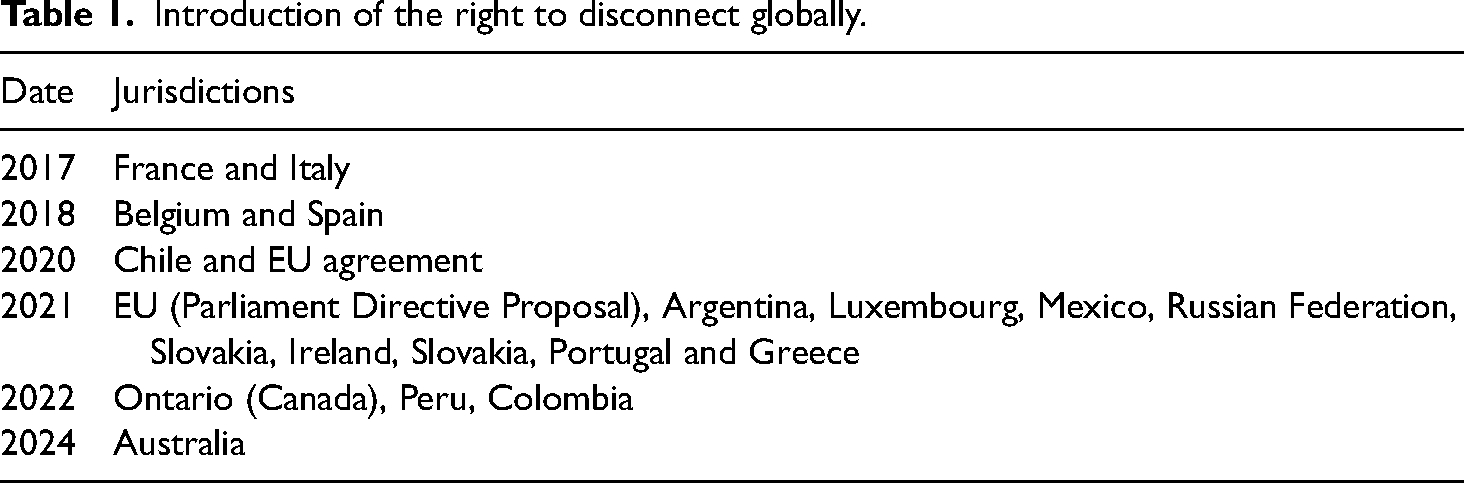
Not all jurisdictions have chosen similar pathways. For example, there are differences in the scope of coverage, where all employees could be covered in some countries and only teleworkers or employees of companies of a minimum size could be covered in others. There are also differences in terms of establishing a concrete right for workers, and countries that merely mandate negotiations concerning a right to disconnect. Finally, specific enforcement measures and penalties can be included, or not.
A polarised debate
The implementation of the right to disconnect in Australia, despite its adoption in other countries, has sparked intense debate. To gain a sense of the key arguments, we conducted a Leximancer text mining analysis of media coverage (see methods in Appendix). Text mining involves identifying concepts and themes in large unstructured data sets by analysing words and their semantic relations. Taking a birds-eye view of the heatmap, we can see five themes: work, changes, people, productivity and cost (cf. Figure 2). It is interesting to see that productivity is discussed more frequently in texts than the impact of the right to disconnect on people's (working) lives. Both ‘productivity’ and ‘cost’ signal that the debates focus on the financial and economic implications of the right to disconnect, which are parts of the debate that are juxtaposed with the impact on people's (working) lives, as shown by the distance between the themes on the heat map. We now turn to a closer examination of the concepts displayed within the themes.
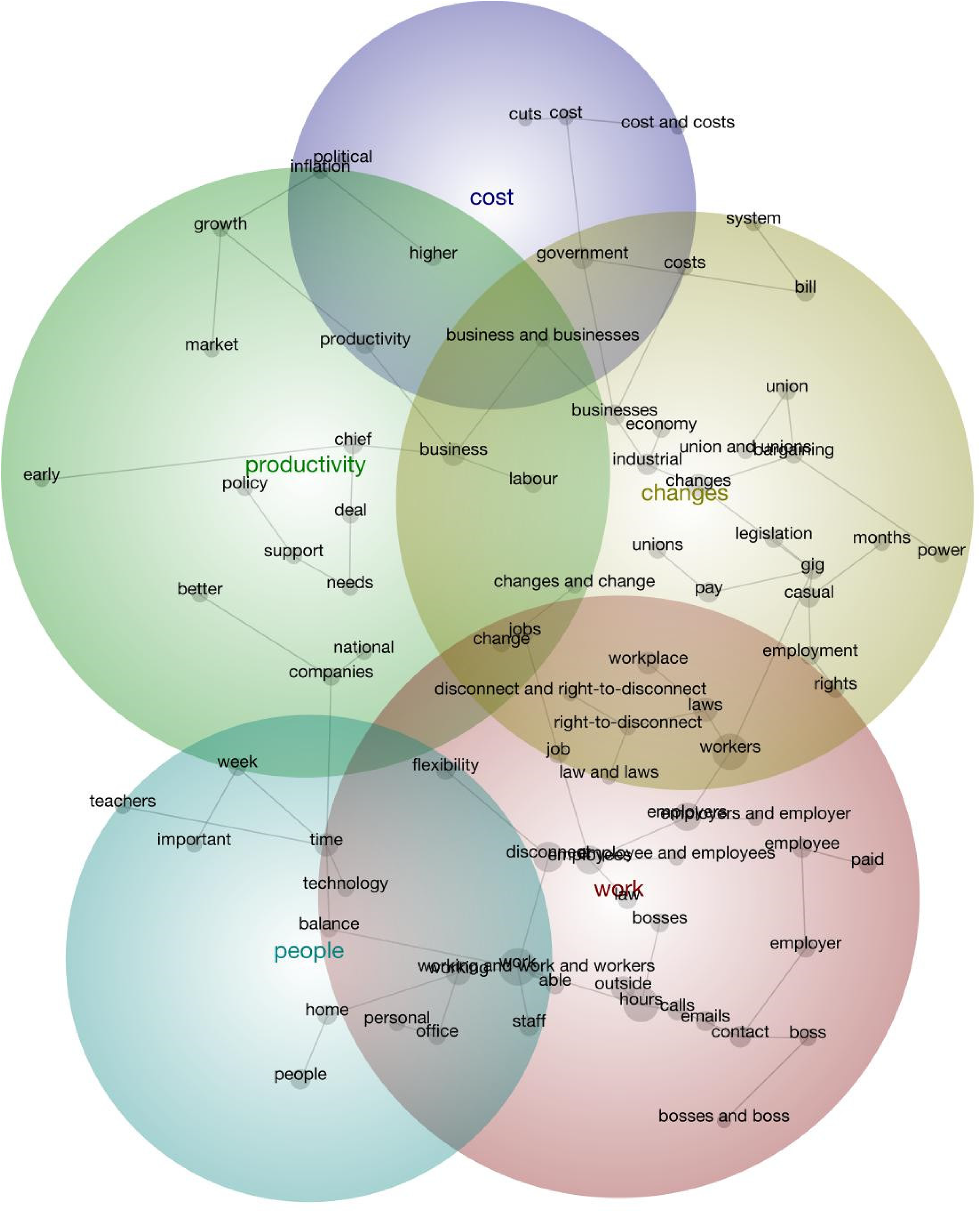
A heatmap of the public debate on the right to disconnect.
Work: At the core of the coverage, we find concepts that revolve around work and those who perform it. The Bill's potential impact on work was discussed, particularly regarding hours, pay and the right to disconnect. Flexibility emerged as a key area of concern, which tellingly sits at the thematic nexus of ‘work’, ‘productivity’ and ‘people’, with debate focused how the right to disconnect might negatively impact flexibility. Inflexibility can result from employees not only answering but also from increased bureaucracy caused by the introduction of policies and procedures. For instance, the Business Council of Australia chief executive said: ‘everyone deserves to be able to switch off at home, though it's really important to get the balance right here given people are now wanting more flexibility and to work different hours in different ways’ (The Australian – 10 February 2024). The chair of the Productivity Commission stated that ‘if we are going to move away from flexibility, there needs to be a very strong policy rationale for doing so’ (The Australian Financial Review – 13 February 2024), while the Australian Chamber of Commerce and Industry chief executive called the right to disconnect ‘the antithesis of flexibility’ (The Australian – 16 December 2023).
The role of employers in ensuring fair treatment of employees and compliance with the right to disconnect was also a recurring topic: ‘Workers will obtain the legal right to ignore phone calls and emails made by their employers outside of working hours. The company would be able to be penalised if contact is deemed unreasonable and initiated on unpaid time’ (The Australian – 13 February 2024). Similarly: ‘The idea that an employer could be imprisoned for calling a worker after 5pm would be comical were it not a cold, stark reality’ (23 February 2024).
Changes: The Bill's proposed changes and their potential impact on employment relations were also at the heart of the media reporting, focusing on how the right to disconnect may reshape workplaces in Australia. A commentator in The Australian stated that ‘“the right to disconnect” hinges on the seductive narrative of restoring the work–life balance supposedly disrupted by the pressure of modern life. Work is scapegoated as the problem, as an unnecessary burden and a source of stress, rather than the key to personal fulfilment and shared prosperity’. (12 February 2024). Opposition Leader Dutton vowed to ‘roll back the reform, standing with business groups that say the laws are unnecessarily prohibitive’ (The Age – 18 February 2024). Such commentary reveals the ideological properties of the debate. Media articles also included numerous comments from the Government. Workplace Relations Minister Burke said that ‘[a]t one level, it is interesting that this is even controversial. At its core, all we are saying is that you are meant to be paid when you are working in Australia’ (The Age – 14 February 2024).
The supposed possibility of the right to disconnect to alter the dynamics between employees and employers came to the foreground, with business representatives lamenting the top-down approach of the Bill: ‘If you're a large corporate, it's something you can write into an EBA 2 and if you're a small business, it's something you can agree with your staff. It's not something that needs to be prescribed in legislation, and the risk is, by doing that it becomes heavy-handed’ (The Sydney Morning Herald – 17 February 2024). Workplace silk 3 Jeffrey Phillips SC said that the right to disconnect provisions was ‘silly’ and ‘unworkable’ for the legal industry (The Australian – 19 February 2024). University of Adelaide professor Andrew Stewart conveys a contrary view in The Australian Financial Review, stating that the right to disconnect provisions should operate ‘as a general principle and then worked through the award system 4 on an industry-by-industry basis to determine any exemptions; for example, for emergency workers’ (3 February 2024).
Productivity: The media coverage also extensively discussed expected economic impact. Specifically, discussions arose around whether the provisions would support or hinder productivity growth. A commentator in The Australian Financial Review stated that ‘the hyper-politicised creation of another source of conflict between employers and employees in an already conflict-based workplace framework underscores how disengaged the political debate is from the cooperative and bargaining-based IR agenda that's needed to boost productivity’ (12 February 2024). Conversely, Greens Senator Barbara Pocock argued that the right to disconnect will ‘contribute to improvements in mental health and work-family balance, and increase productivity’ (The Australian Financial Review – 8 February 2024). Discussions also covered how to balance the needs of employers and employees, in terms of (dis)connecting from work. A comment in The Canberra Times describes how the right to disconnect may be able to create a level playing field: ‘The greatest productivity is possible where there is flexibility for workers, not just for businesses’. (29 February 2024). While a majority of Australian Financial Review readers believe that workers have a right to decline unreasonable after-hours calls, indeed more than 70 per cent of 512 readers polled said they supported the changes, more than a third of readers said that the right to disconnect laws will harm productivity (20 February 2024).
People: The impact of the right to disconnect on people's (working) lives was also discussed, although tellingly the heatmap shows that this theme was less often topic of debate compared to the impact on productivity. Articles delved into how the right to disconnect could positively affect well-being: ‘Unpaid overtime is ubiquitous, has untold financial, physical, mental and social costs, and demands urgent action through a right to disconnect’ (The Canberra Times – 4 February 2024). This included discussions around work–life balance and the increasing use of technology: ‘technology that once might have promised freedom and a shorter working week has now, for so many workers, created a tether to the workplace in their phones and laptops, extending the length of the working week without being paid’ (The Australian – 10 February 2024). The Leximancer analysis highlighted the impact on a specific group of workers: teachers. An opinion piece in The Age reads: ‘If we want better wellbeing and mental health to underpin better teacher retention rates in schools, we might shift our attention from the people who genuinely care about teacher retention, their principals, to the people doing the undermining. In short, it is parents who need to back off. Principals and teachers are already mostly reasonable’. (10 February 2024). The job specific elements of the right to disconnect are also remarked on in The Age, where the Commonwealth Bank of Australia chief executive stated: ‘Customers expect our services, or many of them are available, at all times, and we expect to be able to think through some of the reasonableness of, and requirements on, different roles’. (18 February 2024).
Cost: Media articles also focused on potential costs for the Australian businesses and the broader economy. The Council of Small Business Organisations Australia said the right to disconnect provisions may ‘create significant confusion for small businesses, exacerbate the cost of compliance and doing business and have flow-on impacts on the costs of goods and services’ (The Australian – 5 February 2024). On the other hand, it was stated that ‘the cost of mental health workers’ compensation claims tend to be much higher than claims due to other work-related injuries or conditions’ which is ‘why the right to disconnect is so important’ (The Australian – 28 February 2024). The debate around the economic impact of the right to disconnect was a recurring theme. A commentator in The Australian notes that the right to disconnect will ‘slow Australia's transition to being a stronger, more productive and prosperous nation’ (13 February 2024). Similarly, in The Australian Financial Review, it is remarked that ‘we will see more businesses fail as higher costs start to outstrip revenue growth. The right to disconnect, talk of a four-day week and the entrenched working-from-home trend in Australia has caused the re-emergence of an island economy mentality’ (1 April 2024).
The heated debate around the right to disconnect is unsurprising, as discussion about industrial relations reforms in Australia often play out in this way. Overall, there is acknowledgement of the impact of technology-enabled flexible work arrangements on well-being, work–life balance, productivity and costs. This aligns well with the model derived from the literature (Figure 1). However, there is no agreement on the pathway forward: do we need a prescriptive top-down approach, or can we let employers and employees figure this out? It also appears that those aiming to incite opposition against the right to disconnect often employ hyperbolic language. Opponents argue that the right to disconnect will result in more vexed and combative workplace relations, a reduction in flexible work, productivity losses and increased costs affecting businesses and the economy. They argue that impeding employers from contacting staff outside of work hours is not on par with expectations in the modern economy, and that if matters of connectivity need to be addressed, this is best done at the workplace level. Conversely, proponents of the right to disconnect provisions argue that employees should be allowed to disconnect from work and that the provisions introduced into the Fair Work Act will help employees to demarcate their work from their personal life by introducing guard rails that employers must respect, thus balancing the power disparity in the relationship between employers and employees.
Discussion
The debate in Australia in the lead up to the introduction of the right to disconnect reveals some common ground on the necessity to deal with hyperconnectivity as a result of technology-enabled flexible work arrangements. However, the divergence manifests in the favoured pathway. This debate is also apparent in the literature, which discusses the advantages and limitations of diverse top-down legislative or self-regulatory pathways experienced overseas. Lessons can thus be drawn from early adopters. Specifically, academic literature and lessons learnt from early adopters are useful for Australia to prepare for the implementation phase. The nascent literature on the right to disconnect discusses diverse implementation pathways, whether legislative or self-regulatory. Müller (2020: 3) highlights that European countries have chosen four distinct pathways in relation to the right to disconnect:
- ‘balanced promote-protect’ approach: specific legislation introducing a legal framework for the right to disconnect (Belgium, France, Italy and Spain); - ‘promoting’ approach: legislation on the use of telework, with provisions identifying its potential advantages but not its potential disadvantages (Czechia, Lithuania, Poland and Portugal); - ‘general’ regulatory approach: only general legislation regulating the use of tele/remote work (Austria, Bulgaria, Estonia, Germany, Greece, Croatia, Hungary, Luxembourg, Malta, the Netherlands, Romania, Slovenia and Slovakia); - no specific legislation governing tele- or remote working (Cyprus, Denmark, Finland, Ireland, Latvia and Sweden).
Pucheta and Ribeiro Costa (2022) specify that some countries consider the right to disconnect a ‘fundamental right’ while other countries do not. In cases where no specific legislation is implemented, Fairbairn (2019) indicates that the right to disconnect can be implemented through workplace policies and culture, or collective agreements. A key question in the literature that echoes the debate in Australia is whether specific legislation is needed. Golding summarises the core of the argument: ‘The right could be formulated as an express contractual term. Modern awards and the National Employment Standards could be varied to include it. However, these options depend on direct intervention at the workplace level, or by Parliament. Instead, the common law could be instrumental in recognising it as a term implied by law’ (2023: 728). There seems to be a consensus that, in most cases, a top-down approach is preferable and leads to better outcomes for workers (Borges, 2023; Golding, 2023; Lerouge and Trujillo, 2022; Williamson and Pearce, 2022). Indeed, due to the acceleration of technology-enabled flexible work, a safeguard is needed so that ‘employees cannot be punished or suffer the scorn of their employer or supervisor if they refuse to respond to an email or a telephone call outside of their working hours’ (Lerouge and Trujillo, 2022: 452). Importantly, regulatory traditions should be considered. For example, Germany has a strong self-regulatory model (Von Bergen et al., 2019) and was one of the world's first countries to introduce a self-regulatory approach to a right to disconnect, five years before France's top-down approach.
To advance the debate about the importance of legislation, a first insight comes from France. Similar to the Australian approach, a court needs to decide whether the right to disconnect has been breached and on the possible penalty. There are no electronic records of the decisions made by the French lower courts. However, higher courts’ decisions (the Cour d’Appel and Cour de Cassation) are available. Eight decisions 5 were made by such courts since the law was implemented 6 . One decision was about a trade union contesting the internal procedure put forward by a company without sufficient consultation. The seven other decisions related to individuals included not only the right to disconnect but also other rights such as unpaid work (4), unpaid leave, on-call allowances (3), unfair dismissal (3), bullying (2), safety and lack of good faith in the application of the contract. This shows that the right to disconnect operates as a ‘companion right’, used in combination with other rights. It also suggests that legislation on the right to disconnect is useful since it offers supplementary avenues for employees to claim compensation.
There is little evidence on the impact of right to disconnect legislation. Weber and Adăscăliței's (Eurofound, 2023) study is an exception. The authors conducted a survey of employees and HR managers of companies in Belgium, France, Italy and Spain. After five years, only 45% of workers reported that a right to disconnect policy is in place in their workplace, and only 50% of these were aware of actions for implementation. Policies had a limited impact on the likelihood of workers being contacted outside of working hours or working extra hours. However, the study notes a substantial positive impact on:
- Employees being compensated when they work extra hours due to contact, - Their level of autonomy and flexibility, - Work–life balance, - Overall positive impact of the right to disconnect policy.
This provides early evidence of the impact of company policies, which can contribute to a positive outcome of technology-enabled flexible work arrangements. However, the low level of implementation also suggests that the legislative approach in these four EU countries was in itself not sufficient. Indeed, in all four countries, the legislation was only imposing inclusion of a clause in the bargaining agreements with no immediate sanctions. In Italy, the regulation is weaker and limited to individual negotiations with employees with ‘smart working contracts’. These early findings suggest that a stronger top-down legislative approach, such as the one adopted in Australia, is more likely to yield positive outcomes for employees and employers, hopefully leading to a broader adoption and implementation of company policies.
Another early finding is the importance of implementation, beyond the adoption of policies (Borges, 2023). The right to disconnect requires a review of existing workplace policies and practices to ensure compliance and foster a supportive environment (Eurofound, 2023; Lerouge and Trujillo Pons, 2022). Employers should audit current practices, create policies relating to out-of-hours communications if these do not exist and engage in consultations with employees to address expectations. The development of clear policies and unambiguous practices is crucial to create a shared understanding between employees and employers and to avoid potential disputes (Hopkins, 2024). This can help to create a better structured and justified approach to (ignoring) after-hours work demands. Of essence is the recognition of the idiosyncrasies of flexible work arrangements; they are industry-, organisation- and individual-specific (Brodie, 2023; Pellerin et al., 2023; Secunda, 2019; Von Bergen et al., 2019).
Accordingly, successful implementation must go beyond prescriptive measures. Useful actions include automated settings so that communication is only delivered during work hours, or automatic deletion of emails during holidays (Eurofound, 2023). These can help mitigate the pressure on workers to respond immediately and can help to maintain boundaries. However, one of the key issues to be addressed is a culture of overconnection and its seemingly inescapable nature (Hesselberth, 2018). Weber and Adăscăliței conclude: ‘Company-level evidence shows that the implementation of a right to disconnect policy on its own is insufficient to bring about cultural change in the workplace; the policy must be accompanied by awareness raising, training and effective measures to limit out-of-hours connection in ways that are tailored to specific work environments’ (Eurofound, 2023: 2). Thus, a cultural shift is needed, spurred by a mixture of top-down legislative approaches, incentivised self-regulation and dialogue between employees and employers.
Conclusion
The introduction of the right to disconnect in Australia marks a significant step in addressing the complexities of technology-enabled flexible work arrangements. This development is rooted in the need to balance the benefits of flexibility with the risks of hyperconnectivity. As this paper shows, the Australian context reflects a broader global trend where the boundaries between work and personal life have become blurred, necessitating clear policies and cultural shifts in workplaces. While the right to disconnect offers a promising framework for safeguarding employees’ personal time, its success depends on careful implementation. Lessons from early adopters suggest that a top-down legislative approach, complemented by industry-specific guidelines and proactive workplace policies, can foster a more balanced and productive work environment. However, legislation alone is not sufficient; a concerted effort to change the workplace culture is crucial. This includes raising awareness, providing training and implementing practical measures that respect employees’ right to disconnect, tailored to the specific needs of different sectors and roles. A promising frame of analysis for further research is offered by Williamson and Pearce, who argue that ‘the conception and regulation of working from home is shifting from an individual flexibility, to a ‘collective flexibility’ available to a wide array of workers, collectively negotiated and governed by increased regulation’ (2022: 461). Future research could test and advance the model proposed in this paper, assess the impact of different legislative approaches and their interaction with diverse enforcement mechanisms and conduct studies on the right to disconnect in work settings. Additionally, analysing decisions by the Fair Work Commission and further analysing decisions by overseas courts and tribunals on the right to disconnect can also offer further insights into its practical implications and enforcement.
Footnotes
Declaration of conflicting interests
The author(s) declared no potential conflicts of interest with respect to the research, authorship, and/or publication of this article.
Funding
The author(s) received no financial support for the research, authorship, and/or publication of this article.

Notes
Biographical notes
Appendix: Research methodology
Text mining involves identifying concepts and themes in unstructured data by analysing words within documents. Machine-based concept identification is recognised for its reliability and reproducibility. Leximancer software uses a Bayesian learning algorithm to identify frequently used concepts and their relationships, facilitating the examination of both individual concepts and groups of related concepts that form themes (Mathies and Burford, 2011). Leximancer is useful for analysing data in articles concerning a certain topic, particularly when a topic is contested or controversial (Gurney, 2017).
Themes and concepts are automatically generated and reflect the most frequent and semantically connected concepts within the corpus. Leximancer displays themes in a heat map, with the thematic importance indicated by colour: cooler colours such as purple and blue signify lesser importance, while warmer colours like red indicate greater importance. The clustering of themes is also relevant. A theme cluster consists of themes that frequently co-occur in the text data, whereas themes that occur less frequently or in different contexts are placed in separate clusters. The distance between concepts on the map reflects their semantic relationship, with closely related concepts mapped near each other (Smith and Humphreys, 2006). By organising themes into clusters, Leximancer helps identify themes, illustrating their connections and resulting in a ‘map of meaning’ that shows the relationships and importance of concepts and themes. This provides an overview of the relationships, helping researchers identify patterns and trends (Kaine and Boersma, 2018).
The Factiva database was used to search for news articles on the ‘right to disconnect’. The search covered the period from 4 September 2023 (the day that the Federal Government introduced the Fair Work Legislation Amendment in the House of Representatives) to 12 June 2024 (when the Leximancer analysis was conducted). It is important to note that while the introduction of the Bill, its readings and amendments and passing of both Houses all occurred within this time bracket, the debate around the implementation of the right to disconnect provisions continues. The search targeted major news and business sources in Australia, yielding 380 articles from 23 sources.