



Abstract
Although management research on work-life flexibility policies has occurred for over 40 years, it is underdeveloped with inconsistent results. We argue that this is due to theorizing that—but not measuring whether—policy use increases boundary control; a fragmented literature examining a range of policies (either individually or bundled) without comprehensive integration; and an under-examination of policy implementation effectiveness. Drawing on boundary theory, we inductively review 338 studies to organize the work–life flexibility policy literature around a boundary control and implementation framework. Our framework derives a taxonomy of types of boundary control, identifies implementation stages, considers the importance of policy bundling, and incorporates multi-level (individual, group, organizational, societal) and multi-domain (family, work) dynamics. Our review shows that the current literature often assesses the availability of single policies and individual outcomes; but under-assesses boundary control, extent of use, bundling, implementation, and multi-level outcomes. Our results provide a springboard for future research and practice by offering new insights for understanding work–life flexibility policies, encouraging scholars to: (1) recognize the crucial role of different types of employee boundary control (spatial, size, temporal, permeability, continuity) as an inherent element of policy experiences that must be measured rather than merely assumed; (2) examine how work–life flexibility policy implementation involves four implementation stages—availability, access experiences (including enablers and barriers), use, and outcomes—with multiple stakeholders (e.g., individual employees, supervisors, coworkers, family) and contextual factors (i.e., societal forces); and (3) innovate ways to examine emergent policy issues such as equality, home implementation, and hybrid forms.
Keywords
Moving forward, it is our goal to offer as much flexibility as possible to support individual work styles, while balancing business needs and ensuring we live our culture.
Although work–life flexibility policies have been around for decades, interest in these policies continues to grow exponentially in research and practice (Allen, Johnson, Kiburz, & Shockley, 2013; Kossek, Gettings, & Misra, 2021). This is due to the changing nature of the workforce, with more diversity in terms of gender, age, and family characteristics; the changing nature of work to include more virtual, global, and 24/7 on-demand characteristics; and the increasing turbulence in societal environments ranging from the COVID-19 pandemic to extreme weather from climate change. As employers realign human resource (HR) policies toward these future work trends, many are rapidly increasing the availability of discretionary flexibility policies to give employees more choice over when, where, how much, or how continuously they work—both for work–life purposes and as a strategy to enhance performance (De Menezes & Kelliher, 2017). These policies range from established ones like flextime, part-time work, family leave, and telework, to emerging ones like the right to disconnect when not working (Hesselberth, 2018).
An updated review is needed on work–life flexibility policies, as the literature remains underdeveloped, with inconsistent results. Moreover, research is fragmented across policy types and disciplines, and between and within levels of analysis (institutional, employer, team, employee, family) which often fail to connect. For example, some studies examine a single policy discretely, without regard to other synergistic policies the organization offers (e.g., high performance work systems) while others consider the effects of work–life flexibility policy bundles, referring to a cluster of policies (e.g., “flexible scheduling” as job sharing and part-time work; Chen & Fulmer, 2018). In addition to fluctuations in emphasis on the employer, employee, family, work, and nonwork considerations, the literature is also unclear in assessing implementation effectiveness and sometimes conflates measures across policy availability, use, and consequences. Given this wide variation in studies, accumulative knowledge about the conditions under which the implementation of work–life flexibility policies enhances individual and organizational outcomes remains lacking.
Several common (yet unevenly tested) assumptions abound in the work–life flexibility field. Researchers are coalescing around a common theoretical conception of work–life flexibility policies as resources that enable employees to have greater discretion to exert control over a work role (Bourdeau, Ollier-Malaterre, & Houlfort, 2019; Kelly et al., 2008; Kossek & Lautsch, 2018). Greater control for employees is assumed to improve work (job satisfaction, recruitment, commitment, performance, turnover) and nonwork (stress, work–family conflict) outcomes (Allen et al., 2013; Baltes, Briggs, Huff, Wright, & Neuman, 1999; Gajendran & Harrison, 2007; Mesmer-Magnus & Viswesvaran, 2006). Despite the prevalence of these beliefs, the degree to which they are fundamentally valid remains unclear and synthesis is required to examine the extent to which there is gap between this theorizing and empirical examination of policies, employee control experiences, and outcomes.
Moreover, despite their rising popularity, evidence suggests that work–life flexibility policies have not lived up to their promise to advance societies globally (U.N. Women, 2022). Granted, some reviews argue that these policies offer increased autonomy, participation, and employee voice, which are linked to well-being on and off the job (Fox et al., 2022; Kelly et al., 2008; Kossek & Thompson, 2016; Piszczek & Berg, 2014). Yet, other reviews note that these policies breed backlash and perpetuate inequality, including varying flexibility access for essential and nonessential workers or unpredictable career consequences for men and women (Kossek & Lautsch, 2018; Perrigino, Dunford, & Wilson, 2018). Disconcerting facts include meta-analytic findings suggesting that policy availability is more strongly related to individual outcomes (e.g., work–family conflict) than actual use (Allen et al., 2013); and reviews covering the “business case” suggest the use of informal flexibility practices (e.g., letting an employee occasionally work through lunch to be able to leave early) lead to better organizational performance than the use of formal policies (e.g., invoking a remote work schedule arrangement; De Menezes & Kelliher, 2011). Lost within these findings is clarity on how implementation occurs for specific policies over time, and whether positive or negative outcomes are sufficient indicators for successful or unsuccessful implementation (e.g., Daniels et al., 2021).
These trends suggest that the field needs a literature review grounded in an integrative theoretical umbrella to provide a holistic examination of multiple types of policies, capturing both employer and employee perspectives to clarify: (1) the degree to which implementing flexibility policies offers greater control over the work role and what type of control a specific policy affords; (2) understanding of implementation effectiveness; and (3) whether and how increased types of control dually benefit work and nonwork outcomes for the employee and other stakeholders (e.g., teams, families). Therefore, the goals of this paper are to conduct a comprehensive review across work–life flexibility policies that identifies and synthesizes findings and gaps on these issues, and to develop a framework for future research.
To accomplish this, we draw on a boundary control (Ashforth, Kreiner, & Fugate, 2000; Kossek & Lautsch, 2012; Nippert-Eng, 1996) and implementation framework to organize our review of 338 studies and advance nuanced understanding of the effectiveness of different forms of work–life flexibility policies. Our boundary control view is grounded in early studies on formal work–life flexibility—often rooted in job characteristics theory—that focused on adapting job structures to provide built-in autonomy and control (e.g., Hackman & Oldham, 1975; Karasek, 1979; Orpen, 1981; Schein, Maurer, & Novak, 1977), and integrates boundary theory (e.g., Ashforth et al., 2000). Our review provides insights to advance the field by highlighting how context and the choices made in the implementation of different types of work–life flexibility policies by stakeholders (employees, family, coworkers, supervisors, organizations, and institutions) may alter the extent of employee boundary control realized and its effects when these policies are used. Overall, we seek to capture the current state of management knowledge on how to create conditions that enable effective implementation and remove barriers to improve work–life flexibility policy outcomes.
Our paper extends previous reviews by comprehensively examining how boundaries and control have been theorized and empirically studied in the work–life flexibility policy literature. We add clarity by exposing a disconnect between theory and research design and advance understanding of effective implementation by identifying multilevel enablers and barriers. Our framework for future research identifies what we know and do not know about implementing work–life flexibility policies, and integrates theory on work–life boundaries to organize the literature. To date, no review has systematically developed an overarching framework to link theory to empirical research on implementation across work–life flexibility policies with multilevel work and nonwork outcomes. We build on this analysis to develop a conceptual taxonomy of types of boundary control (spatial, size, temporal, permeability, continuity) afforded by work–life flexibility policies that updates the flexible work arrangements literature (see Table 1, elaborated on below). Finally, we address the confusion around successful implementation—which is critical for understanding the true effects of work–life flexibility policies—by suggesting that previously mixed findings in the literature can be accounted for by (1) variation in the type and degree of boundary control afforded by using different policies (whether individually or bundled together); and (2) the various implementation enablers and barriers to accessing and using policies (e.g., Allen et al., 2013). We also provide an integrative discussion of implementation stages and contextual factors. Below, we begin with a brief review of the concepts used to organize our review and framework (boundaries, job control, implementation), followed by our search methodology, results, and future research agenda.
Conceptual Taxonomy of Types of Boundary Control Afforded Through Different Work–Life Flexibility Policies
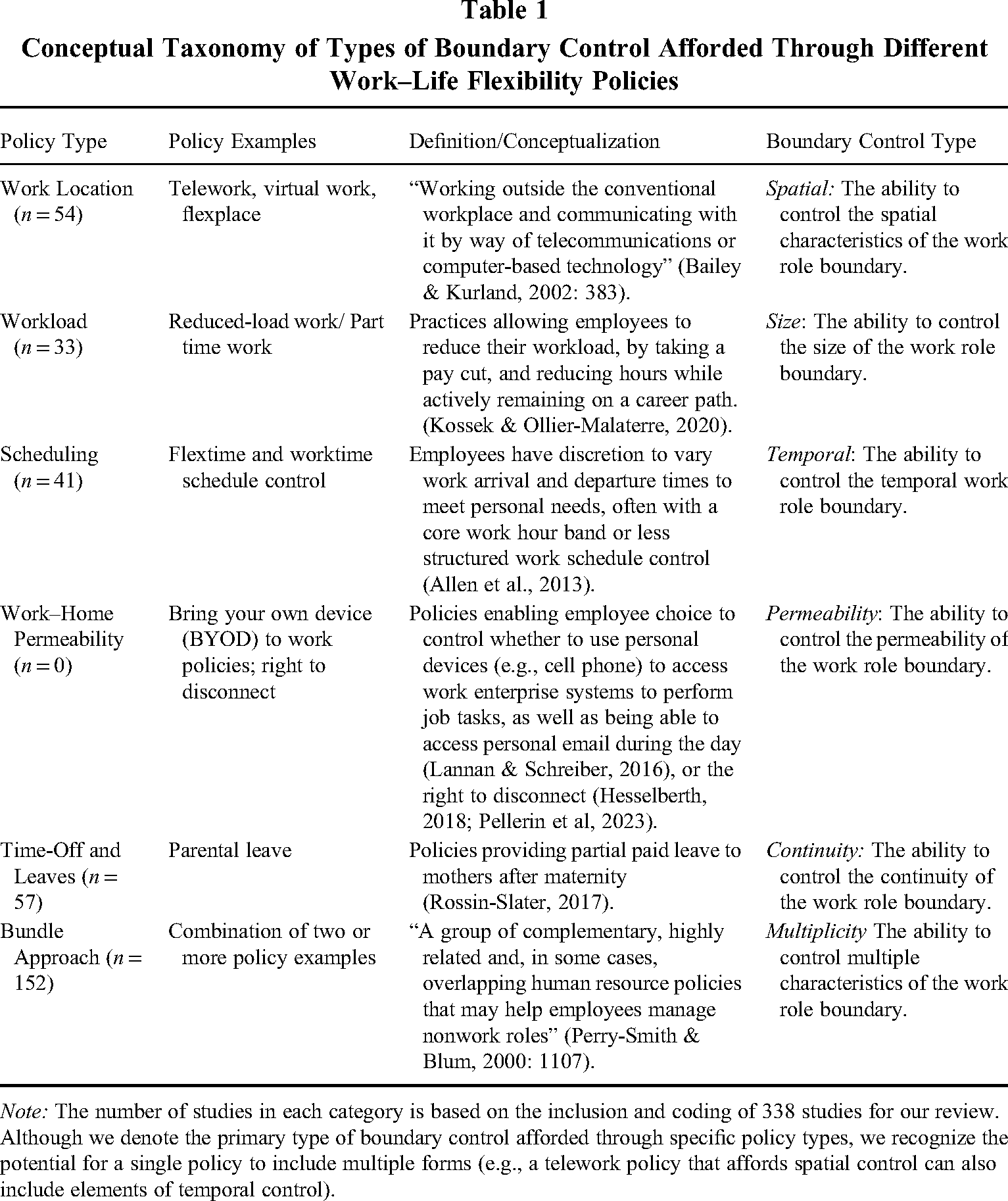
Note: The number of studies in each category is based on the inclusion and coding of 338 studies for our review. Although we denote the primary type of boundary control afforded through specific policy types, we recognize the potential for a single policy to include multiple forms (e.g., a telework policy that affords spatial control can also include elements of temporal control).
Theoretical Background
Boundaries and Job Control: Linkages to Work–Life Flexibility Policies
The importance of providing employees with control as part of their work experiences is a long-standing notion in the management literature, tracing back nearly half a century to job characteristics theory and the concept of autonomy (defined as “the degree to which the job provides substantial freedom, independence, and discretion to the employee in scheduling the work and in determining the procedures to be used in carrying it out”; Hackman & Oldham, 1975: 162). Karasek's (1979: 307) job demands-control theory bolstered this idea, finding that decision latitude—which included “freedom as to how to work”—improved both job satisfaction and well-being. Numerous quasi-experimental studies explored the extent to which introducing flexible scheduling enhanced job-related outcomes including performance, satisfaction, and absenteeism (Orpen, 1981; Pierce & Newstrom, 1983; Ronen, 1981; Schein et al., 1977).
Consistent with the notion of using autonomy to navigate work–life flexibility—and arising from Zerubavel's (1996) work on the cognitive psychological ordering of roles—are Ashforth and colleagues’ (2000) boundary management and Clark's (2000) border theories. These theories help identify the varied ways in which organizations provide employees with the freedom to organize the demarcations of their work and nonwork roles. Although neither control nor formal work–life flexibility policies were pillars of either theory, these theories helped expand understanding that “control” was not only a work-centric source of job enrichment, but also a tool that enabled the management of transitions between work and nonwork roles. Ashforth and colleagues (2000: 488) suggested that organizations must “allow the employee a reasonable degree of autonomy in negotiating role segmentation-integration,” while Clark (2000: 767) suggested that “structural factors like organizational policies about time and work” were a natural expansion for research inquiries. Perlow's (1998: 329) boundary control theory reflected the antithesis of these ideas, suggesting that managers seek to limit subordinates’ control and “affect how employees divide their time between their work and nonwork spheres of life,” believing that these restrictions enhance productivity.
Other boundary management theorists—recognizing that individuals constantly negotiate work and nonwork boundaries (Nippert-Eng, 1996) and use various behavioral tactics to manage these boundaries (Kreiner, Hollensbe, & Sheep, 2009)—note the importance of boundary control, but again do not fully apply this concept to using formal work–life flexibility policies. Only recently did Bourdeau and colleagues (2019: 173) refer to “enabling” work–life flexibility policies as those which “give employees latitude over when, where, and how much they work.” This accumulation of theory spanning nearly 5 decades informs understanding of boundary control—defined as the degree to which individuals can manage work–life boundaries to align with their identities and preferences in an organizational context (Kossek & Lautsch, 2012). Boundary control is an inherent element of work–life flexibility policies where employees have freedom to not only schedule their work and determine how to carry out job tasks (Hackman & Oldham, 1975), but also to determine how they divide their time and energy between their work and nonwork roles (Bourdeau et al., 2019). Thus, despite the strong theoretical link between boundary control and work–life flexibility policies, prior reviews largely neglect this connection. Instead, reviews typically describe the fact that small or mixed effects can vary substantially by the type of flexibility policy (Allen et al., 2013; 2015), employee occupation (Kossek & Lautsch, 2018), or the outcome examined (Byron, 2005; Gajendran & Harrison, 2007; Kossek & Michel, 2011). Other reviews attempt to bridge the macro–micro divide by connecting flexibility policies to individual and organizational performance (De Menezes & Kelliher, 2011; Kelly et al., 2008) or take a multiple stakeholder approach examining both employer and employee views (Hill et al., 2008; Kossek & Thompson, 2016). Each approach has its merits, collectively demonstrating significant between-study variation and suggesting the presence of critical yet still unexplored conditional factors. We suggest that boundary control—including what type of and how much boundary control is afforded through policies (and how it is used)—is a significant omitted variable that can provide further clarity to the existing literature; thus, we use this perspective to organize our review. With this in mind, we now turn to policy implementation.
Implementation of Work–Life Flexibility Policies
Implementation is defined as adapting a program in a manner that keeps the program's main principles intact while aligning it to the context (Herrera-Sánchez, León-Pérez, & León-Rubio, 2017). Yet, evaluating and understanding implementation is “methodologically complex,” since policy use may be selective and elapsed time is required to understand the process and outcomes (Hofferth & Curtin, 2006: 82). Prior reviews point to this complexity. For example, Daniels and colleagues' (2021) review of workplace well-being interventions suggests that implementation is a dynamic, participatory process influenced by both key actors and social systems. In the broader HRM literature, the implementation of high-performance work systems involves alignment between organizational principles, policies, and practices (including flexibility; Posthuma, Campion, Masimova, & Campion, 2013) that affect organizational and individual outcomes (Wright & Boswell, 2002). The conclusion of these reviews is not that positive outcomes are equivalent to successful implementation, but, rather, that successful implementation—reflected through this synchronization of dynamic, contextual elements—results in positive outcomes such as psychological health (Daniels et al., 2021).
Yet, understanding of work–life flexibility policy implementation is more limited by comparison. On the one hand, a predominant view is a simpler one where “supportive supervisors” are considered the policy “gatekeepers” who largely determine whether and to what extent implementation occurs (Crain & Stevens, 2018; Hammer, Kossek, Yragui, Bodner, & Hanson, 2009; Kossek, Perrigino, Russo, & Morandin, 2022; Kossek, Pichler, Bodner, & Hammer, 2011; Straub, 2012). Although valid, this view risks overemphasizing the role of supervisor support in implementation and minimizing the important role of the formal policies themselves. In some countries, formal organizational policies reflect legal codifications of the right to request flexibility (e.g., the United Kingdom; Kossek & Kelliher, 2022). Piszczek and Berg (2014) also argue that scholars need to consider how regulatory institutions, including employment laws or collective bargaining, influence access to control boundaries. Yet, often overlooked are implementation-related factors including co-worker/family support, employee actions, alignment of flexibility with HRM systems like selection and rewards, and the national contexts in which policy availability and use occurs (Ollier-Malaterre & Foucreault, 2017).
On the other hand, the literature recognizes implementation issues—caused in part by these omitted or understudied factors and their potential downstream effects—including unintended consequences from policy use like negative supervisory career and performance attributions (Leslie, Manchester, Park, & Mehng, 2012), flexibility stigma, (Williams, Blair-Loy, & Berdahl, 2013), work intensification (Kelliher & Anderson, 2010), work–life boundary violations (Rothbard, Phillips, & Dumas, 2005), higher work–life conflict (Hammer, Neal, Newsom, Brockwood, & Colton, 2005), and backlash (Perrigino et al., 2018). Given these issues, we agree with the conclusions of Fox and colleagues (2022: 49): the field must do a better job of “identifying change processes that require full examination of the context and implementation.”
It is relevant to note that the growing widespread interest in the management literature on work–life flexibility policies is relatively recent, as these were historically viewed as a “fringe benefit” rather than a core management concern (Kossek et al., 2021). Many leaders did not invest significant time and resources into aligning their corporate cultures and workplace structures with the implementation of work–life flexibility policies (Kotey & Sharma, 2019), leaving them loosely coupled to other HRM performance management systems and largely relegated to the purview of employee benefits experts. The recent global pandemic's shift to more remote work created growing awareness about work–life resilience (and performance) concerns, accelerating employers’ interest (and dramatically changing their narrative) regarding the feasibility of mainstreaming work–life flexibility implementation as a core workforce strategy (Choudhury, 2020). While we can conclude, based on prior research, that policy implementation results in improved well-being (Daniels et al., 2021; Fox et al., 2022), greater understanding is required as to what successful work–life flexibility policy implementation entails and how it affects both employer and employee outcomes.
Search Methodology and Review Overview
We integrated approaches by several leading organizational scholars to conduct our review (Daniels, 2019; Rousseau, Manning, & Denyer, 2008). We started by following the process advocated by Rousseau and colleagues (2008) for the systematic synthesis of scientific knowledge: clear question formulation; comprehensive identification of relevant literature; organization and interpretation; and synthesis. In formulating clear questions, we asked: (1) what types of boundary control are afforded through different policy types? and (2) how is this moderated by implementation?
For comprehensive identification of relevant literature and to assess types of boundary control afforded through various policies, we entered the following terms into the PsycINFO database (widely used in management and industrial organizational psychology) in one search field: “parental leave,” “maternity leave,” “part-time work,” “reduced-load work,” “flextime,” “schedule flexibility,” “schedule control,” “flexplace,” “telecommuting,” “telework,” “flexible work,” “WLB policies,” “work life balance policies,” “WLB practices,” “work life balance practices,” “temporal control,” “boundary control,” “workload control,” and “location control.”
To assess implementation, we entered the following terms in a second search field. First, we entered general terminology, including “human resource management,” “HRM,” “HR,” “human resources,” and “implementation.” Second, in recognition of the connection between work–life flexibility policies and strategic management perspectives (Perry-Smith & Blum, 2000), we entered “strategy,” “strategic management,” “SHRM,” and “resource-based view.” We also entered the terms “practice,” and “high performance work systems” since previous research suggests that work–life flexibility policies constitute examples of high-performance work practices (Combs, Liu, Hall, & Ketchen, 2006). Third, in recognition that institutional pressures influence work–life flexibility policy implementation (Goodstein, 1994), we entered “institutional,” “mimetic,” “normative,” “coercive,” “space,” and “place.” Fourth, in recognition that work–life flexibility policy implementation is used as a form of applicant attraction and recruitment (Casper & Harris, 2008), we entered “attraction,” “recruitment,” “retention,” and “signaling.” Fifth, because implementation of work–life flexibility policies hinges on various factors associated with the strength of the organization's HRM system (Bowen & Ostroff, 2004); we entered the terms “system strength,” “strength,” and “HRM system strength.” All search terms within each field were separated by an “OR” function; the two fields were separated by an “AND” function. We did not set a limit for the publication date of studies.
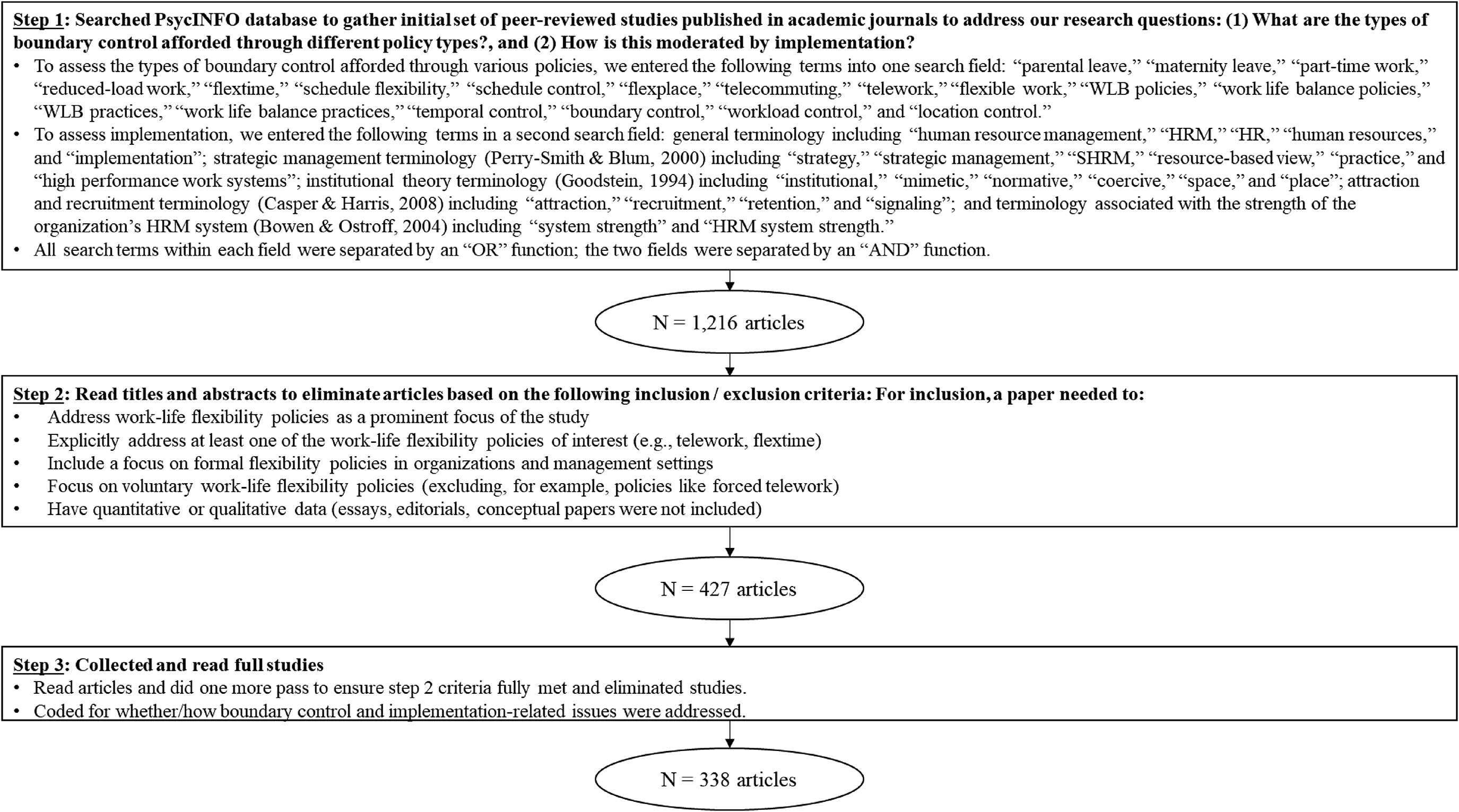
Our search returned 1,216 articles. In identifying studies for inclusion, we initially limited our review to management-focused publications and publications with an Impact Factor at or above 2.0 (consistent with approaches of other previous reviews; e.g., Chen, Mehra, Tasselli, & Borgatti, 2022; Perrigino, Chen, Dunford, & Pratt, 2021). Yet, during the review process, we were encouraged to remove these constraints, which we did in our final analysis presented in this paper to: (1) mitigate the effects of any potential publication-related biases that could influence the interpretation of our findings; and (2) include as wide of a set of articles as possible that met our other, more relevant criteria. To enhance clarity, we were also encouraged to visually depict our review methodology in a PRISMA-based figure (i.e., Preferred Reporting Items for Systematic Reviews and Meta-Analyses; Daniels, 2019; Köbis, Soraperra, & Shalvi, 2021; Page et al., 2021). Figure 1 displays our Protocol and the general 3-step process we followed.
Protocol for Reviewing Studies
Step 1 shows the full list of search terminology that returned the initial set of 1,216 articles. Step 2 shows the final inclusion criteria (after removing the two criteria associated with impact factor and management-focused publications). For example, an article had to examine access to a work–life flexibility policy (since a boundary condition of the review was to focus on formal policies) and had to have data (qualitative or quantitative). Applying these criteria, we narrowed down our list of articles to 427 based on our reading of titles and abstracts. In Step 3, we read through the 427 articles to ensure that they remained in line with these inclusion criteria; this led to the elimination of another 89 studies, and we retained 338 studies for review. To complete the interpretation and synthesis stages of the review (Rousseau et al., 2008), we then coded the 338 articles based on the degree to which they theorized or measured different types of boundary control and implementation. Our results and synthesis are presented below.
Results
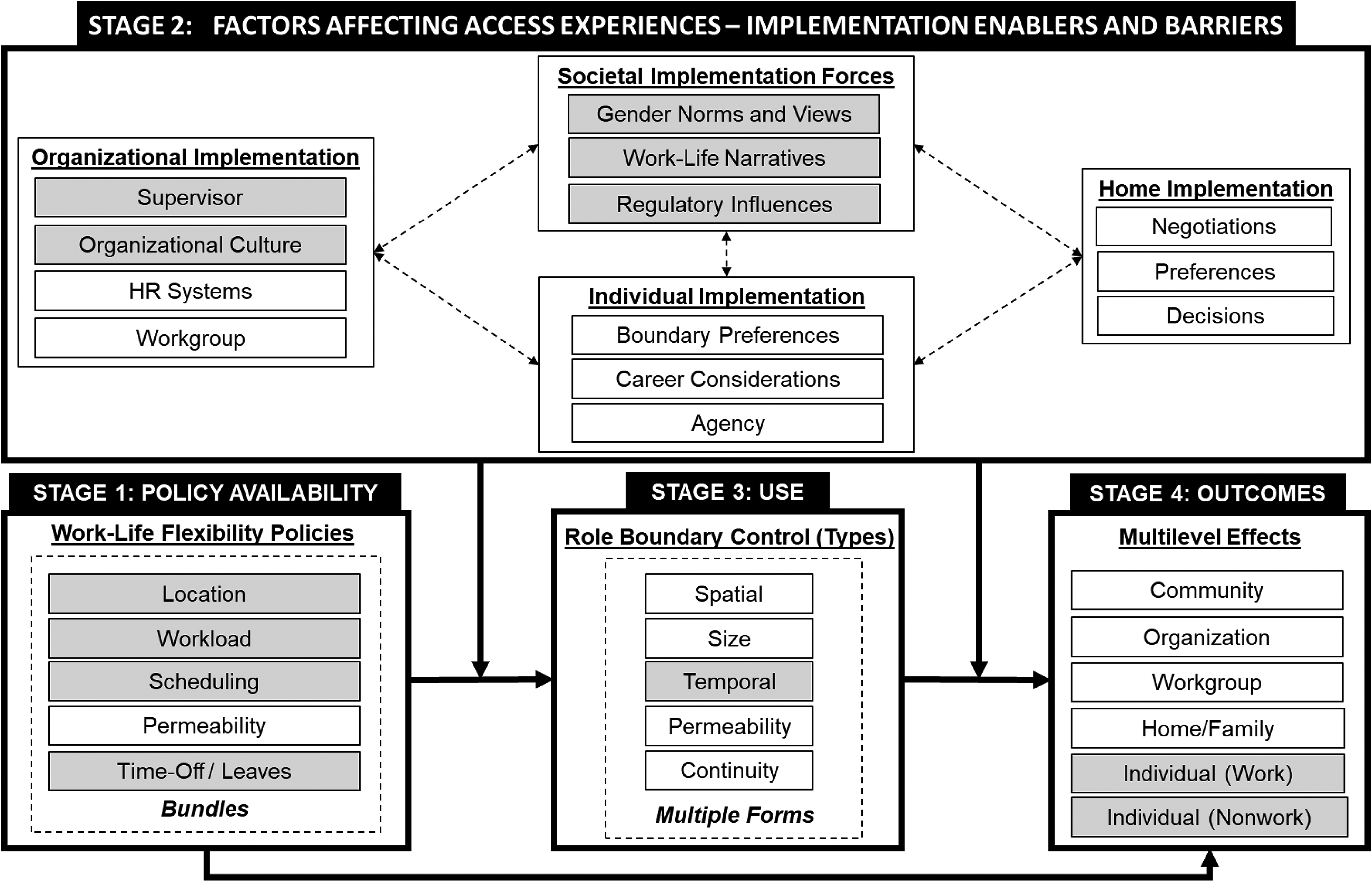
We organize our results around Figure 2, an inductive framework reflecting four stages of work–life flexibility policy implementation generated from the 338 reviewed studies. First, we broadly review all 338 studies in the sample to provide substantiation for the framework in Figure 2. This includes our integrative conceptualization of work–life flexibility policies and boundary control linkages, and general literature trends. Second, we review the shaded portion of Figure 2 —based on quantitative and qualitative findings—where we more accurately pinpoint both well-substantiated areas and gaps.
A Boundary Control and Implementation Perspective on Work–Life Flexibility
Conceptual Support for Framework
Defining work–life flexibility policies. We conceptualize work–life flexibility policies as those which: (1) involve the voluntary employee use of work policies and practices that are designed to provide employee control over different forms of the work role boundary (spatial, size, temporal, permeability, continuity); (2) are embedded within organizational and institutional contexts, with implementation shaped by social influence beyond the individual policy user (coworkers, family members, supervisors); and (3) vary in the extent to which they are used (from zero to partial to full use) and the degree to which they are used separately or bundled for multiplicative effects. The model assumes that positive outcomes will occur when policies are implemented effectively, which happens when: policies are readily available to employees; access experiences are positive and barriers to use are reduced; policies when used are experienced as fostering employee control over work–nonwork boundaries; and negative consequences from use are minimized.
Overview of policies studied
Table 1 provides an overview of the different types of work–life flexibility policies examined, with the statistics in the first column indicating that over half (55%; n = 186) of the 338 studies in our sample examined a single, individual policy. Of these, the most studied policies were leave providing time off (e.g., parental leave) which comprised one-fifth (17%; n = 57) of the types of policies examined in the sample. Location policies (e.g., telework, remote work, and telecommuting) were the next most studied policy type (16%; n = 54). Location policy studies have seen a recent increase in the literature in part due to the Covid-19 pandemic. The remaining studies focused on individual policies as follows: scheduling (e.g., flextime: 12%; n = 42) and workload (e.g., part-time work: 9%; n = 33). Although the importance of control over the permeability of blurred boundaries such as regulating email and texts were often noted in the framing of most telework and remote work studies, we were surprised that there were no studies that empirically assessed policies governing permeability (e.g., right to disconnect; front line worker personal device access).
Turning to the rest of the sample, slightly less than half (45%; n = 152) of the studies examined access or use of multiple types of flexibility policies in the same study. Researchers typically asked employees if they had access to or used (often confounding stages of implementation) a range of flexibility policies from telework to flextime. The extent of use and timing of use often were not carefully measured (e.g., assessed by counts) and the unique effects of using different types of policies, or sequencing them over time (e.g., the effects of being on leave, followed by using part-time work policies) was rarely—if ever—assessed in these studies bundling flexibility policies. Most analysis was cross-sectional and correlated access to or use of a range of policies (e.g., part-time work, leave) with job satisfaction, turnover intentions, or other individual outcomes.
Types of boundary control afforded by work–life flexibility policies
As shown in the right-hand side of Table 1, the literature suggests that work–life flexibility policies afford five types of control over job boundaries: spatial, size, temporal, continuity, and permeability. First, work location policies—like teleworking—afford spatial control regarding where employees conduct their work (Bailey & Kurland, 2002). Second, workload policies—like part-time work (also known as reduced-load work)—afford size control regarding how much of a workload employees take on (Kossek & Ollier-Malaterre, 2020). Third, scheduling policies—like flextime—afford temporal control regarding when employees conduct their work (Allen et al., 2013). Fourth, time-off and leave policies—like parental leave—afford continuity control regarding whether and when employees choose to pause or interrupt their careers (Rossin-Slater, 2017). Fifth, emerging work–life flexibility policies appearing in theory and practice—but not in any empirical study included in our final count—like bring your own device to work and the right to disconnect afford permeability control regarding the degree to which employees have the flexibility to control connectivity.
Notably, flexibility policies that are bundled together combine elements of the five previous categories to afford employees multiple forms of control (which we refer to as multiplicity effects) over their work role boundaries (Perry-Smith & Blum, 2000). For example, a bundle that encompasses reduced-load work and flextime scheduling provides both temporal and size control (Armstrong-Stassen & Schlosser, 2010).
We found a strong conceptual consensus across the 338 studies that the provision of boundary control is a key characteristic embedded within policies. Definitions among these studies include viewing work–life flexibility policies as providing employees with: “more control over work boundaries” (Thompson, Payne, & Taylor, 2015: 727); “more autonomy in determining where, when, and how they conduct work activities” (Reb, Li, & Bagger, 2018: 441); “some control over temporal boundaries” (Rau & Hyland, 2002: 118); “more choices…[to] gain greater control over their personal workplace behavior” (Ng & Feldman, 2015: 894); the ability to “control their work schedules” (Lee & Hong, 2011: 874); “greater autonomy in choosing their hours and locations of work” (Hari, 2017: 102); and “some level of control over when and where they work outside of the standard workday” (Chen, Zhang, Sanders, & Xu, 2018: 1309).
Notably, all definitions focus on control over aspects of work role boundaries while varying in their degree of specificity (e.g., temporal boundary control vs. multiple types of boundary control regarding where, when, and how work is conducted). Moreover, there is broad agreement about the key role boundary control holds when considering specific work–life flexibility policies. Relying on border theory, Lott (2020: 1111) argues that flexible scheduling “provides workers with control over temporal boundaries between work and family domains.” Telecommuting is theorized to enhance spatial control over work-family boundaries (Lautsch, Kossek, & Eaton, 2009), while Casey and Alach (2004: 477) argue that part-time work makes control, or the “ability to pick and choose when and how to work” possible for workers who often otherwise lack autonomy, including lower income working-class and lower middle-class employees. The boundary control afforded through work–life flexibility policies is commonly theorized to lead to positive outcomes. Gajendran, Harrison, and Delaney-Klinger (2015) not only suggest that “telecommuting affords employees greater control over the location and often, the timing, of work” but also that this generates positive effects on both task and contextual performance via perceived autonomy.
Implementation stages
A second main view emerging across the 338 studies is that positive outcomes hinge on policy implementation (e.g., Ellingsæter & Jensen, 2019; Hook, 2010; Murgia & Poggio, 2013). Fiksenbaum (2014: 656) maintains that “flexible work arrangements…give employees some level of control over when and where they work” and that this control in turn engenders positive outcomes when policies are implemented well. Relatedly, there is strong consensus that: (1) the mere presence of work–life flexibility policies “‘on the books’ does not in itself have a measurable positive impact on the well-being of parent employees” (Galinsky, Bond, & Friedman, 1996: 129; see also Goodstein, 1994), and (2) supervisors “play a critical role in work–family programs and policies and in how they are implemented and utilized” (Carlson, Ferguson, Kacmar, Grzywacz, & Whitten, 2011: 775). As noted, the critical role of the supervisor in implementation continues to be predominant in both the work–life literature (Kelly & Kalev, 2006; Koch & Binnewies, 2015) and the broader HRM literature (Sikora, Ferris, & Van Iddekinge, 2015).
As shown in Figure 2, our review identifies four stages of work–life flexibility policy implementation. Stage 1: Availability is a necessary (but not sufficient) requirement for advancing implementation: different types of work–life flexibility policies (left-hand side of Table 1) must be introduced or already available within an organizational context for implementation to evolve toward use. Organizations make various forms of work–life flexibility policies available to workers across occupations, either voluntarily (Peters & Heusinkveld, 2010) or through adherence to coercive regulatory pressures where policy availability is mandatory (Piszczek & Berg, 2014). Stage 2: Access Experiences addresses the extent and quality of individual access to available work–life flexibility policies. As we explain below, this is shaped not only by supervisors as policy gatekeepers, but also by a variety of interconnected, multilevel, dynamic factors that serve as enablers or barriers that exist in tandem for implementation to occur as intended. These include societal implementation forces, and organizational, individual, and home implementation. Stage 3: Use indicates that policies must be available with access enabled and that employees—when voluntarily using the policy—experience different forms and/or degrees of boundary control (right-hand side of Table 1). Important here is that use occurs in a variety of ways (e.g., bundled, intermittent, etc.) rather than through a simple use/non-use dichotomization. Finally, Stage 4: Outcomes accounts for how work–life flexibility policies yield both positive and negative outcomes spanning domains and levels of analysis.
Work–life policies availability as symbolic support
We recognize the flexibility literature stream that indicates the beneficial signaling effects associated with sheer policy availability (e.g., Bainbridge & Townsend, 2020; Casper & Harris, 2008; Thompson et al., 2015). This research finds that policy availability (Stage 1) affords psychological benefits to workers through its symbolic meaning—without necessarily implementation (Stage 2: Access) or use of boundary control (Stage 3: Use)—and enhances individuals’ work-related attitudes and perceptions that the organization is supportive of work–life flexibility (Stage 4; see also Allen et al., 2013). In fact, one “surprising benefit” of the availability of flextime and parental leave policies is their ability to boost diversity among women and minorities in positions of management (Kalev & Dobbin, 2022). We include a direct link between Stages 1 and 4 (Figure 2) to reflect this evidence.
Yet, the findings and conceptualizations from the 338 studies allows us to integrate Stages 2 and 3 as more central features, substantiating assertions that work–life flexibility policies “and the flexibility they afford, presumably provide employees with the control or discretion to determine the optimal allocation” (Erden Bayazit & Bayazit, 2019: 406), while unfavorable outcomes associated with these policies “may lie in the implementation…which sometimes undermines the most important benefit of [work–life flexibility policies] i.e., enhanced flexibility and autonomy” (Delanoeije & Verbruggen, 2020: 795). Indeed, the value proposition underlying the business case for work–life flexibility policies is maximized when implementation is enabled and boundary control is used (Beauregard & Henry, 2009); yet, the absence of this nuanced consideration may account for the mixed findings across previous reviews (e.g., Allen et al., 2013; De Menezes & Kelliher, 2011). Below, we focus on the empirical evidence from the 338 studies to further explore the criticality of Stages 2 and 3 and the need to better understand the conditions under which positive outcomes are likely to occur when access enablers are present (or the reverse dynamics associated with barriers) and boundary control is experienced.
Empirical Findings for Framework: An 80–20 Gap Between Theory and Measurement
Because of the prevalence in theorizing and discussing the importance of control and implementation in the flexibility literature, we coded studies to assess measurement of these concepts. While the arguments theorizing boundary control and implementation across the 338 reviewed studies substantiate the full framework, the shaded areas of Figure 2 reflect what is most studied and supported in the literature; the unshaded areas remain understudied to date.
Only one fifth (20%; n = 68) of the 338 studies measured some form of boundary control, with the remaining four-fifths (80%; n = 270) of the studies—despite featuring control as a central conceptual element in the framing of their work and definition of work-life flexibility policies—failing to do so. Among the 68 studies measuring boundary control, 28 or slightly less than half (48%), focused on policy bundles and 23, about a third (34%), focused on the temporal control associated with scheduling policies. Reflected in the unshaded areas in Figure 2, only 13% (n = 9) of the studies examining control considered the spatial control associated with location policies; 7% (n = 5) considered size control associated with workload, and 4% (n = 3) considered continuity control associated with time-off and leave policies, and no studies considered permeability control. We discuss these findings in greater detail below.
Boundary Control
As noted, one fifth or (20%, n = 68) of the 338 studies measured boundary control and related concepts in relation to flexibility access or use. Investigations—primarily those involving bundled policies (41%; n = 28 of 68 studies)—often used a general lens, focusing on autonomy (Bathini & Kandathil, 2019; Beugelsdijk, 2008; Cañibano, 2019; Gajendran et al., 2015; Grotto & Lyness, 2010; Müller & Niessen, 2019; Pierce & Newstrom, 1983; ten Brummelhuis, Haar, & van der Lippe, 2010; Whyman & Petrescu, 2014), decision latitude (Kauffeld, Jonas, & Frey, 2004), and psychological empowerment (Kim, Lee, & Jang, 2017; Redman, Snape, & Ashurst, 2009). In most cases, the link between work–life flexibility policies and control resulted in a pattern of positive outcomes associated with improved work attitudes and productivity (Meer & Ringdal, 2009).
Regarding the specific types of boundary control most studied, 23 of the 68 studies (34%) linked temporal control to primarily positive effects on individual work outcomes (reduced turnover and absenteeism, increased engagement, performance, and career outcomes) and personal well-being outcomes (health, work–life balance, enrichment, and reduced work–family conflict; Atkinson & Hall, 2009; Azar, Khan, & Van Eerde, 2018; Butler, Grzywacz, Ettner, & Liu, 2009; Carlson et al., 2011; Crompton & Lyonette, 2011; Glavin & Schieman, 2012; Golden, Veiga, & Simsek, 2006; Kelly, Moen, & Tranby, 2011; Moen, Kelly, & Lam, 2013; Pierce & Newstrom, 1983; Swanberg, McKechnie, Ojha, & James, 2011). Hughes and Galinsky (1994) found that schedule control had a positive impact on marital interaction quality and reduced marital tension (for individuals with young children), while two qualitative studies indicated positive effects of temporal control on parenting and fulfillment of domestic responsibilities (Sullivan & Smithson, 2007; Tietze & Nadin, 2011). Studies operationalized temporal control in various ways, with quantitative studies utilizing perceptual measures (e.g., perceived control over work hours; Swanberg et al., 2011) and qualitative studies reporting on displaying boundary control behaviors. Examples of the latter include a mother reporting how she restructured work hours during the day around her children’s schedules, then worked at night to catch up on work while they watched television (Sullivan & Smithson, 2007); or a comptroller choosing to work on a contractual basis with several small firms in order to limit work to only 3 to 4 days a week (Litrico, Lee, & Kossek, 2011).
Despite these exemplar studies, the multiplicity effects of bundling policies remain underexamined, with rare exceptions in two of the few longitudinal studies that examined how reduced load work (size control) led to reductions in overwork when schedule control (temporal control) was also present (Litrico et al., 2011; Piasna, 2018). Moreover, at times multiplicity effects may have been obscured by a single label and broad conceptualization, as in the case of Kelly and colleagues’ (2014: 487) consideration of schedule control as “employees’ control over the timing of their work, the number of hours they work, and the location of their work.” Rather than simply capturing temporal control (i.e., the timing of the work), they appeared to capture a multiplicity effect that also included spatial control (i.e., location) and size control (i.e., the number of work hours), without explicitly examining separate effects or relationships across these distinct types of control. While most of the 68 studies (but not all) point to positive effects linking Stages 1 (availability) and 4 (outcomes), more work addressing the effects of multiplicity and specific types of boundary control is needed to advance knowledge of Stage 3 (use).
Implementation
Similar to the gap in measuring boundary control, we identified a 70–30 gap between theory and empirical measurement of implementation access experiences. Most (70%) or 238 of the 338 studies at best alluded to the importance of work–life flexibility policy implementation—often generally in their discussion section. Turning to the one third that empirically measured implementation, most (nearly two thirds, or n = 61) examined the access experience factors in Figure 2 as a central focus. Of this subset, 20 studies considered access experiences associated with bundles (33%) and time-off/leave policies (33%), while another 13 studies (21%) considered implementation associated with location policies. Seven studies or 11% of studies assessing implementation empirically, considered access experiences with workload policies, while one study considered access experiences with scheduling policies.
The remaining studies (n = 19) either rigorously evaluated outcomes of a work–life flexibility implementation, often using quasi-experimental designs, or did not measure implementation but considered successful outcomes as proxies for implementation success, conflating Stages 1 to 4 (n = 20 studies).
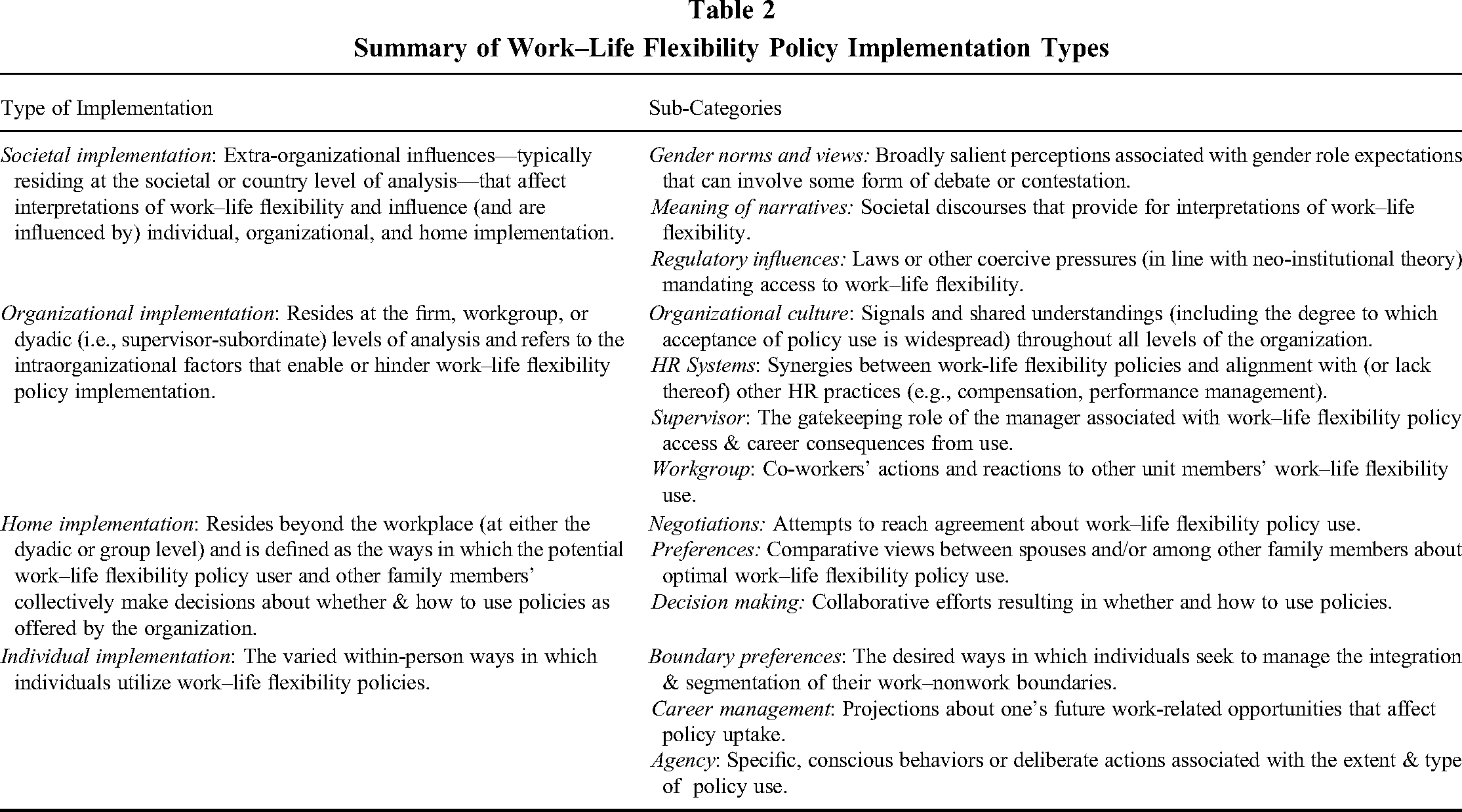
Within the 61 studies that placed a central focus on implementation, we identified four categories of factors affecting access experiences: societal forces, organizational, home, and individual (defined with their sub-dimensions in Table 2). Reflected in the shaded regions of Figure 2, societal forces were a common focus (33 of 61 studies with empirical data; 54%) as were organizational implementation involving the supervisor (24 of 61 studies; 39%) and a supportive culture (19 of 61 studies; 31%). Less examined, and reflected in the unshaded regions, were home implementation (20%, n = 12 studies), individual implementation (18%, n = 11 studies), organizational implementation associated with the workgroup (13%, n = eight studies), and alignment with HR systems (7%, n = four studies). Highlighting the interconnectedness across the four implementation categories and illustrated in Figure 2, 30 or about half of the 61 studies simultaneously considered more than one category.
Summary of Work–Life Flexibility Policy Implementation Types
Societal implementation forces
Societal implementation pertains to the macro extra-organizational level—related to national culture or country level of analysis, for example—that affects interpretations of work–life flexibility and influences (and is influenced by) individual, organizational, and home implementation. Over half (33 of the 61 studies) assessing implementation empirically addressed macro-level forces. These consisted of gender norms and views, work–life flexibility narratives, and regulatory influences. Gender norms and views are defined as broadly salient perceptions associated with gender role expectations that typically involve some form of debate or contestation (rather than broad acceptance) about the roles of each gender in society. Examples include how cultural configurations of motherhood (Masood & Nisar, 2020) and fatherhood (Plantin, 2007), the presence of hegemonic masculinity (Almqvist, 2008), and the male breadwinning model (Suwada, 2017) influence the uptake of parental leave, typically rendering maternity leave as acceptable while discouraging paternity leave. Gender socialization involving expectations about traditional role norms (Chandra, 2012), notions of the “ideal worker” (Ewald & Hogg, 2022), masculinist and heterosexist biases (Hari, 2017), and the patriarchal labor model (Gálvez, Tirado, & Alcaráz, 2018) typically discouraged the uptake of other work–life flexibility policies—for both men and women alike—including teleworking.
Another societal implementation force pertained to prevailing work–life flexibility narratives—that is, various discourses that provide for interpretations of work–life flexibility policies. Often times integrating or overlapping with the gender views and norms, some narratives surrounding work–family backlash and career penalties discouraged the use of work–life flexibility policies including part-time work and telework (Hylmö & Buzzanell, 2002; Kossek, Ollier-Malaterre, Lee, Pichler, & Hall, 2016). In other cases, narratives around the construal of “space” that focused on how nonwork spaces were becoming increasingly acceptable and adaptable for work-related purposes (even prior to the pandemic) fostered the implementation of telework (Richardson & McKenna, 2014; Rossitto & Lampinen, 2018; Sewell & Taskin, 2015). This also illustrates the recursive nature of the relationship between the top-down effects of macro forces and the bottom-up effects of individual, organizational, and home interpretations reflected in Figure 2.
These narratives closely align with regulatory influences—that is, laws or other coercive pressures (in line with neo-institutional theory; DiMaggio & Powell, 1983) that mandate organizational adoption of forms of work–life flexibility. Among the reviewed studies, this was most notable in terms of parental leave policies adopted at the country level and, in particular, paternity leave and fathers’ quota leave policies in Scandinavian countries (Lammi-Taskula, 2008; Närvi & Salmi, 2019; Pajumets, 2010; Plantin, 2007). Highlighting the interconnectedness of societal forces with organizational implementation and Stage 1 of Figure 2, these regulatory influences account for policy adoption at the organizational level (e.g., Giannikis & Mihail, 2011; Kelly, 2010; Paxson, 1995). Despite the lack of empirical research, these same regulatory influences—including the right to request flexibility—also apply to the other types of work–life flexibility policies beyond just parental leave (Kossek & Kelliher, 2022).
Organizational implementation
Organizational implementation—addressed in 39 out of the 61 studies examining implementation—resides at the firm, workgroup, or dyadic (i.e., supervisor–subordinate) levels of analysis and refers to the intraorganizational factors that enable or hinder work–life flexibility policy implementation. Specifically, this form of implementation consists of the supervisor (n = 24), organizational culture (n = 19), the workgroup (n = 8), and HR systems (n = 4). The supervisor—that is, the gatekeeping role of the manager associated with work–life flexibility policy access—is also by far the most studied actor in flexibility implementation (e.g., Crain & Stevens, 2018; Kossek et al., 2022). Although studies collectively note the gatekeeping role that supervisors play in providing access to work–life flexibility policies (Collins, Cartwright, & Hislop, 2013; Kossek et al., 2016; Williams, Cathcart, & McDonald, 2018), much of the research reveals the complexities of supervision in workplaces with a blend of flexible and traditional work. While supervisors are sometimes identified as unsupportive of work–life flexibility policy implementation and unwilling to give up control (Anderson, Coffey, & Byerly, 2002; Galea, Powell, Loosemore, & Chappell, 2020; McDonald, Pini, & Bradley, 2007), or as the source of “uneven implementation” (Kossek, Lautsch, & Eaton, 2006), other studies point to managers themselves as being constrained by organizational demands such as the expectation to coordinate sufficient onsite presence for health and safety (Dick, 2004) or being limited by staffing constraints (Kossek, Rosokha, & Leana, 2020).
Likewise, the potential benefits of the organizational culture—that is, signals and shared understandings (including the degree to which acceptance of policy use is widespread) throughout all levels of the organization—are well understood (Brandth & Kvande, 2019; Casper & Harris, 2008; Choi, 2018; Erden Bayazit & Bayazit, 2019; Giannikis & Mihail, 2011; Todd & Binns, 2013). Indeed, “even the most family-friendly workplace policies are at best useless, or worse, counter-productive, if the work climate does not support them” (Grover & Crooker, 1995: 285), with effective implementation requiring “broad acceptance among fellow employees” (Kröll, Nüesch, & Foege, 2018: 549). Yet, the complexities of implementation involve not only acceptance but also sometimes “a whole new way of looking at things” (Coenen & Kok, 2014: 568) when efforts begin and senior management acts as “the one force that can abolish existing structural inertia and direct organizational resources toward an implementation effort.”
Two other implementation factors are comparatively understudied. First, the ways in which work–life flexibility policies are embedded within HR systems—that is, synergies between and alignment with (or lack thereof) other HR practices (e.g., compensation, performance management)—is a critical consideration. While the implementation of work–life flexibility policies must occur in tandem with implementing a wider variety of resource-related strategies including staffing tailored to their workforce's needs that ultimately maximizes organizational success (Michie & Sheehan-Quinn, 2001; Stavrou, 2005), consideration of work–life flexibility as part of a high-performance work system has received more theoretical than empirical examination. Consistent with strategic HRM theory (Becker & Huselid, 1998), work–life flexibility policies that are integrated with the broader competitive strategy and practices of the firm will be more effective. Yet, the poor execution of performance evaluation systems that are perceived as negative or unfair can increase employees’ perceptions of stress and negate any positive effects that work–life flexibility policies may offer (Topcic, Baum, & Kabst, 2016). Effective implementation “requires that workplace structures and cultures are changed to fit the policies,” but few organizations put in this full effort due to constraints associated with resources and time (Kotey & Sharma, 2019: 734). One participant in Harris’s (2003: 427) study lamented that the implementation of a telework policy came without sufficient preparation: it was “like the last day at school, we were handed a satchel with an information pack and then packed off home to get on with it.” Connecting back to the role of the supervisor, Lirio, Lee, Williams, Haugen, and Kossek (2008: 458) note: “even a supportive and forward-thinking manager cannot control the career progress of a talented reduced-load professional if…work-life policies are not integrated into the reward systems, performance evaluation systems, and procedures for career advancement.”
Second, the workgroup—that is, co-workers’ actions and reactions to other unit members’ work–life flexibility use—remains generally understudied in much of the flexibility implementation literature. Nonetheless, workgroup members play a vital role in implementation. Reflecting perspectives of work–family backlash, uneven implementation across workgroup members can create perceptions of inequity—as in the case of when part-time workers are assigned shifts involving nights and unsocial hours (Dick, 2004), or when positions are not appropriately backfilled for parental leave, forcing the remaining workgroup members to work “ten times harder” (Cant, O’Loughlin, & Legge, 2001: 44). Connecting again to the roles of the supervisor and organizational culture, this point underscores that supervisors’ implementation-related actions do not occur in a dyadic vacuum but affect other members of the team or unit: effective implementation will not occur in the absence of supportive coworker attitudes (Galinsky et al., 1996; Martens, Nijhuis, Van Boxtel, & Knottnerus, 1999; McDonald et al., 2007), particularly in situations where there is stronger interdependence among team members (Gerdenitsch, Scheel, Andorfer, & Korunka, 2016; Pedersen & Lewis, 2012). Indeed, successful implementation of teleworking policies should not only encompass increased cross-functional cooperation, knowledge sharing, and intraorganizational involvement but should also coincide with a culture change when needed (Coenen & Kok, 2014; Nordbäck, Myers, & McPhee, 2017). Finally, the effects on collegiality are another relevant consideration. In some cases, teleworkers reported concerns about non-teleworking colleagues’ perceptions of their work commitment, as well as unwelcome “rigidity” in interactions that could no longer be spontaneous and unplanned (Sewell & Taskin, 2015: 1517; ten Brummelhuis et al., 2010). Yet, in other cases, strong collegiality—as well as the presence of positive workgroup norms—facilitates implementation where employees willingly cover for other individuals to tend to personal needs using work–life flexibility policies (Dousin, Collins, Bartram, & Stanton, 2021; Haas, Allard, & Hwang, 2002).
Home implementation
Only 12 studies (eight—or two-thirds—of which involved parental leave policies) focused on home implementation, which resides beyond the workplace (at either the dyadic or group level) and is defined as the ways in which the employee and other family members’ collectively make decisions about whether and how to use organizational policies. Albeit based on a small number of studies and typically only focusing on spouses’ dyadic interactions, home implementation involves the dynamic interplay of negotiations, decision making, and preferences. The combination of negotiations—that is, attempts to reach agreement about work–life flexibility policy use (Almqvist, 2008; Lammi-Taskula, 2008; McKay & Doucet, 2010)—and the reconciliation of divergent preferences—that is, comparative views between spouses and/or among other family members about optimal work–life flexibility policy use (Delanoeije & Verbruggen, 2019; Närvi, 2012)—appear to result in shared decision making, or collaborative efforts resulting in a definitive choice about policy use (Lundquist, Misra, & O’Meara, 2012; Pajumets, 2010; Plantin, 2007). Notably, seven of these studies focusing on parental leave concurrently examined how gender norms and views shaped preferences and negotiations about parenthood and the division of household labor. Tietze and Musson (2005) combined societal forces and home implementation with a focus on teleworking by examining how the space narrative alters family dynamics for individuals working from home. Richardson and McKenna (2014: 733) report that such attempts at reordering the home space and interruptions can be difficult, leading to “family members feeling left out or ignored,” or conversely, where successful, to better work productivity, balance, and marriage strength.
Individual implementation
Like home implementation, individual implementation was rarely featured in the reviewed studies (11 of 61 studies). Yet, Delanoeije and Verbruggen (2019: 12) admonish that the role of the individual must not be lost among these top-down influences, stressing the need for an “employee-centered approach…to evaluate the success of a work-home policy implementation.” In line with social constructivism, implementation and use of control are best understood from the individual's perspective and evolve based on prior experiences in combination with the other forms of implementation (Cañibano, 2019; Kelliher & Anderson, 2010). We define individual implementation as the varied within-person ways in which individuals assess and enact individual decision-making regarding the use of work–life flexibility policies. We recognize that individual implementation is a nested phenomenon occurring in a context, shaped by societal forces, organizational implementation, and home implementation. Individual implementation consists of boundary preferences, career considerations, and agency.
Boundary preferences—that is, the desired ways in which individuals seek to manage their work–nonwork boundaries—influence the enactment of boundary control (Kossek et al., 2006). This includes, for example, how individual characteristics—including a high need for autonomy or low need for structure—encourage individual use of policies offering spatial and temporal flexibility (Wörtler, Van Yperen, & Barelds, 2021). Individual implementation is also affected by career considerations—that is, projections about one's future work-related opportunities that affect policy uptake—as use decisions are weighed regarding the potential for lost future opportunities associated with promotion and pay (Horvath, Grether, & Wiese, 2018) due to backlash perceptions. Although both areas are well-studied in the broader work–life literature, there was surprisingly little connection to policy implementation and decisions associated with policy use.
Perhaps because behaviors are central to implementation, the majority of the 11 studies examining individual implementation emphasized employees’ agency—that is, specific, conscious behaviors or deliberate actions associated with policy use (e.g., Björk, 2013; Gálvez et al., 2018; Rossitto & Lampinen, 2018). Greer and Payne (2014) identified a dozen different strategies individuals use to overcome telework challenges, including preparing the physical environment, communicating with family about expectations (linking to home implementation), and remaining accessible for coworkers (linking to workgroup implementation). Similarly, Kossek and Lee (2008) identified the importance of communication, coordination, and problem solving for successful individual implementation associated with part-time work. Individuals also consciously choose—sometimes through discussions with their supervisors and other times on their own—whether to alter the length of their parental leave (Nordberg, 2019). Across these examples, it is important to note that agency is exercised within the context of individuals choosing to use formal work–life flexibility policies (rather than the negotiation of an idiosyncratic deal or some other informal arrangement where the formal policy is absent). Yet, with only 11 studies in this category, this remains an underinvestigated area. We elaborate on opportunities to address such gaps with our research agenda below, reflecting on the critical takeaways from our review.
Future Agenda for Advancing the Work–Life Flexibility Field: Focus on Policies, Control, and Implementation
Drawing on over 4 decades of research, we conducted a comprehensive review of the work–life flexibility policy literature organizing studies around an integrative boundary control and implementation perspective and deriving a 4-stage model of work–life flexibility policy implementation (policy availability, access experiences, use, and outcomes). Our review-driven and theoretically-grounded framework (Figure 2) synthesized this research. In doing so, we developed a taxonomy of boundary control (temporal, spatial, size, continuity, permeability; Table 1) afforded in the design of work–life flexibility policies, and identified four types of implementation influences (societal, organizational, home, individual; Table 2). Our review exposed that many studies do not empirically assess several core prevailing assumptions in the literature, including: (1) the conditions under which using formal work–life flexibility policies leads to greater control over the work boundary; (2) greater boundary control as the mechanism that benefits key work (e.g., attraction, performance, turnover) and nonwork (e.g., work–family conflict, well-being) outcomes; and (3) the dynamic, interconnected, multilevel work–home conditions for successful implementation. We elaborate on these issues below.
State of the Science Summary: What We Currently Know and Do Not Know About Work–Life Flexibility
Our review reveals several conclusions about the current literature.
Ambiguity in conceptualization and understanding
A key issue that our review shows is that both the research and popular work–life flexibility literatures have a lot of ambiguity about what “work–life flexibility” is conceptually, and lacks consensus about how to study it empirically and methodologically. Disparate conceptualization and measurement approaches limit the development of accumulative knowledge in the field. It also perpetuates a lack of alignment between workers and firms, families and society—including shared understandings about what work–life flexibility is (and is not). Future studies must identify how to align these gaps in stakeholder interests and experiences in conceptualization and measurement.
The flexibility “black box” of implementation
A second key observation is that the flexibility research is generally plagued by having a “black box” of implementation knowledge (e.g., Lawrence, 1997), which limits practical impact as well as conceptual understanding. We noted that a stream of studies simply linked policy access to outcomes, which may be justified based on a symbolic psychological social exchange relationship. However, this approach obscures understanding of implementation effectiveness, creating a “black box” surrounding the dynamics of availability, access experiences, use, and consequences. While such evidence supports the broad assumption that work–life flexibility policies benefit workers and the firm, the ways in which different types of flexibility policies, forms of boundary control, and implementation enablers and barriers affect access experiences occur in tandem (or not), lack clarity. Without insight into the mechanisms of effective implementation, the full potential of work–life flexibility programs is likely to remain unrealized: the conditions underlying positive effects will be neither fully understood nor maximized. In essence, even if studies document the positive effects of flexibility availability, access experiences, or use, without stronger implementation research, researchers will not fully know why these positive effects occur or how to replicate effective policy implementation.
Prevailing theory–empirical gap
Third, we found evidence of a wide gap between theory and measurement of boundary control and implementation effectiveness in the literature. While all the reviewed studies theorized the importance of flexibility as giving workers some boundary control over their job conditions, only 20% empirically assessed experiences of control over the work boundary. Yet, in studies where control was measured, the patterns of outcomes (when control was higher) tended to trend much more positively compared to both the findings from the studies in our overall sample and the mixed findings documented in previous reviews. Similarly, while all the reviewed studies acknowledged the importance of effective implementation, only about 30% defined and empirically assessed at least one form of implementation. Another telling finding was that roughly half of these studies simultaneously considered multiple aspects of implementation, demonstrating the interconnectedness of implementation across society, work, home, and the individual.
Wide unevenness in what work–life flexibility scholars choose to study
Fourth, consistent with previous reviews (e.g., Fox et al., 2022), our review adds further support for the positive relationship between work–life flexibility policy use and improved well-being on and off the job. Yet our findings revealed tremendous unevenness in what aspects of work–life flexibility policies were studied in the literature, ultimately obscuring understanding of when and how positive results occur for which types of policies. Focusing on the shaded boxes in Figure 2, our results show that research addresses the availability of most types of work–life flexibility policies (Stage 1); does well to substantiate the implementation implications associated with perceived supervisor support for flexibility and a supportive organizational culture (Stage 2); has most studied the effects of temporal control over other forms (Stage 3); and theoretically (and sometimes empirically as well) suggests positive linkages between boundary control to individual work and nonwork outcomes (Stage 4). Yet, despite ample conceptual evidence, there remains limited empirical examination of many other areas of the framework, such as the emergence of permeability policies (Stage 1), home and individual access implementation experiences (Stage 2), in-depth examination of how use is enacted with other forms of boundary control and multiplicity effects (Stage 3), and outcomes involving the workgroup, organization, and family members (Stage 4). Thus, considerable gaps remain.
In sum, our review redirects the field to focus on (1) formal work–life flexibility policies, (2) types of boundary control, and (3) the interconnected dynamics of different forms of implementation (e.g., societal, organization, home, and individual) across these linked realms.
What the field gains by focusing on work–life flexibility policies, boundary control, and implementation
Our insights for future research below are organized along these three themes: policies, boundary control, and implementation. We discuss our rationale for focusing on each, including what the literature can gain from this focus and a research agenda.
Why focus on work-life flexibility policies?
By focusing on recognized policies—which can more easily be measured empirically than informal arrangements—researchers can more transparently compare work–life flexibility access and use across societies, replicate studies, design interventions, and advance the science underlying best practices. Policy measurement will enable the evidence-based assessment of the availability, access experiences, and use of work–life flexibility within and across industries and societies, providing needed information and guidance for policymakers to pass regulations and legislation. This can, for example, enhance the accuracy of data captured in reports on government laws, union contracts, company and non-governmental organizations’ [(e.g., International Labor Organization (ILO), Office of Economic and Country Development (OECD, United Nations (UN)] annual reports, and social responsibility indices (Ollier-Malaterre & Foucreault, 2017). Such policy-capturing data is critical for reducing work–life inequality and may enhance societal interest in policies in a way that creates or establishes a set of minimum occupational health protections in terms of formal availability and access opportunities for all workers, regardless of one's current level of supervisor or organizational support (Kossek & Kelliher, 2022). Instead of organizations viewing flexibility as a public relations tool when facing a tight labor market (to try and lure workers back to the workplace after the recent “great resignation,” Klotz, 2022), but where they retain full discretion to withdraw or limit use at will, a policy approach can shift organizational and broader societal thinking to view flexibility and access opportunities as a fundamental right of workers that must be upheld and protected.
A formal policy focus is also important given that policy implications are sorely underdeveloped in management research (Eby & Facteau, 2022), which is holding back understanding of how to create and sustain healthy workplaces that can jointly advance productivity and well-being. Focusing on disentangling the relationships between availability, access experiences, use, and outcomes, will not only enhance clearer measurement of cultural support for implementing policies (rather than blurring constructs), but can also capture real time changes in how flexibility policies evolve and are enacted. For example, it is possible that the use and access of hybrid work—a growing new policy form—may harm workers if individuals are not allowed to control the days during which they need flexibility. Without this empowerment, working caregivers who use spatial control more heavily than employees who do not have to juggle caregiving with work (Kossek et al., 2021; Kossek, Perrigino, & Gounden-Rock, 2021) may experience adverse impact such as lower pay and greater risk for job loss.
Future research on policies: Addressing bundles, improving measurement, and considering permeability policies
Unfortunately, measures of policies are still very rudimentary and often at a binary level. More refined measures that move beyond dichotomous yes/no measures of policy availability or counts of the number of policies accessed are required to assess bundles of policy use. This includes identifying what creates or inhibits the synergies associated with “good” and “bad” bundles, respectively. Consider, for example, part-time work with limited permeability control. If permeability control is afforded in tandem with size control, the use of part-time work may also foster greater schedule control. Turning to the need for measurement innovation, the field should consider moving beyond self-report data and determining how to access archival measures in partnership with IT researchers and HR analytics. For example, non-same source measures could be used with interdisciplinary teams involving HR data or software that tracks connectivity-related metrics like work and nonwork teleconference and email use, time of use, while teleworking, linking these metrics to work schedules and identifying how work gets dispersed into evenings and weekends (i.e., during personal and family time).
Future studies also need to conduct multi-level assessments of policy availability at the societal (e.g., legal) and firm levels in ways that not only carefully differentiate availability, and access experiences and use within each level, but also recognize and account for the ways in which access is experienced differently at the individual and workgroup levels and accumulative experiences over time. Attention to levels of analysis is important and—despite the inherent interconnectedness and dynamic interactions across levels—future investigations can be more deliberate in considering the top-down nested effects of how organization and workgroup levels affect individual experiences at both work and home. Given these dynamics, future studies should also account for the temporal aspects of use when teasing apart these differences (e.g., use for a day vs. use over the course of a week or—more long-term—over the course of a career), and the downstream career effects of early decisions to heavily use flexibility policies.
Although location, workload, scheduling, and time-off/leave policies receive scholarly attention, more work is required in particular to address permeability policies. On the one hand, it is possible that few organizations are offering policies like bring-your-own device (BYOD) to work or those which allow for accessing personal email during the workday—perhaps because of the unknown associated benefits and costs (corresponding to the lack of empirical research). On the other hand, perhaps employers are already offering these understudied forms and practice is simply outpacing research. Despite research hype, we could find no studies assessing the effectiveness of the right to disconnect policies. Thus, policy-capturing studies on permeability policies are needed as these and other forms of flexibility grow. Whether it is front-line employees engaging in customer-facing work who do not have access to the flexibility they need (e.g., to take a call from a doctor, child, or elderly parent during the work day when on the floor) or employer post-pandemic expectations for greater nonwork-to-work permeability as a quid pro quo for technical professsionals' continuing remote work, permeability policy research is ripe for attention and on the precipice of significant growth. Moreover, it is often linked with other flexibility forms from spatial to temporal control.
Why focus on boundary control?
Even though different forms of boundary control are afforded to employees through formal work–life flexibility policies, we noted a significant gap between the degree to which control is conceptualized and theorized as a central aspect of these policies versus the amount of times control was operationalized or assessed empirically. While these policies are designed to give control, it is likely there will be variation in the degree to which workers report that they experience this control as intended. Offering employees access to policies that on paper are designed to provide control for achieving “better work-life balance” may not achieve this intended result (even when employers may assume that this is the case by their mere offering of flexibility). Without directly measuring boundary control and outcomes (e.g., work–life balance in this example), there remains a critical lack of understanding as to why the outcome was (or was not) achieved. In other words, did the policy fail to generate or provide control? Did the policy provide control which was undermined by access and use barriers? Or did control link to other outcomes such as work commitment, but did not influence balance? Thus, assessment of boundary control is required to begin to address any of these questions.
A focus on boundary control is also important because policies may not confer boundary control equally across individuals—indicative of inequality across jobs and demographic groups—nor will links between control and outcomes necessarily be uniform across all populations. For example, while workers with access to teleworking during the pandemic were privileged compared to essential workers who had greater exposure to Covid-19, not all teleworkers experienced a freedom to control work–nonwork boundaries. Instead, heightened multitasking of work and nonwork demands (e.g., virtual schooling, childcare) led some to feel even less in control, with negative effects on mental health and families (Kossek, Dumas, Piszczek, & Allen, 2021). Going forward, scholars, by assessing boundary control, can better determine the extent to which workers’ interests in hybrid working (a growing post-pandemic trend) aligns with employers as companies vary in their efforts to increase (or reverse) access (Cutter, Bindley, & Dill, 2022).
Future research on boundary control: Specificity and multiplicity, incorporating critical views, and assessing limits
Future studies should build on our conceptual taxonomy of types of boundary control afforded through different work–life flexibility policies with the recognition that control can be used in varying degrees. Research should focus on identifying the nuanced effects of different types of boundary control and take care to match conceptualization with operationalization. For example, while we applaud studies that assess job autonomy, such measures are too vague and imprecise to account for which type(s) of boundary control are experienced in relation to different flexibility policies. Similarly, general measures of schedule control (e.g., Kelly et al., 2014) should either focus specifically on temporal control or should parse apart the different types of control that are embedded within. Without doing so, it will be nearly impossible for researchers to pinpoint the benefits of multiplicity effects and align them carefully to core work–life enrichment and conflict theories.
It will also be interesting to consider whether multiplicity effects entail diminishing returns or a “too much of a good thing” effect (Pierce & Aguinis, 2013). For example, individuals who prefer structure and routine in industries where these work patterns are needed for high productivity might benefit when only one type (rather than multiple types) of control are accessible. Alternatively, as noted in our above discussion of the need to investigate “good” and “bad” flexibility bundles, societal increases in location control could come in tandem with decreases in size or permeability control, and lead to unintended negative consequences.
Studies grounded in cultural discourse and critical theory are also needed to countervail the predominance of positivist views in the literature. Although “control” is a widely shared and inherent definitional element embedded within work–life flexibility, our review indicated that work–life flexibility seems to hold different meanings across different stakeholders. It also occurs in many different forms with varied motivations from health to family needs (Thompson, Payne, Alexander, Gaskins, & Henning, 2022) and in the presence of shifting narratives (Padavic, Ely, & Reid, 2020). For many years, work–life flexibility was viewed as an “accommodation,” yet during the pandemic it took on new meaning to be viewed by employers as a “performance tool,” perhaps signaling a shift in the employer goals of and level of commitment to implementation of policies (Kossek et al., 2021). New terms growing rapidly in the management field—like “hybrid” flexibility—also remain unclear conceptually. Does this, for example, refer to whether workers can control only certain days or times they have flexibility? Or does “hybrid” perhaps refer to work–life flexibility that is socially co-constructed with employers to take on an organization-specific meaning? Or do some firms culturally view flexibility as something limited to only certain types of policies (e.g., flextime, and telework but not part time professional work) and only for certain types of workers? Or do they see flexibility as something that is a buffet-style offering of different types of control for employees to determine their working arrangements—which is, granted, idiosyncratic but through formal policies nonetheless? These are the types of questions that underscore our emphasis for research to assess the alignment of boundary control in relation to work–life flexibility meanings, narratives, and policies between stakeholders and contexts.
Future work can build on our model to measure the effects of using policies over time, focusing on linking different policies to experiences of boundary control. While our review demonstrates strong conceptual and empirical support for this finding, more research is required to advance understanding of when and how much boundary control matters for the effectiveness of flexibility users. Research is required to identify when individuals are less likely to experience boundary control when accessing policies, and whether there are limits to the benefits of control. To this end, understanding agentic-related individual characteristics—including boundary management preferences—is important to integrate and measure in studies since individuals differ in their ability to effectively adapt, innovate, and utilize the control made available to them (e.g., Wu, de Jong, Raasch, & Poldervaart, 2020; Wu, Griffin, & Parker, 2015). If someone is using telework to multitask performing their job while watching their children, will this simply lead to work intensification, burnout, and poorer performance in both realms? Although more work is required to understand how boundary control impacts family-specific and nonwork outcomes, the limited evidence is largely positive. Recall that Hughes and Galinsky (1994) found that schedule control enhanced marital support and reduced marital tension for individuals with children, while temporal control was beneficial for parenting and domestic outcomes (Sullivan & Smithson, 2007; Tietze & Nadin, 2011). Nonetheless, the fact that Hughes and Galinsky (1994) did not find support for the direct effect of schedule control on other marital outcomes serves as a useful reminder that not every type of boundary control will (or should) have a positive effect on every outcome. Future research can undertake nuanced, theory-driven investigations to more accurately connect different forms of boundary control with work and nonwork outcomes alike.
Why focus on implementation?
We significantly lack benchmark data to advance the understanding of the science of implementation effectiveness. Right now, there is limited understanding of implementation conditions which makes it difficult to compare types of flexibility and assess synergies or disconnects. The lack of detail about work–life flexibility policy features, about the extent of use (rather than a dichotomous measure of use or non-use), stakeholder perspectives (e.g., management, employee, coworker, family members), and context of implementation, makes it unclear whether the policies being compared and the extent of employees’ exposure to the policies are really the same across studies. We also lack information where policies are bundled and considered in aggregate, without also considering individual effects and testing synergies within bundles. Examining policy implementation holds the promise of revealing the underlying reasons for mixed policy effects that have been documented in prior reviews, and of identifying best practices for optimal implementation and outcomes in the future.
For example, boundary control is likely to vary across contexts in how policies are implemented within and across cultures, and this should be assessed in terms of organizational and institutional implementation support. In-depth, multi-level implementation, cross-national studies are needed, including a wider range of countries than the United States and Europe, which is where most studies were conducted. Such studies might examine whether a secretary who is able to have temporal control to flex hours each week to take her child to a recurring medical appointment may have more positive use experiences in a country such as Australia or the United Kingdom—where there is a legal right to request a flexible schedule—than in many other countries from the United States to Africa or South America, where there may not be a legal right to request flexibility. We really do not know whether individuals needing flexibility to care for family health, for example, are less likely to access policies due to fears of backlash and potential job loss for flexibility use, since most workers are employed at will or policies may not even be available if there is limited institutional level implementation. Thus, management research on how control relates to implementation must simultaneously consider many realms. Relatedly, gender not only affects implementation in the workplace, but also drives implementation in the home space (Kossek et al., 2021). What happens when working women who use telework policies heavily because they are motivated to take on additional domestic tasks—such as providing childcare and completing housework chores—as they jointly manage their work and family roles related to gender identity? How will they be viewed by professional colleagues in terms of competency? If women continue to use flexibility more than men for work–life-related reasons, will this create a negative spiral of lower career advancement and pay, and will they be devalued in society? Does likely greater flexibility by women reinforce and rigidify traditional gender roles in home implementation for couples with long lasting societal impacts on women's career outcomes?
Future research on implementation: Filling out the implementation framework, identifying unintentional barriers, and learning from history
Future research could draw on the work of Daniels and colleagues (2021) to better understand models of implementation and best practices. Implementation should involve assessment of several stakeholder perspectives and multiple levels of analysis to understand ripple effects and under-examined views. For example, the coworkers’ perspective often remains overlooked. Yet, supervisors’ implementation decisions are not as dyadic as they appear since these decisions affect and are influenced by workgroup members. For instance, the success of reduced-load work arrangements hinges on support from other team members to cover the reduced load, and the ways in which the work arrangement is not only discussed between the supervisor and subordinate but also how it is communicated to other team members (Friede, Kossek, Lee, & Macdermid, 2008). Studies can address what the nature of these conversations are like and how linkages between flexibility policies and the use of team-based structures and enabling social dynamics (e.g., collegiality, conscientiousness cultures) can foster innovation and other workgroup-level outcomes (Beugelsdijk, 2008). In terms of operationalization, future studies might adapt the family-supportive coworker behavior measure developed by Tortez and Mills (2022: 2) to better understand how coworkers provide “tangible assistance” in the implementation of work–life flexibility policies. More generally, as illustrated by our examples, we encourage future work to examine the dynamics between at least two contexts (e.g., home, group) shaping implementation one flexibility policy at a time.
Another area ripe for further study relates to a need for more in-depth investigation of implementation barriers that move beyond their presence toward identifying if they are intentional or unintentional, in order to advance meaningful change. The field has long understood that organizations may intentionally undermine implementation such as by providing policies as window dressing (Goodstein, 1994) in order to attract workers, without top management commitment to strong cultural integration. Yet, far more limited study has been done using recent conceptualizations of “backlash” against work–life flexibility policies which recognize that barriers also exist for unintended reasons (Perrigino et al., 2018). For instance, at the organizational level, an unintentional barrier could be misalignment of a flexibility policy with other HR systems (e.g., leaders lacking understanding or foresight as to how the compensation structure would discourage policy use). Turning to the supervisory level, a supervisor might be viewed as an intentional barrier when they deliberately deny a request to work remotely. However, the supervisor might be an unintentional barrier if they are unaware of existing corporate policies (Beauregard & Henry, 2009) or misinterpret the application of policies (Aryee, Chu, Kim, & Ryu, 2013) that might support effective remote work implementation.
In filling the multiple gaps to be addressed in Figure 2, studies can investigate how home implementation impacts the effectiveness of many other work–life flexibility policies such as telework and part time work beyond leave (which has had the most studies on home implementation). For example, prevailing work–life discourse affects the division of household labor among dual-earner couples and expectations as far as whether and to what extent a spouse should use flexibility policies. Even if all of the organizational implementation factors are enabling—the supervisor, culture, alignment with HRM systems, and workgroup —unintentional barriers from home implementation can curb boundary control (Sewell & Taskin, 2015), thereby attenuating positive outcomes.
There is also a need for scholars to continue to learn from history, and how organizational routines of how many employers approach work–life flexibility may continue to be culturally reproduced. For example, early organizational implementation of flexibility often limited access to employees who were the best (i.e., highest performers) or the most visibly in need of accommodations (e.g., women with children; Grover, 1991), which may have created skewed samples and a confound in early research findings on the positive performance effects of using flexibility. As major organizations (e.g., IBM, Deloitte, Accenture) moved to a mobile workforce in the 2000s, flexibility was often provided with the condition that employees would maintain permeable boundaries for 24/7 availability (Kossek et al., 2021). Now, society, organizations, families, and workers are adjusting to the “new normal” of post-pandemic flexibility that firms vary in how they are adopting. This variation in employer response represents a significant opportunity for future research in two ways. First, the recent reversal of some firms from opening up long term remote and flexibility reinforces our call to integrate critical views since this early history shapes employees’ and managers’ current understanding and reflects their lived experiences of what “effective” implementation entails and what it does not. For example, implementation may continue to be targeted to certain employee groups based on need or performance rather than mainstreamed as widely accepted work form. Second, this history serves as a reminder that work–life flexibility policy implementation has not only evolved in the past but will also continue to evolve in the future. As this evolution occurs, studies addressing the benefits and risks of emergent work–life flexibility policies in a post-pandemic era can integrate ideas from the organizational change literature. For example, will CEOs and HR leaders disagree on which implementation approach to take (i.e., a return to the office, or widespread flexibility) creating an organization implementation barrier (Peters & Heusinkveld, 2010)? Which coworkers will be champions of the change and who will be doubters (Jansen, Shipp, & Michael, 2016)?
Studies should and can pull from other disciplines outside of management, such as integrating a family-systems view to determine whether this potential societal evolution of moving more of the workplace into the home space and time, will generate or deplete resources at home and in the family (Ferguson et al., 2016). Studies addressing societal implementation forces might integrate an institutional work perspective to address how work–life narratives surrounding post-pandemic expectations shift, gain momentum, and become entrained over time (Granqvist & Gustafsson, 2016). These are all pressing questions for future research as the “new normal”—in its infancy—offering researchers a rich opportunity to develop a better understanding of the ever-evolving implementation of work–life flexibility policies.
Recent business press suggests that rising divergence in opinions between workers and managers regarding whether and how flexibility should be implemented post-pandemic is heating up “workplace wars.” Overall, these conflicts regarding what “work looks like” and “who defines how it gets done,” have the potential to substantially alter the long-term dynamics of the employer–employee relationship (Cutter et al., 2022: B4). Work–life flexibility is increasingly important as a cultural symbol of work as a “contested terrain” (Edwards, 1980), reflecting rising societal tensions over who has the ultimate power to control workers’ time, energy, and lives.
Conclusion
Our goal was to reinvigorate research on work–life flexibility policies by directing the field's focus to the importance of and connections among policy use, boundary control, and implementation. We offered a framework that we hope will set a course for advancing theory and future research for years to come, guiding the field forward in a way that: (1) ties research more closely to the importance of understanding policy availability, access experiences, use, and multi-domain outcomes; and (2) considers the roles of effective policy implementation and theoretical and empirical linkages to different forms of boundary control in advancing well-being and productivity for individuals, families, workgroups, and the organization, to help foster societies that support effectiveness across the life span on and off the job.
Footnotes
Acknowledgements
The authors would like to acknowledge Jeff Greenhaus, Professor Emerita of Management at Drexel University, as early seeds of this review emerged from discussions, debate, and collaboration on an early working paper. All authors contributed equally to this paper in different ways.
