




Abstract
In Australia and New Zealand there is an emerging focus on the problems of violence and harassment for the large, feminised workforces of care and support workers in homecare settings. However, much of this research does not consider the power dynamics of workplaces and socio-political influences that impact how workers are supported when facing WPV. This is of particular concern in relation to the growing proportion of Pacific workers in Australia and New Zealand, many of whom have temporary migrant status. Using a narrative review method, we find that extant research largely fails to address the experiences of Pacific homecare workers, and that this, and the lack of attention to Pacific workers in practice, is informed by racist norms and attitudes based on historic and current labour market and migration policies. Drawing on socio-ecological models of workplace violence (WPV), we propose a research and policy analytical framework of WPV that centres Pacific voices and culture to better mitigate and prevent Pacific homecare workers’ experiences of WPV.
Keywords
Introduction
Since the introduction in 2019 of ILO (International Labor Organization) C190, the Violence and Harassment Convention, the problem of workplace violence (WPV) has attracted increasing focus globally. Indeed, WPV is experienced each day by employees globally (ILO, 2020; Lloyds Register Foundation, 2023). The ILO defines WPV as a range of unacceptable behaviours and practices, or threats thereof. This could be a single occurrence or repeated, and result in (or likely to result in) physical, psychological, sexual, or economic harm. WPV includes gender-based violence and harassment (ILO, 2020). While this definition suggests the complexity behind violence, in research WPV is often understood as physical and emotional harm experienced by employees in the workplace which results from interactions between two parties (Ravenswood et al., 2017; Shao et al., 2023). However, while important for identifying how often and to what extent WPV occurs, such research does not encompass the complex power dynamics that underpin violence at work (Williams and Gassam Asare, 2022).
Instead, socio-ecological frameworks of WPV are based on concepts that WPV and its prevention is multi-faceted and include elements of individual, interpersonal, organisational, cultural norms and macro factors related to the regulatory environment (Berlingieri, 2015; Somani et al., 2022; Wu et al., 2022;). Socio-ecological frameworks go beyond the incidences of WPV itself to understand the processes and relationships that create situations within which WPV occurs. This means that the broader societal power dynamics and regulation that influence WPV can be revealed (Calvard and Sang, 2017). Instead of focusing only on what type of WPV occurs, and how often, socio-ecological frameworks take a multi-system approach (Berlingieri, 2015; Calvard and Sang, 2017). For example, what are the social or cultural norms that might prevent someone from reporting WPV? Then, what are the social or cultural norms at play that overlook the experiences of some cohorts, so that their experience of WPV is not even considered in research or policy? Similarly, the regulatory framework can empower or disempower workers from taking action to ensure safe workplaces free from violence. Thus, drawing on a socio-ecological perspective and ILO definitions of WPV, we define it here as physical, sexual, and psychological harm related to work, within the context of the work environment (physical and relationships), and the socio-political context (regulatory environment and social norms).
In New Zealand and Australia there is an emerging focus on the problems of violence and harassment for the large, feminised workforces of care and support workers in home and community settings (Australian Community Research, 2019; Charlesworth et al., 2020; Evesson and Oxenbridge, 2017; NZ Public Service Association, 2021; Ravenswood et al., 2017; Ravenswood et al., 2021). Pacific workers make up an increasing proportion of workers in these growing workforces, including many with temporary migrant status who have migrated as part of Pacific worker labour schemes (Orton and Edwards, 2022; StatsNZ, 2018). In addition to both Australia and New Zealand drawing on migrant Pacific workers to meet workforce shortages in homecare, Pacific peoples’ primary route of migrating to Australia has been via New Zealand rather than participating in Australia's skilled migration programme.
Despite the increasing attention to WPV in homecare and the growing reliance upon Pacific workers in homecare, as we illustrate there is virtually no research concerning the experiences of Pacific workers in the small but growing international body of evidence on WPV in homecare settings. Therefore, our research investigates how Pacific workers in homecare experience WPV and proposes an analytical framework for understanding and preventing WPV towards Pacific homecare workers.
The remainder of this paper is structured as follows: we first explain the narrative review method (Hoff and Scott, 2017; Moher et al., 2009) what is currently known about WPV in homecare; and what is known about Pacific workers’ experiences of homecare. We then present the findings from the review, which illustrate the significant gap in research that takes a socio-ecological perspective of WPV, and the almost non-existent research focus on the experience of Pacific Peoples’ and WPV in homecare. Aligning with our socio-ecological definition of WPV we then discuss the socio-political context for Pacific workers in Australia and New Zealand, and key concepts of Pacific worldviews and health. Finally, we introduce our proposed framework for understanding Pacific homecare workers’ experience of WPV.
Method
This research utilised a narrative review method to investigate the extant research on ‘Pacific homecare workers’ experiences of workplace violence?’ Narrative reviews synthesise research findings to identify key themes or issues, gaps in knowledge, and areas in which future research could be focused (Bettany-Saltikov, 2012; Hoff and Scott, 2017). The narrative review utilised elements of systematic review (Hoff and Scott, 2017), with the PRISMA reporting requirements for systematic reviews guiding the search process (Moher et al., 2009). The systematic search process included three steps: (1) carrying out a set of searches across several databases; (2) screening search results and applying initial inclusion and exclusion criteria; and (3) reading the included screened texts and narrowing these further into a final set of eligible articles.
We conducted two separate reviews: firstly, investigating WPV in homecare in general (see Appendix 1 for details of the process) and a second expanded systematic review specifically investigating what was known about Pacific workers in homecare. The second search was conducted in order to interrogate the extant literature in greater detail due to the absence of research on Pacific workers in studies investigating WPV in homecare in the first search.
Seven electronic databases were used in the second review: Sage, CINAHL (Cumulative Index to Nursing and Allied Health Literature), EBSCOHost, Scopus, Sage, Anthrosource, and Google scholar. We used search terms that included (work* or occupation*) AND (violence or abuse or aggression or harassment) AND (Pacific Islanders or Pacific or Pasifika Pacific people); (Respectful relationships AND va); (Teu le va AND workplace relationships); and (Hierarchy AND va). The cultural term ‘teu le va,’ is a Samoan phrase which loosely translates as teu (look after) and le va (relational spaces). Thus, teu le va emphasises special connections, relationships and context for Samoans and the Pacific peoples including at work (Ofe-Grant, 2023). Figure 1 provides the PRISMA diagram outlining the Pacific search on WPV in homecare. This resulted in seven eligible articles.
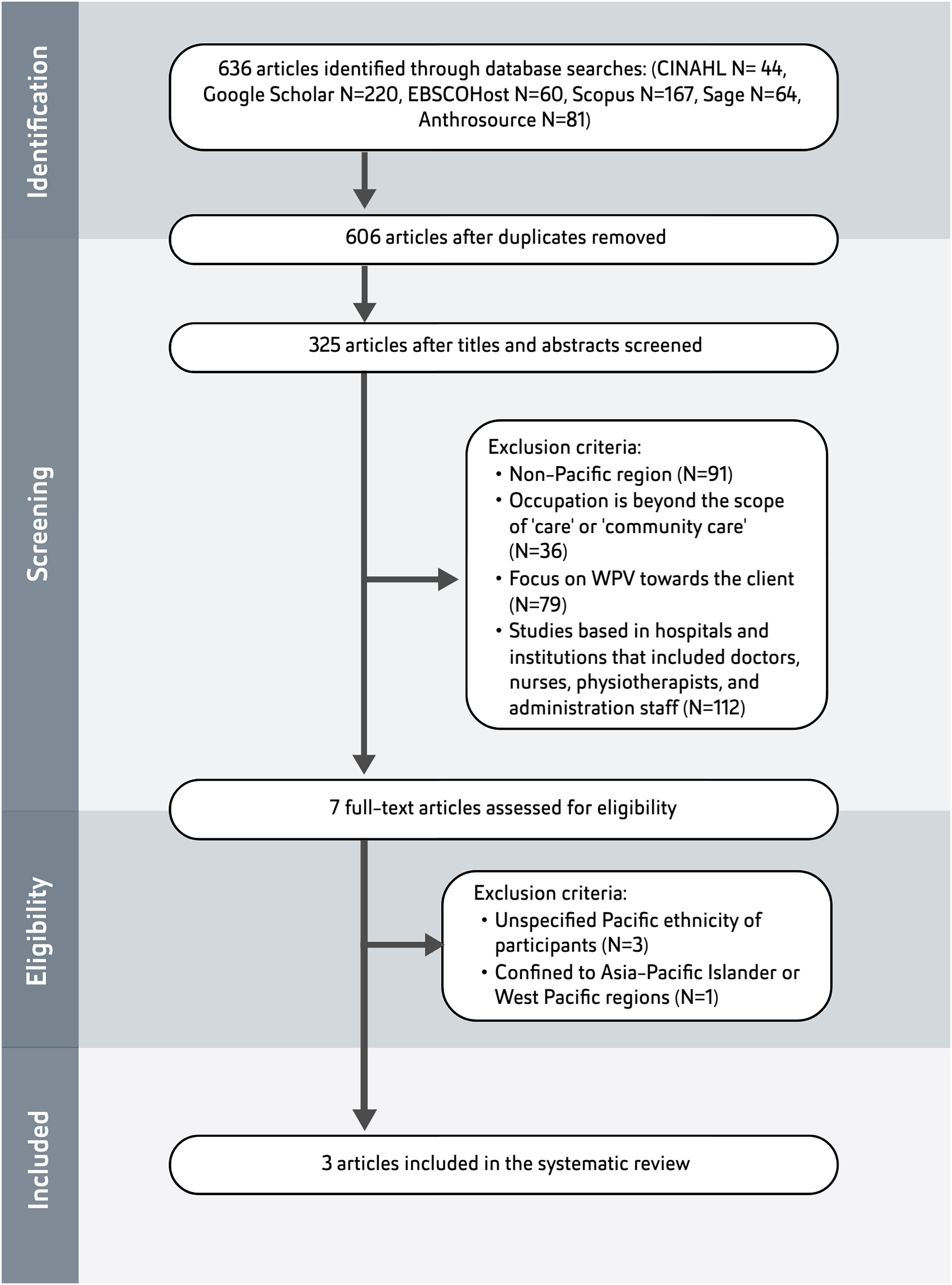
PRISMA diagram Pacific homecare workers’ experiences of WPV.
Analysis followed Braun et al.'s (2019) model of codebook thematic analysis. Prior to commencing analysis, codes were developed drawing on the socio-cultural model of WPV. Thus, the main codes were interpersonal relationships, work environment, the socio-political context of WPV. In addition, a code of ‘category of WPV’ (becoming the theme below of ‘physical, sexual, and psychological harm’) was added in order to review what was known about the frequency and type of WPV experienced in homecare. All of the articles identified by the systematic review were read, and analysed according to the codes, noting the main themes or issues that arose within each code and any new information. This latter point was particularly important for the theme of ‘socio-political context of WPV’ because there were fewer articles that addressed the impact of the macro environment on WPV. Thus, this theme also draws on the broader literature in homecare to identify the known macro factors that may impact on WPV in homecare. Open-ended thematic analysis process, with no pre-determined codes, was employed to analyse the articles resulting from the review specific to Pacific workers due to the small number of articles and lack of substantive research addressing WPV amongst Pacific workers.
Workplace violence in homecare
This section discusses the findings of the narrative reviews into WPV in homecare in general beginning with a brief review of the incidences and types of WPV. We then discuss the workplace level (physical environment and relationships) of WPV before outlining the socio-political context of gendered and racial norms that influence the regulatory environment and workplace conditions for homecare workers and their impact on WPV at the workplace level.
Physical, sexual and psychological harm
Homecare workers experience various forms of physical violence (e.g. Bussing and Hoge, 2004; Campbell et al., 2015; Glass et al., 2017) and verbal abuse and harassment (e.g. Byon et al., 2020; Habib et al., 2020; Lee et al. 2014) inflicted by clients, clients’ family members, colleagues and managers (Byon et al., 2020). It has been estimated that 92% of health care workers might experience some form of abuse from clients over their career (Ridenour et al., 2019). Verbal abuse has been found to be more common (Hanson et al., 2015) than physical or sexual abuse (Karlsson et al., 2019; Ridenour et al., 2019). Up to 30% of women in community care experience sexual harassment (Nakaishi et al., 2013).
Relationship factors
Relationships are key to how homecare workers respond to WPV. Research generally agrees that WPV is under-reported, in part due to poor relationships with managers and financial reasons outlined below. Additionally, some research suggests that homecare workers tolerate WPV because of their perceived duty of care to prioritise the needs of their clients (Byon et al., 2017). WPV from clients is tolerated by care workers as something that is expected as part of the job (Costello, 2015; Longo and Phillips, 2016). One example is that there is a greater incidence of WPV in settings where clients have cognitive impairments, yet in these settings there is still under-reporting and tolerance of it (Green and Ayalon, 2017; Karlsson et al., 2019), reflective of the relational nature of care and how it impacts WPV.
Work environment
Organisational factors increase the risks of WPV occurring. For example, the home environment (e.g. limited space) and other client-specific factors (e.g. restricted mobility, client demands) have been associated with increased violence (Karlsson et al., 2020). Significantly, Karlsson et al. (2019) report that homecare workers working for agencies reported a higher incidence of verbal abuse, compared with those employed directly by clients. This may be associated with time available to care: less time available to provide care is linked to an increased likelihood of violence occurring during provision of personal care such as toileting (Green and Ayalon, 2017; Karlsson et al., 2019). Additionally, verbal abuse has been found to be more common when homecare workers do not have a clear plan for client care, and when their work hours are unpredictable (Karlsson et al., 2019). Homecare workers may underreport violence due to a fear of lost wages or losing a paying client (Byon et al., 2020).
The socio-political context of WPV in homecare
As noted above, socio-ecological analyses of WPV view WPV as a phenomenon that is influenced by multiple levels: individual, workplace, and the socio-political (Berlingieri, 2015; Calvard and Sang, 2017; Somani et al., 2022; Wu et al., 2022). It is, therefore, important to understand the socio-political context for homecare. Homecare is a highly feminised occupation in which workers experience disadvantage and undervaluing arising from inherent gender discrimination associated with this being care work (England and Alcorn 2018; Hartmann and Hayes 2017), women's work, and the stigma associated with ‘dirty work’ (Clarke and Ravenswood 2019). Gender discrimination has led to persistently low wages, low status, and little respect for these workers whose skills and experience are not recognised (Charlesworth and Malone 2017; Cortis and Meagher, 2012). As outlined above, low wages and uncertain hours strongly influence whether or not homecare workers report WPV that occurs. Furthermore, gender norms for care work mean that violence from clients is often tolerated, illustrating the way in which the socio-political context influences WPV at the workplace level.
Additionally, homecare is an occupation that, across the world, relies heavily upon migrant workers, often from particular migrant groups, to fill labour shortages (Howe et al., 2019; Zhang et al., 2019). This reliance upon migrant workers stems from discrimination and perceptions of migrants as ‘second class workers’ who will accept lower work conditions than domestically sourced workers. In care occupations this prejudice is compounded by racist attitudes that view brown migrant workers from the Global South as inherently more caring, family oriented and compliant than white workers (Dodson and Zincavage, 2007). These social norms around migrant workers and care work reinforce the gendered and racialised perceptions of care work and care workers as low skilled and low valued (Montgomery et al., 2005). For migrant workers this shows up in the way in which countries offer temporary migrant visas, often attached to specific workplaces which makes their position in the receiving country not only temporary, but vulnerable to their employers’ demands (Lovelock and Martin, 2016; Williams, 2011).
This is concerning given evidence that WPV may occur more frequently for insecure workers, such as temporary workers and migrants (Green and Ayalon, 2016, 2017) who are also less likely to report WPV to supervisors than other homecare workers (O'Connor, 2005; Reid et al., 2020; Stringer, 2016). Factors that contribute to this include that temporary and migrant workers often receive less training and are more isolated from their employers.
One key finding, from the review, in relation to socio-political factors, is that sexual violence and racist abuse are seldom researched (Green and Ayalon, 2016; Lovelock and Martin, 2016; O'Connor, 2005) despite this being a feminised occupation with proven gender discrimination. Furthermore, it is an ethnically diverse workforce with a global reliance upon migrant workers (Boucher, 2019). One study of care in a home setting by Byon et al. (2020) identified a range of forms of sexual harassment and other sexual violence as well as racial violence and abuse, including discrimination and prejudice. The lack of research that investigates these two aspects of WPV reflects the inbuilt gender and race discrimination in the provision and funding of homecare work globally.
Pacific workers and WPV in homecare
Just as there is a dearth of research investigating the role of race, ethnicity and migrant status in homecare workers’ experiences of WPV, there is also almost no research investigating Pacific workers’ experiences of WPV. The narrative review resulted in only three articles on WPV in homecare that included Pacific workers. However, none of these had a sole focus on Pacific workers (Glass et al., 2017; Horan et al., 2018). In addition, these US-based studies use categories of Pacific Islanders, most including Asian and Hawaiian, that is different to the categorisations used in New Zealand and Australia, making comparison – if there were specific findings – difficult. For example, the NZ categorisation of the Pacific is narrowed to Samoa, Tonga, Tuvalu, Tokelau, Fiji, Niue, and the Cook Islands, and the smaller islands of Rotuma and Kiribati (Ministry for Pacific Peoples. 2018). Australia includes these preceding Pacific nations together with Nauru, Papua New Guinea, Solomon Islands, and Timor-Leste, (Department of Foreign Affairs and Trade, 2023). In contrast, each of the aforementioned studies group Hawaiian and Asian ethnicities as part of the Pacific Islander categorisation. Furthermore, the context of the studies is confined to the United States (e.g. Oregon, Kentucky and Ohio) and therefore refers to specific models of care provision that are not necessarily generalisable or applicable to other countries.
Consequently, although the samples include a low representation of Pacific homecare workers, and a lack of specific findings, these studies may not necessarily characterise or reflect the views and experiences of Pacific peoples in New Zealand and Australia, including that some are migrant workers and others are not. The lack of research that focuses on Pacific workers in homecare is compounded by other lacunae that include a lack of attention to the role that gender plays in experience of violence, a consequent failure to research sexual harassment and violence towards homecare workers; and an overall failure to acknowledge the role that race or ethnicity, and racism, may play in experiences of WPV (Glass et al., 2017; Green and Aylon, 2016; Lovelock and Martin, 2016). Therefore, it is clear that new approaches to researching and understanding WPV experienced by Pacific workers are necessary. The following section outlines the socio-political environment for Pacific workers in Australia and New Zealand, with a particular focus on how racist social norms impact regulation and poor work conditions for Pacific workers.
Socio-political context for Pacific workers in Australia and New Zealand
The regulatory environment for Pacific workers, derived from the colonial history of both New Zealand and Australia, has been informed by racist perceptions of Pacific workers as low skilled, physical labourers and a temporary workforce. Both countries have a long history of relying upon Pacific workers as temporary migrant workers to address chronic workforce shortages—especially in seasonal, labour-intensive work such as agriculture and often in volatile working conditions. Indeed, Pacific workers were first brought to Australia as indentured labourers from the 1860s through to the early twentieth century to fill workforce shortages, particularly in the sugar plantations and cotton holdings of northern Queensland (Bird, 2005). Known as ‘South Sea Islanders’ or ‘Kanakas’ (Queensland Government, 2022), many of these Pacific workers originated from locations within the area of the anthropologic classification of Melanesia that included Vanuatu (former New Hebrides), the Solomon Islands, and Papua New Guinea. Although the terms of their employment were strongly contested (Bird, 2005), most of the islanders were recruited via signed contracts, coercion or a practice called ‘blackbirding’ (kidnapping) that is hidden within white narratives of colonialism, particularly regarding exploitation and violence (Cheer and Reeves, 2013).
Cheap labour procurement of South Sea Islanders to Australia was a practice plagued with mistreatment, deception, and death. Many workers were treated as slaves, forced to work long hours for little or no wages (Bird, 2005). As part of the White Australia Policy, this first wave of workers was largely deported between 1906 and 1908 under the Pacific Island Labourers Act (1901) (Barnivanua-Mar, 2007). The Act sought to regulate the employment of South Sea Islanders in a context in which many Australians opposed the procurement of Pacific labourers who were perceived as ‘stealing jobs’ from local Australians. Despite the opposition from locals and protests from the South Sea Islanders, more than 7500 South Sea Islanders were deported. The injustices, discrimination, grievances, and historic blackbirding experienced by the South Sea Islanders and their descendants continue to be a sore point and focus for seeking redress for human rights violations, social and economic disadvantage, and prejudice.
Pacific migration to New Zealand had similar foundations as Australia. The first wave of Pacific migration began in the early 1950s at a time when the economy was prosperous due to increased import substitutions and growth in the manufacturing and service industries (Gibson, 1983). Comparable to Australia, a long-term labour shortfall (Brosnan et al., 1995) prompted New Zealand to recruit temporary workers from its former Pacific territories such as Western Samoa, 1 Cook Islands, 2 Tokelau and Niue, and later Tonga 3 and Fiji. New Zealand offered an alternative lifestyle to Pacific ways of living that included higher wages, housing, new goods, services and work, and better medical treatment (Ofe-Grant, 2018). Consequently, many Pacific peoples migrated in pursuit of work and opportunities to support their families in the islands and begin new lives in New Zealand.
Underscoring the ‘temporariness’ of this workforce, just as Australia's earlier wave of South Sea Islanders who were deported, New Zealand undertook a series of enforced deportation as a response to the economic recession (1975–1985). The Government targeted Pacific peoples – naming them as ‘thieves’ who took jobs from New Zealand workers and ‘bludgers’ overloading social services (Anae, 1997; Grainger, 2009). This smear campaign viciously sought out Pacific ‘overstayers’ in what became known as the infamous ‘Dawn Raids’ (De Bres and Campbell, 1975). Racism underpinned the Dawn Raids with Pacific peoples blamed for the economic recession while migrant overstayers from ‘white Commonwealth nations’ were ignored (New Zealand Race Relations Office, 1986; Ofe-Grant, 2023; Spoonley, 1998, p. 15). This racism lives on in continuing perceptions of Pacific migrant workers as temporary and cheap labourers and their location in jobs within poor, harsh working conditions as well as a persistent Pacific pay gap (Cochrane and Pacheco, 2022).
More recently, both New Zealand and Australia have used temporary migrant visas to fill workforce shortages. Australia introduced its first-ever seasonal or temporary visa that included aged care in 2018. Known as ‘The Pacific Labour Scheme’, it was a temporary labour migration scheme that recruited approximately 2000 low and semi-skilled workers for one to three years in rural and regional Australia (Department of Foreign Affairs and Trade, 2020). Its focus was on recruiting women to work in non-seasonal, highly feminised sectors such as aged care, disability support and childcare, hospitality, and tourism (Hill et al., 2018). This was the first scheme of its kind in Australia for low-paid non-seasonal feminised work, indicating an increased focus on Pacific nations for migrant labour. In July 2022 this focus was strengthened with the announcement by the new Labour government that the new Pacific Labour Mobility Scheme (PALM) (which replaces the Seasonal Worker Programme and Pacific Labour Mobility schemes) would be extended to aged care workers (Pacific Australia Labour Mobility, 2022). Under the PALM, workers can be recruited to work in low-skilled roles for up to four years under an approved Aged Care Labour Agreements which can be facilitated by the employer signing an MOU with the relevant union (Pacific Australia Labour Mobility, 2022). In mid-2022 there were 25,000 Pacific workers and 2600 Fijian workers on the programme in Australia employed across hospitality and tourism, health care (including aged care) and non-seasonal agriculture (Albanese, 2022). With the expansion of the temporary labour scheme the government is introducing a Pacific Engagement Visa that provides a pathway to permanent residency for 3000 Pacific workers and their families per year. While the PALM is more heavily regulated than earlier schemes, concerns remain that the exploitation and wage theft that occurred under earlier schemes will continue (Foley and Strating, 2022).
Pacific temporary labour schemes in New Zealand began after the Second World War as a response to labour shortages and particularly in low-skilled labour. A special immigration quota for Samoans was introduced as part of the ‘Treaty of Friendship Act’ (1962) 4 with the Samoan government that allowed up to 1100 Samoans to enter New Zealand with conditions such as the promise of employment (Bellamy, 2008). Pacific migrants were recruited mostly in the urban and manufacturing sectors and in low-skilled labour (Gibson, 1983). The Recognised Seasonal Employer (RSE) work policy (Immigration New Zealand, 2022) was introduced in 2007 and continues today, where approved workers from eligible Pacific nations (Fiji, Kiribati, Nauru, Papua New Guinea, Samoa, Solomon Islands, Tonga, Tuvalu, and Vanuatu) fill seasonal horticultural and viticultural workforce shortages.
In New Zealand, aged care workers and disability workers have, from time to time, been listed as workers that meet short-term and long-term skills shortages, enabling them to gain temporary work visas, although not focusing on Pacific nations (Howe et al., 2019). Consecutive New Zealand governments have continuously revamped migration policy focusing on ‘quality’ migrants with permanent settlement while allowing other temporary migrants to enter the labour market under ascribed limitations and temporary initiatives such as the RSE scheme mentioned above (Immigration New Zealand, 2022). Migrants with ‘smart capital’ (i.e. money, knowledge, and expertise) are encouraged to stay in New Zealand and contribute to society and the economy (New Zealand Productivity Commission, 2021). Although this selection process is framed as ‘non-discriminatory’, discrimination is apparent in the ‘inclusion criteria’, for access to visas, including in education requirements and other dimensions that privilege white, Western, and English speakers (Spijkerboer, 2018). Therefore, migrants with high skills and experience have more accessible pathways to inclusion, citizenship, and employment in New Zealand (see ‘NZ's fast-track residency plans overlook Pacific people: Greens’, 2022).
In comparison, low-skilled and temporary migrants, disproportionately from racialised groups such as Pacific workers, are expected to live partitioned lives, granted shorter-term visas, with fewer pathways to long-term residency before returning to their homelands (Anderson, 2010). Highly targeted schemes classify, recruit, retain and segregate migrants, in ways which are fundamentally discriminatory given that they focus on the valuation of human worth (e.g. skills, qualification, experience, language, and health) that are charted onto racialised differences (Collins and Stringer, 2023). As a result of these prerequisites for migrants entering New Zealand, exploitation, modern slavery, and precarity persists.
The ‘precarious Pacific migrant’ whose temporary status in New Zealand tends to surround vulnerability, poverty, and discrimination insofar that their employment status is subject to harsh conditions beyond their control (Solignac, 2022). For example, labour brokerage, high accommodation costs, limited working hours, and accumulated debt from migration pathways further exacerbate working environments that are manipulative and become illegal (Collins and Stringer, 2023). There are numerous examples of Pacific migrant exploitation and modern slavery involving sub-standard pay and employment conditions, inequitable employment agreements, employers withholding passports and other identity documents, physical and verbal threats, and acts of violence to migrants and their families (see Johnston, 2022; Kitchen, 2020; Xia, 2022). Furthermore, many Pacific and other migrants continue working in exploitative situations for fear of losing their visa status, deportation and increased financial hardship (Bathgate, 2022; Lewis et al., 2015). This predicament leads to a situation in which vulnerable people from developing countries and their circumstances heighten the risks of exploitation. The temporary category of immigration status combined with the yearning for permanency in a country steeped in historical colonialism cements the exploitation and vulnerability of Pacific migrants in New Zealand.
In addition to each country seeking more Pacific migrant workers to fill workforce shortages, there is some evidence of increased Trans-Tasman movement amongst Pacific seasonal workers (Faleolo, 2020). Howe et al. (2019) note that there are similarities in the way that New Zealand and Australia use temporary migration, especially in care work. Both countries view care work as low skill, 5 due to gender discrimination and therefore appropriate for temporary work visas – not dealt with as strategically or systematically as more permanent work-related migration. This is also demonstrated in Australia by heavy reliance in aged care on migrant workers on temporary student and holiday visas (Garces-Ozanne and Carlos, 2022).
Pacific worldview and health
As we have demonstrated, the socio-political context for Pacific workers in Australia and New Zealand is one which largely overlooks Pacific worldviews and knowledge. In contrast, studies concerning Pacific peoples tend to begin with a discussion of the Pacific worldview. In other words, the ‘Pacific way of knowing and doing’ of the world around them according to their knowledge, value systems, and institutions (Ofe-Grant, 2022; Quanchi, 2004). Despite each Pacific Island nation having its own culture, language, and history, Pacific peoples share similarities in linguistic, cultural values, and beliefs that permit the usage of shared concepts. For example, family and the church are primary social institutions where Pacific peoples maintain their cultural practices, beliefs, and language (Faleolo, 2020).
This viewpoint is aligned to the Pacific perspective of the ‘self’ where one's meaning and purpose in life is best understood via relationships rather than a single dimensional view (Efi TATT, 2003). Therefore, hierarchy is commonplace in Pacific culture as evidenced in the social institution of Samoa where individuals are assigned statuses such as honorific titles that determine the division of labour within families (Franco, 1991). Thus, Matai (Samoan Chieftainship) are the decision-makers in Samoan culture while the family and extended members are relegated to supportive duties (Macpherson and Macpherson, 2009).
Health, from a Pacific perspective is very different to Western notions of health. For example, health incorporates the concept of the va, that is, a culmination of balance and harmony of the spiritual, cultural, physical, environmental, and communal dimensions (Tamasese et al., 2005). Va is defined as an invisible flow of energy that preserves and maintains peace and harmony between relationships and entities that lead to productive and healthy lives (Wendt, 1996).
Aligned to the va, are spirituality and religiosity (used interchangeably) that are founded on Christianity and God. Spiritual beliefs are anchors in Pacific culture and an integral part of their value systems (Ihara and Vakalahi, 2011; Efi TATT, 2003). Consequently, many Pacific peoples feel connected to God (or gods), their ancestors, land, and the environment. Therefore, spirituality includes pre-European pagan beliefs alongside Christianity (Samu and Suaalii-Sauni, 2009). An important insight regarding Pacific perspectives of spirituality and health is the belief that some illnesses are thought to derive from manifestations of punishment from God or pagan gods (Ofe-Grant, 2018). For example, Tamasese et al. (2005) found that some Samoans view mental health issues as a direct result of serious misconduct and wrongdoing where va relationships led to malaaumatua: curses. Therefore, Samoans might seek reconciliation via indigenous cultural methods such as ifoga, a Samoan ritual of seeking forgiveness through public humiliation, speeches, and gifts (Macpherson and Macpherson, 2009). This cultural practice aims to restore and rejuvenate the va, where health and wellbeing should follow suit.
Given the importance of va, relationships, and adhering to hierarchies within Pacific worldviews, it is imperative to understand WPV from a Pacific perspective to fully acknowledge what WPV might look like and how it is experienced by Pacific peoples in New Zealand and Australia diasporas. This is necessary to respond with suitable strategies and plans to mitigate WPV incidences for Pacific homecare. Therefore, in the next section, we propose an analytical framework for future work that investigates the experiences of WPV for Pacific homecare workers.
Understanding Pacific homecare workers’ experience of WPV
This research sought to present a comprehensive review of extant research regarding Pacific homecare workers’ experiences of WPV. We were initially surprised that most of the articles excluded the voices of Pacific peoples, given that they comprise a large cluster of homecare workers in New Zealand and Australia, some of whom experience increased vulnerability and marginalisation due to being on temporary migrant worker visas. Ultimately, we discovered that little to no research delves deep into the experiences of Pacific peoples and WPV other than what is presented in American-based research.
Although there is research evidence that some WPV interventions can improve homecare workers’ experiences, we should consider that their effectiveness is often contingent or minimalised by societal and structural barriers as suggested by socio-ecological perspectives on violence prevention (Berlingieri, 2015; Calvard and Sang, 2017; Somani et al., 2022; Wu et al., 2022). For example, historical and institutional barriers such as the cheap labour procurement of migrants to Australia, the NZ migrant selection criteria that is discriminatory, and overall poverty and racism profoundly affect the lives and perspectives of Pacific peoples. Consequently, future research must reflect and focus on how societal, institutional and cultural dimensions shape Pacific homecare workers’ experiences of WPV. As such, culturally and contextually appropriate frameworks and interventions are required to meet Pacific people's needs and advance equity-centred approaches (Mulitalo-Lauta, 2001; Ofe-Grant, 2022; Suaalii-Sauni et al., 2009).
Therefore, we present a framework for future research that incorporates Pacific values and institutions underpinned by va relationships to understand and address WPV experienced by Pacific workers shown in Figure 2. The Pacific-centric focus emphasises a specific ‘cultural’ strengths-based approach whereby Pan-Pacific values and beliefs are infused throughout the framework. This emphasis is important for closing the gap for Pacific peoples as marginalised workers, and whose experience of WPV is often overlooked.
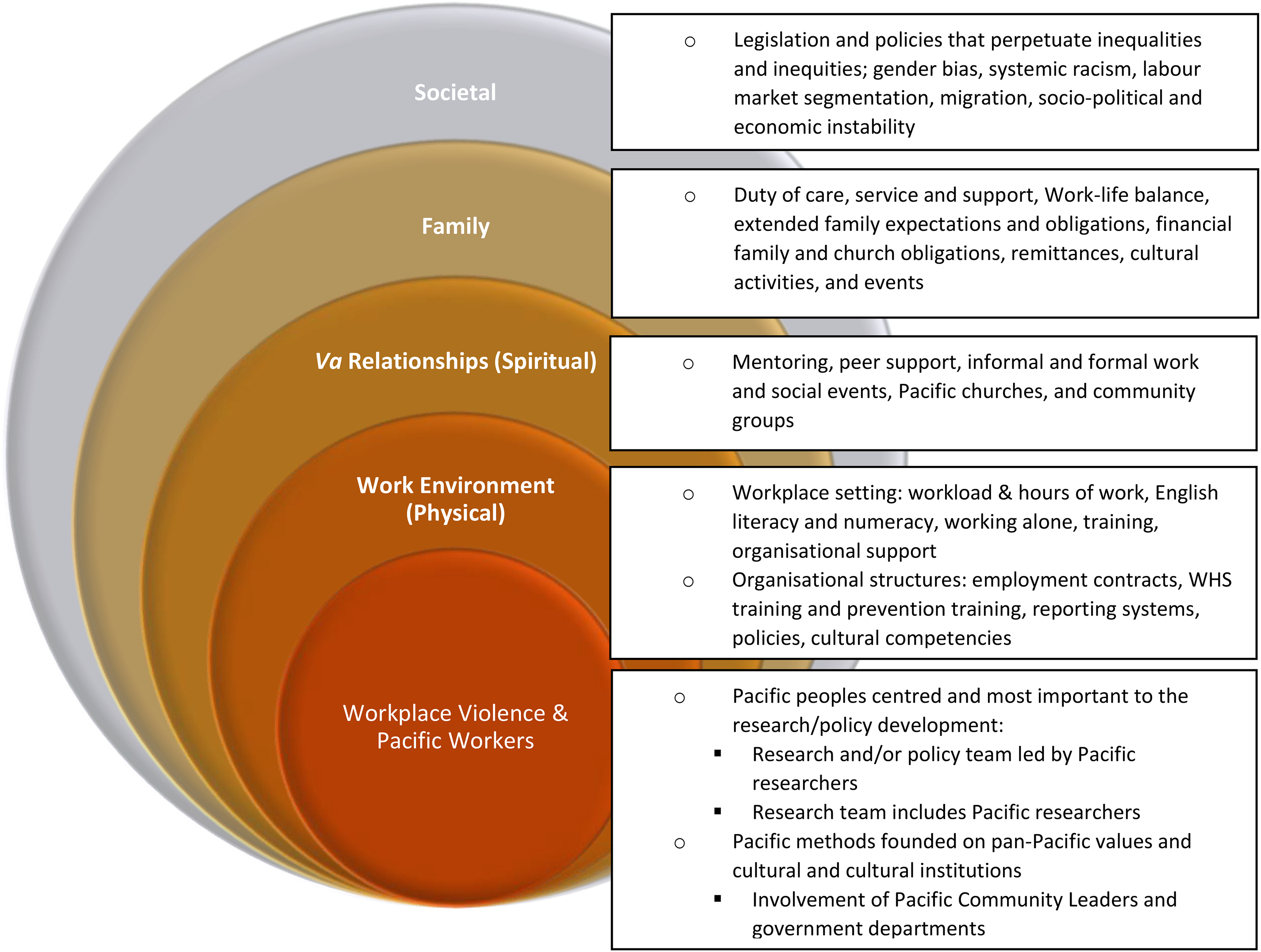
Analytical framework for addressing Pacific homecare workers’ experience of WPV.
Our proposed framework aligns with the socio-ecological perspective of WPV that allows for an in-depth analysis of the multi-level factors that influence violence at work. However, our framework is adapted to incorporate the specific cultural knowledge and competencies of Pacific workers, in order to draw attention to the socio-political and work environment factors that could both increase the likelihood of Pacific workers experiencing violence and reduce their opportunities to seek support. It also identifies where racist social norms towards Pacific homecare workers clearly impact their experience of WPV. The four multi-level factors include work environment (physical), societal, va relationships (spiritual) and family are discussed below.
Work environment (physical)
At the work environment level, in addition to the known impacts of lack of training, workload, hours of work and organisational support (Green and Ayalon, 2017; Karlsson et al., 2019), barriers related to English literacy and numeracy and communication could impact how Pacific homecare workers experience WPV. The type of employment contract can influence the frequency of their exposure to and reporting of WPV. Pacific workers on temporary contracts, those directly employed by clients, or on migrant visas more likely to experience WPV (Green and Ayalon, 2016; Reid et al., 2020). In addition, the employers’ cultural competencies for organisational and peer support play a crucial role in shaping how Pacific workers experience WPV (Adamson et al., 2017; Fa'alogo-Lilo Cartwright, 2021; Rahmanipour et al., 2019) in Australia and New Zealand.
Societal
At the societal level, employment, health, education, migration, and social policies perpetuate inequalities and inequities for Pacific peoples. Care work is highly gendered where stereotypically migrant women from low-income countries work in wealthy countries to look after the elderly and young children (Michel and Peng 2017). The gendered undervaluing of care work ties in with racism, discrimination, and the stigmatisation of Pacific peoples as contingent workers with limited skills, education and sophistication that tend to inform temporary work visas (Nishitani and Lee, 2019). These perceptions of Pacific workers also extend to those who are not migrant workers, but Australian or New Zealand citizens or permanent residents. This combined with the colonial and racist history of coercion, slavery and temporary Pacific labour in Australia and New Zealand (discussed earlier) means that Pacific workers may tolerate WPV because of their status in society as perceived casual workers with limited skills, education, and sophistication. Furthermore, unstable social infrastructures and economic instabilities of their home countries underpin the working lives of many Pacific migrants who seek work in wealthier countries. Pacific workers (and migrants in general) tend to work in precarious conditions with ambiguous and/or lesser employment rights and discriminatory visa conditions (Rahmanipour et al., 2019; Stringer and Michailova, 2019).
Such racist views, overlook the myriad reasons Pacific workers seek work, and how they make their decisions, including Pacific notions of ‘wellbeing’ expressed as ola manuia (Tuvaluan) and mo'ui lelei (Tongan) (Ministry of Health, 2020). These expressions reflect pan-Pacific cultural values such as fa'aaloalo – respect (Samoan), tāpuakiga – spirituality (Tokelau), aro'a – love (Cook Islands Māori) and tauhi vā – collectivism (Tonga) that are important to Pacific peoples and central to their worldview.
The racist socio-political environment implies that Pacific homecare workers are more likely to encounter WPV, potentially based on their race, and experience challenges in reporting and seeking assistance to address WPV (Reid et al., 2020; Stringer, 2016). Arguably, the same racism informs the dearth of research focus on Pacific workers’ experiences of WPV, as well as a significant gap in knowledge of how Pacific worldviews impact the way in which Pacific workers can seek support when faced with violence at work.
These factors in the work environment and societal level have not yet been considered in addressing the WPV experienced by homecare workers. Two additional factors specific to Pacific peoples are the role of va relationships (spiritual element) and the role of family.
Va relationships (spiritual)
Pacific cultures are fundamentally collectivistic where relationships with the environment, spiritual and physical realms, family, community, and the self are paramount for positive wellbeing and harmony. Relationships can also extend to the wider context of Pacific peoples demonstrating a holistic perspective. Consequently, va relationships and the guardianship of these relational dimensions are crucial to the Pacific ethos. When applied to homecare and Pacific workers, va is best understood as the employment and care relationships of Pacific employees and their employers, care patients, and others that determine how behaviour and actions are conducted. In other words, good work relationships are a result of a healthy, fully functional va. As such, Pacific peoples draw their sense of health, safety, and overall wellbeing from the quality of their relationships whether at work, home, church, and the communities.
Another aspect of va is that it is tied to hierarchy which may provide concerns for reporting and questioning unethical work processes or behaviour. Pacific peoples are less likely to question unfair work decisions or precarious and dangerous environments because it may disrupt the harmony of the working relationship (Ofe-Grant, 2018). In other words, should they raise concerns about WPV to their supervisors, it might be viewed as ‘causing trouble’ or disrespectful rather than fulfilling their job responsibilities.
This phenomenon is found in other studies of ethnic migrant groups who will tolerate WPV because of their perceived duty of care to prioritise the needs of the client and avoid unnecessary attention to themselves (Byon et al., 2017; Longo and Phillips, 2016). This expectation is implicit in organisational policy that does not address WPV (Byon et al., 2017). Furthermore, many Pacific cultures operate on a gerontocracy, wherein older people are shown great respect and reverence. Consequently, Pacific peoples might be more inclined to endure WPV if they perceive expressing their true feelings would inconvenience their work or care relationships and potentially be seen as disrespectful to their supervisors and care patients. A breakdown in the work relationship creates an imbalance of meaning and purpose. Therefore, restoring harmony to these relationships using Pacific cultural values is beneficial.
Some factors to consider that could enhance opportunities to seek support and assistance include workplace mentoring, peer support, informal and formal work and social events. Outside of the organisation, Pacific peoples can find solace and help with strengthening relational bonds from Pacific support groups, Pacific churches, and local community centres.
Family
Family is one of the Pacific anchors that establishes hierarchical roles, provides identity, solidifies resilience, and is associated to positive wellbeing. Consequently, Pacific peoples adhere to collectivism where families and groups organise, plan and work together for the greater good rather than follow an independent pathway aligned to individualistic goals and orientation (McLaughlin and Braun, 1998). Therefore, the Pacific concept of family transcends the nuclear definition of family to include obligations to the aigapotopoto (the extended family) and associated communities such as the church.
Considering the Pacific view of family, a Pacific support worker might endure WPV, driven by the greater need of fulfilling family responsibilities, meet financial commitments for overseas remittances, and monetary contributions to the church. Consequently, these entrenched cultural traditions and financial obligations place Pacific peoples and more specifically women in a disadvantaged position. For example, Pacific women may be reluctant to report WPV and tolerate harsh conditions to avoid a loss of income if their patient hours are reduced or where work is suspended due to grievances and disputes. Therefore, employers should be cognisant of how the Pacific family is situated and structured for Pacific workers.
Our framework aligns with the holistic and spiritual perspectives of Pacific health and well-being, extending beyond the conventional notions of family and community. The Pacific-centric focus emphasises a specific ‘cultural’ strengths-based approach whereby critical pan-Pacific values and beliefs are infused throughout the research framework. This emphasis is important for building inclusive practices and closing the gap for Pacific people as marginalised individuals. Furthermore, our framework builds on socio-ecological perspective of violence prevention (Berlingieri, 2015; Calvard and Sang, 2017; Somani et al., 2022; Wu et al., 2022), that considers the distinctly overlapping cultural norms that create the entire panorama of contexts of the Pacific peoples. This framework explicitly incorporates the way in which the cultural norms influence each of the other levels of WPV that considers four intersecting dimensions of: the working environment, va relationships, family and societal values and norms that impact Pacific workers and may instigate or alleviate WPV.
We further recommend that employing a Pacific framework requires involvement of Pacific researchers or policy developers skilled in talanoa (Pacific styles of conversation) and familiar to Pacific cultural nuances, languages, and codes of conduct, particularly regarding socio-cultural hierarchy. Pacific researchers have the capacity to draw on pre-existing connections, networks, advisory groups to access support for the study within their respective communities (Ofe-Grant, 2022). These groups may include key Pacific community leaders and Pacific government officials as strategic points of contact for further Pacific resources and support.
Conclusion
As we have demonstrated, there is very little research and policy development regarding how Pacific homecare workers experience WPV either in homecare work or more broadly. This is a significant gap given the long-standing presence and growing importance of Pacific workers in the New Zealand and Australian homecare labour markets. Using a socio-ecological perspective of WPV, we highlighted the power dynamics of racism in the socio-political environment that impact WPV at the workplace level. Our review revealed the lack of research that investigates Pacific workers’ experiences of WPV.
Responding to this lacuna, we have presented an analytical framework for researching and addressing WPV experienced by Pacific homecare workers. Our framework incorporates the idea of a shared Pacific worldview as central to understanding and addressing WPV.
The analytical framework we have presented builds on socio-ecological models of violence prevention (Berlingieri, 2015; Calvard and Sang, 2017; Somani et al., 2022; Wu et al., 2022) that are increasingly relied upon and understood within the policy environment. Like these models, our framework adopts the idea that violence and its prevention is multi-faceted and at multiple levels from individual, relationship, community, to society. However, our framework incorporates pan-Pacific cultural dimensions of core values and beliefs including its emphasis on the holistic nature of Pacific wellbeing via va relationships. The inclusion of va as a key component of the framework provides the basis for research and policy development that can contribute to positive Pacific wellbeing and the quality of va relationships for Pacific homecare workers, their employers, and clients. This approach is critical to understanding WPV in the highly relational work of care for Pacific peoples in Australia and New Zealand. While developed specifically for use in care-related work, the framework could equally be applied in other occupational settings.
This framework is intended for use by research and policy development teams led by Pacific researchers skilled in talanoa (Pacific styles of conversation) and familiar to Pacific cultural nuances, languages, and codes of conduct, particularly regarding socio-cultural hierarchy (Ofe-Grant, 2022). This framework acknowledges and centralises Pacific peoples and provides a starting point for ensuring that their voices, silenced in research to date, can be included, analysed, and acknowledged. This approach demonstrates a commitment to equity and Pacific self-determination to provide Pacific solutions that enhance outcomes for their communities and peoples.
Footnotes
Declaration of conflicting interests
The authors declared no potential conflicts of interest with respect to the research, authorship, and/or publication of this article.
Funding
The authors disclosed receipt of the following financial support for the research, authorship, and/or publication of this article: This work was supported by the New Zealand Health Research Council.

Notes
Author Biographies
Appendix 1