



Abstract
This article aims to examine the effects of mortality salience on explicit racism (Studies 1 and 2) and implicit racism (Study 3) in Singapore. There was no significant effect of mortality salience on both explicit racism and implicit racism (Studies 1–3). Furthermore, while social dominance orientation was associated with higher explicit racism, it did not moderate the effects of mortality salience on explicit racism (Study 2). In contrast, while social dominance orientation was not associated with implicit racism, it moderated the effects of mortality salience on implicit racism (Study 3). The results might be explained by the adoption of a superordinate Singaporean identity, the strict laws against explicit racism in Singapore, and a lack of mortality salience effects. Future research directions include examining the effects of mortality salience on racism in countries with lenient laws against racism and examining right-wing authoritarianism as a potential moderator.
Keywords
There is a paucity of research using terror management theory (TMT) to explain racism. This lack is intriguing as TMT was originally conceptualized partly to explain the difficulty of different groups to coexist peacefully (Greenberg et al., 1986). In fact, one of the earliest TMT studies found that when mortality is made salient (mortality salience), participants tended to rate a member of an in-group favorably and a member of an out-group unfavorably (Greenberg et al., 1990). While racism has been explained by theories such as the social identity theory (Tajfel & Turner, 1986), we argue that TMT could provide a complementary understanding of the roots of racism. Accordingly, the current study aims to examine the effects of mortality salience on explicit racism (Studies 1 and 2) and implicit racism (Study 3) in Singapore.
Racism
Racism refers to “the differential treatment enacted by an individual, group, or organization on individuals based on assumptions of a group’s phenotypic, linguistic, or cultural differences” (Gamst et al., 2011, p. 251). Racism is expressed either explicitly or implicitly (Ditonto et al., 2013). Explicit racism (intentional, conscious, and nonautomatic) is often assessed using self-report psychometric instruments like the Modern Racism Scale (McConahay, 1986). In contrast, implicit racism (unintentional, unconscious, and automatic) is often assessed using implicit measures like the Implicit Association Test (Greenwald et al., 1998). Explicit racism is further divided into two types: overt racism, characterized by blatant discrimination, and covert racism, characterized by subtle discrimination in ostensibly socially justifiable manners (Chew et al., 2019). Regardless of the type of racism and the manner in which it is expressed, racism results in a range of negative physical and mental health outcomes (Paradies et al., 2015; Pieterse et al., 2012), and reduced employment opportunities (Pager, 2007) for its victims.
Social identity theory has often been used to explain racism (Tajfel & Turner, 1986). The theory posits that we derive part of our self-concept from our membership in social groups (i.e., social identity). Because we are motivated to pursue and maintain a positive self-concept (i.e., self-esteem), we engage in social comparison between groups, resulting in in-group favoritism and out-group derogation. Building on social identity theory, the common in-group identity model proposed that an elimination or reorganization of group boundaries, for example by adopting a superordinate identity (i.e., a single group), could reduce prejudice (Gaertner & Dovidio, 2005). Both the theory and the model have been supported by numerous empirical studies (Gaertner & Dovidio, 2005; McKeown et al., 2016). However, a crucial assumption of the theory has not been addressed: Why do we need self-esteem? TMT complements social identity theory by providing an answer to this question (Greenberg et al., 1986).
Terror Management Theory
According to TMT, the juxtaposition of an instinct for life and the uniquely human awareness of the inevitability of death create the potential for anxiety (Greenberg et al., 1986). To assuage the potential for anxiety, humans rely on a dual-component anxiety buffer: cultural worldview and self-esteem (Solomon et al., 1991). A cultural worldview is a shared conception of reality that (a) imbues the world with order, permanence, and meaning; (b) provides standards of value for individuals to strive for; and (c) promises either literal immortality (e.g., entry into an afterlife) or symbolic immortality (e.g., a monument for remarkable achievement) for individuals who meet those standards. Self-esteem is obtained when individuals successfully meet those standards and hence qualify for immortality. However, because cultural worldviews are social constructions, they require consensual validation from other individuals to function effectively as an anxiety-buffer. This need for validation has a corollary: It is difficult for different groups to coexist peacefully because the presence of a different worldview raises the possibility that one’s own worldview could be wrong. Consequently, to maintain the anxiety-buffer, much of human behavior is driven by a need to defend one’s cultural worldview.
There are three general strategies to defend one’s cultural worldview: (a) assimilation, (b) bolstering and derogation, and (c) aggression (Vail et al., 2012). These strategies have been examined within the TMT framework using the mortality salience hypothesis. According to the hypothesis, if cultural worldviews and self-esteem buffer us against death-related thoughts, reminders of mortality should motivate us to defend our cultural worldview and pursue self-esteem (Harmon-Jones et al., 1997). For example, mortality salience motivated (a) Christian participants to invite an atheist to church (assimilation; Kosloff et al., 2011), (b) participants to rate a member of an in-group favorably (bolstering) and a member of an out-group unfavorably (derogation; Greenberg et al., 1990), and (c) participants to allocate a large amount of hot sauce to a worldview threatening target (aggression; McGregor et al., 1998; McPherson & Joireman, 2009). Overall, in a meta-analysis of 277 mortality salience experiments, 221 (80%) experiments yielded positive results for the mortality salience hypothesis, providing support for TMT (Burke et al., 2010).
The predictions of TMT and the mortality salience hypothesis have also been supported by research conducted during the coronavirus disease 2019 (COVID-19) pandemic. For example, search terms associated with death significantly increased on Weibo and Google after COVID-19 was declared an emergency in China (Li et al., 2020) and the United States (Evers et al., 2021), respectively. Another study explicitly tested the predictions of TMT and found that search terms associated with death, intergroup conflict, and prosocial behavior (but not materialism and anxiety) significantly increased on Google after the first COVID-19 case was identified in Singapore (Chew, 2022). Overall, these big data analyses provided further support for TMT.
More relevant to the aims of the current study, TMT has been used to explain stereotyping and prejudice (see Greenberg & Kosloff, 2008, for a review). For example, because stereotypes are key components of one’s cultural worldview, mortality salience led participants to defend their worldview by increasing stereotyping of a target, increasing liking for a stereotype-consistent target, and decreasing liking for a stereotype-inconsistent target (Schimel et al., 1999). In addition, mortality salience motivated German participants to sit further away from a Turkish confederate (Ochsmann & Mathey, 1994), exacerbated European and Arab participants’ implicit prejudice against each other (Das et al., 2009), and led male participants to report more sexual prejudice toward gay men and lesbians (Webster & Saucier, 2011). Surprisingly, it appears that only a handful of studies have examined the effects of mortality salience on racism. For example, one study reported that mortality salience caused White participants to be more forgiving of a White racist (i.e., an indirect form of racism; Greenberg et al., 2001). Studies examining implicit racism, as assessed using the Implicit Association Test, have yielded mixed results. For example, while one study found that White participants under mortality salience had higher implicit racism against Black individuals (Bradley et al., 2012), another study found no significant difference between the mortality salience and control conditions (Pashak et al., 2018). It is currently unclear whether the mixed results are due to the limitations associated with the Implicit Association Test (Fiedler et al., 2006) or a failure to replicate mortality salience effects (Klein et al., 2019).
Specifically, there have been multiple replication failures for TMT in recent years (Chew et al., 2023; Chew & Yap, 2021; Klein et al., 2019). For example, a large-scale replication study involving 21 laboratories failed to replicate the classical effect of mortality salience on worldview defense (Klein et al., 2019). While a reanalysis of the data using sufficiently powered studies only (n = 40 per cell) successfully replicated the classical effect (Chatard et al., 2020), it should be noted that the original study found significant results with only 11 to 12 participants per cell (Study 1 of Greenberg et al., 1994). Overall, although the current study used TMT as a theoretical framework, it is clear that more research is required to address these replication failures.
The Singaporean Context
Singapore is a multiracial society consisting of four races: 74.3% of the population are Chinese, 13.5% Malays, 9.0% Indians, and 3.2% Others (Singapore Department of Statistics, 2020). Since the 1980s, there has been a disparity in educational and economic achievement between Malays, the indigenous people of Singapore, and Chinese and Indians (Mutalib, 2011). According to the latest Population Census (Singapore Department of Statistics, 2020), only 10.8% of Malays obtained a university qualification compared with 34.7% of Chinese and 41.3% of Indians. In addition, the median monthly household income for Malays was $5,704 compared with $7,972 for Chinese and $8,500 for Indians. Despite interventions to promote racial integration (Judd, 2005; Sim et al., 2003) and strict laws against explicit racism (Penal Code, 1871; Sedition Act, 1948), there are some evidence that racism exists and is a contributor to these disparities (Chew, 2018; Chew et al., 2019).
Although there have been documented instances of racism against Indians (Velayutham, 2006), it appears that there are little educational and economic disparities between Indians and Chinese (Singapore Department of Statistics, 2020). In fact, a higher percentage of Indians obtained a university qualification than Chinese (41.3% vs. 34.7%). Furthermore, Indians had a higher median monthly household income than Chinese ($8,500 vs. $7,972). Consequently, the current study focused on Chinese-Malays relations only.
From a terror management perspective, we expect mortality salience to increase Chinese’s racism toward Malays for two reasons. First, racism enables Chinese to derogate Malays and their cultural worldview. By perceiving Malays as inferior, Chinese reinforce the validity of their own cultural worldview, effectively strengthening the anxiety-buffer against death-related thoughts. Second, Chinese hold numerous stereotypes of Malays. For example, the Chinese Racial Attitudes toward Malays Scale was developed by using Chinese participants’ common, unfavorable, and typical stereotypes of Malays (Chew, 2021). As mortality salience increases stereotyping (Schimel et al., 1999), Chinese reminded of mortality should increase stereotyping of Malays. Taken together, we expect mortality salience to increase Chinese’s explicit racism (Studies 1 and 2) and implicit racism (Study 3) toward Malays.
Study 1
Study 1 aimed to examine the effects of mortality salience on overt and covert racism in Singapore. It was hypothesized that participants in the mortality salience condition would report significantly higher overt racism (Hypothesis 1) and covert racism (Hypothesis 2) than their counterparts in the control condition.
Method
Participants
A total of 99 Singaporean Chinese participants were recruited via convenience sampling. Data from three participants were removed as they did not meet the inclusion criteria (i.e., not Singaporean Chinese). The final sample consisted of 96 participants (60.42% females), with ages ranging from 18 to 60 (M = 23.81, SD = 6.32) years.
Instruments
The Mortality Attitudes Personality Survey
The Mortality Attitudes Personality Survey is a two-item task designed to manipulate mortality salience (Rosenblatt et al., 1989). The task was presented to participants as a “Projective Life Attitudes Assessment,” an innovative method for the assessment of an individual’s personality via content analysis. The two items are (a) please briefly describe the emotions that the thought of (your own death [mortality salience] OR watching television [control]) arouses in you and (b) jot down, as specifically as you can, what you think will happen to you as you (physically die and once you are physically dead [mortality salience] OR watch television [control]). In a recent meta-analysis, 79.8% of the 277 studies used the Mortality Attitudes Personality Survey for mortality salience manipulation (Burke et al., 2010).
The Positive and Negative Affect Schedule
The Positive and Negative Affect Schedule is a 20-item instrument designed to assess two factors of affect: (a) Positive Affect (e.g., Attentive) and (b) Negative Affect (e.g., Distressed; Watson et al., 1988). Participants were asked to report on their feelings and emotions in the present moment. Responses are made on a 5-point Likert-type scale that ranges from 1 = very slightly or not at all to 5 = extremely. Appropriate item scores are summed for each factor, with higher scores indicating higher levels of positive or negative affect. The two-factor structure of the instrument has been supported by exploratory factor analysis (Watson et al., 1988). In addition, Positive Affect had an acceptable internal consistency of .88, whereas Negative Affect had an acceptable internal consistency of .87 (Watson et al., 1988).
The Balanced Inventory of Desirable Responding Short Form
The Balanced Inventory of Desirable Responding Short Form is a 16-item instrument designed to assess two factors of social desirability: (a) Self-Deceptive Enhancement (e.g., I always know why I like things) and (b) Impression Management (e.g., I never cover up my mistakes; Hart et al., 2015). Responses are made on a 7-point Likert-type scale that ranges from 1 = not true to 7 = very true. Negatively worded items are reverse scored and appropriate item scores are summed for each factor, with higher scores indicating higher levels of social desirability. The two-factor structure of the instrument has been supported by confirmatory factor analysis (Hart et al., 2015). In addition, Self-Deceptive Enhancement had acceptable internal consistencies that ranged from .63 to .82, whereas Impression Management had acceptable internal consistencies that ranged from .66 to .74 (Hart et al., 2015).
The Chinese Racial Attitudes toward Malays Scale
The Chinese Racial Attitudes toward Malays Scale is a 17-item instrument designed to assess two factors of racism in Singapore: (a) Overt Racism (e.g., Generally, Malays are lazy) and (b) Covert Racism (e.g., The news media have shown more respect to Malays than they deserve; Chew, 2021). Responses are made on a 5-point Likert-type scale that ranges from 1 = strongly disagree to 5 = strongly agree. Appropriate item scores are summed for each factor, with higher scores indicative of higher levels of racism. The two-factor structure of the instrument has been supported by exploratory factor analysis (Chew, 2021). In addition, Overt Racism had an acceptable internal consistency of .89, whereas Covert Racism had an acceptable internal consistency of .85 (Chew, 2021).
Procedure
Participants reported to a laboratory for a double-blind experimental study. To hide the true nature of the study, participants were told that the study aims to examine the effects of life attitudes on personality. Upon arrival at the laboratory, participants were seated in individual rooms to complete the instruments given the sensitive nature of the topic (i.e., racism) in Singapore. First, participants were randomly assigned to either the mortality salience condition or the control condition using the Mortality Attitudes Personality Survey (Rosenblatt et al., 1989). Second, participants completed the Positive and Negative Affect Schedule (Watson et al., 1988) and the Balanced Inventory of Desirable Responding Short Form (Hart et al., 2015). These instruments were administered to support the cover story and introduce a delay because the effects of mortality salience on worldview defense are only found when death-related thoughts are accessible but no longer in the center of conscious attention (Pyszczynski et al., 1999). Finally, participants completed the Chinese Racial Attitudes toward Malays Scale (Chew, 2021) and a demographic form that asks for age and gender. Participants were probed for suspicion (none expressed suspicion) and thoroughly debriefed. This procedure was approved by the university’s Human Research Ethics Committee (Approval number: H7795).
Results
The data were analyzed using SPSS version 25 and JASP (JASP Team, 2023). The descriptives are presented in Table 1. A series of four Pearson product moment correlations revealed no significant correlations between self-deceptive enhancement and impression management, and overt racism and covert racism, all ps > .05. A series of two independent-samples t tests were conducted to examine the effect of mortality salience on positive affect and negative affect. There was a significant effect of mortality salience on positive affect, with the mortality salience group (M = 27.02, SD = 8.77) reporting higher positive affect than the control group (M = 23.43, SD = 7.12), t(94) = −2.20, p = .03. There was no significant effect of mortality salience on negative affect, p = .18.
Means, Standard Deviations, and Internal Consistency Coefficients of the Variables.
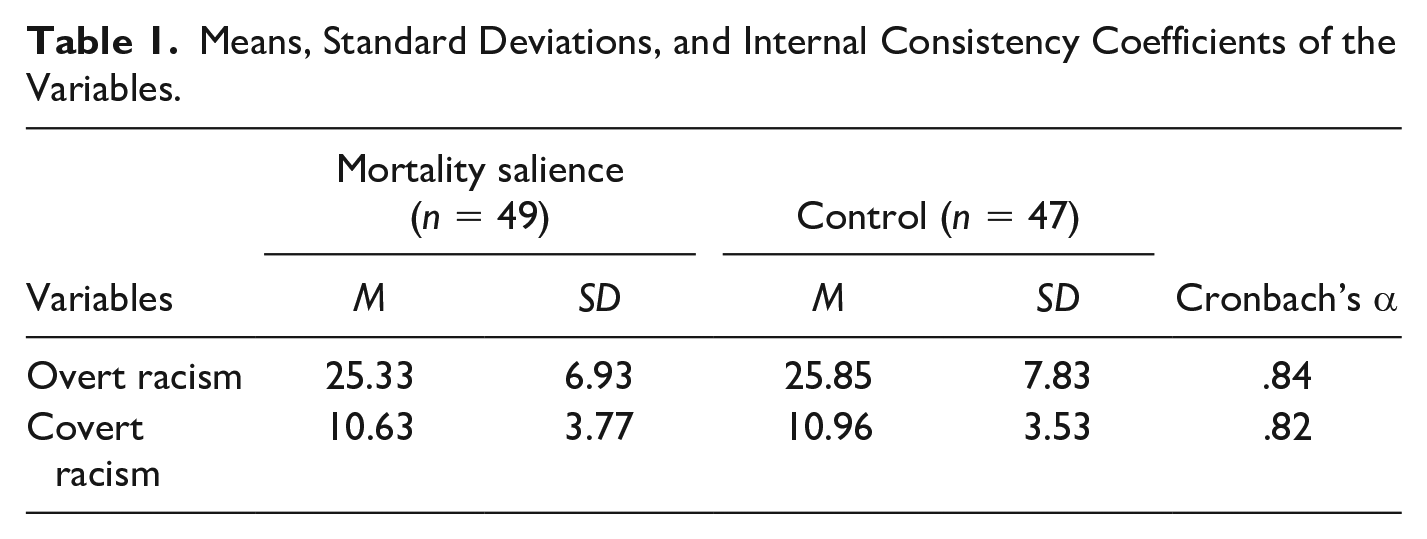
A one-way multivariate analysis of covariance (MANCOVA) was conducted to examine the effect of mortality salience on overt racism and covert racism while controlling for positive affect. There was no significant effect of mortality salience on the combined dependent variables, F(2, 92) = .92, p = .43; Hotelling’s Trace = .02. Because frequentist analyses are unable to quantify the evidence in favor of the null hypothesis (Dienes, 2014, 2016), Bayesian analyses were conducted to examine the nonsignificant findings (Wagenmakers, Love, et al., 2018; Wagenmakers, Marsman, et al., 2018). Specifically, a series of Bayesian independent-samples t tests were conducted to examine the effect of mortality salience on overt racism and covert racism. The Cauchy prior width was set to JASP’s default value of r = .707. The Bayes factor is 4.41 and 4.28 in favor of the null hypothesis for overt racism and covert racism, respectively. According to the classification scheme for Bayes factors, the results provided moderate evidence for the null hypothesis (Lee & Wagenmakers, 2013).
Discussion
The results of the study did not provide support for the hypothesis that participants in the mortality salience condition would report significantly higher overt racism (Hypothesis 1) and covert racism (Hypothesis 2) than their counterparts in the control condition. This was inconsistent with the well-documented causal relationships between mortality salience and prejudice (Greenberg & Kosloff, 2008) and previous studies that have found evidence of out-group derogation in response to mortality salience (Greenberg et al., 1990). The nonsignificant results might be due to the manner in which mortality salience was manipulated. Although the Mortality Attitudes Personality Survey is the most commonly used method to manipulate mortality salience (Burke et al., 2010), it requires participants to reflect and write down their responses. Participants who are unmotivated might not engage in adequate reflection, leading to an unsuccessful manipulation of mortality salience. Alternatively, the results might be explained by individual differences that could moderate participants’ responses to mortality salience. Consequently, a different method was used to manipulate mortality salience and a potential moderator was assessed in Study 2.
Study 2
Mortality salience did not increase Chinese’s explicit racism toward Malays in Study 1. While reminders of mortality should motivate us to defend our cultural worldview (Harmon-Jones et al., 1997), the worldview to be defended could be different for individuals even if they are from the same culture (e.g., the Singaporean culture). Specifically, individuals form their own personalized version of the worldview due to their personality and prior life experiences (Landau et al., 2004). For example, individuals who value tolerance as a key component of their worldview are less likely to respond to mortality salience with out-group derogation than individuals without such a value (Greenberg et al., 1992). Indeed, the effects of mortality salience are moderated by individual difference variables like authoritarianism (Greenberg et al., 1990), attachment style (Mikulincer & Florian, 2000), and personal need for structure (Landau et al., 2004).
Consequently, Study 2 aimed to examine whether social dominance orientation moderates the effects of mortality salience on overt and covert racism. Social dominance orientation refers to a preference for hierarchy and inequality between social groups (Pratto et al., 1994), and it has been found to be positively correlated with prejudice (Duckitt & Sibley, 2010). In addition to the inclusion of a potential moderator, we conducted the study online to maximize anonymity and used a different method to manipulate mortality salience (Quirin et al., 2012). It was hypothesized that participants high on social dominance orientation in the mortality salience condition would report significantly higher overt racism (Hypothesis 1) and covert racism (Hypothesis 2) than their counterparts in the control condition.
Method
Participants
A total of 107 Singaporean Chinese participants were recruited via convenience sampling. Data from eight participants were removed due to missing data and data from one participant were removed due to suspicion of the aim of the study. The final sample consisted of 98 participants (71.4% females), with ages ranging from 17 to 43 (M = 22.08, SD = 4.03) years.
Instruments
The Social Dominance Orientation Scale
The Social Dominance Orientation Scale is a 16-item instrument designed to assess two factors of social dominance: (a) Dominance (e.g., Some groups of people must be kept in their place) and (b) Anti-Egalitarianism (e.g., We should not push for group equality; Ho et al., 2015). Individuals respond on a 7-point Likert-type scale that ranges from 1 = strongly oppose to 7 = strongly favor. Negatively worded items are reverse scored and appropriate item scores are summed for each factor, with higher scores indicating higher levels of social dominance. The two-factor structure of the instrument has been supported by confirmatory factor analysis (Ho et al., 2015). In addition, Dominance had acceptable internal consistencies that ranged from .82 to .90, whereas the Anti-Egalitarianism had acceptable internal consistencies that ranged from .82 to .93 (Ho et al., 2015).
The Death Anxiety Scale and The Fear of Dental Pain Scale
Mortality salience was manipulated by having participants complete either the 15-item Death Anxiety Scale (e.g., I am very much afraid to die; Templer, 1970) or the 15-item Fear of Dental Pain Scale (e.g., I am very much afraid of dental work; Quirin et al., 2012). Responses for both instruments are made on a True/False scale. One study found significant differences in neural activity as participants complete the instruments, suggesting that death-related thoughts are distinct from dental pain-related thoughts (Quirin et al., 2012).
Procedure
Participants completed the double-blind experimental study online via Qualtrics. To hide the true nature of the study, participants were told that the study aims to examine the effects of life attitudes on personality. First, participants completed a filler personality instrument and the Social Dominance Orientation Scale (Ho et al., 2015). Second, participants were randomly assigned by Qualtrics to either the mortality salience condition or the control condition by having them complete the Death Anxiety Scale (Templer, 1970) or the Fear of Dental Pain Scale (Quirin et al., 2012), respectively. Finally, participants completed the Positive and Negative Affect Schedule (Watson et al., 1988), the Balanced Inventory of Desirable Responding Short Form (Hart et al., 2015), the Chinese Racial Attitudes toward Malays Scale (Chew, 2021), and a demographic form that asks for age and gender. Participants were probed for suspicion and thoroughly debriefed. This procedure was approved by the university’s Human Research Ethics Committee (Approval number: H8294).
Results
The data were analyzed using SPSS version 25 and Hayes’ (2017) PROCESS macro. A series of four Pearson product moment correlations revealed no significant correlations between self-deceptive enhancement and impression management, and overt racism and covert racism, all ps > .05. A series of two independent-samples t tests were conducted to examine the effect of mortality salience on positive affect and negative affect. There was no significant effect of mortality salience on positive affect and negative affect, p = .41 and .25, respectively.
Hayes’ (2017) PROCESS Model 1 was used to conduct a series of four moderation analyses with dominance (M = 24.99, SD = 8.29) and anti-egalitarianism (M = 22.02, SD = 8.87) as the moderators. In the first moderation analysis, mortality salience (dummy coded with control condition as zero) was used as the independent variable, dominance (mean-centered) as the moderator, and overt racism as the dependent variable. There was no significant interaction effect between mortality salience and dominance, p = .67. There was also no significant effect for mortality salience, p = .55. There was a significant effect for dominance, b = .28, t(94) = 2.10, p = .04, where higher dominance was associated with higher overt racism.
In the second moderation analysis, mortality salience (dummy coded with control condition as zero) was used as the independent variable, anti-egalitarianism (mean-centered) as the moderator, and overt racism as the dependent variable. There was no significant interaction effect between mortality salience and anti-egalitarianism, p = .47. There was also no significant effect for mortality salience, p = .33. There was a significant effect for anti-egalitarianism, b = .32, t(94) = 2.35, p = .02, where higher anti-egalitarianism was associated with higher overt racism.
In the third moderation analysis, mortality salience (dummy coded with control condition as zero) was used as the independent variable, dominance (mean-centered) as the moderator, and covert racism as the dependent variable. There was no significant interaction effect between mortality salience and dominance, p = .56. There was also no significant effect for mortality salience, p = .83. There was a significant effect for dominance, b = .21, t(94) = 3.35, p = .001, where higher dominance was associated with higher covert racism.
Finally, in the fourth moderation analysis, mortality salience (dummy coded with control condition as zero) was used as the independent variable, anti-egalitarianism (mean-centered) as the moderator, and covert racism as the dependent variable. There was no significant interaction effect between mortality salience and anti-egalitarianism, p = .37. There was also no significant effect for mortality salience, p = .24. There was a significant effect for anti-egalitarianism, b = .20, t(94) = 3.03, p = .003, where higher anti-egalitarianism was associated with higher covert racism.
Discussion
The results of the study did not provide for the hypothesis that participants high on social dominance orientation in the mortality salience condition would report significantly higher overt racism (Hypothesis 1) and covert racism (Hypothesis 2) than their counterparts in the control condition. This was consistent with Study 1 that found that mortality salience did not increase Chinese’s explicit racism toward Malays. However, the results were inconsistent with previous studies that have found relationships between mortality salience and prejudice (Greenberg & Kosloff, 2008). Furthermore, the lack of an interaction effect between social dominance orientation and mortality salience is inconsistent with previous studies that have found moderators for the relationship between mortality salience and out-group derogation (Greenberg et al., 1992).
The results might be explained by the strict laws against explicit racism in Singapore (Penal Code, 1871; Sedition Act, 1948). Although the Sedition Act has since been repealed recently (The Straits Times, 2021), it was used to arrest individuals for racist comments in the past (AsiaOne News, 2012; The New Paper, 2008). These laws might discourage participants, even when reminded of mortality, from expressing explicit racism. However, given the difficulty in detecting implicit racism, it would be difficult for those laws to be used against individuals with implicit racism. Consequently, implicit racism was assessed in Study 3.
Study 3
Given the results of Studies 1 and 2, the aim of Study 3 was to examine the effects of mortality salience on implicit racism in Singapore. Specifically, the current study used the Implicit Association Test as a measure of implicit racism because it is less vulnerable to the social desirability bias (Greenwald et al., 1998) and it has been used to examine prejudice within the context of TMT (Bradley et al., 2012; Das et al., 2009). Furthermore, similar to Study 2, social dominance orientation was assessed as a moderator. It was hypothesized that participants high on social dominance orientation in the mortality salience condition would report significantly higher implicit racism than their counterparts in the control condition.
Method
Participants
A total of 192 Singaporean Chinese participants were recruited via convenience sampling. Data from 88 participants were removed due to missing data or because they were outliers. The final sample consisted of 104 participants (55.8% females), with ages ranging from 18 to 57 (M = 24.71, SD = 5.68) years.
Instruments
The International Positive and Negative Affect Schedule Short Form
The International Positive and Negative Affect Schedule Short Form is a 10-item instrument designed to assess two factors of affect: (a) Positive Affect (e.g., Attentive) and (b) Negative Affect (e.g., Upset; Thompson, 2016). Responses are made on a 5-point Likert-type scale that ranges from 1 = never to 5 = always. Appropriate item scores are summed for each factor, with higher scores indicating higher levels of positive or negative affect. The two-factor structure of the instrument has been supported by exploratory and confirmatory factor analyses (Thompson, 2016). In addition, Positive Affect had acceptable internal consistencies that ranged from .73 to .78, whereas Negative Affect had acceptable internal consistencies that ranged from .72 to .76 (Thompson, 2016).
The Implicit Association Test
The Implicit Association Test is a reaction timed task designed to assess implicit attitudes (Greenwald et al., 1998). The current study adapted the Racism Implicit Association Test package from Inquisit to assess implicit racism in Singapore (Millisecond, 2020). Images of Chinese and Malay Singaporeans were used as targets, and pleasant (e.g., lovely) and unpleasant (e.g., horrible) words were used as attributes. Participants categorize targets, attributes, and target–attribute pairings via keystroke presses. For example, in the first block, participants were asked to press a left key (E) if the target belongs to the category presented on the left (i.e., “Chinese Singaporean”) and to press the right key (I) if the target belongs to the category presented on the right (i.e., “Malay Singaporean”).
Participants completed seven blocks in the following sequence: (a) target sorting training, (b) attribute sorting training, (c) 20 trials of target–attribute consistent pairings, (d) 40 trials of target–attribute consistent pairings, (e) target sorting training with target switching sides, (f) 20 trials of target–attribute inconsistent pairings, and (g) 40 trials of target–attribute inconsistent pairings. In the current study, target–attribute consistent pairings were presented as “Chinese Singaporean—Good” and “Malay Singaporean—Bad,” whereas target–attribute inconsistent pairings were presented as “Malay Singaporean—Good” and “Chinese Singaporean—Bad.”
Participants’ response time was measured in milliseconds (ms) and scored using the improved scoring algorithm (Greenwald et al., 2003) calculated by the DscoreApp (Epifania et al., 2020). Specifically, trials with response latencies faster than 400 ms and slower than 10,000 ms were removed, participants with more than 10% of trials with response latencies faster than 300 ms were removed, and only Blocks 3, 4, 6, and 7 were scored. A D-score was derived by first calculating the differences in response latencies between the consistent pairings (Blocks 3 and 4) and inconsistent pairings (Blocks 6 and 7), and then dividing it by a pooled standard deviation of all the response latencies in the four blocks. The D-score ranges from −2 to +2, with a positive score indicative of a preference toward consistent pairings (i.e., higher implicit racism), and a negative score indicative of a preference toward inconsistent pairings (i.e., lower implicit racism).
Procedure
Participants completed the double-blind experimental study online via Qualtrics. To hide the true nature of the study, participants were told that the study aims to examine the effects of life attitudes on reaction time. First, participants completed a filler personality instrument and the Social Dominance Orientation Scale (Ho et al., 2015). Second, participants were randomly assigned by Qualtrics to either the mortality salience condition or the control condition by having them complete the Death Anxiety Scale (Templer, 1970) or the Fear of Dental Pain Scale (Quirin et al., 2012), respectively. Third, participants completed the International Positive and Negative Affect Schedule Short Form (Thompson, 2016) and a demographic form that asks for age and gender. Finally, participants completed the Racism Implicit Association Test via Inquisit, a reaction time software (Millisecond, 2020). This procedure was approved by the university’s Human Research Ethics Committee (Approval number: H8103).
Results
The data were analyzed using SPSS version 25 and Hayes’ (2017) PROCESS macro. A series of two independent-samples t tests were conducted to examine the effect of mortality salience on positive affect and negative affect. There was no significant effect of mortality salience on positive affect and negative affect, p = .85 and .72, respectively.
Hayes’ (2017) PROCESS Model 1 was used to conduct a series of two moderation analyses with dominance (M = 25.27, SD = 7.15) and anti-egalitarianism (M = 22.74, SD = 7.75) as the moderators. In the first moderation analysis, mortality salience (dummy coded with control condition as zero) was used as the independent variable, dominance (mean-centered) as the moderator, and implicit racism as the dependent variable. There was a significant interaction effect between mortality salience and dominance, b = .02, t(100) = 2.26, p = .03. There was no significant effect for mortality salience, p = .57, and dominance, p = .76.
Simple slopes analyses were conducted to probe the interaction effect by examining the effects of mortality salience on implicit racism at 16th (Low), 50th (Average), and 84th (High) percentile of dominance (see Figure 1). The analyses showed that mortality salience had a significant effect on implicit racism among high dominance participants, b = .17, t(100) = 1.99, p = .05, but not among low dominance participants, b = −.10, t(100) = −1.13, p = .26, and average dominance participants, b = .03, t(100) = 0.49, p = .63. The Johnson–Neyman Technique was used to explore the region of significance (Spiller et al., 2013). When dominance = 31.97, mortality salience had a significant effect on implicit racism, b = .17, t(100) = 1.98, p = .05. As dominance increases, mortality salience had a greater significant effect on implicit racism, highest dominance = 47, b = .46, t(100) = 2.33, p = .02. A total of 16.34% of the participants (n = 17) falls within the region of significance.
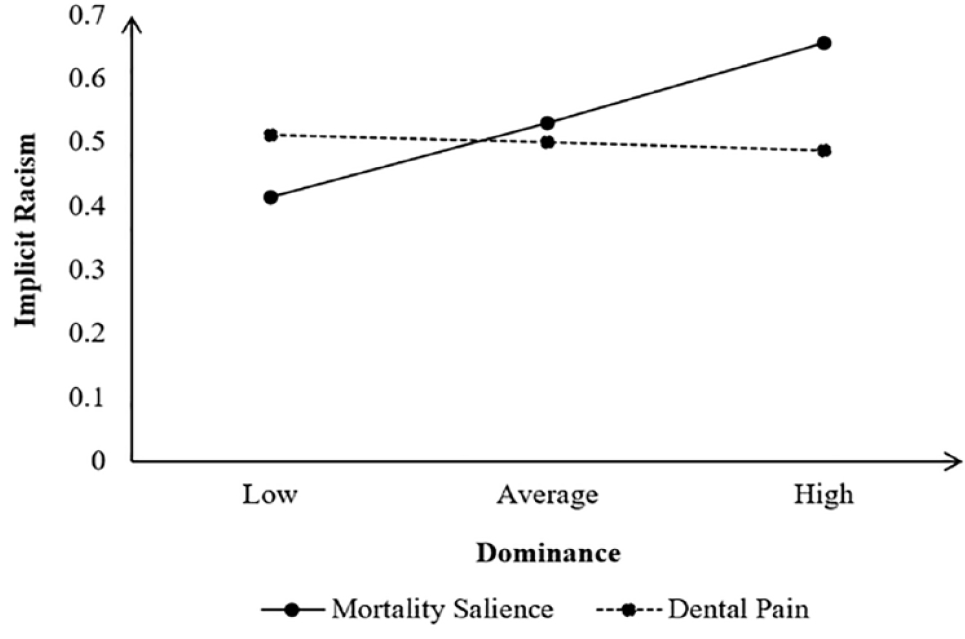
Effects of Mortality Salience on Implicit Racism at 16th (Low), 50th (Average), and 84th (High) Percentile of Dominance.
In the second moderation analysis, mortality salience (dummy coded with control condition as zero) was used as the independent variable, anti-egalitarianism (mean-centered) as the moderator, and implicit racism as the dependent variable. There was a significant interaction effect between mortality salience and anti-egalitarianism, b = .02, t(100) = 2.09, p = .04. There was no significant effect for mortality salience, p = .48, and anti-egalitarianism, p = .38.
Simple slopes analyses were conducted to probe the interaction effect by examining the effects of mortality salience on implicit racism at 16th (Low), 50th (Average), and 84th (High) percentile of anti-egalitarianism (see Figure 2). The analyses showed that mortality salience had a significant effect on implicit racism among high anti-egalitarianism participants, b = .18, t(100) = 2.02, p = .05, but not among low anti-egalitarianism participants, b = −.10, t(100) = −1.10, p = .28, and average anti-egalitarianism participants, b = −.74, t(100) = 0.51, p = .61. The Johnson–Neyman Technique was used to explore the region of significance (Spiller et al., 2013). When anti-egalitarianism = 30.44, mortality salience had a significant effect on implicit racism, b = .17, t(100) = 1.98, p = .05. As anti-egalitarianism increases, mortality salience had a greater significant effect on implicit racism, highest anti-egalitarianism = 44, b = .40, t(100) = 2.21, p = .03. A total of 16.34% of the participants (n = 17) falls within the region of significance.
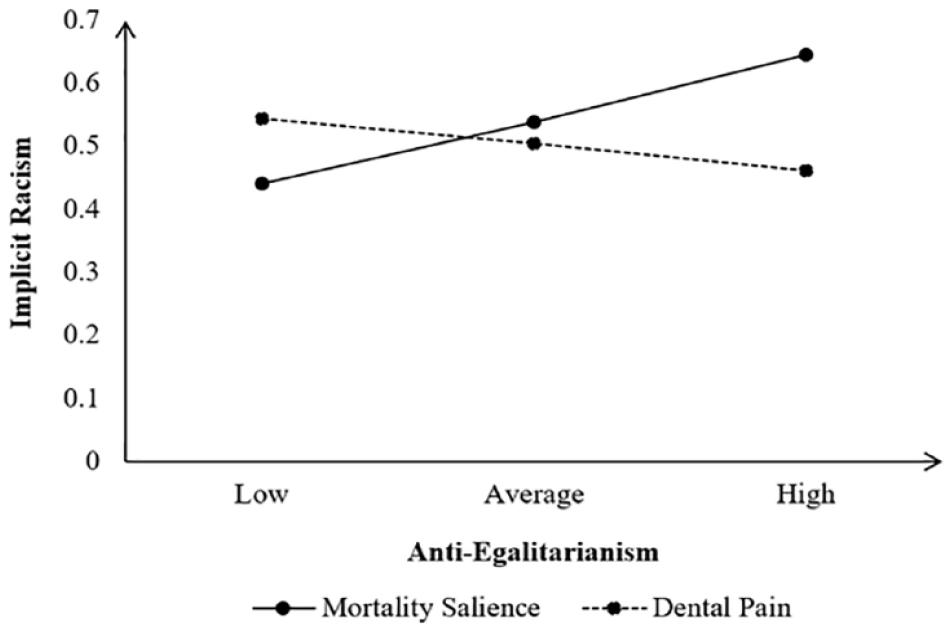
Effects of Mortality Salience on Implicit Racism at 16th (Low), 50th (Average), and 84th (High) Percentile of Anti-Egalitarianism.
Discussion
The results of the study provided support for the hypothesis that participants high on social dominance orientation in the mortality salience condition would report significantly higher implicit racism than their counterparts in the control condition. This was consistent with previous studies that have found moderators for the relationship between mortality salience and out-group derogation (Greenberg et al., 1992). The results suggest that individuals who prefer hierarchy and inequality are more likely to respond to mortality salience with implicit racism. By derogating out-group members and by extension their worldview, these individuals reaffirm the validity of their own worldview and maintain the buffer against the potential for anxiety. While only 16.34% (n = 17) of the participants responded in this manner, the negative effects of racism are diverse and significant for its victims (Pager, 2007; Paradies et al., 2015; Pieterse et al., 2012).
General Discussion
Three studies were conducted to examine the effects of mortality salience on racism. Mortality salience was manipulated by asking participants to complete open-ended questions (Study1) or close-ended instruments (Studies 2 and 3). Explicit racism was operationalized using the Chinese Racial Attitudes toward Malays Scale (Studies 1 and 2) and implicit racism was operationalized using the Implicit Association Test (Study 3). The studies were conducted onsite in a laboratory (Study 1) and online via Qualtrics (Studies 2 and 3). Finally, social dominance orientation was assessed as a potential moderator (Studies 2 and 3).
There was no significant effect of mortality salience on both explicit racism and implicit racism (Studies 1–3). While social dominance orientation was associated with higher explicit racism, it did not moderate the effects of mortality salience on explicit racism (Study 2). In contrast, while social dominance orientation was not associated with implicit racism, it moderated the effects of mortality salience on implicit racism (Study 3). Taken together, the results were only partially consistent with the broader extant literature on TMT and prejudice (Bradley et al., 2012; Das et al., 2009; Greenberg et al., 2001; Greenberg & Kosloff, 2008; Ochsmann & Mathey, 1994; Schimel et al., 1999; Webster & Saucier, 2011). The results might be explained by the adoption of a superordinate Singaporean identity, the strict laws against explicit racism in Singapore, and a lack of mortality salience effects.
First, the initiatives of the Singaporean government might have resulted in the adoption of a superordinate Singaporean identity. For example, students in public schools recite the National Pledge daily to pledge themselves as “. . . as one united people, regardless of race, language or religion . . .” (National Heritage Board, 2021, Our Pledge section). Furthermore, a National Education program was launched in all public schools in 1997 to foster a common Singaporean identity (Ministry of Education, Singapore, 1997). This program enables students to adopt a superordinate Singaporean identity in addition to a preexisting racial identity (Chew, 2018). Mortality salience might have encouraged out-group derogation in the current studies. However, the Chinese participants might have perceived Malays as part of the in-group (i.e., a fellow Singaporean), resulting in the nonsignificant mortality salience effects on both explicit racism and implicit racism.
Second, as mentioned, the strict laws against explicit racism in Singapore might explain the nonsignificant results (Penal Code, 1871; Sedition Act, 1948). Under those laws, offenders have been arrested and given punishments that ranged from stern warnings, probation, a fine of up to SGD5000, and jail (AsiaOne News, 2012; The New Paper, 2008). There are a plethora of strategies that individuals can use to defend their cultural worldview and pursue self-esteem (prosocial behavior, materialism, desire for intimacy, etc.; Burke et al., 2010). Many of these strategies are legal or even encouraged by the individual’s culture. Consequently, participants in the current study might use these strategies instead of racism in response to mortality salience. However, one exception has been documented in Study 3. Specifically, individuals high on social dominance orientation responded to mortality salience with higher implicit racism. As it is difficult, if not impossible, to detect and arrest individuals for implicit racism, it appears that this remains a viable strategy for some individuals.
Finally, the nonsignificant results might be due to a lack of mortality salience effects. As mentioned, although the mortality salience hypothesis has been supported by a meta-analysis (Burke et al., 2010), there has been multiple replication failures for TMT in recent years (Chew et al., 2023; Chew & Yap, 2021; Klein et al., 2019). In fact, Bayesian analyses conducted for Study 1 provided moderate evidence that mortality salience did not result in an increase in explicit racism. As negative evidence accumulates, the robustness of mortality salience effects is in question.
Limitations of the studies should be noted. First, racism was assessed using self-report instruments and a reaction time task. In other words, intentions were assessed instead of behaviors. Given the well-documented gap between intention and behavior (Sheeran & Webb, 2016), an individual responding to mortality salience with higher implicit racism might not exhibit racial discrimination. However, given the strict laws against explicit racism in Singapore (Penal Code, 1871; Sedition Act, 1948), it might not be feasible to examine racial discrimination as an outcome variable. Second, the validity of the Implicit Association Test has been extensively critiqued (e.g., Fiedler et al., 2006). While there are considerable evidence for the predictive validity of the Implicit Association Test (Greenwald et al., 2009) and the task has been successfully used in a few TMT research (Bradley et al., 2012; Das et al., 2009), those critiques constitute a limitation for Study 3. In the future, these limitations might be controlled by using behavioral measures of racism and other measures of implicit racism (Mandelbaum, 2016).
Future research directions might include examining the effects of mortality salience on racism in other countries. Specifically, researchers could replicate the current studies in countries with lenient laws against racism. In the absence of strict laws, individuals might be more inclined to use racism as a form of strategy to defend their cultural worldview in response to mortality salience. Also, researchers could examine another personality variable involved in prejudice, right-wing authoritarianism (Altemeyer, 2006), as a potential moderator. For example, right-wing authoritarianism might moderate the relationship between mortality salience and explicit racism, providing an elaboration to the results of Studies 1 and 2. In turn, these future research directions and the results of the current studies play an important role in the identification of boundary conditions for TMT.
Footnotes
Declaration of Conflicting Interests
The author(s) declared no potential conflicts of interest with respect to the research, authorship, and/or publication of this article.
Funding
The author(s) received no financial support for the research, authorship, and/or publication of this article.
