



Abstract
The current study aimed to examine the effects of mortality salience (MS) and religion on aggression. Participants were 120 students (58.3% females; 73.3% with religion) from a private university in Singapore. They were randomly assigned to either the MS condition or the control condition, asked to remember a time when they were deeply hurt or offended by a person, and provided an opportunity for revenge by sticking pins into a voodoo doll that represented the person. The results showed that participants in the MS condition inserted a significantly higher number of pins into the voodoo doll than participants in the control condition. However, this effect was not moderated by religion and extent of belief in God. Limitations include the consideration of participants with religion as one group for data analysis. Future research directions include recruiting a larger and more diverse group of participants.
According to terror management theory (TMT), the juxtaposition of the universal instinct for life and the uniquely human awareness of the inevitability of death results in terror (Greenberg et al., 1986). To live life with equanimity, we manage this terror using a combination of proximal and distal defenses (Pyszczynski et al., 1999). Proximal defenses are used when death-related thoughts are conscious (e.g., immediately after reminders of death). These pseudo-rational defenses include distracting oneself, denying one’s vulnerability, and suppressing death-related thoughts. In contrast, distal defenses are used when death-related thoughts and awareness are unconscious but accessible (e.g., after a delay following a reminder of death). These defenses include defending one’s own worldview, obtaining self-esteem, and seeking close relationships (i.e., the tripartite security system; Hart et al., 2005).
The predictions of TMT have often been tested using the mortality salience (MS) hypothesis (Burke et al., 2010). The hypothesis states that if the components of the tripartite security system act as an anxiety buffer against death-related thoughts and awareness, then MS should increase the need for those components. Indeed, participants under MS showed out-group derogation (i.e., defending one’s own worldview; Greenberg et al., 1992, 1994), were more likely to engage in risky behaviors such as reckless driving and sun-tanning if those behaviors were linked to their self-esteem (i.e., obtaining self-esteem; Routledge et al., 2004; Taubman Ben-Ari et al., 1999), and reported higher desire for intimacy and affiliation (i.e., seeking close relationships; Mikulincer et al., 2003). Overall, a meta-analysis of 277 experiments yielded effect sizes that ranged from −.48 to .99, with an overall moderate effect size of .35, providing support for the MS hypothesis (Burke et al., 2010).
Literature has documented a multitude of approaches used to defend one’s own worldview. One of those approaches is to manage worldview-threatening individuals. Specifically, in response to those individuals, participants could either engage in assimilation, bolstering and derogation, or aggression (Vail, Kosloff, et al., 2012). For example, MS motivated Christian participants to invite an atheist to church (assimilation; Kosloff et al., 2011), participants to rate a member of an in-group favorably (bolstering) and a member of an out-group unfavorably (derogation; Greenberg et al., 1990), and participants to allocate a large amount of hot sauce to a worldview-threatening individual (aggression; McGregor et al., 1998; McPherson & Joireman, 2009). However, there are two limitations associated with research on the last strategy.
First, it appears that TMT research has exclusively used the hot sauce paradigm to assess aggression (McGregor et al., 1998; McPherson & Joireman, 2009). Consequently, it is unclear if the effect would be found using other measures of aggression, imposing a limit to the generalizability of the findings. Second, the hot sauce paradigm might not be cross-culturally valid given the preference for spicy foods in some cultures. For example, foods in Western cultures tend to be milder and less spicy in taste compared to foods in Asian cultures (Kittler & Sucher, 2003). Indeed, in a survey of attitudes toward Malaysian foods, Western tourists indicated that the food is too hot and spicy for them (Jalis et al., 2009). As such, it appears that the use of hot sauce as a form of punishment and an indicator of aggression is probably valid among Western samples only (e.g., McGregor et al., 1998; McPherson & Joireman, 2009).
The Current Study
Many methods, such as administering electrical shocks (Taylor, 1967), hitting with a Styrofoam sword (Diener, 1976), and the aforementioned allocating of hot sauce (McGregor et al., 1998; McPherson & Joireman, 2009), have been used to assess aggression. However, these methods are either unethical or not cross-culturally valid. The current study aimed to address those limitations and build on extant literature by using the Voodoo Doll Task (see Figure 1; DeWall et al., 2013), a culturally sensitive method to assess aggression among Asian populations.

The Voodoo Doll Task.
Specifically, after a MS manipulation, participants were encouraged to remember a time when they were deeply hurt or offended by a person before being provided with an opportunity for revenge by sticking pins into a voodoo doll that represented the person. It is assumed that being hurt by a person represents a challenge to the tripartite security system (Hart et al., 2005). Specifically, the offensive behavior could threaten one’s own worldview (e.g., by violating prevailing norms of respectful behavior), reduce self-esteem (e.g., if denigrating comments were made on one’s personality or abilities), or affect close relationships (e.g., if the behavior was done by one’s friend or family member). Consequently, participants under MS would be motivated to take revenge via the voodoo doll to “eliminate” the person (i.e., an extreme form of aggression).
However, it was expected that religion or extent of belief in God would moderate the effects of MS on aggression. First, because most religions promise literal immortality, either in the form of an afterlife for Christians and Muslims or reincarnation for Buddhists and Hindus, religions provide a solution to the problem of death (Vail, Kosloff, et al., 2012). In other words, there is a reduced need for the tripartite security system to address death-related thoughts and awareness. Indeed, MS did not result in the typical elevated levels of death-related thoughts and use of distal defenses for participants high on intrinsic religiousness (Jonas & Fischer, 2006). Second, religion is an important component of the worldview for many people. Therefore, the upholding of one’s own worldview as a defense would result in an increased need for religion. For example, MS increased religious participants’ religiosity and their belief in the God prescribed by their religion (Vail, Arndt, & Abdollahi, 2012). Furthermore, the literature is replete with research that has found a positive relationship between religion and forgiveness (Ayten, 2012; Escher, 2013; Hui et al., 2006; Krause, 2018; Rye & McCabe, 2014). Consequently, in response to MS and recall of a hurtful offense, participants with religion or greater belief in God might not respond with aggression either because there is a reduced need for the tripartite security system or an increased need for religion and forgiveness.
Based on our reasoning, it was hypothesized that participants in the MS condition should use a significantly higher number of pins than participants in the control condition. In addition, it was hypothesized that participants in the MS condition with religion or greater belief in God should use a significantly lower number of pins than participants without religion.
Method
Participants
Participants were a convenience sample of 120 Asian students (58.3% females) from a private university in Singapore. Their age ranged from 17 to 64 years (M = 23.05, SD = 5.06). A total of 32 participants (26.7%) indicated no religious affiliation. The remaining 88 participants were Christians (35.0%), Buddhists (18.3%), Muslims (10%), and Hindus (10%). Due to the small number of participants in each religion, these participants were considered as one group for data analysis.
Materials
The Mortality Attitudes Personality Survey
The Mortality Attitudes Personality Survey is a two-item task designed to manipulate MS (Rosenblatt et al., 1989). The task was presented to participants as a “Projective Life Attitudes Assessment,” an innovative method for the assessment of an individual’s personality via content analysis. The two items are: (a) please briefly describe the emotions that the thought of (your own death [MS] OR taking an examination [control]) arouses in you and (b) jot down, as specifically as you can, what you think will happen to you as you (physically die and once you are physically dead [MS] OR take an examination paper and once you complete that paper [control]). In a recent meta-analysis, 79.8% of the 277 studies used the Mortality Attitudes Personality Survey for MS manipulation (Burke et al., 2010).
The Hurtful Offense Recall Task
The Hurtful Offense Recall Task is a task designed to elicit memories of a specific hurtful offense (Van Tongeren et al., 2013). The following instructions were presented: Please think of someone who has deeply hurt or offended you. Without writing the name, write yourself a brief description of what the person did to hurt or offend you. (Note: if the person has done many things, it is important to recall one specific event on which you focus.) Write a short description below to remind yourself of the event. (Van Tongeren et al., 2013, p. 759)
Subsequently, participants were asked to rate the hurtfulness of the offense using a 5-point Likert-type scale that ranges from 1 = very little hurt to 5 = large amount of hurt. This task is commonly used in forgiveness research (Worthington, 2005).
The Positive and Negative Affect Schedule
The Positive and Negative Affect Schedule is a 20-item instrument designed to assess two factors of affect: (a) positive affect (e.g., attentive) and (b) negative affect (e.g., distressed; Watson et al., 1988). Participants were asked to report on their feelings and emotions in the present moment. Responses are made on a 5-point Likert-type scale that ranges from 1 = very slightly or not at all to 5 = extremely. Appropriate item scores are summed for each factor, with higher scores indicating higher levels of positive or negative affect. Scores on the instrument range from 10 to 50 for each factor. The two-factor structure of the instrument has been supported by exploratory factor analysis (Watson et al., 1988). In addition, the positive affect factor had an acceptable internal consistency of .88 whereas the Negative Affect factor had an acceptable internal consistency of .87 (Watson et al., 1988).
The Voodoo Doll Task
The Voodoo Doll Task is an innovative procedure designed to assess aggression (DeWall et al., 2013). Participants were provided with a doll and a box of 20 pins. They were told that the doll represented the person who had hurt them in that specific event during the Hurtful Offense Recall Task and were given the opportunity to stab the doll in any location using the pins. The number of pins inserted into the doll was computed by the third author who was blind to the experimental conditions of the participants, with higher number of pins indicating higher levels of aggression. Scores on the task ranged from 0 to 20. Across nine studies, the Voodoo Doll Task has been established as a valid measure of aggression (DeWall et al., 2013).
Procedure
Participants completed the study in a laboratory. First, participants were randomly assigned to either the MS condition or the control condition using the Mortality Attitudes Personality Survey (Rosenblatt et al., 1989). Second, participants completed the Hurtful Offense Recall Task (Van Tongeren et al., 2013), the Positive and Negative Affect Schedule (Watson et al., 1988), and the Voodoo Doll Task (DeWall et al., 2013). The Positive and Negative Affect Schedule was administered to provide a delay after the MS manipulation, allowing for the activation of distal defenses (Pyszczynski et al., 1999). Finally, participants completed a demographic form that asks for age, gender, religion, and extent of belief in God (1 = do not believe in God to 5 = very much believe in God). Participants who entered “nil,” “atheist,” “agnostic,” or “free thinker” were categorized as without religion, whereas participants who entered “Christian,” “Buddhist,” “Muslim,” or “Hindu” were categorized as with religion. At the end of the experiment, participants were debriefed about the true nature of the study. This procedure was approved by the university’s Human Research Ethics Committee (approval number: H7037).
Results
The data were analyzed using SPSS Version 21 with the alpha level set at .05.
Preliminary Analyses
Preliminary analyses were conducted using independent-samples t-tests and Chi-square test of independence (with Yates Continuity Correction). First, there were no significant effects of gender on number of pins (t(118) = 1.51, p = .133). Second, participants without religion (M = 1.81, SD = 1.73) had significantly lower belief in God than participants with religion (M = 4.15, SD = 1.20, t(118) = −8.32, p < .001). Finally, participants in the MS condition did not significantly differ on positive affect (t(118) = .06, p = .955), negative affect (t(118) = −1.20, p = .234), age (t(118) = −.72, p = .473), and gender (χ2 (1, n = 120) = .86, p = .355, ϕ = −.10) than participants in the control condition. However, participants in the MS condition (M = 4.38, SD = .74) had significantly higher hurtfulness of the offense scores than participants in the control condition (M = 4.08, SD = .87, t(118) = −2.04, p = .04). Consequently, hurtfulness of the offense was included as a covariate for subsequent data analyses.
Main Analyses
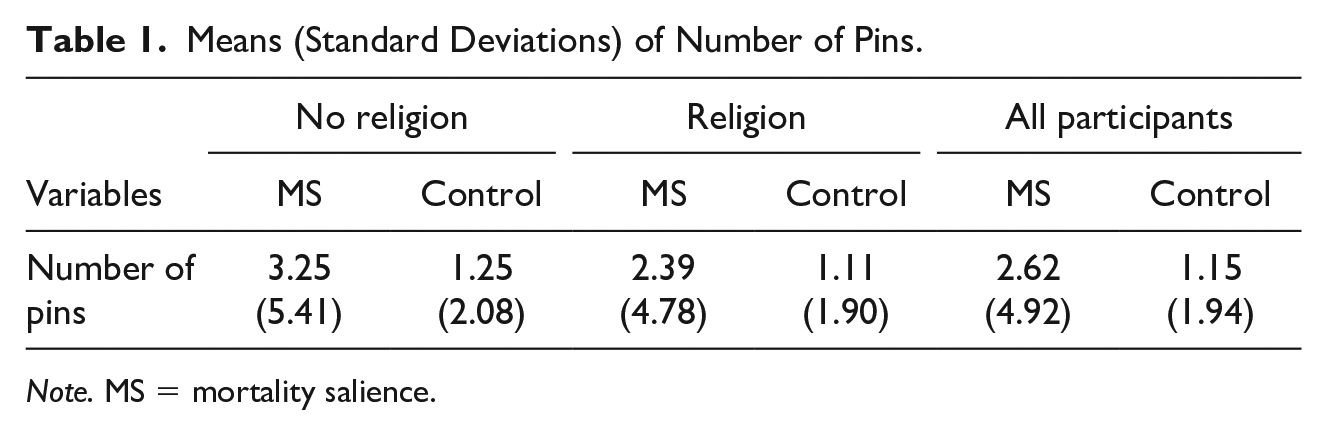
The descriptives are presented in Table 1. An analysis of covariance was conducted with condition (MS vs control) and religion (without religion vs with religion) as the independent variables, hurtfulness of the offense as a covariate, and number of pins as the dependent variable. There was a significant main effect for condition (F(1, 115) = 4.56, p = .04, ηp2 =.04). Participants in the MS condition used a significantly higher number of pins than participants in the control condition. There was no significant main effect for religion (F(1, 115) = .39, p = .53) and no significant interaction effect for condition and religion (F(1, 115) = .23, p = .63).
Means (Standard Deviations) of Number of Pins.
Note. MS = mortality salience.
Hayes’ (2017) PROCESS Model 1 was used to conduct a moderation analysis with condition (dummy coded with control condition as 0 and MS condition as 1) as the independent variable, extent of belief in God (M = 3.53, SD = 1.70) as a moderator, hurtfulness of the offense as a covariate, and number of pins as the dependent variable. There was no significant interaction effect between condition and extent of belief in God (p = .32) and no significant effect for extent of belief in God (p = .50). The effect for condition is close to significance (b = .2.87, t(115) = 1.84, p = .07) with participants in the MS condition using a significantly higher number of pins than participants in the control condition.
Discussion
The present study produced two findings. First, the results showed that participants in the MS condition demonstrated more aggression toward someone who had hurt them in the past compared to those participants in the control condition. Specifically, the MS condition participants inserted 2.3 times more pins in the voodoo doll than those in the control condition. Second, religion and extent of belief in God did not moderate the impact of MS on aggression. Regardless of the participant’s religion (i.e., with or without religion) and extent of belief in God, there were no significant differences in the number of pins inserted in the voodoo doll.
The results were consistent with previous studies that found an increase in aggression due to MS (McGregor et al., 1998; McPherson & Joireman, 2009). However, the underlying mechanisms are probably different. In previous studies, aggression was used to punish worldview-threatening individuals and eliminate their worldview. With the elimination of that worldview, the validity of the participant’s own worldview is strengthened, increasing its terror management function. In the current study, aggression appears to be used as a form of revenge to “eliminate” the person representing a challenge to the tripartite security system. Subsequently, the restoration of the tripartite security system enables it to act effectively as an anxiety buffer against death-related thoughts and awareness. Overall, the results provided support for the MS hypothesis.
Contrary to expectations however, our results showed that religion and extent of belief in God did not moderate the effects of MS on aggression. This was inconsistent with studies that found religion as a moderator of MS effects (Jonas & Fischer, 2006), an increased need for religion in response to MS (Vail, Arndt, & Abdollahi, 2012), and a positive relationship between religion and forgiveness (Ayten, 2012; Escher, 2013; Hui et al., 2006; Krause, 2018; Rye & McCabe, 2014). This might be explained by the way religion and extent of belief in God were assessed in the current study. Specifically, there have been disagreements on how religion should be conceptualized and assessed (McKay & Dennett, 2009). Religion has been operationalized in several ways. For example, some categorized religion as intrinsic versus extrinsic religiosity; others have measured participant’s spiritual awareness and/or perceived importance of religion as their measurement of religion (Gervais & Norenzayan, 2012; Pichon et al., 2007; Shariff & Norenzayan, 2007). Hence, it is unclear which form of religion measurements would moderate the effect of MS on aggression. Also, other research that examined the effect of religion (e.g., prosocial behaviors, punitive acts, moral hypocrisy, self-evaluation) also tended to compare participant’s high religiosity with low religiosity (e.g., Saroglou et al., 2009). However, this approach conflates uncommitted God believers (participant with religion) with non-God believers (participant without religion), making it hard to make definitive conclusions on whether the effects are due to religiosity alone (Galen, 2012). A valid instrument to assess religion is needed to correctly examine the moderating effect of religion in TMT research. Some researchers have suggested to measure individual’s religion implicitly. For example, Bering (2002) found that participants who explicitly indicated that they did not believe in afterlife implicitly agreed with the statements of an afterlife.
The difficulty in operationalizing religion is exacerbated by the lack of distinction between religious beliefs and belief in supernatural agents. According to the dual process model of religious cognition (e.g., Jong et al., 2012; Pirutinsky et al., 2015), individuals without religion can still subscribe to beliefs in supernatural agents (Uhlmann et al., 2008). In Singapore (and other Southeast Asian countries), the notion of supernatural agents is intertwined with major religions and folklores. While many individuals are involved in these superstitious practices (e.g., during the seventh lunar month, it is considered “bad luck” to walk alone at night when the doors of hell are opened and ghosts roam on earth), they do not claim to have any religion or religious affiliation. Consequently, it is unclear if the participants without religion in the current study are indeed irreligious. Taken together, these conceptual and methodological issues might explain the lack of an effect for religion.
Limitations of the study should be noted. First, participants from different religions were considered as one group for data analysis. While all religions are associated with forgiveness, there are differences across religions with regard to levels of forgiveness (e.g., some religions are more forgiving than others) and criteria for forgiveness (e.g., religions differ on the type of offenses that are forgivable; Rye & McCabe, 2014). Second, participants were not asked if they perceived the voodoo doll as an actual representation of the person (i.e., they believe they were hurting the person with the pins). Finally, the current study did not manipulate the recall of hurtful offense. This precluded a conclusion on the specificity of the effects of MS on aggression. For example, MS might also induce aggression on the voodoo doll among those who did not recall a hurtful offense, given the close relationship between death and sticking pins into a voodoo doll that represented a person. In the future, these limitations might be controlled by recruiting a larger and more diverse group of participants, asking participants their perception and belief in the voodoo doll, and introducing a control condition where participants do not recall any hurtful offense, respectively.
In conclusion, the current study showed that MS increased participants’ aggression toward someone who had hurt them in the past. This effect was found regardless of the participant’s religion (i.e., with or without religion) and extent of belief in God. The findings of this study are important because it provides evidence that MS would increase aggression using a different, culturally sensitive, measure of aggression among an Asian sample. With the proliferation of technology (e.g., internet and social media), people are reminded of death on an almost daily basis. Furthermore, given the prevalence of violence, there is a need to address the problem of death as an intervention for aggression. Unfortunately, since religion did not moderate the effects of MS on aggression, more research is needed to examine other variables that could serve as an intervention. With the proper management of terror, we move one step closer to the goal of peace.
Footnotes
Declaration of Conflicting Interests
The author(s) declared no potential conflicts of interest with respect to the research, authorship, and/or publication of this article.
Funding
The author(s) received no financial support for the research, authorship, and/or publication of this article.
