




Abstract
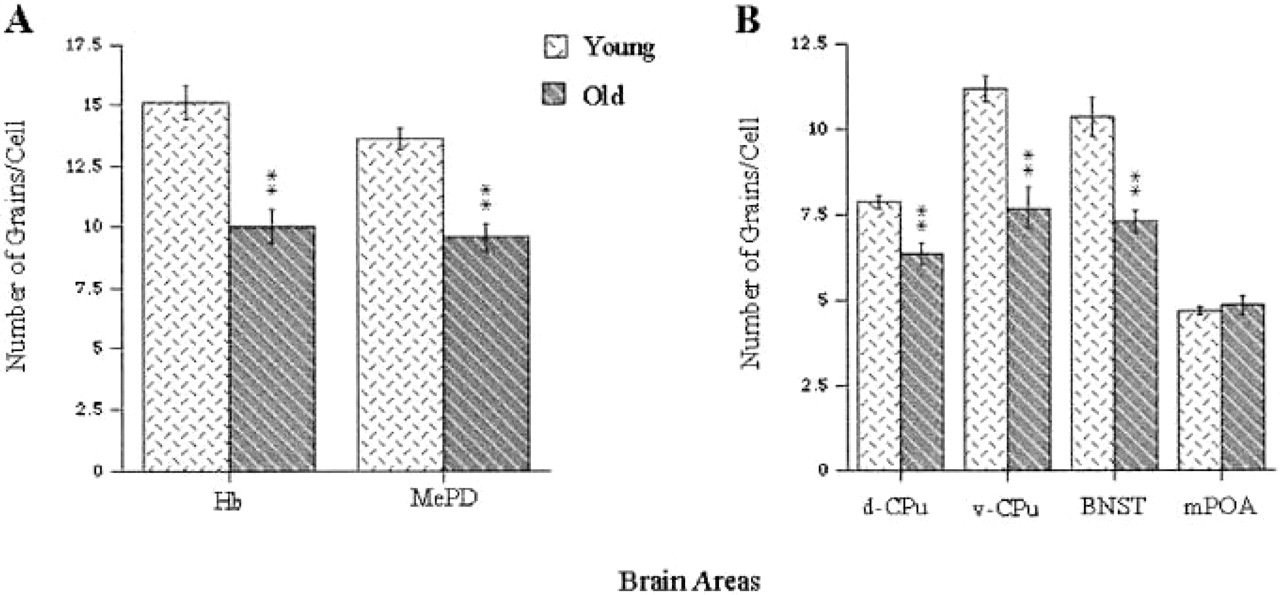
Preprotachykinin-A (PPT-A) mRNA levels in discrete rat brain regions were examined. Analysis of silver grains revealed a 19.2% and 31.5% statistically significant decrease in PPT-A mRNA in the dorsal and ventral caudate putamen (d-CPu and v-CPu), respectively, a 30% lower expression of PPT-A mRNA in the bed nucleus of the stria terminalis (BNST), a 33.7% decrease in PPT-A mRNA in the habenula (Hb), and a 30% decrease of PPT-A mRNA levels in the posterodorsal part of the medial amygdala (MePD). Results show that aging of the CNS is associated with widespread changes in tachykinin gene expression, suggesting that alterations in the tachykinergic system may have implications in the physiopathology of the elderly.
I
Tks are widely distributed in the CNS (Otsuka and Yoshioka 1993). Previous data have highlighted relevant interactions between Tks and the dopaminergic (Innis et al. 1985), the serotonergic (Regoli et al. 1994), and possibly the cholinergic system in basal ganglia (Lewis et al. 1985). Therefore, we investigated the effects of aging on the gene expression of Tks. Male young and old rats (2 months and 2 years of age, respectively) from the INRCA colony were employed. Hybridization histochemistry was performed as described previously (Lewis et al. 1985).
In situ hybridization results were examined with a Nikon Optiphot-2 microscope. As depicted in Figure 1A, PPT-A mRNA levels in young rats were not statistically different from those of old rats in the mPOA, whereas pairwise comparisons showed a statistically significant difference between young and old rats in the d-CPu (p < 0.05) and v-CPu (p < 0.01), as well as in the BNST (p < 0.01). PPT-A mRNA levels in the d-CPu were about 20% lower in old compared to young rats, and v-CPu and BNST showed a 30% decrease in PPT-A mRNA levels in old compared to young rats. Figure 1B shows PPT-A mRNA levels in Hb and MePD. Both areas highlighted an approximately 30% statistically significant decrease (p < 0.01 in Hb or MePD) in their levels of PPT-A mRNA in old compared to young rats.
This study shows significant changes in brain PPT-A mRNA levels during aging. PPT-A gene expression was markedly decreased in old compared to young rats in discrete brain areas, with special regard to the striatum. Tohgi et al. (1997) have recently demonstrated a reduction in the ratio of β-preprotachykinin mRNA to preproenkephalin mRNA expression in the putamen of elderly subjects or of patients with status lacunaris, suggesting that this reduction may have important implications in the susceptibility of elderly people, particularly those with ischemic damage to the striatum, to parkinsonism. Our results further extend previous radioimmunoassay data showing a decline of substance P content in aged compared to young rats in discrete brain nuclei, with special regard to the hypothalamus. In addition, several lines of evidence have led to the suggestion that aging involves an imbalance of brain aminergic and peptidergic systems. With age, there is evidence of decreased levels of striatal dopamine (Strong et al. 1982) as well as altered behavioral responses to dopamine agonists (Stoessl et al. 1989). Biomolecular studies have shown that PPT-A mRNA is markedly decreased in the neonatally 6-hydroxydopamine-induced lesioned rats, whereas only a small reduction is observed in the adult-lesioned rats, and that preproenkephalin mRNA is decreased in the striatum of both neonatally and adult-lesioned rats, suggesting that destruction of dopamine-containing terminals elevates enkephalin levels or decreases PPT-A levels by accelerating or slowing down transcription and/or translation processes, respectively. Finally, several authors have proved that the nucleus magnocellularis in rats is highly sensitive to the memory-enhancing effects of substance P. Interestingly, substance P is markedly decreased in the brain of patients with Alzheimer's disease, raising the hypothesis of a possible contribution of the cholinergic and tachykinergic systems to memory and learning deficits associated with aging and more specifically with Alzheimer's disease. A series of data have also been collected with regard to the implications of substance P in learning and memory processes (Huston and Haserhorl 1995). Therefore, it is concluded that there is a direct effect of aging on PPT-A gene expression and that the reduction of PPT-A mRNA levels could have some relevance to disease states associated with lower tachykinin levels.
(