




Abstract
Exclusionary immigration laws and policies have been shown to produce adverse mental health outcomes. However, less work has traced the processes through which mental health experiences arise and how undocumented college students employ their agency to protect their mental health. Drawing on 66 in-depth interviews, I build on my interviewees’ descriptions of mental health as a rollercoaster to illustrate how their stress process is shaped by immigration laws and students’ agency. I find that ever-changing and unpredictable immigration laws and policies promote feelings of emotional distress. However, students utilize their agency to uplift themselves and support their psychological well-being. Yet despite their actions, emotional distress and psychological well-being coexist in students’ everyday lives. Ultimately, I argue that students’ agency supports their psychological well-being, but the immigration law and policy context they are embedded in limits their efforts and instead places them in a perilous emotional rollercoaster.
Luca Ruiz, an enthusiastic 20-year-old undocumented college student in his second year of college, expressed his aspirations to pursue a doctorate degree. He shared with me that his journey to college had previously been marred by uncertainty because he wondered whether he could pursue college as an undocumented immigrant. While he described how his undocumented immigration status created educational barriers, he also reflected on how it affected his mental health. He shared, Okay, I would say my mental health is a rollercoaster. . . . Because I have so many ups and so many downs. Like my mood can change in like one second. . . . Right now, I’d say it’s really high.
Luca’s metaphor of mental health as a rollercoaster alludes to the array of feelings he experienced. He, like all the other students I interviewed, highlighted that immigration laws and policies are immensely unstable and unpredictable, which resulted in Luca feeling overwhelmed about his future because he has no status. Luca did not qualify for work authorization through the Deferred Action for Childhood Arrivals (DACA) program, which caused him to worry about covering the costs of academic supplies, rent, and groceries and even his future job prospects with his college degree. Yet he expressed hope for his future. He recognized that as an undocumented immigrant, the opportunity to pursue higher education was itself a privilege. He believed earning his degree would position him for success after college. In this article, I trace the emotional rollercoaster that undocumented college students experience to capture the range of emotions that they feel while navigating exclusionary immigration laws and policies.
Aligned with Luca’s experience, research has found evidence of adverse mental health outcomes among undocumented college students. Ever-changing and unpredictable immigration laws and policies foster experiences of emotional distress that negatively affect mental health (Enriquez, Morales Hernandez, and Ro 2018; Hamilton, Patler, and Savinar 2021). Indeed, undocumented college students experience heightened levels of anxiety (Enriquez et al. 2021; Flores Morales and Garcia 2021; Suárez-Orozco and López Hernández 2020), depression (Cadenas and Nienhusser 2021; Velarde Pierce et al. 2021), and suicidal ideation (Hagan et al. 2023). Although this work outlines the detrimental consequences of immigrant illegality (or immigration laws and policies) on mental health, less attention is given to their psychological well-being (or positive mental health). To contribute to this scholarship, I take a holistic approach where I examine both emotional distress and psychological well-being among undocumented college students.
Drawing on 66 interviews with undocumented college students in California, I contend that students experience mental health as an emotional rollercoaster wherein immigration laws structure a stress process in which they must exercise their agency to negotiate their emotional distress and promote psychological well-being. I build onto Luca’s description of a rollercoaster to trace the mental health processes of students. First, I outline the most common stressors that students experienced because of their undocumented immigration status. I find that these immigration-related stressors created two types of feelings: (1) legal uncertainty that emerges from current immigration-related stress and (2) legal insecurity arising from anticipatory immigration-related stress. Second, I discuss how these stressors drove downward motions that consist of students’ feelings of emotional distress. Specifically, students detailed experiencing spirals because they struggled with controlling their worries about their status. Third, I shed light on upward motions or students’ psychological well-being. This motion characterizes students’ efforts to meet their aspirations, reach their goals, and shift their perspectives on their status. Lastly, I show that despite students’ usage of agency, feelings of emotional distress persisted and coexisted with psychological well-being. Ultimately, I argue that undocumented college students’ practice of agency does promote their psychological well-being, but the immigration law and policy context that they are embedded in limits their efforts to protect their well-being and instead places them in a perilous emotional rollercoaster.
Background
The stress process perspective posits that a source of social stratification, such as immigrant illegality, exposes individuals to stress that negatively affects mental health outcomes, but individuals can utilize social support and coping to buffer the effects of stress. Studies on undocumented students find that they employ a variety of coping mechanisms to manage their stress (Cadenas et al. 2022; Kam, Cornejo, and Marcoulides 2021). Still, there is limited work on how structural conditions shape coping and mental health processes. Pearlin and Bierman (2013:331) offer directions for research on coping, “For example, little attention is given to possible differences in coping repertoires among groups differing in social and economic status, treating these differences instead as reflecting the personalities and dispositions of individuals.” They call on research to not only examine coping actions but also direct attention to structural and social aspects that contribute to unique coping circumstances. I do this by highlighting the structural constraints of students’ undocumented immigration status and counterbalancing that investigation with an examination of their agency and agentic actions.
Structural Stressors: Material and Everyday Risks of Illegality
Immigration laws and policies perpetuate inequality and consequentially drive the stress processes of undocumented college students. Immigrant illegality creates four significant dimensions of stress: threat of deportation/detention, financial insecurity, barriers to educational attainment, and social exclusion. One of the most extensively researched stressors among undocumented immigrants is the threat of detention and/or deportation (De Genova 2002). Without legal status, undocumented individuals are deemed “removable” from the United States. The possibility of being forcibly removed creates feelings of fear because it could lead to family separation (Ayón and Becerra 2013; Hagan, Lara, and Montanes 2021). Financial insecurity is a stressor that emerges because of the limitations around securing legal employment. Specifically, undocumented immigrants cannot access work authorization and/or a Social Security number (Amuedo-Dorantes and Bansak 2012; Chang 2019). This structural barrier results in undocumented immigrants having to work jobs that are often unconventional and underpaid and consist of unsafe workplace conditions (Fussell 2011; Gleeson 2010). An undocumented immigration status also limits pathways and success in institutions of higher education (Enriquez et al. 2019; Kreisberg and Hsin 2021). Finally, social exclusion ensues as a stressor because undocumented immigrants limit their participation in everyday social interactions to avoid consequences of exclusionary immigration laws, such as potential encounters with immigration enforcement (Dreby 2015; Enriquez 2020).
These stressors yield negative mental health outcomes because they increase feelings of insecurity. The feelings of fear created by deportability are associated with increased anxiety (Dreby 2015). However, recent studies have shown that concerns of deportation are contextual and vary according to an individual’s social locations (see Enriquez and Millán 2019). As such, scholars have moved to consider how other aspects of illegality affect mental health outcomes. For instance, Suárez-Orozco and López Hernández (2020) found that financial strain among undocumented students is more likely to cause anxiety than students’ deportation concerns. Another study found that higher anxiety levels were associated with undocumented college students’ high persistence in schooling (Cadenas et al. 2022). Velarde Pierce et al. (2021) found a direct association between legal vulnerabilities (i.e., discrimination, social exclusion, threat to the family, and economic insecurity) and depression and anxiety. Relatedly, there is also evidence that suggests that undocumented students experience higher levels of suicidal ideation than their U.S. citizen peers with lawfully permanent resident parent(s) (Hagan et al. 2023).
Undocumented students’ immigration-related stress also distinctly and significantly emerges from anticipatory changes to immigration policies. Immigration scholars highlight that immigration laws and policies create a multilayered and multidimensional context that affects well-being. Silver (2018:11) writes, “the social institutions in which they are involved, and the institutional, local, state, and federal policies that determine their access to resources, all act as tectonic plates, sometimes moving them toward incorporation and other times shifting them farther toward the margins.” Undocumented immigrants must cope with policy shifts that move in unison or pull in opposing directions. These shifts are consequential for their incorporation but also inevitably affect their mental health. Accordingly, research found that inclusive immigration policies can improve mental health outcomes and that exclusionary ones worsen them (Hatzenbuehler et al. 2017).
The DACA program demonstrates how immigration policies can promote well-being, but their ever-changing nature compromises these effects. Established through executive action by President Obama in 2012, DACA grants beneficiaries work authorization and protection from deportation. Obtaining DACA reduces financial strain by granting work authorization that facilitates beneficiaries’ ability to gain legal employment (Amuedo-Dorantes and Antman 2016). DACA is also credited for decreasing poverty among undocumented individuals (Pope 2016). In minimizing these material risks of illegality, students with DACA report decreases in their feelings of distress and improvement with their psychological well-being (Patler and Pirtle 2018). However, continuous threats to terminate the program halt these outcomes.
Ongoing court injunctions to terminate DACA have thwarted positive health effects and instead increased negative mental health outcomes. DACA is the most inclusionary federal immigration policy in recent years, but it is not a permanent law; it is an executive order. This is consequential because presidential terms end, and executive power transfers to a new president, who then holds the jurisdiction over whether to uphold an existing order (Johnson 2017). DACA’s legal reality as an executive order becomes detrimental for undocumented students’ well-being because they contemplate the possibility that the program may abruptly come to an end. Threats to remove DACA create feelings of uncertainty as beneficiaries worry about how they will secure or maintain employment should the program be revoked (Hamilton et al. 2021). This is especially prevalent among college students with DACA because they worry whether they could use their degrees in the future (Morales Hernandez and Enriquez 2021). Finally, DACA beneficiaries fear that the program’s termination would make them easily identified or targeted for deportation (Burciaga and Malone 2021).
Overall, research highlighting the structural constraints associated with immigrant illegality finds that adverse mental health outcomes emerge because of immigration-related stressors. Although these findings affirm immigrant illegality as a source of social stratification, there is also evidence that undocumented students cope with these stressors. This reinforces the need to explore positive mental health (or psychological well-being).
Spotlighting Agency: Positive Mental Health among Undocumented College Students
Sociological research has identified coping and social support as assets that individuals use to help prevent or reduce the negative consequences of stressors (Pearlin and Schooler 1978). Among undocumented college students, social support has been identified as a promoter of well-being because it facilitates students’ navigation of their college campus. Furthermore, studies on undocumented students’ mental health have outlined that coping mechanisms, such as positive reframing in their thoughts, are used to manage immigration-related stressors. Collectively, this work suggests that undocumented students’ employment of agency improves their well-being.
Relying on social support is an agentic action that undocumented students use to promote their well-being. However, findings on the effects of social support are mixed. For example, undocumented students in higher education have been found to rely on their social support comprised of peers and mentors that increase their feelings of belonging and decrease their senses of isolation (Gámez, Lopez, and Overton 2017). One study found that social support among undocumented college students served as a protective factor against anxiety (Suárez-Orozco and López Hernández 2020). By contrast, another study found partial evidence that social support served as a moderator between legal vulnerability (i.e., discrimination, social exclusion, financial insecurity) and mental health but not necessarily that it promoted mental health (Velarde Pierce et al. 2021). Their finding could be partially explained by broader studies on immigrants that have found that social support could exacerbate anxiety and depression (Chadwick and Collins 2015; Guntzviller, Williamson, and Ratcliff 2020).
Undocumented students also practice their agency by employing coping strategies to buffer the effects of immigration-related stress on their mental health. Kam, Pérez Torres, and Steuber Fazio (2018) found that students practiced diverging, reframing, and/or normalizing their thoughts about their undocumented immigration status to manage their stress. In the same breadth, undocumented students employed psychological coping (i.e., confident, empowered, and optimistic coping) to positively reframe the negative thoughts that they had of their status (Kam et al. 2021). Cadenas et al. (2021) found that students’ critical agency (or their individual agency) and motivation for making a difference weakened the indirect effects of discrimination on depression.
This work supports previous research that undocumented students experience positive mental health despite exclusionary immigration laws and policies. This is important because it indicates that multiple factors and contexts are actively shaping well-being. The purpose of this study is to holistically illustrate the mental health processes of undocumented college students. To meet this goal, I conceptualize their mental health as an emotional rollercoaster to examine both negative and positive experiences of mental health. Tracing this full process is necessary to both understanding why social and health inequalities persist and identifying ways to intervene in these inequalities.
Data and Methods
I drew on 66 interviews conducted with undocumented students attending college at one of California’s public university systems. California hosts three public university systems: University of California (UC), California State University (CSU), and California Community Colleges (CCC). The UC and CSU are four-year universities with differing institutional commitments and admissions selectivity, and the CCC are 2-year colleges. All participants were 1.5-generation immigrants, and about a third of participants were DACA beneficiaries. Although the sample was designed to include a comparison on immigration status, the sample reflected national and state trends in this shrinking student population due to ongoing court injunctions. However, there were enough DACA recipients to compare across status, allowing me to explore variations on experiences of mental health. The sample has an overrepresentation of females and Latina/o/xs: 73% (n = 48) identified as female, and 27% (n = 18) identified as male; 95% (n = 63) of respondents identified as Latina/o/x, and 6% (n = 4) did not. 1 Table 1 displays demographic information by university type and immigration status.
Participant Characteristics.
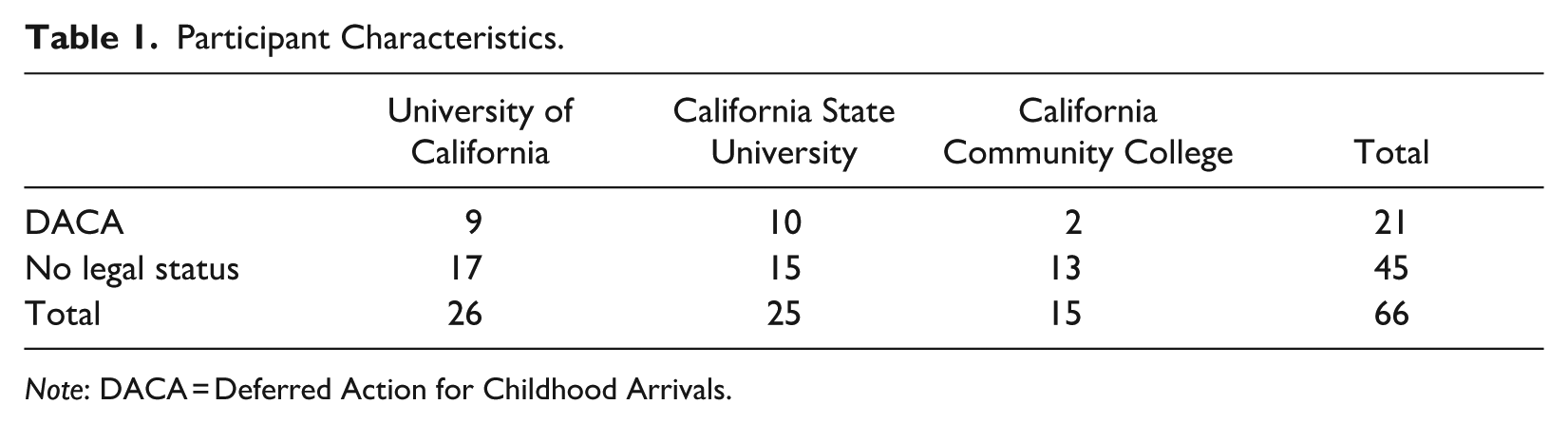
Note: DACA = Deferred Action for Childhood Arrivals.
Interviews were conducted between March and October 2022. They were guided by a semistructured interview guide. I conducted most interviews via Zoom. To recruit participants, I asked members from my personal network within the undocumented student community, which I built over the past eight years through my participation in undocumented student advocacy efforts, to forward a copy of my project information sheet to students. I also relied on snowball sampling where I asked interviewed students to forward a copy of my project information sheet to students they thought were interested. Participants received a USD $30 cash incentive for their interview participation. Prior to the start of each interview, participants completed a pre-interview intake form that inquired about demographics and administered the Patient Health Questionnaire-9, General Anxiety Disorder-7, and flourishing scales. Interviews lasted between 1.5 and 2 hours. The interview guide included questions about how they experienced emotional distress and psychological well-being and asked what hindered or promoted their feelings of each.
Interviews were recorded, transcribed, and coded using Hyperresearch. All interviews were index coded for significant and common themes (Deterding and Waters 2021). Index codes aligned with the sections from the interview questionnaire, and this study focused on the sections of emotional distress and psychological well-being. A second wave of index coding captured different components of these dimensions of mental health. For emotional distress, these included responses to the questions concerning anxiety, depression, and exhaustion. Psychological well-being outcomes included feelings of happiness, optimism, and competency. The responses in these sections were reviewed to identify common patterns and develop analytic codes.
Following index coding, I developed the emotional rollercoaster analytic codebook. Preliminary findings from index coding showed that students experienced both emotional distress and psychological well-being. Students described these experiences as “downs” and “ups,” respectively. In addition, students identified that their status created current and anticipated stress because of the unpredictability of immigration laws. Accordingly, I created two sets of analytic codes to capture these stress differences: legal insecurities (i.e., academics, deportation, political climate) and legal uncertainties (i.e., losing DACA, never getting DACA, post-college academics). To capture the range of feelings that students experienced, upward motions codes consisted of “active problem solving,” “best-case scenario thinking,” and “building themselves up.” Downward motion codes included “mental breakdown,” “substance use,” and “inability to control worries/spiral.” I served as the primary coder and trained one research team member, and together, we resolved inconsistencies if they arose. For example, many students discussed experiencing coexistence of ups and downs in their mental health. We proceeded to code these passages as both upward and downward motions. I explore the dynamic between these motions in the following and pay specific attention to how ever-changing immigration laws and policies inform this coexistence.
Results
The Rollercoaster Track: Immigration-Related Stressors
To illustrate the emotional rollercoaster, I first set the rollercoaster track representing immigration laws and policies. Students mainly experienced three immigration-related stressors: threatened immigration policies, financial concerns, and deportation worries. These stressors fostered feelings of legal insecurity and uncertainty. Feelings of insecurity arose from current stressors related to students’ undocumented immigration status. Feelings of uncertainty emerged from students’ anticipation of immigration-related barriers in their future. Characterizing these similar but distinct feelings highlights the arduous emotional consequences of ever-changing and unpredictable immigration laws and policies and outlines why students’ mental health experiences are unique and complex. Collectively, these structural stressors promoted emotional distress among undocumented students.
Central to students’ everyday lives were the threats to change immigration laws and policies. Specifically, all students discussed concerns over the potential removal of DACA. DACA was important for undocumented college students because it provided access to a work permit and protection from deportation. In other words, it minimized the consequences of an undocumented immigration status. Lucy, who a few months prior had become a DACA beneficiary, discussed her concern over the future of the program: I just recently got DACA last summer, so I’ve had it for a year now. And I’m, extremely grateful. And I know last week, DACA went back into court. And that made me extremely anxious [tearing up].
Lucy was one of the few students that processed their DACA applications during the brief period (January 2021 to July 2021) in which President Biden reinstated the program. However, at the time of data collection, a federal district court judge in Texas challenged the constitutionality of DACA and provisionally blocked the approval of new applications. As a result, beneficiaries like Lucy felt worried because the threat of potentially losing DACA would strip them of their work authorization and protection from deportation. To remain updated on these threats, Lucy was constantly visiting news sites to keep informed. Unfortunately, these actions further fueled Lucy’s feelings of anxiety, which also affected her academics because she began having trouble concentrating in class. Although not all students had DACA, ambiguities around the program steeped into the concerns of students without DACA because they worried about their own prospects in receiving legal protection and relief in the future.
Students without DACA expressed concern over never accessing the benefits of the program. Maricela discussed her worries about never getting DACA. She shared: That was something that I was looking forward to [getting DACA] . . . that was going to be my way of finally being able to help my dad and pay the bills. Ever since, the news came out . . . I go back to the thought of, “Okay, whatever, it doesn’t come back. What am I going to do then?”
Maricela hoped that post-Trump, she would be able to apply for DACA, but the ongoing legal disputes did not allow for herself and other eligible youth to apply for consideration and secure legal work authorization. Maricela felt insecure because she was not able to provide for her family, and she was uncertain if she would have the infrastructure to access a Social Security number in the future. Lacking a Social Security number hindered students’ ability to legally secure a job, which increased their likelihood of experiencing financial difficulty. Often, without a Social Security number, students were forced to seek employment and economic support through unconventional means that made them vulnerable to unsafe and underpaid work conditions that increased feelings of weariness and exhaustion. Maricela’s feelings align with recent work that demonstrates how failed political promises and shortcomings to address immigration at the federal level have detrimental consequences on mental health (Coutin, Chacón, and Lee 2024).
Threats to remove legal work authorization pathways strained students’ mental health by casting feelings of doubt around their financial futures. Ana, a fifth-year student, discussed her feelings of uncertainty when thinking about her financial security in the future: I would like for us to own a house in like a safer environment. And so, that’s kind of stuff that worry me, even now . . . I just really want [my] family and I to live in a safer, healthier environment.
Approaching her final undergraduate term, Ana had begun to think about her transition out of her UC campus. Ana had work authorization but still felt nervous over whether she would be able to provide for her family in the future because of unpredictable immigration laws. The consequences of these feelings of uncertainty on mental health mirror existing work that identified political threats’ role in limiting the positive effects of inclusionary policies, such as DACA, and instead create new legal strains for undocumented college students (Morales Hernandez and Enriquez 2021). This stressor was anticipated, yet it contributed to students feeling unsettled and nervous while in college.
Underlying legal constraints compromised students’ post-college educational opportunities that further contributed to students’ feelings of uncertainty. A little over half of all students expressed interest in pursuing some form of post-college academic program. Although California has implemented inclusionary laws to facilitate accessibility to higher education for undocumented students, undocumented college students still experienced financial challenges while pursuing their degrees. Natalia, a senior who wanted to go to graduate school, shared her financial concerns: I think first, I want to continue my education [pause], “How am I going to pay for it?” . . . I think throughout my education, I’ve always been like thinking about, “How am I going to fund? How am I going to be able to stay in school?”
For Natalia, she was not only thinking about how to fund her current educational expenses, which included her academic supplies and living expenses, but she was also trying to plan how she could fund her graduate studies. Despite inclusive state policies and efforts from undocumented student programming to demystify attending graduate school without legal status, funding sources were scarce and competitive. Additionally, eligibility restrictions on funding according to immigration status could further complicate undocumented student pathways into graduate school. This makes undocumented students’ preparation for a graduate program complex and often a case-by-case basis. However, meeting her current financial concerns limited Natalia’s availability to participate in opportunities that would prepare her for graduate school. This coupled with the funding uncertainty for graduate school fueled her sense of doubt on whether she would be a competitive applicant and made her nervous for her plans postcollege.
Lastly, deportation concerns were a significant structural stressor created by immigration laws and policies. Among students interviewed, it was not common for them to be the subject of a potential deportation or detention. However, this was the case for Jacob, he shared: In 2021, I was detained by ICE [U.S. Immigration and Customs Enforcement], and I had to spend three months in court and detained. . . . I currently have an open case, by the government against me, and I’m in removal proceedings. . . . That puts a heavy burden on me and my family.
His ongoing immigration case caused him to feel concerned and insecure because he was having to manage removal proceedings. He also had feelings of fear and uncertainty because he did not know if he would eventually be deported and separated from his family.
Although it was uncommon to worry about their own deportation, most students talked about the concern they had for their family members. Emmanuel shared: I’m more scared about my parents. Because they don’t have any status . . . I have three siblings, so I’d have to take care of them in any case of the deportation. And that actually worries me.
Students felt insecure because they experienced instances where they worried if their parents had been apprehended. They also had feelings of uncertainty as they thought about the potential consequences of their parents’ deportation, such as taking care of siblings. These findings align with existing research. Specifically, Enriquez and Millán (2019) found that deportation concerns for oneself were not as common among undocumented college students because of their positionality as college students and because they generally have access to more legal protections as young adults who have completed their K–12 education in the United States.
Downward Motions: Emotional Distress
Downward motions were a result of immigration-related stressors that created persistent feelings of insecurity and uncertainty. Unstable immigration policies complicated students’ efforts to control how much they worried about their status. Students described that their feelings of emotional distress culminated in an emotional spiral where they experienced feelings of hopelessness, disruption in their everyday activities, and in some dire cases, substance use.
Feelings of legal insecurity and uncertainty filled students’ thoughts with concerns and doubts. Throughout our conversations, students frequently mentioned that their constant worries contributed to them “spiraling.” I began asking them to describe what that meant to them. Olivia shared: When I think of spiraling, I think like a tornado. Because everything’s up in the air, it all intersects within each other. It’s all bouncing back and forth moving around constantly, there’s no grounding to it.
These unavoidable thoughts were fueled by threats to terminate DACA, which created feelings of uncertainty around whether she would be able to work in the future to provide for her child. For Olivia, these led to her having panic or anxiety attacks. Tómas further detailed the thought process of a spiral: The first thing that happens, I start overthinking things, and the first thing that will always come up is, “Oh, you’re also this [undocumented],” and then that causes me to spiral down even worse. . . . I think that intensifies it. . . . I just ended up feeling worse because of my status.
The threats to change immigration laws increased Tómas’s feelings of nervousness, and they also affected Tómas’s physical well-being. He mentioned that his spirals resulted in him having frequent headaches, losing his appetite, and feeling extremely tired, tense, and restless. Although different immigration statuses (i.e., DACA, undocumented) uniquely shaped student experiences (Morales Hernandez and Enriquez 2021), feelings of insecurity and uncertainty persisted among all students because they all experienced the structural stressors associated with not having a permanent legal status. Indeed, spirals were common among both undocumented students with DACA and those without.
Spirals had detrimental consequences for students, one of which was that it increased their feelings of hopelessness. Leah recounted how this affected her: A few weeks ago, where I had no energy. . . . I was kind of depressed, I had a whole week, just being sad. . . . I was really sluggish. I kind of considered, “What if I just drop out” . . . “How would I even be able to go into the career field that I’d like to go into without a social? How would I get a social on time for graduation?” It’s pretty unpredictable.
Balancing academic insecurities, financial insecurities, and uncertainties along with insecurities and uncertainties around whether immigration laws and policies would negatively change affected her well-being. This resulted in Leah feeling exhausted and questioning whether her pursuit of a college degree as an undocumented student was worth it.
This exhaustion left students vulnerable to experiencing physical disruptions in their lives. Maria described: I didn’t have any pleasure in life. And then I noticed that I didn’t really want to do anything, I didn’t want to get out of bed, I didn’t want to leave my house, I wanted to stay in, even taking my dogs out was a chore.
Students who recounted this experience, like Maria, recognized that this experience was not normal for them. However, breaking through the dark thoughts around immigration laws proved to be difficult. Some students resorted to coping strategies that compromised their well-being. One such coping mechanism was substance use. Carmen shared: I was smoking [marijuana] five times a day, almost dropping out of college because I could not cope with my own brain because these thoughts were always there. They never ever left. Even when I tried to sleep, I couldn’t. I was thinking, “Where am I going to get money?” I can’t work.
Carmen and a few other students described substance use as an action that would distract them from thinking so many negative thoughts about what could happen with immigration laws and policies. However, engaging in substance use did not yield healthier results. Carmen realized that it worsened her mental health because she became increasingly lethargic and restless. Although this coping strategy provided temporary and short-term relief, it also contributed negatively to mental health. Counterproductive mechanisms like this led students to seek alternate ways to boost their mental health.
Upward Motions: Psychological Well-Being
The next portion of the rollercoaster includes upward motions. These motions consisted of students’ psychological well-being, which all students experienced. Students characterized upward motions as the positive feelings they had when relying on their social support, employing their agency to address challenges created by their status, envisioning their futures, and shifting their perspectives.
Undocumented students relied on their social support to process the emotional consequences of their status. Mental health research affirms that individuals experiencing stress could draw on their social support to protect their well-being. Tómas shared why he decided to talk about his status with his immediate friends: They listened, they cared, and I felt like that gave me some sort of hope that I will be accepted in the future. . . . I feel like that just gave me the extra hope, the extra push . . . to not focus too deeply on this [his status] in a negative sense and start seeing myself in a more positive light.
Tómas felt unable to be his authentic self because he could not openly discuss his status. To his surprise, all his friends expressed their support. No longer afraid his status would lead to rejection from his peers, Tómas began feeling more hopeful and optimistic. Having these feelings ultimately increased his self-worth and motivated him to continue pursuing his goals.
Undocumented students also drew social support from attending undocumented student programming events on their campuses. Lucy shared on the impact of attending events with other undocumented students: I mean, once you leave [an undocumented student event], it’s made me feel like I definitely belong here . . . and just knowing communities here, even if they’re not blood, it’s knowing that they’re that group of people that will be there for you.
Many students, like Lucy, expressed having little to no undocumented college students in their networks. Students were aware of the limited number of undocumented college students on campus; it is understandable why they felt that they did not belong at their college campus. Engaging with undocumented student events facilitated expanding their network but also allowed for students to share their experiences with each other. Research has highlighted the positive role that undocumented student centers on campuses have on the academic performance of undocumented students (Cisneros et al. 2022). Emily further elaborated on the impact of attending these events on her well-being: So just creating friendships with people that understand you. It feels so good [chuckles], it’s such a huge support system, seeing these other people work just as hard as you. It gives you so much motivation.
Students developed a sense of belonging by forming friendships where they could share and validate each other’s struggles. It reminded them that they were not the only individuals on campus that encountered these hardships. Many students, like Emily and Lucy, discussed feeling motivated and inspired by their peers to excel academically. Aside from social support, students found other ways to manage the negative thoughts that they had about their status.
Critical for all students was to reframe their negative thoughts and instead draw strength from their status. I asked students how their status harmed their mental health, so it was fitting to also ask them how it affected their mental health positively. Sabrina shared: It’s what made me so strong. It’s what made me so resilient. It’s what made me so hard working. It’s what made me have that feeling of indestructible-ness. And my confidence is because of that. At first, I thought, “I’m not gonna be able to do anything, nothing is possible.” And then I started doing so much. And then I started seeing everything I was capable of.
Sabrina reflected that despite the challenges created by her status, she and other undocumented students at her college continued pursuing their degrees. Instead of focusing on the limitations around her status, she recognized that she actively made decisions to address her academic insecurities, found ways to address her financial insecurity, and ultimately made some peace with not being able to control the uncertainties around her status.
Students were also able to draw strength by continuing or reaching their academic goals. Naomi shared: Graduating from community college and getting accepted to all of the colleges that I applied to, was definitely a big motivation and also made me feel good about myself. . . . I think my curiosity keeps me flourishing or growing in my mentality. That makes me excited to learn about things more in depth.
Naomi, like all other students, identified that reaching their academic goals simultaneously improved their psychological well-being. This is because meeting their academic goals made them feel capable and accomplished. Drawing strength from their status was also facilitated by the agentic actions students took to address their structural marginalization.
Undocumented students employed active problem solving by actively seeking resources to support their educational goals. This has previously been found in research on undocumented students. For Leah, she engaged in active problem solving before she transferred to her college. She shared: My final semester [of community college] I reached out to the coordinator of the [Undocumented Student Services] at this campus, and I asked him where resources are available to undocumented, and AB540 students on campus.
Leah identified as an undocumented student without DACA. Knowing that her employment options were limited, she took initiative to find resources that could lead her to securing economic and academic support while being a student at a four-year college. She credited this with promoting her psychological well-being because she built ties with the staff at the campus’s undocumented student program and secured an internship at the program. Furthermore, her active engagement in these programs increased her feelings of optimism because she gained professional development while also supporting her community.
Other students met their educational goals by problem solving outside of undocumented student spaces. Samuel said: I had applied to [research program] . . . they told me that I didn’t qualify [because of immigration status]. . . . I started talking to my professors, and building relationships, and I told them what had happened. And they asked me if I wanted to work with them on research. Now I work with in three different projects with the three different faculty.
Samuel reflected that this experience was ultimately more fruitful for his professional development than the initial research program he applied to. It also affirmed his desire to pursue a career doing research. Receiving these research opportunities made Samuel feel empowered and motivated to pursue graduate school. Despite legal constraints, students still chose to employ active problem solving by advocating for themselves to prepare for their futures. Institutions are important to facilitate students’ processes in looking for solutions. Students not only practiced their individual agency to achieve academic goals, but they also engaged in collective actions to improve their campuses, which enhanced their psychological well-being.
Undocumented students employed their agency by becoming involved in advocacy efforts to advance educational equity for undocumented students on their campus. Most of the undocumented students interviewed (n = 45) did not have access to employment on campus. This is because there were no laws or policies that facilitated obtaining a Social Security number or work authorization for undocumented students. As a result, undocumented students in California became involved with on-campus and state-wide efforts to campaign for equal employment opportunities on university campuses.
2
Fernando participated in these efforts and shared how they impacted him: Definitely advocating for myself. I feel like with those experiences, I’ve been able to stand up for people, or for people like me. . . . I’ve learned about resources students can take advantage of. I also learned about myself. I feel that being a role model within my community is essential for my character.
The advocacy by Fernando and his peers led to the establishment of a fellowship program on his campus that provides professional development and economic support for undocumented students regardless of their immigration status. Participating in these collective efforts increased Fernando’s sense of empowerment and reinvigorated his feelings of optimism because, along with his peers, they successfully invoked change on their college campus.
Undocumented students took initiative to learn about immigration laws and policies to manage the constraints of their immigration status. Transitioning into college required students to adjust to rigorous academic expectations, but they also had to strategize on how to address their legal vulnerability. For example, students worried about the potential deportation of a family member. Julieta shared how learning about immigration laws and policies helped her manage her deportation concerns: It’s made me become aware of what I can do because of my status. . . . I think being knowledgeable in that aspect of the program or being knowledgeable in what to do. In case someone I know gets deported, I know what to do. Because I’ve retained the information.
Julieta attended undocumented student conferences where she learned about her legal rights, which helped address some preconceptions her family members had over deportation and detention. Although this action did not resolve all the challenges created by her status, it eased her anxieties around detention/deportation by allowing her to understand her rights as an undocumented immigrant. Ruby further shared on how learning about immigration laws impacted her: Before I felt as if I was just like a pushover. . . . So now I’m just like, “I’m an immigrant. So what? I belong here just as much as you belong here. I have worked hard just as much as you’ve worked, but maybe I have worked a little bit harder. But why does that indicate if I belong here? Like, who are you to dictate who I am?”
Learning about the structural disparities experienced by undocumented immigrants revived students’ senses of belonging on their campuses. It affirmed to students that they deserved equal access to resources on campus and reminded them that they could advocate to address on-campus disparities. In doing so, they recognized their capabilities while navigating higher education, which increased their self-worth.
Employing their agency promoted undocumented students’ psychological well-being because it allowed for them to envision opportunities for themselves. For Maricela, using her agency inspired her to make an impact. She shared, “I have all these different opportunities [as a student] . . . and it has helped me feel that I’m doing good, and I can still do this in the future.”
Reflecting on the resources available to her as a student, Maricela felt gratitude. This allowed for her to see beyond her struggles and instead feel motivated to contribute to making her campus an inclusive space for undocumented college students. For Nina, her experiences on campus inspired her career goals. In particular, she participated in a program that provided her with $4,500 for a fellowship placement. She shared: I think the [Undocumented Student Fellowship] was a program I was trying to start in community college. And I remember at the time, it felt so unrealistic to me . . . and then when I transferred here, I was like—they have it here! . . . I always had this mentality that I was going to come back to my community college and bring a program like that someday or even be a counselor specifically for us.
Participating in this fellowship program allowed Nina to see how she could have career opportunities despite not having DACA. This made her feel hopeful and prepared because she now has career-relevant experiences. The program empowered and inspired her to make an impact. Not only did she envision career opportunities for herself, but she also aspired to create similar opportunities for others.
Undocumented students shifted their perspective by accepting that they were not fully in control of changes to immigration laws and policies to promote their well-being. Cynthia shared: Policy changes in “da da da” and, and renewals and approvals—federal courts are constantly changing their minds. There’s this whole thing when you’re constantly hanging on to this [hope in government action] . . . when I felt like I finally let go of that, it was like, “No, I’m gonna be okay, whatever happens.” I wasn’t stressing out as much anymore.
The saliency of insecurity and uncertainty experienced by undocumented students caused them to constantly seek solutions to the constraints created by their status. Ironically, this very sense of urgency had detrimental consequences for their mental health. Students eventually had to learn how to not consistently think about immigration laws and policies. Cynthia later added, I’m gonna keep doing what I’m doing. I know that maybe it [immigration law or policy] changes. And if it doesn’t, then “oh, well,” I just have to find some way around that when it happens.
In other words, students had to continue pursuing opportunities in hopes that systemic changes would occur. Javier and Lorena, respectively, further shared: I never think I’m not going to do it, because I might not have pay or might not have some kind of status. I’m going to work up to it and try my absolute best. So that if I do get a status, that’s great, I did everything that I could, and it’s going to be worth it. . . . I could think about how I really have no certainty or I can just try my best and hope that I do. I guess deep down I always tell myself that there’s no way that I will for certain know how my future will look like . . . so, I always tell myself, “Whatever happens, it happens.” But one thing is for sure, “You’re gonna try, you’re gonna do it.” And, if something happens, that’s just outside sources that are preventing you from doing it. But you know, nobody could say that you didn’t try.
Ultimately, all students had to hold onto hope that their status could change and that there would eventually be a structural change or answer. Students like Javier and Lorena expressed feeling fatigued when they thought too much about ever-changing immigration laws and policies. However, students gained a fresh sense of hope when they resolved to pursue their goals regardless of immigration policy outcomes. Despite experiencing fear, they were just as hopeful and willing to work hard and move forward.
The Loop: Coexistence of Emotional Distress and Psychological Well-Being
Although students negotiated their emotional distress and utilized their agency to promote their psychological well-being, the immigration law and policy context that they were embedded in did not allow for students to solely experience psychological well-being. Noah illustrated how quickly changes to immigration laws and policies affected his mental state. He shared: Joe Biden got elected and he was democratic, he was saying that he was going to do all these things for dreamers. . . . In 2021 . . . beginning of August . . . after the Texas [DACA] ruling, new applicants weren’t allowed into the program. I definitely was . . . very sad . . . that was definitely . . . a very . . . depressing time.
Noah was experiencing an upward motion in his emotional rollercoaster: For a moment, it seemed that immigration laws would shift in his favor. He was feeling hopeful that he would be able to apply for DACA and financially support himself during college. However, the rapid shift in immigration policy abruptly sent him in a downward motion. He reverted to experiencing emotional distress and a plunge. These sudden changes felt like whiplash, with sudden ups and downs. These were disorienting and harmed his mental health by increasing feelings of legal insecurity and uncertainty.
Unstable and unpredictable immigration laws and policies could lead to coexistence of emotional distress and psychological well-being. Sebastian shared: When you start to think bad, it’s like you enter this spectrum of darkness, and you want to find the light, and you dig yourself in more. Because you’re thinking about it, you’re trying to find a solution. . . . Working out and studying or thinking of ways to not think about it’s the best way to get rid of them temporarily, but you know, they come back.
Much like other students, Sebastian experienced this perilous rollercoaster ride. When students experienced a downward plunge, they felt a spectrum of darkness. However, they practiced their agency and looked for solutions to bring themselves out of this and promote their well-being. However, the negative feelings quickly returned because students were acutely aware that immigration laws and policies could become more exclusionary at any moment. These thoughts brought them back to darkness as they faced the structural realities of their exclusion. As a result, agency was not always enough to eliminate the arduous feelings of legal insecurities and uncertainties. This left them feeling the whiplash of perpetual ups and downs.
Discussion
The goal of this article is to holistically capture undocumented college students’ mental health by examining their experiences of emotional distress and the agentic actions that they take to promote their psychological well-being. I conceptualize undocumented students’ mental health as an emotional rollercoaster to capture the range of emotions that they experience while navigating exclusionary immigration laws. I find that threats to change immigration policies, financial worries, and concerns over deportation are all stressors that create feelings of legal uncertainty and insecurity. These feelings of insecurity and uncertainty are consequential because students constantly process the repercussions of their undocumented immigration status. Motions on their emotional rollercoaster ensue as students employ their agency to manage their immigration-related stress. However, unstable immigration laws limit their efforts and result in coexistence of emotional distress and psychological well-being. I argue that undocumented college students practice their agency to negotiate their emotional distress and instead promote their psychological well-being, but the immigration law and policy context that they are embedded in limits their efforts to protect their well-being, which unwillingly places them in a perilous emotional rollercoaster.
Undocumented college students experience structural stressors that foster emotional distress. I find that immigration-related stressors create two main types of feelings: (1) legal insecurity stemming from current stress and (2) legal uncertainty manifesting from anticipatory stress. Distinguishing these types of emotions demonstrates why structural inequalities, particularly legally precarious ones, create unique stress experiences that influence coping. Previous work has outlined the adverse mental health outcomes among undocumented college students. They have been shown to have high rates of anxiety (Suárez-Orozco and López Hernández 2020), depression (Velarde Pierce et al. 2021), and suicidal ideation (Hagan et al. 2023). My work builds on these findings by shedding light on the arduous emotions that undocumented students manage and how they cause them to spiral.
Practicing agency can yield positive mental health outcomes in the face of exclusionary immigration laws. Students employ their agency by finding solutions to address their structural marginalization that allow them to draw strength from their status. This is unique from other external coping strategies because they internally identify their creativity and tenacity while pursuing their education (Cadenas et al. 2021; Kam et al. 2018). In other words, students shift negative thoughts about their status to instead utilizing their agency to resolve problems, which bolsters positive thoughts about themselves. Relatedly, students envisioning opportunities for themselves regardless of their status promoted their psychological well-being. Accessing undocumented student services or programs was one source that students describe in facilitating this process. This corroborates existing work that has found that undocumented student centers play a critical role in empowering students (Cisneros and Rivarola 2020). Undocumented students could be using these spaces to build social connections with peers and professional staff and learn about resources available to them as undocumented students.
Students experience coexistence of emotional distress and psychological well-being because of the underlying exclusionary context of immigration laws and policies that students are embedded in. This finding underscores that immigration laws can thwart positive health effects of employing agency and coping. Although undocumented students may be deploying an array of coping strategies, their intended effect to reduce stress may be compromised because immigration laws continuously change, making them emotionally strenuous for students to manage. Future work should examine the mediating effects of agentic actions to further understand the processes in which structural inequalities and agency are associated to mental health outcomes (see Morales Hernandez, Flores Morales, and Enriquez 2024).
Although my work situates undocumented college students, this conceptualization of mental health as a rollercoaster is applicable to other legally vulnerable and structurally marginalized college students. For example, LGBTQIA+-identifying students navigate threats to implement anti-LGBTQIA+ laws that increase their exposure to stigma, resulting in a higher prevalence of depression symptoms (Kline et al. 2022). Examining their mental health as an emotional rollercoaster would allow for a thorough investigation into how legal structures produce negative mental health experiences but also makes space to consider how these students practice agency to claim their rights, invoke change, and promote their mental health. This is especially important to consider within the United States, where federal policies put into effect via executive power are increasingly outlining directives that are tied to an individual’s identities.
My study has several limitations. First, my work examines the experiences of undocumented college students in California, a state with inclusionary laws and policies (i.e., state access to financial aid) that facilitate incorporation into educational institutions. Additionally, public universities in California have moved toward providing undocumented student centers or programming on campuses. Thus, undocumented college students in less inclusive institutions may experience challenges to accessing resources that could support their navigating college. This could have consequences for their mental health. Future work should examine how state and institutional contexts shape experiences. Second, my study sample is dominantly Latina/o/x and female. This did not allow for me to explicitly explore how different social locations (i.e., gender, racial-ethnic background) affect students’ emotional rollercoasters. This is significant because different social locations have been shown to not only influence their experiences in college but also shape experiences of immigrant illegality.
Yet this work highly suggests that colleges can support undocumented students’ mental health by developing programs that help them recognize their strengths. Programs or centers should create programming that highlights institutional constraints but also outlines the institutional opportunities that students can participate in. In doing so, students can feel empowered to employ their agency to find the resources that they need. Although these efforts do not fully address the constraints of immigration laws, this programming could propel students toward reaching their academic and professional goals and, in turn, promote psychological well-being.
Conclusion
Conceptualizing mental health as an emotional rollercoaster contributes to existing health research by tracing mental health processes that link stressors and mental health outcomes. I introduce a structural approach that also centers the agency of undocumented college students to better understand their mental health experiences. In examining mental health as an emotional rollercoaster, I employ a holistic approach that acknowledges flourishing and well-being as significant dimensions of mental health that warrant further study among this group. In all, it is critical to explore individual efforts to promote well-being to better comprehend how adverse health outcomes persist and how we can intervene.
