




Abstract
Research has established that legal vulnerability has detrimental consequences for the mental health of undocumented individuals. The purpose of our study is to consider how practicing agency is associated with mental health in the face of such structural marginalization. To meet this goal, we conceptualize actions taken to resist structural inequality as acts of resistance to center immigrants’ agency in navigating and contesting their marginalization. Drawing on survey data with California undocumented college students, we examine to what extent engaging in three acts of resistance is associated with depression and anxiety symptomatology. We find that students with higher rates of political engagement and critical consciousness raising report higher depression and anxiety symptomatology. Findings suggest that structural approaches to studying mental health must also consider immigrants’ agency and efforts to navigate, respond to, and challenge their marginalization.
Undocumented college students have poorer mental health outcomes than their U.S. citizen peers (Enriquez, Morales Hernandez, and Ro 2018; Patler, Hamilton, and Savinar 2021; Ro, Rodriguez, and Enriquez 2021; Suárez-Orozco and López Hernández 2020). Indeed, a survey of undocumented college students found that they have higher rates of anxiety and depression symptomatology than that reported by the general college student population (Enriquez et al. 2021). Research suggests that these outcomes stem from the legal vulnerability created by exclusionary immigration policy (Aranda and Vaquera 2015; Ayón and Becerra 2013; Enriquez 2020; Enriquez et al. 2018). One study of undocumented students found that higher feelings of legal vulnerability, including the threat of deportation, economic insecurity, social exclusion, and immigration-related discrimination, are all associated with higher depression and anxiety symptomatology (Velarde Pierce et al. 2021). While this work affirms that illegality has negative implications for undocumented immigrants’ mental health, it is important to consider the association between practicing agency in the face of structural marginalization and mental health.
Socio-legal research on undocumented students has detailed their efforts to resist structural exclusion and advance the well-being of themselves and their community members. We define actions taken to resist structural inequality as acts of resistance to center immigrants’ agency in navigating and contesting their marginalization. Most visibly, undocumented college students led the immigrant youth movement which engaged in political activism for inclusive local, institutional, state, and federal policies (Escudero 2020). They also contest interpersonal exclusion by challenging and reframing discourse around undocumented immigration in public and private spaces (Enriquez and Saguy 2016; Terriquez 2015; Unzueta Carrasco and Seif 2014; Vaquera, Castañeda, and Aranda 2022). For many, navigating structural barriers in their everyday lives can be understood as a form of practicing agency in the face of exclusionary policies blocking access to social institutions, including higher education (Contreras 2009; Enriquez 2011). These acts of resistance are important efforts to resist structural inequality, but we do not know their relationship to mental health.
The purpose of this article is to determine whether and how actions taken by undocumented students to navigate and contest their marginalization are associated with mental health. To meet this goal, we draw on unique survey data with 1,125 undocumented college students in California to examine the relationship between three acts of resistance—political engagement, critical consciousness raising, and undocumented student program usage—and anxiety and depression symptomatology. In doing so, we respond to recent calls for scholarship on immigrant mental health and social determinants of health to examine how structural marginalization contributes to health disparities (Castañeda et al. 2015; Takeuchi 2016). We center structure by drawing on theories of immigrant illegality, which highlight how laws and policies are responsible for making immigration status salient in everyday life and creating social stratification (Dreby 2015; Enriquez 2020; Menjívar and Kanstroom 2013). At the same time, we draw inspiration from black feminist theory to advance an asset-based approach that centers undocumented immigrants’ agency in responding to an exclusionary socio-legal context that compromises their mental health (hooks 1991; Lorde 1992). Ultimately, we contend that structural approaches to studying mental health must also consider immigrants’ agency amid structural constraints.
Immigrant Illegality as a Social Determinant of Health
Researchers have established that immigration functions as a social determinant of health, meaning that structural forces that shape immigrant experiences condition a range of health outcomes. In a recent review of this literature, Castañeda and colleagues (2015) write,
Being an immigrant limits behavioral choices and, indeed, often directly impacts and significantly alters the effects of other social positioning, such as race/ethnicity, gender, or socioeconomic status, because it places individuals in ambiguous and often hostile relationships to the state and its institutions, including health services. (P. 378)
They call for research to move beyond behavioral and cultural explanations to explicate how “the institutional practices and policies that limit rights, resources, and sense of security in navigating everyday life” inform health disparities (p. 382). Our study responds to this call by drawing on socio-legal literature to highlight how immigrant illegality functions as a social determinant of health.
Theories of immigrant illegality highlight structural sources of inequality by focusing on how immigration laws and policies make immigration status consequential for undocumented individuals’ daily lives (De Genova 2002; Dreby 2015; Enriquez 2020; Gonzales 2016; Menjívar and Kanstroom 2013). Specifically, Enriquez (2020) writes, “Structural inequality is produced by immigration law, immigration enforcement and deportation practices, employment policies, and rules dictating access to social services; these restrict undocumented immigrants’ everyday activities, shape decision-making, and limit upward mobility” (p. 10). It is through these institutional policies and practices that immigration status is made salient as it feeds fears of deportation and family separation (Aranda and Vaquera 2015; Enriquez and Millán 2021), creates systemic barriers to securing legal employment (Amuedo-Dorantes and Bansak 2012; Chang 2019), limits pathways to accessing and succeeding in higher education (Enriquez, Morales Hernandez, et al. 2019; Gonzales 2016; Kreisberg and Hsin 2021), and constrains social inclusion and participation (Dreby 2015; Enriquez 2020; Licona and Maldonado 2014).
Immigrant illegality hinders undocumented college students’ incorporation into U.S. society, which in turn is consequential for their mental health. Mental health scholarship has established that immigration status conditions differential health outcomes; specifically, undocumented students have been found to have worse mental health outcomes than U.S. citizens and lawfully present immigrants (Cadenas et al. 2024; Hagan et al. 2023; Nienhusser and Romandia 2022). This research directs attention to structural barriers by calling attention to immigration status, while scholarship using an immigrant illegality framework demonstrates the ways in which policies make immigration status meaningful in ways that contribute to poor health outcomes. Studies of undocumented students have documented their high rates of stress (Cadenas et al. 2024; Enriquez et al. 2018), anxiety (Cadenas et al. 2024; Flores Morales and Garcia 2021; Suárez-Orozco and López Hernández 2020; Velarde Pierce et al. 2021), depression (Cadenas and Nienhusser 2021; Velarde Pierce et al. 2021), and thoughts of self-harm or suicidal ideation (Hagan et al. 2023). Further qualitative work has documented that exclusionary immigration policy contributes to an immense number of stressors for undocumented individuals, including economic insecurity, deportation or detention fears, threat of family separation, uncertain futures, and social exclusion (Enriquez et al. 2018; Morales Hernandez and Enriquez 2021; Rodriguez et al. 2023).
While this work affirms that immigrant illegality has negative implications for mental health, it is important to consider how immigrants manage the consequences of immigration status. Some scholarship has examined coping strategies, documenting how undocumented students cope to manage their immigration-related stress, including practicing diversion, reframing, and/or normalizing (Kam, Pérez Torres, and Steuber Fazio 2018). Similarly, accessing social support has been found to attenuate emotional distress; for example, having social support from faculty, peers, and mentors was associated with lower depression and anxiety symptomatology among undocumented college students (Suárez-Orozco and López Hernández 2020; Velarde Pierce et al. 2021). However, some coping strategies may not support positive mental health, such as the use and/or abuse of substances (Cardoso 2018). Immigrant illegality scholarship further suggests that undocumented immigrants are not passive receivers of their circumstances by highlighting how undocumented immigrants can take an agentic approach to learning about, navigating, and adapting to the structural constraints associated with their immigration status. Enriquez and Millán (2021) document how undocumented young adults develop a nuanced understanding of deportation threats, reducing their concerns for their own deportation and thus shaping the extent to which deportability may harm their mental health. Menjívar and Lakhani (2016) and Enriquez (2020) highlight how undocumented immigrants change their behaviors in their personal and civic lives to navigate immigration laws and policies and possibly adjust their immigration status and remove the structural constraints they face. Furthermore, students in particular have a long history of political action to challenge exclusionary immigration policies and expand access to social inclusion (Terriquez 2017; Zepeda-Millán 2017). This scholarship suggests that undocumented young adults are consistently taking action to negotiate or resist their structural marginalization. Drawing inspiration from the immigrant illegality literature, we seek to consider the extent to which practicing agentic resistance in the face of structural inequality may be associated with the mental health outcomes of undocumented college students.
Exploring Agency and Acts of Resistance
We explore acts of resistance to advance an asset-based approach that centers undocumented immigrants’ agency in responding to an exclusionary socio-legal context that compromises their mental health. Pushing back on work that uses a deficit orientation, we use an asset-based approach in which we focus on students’ strengths and agency. This definition is informed by existing education research which has posited that marginalized students employ their assets to navigate the social inequalities present in schools and schooling (Yosso 2005). Accordingly, we define acts of resistance as actions taken to resist structural inequality. This article examines the case of undocumented immigrant college students as they resist the exclusionary socio-legal context that creates immigrant illegality. However, other marginalized groups can also practice acts of resistance. For example, the U.S. citizen family members of undocumented immigrants may practice acts of resistance as they experience and negotiate the socio-legal context (Dreby 2015; Enriquez 2020; López 2021; Vega 2023). Acts of resistance can be practiced by anyone negotiating one or more structural inequalities such as those tied to race, class, gender, and sexuality.
Our conceptualization of acts of resistance is informed by black feminist scholars who have drawn on lived experience to theorize marginality beyond being a site of deprivation to envision it as a site of resistance. hooks (1991) writes that marginality is “a central location for the production of a counter hegemonic discourse that is not just found in words but in habits of being and the way one lives” (p. 20). Furthermore, Audre Lorde draws our attention to everyday forms of resistance wherein one’s existence and survival are forms of resistance in the face of the structural inequalities that harm well-being. Specifically, in coping with health challenges, she writes, “Caring for myself is not self-indulgence, it is self-preservation, and that is an act of political warfare” (Lorde 1992). Faced with interlocking systems of oppression (Collins 2002), black women, and other marginalized populations like undocumented immigrants, engage in everyday forms of resistance to claim space for themselves and protect their health and well-being. This black feminist lens shifts attention to acts of agency that marginalized individuals invoke to challenge structural inequality in their everyday lives. Studies on resistance have outlined the knowledge and capacity building processes that marginalized communities gain through their collective experiences navigating societal injustices (Cox 2015; Tang 2008). This theorizing encourages us to adopt an asset-based approach wherein acts of resistance are important indicators of what marginalized individuals do to combat structural marginalization, rather than simply suffer from it. Our study’s purpose is to examine how mental health is associated with three acts of resistance commonly practiced by undocumented college students as they exert their agency in exclusionary socio-legal contexts: political engagement, critical consciousness raising, and undocumented student program usage.
Political engagement is a common form through which college students, particularly those from marginalized or underrepresented backgrounds, exercise their agency to seek systemic change (Speer and Peterson 2000). Undocumented immigrants are motivated to engage politically by exclusionary immigration policies and perceived legal vulnerability. Scholars have documented how undocumented college students pioneered an immigrant youth movement that campaigned for inclusive institutional, local, state, and federal policies and was moderately successful in mitigating the negative effects of illegality in everyday life (Enriquez, Morales Hernandez, et al. 2019; Escudero 2020; Unzueta Carrasco and Seif 2014). Undocumented college students are also politically active in other movements that seek to advance social justice by addressing intersectional inequalities (Terriquez and Milkman 2021). Existing work on political engagements’ impact on college student mental health has mixed results. For example, Ballard, Ni, and Brocato (2020) found that various forms of political engagement can support well-being; specifically, signing a petition or participating in a protest march were negatively associated with loneliness and voting in a local or national election or contacting a representative were positively associated with self-esteem and happiness. Studies of sexual minority activists suggest that the frequency of attending a community organization meeting is associated with positive mental health outcomes as collective action can buffer the negative association between heterosexist discrimination and well-being (Velez and Moradi 2016) and reduce symptoms of depression (Ramirez-Valles et al. 2005). A study of Latinx and Black students found that Latinx students who have higher levels of political activism (i.e., donating to causes, volunteered at a social or political action, joining a protest, march, or meeting, boycotting, buycotting, and campaigning) have higher levels of depressive symptoms, but Black students who were more politically involved did not have a significant association to depression and instead reported higher levels of stress (Hope et al. 2018). Furthermore, students who are politically active on social media report higher levels of stress (Hisam et al. 2017). Among undocumented students, those who more frequently engage in advocacy communication or who engage most via social media report more severe depression and anxiety symptoms than infrequent advocators while those who engage in political organizations have lower rates of anxiety (Cornejo, Ayón, and Enriquez 2023).
While political engagement focuses on addressing systemic exclusion, critical consciousness raising targets interpersonal level exclusion by challenging and reframing the discourse around undocumented immigration. Freire (1970) conceptualized critical consciousness as the result of an individual developing an understanding of structural oppression which ultimately motivates them to advocate for socially just change. Critical consciousness raising captures how undocumented students exert agency by drawing on their awareness of the socio-legal context to engage in interpersonal conversations when confronted with anti-immigrant sentiment and exclusionary immigration policies. Undocumented students and youth often engage in these conversations, rather than more public political action, due to threat of deportation (Enriquez and Saguy 2016). Such critical consciousness raising efforts seek to attenuate the interpersonal exclusion fostered by an exclusionary immigration policy context. Research shows that social exclusion due to the immigration policy context is associated with increased depression and anxiety (Ayón and Becerra 2013; Salas, Ayón, and Gurrola 2013; Velarde Pierce et al. 2021). If successful, efforts to reduce interpersonal social exclusion through critical consciousness raising may reduce exposure to social exclusion and thus improve mental health outcomes. Alternatively, engaging in such conversations may increase exposure to anti-immigrant sentiment and heighten feelings of social exclusion, further harming mental health.
Finally, accessing undocumented student programs is an agentic action undertaken to address and resist socio-legal exclusion on the individual level. Unlike political engagement and critical consciousness raising which focus on changing the socio-legal context, this act of resistance centers students’ attempts to mitigate the effect illegality has on their everyday life by accessing resources. At the University of California (UC) and California State University (CSU), where our study took place, all campuses have a center and staff dedicated to serving undocumented students. These institutional spaces help students navigate exclusionary socio-legal contexts by providing resources designed to address students’ legal vulnerability (e.g., legal services, services to mitigate financial insecurity), operating programs that help students cope, and creating an empowering space of belonging (Cisneros et al. 2022; Enriquez, Morales Hernandez, et al. 2019; Sanchez and So 2015). Accessing these resources can be seen as pushing back against socio-legal exclusion given that anti-immigrant narratives frame undocumented immigrants as a drain on social services and discourage them from accessing resources (Cha, Enriquez, and Ro 2019; Huber 2010). Prior research on college student resource use suggests that accessing these types of programs can promote feelings of campus belonging, which is positively associated with mental health (Gopalan and Brady 2020; Strayhorn 2018). Yet, some qualitative research suggests undocumented students who use these services may experience heightened feelings of legal vulnerability which may drive them to use these services and may be reinforced when these resources cannot fully address underlying constraints associated with undocumented legal status (Enriquez, Valdez, Ro, Ayón and Nájera, Forthcoming.); thus, it is possible that undocumented student service usage may be associated with poor mental health outcomes.
This study uses primary survey data to explore whether the acts of resistance described above—political engagement, critical consciousness raising, and undocumented student program usage—are associated with depression and anxiety symptomatology among undocumented college students. These three acts of resistance represent three types of agentic actions that undocumented students can take to address socio-legal exclusion at the systemic, interpersonal, and individual levels. We do not advance explicit hypotheses as to the direction of the association between each act of resistance and mental health outcomes due to the varying results of prior studies on political engagement and the limited research on critical consciousness raising and undocumented student service usage.
Data and Methods
This study draws on survey data collected from 1,125 undocumented undergraduate students in California by the UC Collaborative to Promote Immigrant and Student Equity (UC PromISE). Participants were recruited from all nine UC undergraduate campuses and nine of the 23 CSU campuses. CSU campuses were selected to match the geographic location of the UC campuses. Given the lack of systematically collected and publicly available population level data on undocumented college students, a sampling frame from which to randomly recruit participants did not exist. Instead, we established quotas and recruitment strategies to ensure we reached a wide range of students and had a sample size sufficient for statistical analysis. Announcements to recruit participants were distributed widely through e-mails and social media posts from each campus’ undocumented student support services office, faculty teaching large general education courses and ethnic studies courses, departmental and university office newsletters, and undocumented student organizations.
Survey responses were collected online via Qualtrics and had an estimated completion time of 25–35 minutes. Eligible participants had to self-identify as being over age 18, having at least one immigrant parent, and being a currently enrolled undergraduate student at a UC or CSU campus. Students had to identify as being born outside of the United States and having no permanent legal status (e.g., no current legal status, DACA, Temporary Protected Status [TPS], or some other status they considered to be undocumented). Upon completion, respondents were e-mailed a $10 electronic gift card. All completed surveys were reviewed for validity; incomplete responses, ineligible respondents, and suspected fabricated responses were removed using a detailed protocol. All project activities were approved by the University of California, Irvine Institutional Review Board (IRB).
The online survey was administered from March to June 2020. Given the COVID-19 pandemic and the subsequent implementation of shelter-in-place policies in California, the research team temporarily paused recruitment during the second half of March. Data collection resumed after March 30. At several points throughout the survey, including when responding to questions about their psychological state, participants were instructed to answer the questions based on what was typical prior to the COVID-19 crisis.
Variables
Mental Health Outcomes
Depression and anxiety symptomatology are our two outcome variables. Depression is measured through the validated and widely recognized Patient Health Questionnaire (PHQ-9) scale (Kroenke, Spitzer, and Williams 2001). The responses are summed across all nine scale items, resulting in a score that ranged from 0 to 27 (α = .903). Respondents were asked to indicate the extent to which nine symptoms bothered them over the last two weeks. Response options included “not at all” (0), “several days” (1), “more than half of the days” (2), and “nearly every day” (3). Sample items for depression are “feeling down, depressed or hopeless,”“feeling tired or having little energy,” and “poor appetite or overeating.” Anxiety is measured through the validated Generalized Anxiety Disorder (GAD-7) scale which consists of seven items which are summed as a score ranging from 0 to 21 (α = .931) (Spitzer et al. 2006). This scale asks respondents to indicate how often they have been bothered by various problems over the past two weeks. Similar to depression, answers are scored as follows: “not at all” (0), “several days” (1), “more than half of the days” (2), and “nearly every day” (3). Sample items for anxiety are “feeling nervous, anxious, or on edge,”“trouble relaxing,” and “becoming easily annoyed or irritable.”
Political Engagement
Political engagement was assessed with four items that were then summed to create a political engagement score. Participants were asked, “Below is a list of things that some people do to express their views. For each one, identify how often you do it.” Items included “Sign a petition regarding an issue or problem that concerns you,”“Buy a certain product or service because you like the social or political values of the company,”“Wear buttons or display stickers with social or political messages,” and “Expressed a political point of view during a class discussion.” Each response ranged from 0 to 3, representing “never,”“rarely,”“sometimes,” and “often.” Participants were also provided the option to respond, “I don’t know,” which was recoded as a missing value for all indicators used. A confirmatory factor analysis (CFA) model was used to examine all four items for political advocacy. The CFA fit the data well: χ2[2, 1275] = 19.347, p < .001; root mean square error of approximation (RMSEA) = .08, 90 percent confidence interval (CI) = .052, .118; comparative fit index (CFI) = .97, standardized root mean square residual (SRMR) = .028. The responses are summed across all four items, resulting in a score that ranged from 0 to 12. Higher scores represent more political engagement (α = .740).
Critical Consciousness Raising
The survey included five items that asked about student’s engagement in immigrant conversations to capture critical consciousness raising. Items included “Spoken up when you have heard people make false statements about immigrants,”“Talked with someone about overhearing others make demeaning comments about immigrants,”“Confronted someone because you heard them use the word ‘illegal’ or other derogatory terms for immigrants,”“Wanted to change the subject when you have heard people talking about immigrants in a demeaning way,” and “Talked with others about what immigration policy means for immigrants.” Responses ranged from 0 to 4, representing “never,”“rarely,”“sometimes,”“often,” and “almost all the time.” An omnibus CFA model was used to examine all five items. The CFA model fit the data well: χ2[5, 1273] = 21.291, p < .001; RMSEA = .051, 90 percent CI = .030, .074; CFI = .99, SRMR = .018. The responses are summed across all items, resulting in a score that ranged from 0 to 20. Higher scores represent more critical consciousness raising (α = .760).
Undocumented Student Program Use
Resource use is measured with a single question which asked, “Please identify how frequently you have done the following this academic year:”“visited the undocumented student program office/center.” Responses ranged from 0 to 4, representing “never,”“a few times a year,”“about once a month,”“about once a week,” or “more than once a week.” Responses of “about once a month,”“about once a week,” and “more than once a week” were collapsed due to the small sample sizes in each of these responses. Individuals who responded “I don’t think this exists on my campus” were reclassified as “never” visiting because all campuses have such a program. This measure is an original survey item.
Covariates: Demographic Characteristics
Additional controls for our models included age (continuous), immigration status (0 = no status, 1 = DACA), gender (0 = male, 1 = female), and Latina/o/x race/ethnicity (0 = not Latino/a/x, 1 = Latino/a/x), which represent basic student characteristics. We include dummy variables for each campus with a student sample size of at least 40. Finally, we control for year in school. Our inclusion of covariates is based on previous research showing the importance of age, DACA status, gender, and racial-ethnic identity in mental health outcomes (Suárez-Orozco and López Hernández 2020; Velarde Pierce et al. 2021). Furthermore, campus is important to control for given differences in undocumented student resources and campus cultures which may affect the acts of resistance available for students to engage in (Cisneros and Rivarola 2020).
Analysis
Analysis was completed with Stata 15. We conducted a series of linear regression models to test our hypotheses. Multiple ordinary least squares (OLS) regression has been used in the past by studies examining depression (Ganong and Larson 2011) and anxiety scores (Culatta and Clay-Warner 2021). The primary relationship of interest is between acts of resistance and depression as well as anxiety symptomatology. The first set of models (Models 1–3) within each mental health outcome includes each act of resistance regressed by the mental health outcome. Subsequent models include each act of resistance and sociodemographic covariates (Models 4–6). Finally, the last model (Model 7) includes a model with all acts of resistance and sociodemographic covariates.
Our final sample size was 1,125 college students. About 10 percent of the original sample was excluded due to missing data. Compared to the sample dropped due to missing data, the included sample had slightly lower anxiety score, slightly lower depression score, and slightly lower critical consciousness raising score. The included sample was less likely to be Latinx. This may mean our results are underestimates of the associations between acts of resistance and mental health.
Results
Descriptive Statistics
Table 1 presents the descriptive statistics of the sample. About three quarters of the sample identified as women (76 percent). Almost all (92 percent) of the participants identified as Latino, Latina, Latinx, or Hispanic. Three quarters (75 percent) of the sample identified as being beneficiaries of the DACA program, with the remainder reporting no legal status. Over two thirds (69 percent) of the participants were upperclassmen (third-, fourth-, or fifth-year students) with 31 percent being first and second years. The average age of participants was 21.79 (SD = 3.39). The mean depression score was 9.95 (SD = 6.58) which is categorized as a moderate level of depression (Kroenke et al. 2001). Anxiety average score was 8.84 (SD = 6).
Summary of Key Variables, UC PromISE Data Set 2020, Undocumented College Students.
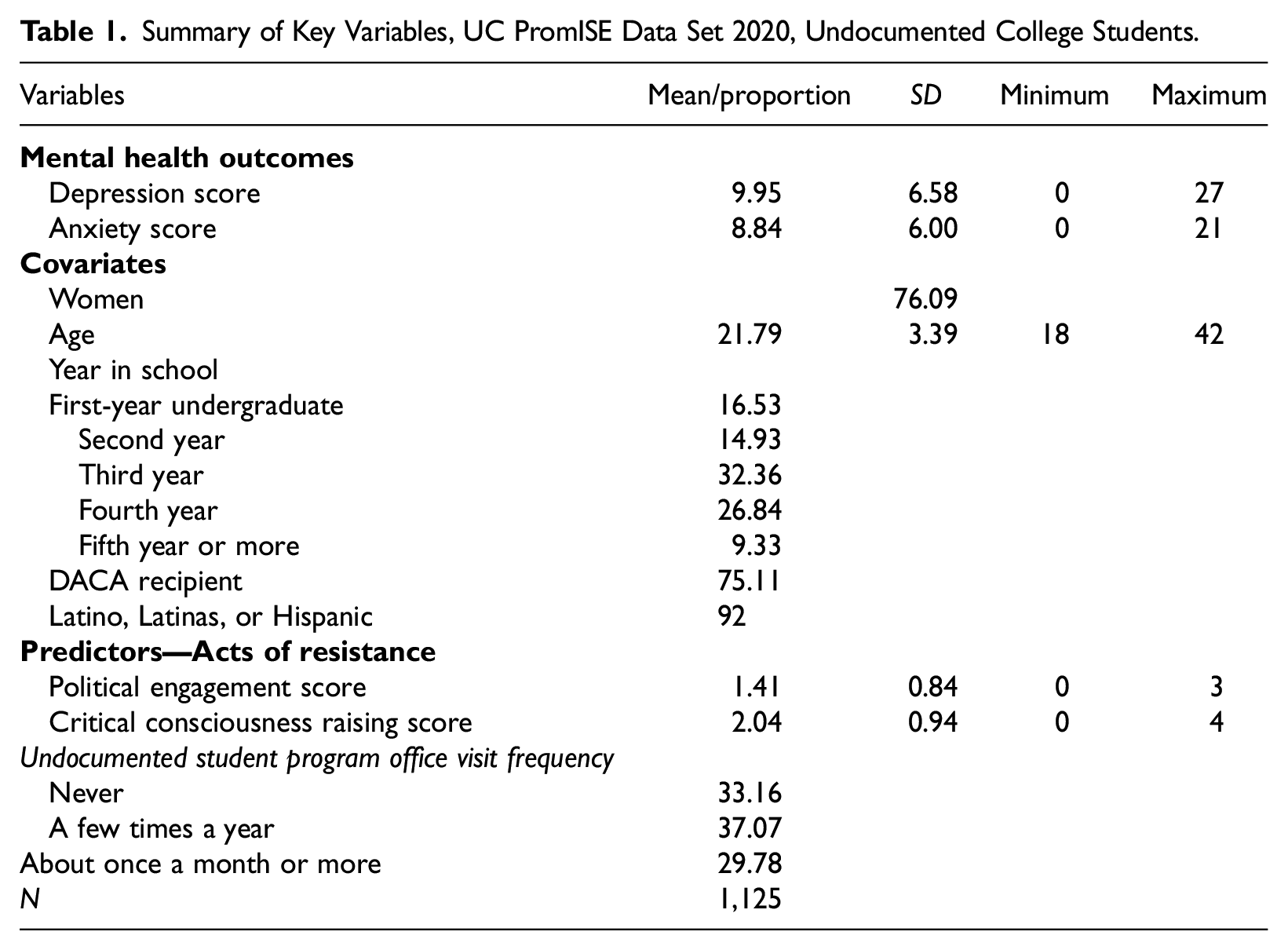
Engagement in acts of resistance ranged but was generally moderate. For political engagement, the average score is 1.41 (SD = 0.84), falling between “rarely” and “sometimes” on the scale. Critical consciousness raising’s average score is 2.04 (SD = 0.94), the equivalent of reporting “sometimes” on all items. Almost three quarters reported visiting the undocumented student program office during the academic year with 33 percent saying they never visited, 37 percent saying they visited a few times a year, and 30 percent visiting about once a month or more.
Regression Results: Depression
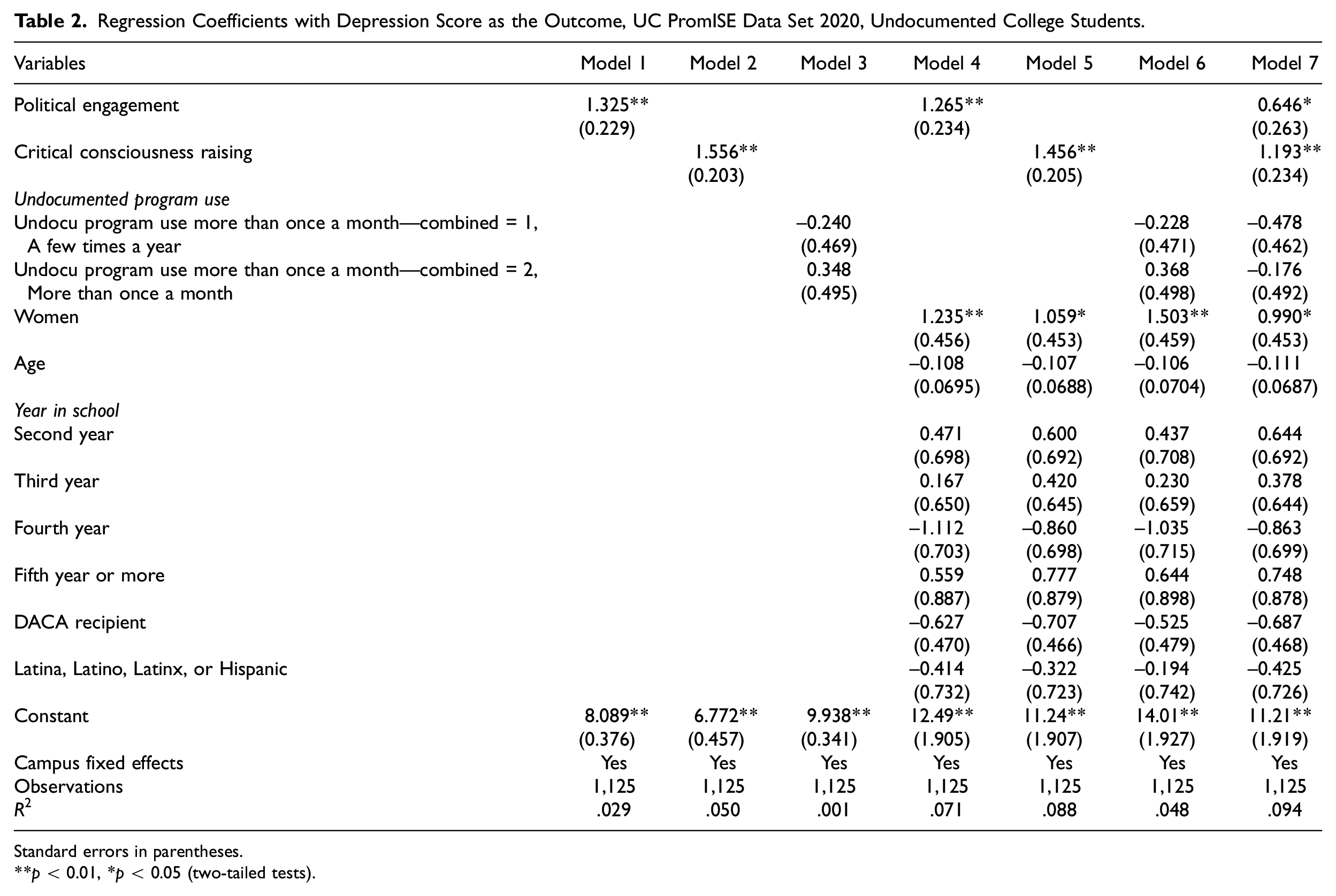
Table 2 shows the results of the OLS regressions modeling depression score. Models 1 to 3 show the association between each act of resistance, respectively, and depression scores. Models 4 to 6 add covariates. Our unadjusted model (Model 1) shows a positive and statistically significant association between political engagement and depression score. Higher scores of political engagement were positively associated with higher depression scores (b: 1.325, SE: 0.229). This indicates that students who reported higher levels of engagement in activities such as expressing political views via signing a petition or sharing a political opinion during a class discussion also reported higher levels of depression symptoms. Model 4 added our covariates. Once we controlled for demographic factors, political engagement remained relevant for depression scores (b: 1.265, SE: 0.234). Gender was the only sociodemographic covariate that was significant in the model. Compared to students who identified as men, participants who identified as women reported higher depression symptomatology.
Regression Coefficients with Depression Score as the Outcome, UC PromISE Data Set 2020, Undocumented College Students.
Standard errors in parentheses.
p < 0.01, *p < 0.05 (two-tailed tests).
Critical consciousness raising is examined in Model 2. Higher critical consciousness raising was positively associated with higher depression scores (b: 1.556, SE: 0.203). This means that students who reported higher levels of engagement in activities such as confronting someone for saying derogatory comments about immigrants or speaking up when people make false statements about immigrants also report higher levels of depression symptoms. This association persisted after including sociodemographic controls as shown in Model 5 (b: 1.456, SE: 0.205). Model 3 takes into consideration usage of undocumented student programs on campus. Variation in frequency of visiting undocumented student programs did not have a statistically significant association with depression scores. This indicates that students who visited undocumented student programs on their campus more did have higher or lower depression symptoms compared with those who did not visit the office at all or who did so less frequently. Model 7 considers all acts of resistance simultaneously to test their collective associations with depression. Higher scores on political engagement were associated with higher depression scores (b: 0.646, SE: 0.263). Similarly, higher levels of critical consciousness raising were associated with higher depression scores (b: 1.193, SE: 0.234). Again, undocumented student program usage did not show statistical significance. Model 7 explains 9.4 percent of the variation in depression score.
Regression Results: Anxiety
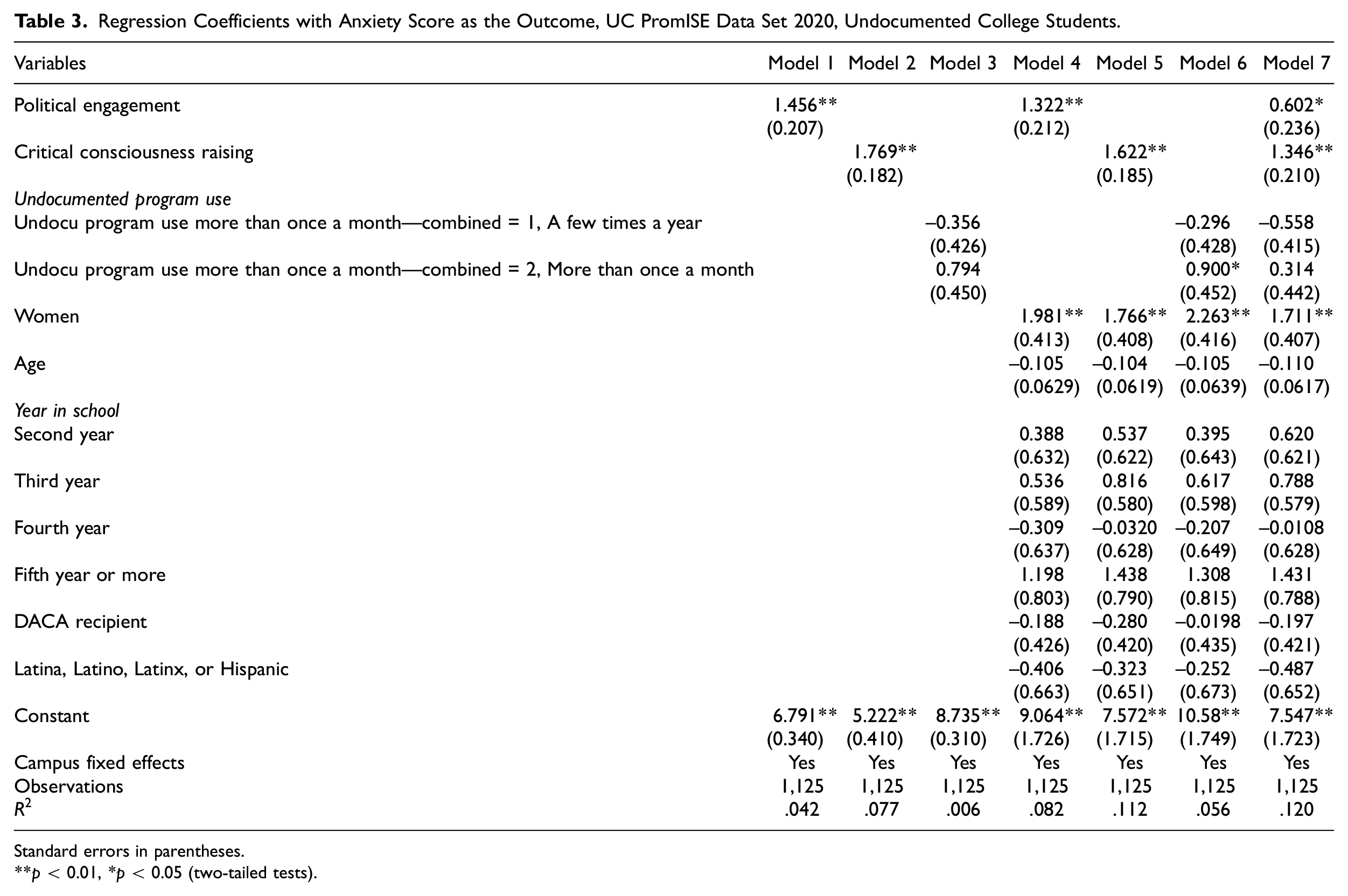
Table 3 shows regression results for anxiety. Results are organized similar to Table 2. Model 1 shows the bivariate regression between political engagement and anxiety score. We find a positive and statistically significant association between political engagement and anxiety score (b: 1.456, SE: 0.20). This indicates that students who reported higher levels of engagement in activities such as expressing political views via signing a petition or sharing a political opinion during a class discussion also reported higher levels of anxiety symptoms. Once sociodemographic factors are controlled for (Model 4), this association persists and remains similar in size (b: 1.322, SE: 0.212). Model 2 shows the association between critical consciousness raising and anxiety score. It shows a positive and statistically significant association between critical consciousness raising and anxiety. For each increase in unit in critical consciousness raising, anxiety score increases by 1.769 (SE: 0.182). And this association remains similar even after sociodemographic controls are adjusted for in Model 5 (b: 1.622, SE: 0.185). This means that students who reported higher levels of engagement in activities such as confronting someone for saying derogatory comments about immigrants or speaking up when people make false statements about immigrants also report higher levels of anxiety symptoms. Furthermore, sociodemographic factors included in our models could not fully explain this association. Model 3 shows the association between undocumented program use and anxiety score. As with the depression model, there is not a statistically significant association between using this program and anxiety score. This remains similar in the model with sociodemographic control variables. These results indicate that students who do and do not visit undocumented student programs in their campus do not differ in their levels of anxiety symptoms. In Model 7, both the coefficients or political engagement and critical consciousness raising remain statistically significant albeit they are slightly smaller in size. Model 7 explains 12 percent of the variance in depression.
Regression Coefficients with Anxiety Score as the Outcome, UC PromISE Data Set 2020, Undocumented College Students.
Standard errors in parentheses.
p < 0.01, *p < 0.05 (two-tailed tests).
Discussion and Conclusions
The goal of our study is to respond to recent calls of social determinants of health scholarship by examining how structural marginalization contributes to health disparities, including in immigrant mental health (Castañeda et al. 2015; Takeuchi 2016). To meet this aim, we draw inspiration from immigrant illegality scholarship and black feminist theory by deploying an asset-based approach that centers undocumented immigrants’ agency in responding to an exclusionary socio-legal context that compromises their mental health. Specifically, we examined the association between undocumented college students’ acts of resistance and their mental health, measured as anxiety and depression symptomatology. We found that political engagement and critical consciousness raising were both associated with higher depression and anxiety scores. Frequency in visiting undocumented student programs or services on campus was not associated with either mental health outcome. Our findings suggest that undocumented college students’ efforts to navigate and contest their marginalization are negatively associated with their mental health.
Political engagement was associated with higher rates of anxiety and depression symptomatology. Previous research on structurally marginalized individuals and college students had found mixed evidence as to the direction of the association between political engagement and mental health (Cornejo et al. 2023; Hisam et al. 2017; Ramirez-Valles et al. 2005). This difference may be due to differences in how ours and prior studies measured political engagement. We used four items to generate a political engagement score: signing a petition, buying certain products because of their social or political values, displaying social or political messages, and expressing a political point of view during a class discussion. These items capture individual self-expression and awareness of larger structural inequalities. However, they do not capture participation in collective political actions. It may be that politically related group activities could facilitate community building which may have a positive association with mental health because it builds social support and capital. However, an individual act of engagement, such as signing a petition, can be an indicator of greater awareness of social inequalities and in turn negatively associated with mental health. Future work should measure and test the role of different forms of political engagement to further unpack the association among different political actions and mental health.
Critical consciousness raising was also associated with higher anxiety and depression scores. The limited research on critical consciousness raising did not allow us to hypothesize a direction. It may be that engaging in political actions and in critical dialogues about immigration and immigration policy are associated with poorer mental health because such activities may increase the stress experienced by undocumented immigrants (Moreno et al. 2022). Indeed, a study of undocumented students’ advocacy communication shows that individuals who frequently engage in advocacy communication have poorer mental health (Cornejo et al. 2023). Notably, while these two acts of resistance seek to address different levels of socio-legal exclusion (i.e., systemic and interpersonal), they both reflect efforts to challenge structural marginalization and seek just change. The fraught nature of contemporary immigration politics could expose undocumented students to increased anti-immigrant sentiment or subject them to persistent policy failures (Wray-Lake, Halgunseth, and Witherspoon 2022). These realities may increase the feelings of social exclusion, a dimension of legal vulnerability associated with increased depression and anxiety symptomatology (Ayón and Becerra 2013; Velarde Pierce et al. 2021).
The use of undocumented student programs was not statistically significantly associated with anxiety or depression symptomatology. While the other two acts of resistance reflect efforts to challenge structural marginalization and seek just change, this one captured students’ attempt to navigate the effect illegality on the individual level. The lack of an association may indicate that the level at which resistance is practiced matters so that individual level acts of resistance may not be associated with one’s mental health. However, it is important to recognize that undocumented student program use may be positively associated with other indicators of undocumented student well-being including sense of empowerment, educational success, and belonging. We should also consider that another potential explanation for undocumented student program usage’s lack of significance is that the item measures frequency in visitation, not necessarily the resources they accessed. Thinking about this in relation to resource use as an act of resistance, students could be visiting the space but not necessarily accessing resources in the absence of a significant event occurring. Moreover, our lack of detection of an association between undocumented student program use and better mental health outcomes may be because students with a range of mental health statuses visit the program office; students with high mental health needs might make more use of the undocumented student program office. If this is the case, any positive association between frequency of attendance to undocumented student program offices and positive mental health outcomes would be muted. Future work should continue to interrogate potential associations between mental health and individual level acts of resistance, including resource use.
Our study demonstrates the importance of considering immigrants’ agency amid structural constraints when studying their mental health. We offer acts of resistance as a unique theoretical framework to capture actions taken to resist structural inequality. We expand on prior research which has focused on political engagement (Cornejo et al. 2023; Rosales, Enriquez, and Nájera 2021) by focusing on three actions taken by undocumented college students. Yet, there are many more actions that can be taken and are practiced by a range of marginalized individuals. Future research should move beyond the study of political engagement to consider acts of resistance across a range of acts and populations. Qualitative work should also explore the processes in which these actions are employed and how exactly they factor into mental health. It may be that there are different ways of engaging in each act of resistance that leads to mixed results or that some types of resistance are less correlated with one’s mental health. Such research would benefit from using a social determinant of health framework to interrogate structural explanations for mental health inequities. Yet, scholars should adopt asset-based approaches that affirm individual agency while investigating the relationships between structural marginalization and well-being. This means recognizing that marginalized people are not simply victims of structural inequality but also that they actively resist their marginalization in a myriad of ways. Their agentic responses are worthy of interrogation and must be studied to understand the full scope of the process through which structural inequality relates to mental health. This work should also examine the relationship between gender and acts of resistance given that gender was a significant covariate in our models and that the profiles varied by gender in some cases.
Our study also affirms the importance of drawing on interdisciplinary scholarship when examining mental health disparities among marginalized populations, like undocumented immigrants. When visioning ways to advance the limited research on immigrant mental health, Takeuchi (2016) called on scholars to draw theoretical inspiration from other fields, such as immigration scholarship, to better account for the structural barriers posed to immigrants’ well-being. We did this by turning to the socio-legal scholarship on immigrant illegality which has highlighted how laws and policies create structural inequality through an exclusionary socio-legal context (Enriquez 2020; Gonzales 2016; Menjívar and Kanstroom 2013) but also recognizes immigrants’ agency to interpret and respond to these barriers (Enriquez 2020; Enriquez and Millán 2021; Menjívar and Lakhani 2016). Turning to black feminist theorizing (hooks 1991; Lorde 1992) further enabled us to theorize acts of resistance as a wide range of actions marginalized individuals can take to resist structural inequality. These literatures supported our adoption of an asset-based approach wherein acts of resistance capture how undocumented college students were responding to an exclusionary socio-legal context that compromises their mental health.
It is important to note that our study focuses on undocumented college students attending four-year public universities in California. California is one of the most inclusive policy contexts for undocumented immigrants, providing access to driver’s licenses and limiting interactions with immigration enforcement (Enriquez, Vazquez Vera, and Ramakrishnan 2019; Golash-Boza and Valdez 2018). Eligible undocumented college students in California can also access in-state tuition rates and state financial aid. Furthermore, public institutions in California have moved toward establishing undocumented student programming. Collectively, these inclusive state and institutional policies shield students from experiencing severe legal vulnerabilities. Undocumented immigrants and undocumented students in more exclusionary policy contexts have different experiences (Burciaga and Martinez 2017; Silver 2018). Thus, future work should examine whether these relationships are consistent in other state contexts.
Our study had some limitations. First, the study used a cross-sectional survey approach so we cannot discuss causality. Second, participants self-selected into the study and may not be representative of undocumented public college students in California. Comparisons to national online surveys of undocumented students and young adults suggest that men, non-Latinx students, and those with later age of arrival may be underrepresented in our study (see Teranishi, Suárez-Orozco, and Suárez-Orozco 2015; Wong and Valdivia 2014). Participants were also partly recruited through undocumented student services, possibly leading to the over-representation of participants who used undocumented student services. It may be that respondents may have been more likely to engage in acts of resistance compared with those who did not complete the study, leading to an overestimation of our results. Third, the survey uses self-report measures for anxiety and depression symptomatology. It is possible that some participants underreported their symptoms due to mental health stigma or a normalization of their strain (Cha et al. 2019). Alternatively, participants who more frequently practice acts of resistance may be exposed to resources or conversations that make them more willing or able to accurately report their symptoms. Fourth, we collected data during the initial months of the COVID-19 pandemic, which could have influenced the prevalence of depression and usage of acts of resistance among students. Participants were instructed to answer based on pre-pandemic experiences. However, and lastly, asking participants to recall how they felt in the last two weeks prior to COVID-19 could have contributed to faulty responses as recollection of these events may have been difficult.
Finally, our study has implications for practitioners working with undocumented college students. Practitioners should recognize that the actions taken to resist structural constraints, like immigrant illegality, likely have consequences for one’s mental health. Student affairs practitioners should offer services and design programming with this in mind to minimize the potential negative mental health impacts on engaging in acts of resistance. For example, activist spaces could include discussions of how political engagement may be associated with one’s mental health and offer tools to mitigate this potential association. Programming and services should also be designed and advertised in ways that will not exacerbate feelings of social exclusion that could be associated with one’s mental health. Mental health practitioners should be informed about the unique stressors faced by this marginalized student group and be attentive to the various ways in which they resist the constraints of their status may also be associated with their mental health.
Footnotes
Funding
The author(s) disclosed receipt of the following financial support for the research, authorship, and/or publication of this article: This study was conducted with the support of funding from the University of California Multicampus Research Programs and Initiatives (grant no.: MRI-19-601090); California State University (CSU) Channel Islands Vice President for Student Affairs; CSU Fresno Kremen School of Education & Human Development; CSU Los Angeles College of Education; CSU Sacramento Center on Race, Immigration, and Social Justice; and San Francisco State University College of Science and Engineering.
