



Abstract
Learners with autism are affected by different challenges during learning. There is a growing focus on education to facilitate learners to become more self-resilient by involving animals in learning spaces. This qualitative study explored the impact of animal involvement on the learning experiences of learners with autism. Twenty diaries, 32 questionnaires, and 40 guided narratives and pictorial voices were used to collect data. The study found that learners demonstrated improved communication, imagination, empathy, motivation, calculation skills, responsibility, and well-being while interacting with animals. The study concluded that involving animals in the learning spaces has significant positive impact on learners.
Introduction
Learners of all ages and abilities seem to hold a natural curiosity about animals of all types from the furry and feathered to the scaly and hairy, and generally are easily drawn toward them, in an inquisitive manner to learn more, make physical contact, and form connections (LaHart, 1978). This notion underpins the importance of having animals in learners learning environment. Learners and animals are unique and need to be viewed as such, as each one comes with a diverse range of abilities, behaviors, emotional responses, and preferences (Melson, 2003). As learners form relationships and bonds with humans so can they form unique bonds and relationships with animals that are healthy and supportive. For those followers of the social-emotional learning theory, animals in classrooms may be a vital concept in supporting learners to learn through the emotional support bonds formed by the learners and animals (Ward, 1992). Currently, there is a new focus on education to facilitate learners to become more self-resilient through different innovative supporting systems (Gilligan, 2001). The move to incorporate animals into learners’ educational settings has seen a gradual increase.
Many educational practitioners today are aware of the physical benefits that animals can bring to human health through contact, time in their presence, and even through observation (Acar & Torquati, 2015). Such benefits may include reduced blood pressure, reduced respiratory rates, and reduced stress levels, along with many more (Zerzog, 2011). For learners who are exposed to animals from a young age, there is also the impact of reduced allergen rates as found by Heinrich (2002). When a child’s health is good, this makes their education experience easier positive and enjoyable. Animals also have an emotional impact on people and in learners, this is highly valuable within the education setting as this makes them more resilient and provides them with the support and encouragement to learn. Animals are non-judgemental and provide a listening ear and friendship when required by any learner. Beck and Katcher (1983) states that when learners and animals interact together there is usually a positive influence, while Ruth (1992), identified that those children who are uncomfortable interacting with other people generally do very well with animals. When combining these influences and considering the other effects animals have on social interaction and engagement, children’s behavior and self-concepts, there is need to utilize the benefits that comes with involvement of animals in learning spaces.
Specifically, in education animals have been found to have improved individual learner’s performances through increasing their motivation, and reducing their blood pressure and stress levels (Beck & Katcher, 1983). McCardle et al. (2011) asserts that involvement of animals in learning spaces helps in easing individual learner’s social interactions while improving their motor skills and physical abilities. This in turn creates a conducive atmosphere to learn and acquire personal resilience on the part of learners. Gee et al. (2007) believe that the interaction between learners and animals in learning spaces can increase their concept of communication that is vital in learning and acquisition of skills. It is in such environments that children can learn various methods of communication through observation of behavior that may be key in the learning process. Animals can offer a further dimension of positive support through sensory stimulation and sensory calming for children with disabilities and special needs who receive their education within establishments (Grandin, 2011). Contact with horses either via equine psychotherapy or hippotherapy (therapeutic riding) can improve balance, posture, flection, and co-ordination (Lessick et al., 2004). It is therefore imperative that educational practitioners need to consider all these benefits while imparting knowledge and skills to learners with special needs.
In light of the above assertions, this research set out to explore the impact of animal involvement on the learning experiences of learners with autism.
The Research Setting
The research took place in two schools for young people with special needs (autism). The schools offered the young people to work and engage with a range of animals within the schools. The animals included Guinea pigs, birds, and snakes. There were also opportunities for learners to spend time on the school’s mini farm holding with horses, goats, pigs, and chickens. During the holidays following a robust assessment to meet the requirements for safety and protection of animals some young people were offered opportunities to take some of the animals’ home.
Methodology
The study utilized qualitative data to explore the impact of animal involvement on the experiences of learners with challenging learning needs.
Data Collection
The teachers observed and interacted with learners during learning to explore the impact of animal involvement in the learning space. Teachers recorded their observations in the diary they kept. Twenty diaries were recorded over a period of 12 months. To ensure that the animal intervention experience research project was holistic, parents were also asked to feedback on the changes they observed in learners at home since the project started. A total number of 32 open-ended questionnaires to enhance collection of qualitative data were completed and returned by parents. Furthermore, the learners were also asked to tell their experiences of learning since the involvement of animals in their learning spaces within and outside the school. The learners used guided narratives and pictorial voices to express their experiences. A total of 40 guided narratives and pictorial voices were collected for analysis from the learners. To facilitate effective responses from learners the teachers prompted and supported the learners to tell their experiences. All the learners who took part in the study were able to express themselves in terms of communication.
Data Analysis
Following organization of data using NVivo a thematic analysis was employed. The purpose was to compact extensive and diverse raw data from three groups of research participants into a succinct structure (Denscombe, 2010). This provided the researchers with an opportunity to identify compare and determine the data upon which to focus. Themes supported by extracts from parents’ teachers and learners were generated. To verify the analyzed information, the researchers took back the themes and data for confirmation with parents, learners, and teachers. Following the confirmation. The researchers reviewed the themes and realigned them with confirmatory changes that had been noted. This formed the final output of the research study.
Ethical Consideration
Three information sheets for parents’ learners and teachers were developed to inform the three groups about the research study. A letter was also sent to parents, teachers, and learners inviting them to take part in the study. A consent form for teachers, parents, and learners was also developed. All learners who took part in the study had to secure permission from their parents through the consent form signed jointly by them and their parents. Teachers and parents also signed the consent form. The consent form allowed teachers, parents, and learners to withdraw from the study at any point if they wish to do so.
During the research project a leaflet was created for parents, staff, and pupils to explain the rationale and provision of the animal room to ensure that all those within and outside the school had a clear understanding of the animal’s functions (in line with the Animal Welfare Act 2006) and benefits within the school. The learners were afforded the opportunity during school holidays to foster an animal to develop their understanding of responsibility, care provision, and animal welfare, this venture does require parental permission as under the Animal Welfare Act, 2006 ultimate responsibility for the animal will rely on the parent. Parental permissions were sought and obtained prior to learners being given the opportunity to take care of an animal.
Results
Following analysis of results from teachers’ parents and learners, themes were generated in line with the data provided and analyzed.
Communication
Teachers, parents and learners reported improvement in communication for the learners. Furthermore, the learners showed different ways of communicating: The learners communicated their experiences with animals in a variety of ways, verbally when they tell stories and in pictures through drawing. My son started to tell us how he had spent a day with animas at school, he even brought pictures telling his experiences with animals, honestly, my son s’ communication has greatly improved since the animals were introduced at the school. I really like to learn and play with animals and I have enjoyed drawing the animals and showing them to my mum and dad, I also like telling stories about animals to my friends.
Calm
Teachers and parents felt that the presence of animals in the learning space made the learners to feel calm and created a conducive atmosphere for teaching and learning: All the learners were so engaged with the animals trying to understand so many useful things about them ranging from what type of food do the animals eat to how much they need. Clearly, there was complete silence in the learning space. My daughter started to engage with activities without any problems. She can now complete tasks without being pushed or distracted.
Motivation
Teachers and parents reported increased motivation to learn among the learners due to the presents of animals in the learning spaces. The learners also reported self-motivation toward schoolwork: Leaners showed a lot of interest towards their schoolwork; there was a marked improvement in the completion of homework and classroom work. My daughter started to complete her schoolwork without any push; she also looked forward to go to school every day having animals in the learning space was great. I like animals; I now know a lot that I have learnt through animals. Now I can do all my schoolwork without being told and look forward to go to school every week.
Improved Motor Skills
Teachers and parents reported an improvement in motor skills in learners because of working with animals in the learning spaces. The learners also felt that their motor skills and balance greatly improved: Learning and working with animals helped learners to develop new skills for example caring for the animal moving it around and putting it in the right place. I was so fascinated to see how much my son was able to do. He could ride a horse care for it and prepare bedding. I can now do so many things since I started working with animals. I can now ride horses and help to prepare the animal bedding.
Increased Class Attendants
Teachers and parents reported that since the involvement of animals in the learning spaces the learners increased their attendants’ rate. The learners also confirmed increased motivation to attend school: Since the involvement of animals in the learning spaces of the school there was an increase in attendants of the learners. My daughter wanted to be at school every day; previously she had struggled with attendants honestly the animals were a factor in this positive development. School was really interesting I now get up early to be the first at school and I can’t even afford to miss one day.
Increased Responsibility
Parents and teachers reported that the learners developed a sense of responsibility as they were tasked to look after and care for specific animals. The learners also felt that they developed a sense of responsibility through their different roles in looking after animals: Most of the learners showed a good sense of responsibility by making sure that the animals they were looking after were well catered for everyday. Honestly my daughter became more responsible and caring since she started working with animals at school; it was really fascinating for me how learners change. I feel so happy to look after these animals. The responsibility that comes with it is so fulfilling.
Imagination and Abstract Presentations
Teachers and parents reported improved imagination and abstract presentations among learners. The learners also showed a lot of imagination and abstract presentations in their work (see Appendix 1 and Appendix 2): The learners were so imaginative in capturing different experiences while learning with animals. Oh, my son started to be so creative presenting different learning situations with animals. I really liked the images that he drew. I liked capturing my animal learning experiences with images. It made me to be creative because I really like telling stories that way.
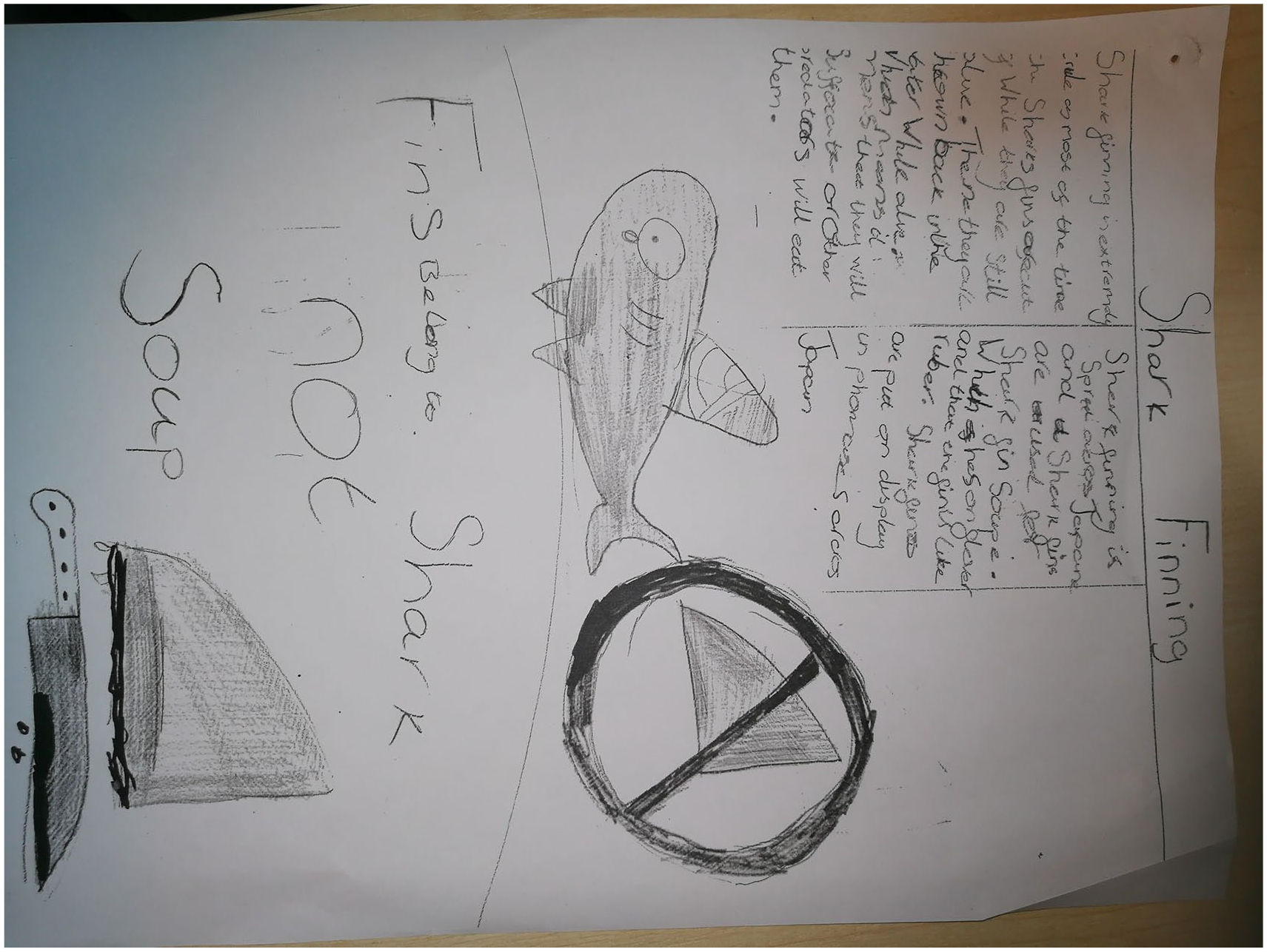
A campaign poster by a learner against the killing of sharks (Put under Imagination and Abstract Presentation).
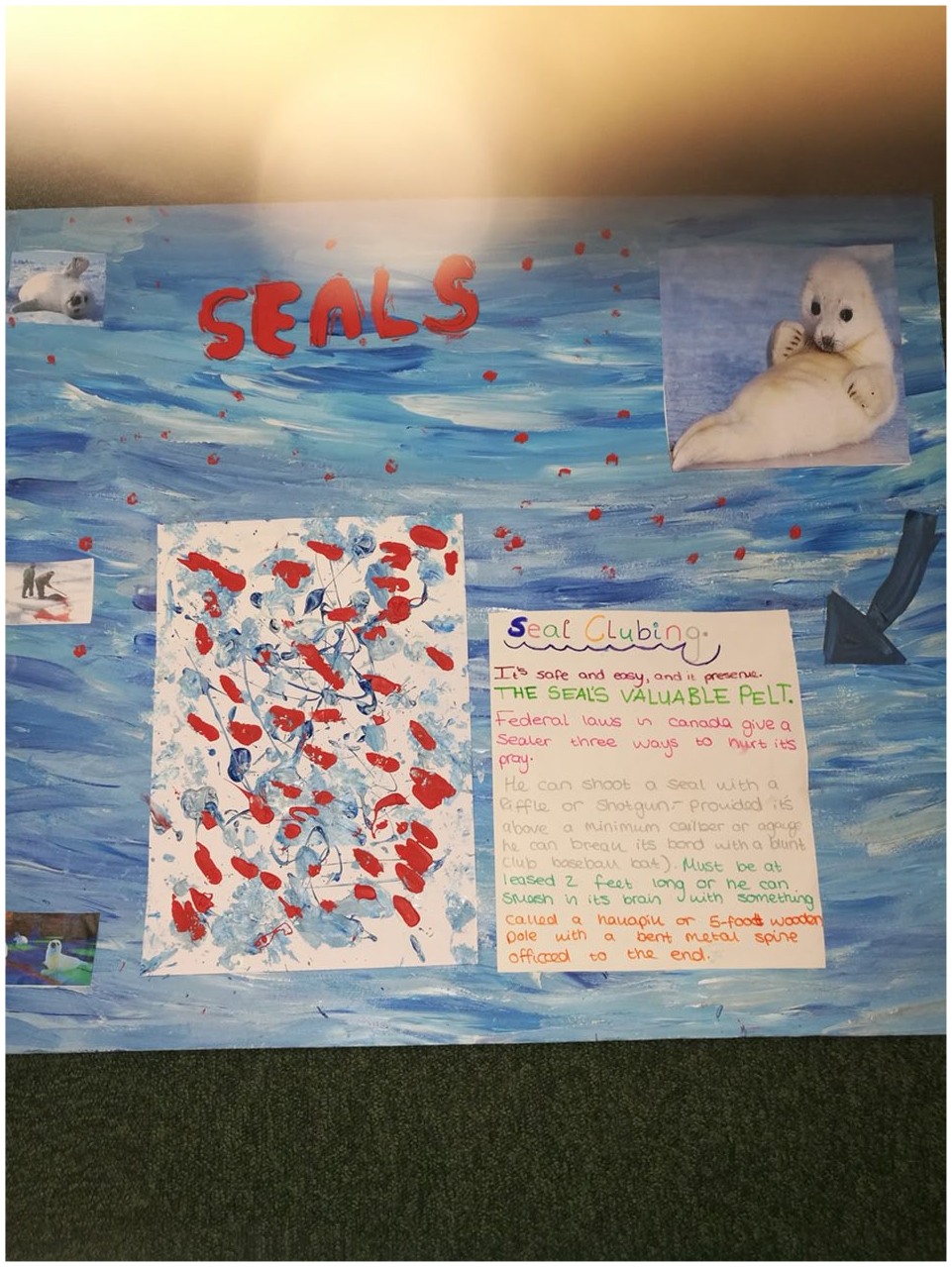
A campaign poster against killing seals by a learner (Put under Imagination and Abstract Presentation in the results section).
Increased Calculation Skills
Both parents and teachers reported increased mathematical knowledge in learners following the involvement of animals in learning spaces. The learners also felt that their calculation ability went up because of working and learning with animals: My daughter could easily deal with high order concepts of ratio and calculations honestly it really surprised me. Learners are now doing well in ratio calculations and other concepts as they normally do them when mixing different foods for animals and keeping records. Now I can easily do mental calculations and ratio, it only became easy for me when animals were introduced in the learning spaces in my school.
Empathy and Well-Being
Parents and teachers reported increased empathy among children because of interacting and caring for animals both at home and at school. The learners also felt that they had developed a sense of empathy because of their experiences with animals: My son developed this natural empathy and happiness in different situations at home with friends and his young sister. Honestly working with animals has changed my son for the positive. learners are now showing a lot of empathy and relaxation for each other in learning spaces, following the involvement of animals in learning. I have just developed this empathy and love towards situations of animals,’ my friends and family. Working with animals has made me to feel empathetic and considerate for others.
Discussion
Communication is at the heart of best practice in teaching and learning (Dina & Maher, 2006). Indeed, education was one of the first disciplines to recognize the importance of communication. It is through the capacity to communicate that different learners with different learning needs can convey important messages during the process of learning. It is therefore important that teachers should create a conducive atmosphere for learners to capture different communication skills (Goodman, 1999). Thus, the provision of animals in the learning space presented the learners with a wide variety of opportunities to learn different communication skills in an interesting and motivating way. Such an environment can be beneficial to learners with a short listening or learning span, including autism and challenging behavior (Barrouillet et al., 2007). It is also important to realize that the presence of animals in the learning spaces enabled learners to master different communication skills both at school and at home. For example, the learners had communicated their experiences with animals to the teachers and parents in a variety of ways (See Appendices 1 and 2). The presence of animals in the learning space and at home during the holidays also made the students to be inquisitive thus, motivating them to seek more information through questioning thereby improving their communication skills.
Animals have calming effect on people in general (Allen et al., 2002). This instinctive and universal response can be clearly manifested for example if an animal is brought in a room with learners, they will suddenly lower their noise. The calming effect of animals protects against loneliness, depression, and anxiety thus creating a conducive atmosphere to learn and listen (Fine, 2006). Fine (2006) concurs with Wells (2009) who also believe that tenseness and anxiety can be reduced when people interact with animals. People in general are more sociable, accepting, and loving in the presence of animals. Furthermore, it encourages them to participate in-group activities such as exercises and learning. Similarly, the presence of animals in the learning spaces of this research enabled the learners to be sociable, welcoming, and loving. Thus, creating a conducive atmosphere for learning to take place. For example, the calm environment both at home and at school enabled teachers and parents to impart knowledge and skills to the learners at a time when they were fully motivated to do so.
Animals are can be a source of motivation to human beings especially to children (Folse et al., 1994). They have a therapeutic effect to people affected by depression or any other secondary conditions that can affect the learning processes of learners. More importantly, the parents and teachers reported increased motivation among children since the introduction of animals in learning spaces at school. For example, children were able to complete their work without being pushed to do so. The learners also expressed increased desire to learn more about animals, which in turn motivated them to complete their schoolwork without being pushed. The effect of motivation also pushed up attendance rates for many learners thus enabling consistence in learning.
Caring for animals entails a degree of responsibility and consistence in doing things (Bustad, 1990). Again, parents and teachers reported increased sense of responsibility and consistence in discharging of duties among children. For example, the learners felt that it was imperative that the animals they looked after were given all the necessary support including food and water at specifically designated time every day. This increased responsibility also helped the learners to deal with other issues outside the learning space, for example, when they were confronted with life chores that demanded commitment. The learners felt that their interaction with animals built a strong foundation in conceptualizing responsibility as an important aspect of life. For example, learners found that responsibility was a key aspect in achieving everyday life tasks.
Imagination and abstract presentation of concepts is a very important aspect in the development of learners (Baer & Garrett, 2010 ). Imagination involves forming a mental image of something that is not perceived through the normal five senses of a human being (Clegg, 2008). It involves the construction of mental scenes, objects or events that do not exist, or have happened in the past. Everyone has a certain degree of imagination ability power (Creme, 2003). The imagination manifests itself in various degrees for different people. Teachers and parents confirmed that through the experiences of learning in spaces where animals were present the children developed a sense of imagination and creativity that went beyond their experiences with animals. This imagination was communicated in different ways, for example, through sharing stories in class or through art images see Appendices 1 and 2. The power of imagination is very critical to learning and communicating in children (ref). It is the starting point of art, creativity, and appreciation of events in a variety of ways. It is therefore important that teachers should take advantage of the situation created by the involvement of animals in the learning spaces by encouraging children to be imaginative in a variety of ways using their experiences of learning as a starting point.
Calculating ability is key in life as it is used in different situations that support society and development (Norris, 2012). Teachers and parents reported increased knowledge and skills in calculation and manipulation of numbers. During the process of looking after and caring for animals, children had to know the right amount of food and water the animals needed for a specific duration. Furthermore, learners needed to know the ratios where food or water was used to make food for the animals. This experience created a very important base in developing calculation abilities in children. It is important to acknowledge that these skills were developed naturally alongside real experience without being forced into the children using abstract teaching techniques (Maller, 2005). Natural learning environments are therefore beneficial to learners as they normally take away pressure and anxiety to master difficult concepts. Furthermore, they can take away competition among learners and inculcate a sense of togetherness and resilience during the process of mastering new concepts.
Animals can easily engage with young and old people (Bull, 2002). The animals’ natural curiosity in relation to human beings can restore learners’ awareness of their inmate worth and value which in turn improves the learners’ sense of well-being. Furthermore, interaction with animals can reduce stress through relaxation. Animals have an empathizing impact on humans, which can filter natural in the process of interaction (Cotton, 1992). Animals have respect for personal boundaries, which can have a positive impact in building the socialization profile of the learners during interaction. The sense to draw boundaries is a very important aspect in building important traits of good behavior, which results in positive outcomes. Teachers and parents reported positive well-being for learners following their interaction with animals in the learning spaces. It brought happiness and relaxation, which created a conducive atmosphere for learning to take place. More importantly, the learners developed a degree of empathy, which improved their interaction and relationship with others.
Implication for Professionals Working With Children
When using animals in learning spaces, it is important for teachers to make sure that the direction of teaching focusses on the important aspects of the curriculum (Marsh, 2003). At times, the use of animals has veered off the main outcomes of the curriculum in preference of interesting new emerging themes in the subject being taught. However, to some extent, unintended outcomes may be important; this should be balanced with the core aims and objectives of the curriculum.
Use of animals in teaching spaces triggers many ethical considerations in terms of the care and respect for the animals that are being used (Harris, 2005). It is therefore important that teachers and other practitioners adhere to the highest standards of according care and respect for the animals being utilized. They should endeavor to influence the learners to understand the importance of according good care and respect to the animals they are interacting with in the learning spaces.
More importantly, the safety of learners during the process of learning and interacting with animals is key for teachers and other educational practitioners (Ball & Ball-King, 2011). It is imperative that prior to the involvement or use of animals in learning spaces a robust and comprehensive risk assessment need to be undertaken to ensure safety for the learners. The outcomes of the risk assessment also need to be clearly conveyed to the learners highlighting clear precautions to be observed.
Benefits of the Study
Following the completion of the study, there were some benefits that were realized concerning learners and their development. The key benefits identified by the study were as follows:
Parents and teachers confirmed that they were now enjoying better relations with children both at home and school, respectively, as they were now engaging in dialogue triggered by the involvement of animals in the learning spaces.
There was a significant increase in attendance by some of the pupils who were known to be non-attenders in their previous schools.
Many pupils who previously struggled to stay in their lessons began to improve their attention and staying in lessons more and longer.
The majority of pupils liked working with the animals and found that they keep them calm and relaxed making them ready and willing to learn.
Limitations of the Study
The study took place in two schools located in one city, it may therefore be that the findings are peculiar to the schools concerned taking into consideration the specific physical and social environment in which the research took place. In future, quality and dependable results could be yielded by increasing both the number of schools and cities to be involved in the study. This will enable comparisons and possible generalization of the outcomes based on the number of schools and learners involved.
The research predominantly utilized a qualitative research approach seeking to understand the lived experiences of the research participants (Merriam, 2009). However, future research may circumvent this limitation by embarking on a similar research utilizing a mixed approach paradigm. This will enable the study to effectively deal with both quantitative and qualitative concepts effectively.
Concluding Comments
Involving animals in the school for learners with autism has significant positive impact on their learning experiences. The study found that learners demonstrated improved communication, imagination, empathy, motivation, calculation skills, responsibility, and well-being following their experiences of interacting with animals in the learning spaces.
Footnotes
Acknowledgements
The authors would like to thank the teachers and learners for their support in this study.
Declaration of Conflicting Interests
The author(s) declared no potential conflicts of interest with respect to the research, authorship, and/or publication of this article.
Funding
The author(s) received no financial support for the research, authorship, and/or publication of this article.
