




Abstract
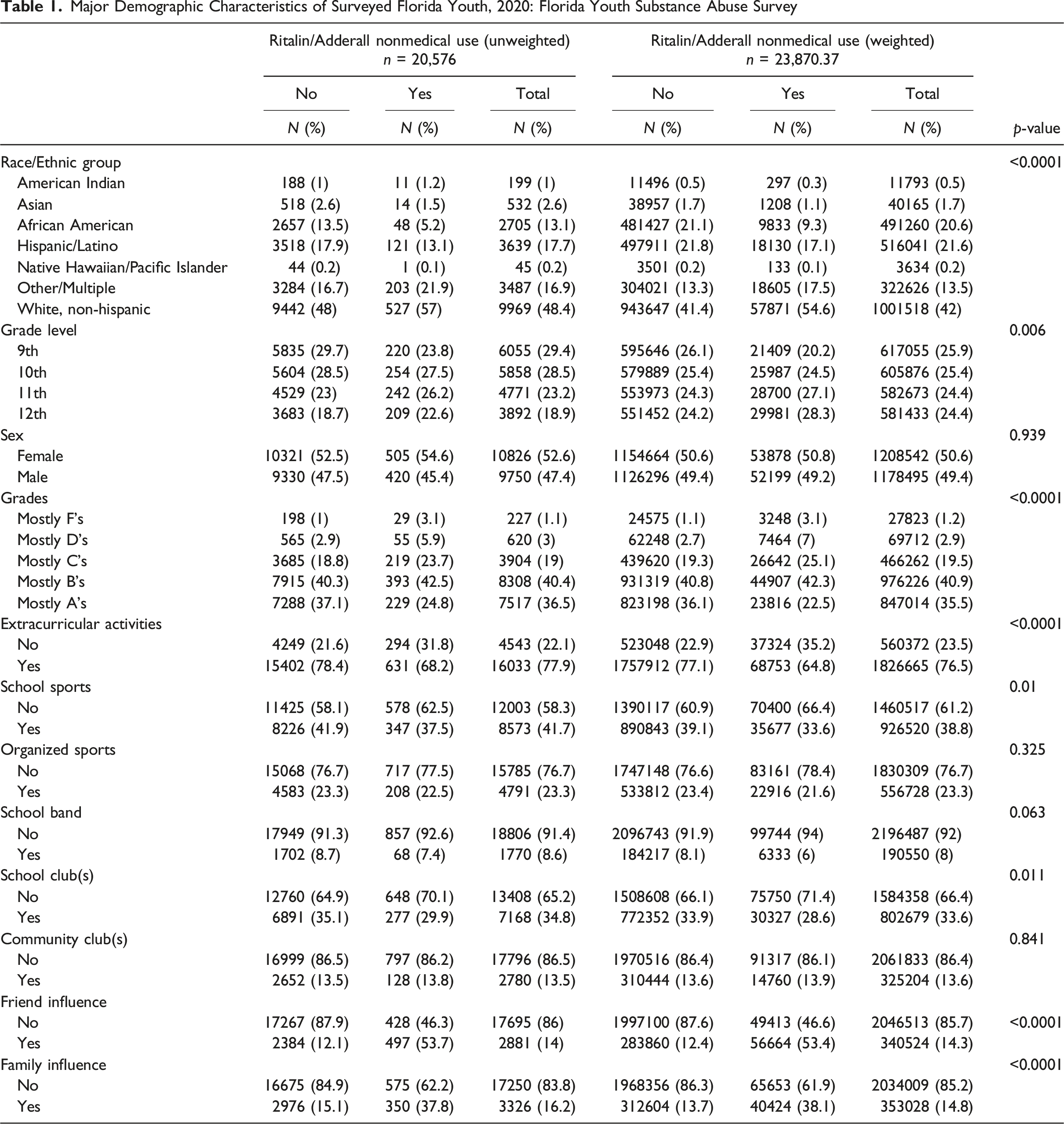
Nonmedical stimulant use (NMSU) among adolescents poses significant public health concerns. Using cross-sectional design, this study examined risk and protective factors for NMSU among 20,576 Florida high school students using the 2020 Florida Youth Substance Abuse Survey, with 925 students reporting NMSU. Guided by Hawkins and Catalano’s Social Development Model, we employed multivariate logistic regression analyses to estimate adjusted odds ratios while controlling for demographics. Students engaged in extracurricular activities were 50% less likely to report NMSU. Higher academic performance was associated with lower NMSU likelihood. Students with friends who used stimulants nonmedically were significantly more likely to engage in NMSU (AOR, 7.60; 95% CI: 6.35, 9.10), as were those living with relatives who used substances (AOR, 3.54; 95% CI: 2.94, 4.26). Findings highlight the importance of extracurricular involvement and positive social networks in mitigating NMSU. Interventions addressing family, peers, and extracurricular involvement are crucial for prevention and evidence-based policies.
Keywords
Introduction
In recent decades, nonmedical stimulant use (NMSU) has emerged as a pressing public health concern, due in part to significant increases in the diagnosis and treatment of Attention-Deficit-Hyperactivity-Disorder (ADHD) among U.S. adolescents (Setlik et al., 2009). Ritalin (methylphenidate hydrochloride) and Adderall/Vyvanse (dextroamphetamine-amphetamine) are among the most prescribed stimulants medications for ADHD in children and adults, as they are first-line agents for the treatment of ADHD.
Much of the existing research on adolescent substance misuse and abuse has focused on widely available substances, such as alcohol, cigarettes, opioids, and marijuana (Faraone et al., 2020; Kaye & Darke, 2012; Miech, Johnston, Patrick, O'Malley, Bachman, & Schulenberg, 2023). However, with the rise in ADHD diagnoses leading to increased prescriptions for ADHD medications among increasingly younger individuals, there is a heightened concern among healthcare professionals about the potentially harmful health consequences of long-term NMSU, such as cardiovascular system complications, neuropsychological disorders, addiction, dependence, polysubstance use, higher emergency department visits, critical care unit admissions, and risk of mortality from motor vehicle crashes and overdose (Kaye & Darke, 2012; Miech, Johnston, Patrick, O'Malley, Bachman, & Schulenberg, 2023; Nazarova et al., 2022). Stimulant misuse or abuse among young people who start early may have increased risks of adverse health consequences. Therefore, a more robust understanding of the motivations and contexts for NMSU among high school students may improve targeted interventions among adolescents who are more vulnerable to substance abuse initiation and progression to addiction (Butler et al., 2021; Faraone et al., 2020; Jordan & Andersen, 2017; Miech, Johnston, Patrick, O'Malley, Bachman, & Schulenberg, 2023; Schepis et al., 2020; Sibley et al., 2023; Trucco, 2020; Wong et al., 2022).
NMSU has been measured by other scientists in terms of past use over the past 12-months and past 30-day intervals using the age-appropriate language to explain nonmedical use as, “without a doctor telling you to use them” (Miech, Johnston, Patrick, O'Malley, Bachman, & Schulenberg, 2023). In our present study, we defined NMSU as the misuse or abuse of a stimulant over an individual’s lifetime without a doctor’s order, where misuse is defined as using a stimulant the wrong way, while abuse is deliberate, repeated use that has harmful effects on one’s life. Asking about lifetime stimulant diversion in this study provided broader insights into the overall prevalence of NSMU, as it captured individuals who may have experimented with stimulants at any point, even if they no longer used them (McCabe et al., 2023; Xu et al., 2018).
The need to study this topic is underscored by concerning increases in NMSU in the U.S., which surged by 133% from 1998 to 2005, followed by a notable decline in overall youth substance misuse over the next two decades (Miech, Johnston, Patrick, O'Malley, Bachman, & Schulenberg, 2023; Setlik et al., 2009). Despite some positive trends in youth substance misuse by the 2020s, ADHD stimulant misuse did not decrease as sharply as other prescription drug misuse from 2005 to 2023. Meanwhile, ADHD diagnoses continued to rise significantly from 1997 to 2016, and studies found a correlation between increased ADHD prescribing and higher NMSU among youth (Miech, Johnston, Patrick, O'Malley, Bachman, & Schulenberg, 2023). Notably, one study of U.S. secondary schools with high rates of prescription stimulant therapy found that students in these schools had 36% higher odds of engaging in NMSU.
High rates of emergency department visits for stimulant overdoses are also a significant concern related to NMSU, as ED visits for overdoses are correlated with worse symptom severity and poorer prognosis, as well as higher costs to the healthcare system (Miech, Johnston, Patrick, O'Malley, Bachman, & Schulenberg, 2023). One eight-year longitudinal study showed a spike of 76% in US Poison Control Center calls related to stimulant overdoses which was disproportionately higher than calls for overdoses of other substances (Setlik et al., 2009). Therefore, the persistence of NMSU combined with high potential morbidity and mortality from overdose suggests ongoing vigilance is needed to ensure youth are not adversely affected by these widely available medications (Miech, Johnston, Patrick, O'Malley, Bachman, & Schulenberg, 2023).
NMSU among youth in the U.S. has been a significant concern, particularly in the context of academic performance and mental health. The estimated 5.6 million young individuals engaging in NMSU in 2019 highlights the widespread nature of this issue. Among high school seniors, 9.5% reported having used stimulants improperly at least once during their educational career. This trend is often linked to the pressures of academic achievement, with many students using stimulants like Adderall or Ritalin without a prescription to enhance focus and productivity. However, improper use can lead to serious health risks, including dependency, cardiovascular issues, and mental health complications. The data from Faraone et al. (2020) aligns with broader findings from youth risk behavior surveys, which track substance use trends among adolescents. Efforts to address this issue include educational campaigns, stricter prescription regulations, and increased mental health support for students.
Compared to other substances, NMSU is thought to be less common than abuse of other medications, recreational, and illicit drugs, and therefore, the risk and protective factors for illicit substances or opiates likely differ than the risk and protective factors involved in NMSU (Butler et al., 2021; Faraone et al., 2020; Kaye & Darke, 2012; Wong et al., 2022). Motivation for misuse or abuse may differ among age groups, and there is a dearth of studies examining adolescents’ specific risk and protective factors for NMSU. Elucidating the specific factors underlying the type of substance and patterns of issues among younger populations is critically important to guide prevention efforts.
Many studies of NMSU focus on college students, and in this population, NMSU is associated with male gender, Caucasian race, a desire for high academic achievement, eating disorders, and abuse for recreational purposes, especially in combination with alcohol (Butler et al., 2021; Faraone et al., 2020; Kaye & Darke, 2012; Wong et al., 2022). Thus, there are many different underlying reasons for NMSU, and reasons influencing adolescents may be distinct from college students’ experiences. In studies of younger youth and children, investigators examined patterns of behavior between medical users and non-medical stimulant users finding few differences except that 10–18-year-olds were likely to endorse non-medical stimulants use if they close friends who tried Adderall. Binge drinking and illicit drug use history also correlated with self-report of NMSU (Wang et al., 2015). Additional studies of large national data sets following trends in stimulant use by youth indicated that the most common form of NMSU was using other’s prescriptions followed by taking the stimulant in a manner (more or different route) than what was prescribed (Miech, Johnston, Patrick, O'Malley, Bachman, & Schulenberg, 2023; Wang et al., 2015).
To address the knowledge gap about adolescent stimulant use, misuse, and abuse, the present study draws upon Hawkins and Catalano’s Social Development Model (SDM) and the Communities that Care (CTC) Prevention System , which provides a theoretical framework for understanding risk and protective factors related to substance NMSU (Burrow-Sánchez & Ratcliff, 2021). SDM posits that bonding to prosocial families, schools, and peers is a key protective factor against substance use, while bonding to antisocial peers and environments increases risk (Oesterle et al., 2018). This framework has guided the development of instruments such as the Florida Youth Substance Abuse Survey (FYSAS), which assesses a range of risk and protective factors across multiple domains (Florida Youth and Substance Abuse Survey, 2020). By applying SDM to the study of NMSU among high school students, this research contributes to the limited body of knowledge on this topic and informs the development of tailored prevention and intervention strategies.
Understanding risk behaviors associated with prescription diversion among adolescents is central to developing effective prevention and intervention strategies that can be tailored to strengthen protective factors, such as educational programs, parental guidance, and practitioner training programs which have been demonstrated to have long-term efficacy in terms of healthcare providers’ knowledge about prevention strategies geared toward adolescents (McGuier et al., 2022). Addressing the health and social risks of NMSU through school-based initiatives, stricter prescription regulations, and awareness campaigns can help mitigate the issue. Ultimately, reducing stimulant diversion benefits not only individual adolescents but also the healthcare system and society at large. Lower rates of NMSU can lead to fewer emergency room visits and reduces strain on mental health service providers.
Purpose
With the increase in ADHD diagnoses leading to more prescriptions for ADHD medications and the potential for NMSU, there has been a growing focus on understanding the unique factors contributing to this issue (Faraone et al., 2020). Despite advances in identifying the correlates of Ritalin and Adderall nonmedical use among high school students, several gaps remain in the literature. For example, while existing research has highlighted individual-level risk and protective factors, there is a need for comprehensive, multilevel analyses that examine the interplay between individual, familial, peer, and environmental influences on substance use behaviors. Addressing these gaps is essential for developing targeted prevention and intervention strategies aimed at reducing stimulant diversion and nonmedical use among adolescents while promoting their overall health and well-being. Therefore, guided by SDM and the Communities that Care Prevention System, we aimed to examine the associations between various risk and protective factors for NMSUamong Florida high school students using the 2020 Florida Youth Substance Abuse Survey (FYSAS) (Hawkins et al., 1992).
Method
Instrument
The Florida Youth Substance Abuse Survey is based on the Communities That Care Youth Survey, developed from the nationally recognized work of Dr. J. David Hawkins and Dr. Richard F. Catalano (Arthur et al., 2002). This validated instrument focuses on identifying risk factors related to alcohol, tobacco, other drugs (ATOD) use, and delinquent behavior, and in identifying protective factors that guard against these behaviors. The original instrument had an average reliability of 0.78 across all of the scales and the factor structures of the scales are coherent (Arthur et al., 2002). The 2020 FYSAS was administered between February 2020 and March 2020 (Florida Youth and Substance Abuse Survey, 2020).
Sampling and Participants
The 2020 FYSAS produced state- and county-level statistical estimates representing high school (grade 9–12) grade aggregates. The sampling strategy consisted of a stratified, two-stage cluster sample of students attending public high schools in Florida. Furthermore, the samples were stratified by county. In stage 1 selection, all public high schools were included in the sampling from each county, and then separate groups of high schools were randomly selected from each of the 67 Florida counties. The probability of selection for each school was proportional to the school enrollment numbers. This resulted in the selection of 348 schools for participation. In stage 2 selection, survey coordinators were instructed on how to choose classrooms to participate in the survey randomly. Special education and ESOL (English for speakers of other languages) were excluded. A total of 52,093 high school students participated in the survey, with a response rate of 66.7%. After removing 31,517 invalid records or responses with incomplete data of our specific research question, the final sample size was 20,576. Only three counties (Broward, Dixie, and Jefferson) were unable to participate in the survey due to the COVID-19 school shutdowns. Sampling weights were applied to the 2020 FYSAS dataset to account for the sampling of students in clusters, adjusting for nonresponse at both the school and classroom levels and the sample distribution across grade levels, gender groups, and counties. All 20,576 Florida high school students (weighted sample n = 23, 870.37) who responded to the 2020 FYSAS were included in the analysis.
Variables
The study’s key outcome variable was nonmedical Ritalin/Adderall use operationalized as No/Yes, as our study focused on the use of Ritalin/Adderall rather than frequency of use. The study survey asked students, “On how many occasions (if any) have you used amphetamine (included Ritalin, Adderall, etc.) without a doctor’s orders in your lifetime?” with options of 0 occasions, 1–2 occasions, 3–5 occasions, 6–9 occasions, 10–19 occasions, 20–39 occasions, and 40 or more occasions.
Our variable selection was guided by the Social Development Model theory but constrained by available measures in the FYSAS. We selected variables that best represented the core SDM constructs of prosocial bonding (academic performance, extracurricular activities) and antisocial influences (peer and family substance use). While this approach limits our ability to capture the full complexity of the SDM framework, it provides a foundation for understanding key protective and risk factors that can inform immediate intervention efforts while highlighting areas for future comprehensive research.
The study’s key independent variables were selected to represent both protective factors (prosocial bonding) and risk factors (antisocial influences) (Hawkins et al., 1992). Student grades (Mostly F’s to Mostly A’s) and extracurricular activities were chosen as protective factors representing bonding to prosocial school institutions and academic achievement norms (Xu et al., 2018). For extracurricular activities, the survey asks students, “Which of the following activities do you actively participate in (Choose all that apply)” options to select from: school sports, organized sports outside school, school band, school club(s), and community club(s). We operationalized extracurricular activities as ‘No’ if a student did not participate in any activity and ‘Yes’ if a student participated in at least one activity, reflecting the SDM premise that structured prosocial activities provide protective bonding opportunities.
Friend influence and family influence were selected as risk factors representing exposure to antisocial bonding and modeling. For friend influence, consistent with SDM’s emphasis on peer networks, the study asked students, “Think of your four best friends (the friends you feel closest to). In the past year (12 months), how many of your best friends have used prescription drugs without a doctor’s orders?” with options choices from 0–4. We operationalized friend influence as a ‘No’ if a student does not have any friends who have used prescription drugs without a doctor’s order and a ‘Yes’ if a student does have any friends who have used prescription drugs without a doctor’s order. Finally, regarding family influence, reflecting SDM’s recognition of family as a primary socialization unit, the study asked students, “Have you ever lived with someone who uses illegal drugs or abuses prescription drugs?” with options of no or yes.
The study’s demographic variables included grade level (9th, 10th, 11th, and 12th grade), sex (male and female), race/ethnicity (American Indian, Asian, African American, Hispanic/Latino, Native Hawaiian/Pacific Islander, Other/Multiple, and White non-Hispanic), which were included as control variables consistent with SDM’s recognition that social position influences access to bonding opportunities and risk exposure.
Statistical Analysis
Frequencies and percentages were used to summarize the data. Variance inflation factors (VIFs) were assessed to gauge the presence of multicollinearity, which was not detected in any model and linkage methods to test for clustering. Our analysis accounted for clustering effects inherent in the two-stage sampling design. We used Stata’s survey commands (svyset and svy: logistic) to specify counties as primary sampling units and incorporate sampling weights, ensuring that standard errors were properly adjusted for the clustering of students within schools and schools within counties. This approach prevented the underestimation of standard errors that would occur if observations were incorrectly treated as independent (Mehmetoglu & Jakobsen, 2022).
We used a series of five multivariate logistic regressions to estimate adjusted odds ratios (AORs). Model 1 examined the association between academic performance (grades) and NMSU while controlling for demographic variables (race/ethnicity, grade level, and sex). Model 2 added extracurricular activities as the primary predictor while maintaining demographic controls. Model 3 focused on friend influence as the key predictor with demographic controls. Model 4 examined family influence with demographic controls. Model 5 represented the full model, incorporating all key independent variables (grades, extracurricular activities, friend influence, and family influence) simultaneously while controlling for all demographic variables. This modeling approach allowed us to examine both the individual effects of each theoretical construct and their combined influence on NMSU. Regression models were summarized using adjusted R-squared, and statistical significance was assessed at an alpha level of 0.05. Appropriate sampling and clustering weights were included in the analysis. The survey items were analyzed using Stata version 17MP. In accordance with the policy of the University, the Institutional Review Board categorized the research as exempt since the study analyzed secondary data that is publicly available.
Results
Major Demographic Characteristics of Surveyed Florida Youth, 2020: Florida Youth Substance Abuse Survey
Weighted Logistic Regression of Ritalin/Adderall Nonmedical Use and Participant Characteristics, N = 23,870.37
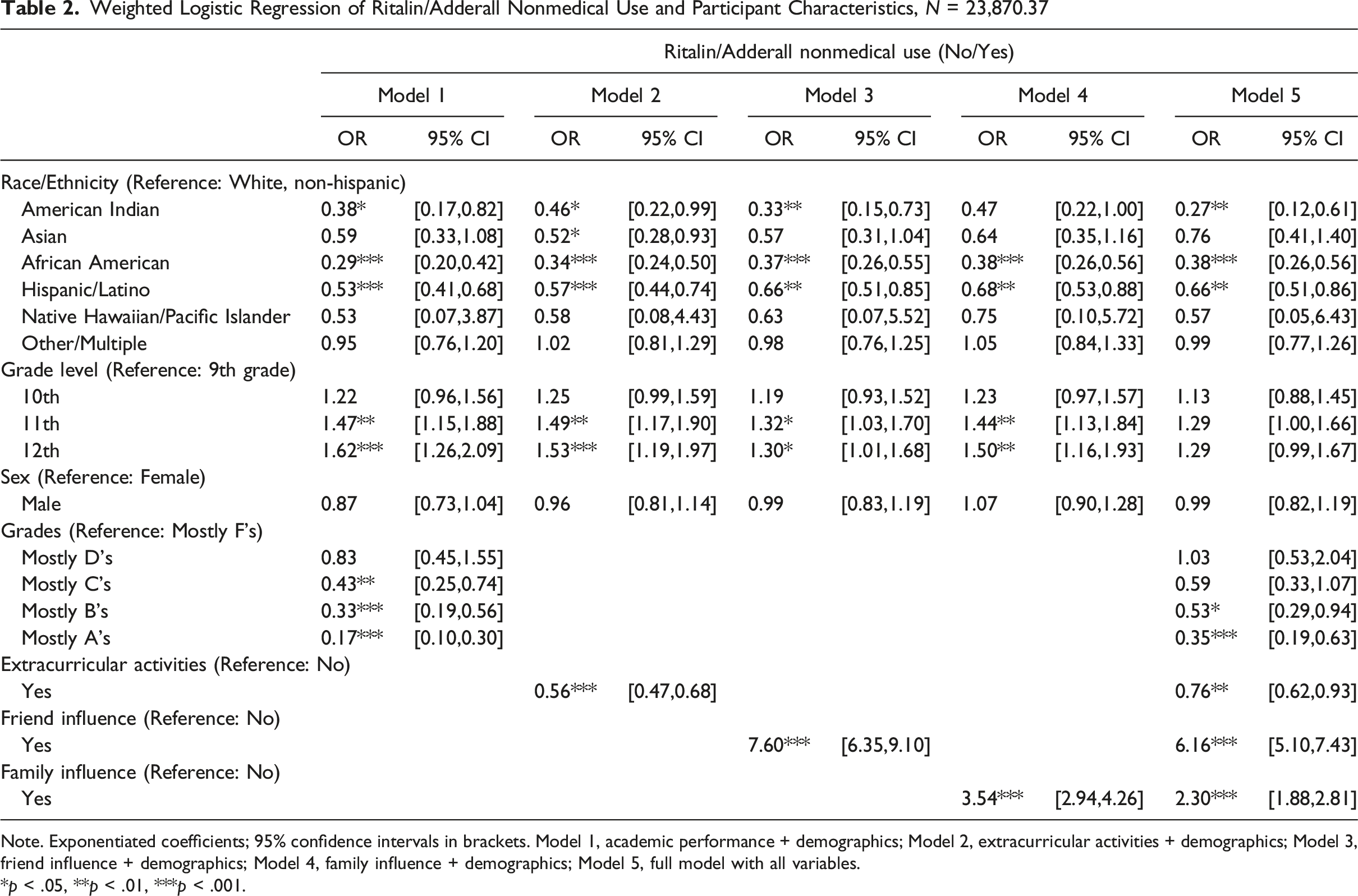
Note. Exponentiated coefficients; 95% confidence intervals in brackets. Model 1, academic performance + demographics; Model 2, extracurricular activities + demographics; Model 3, friend influence + demographics; Model 4, family influence + demographics; Model 5, full model with all variables.
*p < .05, **p < .01, ***p < .001.
Academic performance showed a consistent inverse relationship with nonmedical Ritalin/Adderall use. Compared to students with mostly F’s, those with mostly B’s and A’s were 47% and 65% less likely to report nonmedical use, respectively (AORs = 0.35 to 0.54, p < .05). Extracurricular activity involvement was also a protective factor, with students who participated in such activities being 24% less likely to engage in nonmedical Ritalin/Adderall use (AOR = 0.76, p < .01). Friend and family influences emerged as significant risk factors for nonmedical Ritalin/Adderall use. Students who had friends engaging in nonmedical prescription drug use were over six times more likely to report nonmedical Ritalin/Adderall use themselves (AOR = 6.16, p < .001). Similarly, those who lived with a family member with a history of illegal drug use or prescription drug nonmedical use were 2.3 times more likely to engage in nonmedical Ritalin/Adderall use (AOR = 2.30, p < .001).
Discussion
Our study highlighted the importance of social influences in shaping NMSU among adolescents in Florida, which is consistent with previous research (Sattler et al., 2021; Vosburg et al., 2021). Adolescent decision-making is influenced by various factors, including the roles of parents, teachers, and mentors, brain development, developmental milestones, available resources, and health literacy. Parents and peers appear to have the most significant impact on substance use decisions and behaviors among adolescents (Albert et al., 2013; Trucco, 2020).
Peers are considered to have a powerful influence on adolescent substance use, especially among males (Albert et al., 2013; Reiter et al., 2019; Trucco, 2020). This influence may be even more substantial in the absence of traditional role models such as parents, teachers, coaches, and mentors highlighting the role of peer networks in nonmedical prescription drug use, and emphasizing the need for interventions targeting social norms and peer dynamics (McCabe et al., 2019). Furthermore, since 50%–90% of adolescents who misuse stimulants reported they obtained them from friends or family members (Faraone et al., 2020), targeted interventions—such as public health programs and community-based initiatives—could be especially beneficial for parents who use or have misused substances.
While adolescents in this sample reported some positive trends, such as relatively low overall rates of nonmedical prescription drug use and high rates of involvement in extracurricular activities. Protective factors include positive peer influences and extracurricular activities. As a result, participation in sports and other forms of active engagement in schools and communities cannot be underestimated. Adolescence is a time of development during which coaches, mentors, teachers, and other role models can profoundly affect adolescents’ lives. Extracurricular participation in teams and clubs may be an important protective factor that influences adolescents during this critical stage of development. Additionally, interventions that increase support can serve as deterrents for NMSU, such as tutoring programs, body image counseling, and discouraging nonmedical use for academic performance through academic dishonesty policies in institutions of learning (Faraone et al., 2020).
Investigations into the impact of extracurricular activities on nonmedical substance use have yielded promising findings. Maxwell (2009) found that participation in structured extracurricular activities was associated with a reduced likelihood of nonmedical prescription drug use among adolescents, pointing to the potential protective effects of organized recreational and educational pursuits. Previous studies identified a strong inverse relationship between academic engagement and nonmedical substance use (Albert et al., 2013; Reiter et al., 2019), suggesting that academic success may serve as a protective factor against nonmedical drug use. Additionally, Faraone et al. (2020) also found an inverse relationship between GPA and NMSU (Miech, Johnston, Patrick, O'Malley, Bachman, & Schulenberg, 2023), supporting the notion that academic performance serves as a buffer against NMSU. Our study extends this literature by demonstrating a dose-response relationship, with students earning mostly A’s showing 83% reduced odds compared to those earning mostly F’s—a gradient effect not previously quantified specifically for stimulant misuse. This finding suggests that academic support interventions may have measurable impacts on reducing NMSU risk.
Our findings revealed that students in higher grade levels, particularly 11th and 12th graders, had significantly increased odds of reporting NMSU compared to 9th graders (AOR = 1.47 for 11th grade and AOR = 1.62 for 12th grade in Model 1). This pattern aligns with existing literature demonstrating that prescription drug misuse typically increases with age during adolescence (McCabe et al., 2019; Miech, Johnston, Patrick, O’Malley, & Bachman, 2023). Several factors may explain this grade-level progression. First, older students face increased academic pressures as they approach college applications and standardized testing, potentially motivating stimulant use for cognitive enhancement (Faraone et al., 2020). Second, upperclassmen have had more years of exposure to peers who may use or share prescription medications, increasing both access and normalization of NMSU behaviors (Albert et al., 2013). Third, older adolescents demonstrate greater autonomy in decision-making but may still lack fully developed risk assessment capabilities, making them vulnerable to experimental substance use (Jordan & Andersen, 2017). Additionally, 11th and 12th graders are more likely to have driver’s licenses and increased freedom, potentially facilitating access to prescription medications through expanded social networks beyond their immediate school environment. The developmental timing also coincides with peak risk-taking behaviors during late adolescence (Trucco, 2020).
This study has important implications for developing educational and social initiatives that support families and improve adolescent decision-making that may be best viewed from the lens of the ecological model. It is clear there is a complex interactions of different levels including adolescent support systems, peers, environment, culture, and perceived support system that help shape health-related decisions among adolescents (Albert et al., 2013; Höltge et al., 2021; Reiter et al., 2019; Woldehanna et al., 2021). For example, support systems are crucial to adolescent development. In the absence of parents and other formative role models, adolescents often find alternative support systems. Studies of adolescents exposed to street violence or gangs suggest that they form strong bonds with other street gang members; similarly, orphaned adolescents develop extremely close bonds with their siblings (Höltge et al., 2021). Further research on how adolescents navigate complex healthcare decisions can be leveraged to guide prevention efforts to curtail substance nonmedical use (Fleary & Joseph, 2020). Understanding how adolescents make healthcare decisions is key to shaping effective substance misuse prevention strategies. Research shows that young people often weigh peer influence, accessibility, and perceived benefits when deciding whether to misuse prescription stimulants or other substances (Xu et al., 2018). By identifying these decision-making patterns, prevention efforts can be developed to address modifiable risk factors and strengthen protective influences like parental guidance, school-based education, and mental health support. For example, studies suggest that adolescents who receive early education on prescription drug risks are less likely to engage in NMSU. Additionally, interventions that promote self-efficacy and informed decision-making—such as programs that teach refusal skills and alternative coping mechanisms—can significantly reduce misuse rates. Targeted interventions for parents who use or have used substances recreationally or without a prescription, such as public health programs for addiction and other community-based programs that strengthen families, could also be beneficial. Programs for adolescents, such as after-school physical education, sports, enrichment programs, summer camps, and counseling, may also be beneficial in combating the problem of NMSU.
Future research on understanding adolescents’ motivations for NMSU will more effectively guide preventive efforts. The role of social media in influencing substance use decisions among adolescents should also be studied as a possible contributor to NMSU among high school students, as this is a major source of peer contact and influence. Platforms like TikTok, Instagram, and Snapchat expose adolescents to peer influence, normalization of stimulant use, and misinformation about prescription drugs, making these social media sources possible contributors to the ongoing problem, although social media also has the potential to be leveraged for disseminating positive health messaging.
Limitations
This study has several limitations that should be considered when interpreting the findings. First, the cross-sectional design precludes causal inferences about the relationships between risk and protective factors and NMSU (Sedgwick, 2014). Longitudinal studies are needed to establish temporal relationships and further elucidate these factors’ complex interplay over time (Fagan et al., 2023). Furthermore, data collection period was impacted by the COVID-19 shutdown that might have influenced the participation of 1 school. Second, the data were based on self-reports, which may be subject to social desirability and recall biases (Althubaiti, 2016). However, the anonymity of the survey and the use of validated measures help mitigate these concerns (Brener et al., 2003).
Third, the study focused on a population of high school students in Florida, which may limit the generalizability of the findings to other populations or geographical areas (Polit & Beck, 2010). Future research should explore these relationships using diverse samples to enhance external validity (Steckler & McLeroy, 2008). Fourth, although the study included several key risk and protective factors, there may be other important variables that were not captured in the analysis, such as mental health status, stress levels, and access to healthcare services. A more comprehensive assessment of potential confounders and mediators could provide a more nuanced understanding of the pathways to NMSU (VanderWeele, 2019).
Fifth, the survey instrument specifically named only Ritalin and Adderall as examples of prescription stimulants, despite the existence of many other prescription stimulants (e.g., Vyvanse, Concerta, Strattera, and others). This naming limitation may have led to underreporting of nonmedical use of other prescription stimulants not explicitly mentioned, potentially underestimating the true prevalence of NMSU in our sample. This underestimation could impact the strength of associations we observed between risk/protective factors and NMSU, as students who engaged in nonmedical use of other stimulants may not have recognized their behavior as fitting the survey question . Furthermore, our binary operationalization of extracurricular activities (any vs. none) fails to capture variations in intensity, duration, or type of involvement that may differentially influence NMSU risk. The friend influence measure assessed only the presence of any friends using prescription drugs nonmedically, without capturing the number of friends involved, relationship closeness, or frequency of exposure. Similarly, our family influence variable measured only whether participants had ever lived with someone who used substances, without assessing duration of exposure, relationship quality, or severity of substance use.
Despite these limitations, this study had several strengths. The large, representative sample of Florida high school students provides robust estimates of the prevalence and correlates of NMSU in this population (Sedgwick, 2014). Using a validated survey instrument, the Florida Youth Substance Abuse Survey, enhanced the reliability and comparability of the findings (Florida Youth and Substance Abuse Survey, 2020). Furthermore, multiple levels of influence, including individual, peer, and family factors, align with the ecological models of adolescent development and offer a more comprehensive perspective on the complex determinants of substance use behaviors (Henneberger et al., 2021).
This study also highlights the importance of extracurricular activities and academic performance as protective factors against NMSU, which has important implications for prevention and intervention efforts (Bugbee et al., 2019; Faraone et al., 2020). The findings underscore the need for a multifaceted approach that addresses individual risk factors and social and environmental contexts. By identifying modifiable targets for intervention, such as promoting engagement in extracurricular activities and supporting academic success, this study contributes to the growing body of evidence to inform evidence-based strategies to prevent and reduce stimulant nonmedical use among adolescents (Maxwell, 2009; McCabe et al., 2019).
Conclusion
This study highlights the complex interplay between risk and protective factors associated with nonmedical prescription stimulant use among Florida high school students. These findings show the importance of extracurricular involvement, academic performance, and social influences in shaping adolescent substance use behaviors. Participation in extracurricular activities and higher academic achievement were associated with lower odds of stimulant nonmedical use, whereas peer and family substance use increased the risk.
These results have significant implications for prevention and intervention efforts aimed at reducing NMSU among adolescents. A multilevel approach targeting individual, family, school, and community factors may most effectively address this complex issue. At the individual level, promoting engagement in extracurricular activities and supporting academic success can enhance protective factors and build resilience. Family-based interventions such as parent education and support programs can help address substance use issues within the home environment and strengthen family bonds.
At the school and community levels, implementing evidence-based prevention programs, such as the Communities That Care system, can help foster positive youth development and reduce the risk factors for substance abuse (Oesterle et al., 2018). These programs should be tailored to the unique needs and contexts of high school students, addressing the specific motivations and consequences of NMSU in this population.
Furthermore, this study highlights the need for a more nuanced understanding of the factors influencing stimulant prescription and nonmedical use among adolescents. Future research should investigate the decision-making processes behind stimulant prescriptions, considering both the medical necessity and potential for nonmedical use. Exploring the comparative effectiveness of pharmacological and non-pharmacological interventions such as behavioral modification and cognitive-behavioral therapy can inform personalized treatment approaches for adolescents with ADHD and other related conditions (Haugan et al., 2022).
The findings emphasize the importance of a comprehensive, multilevel approach to prevention and intervention that addresses individual, social, and environmental influences. By prioritizing research, policy, and practice efforts that enhance protective factors and mitigate risk factors, we can promote healthy adolescent development and reduce the burden of nonmedical prescription drug use in this vulnerable population.
Footnotes
Acknowledgements
The author would like to thank the Florida Department of Children and Families for providing us access to the Florida Youth Substance Abuse Survey (FYSAS).

Ethical Considerations
In accordance with the policy of the University, the Institutional Review Board categorized the research as exempt since the study analyzed secondary data that is publicly available.
Author Contributions
Hanadi Hamadi led the overall project, led data analysis and contributed to reviewing and writing. Rachel McMahan Thomas led the writing of the manuscript. Zhigang Xie provided important conceptual contributions to the analysis and contributed to reviewing and writing. Kaveri Subrahmanyam and Karen B. Patterson contributed to reviewing and writing. Aaron Spaulding provided biostatistical oversight to support data analysis and contributed to writing. All authors contributed to the conceptualization and design of the study, as well as interpretation of study findings, critical review of drafts and approval of final manuscript for submission.
Funding
The authors received no financial support for the research, authorship, and/or publication of this article.
Declaration of Conflicting Interests
The authors declared no potential conflicts of interest with respect to the research, authorship, and/or publication of this article.