



Abstract
The purpose of this study is to take a life course perspective to explore how experiences at different life course stages of substance users and contextual factors influence their drug use behaviors. Using the life history narrative approach to interview 31 persons who were taking part in rehabilitation treatment in Hong Kong, this study maps out substance use trajectory into four stages (onset, persistence, escalation, and desistance) addressing three interrelated themes: (1) substance use behavior characteristics, (2) critical life events, (3) and social and structural factors. The results showed an interaction between substance use behaviors and their experience in different life stages. Because substance use has become more hidden in the stage of persistence and escalation, particularly in dense cities like Hong Kong, early social support is advocated to be provided in prevention and rehabilitation, such as offering better vocational training support and follow-up service to rebuild relationships with families.
Keywords
Introduction
Substance use has been a prolonged social issue endangering public health worldwide. There has been an international effort to deal with increasing substance use in this era. However, with the emergence of COVID-19, which has largely influenced worldwide economic activities, the mission of tackling drug use and trafficking has faced additional challenges as the drug use and trafficking patterns quickly adapted to the pandemic. The social impact of the pandemic, such as unemployment and inequality, could further push the already vulnerable populations into drug use (United Nations Office on Drugs and Crime [UNODC], 2021). There is an urge to evaluate and modify anti-drug strategies to keep drug use under control.
While this study focuses on problematic long-term substance use among young adults, their onset of drug use mostly occurred earlier in their adolescence and developed into more problematic in later stages. The worldwide rising figures of young persons who use drugs indicates that there is a growing risk of having more early substance users who might eventually engage in problematic substance use. According to the latest World Drug Report from UNODC (2021), higher rates of drug use, particularly among youths, have been observed in recent years. This is supported by the data from some more developed countries, such as the UK and US, indicating an uptrend in the number of young drug users over the last few years. The latest UK figures showed that drug use among 15-year-olds has increased over the past 5 years. In 2018, approximately 38% and 21% of 15-year-old teenagers reported using drugs in England and Scotland, respectively, compared with 24% and 18% in 2014 and 2013 respectively (United Kingdom Focal Point on Drugs, 2021). In the US, the proportion of 8th graders who reported to have ever taken illicit drugs increased from 18.2% in 2017% to 21.3% in 2020 (U.S. National Institutes of Health, 2020). Similarly, Hong Kong is also facing increased problematic substance use among youngsters lately. In 2021, the number of reported drug abusers aged under 21 rose by 47%, and the proportion of students among them increased from 25.5% to 45%, compared with the previous year (Hong Kong SAR government, 2021). It indicates that Hong Kong, where the current study takes place, as well as other more developed countries are facing increasing risks of having more adolescents and young adults with long term drug use.
The increase in young drug users could be associated with the reduced perception of drug risks, particularly cannabis among youths (UNODC, 2021). With an increasing number of countries that have legalized or planned to decriminalize the recreational use of cannabis, the normalization of cannabis use has become a worldwide phenomenon and a challenge to anti-drug policymakers. Statistics show that roughly 200 million people reported cannabis use in 2019, equivalent to approximately 4% of the global population. The number of cannabis users has increased by almost 18% over the last decade (UNODC, 2021). The expansion of the cannabis user population has been observed over the past few years in the US, UK, and European countries (EMCDDA, 2021; U.S. National Institutes of Health, 2020; United Kingdom Focal Point on Drugs, 2021). In Hong Kong, the number of reported cannabis users has increased by 58% compared with last year, making cannabis the most prevalently used drug in Hong Kong (Hong Kong SAR government, 2021).
Apart from the increasing prevalence of cannabis use among youngsters, the proliferation of crypto markets has made illicit drugs more accessible. Current figures indicate that web-based sales have increased nearly four-fold between mid-2017 and 2020, from 80 million to 315 million dollars (UNDOC, 2021). Although the legalization of cannabis and the emergence of crypto markets in recent years pose additional challenges to supply-reduction efforts that societies take to deal with problematic youth drug use, we argue that reducing the drug demand among youngsters could still be a significant focus to treat the root cause. In this globalized era with technological breakthroughs almost every day, it is nearly impossible for the anti-drug parties to act proactively to deter illicit drug trades and trafficking. As swiftly as the drug traffickers adapted to the initial setback caused by the COVID-19 pandemic lockdown, governments should learn not to race against the successive evolution of drug trafficking modes. Rather than chasing the drug traffickers, we believe that putting more effort into understanding the drug use pattern of young persons could eventually help develop more effective strategies to tackle the risk factors and prevent drug use. Therefore, this study aimed to identify the pattern of drug use trajectory from chronic drug users and to explore significant risk and protective factors influencing substance use.
A Life Course Perspective to Study Substance Use
Studies of substance use with a life course perspective can be traced back to early longitudinal studies of adolescent drug use and abuse (e.g. Desmond & Maddux, 1981; O'Donnell, 1969) in addressing factors influencing the start, persistence, and end of substance use. As one of the influential researchers studying drug use among adolescent and young adults, Kandel (1975) showed how changes of adolescent involvement in drug use can be broken down into stages that early alcohol use might lead to the use of other illicit drugs. While her work mainly focuses on the development of substance use behaviors among adolescents, the perceptive of understanding the development of substance use in stages and pathways has been influential to subsequent substance use studies on youth as well as those focus on different life stages. For instance, Hser and her colleagues (2007) proposed a conceptual framework for understanding drug use trajectory with a life course perspective. They argue that the life course perspective allows us to address drug use trajectories by identifying critical events and factors contributing to the persistence or change in drug use. It allows us to study the interaction between events that occur during the life span and drug use behaviors.
Similarly, the strength of developmental and life-course perceptive in studying prolonged issues has been recognized by criminologists. The developmental and life-course criminology (DLC) was established in late 20th century as a subfield aiming to address the development of offending and antisocial behaviors, risk factors at different life stages, and the effects of life events on the course of development (Farrington, 2003). With the assumption that the development of criminality is associated with individual and social-structure factors and varies with age (Blumstein et al., 1988), DLC emphasizes the importance of transitions or specific events in changing one’s long-term behavioral trends, which are referred to as trajectories (Schram & Tibbetts, 2014).
Sharing the life-course perspective to understand the impact of critical events during the life span on development of offending and substance use behaviors respectively, DLC and life-course substance use researchers place their emphasis on investigating how critical life events, as known as the “turning points” in some studies, and other contextual influences shape individuals’ decision making regarding their problematic behaviors (Hser et al., 2007; Kazemian et al., 2018; Sampson & Laub, 1995). For the application of life course perspective in criminology, it has been widely used in explaining the trajectories of various deviant and offending behaviors, ranging from substance use to serious crimes such as sexual offending and homicide (Dobash et al., 2007; Fox & Farrington, 2016; Herrenkohl et al., 2012; Lussier, 2017). On the other hand, life course substance use researhcers also demonstrated its applicability to understand substance use trajectory over the life span (Ahern & Leslie, 2013; Curran et al., 1998; Dawson et al., 2006; Hser et al., 2015; Moneyham & Connor, 1995; Teruya & Hser, 2010).
While the majority of life course substance use research adopted quantitative methods (e.g. Guo et al., 2002; Kuettel, 2021; Sullivan & Hamilton, 2007), qualitative life course substance use research can provide more in-depth understanding to problematic drug use over the life span. For instance, Foster et al. (2021) show that problematic drug use was more likely not to be recognized by individuals themselves earlier in life. Their findings suggest that individuals would normalize and minimize the impact of problematic drug use. Another example is that caregiving for an ill or dependent family members was related to reduced drinking and substance use (Jessup et al., 2014). Although qualitative research has its strength to generate in-depth analysis and discussion, the excessive amount of time and effort needed in data collection could be a barrier. This leads to a lack in qualitative research on life course and substance use. On the other hand, existing life-course drug use research were mainly carried out in Western countries, particularly in the US, but rarely addressed in other cultures. Therefore, this study aims to take an in-depth look into the lives of substance users to understand how their experiences at different life course stages affected their behaviors by conducting a qualitative study in Hong Kong.
Our analysis is based on the “career” paradigm which is widely recognized in the fields of crime and substance use to disentangle the relationship between the concerned behaviors and other factors over time. In criminological research, the career paradigm has led to a large variety of research looking into how criminal behaviors trajected over time (e.g. Piquero et al., 2003, (Blumstein et al., 1988; Laub & Sampson, 2001; Loeber & Le Blanc, 1990). These studies have enhanced our understanding of deliquent and criminal behaviors trajectory over life span and demonstrated the value of taking a longitudinal view in analysing criminal behaviors. Similarly, studies appying the career paradigm have emegered in the field of substance use research as well (e.g. Anglin & Speckart, 1986; Nurco et al., 1981). The career persepetive allows these studies to provide insight about how individual development and their substance use behaviors changes over a longer time frame. It is suggested that drugs can be interwined with one’s all parts of life when it becomes problematic (Hunt, 1997).
Since a primary purpose of the current study is to explore the interaction between individual life events and their substance use trajectory over a long period of time, our analysis is based on the career perspective with three interrelated themes were identified: (1) substance use behavior characteristics, (2) critical life events, and (3) social and structural factors. The first theme addresses our interviewees’ substance use behaviors pattern. It captures the changes in their substance use behaviors at different stages. Then, the second theme outlines some significant life events commonly faced by interviewees in different stages. It discusses how critical life events interact and influence their decision making about substance use. The last theme addresses the social and structural factors observed from our interviewees’ accounts. Although the primary focus of the study lies on the interaction between life events and drug-use decisions on the psychological and cognitive levels, the social and macro-level considerations were equally important.
Methodology
This study adopted a life-course preceptive to outline our interviewees’ drug use trajectory. We believe that, as discussed previously, a life-course framework effectively explores the impact of social and contextual factors on drug-taking behaviors. This helps us understand the risk factors encouraging drug consumption among our interviewees. Thus, semi-structured interviews were conducted, with an interview schedule addressing different stages from the life-course framework. The interview content covers participants’ drug-use and life experience throughout their life spans. It was conducted in Cantonese and then transcribed and translated into English. The interview schedule was reviewed and endorsed by the ethics committee of the University.
Participants
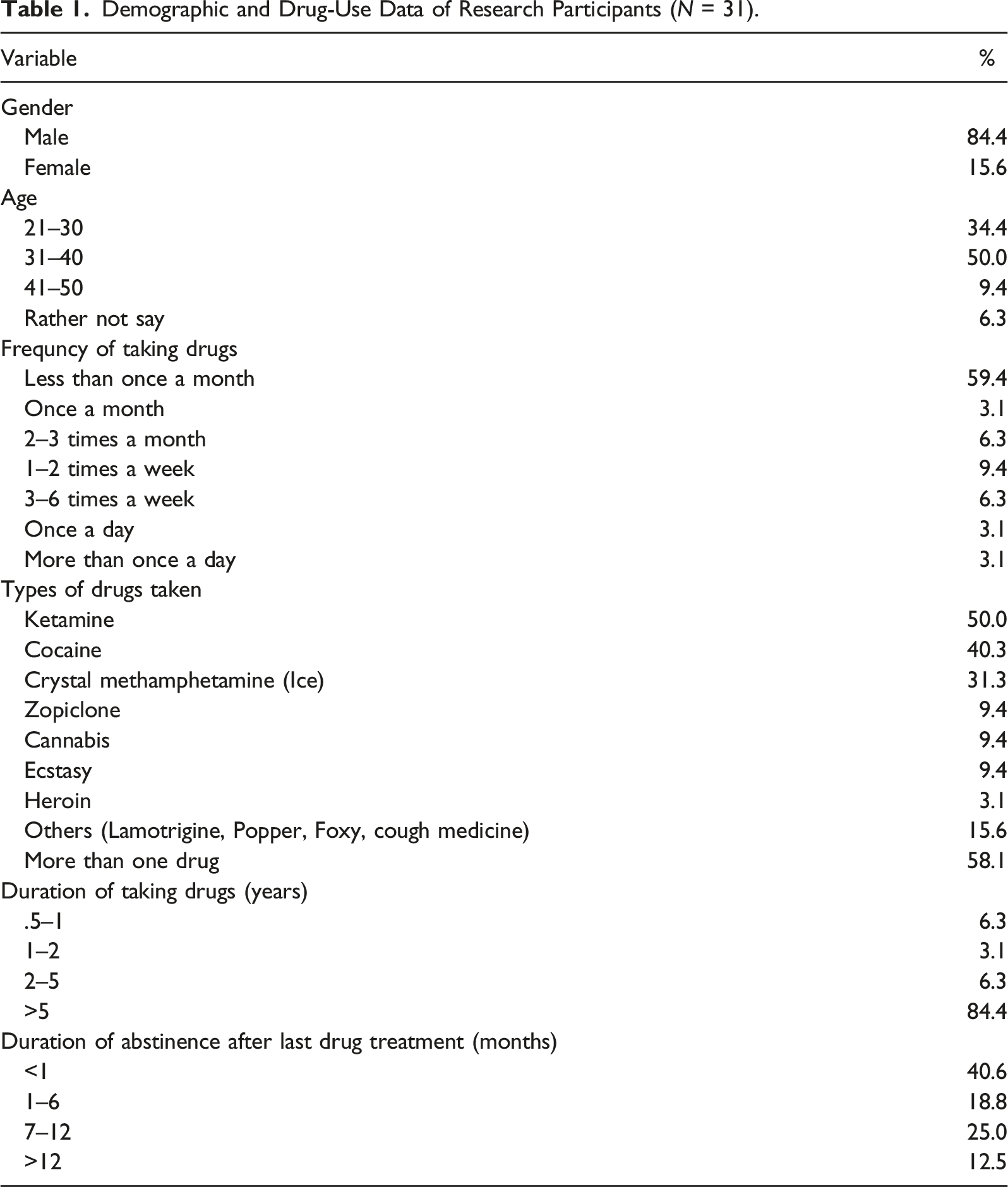
Demographic and Drug-Use Data of Research Participants (N = 31).
Life History Narrative Approach
Using the approach of a life history narrative, this study intends to reveal the substance use trajectory from our participants’ personal accounts. It allows us to understand interviewees’ drug use patterns by relating their entire life, from childhood to the present (Tierney, W. G. & Lanford, M., 2019), and provides more detailed accounts of key drug-use career characteristics like escalation and desistance as it lets drug users reflect on their lives in their own words (Blokland & Nieuwbeerta, 2010). Such an approach was also adopted in previous studies; for example, McIntosh and McKeganey (2000) collected narratives from 70 recovering drug addicts to explore their construction of a non-addict identity during their rehabilitation, and Lander (2014) examined the aging process among drug-using women by getting retrospective narratives from four participants. Inspired by these studies, we believe that the life history narrative approach facilitates discussions from the perspective of developmental psychology to understand drug use trajectories through detailed personal accounts and reflections.
Analysis
Using an in-depth exploration of the participants’ subjective experiences, our analysis is organized chronologically and thematically. Managing data chronologically enables us to structure the drug use pattern over the interviewees’ life spans, whereas thematic analysis allows us to theoretically examine the content relevant to the life course framework. The discussion will be placed in chronological order into four stages: onset, persistence, escalation, and desistance. First, onset addresses why and when people initiate drug use. Second, we investigated why and how individuals continue their drug-use behaviors to address persistence. Third, the factors leading to increased frequency and severity of drug-use behaviors are discussed. Finally, we probe into the factors that lead drug users to stop their drug-use behaviors.
Findings
Onset
Onset indicates the first attempt or initiation of drug use among our interviewees. From the qualitative data collected from the participants, we found that school completion or dropout was a significant life event they faced in their teenage years. Since our figures show that most participants (74.2%) had their first drug-use experience below the age of 20, they were commonly in school or at their early career onset. As teenagers in Hong Kong are liable to study up to junior secondary school, those who were not interested in studying or unable to continue their studies would likely stop attending school at approximately 15 years old. Without sufficient career support, they will likely go through a period of unemployment until they get a job. While studying at school provides constant engagement and commitment, leaving school causes them to feel lost and confused with a vast amount of spare time before getting a job. Thus, leaving school is the key life event nearly half of our participants (14 out of 31) experienced when they were introduced to drugs. When I was 15 years old (I am now 33), I used to go to discos in mainland China with my friends and take ecstasy. It was right after I finished my third year in secondary school, and I had not started to work yet. (Interviewee #3)
Based on the assumption that the influence of formal and informal social control institutions varies across the life span, the age-graded theory of informal social control suggests that crime and delinquency is more likely to occur when individual’s bond to the conventional society is weakened (Laub et al., 2019). This is coherent with our findings that leaving schools without employment could be a risk factors leading to the onset of substance use among our participants. Together with other risk factors which we have observed and will be discussed in the following, they are more likely to engage in substance use than others.
First, having a weak attachment to families could be a risk factor. Of our participants, seven were from divorced or single-parent families, whereas eight felt their parents did not care about them. Because I was in a single-parent family, my mother gave me a lot of freedom as she could not spend time taking care of me when she had to work. As long as I was not arrested, she did not care about how I spent my time. (Interviewee #7)
In particular, the neglectful parenting is found to be a risk factor leading to our participants’ onset. It was because that parental monitoring is argued to have a strong contextual influence on unstructured socialization of the youth that weaken informal social control might lead to their engagement of delinquent behaviors (Osgood & Anderson, 2004). Other than relationships with families, making friends with those involved in drug use would be another significant risk factor leading to the drug use trajectory. Since the participants had their onset stage during teenage age, it was the time when their significant other shifted from parents to peers. Thus, peer pressure and influence shaped their behaviors, including drug use. Peers introduced most of the participants (25 out of 31) to their first drug-use experience. I had my first drug-use experience when I was 15 years old. I was still a student. In the old days, we liked playing football at the playground near where I live. One day, one of the friends I made at the playground brought some ketamine for everybody to try. As we were curious, every one of us tried and then got addicted eventually. (Interviewee #9)
According to our interviewees, taking drugs was common among their peers as they were “curious” and “simply following others.” Our findings support the argument of Osgood and Anderson (2004) that time spent in unstructured socializing with peers has a significant impact on adolescents’ engagement in delinquency. The impact of family and peer influence we found here is consistent with some findings from earlier studies (Duncan et al., 1995), suggesting that these significant others are critical to substance use onset among the youth. Apart from these, we found that the prevalence of disco between the 1990s and 2000s could be another contributing factor. Since most interviewees are long-term drug users (84.4% over 5 years of drug history) and between 21 and 40 years old (84.4%), they shared a similar environment and started taking drugs at similar points in time. As told by the interviewees, hanging out with friends in discos was one of the most common recreational activities they had in their teenage years, which was more than a decade ago. Of all interviewees, 19 (61.3%) took drugs habitually in discos at their early stage of drug use. They either took drugs for the first time in discos, or they took drugs in discos constantly after they had been introduced to drugs elsewhere. Drugs were commonly accessible and used in discos. The first time I tried taking drugs was in mainland China more than 10 years ago. I had finished my study already and was so upset because of the breakup with my girlfriend; some of my peers brought me to discos to cheer me up. I did not take drugs at first, but then I tried as my friends persuaded me. Drugs were commonly seen in discos in those days. (Interviewee #4)
Since Hong Kong is geographically close to mainland China and it is convenient to cross the border, most teenagers would prefer going to discos in mainland China than in Hong Kong because of the lower price and lesser control. The lower age control in mainland China made discos accessible to teenagers under 18. It allowed this vulnerable group the opportunity to take their first drugs. According to the participants, the hallucinogenic and stimulant effects of drugs, particularly ecstasy and ketamine, allowed them to get high and into the “party mood;” therefore, drugs were more prevalent in discos. All interviewees who had their first drug-use experience in discos took either ecstasy or ketamine, while half of them took both ecstasy and ketamine. I used to take ketamine mainly and sometimes ecstasy, but not cocaine. It is because taking ketamine or ecstasy got me a better feeling in discos with the music playing there. My social life was like that. (Interviewee #29)
To summarize, leaving school could be a significant life event leading to the onset of the drug use trajectory. Together with other risk factors mentioned (e.g., having a weak family attachment, staying with deviant peer groups who take drugs, and the prevalence of drug-taking in discos), it made drug-use part of their social life in their teenage years. With the excessive amount of leisure time which they gained after leaving school, they could easily spend more time having fun with their peers in discos, where drug-taking was prevalent.
Persistence
Unlike other transition stages, persistence indicates the sustenance and continuation of the drug-use behavior after the onset. Proceeding from onset to persistence is characterized by the normalization of drug-taking as part of their life (Asbridge et al., 2016). As there might not be a significant change in their drug-taking behavior, a primary feature observed in persistence is the development of a lifestyle in which they live with drugs. After I started working full time, I took drugs with my colleagues. One of them was a rich guy who shared drugs with us. At first, I only took drugs at discos or at home. After a while, I would also take drugs during casual social activities, such as singing karaoke and taking a joyride. I also took some drugs at work as it made me feel better. (Interviewee #8)
Although it is common to get a full-time job to sustain their drug supply, very few of the interviewees revealed that they continued their drug-taking by being involved in jobs with easy access to illicit drugs, such as working for a gang or as drug dealers. My first encounter with drugs was at the age of 15. I used to hang out with my friends at the playground, and then we made some friends who took drugs. After a few years, I joined a gang group. Due to the nature of my job, drugs were very accessible to me. I started taking drugs more. (Interviewee #27)
Either by having a conventional job or involving in jobs with easy access to illicit drugs, the interviewees developed a lifestyle in which they found a way to live with drugs. At the early stage, their purpose of taking drugs could be mainly recreational, that is, taking drugs only during fun times with friends. However, as time goes, drugs no longer only existed in their social life but became part of their daily life as they regularly used them as a habit. They took drugs habitually even if the drugs no longer provided the physical effect they used to get. At first, my peers and I only tried a little and did not get addicted. I would only take drugs when I went to discos with my friends. With time, taking drugs became a habit for me. As I have taken drugs for quite a long time, the drug effect has become so mild on me. I simply enjoyed the process of taking drugs. (Interviewee #9)
When drug-taking became part of their life, it made sense that they constantly engaged in deviant social circles with drug-taking peers. Once they got into the social circle with drug-taking as their new normal, they were stuck and could hardly come out from it. When I was released from the detention center, I thought I was a “bad” person who deserved only “bad” friends. I could not be friends with those model students. Therefore, I could only return to my social circles with peers who engaged in illicit activities. After hanging out with my old friends several times, I could no longer resist ecstasy and ketamine. Therefore, taking drugs in discos with friends was a habit in my teenage years. It was on and off when I started working and until now. (Interviewee #5)
Their feeling of belonging to a deviant social circle could be a psychological trap to get away from drugs. Even when they had an opportunity or thought about stopping drugs, they might not be able to build a social network with people who are not involved in deviant activities, as they labeled themselves as drug users who can never come out of the circle. It forms a vicious circle where their self-identification as drug users is reinforced by their drug-taking behavior, which then signifies their alienation that they perceive as being excluded from the conventional social circle.
Apart from the sense of isolation, the shutdown of discos in the late 2000s also contributed to the routinization of their drug-use behaviors. Since discos were commonplace for them to seek fun and take drugs in their teenage years, drug-taking was confined to discos where they would like to have fun with their peers but not elsewhere in their daily life. However, when the disco business was brought down due to stricter control imposed by the government, they could no longer take drugs in discos and had to start taking them at home or in their private spaces. Consequently, taking drugs turned from a social activity in which they shared drugs with their peers in discos to a private activity in which they would take drugs alone. Yes, I only took drugs in discos before. I think the closedown of discos in Hong Kong led to a worse situation. When I had a problem in my life and wanted a way of escape, I brought drugs back home, leading to issues like a hidden lifestyle. Initially, I was not a frequent drug user, but the environment encouraged me to take drugs since they are now available at home. (Interviewee #30)
Since drug taking transformed from a social activity which they performed with peers to an activity they do alone, it amplified their sense of alienation with drugs as their only companion. The sense of loneliness and alienation strengthened their bond with drugs and discouraged them from building a social network with others. This eventually led them away from the social support that could help them get rid of drugs. The unhappy events in my life, such as frequent family and relationship issues, made me want to escape reality with drugs. At that point, I thought all I had in my life was drugs. Drugs got me through the two years I never left my neighborhood. It was because they would give you the feeling you want when you pay for them. Drugs, unlike life, were so simple and real to me. It made me feel like time passed faster and kept me out of annoying thoughts. (Interviewee #6)
The persistence stage marks the continuation of drug use after the first attempt at drug-taking. It is characterized by the normalization and habituation of drug-taking, such that drug use becomes part of their life. Drug users seek a way to maintain their drug supply by getting employment or access to the drug supply chain. Catalyzed by the shutdown of disco business in the region and the sense of isolation from other social circles, their drug use behaviors developed to be more consistent and hidden. A strong and stable bonding was built between the drug users and the drugs.
Escalation
The escalation stage is featured by a significant increase in drug use behaviors in terms of frequency, severity, and reliance. A common indicator of an escalation in drug use is the emergence of drug-related emotional problems, which could significantly influence their interpersonal life (Chen et al., 2009). While persistence is a state in which drug users develop a lifestyle in which they use drugs with self-control, escalation is likely to result in a loss of self-control in drug-use behavior due to the sudden surge in drug-use level (Wills & Dishion, 2004). When I was most addicted to drugs, I was so eager to take drugs that I would call the drug dealers early in the morning, like 4 or 5 am. I lost my job because I was caught using drugs. I tried everything to get money to buy drugs; I sold all my belongings, such as game consoles and cameras, and asked everyone I knew for loans. (Interviewee #8)
A primary reason for losing control of drug use is addiction. On the one hand, drug users might need the drug effects to feel better over life challenges and difficulties. I think the craving was the most difficult part to deal with… I was more radical and emotional when I was under the control of drugs. I would keep thinking about drugs and feel I had to take some drugs to get rid of annoying thoughts. (Interviewee #23)
On the other hand, drugs could have a unique meaning to every drug user. To some interviewees, drugs could be a way to memorize their loved ones due to the soothing effect of these drugs. After I broke up with my ex-girlfriend, I was upset as we used to live together. I would miss her when I saw our bed and our photos. When my mother and brother slept, I wanted to take drugs to hypnotize myself or to get rid of the bad feeling. (Interviewee #7)
When their craving for drugs was so strong that they lost control, their persistence stage lifestyle could no longer be sustained. While being employed is a key indicator of persistence, the end of stable employment is regarded as a key life event in escalation. This is because a full-time job normally takes more than 8 hours daily. If they lose control over their drug-use behaviors, their job performance is likely to be affected, possibly leading to unemployment. Apart from my full-time job in computer repair, I started my own business reselling old computers… I kept using the money I earned to buy more sleeping pills. Ultimately, I could no longer continue my own business, and I also lost my full-time job as I often suffered from seizures during work. (Interviewee #25)
Second, it was common to observe relationship breaches at the escalation stage. Since escalation marks the loss of self-control in drug-taking, the side effect of the drugs could make them more emotional or irritational, and they are more likely to argue with their family and peers. Moreover, drug use could be occupying to their time as drug effects disable them from having a functional social life. It hinders their interpersonal relationship when they can no longer socialize conventionally. During the days when I lived with drugs, I argued with my mother every day… Sometimes, when my mother came back home, she would blame me when she saw me taking drugs again. My mother, my brother, and I argued every day… It continued until I got arrested again. (Interviewee #7)
Finally, drug users commonly experience severe health problems as a side effect of over-dependence on drugs. Different drugs cause different side effects to drug users and adversely affect their quality of life when the health issues become increasingly problematic. Severe health problems could also affect employment and interpersonal relationships. At the time when I took many drugs, I did not leave my neighborhood for two years because I had to go to the toilet every 5 minutes. I always went to the hospital as there was blood in my urine. It lasted more than 10 years until 3 months ago when I had my urinary bladder replacement surgery. (Interviewee #6)
In the drug use trajectory, addiction could primarily drive the transition of stages from persistence to escalation. While drug use is regarded as a habit and part of life in the persistence stage, the surge in drug-taking behavior could be beyond drug users’ control, such that their employment, relationships, and health are affected. Therefore, unemployment, relationship breach, and severe health problems could be the significant life events observed during the escalation period.
Desistance
The desistance stage is featured by a reduction in drug use, rather than the cessation or abstinence of drug use. It is recognized that the problem of measuring desistance from drug use, as well as offending, is that it largely depends on how the end state was defined and the timeframe covered in studies. As a result, life course researchers prefer to focus on the reduction of drug use rather than focusing on desistance per se (Hser et al., 2007). While studying onset allows us to understand risk factors leading to the initiation of drug use, the study of desistance explores factors that encourage reduction of problematic drug use. According to our interviewees, it was commonly observed that they are willing to stop taking drugs for reasons they found more meaningful to them, including new hobbies, children, and religion. The position of drugs in previous stages was “replaced” by their “meaning in life”, which could be their hobbies and important persons. Drug-taking was a habit of chronic drug users in the persistence and escalation stages. In desistance, it is observed that some interviewees replace their drug-taking habits with their hobbies, when they are willing to give up substance use for their hobbies. The motive behind my determination to stop taking drugs is the music band I am part of now. Although I took drugs, I loved music deep down. The feeling of playing music on stage was wonderful. Our music band was always invited to different places to perform, which has made my life fruitful. I spent more time on my interests and the music I love. I avoid taking drugs because I need to keep my mind clear to perform. (Interviewee #7)
Before desistance, they relied on drugs as they viewed drug as part of their social life. However, after they have built their passion and a healthy social circle with their hobbies, they are willing to “sacrifice” their drug use habit and replace it with their hobbies. Hobbies not only provided them the satisfaction and pleasure they needed from engaging in social activities but also occupied their time, such that they had less time to think about drugs. Apart from getting a hobby as a replacement for drugs, the second critical life event, observed particularly from interviewees who are parents, is that they thought about their kids’ development. If you ask me the major motivation for stopping drug use, it was when I realized that my daughter getting older every day; my daughter is 6 years old now. I do not want her to have a “prisoner father.” It would be shameful to let others know that. (Interviewee #29)
They stopped drug use when they realized their drug-taking behavior could be a problem for the next generation. As parents, they believed they had to stop taking drugs for their kids to be proud of them rather than ashamed of having a drug-taking parent. Finally, becoming religious was another meaningful activity helping them stop taking drugs. I have decided to follow Christ because I experienced miracles during the days when I underwent treatment in the hospital…There was a cross in my patient ward and I tried to pray. I asked Christ to help me because I wanted to sleep. Right after my prayer, I fell asleep immediately. It was the first time I could take a long sleep without interruption by a cough… I have stopped taking drugs, smoking, and drinking since I was discharged from the hospital. (Interviewee #18)
In desistance, having new hobbies, beloved ones such as children, and religion are significant changes to the interviewees’ lives, encouraging them to stop taking drugs. These changes gave them a different lifestyle from what they were used to while living with drugs. It motivated them to get rid of the drug-taking habit. On the other hand, these changes could impact them on the cognitive and psychological level that these changes bring the interviewees new existential meanings, which thus motivating them to stop taking drugs (Giordano et al., 2002).
To summarize, this study adopts a developmental and life-course perspective to understand the drug-use trajectories of chronic drug users. The career perspective allows us to see drug use within a longer timeframe so that interaction between drug use, life events, and wider social contexts can be observed at different stages. Figure 1 summarizes the turning points, transitions, and drug-taking trajectory across the four stages. Critical life events were more commonly shared in earlier stages of life, as the interviewees tended to grow up in a similar environment where they were put in the same educational system and similar environment. As they grew up, their life paths became more diverse. Taking different life decisions led them to more diverse life situations. Therefore, a greater variety of critical life events was observed in later stages. The interaction between drug-use behaviors and experiences in different life stages.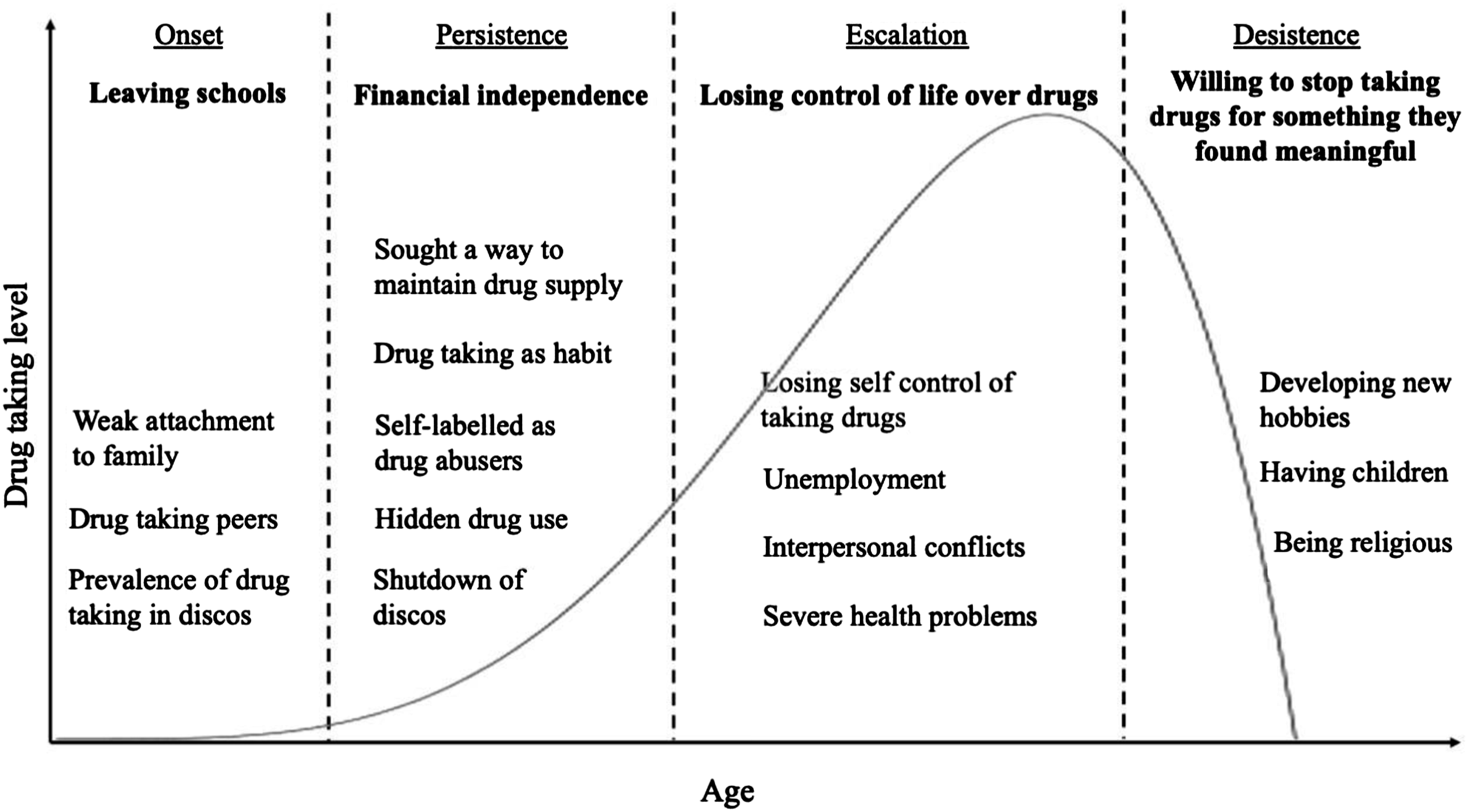
Discussion
This study used a life history narrative approach to structure the drug-use pattern of 31 persons who were taking part in drug rehabilitation treatment in Hong Kong. Three significant findings and implications were identified. First, this study demonstrates the capability of applying life-course framework in drug use research. Echoing previous findings, such as those of Tam et al. (2018), to understand drug use with a stage model, our findings showed that drug use trajectory could also be structured in a stage model with four stages: onset, persistence, escalation, and desistance. With a life-course framework, observing drug use over a longer timeframe allows us to understand this issue from a wider perspective. Rather than focusing on personal factors, such as self-regulation (e.g. Chavarria et al., 2012) or personality (e.g. Skóra et al., 2020), the life-course framework allows us to observe the interaction between drug use pattern of a generation and the wider social context they experienced in their upbringing.
Second, this study shows an interaction between drug use trajectory and life events at different stages of drug use. While Tam et al. (2018) investigated the change in drug-taking behaviors with the wider social contextual change, it left out the effect of significant life events on decision-making. One significant presumption of the life-course perspective is that critical life events could be powerful in changing one’s perspective and affecting their decision-making on drug use. This study builds on the stage model proposed by Tam et al. (2018) and extends the discussion to the impact of significant life events on drug-use behaviors. We demonstrated that key life events, such as leaving school and being parents, could influence the participants’ decision over drug-taking throughout their lifespan.
Thirdly, we argue that drug use should be perceived in a wider frame by taking a life-course perspective and addressing factors across different levels. On the one hand, taking a life-course perspective allows us to study drug use in a longer time frame and observe how life events and personal development influence individuals’ drug-taking behaviors from time to time. On the other hand, it is equally important to explore the impact of factors at both micro- (such as individual life events and interpersonal relationships) and macro-levels (such as the shutdown of disco business in society) on drug-taking trajectory. For instance, the shutdown of the disco business led to more hidden drug use, which further developed a stronger sense of loneliness. We believe that drug use is a complex and long-existing issue consistently affected by the interaction of individuals’ developmental psychology and the social context of the wider society.
Finally, our study addresses substance use trajectory with a life course perspective in an Asian society, which is relatively underresearched compared to the western societies. While marijuana is generally the most used drug in studies conducted in the US (Banks et al., 2017), ketamine was the most prevalent drug among our participants. As we have emphasized on the impact of social contexts on our interviewees’ substance use behaviors, we believe that the prevalence of ketamine can be explained by the fact that it is one of the most accessible “party drug” to be found in discos in earlier years. Moreover, substance use can be more hidden in Hong Kong than other part of the world, given that Hong Kong is one of cities with the densest population. Having packed residential skyscrapers can make drugs more accessible and less detectable when they can get drugs at a close walking distance. As a result, prevention is argued to be even more important in highly dense cities like Hong Kong when problematic substance use tend to be more hidden and difficult to be detected.
Implications for Drug Prevention and Rehabilitation
Our study shows that leaving school is a key life event that easily leads adolescents to the onset of drug use, and quitting drugs is not easy when they have developed a lifestyle of living with drugs. For those with weak attachment with their families, they could be easily attached to friends and tempted to take drugs to fill up their leisure time. In Hong Kong, parents are legally responsible for ensuring that children between the ages of 6 and 15 attend school regularly (Education Bureau, 2017). Schools are required to report cases of students’ non-attendance to the Education Bureau (EDB) on the seventh day of their continuous absence. EDB will assess the non-attendance cases and provide support services to these students and their parents. However, when students reach 15 years old, no regular government support services are offered to school dropouts unless they are willing to join vocational training programs offered by the Vocational Training Council or Labor Department on a voluntary basis. Therefore, more than investing time and resources in drug treatment and rehabilitation, preventing young adolescents’ onset of drug use trajectory is important. To achieve this, early prevention measures with regular and government support to guide them through the school-to-work transition, including times of school non-attendance or dropout, are deemed necessary.
The Youth Employment and Training Program is the key measure that offers pre-employment and on-the-job training for school leavers aged 15 to 24 in Hong Kong. Employers who offer on-the-job training to young people are eligible to receive an on-the-job training allowance for a maximum period of 12 months (Labor Department, 2023; Tam et al., 2021). When dropping out of school, adolescents are required to be financially independent to support their everyday expenses. They may not be patient enough to join such a long period of pre-employment training and on-the-job apprenticeship scheme with comparatively low salaries. Ultimately, they may look for ways to get “fast money.” The jobs with easy access to illicit drugs will easily be the target of school dropouts and non-engaged adolescents. To keep them away from the onset of drug use trajectory, school referral of non-attendance and school dropouts for short but intensive early prevention services is worth considering. To compete with young adolescents’ risk-taking attitude of getting “fast money,” short but intensive intervention with individualized (or family-based) follow-up services may help them realize their life goals and career interests in the short run. In the long run, tailor-made and individualized (or family-based) follow-up services may help drug users re-establish relationships with their families and break the deviant social circle. Drug desistance will gradually be possible when they can find the “replacement” of drugs as our findings suggest, such as helping them to develop a hobby or find a job that they are passionate about.
Limitations and Future Directions
The first limitation of this study is sampling. Convenience sampling was used due to the difficulty in sampling among this particularly vulnerable group. Since our interviewees were recruited from social centers, only those who sought help from social workers could be recruited. Therefore, our study findings might not be generalizable to the hidden drug use population. On the other hand, the stage and type of treatment they received are diverse and not controlled in this study. The types of drugs used by the interviewees differed, and the effect of different drugs was not taken into account in this study. For example, cocaine and zopiclone are different types of drugs and bring entirely different effects to drug users. Thus, future studies could focus on drug users of a particular kind to control drug effects and generate a more accurate account.
Another limitation is that the trajectories of drug use were identified retrospectively. The life-history narrative approach only allows us to see chronic drug use based on the outcome. Therefore, our finding is inductive and a collection of personal accounts. To study the causal relationship, longitudinal studies of drug use could be conducted in the future. Moreover, this approach also limited the direction of our discussion. While it intends to see drug use as a long-term issue, only long-term drug users can be addressed under this framework. Drug users with relatively short drug use histories might be left out.
Furthermore, the interviews were conducted before the COVID-19 pandemic. The impact of the wider social context during COVID-19 could not be addressed in this study. The lockdown brought by COVID-19 is believed to have had a considerable impact on society and individual mental health (Chiappini et al., 2020; Taylor et al., 2021; Zaami et al., 2020). The experience of COVID-19 could be a significant life event for drug users altering their drug-using patterns. Therefore, we believe an update might be needed to address the impact of COVID-19.
Footnotes
Declaration of Conflicting Interests
The author(s) declared no potential conflicts of interest with respect to the research, authorship, and/or publication of this article.
Funding
The author(s) disclosed receipt of the following financial support for the research, authorship, and/or publication of this article: The study was funded by Hong Kong Research Grants Council’s General Research Fund (RGC Ref. No. 11611120).
Ethics Approval
The interview schedule was reviewed and endorsed by the ethics committee of the City University of Hong Kong.
