




Abstract
Fentanyl analogs are synthetic opioids used for pain treatment and palliative care, which are also sought after by drug users for their psychoactive properties. Clandestinely produced fentanyl has caused an overdose crises of unprecedented scale in the United States. In Sweden, the retail purchase, possession, and use of some analogs are legal, providing opiate users with a legal alternative, until the process of scheduling is finished. The continuous process of scheduling and introduction of slightly modified variants implies that there is much uncertainty regarding the potency and quality of newly introduced analogs. We examine user perceptions of fentanyl analogs in a thematic analysis of the public internet forum, Flashback, from 2012 to 2019. In 24 threads on fentanyl analogs, posters shared and discussed information on the emergence of new analogs, their desirability and prices, adverse health effects, and eventual scheduling.
Introduction
The synthetic opioid, fentanyl, has several analogs that are 3 to 10,000 times more potent than morphine (Suzuki & El-Haddad, 2017), much cheaper than heroin and easily available online (Pardo et al., 2019). In the United States, fentanyl is often disguised in the heroin supply because it is a cheap way for distributors to increase the potency (Mars et al., 2019). This adulteration has caused “the worst drug-related crisis in history” (Beletsky & Davis, 2017, p. 156), characterized by unprecedented high rates of fatal overdoses (Suzuki & El-Haddad, 2017). These intoxications are not from pharmaceutical fentanyl, diverted from licit use in the health care sector, but from clandestinely manufactured analogs (Lucyk & Nelson, 2017; Mounteney et al., 2015). These non-pharmaceutical fentanyl analogs are fast becoming an international problem.
In Sweden, the location for the present study, fatal opioid overdoses increased by 18% annually, from 102 deaths in 2004 to 507 in 2014, corresponding to 5.3 per 100,000 population. Fentanyl analogs were believed to play an important part in this increase (Guerrieri et al., 2017). Sweden is generally known for its strict drug control policy (Moeller, 2019), but new psychoactive substances (NPS) are scheduled individually, as opposed to the generic control of all structurally related substances. Manufacturers are able to introduce new, slightly modified and unregulated analogs faster than they can be controlled (Armenian et al., 2018). Several online vendors exploited this opportunity, imported unscheduled fentanyl analogs in bulk from China, and made a business by repackaging and selling them in the form of nasal sprays and pills (Meyers et al., 2015). In this study, we conduct a qualitative thematic analysis of discussions from the Swedish Internet Forum, Flashback.org, on the process of serial introduction and scheduling of fentanyl analogs.
Limited prior research has examined user perceptions of fentanyl. This research examines either diverted pharmaceutical fentanyl or the clandestinely produced fentanyl that contaminates the heroin supply. An early study by Firestone et al. (2009) found that street drug users in Vancouver with a history of injection found pharmaceutical fentanyl, extracted from patches, to be highly desired, sought after, and expensive. Similarly, but in a controlled setting, Greenwald (2008) found that pharmaceutical fentanyl ranked higher than other opioids, measured as willingness to pay among a sample of heroin-dependent, buprenorphine maintained volunteers. Mazhnaya and colleagues (2020) conducted a survey (n = 311), on non-pharmaceutical fentanyl in the heroin supply among persons who reported having injected drugs in the past 6 months and used fentanyl in their lifetime; 43% reported that they prefer drugs that contain fentanyl, with a higher share of positive responses among women than men.
The desired effects from fentanyl analogs have been described as the fast and powerful onset, relief of withdrawal symptoms and pain, and the ability to bring back an opioid euphoria that experienced users may have lost to tolerance (Mars et al., 2019). Compared with heroin, fentanyl has a longer “nod”, characterized by relaxation and sedation (Suzuki & El-Haddad, 2017). In Kilwein et al.’s (2018) online survey assessing nonmedical fentanyl use (n = 122), the most common motives were to relieve stress, get high, and relieve pain/physical discomfort. The primary adverse effect comes from the strong µ-opioid receptor agonism and the rapid onset of action that, in combination, increase fatal overdose risk. Other undesired effects include tolerance, withdrawal, dizziness, respiration depression, a shorter half-life compared with heroin, and therefore increased frequency of use among chronic heroin users (Helander et al., 2017; Kilwein et al., 2018). Generally, the quality and effects of psychoactive drugs are difficult to ascertain. Bancroft and Scott Reid (2016) explained how perceptions of quality and desirability are local and evolving cultural norms with varying degrees of adaptation. The configuration of the drug, user, and the context of use, aids in creating a more stable, coherent object. User’s online discourse and knowledge were key in shaping a community configuration of quality.
The use of data from internet forums for research is not new (see, for example, Williams & Copes, 2005). However, the increase in the online drug trade since 2011 has spurred an increased interest in the methodological aspects of using these data. Enghoff and Aldridge (2019) noted that online forums in particular are a good source of information as they include a wide range of trip reports, questions and answers, and consumption tips. As the forum posts are archived, they can be used to analyze changing perceptions of substances over time, providing rich and detailed user perspectives (Bancroft & Scott Reid, 2016; Kamphausen & Werse, 2019; Mars et al., 2019; Seale et al., 2010).
Prior research on user perceptions has analyzed data from internet forums for NPS. Thematically, this research broadly falls into two categories; one focuses on the communication of information and opinions on the properties of substances, and the other on the commercial aspects of the trade. Kjellgren et al. (2013) analyzed the sentiments in trip reports on synthetic cannabinoids posted on Flashback.org. These threads detailed positive and negative psychoactive properties of individual variants, which over time formed a community opinion on the quality of the substances. Ledberg (2015) examined eight Flashback.org forum threads on NPS, primarily stimulants, to see whether interest changed with scheduling. He found that the number of daily posts substantially decreased after scheduling and interpreted this as reduced interest from buyers. Rhumorbarbe et al. (2019) similarly counted the number of posts for various NPS and noted that the posts describe presence, popularity, and pricing of individual substances over time. They argued that authorities and researchers could utilize these online discussions for monitoring NPS, especially for early warning systems.
Meyers and colleagues (2015) focused on the commercial aspects of webshops that sell synthetic cathinones (bath salts). The shops were informative about their products and used regular marketing strategies to increase sales, such as buy-one-get-one-free sales, price match guarantees, and discounted products to select states. Similar to cryptomarkets (Ladegaard, 2018), the shops offered drug samples in trade for reviews on the forum, and offered services like direct communication with buyers on the shipment status of their order. In a recent study, Williams and Nikitin (2020) selected the 100 most popular internet Kratom vendors and examined their advertised sales practices. They counted topics that relate to payment and shipping options, age verification, health warnings, and advocacy regarding state regulations. From this research, they found that the internet vendors faced problems with payments because authorities monitor banks and payment processors. Instead, these vendors had to rely on cryptocurrencies, which limited their business. Pineau and colleagues (2016) analyzed how online offers for doping products were discussed in online forums, and how participants evaluated the promotion methods used by suppliers. Their research demonstrated that the most popular products were stably discussed over time and that the emergence of new products increased intensity of discussions for a period. They argued that by following these forums, it is possible to detect new products, suppliers, and follow temporal trends in the market for doping products.
The aim of this study is to examine how posters on Flashback.org perceive benefits and costs of fentanyl analogs in terms of their desired psychoactive properties and monetary price. In our analysis, we combine the socially shaped user perceptions with the commercial aspects of the online trade and aim to provide insights into the market adjustment that occurs from the introduction of new analogs to their eventual scheduling or fading out of popularity. The study location, Sweden, provides a unique opportunity to study these aspects. The Swedish market for fentanyl analogs is largely separate from the wider heroin market and the posters in our study actively seek out fentanyl analogs online and explore different synthetic opioids. This niche market of internet-savvy opioid users is quite different from the chronic heroin users, sampled in the North American research, who often lead less structured, more chaotic lives.
Theoretical Underpinnings
We focus on the discussions surrounding the quality and pricing of the various analogs. While questions of valuation are often seen as the domain of economics, there are important social components to this process. We understand the posts on Flashback.org as a networked evaluation of fentanyl analogs. Economic sociology provides an appropriate interdisciplinary framework for this analysis as it applies sociological perspectives to economic phenomena (Beckert & Wehinger, 2013; Moeller, 2018). From this theoretical perspective, posters on Flashback.org represent the demand side of a market for fentanyl analogs that communicate information to reduce uncertainty and improve market order.
Broadly speaking, there are three traditions in economic sociology that focus on institutions, networks, and culture (Fligstein & Dauter, 2007). We utilize insights from each, but primarily the network perspective. The institutional perspective concerns how formal rules and informal understandings govern relations among suppliers and customers (Swedberg, 2003). This pertains to the issues of how users evaluate the desired psychoactive properties of legal fentanyl analogs compared with illegal opioids, and how they respond to scheduling (Reuter & Kleiman, 1986). From the network perspective, we draw on research that has highlighted how information within informal social structures reduce uncertainty regarding products and valuation (Carruthers, 2013; Granovetter, 1985; Murji, 2007). The openness of this process requires suppliers to demonstrate reliability and trustworthiness because it is easy for the buyers to change to another supplier (Klemperer, 1987). From a cultural economic sociology perspective, fentanyl analogs are embedded in narratives that specify community standards for their desirable qualities (Bancroft & Scott Reid, 2016) and fair prices (Kahneman et al., 1986; Moeller & Sandberg, 2019). Flashback.org, and the posts we use as data, serve as judgment devices where these social perceptions and community preferences are shaped (Beckert, 2011).
Materials and Method
Data were collected from the Swedish public online discussion forum, Flashback.org, which has 1,277,031 registered members (January 19, 2020) and 2 million unique weekly visitors, out of a total Swedish population of 10.2 million. Membership is anonymous and free. Anyone can read the chronologically organized posts, and moderators remove posts that mention selling and buying, locations and individuals, in ways where they might be identified (see also Kjellgren et al., 2013; Ledberg, 2015). Sampling was retrospective, and we collected the data by crawling the site, using the R stats package rvest. Web crawling is a technique for extracting content from web resources, cleaning the data, and preparing them for analysis (Bradley & James, 2019).
We started by searching for fentanyl-related threads using the site’s internal search engine. We searched the subforum “Droger/Opiater och andra opioider” [Drug/opiates and other opioids] for the term “fenta” (November 11, 2019), which yielded 66 threads constituting a total data corpus of 91,737 posts. We excluded six threads that were very broad frequently asked questions that included posts on fentanyl analogs but were focused on other opioids: Heroin, Oxycodone, Buprenorphine, Opiates, Methadone, and Tramadol. From the remaining 60 fentanyl-focused threads, we selected the threads that concerned individual fentanyl analogs. These threads were identified by having the name of a specific analog in the title, and from reading of the first five posts to confirm this was the primary subject. This reduced the sample to 24 threads with 8,761 posts. The average number of posts per thread was 365 (SD = 433; Min = 6; Max = 1,803). The average number of unique poster per substance was 74.7 (SD = 67, Min = 5; Max = 261). The first post was on September 13, 2012, and the last post was on July 26, 2019, corresponding to 2,507 days and 3.5 posts per day. On average, the 24 threads lasted 519 days (SD = 452; Min = 17; Max = 1,672). Together, these posts comprise 523,643 words, or about 60 words each on average. Each post was coded with the title of the thread in which it was posted, the content of the post, the pseudonym of the poster, and the date and time it was posted.
Table 1 shows the names of the substances discussed in the threads, when the thread was started, and the relevant scheduling dates. There is no systematic naming process for synthetic opioids and some analogs have several synonyms (Armenian et al., 2018). We use the common name and introduce a short name for the sake of improving overview for the rest of the article. 1 The Public Health Agency of Sweden makes legal recommendations on individual substances and the Government decides to schedule them (Polisen, 2018). Substances scheduled under the law, Prohibition of Certain Goods Dangerous to Health, are illegal to sell and possess (SFS, 2011), and substances scheduled under the Narcotic Drug Control Ordinance are illegal to sell, possess, and use (SFS, 1992). The status of individual analogs under review by The Public Health Agency of Sweden is posted online (Polisen, 2018). The table is organized chronologically by first mention on Flashback.org, denoted as day.month.year.
Fentanyl Analogs Discussed in the Sample.
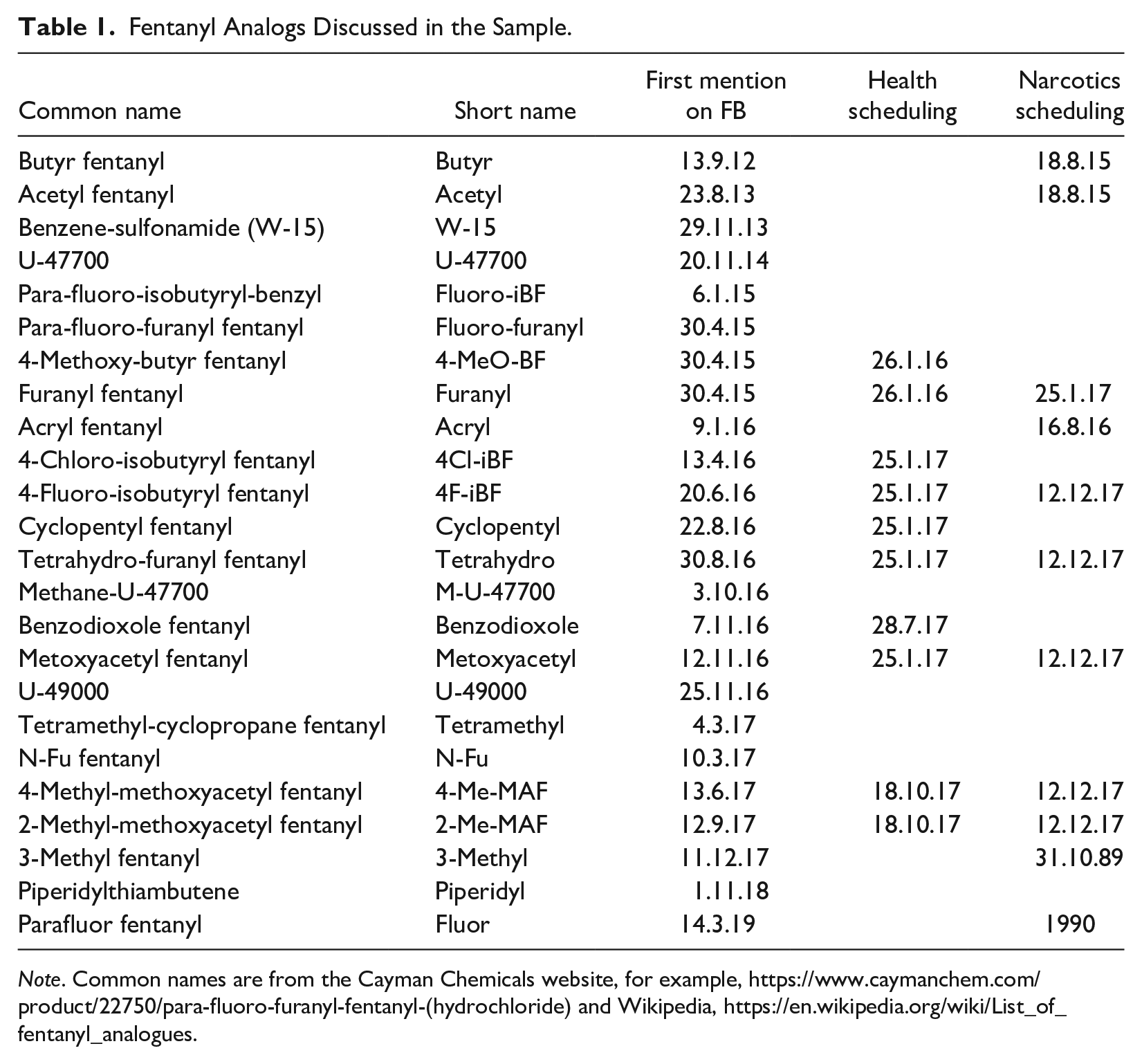
Note. Common names are from the Cayman Chemicals website, for example, https://www.caymanchem.com/product/22750/para-fluoro-furanyl-fentanyl-(hydrochloride) and Wikipedia, https://en.wikipedia.org/wiki/List_of_fentanyl_analogues.
As seen in Table 1, nine of the analogs ended up scheduled as narcotics, and six as dangerous to health, after they were mentioned on Flashback.org. Two analogs were already scheduled as narcotics before they were first mentioned on Flashback.org. The time between first mention on Flashback.org and narcotic scheduling was 469 days on average (SD = 314, Min = 182, Max = 1,069). The time from introduction to health scheduling was typically shorter at 225 days on average (SD = 150, Min = 74, Max = 626). For the six analogs that were first scheduled as dangerous to health and subsequently as narcotics, the time between these two was 195 days (SD = 141, Min = 55, Max = 365).
We follow Williams and Copes (2005) and understand the forum threads as “textual conversations” and “cultural artifacts,” amenable to empirical analysis. We conduct a thematic analysis to identify and examine patterns in the text, referred to as themes, which capture important aspects of meaning in the data (Altheide, 2000). Specifically, we use a theoretical thematic analysis because we explore questions of quality, valuation, and scheduling, within the selected sample, instead of having the overall data corpus guide our questions (Braun & Clarke, 2006). Accordingly, we used a theory-driven coding where we looked specifically for posts that relate to our research problem. Our initial interest was in the impacts of scheduling and we searched for posts relating to this theme. We first read all posts in each of the 24 threads and discussed which were potentially of most relevance. In this first stage of our interpretative analysis, we discussed which themes best reflected broader sentiments on scheduling.
We found that questions pertaining to scheduling were closely related to the perceived quality of individual analogs. For the less desirable analogs, the scheduling theme was largely absent. We went back to the data and collected posts where users discuss quality and monetary valuation. From this rereading, we agreed on four overarching themes that encapsulate how users perceive benefits and costs of individual analogs in relation to the process of scheduling. The extracts we present in the findings were translated from Swedish by the researchers. The original posts contain slang, grammar mistakes, and absent or wrong punctuation. We have attempted to retain the tone of the original posts by copying their punctuation, mistakes in capitalizations, spelling, spacing, and so on, in the translations. All prices are in SEK (SEK 100 ~ US$10.8).
Results
The findings are organized according to four themes: emergence, valuation, warnings, and scheduling. These themes reflect a typical temporal pattern in the threads and shift between discussion of informal and more formal assessments. The initial emergence is focused on subjective assessments of the desirability of an analog, while the following theme constitutes a more formal assessment of value. Continuing this oscillation, the third theme on warnings is from peer to peer, while the fourth and final theme concerns discussion of the official scheduling.
Emergence
The theme, emergence, is focused on describing and understanding user perspectives on the uncertainties associated with new analogs. The typical pattern was that an analog appeared for sale on one of the webshops and a few initial posts describe its psychoactive effects and quality. These trip reports were sometimes based on samples provided by the webshops. After a while, posters would compare it with other analogs available on the market and form a broader evaluation of its desirability.
Threads would often start with posts that express excitement and enthusiasm over the arrival of a new analog. The poster, Andreas 100kg, captured the uncertainty and excitement in one of the first comments on U-47700: “Crossing my fingers! Once more into the abyss . . .” For some analogs, the descriptions were quite positive, such as Fordie’s enthusiastic description of acryl: I also get very alert on higher doses. When I took 4st 0.6 mg IV I got really speeded, then after 2h I took another two, ate and drank water and smoked a cig and then I nodded to pieces.
Other posts were skeptical, typically due to the short duration, noted here by Claddis in a comment on tetrahydro: “Weak buzz for 15–20 min . . . Wait until new ones are released.”
Posters were aware that they contributed to accumulating knowledge about new analogs as evidenced by this post by viiktor on furanyl: “took a test dose 5 minutes ago starting to feel a little warm and in a better mood. Will wait a while before I take a higher dose and return. It is definitely active.” These trip reports were sometimes conducted at the behest of the webshops that would provide customers with samples in return for posts on Flashback.org. According to HerrFroberg, “the sample bottles are only a third full it seems, its a sample after all,” but were commonly used. The poster, mecca—village, described this relationship while complaining of a promised sample of 2-Me-MAF being delayed: 2 week wait now and 2 times the shop said they shipped only to take it back 3 days later. I think this is bad, sure it is a free sample and all. But it is us that are the test subjects and not you behind the shop.
The purpose of the samples was to advertise new analogs, and get the price and concentration right. Commenting on 4F-iBF, the poster Tapio6 explained this as follows: I know the shops always say that this one is the fattest/best in a long time but this time I think they got something good. They will have to figure the concentration out themselves or send out some samples. I don’t think a lot of people will take a chance on 10mg/10ml doesn’t sound like much and 899:- isn’t something Id just throw away.
After a while, posters would compare the analog as part of a landscape consisting of multiple analogs dynamically entering and leaving the market. The poster, Boekslol, commented that 4-Me-MAF was “easily the best one yet after its predecessors were classed, really nodded of this one and the muscles were compleeeeetely relaxed.” This poster, Ordeal89, referenced the desirable euphoric effect when comparing two analogs: Tetrahydrofuran.F doesn’t feel as euphoric as the acrylfenta was. However after two sprays I feel a proper effect! Feelings: comfortable bodyload, weak desire to scratch all over my body (maybe from higher doses), anxiety is gone but can’t say that I feel happy/joyous.
Some users questioned whether the producers were able to come up with new analogs of equal quality. Eddiepeddie noted a decline in quality over time: “Having a hard time seeing a new analog come out that gives a good effect. Has just been going down and down fast with all the new ones released. Been several years since a good analog existed.” Despite several trip reports on each analog, these quality assessments are subjective (Bancroft & Scott Reid, 2016). Phobiazi expresses that this uncertainty is closely associated with the process of introducing new analogs: “It is extremely individual, so hard to say! The more mutated analogs are released every year the more will get 0 and others 100!” The process of samples and crowdsourced testing can be exploited as there are no external control of the claims made by shops or in trip reports, as noted here by poster Dezeel: Like how they initially write that it is sooo tested and evaluated by “experienced users” and is “OPTIMALLY” dosed, only to make a u-turn, and a post about “evaluation ready” and increased potency a few days later. I will wait patiently until they have tablets if they are around 30 mg at a reasonable price or even better, as a powder.—D
Valuation
In the next phase, the trip reports and comparisons begin to form a community opinion on the relative qualities of an analog. We use the term “valuation” to describe this theme as it captures the social process where different scales of what constitutes quality are discussed (Beckert, 2011). Valuation improves comparability between products, reduces uncertainty, and adds to market order.
Posters discussed what constitutes a fair price and described various ways of negotiating with the webshops. The valuation includes duration of the high as noted here by the poster, Sirmess, in the thread on acetyl: “Pretty hefty price and for a short buzz.” This assessment of value for money rotates around the notion of a fair price, often in comparison with heroin. JojjeMeduza expressed this sentiment in the thread on 4-CL-iBF: I still think it is expensive. But sure if it works that is great, but max 400:- would be a more reasonable price I think. You can get real dope cheaper so why not do that? What do you guys think a fair price should be?
When prices are too high, the relative merits of purchasing illegal opioids increase, as explained by the poster, Powddder: Considering how little I get from this it is not worth it really. But cheap and legal in any case. Using the spray. Do not recommend it. You can get real and much better opiods for the same money if you really have to use. If it had not been legal I would have never bought it. Not a chance.
The discussions of prices relate to the market adjustment that occurs after new analogs are introduced. Webshops compete on prices, as noted here by poster Abasin: “R*24 (shop, ed.) have just announced that they increased the potency of their cycloflarror to 60mg/10ml.” The poster, 888hello888, speculated that this competition on price and potency could lead to fatalities: “Let us hope no other shop gets this one. Then they might start competing and then you will end up with 70mg bottles, and then the deaths will come on a conveyor belt.” Harrowingly, this comment was posted in the thread on acryl in January 2016, shortly before a 7-month period of 40 deaths attributed to this specific analog in Sweden (Guerrieri et al., 2017).
This price competition incites users to contact the webshops and negotiate compensation when they were disappointed. Occasionally, the webshops, here represented as the poster, Slingshot, would comment directly on FB with offers of discounts on new orders: Paying customers that were affected will get 50% extra on their next order, and anyway I figured out the potency/mixture. the two beta testers that tried this one experienced double strength as well as fast increase within 5–7 minutes, so it is now very close to the potency it should have.
Warnings
The third theme is the beginning of adverse effects becoming more widely known. Posters describe their own experiences, or events that happened to people they know. Common topics revolved around tolerance development, addictive qualities, withdrawals, and risks of fatal overdoses.
The poster, Inte-Igen, sarcastically commented on an enthusiastic trip report by another forum member: “Wonderful report. Good luck fucking up your job and your life with fentanyl. Shortly, no one will be shocked when your suit is exchanged for a hoodie and sweatpants.”
Many of these posts resembled trip reports except they emphasized the adverse effects. Here, the need for frequent redosing of furanyl was described by Primalskri: “The last twenty-four hours I have been so dependent that I woke every hour or every two hours just because I need to redose.” This poster, Uschiamig, contextualizes his adverse experiences with a description of his opioid experience: Unless you are an extremely hardened opiods junkie you should not smoke this substance [. . .] After sitting and smoking this on and off for a few hours I had fallen asleep in a kitchen chair. That is not something I usually do on opioids, to even nod is very unusual. I was awoken by my mobile making sounds and after fetching some more I smoked one more pile, of course. Since I needed to buy cigarettes I go out to 7-Eleven. After walking for about 5 minutes I become extremely nauseous and have to sit down in an entrance door, in the middle of Götgatan around one o’clock on a Wednesday. Not nice at all, I became a real trashy junkie [. . .] Almost immediately outside the entrance to the store I feel sick again and this time I do not manage to calm down and properly puke in the middle of the street, three times. I pretty much never feel even slightly ill from opioids but this simply could not be contained. When I finally made it home it is time to puke some bile. It is only after having smoked a little more that I managed to even type this. I smoked the smallest piles possible but even then I am acting like a 14-year old on their first tramadol trip. I need to get a scale quickly. Take it easy with this drug . . .
Some posters described legal consequences. The poster, HentaiMannen, was sanctioned for being in possession of an illegal analog, but described it as a potential turning point: I have to go do a urine test because of the cops. They did a house search, found lyrica and some empty fentbottles [. . .] Besides that it sucks that I now have a bunch of entries on my criminal record thanks to this mess. I see it as a blessing in disguise. Maybe it was the kick in the ass I needed to clean up my life!
The ultimate risk from fentanyl analogs is a fatal overdose and posters were acutely aware of this danger. DisSid commented on a webshop’s slogan in the thread on 4-Me-MAF: “What bloody gallows humour at TS (shop, ed.), ‘shop until you drop’.” Many posts are about friends and acquaintances dying and some even describe how they themselves came close to dying from overdoses. Primalskri allegedly posted the following directly from the hospital bed: Today I almost died. In the hospital now. I had taken a little too much, sat on my couch and according to my girlfriend I passed out and became blue in the face and lips. Clearly breathing veery slowly as well. It took her about 3 min to revive me and then I did not have the faintest idea what had happened. If she had not been there, there is a big chance I would not have been alive anymore.
Scheduling
Finally, rumors of an eventual scheduling start to appear. At this point, posts in threads on less popular analogs have largely stopped. In contrast, for the more popular analogs, many posts discuss scheduling until the actual date, after which discussion dies out except for a few posts reminiscing.
When the date of scheduling was published, posters like Synatt would keep track of the days and share with other posters that inquired into the status: “Not yet, there is about 8 days left until scheduling.” In general, there was a lot of attention on the official information from health authorities, and some posters like Farenhigh followed these sources over longer periods of time. Here, the scheduling of butyr is commented on as follows: They pick up some substances quite quickly really. For example, there are drugs that were launched last year that are not even on the list. In contrast, this one has only been in Sweden for a few months and is already on the list of substances to be scheduled within a short time.
When a scheduling date was published, some posters would state that they intended to stockpile popular analogs as illustrated here by the posters pendejo4life, “Time to stockpile this one. Damn scheduling and shit,” and Phobiazi, “Damn, what a shame. Will try to buy a couple of bottles before that then!” Sometimes, the shops would offer discounts to clear inventory. Poster jerran777 corresponded with a webshop shortly after the news of the acryl scheduling: “I just received a mail about this. It will be scheduled and they guess that it will take around 60 days. That is why you get two for the price of one now.”
The evaluation of analogs that posters on Flashback.org perceived to be dangerous, and the official schedulings could deviate, according to poster Hayyden, “Must be a straight lottery!” Sometimes, posters would actually support scheduling. The poster, Pukeeye, commented on the scheduling of 2-Me-MAF: “Finally! Why does it take so long to stop the greedy killings?” The poster, SwanSong, described contradictory emotions in the thread on acrylfentanyl, as follows: The dosing on this one is quite difficult to get right, I think, and there is a fine line between feeling good and fixing up/cleaning the apartment and lying down barely able to focus and no energy for moving. This is the reason it is even harder finding a “Lying down and cozying up with a movie” dose without risking never waking up again [. . .] I am not anti by any means . . . despite this I know that I will be low-key hated on for saying this, but I am actually a little relieved that this one will be scheduled soon, I really do not want any more people dying from it. Fingers crossed the next analog is a little more balanced.
Eventually, as more analogs were scheduled, posters on Flashback.org would reminisce about particularly popular substances. Stability, commenting on 4-Me-MAF: “This analog was fucking love to me”; Hayyden in the thread on furanyl: “Yeah goddamn I miss the acetyl, just like you said, much cleaner and more euphoric buzz than all the other analogs”; and Salmoncat on acryl: “Missing this one too. Is there anything similar to the TS (shop, ed.) akrylfentanyl? Need an ounce of joy back in my life.” Other posters commented on the larger picture. Here, the poster, Cp5, stated, “Think it feels like the era of rc opis is over.” Other posters were less diplomatic, like the poster, VictoryOrValhalla, commenting in the piperidyl thread: Damn whore cops and prosecutors that had to destroy the fentanalog-epoch, now we have to settle for shit like this that has effect like 1/10 tramadol and lots of other wonderful side effects. The Chinese must hurry up and come up with something badass and fast as hell.
Discussion
The Flashback.org subforum on opiates and other opioids was very active and included several threads dedicated to the discussion of fentanyl analogs. This allowed us to build a sample containing extracts from chronologically organized conversations by members of this otherwise very hard to reach population. Drawing from this sample, we explored themes underlying the evaluation of fentanyl analogs in terms of their desired and adverse properties, price, and the impact of scheduling.
The market for fentanyl analogs in Sweden is unusual in international comparison as it is largely separate from the wider opioid market (Guerrieri et al., 2017; Pardo et al., 2019). Not all of the posters on Flashback.org are users of fentanyl analogs, but some of them are, and they have purchased wittingly and not as an unintended consequence of buying adulterated heroin as is usually the case in research on user perspectives (e.g., Ciccarone et al., 2017). Whereas some research finds that heroin users view fentanyl in very positive terms, as “the best stuff ever” (McLean et al., 2019, p. 962) and Greenwald’s (2008) willingness to pay study, this research concerns either unspecified analogs or pharmaceutical fentanyl. As the webshops advertised the name of the analog, our sample provides us with novel examples of how users share information on specific analogs.
We interpret these online interactions as a combination of social and economic processes that shape the normative assessments of costs and benefits. From this theoretical perspective, the point of departure is the observation that the market for fentanyl analogs is unregulated as the state does not enforce any quality standards (Beckert & Wehinger, 2013). In the context of the highly dynamic nature of the market, with its “samsaric cycle of birth, death and rebirth” (Reuter & Pardo, 2017, p. 26), the discussions on Flashback.org serve a pivotal role for creating order in the market.
The process of creating market order was seen in our theme on emergence. Every time a new analog appeared for sale, it spurred many posts on Flashback.org concerning the desirability in comparison with other analogs on the market. Flashback.org served as a judgment device for sharing information (Beckert & Aspers, 2011). The psychoactive properties of drugs are difficult to measure objectively. The social process of qualifying individual fentanyl analogs is not simply a matter of knowing the concentration of the solution sold. The effects that users describe as desirable are deeply culturally entrenched (Bancroft & Scott Reid, 2016). In particular, the intense rush and feelings of euphoria were positively valued, whereas the short duration and withdrawals were negative characteristics. This is in line with prior research (e.g., Ciccarone et al., 2017; Pardo et al., 2019), but it is novel to see comparisons of effect between analogs.
The economic aspects played an important role in these comparisons. Trip reports served to provide other readers of the message board with basic information regarding the product quality, but as several posters noted, they also served as advertisements. The webshops would provide samples in exchange for a review posted on Flashback.org, compromising their integrity. Prior research has described that webshops use marketing strategies for promoting NPS (Meyers et al., 2015; Williams & Nikitin, 2020). In our study, we emphasized that the posters critically disseminated this information and recognized that it was less reliable, similar to how drug dealers are considered poor sources of information as regards the quality of their products (Mars et al., 2018). From the perspective of economic sociology, this collective assessment of information is a key feature for reducing the uncertainty associated with buying psychoactive goods from an anonymous supplier and making better informed decisions (Carruthers, 2013).
At the retail level, the illicit drug trade is characterized by rip-offs of buyers with a high social distance to the seller (Jacques et al., 2014). Similar rip-offs are less likely online because it is easier for the buyers to change to another supplier (Klemperer, 1987). To maintain their reputations, the fentanyl selling webshops would engage with buyers on Flashback.org and actively contribute to reduce uncertainty. Collectively, trip reports and comparisons form a normative understanding of the individual fentanyl analogs. After a while, some analogs are judged as more desirable. This networked information sharing also illustrates that each purchase is not an isolated transaction by anonymous participants, as assumed in neoclassic economics (Swedberg, 2003), but rather it is part of a wider configuration of the product, its desirability, and ultimately also its price (Granovetter, 1985; Moeller & Sandberg, 2019).
We pursued this networked evaluation and examined the process of formalizing desirable psychoactive effects in a monetary value that is considered fair (Kahneman et al., 1986). The notion of a fairness is particularly important in pricing of uncertain goods like fashion and art, where an objective quality is difficult to assess (Beckert, 2011). Over time, community standards on Flashback.org indicate to the webshops which prices are considered fair. Providing fair prices is key to uphold a good reputation for suppliers. The status of the seller intermingles with the standard of the product they sell (Beckert & Aspers, 2011). This increases competition between webshops, and negotiations with buyers were important elements in generating and communicating prices. The webshop suppliers would participate and announce new prices, potency, and discounts, after having observed competitor’s prices and reactions from the demand-side participants. While this willingness to pay for the various analogs is affected by individual differences in available funds and severity of addiction, the networked nature of the value judgment was interesting theoretically and empirically. It demonstrates how Granovetter’s (1985) claim that economic transactions are embedded in social networks is relevant even in a market for dangerous products such as fentanyl analogs.
The price levels for fentanyl analogs were commonly compared with the prices for heroin on the illegal market, including the risk of illegal purchases (Reuter & Kleiman, 1986). Whereas we have noted that the markets for heroin and fentanyl are largely separate in Sweden, the buyers appear to overlap. Buying fentanyl legally does not preclude also buying heroin illegally. We did not measure prices quantitatively, but our findings suggest that there is a legality premium for fentanyl analogs, where buyers are willing to pay more to avoid legal risks. Recent research on the legal cannabis market in the United States has found that buyers will pay more for legally sourced cannabis, compared to illegal cannabis of a similar quality (Amlung et al., 2019). When considering our findings in relation to Greenwald’s (2008) findings on user’s willingness to pay for pharmaceutical fentanyl and some user’s preference for heroin contaminated with heroin (Mars et al., 2019; Mazhnaya et al., 2020), this gives indications that users perceive the costs from potential law enforcement in the heroin market to be high. Legally available fentanyl analogs were therefore a very attractive alternative in comparison, despite their relatively high monetary cost.
The third theme, Warnings, encapsulates the decline of a drug epidemic. Popularity of individual analogs fades as the adverse health consequences of long-term use become apparent to the susceptible population (Caulkins et al., 2009; Golub et al., 2005). Posters would relay stories contextualized with information on the user’s experience with fentanyl analogs and other opioids. This illustrates how the networked nature of information dissemination has an important cultural component. Williams and Copes (2005) noted how participants in online message boards signal authenticity to influence normative evaluations. One of the advantages of social networks is the sharing of “private information” that increases its reliability and improves decision-making (Uzzi, 1999). Using fentanyl involves a tradeoff between the desired potency and the risk of overdoses (Mars et al., 2019; Mazhnaya et al., 2020). Some analogs were perceived by users to be more dangerous than others were. Future research into the perceived qualities of individual analogs should examine whether this popularity correlates with potency. It would also be relevant to monitor whether the heroin and fentanyl analog markets in Sweden continue to be separate or whether the schedulings have driven the fentanyl market toward heroin distribution channels, similar to the situation in most other countries (Mounteney et al., 2015; Pardo et al., 2019).
Finally, the theme, Scheduling, contributes an institutional perspective on how rules and regulation, drug policies, affect the market and how users interpret the regulation. Swedberg (2003) stated that the law is constituent for economic phenomena. The scheduling of individual analogs illustrates this. Except for a few of the most popular substances, posters immediately lost interest after the scheduling date. The community sentiment was to move on to another and still legal analog after scheduling. Scheduling imposes substantial transaction costs on the retail market for fentanyl analogs because suppliers and buyers have to start the process of reducing uncertainty regarding quality over again, whenever a new analog is introduced. This is a dilemma inherent in the Swedish policy toward NPS. Internationally, overdoses are mostly from clandestinely produced fentanyl analogs and only to a lesser extent from diverted pharmaceutical products (Armenian et al., 2018; Beletsky & Davis, 2017). The substances that replace classified analogs may be even more dangerous than their predecessors. However, this problem could conceivably also affect countries that ban entire classes. Producers may become even more creative and experiment with developing new classes of substances with properties similar to synthetic opioids (Reuter & Pardo, 2017).
Sometimes, posters would return to threads that were otherwise dormant, with emotional posts about missing particular analogs. Whereas it is beyond the scope of this article to conduct detailed analyses of which specific analogs drew the most discussions or were seen as most desirable by users, this would an interesting topic for future research. Several posts indicated that some users disagreed with scheduling and found other nonclassified analogs to be more dangerous. Prior research has examined whether internet forums like FB can provide authorities with crowdsourced information on NPS to be used in the scheduling process (Armenian et al., 2018; Kjellgren et al., 2013; Ledberg, 2015). A policy relevant follow-up analysis could test the degree of overlap between opinions of Flasback.org posters on individual analogs and the scheduling by The Public Health Agency of Sweden. This question can be examined by quantifying positive and negative posts using sentiment analysis. Are the most potent and harmful analogs also the most popular among users? Are there subtle psychoactive effects associated with some analogs that do not pertain to potency?
Footnotes
Declaration of Conflicting Interests
The author(s) declared no potential conflicts of interest with respect to the research, authorship, and/or publication of this article.
Funding
The author(s) received no financial support for the research, authorship, and/or publication of this article.
